Arthur Wellesley 1769-1852 journeyed from Bandon to Bantry to inspect defences. He is credited with the phrase re nationality ‘that because a man is born in a stable that does not make him a horse’, in fact this was probably said by Daniel O’Connell. His paternal grandfather was Richard Colley of an old English or Gaelic family of origin who had conformed to the Established Church. The grandfather had taken the name of a childless relative Wellesley.
This extract if from the grand Tour of Cork, Cornelius Kelly. Cailleach Books, 2003.
28th (Summer) 1806 set off at half past six and arrived at Bantry and half past four – and very bad road and miserable country after you pass Dunmanna (Dunmanway) – got a boat and went to look at Whiddy Island and the fortification construction there – the island is of greater extent then I had imagined and the formation of it makes it more difficult the I had thought- though the forts are properly placed yet I do not think it has been a wise measure to destroy the battery on Horse Island
The original manuscript is held at the Lambeth Library in England and is written after the Battle of Kinsale and prior to the storming of the O’Sullivan Castle at Dunboy by SIR GEORGE CAREW to LORD DEPUTY MOUNTJOY. MS 624, p. 14113 May 1602
Supplementary information: Calendar of the Carew Manuscripts preserved in the Archiepiscopal Library at Lambeth, ed. J. S. Brewer & W. Bullen (6 vols., 1867-73), vol. IV, document 237.
Contents:
“Your letters by your servant Pavye, bearing date the 19th and 20th of April, I received the 12th of this instant; being sorry in my heart that I was gone from Corke before his coming, that I might have more fully answered every point of them.. and more precisely have obeyed your Lordship’s directions… Upon the messenger I can lay no blame, for he departed Dublin the 20th, and I rose from Corke the 23rd of April, whereby it was impossible for him to overtake me; and to follow me by land he could not, and by sea, before the wind served, he could not budge out of Kynsale…
“The general letter from your Lordship and the Council I have answered at large… By reason of the want of my papers and the officers of the munitions and victuals (.. one in Corke and the other in England) I am ignorant of the magazines of either of them, but.. have taken such a course as I hope will be pleasing to you, and, if your Lordship shall not so think it, I will at my return from Donboye accomplish your commandments to the uttermost I may…
“For the fortifications in the river of Corke.. I cannot give any directions in them until my return; and in the meantime Paul Ive will be sufficiently employed at Kynsale.”
I thank you for imparting the Lords’ letters to me, and do hope they “will redress the error in victualling, and give order for our payments in money since the contract for clothes is broken,.. for the soldier in the meantime both in back and belly is pinched.”
“Of the coming of Spaniards I am no less distracted in my judgments than your Lordship is, for all passengers or merchants that come out of France or Spain do still assure their coming, and that very shortly. The rebels stand assured of their coming before this month is expired, and the hope thereof keeps Tyrrell and William Bourke my neighbours, who otherwise would quit this province; for they are heartily afraid of treason in the provincials, and wish themselves gone… They lie in such incredible strengths of huge mountains and ugly glynns of bog and wood, as I think no place of the world yields the like, and the ways of such advantage unto them as an 100 men may forbid an army of 5,000 to march from Bantry to Donboye, which is but 24 miles; and if there were no enemy to resist us, nor any baggage in our army, the ways in themselves are so difficult as in less time than eight days I cannot come thither, for three miles a day is the most we can march; and for horse or garrons to carry victuals and munitions no possibility of passage. Wherefore I have resolved by boats and shipping to cross the Bay of Bantry, and to land within seven miles of the castle, which is a reasonable way (though mountainous), yet indifferent as well for us as the enemy. I would not have believed any man’s report if my own eyes had not seen the mountains and glynns which here I find…
“If the Queen’s fleet were not upon the coast of Spain, I do confidently believe that we should within a few days see another Spanish army in Munster. But my hope is that the fleet will enforce their stay; which moved me to make the greater haste to Beerehaven to win the castle of Donboye before their coming; the which (as I understand) is, by the advice of the Spaniards that were there, strongly re-enforced with hugh earthy-works able to withstand a great battery. But howsoever I hope in God to carry it, but am much afraid that I shall be enforced to send unto Corke for a supply of munitions, which is the cause I have directed the clerk of the munition to reserve five last of powder, if extremity did enforce me, and also that these parts might not altogether be left bare to answer foreign occasions.
“But I hope the store is such as that the ten last written for may be sent unto you, and five last remaining. If not, to supply your army in Connaght which goes to Ballyshennan there is five lasts of powder with lead and match at Lymericke, which by water with a guard to Athlone may be carried safely from thence. But if Corke cannot yield your Lordship the ten lasts demanded, what lacks of the same (if your Lordship do send for it) I will presently send it unto Dublyn, not meaning to dispute but to obey all your Lordship’s commandments… The strength of the magazine.. is better known to the master of the ordnance there, who before his departure from hence did sundry ways dispose the same; and my particular notes are in Shandon… Of all the other things in that note comprised, if they be in the store at Corke, they shall be presently sent unto your Lordship, though I am sorry to depart with pioneers’ tools, having so great occasion to use them in the work intended.
“If the munition at Lymericke might come safely unto me by sea, I would not care how bare the store.. at Corke were left; but this summer time there is not so little as twenty galleys swarming upon this coast, and within these ten days they have taken two merchants, one of Gallwaye and an Englishman, both of them loaden with corn and wines, which goods is now in possession of the rebels, which is a great relief to the Buonies, who before lived only upon beef and water, and wanted bread, for want whereof they grew into such discontent as they were ready to break.
“According your Lordship’s commandment, Cormocke and John Barry shall be discharged, but [I] do humbly pray your Lordship (not for any love I bear them, but for the service’ sake,) that they may be continued in pay until I return;.. for.. they being now with their companies in the camp with me, it is an inconvenient time to cast them, lest at my back they may work some disturbance, and at Cormocke’s hands I expect no better, which they dare not do when I am returned. Besides the better part of my army is Irish; whom for the present I dare not discontent… But then no man [is] more glad of cashiering Irish companies than myself.
“The copies of letters and other notes your Lordship writes for are in my cabinet at Shandon, but as soon as I return I will send them unto you. I have written unto my wife to deliver unto your servant Pavye 400l. in Spanish silver, which I am sure he shall receive. In your Lordship’s next.. signify.. the receipt of it. 200l. Apsley had; the rest your Lordship may easily judge where it remains; a particular note I will send you at my return, for now I cannot do it.
“I will write often unto you, and.. pray your Lordship to do the like, being unto me a good light how to direct my ways in Munster, besides the comfort I receive in your Lordship’s good successes, which I beseech the Almighty to bless you in, that your works were ended, and both of us in England, to have the society of our friends, and to enjoy part of their ease.”
Camp near the Abbey of Bantry, 13th May 1602.
Copy.
This petition written in French is held at the UK National Archives in Kew. It refers among other places to Donemark, Bantry, Co. Cork and is one of the earliest written references to that part of the country.
The Normans would have found the fertile Drumlin belt around Bantry attractive.
You are here: Home > the Catalogue > Search the Catalogue: Full details
Item reference SC 8/98/4889
Petitioners: Maurice de Carreu (Carrew). Addressees: King. Places mentioned: Desmond, County Limerick, [Ireland]; Ath[. …
Places mentioned: Desmond, County Limerick, [Ireland]; Ath[…] Ocarbry cantred [unidentified], County Limerick, [Ireland]; Scenned (Shanid) cantred, County Limerick, [Ireland]; Corkey cantred [unidentified], County Limerick, [Ireland]; Killyde (Killeedy), County Limerick, [Ireland]; O[O…] and Oflannan cantred [unidentified], County Kerry, [Ireland]; Maycenekyn (Magunihy) cantred, County Kerry, [Ireland]; Ofurris cantred [unidentified], County Kerry, [Ireland]; Kilorglan (Killorglin) cantred, County Kerry, [Ireland]; Corkelye and Bear cantred [unidentified], County Cork, [Ireland]; Formertheragh (Fermoy) cantred, County Cork, [Ireland]; Glynsalwy cantred [unidentified], County Cork, [Ireland]; Oglassyn cantred [unidentified], County Cork, [Ireland]; Donemark [unidentified], [County Cork, Ireland].
Other people mentioned: Maurice Fitz Gerard (Fitz Gerald); Richard de Burgh; Thomas Fitz Moriz (Maurice); Maurice Fitz Thomas; Thomas de Clare; John de Prendregast (Prendergast); Geoffrey de Cogan, son of Eustace de Cogan; Eustace de Cogan.
Nature of request: Maurice de Carreu states that he holds half of Desmond for the service of 30 knights. He asks the King to take the services from certain of his tenants, whom he names, and also to take his manor of Donemark, and to release him from the debt he owes him, and to let him have the rest of his feed quit.
Endorsement: He is to go to the Justiciar and to the King’s council in those parts, and the council is to inform the King more clearly about the demand. And the King will take counsel on this and will order his will on the matter. And a writ is to be sent to the Justiciar on this.
Covering dates
[c. 1300]
Note
Dated to c. 1300 by Connolly, ‘Irish Ancient Petitions’ p.33.
Related material
For another petition from the same petitioner, see SC 8/199/9933
Irish Material in the Class of Ancient Petitions (SC 8) in the Public Record Office, Analecta Hibernica, vol. XXIV, P. Connolly, (Stationery Office of Ireland, 1987), p.33 (brief calendar of petition)
Relation: King George III Topographical Collection. Collect Britain
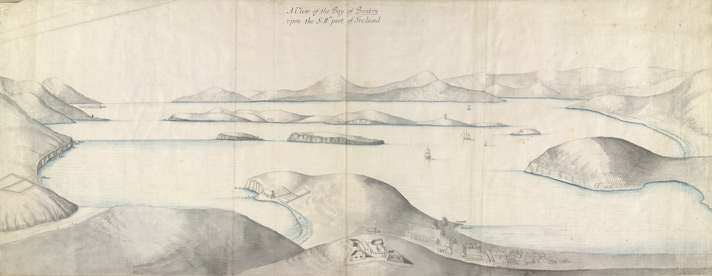
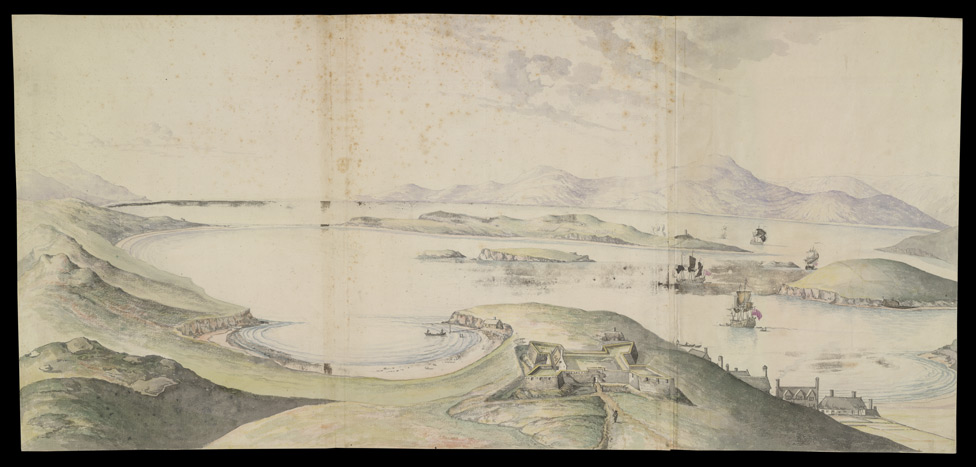
Description: View of Bantry Bay in West Cork, Ireland. It is the largest bay in south west Ireland and stretches almost thirty miles from the town situated on its banks, to its entrance and the ocean. The Beara Caha mountains surround the bay. The bay has twice been the site of foreign invasions, by the Spanish in 1689 to support James II and by the French in 1796 to support an Irish uprising.
The legend is that the Vickery family of Co. Cork are reputed to be descended from two brothers from the West Indies who were shipwrecked in Bantry Bay in the mid-18th century. This however is unlikely as there are Vickeries in early 18th century Bantry leases suggesting they were around pre 1700.
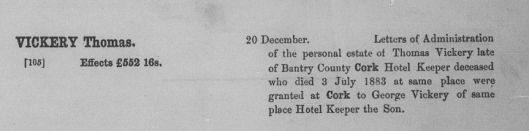
Thomas Vickery (1808-1883) was one of this family and married Mary Sullivan.
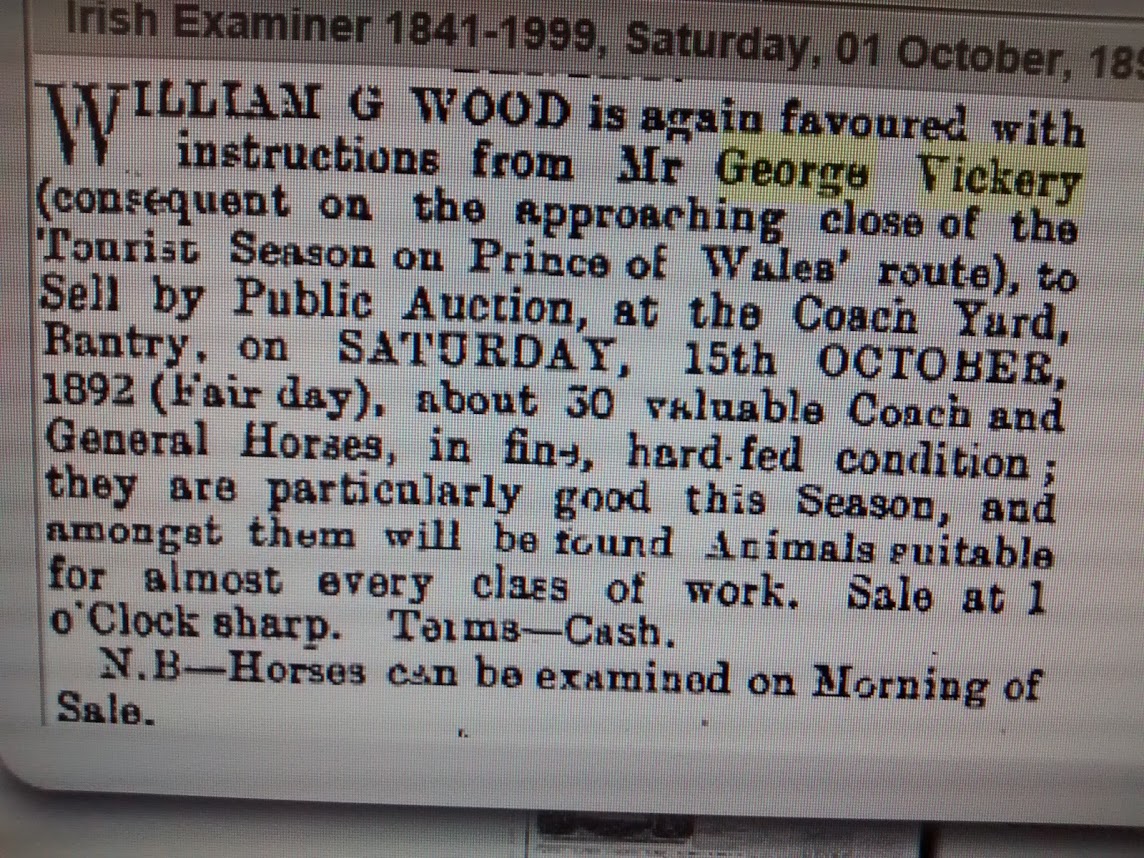
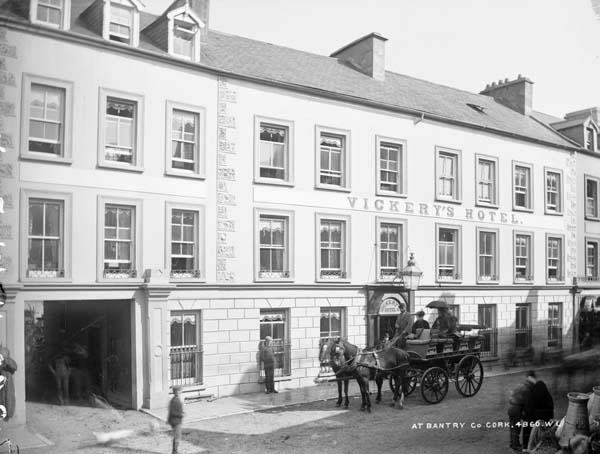
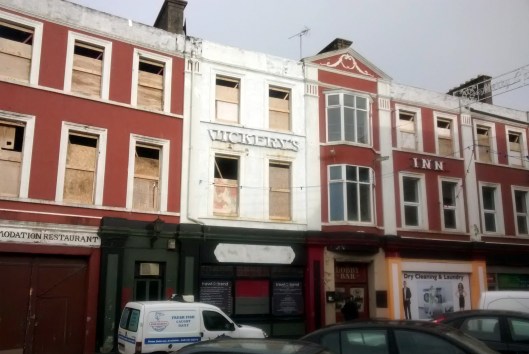
He established a hotel on the site of an old dye works in Bantry c1850 and it continued in business until late 2006 when it was bought by a development consortium. During the troubles the hotel was burned down and reconstructed with the novelty of a wash hand basin in every room.
In 1850 the hotel had 25 bedrooms and it was also the centre of a coaching establishment. This linked Bantry to Killarney on the emerging tourist route. Up to 100 horses were kept for this purpose.
Thomas Vickery’s nephew Robert Stanley Vickery stated that his uncle with establishing his hotel and postal arrangements for the establishment of tourist did more for Bantry and its neighbourhood then the Bantry (White) family ever did. Countless people had their first training in catering and business in the hotel and in the garage business the family also ran. Many went on to found their own businesses or work in others all over Ireland and the world.
Ardgoeena from c 1740 still there in ownership of Gallagher family,remnants of probable stable still extant main wall of old house collapsed some years ago. Well behind stables.:
There were two large crypts at the sea ward side of St. James Church of the Evansons until a cemetery clearance in the 1930s. The family in England had paid for their maintenance from the late 19th century and when after WW2 they discovered the loss of the tombs with all their detail they were most upset.
Branches of the family were sugar planters and slave owners in Barbados. They expanded into Bandon and Cork where Charles was Mayor. It is difficult to distinguish whether at time the were based in both Bandon and Durrus the house name ‘Brookfield’ may be either Durrus Court or a Bandon House.
Evansons
Dive Downe’s was the bishop of Cork and Ross and in 1700 toured the dioceses he says ‘Mount Gabriel is the haunt of wolves and there are no trees or shelter except rocks and bogs. The patron saint of Durrus is St Faughan in the parish of Durrus i.e. about Four Mile Water and at Blackrock near Bantry are about 30 Protestant families and in that part of the parish which is in Bantry are two English Schools kept by women. All the inhabitants of Kilcrohane are Papists and the land very coarse except for that of the Bishop of Cork’s lands’. He refers to Vicar Thomas Holmes of Kilmacomoge preaching every fourth Sunday at Captain Evanson’s house at Four Mile Water. Nathaniel Evanson the elder was the Lieutenant of Dragoons who received 2,400 acres of O’Donovan lands at Castle Donovan in the 1661. He mortgaged these lands and moved to Four Mile Water. He had three children, Thomas whose son Edward settled in Antigua, a daughter who married John Beamish in 1678 and a son Charles who married Susan Arnopp in 1688 (daughter of Colonel Arnopp of Dunmanway). Their eldest son Nathaniel married Mary Alleyn in 1724 and died at Four Mile Water in 1766. Their son was Alleyn, and his son Nathaniel the third, who was at Four Mile Water in the 1790s was made a Justice of the Peace on the 27th May 1799. They had numerous relations sugar planters in Antigua. He may also have been resident in Bandon. He married Mary Townsend Baldwin in 1784 and their children were Alleyn who was ordained, Nathaniel (1802-29) and Tonson (Richard) who built Friendly Cove probably around 1810. He married Melian Donovan in 1812 who died childless and then Mary Beamish in 1816. Friendly Cove passed to William Beamish Morris who married their daughter Catherine. In Pigot’s Directory of 1824 Nathaniel Evanson and Richard Evanson are at Four Mile Water. Nathaniel Evanson, Sea Lodge, Cork died on 1849 and the Rev. Alleyn Evanson died in 1853. In Slater’s Directory of 1846 Allen Evanson lives at the Court, Richard Tonson Evanson at Friendly Cove, and Richard Tonson Evanson Jnr. at Ardogina. There is no reference to them in Thom’s 1862 Directory. Richard Tonson Evanson was one of the judges of the Bantry Agricultural Show in 1861 and his address was Bantry. Evanson’s Cove is shown, on the northern side of the road as a wooded estate, on the Ordnance survey map of 1842 in Ahakista but does not appear on the later map. There are two references to Evansons of Brookfield, Cork in the King’s Inns Admission rolls for the early 19th.Century. The Rev. A. Evanson sat on a committee in Bantry in 1824 to petition against the withdrawal of the linen bounty.
In 1864 Richard Evanson makes over Friendly Cove to his son-in-law and goes to live in Gurteenroe and in 1869 he has moved to Cork City. That branch of Evanson line died out by the death of the last descendant Catherine Beamish Morris in 1898 aged 80, there are however Evanson descendants living in Cork.
Local sources suggest that the Evanson family in West Cork descend from Lieutenant Nathaniel Evanson who was granted an estate of 2,373 acres in the barony of West Carbery, county Cork in 1666. Rev. A. Evanson and Richard T. Evanson were among the principal lessors in the parish of Durrus, barony of West Carbery, at the time of Griffith’s Valuation. Rev. William Evanson was also a lessor in the parish of Kilcrohane and Rev. Allan Evanson in the parish of Kilmocomoge, barony of Bantry, at the same time. Lands owned by members of the Evanson family and others, in the parishes of Carrigaline and Durrus, were offered for sale in the Landed Estates Court in November 1862. The sale included Charlemont House, this had ben the residence of Charles, the Mayor of Cork. This property was held under a lease from the Allen family dating from 1800. In the 1870s, Revs, Charles, Robert and Richard Evanson of Llansory rectory, Monmouthshire, Wales, owned over 2000 acres in county Cork. In 1858 Michael Hungerford Morris married Elizabeth Burrows Evanson, daughter of Richard Tonson Evanson and in the 1870s Michael H. Morris of Durrus owned 1,157 acres in county Cork. http://boards.ancestry.co.uk/surnames.beamish/111/mb.ashx
Houses
House Name / Description
Townland
Civil Parish
PLU
DED
Barony
County
Map Ref
Ardogeena House (H2670)
At the time of Griffith’s Valuation, Richard T. Evanson was leasing this property to Florence McCarthy when it was valued at £10. In 1837, Lewis noted the house as the seat of R.T. Evanson. It is still extant and occupied.
Ardogeena
Durrus
Bantry
Durrus East 27
West Carbery (West)
Cork
Lat/Lon:51.60992
-9.52747OSI Ref:
V942408 Discovery map #88. OS Sheet #130.
Four Mile Water Court or Durrus Court (H2672)
Rev. Alleyn Evanson was leasing this property from the Earl of Bandon’s estate at the time of Griffith’s Valuation, when it was valued at £15. It is labelled Four Mile Water Court on the 1st edition Ordnance Map and Durrus Court on the later 25-inch edition. In 1837, Lewis recorded it as Four Mile Water Court, the seat of A. Evanson. It is still extant.
Gearhameen
Durrus
Bantry
Durrus West 28
West Carbery (West)
Cork
Lat/Lon:51.62046
-9.54660OSI Ref:
V929420 Discovery map #88. OS Sheet #130.
Friendly Cove (H2675)
Richard T. Evanson was leasing this property from John B. Gumbleton at the time of Griffith’s Valuation, when it was valued at £24. Stores adjoining the property were valued at £6. Leet records this property as the residence of Nathaniel Evanson, jnr. in 1814. The house is still extant and in 2009 was offered for sale.
Murreagh
Durrus
Bantry
Durrus East 27
West Carbery (West)
Cork
Lat/Lon:51.61705
-9.53204OSI Ref:
V939416 Discovery map #88. OS Sheet #130.
Charlemont House (H3834)
Charlemont House was leased by Charles Evanson from Nicholas G. Allen at the time of Griffith’s Valuation, when it was valued at £20. It was included in the sale of Evanson property in the Landed Estates Court in November 1862. It is still extant.
Monfieldstown
Carrigaline
Cork
Douglas
Cork
Cork
Lat/Lon:51.87444
-8.40225OSI Ref:
W723692 Discovery map #87. OS Sheet #75.
Archival sources
National Archives of Ireland: Landed Estates’ Court Rentals (O’Brien), Evanson, 6 November 1862, Vol 66, MRGS 39/033, (microfilm copy in NUIG)
National Library of Ireland: Abstract of deed of 25 Sept., 1844, between Rev. Alleyn Evanson of Fourmilewater, and Stephen Sweetman and Maria Sweetman als. Long, his wife, with Trustee, Richard James Long, 1844. Genealogical Office: Ms.144, pp.33 & 37-8
National Library of Ireland: Investigation into search for acts by Allan Evanson against lands of Ballyboughemore, Carrurmore, Doogh and Litter in the parish of Kilmoe, Barony of West Carbery, Co. Cork, 1849. GO Ms.144, pp.33-40
National Library of Ireland: Lismore Castle Papers, include rental & other documents re sale of lands in barony of West Carbery, Co Cork, in Encumbered Estates Court, 1854. Collection List 129. MS 43,964
Evansons named in 1837/8 enquiry into fictious votes Cork City
Evanson, the Rev. Alleyn Four-mile Water yes
Evanson, Nathaniel Four-mile Water no
Evanson, Charles Four-mile Water no
Evanson, Abraham M. Four-mile Water no
Evanson,William B. Four-mile Water yes
Evanson, Richard Tonson Ardoguma yes
Evanson, Nathaniel Friendly Cove
Evanson, Nathaniel jun. Four-mile Water no
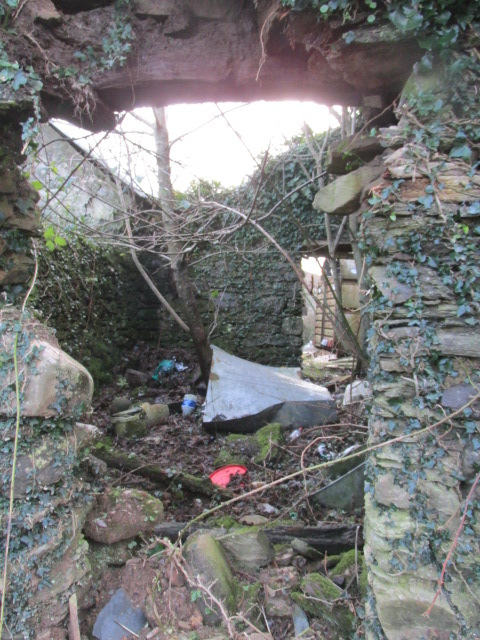
Recollections of James Stanley Vickery as a grandchild in Molloch, Durrus, Bantry (1829-1911), House c 1740-70 and Probably Prior House in ruins Pre-1740
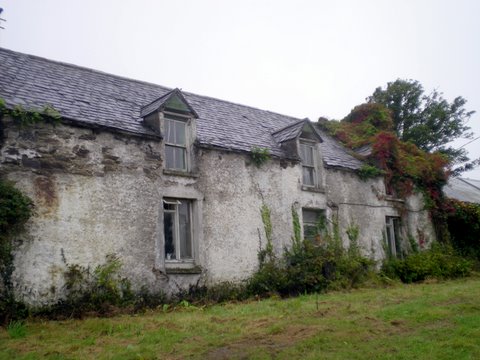
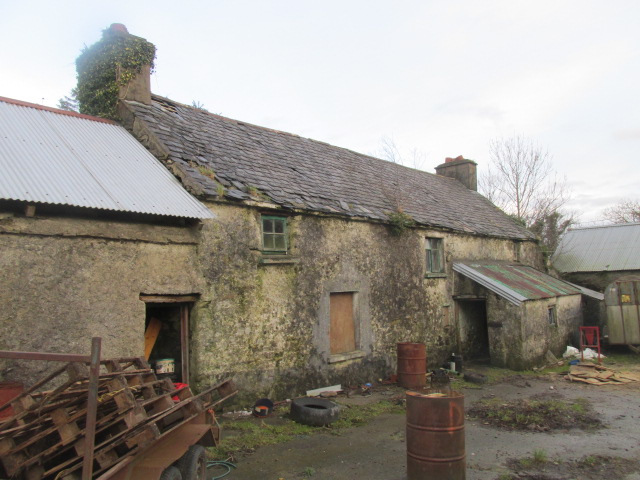
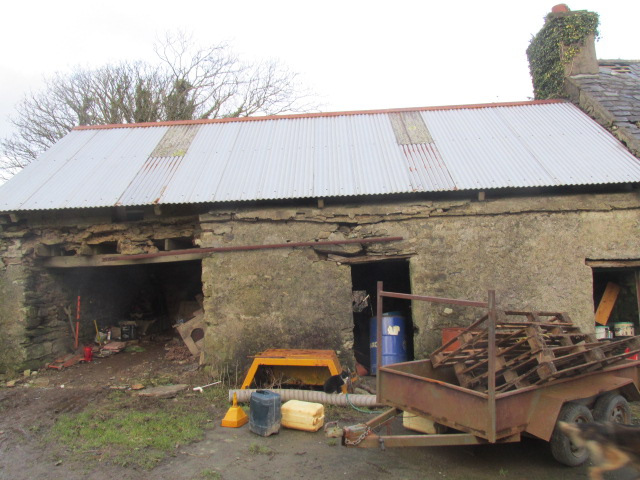
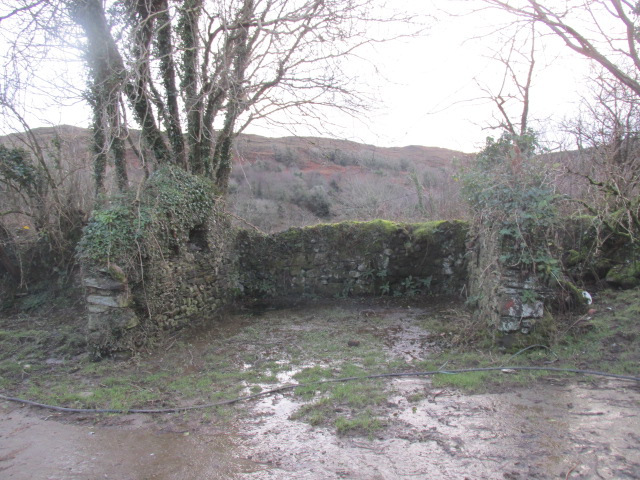
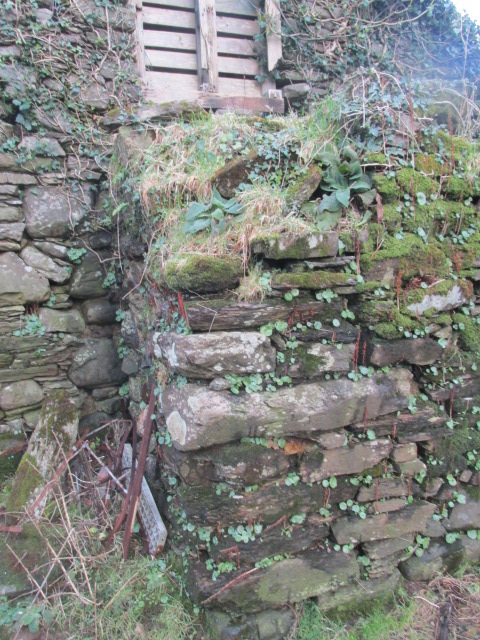
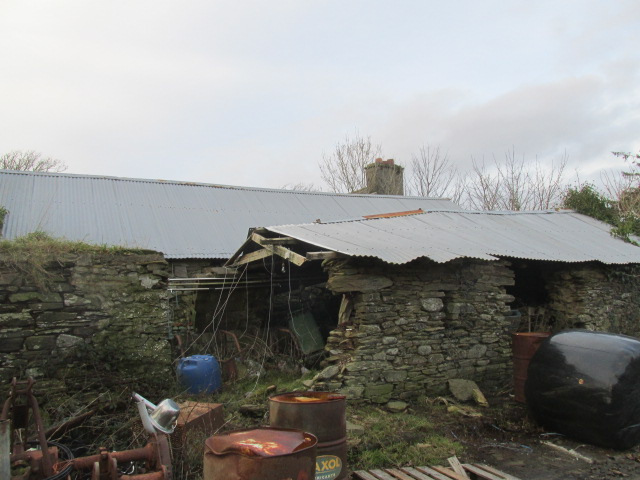
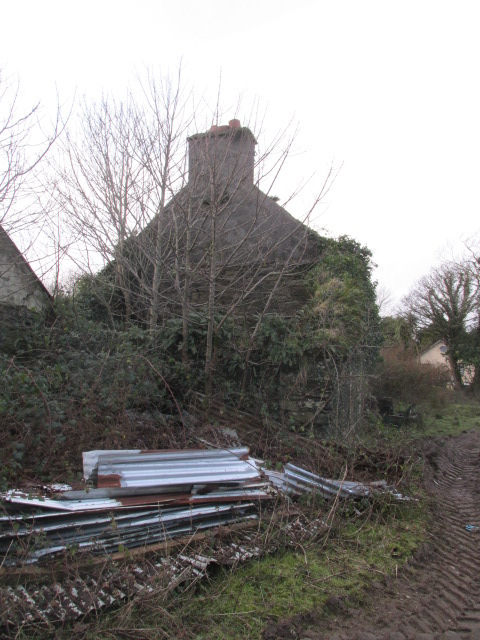
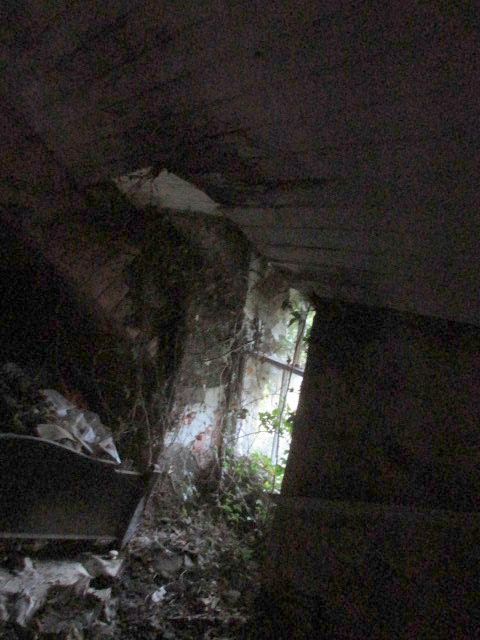
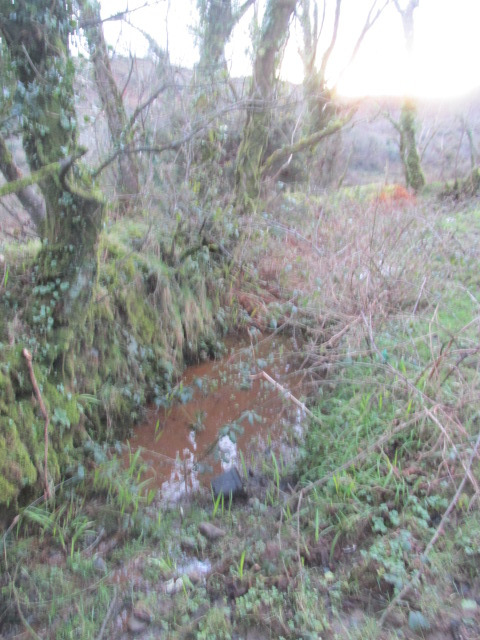
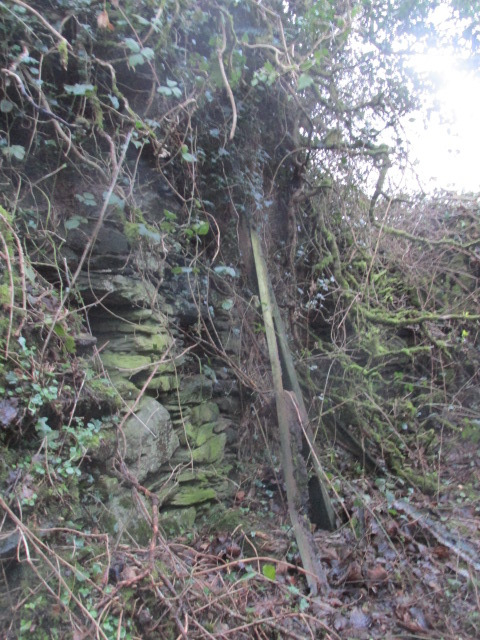
Enclose are picture of the house, yard and well in January 2016. Also enclosed in the probably earlier Vickery house possibly before 1740s situated just a distance from the present house which was lived in up to the 1980s by the Swanton family who are probably related by marriage to the Vickeries.
The farm comprised 170 acres large farm for the area.
In the Bantry Estate Records the Vickeries and their kinsmen the Warners and O’Sullivans were noted as yeomen farmers. Like the Warners, the Vickeries probably originated in nearby Rooska and are most likely in the Bantry area pre 1700. The Warners apart from farming also held various farms which were sub let as did the Tedagh Sullivans, The Warners had a reputation for hard work, honesty and fair dealing which transferred to their Cork descendants, the Musgrave family (Supervalu) on the female line. Like the Vickeries they were Church of Ireland and late converted to Methodism.
House 1740-70, and probable pre 1740 house:
There is a debate as to whether he has all the family information correct. Entire Recollections:
In Frank Callanan’s biography of Tim Healy (Politician, barrister, Governor General of Irish Free State) he states that his grandfather Healy was a classical teacher in Bantry. In the recollections James relates how he was taught by a master called Healy it may be the same man.
The above house may have been the residence of James Stanley Vickery. It is owned by Mr Jimmy Swanton, Moloch, Durrus and was lived in until around 25 years ago.
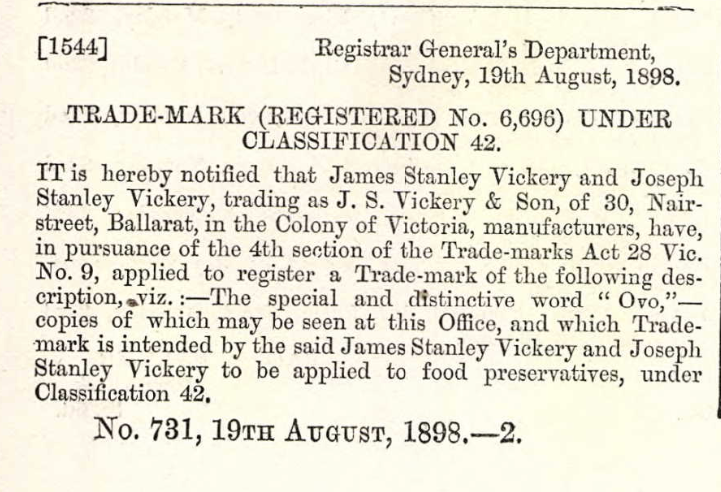
These are an extract of the early memories of James Stanley Vickery who later went to Australia. He founded a business in Ballarat dealing in chemicals, food products etc. This successful business remained in the Vickery family until World War 2.
James Swanton was a notable local figure and was a Cess payer representative in 1834:
1834. NAMES and PLACES of RESIDENCE of the CESS PAYERS nominated by the County Grand Jury at the last Assizes, to be associated with the Magistrates at Special Road Sessions to be holden in and for the several Baronies within the County, preparatory to the next Assizes, pursuant to Act 3 and 4 Wm. 4, ch. 78.
Barony of Bantry
William O’Sullivan Carriganass, Kealkil
Michael Sullivan, Droumlickeerue
John O’Connell, Bantry
Richard Levis, Rooska
William Pearson, Droumclough, Bantry
Daniel O’Sullivan, Reedonegan
Jeremiah O’Sullivan, Droumadureen
John Cotter, Lisheens,
James Vickery, Mullagh, Bantry
Rev. Henry Sadler, The Glebe
John Godson, Bantry
Richard Pattison, Cappanabowl, Bantry
John Kingston, Bantry
Samuel Vickery, Franchagh
William Pearson, Cahirdaniel, Bantry
Robert Vickery, Dunbittern, Bantry
Daniel Mellifont, Donemark
John Hamilton White, Droumbroe
Samuel Daly, Droumkeal
He was born in Skibbereen and after his parent died of Asiatic cholera in 1832 he and his two sisters went to live with their grandparents at Moloch, Durrus 1832-36. His grandfather James had formerly farmed in Rooska and held the farms by lease from Lord Bantry at a modest rent and the family was comfortably off. There was a suggestion that the family were involved in smuggling and the Vickerys are reputed to descend from two brother shipwrecked in Bantry c 1740. In later years his grandfather became religious and a leading light in the Methodist movement. James spent 4 years in Moloch and gives an interesting account of life at the time. In his grandfather’s time there were good prices for produce but hard to get to market. There were no proper roads and his grandmother or aunt had to go to Bantry it was on horseback in the old fashion pillion. When wheeled vehicles arrived on the farm but were used with a feather bed.
The house was a two storey one with slated roof. There was rough comfort with turf fires. Wood was dug out of the bog sufficient to make rafters for the outhouses, oak as black as jet. There was a resinous wood found in great plenty out of which when dry they made good torches which was often used instead of a candle. In 2008 there are still quantities of bog oak in the nearby Clonee bog.
Bacon hanging from the kitchen rafters, potatoes in their prime, with oatmeal porridge, wholemeal bread, milk and butter and honey in abundance. It was the finest honey country around with the hill tops covered in native heath and the fields in red clover. There was the best kind of fish with very little of either beef or mutton or even the staple commodity bacon. Off the wild coast grew some edible seaweeds which made a cheap pleasant and extremely wholesome food. Carrageen moss had long formed a medical food of great value. Shellfish of various kinds were cheap, crab of large size were very common. Oysters very large and plentiful were not much in use. Everything was both cheap and plentiful with the exception of that most needful of all money to purchase. He knew of turbot sold at 2/6 which would cost 20/- in Billingsgate. The people though living close to the sea were not strictly seagoing unlike the Cornish folk on the opposite coast of England.
Spinning wheels would be making music the large one for wool and the small one for flax. The articles made from these materials were very coarse but strong and endurable. Farming implements were of the primitive kind, a one furrow plough scythe, sickle and flail. The latter consisted of two well seasoned ashen sticks about five feet long united together with strip of green hide. With this the corn was threshed and it was a pleasant sight to watch the active young men face each other at the work. There was not even a winnower in use and the corn had to be separated from the chaff by holding it up to the wind the corn falling on a sheet of tarpaulin spread on the ground to receive it. Foreign matter small stones and clay was later removed prior to going to the mill by spreading it on a large kitchen table and the women of the house picked it out.
After killing the fatted cow the rough fat was melted and used in the making of candles usually by the slow process of dipping. A good washing potash lye was made from ashes of burnt furze. Starch was made from the farina of potatoes. A kind of tea was made from a certain kind of mint, china tea being a luxury forming often times a valued present from well to do friends. A sweet and mild alcoholic drink was brewed from honey called metheglin (spiced mead). Sickness was treated with simple herbs grown in the garden. He well remembered the abhorrent taste of tansy to kill worms and other parasites in the child’s interior. Whiskey was not forgotten no doubt having the well known peculiar flavour of genuine ‘Potheen’. It was very little used as a beverage by the family but as a remedy it had its place in emergencies. He dwelt on these particulars as they gave an insight on the common life of the time now passed away.
He recalls his grandfather’s death and the wake going over two nights with a professional keener.
He went around 1837 to a small private school in Bantry run by a man called Healy who was a Catholic. The new National schools had been boycotted by the Irish Protestants. Healy had attained a proficiency in mathematics but was extremely cruel, over one of the rafters he threw a small rope and tied it under James’s arms and hoisted him up swinging him gently and letting him feel the holly rod to the amusement of the other boys. His wife on seeing it stopped him and gave Healy a piece of his mind. Healy was later convicted of cruelty in front of the magistrates. James later went to live with relatives in Bandon and went to Australia in 1853. The house in Mulagh is the old Swanton farmhouse last occupied by Jimmy Swanton’s mother 1980s. and in fair structural condition. Sullivan











 West Cork History