• About
  • Customs Report 1821-2 (and Miscellaneous Petitions to Government 1820-5) and some Earlier Customs Data, including staffing, salaries, duties including, Cork, Kinsale, Youghal, Baltimore, with mention of Bantry, Crookhaven, Glandore, Berehaven, Castletownsend, Enniskeane, Passage, Crosshaven, Cove, Clonakilty, Cortmacsherry.
  • Eoghan O’Keeffe 1656-1723, Glenville, Co. Cork later Parish Priest, Doneralie 1723 Lament in old Irish
  • Historic maps from Cork City and County from 1600
  • Horsehair, animal blood an early 18th century Stone House in West Cork and Castles.
  • Interesting Links
  • Jack Dukelow, 1866-1953 Wit and Historian, Rossmore, Durrus, West Cork. Charlie Dennis, Batt The Fiddler.
  • Kilcoe Church, West Cork, built by Father Jimmy O’Sullivan, 1905 with glass by Sarah Purser, A. E. Childs (An Túr Gloine) and Harry Clarke Stained Glass Limited
  • Late 18th/Early 19th century house, Ahagouna (Áth Gamhna: Crossing Place of the Calves/Spriplings) Clashadoo, Durrus, West Cork, Ireland
  • Letter from Lord Carbery, 1826 re Destitution and Emigration in West Cork and Eddy Letters, Tradesmen going to the USA and Labourers to New Brunswick
  • Marriage early 1700s of Cormac McCarthy son of Florence McCarthy Mór, to Dela Welply (family originally from Wales) where he took the name Welply from whom many West Cork Welplys descend.
  • Online Archive New Brunswick, Canada, many Cork connections
  • Origin Dukelow family, including Coughlan, Baker, Kingston and Williamson ancestors
  • Return of Yeomanry, Co. Cork, 1817
  • Richard Townsend, Durrus, 1829-1912, Ireland’s oldest Magistrate and Timothy O’Donovan, Catholic Magistrate from 1818 as were his two brothers Dr. Daniel and Richard, Rev Arminger Sealy, Bandon, Magistrate died Bandon aged 95, 1855
  • School Folklore Project 1937-8, Durrus, Co. Cork, Schools Church of Ireland, Catholic.
  • Sean Nós Tradition re emerges in Lidl and Aldi
  • Some Cork and Kerry families such as Galwey, Roches, Atkins, O’Connells, McCarthys, St. Ledgers, Orpen, Skiddy, in John Burkes 1833 Commoners of Great Britain and Ireland:
  • Statement of Ted (Ríoch) O’Sullivan (1899-1971), Barytes Miner at Derriganocht, Lough Bofinne with Ned Cotter, later Fianna Fáil T.D. Later Fianna Fáil TD and Senator, Gortycloona, Bantry, Co. Cork, to Bureau of Military History, Alleged Torture by Hammer and Rifle at Castletownbere by Free State Forces, Denied by William T Cosgrave who Alleged ‘He Tried to Escape’.
  • The Rabbit trade in the 1950s before Myxomatosis in the 1950s snaring, ferrets.

West Cork History

~ History of Durrus/Muintervara

West Cork History

Tag Archives: cork

Robert Swanton, Ballydehob, Co. Cork, United Irishman and Judge of the Marine Court, New York, 1764-1840

08 Saturday Sep 2012

Posted by durrushistory in Uncategorized

≈ 4 Comments

Tags

bantry, co.cork, cork, history, irish history, lawyer, united irishmen marine court of new york ballydehob skibbereen west cork, west carbery, west cork


1764-1840Fr. Coombes a noted Cork historian wrote the following in respect of Robert Swanton.

The Swanton Memorial

An Historical Memorial in Skibbereen

by James Coombes

From the Swanton Family History Worldwide by Louise May Swanton

Two forgotten Ballydehob patriots are linked in a memorial in the old Protestant cemetery in Skibbereen. On the obelisk which surmounts the memorial there is a draped urn with the single word ROBERT inscribed on it. One of the four panels had the following inscription:

Sacred to the Memory of
ROBERT SWANTON
Counsellor at Law
One of the Judges of the Marine
Court of the City of New York
Who departed this life
in Ballidahab
On the 15th of February 1840
aged 76
He was a humble Christian and faithful
Friend and Benefactor

Be ye kind to one another, tenderhearted,
Forgiving one another even as God
for Christ’s sake hath forgiven you.
Epb. iv.3
Do ghradhaigh se na Gaedhil agus an Ghaeilge

Another panel commemorates three children of Thomas Swanton, Maria (d. 21 July 1852, aged 11 years 5 months); Ellen (d. 1 April 1856, aged 17 years 9 months); Annie (. 21 Nov. 1857, aged 17 years 9 months). It also contains the inscriptions: “Omnibus inservientes sed servi unius Domini” and “Blessed are the dead who die in the Lord.”

A third panel commemorates Sarah wife of Nathaniel Evanson, IV July 1830 aged 33. Sarah was almost certainly a sister of Thomas Swanton, who was a nephew of Robert Swanton.

Robert Swanton was born about the year 1764. Richard Deasy of Clonakilty wrote of him in 1845 that he had been a ‘most active agent of the United Irishmen’ and that he had ‘organised the country into a military preparation with sergeants and officers’.

Shortly before the rising of 1798 Lord Edward Fitzgerald, the Sheares brothers and other leaders were arrested. Swanton fled to America. According to one account, he had also been arrested and had escaped from jail. The late Thomas Roycroft of Skibbereen kept alive the tradition that he had been hidden in a butter barrel, smuggled out to sea in a rowing boat, and that he had boarded a ship six miles from the coast.

He soon made his mark in his adopted country, and in the 1820’s, was a leading figure in the ‘Friends of Ireland in New York’. He was the author of ‘A Manifesto to the People of Ireland’ issued by the ‘Friends’. Among his colleagues in this society were Dr. William Power and his brother Father John Power, vicar general of New York, and one of the most eminent priests in America. They were sons of Andrew and Elizabeth Power (1), who lived in the house now (1981) occupied by Mr. Joe Connolly of Deelish Skibbereen. They were nephews of Father John Power, the saintly pastor of Kilmacabea. Further research would probably unearth more details of Robert Swanton’s American career. For the moment, we must be satisfied with the obituary published by the New York Evening Post on 4 April 1840.

“It is with heartfelt regret that we announce the death of Robert Swanton, for many years judge of the Marine Court of this city. He died on the 15th of February last in the County of Cork, Ireland, which place he revisited about four years ago after an absence of more than 36 years. The loss of this inestimable man cannot fail to be severely felt by the poor and oppressed to whom he was an undeviating protector and friend.

Possessed of considerable wealth but disdaining the vanities and luxuries for which wealth is so eagerly sought, he freely contributed to the relief of the indigenous and to promoting the interest of numerous relatives and friends. He was no less alive to the political and moral welfare of his fellow creatures. He was an unswerving and ardent advocate of the rights of man.

In the great effort undertaken at the end of the last century by a magnanimous and self-devoted band of patriots to rescue their native land from the grasp of the oppressor, he nearly sacrificed his life, was driven from his home, to become a friendless and destitute exile. But in the cherished land of his adoption, his sound sense, his intelligence, his integrity and his devotion to popular rights were soon appreciated and earned the esteem and love of a numerous circle of friends.

Neither prosperity nor advancing age dampened the ardor of his philanthropy. We have no doubt that after he had passed the alloted span of man’s existence here, he was willing to sacrifice all for the social regeneration of man as when, 44 years ago, he placed his name on the roll of the “United Irishmen”.

The Truth Teller (2) said of him “To the above just tribute to the memory of a good man – ‘the noblest work of God’ – we add that the following extract of a letter from him, for examination of which we are indebted to one of his distinguished friends, dated Cork 30th November last, showing that in his 80th year he was still the same unchanged, unchangeable and uncompromising Democrat which marked his previous course.

The octogenarian asked an old friend in New York “What are the prospects of my esteemed fellow citizen, Martin Van Buren? Electioneering rumor is busy even here. Well have you tacked British to the self-styled Whigs of the present day”. In allusion to the name the opposition have taken he continues, “You and I have often been amused with names, but never gulled by them. I know that American Democracy will — the people will — be true to themselves and Martin Van Buren will be our next President. I hope to be with you in time to give my feeble support to the good old cause”. The prophetic voice of Robert Swanton is now a voice from the grave: “appreciate, believe, act.”
Non farming leases Bantry Area mainly from Bantry House Papers 1565-1914

08 Saturday Sep 2012

Posted by durrushistory in Uncategorized

≈ 3 Comments

Tags

bantry, Bantry bantry bay whiddy castletownbere glengariff west carbery o'Sullivan bere paddy o'keeffe bantry house whites of bantry, Bantry Beara Middle Men O'Sullivan, cork, Cork Archive, John Driscoll, O'Sullivan, Paddy O'Keeffe, Thomas, University College Cork


This list comes mainly from the online catalogue of the Bntry House papers held in University College Cork, Boole Library with some from the Paddy O’Keeffe (Bantry businessman and historian) in the Cork Archives.

Occupations Bantry

Click to access Bantryhouse.pdf

The National Archives in Dublin have two rent books from the Bantry Estate dating from the 1780s (ref MS. 5944 and 5955).  These contain details of tenancies and tenants in the Bantry and Beara areas.  Quite a numbe of the tenants are of the O’Sullivan family and would be in the category of middle-men.


https://picasaweb.google.com/lh/sredir?uname=100968344231272482288&target=ALBUM&id=5872596379695712433


Date Name Occupation Place Bantry except where otherwise indicated

1565 Sir Owen O’Sullivan Landowner Granted Whiddy Island by crown, Paddy O’Keeffe papers.§
1591 Hugo Brightoy and James ~Derbyshire Fishery owners Whiddy Island Took a mortgage from Sir Owen O’Sullivan and his son Owen O’Sullivan mentioned in Paddy O”Keeffe papers Cork Archive.
1608 Edward Davenant (d. 1639) Fishery Proprietor (with John Snelling d. 1626) Holder of lease of 31 years believed to be from Owen O’Sullivan Downaboy of lands at Seskin, Ballegobbane and Caherdonly from Paddy O’Keeffe papers in Cork Archive
1728 Hugh Hutchinson Mentioned in deed Blackrock
Richard Goodwin Comholly
John Williams
Theophilius Hutchinson
Robert Lantoy Goodwin
1730 George Murray In deed
1744 William Blair In deed from William Annesly to Richard White
1746 Charles Thomas
1746 William Blatchford Victualler and Cooper
1754 Richard Blair In deed
1754 John Goodwin Apotherary
1755 Robert Young Merchant
1755 Thomas and John Murray Weavers
1756 Robert Collins Joyner
1769 Richard Spenser Weaver
1773 John Clerke Clothier and Post-Master
1786 John Blatchford Shopkeeper
1786 David Jenkins Shopkeeper
1787 Michael Gallawy Shopkeeper
1789 John Banfield
John Kirby
Samuel Hellen
Denis Healy
Richrd Goggin
Cornelius Clery
Sylvester Clery
David Dick
Thomas Tamplin
Cornelius Sullivan otherwise Brah
Doctor Colnan
Daniel Sullivan (his father Cornelius Sullivan), Ananias Sullivan.
Timothy Sullivan
Thomas Jenkins premises formerly salt house
Chandler
Innkeeper

Weaver
Weaver

Cordwiner
Boatman
Sub Constable

Doctor
Hatter

Shopkeeper
1790 Florence Cotter the Elder and Patrick Cotter Blacksmiths Parkplace
1790 Tom Kirby
John Goodwin
John Barry
John Bird Senior and Junior Farmers
Philip Harrington Innkeeper
Surgeon
Tidewaiter

Weaver
1791 Elizabeth Jagoe, son John
Francis Hoskins Widow
1792 Daniel Sullivan
Thomas Bird Shopkeeper
Nailor
1793 James and John Dungan Smiths Dunemark
1793 John Burk Cooper Parkplace
1793 James and John Dungan Smiths Dunemark
1793 John Burk
John Banfield
Timothy Sulivan Cooper
Chandler
Victualler Parkplace
1794 Thomas and Ann Barter
Daniel Sullivan

Farmer and Carier Glawn
1795 John Young
Cornelius Casey Property holder
Carrier
1796 Timothy Sullivan
Michael Galwey
Catherine McCarthy
Timothy Flyn (surrendered to Denis T. Sullivan)
Denis Carthy
Richard Hoskin
William Gill
John Clerke
Timothy Sullivan
Denis Flyn held by William Connolly
John Warner
Robert Bird
Eliza Lynch
Dan and Tim Lynch
Mochael Celler
Michael Mccarthy Merchant
Merchant

Carpenter

Victualler

Postman

Grocer
1800s Timothy Sullivan Victualler
1800 John Warner
John and Robert Clerk
Farmers
1801 Timothy Mahony
Richrd Hoskin
Richard Clerke Shopkeeper
Blacksmith
Shopkeeper
1802 Richard Barret
John and William Jnr Young Cooper
Shopkeepers
1802 Batt Daly Cooper
1803 Robert Nicholas Bird Merchant
1804 Christopher Bant
Philip Harrington Shopkeeper
Weaver
1805 Jeremiah Sullivan Boatman
1806 Richard Hoskins the elder and younger Blacksmith , Eilliam Downing
Robert Kenney Cordwainer
1807 John Clerke Postmaster
1808 Humphrey Sullivan
Alexander Gibbons
Daniel Connoly\Cornelius Mahony formerly denis Williams
Jmes rearden
Denis Bryan
Darby Mahony
John Smith
Patrick Shea
Timothy Sullivan
Charles McDonnough formerly Peter Bird
Robert Henry from Jeremiah Sullivan surrendered 1811 Butcher

Donemark
1809 Timothy Shea father James
Esther Cook widow
Patrick Lyne formerly Daniel Latterford Carpenter

Fisherman
1811 William Hutchinson Codwaiter
1810 Robert Harding formerly John Driscoll In deed
Timothy Linnehan White Smith
Patrick Leary Chairmaker
Cornelius Sullivan Weaver
Denis Slattery Mason
Dennis Crimeen Boatman
Jeremiah Sullivan Weaver
Patrick Kearney Publican
Richard Clerke Merchant
1812 Timothy Sullivan Merchant
Young Lavers Merchant
Cornelius Sullivan Grocer
Denis O’Leary Shopkeeper
Robert John Bird Tanner
Timothy Flyn Carpenter
Thomas Sullivan Miller
John Shea Brogue Maker
Daniel Sullivan Hatter
Humphrey Sullivan
William Dealy Victualler

Donemark
1813 Thomas Hunter Baker
Jeremiah Croneen Dealer
1814 Michael Flyn Tanner
Laurence and John Kenedy Weavers
John Barry Quarryman
Rev. Charles Smith Minister Cappanaloghy
Thomas Godson Writing Clerk Brennybeg land formerly occupied by his grandfather
1816 Edward Moroney Publican
Henry Clerke Cordwainer (Shoemaker)
John Slattery Mason
1817 Frances Blair one of 6 daughters of Hamilton Blair In will
1817 Denis Hurly Fisherman
Jeremiah Hurly Tyler
Daniel Collins Policeman
Samuel Young Tide Surveyor
Edward Blake Fisherman
1818 David Dick Revenue Officer
William Young Shopkeeper
1819 Timothy Sullivan Shopkeeper
1822 John Vickery Shopkeeper
Richard Spenser Linen Weaver
1823 Timothy Sullivan Victualler
William Mealy Postmaster Castletown
William (Wats Healy) Postmaster Castletowm
1824 Daniel Donovan Ropemaker
Morty P. O’Sullivan Shopkeeper
1825 Timothy Murphy Ship’s Master Mariner
Jeremial Neal
Samuel Piddle Wheelwright
In deed
Garret Barry Shopkeeper
1827 Michael Daly Cooper
1828 John Godson Architect
1830 John Tagoe (Jago)
Edward Barry Storekeeper near Quay
Donemark
1832 Samuel Willis
Jeremiah Sullivan
Jeremiah (Laurcy) Dwyer
Blacksmith
Publican
1834 Denis Sullivan Shopkeeper
1835 Philip Armstrong Medical Doctor
1836 Daniel Timothy Sullivan Tanner
1837 Thomas Eccles Hotel keeper Glengariff
1839 Daniel Riordan
William Cotter Shoemaker
Shoemaker
1840 Thomas Vickery Shopkeeper
1842 John Jago Barrister
1844 John Leary went to America Lawyer
Jeremiah exec of Henry Cullinane Shopkeeper
1849 John Lavellin Puxley, Tensy, South Wales Mining Rights Allihies Area and later deeds
1849 Rev, Michael O’Leary
David Donovan
Mary Sullivan Priest for schoolhouse
Process Officer
Dealer Trafask
1851 Timothy McCarthy Dealer
Mary Webber Dress Maker
1852 John Meara Shopkeeper Lisaramig
John O’Connell Merchant
Thomas Godson Hotelier
1853 Rev. Thomas O’Grady Minister for schoolhouse Curriglass
1855 Thomas Lannin Shopkeeper
1856 Daniel Sullivan Postmaster Castletown
Daniel Moriarty Shopkeeper Castletown
James Murphy Shopkeeper Castletown
Patrick Sullivan Builder Castletown
1857 Timothy Murphy Shoemaker
1860 Timothy Harrington Shopkeeper Castletown
Michael Hanly Shopkeeper Castletown
1862 Denis Murphy Merchant

Timothy Regan Harrington Merchant Castletown
1863 Thomas Spenser Shopkeeper (Dunmanway)
Nicholas Power Master Mariner Castletown
Michael Sullivan Smith Castletown
1864 Cornelius O’Leary Merchant Newtown
1865 Charles Thomas Mining Rights Lisherenig, ejected let to J. Warner
1866 R.Auketell William B. Ritchie Moning rights Dromkeal, Dromduff East and West
1867 William Coakley Carrier
Tom Murphy Grocer, the Square Macroom
1869 William Lannin George Bird Clerk workhouse
Chairman
1870 William Murphy Builder timber merchant
1875 Payne Estate Manager
1877 William Clarke Merchant
John B. Eddy, William J. Sennot ejected and replaced by James Coates Slate Quarries Droumkeal, Teenamoderee, Droumduff
1878 John McCarthy formerly John Goodman Shopkeeper Tanyard originally leased by Young 18117
1879 Paul Kingston Farmer Inchingerig Caheragh
1880 John O’Shea Mariner and Publican
1881 John Vickery Hotel Keeper
1882 Denis McCarthy Marchant
1883 Daniel Healy
John McCarthy Victualler
Shopkeeper
1885 Cornelius O’Leary
Daniel Sullivan
William Shanahan Tailor
Car Driver
Carpenter
1886 William Warnr Saddler
1887 Mary Cullinane
Berehaven Mining Co. Shopkeeper
Surrender Mining Leases
1888 Robert Clerk
Michael McCarthy
John McCarthy Shoemaker
Merchant
Victualler
Castletown
1889 Timothy McCarthy
Cornelius McCarthy
Julia O’Leary Cattle Dealer
Butcher
Shopkeeper
1890 Denis Crowley
James Frances Murphy

Patrick
O’Callaghan
Joseph
Richard Acton
Patrick Murphy
Hotel Proprietor
Grocer and Spirit Merchant
Shopkeeper

Shopkeeper
Shopkeeper Castletown

Castletown
1895 Patrick O’Brien

George W. Biggs Shopkeeper bankrupt
1901
Merchant
1896 John Swanton Warner Merchant Bantry and Castletown
1901 Thomas Lannin
Patrick Murphy Farmer
Shoemaker Carriganass
Breenybeg
1904 Denis and Michael O’Shea Shopkeeper Castleton
1906 Quinlavan Sullivan
Richard Harvey Shoemaker
Constable RIC Ardgroom village
Glengariff
1907 Ellen and Patrick O’Brien Publican
1908 Michael Hanly
Admiralty surrendered 1926 Shopkeeper Castletown
Garnish Island
1913 William Henry O’Sullivan J.P. In deed
1914 John Hurley Civil Bill Officer Castletown

Robert Holhane (Houlihane?) deemed honourary Englishman, Cork, 6th February 1425

12 Saturday May 2012

Posted by durrushistory in Uncategorized

≈ Leave a comment

Tags

1425, cork


Trinity College/Circle.

Patent Roll 3 Henry VI

  • View whole roll
  • Abbreviations
  • Glossary
  • Improve this record
  • Print
  • Sort by date
RCH 235/6
RCI_plate_1
  • «
  • 6
  • »
6 Feb. 1425
Dublin

The K. has learned that although Robert s. of Philip Holhane and Margaret Barry has the surname of an Irish lineage, viz. the Holhganes [licet habeat cognomen de nacione Hibernic’, videlicet dez Holhganes], yet he [Robert] and his ancestors since the time of the conquest of Ire. are and were the K.’s faithful lieges in the county and city of Cork, hitherto dwelling among the K.’s lieges. By advice of John Lord Talbot kt, Jcr of Ire., and the K.’s council in the same [land], and wishing to bestow gracious favour upon Robert, GRANT of the K.’s special grace to the same Robert that he may be of free status and condition, and free and quit from all Irish servitude and condition; and that he may use and enjoy English laws, uses and customs, in and through all things, in the same manner as English persons in the same land enjoy and use them; and that he shall answer and be answered bot in the K.’s courts and in other courts, spiritual and temporal; and that he may be inherited in any lands, tenements, rents, services and possessions by right of inheritance or acquisition in fee tail; and that he may acquire lands, tenements, rents, service and possessions, and have and occupy them, and enjoy them to himself and his heirs, and succeed and inherit the same; and that he may be promoted and admitted to any ecclesiastical benefices and dignities, and may have, occupy and enjoy the same just as English persons in the same land have and enjoy such benefices, without interference or impediment of the K., his heirs, officers or ministers whatsoever, notwithstanding the Irish condition or servitude, or any statute or ordinance concerning this made before this time to the contrary; so long howeer as the same Robert bears and maintains himself as the K.’s faithful liege in the future.

Attested:
John, Lord Talbot, Jcr
F:

Rep. RCI 1811–15, plate 1, §2.

T:

NLI, [Harris] MS 4, f. 284.

C:

RCH.

The following abbreviations are used within in the text of CIRCLE

  • abp = archbishop [of]
  • BMV = beate Marie Virginis [of the Blessed Virgin Mary]
  • C. = chancellor [plural: chancellors]
  • co. = county (i.e. medieval shire: lower case ‘c’) [plural. cos.]
  • dcd = deceased
  • e. = earl of
  • Edw. = Edward (used when giving dates by regnal year)
  • Eng. = England
  • esq. = esquire [plural: esquires]
  • Ex. = exchequer
  • g.s. = great seal
  • Hen. = Henry
  • Ire. = Ireland
  • Jcr = justiciar [plural: justiciars]
  • JP = justice of the peace
  • K. = king
  • kt = knight
  • Lt = lieutenant
  • O.Carm. = Order of Carmelites
  • O.F.M. =  Order of Friars Minor (Franciscans)
  • O.P. = Order of Preachers (Dominicans)
  • Ric. = Richard (used when giving dates by regnal year)
  • s. = son
  • sen. = seneschal of
  • T. = treasurer [plural: treasurers]
  • w. = wife

Close Roll 2 Henry VI

  • View whole roll
  • Abbreviations
  • Glossary
  • Improve this record
  • Print
  • Sort by date
RCH 234/44
  • «
  • 50
  • »
May be connected
13 May. 1424
Dublin
To the constable of Dublin castle.

ORDER to deliver from prison Robert Oholeghan clk, being in the prison [of Dublin castle] there, by mainprize of Nicholas Barry of co. Cork, Nicholas Mayowe and Philip Payn of Baldwill, co. Dublin.

C:

RCH.

Footnotes:

{1} The time is not dated in RCH; the date given here is that of §43 above.

The following abbreviations are used within in the text of CIRCLE

  • abp = archbishop [of]
  • BMV = beate Marie Virginis [of the Blessed Virgin Mary]
  • C. = chancellor [plural: chancellors]
  • co. = county (i.e. medieval shire: lower case ‘c’) [plural. cos.]
  • dcd = deceased
  • e. = earl of
  • Edw. = Edward (used when giving dates by regnal year)
  • Eng. = England
  • esq. = esquire [plural: esquires]
  • Ex. = exchequer
  • g.s. = great seal
  • Hen. = Henry
  • Ire. = Ireland
  • Jcr = justiciar [plural: justiciars]
  • JP = justice of the peace
  • K. = king
  • kt = knight
  • Lt = lieutenant
  • O.Carm. = Order of Carmelites
  • O.F.M. =  Order of Friars Minor (Franciscans)
  • O.P. = Order of Preachers (Dominicans)
  • Ric. = Richard (used when giving dates by regnal year)
  • s. = son
  • sen. = seneschal of
  • T. = treasurer [plural: treasurers]
  • w. = wife

This glossary is by no means comprehensive. Readers may also wish to consult standard references books such as Joseph Byrne, Byrne’s dictionary of local Irish History from the earliest times to c.1900 (Cork, 2004); P. G. Osborn, Osborn’s concise law dictionary, ed. Sheila Bone (London, 2001).

Abbreviations

  • AN = Anglo-Norman
  • Ir. = Irish
  • Lat. = Latin
  • ME = Middle English
  • OED = Oxford English Dictionary


Term Explanation
advowson The right of patronage or presentation to a church benefice.
allocate, writ of A writ authorizing allowance to be made by the officers of the Ex. of a specified amount: often this amount is to be off-set against the debts owed to the K. by the beneficiary.
alterage A form of affinity proscribed in late medieval Ireland between the Irish and the English, whereby a man stood sponsor for a child at baptism; (also) gossipred.
assize Technical term for legal proceedings or various kinds. See mort d’ancestor, novel disseisin.
avener [Lat. avarius] provider of oats, esp. for the household of the K. or his chief governor
avoirdupois Miscellaneous merchandise sold by weight.
bonnaght [Ir. buannacht] The billeting of mercenaries or servants.
cask See tun.
certiorari, writ of Letters close issued by the K. to his officers commanding them to supply information to him concerning a specified matter, normally by searching the records.
chattels Property, goods, money: as opposed to real property (land).
dicker [Lat. dacra] A measure of 10 hides.
dower Portion (one third) of a deceased husband’s estate which the law allows to his widow for her life.
escheat The reversion of land to the lord of the fee to the crown on failure of heirs of the owner or on his outlawry.
extent A survey and valuation of property, esp. one made by royal inquisition.
falding [Ir. fallaing] A kind of coarse woollen cloth produced in Ireland; the mantle or cloak made from the same.
fee-farm A fixed annual rent payable to the K. by chartered boroughs.
fotmel [Lat. fotmellum] A measure of lead.
engrossment Technical term: the action of writing out, for instance patent letters and charters; (also) the documents thus written out.
enrolment Technical term: the action of recording in the records of the K., esp. the registering of a deed, memorandum, recognizance; (also) the specific item or record thus enrolled.
hanaper A repository for the keeping of money. The ‘clerk of the hanaper in chancery’ was the chancery official responsible for the receipt of fines for the issue, engrossment and ensealing of writs, patents and charters issued by the chancery.
herberger [Lat. herbergerius, hospitator] One sent on before to purvey lodgings for an army, a royal train (OED).
galangal [AN galyngale] The aromatic rhizome of certain Asian plants of the genera Alpinia and Kaempferia, of the ginger family, used in cookery and herbal medicine; (also) any of these plants (OED).
generosus [Lat.] Term designating social status: translated as ‘gentleman’.
king’s widow [Lat. vidua regis] The widow of a tenant in chief: so called because whe was not allowed to marry a second time without royal licence.
knights’ fees Units of assessment of estates in land. Originally a single knight’s fee was the amount of land for which the military service of one knight (=knight service) was required by the crown. ‘Fee’ derives from the Latin feudum, which in other contexts translated as ‘fief’. In practice the descent of landed estates meant that many knights’ fees came to be subdivided and, in the later Middle Ages, personal service was frequently commuted to money payments (=scutage).
liberate, writ of A chancery writ issued to the treasurer and chamberlains of the Ex. authorizing them to make payment of a specified amount, often the annual fees, wages and rewards of the K.’s officers.
linch [Lat. lincia] A measure of tin.
livery The delivery of seisin, or possession, of an estate hitherto held in the K.’s hand, for instance when a minor reaches the age of majority.
mainprize Legal term: the action of undertaking to stand surety (=‘mainpernor’) for another person; the action of making oneself legally responsible for the fulfilment of a contract or undertaking by another person (OED).
mass [Lat. messa] A standard measure of metal.
messuage A portion of land occupied, or intended to be occupied, as the site for a dwelling house; (also) a dwelling house together with outbuildings and the adjacent land assigned to its use (OED).
mort d’ancestor, assize of [Lat. assisa mortis antecessoris] A legal process to recover land of which the plaintiff’s ancestor (father, mother, uncle, aunt, brother sister, nephew or niece) died seised (=in possession), possession of which was since taken by another person.
nolumus, clause of [Lat. cum clausula nolumus] A standard clause inserted especially in letters of protection by which pleas and suits are delayed for a specified period of time.
novel disseisin, assize of [Lat.assisa nove disseisine] A legal process to recover land from which the plaintiff claims to have been dispossessed (=disseised).
pensa See wey.
piece [L. pecia] A standard quantity of merchandise.
pendent seal Seal hanging from engrossed letters patent attached to a tongue or tag of parchment.
perpresture An illegal encroachment upon royal property.
plica A fold along the foot of engrossed letters patent and charters to create a double thickness of parchment, used for attaching the ‘great seal pendent’ to the letters. An incision was made in the plica and through which a tag of parchment was attached. A wax impression of a seal was then affixed to the tag.
protection An act of grace by the K., granted by chancery letters, by which the recipient is to be free from suits at law for a specified term; granted especially to persons crossing overseas or otherwise out of reach of the courts in the K.’s service.
quare impedit, writ of An action brought to recover the advowson of a benefice, brought by the patron against the bishop or other person hindering the presentation.
scutage The commutation of personal military service to the crown for a money payment. Normally called ‘royal service’ in Ireland.
seisin Formal legal possession of land.
sendal [Lat. cendallum; ME cendal] A thin rich silken material (OED).
stallage [Lat. stallagium, estallagium] Payment for a market stall.
tun [Lat. dolium] A large cask or barrel, esp. of wine.
valettus A term designating social status: translated ‘yeoman’.
Vidua Regis [Lat.] See King’s widow.
volumus, clause of [Lat. cum clausula volumus] A standard clause inserted esp. in letters of protection by which pleas and suits are delayed for a specified period of time. In full the clause runs: volumus quod interim sit quietus de omnibus placitis et querelis (=we wish that meanwhile he be quit of all pleas and plaints).
waif A piece of property which is found ownerless and which, if unclaimed within a fixed period after due notice given, falls to the lord.
waivery [AN weiverie] The technical term for proceedings of outlawry in the case of women.
wey [Lat. pensa, peisa, pisa] A standard of dry-goods weight.
worsted [ME wyrstede] A woollen fabric or stuff made from well-twisted yarn spun of long-staple wool combed to lay the fibres parallel (OED).
writ [Lat. brevis] Letters close containing commands by the K. to certain specified persons, esp. royal officers. Returnable writs, which were not normally enrolled in the chancery rolls, were to be returned by the officer to chancery with details of the actions taken by the officer in response to the contents. See also allocate, certiorari, liberate.


This glossary is by no means comprehensive. Readers may also wish to consult standard references books such as Joseph Byrne, Byrne’s dictionary of local Irish History from the earliest times to c.1900 (Cork, 2004); P. G. Osborn, Osborn’s concise law dictionary, ed. Sheila Bone (London, 2001).

Abbreviations

  • AN = Anglo-Norman
  • Ir. = Irish
  • Lat. = Latin
  • ME = Middle English
  • OED = Oxford English Dictionary
Term Explanation
advowson The right of patronage or presentation to a church benefice.
allocate, writ of A writ authorizing allowance to be made by the officers of the Ex. of a specified amount: often this amount is to be off-set against the debts owed to the K. by the beneficiary.
alterage A form of affinity proscribed in late medieval Ireland between the Irish and the English, whereby a man stood sponsor for a child at baptism; (also) gossipred.
assize Technical term for legal proceedings or various kinds. See mort d’ancestor, novel disseisin.
avener [Lat. avarius] provider of oats, esp. for the household of the K. or his chief governor
avoirdupois Miscellaneous merchandise sold by weight.
bonnaght [Ir. buannacht] The billeting of mercenaries or servants.
cask See tun.
certiorari, writ of Letters close issued by the K. to his officers commanding them to supply information to him concerning a specified matter, normally by searching the records.
chattels Property, goods, money: as opposed to real property (land).
dicker [Lat. dacra] A measure of 10 hides.
dower Portion (one third) of a deceased husband’s estate which the law allows to his widow for her life.
escheat The reversion of land to the lord of the fee to the crown on failure of heirs of the owner or on his outlawry.
extent A survey and valuation of property, esp. one made by royal inquisition.
falding [Ir. fallaing] A kind of coarse woollen cloth produced in Ireland; the mantle or cloak made from the same.
fee-farm A fixed annual rent payable to the K. by chartered boroughs.
fotmel [Lat. fotmellum] A measure of lead.
engrossment Technical term: the action of writing out, for instance patent letters and charters; (also) the documents thus written out.
enrolment Technical term: the action of recording in the records of the K., esp. the registering of a deed, memorandum, recognizance; (also) the specific item or record thus enrolled.
hanaper A repository for the keeping of money. The ‘clerk of the hanaper in chancery’ was the chancery official responsible for the receipt of fines for the issue, engrossment and ensealing of writs, patents and charters issued by the chancery.
herberger [Lat. herbergerius, hospitator] One sent on before to purvey lodgings for an army, a royal train (OED).
galangal [AN galyngale] The aromatic rhizome of certain Asian plants of the genera Alpinia and Kaempferia, of the ginger family, used in cookery and herbal medicine; (also) any of these plants (OED).
generosus [Lat.] Term designating social status: translated as ‘gentleman’.
king’s widow [Lat. vidua regis] The widow of a tenant in chief: so called because whe was not allowed to marry a second time without royal licence.
knights’ fees Units of assessment of estates in land. Originally a single knight’s fee was the amount of land for which the military service of one knight (=knight service) was required by the crown. ‘Fee’ derives from the Latin feudum, which in other contexts translated as ‘fief’. In practice the descent of landed estates meant that many knights’ fees came to be subdivided and, in the later Middle Ages, personal service was frequently commuted to money payments (=scutage).
liberate, writ of A chancery writ issued to the treasurer and chamberlains of the Ex. authorizing them to make payment of a specified amount, often the annual fees, wages and rewards of the K.’s officers.
linch [Lat. lincia] A measure of tin.
livery The delivery of seisin, or possession, of an estate hitherto held in the K.’s hand, for instance when a minor reaches the age of majority.
mainprize Legal term: the action of undertaking to stand surety (=‘mainpernor’) for another person; the action of making oneself legally responsible for the fulfilment of a contract or undertaking by another person (OED).
mass [Lat. messa] A standard measure of metal.
messuage A portion of land occupied, or intended to be occupied, as the site for a dwelling house; (also) a dwelling house together with outbuildings and the adjacent land assigned to its use (OED).
mort d’ancestor, assize of [Lat. assisa mortis antecessoris] A legal process to recover land of which the plaintiff’s ancestor (father, mother, uncle, aunt, brother sister, nephew or niece) died seised (=in possession), possession of which was since taken by another person.
nolumus, clause of [Lat. cum clausula nolumus] A standard clause inserted especially in letters of protection by which pleas and suits are delayed for a specified period of time.
novel disseisin, assize of [Lat.assisa nove disseisine] A legal process to recover land from which the plaintiff claims to have been dispossessed (=disseised).
pensa See wey.
piece [L. pecia] A standard quantity of merchandise.
pendent seal Seal hanging from engrossed letters patent attached to a tongue or tag of parchment.
perpresture An illegal encroachment upon royal property.
plica A fold along the foot of engrossed letters patent and charters to create a double thickness of parchment, used for attaching the ‘great seal pendent’ to the letters. An incision was made in the plica and through which a tag of parchment was attached. A wax impression of a seal was then affixed to the tag.
protection An act of grace by the K., granted by chancery letters, by which the recipient is to be free from suits at law for a specified term; granted especially to persons crossing overseas or otherwise out of reach of the courts in the K.’s service.
quare impedit, writ of An action brought to recover the advowson of a benefice, brought by the patron against the bishop or other person hindering the presentation.
scutage The commutation of personal military service to the crown for a money payment. Normally called ‘royal service’ in Ireland.
seisin Formal legal possession of land.
sendal [Lat. cendallum; ME cendal] A thin rich silken material (OED).
stallage [Lat. stallagium, estallagium] Payment for a market stall.
tun [Lat. dolium] A large cask or barrel, esp. of wine.
valettus A term designating social status: translated ‘yeoman’.
Vidua Regis [Lat.] See King’s widow.
volumus, clause of [Lat. cum clausula volumus] A standard clause inserted esp. in letters of protection by which pleas and suits are delayed for a specified period of time. In full the clause runs: volumus quod interim sit quietus de omnibus placitis et querelis (=we wish that meanwhile he be quit of all pleas and plaints).
waif A piece of property which is found ownerless and which, if unclaimed within a fixed period after due notice given, falls to the lord.
waivery [AN weiverie] The technical term for proceedings of outlawry in the case of women.
wey [Lat. pensa, peisa, pisa] A standard of dry-goods weight.
worsted [ME wyrstede] A woollen fabric or stuff made from well-twisted yarn spun of long-staple wool combed to lay the fibres parallel (OED).
writ [Lat. brevis] Letters close containing commands by the K. to certain specified persons, esp. royal officers. Returnable writs, which were not normally enrolled in the chancery rolls, were to be returned by the officer to chancery with details of the actions taken by the officer in response to the contents. See also allocate, certiorari, liberate.

Grant of custody of Leper House, St. Stephen near Cork, 22 November 1408.

12 Saturday May 2012

Posted by durrushistory in Uncategorized

≈ Leave a comment

Tags

cork, leprosy


From Trinity College/Circle.


Patent Roll 10 Henry IV

  • View whole roll
  • Abbreviations
  • Glossary
  • Improve this record
  • Print
  • Sort by date
RCH 189/2
  • «
  • 2
  • »
22 Nov. 1408
Waterford

GRANT, for life, of the K.’s special grace, to Henry Offyghan,1 chaplain, of custody of the leper-house of St Stephen near Cork.2

Attested:
Thomas of Lancaster, Lt
Authorized:
By petition.
T:

NLI, [Harris] MS 4, f. 164.

C:

RCH.

N:

Rep. RCI 1816–20, 8th rep., p. 386.

Footnotes:

1 ‘Ossyghan’ in RCH and Rep. RCI 1816–20, 8th rep., p. 386. Archdall renders the name as ‘Henry Fygham’ (Monasticon Hibernicum, p. 68).
2 For St Stephen’s leper hospital, near Cork, see Med. religious houses, Ire., p. 348.

The following abbreviations are used within in the text of CIRCLE

  • abp = archbishop [of]
  • BMV = beate Marie Virginis [of the Blessed Virgin Mary]
  • C. = chancellor [plural: chancellors]
  • co. = county (i.e. medieval shire: lower case ‘c’) [plural. cos.]
  • dcd = deceased
  • e. = earl of
  • Edw. = Edward (used when giving dates by regnal year)
  • Eng. = England
  • esq. = esquire [plural: esquires]
  • Ex. = exchequer
  • g.s. = great seal
  • Hen. = Henry
  • Ire. = Ireland
  • Jcr = justiciar [plural: justiciars]
  • JP = justice of the peace
  • K. = king
  • kt = knight
  • Lt = lieutenant
  • O.Carm. = Order of Carmelites
  • O.F.M. =  Order of Friars Minor (Franciscans)
  • O.P. = Order of Preachers (Dominicans)
  • Ric. = Richard (used when giving dates by regnal year)
  • s. = son
  • sen. = seneschal of
  • T. = treasurer [plural: treasurers]
  • w. = wife

This glossary is by no means comprehensive. Readers may also wish to consult standard references books such as Joseph Byrne, Byrne’s dictionary of local Irish History from the earliest times to c.1900 (Cork, 2004); P. G. Osborn, Osborn’s concise law dictionary, ed. Sheila Bone (London, 2001).

Abbreviations

  • AN = Anglo-Norman
  • Ir. = Irish
  • Lat. = Latin
  • ME = Middle English
  • OED = Oxford English Dictionary


Term Explanation
advowson The right of patronage or presentation to a church benefice.
allocate, writ of A writ authorizing allowance to be made by the officers of the Ex. of a specified amount: often this amount is to be off-set against the debts owed to the K. by the beneficiary.
alterage A form of affinity proscribed in late medieval Ireland between the Irish and the English, whereby a man stood sponsor for a child at baptism; (also) gossipred.
assize Technical term for legal proceedings or various kinds. See mort d’ancestor, novel disseisin.
avener [Lat. avarius] provider of oats, esp. for the household of the K. or his chief governor
avoirdupois Miscellaneous merchandise sold by weight.
bonnaght [Ir. buannacht] The billeting of mercenaries or servants.
cask See tun.
certiorari, writ of Letters close issued by the K. to his officers commanding them to supply information to him concerning a specified matter, normally by searching the records.
chattels Property, goods, money: as opposed to real property (land).
dicker [Lat. dacra] A measure of 10 hides.
dower Portion (one third) of a deceased husband’s estate which the law allows to his widow for her life.
escheat The reversion of land to the lord of the fee to the crown on failure of heirs of the owner or on his outlawry.
extent A survey and valuation of property, esp. one made by royal inquisition.
falding [Ir. fallaing] A kind of coarse woollen cloth produced in Ireland; the mantle or cloak made from the same.
fee-farm A fixed annual rent payable to the K. by chartered boroughs.
fotmel [Lat. fotmellum] A measure of lead.
engrossment Technical term: the action of writing out, for instance patent letters and charters; (also) the documents thus written out.
enrolment Technical term: the action of recording in the records of the K., esp. the registering of a deed, memorandum, recognizance; (also) the specific item or record thus enrolled.
hanaper A repository for the keeping of money. The ‘clerk of the hanaper in chancery’ was the chancery official responsible for the receipt of fines for the issue, engrossment and ensealing of writs, patents and charters issued by the chancery.
herberger [Lat. herbergerius, hospitator] One sent on before to purvey lodgings for an army, a royal train (OED).
galangal [AN galyngale] The aromatic rhizome of certain Asian plants of the genera Alpinia and Kaempferia, of the ginger family, used in cookery and herbal medicine; (also) any of these plants (OED).
generosus [Lat.] Term designating social status: translated as ‘gentleman’.
king’s widow [Lat. vidua regis] The widow of a tenant in chief: so called because whe was not allowed to marry a second time without royal licence.
knights’ fees Units of assessment of estates in land. Originally a single knight’s fee was the amount of land for which the military service of one knight (=knight service) was required by the crown. ‘Fee’ derives from the Latin feudum, which in other contexts translated as ‘fief’. In practice the descent of landed estates meant that many knights’ fees came to be subdivided and, in the later Middle Ages, personal service was frequently commuted to money payments (=scutage).
liberate, writ of A chancery writ issued to the treasurer and chamberlains of the Ex. authorizing them to make payment of a specified amount, often the annual fees, wages and rewards of the K.’s officers.
linch [Lat. lincia] A measure of tin.
livery The delivery of seisin, or possession, of an estate hitherto held in the K.’s hand, for instance when a minor reaches the age of majority.
mainprize Legal term: the action of undertaking to stand surety (=‘mainpernor’) for another person; the action of making oneself legally responsible for the fulfilment of a contract or undertaking by another person (OED).
mass [Lat. messa] A standard measure of metal.
messuage A portion of land occupied, or intended to be occupied, as the site for a dwelling house; (also) a dwelling house together with outbuildings and the adjacent land assigned to its use (OED).
mort d’ancestor, assize of [Lat. assisa mortis antecessoris] A legal process to recover land of which the plaintiff’s ancestor (father, mother, uncle, aunt, brother sister, nephew or niece) died seised (=in possession), possession of which was since taken by another person.
nolumus, clause of [Lat. cum clausula nolumus] A standard clause inserted especially in letters of protection by which pleas and suits are delayed for a specified period of time.
novel disseisin, assize of [Lat.assisa nove disseisine] A legal process to recover land from which the plaintiff claims to have been dispossessed (=disseised).
pensa See wey.
piece [L. pecia] A standard quantity of merchandise.
pendent seal Seal hanging from engrossed letters patent attached to a tongue or tag of parchment.
perpresture An illegal encroachment upon royal property.
plica A fold along the foot of engrossed letters patent and charters to create a double thickness of parchment, used for attaching the ‘great seal pendent’ to the letters. An incision was made in the plica and through which a tag of parchment was attached. A wax impression of a seal was then affixed to the tag.
protection An act of grace by the K., granted by chancery letters, by which the recipient is to be free from suits at law for a specified term; granted especially to persons crossing overseas or otherwise out of reach of the courts in the K.’s service.
quare impedit, writ of An action brought to recover the advowson of a benefice, brought by the patron against the bishop or other person hindering the presentation.
scutage The commutation of personal military service to the crown for a money payment. Normally called ‘royal service’ in Ireland.
seisin Formal legal possession of land.
sendal [Lat. cendallum; ME cendal] A thin rich silken material (OED).
stallage [Lat. stallagium, estallagium] Payment for a market stall.
tun [Lat. dolium] A large cask or barrel, esp. of wine.
valettus A term designating social status: translated ‘yeoman’.
Vidua Regis [Lat.] See King’s widow.
volumus, clause of [Lat. cum clausula volumus] A standard clause inserted esp. in letters of protection by which pleas and suits are delayed for a specified period of time. In full the clause runs: volumus quod interim sit quietus de omnibus placitis et querelis (=we wish that meanwhile he be quit of all pleas and plaints).
waif A piece of property which is found ownerless and which, if unclaimed within a fixed period after due notice given, falls to the lord.
waivery [AN weiverie] The technical term for proceedings of outlawry in the case of women.
wey [Lat. pensa, peisa, pisa] A standard of dry-goods weight.
worsted [ME wyrstede] A woollen fabric or stuff made from well-twisted yarn spun of long-staple wool combed to lay the fibres parallel (OED).
writ [Lat. brevis] Letters close containing commands by the K. to certain specified persons, esp. royal officers. Returnable writs, which were not normally enrolled in the chancery rolls, were to be returned by the officer to chancery with details of the actions taken by the officer in response to the contents. See also allocate, certiorari, liberate.

Daily invasions of the surrounds of Cork by the King’s enemies, 8th January, 1390.

12 Saturday May 2012

Posted by durrushistory in Uncategorized

≈ Leave a comment

Tags

cork, history, norman, rebel cork


From Trinity College/Circle.


Patent Roll 13 Richard II

  • View whole roll
  • Abbreviations
  • Glossary
  • Improve this record
  • Print
  • Sort by date
RCH 146/217
CPI_87
  • «
  • 217
  • »
8 Jan. 1390
Naas
To the admiral of Ire. or his deputy, and to all and singular masters and mariners of ships and barges, and also to the keepers of ports and passages and other marine places, and to all and singular mayors, seneschals, sheriffs, sovereigns, provosts, bailiffs, serjeants, sub-serjeants throughout the K.’s land of Ire.

The K. has considered how the K.’s city of Cork is situated on the frontier of the K.’s Irish enemies and is surrounded on all sides by those enemies, and how the K.’s faithful lieges of the parts neighbouring the city are destroyed and devasted by hostile attacks and daily invasions of those enemies, so that the citizens and commons and the K.’s said lieges cannot reside there upon the defence of that city these days without a great supply of produce [absque magna frugum copia] for their sustenance. The K. has also considered the good place that the K.’s city holds in aid and comfort of his faithful lieges and in resistance of the malice of his Irish enemies.

By advice of the Jcr and council in Ire. and of the K.’s special grace, the K. has granted and given licence to the citizens and commons to buy and load all kinds of grain by themselves or their servants and deputies in ships, barges and boats in any ports in the land of Ire. for their sustenance, as is necessary and fit from time to time; and to transport the grain thus loaded to the same city for that reason, both by land and by sea, and to carry it freely and without any impediment whatsoever, notwithstanding any statutes, proclamations or inhibitions to the contrary made before this time. ORDER not to trouble or oppress them in any way contrary to this the K.’s grant.

Attested:
[John Stanley] Jcr
T:

CPI, p. 87.

C:

RCH.

The following abbreviations are used within in the text of CIRCLE

  • abp = archbishop [of]
  • BMV = beate Marie Virginis [of the Blessed Virgin Mary]
  • C. = chancellor [plural: chancellors]
  • co. = county (i.e. medieval shire: lower case ‘c’) [plural. cos.]
  • dcd = deceased
  • e. = earl of
  • Edw. = Edward (used when giving dates by regnal year)
  • Eng. = England
  • esq. = esquire [plural: esquires]
  • Ex. = exchequer
  • g.s. = great seal
  • Hen. = Henry
  • Ire. = Ireland
  • Jcr = justiciar [plural: justiciars]
  • JP = justice of the peace
  • K. = king
  • kt = knight
  • Lt = lieutenant
  • O.Carm. = Order of Carmelites
  • O.F.M. =  Order of Friars Minor (Franciscans)
  • O.P. = Order of Preachers (Dominicans)
  • Ric. = Richard (used when giving dates by regnal year)
  • s. = son
  • sen. = seneschal of
  • T. = treasurer [plural: treasurers]
  • w. = wife

This glossary is by no means comprehensive. Readers may also wish to consult standard references books such as Joseph Byrne, Byrne’s dictionary of local Irish History from the earliest times to c.1900 (Cork, 2004); P. G. Osborn, Osborn’s concise law dictionary, ed. Sheila Bone (London, 2001).

Abbreviations

  • AN = Anglo-Norman
  • Ir. = Irish
  • Lat. = Latin
  • ME = Middle English
  • OED = Oxford English Dictionary


Term Explanation
advowson The right of patronage or presentation to a church benefice.
allocate, writ of A writ authorizing allowance to be made by the officers of the Ex. of a specified amount: often this amount is to be off-set against the debts owed to the K. by the beneficiary.
alterage A form of affinity proscribed in late medieval Ireland between the Irish and the English, whereby a man stood sponsor for a child at baptism; (also) gossipred.
assize Technical term for legal proceedings or various kinds. See mort d’ancestor, novel disseisin.
avener [Lat. avarius] provider of oats, esp. for the household of the K. or his chief governor
avoirdupois Miscellaneous merchandise sold by weight.
bonnaght [Ir. buannacht] The billeting of mercenaries or servants.
cask See tun.
certiorari, writ of Letters close issued by the K. to his officers commanding them to supply information to him concerning a specified matter, normally by searching the records.
chattels Property, goods, money: as opposed to real property (land).
dicker [Lat. dacra] A measure of 10 hides.
dower Portion (one third) of a deceased husband’s estate which the law allows to his widow for her life.
escheat The reversion of land to the lord of the fee to the crown on failure of heirs of the owner or on his outlawry.
extent A survey and valuation of property, esp. one made by royal inquisition.
falding [Ir. fallaing] A kind of coarse woollen cloth produced in Ireland; the mantle or cloak made from the same.
fee-farm A fixed annual rent payable to the K. by chartered boroughs.
fotmel [Lat. fotmellum] A measure of lead.
engrossment Technical term: the action of writing out, for instance patent letters and charters; (also) the documents thus written out.
enrolment Technical term: the action of recording in the records of the K., esp. the registering of a deed, memorandum, recognizance; (also) the specific item or record thus enrolled.
hanaper A repository for the keeping of money. The ‘clerk of the hanaper in chancery’ was the chancery official responsible for the receipt of fines for the issue, engrossment and ensealing of writs, patents and charters issued by the chancery.
herberger [Lat. herbergerius, hospitator] One sent on before to purvey lodgings for an army, a royal train (OED).
galangal [AN galyngale] The aromatic rhizome of certain Asian plants of the genera Alpinia and Kaempferia, of the ginger family, used in cookery and herbal medicine; (also) any of these plants (OED).
generosus [Lat.] Term designating social status: translated as ‘gentleman’.
king’s widow [Lat. vidua regis] The widow of a tenant in chief: so called because whe was not allowed to marry a second time without royal licence.
knights’ fees Units of assessment of estates in land. Originally a single knight’s fee was the amount of land for which the military service of one knight (=knight service) was required by the crown. ‘Fee’ derives from the Latin feudum, which in other contexts translated as ‘fief’. In practice the descent of landed estates meant that many knights’ fees came to be subdivided and, in the later Middle Ages, personal service was frequently commuted to money payments (=scutage).
liberate, writ of A chancery writ issued to the treasurer and chamberlains of the Ex. authorizing them to make payment of a specified amount, often the annual fees, wages and rewards of the K.’s officers.
linch [Lat. lincia] A measure of tin.
livery The delivery of seisin, or possession, of an estate hitherto held in the K.’s hand, for instance when a minor reaches the age of majority.
mainprize Legal term: the action of undertaking to stand surety (=‘mainpernor’) for another person; the action of making oneself legally responsible for the fulfilment of a contract or undertaking by another person (OED).
mass [Lat. messa] A standard measure of metal.
messuage A portion of land occupied, or intended to be occupied, as the site for a dwelling house; (also) a dwelling house together with outbuildings and the adjacent land assigned to its use (OED).
mort d’ancestor, assize of [Lat. assisa mortis antecessoris] A legal process to recover land of which the plaintiff’s ancestor (father, mother, uncle, aunt, brother sister, nephew or niece) died seised (=in possession), possession of which was since taken by another person.
nolumus, clause of [Lat. cum clausula nolumus] A standard clause inserted especially in letters of protection by which pleas and suits are delayed for a specified period of time.
novel disseisin, assize of [Lat.assisa nove disseisine] A legal process to recover land from which the plaintiff claims to have been dispossessed (=disseised).
pensa See wey.
piece [L. pecia] A standard quantity of merchandise.
pendent seal Seal hanging from engrossed letters patent attached to a tongue or tag of parchment.
perpresture An illegal encroachment upon royal property.
plica A fold along the foot of engrossed letters patent and charters to create a double thickness of parchment, used for attaching the ‘great seal pendent’ to the letters. An incision was made in the plica and through which a tag of parchment was attached. A wax impression of a seal was then affixed to the tag.
protection An act of grace by the K., granted by chancery letters, by which the recipient is to be free from suits at law for a specified term; granted especially to persons crossing overseas or otherwise out of reach of the courts in the K.’s service.
quare impedit, writ of An action brought to recover the advowson of a benefice, brought by the patron against the bishop or other person hindering the presentation.
scutage The commutation of personal military service to the crown for a money payment. Normally called ‘royal service’ in Ireland.
seisin Formal legal possession of land.
sendal [Lat. cendallum; ME cendal] A thin rich silken material (OED).
stallage [Lat. stallagium, estallagium] Payment for a market stall.
tun [Lat. dolium] A large cask or barrel, esp. of wine.
valettus A term designating social status: translated ‘yeoman’.
Vidua Regis [Lat.] See King’s widow.
volumus, clause of [Lat. cum clausula volumus] A standard clause inserted esp. in letters of protection by which pleas and suits are delayed for a specified period of time. In full the clause runs: volumus quod interim sit quietus de omnibus placitis et querelis (=we wish that meanwhile he be quit of all pleas and plaints).
waif A piece of property which is found ownerless and which, if unclaimed within a fixed period after due notice given, falls to the lord.
waivery [AN weiverie] The technical term for proceedings of outlawry in the case of women.
wey [Lat. pensa, peisa, pisa] A standard of dry-goods weight.
worsted [ME wyrstede] A woollen fabric or stuff made from well-twisted yarn spun of long-staple wool combed to lay the fibres parallel (OED).
writ [Lat. brevis] Letters close containing commands by the K. to certain specified persons, esp. royal officers. Returnable writs, which were not normally enrolled in the chancery rolls, were to be returned by the officer to chancery with details of the actions taken by the officer in response to the contents. See also allocate, certiorari, liberate.

Fresh Water Conduit, Cork, 1303.

11 Friday May 2012

Posted by durrushistory in Uncategorized

≈ Leave a comment

Tags

4 courts public records office, cork


Trinity College has just launched a digital project to make public replicas of some of the losses of the Public Records Office in 1922.  There is a photograph in  the Irish Times of the 9th May 2012 showing the Public Records office in 1914 before the unbelievable act of vandalism which destroyed 700 years of Ireland’s heritage.

Included in the list of calendar rolls from the 13th October 1303 is a direction that the murage  ( a medieval toll or local tax) is to be used to offset the cost of providing a fresh water conduit in Cork, this is set out below, the entire collection can be accessed at Trinity College/Circle.

Patent Roll 31 Edward I

  • View whole roll
  • Abbreviations
  • Glossary
  • Improve this record
  • Print
  • Sort by date
RCH 6/80
CPI_40
  • «
  • 103
  • »
15 Oct. 1303
Clonmel

The bailiffs and men of Cork have a murage according to the tenor of the murage granted to other Irish cities for six years from the Monday after St Denis next [14 Oct.]. And it is granted to them that half of the cost which they spend on fresh-water conduit [conductum aque dulcis] in that town is to be allowed to them on their account of the issues of the said murage.

Attested:
John Wogan, Jcr
T:

CPI, p. 40.

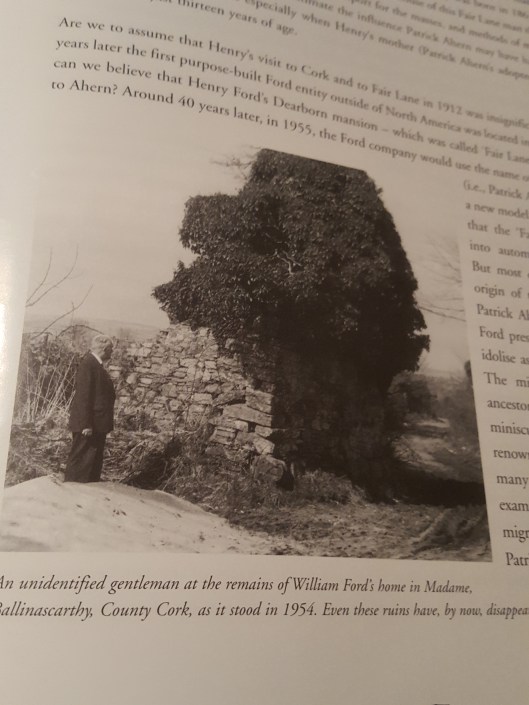
Henry Ford, Madame, Ballinascarthy, West Cork and the Uilleann Pipes

26 Thursday Apr 2012

Posted by durrushistory in Uncategorized

≈ 2 Comments

Tags

balllinascarty, cork, henry ford, lisellan, uileann pipes


In issue 16 of ‘The Archive’, the Journal of the Cork Northside Folklore Project, there is an article about the Crowley Music family and shop in McCurtain Street, Cork.

It relates how in the 1926, Henry Ford (1863-1947) the Motor Magnate, sent a set of uilleann pipes, belonging to his father William (1826-1905) for repair.  The pipes are reputedly in the Ford Museum in Detroit on display.

The Fords occupied a 23 acre farm on the Bence Jones estate at Lisellan near Ballinascarty, before emigrating to the US, the rest is history.

The implication in the article was that William was able to play the pipes a matter that might yield further research.

20190111_225625


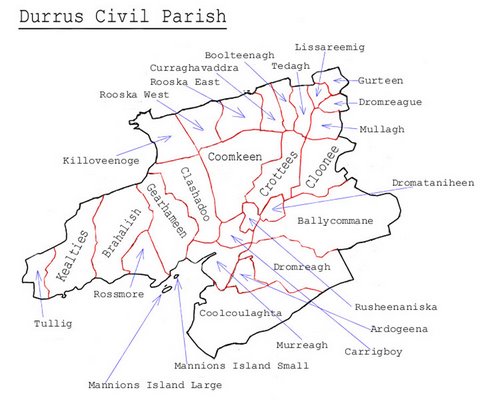
Irish Loan Reproduction Fund Loans, Durrus/Kilcrohane, west Cork, 1846-53.

10 Tuesday Apr 2012

Posted by durrushistory in Uncategorized

≈ Leave a comment

Tags

ballycomane dromreagh, brahalish, brahalish rossmore tullig, coomkeen clashadoo, cork, crottees, dukelow, history, irish loan reproduction fund, Kilcrohane carrigboy rooska, rosnacaheragh, west carbery


The Irish Reproductive Loan Fund was a micro credit scheme set up in 1824 to provide small loans to the ‘industrious poor’. Local associations and committees administered the scheme, most often from a small town in a rural area, and county committees oversaw their work. The records of the local associations and county committees are in the UK National Archives and cover the years 1824 to 1846 for county Cork. As well as the notes of security for the loans, there are loan ledgers, repayment books and defaulters’ books. The minimum information supplied is address and occupation, but much additional detail is often given in the local association records, including notes on health, family circumstances and emigration.


durrus townlands-1

brahalish 1848

carrigboy 1846

loan reproduction fund 1846

Reproduction Loan Records Durrus/Kilcrohane 1853

Verified by Constable Heffernan, Carrigbui, 1853.  The handwriting is somewhat difficult to make out, there are comments like gone to England, America, in poor circumstances or middling circumstances.

Cruttees T91/142B  
     
Richard Duklow 23/3/1848  
Michael Baker 23/3/1840
Michael Baker 13/7/1840
James Dukelow 18/1/1846  
   
Aghagouna (Part Clashadoo) T91/142B/0136  
     
John Dukelow 26/10/1846
Jehr. Sullivan 10/5/1846
Timothy Sullivan 29/6/1846
Denis Wholley 22/6/1846
John Wholley 22/6/1846
Jehr. Sullivan (Comba) 20/7/1846
Timothy Sullivan (alias S Kelly) 13/7/1846
Michael Coppinger 20/7/1846
Ballycomane T91/142B/0137  
Michael Hurly 20/4/1846
Mary Connolly 13/7/1846
Coomkeen or Cumkeen T91/142B  
Patrick Horrigan 20/4/1846
Denis Carthy 18/?/1846
Carrigboy T91/142B/0139  
Edward Goggin 20/4/1846
Patrick Murray 20/4/1846
Barth. Mountain 14/5/1846
Patrick Murray 18/5/1846
Cornelius Curran 18/5/1846
Henry Caverly 8/6/1846
Richard Caverly 8/6/1853
William Goggin 29/3/1846
Daniel Minehane 29/6/1846
James Mahony 24/6/1846
James Harrington 13/7/1846
Carrigboy T91/142B/0140  
Michael Hanly 10/8/1846
Denis Sullivan 13/7/1846
Patrick Sullivan 27/7/1846
James Holland 10/8/1846
Patrick Donovan 10/8/1846
Michael Walsh 10/8/1846
John Mole? 7/10/1846
Lar Lyhane 10/8/1846
John Mahon 26/10/1846
Droumreigh or Droumreagh T91/142B  
     
Daniel Sullivan 11/5/1846
Michael Brien 11/5/1846
Denis Carthy 11/5/1846
Maurice Brien 20/7/1846
Michael Sullivan 20/7/1846
Michael Sullivan (Omgh) 20/7/1846
Jeremiah Sullivan 27/4/1850
Frank Hunt 3/8/1846
James Hunt 20/8/1846
     
Coolcolaghta or Coolcologhta T91/142B/0142  
     
Denis alias Connie Sullivan Snr. 18/5/1846
Mary Carthy 18/5/1846
Patrick Donovan 18/5/1846
Edward White 20/7/1846
Richard Baker 30/7/1846
Daniel Donovan 3/8/1846
Rossmore T91/142B/142B  
     
James Callaghan 20/5/1846
John Patison 25/5/1846
Timothy Driscoll 15/3/1846
Timothy Daly 26/10/1846
Edward Attridge 10/8/1846
Denis Connolly 26/10/1846
Brahalish T91/142B/0144  
Charles King 27/7/1846
Mary Sullivan 8/6/1846
Owen Sullivan 8/6/1846
Timothy King 10/7/1846
James Williamson 27/7/1846
Kitty Carthy (Silvy?) 27/7/1846
Blair’s Cove T91/142B/0145  
James Sullivan (Barnagh) 15/6/1846
Mary Sullivan 13/7/1846
Rossnacaheragh T91/142B/0146  
Timothy Sullivan 15/3/1846
Michael Wholahane 16/7/1846
Mary Sullivan 6/7/1846
John Driscoll 6/7/1840
Tom Foley 20/7/1846
Michael Donovan 20/7/1846
John Daly 27/7/1846
Gearameen T91/142B/0147  
     
Daniel Hartigan 22/6/1846
William Johnson 29/6/1846 (possibly also Parkanna and Classadoo)
Coolnahorna (Upper Clashadoo) T91/142B/0148  
David Hartigan 22/6/1846
Daniel Callaghan 13/7/1846
Boulineagh T91/142B/0149  
Daniel Holland 29/6/1846
Coalta (Kealties) T91/142B/0151  
John Shanahan 29/6/1846
Kitty Sullivan 29/6/1846
Patrick Donovan 22/6/1846
Jude Martin 27/7/1846
James Donovan 27/7/1846
Maurice Foley 27/7/1846
Cornl. Flynn 2/8/1846
     
     
Clossadoo (Clashadoo) T91/142B/0153  
     
James Mahony 22/3/1846
Norry Mahony 22/6/1846
David Hartigan 22/6/1846
Norry Smith 6/7/1846
John Canty 13/7/1846
Ellen Driscoll 13/7/1846
Moulimill or Moulemil T91/142B/0153  
Corn Mahony 22/3/1846
William Patison 3/8/1846
Tom Baker 2/8/1846
Susana Levis 3/8/1846
Richard Patison 3/8/1846
Tullig T91/142B/0155  
Timothy Coghlan 10/8/1846
Glebe (Clashadoo) T91/142B/0155  
John Carthy 18/1/1846
Jehr. Hayes 6/7/1846
Jehr Hayes 27/7/1846
Filechilla T91/142B/0156  
Eileen Flynn 3/8/1846
Upper Glen T91/142B/0157  
Richard Hunt 13/7/1846
Glenloch T91/142B/0158  
Timothy Connolly 107/1846
Mary Regan 13/7/1846
Daniel Whollehane 13/7/1846
Denis Carthy (Down) 30/8/1846
Daniel Lairin Laurin? 20/7/1846
William Scott 20/7/1846
James Harrington 27/7/1846
Murthy Donovan 27/7/1846
Daniel Holland 2/8/1846
John Driscoll 10/8/1846
Mary Connell 10/8/1846
Glenloch T91/142B/0159  
Daniel Carthy 10/8/1846
Daniel Carthy
Patrick Donovan 10/8/1846
Kilcrohane T91/142B/0161  
Michael Gallagher 7/10/1846
     
Rouska (Rooska) T91/142B/0162  
     
Richard Varian 10/8/1846
John Murphy 27/7/1846
Timothy Driscoll 3/8/1846
George Varian 3/8/1846
Craghamadra T91/142B/0163  
Timothy Mahony 27/7/1846
Moreigh T91/142B/0164  
James Brian? 27/7/1846
Keelovenogue T91/142b/0165  
John Murphy 3/8/1846
Skehaneyleary T91/142B/0166  
Vincent White 20/7/1846
Reenachappil T91/142B/0167  
Jesey/ Lynch 3/8/1846
Cumachee T91/142B/0168
Jerry Mahony 18/8/1846
Daniel Donovan 10/8/1846
Aghaville T91/142B/0169  
Ellen Spelane 10/8/1846
Skrehanamuclla (lower Coomkeen) T91/142B/0170  
Charles Dukelow 26/10/1846
Parkaeuina T91/142B/0171  
William Johnson 26/10/1846 Classadoo

Letter from Sir George Carew to Lord Deputy Mountjoy, from camp at the Abbey, Bantry, 1602.

07 Wednesday Dec 2011

Posted by durrushistory in Uncategorized

≈ 4 Comments

Tags

bantry, cork, history, west cork


https://www.google.ie/maps/place/Abbey,+Co.+Cork/@51.6755658,-9.4787845,15z/data=!4m2!3m1!1s0x48450ae74e1778df:0xcf5b987d07037e66

The original manuscript is held at the Lambeth Library in England and is written after the Battle of Kinsale and prior to the storming of the O’Sullivan Castle at Dunboy by SIR GEORGE CAREW to LORD DEPUTY MOUNTJOY.  MS 624, p. 141  13 May 1602

These documents are held at Lambeth Palace Library
Former reference: MS 624, p. 141
4 Pages.
Supplementary information: Calendar of the Carew Manuscripts preserved in the Archiepiscopal Library at Lambeth, ed. J. S. Brewer & W. Bullen (6 vols., 1867-73), vol. IV, document 237.
Contents:
“Your letters by your servant Pavye, bearing date the 19th and 20th of April, I received the 12th of this instant; being sorry in my heart that I was gone from Corke before his coming, that I might have more fully answered every point of them.. and more precisely have obeyed your Lordship’s directions… Upon the messenger I can lay no blame, for he departed Dublin the 20th, and I rose from Corke the 23rd of April, whereby it was impossible for him to overtake me; and to follow me by land he could not, and by sea, before the wind served, he could not budge out of Kynsale…
“The general letter from your Lordship and the Council I have answered at large… By reason of the want of my papers and the officers of the munitions and victuals (.. one in Corke and the other in England) I am ignorant of the magazines of either of them, but.. have taken such a course as I hope will be pleasing to you, and, if your Lordship shall not so think it, I will at my return from Donboye accomplish your commandments to the uttermost I may…
“For the fortifications in the river of Corke.. I cannot give any directions in them until my return; and in the meantime Paul Ive will be sufficiently employed at Kynsale.”
I thank you for imparting the Lords’ letters to me, and do hope they “will redress the error in victualling, and give order for our payments in money since the contract for clothes is broken,.. for the soldier in the meantime both in back and belly is pinched.”
“Of the coming of Spaniards I am no less distracted in my judgments than your Lordship is, for all passengers or merchants that come out of France or Spain do still assure their coming, and that very shortly. The rebels stand assured of their coming before this month is expired, and the hope thereof keeps Tyrrell and William Bourke my neighbours, who otherwise would quit this province; for they are heartily afraid of treason in the provincials, and wish themselves gone… They lie in such incredible strengths of huge mountains and ugly glynns of bog and wood, as I think no place of the world yields the like, and the ways of such advantage unto them as an 100 men may forbid an army of 5,000 to march from Bantry to Donboye, which is but 24 miles; and if there were no enemy to resist us, nor any baggage in our army, the ways in themselves are so difficult as in less time than eight days I cannot come thither, for three miles a day is the most we can march; and for horse or garrons to carry victuals and munitions no possibility of passage. Wherefore I have resolved by boats and shipping to cross the Bay of Bantry, and to land within seven miles of the castle, which is a reasonable way (though mountainous), yet indifferent as well for us as the enemy. I would not have believed any man’s report if my own eyes had not seen the mountains and glynns which here I find…
“If the Queen’s fleet were not upon the coast of Spain, I do confidently believe that we should within a few days see another Spanish army in Munster. But my hope is that the fleet will enforce their stay; which moved me to make the greater haste to Beerehaven to win the castle of Donboye before their coming; the which (as I understand) is, by the advice of the Spaniards that were there, strongly re-enforced with hugh earthy-works able to withstand a great battery. But howsoever I hope in God to carry it, but am much afraid that I shall be enforced to send unto Corke for a supply of munitions, which is the cause I have directed the clerk of the munition to reserve five last of powder, if extremity did enforce me, and also that these parts might not altogether be left bare to answer foreign occasions.
“But I hope the store is such as that the ten last written for may be sent unto you, and five last remaining. If not, to supply your army in Connaght which goes to Ballyshennan there is five lasts of powder with lead and match at Lymericke, which by water with a guard to Athlone may be carried safely from thence. But if Corke cannot yield your Lordship the ten lasts demanded, what lacks of the same (if your Lordship do send for it) I will presently send it unto Dublyn, not meaning to dispute but to obey all your Lordship’s commandments… The strength of the magazine.. is better known to the master of the ordnance there, who before his departure from hence did sundry ways dispose the same; and my particular notes are in Shandon… Of all the other things in that note comprised, if they be in the store at Corke, they shall be presently sent unto your Lordship, though I am sorry to depart with pioneers’ tools, having so great occasion to use them in the work intended.
“If the munition at Lymericke might come safely unto me by sea, I would not care how bare the store.. at Corke were left; but this summer time there is not so little as twenty galleys swarming upon this coast, and within these ten days they have taken two merchants, one of Gallwaye and an Englishman, both of them loaden with corn and wines, which goods is now in possession of the rebels, which is a great relief to the Buonies, who before lived only upon beef and water, and wanted bread, for want whereof they grew into such discontent as they were ready to break.
“According your Lordship’s commandment, Cormocke and John Barry shall be discharged, but [I] do humbly pray your Lordship (not for any love I bear them, but for the service’ sake,) that they may be continued in pay until I return;.. for.. they being now with their companies in the camp with me, it is an inconvenient time to cast them, lest at my back they may work some disturbance, and at Cormocke’s hands I expect no better, which they dare not do when I am returned. Besides the better part of my army is Irish; whom for the present I dare not discontent… But then no man [is] more glad of cashiering Irish companies than myself.
“The copies of letters and other notes your Lordship writes for are in my cabinet at Shandon, but as soon as I return I will send them unto you. I have written unto my wife to deliver unto your servant Pavye 400l. in Spanish silver, which I am sure he shall receive. In your Lordship’s next.. signify.. the receipt of it. 200l. Apsley had; the rest your Lordship may easily judge where it remains; a particular note I will send you at my return, for now I cannot do it.
“I will write often unto you, and.. pray your Lordship to do the like, being unto me a good light how to direct my ways in Munster, besides the comfort I receive in your Lordship’s good successes, which I beseech the Almighty to bless you in, that your works were ended, and both of us in England, to have the society of our friends, and to enjoy part of their ease.”
Camp near the Abbey of Bantry, 13th May 1602.
Copy.

Petition of Maurice de Carrreu (Carrew) to King of England c1300 including Donemark, Bantry.

07 Wednesday Dec 2011

Posted by durrushistory in Uncategorized

≈ 3 Comments

Tags

bantry, cork, irish history, west cork. history


https://www.google.ie/maps/place/Donemark,+Co.+Cork/@51.6968024,-9.4492162,15z/data=!3m1!4b1!4m5!3m4!1s0x48450bbaf6a63bed:0x5730c094c9aaf311!8m2!3d51.6967908!4d-9.4404396

This petition written in French is held at the UK National Archives in Kew.  It refers among other places to Donemark, Bantry, Co. Cork and is one of the earliest written references to that part of the country.

The Normans would have found the fertile Drumlin belt around Bantry attractive.

You are here: Home > the Catalogue > Search the Catalogue: Full details
the Catalogue
Welcome (catalogue home page) About the catalogue Browse the catalogue Link to help - opens in a new window
Search the catalogue Research guides

Item reference SC 8/98/4889

Petitioners: Maurice de Carreu (Carrew). Addressees: King. Places mentioned: Desmond, County Limerick, [Ireland]; Ath[. …

Jump to :  Summary |  Finding aids Browse from here
View digital image
More ordering and viewing options for this document

Context

SC  Records of various departments, arranged artificially according to type, and formerly entitled Special Collections
top of page SC 8  Special Collections: Ancient Petitions
top of page PETITIONS TO THE KING; TO THE KING AND COUNCIL; TO THE COUNCIL; TO THE PARLIAMENT; AND THE LIKE.
top of page SC 8/98  4851-4900. Individual petitions are described , dated, and are available at item level.
Top of page

Record Summary

Scope and content
Petitioners: Maurice de Carreu (Carrew).
Addressees: King.
Places mentioned: Desmond, County Limerick, [Ireland]; Ath[…] Ocarbry cantred [unidentified], County Limerick, [Ireland]; Scenned (Shanid) cantred, County Limerick, [Ireland]; Corkey cantred [unidentified], County Limerick, [Ireland]; Killyde (Killeedy), County Limerick, [Ireland]; O[O…] and Oflannan cantred [unidentified], County Kerry, [Ireland]; Maycenekyn (Magunihy) cantred, County Kerry, [Ireland]; Ofurris cantred [unidentified], County Kerry, [Ireland]; Kilorglan (Killorglin) cantred, County Kerry, [Ireland]; Corkelye and Bear cantred [unidentified], County Cork, [Ireland]; Formertheragh (Fermoy) cantred, County Cork, [Ireland]; Glynsalwy cantred [unidentified], County Cork, [Ireland]; Oglassyn cantred [unidentified], County Cork, [Ireland]; Donemark [unidentified], [County Cork, Ireland].
Other people mentioned: Maurice Fitz Gerard (Fitz Gerald); Richard de Burgh; Thomas Fitz Moriz (Maurice); Maurice Fitz Thomas; Thomas de Clare; John de Prendregast (Prendergast); Geoffrey de Cogan, son of Eustace de Cogan; Eustace de Cogan.
Nature of request: Maurice de Carreu states that he holds half of Desmond for the service of 30 knights. He asks the King to take the services from certain of his tenants, whom he names, and also to take his manor of Donemark, and to release him from the debt he owes him, and to let him have the rest of his feed quit.
Endorsement: He is to go to the Justiciar and to the King’s council in those parts, and the council is to inform the King more clearly about the demand. And the King will take counsel on this and will order his will on the matter. And a writ is to be sent to the Justiciar on this.
Covering dates [c. 1300]
Note Dated to c. 1300 by Connolly, ‘Irish Ancient Petitions’ p.33.
Related material For another petition from the same petitioner, see SC 8/199/9933
Held by
The National Archives, Kew
Former reference (Department) Parliamentary Petition 1575
Legal status Public Record(s)
Language French
Top of page

Finding aids

Publication note Irish Material in the Class of Ancient Petitions (SC 8) in the Public Record Office, Analecta Hibernica, vol. XXIV, P. Connolly, (Stationery Office of Ireland, 1987), p.33 (brief calendar of petition)
← Older posts
Newer posts →

Blog Stats

  • 840,567 hits

16th Regiment of Foot assisted female emigration australia ballyclough bantry bay caithness legion cavan regiment of militia cheshire fencibles coppinger's court inbhear na mbearc Irish words in use 1930s lord lansdowne's regiment mallow melbourne ned kelly new brunswick O'Dalys Bardic Family. o'regan Personal Memoirs rosscarbery schull sir redmond barry sir walter coppinger st. johns sydney Townlands treaty of limerick Uncategorized university of Melbourne victoria

16th Regiment of Foot assisted female emigration australia ballyclough bantry bay caithness legion cavan regiment of militia cheshire fencibles coppinger's court inbhear na mbearc Irish words in use 1930s lord lansdowne's regiment mallow melbourne ned kelly new brunswick O'Dalys Bardic Family. o'regan Personal Memoirs rosscarbery schull sir redmond barry sir walter coppinger st. johns sydney Townlands treaty of limerick Uncategorized university of Melbourne victoria
Follow West Cork History on WordPress.com

Enter your email address to follow this blog and receive notifications of new posts by email.

Join 518 other subscribers

Feedjit

  • durrushistory's avatar durrushistory

Archives

  • December 2025
  • November 2025
  • October 2025
  • September 2025
  • August 2025
  • July 2025
  • June 2025
  • May 2025
  • April 2025
  • March 2025
  • February 2025
  • January 2025
  • December 2024
  • November 2024
  • October 2024
  • September 2024
  • August 2024
  • July 2024
  • June 2024
  • May 2024
  • April 2024
  • March 2024
  • February 2024
  • January 2024
  • December 2023
  • November 2023
  • October 2023
  • September 2023
  • August 2023
  • July 2023
  • June 2023
  • May 2023
  • April 2023
  • March 2023
  • February 2023
  • January 2023
  • December 2022
  • November 2022
  • October 2022
  • September 2022
  • August 2022
  • July 2022
  • June 2022
  • May 2022
  • April 2022
  • March 2022
  • February 2022
  • January 2022
  • December 2021
  • November 2021
  • October 2021
  • September 2021
  • August 2021
  • July 2021
  • June 2021
  • May 2021
  • April 2021
  • March 2021
  • February 2021
  • January 2021
  • December 2020
  • November 2020
  • October 2020
  • September 2020
  • August 2020
  • July 2020
  • June 2020
  • May 2020
  • April 2020
  • March 2020
  • February 2020
  • January 2020
  • December 2019
  • November 2019
  • October 2019
  • September 2019
  • August 2019
  • July 2019
  • June 2019
  • May 2019
  • April 2019
  • March 2019
  • February 2019
  • January 2019
  • December 2018
  • November 2018
  • October 2018
  • September 2018
  • August 2018
  • July 2018
  • June 2018
  • May 2018
  • April 2018
  • March 2018
  • February 2018
  • January 2018
  • December 2017
  • November 2017
  • October 2017
  • September 2017
  • August 2017
  • July 2017
  • June 2017
  • May 2017
  • April 2017
  • March 2017
  • February 2017
  • January 2017
  • December 2016
  • November 2016
  • October 2016
  • September 2016
  • August 2016
  • July 2016
  • June 2016
  • May 2016
  • April 2016
  • March 2016
  • February 2016
  • January 2016
  • December 2015
  • November 2015
  • October 2015
  • September 2015
  • August 2015
  • July 2015
  • June 2015
  • May 2015
  • April 2015
  • March 2015
  • February 2015
  • January 2015
  • December 2014
  • November 2014
  • October 2014
  • September 2014
  • August 2014
  • July 2014
  • June 2014
  • May 2014
  • April 2014
  • March 2014
  • February 2014
  • January 2014
  • December 2013
  • November 2013
  • October 2013
  • September 2013
  • August 2013
  • July 2013
  • June 2013
  • May 2013
  • April 2013
  • March 2013
  • February 2013
  • January 2013
  • November 2012
  • October 2012
  • September 2012
  • August 2012
  • July 2012
  • June 2012
  • May 2012
  • April 2012
  • March 2012
  • February 2012
  • January 2012
  • December 2011
  • November 2011
  • October 2011

Blog at WordPress.com.

  • Subscribe Subscribed
    • West Cork History
    • Join 518 other subscribers
    • Already have a WordPress.com account? Log in now.
    • West Cork History
    • Subscribe Subscribed
    • Sign up
    • Log in
    • Report this content
    • View site in Reader
    • Manage subscriptions
    • Collapse this bar
 

Loading Comments...