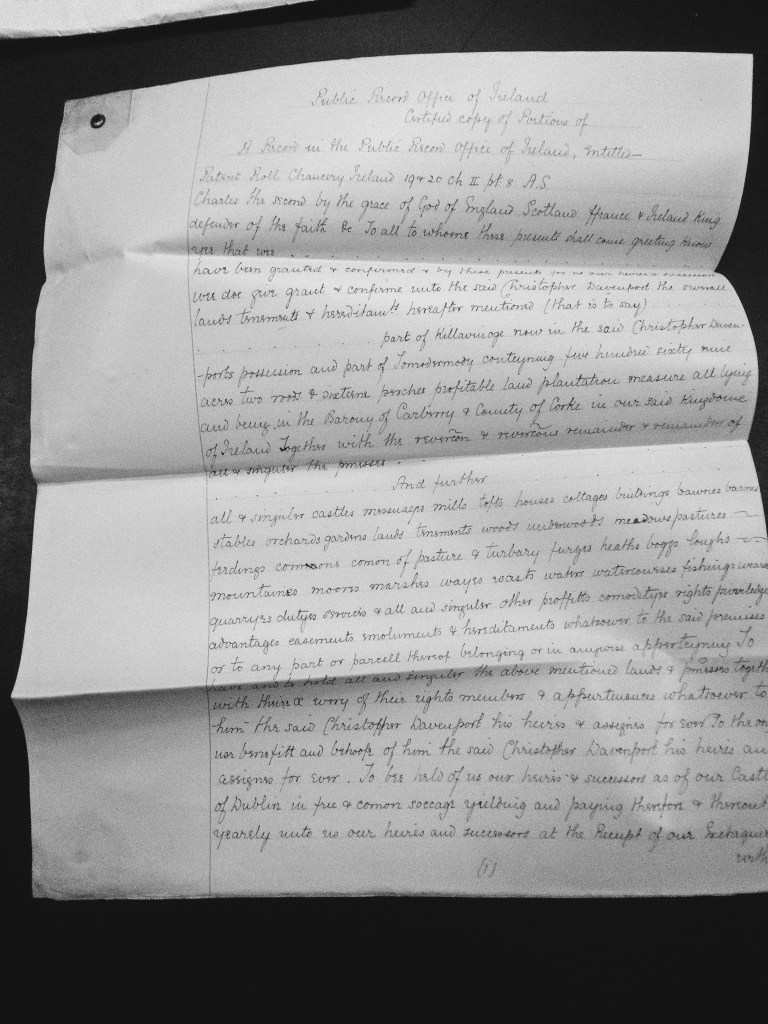
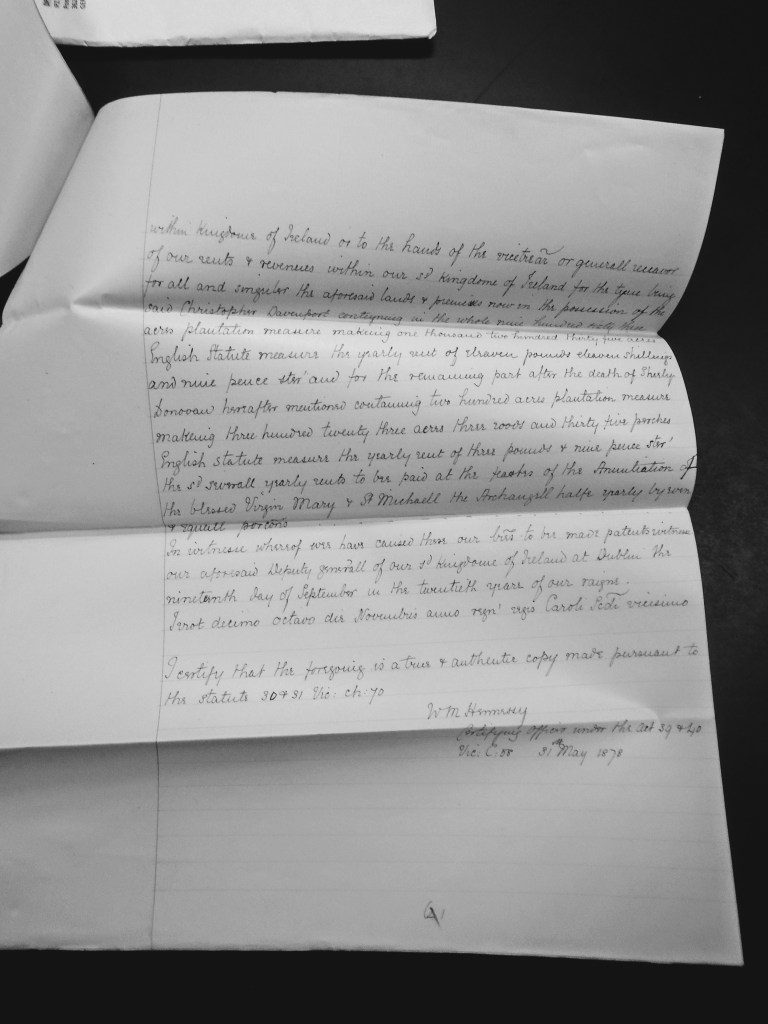
1843-1844. Alexander O’Driscoll Landlord, Magistrate, Skibbereen, In trouble Again before the Lord Chancellor, He Had 40 Men Dig the Potatoes Of a Defaulting Tenant, while there cattle from a neighbouring farm strayed and were seized by his Drivers, Another Incident of Whipping a Boy on the Hunt. Maintains a Local Vendetta Against Him. Charges Concocted by a certain class of Individuals named ‘The Arbitration Committee of the Repeal Association’ consisting of A Dealer of Tapes and Small Cottons, A Village Schoolmaster, A Ci-Devant Village Saddler, A former Maker of Felt Hats and A Bankrupt Corn Dealer.


Alexander O’Driscoll Landlord, Magistrate, Skibbereen, In trouble Again before the Lord Chancellor, He Had 40 Men Dig the Potatoes Of a Defaulting Tenant, while there cattle from a neighbouring farm strayed and were seized by his Drivers, Another Incident of Whipping a Boy on the Hunt. Maintains a Local Vendetta Against Him. Charges Concocted by a certain class of Individuals named ‘The Arbitration Committee of the Repeal Association’ consisting of A Dealer of Tapes and Small Cottons, A Village Schoolmaster, A Ci-Devant Village Saddler, A former Maker of Felt Hats and A Bankrupt Corn Dealer.

The the time there was another local Alexander O’Driscoll prominent in Skibbereen and another alos a Magistrate in Passage outside Cork. It is sometime difficult to see who is who.

The was a whole infrastructure of enforcement of tithes, cess, rents. The tithe proctors, drivers, bailiffs. Every village had a pound. Often a Landlord’s driver at midnight would seize cattle of defaulters and place then in the pound for auction. Not only cattle but eggs were restrained as in the Bandon Estate Records.

In extreme cases as in the tithe agitation of the 1830s the police and military were called in. The Rev. Kenny of Kilmeen had a gun boat called to Clonakilty to enforce tithe collection at Kilmeen.

O’Donovan Rossa in his recollection said it was common for farmers corn to be distrained while in the corn mill or store. This happened to his family.

Our Alexander is probably the one who had the tithes of Durrus and Bantry rented and was seeking military assistance to enforce collection.

CSO/RP/1833/3107. Letter from Alexander O’Driscoll, Skibbereen, [County Cork], to John Roberts, Chief Magistrate, Bantry, [County Cork], requesting police protection to recover lay tithes he has on lease in the parishes of Kilmacomogue [Kilmocomoge] and Kilcrohane, [County Cork].

1826. Donor to Durrus Churches

Pages 453 on:


..

Captain Alexander O’Driscoll, 1827, Clover Hill, Superseded 1810-30, Restored 1843. Norton Cottage, Skibbereen (two of same name at time), Ancestor Alexander married daughter of McFineen Dubh O’Sullivan, son of Tim ‘The Gauger’, sister Mrs Freke of Baltimore Castle.  1820 signed Memorial for new road Glengariff to Castletownbere.  Married to the daughter of Thomas Attridge, Ballydehob. Correspondence with Chief Secretary appealing dismissal of 1820.  1822 subscriber as Clover Hill, Church Building Fund Durrus, he held tithes in Kilcrohane with Rector and Rev. Alleyn Evanson. Present at enquiry Skibbereen 1823 into enquiry into fatal affray at Castlehaven caused by Rev. Morritt’s tithe extraction. Grand Jury Presentments attending 12 from 1838-1840 at Norton Cottage.  Probably engaged with his crew in marine salvage of Clio out of Crookhaven 1825. 1826 City election voted O’Callaghan conservative. Voted 1835 election as out of town Freeman address Shepperton. Public support for him on dismissal 1835 by fellow Magistrates Lord Bantry, Simon White, John Puxley, Samuel Townsend Senior, Samuel Townsend Junior, Hugh Lawton, Thomas Somerville, Rev. Alleyn Evanson, Richard Townsend Senior.   Enquiry attended in Bandon 1841 into suspension arising from conduct with Stipendiary Magistrate J. Gore Jones and Sub-Inspector Andrew Creagh  attended Earl of Bandon, Lord Viscount Bernard, on. H. White Hedges, Macroom Castle, Henry Bernard, Castle Barnard, Abraham Morris Dunkettle, Captain Henry Wallis, Drishane Castle, Lieutenant Colonel St. John Clerke, Overton House, William Cooke Wallis Junior, Castlecook, Mathias Hendley, Mountrivers, Henry Leader, Mount Leader, George Browne, Coolcower, St. Ledger Aldworth, Newmarket, Charles Evanson, Carlemont, Cork, Sir Thomas Deane, Thomas Hungerford, The Island, Nicholas Dunscomb, Mount Desert, Richard Henry Hedges Becher, Hollybrook, Skibbereen, John Isaac Heard, Kinsale, John Wheeler, Junior, James Gillman, Retreat, MD, Clonakilty, Thomas Herrick, Coolkerry, Captain R.A. Rogers, Petersfield, Michael Gallway, Gurtnagreena, John Nason, G. Nagle, Ballinamona Castle, Samuel Wallis Goold Adams, Jamesbrook, Jeremiah E. McCarthy, Rathduane, William F. Austen, Greenshela, Thomas R. Sarsfield, Ducloyne, Arthur Pery Aylmer, Castlefreke, Thomas Cuthbert Kearney, Garretstown, Joseph Haynes, Maryland House, Charles Connell, Cloverhill, John Barter, Cooldaniel, Francis G. Woodley, Leeds, Lawrence Corban, Maryville, E. Millett, MD, Cove.  1841 supported Conservative Longfield Longueville, Mallow even though Catholic hosted meeting attending John Ross, Rossford, Thomas Morris, Mahonagh, Thomas Wood, Dereeny, Listed 1838, dead….. with address Mount Music/Bunaulin, Caheragh when daughter Kate married Herbert Baldwin Esq., 1845. 1835 Subscriber at Gortnascrena, Skibbereen, Lewis Topographical Dictionary of Ireland 1837. Suspended for a period as J.P. reinstated after altered by a sitting of over 70 Magistrates in Bandon from both political sides. 1828 Bandon Quarter Sessions. His lands managed by Bird. Member Provisional Committee projected Bandon to Bantry Railway 1845, address Norton Cottage.   Believed to have been committed to a debtors prison in Cork by his wine merchant where he died. Norton Cottage was lived in once by Dr. O’Donovan, J.P., and bought 1925 by Jasper Woulfe, Solicitor, Crown Prosecutor and TD, 

..

.

1799, Methodist Rev. Averill, Tour, Bandon, Benour, Dunmanway, Glandore, Castletownshend, Skibbereen, Baltimore, Adrallagh, Aughadown, his assistant Preaching in Irish at Ballydehob, Altar, in a Little Cabin, 30 Protestants Piteous, Clothed in Rags, Rooska probably Vickeries, Bantry


1799, Methodist Rev. Averill, Tour, Bandon, Benour, Dunmanway, Glandore, Castletownshend, Skibbereen, Baltimore, Adrallagh, Aughadown, his assistant Preaching in Irish at Ballydehob, Altar, in a Little Cabin, 30 Protestants Piteous, Clothed in Rags, Rooska probably Vickeries, Bantry.

Gideon Ouseley – A maverick Irish Methodist preacher.

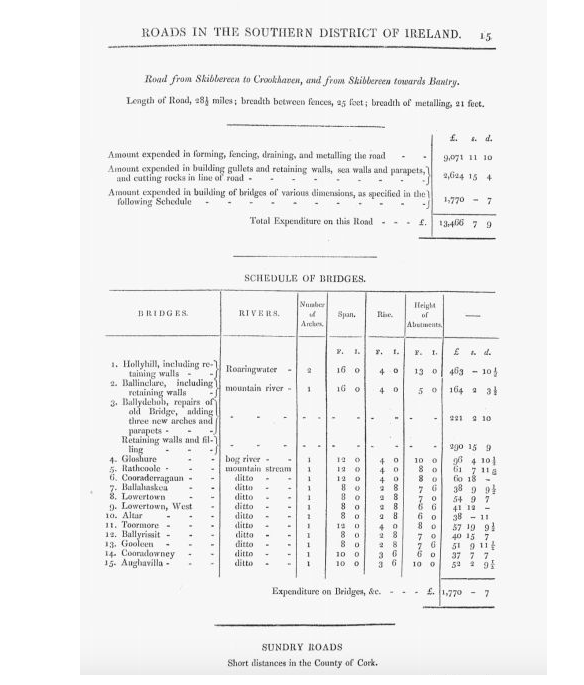
1829. Memorial of nobility, magistrates and gentlemen of counties Cork and Kerry, to Hugh Percy, Lord Lieutenant, requesting the construction of a new line of road from Bantry to Skibbereen, containing 46 signatures (most transcribed)


..

From Chief Secretary papers:

CSO/RP/1829/905.   Letter from the Marquis of Lansdowne [Henry Petty Fitzmaurice, 3rd Marquis Lansdowne], Bowood [House, Derry Hill, Wiltshire, England], to Francis Leveson Gower, Chief Secretary, forwarding memorial of nobility, magistrates and gentlemen of counties Cork and Kerry, to Hugh Percy, Lord Lieutenant, requesting the construction of a new line of road from Bantry to Skibbereen, containing 46 signatures, with covering note by Henry Greville, [Irish Office, London]. [Contains list of names not given in this description]

..

Some of the names are very indistinct

Lansdowne, Marquis of Lansdowne [Henry Petty Fitzmaurice, 3rd Marquis Lansdowne], Bowood [House, Derry Hill, Wiltshire, England],

Bantry, Lord Bantry

Berehaven, Richard White (1800-1868), 2nd Earl of Bantry, Lord Berehaven.  As Berehaven travelled extensively he was often absent from Bantry. He visited the usual sites of the nineteenth century Grand Tour, also visiting Spain, Russia, the Baltics and Scandinavia. There were two activities he invariably participated in while travelling: sketching and collecting. The latter activity led to the creation of one of the most eclectic collections of art to grace an Irish home.

J. Herbert, Sheriff of Kerry

James Hickson, J.P.

Wiliam Godfrey, Rector of Kenmare and J.P.

Edward Godfrey

Daniel Cronin, J.P.

Daniel Mahony, J.P.

Christopher Gallwey, J.B. lives in Killarney manages Kenmare/Brown Estate in Bantry/Beara

John O’Connell, J.P.

J. D. Godfrey, J.P.

Thomas Marshall, ?, J.P.

Robert Blennerhassett, J.P.

T. C. Bland, J.P.

J. Bland

Thomas H. Fuller

Samuel Mathews, Clerk

Edward Donnell, P.P

Sylvester McSwiney possibly of the extended O’Sullivan family of Beara

Richard Fitzmaurice, J.P

Thomas Hutchins, Bantry

Arthur Hutchins, Junior, Bantry

Samuel Hutchins, Bantry

Edward Ashe

Denis Mahony, Captain?, J.P.

Simon White, J.P., Glengariff

David Mellifont, Donemark, Bantry

Samuel Hutchins, Bantry

Tuckey Broderick?

James McCheane, Clerk, Dunmanway

B.B.? White

..

..

Rev. Edward Herbert Kenny, Rector of Kilmeen, Widely Praised for Work on Road and Bridges enabling Sea Sand to be used as Fertilizer in Interior of West Cork. 1832 calls in Gunboat to Clonakilty, 69th Regiment and Police in Attempt to Collect his tithes at Kilmeen and Ballygurteen.


Magistrate: Rev. Edward Herbert Kenny, 1799, died 1842.  Freeman of Kinsale 1797. Subscriber, at Moviddy, James Mullalla, Review of Irish Affairs 1688-1795. Major figure in road building praised by Horatio Townsend for road work enabling sea sand to go through Kilmeen to interior. Present at enquiry Skibbereen 1823 into enquiry into fatal affray at Castlehaven caused by Rev. Morritt’s tithe extraction. 1822 received £50 for distress in Kilmeen from Lord Lieutenant.  1830 subscriber Robert O’Callaghan Newenham ‘Views of the Antiquities of Ireland’. 1833 tithes.  1831, Ballineen 1835, 1835 Son of Rev. Dr. John Kenny, rector of Kilbrogan which he spent £3. 104 on,  his father had married sister of Emmett Archbishop of Tuam. Family based in Bandon area. Subscriber at Kilmeen Glebe where he was rector for 43 years. Lewis Topographical Dictionary of Ireland  1837. Rector of Durrus for 6 years. Edward Herbert Kenney 1793-1799, a Justice of the Peace 28th May 1799.  He was later Rector Rosscarbery and his work in organising relief work (in the famine of 1822) and paying the workers in money or meal was praised by the Parish Priest for his ‘meritorious conduct’.  Family buried at Ballymartle.   County Freeman Kilmeen of Cork City voting in Cork City Election 1837.

Rev. Edward Herbert Kenny, Rector of Kilmeen, Widely Praised for Work on Road and Bridges enabling Sea Sand to be used as Fertilizer in Interior of West Cork. 1832 calls in Gunboat to Clonakilty, 69th Regiment and Police in Attempt to Collect his tithes at Kilmeen and Ballygurteen.

It is difficult to reconcile his altruism and industry wiht his tithe collecting attempts. Reading the Chief Secretary Papers the military and Dublin Castle Authorities wee thoroughly sick of him and his high handed antics.

Kilmeen Herbert Gillman, Edward O’Brien.  Rev. Edward Herbert Kenny £750 entirely to Rev. Edward Herbert Kenny.  Special Vestry chaired by Robert Sealy, William Buttomere (Buttimer), John Bateman, John Collins approved no variation for 21 years rector assented. 1833 For 7 years ending 1821 barrel of wheat £1 18 shillings 8 and a half pence grown in said country

Chief Secretary Papers:

CSO/RP/1832/5791. Letters from EH Kenny, Rector of Kilmeen and magistrate, Clonakilty, [County Cork], to Edward Smith Stanley, [Chief Secretary], stating that his bailiff was assaulted while attempting to distrain livestock in lieu of tithe arrears in his parish and that a party of police was stoned while attempting to restore order; seeking the stationing of a military force in the parish and suggesting that the military commanders be appointed to the commission of the peace.

Also letter from Daniel Conner and NS Shuldham, magistrates, to Stanley, reporting on the incident. CSO/RP/1832/6119. Letter from the [Maj Gen Edward Blakeney, Commander in Chief], Major General Commanding, Royal Hospital, [Dublin], to Sir William Gosset, [Under Secretary], forwarding a report [not extant] from Col Wilson, commanding the 65th Reserve concerning the enforcement of tithes at Kilmeen, [possibly County Cork]. CSO/RP/1832/5562.

File containing police reports of a serious attack on the police and military while attempting to assist Rev Edward H Kenny with the enforcement of his tithes at [Ballingurteen, County Cork] CSO/RP/1832/6335.

Letter from [Arthur Chichester, 1st Baron] Templemore, Military Secretary, Royal Hospital, Dublin, to Sir William Gosset, [Under Secretary], referring to military reports from Maj Gen James Douglas and Capt Patience, 65th Reserve at Clonakilty, [County Cork], concerning an unnecessary request made to Capt Patience by Rev EW Kenny, magistrate. Also copy of letter from Gosset, Dublin Castle, to Kenny, Kilmeen, Clonakilty, informing him that the troops should not have been required to march 18 miles on unnecessary business.

1880, William Bence Jones, Landlord ‘To My Tenants and Their Wives, Send Your Butter to London, Cork is the Best Place in the World to Sell Inferior Butter, The use of Brains and Sense is All That is Required.


In his memoir he states his father an grandfather were absentee landlords,

William Bence Jones (1812-1882), B.L., Lisselane, Clonakilty, London Bar 1837.  Attending Landlord Meeting Bandon Courthouse 1846, listed 1854, 1861, listed 1875-6.  Subscribing £2 1851 to Clonakilty Infant School. 1858 funded erection of Kilmaloda church. Ross representative with Sampson Beamish, Standing Committee, Diocesan Synod 1871. Boycotted during Land war. Irish agriculturist, b. Beccles, Suffolk; his grand father bought an estate at Lisselane, Co. Cork, and Jones undertook its management in 1838 following embezzlement by agent; built Glenville, the family home, and lived there till 1880; his opposition to relief work – advocating emigration and drainage as alternatives – led to attacks by the Land League, followed by a boycott which he successfully resisted; he strenuously opposing Gladstone’s Irish Land Act of 1881, but left Ireland that year;   works include Life’s Work in Ireland of a Landlord Who Tried to Do His Duty (1880); and works on ecclesiastical matters such as What Has Been Done in the Irish Church Since its Disestablishment (1875)

May be descendant of Cork Jones attorney and Droumbeg, Rosscarbery landed family.

.

1832, Report of Assistant Barristers, West Cork, Trials, Appeals, Ejectments


.

1837, Extracts from the Report on The Manor Courts of Ireland, Manors of Abbeymahon, Atham (Beara), Ballydehob, Ballymodan, Bantry, Bridgetown (Skibbereen), Castlemahon (Bandon), Dunmanway, Cloghanmore (Rosscarbery), Rathbarry and Gortnahowna (Clonakilty), Timoleague, with Townland Listings.


West Cork Manors are in detail at page 334 on. The Manors are legacies of the forfeit lands and English Crown Grants to various Estates. The early report contains detailed evidence of the working of the Manor Court mainly not complimentary. The Courts were presided over by Seneschals. generally not legally qualified and often the local Landlord’s Agent.

https://wordpress.com/block-editor/post/durrushistory.com/35364

https://wordpress.com/block-editor/post/durrushistory.com/33720

https://wordpress.com/block-editor/post/durrushistory.com/35699

https://wordpress.com/block-editor/post/durrushistory.com/35913

..

1822, The Troubles of a Struggling Farmer, Mud Cabin, Heavy Taxes, Tithes, Cess, and Rack Rents, Wintry Wind, by Poet Mícheál Óg Ó Longáin (1766-1837), Caheragh, (lived later Glanmire), Co. Cork.


durrushistory's avatarWest Cork History

1822, The Troubles of a Struggling Farmer, Mud Cabin, Heavy Taxes, Tithes, Cess, and Rack Rents, Wintry Wind, by Poet Mícheál Óg Ó Longáin (1766-1837), Caheragh, (lived later Glanmire), Co. Cork.

Life

1766–1837),poet and scribe; born to the Ó Longáin learned family in Carrignavar, Co. Cork.
1766-1837; b. Carrignavar, Co. Cork; son of Mícheál mac Peadair; orphaned young, his parents dying in 1770 and 1774; employed as cowherd; returned to education, 1784; assisted United Irishmen, 1797-98; wrote for Whiteboys, 1785; ‘Buachaillí Loch Garman [Boys of Wexford]’, 1798; m. 1800; worked as scribe, labourer, and teacher in Co. Cork; settled in north Kerry and East Limerick, 1802-07; wrote on poverty and oppression; employed as a teacher and scribe by Rev. John Murphy, Bishop of Cork, 1814; copied manuscripts, 1817-1820; sons Peadar and Pól, and Seosamh, also became scribes; died. on his son Pól’s 11-acre holding in eleven acres in Knockboy in…

View original post 277 more words

West Cork Tithes. 1832, Death of Rev. Charles Ferguson, Vicar and Prebentry of Timoleague, Tithes in West Cork.


Computation by Parish, Commissioners, Beneficiaries, Amount, Select Vestries.

https://docs.google.com/spreadsheets/d/1SW0gTN5Iwt_e7Q4igxmfXimwnzmMHo-J8LFHPytSPxQ/edit#gid=0

The sums paid on tithes 1820s was enormous, not all went to the clergymen some went to lay impropriators who puchased tithes as an investment. Of the amount which went to clergymen part was to pay for services such as the care of fondlings burial of the indigent dead and other services.

Father Patrick Hickey in his Mizen history has document in detail this period.

Timoleague Tithes. Commissioners Patrick O’Brien, Michael Enright.

CSO/RP/1829/910 Letter from Rev Charles Ferguson, Bandon, relating to Patrick O’Brien who stands accused of smuggling tobacco. Confidential letter from Rev Charles Ferguson, Prebendary of Timoleague, Timoleague Glebe House, Bandon, [County Cork], to William Gregory, Under Secretary, relating to Patrick O’Brien who stands accused of smuggling tobacco.

Tithes payable to Rev. Charles Ferguson as Prebentry and Vicar of parish.

TCD, FERGUSON Charles 1811 14 Joseph Curator Dublin TCD

Charles Ferguson, Timoleague, 1832 was murdered while attempting to collect his tithes by force.

Involved in litigation with parishioners.

Commissioners set tithes at £413 British sterling, to Rev. Charles Ferguson as Prebentry and Vicar of parish. Unusually the Select Vestry of qualified voters on 1827 agreed a figure of £320 for 21 years, included Jerry Leary, Daniel Leary, ..Long Chairman his mark, Felix Mccarthy. Around this time the pay offered for teacher sin the new National Schools was £28 a year.

1828 Average price of wheat for seven years prior to 1821, £1 18 shillings per barrel 

..

..

Tithes

Tithes were a medieval tax of one tenth of crops.  The benefits went to the clergy who were expected to provide civil services out of it.  In Cork Richard Boyle (ancestor the the Dukes of Devonshire and numerous other lines) managed by underhand methods in the early 17th century to acquire most of the Diocesan tithes.  A large part was ‘impropriate’ and in time were traded as any form of property.  Much of the later trouble with tithes came from the vigorous enforcement to entitlements by tithe proctors who sometime acquired the tithes or received a significant proportion of money collected.

The Tithe Composition Act of 1823 provided that a special Vestry could appoint an arbitrator to determine the amount of tithe.  The exemption of pasture from tithe was abolished in 1824.  The amount of tithe was fixed at 21 years.   Schull implemented tithe composition in 1826.  Kilmoe followed in 1828, Aughadown in 1829 and Kilcoe in 1830.  In Kilcoe the tithe of £215 of which went to the Rector Rev. Henry Stewart the balance to the ‘lay impropriator’, Lord Audley.

The local tithe compositions were extremely high, of Durrus £350 of which £170 to the lay Impropriator originally the Earl of Donoughmore in the 1820 it was divided into Nathaniel Evanson for Durrus and he and Alexander O’Driscoll for Kilcrohane, Schull Parish was £850, Kilmoe £500, Dunmanway £461 in contrast to Watergrasshill near Cork of £43.  Tithes payable Rev. Edward Jones Alcock, Durrus, of £320 Sterling is due and payable by the year to the said Reverend Edward Jones Alcock, the composition from the tithes claimable by him as figure of such part of said Parish as is commonly known by the name of Durrus or Parish of KIlcrohane is payable to the Reverend Alcock Vicar of the said Parish the sum of £170.

After the depression starting at the end of the Napoleonic Wars in 1815 the earlier measure to alleviate tithes was inadequate and widespread agitation broke out.  The Reverend Robert Traill, Rector of Schull wrote, ‘One clergyman within 30 miles of us has been murdered, and another most narrowly escaped with his life by taking refuge in the house of a priest.  The ungodly are rising up, and these poor deluded Roman Catholics are caballing to deprive me of my tithes, alas!.  What wickedness is this?

Tithe agitation drew on the earlier activities of the Whiteboys.  As late as 1822 Richard O’Donovan, of Bawnlahan said the Whiteboys had been caught in a pitched battle with police and troops on January 25th nine had been found guilty of Insurrection Act and hanged.  This was prompted by and Excise raid on a poteen making operation which developed into a running battle with the Whiteboys.

From 1834 the anti tithe meetings combined with Repeal meetings but largely with the same organisers.

The Tithe Act of 1833 reduced tithes by 25% and converted it into a tax into a rent charge to be collected by the Landlord with the rent.

By 1838 there were public meetings in Skibbereen and Bandon where all sides agreed to look for ‘an equitable arrangement of tithes’ and asked parliament to make the necessary arrangements.

..

https://wordpress.com/block-editor/post/durrushistory.com/27634

https://wordpress.com/block-editor/post/durrushistory.com/30067

https://wordpress.com/block-editor/post/durrushistory.com/31769