• About
  • Customs Report 1821-2 (and Miscellaneous Petitions to Government 1820-5) and some Earlier Customs Data, including staffing, salaries, duties including, Cork, Kinsale, Youghal, Baltimore, with mention of Bantry, Crookhaven, Glandore, Berehaven, Castletownsend, Enniskeane, Passage, Crosshaven, Cove, Clonakilty, Cortmacsherry.
  • Eoghan O’Keeffe 1656-1723, Glenville, Co. Cork later Parish Priest, Doneralie 1723 Lament in old Irish
  • Historic maps from Cork City and County from 1600
  • Horsehair, animal blood an early 18th century Stone House in West Cork and Castles.
  • Interesting Links
  • Jack Dukelow, 1866-1953 Wit and Historian, Rossmore, Durrus, West Cork. Charlie Dennis, Batt The Fiddler.
  • Kilcoe Church, West Cork, built by Father Jimmy O’Sullivan, 1905 with glass by Sarah Purser, A. E. Childs (An Túr Gloine) and Harry Clarke Stained Glass Limited
  • Late 18th/Early 19th century house, Ahagouna (Áth Gamhna: Crossing Place of the Calves/Spriplings) Clashadoo, Durrus, West Cork, Ireland
  • Letter from Lord Carbery, 1826 re Destitution and Emigration in West Cork and Eddy Letters, Tradesmen going to the USA and Labourers to New Brunswick
  • Marriage early 1700s of Cormac McCarthy son of Florence McCarthy Mór, to Dela Welply (family originally from Wales) where he took the name Welply from whom many West Cork Welplys descend.
  • Online Archive New Brunswick, Canada, many Cork connections
  • Origin Dukelow family, including Coughlan, Baker, Kingston and Williamson ancestors
  • Return of Yeomanry, Co. Cork, 1817
  • Richard Townsend, Durrus, 1829-1912, Ireland’s oldest Magistrate and Timothy O’Donovan, Catholic Magistrate from 1818 as were his two brothers Dr. Daniel and Richard, Rev Arminger Sealy, Bandon, Magistrate died Bandon aged 95, 1855
  • School Folklore Project 1937-8, Durrus, Co. Cork, Schools Church of Ireland, Catholic.
  • Sean Nós Tradition re emerges in Lidl and Aldi
  • Some Cork and Kerry families such as Galwey, Roches, Atkins, O’Connells, McCarthys, St. Ledgers, Orpen, Skiddy, in John Burkes 1833 Commoners of Great Britain and Ireland:
  • Statement of Ted (Ríoch) O’Sullivan (1899-1971), Barytes Miner at Derriganocht, Lough Bofinne with Ned Cotter, later Fianna Fáil T.D. Later Fianna Fáil TD and Senator, Gortycloona, Bantry, Co. Cork, to Bureau of Military History, Alleged Torture by Hammer and Rifle at Castletownbere by Free State Forces, Denied by William T Cosgrave who Alleged ‘He Tried to Escape’.
  • The Rabbit trade in the 1950s before Myxomatosis in the 1950s snaring, ferrets.

West Cork History

~ History of Durrus/Muintervara

West Cork History

Tag Archives: west cork

Some Kilmocomogue (Cill Mocomoge’s Church), (Bantry), Church of Ireland and Methodist, Births, Marriages and Deaths from 1629

28 Tuesday May 2013

Posted by durrushistory in Uncategorized

≈ Leave a comment

Tags

bantry, Bantry Bay, County Cork, west cork


Down survey map 1665-68

http://downsurvey.tcd.ie/down-survey-maps.php#bm=Beara+%26+Bantry&c=Cork&indexOfObjectValue=-1&indexOfObjectValueSubstring=-1

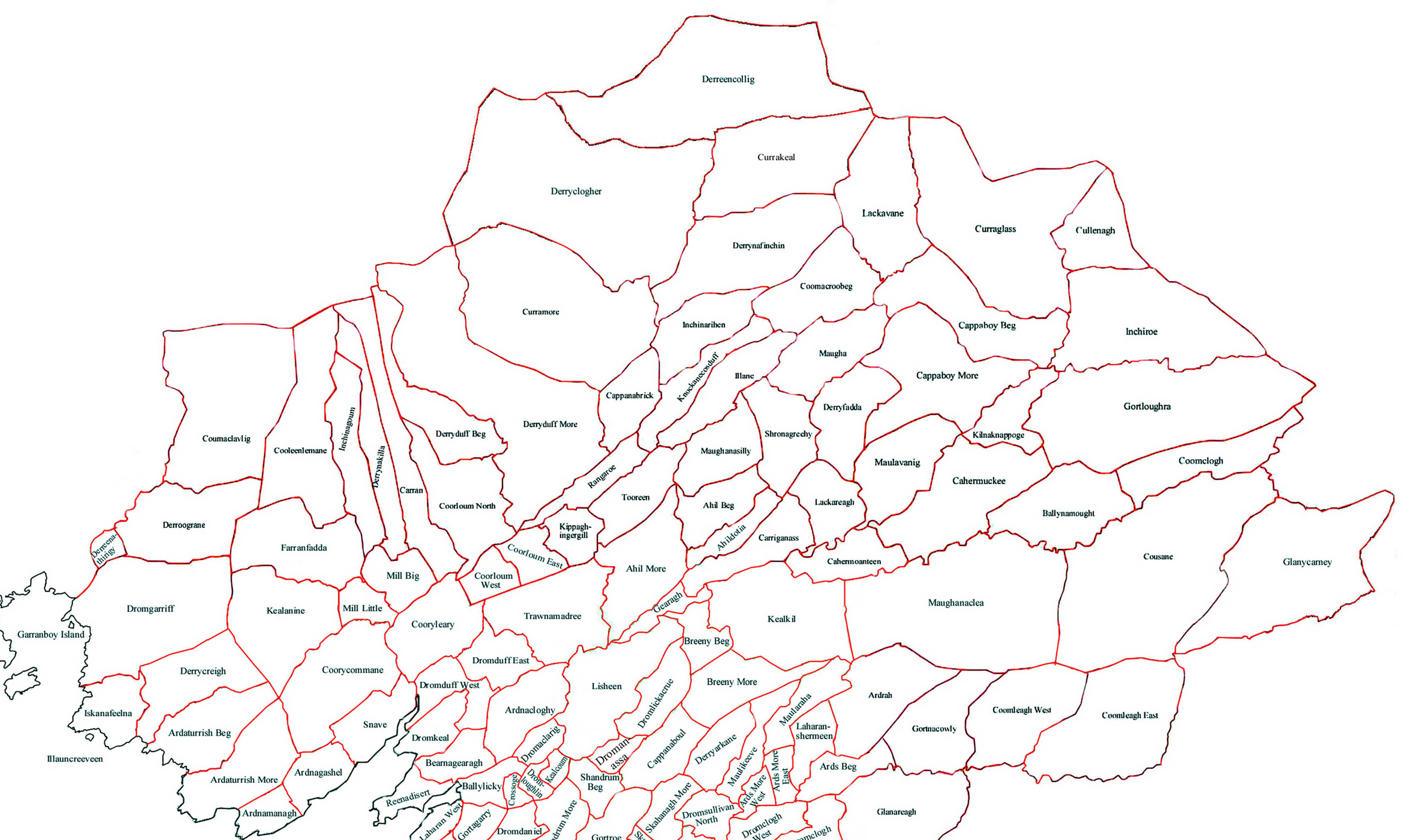
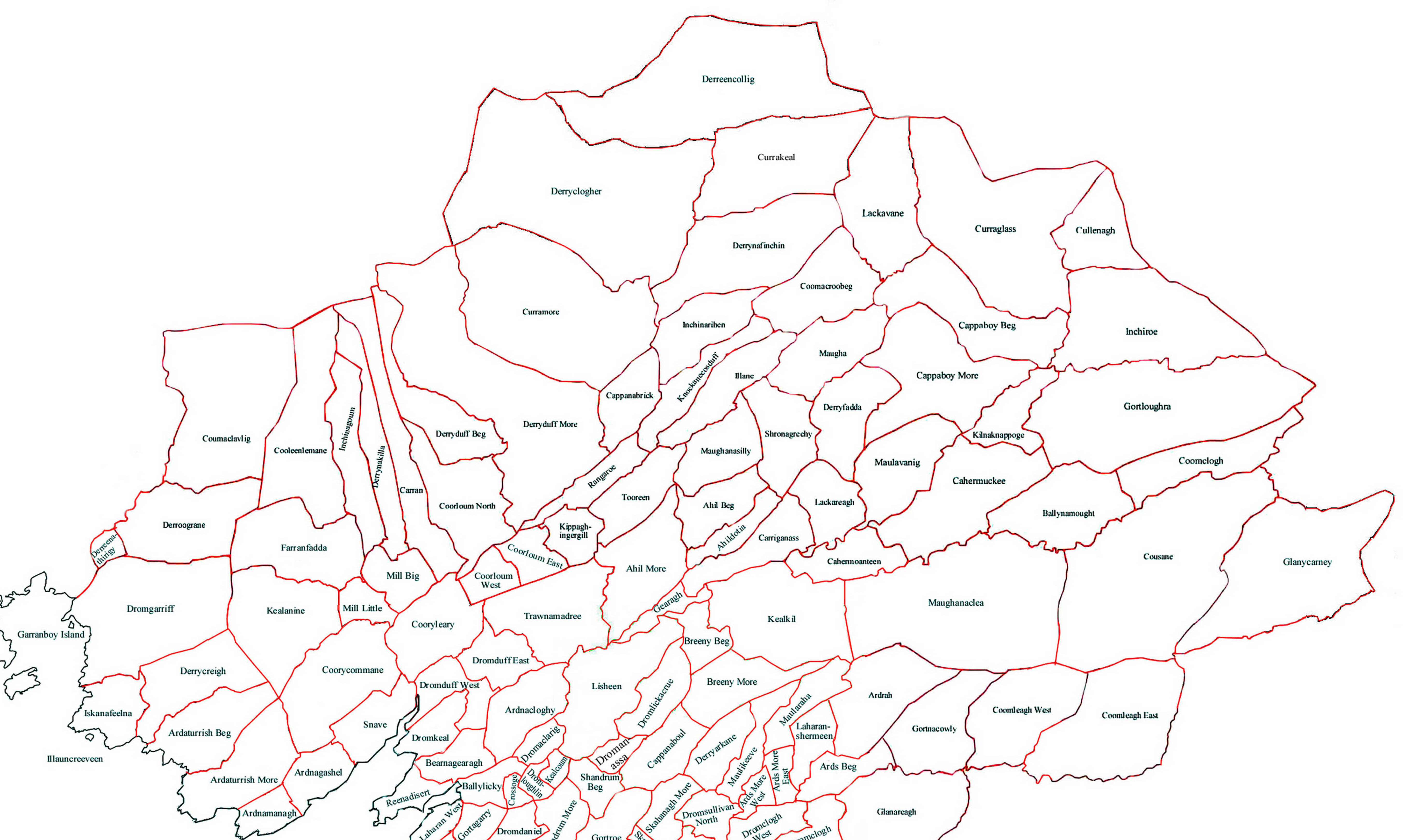
Townlands:
KilmocomogeN

KilmocomogeN-2

Tithe Aplottments 1825, by Susan Beretta, Salt Lake City.

http://corkgen.org/publicgenealogy/cork/potpourri/corkancestors.com/Bantry2.htm

http://corkgen.org/publicgenealogy/cork/titheapplot/kilmocomoge/tithe.html

Griffith Valuation 1853:

http://www.askaboutireland.ie/griffith-valuation/index.xml?action=doPlaceSearch&Submit.x=32&Submit.y=10&freetext=Place+Name&countyname=CORK&baronyname=&unionname=&parishname=KILMOCOMOGE

Births:

https://docs.google.com/spreadsheet/ccc?key=0AqhnQGE3ANjzdElPUkFtU2dnN1cyZWdpeGZldFRjQ0E#gid=0

Marriages:

https://docs.google.com/spreadsheet/ccc?key=0AqhnQGE3ANjzdHFKSEF0UTR2UzNmaWdBcjdYcUFHd1E#gid=0

Deaths (includes transcriptions from Old Bantry Graveyard done by Hazel Vickery), some families used the old graveyard in Bnatry in the 20th century. Some outlyingfamilies probably used Moulivard in the townland of Ballycomane, Durrus. The late Bnatry Historial Paddy O’Keeffe commissioned an engineering survey f the then overgrown graveyard in 1955 and commenced its restoration:

https://docs.google.com/spreadsheet/ccc?key=0AqhnQGE3ANjzdERmc3BGbFczVFZqN0FTUkJtU1RsU2c#gid=0

https://mail.google.com/mail/u/0/?tab=wm#inbox/14354dd4f54c4cdc?projector=1

https://mail.google.com/mail/u/0/?tab=wm#inbox/14354dd4f54c4cdc?projector=1

Present Parish:
http://www.kilmocomogue.cork.anglican.org/Kilmocomogue/Welcome.html

Bantry Estate Rent Books from 1780s Bantry Beara areas, Co. Cork

30 Tuesday Apr 2013

Posted by durrushistory in Uncategorized

≈ 2 Comments

Tags

bantry, Bantry Bay, down survey bantry beara, Dublin, Google, ireland, National Archives, west cork, WordPress


There are two rent books relating to the Bantry Estate in the National Archives, Dublin, Ref. MS. 4944 and 4945

https://picasaweb.google.com/lh/sredir?uname=100968344231272482288&target=ALBUM&id=5872596379695712433

Non farming leases from Bantry House are included here

https://durrushistory.wordpress.com/2012/09/08/non-farming-leases-banrty-area-mainly-from-bantry-house-papers-1565-1914/

Down Survey 1665-68

http://downsurvey.tcd.ie/down-survey-maps.php#bm=Beara+%26+Bantry&c=Cork&indexOfObjectValue=-1&indexOfObjectValueSubstring=-1

Legal tenure of Ballydehob, Dromreagh, Murreagh and Adroguinna, from 1626, West Cork.

13 Wednesday Mar 2013

Posted by durrushistory in Uncategorized

≈ 1 Comment

Tags

cork, durrus, Earl of Burlington, ireland, Mines west Cork, Napoleonic Wars, schull, Sir William Hull. Earl of Cork, west cork


https://www.google.ie/maps/place/Ardogeena,+Co.+Cork/@51.6122167,-9.532978,15z/data=!3m1!4b1!4m2!3m1!1s0x48459fb8f9c0f5c7:0x7554b4a819007bca?hl=en

From the Encumbered estates Court 1854 where the title to land before the court is recited.  This court was an attempt to ‘dry clean’ in a legal sense property which was so heavily encumbered that in effect in was unsaleable.  Apart from bank mortgages much of this property, the insolvent estates of Irish landlords, was heavily affected by family settlements to provided for annuities for family members, marriage portions and so on. The famine was only the last straw which broke the camel’s back, the financial distress had been piling up since the collapse in agricultural prices with the ending of the Napoleonic Wars in 1817.

Deed 12th April and 13th 1738, Earl of Burlington and Cork (descendants of Boyle), Sir William Heathcote to Richard Tonson (one of the Tonsons was the illegitimate son of Hull, who ran a fishery in Schull and was a major landowner).  All manorial rights to the Lord of the Manor of Ballydehob and lands of Dromreagh, Murreagh and Ardoginna (these three townlands are in Durrus on the Schull side of the Mizen peninsula), acquires Dromrigh, alias Drumreagh, Dromlowe, and Ardogennae, three ploughlands in tenure and occupation of Edward Boyle and Mary his wife lease of 21st May 1626 for 5,000 years, sold to Richard Tonson for £1,700, Evanson 24th September 1765, Richard Tonson to Richard Tonson Evanson received by William Tonson Lord Baron Riversdale to Nathaniel Evanson 12th March 1811, Parliamentary conveyance his Grace to have right to protect claim, minerals to be excepted, (in fact the area is rich in minerals there were a number of mines in the region in the 19ht century).

Early Irish History and Antiquities and the History of West Cork By Rev. W. O’Halloran 1916, O’Mahony Genealogy.

02 Tuesday Oct 2012

Posted by durrushistory in Uncategorized

≈ 3 Comments

Tags

carbery, O'Mahony genealogy, west cork


From: Early Irish History and Antiquities and the History of West Cork
By Rev. W. O’Halloran
1916

The O’Mahonys of West Cork

Dr. Smith says: ” These Mahowns derive their pedigree from Kean Mac Moyle More, who married Sarah, daughter to Brian Boru, by whom he had Mahown, the ancestor of all the sept. It is from this Kean the village of Iniskeen, in Carbery, has its name, and from this sept that Bandon is sometimes called Droghid Mahon. Mahon was the ancestor of the Mahonys, or O’Mahonys.”
The O’Mahonys, whose stronghold was in the neighbourhood of Bandon (Drohid Mahon), were the first to encroach on the territory of the O’Driscolls. This occurred long before the Anglo-Norman invasion. They possessed themselves of the western portion of Corca Laidhe called Ivahah, which comprised the parishes of Kilmoe, Schull, Durrus, Kilchrohane, Kilmacougue, and Caheragh. They had fourteen strongly built castles.
The Rosbrin family and the proprietor of Dunbeacon Castle joined the Desmond rebellion in 1579. The head of the O’Mahony sept kept aloof.
Sir Thomas Norreys, Lord President of Munster, spent some time at Ross in 1599 looking out for the arrival of the Spaniards. He writes to the Privy Council on the 26th of March: ” Since my last letter in Ross, I continued in this country until March 16th, but could find no confirmation of the arrival of the Spaniards. I returned home by Kinelmeky, where the O’Mahons dwell, and burned their corn and spoiled the country.” When the corn was young they destroyed it by a specially made harrow called a ” pracas,” and when it was in a more advanced stage by sickles and swords.
The Spanish expedition, as already stated, was supported by the O’Driscolls and O’Sullivan, and likely the head of the O’Mahonys would have joined it only that he was cast into prison at the time by Carew, who invited him ostensibly to the assizes then being held in Cork.
Some of the O’Mahonys migrated into Kerry and settled near Killarney, Castleisland, and Kenmare, and were people of importance, their descendants remaining to the present day. In 1584 commenced the decay of the sept, and the subsequent wars proved disastrous to it

Tom Hosford, born 1874, Gortnaclohy, An unforgettable Schoolmaster, Skibbereen, early mid 20th century.

29 Saturday Sep 2012

Posted by durrushistory in Uncategorized

≈ 4 Comments

Tags

free education skibbereen bantry west carbery co. cork, irish history, west cork


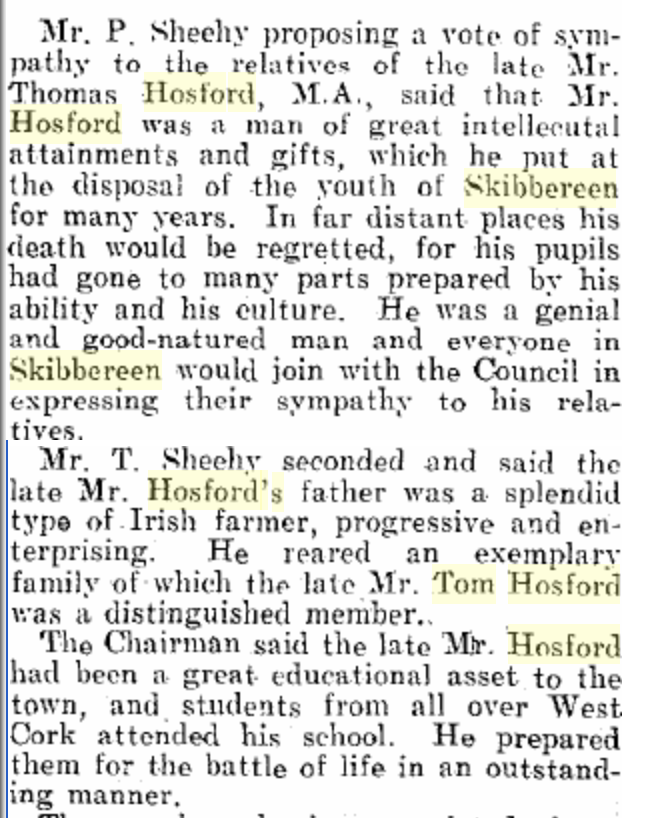
Tom Hosford Schoolmaster Skibbereen

Before the coming of ‘Free Secondary Education’, in the mid 1960s secondary education in Irish towns was patchy or non existent. Ireland’s prosperity of recent times can be attributed to that decision as the development of human capital.  In Skibbereen Catholics were provided for by a Girls Convent and to some extent by the De La Salle Brothers. In the 1991 booklet on the 100th anniversary of the Church of Ireland Church at Abbeystrewry there is a portrait by Trevor Roycroft of Tom Hosford, who ran a secondary school for boys and girls of all religions in Skibbereen.  Thomas Hosford MA appears in Guy’s Directory of 1914 as having a Church Of Ireland, Intermediate and Collegiate School. In the census of 1901 and 1911 he is born either in 1874 a member of a large farming family in Gortnaclohy and he took his MA in Trinity College Dublin he probably did a BA in Queens College Cork in 1896. . It is clear from the article that many benefited from his selfless devotion to his pupils. A school, similar in some respects operated in Bantry in the 1940s 50s and early 60s. A similar one operated from the Model School in Dunmanway.


Children of (166) William Hosford and Elizabeth Sweetnam of Fort Robert and
Castlelands (Skibbereen):
361 Joseph Hosford born 1871, died 1944
362 William Hosford born 1872, emigrated Canada (Ontario)
363 Thomas Hosford born 1873, schoolmaster, died 1938


Robert Swanton, Ballydehob, Co. Cork, United Irishman and Judge of the Marine Court, New York, 1764-1840

08 Saturday Sep 2012

Posted by durrushistory in Uncategorized

≈ 4 Comments

Tags

bantry, co.cork, cork, history, irish history, lawyer, united irishmen marine court of new york ballydehob skibbereen west cork, west carbery, west cork


1764-1840Fr. Coombes a noted Cork historian wrote the following in respect of Robert Swanton.

The Swanton Memorial

An Historical Memorial in Skibbereen

by James Coombes

From the Swanton Family History Worldwide by Louise May Swanton

Two forgotten Ballydehob patriots are linked in a memorial in the old Protestant cemetery in Skibbereen. On the obelisk which surmounts the memorial there is a draped urn with the single word ROBERT inscribed on it. One of the four panels had the following inscription:

Sacred to the Memory of
ROBERT SWANTON
Counsellor at Law
One of the Judges of the Marine
Court of the City of New York
Who departed this life
in Ballidahab
On the 15th of February 1840
aged 76
He was a humble Christian and faithful
Friend and Benefactor

Be ye kind to one another, tenderhearted,
Forgiving one another even as God
for Christ’s sake hath forgiven you.
Epb. iv.3
Do ghradhaigh se na Gaedhil agus an Ghaeilge

Another panel commemorates three children of Thomas Swanton, Maria (d. 21 July 1852, aged 11 years 5 months); Ellen (d. 1 April 1856, aged 17 years 9 months); Annie (. 21 Nov. 1857, aged 17 years 9 months). It also contains the inscriptions: “Omnibus inservientes sed servi unius Domini” and “Blessed are the dead who die in the Lord.”

A third panel commemorates Sarah wife of Nathaniel Evanson, IV July 1830 aged 33. Sarah was almost certainly a sister of Thomas Swanton, who was a nephew of Robert Swanton.

Robert Swanton was born about the year 1764. Richard Deasy of Clonakilty wrote of him in 1845 that he had been a ‘most active agent of the United Irishmen’ and that he had ‘organised the country into a military preparation with sergeants and officers’.

Shortly before the rising of 1798 Lord Edward Fitzgerald, the Sheares brothers and other leaders were arrested. Swanton fled to America. According to one account, he had also been arrested and had escaped from jail. The late Thomas Roycroft of Skibbereen kept alive the tradition that he had been hidden in a butter barrel, smuggled out to sea in a rowing boat, and that he had boarded a ship six miles from the coast.

He soon made his mark in his adopted country, and in the 1820’s, was a leading figure in the ‘Friends of Ireland in New York’. He was the author of ‘A Manifesto to the People of Ireland’ issued by the ‘Friends’. Among his colleagues in this society were Dr. William Power and his brother Father John Power, vicar general of New York, and one of the most eminent priests in America. They were sons of Andrew and Elizabeth Power (1), who lived in the house now (1981) occupied by Mr. Joe Connolly of Deelish Skibbereen. They were nephews of Father John Power, the saintly pastor of Kilmacabea. Further research would probably unearth more details of Robert Swanton’s American career. For the moment, we must be satisfied with the obituary published by the New York Evening Post on 4 April 1840.

“It is with heartfelt regret that we announce the death of Robert Swanton, for many years judge of the Marine Court of this city. He died on the 15th of February last in the County of Cork, Ireland, which place he revisited about four years ago after an absence of more than 36 years. The loss of this inestimable man cannot fail to be severely felt by the poor and oppressed to whom he was an undeviating protector and friend.

Possessed of considerable wealth but disdaining the vanities and luxuries for which wealth is so eagerly sought, he freely contributed to the relief of the indigenous and to promoting the interest of numerous relatives and friends. He was no less alive to the political and moral welfare of his fellow creatures. He was an unswerving and ardent advocate of the rights of man.

In the great effort undertaken at the end of the last century by a magnanimous and self-devoted band of patriots to rescue their native land from the grasp of the oppressor, he nearly sacrificed his life, was driven from his home, to become a friendless and destitute exile. But in the cherished land of his adoption, his sound sense, his intelligence, his integrity and his devotion to popular rights were soon appreciated and earned the esteem and love of a numerous circle of friends.

Neither prosperity nor advancing age dampened the ardor of his philanthropy. We have no doubt that after he had passed the alloted span of man’s existence here, he was willing to sacrifice all for the social regeneration of man as when, 44 years ago, he placed his name on the roll of the “United Irishmen”.

The Truth Teller (2) said of him “To the above just tribute to the memory of a good man – ‘the noblest work of God’ – we add that the following extract of a letter from him, for examination of which we are indebted to one of his distinguished friends, dated Cork 30th November last, showing that in his 80th year he was still the same unchanged, unchangeable and uncompromising Democrat which marked his previous course.

The octogenarian asked an old friend in New York “What are the prospects of my esteemed fellow citizen, Martin Van Buren? Electioneering rumor is busy even here. Well have you tacked British to the self-styled Whigs of the present day”. In allusion to the name the opposition have taken he continues, “You and I have often been amused with names, but never gulled by them. I know that American Democracy will — the people will — be true to themselves and Martin Van Buren will be our next President. I hope to be with you in time to give my feeble support to the good old cause”. The prophetic voice of Robert Swanton is now a voice from the grave: “appreciate, believe, act.”
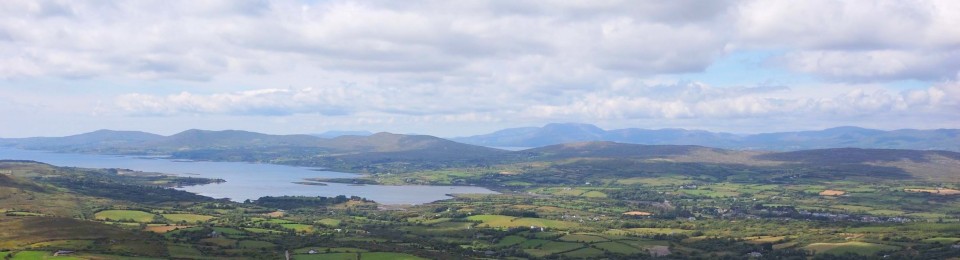
John Stevens, visit to Bantry, May 1689, ‘Not worth the name of a Town, having not more then seven or eight little houses the rest very mean cottages.

10 Thursday May 2012

Posted by durrushistory in Uncategorized

≈ 1 Comment

Tags

bantry, west cork


https://www.google.ie/maps/place/Bantry,+Co.+Cork/@51.6809048,-9.4573576,15z/data=!3m1!4b1!4m5!3m4!1s0x48450a56fb9974b9:0x0a00c7a99731a220!8m2!3d51.6809112!4d-9.4485855?hl=en

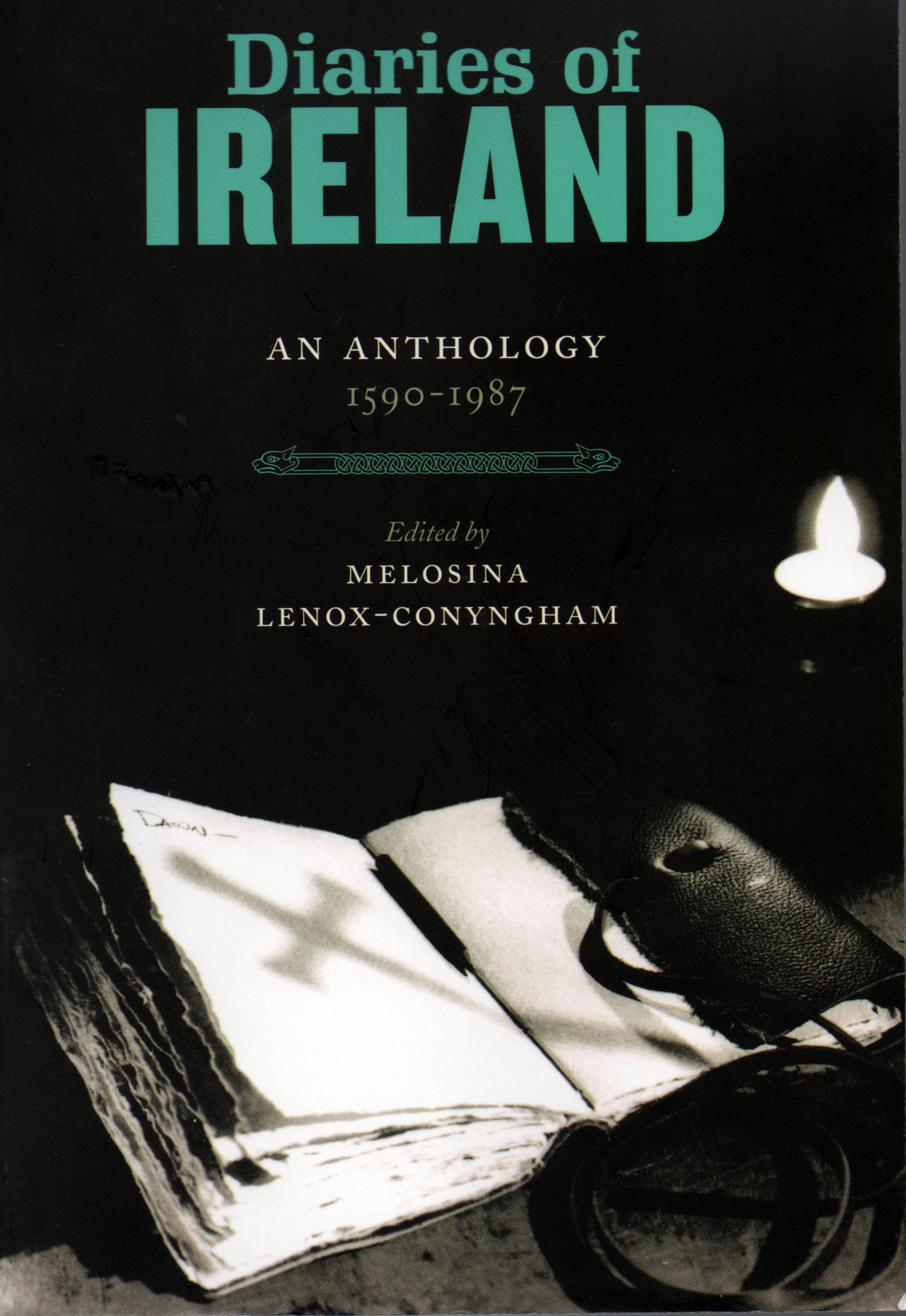
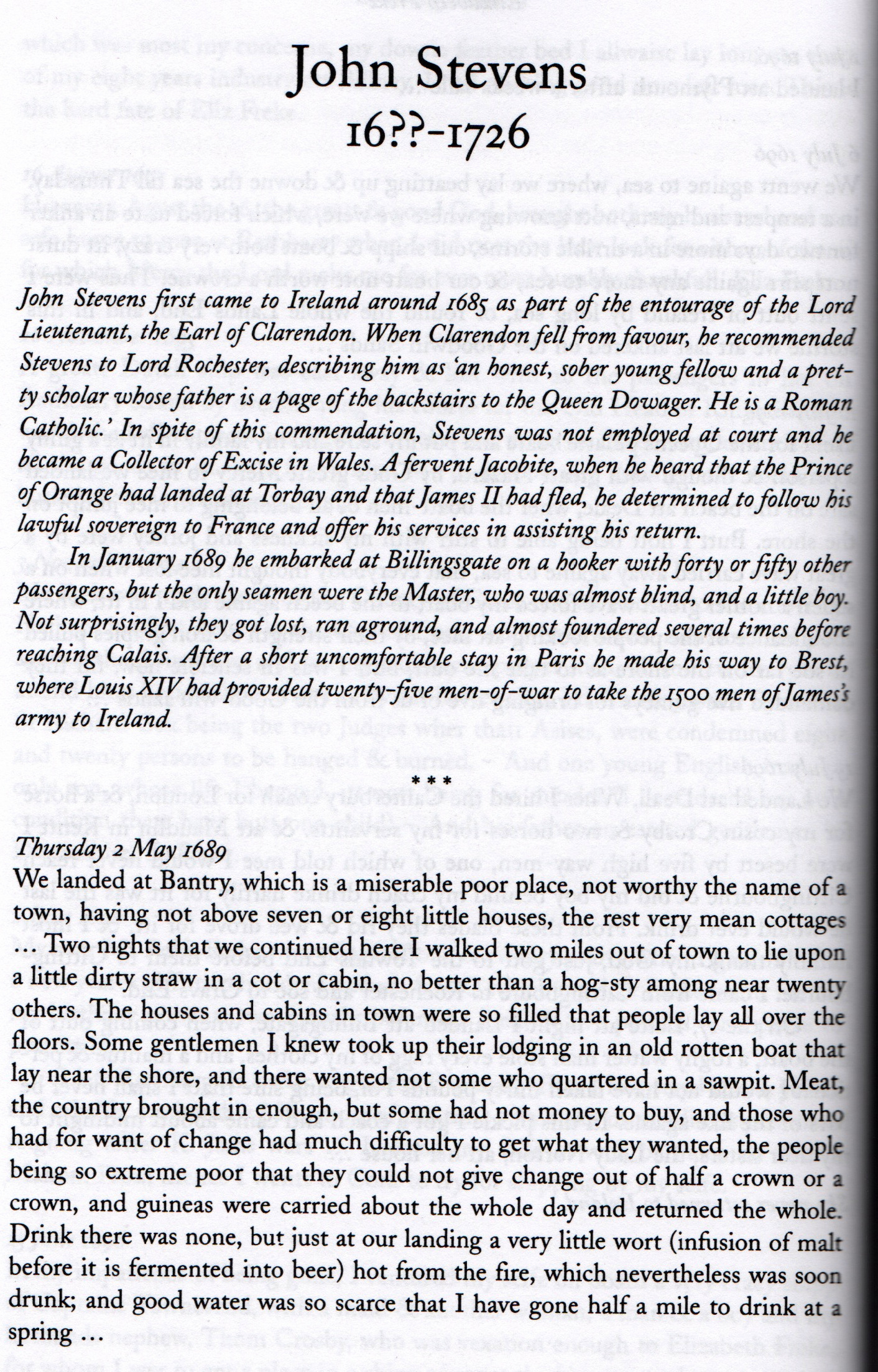
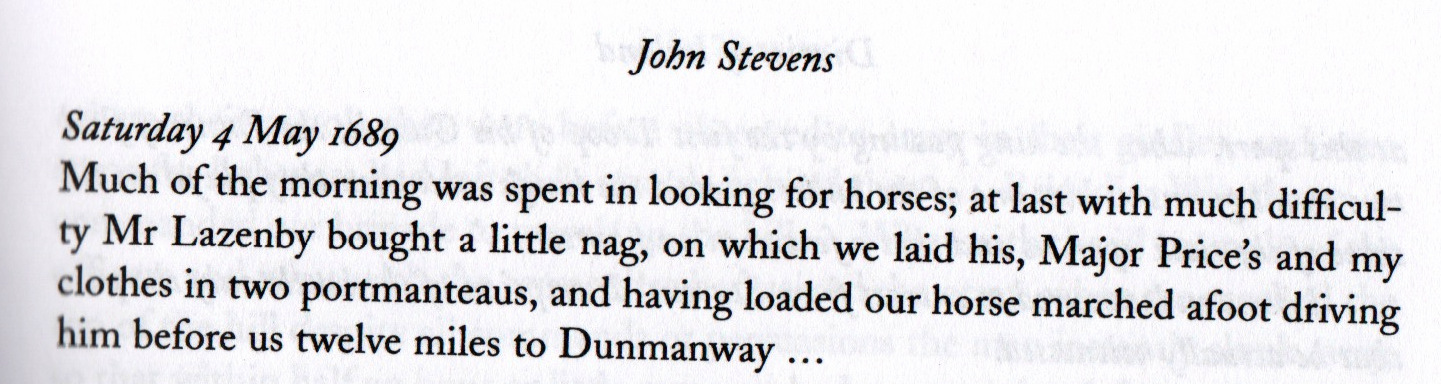
John Stevens was a Jacobite and landed in Bantry on the 2nd May 1689.  The enclosed piece is from a collection of tales in ‘Diaries of Ireland’,  An Anthology 1590-1987, by Melosina Lenox-Conyngham, The Lilliput Press, 1998.

Thursday 2 May 1689

We landed in Bantry, which is a miserable poor place, not worthy of the name of a town, having not above seven or eight little houses, the rest very mean cottages… Two nights that we continued here I walked two miles out of town to lie upon a little dirty straw in a cot or cabin, no better than a hog-sty among near twenty others.  The houses and cabins in town were so filled that people lay all over the others.  Some gentlemen took up their lodgings in an old rotten boat that lay near the shore, and there wanted not some who quartered in a saw pit.  Meat, the country brought in enough, but some had not money to buy, and those that had for want of change had much difficulty to get what they wanted, the people being so extremely poor that they could not give change out of half a crown or a crown, and guineas were carried about the whole day and returned the whole.  Drink there was none, but just at our landing a very little wort (infusion of malt before it is fermented into beer) hot from the fire, which nevertheless was soon drunk; and good water was so scarce the I have gone half a mile to drink a spring….

Saturday 4 May 1689.

Much of the morning was spent in looking for horses; at last with difficulty, Mr Lazenby bought a little nag, on which we lay his, Major Price’s and my clothes in two portmanteaus, and having loaded our horse marched afoot driving him before us twelve miles to Dunmanway

1-Scan 1504

1-Scan 1506 2-Scan 1507

Census 1841-81, Durrus West Cork townlands population and houses

09 Monday Apr 2012

Posted by durrushistory in Uncategorized

≈ Leave a comment

Tags

census, history, west cork


https://www.google.ie/maps/place/Durrus,+Co.+Cork/@51.6217107,-9.521993,11z/data=!4m2!3m1!1s0x48459fe7ccd270df:0x231e3744ac95441a

Bantry Barony,

Durrus Parish.

Population

1841

1851 1861 1871 1881
Booltenagh 107 28 18 23 18
Curraghavaddra 115 50 37 43 35
Dromreague 28 18 21 22 9
Gurteen 62 51 38 49 49
Lissareemig 10 7 16 8 6
Mullagh 93 20 21 22 24
Rooska East 132 34 33 33 25
Rooska West 155 160 97 89 79
Tedagh 30 34 35 29 30
Total 752 389 336 318 275
Carbery West, West Division, Durrus Parish
Ardgeena 69 46 14 35 42
Ballycomane 381 223 185 210 205
Brahalish 277 147 131 113 109
Carrigboy 190 137 200 12 26
Clashadoo 263 162 141 147 130
Clonee 95 30 27 34 25
Coolculaghta 474 215 193 231 217
Coomkeen 164 120 131 140 134
Crottees 146 76 63 52 51
Dromatanaiheen 50 22 22 22 23
Dromreagh 263 119 105 101 101
Gearhameen 263 134 105 107 95
Kealties 419 186 178 175 100
Kilvenoge 207 121 78 69 75
Murragh 121 33 33 39 38
Rossmore 177 94 112 113 70
Rusheenaniska 35 21 12 14 10
Tullig 116 94 35 57 52
3731 2003 1501 1703 1581
Total
Bantry Barony, Durrus Parish. Houses

1841

1851 1861 1871 1881
Booltenagh 18 5 2 3 4
Curraghavaddra 15 8 7 8 6
Dromreague 6 6 6 3 3
Gurteen 10 10 9 9 9
Lissareemig 2 1 3 1 3
Mullagh 13 7 5 4 5
Rooska East 19 5 5 5 4
Rooska West 23 20 17 16 13
Tedagh 6 5 7 7 6
Total 114 79 61 54 64
Carbery West, West Division, Durrus Parish Houses
Ardgeena 11 8 3 7 6
Ballycomane 60 42 33 30 29
Brahalish 41 25 23 21 18
Carrigboy 20 20 37 3 3
Clashadoo 46 37 25 25 21
Clonee 14 11 6 6 5
Coolculaghta 76 40 36 41 40
Coomkeen 27 23 22 23 22
Crottees 22 17 12 8 9
Dromatanaiheen 9 5 3 4 3
Dromreagh 48 17 17 16 20
Gearhameen 38 21 19 19 21
Kealties 75 32 28 29 23
Killavenoge 28 20 15 13 12
Murragh 18 8 7 6 7
Rossmore 26 16 22 19 11
Rusheenaniska 5 3 2 3 1
Tullig 18 19 10 11 9
Total 395 374 322 291 236

These figures are obtained from the Census Commissioners report to the House of Commons, 1884.

Letter from Sir George Carew to Lord Deputy Mountjoy, from camp at the Abbey, Bantry, 1602.

07 Wednesday Dec 2011

Posted by durrushistory in Uncategorized

≈ 4 Comments

Tags

bantry, cork, history, west cork


https://www.google.ie/maps/place/Abbey,+Co.+Cork/@51.6755658,-9.4787845,15z/data=!4m2!3m1!1s0x48450ae74e1778df:0xcf5b987d07037e66

The original manuscript is held at the Lambeth Library in England and is written after the Battle of Kinsale and prior to the storming of the O’Sullivan Castle at Dunboy by SIR GEORGE CAREW to LORD DEPUTY MOUNTJOY.  MS 624, p. 141  13 May 1602

These documents are held at Lambeth Palace Library
Former reference: MS 624, p. 141
4 Pages.
Supplementary information: Calendar of the Carew Manuscripts preserved in the Archiepiscopal Library at Lambeth, ed. J. S. Brewer & W. Bullen (6 vols., 1867-73), vol. IV, document 237.
Contents:
“Your letters by your servant Pavye, bearing date the 19th and 20th of April, I received the 12th of this instant; being sorry in my heart that I was gone from Corke before his coming, that I might have more fully answered every point of them.. and more precisely have obeyed your Lordship’s directions… Upon the messenger I can lay no blame, for he departed Dublin the 20th, and I rose from Corke the 23rd of April, whereby it was impossible for him to overtake me; and to follow me by land he could not, and by sea, before the wind served, he could not budge out of Kynsale…
“The general letter from your Lordship and the Council I have answered at large… By reason of the want of my papers and the officers of the munitions and victuals (.. one in Corke and the other in England) I am ignorant of the magazines of either of them, but.. have taken such a course as I hope will be pleasing to you, and, if your Lordship shall not so think it, I will at my return from Donboye accomplish your commandments to the uttermost I may…
“For the fortifications in the river of Corke.. I cannot give any directions in them until my return; and in the meantime Paul Ive will be sufficiently employed at Kynsale.”
I thank you for imparting the Lords’ letters to me, and do hope they “will redress the error in victualling, and give order for our payments in money since the contract for clothes is broken,.. for the soldier in the meantime both in back and belly is pinched.”
“Of the coming of Spaniards I am no less distracted in my judgments than your Lordship is, for all passengers or merchants that come out of France or Spain do still assure their coming, and that very shortly. The rebels stand assured of their coming before this month is expired, and the hope thereof keeps Tyrrell and William Bourke my neighbours, who otherwise would quit this province; for they are heartily afraid of treason in the provincials, and wish themselves gone… They lie in such incredible strengths of huge mountains and ugly glynns of bog and wood, as I think no place of the world yields the like, and the ways of such advantage unto them as an 100 men may forbid an army of 5,000 to march from Bantry to Donboye, which is but 24 miles; and if there were no enemy to resist us, nor any baggage in our army, the ways in themselves are so difficult as in less time than eight days I cannot come thither, for three miles a day is the most we can march; and for horse or garrons to carry victuals and munitions no possibility of passage. Wherefore I have resolved by boats and shipping to cross the Bay of Bantry, and to land within seven miles of the castle, which is a reasonable way (though mountainous), yet indifferent as well for us as the enemy. I would not have believed any man’s report if my own eyes had not seen the mountains and glynns which here I find…
“If the Queen’s fleet were not upon the coast of Spain, I do confidently believe that we should within a few days see another Spanish army in Munster. But my hope is that the fleet will enforce their stay; which moved me to make the greater haste to Beerehaven to win the castle of Donboye before their coming; the which (as I understand) is, by the advice of the Spaniards that were there, strongly re-enforced with hugh earthy-works able to withstand a great battery. But howsoever I hope in God to carry it, but am much afraid that I shall be enforced to send unto Corke for a supply of munitions, which is the cause I have directed the clerk of the munition to reserve five last of powder, if extremity did enforce me, and also that these parts might not altogether be left bare to answer foreign occasions.
“But I hope the store is such as that the ten last written for may be sent unto you, and five last remaining. If not, to supply your army in Connaght which goes to Ballyshennan there is five lasts of powder with lead and match at Lymericke, which by water with a guard to Athlone may be carried safely from thence. But if Corke cannot yield your Lordship the ten lasts demanded, what lacks of the same (if your Lordship do send for it) I will presently send it unto Dublyn, not meaning to dispute but to obey all your Lordship’s commandments… The strength of the magazine.. is better known to the master of the ordnance there, who before his departure from hence did sundry ways dispose the same; and my particular notes are in Shandon… Of all the other things in that note comprised, if they be in the store at Corke, they shall be presently sent unto your Lordship, though I am sorry to depart with pioneers’ tools, having so great occasion to use them in the work intended.
“If the munition at Lymericke might come safely unto me by sea, I would not care how bare the store.. at Corke were left; but this summer time there is not so little as twenty galleys swarming upon this coast, and within these ten days they have taken two merchants, one of Gallwaye and an Englishman, both of them loaden with corn and wines, which goods is now in possession of the rebels, which is a great relief to the Buonies, who before lived only upon beef and water, and wanted bread, for want whereof they grew into such discontent as they were ready to break.
“According your Lordship’s commandment, Cormocke and John Barry shall be discharged, but [I] do humbly pray your Lordship (not for any love I bear them, but for the service’ sake,) that they may be continued in pay until I return;.. for.. they being now with their companies in the camp with me, it is an inconvenient time to cast them, lest at my back they may work some disturbance, and at Cormocke’s hands I expect no better, which they dare not do when I am returned. Besides the better part of my army is Irish; whom for the present I dare not discontent… But then no man [is] more glad of cashiering Irish companies than myself.
“The copies of letters and other notes your Lordship writes for are in my cabinet at Shandon, but as soon as I return I will send them unto you. I have written unto my wife to deliver unto your servant Pavye 400l. in Spanish silver, which I am sure he shall receive. In your Lordship’s next.. signify.. the receipt of it. 200l. Apsley had; the rest your Lordship may easily judge where it remains; a particular note I will send you at my return, for now I cannot do it.
“I will write often unto you, and.. pray your Lordship to do the like, being unto me a good light how to direct my ways in Munster, besides the comfort I receive in your Lordship’s good successes, which I beseech the Almighty to bless you in, that your works were ended, and both of us in England, to have the society of our friends, and to enjoy part of their ease.”
Camp near the Abbey of Bantry, 13th May 1602.
Copy.

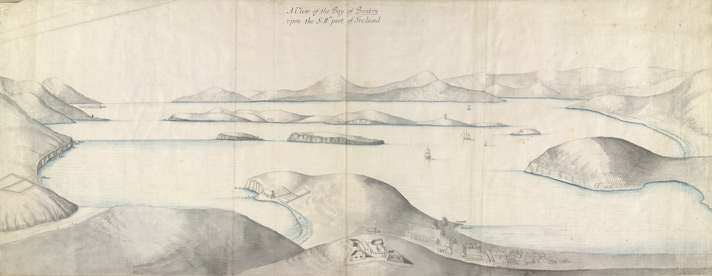
View of Bantry Bay 1685, British Library.

02 Friday Dec 2011

Posted by durrushistory in Uncategorized

≈ 1 Comment

Tags

bantry, cork, irish history, west cork


← Older posts
Newer posts →

Blog Stats

  • 840,605 hits

16th Regiment of Foot assisted female emigration australia ballyclough bantry bay caithness legion cavan regiment of militia cheshire fencibles coppinger's court inbhear na mbearc Irish words in use 1930s lord lansdowne's regiment mallow melbourne ned kelly new brunswick O'Dalys Bardic Family. o'regan Personal Memoirs rosscarbery schull sir redmond barry sir walter coppinger st. johns sydney Townlands treaty of limerick Uncategorized university of Melbourne victoria

16th Regiment of Foot assisted female emigration australia ballyclough bantry bay caithness legion cavan regiment of militia cheshire fencibles coppinger's court inbhear na mbearc Irish words in use 1930s lord lansdowne's regiment mallow melbourne ned kelly new brunswick O'Dalys Bardic Family. o'regan Personal Memoirs rosscarbery schull sir redmond barry sir walter coppinger st. johns sydney Townlands treaty of limerick Uncategorized university of Melbourne victoria
Follow West Cork History on WordPress.com

Enter your email address to follow this blog and receive notifications of new posts by email.

Join 518 other subscribers

Feedjit

  • durrushistory's avatar durrushistory

Archives

  • December 2025
  • November 2025
  • October 2025
  • September 2025
  • August 2025
  • July 2025
  • June 2025
  • May 2025
  • April 2025
  • March 2025
  • February 2025
  • January 2025
  • December 2024
  • November 2024
  • October 2024
  • September 2024
  • August 2024
  • July 2024
  • June 2024
  • May 2024
  • April 2024
  • March 2024
  • February 2024
  • January 2024
  • December 2023
  • November 2023
  • October 2023
  • September 2023
  • August 2023
  • July 2023
  • June 2023
  • May 2023
  • April 2023
  • March 2023
  • February 2023
  • January 2023
  • December 2022
  • November 2022
  • October 2022
  • September 2022
  • August 2022
  • July 2022
  • June 2022
  • May 2022
  • April 2022
  • March 2022
  • February 2022
  • January 2022
  • December 2021
  • November 2021
  • October 2021
  • September 2021
  • August 2021
  • July 2021
  • June 2021
  • May 2021
  • April 2021
  • March 2021
  • February 2021
  • January 2021
  • December 2020
  • November 2020
  • October 2020
  • September 2020
  • August 2020
  • July 2020
  • June 2020
  • May 2020
  • April 2020
  • March 2020
  • February 2020
  • January 2020
  • December 2019
  • November 2019
  • October 2019
  • September 2019
  • August 2019
  • July 2019
  • June 2019
  • May 2019
  • April 2019
  • March 2019
  • February 2019
  • January 2019
  • December 2018
  • November 2018
  • October 2018
  • September 2018
  • August 2018
  • July 2018
  • June 2018
  • May 2018
  • April 2018
  • March 2018
  • February 2018
  • January 2018
  • December 2017
  • November 2017
  • October 2017
  • September 2017
  • August 2017
  • July 2017
  • June 2017
  • May 2017
  • April 2017
  • March 2017
  • February 2017
  • January 2017
  • December 2016
  • November 2016
  • October 2016
  • September 2016
  • August 2016
  • July 2016
  • June 2016
  • May 2016
  • April 2016
  • March 2016
  • February 2016
  • January 2016
  • December 2015
  • November 2015
  • October 2015
  • September 2015
  • August 2015
  • July 2015
  • June 2015
  • May 2015
  • April 2015
  • March 2015
  • February 2015
  • January 2015
  • December 2014
  • November 2014
  • October 2014
  • September 2014
  • August 2014
  • July 2014
  • June 2014
  • May 2014
  • April 2014
  • March 2014
  • February 2014
  • January 2014
  • December 2013
  • November 2013
  • October 2013
  • September 2013
  • August 2013
  • July 2013
  • June 2013
  • May 2013
  • April 2013
  • March 2013
  • February 2013
  • January 2013
  • November 2012
  • October 2012
  • September 2012
  • August 2012
  • July 2012
  • June 2012
  • May 2012
  • April 2012
  • March 2012
  • February 2012
  • January 2012
  • December 2011
  • November 2011
  • October 2011

Blog at WordPress.com.

  • Subscribe Subscribed
    • West Cork History
    • Join 518 other subscribers
    • Already have a WordPress.com account? Log in now.
    • West Cork History
    • Subscribe Subscribed
    • Sign up
    • Log in
    • Report this content
    • View site in Reader
    • Manage subscriptions
    • Collapse this bar
 

Loading Comments...