1822, The Troubles of a Struggling Farmer, Mud Cabin, Heavy Taxes, Tithes, Cess, and Rack Rents, Wintry Wind, by Poet Mícheál Óg Ó Longáin (1766-1837), Caheragh, (lived later Glanmire), Co. Cork.
Life
1766–1837),poet and scribe; born to the Ó Longáin learned family in Carrignavar, Co. Cork. 1766-1837; b. Carrignavar, Co. Cork; son of Mícheál mac Peadair; orphaned young, his parents dying in 1770 and 1774; employed as cowherd; returned to education, 1784; assisted United Irishmen, 1797-98; wrote for Whiteboys, 1785; ‘Buachaillí Loch Garman [Boys of Wexford]’, 1798; m. 1800; worked as scribe, labourer, and teacher in Co. Cork; settled in north Kerry and East Limerick, 1802-07; wrote on poverty and oppression; employed as a teacher and scribe by Rev. John Murphy, Bishop of Cork, 1814; copied manuscripts, 1817-1820; sons Peadar and Pól, and Seosamh, also became scribes; died. on his son Pól’s 11-acre holding in eleven acres in Knockboy in…
The sums paid on tithes 1820s was enormous, not all went to the clergymen some went to lay impropriators who puchased tithes as an investment. Of the amount which went to clergymen part was to pay for services such as the care of fondlings burial of the indigent dead and other services.
Father Patrick Hickey in his Mizen history has document in detail this period.
Timoleague Tithes. Commissioners Patrick O’Brien, Michael Enright.
CSO/RP/1829/910 Letter from Rev Charles Ferguson, Bandon, relating to Patrick O’Brien who stands accused of smuggling tobacco. Confidential letter from Rev Charles Ferguson, Prebendary of Timoleague, Timoleague Glebe House, Bandon, [County Cork], to William Gregory, Under Secretary, relating to Patrick O’Brien who stands accused of smuggling tobacco.
Tithes payable to Rev. Charles Ferguson as Prebentry and Vicar of parish.
TCD, FERGUSON Charles 1811 14 Joseph Curator Dublin TCD
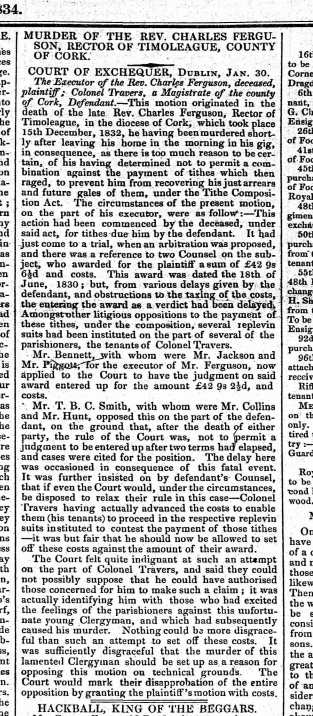
Charles Ferguson, Timoleague, 1832 was murdered while attempting to collect his tithes by force.
Involved in litigation with parishioners.
Commissioners set tithes at £413 British sterling, to Rev. Charles Ferguson as Prebentry and Vicar of parish. Unusually the Select Vestry of qualified voters on 1827 agreed a figure of £320 for 21 years, included Jerry Leary, Daniel Leary, ..Long Chairman his mark, Felix Mccarthy. Around this time the pay offered for teacher sin the new National Schools was £28 a year.
1828 Average price of wheat for seven years prior to 1821, £1 18 shillings per barrel
..
..
Tithes
Tithes were a medieval tax of one tenth of crops. The benefits went to the clergy who were expected to provide civil services out of it. In Cork Richard Boyle (ancestor the the Dukes of Devonshire and numerous other lines) managed by underhand methods in the early 17th century to acquire most of the Diocesan tithes. A large part was ‘impropriate’ and in time were traded as any form of property. Much of the later trouble with tithes came from the vigorous enforcement to entitlements by tithe proctors who sometime acquired the tithes or received a significant proportion of money collected.
The Tithe Composition Act of 1823 provided that a special Vestry could appoint an arbitrator to determine the amount of tithe. The exemption of pasture from tithe was abolished in 1824. The amount of tithe was fixed at 21 years. Schull implemented tithe composition in 1826. Kilmoe followed in 1828, Aughadown in 1829 and Kilcoe in 1830. In Kilcoe the tithe of £215 of which went to the Rector Rev. Henry Stewart the balance to the ‘lay impropriator’, Lord Audley.
The local tithe compositions were extremely high, of Durrus £350 of which £170 to the lay Impropriator originally the Earl of Donoughmore in the 1820 it was divided into Nathaniel Evanson for Durrus and he and Alexander O’Driscoll for Kilcrohane, Schull Parish was £850, Kilmoe £500, Dunmanway £461 in contrast to Watergrasshill near Cork of £43. Tithes payable Rev. Edward Jones Alcock, Durrus, of £320 Sterling is due and payable by the year to the said Reverend Edward Jones Alcock, the composition from the tithes claimable by him as figure of such part of said Parish as is commonly known by the name of Durrus or Parish of KIlcrohane is payable to the Reverend Alcock Vicar of the said Parish the sum of £170.
After the depression starting at the end of the Napoleonic Wars in 1815 the earlier measure to alleviate tithes was inadequate and widespread agitation broke out. The Reverend Robert Traill, Rector of Schull wrote, ‘One clergyman within 30 miles of us has been murdered, and another most narrowly escaped with his life by taking refuge in the house of a priest. The ungodly are rising up, and these poor deluded Roman Catholics are caballing to deprive me of my tithes, alas!. What wickedness is this?
Tithe agitation drew on the earlier activities of the Whiteboys. As late as 1822 Richard O’Donovan, of Bawnlahan said the Whiteboys had been caught in a pitched battle with police and troops on January 25th nine had been found guilty of Insurrection Act and hanged. This was prompted by and Excise raid on a poteen making operation which developed into a running battle with the Whiteboys.
From 1834 the anti tithe meetings combined with Repeal meetings but largely with the same organisers.
The Tithe Act of 1833 reduced tithes by 25% and converted it into a tax into a rent charge to be collected by the Landlord with the rent.
By 1838 there were public meetings in Skibbereen and Bandon where all sides agreed to look for ‘an equitable arrangement of tithes’ and asked parliament to make the necessary arrangements.
Old Caheragh Church and Caheragh Poets in Irish, Na Baróidigh, (Seán, Seámus, Riocárd) Lissane, Donnacha, Muiris and Paul Ó h-Anngáin, Donnacha Ó Briain, Diarmuid Ó Crualaoich, Mícheál Óg Ó Longáin (lived later Glanmire), Church Bell Provided by Patrick Rocky Mountain O’Brien of Dromore.
Thanks to Peter O’Driscoll, Aughaville now San Francisco.
It is difficult as you drive from Drimoleague to Skibbereen over the improved farmland now used for intensive dairying that pre Famine, Caheragh was one of the most densely populated, non urban areas in the world. The parish had a population of more than 10,000. It was along with Drinagh and Castlehaven in the 18th century a centre of Gaelic Poetry. Eugene Daly in the Skibbereen Journal has recently published an article giving more details:
In the records of mid 18th century the Catholic Church in Caheragh was a small shed and cabin:
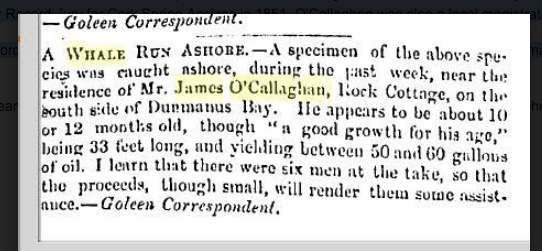
1862 Whale Landed on Dunmanus Bay near Residence of James O’Callaghan, J.P. Rock Cottage. His son Sir FRANCIS LANGFORD O’Callaghan (1839–1909), civil engineer, born on 22 July 1839, was the second son of James O’Callaghan, J. P., of Drisheen, Co. Cork, by his wife Agnes, daughter of the Rev. Francis Langford, one time Rector of Kilmoe (Goleen), Chief Engineer to the Government of India. Chief Railway Engineer, Government of India. Later managing member of the Ugandan Railway Commission.
Engineer. Francis O’Callaghan was born on 22 July 1839, the second son of James O’Callaghan, JP, of Drisheen, Co. Cork, and his wife Agnes, née Langford. He attended Queen’s College, Cork, and received his practical training under HENRY CONYBEARE . In 1862, he competed for and won a place on the staff of the Indian Public Works Department. He spent thirty two years in the Indian service, rising to the rank of chief engineer, (first class), and retiring in 1894. On his return to England he was appointed managing member of the Ugandan railway commission, a post which he half for three years and in connection with which was awarded a knighthood in 1902. He died at his home in Guildford on 14 November 1909. He had married in 1875 Anna Maria Mary, daughter of Lieutenant Colonel Powell, of Banlahan, Co. Cork.
Lieutenant-Colonel Henry Claringbould Powell, (1801-1902), 1874, Bawnlahan (O’Donovan Estate), Leap, Resident, £67, 2nd. son Major Edward Powell and Eleanor d James B. Buchanan, m Mary Ann d Lieutenant-General Hutchesson, daughter 1837, oldest son Rev. Francis Perry Hutchesson b 1843, Newcastle. Estate to Powells from Lieutenant-General O’Donovan (The O’Donovan) on the death of his widow to her brother Major Powell. Probate last address 2, Alfred Place, Dover, in Ireland £1,886. Land record, 1870, 2,475 acres. O’Donovan estate passed to Powells from Wales on marriage of The O’Donovan, Miss Powell she died and the estate passed to her brother.
Cork Examiner 4 September 1862.
James McCarthy, Ballydevlin, Goleen. Cess payer representative. May be joint Commissioner to assess tithes in Parish of Kilmoe with Florence McCarthy, £500 undivided and payable to Rev. Francis Langford, Rector
Possibly related Denis O’Callaghan Fisher. Solicitor, Mount St., Dublin Genealogist. Brother of Rev. Fisher, Kilmoe may be connected to area. On his Vol 1 of Irish Marriages 1740-1820 handwritten medical notes on Goleen, Kilcrohane. May be connection to James O’Callaghan, J.P. Rock Cottage, Schull. Buried “Deansgrange No.3826 DENIS O’CALLAGHAN FISHER | Genealogist | born 18th Nov. 1809, died 22nd Decr. 1869 | Also | CHRISTABELLA DELANY | Aunt of the above | who died the 8th of May 1869 | aged 86 years | Also his brother | Rev. WILLIAM ALLEN FISHER | for 40 years Rector of | the Parish of Kilmoe, Diocese of Cork | born 4th Nov. 1808, died 5th Aug. 1880 | “”And I heard a great voice from heaven say | unto them come up hither”” | Rev. VI. 12.” Left £1,500 Possibly related
Pages 204 on. Voters had to have a property valuation which is indicated ranging from £10 to £50 freeholder and often their addresses does not coincide. To qualify for a vote there had to be an earlier application to the Quarter Session barrister with a qualifying property. Tht often enable to link people to particular localities.
The petition was instigated by the unsuccessful candidates Protestant Conservatives Longfield and Leader. The Liberal/Catholic candidates O’Connell and Roche won.
The elections were highly contested every vote scrutinised adn any legal defect disallowed the vote. It was also the era of open voting.
Unusually those such as the O’Sullivan of Beara and Cotters of Kealkil who you would have expected to vote for O’Connell did not do so reflecting their close connection with Lord Bantry.
From Box 25 Microfilm C of I Co. Cork Records National Archives. There are some marriages listed which may be the parents. These are from Dr. Albert Casey’s of Alabama Irish Records Database cited in Ancestry.com
Quite a number of Protestants appear in the Catholic records in marriages or as sponsors or witnesses for Catholic friends or neighbours:
The background is heightened political and religious tensions arising from the imminence of Catholic Emancipation.
Judging from the evidence of Daniel O’Connell, a few months before he was elected MP to a British Parliamentary Enquiry, the balance of economic advantage at least in bank deposits and shareholding in the Bank of Ireland had shifted to the Catholics. Also in Cork the Catholic butter and provisions merchants amassed huge fortunes while many of the landlord families were on the edge of insolvency.
Many landlords who constituted large numbers of the Magistrates where is straitened financial circumstances from the 1790s if the example of the smaller Landlords in Durrus, Blairs, Evansons,Hutchinsons is anything to go by. Various deeds give evidence of rent charges, mortgages they give to members of the local class of rising merchants, large farmers such as the Swantons, various O’Sullivans, McCarthys, O’Connells, Levis, Kingston, Shannon families.
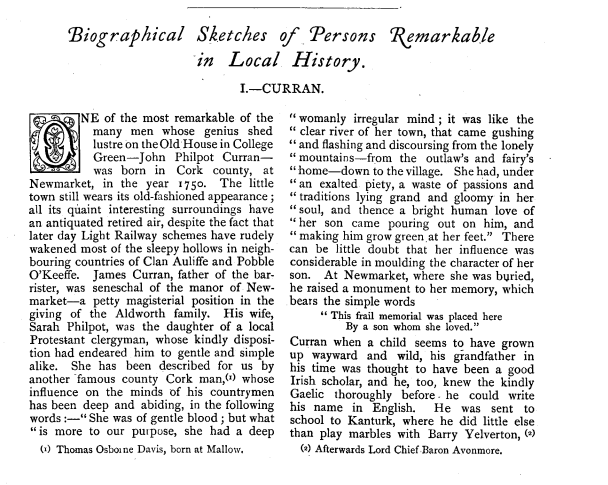
Master of The Rolls, Dublin Portrait of John Philpot Curran.
Came from a relatively humble background, the local rector took him under his wings and he got to Trinity College, Dublin. Like many aspirant Barristers he subbed as a teacher did a bit of journalism before hitting lucky through patronage.
The Coppingers, Cotters and perhaps the Gallweys are of Hiberno-Danish descent. Some of those with this ancestry still have blonde hair.
The Coppingers assembled vast estates in West Cork primarily by the local land owning families raising mortgages and defaulting. One example is the townland of Ballycomane in Durrus. This had been McCarthy of Scart property, mortgaged to Coppinger and when the Coppingers backed the wrong side in the 17th century their land was forfeit.
Much of the estates ended up with the Evans-Freke family (later Lord Carbery), that family around 1778 presumable for raising money commissioned a survey of their estates. The original book of maps in in the National Library Mapping…


 West Cork History