Return of prefix ‘O’ and ‘Mac’ in Irish Surnames
20 Sunday Nov 2016
Posted in Uncategorized
20 Sunday Nov 2016
Posted in Uncategorized
19 Saturday Nov 2016
Posted in Uncategorized
…
John Randal Carey (1834-1923), 1879 Member of Syndicate Founders of Sydney Daily Telegraph, Grandson of Daniel McCarthy (Mucklagh), Former Parish Priest of Durrus, West Cork and Sarah Blair of Blair’s Cove, Great Grandfather Allegedly Claimed to be head of McCarthy Family worldwide.
The Mccarthy Estates were forfeited due to Rebellion and the Durrus element former part of the Evanson later Lard Bandon estate.
The branch Mucklgh from Irish Muc pig after their herds of pigs) are referred to in the Dublin penny JOurnal:
In 1835 the Dublin Penny Journal carried an article and illustration of Culnalong Castle and referred to the last of the Mucklaghs…’their descendants struggled on for no inconsiderable part of a century in the doubtful class entitled’ decayed gentry’ I well remember the last of them who lingered in this neighbourhood (Durrus). He was a patriarchal-looking man, with snow white hair. He inhabited a cottage near Dunbeacon. He was as finely formed and athletic a fellow as I ever saw. The peasants regarded him with no small feelings of respect and affection, to which his excellent qualities appeared to entitle him well. He died at the age of 90 in the year – let me see 1795, I think, and he possessed to the very last the buoyancy of spirits and the warmth of affection that more properly belong to youth. Poor fellow! He sometimes indulged in a sigh at the fallen fortunes of his house but it was not a sigh of bitterness. This article was probably written by Cork Antiquarian John Windele and the comment and poem in the article by his friend Father John Ryan of Drimoleague.
Daniel McCarthy family and Blairs:
https://docs.google.com/document/d/1BnjAwZ6eFk_0sTMsjxYBo3YFQLNqJ4J2utWIftpJXqs/edit…..
Courtesy Nigel Moss.
Reverend Daniel McCarthy marriage Licence Bond was dated 26 July 1793 and the marriage took place in Cork & Ross around that time. The bond totalled £1,000; a sizable amount of money and one wonders how he could provide that sum.
According to Samuel Trant McCarthy’s The McCarthys of Munster, Daniel “was six feet four inches in height and of a distinguished appearance. He is said to have been a severe disciplinarian, in regard to his four sons at least. He used to make them walk through the cemetery in the dark, and take them out in a boat in stormy weather, so that they might develop the same courage which he himself possessed.”
It was Daniel’s daughter, Margaret, who married Major John Westropp Carey, who lived in Glenlough Cottage (Durrus) on the northside. Carey had fought, with distinction, in the Peninsular Wars in the 10th & 30th Regiments, as had his brothers. They married on 10 November 1822 at St Nicholas Church, Cork City. Major Carey was the son of William Carey JP of Lodge, Cork and his wife, Jane, nee Westropp (daughter of Randall Westropp Mayor & Alderman of Cork & his wife Peniel, nee Becher, Granddaughter of Colonel Thomas Becher. Major John Westropp Carey & his wife, Margaret, nee McCarthy were the parents of Rev William John Carey TCD, BA ( Daniel’s Grandson) who I believe was the first Rector of Glengariff, where he was appointed Rector of Trinity Church,Glengarriff in 1872, and died there in December 1906. Their 2nd son, John Randall Carey born in 1834, emigrated to New South Wales and was Founder of the Sydney Telegraph Newspaper.…..
John Randal Carey (1834-1923), businessman and newspaper proprietor, was born on 14 April 1834 at Cork, Ireland, son of John Westropp Carey, of the Connaught Rangers, and his wife Margaret, née McCarthy. Educated at Hamblin’s College, Cork, he worked for a merchant before leaving for the Australian goldfields. He reached Victoria in the Countess of Yarborough in December 1853 and tried his luck on the diggings before setting up as a general agent and auctioneer as partner in Richards & Carey at Castlemaine. An excellent horseman, he rode his own steeplechasers and later owned Mazeppa, a champion trotter. About 1862 he followed the goldseekers to New Zealand and joined Arthur William Gilles as general agents, auctioneers and importers of stock from the Australian colonies; they soon established branches at Invercargill, Hokitika and Auckland. From April 1869 Carey was captain of the Auckland Troop of the Royal Cavalry Volunteers; he probably fought in the Maori wars.
On 14 June 1873 at St John’s College, Auckland, he married Mary Taylor; that year he and Gilles moved their business to Sydney. With experience of auctioneering and shipping, Carey recognized that transport and land development were inextricably linked. In 1875 he acquired the Manly run which had five boats operating a freight, passenger and towing service across the harbour; he continued as managing director and a major shareholder in the Port Jackson Steamboat Co. in 1877, remaining a director of the reconstituted Port Jackson Steamship Co. Ltd and, on its absorption of a competitor, of the Port Jackson Co-operative Steamship Co. Ltd in 1896-1904. In 1877 he visited England to oversee construction of ferries. He also helped to form the Balmain Steam Ferry Co. Ltd in 1882 and, as a partner in Mann, Carey & Co., extended his activities to railway construction, tendering successfully for the Nyngan to Bourke line. With less success he set up the Sydney Tramway & Omnibus Co. Ltd which was in liquidation in 1899.
In 1879 he was one of a syndicate which started the Daily Telegraph, a four-page penny newspaper. With Watkin Wynne as manager, and Carey as chairman of the company from 1884, it succeeded: other newspapers were forced to drop their prices. In 1890 its editorial staff Frederick Ward, L. J. Brient and Henry Gullett resigned when a direction on editorial policy restricted them from commenting on Carey’s other business enterprises. The paper featured sensational news and in 1894 introduced linotype machines against opposition from printers. He remained chairman and the controlling influence of the paper until February 1921.
In 1899 the Daily Telegraph campaigned to send troops to help Britain in the South African War and sponsored an insurance fund for Australian volunteers. Carey believed the Australian outback produced the right type of man for South Africa: in 1900, as chairman of a Citizens’ Bushmen’s Committee, he organized the recruitment of the Bushmen’s Contingent and the purchase of horses. A major in the reserve of officers from January 1900 to December 1904, he rode at the head of the contingent when it paraded through Sydney.
Carey was also a trustee of the Savings Bank of New South Wales, a member of the Rocks Resumption Advisory Board, and a director from 1899 and chairman in 1906-23 of Royal North Shore Hospital. His business enterprises and membership of the Athenaeum Club had brought him into close association with leading politicians and he used his connexions to obtain additional land for the hospital. His wife presided over its fund-raising committee and his daughter Beatrice was for some years its masseuse.
Survived by his wife, two sons and two daughters, Carey died at his residence at Milson’s Point on 9 June 1923. After the funeral his body was taken by special ferry to be buried in the Anglican section of South Head cemetery. His estate was valued for probate at £79,052.
19 Saturday Nov 2016
Posted in Uncategorized
Extracts from Diary 1622 of Richard Boyle, Great Earl of Cork, on Nonpayment by Blind John Power, of Rectorial Tithes, including Caheragh, Creagh, Kilcoe, Schull, Myross, West Cork, Gift to Lord Beaumont Departing, of Gelding, Caste of Falcons, Merlyns, 9 Barrels of Irish Fryce and Barrell of Pickled Scallops used for Food by the Irish, Sending Cutty (‘Cuidighe’ Irish for Companion) Ogle to England.
Courtesy Dr. Casey collection.
The tithe references are possibly a relict of the Norman incursions to West Cork. These areas belonged to either St Catherine’s of Waterford or the College of Youghal. They appear in the accounts books of St Finbarrs Cathedral Cork, from the 1780s, the ledgers are in pristine condition in the RCB Library in Rathgar, Dublin.
View original post 4 more words
17 Thursday Nov 2016
Posted in Uncategorized

This gallery contains 16 photos.
Originally posted on West Cork History:
1828. Formation of Bandon Co. Cork Brunswick Constitutional Club, Orangemen Chiefly Cotton Weavers, Attack Catholics at…
16 Wednesday Nov 2016
Posted in Uncategorized
Edward Davenant (1568-1639), Record of Cambridge University, England Entry 1584 of ‘Whiddy Island’, Bantry, Co. Cork. Later owner fishery.
This corroborates the Fishery at the time being financed from London Merchants .
https://wordpress.com/post/durrushistory.com/20050
He is son of John, brothers John 1587, William 1590, George 16o2.

Death:
| 1639 | Edward Davenant | Whiddy Island | Will dated Whiddy 29th December 1636. He was brother of Bishop of John Davenant of Salisbury, active in Bantry Fishery since 1608 when he leased Whiddy Island from Sir Owen O’Sullivan’s widow. To son Edward D.D. New Sarum, Wilts | His father-in-law was Simms, London. One daughter marrried John Palmer of Whiddy, another son John of Whiddy married Ann Boyle both drowned crossing to Whiddy 1641. William may have been another son. | Paddy O’Keeffe papers, Cork Archives | He was born London 1586 son of John, Cambridge 1584. Brothers Cambridge graduation: John 1587, William 1590, George 1602. |
Marriage:
| Pre 1610 | Edward… |
View original post 18 more words
15 Tuesday Nov 2016
Posted in Uncategorized
1892. Immense Funeral of Mrs Thomas Dillon, nee Roycroft, Bantry, Obituary a Who’s Who of West Cork.
The Dillons were very prominent in Durrus and Bantry. Possibly buried at Moulivard, Durrus East in the large Dillon tomb.
Thomas Dillon, Poor Law Guardian, 1892 election:
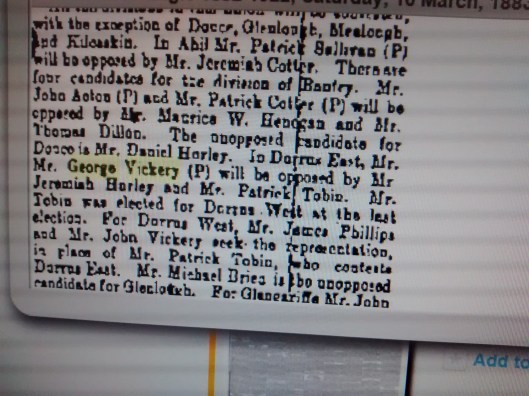
In the 1940s Shawn Dillon of Clashadoo durrus was involved in setting up Clann na Poblachta locally and inherited his aunt’s properties near the railway station
In the late 18th century one of the Dillons possibly the same extended family married one of the Whites (Lord Bantry) set as aside as a ‘Popish Marriage’.
…
…
…


..
15 Tuesday Nov 2016
Posted in Uncategorized
Tags
Samuel Vickery (1832-1912) Reminiscences to his Daughter Martha Ellen, Evansville, Indiana, USA, Childhood in Rooska, Parish of Durrus and Reendonegan, Bantry, West Cork, Family Fishery, Girls Hired to Spin Twine for Nets, Catching Sparrows in Thatch of House, Hens Fed Sour Milk and Potatoes, School at Four Mile Water (Clashadoo, Durrus), Emigration 1850 to New Orleans Upriver to Indiana
Then follows notes of Samuel’s reminiscences about his Irish childhood that were jotted down by his daughter Martha Ellen. Samuel born 1832 was named after his 3 uncles. The family lived at Rooska till Sam was 8 years old, at which time they moved to Reendonegan on Bantry Bay.
Courtesy Mini Nordby, Vancouver.
West Cork weaving including nets:
https://docs.google.com/document/d/1u0vIz1nxG34pJua7qC7jtTCKWLjwVY81jSl0usPdojk/edit
Memories of Samuel Vickery (1832-1912), Rooska and Indiana.
He was born in Rooska father William Warner Vickery mother Elizabeth Woulfe, Stouke, Ballydehob. In his later years in Indiana his daughter Martha Ellen took a note of his recollections. He lived in Rooska in a 2 storey two rooms long stone thatched house until the family moved to Reendonegan in 1840. He used to catch sparrows in the thatch. The house was enclosed with a thorn hedge close by hill with gooseberries adn bees. While at Rooska he crossed the hill to go to school at Four Mile Water (Clashadoo), at Reendonegan he went to school on a donkey. HIs father was involved in fishing and employed girls to spin twine for nets. The hake was split open dried with salt. He would mind the cows in the field which had no ditches and feed them wild mustard while milking. The hens were fed sour milk and potatoes. Seaweed was gathered and used as fertilizer. There were bogs and turf at Rooska. In Reendonegan he had a half day from school on Saturday and would bathe no towel run to dry himself. The house at Reendonegan was large with large rooms and a slate roof. The nearly lake teemed with fish. His father made splinters which were used as torches in the kitchen. At a table against the wall the servants ate fish, sour milk and potatoes. The Vickery cousins still had a large kettle used to make soup during the famine. In 1850 the entire family went to New Orleans sold the Reendonegan property and went upriver to Indiana where descendants still live in Evansville. The family consisted of eight living children including his older sister Ellen who had married Tom Warner she gave birth on the six week voyage the meagre water supply had to be used to bathe the baby.
Probably a cousin memories in Australia:
James Swanton Vickery (C1837-1908) from West Cork, to Stockbroking in Australia.
https://wordpress.com/post/durrushistory.com/8176
Notes on Ballycomane, Durrus, branch of family:
https://docs.google.com/document/d/1EEEnXyuqwa3yOlSY3JnO6T1qXejygDmVWqjQWg0G2gM/edit
1870s Memoirs, Bandon:
…..
…..


..
13 Sunday Nov 2016
Posted in Uncategorized
This gallery contains 10 photos.
Originally posted on Roaringwater Journal:
As we were last year, Robert and I have emerged from our National Digital Week experience…
13 Sunday Nov 2016
Posted in Uncategorized
‘Tá lampa dFocal do mo mar Choraibh’ Thy words are a lamp unto my feet. Sacred to the memory of Thomas Olden, D.D., M.R.I.A.,, Historian of Church of Ireland, Gaelic Scholar, for thirty years Vicar of Ballyclough Parish, Co. Cork. Born 1st March, 1823. Died 29th October 1900. An eminent Irish Scholar, Antiquarian and Church Historian. He served God in his generation. Erected by a few friends.
….
From Colonel Grove White:
Click to access gw1_141-150.pdf
Thomas Olden, son of Robert Olden, of Cork. T.C.D.; B.A., 1846′ M.A. 1888; B.D. 1897; D.D. (Honoris Causa) 1898; M.R.I.A. 1870. Obtained honours in science, gold medal in logic and ethics, and first-class Div. Test. He was ordained deacon, 12th July, 1846, at Down, for the curacy of Cullen, Cork; and priest, 30th May, 1847, at Midleton, by * Laban signifies mud, dirt, or perhaps the meaning may be Leath (Lah), Half-La-bawn, half-bawn. REV. THOMAS OLDEN, D D. » I – • • BALLYCLOUGH (LAVAN ) PARISH AND CASTLE ’47 Bishop of Killaloe. Wa s curate of Tullilease, Cloyne, i860, and vicar of same, 27th August, i860 to 1868 (vide his important work in that parish). He married on 28th July, 1853, Sophie Elizabeth, dau. of the Rev. James Morton, V. Clonfert (Brady), and by her, who died 27th December, 1899, had issue—1. James Morton Ruxton Fitzherbert, b. 25th May, 1854, who was unfortunately drowned, together with his cousin, Robert Aidworth, when at Rossal College, in Lancashire, in 1868; 2. George Gustavus, ob. juv. ; 1st, Olivia; 2nd, Sophia Jane Louisa; and 3rd, Dorothea Emily Morton, wife of Rev. John Harding Cole, B.A., last R.V. of Leighmoney, Cork. Dr. Olden was a scholar of much distinction, a learned antiquarian, and well versed in the Irish language. He published many valuable writings, amongst them being—The Epistles and Hymn of St. Patrick (3rd ed. S.P.C.K., 1894); A History of the Church of Ireland (2nd ed., 1895); ZTre Scriptures in Ireland One Thousand Years Ago, a translation from the Wurtzburg Glosses; sixty-three “Lives of Distinguished Irishmen,” in the Dictionary of National Biography; numerous papers in the Proceedings of the Royal Irish Academy, the Royal Society ‘of Antiquaries, and the St. Paul’s Ecclesiological Society, etc., etc. In recognition of his merits, his University conferred upon him (Honoris Causa) the Degree of D.D. in 1898. Dr. Olden resigned Ballyclogh, owing to ill-health, in July, 1899, but retained his stipend and glebe; and the parish of Ballyclogh, with Dromdowney was added to Castlemagner union (q.v.) Dr. Olden died at his vicarage, Ballyclough, on the 29th of October, 1900, aged JJ years. Of him, the Bishop of the Diocese said, in his annual pastoral letter, January, 1901 :—”We were proud of him in this diocese. We felt it to be an honour that he was numbered amongst our Clergy. By his learning and ability he has done a great work for the Church. As an Irish scholar, there were not many that could surpass him. But it is as the historian of the Church of Ireland that he will ever be remembered. Although he was so learned, and so distinguished, hse was kind and gentle and unassuming in his manner, and was dearly loved by his family and his friends, and by the people amongst whom hie ministered for thirty-one years. A mural tablet has been erected to his memory in Ballyclough Church by his parishioners and friends.” The late Rev. Dr. Olden also wrote:— St. Patrick and his Mission, Dublin, 1894, an(* a now very scarce and valuable pamphlet: Some Notices of St. Colman of Cloyne, Bishop and Poet. Cork: T. Morgan, 1881. To the Journal of the Royal Society of Antiquaries he contributed a paper on ” The Voyage of St Brendan,” 4th quarter, 1891. To the Cork Historical and Archceological Journal he contributed a paper on “Kilmaclenine” in No. 39, July-Sept., 1898, besides some interesting notes to the article on St. Beretchert of Tullylease, that appeared in the No. for February, 1895, and he also contributed still more frequently to the Transactions of the Royal Irish Academy, Dublin, of which he was a ember. The wording of his mortuary tablet will be found later on in the portion of the present series relating to Ballyclough Church. . (Lewis, pub. 1837), under “Ballyclogh”
…..
 ..
..

….
12 Saturday Nov 2016
Posted in Uncategorized
1824, Evidence of Sir Richard Griffith Esq., Road Engineer, to House of Commons Select Committee, on Harmony in West Cork between Protestant and Catholics, Distress of 1822, Evidence of Alexander Nimmo, Scots Road Engineer on Building of 19 miles on the Northern Side of Bantry Bay under Joint Supervision of Captain O’Sullivan Most of His Workers are His Tenants Not Paid in Cash but in Rent Abatement.
Elsewhere Nimmo’s evidence of Enormous Economic Benefits of Road Building. He was involved in the 1820s in extensive road works in North Cork and credited the roads with opening up the area to the butter trade and the huge improvements that benefited the local area.
Before Griffith’s road to Crookhaven wheeled carts were unknown in the western end of the Mizen Peninsula. Even today a close look at the cuttings through and bridges re a testament to the thorough work with little modern equipment.
..
…


…

 West Cork History