This gallery contains 12 photos.
Originally posted on Roaringwater Journal:
Ballydehob’s own railway was known, affectionately, as The Flying Snail. Way back in 2013 I wrote a piece…
02 Sunday Apr 2017
Posted in Uncategorized
This gallery contains 12 photos.
Originally posted on Roaringwater Journal:
Ballydehob’s own railway was known, affectionately, as The Flying Snail. Way back in 2013 I wrote a piece…
01 Saturday Apr 2017
Posted in Uncategorized
28 Tuesday Mar 2017
Posted in Uncategorized
The 1820s were grim economically for West Cork. The collapse of the textile industry which in the Baronies of Carbery was dependant on home weaving was hard hitting on those families partly dependant on it.
This triggered wide spread emigration mostly but not exclusively Protestant to Canada and Rochester, New York. Many of the families listed here had members who emigrated.
1830 Tithe Applotments (Tax Assessments) for Durrus District, West Cork, for Church of Ireland/Methodist families. This might loosely be described as a tax assessment. Not all people are included, no labourers, cottiers, artisans such as shoemakers are excluded. However by combining the amount of land and its value it provided valuable information. Discernable are clusters of small holdings in Coolculagta, Ardgoena, Droumreagh which were likely to have been weaving centres.
You can see clusters of small holding probably weavers in Drumreagh, Ardgoena, Coolculaghta. Also there are names which are no longer around.
The originals can be viewed here, some parts such as Clashadoo are missing, the transcriptions are very poor:
Tithe Aplottments 1830 DurrusParts of Bantry, Church of Ireland
27 Monday Mar 2017
Posted in Uncategorized
Kilbronogue:
1847. Father John Kelleher, PP. Ballydebob, on evils of Land Tenure. Townland of Kilronogue, Ballydehob, West Cork, Population 1841 445, 1847 125 Dead from Hunger, 6 from Disease, 84 Missing. 1841 74 Houses, 1847 27 Unroofed, 11 Unoccupied.
http://www.failteromhat.com/southernstar/page12.php
At Kilbronogue the Revd. continued his journey escorted by Captain Harston, agent of the British Association and the Roman Catholic Parish Priest, Fr. Barry. He visited nine houses before turning away with despair. “In the ninth house that of Charles Regan, I found that of eleven only three remained. We had met the woman of the house on the road and she accompanied me to most of the houses. When we arrived at her cabin she said: ‘I have a fine young man of nineteen years of age and you could carry him in the palm of your hand.’ I entered and saw a bundle of skin and…
View original post 487 more words
27 Monday Mar 2017
Posted in Uncategorized
Roads are discovered to yield a more profitable crop than farming, 1809 Presentments John Arundel, William and John Swanton, Ballydehob, Alexander O’Driscoll, Skibbereen, John and William Warner, Bantry, Samuel Townsend Henry Ryan, Skibbereen, Later, Birds and Tobins of Kilcrohane, Moss and Nicholas Families Durrus, Shanahans Dunbeacon, Vickeries Ballycomane, Fitzgeralds Baltimore.
The latter families many intermarried and with McCarthys, O’Sullivans, Murnanes of Letterlickey, Catholic Shannons of Brahalish.
The Fitzgerald are probably the ancestors of JFK’s mother.
Later c 1830s records show the Tobins securing contracts with the Birds of Bantry (Birds and Tobins local agents Lord Bantry) for areas quite distant from home place almost like Irish ‘subbies’ in England.
In 1739 (13 Geo. II, 20 c. 10) Grand Juries were given the power of acquiring any land, other than built-up areas or private gardens, avenues and orchards, that was needed for new roads, and though damages were payable it was the jury itself that assessed them. In fact there was little objection to finding room for new roads in a country where land was owned in large blocks and used extensively rather than intensively.
From Professor Andrews former geographer TCD:
Indeed in the last analysis it was the Irish tradition of low yielding husbandry that made many middle-class tenants and small gentry so assiduous in their efforts to secure road contracts as a supplementary source of income : as one Co. Limerick landowner succinctly expressed it, ‘roads are discovered to yield a more profitable crop than farming.’10 Grand Jurors were thus subject to pressure from their friends and dependents to present money for roads whether they were necessary or not, and inevitably new lines proliferated.
Cork Grand Jury 1890 presentments p.128-9.
https://docs.google.com/document/d/1uGCxYYvCGNEbpzypv-6tdTnz78HsuF_YJELLh9ezWvM/edit
26 Sunday Mar 2017
Posted in Uncategorized
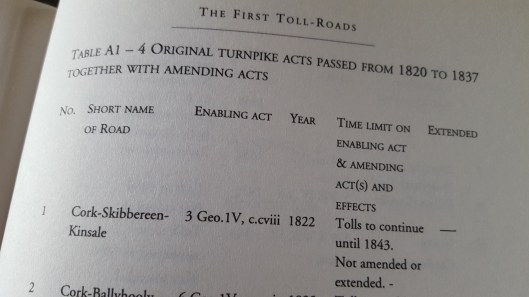
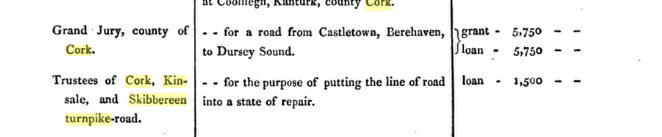
1729 Turnpike Trust. 1822 Cork, Skibbereen and Kinsale Turnpike (Toll Road), Tolled to 1843. 1839 Funding by Commissioner of Public Works, Loan to Trustees of Cork, Skibbereen and Kinsale Turnpike, For road from Castletownbere to Dursey Island, For a Railway From Certain Bogs to Supply Cork with Turf.
In the early 18th. century the Irish roads were generally of a very poor quality. The Turnpike Trust was an attempt to improve by sponsoring private Acts of the Irish Parliament for new or to maintain existing road schemes. These were to be funded by the users.
Another Northern European country, Denmark, not invaded by the Romans and not having their roads, also had a major road problem in the mid 18th century. An Irish Engineer based in Denmark produced a recent paper on the subject. In the case of Denmark, the King brought in French Engineers c 1750 to lay out a national road system, which lasted to the 1960s. The French planted trees alongside the roads something happily replicated in the Irish Motorway Network post 2000, in the autumn the colours are amazing.
Simultaneously the Cork Grand Jury continued piecemeal improvements, added to by the great arterial schemes of Sir Richard Griffith and Nimmo in the 1820s.
The turnpike road to Skibbereen seems to coincide with the mail coach road of 1832 (ROAD PLANNING IN IRELAND BEFORE THE RAILWAY AGE By J. H. ANDREWS Trinity College, Dublin).
Before very long, in any case, the railways were beginning to distract attention from the problem of the trunk roads. In 1857 all the surviving turnpike trusts were liquidated on the ground that, since long distance traffic was now virtually monopolised by the railways, the roads could reasonably revert to county charge. Four years later the mail coaches, now reduced to a mere 238 miles, made their last appearance in the postal section of Thorn’s annual directory:

…
Cork Turnpike Road Legislation
1731, Cork-Kilworth Mountain to Co. Tipperary border, tolls intended to last to 1752.
1779-80, tolls increased
1798, road privatised
1798, tolls on stagecoaches doubled
1799, tolls increased.
1731, Newcastle-Limerick-Cork, tolls intended to last to 1753.
1745, tolls increased road to go via Charleville.
1826, new Act.
1747, Listowel-Cork, original tolls to 1809
1767, adjustment of position of turnpike gates
1765, Kanturk-Fair Lane (Cork), tolls intended to continue to 1826 but only short length constructed
1790, Charleville to Cork City
1812, Cork-Tralee, tolls to 1833.
1822, Cork-Skibbereen-Kinsale, tolls to 1843
1825, Cork-Ballyhooly, tolls to 1846.
1830 Extension of Waterford-Cork, provisional only.
1857, all existing turnpike roads in Ireland abolished with effect from 5th April 1858

..

…..
……..

……
24 Friday Mar 2017
Posted in Uncategorized
1875. Landed Court Sale of Samuel Townsend lands at Caheragh and Islands of East Calf, Doneen, Travans where tenants Make Large Quantities of Kelp from Seaweed.
…
Legal Dispute over Extraction of Seaweed at Friendly Cove, Durrus, West Cork, 1887.
…
Magistrate:
Samuel Townsend, Esq. DL?, Junior, Whitehall, Skibbereen. Bandon Brunswick Constitutional Club 1828, listed 1838, sitting Skibbereen, 1835. County Freeman of Cork City voting in Cork City Election 1837. Signed public declaration in Skibbereen to Alexander O’Driscoll on his removal as Magistrate 1835 with Lord Bantry, Simon White, John Puxley, Arthur Hutchins, Thomas Baldwin, Samuel Townsend Junior and Senior, Thomas Somerville, Richard Townsend Senior, Rev. Alleyn Evanson, Timothy O’Donovan, Richard Townsend, Lyttleton Lyster. Attending Famine Relief Meeting Dunmanway 1846. Skibbereen 1847 as Reenadowna distress meeting. Attending Railway meeting Drimoleague 1856. Bantry 1861, 1874 as Samuel R.,
…


 …
…
24 Friday Mar 2017
Posted in Uncategorized
…
1848. Petition, House of Lords, London, From Schull, for the Imposition of the Severest Penalties on all Roman Catholic Priests who shall Denounce Persons from the Altar.—From Members of several Lodges of the Independent Order of Odd Fellows
§Took the Oaths.—The Viscount St. Vincent. PUBLIC BILLS.—1a Mutiny; Marine Mutiny.
§3a and passed;—Property Tax.
§PETITIONS PRESENTED. From Schull, for the Imposition of the Severest Penalties on all Roman Catholic Priests who shall Denounce Persons from the Altar.—From Members of several Lodges of the Independent Order of Odd Fellows
22 Wednesday Mar 2017
Posted in Uncategorized
The Co. Antrim Rolls give an idea of the scale of the catastrophe inflicted on the Irish People in 1922.
Click to access hearth_rolls_of_county_antrim.pdf
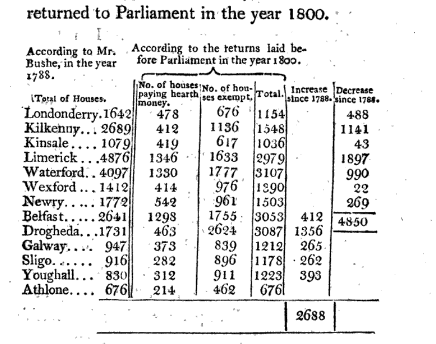
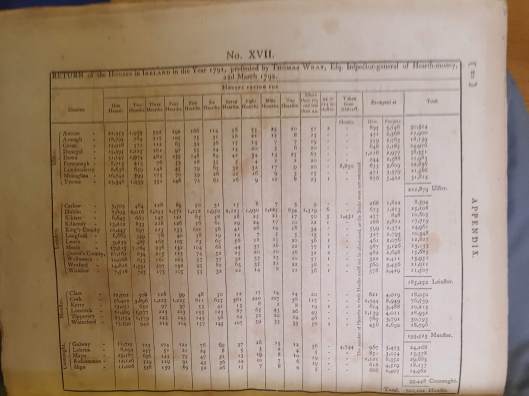
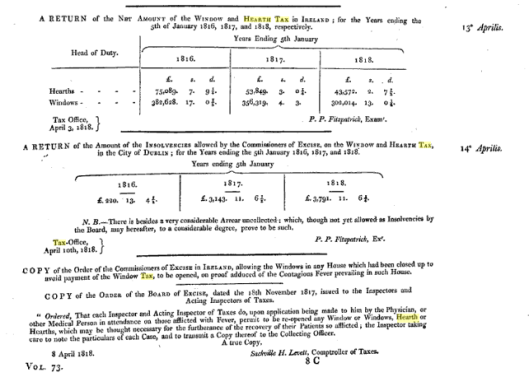
1788 Kinsale Heart Tax Returns with Exemptions. Loss of Window Tax Returns and Irish Tax Revenue 1818-8. Applications to Reopen Closed Hearths on Advice of Physicians for Those with Fever.
Kinsale:
The Sullivan/O’Sullivan family of Tedagh, Parish of Durrus descend from Michael Sullivan described as a heart tax collector. Presumably he as a Catholic could not be such but perhaps had a nominal Protestant as Collector. Interestingly some of the extended O’Sullivan family such as John O’Sullivan from Millcove, Beara were Baronianl High Constables responsible for the collection of the cess.
Hearth Tax Collection
From 1662 to end of the 18th century. It was levied half yearly by the Sheriff of each county on the basis of lists of the names of householders compiled by local Magistrates.
The list of the households required to pay the Hearth Tax became known as the Hearth Money Rolls, which were arranged by county, barony, parish, and townland. The tax was sometimes collected over an area known as a ‘walk’, which was based on both the town and a large rural area outside the town.
Several attempts were made in Parliament to abolish or at least limit the proportion of households obliged to pay the tax, which was widely regarded as “a shameful infliction upon the poor peasant, to whom even two or three shillings in the year for such a tax was a burden and a wrong”.
Major reform of the hearth tax was finally carried out in 1793 whereby one-hearth households with less than £10 in personal property, or with houses and land worth £5 or less, were henceforth deemed exempt from the tax. The measure was apparently a consequence of parliamentary pressure in the previous session; the modification of the window tax in Britain giving total relief to poorer householders had led to calls in the Irish Parliament for similar “liberality” in the light of Ireland’s healthy finances. The Chancellor of the Exchequer (William Pitt) had refused, but a parliamentary committee was established under the de facto chairmanship of Mr G.P. Bushe who successfully proposed that one-hearth householders should be divided into two groups: those above and those below £5 in annual valuation. Subsequently, in 1795, freedom from hearth tax was extended to all one-hearth householders, as the opposition had earlier demanded; at the same time the tax on multiple-hearth houses was raised.[9][11] The number of persons exempted from the hearth tax was estimated at between a million and a half to two million.[12]
The original Hearth Money Rolls are not extant. The records were housed in the Four Courts in Dublin, the repository for the Public Records Office, but during the Irish Civil War in 1922 the building was destroyed by fire, which also destroyed the Rolls (along with the Irish census records for 1821, 1831, 1841, and 1851), but copies of some of the Rolls have survived.
21 Tuesday Mar 2017
Posted in Uncategorized
1843. Mail and Day Coach Timetable and Fares from Cork to Bandon, Clonakilty, Bantry, Enniskeane, Macroom, Skibbereen. Sample Coach Leaves Bantry 8.15 am, Cork 3.15 pm Fare 14 shillings Inside, 10 shillings Outside.
In 1800 the area 30 miles around Cork had a well developed infrastructure, piped water in the City, comparatively good roads and bridges, harbours. In the West and North it would approximate to what is now known as 3rd world. This was improves so by 1843 a reasonably good system of roads operated combination of the Grand Jury and Central Government intervention such as the arterial road schemes of Sir Richard Griffith and Alexander Nimmo had a dramatic effect.
Arterial coach services wee provided by Bianconi local services connected town with Cork.
The timetable below is just prior to the railway age.
By 1900 Cork had one of the most advanced rail systems in Northern Europe a mix of broad and narrow gauge. All that remains is the main line from Cork to Dublin, Cobh, Tralee via Mallow.
Coach Service
When the telegraph opened in Dunmanway around 1860 a newspaper report have an account of a speech of an old man. He recalled towards the end of the 18th century his mother rode to Dunmanway through bridle paths with two small children on panniers on the horse. Then rough carts with timber wheels came in followed in the early 19th century by the ‘Scotch’ cart with car wheels and an iron band. Wheeled carts were unknown in the Goleen area until the opening in the late 1820s of Richard Griffith’s road from Skibbereen to Crookhaven.
The road from Cork to Bantry in its present form was built between 1810-11. The Cork based John Anderson, a Scotsman, had the contract for the mails and persuaded the Cork Grand Jury to provide funding for the Cork Bantry road. The Irish Mail service dates from 1790.
In 1843 the coach left Bantry at 8.15 am and arrived in Cork at 3.15 there were inside and outside fares. Before the extension of the railway from Drimoleague to Bantry, a coach service was provided from Bandon to Bantry, and the travel time by train and coach from Cork to Bantry was approximately 6½ hours. In the early 19th century, the Drummond commission reported that Bantry was linked by a daily Dunmanway Coach which carried an average of 3 passengers. The Cork and Bandon Company agreed with the Post Office to provide a conveyance for the mails from Cork to Bantry in May 1857, the Bantry mail service being given to Mr. Thomas Marmion of Skibbereen. A complaint was made in July 1864 of the late arrival of the Bantry Mail Car. Apparently the driver had fallen asleep on the car between Drimoleague and Bantry, having been plied with drink by a passenger. The Mail Inspector sought the removal of the driver, and an instruction was issued that he was not to be employed on mail cars.
The Prince of Wales (later Edward 7 1901-1910) arrived in Bantry by coach from Bandon to meet the Royal Yacht in Bantry and from there to Glengarriff and Killarney. This route had been pioneered by Thomas Vickery of Bantry.
1829, Thomas J. Hungerford’s Cork and Skibbereen Union Coach.
https://books.google.ie/books?id=ttUHAAAAQAAJ&printsec=frontcover#v=onepage&q&f=false
….


….

 West Cork History