1875. Landed Court Sale of Samuel Townsend lands at Caheragh and Islands of East Calf, Doneen, Travans where Tenants Make Large Quantities of Kelp from Seaweed.


1875.  Landed Court Sale of Samuel Townsend lands at Caheragh and Islands of East Calf, Doneen, Travans where tenants Make Large Quantities of Kelp from Seaweed.


1843, Cases of Trespass for Seaweed Extraction, Ballydehob, Skibbereen, Co. Cork, Magistrates Declining Jurisdiction for Extraction below Low water mark.

Gather Your Seaweed

Legal Dispute over Extraction of Seaweed at Friendly Cove, Durrus, West Cork, 1887.

The use of seaweed in farming, Edible seaweeds, rights to harvest seaweed attaching to land in townlands of Brahalish and Rossmoe, Durrus, West Cork, Rev. Caesar Otway 1822 on seaweed use Mount Gabriel/Dunbeacon.

Carrigín Cool na h-Orna, Rossmore, Durrus, West Cork, a hint of Pre-famine Agriculture and other Incorporeal Hereditaments.

Magistrate:


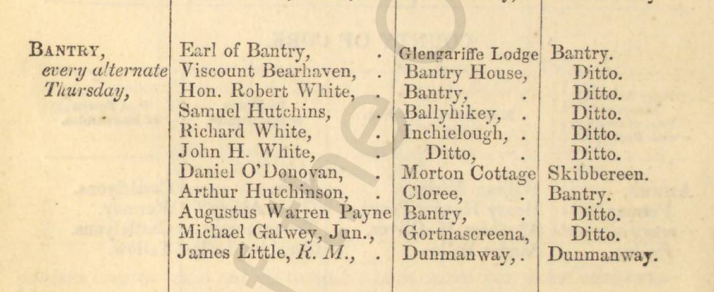
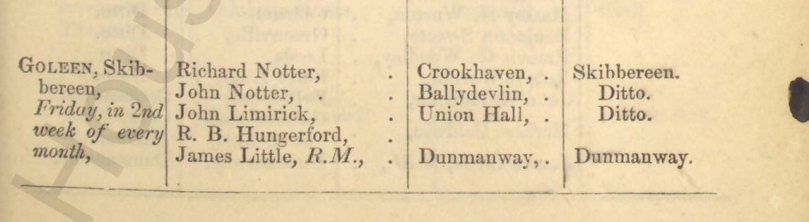
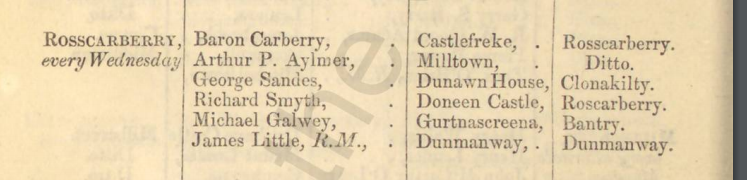
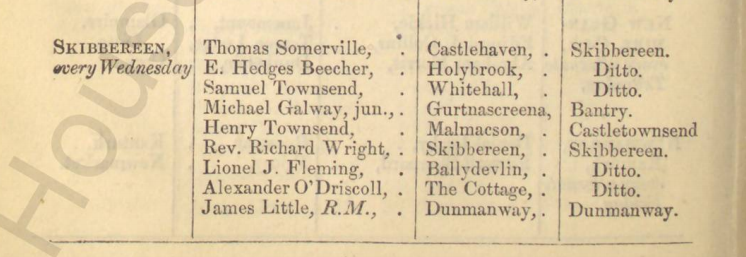
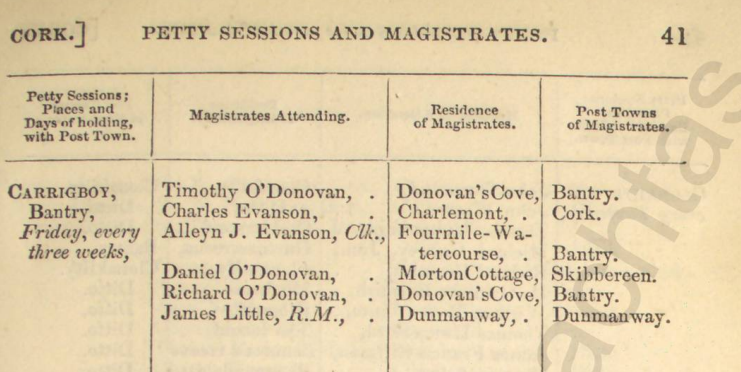
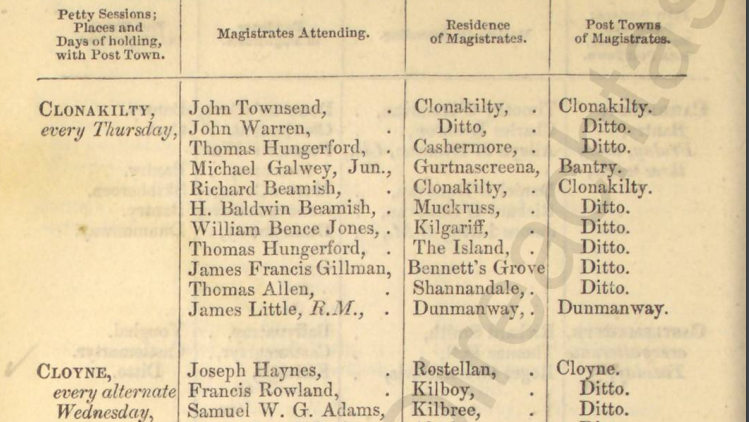
Samuel Townsend, Esq. DL?, Junior, Whitehall, Skibbereen. Bandon Brunswick Constitutional Club 1828, listed 1838,  sitting Skibbereen, 1835.  County Freeman of Cork City voting in Cork City Election 1837. Signed public declaration in Skibbereen to Alexander O’Driscoll on his removal as Magistrate 1835 with Lord Bantry, Simon White, John Puxley, Arthur Hutchins, Thomas Baldwin, Samuel Townsend Junior and Senior, Thomas Somerville, Richard Townsend Senior, Rev. Alleyn Evanson, Timothy O’Donovan, Richard Townsend, Lyttleton Lyster. Attending Famine Relief Meeting Dunmanway 1846.   Skibbereen 1847 as Reenadowna distress meeting. Attending Railway meeting Drimoleague 1856.  Bantry 1861, 1874 as Samuel R.,


1-IRE-LEC-4506900-01063


2-IRE-LEC-4506900-01064

1848. Petition, House of Lords, London, From Schull, West Cork, for the Imposition of the Severest Penalties on all Roman Catholic Priests who shall Denounce Persons from the Altar.—From Members of several Lodges of the Independent Order of Odd Fellows


1848.  Petition, House of Lords, London, From Schull, for the Imposition of the Severest Penalties on all Roman Catholic Priests who shall Denounce Persons from the Altar.—From Members of several Lodges of the Independent Order of Odd Fellows


HL Deb 10 April 1848 vol 98 c70

Took the Oaths.—The Viscount St. Vincent. PUBLIC BILLS.—1a Mutiny; Marine Mutiny.

3a and passed;—Property Tax.

PETITIONS PRESENTED. From Schull, for the Imposition of the Severest Penalties on all Roman Catholic Priests who shall Denounce Persons from the Altar.—From Members of several Lodges of the Independent Order of Odd Fellows

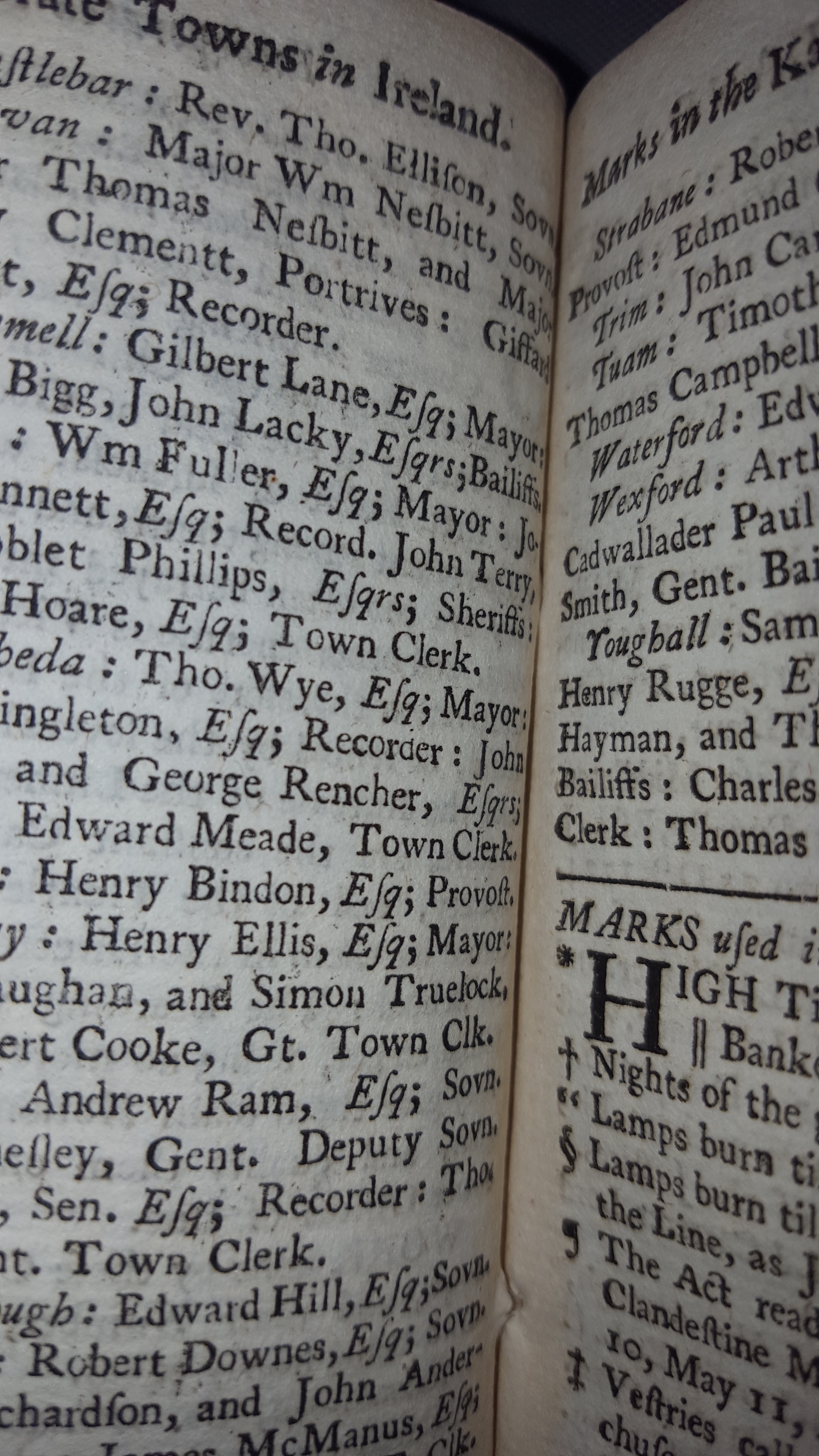
1788 Kinsale Heart Tax Returns with Exemptions. Loss of Window Tax Returns and Irish Tax Revenue 1818-8. Applications to Reopen Closed Hearths on Advice of Physicians for Those with Fever.


The Co. Antrim Rolls give an idea of the scale of the catastrophe inflicted on the Irish People in 1922.

Click to access hearth_rolls_of_county_antrim.pdf


1788 Kinsale Heart Tax Returns with Exemptions.  Loss of Window Tax Returns and Irish Tax Revenue 1818-8.  Applications to Reopen Closed Hearths on Advice of Physicians for Those with Fever.

Kinsale:

Screen Shot 2017-03-22 at 08.34.09

https://books.google.ie/books?id=ZqVfAAAAcAAJ&pg=PA80&lpg=PA80&dq=hearth+tax+collectors+cork&source=bl&ots=dtE_S5Rftj&sig=fjC9kTIcd5UTCB-TOFwWhCOLSx8&hl=en&sa=X&ved=0ahUKEwiOkLfskLDSAhXsJcAKHXF6BBQ4ChDoAQgcMAc#v=onepage&q=hearth%20tax%20collectors%20cork&f=false

Petty’s census 1659 for hearth tax Durrus

The Sullivan/O’Sullivan family of Tedagh, Parish of Durrus descend from Michael Sullivan described as a heart tax collector.  Presumably he as a Catholic could not be such but perhaps had a nominal Protestant as Collector.  Interestingly some of the extended O’Sullivan family such as John O’Sullivan from Millcove, Beara were Baronianl High Constables responsible for the collection of the cess.

Hearth Tax Collection

From 1662 to end of the 18th century. It was levied half yearly by the Sheriff of each county on the basis of lists of the names of householders compiled by local Magistrates.

The list of the households required to pay the Hearth Tax became known as the Hearth Money Rolls, which were arranged by county, barony, parish, and townland. The tax was sometimes collected over an area known as a ‘walk’, which was based on both the town and a large rural area outside the town.

Several attempts were made in Parliament to abolish or at least limit the proportion of households obliged to pay the tax, which was widely regarded as “a shameful infliction upon the poor peasant, to whom even two or three shillings in the year for such a tax was a burden and a wrong”.

Major reform of the hearth tax was finally carried out in 1793 whereby one-hearth households with less than £10 in personal property, or with houses and land worth £5 or less, were henceforth deemed exempt from the tax. The measure was apparently a consequence of parliamentary pressure in the previous session; the modification of the window tax in Britain giving total relief to poorer householders had led to calls in the Irish Parliament for similar “liberality” in the light of Ireland’s healthy finances. The Chancellor of the Exchequer (William Pitt) had refused, but a parliamentary committee was established under the de facto chairmanship of Mr G.P. Bushe who successfully proposed that one-hearth householders should be divided into two groups: those above and those below £5 in annual valuation. Subsequently, in 1795, freedom from hearth tax was extended to all one-hearth householders, as the opposition had earlier demanded; at the same time the tax on multiple-hearth houses was raised.[9][11] The number of persons exempted from the hearth tax was estimated at between a million and a half to two million.[12]

The original Hearth Money Rolls are not extant. The records were housed in the Four Courts in Dublin, the repository for the Public Records Office, but during the Irish Civil War in 1922 the building was destroyed by fire, which also destroyed the Rolls (along with the Irish census records for 1821, 1831, 1841, and 1851), but copies of some of the Rolls have survived.


20181120_135131

https://books.google.ie/books?id=YnxDAAAAcAAJ&pg=PA647&lpg=PA647&dq=hearth+tax+collectors+cork&source=bl&ots=YYQXu0jlOF&sig=yyGR56T7s3FLJ6oZNi-IVvGCENk&hl=en&sa=X&ved=0ahUKEwjqvsrAkrDSAhXkCcAKHVo4B7U4FBDoAQgTMAQ#v=onepage&q=hearth%20tax%20collectors%20cork&f=false

Screen Shot 2017-03-22 at 08.04.06

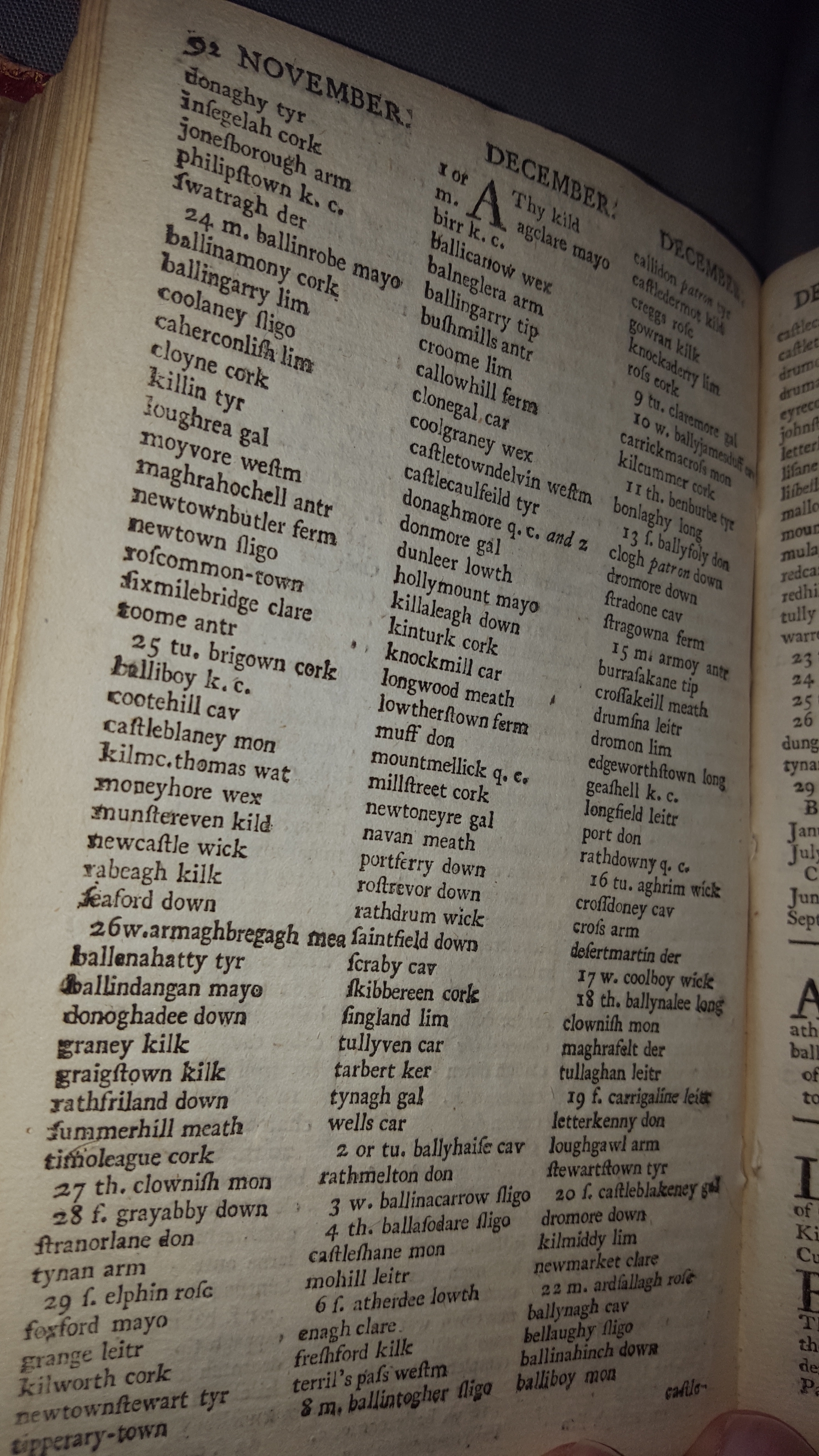
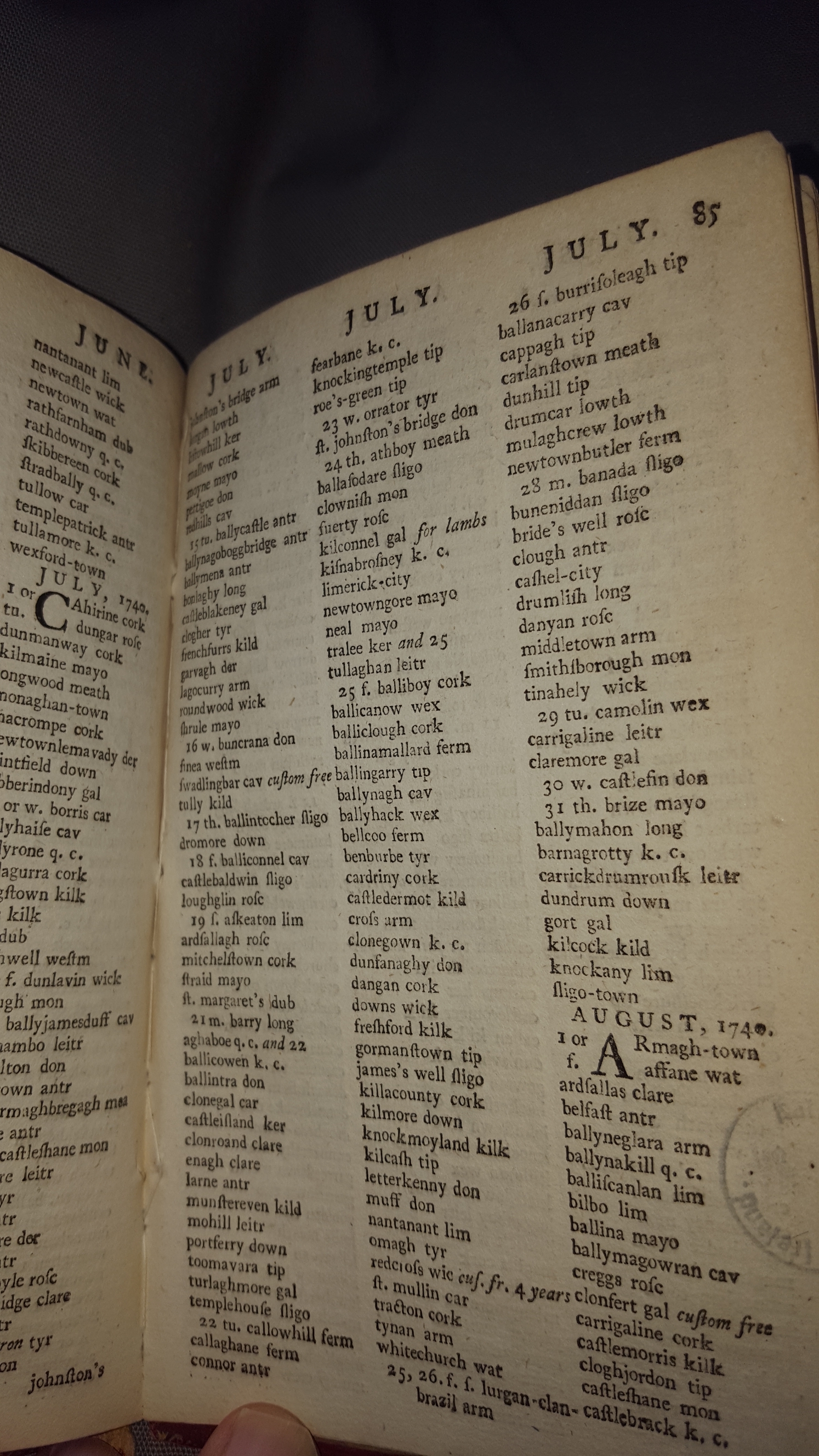
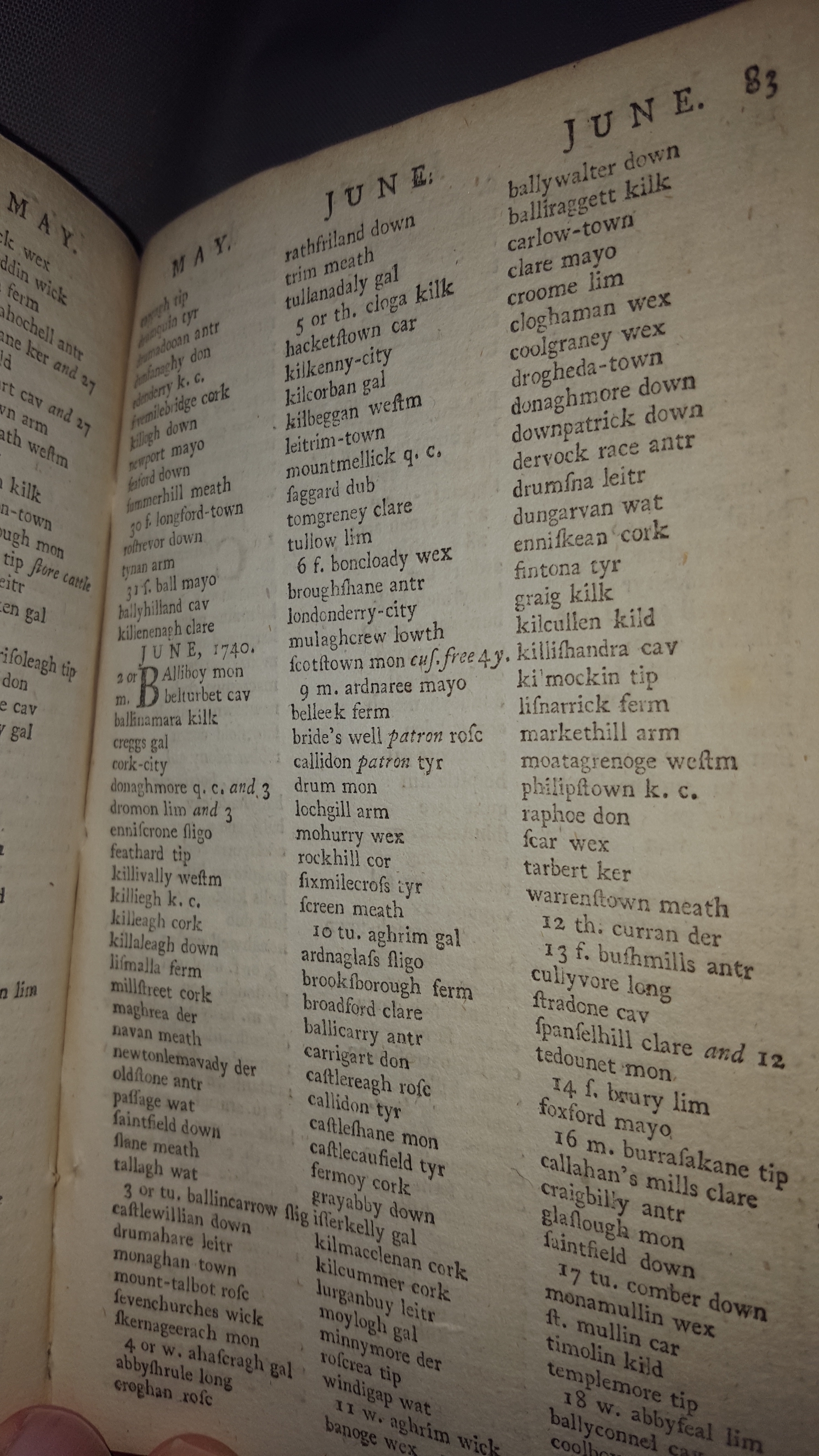
1843. Mail and Day Coach Timetable and Fares from Cork to Bandon, Clonakilty, Bantry, Enniskeane, Macroom, Skibbereen. Sample Coach Leaves Bantry 8.15 am, Cork 3.15 pm Fare 14 shillings. Inside, 10 shillings Outside.


1843.  Mail and Day Coach Timetable and Fares from Cork to Bandon, Clonakilty, Bantry, Enniskeane, Macroom, Skibbereen.  Sample Coach Leaves Bantry 8.15 am, Cork 3.15 pm Fare 14 shillings Inside, 10 shillings Outside.

In 1800 the area 30 miles around Cork had a well developed infrastructure, piped water in the City, comparatively good roads and bridges, harbours.  In the West and North it would approximate to what is now known as 3rd world.  This was improves so by 1843 a reasonably good system of roads operated  combination of the Grand Jury and Central Government intervention such as the arterial road schemes of Sir Richard Griffith and Alexander Nimmo had a dramatic effect.

Arterial coach services wee provided by Bianconi local services connected town with Cork.

The timetable below is just prior to the railway age.


By 1900 Cork had one of the most advanced rail systems in Northern Europe a mix of broad and narrow gauge.  All that remains is the main line from  Cork to Dublin, Cobh, Tralee via Mallow.


Coach Service

When the telegraph opened in Dunmanway around 1860 a newspaper report have an account of a speech of an old man. He recalled towards the end of the 18th century his mother rode to Dunmanway through bridle paths with two small children on panniers on the horse.  Then rough carts with timber wheels came in followed in the  early 19th century by the ‘Scotch’ cart with car wheels and an iron band.  Wheeled carts were unknown in the Goleen area until the opening in the late 1820s of Richard Griffith’s road from Skibbereen to Crookhaven.

The road from Cork to Bantry in its present form was built between 1810-11.  The Cork based John Anderson, a Scotsman, had the contract for the mails and persuaded the Cork Grand Jury to provide funding for the Cork Bantry road.  The Irish Mail service dates from 1790.

In 1843 the coach left Bantry at 8.15 am and arrived in Cork at 3.15 there were inside and outside fares.   Before the extension of the railway from Drimoleague to Bantry, a coach service was provided from Bandon to Bantry, and the travel time by train and coach from Cork to Bantry was approximately 6½ hours.  In the early 19th century, the Drummond commission reported that Bantry was linked by a daily Dunmanway Coach which carried an average of 3 passengers.   The Cork and Bandon Company agreed with the Post Office to provide a conveyance for the mails from Cork to Bantry in May 1857, the Bantry mail service being given to Mr. Thomas Marmion of Skibbereen.  A complaint was made in July 1864 of the late arrival of the Bantry Mail Car.  Apparently the driver had fallen asleep on the car between Drimoleague and Bantry, having been plied with drink by a passenger.   The Mail Inspector sought the removal of the driver, and an instruction was issued that he was not to be employed on mail cars.

The Prince of Wales (later Edward 7 1901-1910) arrived in Bantry by coach from Bandon to meet the Royal Yacht in Bantry and from there to Glengarriff and Killarney.   This route had been pioneered by Thomas Vickery of Bantry.

Last Act of the Pre 1800 Irish Parliament, Cap. 100 of 40 George 3 an Act for The Better Regulation of The Butter Trade, And Also Respecting Sedan Chairs, Coaches, and Chaises Plying For Hire, Within the City and Liberties of Cork

1829, Thomas J. Hungerford’s Cork and Skibbereen Union Coach.


Late 19th Century Coach Service Dunmanway to Glengariff Run by Andrew Brophy later taken over by Thomas Vickery of Bantry.


Michael Gallwey b 1790, Kilkeran, Co. Cork, Brewer and Provider of Royal Mail Coach Service from Cork to Skibbereen and Waterford and his brother Charles b 1811 Major with Sir De Lacy Evan’s Legion against the Spanish Carlists (1835-7) and Some Galwey Magistrates adn Lawyers.


1841 Cork County election, Shenanigans, Patrick O’Sullivan, Millcove, Senescahal, leading Conservative party from Castletown Berehaven on Schooner ‘Sophia’ to Bantry via Adrigole, Leaving Bantry 4am, Breakfast in Dunmanway , Bandon 2pm. Attacked by Mobs in Bantry, Bandon and Upton, Parish Priest of Bantry Father Barry and his Curate Father Ragley pass through Bandon in a Coach Greatly crowded, Festooned with Handkerchiefs, Branches Of Trees Waving, A Great Deal of Noise.


https://books.google.ie/books?id=ttUHAAAAQAAJ&printsec=frontcover#v=onepage&q&f=false


….

Screen Shot 2017-03-21 at 18.09.50

Screen Shot 2017-03-21 at 18.10.05


….

1850 Rescue in Dunmanus Bay, West Cork of Mountaineer, 869 Tonnes, 35 Days out of Quebec and later 1862 Sale of Salvage by Receiver of Wreck, Thomas H. Love, Skibbereen.


1850 Rescue in Dunmanus Bay, West Cork of Mountaineer, 869 Tonnes, 35 Days out of Quebec and later 1862 Sale of Salvage by Receiver of Wreck, Thomas H. Love, Skibbereen.

https://www.google.ie/maps/@51.6141969,-9.5449956,15z

1825, Salvage Award by Baron Pennyfeather at Cork Assizes from Rescue at Crookhaven, West Cork, of Clio of St. John’s New Brunswick en Route to Cork abandoned in a Storm Boarded with 34 Salvage claims Awards to Daniel Coughlan, Esq. £220, Joseph Baker Esq. £80, F.(Thomas) Raycraft (Roycroft) Esq.£50, Francis Gillies Esq. £60, A.O’Driscoll Esq.£60, John Notter Esq.£60, Florence McCarthy Esq. £100, Richard Medway £100.

1845, John Coughlan of Crookhaven, West Cork Owner of Whaler ‘The Wild Irish Girl’. Rescues Schooner British America (Canada) ‘Exile’.

1847 Report on memorial presented to the Lords of the Admiralty with regard to the Harbours and Lighthouses of Co. Cork mentioning the catchment of the River Bandon, Innishannon, Kinsale Fishery and Harbour, Courtmacsherry, Illen Skibbereen, Baltimore, Schull, Carrig-na-Melia off Castle Island, the Cosheen Fishing and Mining Company rescue of East India Man ‘Charlotte’ by Cosheen fishermen.

1850 Rescue in Dunmanus Bay, West Cork of Mountaineer, 869 Tonnes, 35 Days out of Quebec and later Sale of Salvage

Dunbeacon station referred to was The Station heights later a locus of music and dance after the Coastguard left.

Courtesy Peter Evans.

Dr O’Donovan referred to is likely to be below Magistrate, his brothers Timothy and Richard of O’Donovan’s Cove adn Fort Lodge both Magistrates.

Dr. Daniel O’Donovan 1818, Norton Cottage, Skibbereen, listed 1838, son Richard Esq. O’Donovan Cove, and Jane d Alexander O’Donovan, Squince.  Fond of dogs.  Father? of Dr. O’Donovan author History of Carbery.  Brother of Timothy and Richard O’Donovan JP and uncle of Richard O’Donovan JP. Daniel O’Donovan MD has land in Knockeens, Glanroon in Griffiths.  Rented Ahakista Cottage from Charles Evanson.  He was married to a sister of Rickard Deasy of the Clonakilty brewing family, MP. and Attorney General for Ireland and later Judge. Subscriber at Woodview, Lewis Topographical Dictionary of Ireland  1837.

SOURCE:- The Cork Southern Reporter Dec 19 1850

Rescue

Rescue 2

WRECK sale of timber (1)

1862. Death of Sister Joseph Xavier (Fanny) Murphy, daughter of Nicholas Murphy (of Brewing/Distilling Family), Clifton, Cork. Foundress and Endower of Bantry Convent of Mercy.


1862.  Death of Sister Joseph Xavier (Fanny) Murphy, daughter of Nicholas Murphy (of Brewing/Distilling Family), Clifton, Cork.  Foundress and Endower of Bantry Convent of Mercy.

The convent is no longer a secondary school.  The Chapel is noted for its art windows.  It was a Catholic secondary school for girls but had protestant pupils who in their recollection always had their religious beliefs respected.

Samuel Hynes, Architect, (1854-1931), among his Commissions, Convent of Mercy Chapel and Munster and Leinster Bank, Bantry, Kilnamartyra School. Star of the Sea Church, Kilcrohane, West Cork, Presentation Convent, Melbourne, Australia.

http://www.corkpastandpresent.ie/history/irishbuilder/bantryconventofmercychapel/

Click to access bantry_conventchapel_1877.pdf

http://www.buildingsofireland.ie/niah/search.jsp?type=record&county=CO&regno=20834090

Screen Shot 2017-03-19 at 11.48.21


SOURCE:- Cork Examiner Feb 21st 1862

CONVENT BANTRY 1

CONVENT BANTRY 2

Convent Bantry 3

Charabanc on Thomas Vickery’s Prince of Wales Route, Bantry to Kenmare/Killarney.


Charabanc on Thomas Vickery’s Prince of Wales Route, Bantry to Kenmare/Killarney.


Thomas Vickery, Bantry, 1808-1883, Hotel and Transport Pioneer in Irish Tourist Industry, Winter Sale of Horses and some Vickery Genealogy..


Thomas Vickery, Bantry, 1808-1883, Hotel and Transport Pioneer in Irish Tourist Industry, Winter Sale of Horses and some Vickery Genealogy.


20170317_132943

20170317_132939


1842. Letter to Dr. John O’Donovan, Antiquarian re O’Donovans of O’Donovan Cove, Durrus, West Cork.


1842.  Letter to Dr. John O’Donovan, Antiquarian re O’Donovans of O’Donovan Cove, Durrus, West Cork.

From Graves collection Royal Irish Academy, Dublin.  This is part of a large correspondence of Dr. John O’Donovan, antiquarian from South Kilkenny anxious to trace his paternal roots in Carbery.

Portrait of Dr. John O’Donovan (1809-1861), Scholar, National Gallery  on loan to Royal Irish Academy.

Screen Shot 2018-08-27 at 07.41.28


James O’Donovan is a journalist with the London Times newspaper.


Letter from James O’Donovan/Donovan (Cousin of Timothy O’Donovan),  to Dr. John O’Donovan 2409/JOD/274 (viii)

Cygnet Cottages, Perry St.,

Gravesend, Kent,

July 14th 1842.


The Genealogical ignorance of my worth kinsman in the nearest degree remind me of a contest for the family presidency which took place three or four years ago. at a public assembly in Cork and in which figured foremost concerning Richard O’Donovan (Eldest son my cousin Timothy of the Cove) and was at he … part causing him to be presented and introduced as ‘The O’Donovan’ whereupon, a lady expressed some curiosity to see this ‘O’Donovan’ and having been gratified by an introduction, most indignantly repudiated all pretence of such distinction, claiming it as a right inherent to her cousin the Richard O’Donovan of Lisheen.

The abashed youth abandoned the assembly and with that his claim, as I may say, the lady having subsequently informed me with much self-satisfaction, that, she  .. that night.

I saw last year in the possession of Doctor O’Donovan, of (Norton) Cottage, Skibbereen, an uncle of this Richard, a printed copy of a Genealogical Pedigree of the McCarthy family purchased in Paris, and in this there is frequent allusion to the O’Donovan family and to the .agary Donovan inconnection with the McCarthys.

Rickard? O’Donovan, is a man of considerable literary attainments and has, probably directed himself also to a much of antiquarian research as would interest him on inquiry as to his own pedigree. on the paternal and maternal side.  I enclose a note to him which if   you are likely to be productive of any useful results, you can enclose to him.  His father was the late Richard O’Donovan of O’Donovan’s Cove and his mother was my father’s sister (consequently of Ringorish? family).  He surprises me much when that his elder brother Timothy, of the Cove, could not give you any information as he is not only a man of much family pride, but also a of very extensive information (for a country gentleman) and of intellectual abilities above the ordinary standard.