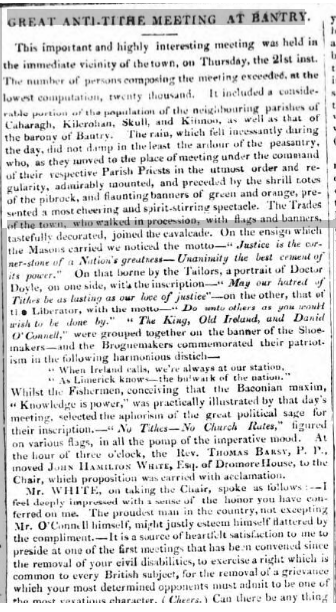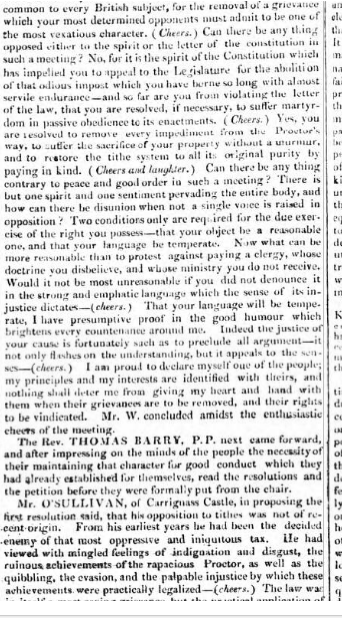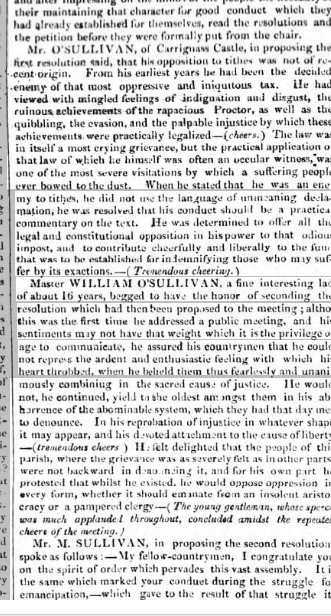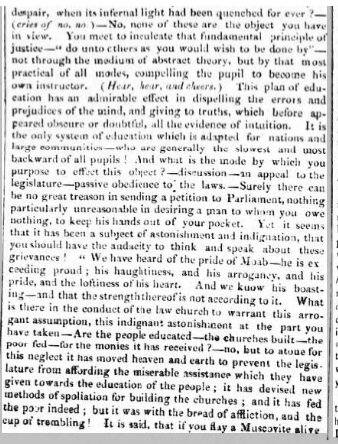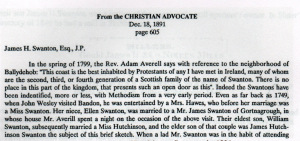
Methodist Minister, Rev. Adam Averill, 1799, on possible Scottish Origin, of West Cork, Swanton family and reputed Scottish Plantation, Castlehaven/Skibbereen c 1690s, Andersons, Hamiltons.


durrushistory's avatarWest Cork History

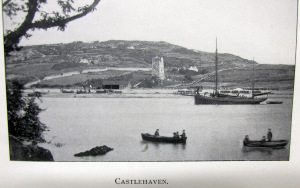
https://www.google.ie/maps/place/Castlehaven,+Co.+Cork/@51.5108647,-9.1919606,12z/data=!4m2!3m1!1s0x4845af85f3f3c235:0x1800c7a937dfd780

Methodist Minister, Rev. Adam Averill, 1799, on possible Scottish Origin, of West Cork, Swanton family and reputed Scottish Plantation, Castlehaven/Skibbereen c 1690s, Andersons, Hamiltons.

It is interesting that the West Cork Somervilles, descend from a Rev. Somerville who fled to Ireland from persecution in Scotland c 1690 and may coincide if there was such a Plantation.

Re the names Hamilton may be Scottish or a corruption of an old Gaelic name.

The Swantons have a tradition of industry, hard work and dissent which some would say are Scottish virtues.

1-IMG_78201-Scan 1473

View original post

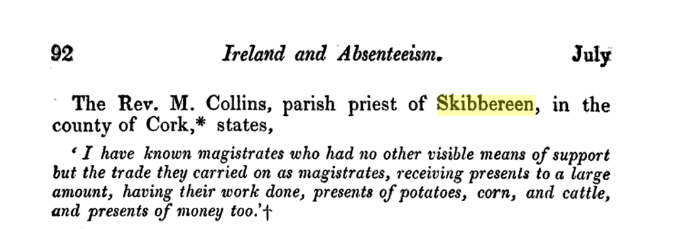
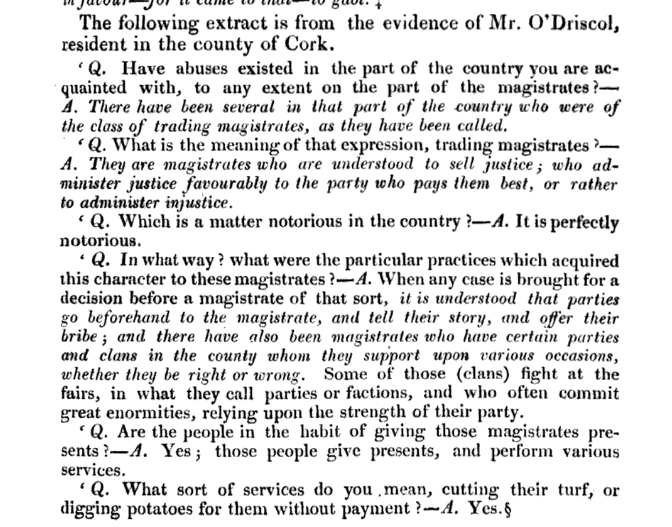
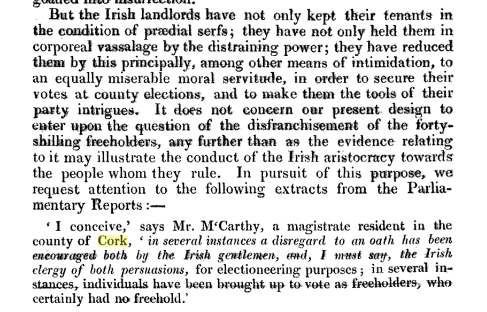
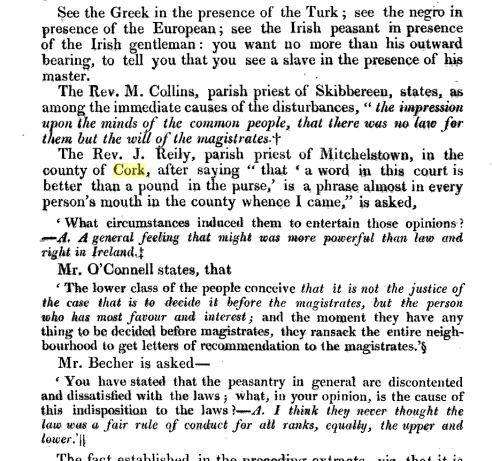
Justice for Sale, Skibbereen Area, West Cork  Evidence of Father Collins, parish Priest,’ I have known Magistrates who had no other visible means of support but the trade they carried on as Magistrates, Receiving Presents to a large amount, having their work done, presents of potatoes, corn and cattle and presents of money too’. Alexander O’Driscoll, ‘Several in That part of the County Called Trading Magistrates,  Who are Understood to Sell Justice to the Party Who Pays them Best’ Perjury at Elections Mr. McCarthy, Magistrate. From the Westminster Review.


 Justice for Sale, Skibbereen Area, West Cork  Evidence of Father Collins, parish Priest,’ I have known Magistrates who had no other visible means of support but the trade they carried on as Magistrates, Receiving Presents to a large amount, having their work done, presents of potatoes, corn and cattle and presents of money too’. Alexander O’Driscoll, ‘Several in That part of the County Called Trading Magistrates,  Who are Understood to Sell Justice to the Party Who Pays them Best’ Perjury at Elections Mr. McCarthy, Magistrate from the Westminster Review.

There were calls around this time for a minimum property qualification for Magistrates to avoid the type of temptation alleged.   From the early 1820s Petty Session Courts began spontaneously to appear in Cork. They were given a statutory basis later in the decade and supplemented by paid Stipendiary Magistrates who sat with local Magistrates


Cork Magistrates:


https://docs.google.com/document/d/1ZvT84JCKTIhMqqZjJsF_AUJLH8S820ksObykwOty3wg/edit


https://books.google.ie/books?id=snkIAAAAIAAJ&pg=PA92&lpg=PA92&dq=petty+session+skibbereen&source=bl&ots=VpMC3KMivx&sig=0Cd3mp3B7m2S-b462cvalhzNkqI&hl=en&sa=X&ved=0ahUKEwjc-JmkoZrVAhXHLsAKHfMPCWw4ChDoAQgdMAE#v=onepage&q=cork&f=false..

Screen Shot 2017-07-22 at 11.51.03

Screen Shot 2017-07-22 at 11.52.17

Screen Shot 2017-07-22 at 11.57.33

Screen Shot 2017-07-22 at 11.58.26


1714, Disturbances caused by a ‘Clan of loose unaccountable Irish Papists’ who ‘appear with Swords, Cutlashes and Fire Arms, to the Great Terror of the Neighbouring Subjects.’ in Crookhaven, West Cork.


https://www.google.ie/maps/@51.4684006,-9.7282294,17z

1714, Disturbances caused by a ‘Clan of loose unaccountable Irish Papists’ who ‘appear with Swords, Cutlashes and Fire Arms, to the Great Terror of the Neighbouring Subjects.’ in Crookhaven, West Cork.

From the catalogue of Marsh’s Library Dublin location of manuscript.

1807, Crookhaven, West Cork, Traveller’s Tale

Rev. Paul Limrick legal Action c 1725 re Glebe of Crookhaven, In the court case concerning the glebe in Crookhaven, Paul wrote “Crookhaven is eight miles of barbarous road from Skull, and in winter, though I take horse before day, I can scarce reach Crookhaven by 12 o’clock. I am obliged immediately, without refreshing myself, to take horse and ride in the night to get home, for there is not in the whole parish a bed a man can lie on, or a morsel to be eaten…” People mentioned: Rev. Demetrius O’Coghlan, ordained in Cork 1618, fled to England in Rising 1641 and died there, Thadeus Coghlan son to Rev. Demetrius O’Coghlan husband to Sarah, Richard Coghlan, Mrs. Sarah Coghlan, 80, married to Thadeus son to Rev. Demetrius, Mary Coghlan granddaughter by her mother to Mary Coghlan alias Spain whose grandfather was the proprietor of 8 Gneeves at Crookhaven, Donagh McWilliam Coghlan, Proctor to Rev. Demetrius O’Coghlan. Jeremy/Jeremiah Coghlan, great grandson to Rev. Demetrius O’Coghlan, probably Attorney, Seneschal of Dungarvan Manager with Andrew Crotty of Devonshire Estate Waterford, married Miss Evanson Durrus. Brigid Limrick daughter of Rev. Paul married Benjamin Sullivan, self styled Ó Sullivan Mór, Attorney Cork and Clerk of Crown Cork and Waterford mother of Sir Benjamin Sullivan, Judge of Supreme Court, Madras, India, Colonel Henry Becher grandfather of Henry Becher built a fish palace c 1650 east of Crookhaven Church in opposition to Richard Hull. Darby Mahony 62, son of Teige Mahony, agent, driver to Sir Richard Hull, Gibson moved to a farm on favourable terms by Hull suggestion he was illegitimate son (that it was a pig of his own sow), John Cullane, Mason c 1650.

Extract from letter ‘Very Bad Mutton and Beef, you Can’t Conceive of the Wretchedness of it’, of Godwin Swift (Customs Man), 16th May 1757 from Crookhaven, West Cork, Ireland.


Rev. Fitzgerald Tisdall, Rector of Kilmoe (Goleen), West Cork, Founder and Commandant of Crookhaven Yeomanry Corps, Murdered at Priest’s Leap, 1809.


1824 Richard Griffith, Road Engineer, Progress Report, Skibbereen to Crookhaven, Wheeled Carts now Appear, where heretofore Loads were carried on the Backs of Horses, New Entrance to Town Of Bandon, Road From Courtmacsherry to Timoleague, Road from Clonakilty to New Fishery Pier At Ring, New Road Skibbereen to Bantry, Macroom to Killarney, with a Note on The System of Labour Organisation Used.


Papers concerning disturbances in Crookhaven, Co. Cork

MS Date: 1714
Description: 4p.
Contents: Copy letter from Captain Lewis Lermond in Bantry to Lieutenant Colonel Manning, his superior officer, in Dublin giving an account of disturbances caused by a ‘Clan of loose unaccountable Irish Papists’ who ‘appear with Swords, Cutlashes and Fire Arms, to the Great Terror of the Neighbouring Subjects.’ in Crookhaven, Co. Cork. He encloses with the letter supporting letters and statements by Finin Merigoe, Dermod Merigoe, Kedagh Donovan and Cornelius McMurtigh.
Item Note: Previously p. 47. See also Z3.1.1(11).

Tomb Old Caheragh Graveyard, Skibbereen, West Cork, of Timothy McCarthy Downing, Skibbereen Lawyer, Landlord, Margaret Mary daughter buried died 1868, aged 28 wife of Captain Thomas John Davys, Justice of the Peace Longford, His Brother Roger Downing , Bantry Businessman, Political Activist. Obituary 1873 Charles O’Regan, Esq, 78, Landlord, Ballydehob, A Fine Old Irish Gentleman Uncle of Charles Roycroft, Magistrate, Macroom.


durrushistory's avatarWest Cork History

https://mail.google.com/mail/u/0/#sent/15d4a276e9da9000

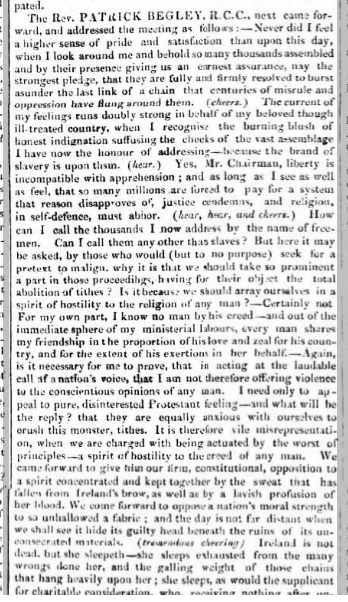
Obituary 1873 Charles O’Regan, Esq, 78, Landlord, Ballydehob, A Fine Old Irish Gentleman Uncle of Charles Roycroft, Magistrate, Macroom,

https://mail.google.com/mail/u/0/#sent/15d4a276e9da9000

Tomb Old Caheragh Graveyard, Skibbereen, West Cork, of Timothy McCarthy Downing, Skibbereen Lawyer, Landlord, Margaret Mary  daughter buried died 1868, aged 28 wife of Captain Thomas John Davys, Justice of the Peace Longford,  Roger Downing , Bantry Businessman, Political Activist.

Died 1879Timothy McCarthy Downing EsqSolicitor, MPProspect House, Skibbereen. Subscriber (5 copies) Dr. Daniel Donovan ‘History of Carbery, 1876.Probate to Rev. Charles Davis, Rosscarberry and Francis Joseph McCarthy, Queenstown Esq two of the Universal LegteesEffect under £9,000. Captain John Thomas Davies, JP, Longford, married Margaret Mary McCarthy Downing d Mccarthy Downing, Skibbereen, solicitor, landlord, MP. died 1868, aged 28 buried Old Caheragh.Landed estate sale of Becher Estate sons, Charles Edward b 1845, Francis Henry named as life in a number of leases b 1846

View original post 297 more words

1843, Frequency of Petty Session Courts at Carrigboy (Durrus) , Held Every Three Weeks, West Cork, Missed due to Wet Days, Magistrates in Cork, too near Christmas only 5 Sitting Days Missed in 1842.


1843, Frequency of Petty Session Courts at Carrigboy (Durrus) , Held Every Three Weeks, West Cork, Missed due to Wet Days, Magistrates in Cork, too near Christmas only 5 Sitting Days Missed in 1842.

The local Magistrates were members of the Evanson family, the O’Donovans of O’Donovan’s Cove, The Fort, three brothers and from surrounding areas.  It is unclear if the Resident Magistrates were sitting at this time.


The petty Session Court was held on the first floor of the Courthouse from after 1850 when the village was rebuilt by the Bandon estate.  Some years later due to the hue crown attending court the floor collapsey.  Although there weee injuries no fatalities.


https://books.google.ie/books?id=fVkSAAAAYAAJ&pg=RA2-PA25&lpg=RA2-PA25&dq=cork+petty+session+clerks&source=bl&ots=eUN1IjKDx5&sig=d4Ktg_s9R360HiVv8mMyaiFraqY&hl=en&sa=X&ved=0ahUKEwjmqJjj6ovVAhXEIMAKHSmvAG84ChDoAQgmMAA#v=onepage&q=cork%20petty%20session%20clerks&f=false


Screen Shot 2017-07-15 at 18.47.45


..


Nineteenth-century copy of Aodh MacAingil’s ‘Scáthán Shacramainte na hAithridhe’ or ‘The Mirror of the Sacrament of Penance’ printed at the Irish press in the college of St. Anthony’s, Louvain, in 1618. Aodh Mac Cathmhaoil OFM (Anglicized: Hugh MacCaghwell, 1571-22 Sept. 1626) was an Irish Franciscan theologian and Archbishop of Armagh. He was known by Irish speakers at Louvain by the honorary name Aodh MacAingil


Nineteenth-century copy of Aodh MacAingil’s ‘Scáthán Shacramainte na hAithridhe’ or ‘The Mirror of the Sacrament of Penance’ printed at the Irish press in the college of St. Anthony’s, Louvain, in 1618. Aodh Mac Cathmhaoil OFM (Anglicized: Hugh MacCaghwell, 1571-22 Sept. 1626) was an Irish Franciscan theologian and Archbishop of Armagh. He was known by Irish speakers at Louvain by the honorary name Aodh MacAingil


Courtesy Capuchin Archives:


….

Screen Shot 2017-07-15 at 18.30.57


1796.  The Harmful Effects of Peace, Expedition to Bantry Bay No Troops In Action.  Various Accounts of French Invasion.


1796.  The Harmful Effects of Peace, Expedition to Bantry Bay No Troops In Action.  Various Accounts of French Invasion.


..

https://collage.cityoflondon.gov.uk/zoom-item?i=16229&WINID=1499984065686


1796 French Invasion Bantry Bay Anchor


False Alarm of French Invasion at Bantry Bay, 1779


-osullivan-berehaven-on-french-invasion-bantry-bay-2nd-january-1797/


Cartoon from Bond Street, London January 1797 on Destruction of French Armada at Bantry Bay.

Notes on the Movement of the French Fleet in Bantry Bay and Panic in Bantry on Friday the 23rd December 1796, the women seek asylum in Bandon or Cork or to the Kerry Hills from a contemporaneous note by Edward Morgan.


Imagined Landing of the French in Bantry Bay 1796 from the London Printing and Publishing Company


1822 Petition of Joshua H Cox, Manor House, Dunmanway for continuance of Mother’s Pension of £200 Mentions Favourable Treatment of French Officers in 1796, French Officers on Parole entertained at Balls, Petition of Herbert Gillman, Woodbrook, Dunmanway, to be Re-Instated as Magistrate, Mentions his Role in preventing Spread of the ‘Insurrectionary Spirit’ in the South of Ireland in the Winter of 1821, Other Baldwin Magistrates, Co. Cork.

“Effects of peace”; ten figures in two rows soliloquiz on the blessings of peace. The last, a foppish young officer, alludes to the expeditions of Bantry Bay and Fishguard, in neither of which were troops in action. The intention appears to be to show the harmful effects of peace.

Satirical Print Collection
Artist

Woodward, George Moutard (1760?-1809)~
Engraver

Cruikshank, Isaac (1756/7-1810/11)
Publisher


Screen Shot 2017-07-13 at 23.18.26

Screen Shot 2017-07-13 at 23.18.41

Screen Shot 2017-07-13 at 23.19.26

Screen Shot 2017-07-13 at 23.24.51

….

1812. Coach from Cork to Skibbereen, Leaves Burchill’s Bush Tavern, George’s St. (Washington St.) 6 am Arriving Skibbereen 6 pm via Innishanon, Bandon, Clonakilty, Rosscarbery.  Reaching Skibbereen 6pm.


https://www.google.ie/maps/@51.5662801,-9.2861651,14z


1812. Coach from Cork to Skibbereen, Leaves Burchill’s Bush Tavern, George’s St. (Washington St.) 6 am Arriving Skibbereen 6 pm via Innishanon, Bandon, Clonakilty, Rosscarbery.  Reaching  Skibbereen 6pm.

Burchills Tavern suggests a link to the west by name.  Many of the name are in Crookhaven.

At this period the road improvements to the west had started to kick in.  Further roads to Crookhaven and further west on the Beara Peninsula would be another 20 years.  Indeed work still need to be done

1843 Coach Certificates:


https://books.google.ie/books?id=fVkSAAAAYAAJ&pg=RA2-PA25&lpg=RA2-PA25&dq=cork+petty+session+clerks&source=bl&ots=eUN1IjKDx5&sig=d4Ktg_s9R360HiVv8mMyaiFraqY&hl=en&sa=X&ved=0ahUKEwjmqJjj6ovVAhXEIMAKHSmvAG84ChDoAQgmMAA#v=onepage&q=cork&f=false

Screen Shot 2017-07-15 at 20.49.50


..

1843. Mail and Day Coach Timetable and Fares from Cork to Bandon, Clonakilty, Bantry, Enniskeane, Macroom, Skibbereen. Sample Coach Leaves Bantry 8.15 am, Cork 3.15 pm Fare 14 shillings. Inside, 10 shillings Outside.

Late 19th Century Coach Service Dunmanway to Glengariff Run by Andrew Brophy later taken over by Thomas Vickery of Bantry.

1829, Thomas J. Hungerford’s Cork and Skibbereen Union Coach.


https://wordpress.com/post/durrushistory.com/8993

1729 Turnpike Trust. 1822 Cork, Skibbereen and Kinsale Turnpike (Toll Road), Tolled to 1843. 1839 Funding by Commissioner of Public Works, Loan to Trustees of Cork, Skibbereen and Kinsale Turnpike, For road from Castletownbere to Dursey Island, For a Railway From Certain Bogs to Supply Cork with Turf.

20170711_142847

20170711_142957


….

1812.  Cork.  Rates of Tax on Hearts and Windows, Greyhounds at £1 per annum, Miscellaneous Dogs (Hounds, Pointers, Setting Dog, Spaniel, Lurcher, Terrier), at 10 shillings, Male Servants. Lodgers, Horses, Geldings, Mares, Mules,  Carriages, Coaches, Berlins, Chariots, Galashes with 4 Wheels and Two Horse Carriages with 2 Wheels. Michael Sullivan/O’Sullivan, Hurrig Sept of O’Sullivans, Bantry, Heart Tax Collector, Alleged Descendant of O’Sullivan Bere.


..

1812.  Cork.  Rates of Tax on Hearts and Windows, Greyhounds at £1 per annum, Miscellaneous Dogs (Hounds, Pointers, Setting Dog, Spaniel, Lurcher, Terrier), at 10 shillings, Male Servants. Lodgers, Horses, Geldings, Mares, Mules,  Carriages, Coaches, Berlins, Chariots, Galashes with 4 Wheels and Two Horse Carriages with 2 Wheels. Michael Sullivan/O’Sullivan, Hurrig, Bantry, Heart Tax Collector, Alleged Descendant of O’Sullivan Bere.


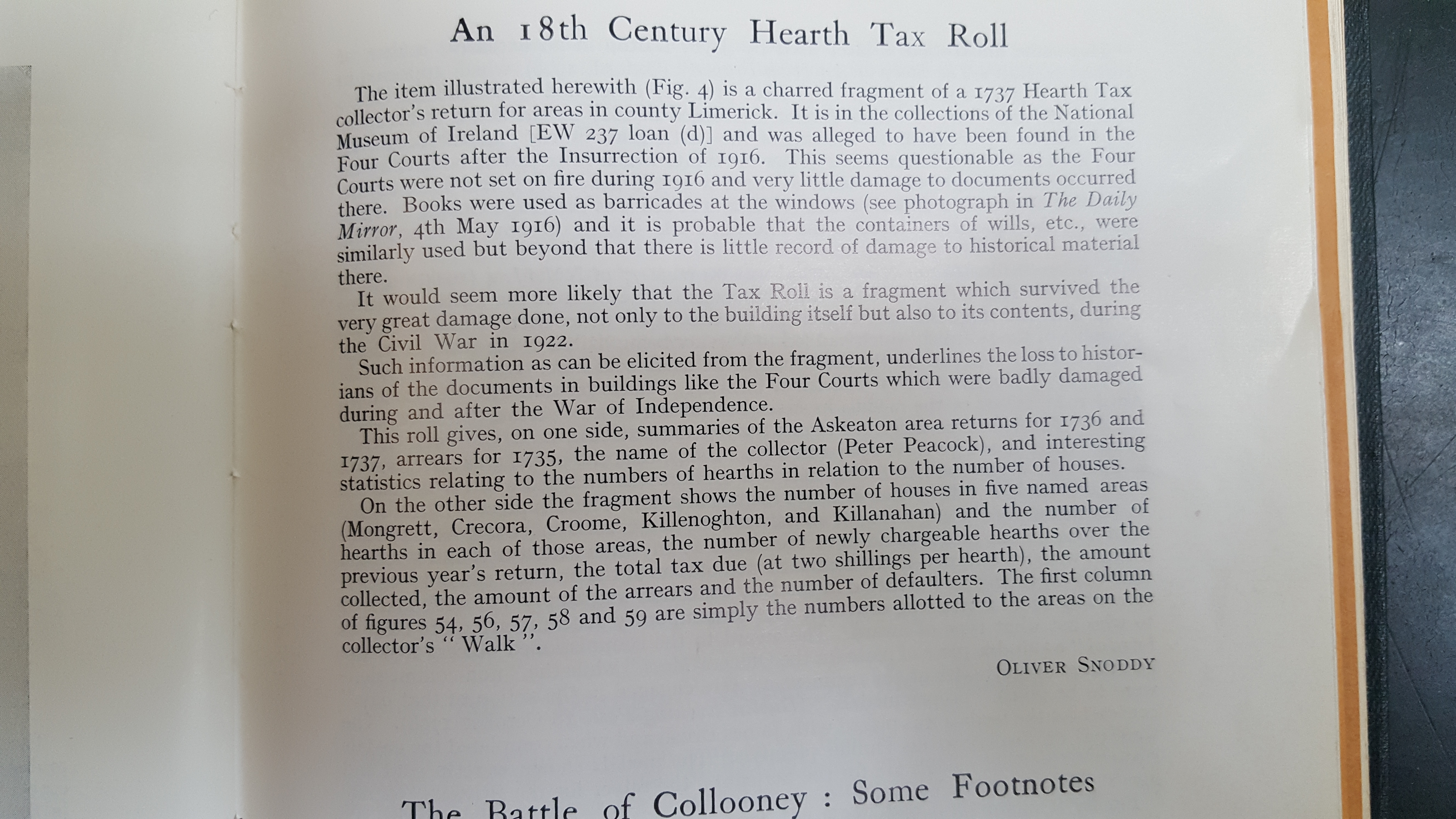
The heart tax records of the 18th century were kept in rolls.  Not only did they record by townland those who paid but those exempt by virue of not having windows or hearths.  The vast bulk were destroyed in the Public Record Office in 1922.

The Grand Jury Records for Cork from the 1820s show Cess Tax collection by Baronial Constables.  It is not clear if this replaced the heart and miscellaneous tax.  Cork Grand Jury:


https://docs.google.com/document/d/1uGCxYYvCGNEbpzypv-6tdTnz78HsuF_YJELLh9ezWvM/edit


The high rate of duty on greyhounds may suggest their status.  roman Empire records refer to exports of greyhounds from Ireland.  In Durrus the O’Donovan landlord family were involved in dogs, maintaining kennels. In the correspondence between Dr. John O’Donovan, (Graves Collection, Royal Irish Academy) the antiquarian and Timothy O’Donovan, Magistrate the merits of the Irish greyhound are debated.  Some years later across Dunmanus  Bay, an Evanson descendant Morris of Ardgoena House ran coursing.


…..

Michael Sullivan (sometimes he signed as O’Sullivan)various;y described as heart tax collector with significant property interests.  A Catholic strictly speaking he could not be a heart tax collector perhaps had a Protestant nominee.  for the probably later cess tax the baronial Constables for Bantry adn Bere were also O’Sullivans.  Through his 1777 marriage to Mary Vickery of Whiddy Island there is an enormous world wide family.

A Good Sheltry Farm gone to Forestry, Upper Tedagh, Durrus/Bantry,Homeplace of Sullivan/O’Sullivan family (Hurrigs), some claim Descent from O’Sullivan Bere from 1777 marriage of Michael Sullivan with Mary Vickery and some property dealings of the family

Robert Sullivan/O’Sullivan Esq, Tedagh, Parish of Durrus, Bantry, to New Orleans, 1845.

Hearth Tax Collection

From 1662 to end of the 18th century. It was levied half yearly by the Sheriff of each county on the basis of lists of the names of householders compiled by local Magistrates.

The list of the households required to pay the Hearth Tax became known as the Hearth Money Rolls, which were arranged by county, barony, parish, and townland. The tax was sometimes collected over an area known as a ‘walk’, which was based on both the town and a large rural area outside the town.

Several attempts were made in Parliament to abolish or at least limit the proportion of households obliged to pay the tax, which was widely regarded as “a shameful infliction upon the poor peasant, to whom even two or three shillings in the year for such a tax was a burden and a wrong”.

Major reform of the hearth tax was finally carried out in 1793 whereby one-hearth households with less than £10 in personal property, or with houses and land worth £5 or less, were henceforth deemed exempt from the tax. The measure was apparently a consequence of parliamentary pressure in the previous session; the modification of the window tax in Britain giving total relief to poorer householders had led to calls in the Irish Parliament for similar “liberality” in the light of Ireland’s healthy finances. The Chancellor of the Exchequer (William Pitt) had refused, but a parliamentary committee was established under the de facto chairmanship of Mr G.P. Bushe who successfully proposed that one-hearth householders should be divided into two groups: those above and those below £5 in annual valuation. Subsequently, in 1795, freedom from hearth tax was extended to all one-hearth householders, as the opposition had earlier demanded; at the same time the tax on multiple-hearth houses was raised.[9][11] The number of persons exempted from the hearth tax was estimated at between a million and a half to two million.[12]

The original Hearth Money Rolls are not extant. The records were housed in the Four Courts in Dublin, the repository for the Public Records Office, but during the Irish Civil War in 1922 the building was destroyed by fire, which also destroyed the Rolls (along with the Irish census records for 1821, 1831, 1841, and 1851), but copies of some of the Rolls have survived.


….

….

1578, Will of James Unak (Uniacke), Youghal, Co. Cork, Overseer, the Seneschal.  Later Uniacks of Nova Scotia.


1578, Will of James Unak (Uniacke), Youghal, Co. Cork, Overseer, the Seneschal.  Later Uniacks of Nova Scotia.


The Seneschal was a legal officer below current District Justice nominated by The Lord of the Manor.


Dr. Casey Item 771

Screen Shot 2017-07-05 at 23.26.24


..

Uniacke Estates:


http://landedestates.nuigalway.ie:8080/LandedEstates/jsp/estate-show.jsp?id=2507


Canada:


On line records of St. Mary’s Cathedral, Halifax, Nova Scotia, Candada, many Cork records including O’Sullivan from Beara Peninsula. Anglican Archives, Kingston, Ontario containing Mizen Muinter Bhaire records, and Richard John Uniacke from Cork to Nova Scotia 1755, Solicitor General, Attorney General Nova Scotia, his son James Boyle the first Prime Minister of Nova Scotia.


Nova Scotia:


Conversions among Catholic Lawyers to the Church of Ireland, 1704-1778. Official concern about ‘Catholic Wives’ 1714, Two thirds of the Business of the Four Courts consists of Popish Discoveries 1723, Andrew Arcedeckne (b Kilkenny 1691) Attorney General Jamaica 1716-7. Dennis Kelly Chief Justice, Jamaica Bryan Finucane Co. Clare Chief Justice, Nova Scotia 1776, Richard J Uniacke, Co. Cork, Solicitor General, Nova Scotia to 1830, Edward Savage, Co. Down Judge South Carolina after 1765