• About
  • Customs Report 1821-2 (and Miscellaneous Petitions to Government 1820-5) and some Earlier Customs Data, including staffing, salaries, duties including, Cork, Kinsale, Youghal, Baltimore, with mention of Bantry, Crookhaven, Glandore, Berehaven, Castletownsend, Enniskeane, Passage, Crosshaven, Cove, Clonakilty, Cortmacsherry.
  • Eoghan O’Keeffe 1656-1723, Glenville, Co. Cork later Parish Priest, Doneralie 1723 Lament in old Irish
  • Historic maps from Cork City and County from 1600
  • Horsehair, animal blood an early 18th century Stone House in West Cork and Castles.
  • Interesting Links
  • Jack Dukelow, 1866-1953 Wit and Historian, Rossmore, Durrus, West Cork. Charlie Dennis, Batt The Fiddler.
  • Kilcoe Church, West Cork, built by Father Jimmy O’Sullivan, 1905 with glass by Sarah Purser, A. E. Childs (An Túr Gloine) and Harry Clarke Stained Glass Limited
  • Late 18th/Early 19th century house, Ahagouna (Áth Gamhna: Crossing Place of the Calves/Spriplings) Clashadoo, Durrus, West Cork, Ireland
  • Letter from Lord Carbery, 1826 re Destitution and Emigration in West Cork and Eddy Letters, Tradesmen going to the USA and Labourers to New Brunswick
  • Marriage early 1700s of Cormac McCarthy son of Florence McCarthy Mór, to Dela Welply (family originally from Wales) where he took the name Welply from whom many West Cork Welplys descend.
  • Online Archive New Brunswick, Canada, many Cork connections
  • Origin Dukelow family, including Coughlan, Baker, Kingston and Williamson ancestors
  • Return of Yeomanry, Co. Cork, 1817
  • Richard Townsend, Durrus, 1829-1912, Ireland’s oldest Magistrate and Timothy O’Donovan, Catholic Magistrate from 1818 as were his two brothers Dr. Daniel and Richard, Rev Arminger Sealy, Bandon, Magistrate died Bandon aged 95, 1855
  • School Folklore Project 1937-8, Durrus, Co. Cork, Schools Church of Ireland, Catholic.
  • Sean Nós Tradition re emerges in Lidl and Aldi
  • Some Cork and Kerry families such as Galwey, Roches, Atkins, O’Connells, McCarthys, St. Ledgers, Orpen, Skiddy, in John Burkes 1833 Commoners of Great Britain and Ireland:
  • Statement of Ted (Ríoch) O’Sullivan (1899-1971), Barytes Miner at Derriganocht, Lough Bofinne with Ned Cotter, later Fianna Fáil T.D. Later Fianna Fáil TD and Senator, Gortycloona, Bantry, Co. Cork, to Bureau of Military History, Alleged Torture by Hammer and Rifle at Castletownbere by Free State Forces, Denied by William T Cosgrave who Alleged ‘He Tried to Escape’.
  • The Rabbit trade in the 1950s before Myxomatosis in the 1950s snaring, ferrets.

West Cork History

~ History of Durrus/Muintervara

West Cork History

Monthly Archives: October 2011

US Navy Airforce base Whiddy Island, 1918.

13 Thursday Oct 2011

Posted by durrushistory in Uncategorized

≈ 2 Comments

Tags

Curtis H16 Large America, us navy air service whiddy


Once the US joined the Allied war effort in April 1917 they determined that naval aviation facilities were necessary along the coast of Ireland. They selected Lough Foyle, Lough Swilly, Queenstown (Cobh), Wexford (Ferrybank), Whiddy Island and Berehaven as sites.

The development of the Whiddy site was difficult as being an island all material had to be shipped to the island.  Work started in December 1917 and was completed in August 1918.  The base consisted of hangars, slipway, weather and radio stations and a barracks. Staffing was made up  of 9 officers, 9 pilots and 399 enlisted men.  The first two plane US Navy ‘Curtis H12 Large America’ arrived in September 1918 and went into patrol.  The were joined by three other planes.  As the war ended in November 1918 the planes in total only logged under 70 hours airtime.

The base after the war was dismantled.  Some of the material was auction off locally there is however still the remains of the concrete base of the hangars and other base installations.

See: The Whiddy Island Seaplane Base, Donal Fitzgerald, Bantry Historical and Archaeological Society 1994

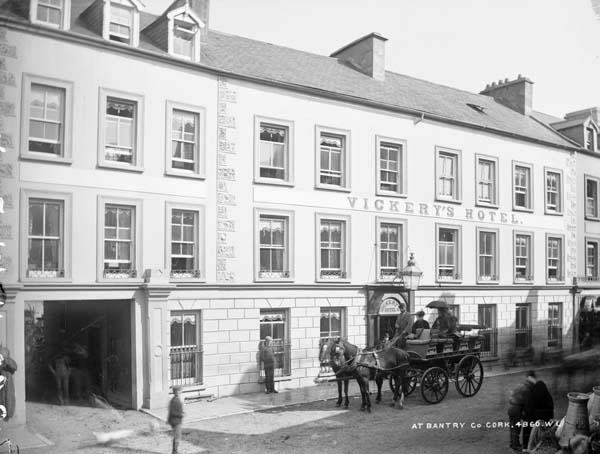
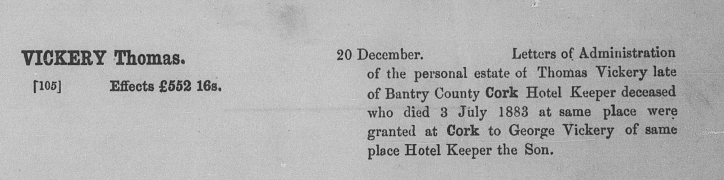
Thomas Vickery, Bantry, 1808-1883, Hotel and Transport Pioneer in Irish Tourist Industry, Winter Sale of Horses and some Vickery Genealogy.

13 Thursday Oct 2011

Posted by durrushistory in Uncategorized

≈ 7 Comments

Tags

bantry, Bantry Bay, County Cork, Hotel, Killarney


Updated:

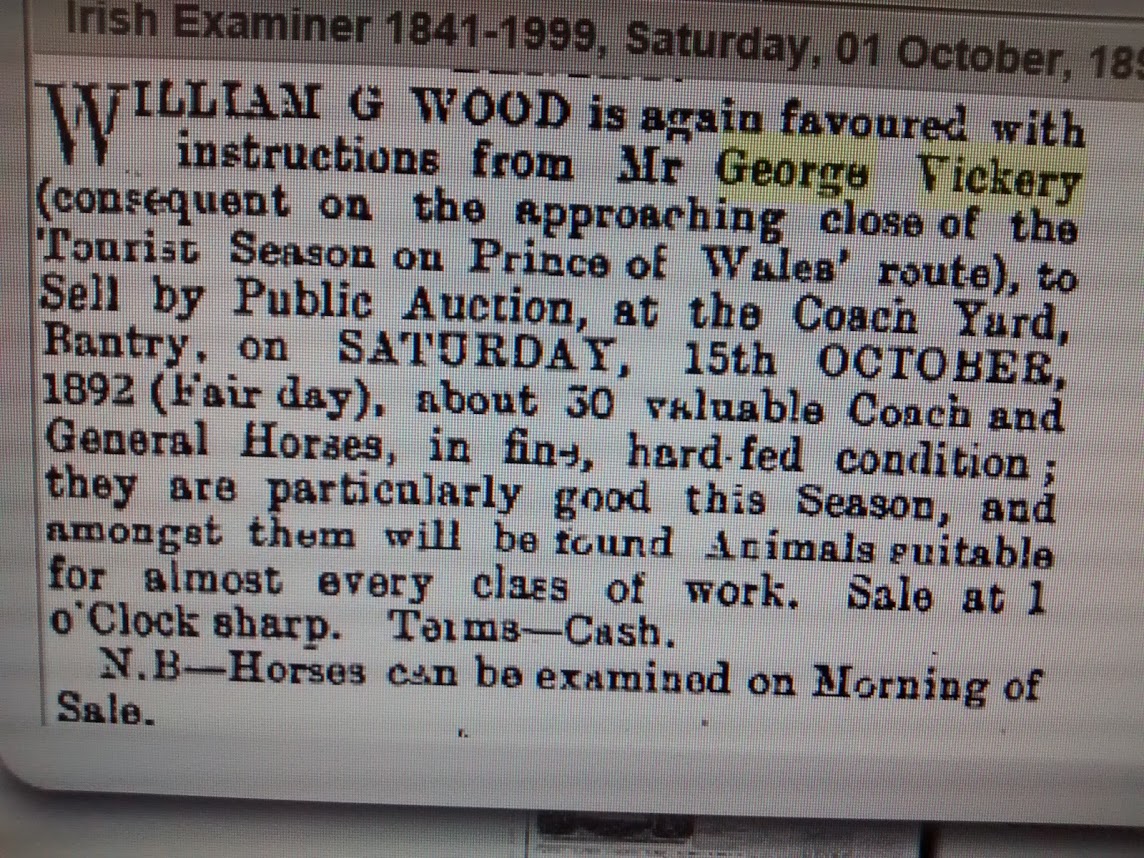
George Vickery Horse Sale 1892

From National Library of Ireland photographic collection c 1890s.  Burnt down during Troubles to prevent use by Black and Tans.

Former Hotel January 2016, currently being refurbished.

1-IMG_20160114_141058806

Screen Shot 2016-01-18 at 17.06.44

https://www.google.ie/maps/place/Bantry,+Co.+Cork/@51.6808918,-9.4486028,9z/data=!4m2!3m1!1s0x48450a56fb9974b9:0xa00c7a99731a220

Courtesy Hazel Vickery:

http://www.irelandxo.com/sites/default/files/history_of_the_vickery_family_of_west_cork.pdf

http://www.irelandxo.com/sites/default/files/vickery_of_the_bantry_hotel_v2.pdf

The legend is that the Vickery family of Co. Cork are reputed to be descended from two brothers from the West Indies who were shipwrecked in Bantry Bay in the mid-18th century. This however is unlikely as there are Vickeries in early 18th century Bantry leases suggesting they were around pre 1700.

Thomas Vickery (1808-1883) was one of this family and married Mary Sullivan.

He established a hotel on the site of an old dye works in Bantry c1850 and it continued in business until late 2006 when it was bought by a development consortium.  During the troubles the hotel was burned down and reconstructed with the novelty of a wash hand basin in every room.

In 1850 the hotel had 25 bedrooms and it was also the  centre of a coaching establishment. This linked Bantry to Killarney on the emerging tourist route. Up to 100 horses were kept for this purpose.

Thomas Vickery’s nephew Robert Stanley Vickery stated that his uncle with establishing his hotel and postal arrangements for the establishment of tourist did more for Bantry and its neighbourhood then the Bantry (White) family ever did.  Countless people had their first training in catering and business in the hotel and in the garage business the family also ran.  Many went on to found their own businesses or work in  others all over Ireland and the world.

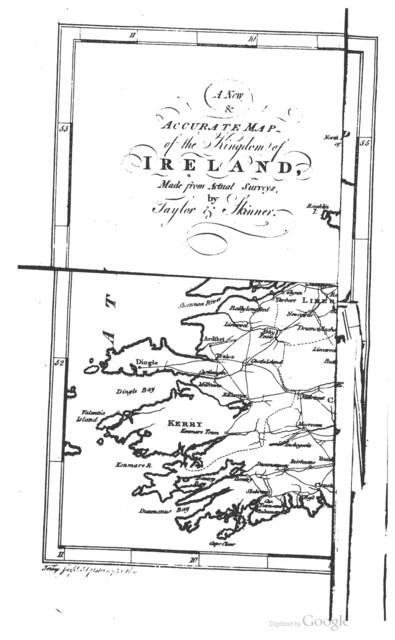
Taylor and Skinner road map West Cork 1777

11 Tuesday Oct 2011

Posted by durrushistory in Uncategorized

≈ Leave a comment

Tags

1777 taylor and skinner


Caesar Otway journey Mount Gabriel 1822.

11 Tuesday Oct 2011

Posted by durrushistory in Uncategorized

≈ 4 Comments

Tags

boyle cox carew schull bantry, dublin penny journal, george petrie, mount gabriel o'mahony, protestants caesar otway sea, west munster


The Reverend Caesar Otway (1780-1842), a native of Nenagh, Co. Tipperary, passed through the district in 1822 going from Schull to Bantry.  He describes the journey passing ‘the dark and lofty Mount Gabriel, and took my dreary way over a comfortless tract of country, the peninsula of Ivaugh… and here the tribe of O’Mahony has contrived to increase and multiply, and they replenished these wastes with Paddies, pigs, and potatoes.  Let no one say looking at these moors, studded over with cabins, and those cabins crowded with children, pigs, goats, cocks and hens, that a poor Irishmen is not an industrious creature.  No; look at that string of men, women, boys and girls, toiling up the mountain side with sea-weed and sea-sand in baskets on their backs.  See them reclaiming, from amidst rocks and bogs, patches of ground on which to cultivate their only food, the potato; and no one witnessing this struggle of human industry against nature, but must acknowledge that the Irish can be industrious’.  He continued past the stone circle at Dunbeacon and remarked on Dunmanus bay, a very fine estuary a safe harbour and then addressed himself to ‘my Protestant reader, in the condition of the poor Protestants in this south –west district of the county of Cork, planted here originally by the piety of the Boyles and other undertakers of the plantation of Munster.  The encouragement, the increase, the cherishing of this Protestant yeomanry formed the pride and honest boast of a Boyle, a Cox, or a Carew; and they were as proud of the number of their Protestants as the number of their acres; but now their absentee descendants have other views and other partialities-as the modern system of elective franchise has changed the face of the country, and made Ireland one wide expanse of populous pauperism, and Protestants are effectually discouraged’.

From Library Ireland

Rev. Caesar Otway

Author of “A Tour in Connaught.”

From The Dublin University Magazine, Volume 14, No.82, October 1839

OUR sketch attempts to pourtray a thorough Irishman. Attempts, we say deliberately, because with all due respect to the clever artist, we declare that though the animal representation be faithful, the spiritual is not caught; for instead of a countenance beaming with gaité de coeur, sparkling with ready fun, and mutable with a playfulness of muscle—the presage of a coming repartee—we have here a likeness, it is true, but of an atrabilious smell-fungus character. The man is taken off as if when his stomach is settling after the sickness of a steam-packet; or after (as is common in his native Tipperary) plotting a homicide. For all this we blame not the artist—for if Caesar Otway chooses to take to his chair as grave as a mustard-pot, considering it needful to be serious, and ambitious of making his anomalous countenance, ordinary as it is (unless sun-lit) cloud-capt with solemnity, whose fault was it? Perhaps it would have been better, had we, instead of taking him like a hare, sitting in its form, caught him unawares, and watching our opportunity, seized him during the “mollia tempora fandi,” in conversation with some kindred spirits in Messrs Currys’ shop. But this is not easy, for it is not every one who can hit well flying. At all events, here is the animal—you may swear to its identity, for it is, at least, as like Caesar Otway as a dead dolphin is like a living one.

We do not intend either in this or our future portraitures, to offer a detailed biography of the individual. Our desire is only to assign a few reasons for admitting him into our Gallery.

The REV. CAESAR OTWAY is a clergyman of the Established Church, and though advanced in life,Caesar Otway and approaching his sixtieth year, has never been beneficed—the only situation he fills in his profession, being some inferior office in St. Patrick’s Cathedral, and the assistant chaplaincy of the Magdalen Asylum. As a preacher Mr. Otway has much originality; his sermons are animated, forcible, and out of the common run; and though often homely, and approaching to vulgarity in his expressions, and sometimes tempted to indulge his native humour, so far as to border on the ludicrous, yet he has the undoubted power of arresting the attention, and fixing his doctrine, which is Evangelical, in the memory of his hearers. Still our impression is, that Caesar Otway is not at home in the pulpit; for though be does his best, and is evidently faithful and serious, we have no doubt he would have been more in his proper place at the bar.

As a writer Caesar Otway is chiefly known by his descriptions of the scenery and manners of his native land. Of these his “Sketches in Ireland,” and recently published “Tour in Connaught,” are fair specimens. Mr. Otway, in the year 1825, in conjunction with his friend, the Rev. Dr. Singer, Fellow of Trinity College, (whom we hope hereafter to introduce more formally to our readers) undertook the first Irish religious magazine in connection with the Established Church. This valuable and moderate journal, entitled the Christian Examiner, which is still in existence, though struggling under various and unmerited discouragements, remained until the last three years chiefly under Mr. Otway’s management; and it was in the pages of this magazine, and as he said “in order to enliven it, and make it read by the parson’s wife and daughters, as well as the parson himself,” that he ventured to sketch off what his recollections were of the different parts of the island he had visited. Besides these lighter articles, there are many valuable papers to be found in the numerous volumes of the Examiner, supplied by Mr. Otway, of a historical, biographical and controversial character. Among these may be noticed his history of Popery in Ireland, Memorials of the Established Church, and Biographical Sketches ofPrimate Marsh, Archbishop King, Andrew Sall, &c. &c. Mr. Otway has also supplied in many other articles, of an amusing and instructive kind, to other periodicals of a Protestant and Conservative character, which have appeared in Dublin during the last 15 years—what has been the extent of his contributions to our own pages, is, of course, among the secrets of the confessional, and may not be divulged.

In the year 1832, Mr. Otway, being willing to gratify the demand which then arose for cheap literature, and thus to aid in the diffusion of useful information among the poorer classes respecting the antiquities and history of their country; and desirous of opening out its capabilities by giving information concerning its past and present state, carried on, in conjunction with his friend,GEORGE PETRIE, Esq., for one year, the DUBLIN PENNY JOURNAL. At the end of that period these gentlemen ceased to be connected with it, and certainly with a loss to the country—for without desiring at all to detract from the merits of its subsequent management, it can be with great safety said, that the volume produced by their exertions, without containing one line that would mark the religious or political partialities of the writers, contained more matter illustrative of the history and antiquities of Ireland, than any previous publication.

The peculiar characteristics of Caesar Otway as a writer are, the power he possesses of making his readers partake in the deep feeling he has for the natural beauties of his native land, and the humour and tact with which he describes the oddities and amiabilities of the Irish character; and while depicting, with no mean effect, the absurdities of poor Paddy, there is no sourness in his satire. He even treads tenderly upon the heels of Popish Priests, and would, if possible, by his playful hits, rather improve the profession than hurt the individual.

Beginning late in life to write for publication—we have heard that till his fortieth year he was not aware that he could handle a pen—occupied, too, for seventeen years as the curate of a country parish, he had not the time, even if he had the desire, to be an author : he, therefore, exhibits both the faults and excellencies of one who has late in life come for the first time before the public. His style is often rough and ill-formed; he frequently sins against taste and judgment, and sometimes so far forgets his schoolmaster as to break Priscian’s head;—but, on the other hand, he shows the advantages possessed by one who has evidently poured in much, before he attempted to pour out any. He seems full of multifarious information—he is fraught with practical knowledge—and, having observed almost as much as he has seen and read, he can adorn with legend, anecdote, and veracious story, almost any place or thing he attempts to describe; and we verily believe he would give a very pleasant description of a tour round a broomstick. This is what renders his Tours so interesting; the reader, as he follows him on his journey, is beguiled into a knowledge of the history and traditions of the country through which he passes.

Perhaps our friend Caesar Otway has wasted his time and talents on this gossiping kind of authorship, for we have reason to believe he has powers and acquirements calculated to make him a pleasing and instructive historian. A good Conservative history of Ireland is yet a desideratum, and no one, in our humble opinion, could supply the deficiency better than the elderly gentleman who is so gravely, against his grain, courteous reader, pourtrayed in the etching before you.

A new edition of Mr. Otway’s Sketches in the North and South has lately been issued, and he has in preparation a volume, chiefly devoted to the little known scenery of North Connaught and West Munster.

A. P.

John Windle Dublin Penny Journal 1830 Drimoleague to Durrus

Rides through the County of Cork, Castle Donovan, Dublin Penny Journal 11th November 1834

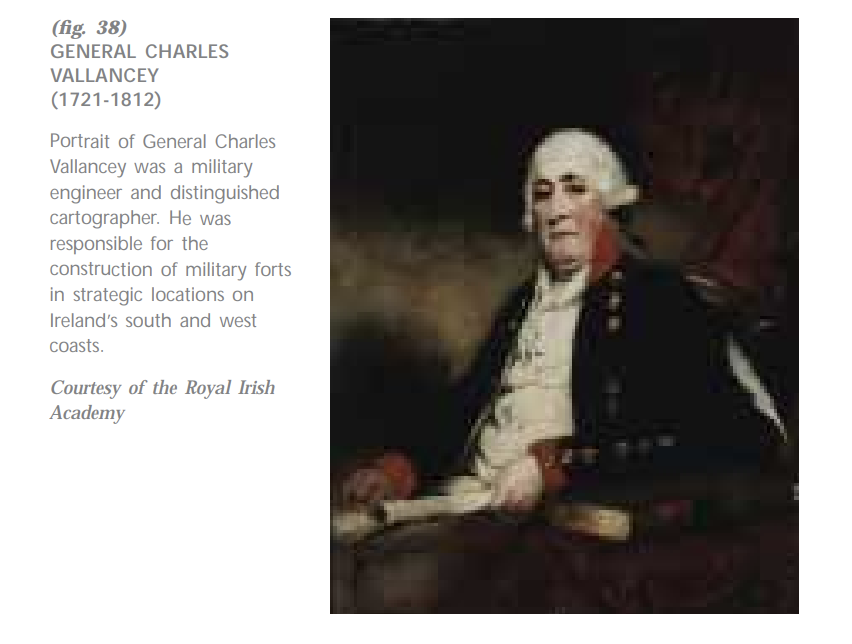
General Charles Vallancey (1721-1812) Survey Report West Cork, 1778.

11 Tuesday Oct 2011

Posted by durrushistory in Uncategorized

≈ 1 Comment

Tags

irish language military survey, vallancey 1831 census bantry


https://www.google.ie/maps/place/Durrus,+Co.+Cork/@51.6711046,-9.2985247,12z/data=!4m2!3m1!1s0x48459fe7ccd270df:0x231e3744ac95441a

General Charles Vallancey Survey Report  1778

He was sent to Ireland to assist in a military survey, remained and became an authority on Irish antiquities.Screenshot 2023-01-26 at 19.23.50
He fathered numerousn children by three wives. He learnt Irish and became fluent in it.  Some of his theories are now regarded with a degree of scepticism.   He wrote a report on the West Cork area which should also hold true for Durrus at the period: ‘There was only one road between Cork and Bantry; you may now proceed by eight carriage roads beside several horse tracks branching off from these great roads, from Bantry the country is mountainous and from the high road has the appearance of being barren and very thinly populated; yet the valleys abound with, corn and potatoes and the mountains are covered with black cattle. In 1760, twenty years ago it was so thinly inhabited, an army of 10,000 men could not possibly have found subsistence between Bantry and Bandon.   The face of the country now wears a different aspect:  the sides of the hill are under the plough, the verges of the bogs are reclaimed and the southern coast from Skibbereen to Bandon, is one continued garden of grain and potatoes except the barren pinnacles of some hills and the boggy hollows between which are preserved for fuel’   This would suggest that the major population expansion may have dated from c 1775. Wakefield in 1809 estimated the number of houses on the Muintervara peninsula occupied by Catholics and Protestants at 600.  In the 1831 Census the population of Durrus East is 1,620.  In 1838 the population was 8,340 of whom around 800 were Protestant.

From Library Ireland

General Charles Vallancey

From A Compendium of Irish Biography, 1878

« James Ussher | Index | Charles Vereker, Viscount Gort »

Vallancey, Charles, General, an antiquary, was born in England in 1721. He entered the army at an early age, was attached to the Royal Engineers, became a Lieutenant-General in 1798, and a General in 1803. He came to Ireland before 1770 to assist in a military survey of the island, and made the country his adopted home. His attention was strongly drawn towards the history, philology, and antiquities of Ireland at a time when they were almost entirely ignored, and he published the following, among other works: Collectanea de Rebus Hibernicis, 6 vols., between 1770 and 1804; Essay on the Irish Language, 1772; Grammar of the Irish Language, 1773; Vindication of the Ancient Kingdom of Ireland, 1786; Antient History of Ireland proved from the Sanskrit Books, 1797; Prospectus of a Dictionary of the Aire Coti or Antient Irish, 1802. He was a member of many learned societies, was created an honorary LL.D., and became a fellow of the Royal Society in 1784.

During the Insurrection he furnished the Government with plans for the defence of Dublin. Queen’s-bridge, Dublin, was built from his designs. He died 8th August 1812, aged 91. There are portraits of him in the Royal Irish Academy and in the board-room of the Royal Dublin Society. In the light of modern research his theories and conclusions — a fanciful compound of crude deductions from imperfect knowledge — are shown to be without value, and such as would not now receive a moment’s attention. George Petrie says: “It is a difficult and rather unpleasant task to follow a writer so rambling in his reasonings and so obscure in his style; his hypotheses are of a visionary nature.” The Quarterly Review declares that: “General Vallancey, though a man of learning, wrote more nonsense than any man of his time, and has unfortunately been the occasion of much more than he wrote. The Edinburgh Review says: “To expose the continual error of his theory will not cure his inveterate disease. It can only excite hopes of preventing infection by showing that he has reduced that kind of writing to absurdity, and raised a warning monument to all antiquaries and philologians that may succeed him.”

Sources

16. Authors, Dictionary of British and American: S. Austin Allibone. 3 vols. Philadelphia, 1859-’71.

40. Biographical Division of English Cyclopaedia, with Supplement: Charles Knight, 7 vols. London, 1856-’72.

72. Castlereagh, Viscount: Memoirs and Correspondence, edited by the Marquis of Londonderry. 12 vols. London, 1848-’53.

146. Gentleman’s Magazine. London, 1731-1868.
Gilbert, John T., see Nos. 110, 335.

Petty’s census 1659 for hearth tax Durrus

11 Tuesday Oct 2011

Posted by durrushistory in Uncategorized

≈ 5 Comments

Tags

petty census hearth tax


The Co. Antrim Rolls give an idea of the scale of the catastrophe inflicted on the Irish People in 1922.

Click to access hearth_rolls_of_county_antrim.pdf


Appendix 9 Petty’s Census 1659


This was compiled for the purpose of compiling a tax base which ultimately became a hearth tax.

Described as ‘Part of Dunisse Parish’

A table sets out the breakdown of land ownership and the total area is 8,674 acres, 5,646 profitable, 3,078 unprofitable. This document is the Downe Survey in the National Library Ms 714

Collumlimge, no.6, Lt. Coll. John Read, 3 English, 3 Irish

Curcollaght, no.5, Richd. Earlsman, 2 English, 3 Irish

Dromreage, no.23,    ”         , 23 Irish

Tullagh, no.9,  ”   ”, 9 Irish

Rossmoye, no.11,   ” , 11 Irish

Bracklisse, no.2, ” ” , 2 Irish

Killounnoge, no.6,  ” ”  , 6 Irish

Part Ducusse

Ballycomane, no.22, Richd. Earlsman, 22 Irish

Maulbyvard, no.17,  ”    ”   , 17 Irish

Letterlicky, no.27,   ”    ”   , 27 Irish

Skart, no.32,  ”   ”  , 32 Irish

Baregorume, no.14,  ”  ”  , 14 Irish

Carrig Buvy, no.51,  ”  ”  , 4 English, 47 Irish

Clonigh, no.2,  ”  ”  , 2 Irish


Durrus is listed but the townlands are more proper to Bantry i.e., Rooska, Beach etc.  The numbers listed are not the absolute population but those liable to hearth tax, over 18, not a servant or single.


Description of ‘The Parish of Durrous’

Is bounded on the East with the Parish of Caharagh on the South with the parish of Skull  on the West with the Sea and the Parish of Kilcroghane and the North with the Harbour of Bantry and the Barony of Bantry in the County of Corke:-

The qualitie of the Land of this Parish is course part mountainous pasture part wood and some arable: – A small river called the Four Mile Water runneth through the Parish into the Sea, in its way passing neere the Church of Durrous and neere unto the Sea by the House called Four Mile Water at present is a Garrison:- The following Denominations are members of this Parish viz

Glinnykelty 2  Tullagh 3  Cullinalong 4 Drumitahane 5 Killowne

Colanalong Coarguolaghty Ballicomane Aghaguhine Letterlicky

Skart Baregorrum Cahersacragh (?) Killaminoge Drumreagh


A table sets out the breakdown of land ownership and the total area is 8674 acres, 5646 profitable, 3078 unprofitable. This document is the Downe Survey in the National Library  Ms 714


Numbers Proprietors Denominations         Numbers of Lands                 Lands

In Plott         Acres by Profitable         Unprofitable

Admeasurement

487 Florence McCarthy Pt. of Tullough Glynikelly 599-2-0 Ar. & Past.

And Collanatsonge 599-2-0.


487m The Same Part of Tullough 182-0-0 Unprofit.182-0-0

m Capt. William Hull Part of the same &    )

Protestant Prop. Drumlahane 40 acres)


487.1 Owen o Dale Jr Part of Killtowne 062-0-0 Ar.& Past.062-0-0

The same of the same 026-0-0 Mount. 026.0.0


487b Florence McCarthy Part of the same 128-0-0 Bogg &Mt.128-0-0


487b The Same Pt. of Coolanalong 238-0-0 The same 238-0-0


488.1 The Same of the Same 114-0-0 Ar. & Past.


488.16 The Same of the Same 334-0-0 Bogg&Mt.337-0-0


488.16 of the Same 468-0-0 Bogg&Mt.468-0-0


488.2 The Same of the Same 116-0-0 Ar. & Past. 116-0-0


2b The Same of the Same 022-0-0 Bogg – 022-0-0


2b The Same of the Same 022-0-0 Bogg – 022-0-0


488 John McCarty als Muckle Part of the Same 860-0-0 Ar. & Past. 860-0-0


489 Knogher & Mahony Coarguolaghty   ) 372-2-0       Ar.Wood & Past.372-2-0

+ als Mc O Deilanirfra 3 plough Landes)

489 The Same of the same 072-0-0 Bar.Mt. 072-0-0


489 The Same of the Same 110-0-0 Mount.110-0-0


489 m. The Same of the Same 092-0-0 Mount.092-0-0


491 Owen McThynine Aghaguihine 1 Pt. 624-0-0 Ar. & Past.624-0-0


491 Friosyne McNasoig Part of the Same 232-0-0 Ar. & Past.2323-0-0

491.1 Owen McFhynine Part of the Same 058-0-0 Ar. & Past. 058-0-0

491.V Unprofitable Land in Aghaguhine 087-0-0 Bog.& Mt.087-0-0


492 Donagh McDermod   ) Letterlecky 348-0-0 C…Mt.Past.348-0-0

& Daniel, McDermody


492a Fhymine McOwen Pt. of the Same & 156-0-0 Ar. & Pasat. 146-0-0

492b Charles McCarthy & Donagh Part of the Same) 231-0-0 Bogg 231-0-0

a:V ??  Ffynine McOwqen Pt. of Letterlecky  ) 114-0-0 B & Mt. 114-0-0

b:V Charles McCarty & Donagh Part of the Same  ) 212-0-0

493 Ffynine McCarty Skart 3 ploughed Lds. 724-0-0 Ar. & Past. 724-0-0

494 Jn. McCarty als. Muckly Baregorrum 1  pld. 412-0-0 Ar. & Pasat. 412-0-0

494V The Same of the Same 180-0-0 B.Mount.180-0-0

The Same of the Same 048-0-0 Wood 048-0-0

B & Mt.  212-0-0

P The Same of the Same 009-0-0 Pasture 009-0-0

495 Fynine McCormack Cahivevneagh 1/1 pt. 318-0-0 Ar.l & Past. 318-0-0

496 Philip O’Sullivan Kilominogue 1 ½ pt. 335-0-0 Ar. & Past. 335-0-0

A E. of Cork Ptestant Drumreagh 896


Total 8674-1-0 5646-0-0 3078-1-0


Petty, in 1687 believed that land values were substantially higher than in 1641 but the population had not recovered to its level before that time.
 

Gill Abbey, Cork inventory 1541 including ‘vicarage’ of Durrus

11 Tuesday Oct 2011

Posted by durrushistory in Uncategorized

≈ 1 Comment

Tags

1541 vicarage skiddy meade, gill abbey durrus coppinger


Inventory Gill Abbey (Cork) 1541

Against the background of the Tudor appropriation of religious property an inventory of property belonging to Gill Abbey was conducted in 1541.  A panel of Cork jurors were appointed and numbered, Walter Gallwey, John and Richard Skiddy, Patrick and William Coppinger, William Meade and Richard Gould (these were representative of old Cork Merchant families some of possible Viking decent).  They included under ‘Durruske’ the vicarage of Durrus which also belonged to St. Catherines in Waterford.   In the 1580s the parsonage and vicarage had a valuation of 40s. A further list was compiled in 1588 and the valuation of Durrus vicarage was £1. 6s. 8d. and ‘Kylcroghan’ was £2. 10s. 0d. in 1591.

It might be noted that the Coppinger family at one stage owned the Durrus town land of Ballycommane

Evanson Family and Estates, Durrus

09 Sunday Oct 2011

Posted by durrushistory in Uncategorized

≈ 6 Comments

Tags

bantry, evanson durrus west cork, irish history, west cork


Magistrate, Nathaniel Evanson, 1675, probably Castledonovan.

Gearhameen, originally McCarthy Castle then Durrus Court c 1740:

https://www.google.ie/maps/place/Gearhameen,+Co.+Cork/@51.6261045,-9.5602202,15z/data=!4m2!3m1!1s0x48459e28b250bf55:0x4d51dc58ca16170f

Ardgoeena from c 1740 still there in ownership of Gallagher family,remnants of probable stable still extant main wall of old house collapsed some years ago.   Well behind stables.:

https://www.google.ie/maps/place/Ardogeena,+Co.+Cork/@51.6122037,-9.5242018,15z/data=!3m1!4b1!4m2!3m1!1s0x48459fb8f9c0f5c7:0x7554b4a819007bca

Friendly Cove/Murreagh probably from c1790:

https://www.google.ie/maps/place/Murreagh,+Co.+Cork/@51.6143184,-9.5429485,15z/data=!3m1!4b1!4m2!3m1!1s0x48459fcb224cb7e3:0x5f4e5fce7b3b237d

There were two large crypts at the sea ward side of St. James Church of the Evansons until a cemetery clearance in the 1930s. The family in England had paid for their maintenance from the late 19th century and when after WW2 they discovered the loss of the tombs with all their detail they were most upset.

Branches of the family were sugar planters and slave owners in Barbados. They expanded into Bandon and Cork where Charles was Mayor. It is difficult to distinguish whether at time the were based in both Bandon and Durrus the house name ‘Brookfield’ may be either Durrus Court or a Bandon House.

Evansons

Dive Downe’s was the bishop of Cork and Ross and in 1700 toured the dioceses he says ‘Mount Gabriel is the haunt of wolves and there are no trees or shelter except rocks and bogs. The patron saint of Durrus is St Faughan in the parish of Durrus i.e. about Four Mile Water and at Blackrock near Bantry are about 30 Protestant families and in that part of the parish which is in Bantry are two English Schools kept by women.  All the inhabitants of Kilcrohane are Papists and the land very coarse except for that of the Bishop of Cork’s lands’. He refers to Vicar Thomas Holmes of Kilmacomoge preaching every fourth Sunday at Captain Evanson’s house at Four Mile Water.  Nathaniel Evanson the elder was the Lieutenant of Dragoons who received 2,400 acres of O’Donovan lands at Castle Donovan in the 1661. He mortgaged these lands and moved to Four Mile Water.  He had three children, Thomas whose son Edward settled in Antigua, a daughter who married John Beamish in 1678 and a son Charles who married Susan Arnopp in 1688 (daughter of Colonel Arnopp of Dunmanway).  Their eldest son Nathaniel married Mary Alleyn in 1724 and died at Four Mile Water in 1766.  Their son was Alleyn, and his son Nathaniel the third, who was at Four Mile Water in the 1790s was made a Justice of the Peace on the 27th May 1799. They had numerous relations sugar planters in Antigua. He may also have been resident in Bandon. He married Mary Townsend Baldwin in 1784 and their children were Alleyn who was ordained, Nathaniel (1802-29) and Tonson (Richard) who built Friendly Cove probably around 1810.  He married Melian Donovan in 1812 who died childless and then Mary Beamish in 1816.  Friendly Cove passed to William Beamish Morris who married their daughter Catherine.  In Pigot’s Directory of 1824 Nathaniel Evanson and Richard Evanson are at Four Mile Water.  Nathaniel Evanson, Sea Lodge, Cork died on 1849 and the Rev. Alleyn Evanson died in 1853. In Slater’s Directory of 1846 Allen Evanson lives at the Court, Richard Tonson Evanson at Friendly Cove, and Richard Tonson Evanson Jnr. at Ardogina.  There is no reference to them in Thom’s 1862 Directory.  Richard Tonson Evanson was one of the judges of the Bantry Agricultural Show in 1861 and his address was Bantry.   Evanson’s Cove is shown, on the northern side of the road as a wooded estate, on the Ordnance survey map of 1842 in Ahakista but does not appear on the later map. There are two references to Evansons of Brookfield, Cork in the King’s Inns Admission rolls for the early 19th.Century.  The Rev. A. Evanson sat on a committee in Bantry in 1824 to petition against the withdrawal of the linen bounty.

In 1864 Richard Evanson makes over Friendly Cove to his son-in-law and goes to live in Gurteenroe and in 1869 he has moved to Cork City.  That branch of Evanson line died out by the death of the last descendant Catherine Beamish Morris in 1898 aged 80, there are however Evanson descendants living in Cork.

From University College Galway
Moore Institute logoIrish Research Council for the Humanities and Social Sciences (IRCHSS) logo

ESTATE: EVANSON

Associated Families

  • Evanson
  • Morris (Durrus)

Description

Local sources suggest that the Evanson family in West Cork descend from Lieutenant Nathaniel Evanson who was granted an estate of 2,373 acres in the barony of West Carbery, county Cork in 1666. Rev. A. Evanson and Richard T. Evanson were among the principal lessors in the parish of Durrus, barony of West Carbery, at the time of Griffith’s Valuation. Rev. William Evanson was also a lessor in the parish of Kilcrohane and Rev. Allan Evanson in the parish of Kilmocomoge, barony of Bantry, at the same time. Lands owned by members of the Evanson family and others, in the parishes of Carrigaline and Durrus, were offered for sale in the Landed Estates Court in November 1862. The sale included Charlemont House, this had ben the residence of Charles, the Mayor of Cork. This property was held under a lease from the Allen family dating from 1800. In the 1870s, Revs, Charles, Robert and Richard Evanson of Llansory rectory, Monmouthshire, Wales, owned over 2000 acres in county Cork. In 1858 Michael Hungerford Morris married Elizabeth Burrows Evanson, daughter of Richard Tonson Evanson and in the 1870s Michael H. Morris of Durrus owned 1,157 acres in county Cork. http://boards.ancestry.co.uk/surnames.beamish/111/mb.ashx

Houses

House Name / Description Townland Civil Parish PLU DED Barony County Map Ref
imageArdogeena House (H2670)
At the time of Griffith’s Valuation, Richard T. Evanson was leasing this property to Florence McCarthy when it was valued at £10. In 1837, Lewis noted the house as the seat of R.T. Evanson. It is still extant and occupied.
Ardogeena Durrus Bantry Durrus East 27 West Carbery (West) Cork Lat/Lon:51.60992
-9.52747
OSI Ref:
V942408 Discovery map #88. OS Sheet #130.
Four Mile Water Court or Durrus Court (H2672)
Rev. Alleyn Evanson was leasing this property from the Earl of Bandon’s estate at the time of Griffith’s Valuation, when it was valued at £15. It is labelled Four Mile Water Court on the 1st edition Ordnance Map and Durrus Court on the later 25-inch edition. In 1837, Lewis recorded it as Four Mile Water Court, the seat of A. Evanson. It is still extant.
Gearhameen Durrus Bantry Durrus West 28 West Carbery (West) Cork Lat/Lon:51.62046
-9.54660
OSI Ref:
V929420 Discovery map #88. OS Sheet #130.
imageFriendly Cove (H2675)
Richard T. Evanson was leasing this property from John B. Gumbleton at the time of Griffith’s Valuation, when it was valued at £24. Stores adjoining the property were valued at £6. Leet records this property as the residence of Nathaniel Evanson, jnr. in 1814. The house is still extant and in 2009 was offered for sale.
Murreagh Durrus Bantry Durrus East 27 West Carbery (West) Cork Lat/Lon:51.61705
-9.53204
OSI Ref:
V939416 Discovery map #88. OS Sheet #130.
Charlemont House (H3834)
Charlemont House was leased by Charles Evanson from Nicholas G. Allen at the time of Griffith’s Valuation, when it was valued at £20. It was included in the sale of Evanson property in the Landed Estates Court in November 1862. It is still extant.
Monfieldstown Carrigaline Cork Douglas Cork Cork Lat/Lon:51.87444
-8.40225
OSI Ref:
W723692 Discovery map #87. OS Sheet #75.

Archival sources

  • National Archives of Ireland: Landed Estates’ Court Rentals (O’Brien), Evanson, 6 November 1862, Vol 66, MRGS 39/033, (microfilm copy in NUIG)
  • National Library of Ireland: Abstract of deed of 25 Sept., 1844, between Rev. Alleyn Evanson of Fourmilewater, and Stephen Sweetman and Maria Sweetman als. Long, his wife, with Trustee, Richard James Long, 1844. Genealogical Office: Ms.144, pp.33 & 37-8
  • National Library of Ireland: Investigation into search for acts by Allan Evanson against lands of Ballyboughemore, Carrurmore, Doogh and Litter in the parish of Kilmoe, Barony of West Carbery, Co. Cork, 1849. GO Ms.144, pp.33-40
  • National Library of Ireland: Lismore Castle Papers, include rental & other documents re sale of lands in barony of West Carbery, Co Cork, in Encumbered Estates Court, 1854. Collection List 129. MS 43,964

Contemporary printed sources

  • GRIFFITH’S VALUATION OF IRELAND, 1850-1858. : West Carbery (West) Barony: 113 (Ardogeena), 119 (Gearhameen), 121 (Murreagh)
  • GRIFFITH’S VALUATION OF IRELAND, 1850-1858. : Barony of Cork: 11 (Monfieldstown)
  • HUSSEY DE BURGH, U. H. The Landowners of Ireland. An alphabetical list of the owners of estates of 500 acres or £500 valuation and upwards in Ireland. Dublin: Hodges, Foster and Figgis, 1878: 150
  • LEET, Ambrose. A directory to the market towns, villages, gentlemen’s seats, and other noted places in Ireland. Dublin: Printed by B. Smith, 1814 : 190
  • LEWIS, Samuel. A Topographical Dictionary of Ireland. London: S. Lewis & Co., 1837: Vol.I, 591 (Durrus Parish)
  • PARLIAMENTARY PAPERS. 15th Annual Report of the Commissioners of Public Records Ireland, 1825. Vol XVI, Appendix I, Grants under Acts of Settlement: 64
  • PARLIAMENTARY PAPERS. Return of owners of land of one acre and upwards, in the several counties …. in Ireland. HC 1876, LXXX: 122

Modern printed sources

Evansons named in 1837/8 enquiry into fictious votes Cork City
Evanson, the Rev. Alleyn Four-mile Water yes
Evanson, Nathaniel Four-mile Water no
Evanson, Charles Four-mile Water no
Evanson, Abraham M. Four-mile Water no
Evanson,William B. Four-mile Water yes
Evanson, Richard Tonson Ardoguma yes
Evanson, Nathaniel Friendly Cove
Evanson, Nathaniel jun. Four-mile Water no

Earl of Bandon (Bernard) Estate, Durrus, Co. Cork

09 Sunday Oct 2011

Posted by durrushistory in Uncategorized

≈ 1 Comment

Tags

bandon landlord durrus cork, cork archives, evanson gerhameen


From University College Galway, database.

The Bandon estate recovered Durrus lands on the expiration of the Evanson’s lease c1850.  The estate extended from Crottees to Brahalish and included the village which the estate rebuilt c1850.
In the Bandon Estate papers there is a lease from Bernard to Charles and Nathaniel Evanson and Jeremy Cough(l)an (probably of Carrigmanus/Crookhaven their cousin) of lands at Gerhameen, Coller, Rathmore and Rosavanny for 31 years from the 30th October 1727.
The estate donated the site of the present Catholic church c1899.
In the late 19th century Lord Bandon used Durrus Court as a summer residence. The family maintained gamekeepers in areas such as Coomkeen, the Burke family.

The rental registers of the estate covering the Durrus lands from 1850 were rescued some years ago and are currently in the Cork Archives Institute but are awaiting restoration.

FAMILY: BERNARD (EARL OF BANDON)

Family name: Bernard
Family title: Earl of Bandon
Description:
Estates:
  • Bernard – According to Burke, the first Francis Bernard settled in Ireland around the time of Elizabeth I. In 1703 Francis Bernard purchased parts of the Earl of Clancarty estate in the barony of Muskerry, including Ballytrasna. A descendent, also Francis Bernard, was created Viscount Bernard and Earl of Bandon in 1800. The Earl of Bandon’s estate in county Cork amounted to almost 41,000 acres in the 1870s. At the time of Griffith’s Valuation, the estate was among the principal lessors in the parishes of Skull, barony of West Carbery, Ballinadee, Ballymoney, Desertserges, Kilmaloda, Kinneigh, barony of East Carbery, Ardfield, Castleventry, Kilkerranmore, Kilmeen, Lislee and Ross, barony of Ibane and Barryroe, Liscarroll and Buttevant, barony of Orrery, Kilmore, Knockavilly, barony of Kinalea, Athnowen, barony of East Muskerry, Caherlag, Carrigtohill, barony of Barrymore and Ballymodan, barony of Kinalmeaky. A Colonel Bernard, resident in India, was the owner of over 900 acres in county Waterford in the 1870s. The Waterford estate derives from Anne Bernard, who married Robert Foulkes of Youghal in the eighteenth century but bequeathed her estate to her nephew Stephen Bernard.

Carbery/Evans/Evans-Freke Estate, Durrus

09 Sunday Oct 2011

Posted by durrushistory in Uncategorized

≈ 2 Comments

Tags

1821 disturbances, Arthue Hyde., Ballycomane, Carrigboy, Clonee, crottees, Dromreagh, Hugh Hutchinson. James Bernard, Moulivard, Thomas Sherrard


In 1700 Bishop Dives Downes visited Durrus and said the landowners included Colonel Freke presumably Ballycomane.

Match 670 from ‘CSO/RP’
NAI REFERENCE: CSO/RP/SC/1821/299
TITLE: Letter from 6th baron Carbery, County Cork, reporting his efforts to maintain law and order in area
SCOPE & CONTENT: Letter from John Evans-Freke, 6th baron Carbery, Castle Freke, Rosscarbery, County Cork, to Chief Secretary’s Office, Dublin Castle, concerning the state of his neighbourhood and emphasising his own vigilance in keeping the peace. Urges government to adopt ‘vigorous’ measures to prevent the ‘contagion’ from spreading to all parts of Ireland. Comments that, ‘Until the Irish are taught to obey the Laws by a due sense of religious and moral Obligation they must be made to obey them by coercive means – This is a most difficult Country to govern’.
EXTENT: 1 item; 4pp
DATE(S): 30 Nov 1821
DATE EARLY: 1821
DATE LATE: 1821

For Map of Ballycomane, Durrus, c1770

https://durrushistory.wordpress.com/2012/08/17/ballycomane/

From University College Galway, database, includes town land of Ballycommane.

FAMILY: EVANS/EVANS-FREKE (BARON CARBERY)

The National Library, Map Collection has a map of the estate of family compiled by Thomas Sherrard it included the townland of ‘Ballycomaune’ (Ballycomane), Durrus and was done in 1788.  It shows the townland with a ford at the road to Bantry presumably where the former creamery was.

Ballycomane is divided into:

West 210 acres arable, mountain

Middle 266 acres arable and pasture

Mountain 318 acres coarse mountain

Lissheen 305 acres arable and mountain

East 213 acres arable and mountain.

The total area is 1,315 acres, and the total family estate is 15,276 acres.  The maps are beautifully produced in a black hue.

In addition local townlands bordering on the estate are listed with the owners and are

Glenlough, Knowlavard (Moulivard) and Clonee Hugh Hutchinson.  West Clonee Arthur Hyde.  Kielreagh and Dromreagh Rt. Hon. Lord Riversdale.  Carrigboy, Dromtineheen and Crutteee (Crottees), James Bernard.

Family name: Evans/Evans-Freke
Family title: Baron Carbery
Description:
Estates:
  • Evans/Evans-Freke – John Evans, of Welsh descent, settled in the city of Limerick in the early 17th century. In 1666 George Evans was granted 2,376 acres in counties Limerick and Tipperary. The Right Honourable George Evans of Bulgaden Hall, parish of Uregare, county Limerick, married Mary, a daughter of John Eyre of Eyre Court, county Galway in 1679. Their eldest son George was created Baron Carbery of Carbery, county Cork, in 1715. He married Anne Stafford of Blatherwick. The descendants of their eldest son George eventually died out in the main line and it was the grandson of their second son John Evans Freke of Bulgaden Hall, who eventually became the 6th Baron. He was succeeded by his nephew George Patrick Evans Freke in 1845. In the early 1850s Baroness Carbery, widow of the 6th Baron, held land in the parishes of Athneasy, Kilbreedy Major, Uregare, baronies of Smallcounty, Coshma and Coshlea, county Limerick, and in the parish of Athnowen, barony of East Muskerry, county Cork. In the 1870s Lord Carbery of Castlefreke, county Cork, owned 13,692 acres in county Cork, 2,724 acres in county Limerick and much smaller estates in counties Kilkenny and Queen’s county [county Laois]. The Parliamentary Return of 1876 records Stewart and Kincaid as his land agents. The representatives of Lady Carbery’s estate were among the principal lessors in the parishes of Dromdaleague, Durrus, Tullagh, barony of West Carbery, the parishes of Kilkerranmore and Rathbarry, barony of Ibane & Barryroe and the parishes of Ross and Fanlobbus, barony of East Carbery, at the time of Griffith’s Valuation. Lord Carbery was among the principal lessors in the parish of Kilbrittain, barony of East Carbery, at the same time. The estate was sold by John, Lord Carbery, in 1919
← Older posts
Newer posts →

Blog Stats

  • 842,283 hits

16th Regiment of Foot assisted female emigration australia ballyclough bantry bay caithness legion cavan regiment of militia cheshire fencibles coppinger's court inbhear na mbearc Irish words in use 1930s lord lansdowne's regiment mallow melbourne ned kelly new brunswick O'Dalys Bardic Family. o'regan Personal Memoirs rosscarbery schull sir redmond barry sir walter coppinger st. johns sydney Townlands treaty of limerick Uncategorized university of Melbourne victoria

16th Regiment of Foot assisted female emigration australia ballyclough bantry bay caithness legion cavan regiment of militia cheshire fencibles coppinger's court inbhear na mbearc Irish words in use 1930s lord lansdowne's regiment mallow melbourne ned kelly new brunswick O'Dalys Bardic Family. o'regan Personal Memoirs rosscarbery schull sir redmond barry sir walter coppinger st. johns sydney Townlands treaty of limerick Uncategorized university of Melbourne victoria
Follow West Cork History on WordPress.com

Enter your email address to follow this blog and receive notifications of new posts by email.

Join 519 other subscribers

Feedjit

  • durrushistory's avatar durrushistory

Archives

  • December 2025
  • November 2025
  • October 2025
  • September 2025
  • August 2025
  • July 2025
  • June 2025
  • May 2025
  • April 2025
  • March 2025
  • February 2025
  • January 2025
  • December 2024
  • November 2024
  • October 2024
  • September 2024
  • August 2024
  • July 2024
  • June 2024
  • May 2024
  • April 2024
  • March 2024
  • February 2024
  • January 2024
  • December 2023
  • November 2023
  • October 2023
  • September 2023
  • August 2023
  • July 2023
  • June 2023
  • May 2023
  • April 2023
  • March 2023
  • February 2023
  • January 2023
  • December 2022
  • November 2022
  • October 2022
  • September 2022
  • August 2022
  • July 2022
  • June 2022
  • May 2022
  • April 2022
  • March 2022
  • February 2022
  • January 2022
  • December 2021
  • November 2021
  • October 2021
  • September 2021
  • August 2021
  • July 2021
  • June 2021
  • May 2021
  • April 2021
  • March 2021
  • February 2021
  • January 2021
  • December 2020
  • November 2020
  • October 2020
  • September 2020
  • August 2020
  • July 2020
  • June 2020
  • May 2020
  • April 2020
  • March 2020
  • February 2020
  • January 2020
  • December 2019
  • November 2019
  • October 2019
  • September 2019
  • August 2019
  • July 2019
  • June 2019
  • May 2019
  • April 2019
  • March 2019
  • February 2019
  • January 2019
  • December 2018
  • November 2018
  • October 2018
  • September 2018
  • August 2018
  • July 2018
  • June 2018
  • May 2018
  • April 2018
  • March 2018
  • February 2018
  • January 2018
  • December 2017
  • November 2017
  • October 2017
  • September 2017
  • August 2017
  • July 2017
  • June 2017
  • May 2017
  • April 2017
  • March 2017
  • February 2017
  • January 2017
  • December 2016
  • November 2016
  • October 2016
  • September 2016
  • August 2016
  • July 2016
  • June 2016
  • May 2016
  • April 2016
  • March 2016
  • February 2016
  • January 2016
  • December 2015
  • November 2015
  • October 2015
  • September 2015
  • August 2015
  • July 2015
  • June 2015
  • May 2015
  • April 2015
  • March 2015
  • February 2015
  • January 2015
  • December 2014
  • November 2014
  • October 2014
  • September 2014
  • August 2014
  • July 2014
  • June 2014
  • May 2014
  • April 2014
  • March 2014
  • February 2014
  • January 2014
  • December 2013
  • November 2013
  • October 2013
  • September 2013
  • August 2013
  • July 2013
  • June 2013
  • May 2013
  • April 2013
  • March 2013
  • February 2013
  • January 2013
  • November 2012
  • October 2012
  • September 2012
  • August 2012
  • July 2012
  • June 2012
  • May 2012
  • April 2012
  • March 2012
  • February 2012
  • January 2012
  • December 2011
  • November 2011
  • October 2011

Blog at WordPress.com.

  • Subscribe Subscribed
    • West Cork History
    • Join 519 other subscribers
    • Already have a WordPress.com account? Log in now.
    • West Cork History
    • Subscribe Subscribed
    • Sign up
    • Log in
    • Report this content
    • View site in Reader
    • Manage subscriptions
    • Collapse this bar
 

Loading Comments...