Early Cork Apothecaries, Doctors with Some Genealogical, Political and Financial Data.


Early Cork Apothecaries, Doctors with Some Genealogical, Political and Financial Data.

Some non medical personnel are included to give a flavour of the early period.  It is surprising how affluent some of the early personnel were investing in property and in the mid 19th century in Railway Shares.


https://docs.google.com/spreadsheets/d/17Xdk_bdkpBSVHaTP45WxSY0r4v6-kluvlPz7ZynQxfU/edit#gid=0

Some Connor/Conner/O’Connor, Manch, Dunmanway, West Cork, 17th century  Deeds, Wills, With Numerous Local People Named.


..

Some Connor/Conner/O’Connor, Manch, Dunmanway, West Cork, 17th century  Deeds, Wills, With Numerous Local People Named.

There are two theories of the origin of the Connor family, one that they descend from a London Merchant granted lands in Bandon. The other that they are of the ancient O’Connor family.  Only DNA would solve this conundrum.  Descendant of the extended family are prominent in Irish Legal Circles.


As Magistrates:

George Connor, 1751, Ballybricken, Monkstown

James Connor, 1778, Killelough, Fermoy?

Daniel Connor, Manch House, Member Commission on Magistrates 1838. Two Daniel Connors one at Ballybricken.

Daniel Conner/Connor Esq., Ballybricken/Manch House, Dunmanway, Pre 1831.  Listed 1835. Subscriber Lewis Topographical Dictionary of Ireland 1837. Member Hanover Association meeting Cork 1791 re Whiteboys. Member Commission on Magistrates 1838. Refusal to convict those accused of firing at Orange Parade in Dunmanway regarded as partisan.  Sitting Ballineen, Dunmanway 1835.   County Freeman of Cork voting in Cork City Election 1837. Member Provisional Committee projected Bandon to Bantry Railway 1845.  Attending Landlord Meeting Bandon Courthouse 1846. Attending Famine Relief Meeting Dunmanway 1846.  Voted 1850 for Denis Galwey as High Constable for Ibane and Ballyroe (Clonakilty), listed 1854 as Manch, sitting Dunmanway 1861 (Connor), listed 1875-6.

.

Daniel Conner/Connor, 1868, Manch House, Ballineen, Resident, £374.   1840 petition for Catholic Equality.  m Patience d Henry Longfield JP, Waterloo, son 1859, Henry Daniel, JP, Barrister, Bencher King’s Inns, listed 1875-6.   listed 1843, 1870, 4,196 acres.  1847 distribution of New England Relief Committee Famine Relief for Dunmanway.

Daniel Connor, Esq., Ballybricken, Carrigaline/Monkstown, Ex-Officio Poor Law Commissioners 1839,  listed 1843.  Member Provisional Committee projected Bandon to Bantry Railway 1845

Daniel Conner, 1880, Ballybricken, Monkstown, Cork, Resident, £271 Subscriber as JP Lewis Topographical Dictionary of Ireland  1837.  Father and son?

Henry Daniel Conner TCD MA KC, (1859-, Manch House, Ballineen, 16 Fitzwilliam Place, Dublin, son Daniel JP, Manch House, Patience d Henry Longfield JP, Waterloo, Ed Stratford-on-Avon, TCD, King’s Inns, Inner Bar, author Fisheries Law In Ireland, Bencher Chancellor Diocese of Killaloe, m Annie d Rev Goodwin Purcell, Glenanne, Co. Cork, listed 1922.  Henry Daniel Conner, KC, MA, JP, Manch House, Ballineen and 16 Fitzwilliam Place, Dublin, eldest son of Daniel Conner, JP of Manch House, and his wife Patience, daughter of Henry Longfield JP of Waterloo, Co Cork.  Born at Manch House on 3rd October, 1859.  Educated at Stratford on Avon and Trinity College, Dublin.  MA, Senior Exhibitioner and Golf Medalist.  Barrister at Law 1882. QC 1899.  Justice of the Peace in Co Cork, Chancellor of the Diocese of Killaloe.  Bencher of Kings Inn. Author of “The Fishery Laws of Ireland” 1892 (2nd edition 1908).  Recreations: shooting and fishing.  Married in 1881, Anne, daughter of Rev. Goodwin Purcell, of Charlesworth and formerly of Glenanore Co Cork and had issue two sons, Daniel Goodwin (Royal Field Artillery) and Henry Longfield and one daughter, Alice Mary.  Clubs:  University, Dublin and County Cork.

Robert Longfield Conner, 1784, Connerville, Dunmanway, possible son Roger and Anne Longfield

Roger Conner, 1757, Connerville, Dunmanway

William Connor, Bandon, Provost,  witness to deed 1740.

William Conner, 1752, Connerville, Dunmanway

William Conner, 1789, Mosestown, Whitegate

William Conner/Connor, Pre 1828, Mishells, Bandon. 1828 Bandon Quarter Sessions. Committee Protestant Conservative Society 1832.  Protestant protest meeting Cork 1834. Protestant Protest Meeting Bandon 1834.  Subscriber Lewis Topographical Dictionary of Ireland  1837,  listed 1842.  County Freeman Cork City voter Cork City election 1837. As Captain William R. Anti-Repeal Meeting, Dunmanway 1843 as Manch House. 1870, 1,970 acres.


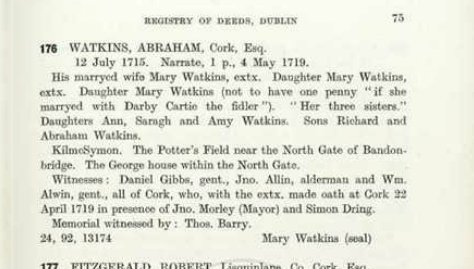
Abraham Watkins Esq, Cork Extensive Property Owner in Bandon, Will dated 12th July 1715, My Daughter Mary Watkins ‘Not to have one penny if she marries Darby Cartie the Fiddler’, Deed of 1718 between William Bailey, Ballinacolle, Myross, West Cork wherein Charles Stanton is to teach his daughter and four children dancing, jigs, hornpipes, minuets and country dances


durrushistory's avatarWest Cork History

Abraham Watkins Esq, Cork Extensive Property Owner in Bandon, Will dated 12th July 17  My Daughter Mary Watkins ‘Not to have one penny if she marries Darby Cartie the Fiddler’

https://wordpress.com/post/durrushistory.com/5125

Will 176:

Screen Shot 2017-08-15 at 14.06.19

The name Abraham Watkins appears in Coolfadda as early as 1626.

http://www.bandon-genealogy.com/bandon_rent_roll_1720.htm

The Irish Manuscript Commission have digitalised some of their old publications.  This is from a series on Memorials in the Registry of  Deeds.  These survived the destruction of 1922.

http://www.irishmanuscripts.ie/servlet/Controller?action=digitisation_backlist

View original post

The Mellifonts: Will of David Mellefont, 61 Grafton St., Dublin, Tories 17th Century Ballingeary, Melefont family member attained as rapparee in Balingeary (Kinsale) area 1690, 1731 Convert Roll Gilbert Mellifont, Dunmanway, Magistrates, Lawyers, Middlemen Later, Bantry, Dunmanway.


The Mellifonts: David Mellefont, 61 Grafton St., Dublin, Tories 17th Century Ballingeary, Melefont family member attained as rapparee in Balingeary, KInsale area 1690, 1731 Convert Roll Gilbert Mellifont, Dunmanway, Magistrates, Lawyers, Middlemen Later, Bantry, Dunmanway.


Gilbert Melefont, Gent. 1731/32 Parish Fanlobbus (Dunmanway) Family heavily involved in Bantry area Donemark tenants of Kenmare Estate, middle men, later Magistrates in Dunmanway Melefont family member attained as rapparees in Balingeary area 1690, Sir Henry Blackhall on Munster Gallweys May be brother of David of Mellifont one of family Mary Mellifont married Henry Gallwey Bantry c 1700.

Proceedings at the High Court of Justice at Dublin and Cork 1652–1654 for Trying Irish Catholics Arising from Rising of 1641. Mentioned Belgooly, Bandon, Garretstown, Included : ‘Triall.Jo. Long. Philip Barry oge Ja: Roch. Rich. Roch. not here.David oge Reagh. Catherine Dolbier at Belgooly . Pierse Gogan. saved by him. Co. Corke Gerot Nugent. Laghlyn o Line. Philip Roch. Ric. Barry. Jo. Roch. W Mollifont for murdering Pascha Trudgeon’ 54. Jo. Long. – Guilty.55. Philip oge Barry. – Not Guilty.56. James Roch. – Not Guilty.57. David oge Reagh – Not Guilty.58. Philip Roch – Not Guilty.59. Rich. Roch. – Not Guilty.60. Laughlin Ô Line. – Not Guilty.61. W. Mellifont. – Not Guilty.62. Pierse Gogin – Not Guilty63. Rich. Barry – Not Guilty.64. Gerot Nugent – Not Guilty.65. Jo. Roch. – Not Guilty. Trial of Charles MacCarthy Reagh, Dermot McNecrimineh and John Burrows; Trial of Lieutenant Colonel Bourke; Trial of Dr Hely; Trial of John Barry

Mellifonts of Donemark, Bantry, West Cork.

Raparees, Tories, Whiteboys, Anti-Tithers of Muskerry, The Mellifonts, First Boycott, Wife of the Bold Tenant Farmer, his cottage at Ballinascarty and Michael O’Riordan’s (Communist Party of Ireland) tribute to the Keohane Sisters Clonakilty, Co Cork.

1840 Evictions by Lord Kenmare and his Middleman David Mellifont, at Ahil, Bantry, West Cork and other areas, Distress, Typhus, Borrowing from Butter Merchants.


Some Rent receipts, Kenmare Estate 1741-46, Bantry Beara Area, William Sullivan, Florence Sullivan, Rev. Thomas Miller, Mort Sullivan, Gilbert Mellifont Donemark, Michael Murphy Newtown and Mills, Beversham Harman Laheran, Patrick Galwey Gurteenroe, Daniel Cronin Gortdarrug Cooloum, Thomas Hutchins Ballylickey, John Riordan Ballylickey, Patrick Minihane Donemark, Richard Tobin Mills Donemark, Ards Coomleigh, Denis Leary, John Harman.

Will:


http://www.irishmanuscripts.ie/digital/Registry%20Of%20Deeds%20Abstracts%20Of%20Wills%20Vol%20II%201746-85/


Colonel John Townsend and his cousin in Australia have a web site devoted to the West Cork, Townsend family (part Galwey), there are a number of Mellifonts (spelling varies) in the extended family:


http://www.astro.wisc.edu/~townsend/tree/home.php


..

Reclamation Work 1829 to 1834 at Ballyvourney, (Baile Bhúirne/Mhúirne), Barony of Muskerry, Co.Cork,  by Charles Colthurst, Agent to Colthurst Estate. Claims 70,000 acres in Macroom Union Capable of Improvement in 1841.


https://www.google.ie/maps/place/Flats,+Ballyvourney,+Co.+Cork/@51.9454909,-9.1728442,15z/data=!3m1!4b1!4m13!1m7!3m6!1s0x48459fe7ccd270df:0x231e3744ac95441a!2sRusheenaniska,+Durrus,+Co.+Cork!3b1!8m2!3d51.6217112!4d-9.521993!3m4!1s0x48451e3c05829a7d:0x2600c7a819bb3a11!8m2!3d51.9455347!4d-9.1639709


https://en.wikipedia.org/wiki/Ballyvourney


Reclamation Work 1829 to 1834 at Ballyvourney, (Baile Bhúirne/Mhúirne), Barony of Muskerry, Co.Cork,  by Charles Colthurst, Agent to Colthurst Estate.


His evidence to 1841 Parliamentary Commission was that there was major scope for Land Reclamation.


…..

As Magistrate:


Charles Colthurst, Clanmoyle, Peake, Coachford, Pre 1830. Member 1832 Cork Friendly Club. Listed 1835. Member Commission on Magistrates 1838.  Listed 1842.  Subscriber Lewis Topographical Dictionary of Ireland  1837.   County Freeman Cork City voter Cork City election 1837. House reputedly built late 18th century by Coulthurst of Ballyvourney demesne now occupied by Moremiles Ltd.  Charles operated Clonmoyle Mill c 1846-1854, later owned by John Young and Sons Ltd, who lived at Clonmoyle House at Peake.  Died Adelaide Terrace formerly Tivoli 1865 probate to Joseph Colthurst Dripsey Castle and Alfred Greer, Dripsey House, £19,000.  Agent from c 1806 for 35 years to  Sir Nicholas Colthurst extensive estates.Evidence 1841 Commission on possibility of scope for extensive reclamation in Ballyvourney, operated model farm.


…..


….

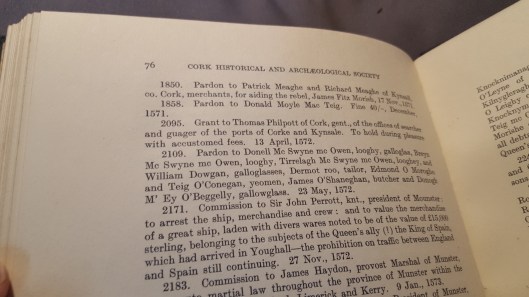
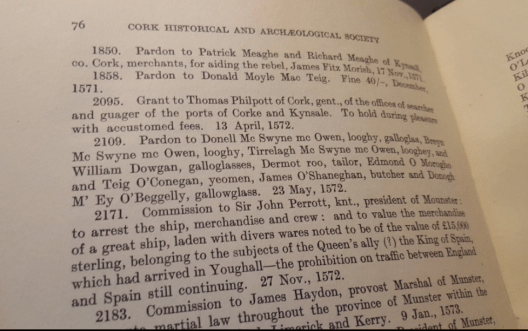
1572 on.  Fiants of Queen Elizabeth 1 of England with West Cork References Multiple Pardons (McCarthy/O’Driscolls, Crowleys/O’Crowleys/Dalys/O’Mahonys/O’Cullanes/Collins for ‘Rebels’. Includes Donald Oge McDonnell McCartie, Brahalish Donald Mac Owen McDonogh O’Dailie, Montrewarie (Kilcrohane). 1595-6, multiple O’Mahonys included Bandon and Mizen area, McCarthys, O’Donovans, Crowleys


Early stage transcription:


Fiants of English Kings and Queen Elizabeth 1 (1)


1560s.  Fiants of Queen Elizabeth 1 of England with West Cork References Multiple Pardons (McCarthys. O’Driscolls/Crowleys/O’Crowleys/Dalys/O’Mahonys/O’Cullanes/Collins for ‘Rebels’.

The format of the surnames is different to that now used.

1595-6, multiple O’Mahonys included Bandon and Mizen area, McCarthys, O’Donovans, Crowleys, from page 204.  Thanks to John Hallisey for drawing attention to this.

https://archive.org/details/reportofdeputyke1720irel/page/n35

Records listed below abstracted by John T. Collins, Cork Historian in the 1930s.

Courtesy History Ireland:

Tudor Fiants

Published in Featured-Archive-PostFeaturesIssue 4 (July/August 2015)Volume 23

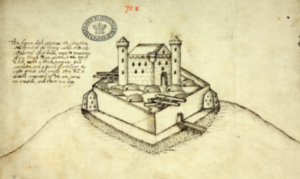
A 1590s image of Burt Castle, Co. Donegal. (NAI)

Digitisation has transformed how we practise family history. There are over 120 million Irish historical records on-line. It is now possible to trace and document Irish families to a much earlier date. This has led to renewed interest in early modern records, 1500–1700. One series of particular interest and use to family historians are the Tudor Fiants.

A ‘fiant’ was a warrant by the deputy or council to the Irish Chancery to prepare letters-patent—published written orders to convey a right, an office, title to property or a pardon. The Fiants are statements of command. The term comes from the first word of the customary opening protocol in these documents: Fiant litterae patentes (‘Let letters patents be made’).

The Irish Fiants don’t survive as a series until Tudor times. (The medieval chancery warrants have survived in sufficient quantities that Irish fiants are one of the ‘categories of substitute material’ used by TCD’s CIRCLE project to reconstruct the rolls of the medieval Irish Chancery.) From 1875, Calendars of the Irish Fiants from 1521 to 1603 were published in the Reports of the Deputy Keeper of the Public Records Office. In 1994 this material was compiled into four volumes and re-published as Irish Fiants of the Tudor sovereigns (De Búrca, Dublin).
Even though the Tudor Fiants are widely available to researchers, they remain an under-used source. Yet they provide detailed evidence for family historians who want to trace Gaelic and Old English families, or to delve into the origin and history of family names and place-names in Ireland.

The Tudor Fiants contain over 120,000 named individuals in Ireland, and provide additional corroborative detail, including status or occupation and usual place of residence. The level of detail recorded in each fiant makes it possible to trace individuals and to identify place-names often to within a present-day parish or barony.
The Fiants document the population beyond the ‘body politic’ of gentry and aristocracy. Coverage is mainly, though not exclusively, of adult men. In addition to the great families that are documented in other sources, the Fiants include aldermen, merchants and artisans in the towns, and yeomen and husbandmen in the countryside. While some fiants include the names of men described as cottiers and labourers, as a rule of thumb these were usually encompassed in the catch-all phrase ‘all other persons inhabiting the country’.

In the late 1500s we find a huge increase in the number of Fiants for Pardons issued. Evidence suggests that these lists of names were compiled from schedules of followers sent in to the council. When you find a name relevant to your research, always look to see who else is in the same group. Researchers can use this evidence to recreate factional groups within a lordship, as well as the lord’s own following, including his military retinue of gallowglass, kerne and horseboys. A particular feature of the Fiants for Pardons is the use of double and even treble patronyms in personal names, to identify the named individual’s grandfather or great-grandfather. With this detailed evidence, it is possible to separate out an individual from his doppelgänger, even when they have a common Christian name. Researchers can also construct distinct lineage groups within an extended family.

Kenneth Nicholls has made extensive use of the Tudor Fiants to recreate family histories of Irish lordships, including Kavanagh and MacCoghlan of Delvin. Nicholls is the only person I’m aware of who has used the Fiants to document individuals moving between different townlands within a joint-lineage landholding (The O’Duinn Manuscript, Irish Manuscripts Commission, 1983).

Calendars of Fiants for the reigns of James I and Charles I were also compiled, but never published. Handwritten copies of these Calendars are available in the National Archives of Ireland. These later series of fiants use a lot of textual contractions and require some interpretation.

Fiona Fitzsimons is a director of Eneclann, a Trinity College campus company, and of findmypast Ireland.

20170811_103955 (1)


..

Screen Shot 2018-12-21 at 09.09.05

Screen Shot 2018-12-21 at 09.09.19

Screen Shot 2018-12-21 at 09.09.39

..

Screen Shot 2018-12-21 at 09.09.49

..

Fuller Listing Here:

https://photos.app.goo.gl/Thfx9C68J6d62Y6x5

1579 Fiant No 3535, Elizabeth 1

Donald Mac Owen McDonogh O’Dailie, Montrewarie (Kilcrohane)


…..

1656. Petition of The Following, ‘That Daniell O’Donovand als O’Donovane of Curraghnylickey (Drinagh), Most Knew Him before 1641 Rebellion, as a Civil Honest, and Quite Gentleman’, Samuell Browne, Edward Renys, Edward Clerke, Francis Barnett (Mark) Mathew Perrott, Amos Bennets, Robert Osborne, Dermod O’Mahowby, Samuel Skinner, William Holcombe, Thomas Attridge, Barnabe Witcherly, Der. Coughlan, Will Corlless, Thomas Recraft (Roycroft), Mathew Sweethman (Sweetnam), Geyles Smith (Mark), Timothy Coughlane, Ja? Base, Abel Marshall, John Vallyes (mark), Ralph Fuller, Teig Has (O’Hea?), Phillip Otrrydge (Attridge), John Baily, John Abbott, Philip Madoxe, Rowland Neild, William Ottrydge (Attridge), Thomas Hungerford, Samuel Poole, James Dyer, Richard Nobbs, John Chamberlen (Mark), Bart Philpot, Richard Skines  (Skuse?) (Mark), Henry Abbott (Mark), Richard Chambers (Mark), Thomas Duggen.


1656. Petition of The Following, ‘That Daniell O’Donovand als O’Donovane of Curraghnylickey, Most Knew Him before 1641 Rebellion, as a Civil Honest, and Quite Gentleman’, Samuell Browne, Edward Renys, Edward Clerke, Francis Barnett (Mark) Mathew Perrott, Amos Bennets, Robert Osborne, Dermod O’Mahowby, Samuel Skinner, William Holcombe, Thomas Attridge, Barnabe Witcherly, Der. Coughlan, Will Corlless, Thomas Recraft (Roycroft), Mathew Sweethman (Sweetnam), Geyles Smith (Mark), Timothy Coughlane, Ja? Base, Abel Marshall, John Vallyes (mark), Ralph Fuller, Teig Has (O’Hea?), Phippip Ottrrydge (Attridge), John Baily, John Abbott, Philip Madoxe, Rowland Neild, William Ottrydge (Attridge), Thomas Hungerford, Samuel Poole, James Dyer, Richard Nobbs, John Chamberlen (Mark), Bart Philpot, Richard Skines  (Skuse?) (Mark), Henry Abbott (Mark), Richard Chambers (Mark), Thomas Duggen.

Curraghnylickey, in Drinagh


There is a further certificate dated 1661 from Henrie Becher testifying that Daniel O’Donovan was civil to all English of the Chief Gentry. At his burial he was poor, there was a great conflux of all class of English.


Bennets around Clonakilty.

The Dyer family had members in the Customs service in Crookhaven.

The various Coughlans probably Protestant branch Carrigmanus, Mizen.

Hungerford probably The Island, Rosscarbery.

From papers copied in the 1950s by Paddy O’Keeffe, Bantry businessman and historian.


Courtesy Barry Bradfield:


Curraghalicky


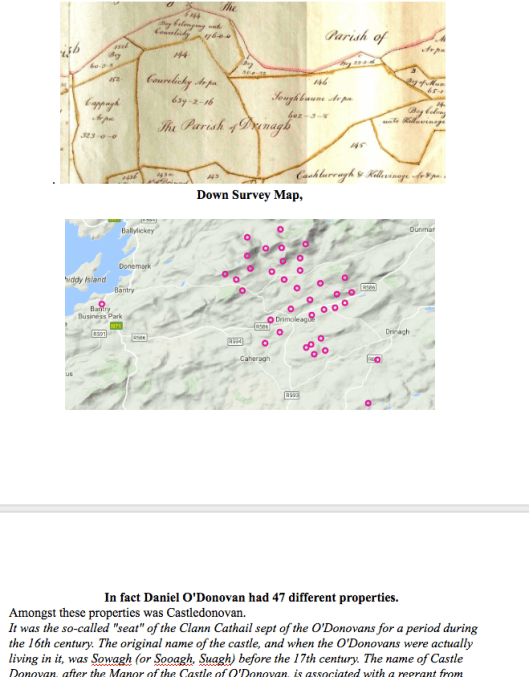
Curraghnylickey meaning the field of the stones is about four miles north east of Drinagh. It is currently spelt Curraghalicky and is in Drinagh Parish.

Down Survey and Daniell O’Donovan / O’Donavane.

Daniel held Courelicky (639 +176 acres) and the adjoining townland of Toughbaune (602+35+23 acres) These were plantation acres and would amount to about 2400 statute acres.

In fact Daniel O’Donovan had 47 different properties.

Amongst these properties was Castledonovan.

It was the so-called “seat” of the Clann Cathail sept of the O’Donovans for a period during the 16th century. The original name of the castle, and when the O’Donovans were actually living in it, was Sowagh (or Sooagh, Suagh) before the 17th century. The name of Castle Donovan, after the Manor of the Castle of O’Donovan, is associated with a regrant from James II of England in 1615.

According to tradition the tower was severely damaged by Oliver Cromwell’s soldiers in the late 1640s, blown up with powder in retaliation for Donal III O’Donovan joining the Stuart side and for his involvement in the rebellion and massacres of 1641, and has been uninhabited since that time.

https://en.wikipedia.org/wiki/Castle_Donovan


His son Donal Óg had Raheen Castle across from Castletownsend,

He appears to have fought for the Stewart King Charles in the 1641 rebellion and this petition appears to be against the confiscation of his estates at that time.

He may have had portion of his estates returned after 1660 on the Restoration of Charles 2nd but I failed to locate him on the 1670 landowners list. A lot of the names on the petition are from Bandon but some are further west from Bandon.

Barry adds:

Mathew Perrott as I had recently being doing some research on the Perrott family and failed to locate them in the 1641 Depositions or the 1659 Census of Ireland etc. I had found details published mid 1800’s by a Perrott family from near Bandon who went to America which claimed their ancestor was a Mathew Perrott who came over with King William in the 1680’s.

I did locate a Mathew Perrott marriage in the 1680’s near Bandon to a Carey woman.

Screen Shot 2017-08-08 at 20.35.28


April 1689. Selection of MPs for Borough of Baltimore.  Cornelius O’Donovan, Morrogh O’Donovan, Cornelius O’Donovan of Kilmacabea, Daniel O’Donovan of Kilgliny, Daniel Regane, Daniel O’Donovan of Gortnaskehy, Tymothy Regan, Daniel O’Donovan of Fournaught (Castlehaven), Thady Regan of Ballinacloghy (Leap), Cornelius O’Donovan of Ballynacala, Keadagh O’Donovan als O’Donovane, all Burgesses of Baltimore have chosen Daniel O’Donovan and Jeremie Donovan Esq. as Member.


April 1689. Selection of MPs for Borough of Baltimore.  Cornelius O’Donovan, Morrogh O’Donovan, Cornelius O’Donovan of Kilmacabea, Daniel O’Donovan of Kilgliny, Daniel Regane, Daniel O’Donovan of Gortnaskehy, Tymothy Regan, Daniel O’Donovan of Fournaught, Thady Regan of Ballinacloghy, Cornelius O’Donovan of Ballynacala, Keadagh O’Donovan als O’Donovane, all Burgesses of Baltimore have chosen Daniel O’Donovan and Jeremie Donovan Esq. as Member.

Jeremie may have been an attorney in Dublin interfacing on behalf of local families with the authorities.

In many ways this was the last horray of the old local Gaelic Order.  In the following year the Battle of The Battle of The Boyne would settle affairs for over 200 hundred years. Families of English origin were in the area since around 1600 such as the Bechers and Townsends.  Relations seem to have been reasonable between the local Gentry.


After the confiscations, the O’Regans miraculously managed to hold onto their lands:


Early Genealogy of Sir Teague O’Regan of Balltnaclohy and Gortniglogh, Killeenlea, near Leap, Carbery West Cork, Temporary holding of lands from 1615 by Sir Walter Coppinger, loss by forfeiture and subsequent restoration under Articles of Treaty of Limerick 1690, later family including fashionable Dr.O’Regan of Mallow and Legal Luminaries, friend of Daniel O’Connell. Estates finally sold by descendants Cagney family early 20th century to tenants.


Courtesy Wikipedia

Jeremiah O’Donovan (IrishDiarmaid Ó Donnabháin), The O’Donovan of Clan LoughlinLord of Clan Loughlin,[1] was MP for BaltimoreCounty CorkIreland, in James II‘s Patriot Parliament of 1689,[2] alongside his kinsmen Daniel O’Donovan (MP Baltimore) of Clancahill and Daniel O’Donovan (MP Doneraile).

Obtaining letters patent from Charles II, his extensive landholdings were erected into the manor of O’Donovan’s Leap, or the Manor of the Leap, in 1684.

He was also appointed Registrar of the Admiralty in Ireland by James II.

Jeremy O’Donovan was the son of Daniel Mac Murtogh O’Donovan, Lord of Clan Loughlin. A Protestant, he married in 1686 Elizabeth Tallant, daughter of Oliver Tallant, and they had issue 1) Jeremiah, 2) John, and 3) Anne.

Jeremy Donovan served in the Patriot Parliament of 1689, his Protestant standing kept him from being outlawed as were the other O’Donovan members of the House of Commons of the Parliament. Daniel O’Donovan, Esq. (M.P. Doneraile) and Daniel O’Donovan, gent. (M.P. of Baltimore) were both outlawed as they were Catholic, while Jeremy was not.

He died in 1709, leaving his sons minors. He was succeeded by 1) Jeremiah, who inherited his estates, but sold the manor in its entirety in 1737 to Richard Tonson.

The Jeremy Donovan’s of Leap.

The Jeremy Donovan’s had 3 townlands near Leap in 1670. Details of size, owner in 1641 and numbers on the land from the 1659 census follow.


1827, Select Vestry Returns, Church of Ireland, Including Some Named Vestrymen and Churchwardens, Abbeystrewy (Skibbereen), Ballyvourney, Castlehaven, Creagh, Drinagh, Durrus, Fanlobus (Dunmanway), Innishannon, Kilbrogan, Macroom, Morogh, Tullagh (Baltimore)


1827, Select Vestry Returns, Church of Ireland, Including Some Named Vestrymen and Churchwardens, Abbeystrewy (Skibbereen), Ballyvourney, Castlehaven, Creagh, Drinagh, Durrus, Fanlobus (Dunmanway), Innishannon, Kilbrogan, Macroom, Morogh, Tullagh (Baltimore)


In some Parishes Innishannon and Kinsale, there are probably more the first Vestry meeting took place to consider church business all being Church of Ireland members. The Vestry reconvened some time later that day and dealt with non religious local business, paupers, burying indigent dead etc.  This Vestry also numbered local substantial Catholic farmers and business people. Probably a relic of the Medieval pre Reformation Irish Church influenced by Norman practices.


By scrolling through Eppi Project (Digitalization of Irish Parliamentary Records 1800-1922 it may be possible to locate other parishes.


http://www.dippam.ac.uk/eppi/documents/9813/page/214917


1827 Vestry Returns for Dioceses of Cork and Cloyne, Church of Ireland (the State Church).

St. James, Durrus, Select Vestry, 1827.


1827, Sums Allotted by Church of Ireland (Then State Church) Dioceses of Cork, Ross and Cloyne often for Foundlings and Burial of Paupers.


https://durrushistory.wordpress.com/wp-admin/edit.php?s=vestry&post_status=all&post_type=post&action=-1&m=0&cat=0&paged=1&action2=-1


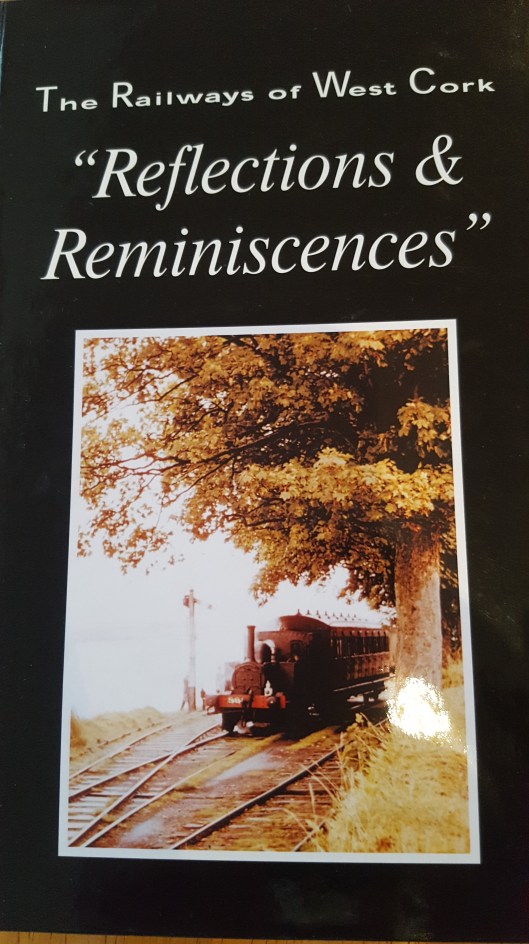
New Book on West Cork Railway System Including Colour Photographs of Some of the Last Journeys Pre 1962.


New Book on West Cork Railway System Including Colour Photographs of Some of the Last Journeys Pre 1962.


The book os for sale in Skibbereen in Cathal O’Donovan’s bookshop


West Cork Railway Map 1940, Comic Postcard Schull/Skibbereen Tramway, Timoleague Line with Ardageen, last Train out of Macroom 1953, 1956 Diesel Railcar


20170806_175708 (2)

20170806_180708


20170806_175734

….