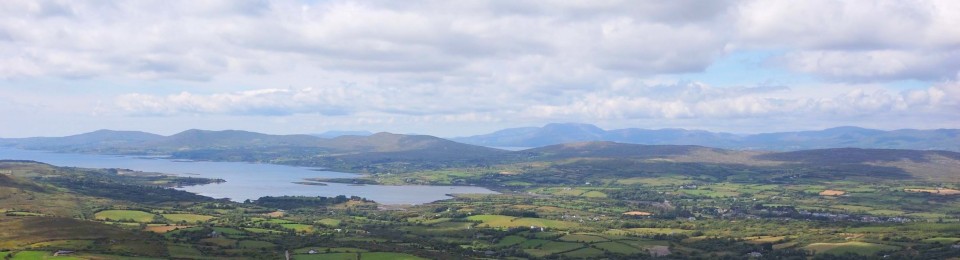
1594. Conveyance to Walter Coppinger, Lands including Half Ploughland Ballycomane, Durrus formerly Property of Donal McCarthy, Cloghane, Caheagh, Later Attained for Treason.


https://www.google.ie/maps/place/Ballycommane,+Co.+Cork/@51.6272274,-9.4964899,15z/data=!3m1!4b1!4m5!3m4!1s0x4845a002b232cddd:0x449e2e7119ec432!8m2!3d51.6273533!4d-9.4885326?hl=en

Conveyance to Walter Coppinger, 1594. Lands including Half Ploughland Ballycomane, Durrus formerly Property of Donal McCarthy, Cloghane, Caheagh,  Later Attained for Treason.

Courtesy Coppinger Family website:

http://www.copinger.org/page.php?file=1_3

Conveyance to Walter Copinger, 1594.

Indenture made 16 May, 36 Eliz. Betwixt Walter Coppinger fz James of Cork, gent., on one part, and Charles McCormuck McTeige McCartye and Donogho McCormucke McTeige McCartye, of Cloghrean, in Co. Corke, gent., and sons to Sir Cormucke McTeige, late of Blaerny, Knt., dec.  Witnesseth that whereas said Charles McCormucke and Donogho McCormucke, by deed dated this day haue granted to Walter Coppinger, his heirs &c., not only the manor and castel of Cloghane, with three plowlands of demesne lands in Carbry, Co Corke, and the half plowland of Ballycomane in Carbry afs’d, but all their right, &c., in the lands, &c., of Donyll McCormucke McCartye, late of Cloghane and late attainted of high treason, &c. To haue said Castel of Cloghane, &c., and half plowland of Ballycomane, rendering yearly 43s. 4d. of Ireland.  Nevertheless the said Walter C. doth covenant with said C.McC and D.McC., that if said C. and D. do pay said W.C. at the now dwelling house of John Coppinger fz. John of Corke,  before the expiration of nine years 100 pounds, money of England, from date hereof, said deed to be void.  In witness whereof, &c.,

Thomas Sarsfelde, John Roche, John Coppinger
Edmonde White, John Moonut (sic.)

For the better understanding of the suit which subsequently arose between the parties, it may be well to show the devolution of the property previous to the date of the last mentioned conveyance or mortgage.  This appears very clearly from the recitals in a document still in existence.

Whereas Queen Elizabeth, of famous memorie, by Letters Patent under her broad seale of the Kingdome, dated the 19th year of her Raigne,[3] in consideration of manie great and acceptable services vnto her highness in times of hostillity and rebellion performed and done by the said Sir Cormacke McTeige, Knt, as a speciall mark of her princelie favour and as a recompense of the great merits and service amongst other things granted vnto him the said Sir Cormacke and his heirs, all that and those the Manour and Castle of Cloghan, three plowlands thereunto belonging, and all and singular the parts and parcells, members, and appurtenances therevnto as well in desmesne as in service, and all other rents and hereditaments of whatsoever quantitie, nature, or degree now taken, accepted, or reputed as part member or hamlett hereof or held or possessed as member, part or appurtenant therevnto, situate, lying, and being in the barronie of Carrabry in the Countie of Courke, and all the halfe plowland of Ballycomene situate in the said Countie and Barronie excheted vnto the Crowne by the attainder of Danell McComake McCartie, late of Cough, attained of high treason by force and virtue whereof the said Sir Cormacke McTeige, Knt, ent’red into the said Manner, Castle, and lands and other hereditaments, and was thereof seised in his demeasne as of fee, and died of such an estate soe thereof seised after and by whose decease the said Manner, Castle, Toune, and lands and other hereditaments discended and came vnto Charles Cartie,[4] sonne and heir vnto the said Sir Cormake whose sonne and heire being thereof seised in his demeasne as of fee by his deed in due forme of lawe perfected, wherein Donoge Cormake, brother to the said Charles did ioyne, dated 16 May, 1594″

granted premises as above mentioned to Walter Copinger.

A bill was some years afterwards filed in the Court of Chancery by the above-named Charles McCormacke McTeige McCartye to set aside this deed, or rather to obtain a decree that it was intended to be by way of mortgage only. The proceedings are set forth at great length in the decree, dated the 5th December, 1633, which is preserved in the Public Record Office, Dublin.  In these proceedings McCartye’s son alleges that the deed was “upon confidence and trust upon condition comprised in a defeazance signed, sealed, and delivered by the said Walter Coppinger bearinge equall date with the said deede of feoffment by which the said Walter Coppinger did by himselfe, his heirs and assigns, convenant and graunt to and with the said Charles McCormacke and the said Donogh McCormacke and euerie of them and the heirs and assigns of the said Charles McCormacke and Donogh McCormacke and eurie of them that if the said Charles McCormacke and Donogh McCormacke or one of them or the heirs or assigns of them or one of them did well and truely content, satisfie, and pay or cause to be contented, satisfied, and paid to the said Walter Coppinger, his heirs or assigns at the dwelling house of John Coppinger fitz John within the Citti of Courke,” the amount advanced the premises should be reconveyed.

The Court does not seem to have given effect to the alleged deed of defeazance, for it ordered that “notwithstanding any previous order or orders to the contrary Sir Walter Coppinger should hold and enjoy all and singular the Castle and 3 plowlands of Cloghane, situate in the Barony of Carbery and Co. of Cork, and the half plowland of Ballycoman als Ballycomem with the appurtenances for ever against the plaintiff Charles McCarty.”  It further ordered that the plaintiff should execute a conveyance of the said premises to the defendant Sir Walter or others to his use in consideration of £300 to be paid by instalments.

https://durrushistory.wordpress.com/wp-admin/edit.php?s=ballycomane&post_status=all&post_type=post&action=-1&m=0&cat=0&paged=1&action2=-1

https://durrushistory.wordpress.com/wp-admin/edit.php?s=ballycomane&post_status=all&post_type=post&action=-1&m=0&cat=0&paged=1&action2=-1

Ballycomane. Ballycomane (1349 acres) (Irish: Baile an Chumain, meaning ‘town of the little valley’). Part of it is Ballinwillin with a boulder burial,with the remains of a millrace which may have been used by monks at the nearby church of Mouliward, ringfort and standing stone pair. Mass rock in Vincent Hurley’s farm. Former graveyard in Sam Attridge’s lands no remains. The oldest family are probably the Hurleys (Vincents), they moved from Ballnacarriga outside Dunmanway and Darby Hurley who held Ballycomane Middle was allegedly evicted by Lord Carbery when a rent payment was missed, the farm was then given to the Vickerys c 1770 Conveyance to Walter Copinger, 1594. Indenture made 16 May, 36 Eliz. Betwixt Walter Coppinger fz James of Cork, gent., on one part, and Charles McCormuck McTeige McCartye and Donogho McCormucke McTeige McCartye, of Cloghrean, in Co. Corke, gent., and sons to Sir Cormucke McTeige, late of Blaerny, Knt., dec. Witnesseth that whereas said Charles McCormucke and Donogho McCormucke, by deed dated this day haue granted to Walter Coppinger, his heirs &c., not only the manor and castel of Cloghane, with three plowlands of demesne lands in Carbry, Co Corke, and the half plowland of Ballycomane in Carbry afs’d, but all their right, &c., in the lands, &c., of Donyll McCormucke McCartye, late of Cloghane and late attainted of high treason, &c. To haue said Castel of Cloghane, &c., and half plowland of Ballycomane, rendering yearly 43s. 4d. of Ireland. Nevertheless the said Walter C. doth covenant with said C.McC and D.McC., that if said C. and D. do pay said W.C. at the now dwelling house of John Coppinger fz. John of Corke, before the expiration of nine years 100 pounds, money of England, from date hereof, said deed to be void. In witness whereof, &c., Originally McCarthy probably Mucklagh mortgaged it to Sir Walter Coppinger, defaulted he went into possession. His estates fofeit Evans Freke family later Lord Carbery probably bought from Hollow Blade Company of Commissioner of Forfeit Estatrs. Recites deed dated 7th June 1823, John Vickery then of Ballycomane, Co.Cork demised by George Vickery now of Knockane, Co. Cork land of Ballycomae. Recites deed 2nd August 1790 whereby Lord Carbery demises to John Vickery then of Ballycomane since deceased part of lands of Ballycomane called the middle division as then in his possession. These lands became vested in the said John Vickery’s three sons namely William, George and John Vickery and they afterwards agreed to divide the lands. Vickery lease of 1785 of substantial farm may hev been Hurle earliee at some tim a Hurley/Vickery marriage recordedd 1926, James Sullivan, (Descendant of Michael Sulivan reputed descendant of O’Sullivn Beren adn Mary Vickery of Whiddy m 1783) Clonee, sold having bought Moskeigh House, October, Mrs Vickery, Ballycomane (moved to French Furze, Carrigaline) 125 a bought by Deanes (their Crottees property now owned by Carmel Deasy) .

….

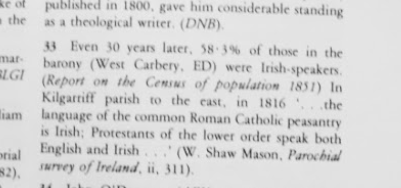
1871. Linguistic Map Ireland. Majority Irish Speaking, Parts of Ballydehob, Beara, Caheagh, Clonakilty, Garretstown, Muskerry, West Cork


1871.  Linguistic Map Ireland Majority Irish Speaking, Parts of Ballydehob, Beara, Caheagh, Clonakilty, Garretstown, Muskerry, West Cork.

Irish speaking, Protestant West Cork with census 1901 for Cork, 19th century

Rev. Patrick Ernest Donovan (1861-1953), Foronaught, Myross, Skibbereen, West Cork, Irish Speaking Methodist Missionary.

Screen Shot 2017-04-29 at 20.29.31

….

Legal Interpeters:

1902Andrew KelleherInterpeter for Glengariff District1901 census Humphrey Kelleher was living in Bantry with his son Andrew, 27, a draper’s assistant, and daughter Hannah, 35, housekeeper. By the time of the 1911 census, there were nKellehers on Barrack road.http://doras.dcu.ie/17739/1/Irish_Language_Court_Interpreting_1901-1922_Mary_Phelan.pdfSome interpreters, such as Humphrey Kelleher, combined interpreting with being a civil bills officer (C.B.O.). Summons servers and civil bill officers were paid a salary of £10 per year plus up to one shilling for each summons served. They had to travel considerable distances to serve summonses and keep a record of when and where summonses were serve
1902Humphrey KelleherProcess Server, InterpeterIn 1902 at Skibbereen quarter sessions, a solicitor called Mr Wolfe asked the judge about the appointment of a process server and interpreter at Bantry. The context was that Humphrey Kelleher, the person who had been fulfilling these two functions, had died, his son was willing to take his place as process server, but as he did not speak Irish, not as interpreter. The son had the support of all the solicitors in Bantry bar one, a Mr Flynn, who favoured a man called Power from Glengariffe (sic) who ‘could speak Irish well’. He argued that there were already two process servers in Bantry but none in Glengariffe where it was difficult to have processes served.http://doras.dcu.ie/17739/1/Irish_Language_Court_Interpreting_1901-1922_Mary_Phelan.pdf1901, Humphrey KelleherBantry Cork aged 74 Co. Cork
1864, 1921Edward CollinsCivil Bill Officer since 1864, InterpeterLiscarroll. Edward Collins civil bill officer for Macroom, occupation ‘interpreter’ in the 1911 census, was raised in the Dáil in 1927. At that stage he was 77 and had worked as a summons server for 58 years and as a civil bill officer for 57 years. He was discharged from his job and was not offered any form of compensation or pension. The two posts of summons server and civil bills officer were combined into one post, summons server, under the Court Officers Act 1926 (Dáil Éireann vol. 19, 26 April 1927).Guys:http://www.corkpastandpresent.ie/places/streetandtradedirectories/1921guyscitycountyalmanacanddirectory/1921pagesito95/1921%20p.18-25.pdf

Magistrates with Irish Competence:

1815John Eugene McCarthyMiddle Temple since 1815 practised as Conveyancer in England, Seneschal of Manor of Rathbarry and Gorthnahoena since 1826 and for some time Timoleague. Kings Inns 1837.Rathbarry, Rosscarbery. 1st son of Eugene McCarthy, Gent, Blennerville, Co. Kerryand Ellen O’Sullivan in 1837 for Kings Inns , Newtown, Co. Cork. Rathbarry. Conducted when requied Manor Court as Senescal in Irish. Purchased a house and garden for bailiff to avoid being dependant on him. Earlier Seneschal used a pub. Advised Mr. Spring Rice (Lord…Mount..) on proposed changes to legislation1837 Parlimentary report.
From 1837John Borlease WarrenSeneschal of Macroom, Kilcrea, BlarneyAppointed by his relation Lord Bandon. Macroom held in Courthouse, Kilcrea in two farmhouses.John Borlease Warren (1799-, Magistrate also for Kerry, Warren Grove, Crookstown and Sillerdane Cottage, Kenmare, Co. Kerry, brother of Sir Augustus Warren, m 1823 Mary d Rev R. Warren, Involved in attempts to amicably resolve tithes 1838. 1835 Subscriber Lewis Topographical Dictionary of Ireland 1837. Related and tenant of Lord Bandon. Lord Bandon as Lord of Manor of Macroom, Kilcrea and Blarney appointed him Seneschal to Manor Courts replace Mr. Brown who heard cases to his death at 87 in 1836. Permitted witnesses to give evidence in Irish.

…..

Screen Shot 2017-04-29 at 20.29.46

1796, 1 August 1796, Skibbereen Meeting, ‘Members of the Atlantic Society will meet next club day at Castle of Old Court in Ilen River, signed Michael Beecher, Adm, Daniel O’Donovan Vice Adm.’


https://www.google.ie/maps/place/Skibbereen,+Co.+Cork/@51.5559277,-9.264319,17z/data=!3m1!4b1!4m5!3m4!1s0x4845a5b8ee671cad:0x28dab316351c3ffb!8m2!3d51.5559418!4d-9.2621613?hl=en

1796, 1 August 1796, Skibbereen Meeting,  ‘Members of the Atlantic Society will meet next club day at Castle of Old Court in Ilen River, signed Michael Beecher, Adm, Daniel O’Donovan Vice Adm.’


It is not clear what the purpose of the Society was.


Old Court:


http://landedestates.nuigalway.ie/LandedEstates/jsp/property-show.jsp?id=2614


http://landedestates.nuigalway.ie/LandedEstates/jsp/estate-show.jsp?id=2436


Courtesy Becher family web site


http://freepages.genealogy.rootsweb.ancestry.com/~becher/bechers_in_the_newspapers.htm

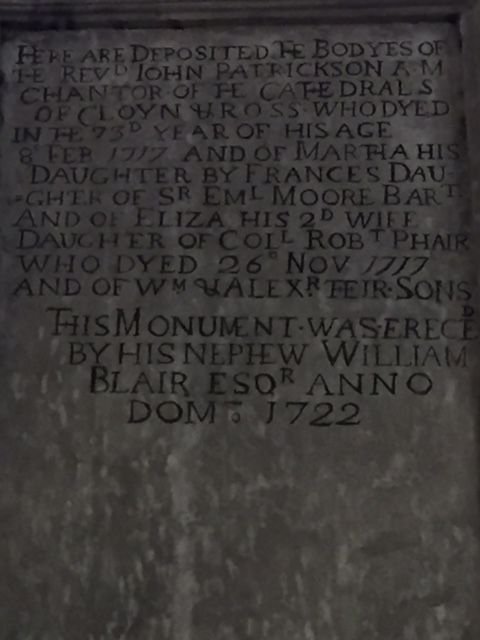
1717. Patrickson monument in St. Mary’s Church, Dunmanway, West Cork. Here are Deposited the Bodies of Rev. John Patrickson, AM, Chantor of the Cathedral of Cloyne and Ross who Died 1717 aged 73, Martha his daughter By Frances Daughter of Sir Emanuel Moore Bart, and His 2nd Wife daughter of Colonel Robert Phaire Died 1717, Among connected Families: Blairs of Blair’s Cove, Durrus, Children and Descendants of Father/Rev. Daniel McCarthy (Muclagh) and Sarah Blair, Clearys of Dunbeacon, Durrus.


https://www.google.ie/maps/place/Dunmanway/@51.704042,-9.1918372,13z/data=!4m5!3m4!1s0x484501afd195aefd:0xa00c7a99731ffb0!8m2!3d51.7222431!4d-9.1117859

1717.  Patrickson monument in St. Mary’s Church, Dunmanway, West Cork.    Here are Deposited the Bodies of Rev. John Patrickson, AM, Chantor of the Cathedral of Cloyne and Ross who Died 1717 aged 73, Martha his daughter By Frances Daughter of Sir Emanuel Moore Bart, and His 2nd Wife daughter of Colonel Robert Phaire Died 1717, Among connected Families: Blairs of Blair’s Cove, Durrus, Children and Descendants of Father/Rev. Daniel McCarthy (Muclagh) and Sarah Blair, Clearys of Dunbeacon, Durrus.

Patrickson monument in St. Mary’s Church, Dunmanway.  There was a reference to that stone in the minute book. It is the only piece of the old St. Mary’s church, built around 100 years previously to make it into the new church in 1821.  Patrickson put up quite a lot of money towards the building of the first one.

The Patricksons were one of a number  of families such as the Fenwicks Little Island, Inis Beg Skibbereen, Phairs, Whites (Later Lord Bantry), Davies of Macroom, Blairs (later Blair’s Cove) active in the Land Market late 17th and early 18th century acquiring large tracts of West Cork from the Hollow Blade Company.

There is a large extended family Catholic and Protestant in Ireland, UK and Australia. The Cleary branch is in Australia.

Courtesy Eunice Jeffers

IMG_8661

….

TCD records as him born Co. Down associated families Hamiltons and Blairs may alos be from there

Rev. John Patrickson TCD 1669, (1651-died 1718, Native Co. Down. Chantor of Ross, 1695. Chantor, Cloyne Cathedral.  Patricksons ancestors of Durrus Blairs. 1702, Deed from Rev. John Patrickson, Chantor of Cloyne (Dunmanway Patricksons ancestors of Durrus Blairs) to Sir Richard Cox, Chief Justice of Ireland, of Lands at Dunmanway and Kilbarry, Coolsnagh, Coomshiplogh, Inchiragh, Derrynacahreagh, Cloontiuirk, Dereens, Tonetove, Derrylahan, Mills and Tolls, Park, Castle, Malthouse,  bounded by Derrenasabagh, Gortnavan. Founding Deed of Dunmanway Names John Clay, John Turk, Thomas White, Mathew Rhems, William Short, John Farr, George Lantry, John Lumsie, George Stuke, Richard Nott, William Sisk, Thomas Roche, James Grace, William Smith George Moore Bounded by the Lanes of Mahonoh. The Dunmanway Patricksons are associated with the Blairs. The Whites (later of Whiddy, Bantry), Fenwicks, Davies. In a deed of 1713 William Blair of Dunmanway son of Elinor nee Patrickson (she is sister to Rev. John Patrickson, Chantor of Cloyne) appears.  Dr. Charles Webster, History of Ross Dioceses.  Also Vestry minutes in 1822 refer to the Patrickson monument from the previous building being installed in the new building. It reads as follows: “Here are deposited the bodyes of Rev. John Patrickson A.M. Chantor of the Cathedrals of Cloyne & Ross who dyed in his 73rd year of his age. 8 February 1717 and of Martha his Daughter by Frances daughter of Sir Eml. Moore Bart. And of Eliza his 2nd wife , daughter of Coll. Robert Phair who dyed 26th November 1717. And of William & Alexander their sons. This monument was erected by his nephew, William Blair Esq. Anno. Dom. 1722

1848. Attendance Book, Dunmanway, West Cork, Church of Ireland (Regular, Not Great), Parishioners Names, Addresses, Age, Deaths, Confirmations.

Sale of Blair Estate, Coolculaghta old name Carpolite, (Blair’s Cove), Durrus, West Cork, by Landed Estates Court 1866, with details of Legal Tenure, Tenants, Leases, Maps

1766John Thomas Patrickson MDSurgeon. Dr. Farmer 1762 involved in founding South Infirmary with Dr. Davis, Surgeons Hungerford Daunt and John T. Patrickson.Subscriber ‘History of the Irish Rebellion’ reprinted 1766 Cork Bagnell of Castle St.May have Dunmanway connections

Moore, Rosscarbery genealogy:

Click to access 1st%20Bart.pdf

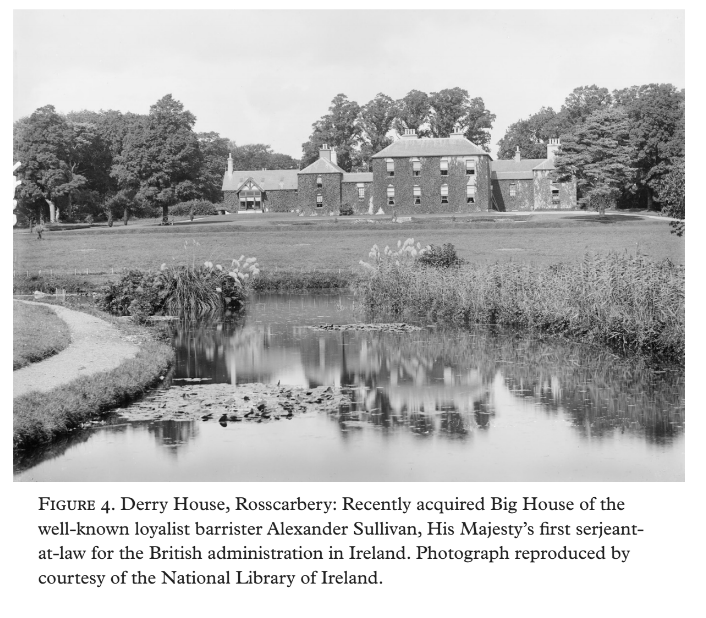
April 1921, Burning by IRA of The College, Rosscarbery, Co.Cork, reputedly the lineal successor of a Famous School Established in the Sixth century by Saint Fachtna and Derry House Rosscarbery, House of Alexander Sullivan, Kings Counsel and Last Serjeant-at-Law Only Barrister Who Could Be Obtained to Defend Sir Roger Casement 1916


April 1921, Burning by IRA of The College, Rosscarbery, Co.Cork, reputedly the lineal successor of a famous school established in the sixth century by Saint Fachtna and Derry House Rosscarbery, House of Alexander Sullivan, Kings Counsel and Last Serjeant-at-Law Only Barrister Who Could Be Obtained to Defend Sir Roger Casement 1916

From James S. Donnelly, Junior, Big House Burnings, Co. Cork.

https://mail.google.com/mail/u/0/#inbox/15b7e169f8306ae8?projector=1

Though their initial plan for a full-scale assault against the Rosscarbery police barracks was derailed, members of the West Cork Brigade mounted another and this time successful effort at the end ofMarch 1921. Bombs and fire destroyed the ground-floor rooms of the barracks before its defenders surrendered with heavy casualties two dead and nine more wounded. Adjacent to the barracks, and almost in the centre of the town, stood that venerable and Protestant institution called “The College” (figure 3), which was directed byMrs. Zoe Louise Becher, wife of the Rev. Harry Becher, the Anglican rector of Rosscarbery.1 Reputedly the lineal successor of a famous school established in the sixth century by Saint Fachtna, foundress of the diocese of Ross, the college had served “for a long time past”as a Protestant academy, and in 1921 it had perhaps forty students from well-to-do families. After the Rosscarbery RIC barracks had been blown apart, rumours spread that the crown forces were about to occupy the college; the IRA promptly intervened and burned it down on 2 April. About a week later, the Volunteers pressed their advantage, returned to Rosscarbery, and torched Derry House purchased two years earlier by the prominent barrister Alexander Sullivan.   As His Majesty’s first serjeant-at-law for the British administration in Ireland, Sullivan was highly unpopular. In fact, he had been the target of an attempted assassination in January 1920 while working as a crown prosecutor in County Kerry.  He was widely known for his denunciations of both the Sinn Féin party and republican violence. The destruction of Sullivan’s mansion removed one of the few remaining Big Houses in or very near the town was potential accommodation for police or soldiers.

The College is mentioned in the 1840s letters of Dealy, (Daly) Bantry shipowner and timber merchant, trade is bad and only for a loan from friends could he afford to send his boys to the college.

Private. I wrote you some disponding letters in April last. at that time I was hard pressed to meet some bills – and I was preparing to remove my boys from Rosscarbery School (Diocesan Secondary School) which would have been a severe blow to your aunt. but thank Providence I met more kind and good friends and if I can rub over another season I am in hopes that I will not owe any a man a shilling particularly if I can effect good sales & to encourage which I am offering goods on low terms. The fisheries have nearly failed here as yet this season & I hold a large stock of salt __ has improved the English market & I am a considerable holder.

Letter William J. Dealy, 1798- Shipowner, Bantry, Co. Cork re trade, fishing business to his son in Canada 1840, and the Dealy Brig

….

Screen Shot 2017-04-19 at 09.33.04


Past Pupil:

William Wood Wolfe (1871-1960), Magistrate, , 1905, The Bridge, Skibbereen, eldest surviving son of William John (1836-1894), farmed 500 acres shopkeeper, ed St. Faughnans, Rosscarbery, Methodist, agnostic in 1911 census later became Catholic, brother of Jasper Wolfe Crown His mother described his wife, a Catholic as a ‘low wretched barmaid  Skibbereen UDC, only Non-Catholic to chair UDC in 1910, listed 1913 at Snugville, Skibbereen, listed 1921.  Received IRA threats to withdraw just before Truce in July 1921.

….

Sergeant Sullivan’s mother was Donovan perhaps linked to the area his father was from Bantry.

…..

Screen Shot 2017-04-19 at 09.33.26

..

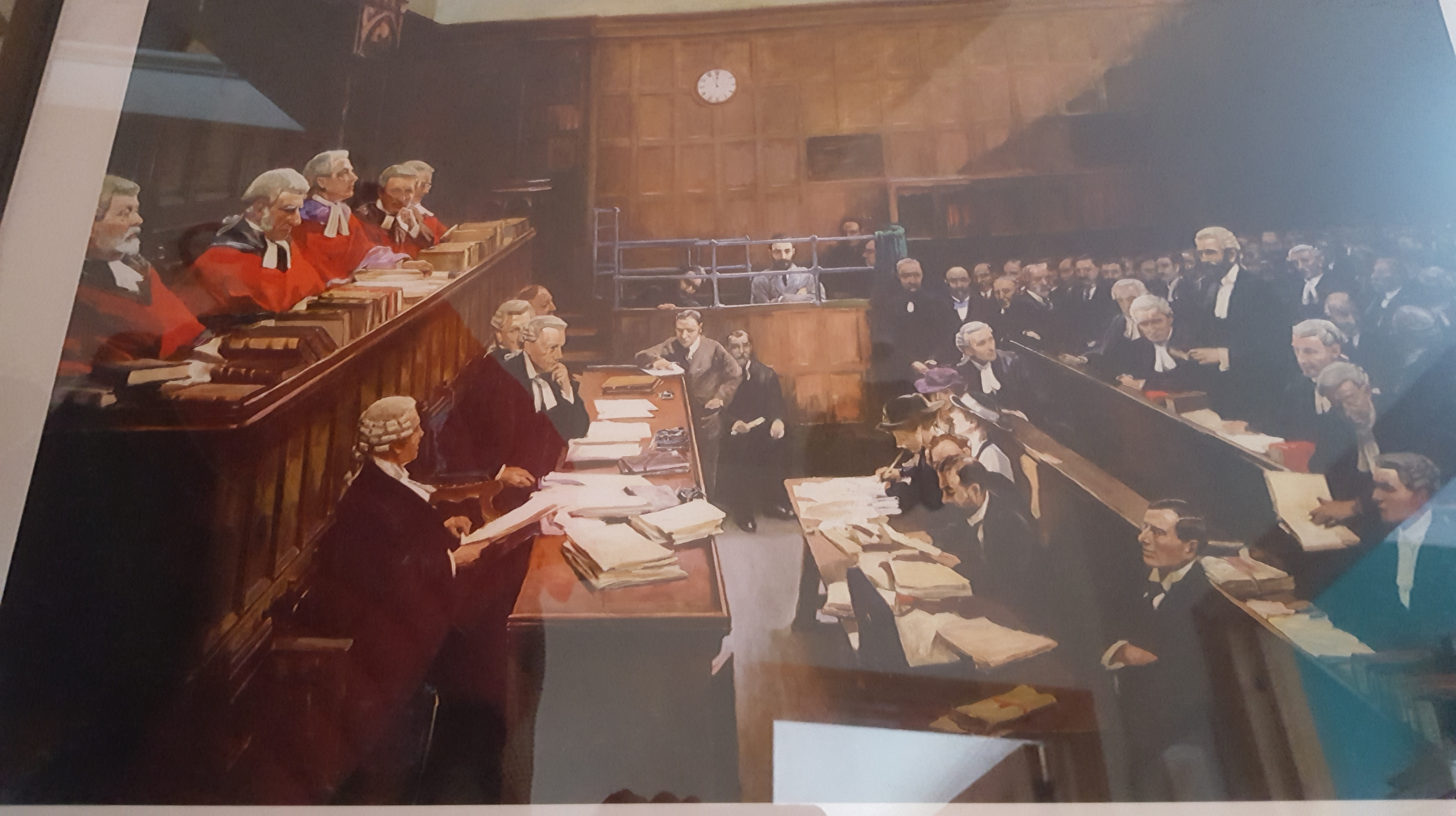
Alexander Sullivan, seen standing, Kings Counsel and Last Serjeant-at-Law Only Barrister Who Could Be Obtained to Defend Sir Roger Casement 1916. Note women facing Judges.  First women to be allowed by special dispensation to be part of a legal team in their case that of defending solicitor Gavan Duffy.


In July 1916, during his appeal against his death sentence for his role in the Easter Rising, Roger Casement wrote to his family, asking, “Who was the painter in the jury box?”

The painter was a rather unlikely presence: Sir John Lavery, born into a Catholic family in Belfast, was renowned for his portraits of English high society, and his studio had been visited by royalty. He had been invited to record the appeal trial by the presiding judge, Sir Charles Darling, a former client of his. Yet, as Casement noted, the painter “came perilously near aiding and comforting” the prisoner in the way he “eyed Mr Justice Darling’s delivery” of the verdict confirming the death sentence. Casement also noted that Lavery’s wife, Hazel, looked “very sad” at the same moment. The uneasy relationship between Lavery’s position as part of the imperial artistic establishment and his growing sympathies with Irish nationalism would produce a painting at once monumental and hard to place.

Lavery’s record of this moment in history is literally the work of an insider: it is possible only because Lavery was respectable enough to be given privileged access to the trial. Lavery later claimed that Darling had commissioned the work. Yet the result is not the grand image of imperial justice that might have been intended. The conventions of the genre are honoured in the large scale – three metres wide and two metres high – and the meticulous portraits of dozens of individuals. A sense of dramatic moment is created by the slanting light and by the clock that approaches the fatal hour of 12.

But the judges are almost statuesque. All the animation is given to Casement’s defence counsel. And the centre of the picture is occupied by Casement himself, who seems simple and human amid the pomp. He looks not at his judges but at the viewer. This is to be the judgment not of a mere court but of history.  Courtesy Irish Times.

.

20180422_094245


..

1837. House of Lords The Right Honourable The Earl of Bandon v Henry Becher, Lands in 1737 Mortgage Killeenleagh, Lassanaroe, Cappamore, Cahergall (Kilcrohane), Marriage Settlement 1740 Including Ardenant (Schull), Balteenoughtra, Ballyourane (Caheragh), Barnitonicane (Ballydehob), Caherolickenny, Mauldenny, Derrynalamane (Ballydhob), Dunkelly (Crookhaven), Keelbronhoe (Ballydehob), Lassanaroe, Rathcool, Ratourah (Schull), Letterscanlan. Families Mentioned, Alleyn, Becher, Hedges, Townsend, Wright, Evans, O’Donovan, Hungerford.


https://www.google.ie/maps/@51.6090911,-9.3729205,11.19z

1837.  House of Lords The Right Honourable The Earl of Bandon v Henry Becher, Lands in 1737 Mortgage Killeenleagh, Lassanaroe, Cappamore, Cahergall (Kilcrohane), Marriage Settlement 1740 Including Ardenant (Schull), Balteenoughtra, Ballyourane (Caheragh), Barnitonicane (Ballydehob), Caherolickenny, Mauldenny, Derrynalamane (Ballydhob), Dunkelly (Crookhaven), Keelbronhoe (Ballydehob), Lassanaroe, Rathcool, Ratourah (Schull), Letterscanlan. Families Mentioned, Alleyn, Becher, Hedges, Townsend, Wright, Evans, O’Donovan, Hungerford.

The case recites the tortious history of various land transfers in the 18th and 19th centuries.  Many of the townlands former part of the Western Bandon estate that by 1910 was vested in the tenants.  Many of the tenants details are in the Cork Archives, Bandon Estate papers.

https://books.google.ie/books?id=51YDAAAAQAAJ&pg=PA487&lpg=PA487&dq=wright+attorney+bandon&source=bl&ots=7ofpSoXzdf&sig=ok6GdnB0iGoz1lSQOBG061P-2jQ&hl=en&sa=X&ved=0ahUKEwj04OyMoKvTAhVPaVAKHVjDBsIQ6AEITTAF#v=onepage&q=wright%20attorney%20bandon&f=false

1852. Marriage Baron Carbery and Harriet Shuldham (Dunmanway). Deed of Settlement made between George Evans, 7th Baron Carbery, Castle Freke, Co. Cork, and Harriet Maria Catherine, Baroness Carbery (his wife) in the 1st part, Edmund William Shuldham (her father and Lieutenant General in the East India Company’s service), Dunmanway, Co. Cork, in the 2nd part, and Fenton John Evans Freke (Captain in her Majesty’s Second Regiment of Life Guards), William John Freke (Solicitor), city of Dublin, and Edmund Anderson Shuldham, Dunmanway, Co. Cork, in the 3rd part, listing the trusts and agreements involved in the marriage between Baron Carbery and Harriet Shuldham in August 1852.


Boole Library, UCC:

http://booleweb.ucc.ie/index.php?pageID=338

4 Nov 1852

Deed of Settlement made between George Evans, 7th Baron Carbery, Castle Freke, Co. Cork, and Harriet Maria Catherine, Baroness Carbery (his wife) in the 1st part, Edmund William Shuldham (her father and Lieutenant General in the East India Company’s service), Dunmanway, Co. Cork, in the 2nd part, and Fenton John Evans Freke (Captain in her Majesty’s Second Regiment of Life Guards), William John Freke (Solicitor), city of Dublin, and Edmund Anderson Shuldham, Dunmanway, Co. Cork, in the 3rd part, listing the trusts and agreements involved in the marriage between Baron Carbery and Harriet Shuldham in August 1852. A later declaration by Baron Carbery and his wife releases Fenton John Evans Freke as one of the Trustees of the settlement. Signed and sealed by only the Baron and Baroness Carbery. A declaration on the reverse of the settlement notes that George Evans, Lord Baron Carbery is “…Deaf and Dum, but being capable of reading”.

Lifting the Bonnet, The McCarthy Blood in the Shouldhams of Coolkelure, Dunmanway and Lord Carbery of Castlefreke, other West Cork landlord Families lineage.

Midsummer Athletic Sports , Coolkellure, Dunmanway, West Cork, 1877 under the Patronage of Colonel Shouldham including Throwing a Weight, Throwing Cricket Ball.

Coolkellure House, 1865, for Colonel Shuldham, Dunmanway, West Cork

1832. Lord John Carbery (Evans-Freke) 6th Baron Carbery (1765-1845), 1821, Castle Freke, Rosscarbery. Pamphlet urging Reform of Cork Grand Jury Places mentioned Parishes of Kilmeen, Kilmacabea, Parish of Rosscarbery, Bohanagh, Ardagh, Mealmoreen, Carrigluskey. Ploughlands, Gneeves Cuasses

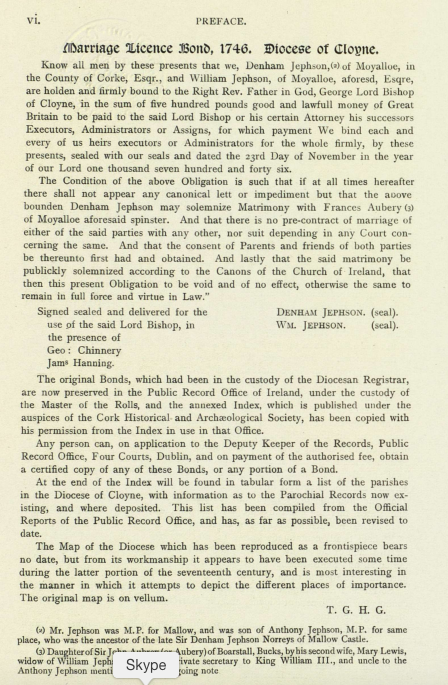
1746. Sample Marriage Licence Bond.


1746. Sample Marriage Licence Bond.

..
Members of the Church of Ireland could get married by having Banns read three weeks in a row in Church or by applying for a Marriage Licence Bond. It is likely that this was the favoured route for the more prosperous.

Unfortunately most were destroyed in Dublin in 1922.

The Licences were administered by the Church of Ireland Consistory Courts. Some details of the Cork Court are included here:

https://docs.google.com/document/d/1FWBV3gRAeVpYqD5Nlq9j4by9xQGww9Y141pT1mZshpA/edit


..

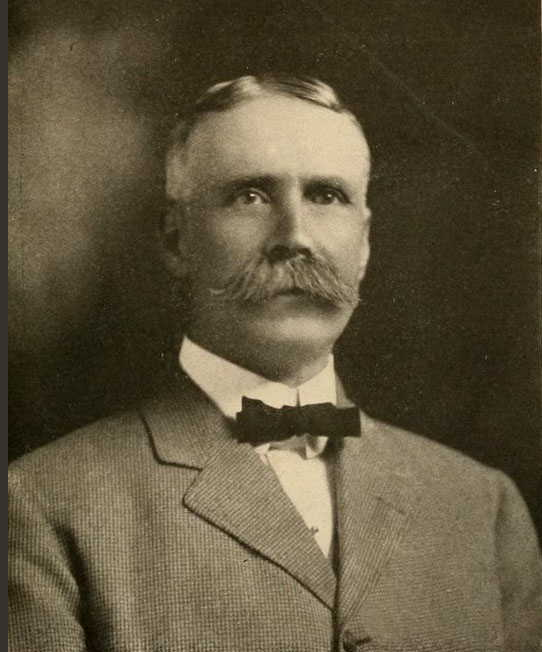
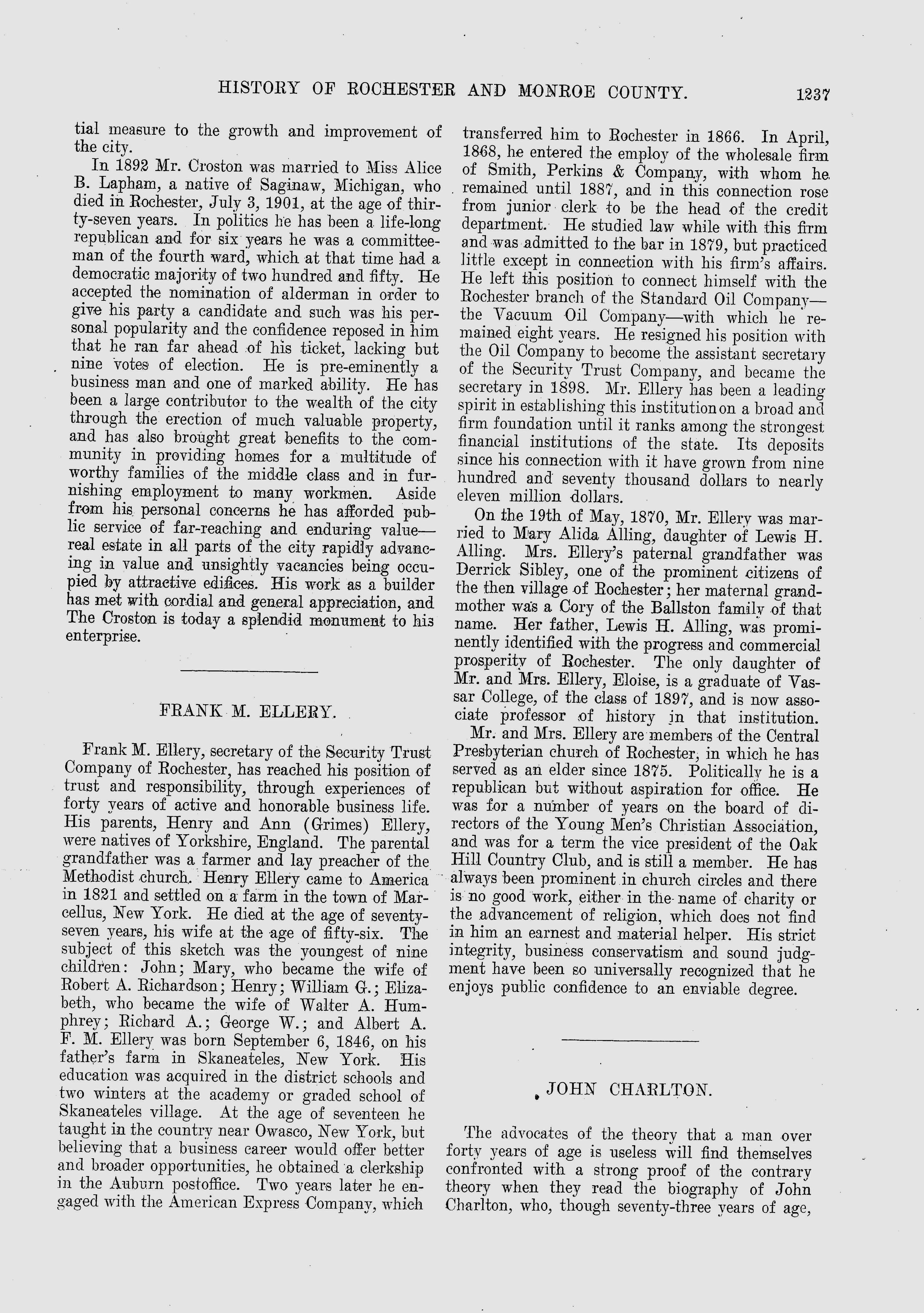
Frank Croston 1852-1921, Probably born Reenaccapall. Parish of Kilcrohane, West Cork, Major Real Estate Developer of High Quality Commercial and Residential Property, Rochester, New York, Republican Party Activist. Varian Brush Making Family Possible Origin, Rooska, Bantry.


https://www.google.ie/maps/@51.5918522,-9.6544772,16z

The Crostons in Durrus are generally weavers or labourers.  There are references to family member sin 19th century census reproduced in the Cole Family History unfortunately the records were destroyed in the Public Record Office in 1922 but the Cole history has survived.Some who emigrated to the USA in the 19th century did not fare well.

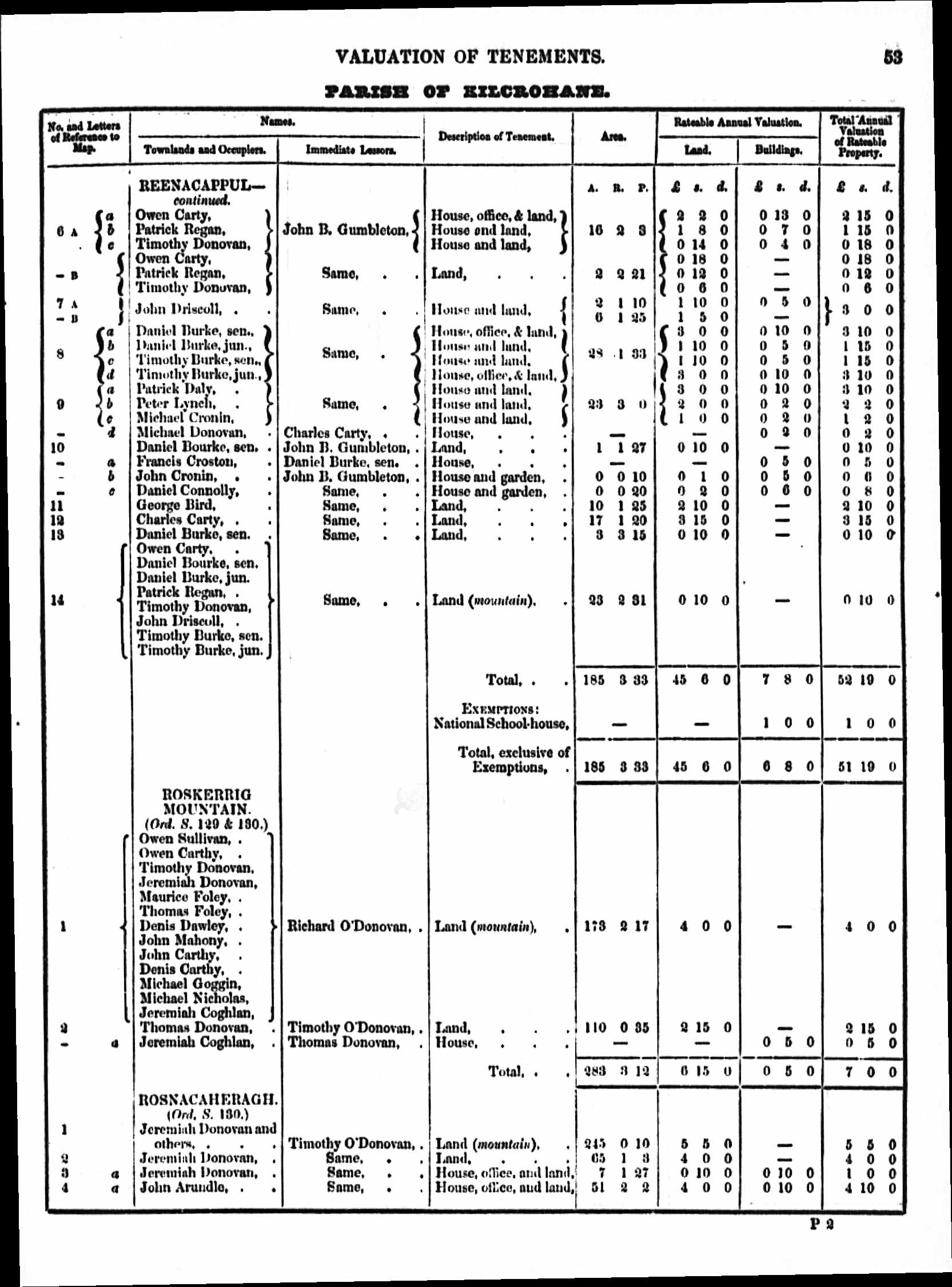
Frank Croston’s family probably moved around. His father’s house in the Griffith Valuation is very low insistent with a cottage but with no garden, the Landlord Daniel Burke, Senior, he in turn a tenant of John B.Gumbleton.  This is consistent with the patters of weavers and labourers staying within an area but moving.


Screen Shot 2017-04-14 at 09.43.06


Spinning and Weaving John and Isaac Johnson and John Croston Weavers of Old from 1938 School Folklore Collection, Carrigboy National School, Durrus, West Cork. From Breda McCarthy, Coolcuaghta.

Records of South West Cork families such as Dalys, Haggertys, Swanton, Jagoe. Lannin, Levis, Dukelow, Beamish, Harrington, Mahony, McCarthy, Stout, Kingston, Raycroft, Jennings. Skuce, in Registers of Rochester New York, Register Mount Hope Cemetery, Rochester, Rochester Genealogy Relevant Canadian Records.

Some West Cork Emigration to Rochester, New York, Ontario, Canada, Bradford and Haverill, Mass, Wisconsin, Minnesota Some families Mentioned, King, Lannin, Gallagher, Attridge, Croston, Kingston, Levis, Swanton, Salter, Daly, Mahony, Gosnell, Dukelow, Williamson

The progress of the Attridge family from Lisheenacreaagh (Lisín-na-Creiche: little-fort-of-the-cattle-spoil), Ballydehob, West Cork to Rochester, New York, United States and Waterdown, East Flanboro. Ontario, Canada, with associated families, Gosnells, Skerkin Island, and Lees and Sheehans, photographs of Sally and William Atteridge, Rochester, born West Cork 18th century, and Protestant Hedge School Masters.

Some Birth, Marriage and Death Records from 1592 of Church of Ireland, Methodist, Quaker and old Catholic Families, Skibbereen District, West Cork and Rochester, New York.

Courtesy Heather Croston, USA:

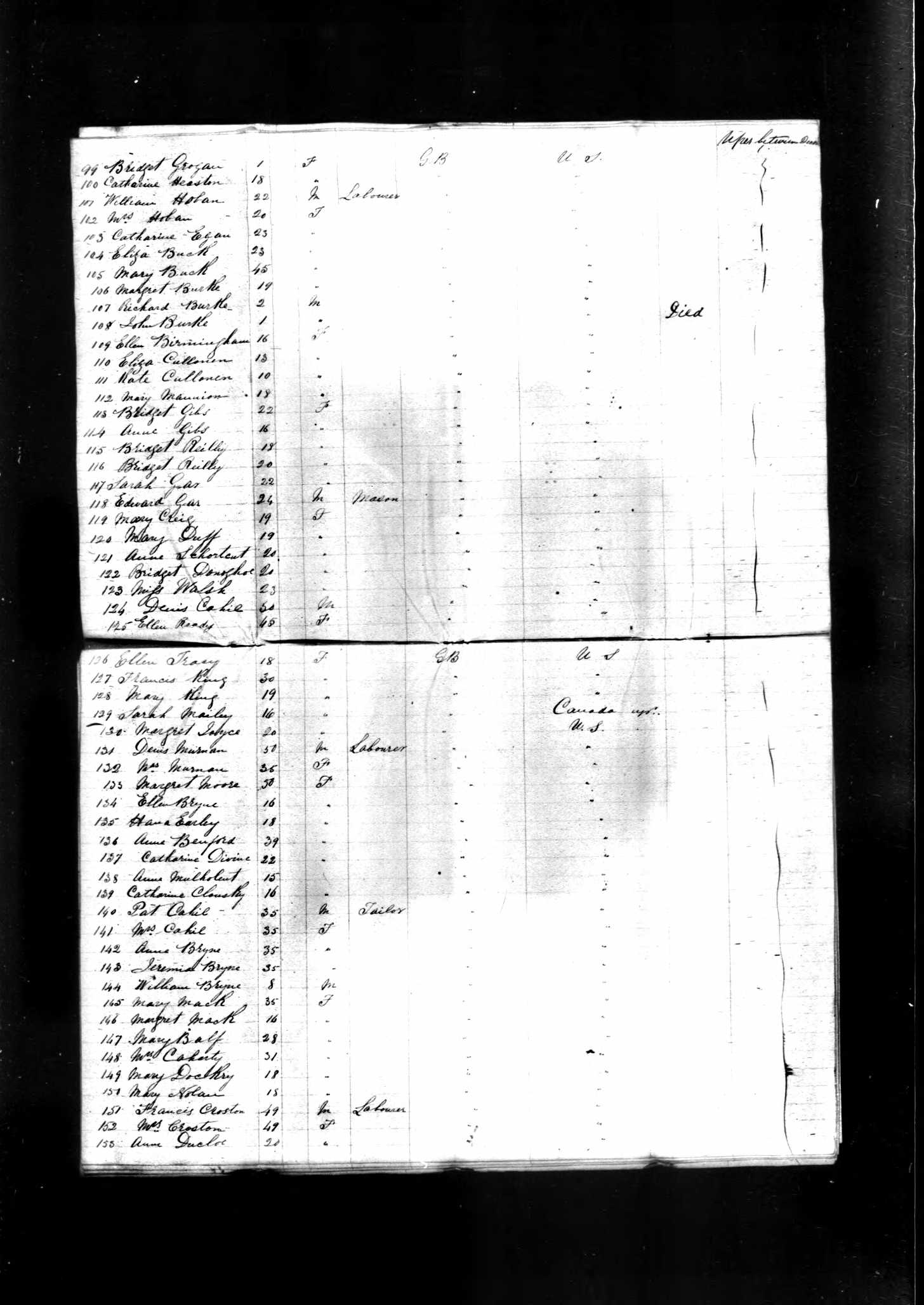
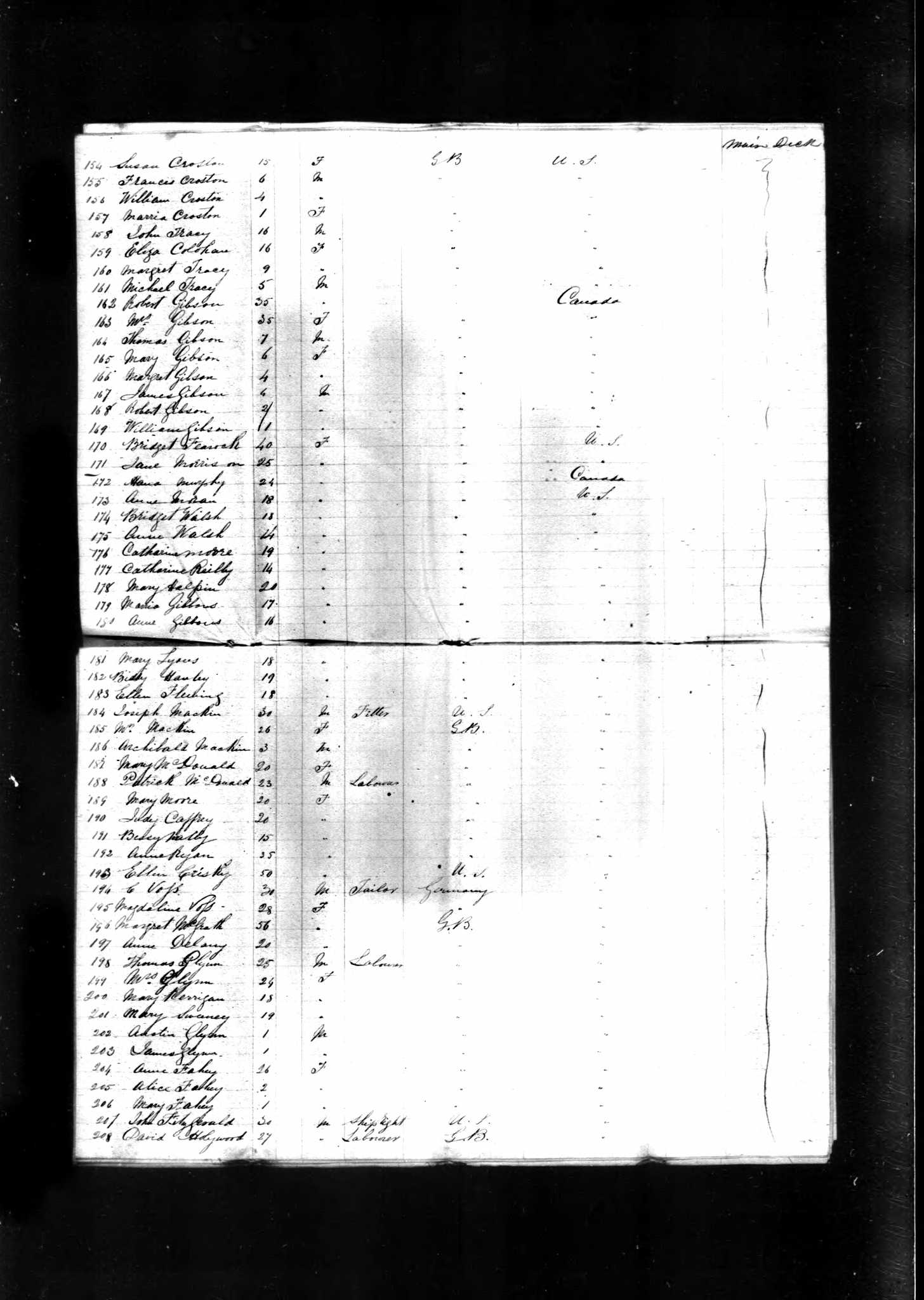
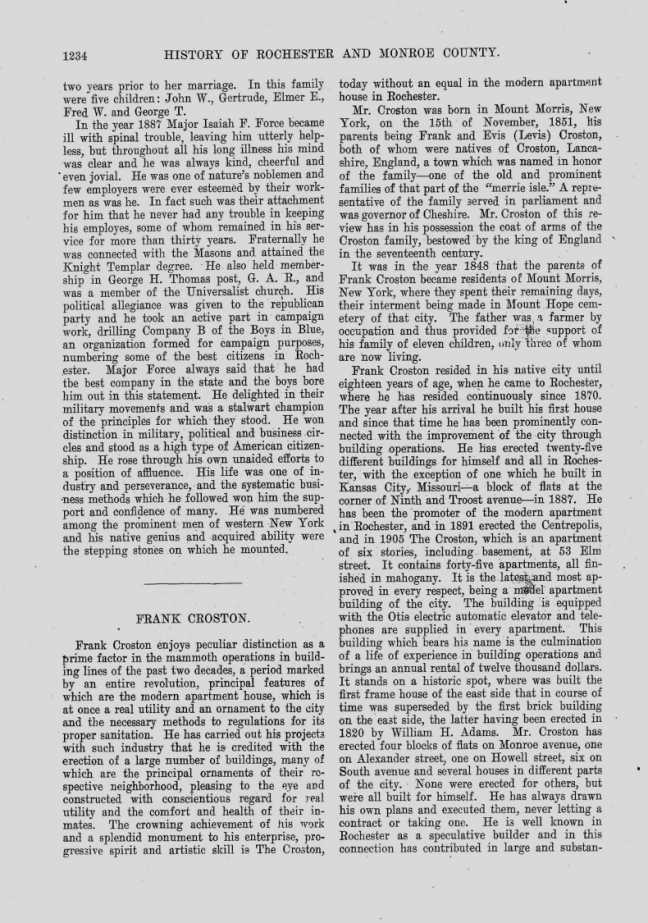
His parents were Francis Croston and Avisa Levis.   They arrived in New York 22 June 1858.   Their daughter Ann was born in 1844 Schull on the same plot of land where my family lived. In the record it says “of Durrus Parish”.  On the passenger list her name is Ann Ducloe (Dukelow) . I don’t have a record of her marriage, or know who her husband was. (this is new info for me)   They settled in Mt. Morris, Livingston, NY (south of Rochester)  When Francis “Frank” was 18 he moved to Rochester. 2 years later his parents had passed away and left the children with land in Mt. Morris. I believe this is how he started his career in real estate.
I suspect his father was the Francis Croston on the 1850 Griffiths Valuation of Kilcrohane, Reenacuppul. This is not far from Moulamill. The low valuation would be consistent with a weaver’s cottage:
32504_Cork_12-B10a
In the History of Rochester it says that his family was English and he was born in New York, But all early records show this is not true. He seems to have led people to believe this later in his life, maybe because at the time Irish were discriminated against. Many US born felt that the Irish immigrants were taking jobs from them. The other reason may be that the family identified as English even though they were born in Ireland. I’m not sure.
The invention of a spurious genealogy is relatively common witness the Whites (Lord Bantry).  This is something Bantry antiquarian Paddy O’Keeffe researched and determined it was bogus.
Also the description of the family in Lancashire is very embellished. The town was not thought to be named after the family but the other way around. Also the story about the coat of arms: I’ve found no evidence that it’s true. So don’t take any of that as fact.
In the Croston Parish records I have seen some names that are also found in West Cork: Wilkinson, something similar to Roycroft etc.. and have wondered if other Lancashire families went to Cork at the same time. Perhaps settled on the same land. I haven’t really had time to research England yet, outside of the Irish lines that immigrated there. That will be next if I can make a DNA connection.
There were many Croston- Sullivan/ McCarthy/ Driscoll marriages, mostly in Skibbereen, but some in Durrus.
Emigration Manifest:

Passenger List pg1

passenger list pg 2

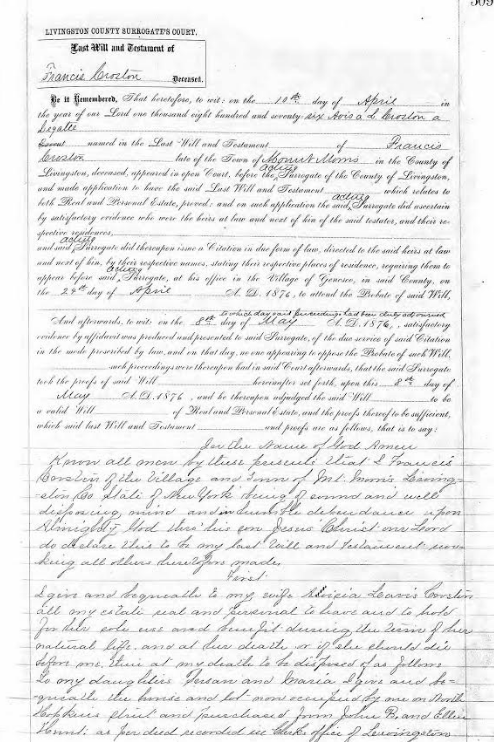
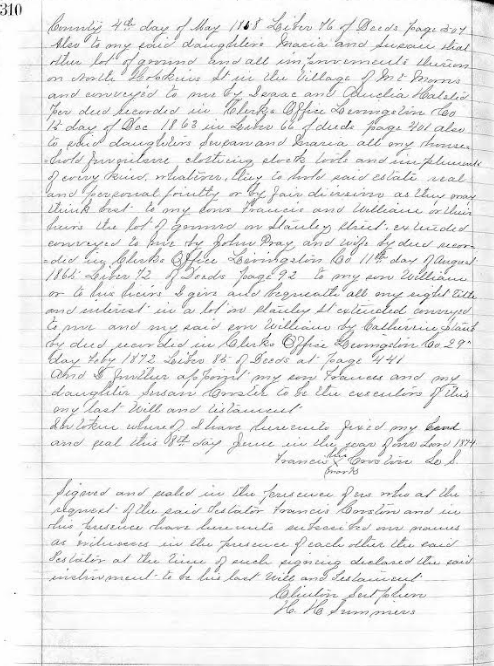
Father’s Will,  He is illiterate:

Screen Shot 2017-04-13 at 20.41.22

Screen Shot 2017-04-13 at 20.41.32

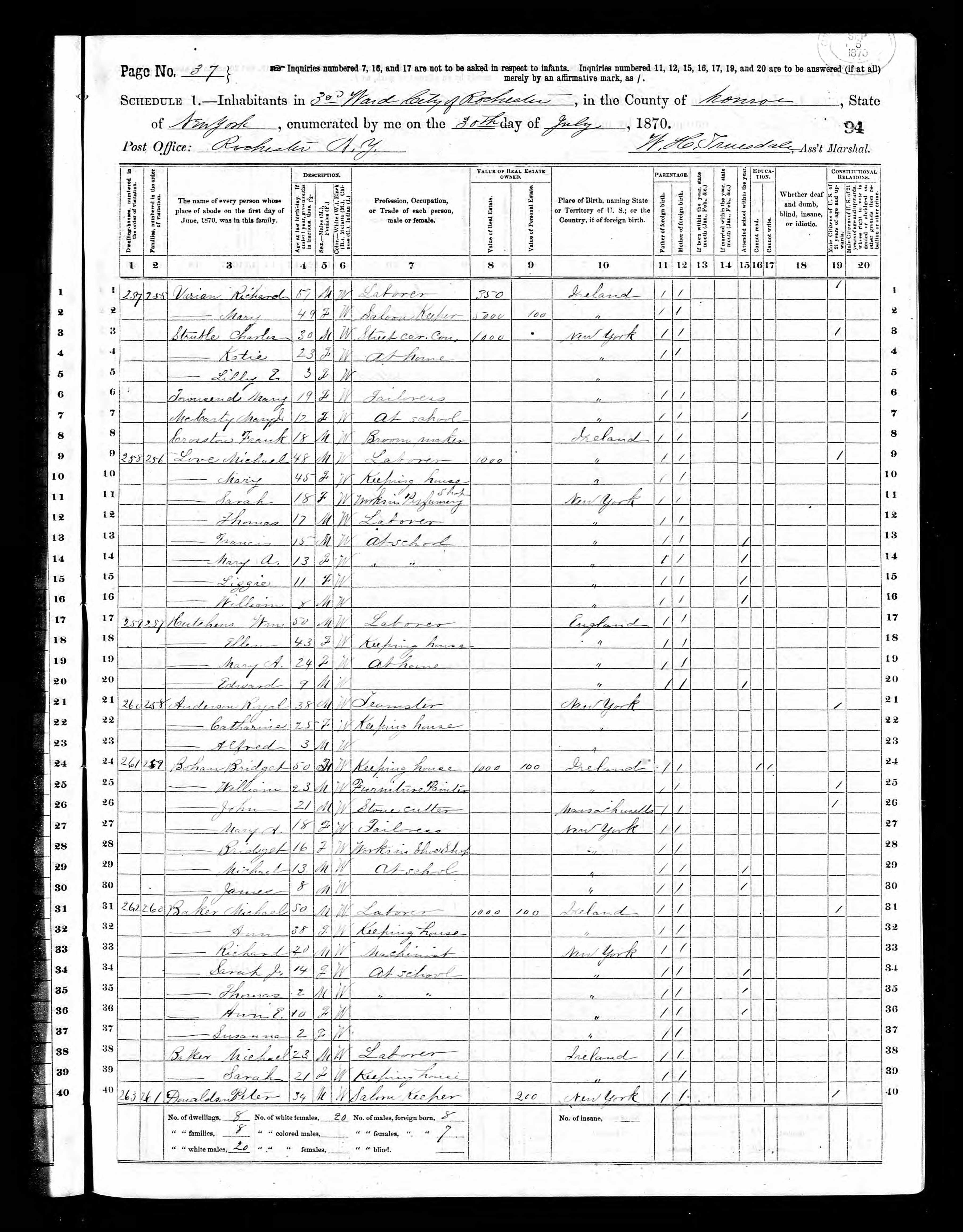
Census Rochester 1870, note also Baker family probably from Rossmore, Durrus, one of the Bakes was the head of the ’99 Cousin Clan’ (families such as Dukelow, Attridge, Gosnell, Baker, Gallagher, Skuce, Shannon) from Durrus/Schull who ran Rochester City Council through the Republican Party for many years in the 19th century:
1870 Census Rochester
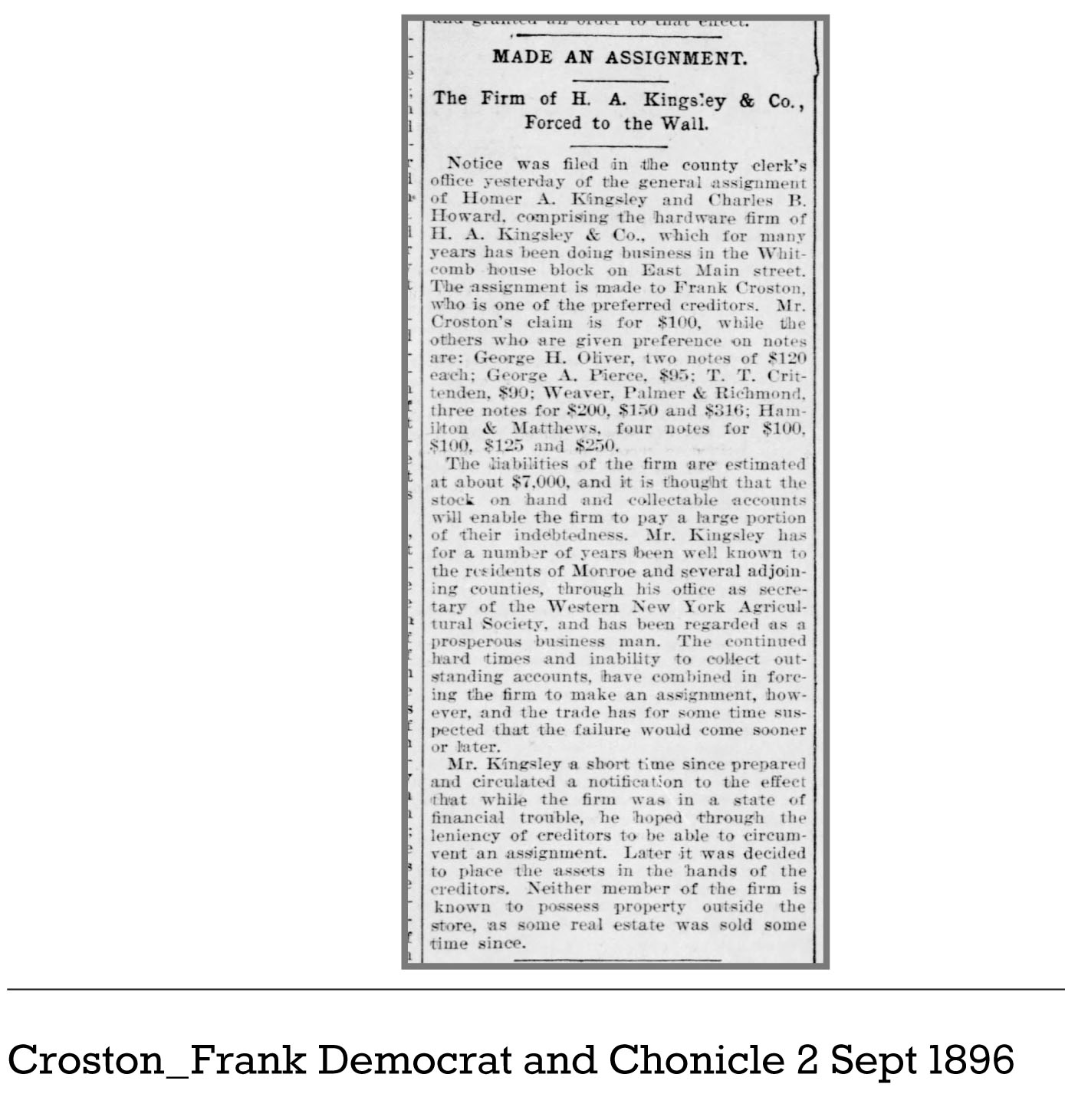
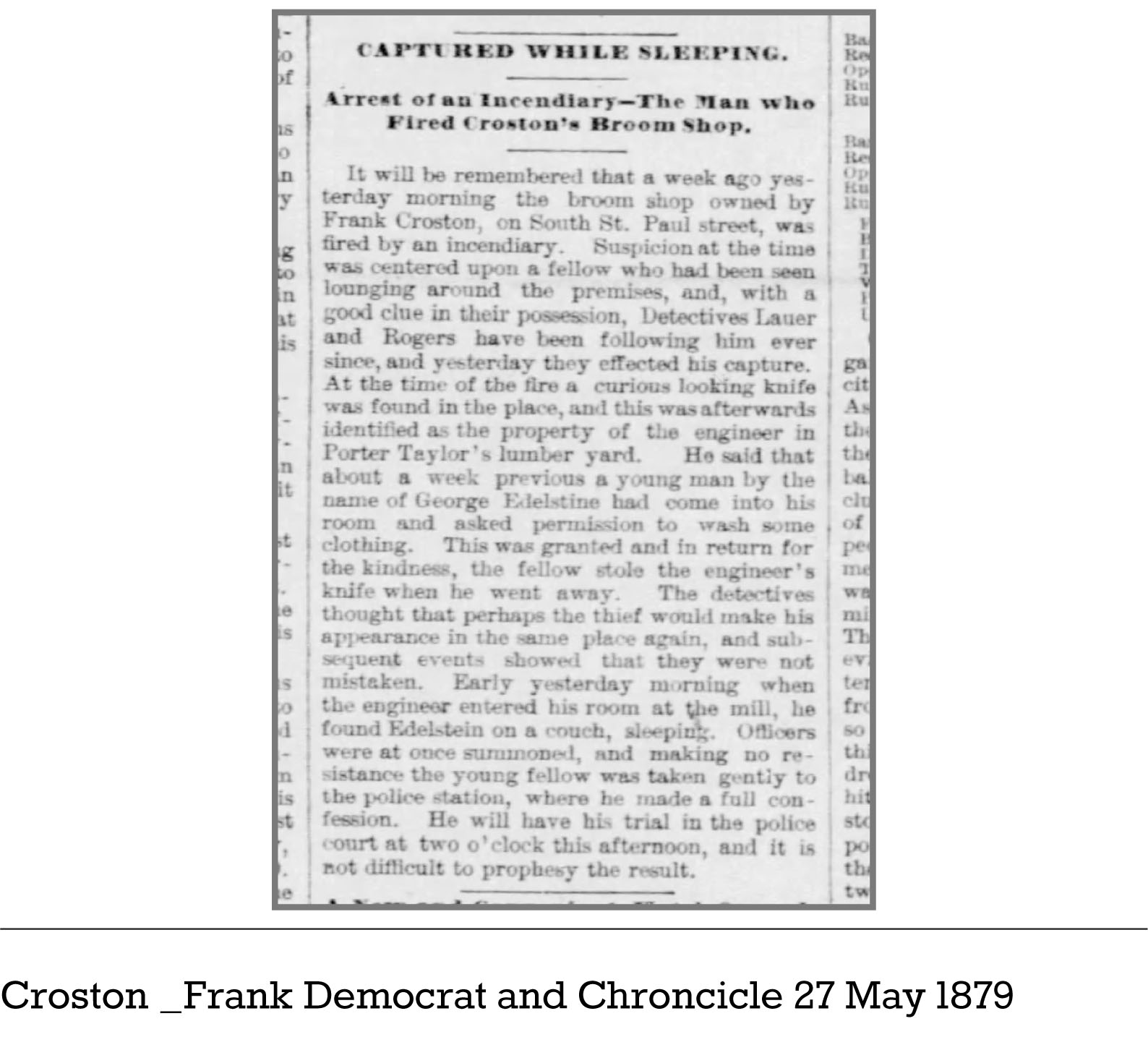
When Frank moved to Rochester from Mt. Morris he boarded with Richard Varian. He was a broom maker for a few years with his brother William. When Frank started working in real estate William took over the business.  Frank was also involved with helping to liquidate a hardware store’s inventory after the owner died.

….

When Frank as boarding in Rochester it was with Richard Varian listed as a labourer. It may be a coincidence but Frank and his brother William were in the brush making business.  The Varian brush business started in Cork then Dublin.  online genealogical forums suggest the family may have originated in Rooska. In the 18th century the Varians there were prosperous ‘yeomen’ farmers, intermarried with Fergusons and Roycrofts of Durrus. They appear in the Bantry House leases and in various deeds.

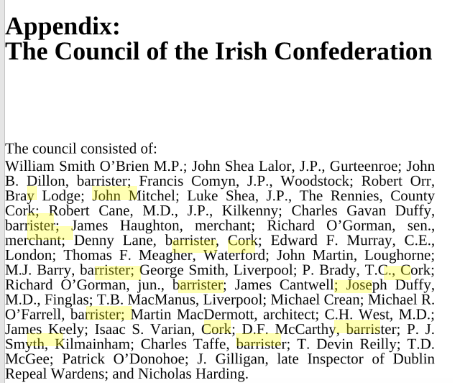
In 1848 Isaac Varian in Cork is listed a a member of the Council of the Irish Confederation of Young Irelanders a reforming political association, perhaps a vague connection of local political consciousness in the West Cork area as in 99 cousins in Rochester:

Screen Shot 2017-04-17 at 09.50.56

Croston_Frank_Democrat_and_Chonicle_2_Sept_1896

Croston__Frank_Democrat_and_Chroncicle_27_May_1879

Frank Croston pt 1

Frank Croston pt 2

….

…..