
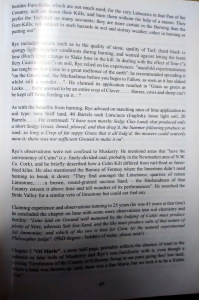
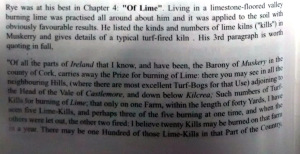
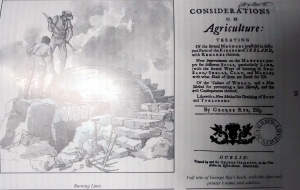
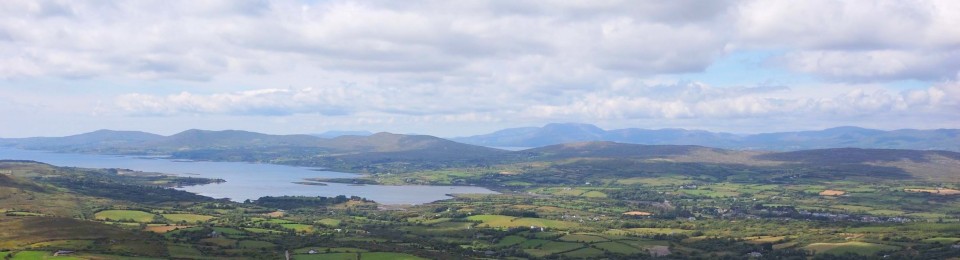
John Rye, Macroom, Co.Cork, Early Agriculturalist, 1730 on the Burning of Lime.
Ryecourt:
http://landedestates.nuigalway.ie:8080/LandedEstates/jsp/property-show.jsp?id=3156
30 Tuesday Aug 2016
Posted in Uncategorized
John Rye, Macroom, Co.Cork, Early Agriculturalist, 1730 on the Burning of Lime.
Ryecourt:
http://landedestates.nuigalway.ie:8080/LandedEstates/jsp/property-show.jsp?id=3156
30 Tuesday Aug 2016
Posted in Uncategorized
Agreement made between Francis Edwards, Jacob Sawbridge, Elias Turner, and Charles Ward on behalf of the Governor and Company for making Hollow-Sword Blades in England in the first part, and Francis Bernard, City of Dublin, in the second part. For the sum of £3,566. 5s. 0d. paid by Bernard to the Governor and Company, for a term of one year, they convey to Bernard the town and lands of Knocknacarra, Killdara, [Coghans], Coolmayne, Ballynagragh, Ballinvradigg, Coolbane, Garrylucas Upper, Ballincurrig, and Ardacrow, all in Cork county. Signed by all parties, and signed and sealed by Bernard.
One of the founding blocks of the Bandon estate.
From Boole Library UCC
http://booleweb.ucc.ie/index.php?pageID=409
The Hollow Blade Company acquired large tracts of forfeit land in Co. Cork as part payment for financing the Wars of William of Orange, hit by financial panic in the early 18th century they had to liquidate and this transaction was…
View original post 737 more words
30 Tuesday Aug 2016
Posted in Uncategorized
The Rev. Alcock lived at Sea Lodge, Gearhameen, he later built the old Rectory in Clashadoo.
The Tithes in the 1820s: ‘The year’s tithe due to Mr. Alcock, the Rector Durrus, was nearly collected in one day. The summary collection was effected by the police who act as drivers. In the case referred to the determination to to obtain ‘Tithe Distress’ was so great that I have been informed that the house where the parish priest the Reverend Quin was saying Mass was forcibly entered and a bed the only item of value would have been taken but for the suggestion of some Protestant who objected to that mode of insult to a Clergyman.
The Tithes were a tax on cultivated land pasturage was exempt. In was in the popular imagination seen as being for the maintenance of the Church of Ireland clergy it then being the State Church…
View original post 724 more words
29 Monday Aug 2016
Posted in Uncategorized
Last Act of the Pre 1800 Irish Parliament, Cap. 100 of 40 George 3 an Act for The Better Regulation of The Butter Trade, And Also Respecting Sedan Chairs, Coaches, and Chaises Plying For Hire, Within the City and Liberties of Cork.
In the office of C.E. B. Brett, Belfast Lawyer and Architectural Historian.
Patricia Craig, obituary of C. E. B. Brett, in The Independent ([Sat. 24 Dec. 2005)
[Available online.]
A key moment in Charles Brett’s life occurred in 1956 when, at the age of 27, he was invited to join the Northern Ireland committee of the National Trust. Innocently enquiring what books he should read to fit himself for the task, he was told there were none to be had – an assertion he later found to be “substantially true”. In that instant a resolve was formed in his mind to make good the deficiency himself, a resolve he carried out with the utmost thoroughness and virtuosity.
He wasted no time in getting to grips with the enterprise. People going about their business in Belfast’s city centre during the late 1950s might have wondered at the occupation of a tall, fair-haired young man with a notebook and pencil, and the attention he seemed to be bestowing on buildings which everyone else either took for granted or mildly disparaged, according to the fashion of the day. In this manner – noting, recording and appreciating – Brett’s great work as Northern Ireland’s premier architectural historian got under way.
He started, as he said himself, just in the nick of time, as the Victorian city with its Georgian underlay fell victim to the rage for redevelopment which overtook the whole of the United Kingdom in the 1960s; and then to the additional, local depredations of “politically motivated” arsonists and bombers, once “the Troubles” had taken root. Brett’s Buildings of Belfast, 1700-1914 when it was published by Weidenfeld & Nicolson in 1967, already contained much to lament, including Charles Lanyon’s School for the Deaf and Dumb, and the old Lunatic Asylum on the Falls Road, demolished, as Brett has it, in 1924, “by the lunatics of Belfast”.
There were three main strands to Charles Brett’s working life at the time. In 1950, he had joined the family firm of solicitors, L’Estrange and Brett, and his initial architectural scrutiny of Belfast was carried out during his lunch hour. He was also a keen member of the rocky Northern Ireland Labour Party, a would-be non-sectarian organisation caught between clashing factions, and destined to fade out of Northern Irish politics (though not before Brett had successfully chaired it for a number of years). By opting for socialism, rather than Unionism, he was subscribing to a view of the world not readily attributable to someone of his background (though among his ancestors, it’s true, were those of a similarly radical, anti-Unionist and even anti-clerical cast of mind).
He was born in 1928 in Holywood, Co Down, into a prominent legal family, and educated in England, at Rugby and Oxford, where he read History at New College, Oxford and was president of the Poetry Society. Then he spent a year in Paris, working as a broadcaster and journalist, and savouring the mildly bohemian pleasures of an unencumbered life abroad, before returning in 1950 to Ireland and all its provocations. Belfast, however – which he’d lumbered in his mind with a dismal backwaterish quality – he found bristling with an indigenous camaraderie and vitality. The worlds of the arts, and of trade unionism, gave him an outlet for all his gregarious, cultural and reformist tendencies.
As for the other kind of Unionism: as he says in his autobiography-cum-family-history, Long Shadows Cast Before (1978), in the face of Unionist smugness and self-satisfaction, and in view of the overbearing way the one-party state was run, there was nothing for it but to “stand outside and bung bricks at them: a duty that I performed to the best of my ability, and with relish, for the next 20 years”.
In that assertion, you catch the unmistakable tones of the independent-minded, witty and forthright campaigner for social justice and improvement in every area of life with which he came in contact: someone whose raison d’être was to uphold the values of reason, tolerance and civilisation, even if it meant (as a Labour activist) getting up on a cart, or climbing the Custom House steps (Belfast’s version of Speakers’ Corner) to cry up the necessity for change before a sometimes unenthralled audience. He did this in order not to shirk any aspect of the socialist agenda; but (he says) “I was more at home in a committee room than on the back of … a lorry”.
Committee rooms come into the picture, in abundance. The year 1967 saw the founding of the Ulster Architectural Heritage Society, mostly at the instigation of Charles Brett – an organisation he was still serving, as President, at the time of his death. Chairman of Hearth Housing Association, of the Northern Ireland Housing Executive, Vice-Chairman of the Arts Council of Northern Ireland … the list is formidable.
But the preservation of Ulster’s dwindling store of architectural treasures became Brett’s most cherished preoccupation, “the modest but delightful buildings with which previous generations have endowed the towns, villages and countryside”; and to the listing and evaluation of these he brought a poet’s eye and a solicitor’s discipline, allied to a kind of benign despotism which came into play whenever he considered that others were dragging their heels.
The last part of the 20th century was not, he noted wryly, an auspicious era for a Northern Irish conservationist. His own solicitors’ office, in one of Belfast’s few remaining Georgian terraces, suffered severe damage from a massive car-bomb which exploded nearby in 1972; and Brett himself was quickly among the teams of helpers, “filthy and often bleeding from scratches made by slivers of broken glass”, who worked day and night to clear up the mess. The office continued in use (it is still there, under different ownership), and during the subsequent bomb scares which plagued the city, causing mass evacuation of workplaces, Brett would carry his papers out to a traffic bollard near the City Hall – a makeshift solicitor’s desk.
With so much destruction taking place, the necessity to conserve what remained became even more urgent. Throughout the entire period of disruption, Charles Brett – who’d made himself into a connoisseur of the cobweb fanlight and the fluted wooden column – went on providing invaluable guides to the existing building heritage of the north. These culminated in the splendidly produced, vividly informative trio of volumes, Buildings of County Antrim (1996), Buildings of County Armagh (1999), and Buildings of North County Down (2002), in which scholarship and idiosyncrasy combine to make a sparkling effect.
Going his own way, with elegance and aplomb, Brett stood in his lifetime as an antidote to the madness, complacency and inertia which bedevilled his birthplace; and if his impatience with diehards and ditherers alike sometimes got people’s backs up, the vast and eclectic nature of his circle of friends is a testament to his kindness, generosity, originality and verve. He was a delight to know.
29 Monday Aug 2016
Posted in Uncategorized
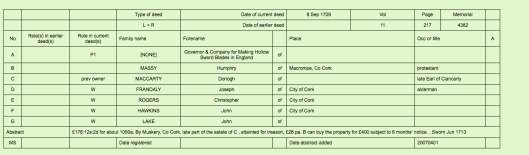
1709. Sale of Part Estate Muskerry by Hollow Blade Company to Humphry Massy, Macroom, Protestant of Late Donogh McCarthy late Earl of Clancarthy Attained for Treason.
http://landedestates.nuigalway.ie:8080/LandedEstates/jsp/family-show.jsp?id=2825
Massey Magistrates:
Right Honourable Hugh Massy, 1797
Humphrey Massy, 1719, Macrompe (Macroom), purchased former Earl of Clancarty Donogh McCarthy Muskerry estate from Hollow Blade Company 1709.
Massey Hutchinson Massey, Mount Massey, Macroom. Pre 1830, listed 1835.
William Massey, pre 1830
William Hugh Hutchinson Massey, Mountmassey, Macroom, listed 1875-6. 1870 return, 13,363 acres.
28 Sunday Aug 2016
Posted in Uncategorized
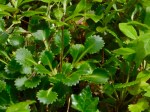
This gallery contains 16 photos.
Originally posted on Roaringwater Journal:
Glengarriff Woods – serene, beautiful and incredibly diverse The second (now annual) Ellen Hutchins Festival has…
28 Sunday Aug 2016
Posted in Uncategorized
Snapshot of a West Cork family, 1881 letter from James Skuce to his Nephew in Canada from Canadian Archives, from Derrrynafulla, Glengariff, Clashadoo Durrus to teaching, Businessman, Shipowner, Owner of Blackrock Castle Cork, family Emigration, RIC.
One of the Skuce ancestors hailed from Derrynafulla, near Glengariff and was probably born in India perhaps his father was serving with the East India Company. The family had a history of law enforcement as bailiffs, RIC men.
He may have worked for the Chief Executive equivalent of R and H Hall Grain Merchants still in existence as part of a wider company. He is likely to have placed his nephews as managers in that company. His son a bank manager died in Dundalk in the mid 1940s his second name was Evanson pointing to a tantalising link between the Skuse and Evanson families in the early 19th century in Durrus.
Halls Magistrates:
Edwin…
View original post 640 more words
28 Sunday Aug 2016
Posted in Uncategorized
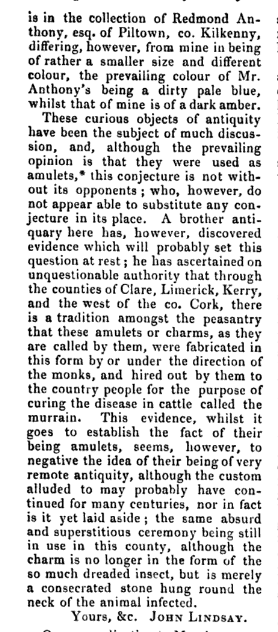
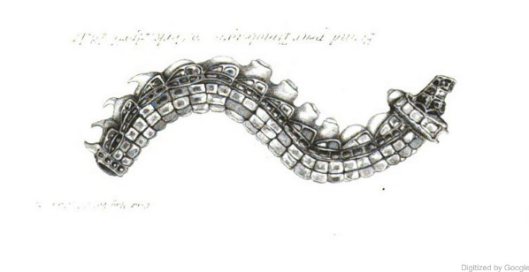
1844. Discovery of Amulet, Remnant of Antiquity near Timoleague, Where there Was A Franciscan Monastery Thought to Be Used As A Charm Against Caterpillars (Couac or Murrain)

| 1787-1870 | John Lindsay TCD, Esq | Kings Inns 1812. Barrister, little practise independently wealthy. | Lindville/Maryville, Blackrock, son of Thomas Barrister, Mary dau of Samuel Maylor, Merchant Lord Mayor 1766, m Annie d Peter Morgan, Bridestown, 5 sons 1 daughter, only daughter Mrs. Carlton. Member 1832 Cork Friendly Club. 1861 Member Society Irish Antiquaries. | Lucas Directory 1787 | Published ‘View of the Coinage of Ireland’ enormous collection of coins c 1835 if it is the same man. Contributor to ‘Gentlemans Magazine” on coinage. Associate of Richard Sainthill. Obituary by Richard Caulfield Kilkenny Journal of Archaeology. | John Windle. “May be the same Lindsay, John, Esq. Lindville, Blackrock Road. On Sunday morning [21st], at Lindville, on the Blackrock road…aged 60 years. He was a most affectionate husband, a tender and indulgent parent, and a truly honest man.‘ CC (23/09/1828) “ |
Similar Type



26 Friday Aug 2016
Posted in Uncategorized

Cashelane Church of Ireland School, Parish of Schull, West Cork Photo of Pupils early 1930s
Cashelane Church of Ireland School early 1930s
The school was initially supported by the Church Education Society. There was an application by the Rev. R. H. Carroll, the manager of Altar rectory, Toormore, for a grant to build a new school. This was in his name, and that of Rev. J.T. Levis of Durrus and Rev. Brady of Ballydehob. The existing school was unsuitable due to distance for pupils. The school would have 30 children mixed; that it had been inoperative since 1902, as a teacher could not be located. In 1902 the average attendance was 10.7-11. The nearby Catholic School at Dunbeacon had an average attendance of 54.8-68.3, and included 11 Established Church children, and had an assistant teacher. It was expected that the enrolment of the new school would be 21 males and 13 females. There were no objections to the development from Rev. O’ Callaghan P.P but Fr. O’Connor whose school at Dunbeacon would lose 11 children, objected as did Rev. W. Caldwell, the Morreagh manager of the Methodist School. The previous teacher Mrs. Griffin resigned in December 1902 and the school was technically taken off the school register from that date, to be restored on completion of the new school on July 1906. Ms. Trinder, who had qualified from the Church of Ireland College in 1894, and had taught at Kilcoe/Corrovally was appointed and the new manager was Rev. A.J. Brady, as the school was now in his parish. In October 1906 the attendance was 10 boys and 10 girls out of a possible enrolment of 22.
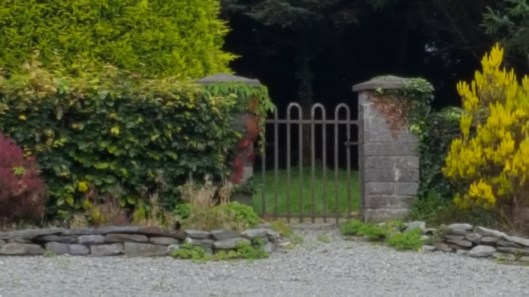
The school is built on a site at Old Mill Farm, Dunbeacon just off the Durrus Toormore Road. The site was donated by the Sweetnam family. The school closed around 1945 and has been converted to a private residence. Only the gate suggests the former use.
Mrs Sweetnam from Raheen who taught in the school was married to a second cousin of this family. She had no Irish which caused difficulty post Independence. In the late 1930s Lizzie Jermyn who had good Irish and was young taught Irish a few days a week.
After the school closed the pupils dispersed some to Durrus and Ballydehob an som ot the local Catholic school at dunbeacon around the corner.
Teachers
Mrs. Griffin, -1902 Ms. Trinder, 1906-
Photograph c 1933.

Back Row, left to right. Teacher/Trainee? Teacher Mrs Annie Sweetnam, Dunbeacon, not qualified not sure if it was because she had no Irish. Good teacher for writing, hymns, sent her two daughters to Ballydehob. School closed mid 1940s. Some pupils went to St. James Durrus Some to Dunbeacon Catholic. Lack of Irish meant that pupils used to go to St. James probably to Líam Blennerhassett from Kerry he had excellent Irish.
No. 2 Richard (Sonny) Pyburn, b 1919, all Pyburns Dunbeacon, farmer. May have spent some months in St. James, Durrus.
Front:
No. 2 Victor Sweetnam, Lahern, brother to Nan Sweetnam, farmer, never married.
No 3. Nan Levis, Cashelane, lived with her single brother neither married, farmers.
No. 4. Georgina Pyburn, Dunbeacon, married George Bower (He is buried St. James, Durrus), Co. Louth, he was a horticulturalist with Guinness at Birr. 2 boys, Raymond, Bert, i girl.
No. 5. Susan Pyburn, married Charlie Gilliard, mechanic, London, 1 boy 1 girl.
No. 7 Vera Pyburn, m Ernie Splaine, Riverstick, KInsale,, Son Robert (Show jumping champion) Freida, Jean
3 small boys don’t know names possibly one a Phillips from Dunbeacon or William Levis no family married in to farm.
The school was initially supported by the Church Education Society. There was an application by the Rev. R. H. Carroll, the manager of Altar rectory, Toormore, for a grant to build a new school. This was in his name, and that of Rev. J.T. Levis of Durrus and Rev. Brady of Ballydehob. The existing school was unsuitable due to distance for pupils. The school would have 30 children mixed; that it had been inoperative since 1902, as a teacher could not be located. In 1902 the average attendance was 10.7-11. The nearby Catholic School at Dunbeacon had an average attendance of 54.8-68.3, and included 11 Established Church children, and had an assistant teacher. It was expected that the enrolment of the new school would be 21 males and 13 females. There were no objections to the development from Rev. O’ Callaghan P.P but Fr. O’Connor whose school at Dunbeacon would lose 11 children, objected as did Rev. W. Caldwell, the Morreagh manager of the Methodist School. The previous teacher Mrs. Griffin resigned in December 1902 and the school was technically taken off the school register from that date, to be restored on completion of the new school on July 1906. Ms. Trinder, who had qualified from the Church of Ireland College in 1894, and had taught at Kilcoe/Corrovally was appointed and the new manager was Rev. A.J. Brady, as the school was now in his parish. In October 1906 the attendance was 10 boys and 10 girls out of a possible enrolment of 22.
The school is built on a site at Old Mill Farm, Dunbeacon just off the Durrus Toormore Road. The site was donated by the Sweetnam family. The school closed around 1945 and has been converted to a private residence. Only the gate suggests the former use. Mrs Sweetnam from Raheen who taught in the school was married to a second cousin of this family. She had no Irish which caused difficulty post Independence. In the late 1930s Lizzie Jermyn who had good Irish and was young taught Irish a few days a week.
After the school closed the pupils dispersed some to Durrus and Ballydehob an som ot the local Catholic school at dunbeacon around the corner.
Teachers
Mrs. Griffin, -1902 Ms. Trinder, 1906-
Photograph c 1933.
Back Row, left to right. Teacher/Trainee? Teacher Mrs Annie Sweetnam, Dunbeacon, not qualified not sure if it was because she had no Irish. Good teacher for writing, hymns, sent her two daughters to Ballydehob. School closed mid 1940s. Some pupils went to St. James Durrus Some to Dunbeacon Catholic. Lack of Irish meant that pupils used to go to St. James probably to Líam Blennerhassett from Kerry he had excellent Irish.
No. 2 Richard (Sonny) Pyburn, b 1919, all Pyburns Dunbeacon, farmer. May have spent some months in St. James, Durrus.
Front:
No. 2 Victor Sweetnam, Lahern, brother to Nan Sweetnam, farmer, never married.
No 3. Nan Levis, Cashelane, lived with her single brother neither married, farmers.
No. 4. Georgina Pyburn, Dunbeacon, married George Bower (He is buried St. James, Durrus), Co. Louth, he was a horticulturalist with Guinness at Birr. 2 boys, Raymond, Bert, i girl.
No. 5. Susan Pyburn, married Charlie Gilliard, mechanic, London, 1 boy 1 girl.
No. 7 Vera Pyburn, m Ernie Splaine, Riverstick, KInsale,, Son Robert (Show jumping champion) Freida, Jean
3 small boys don’t know names possibly one a Phillips from Dunbeacon or William Levis no family married in to farm.
Dunbeacon, West Cork, National School 1902 -c 1975
Courtesy Peter Clarke:
http://sheepsheadplaces.net/dunbeacon-national-school
Around the corner was the former Church f Ireland school at Castlefean 1904-c 1945. It has been tastefully restored as a private residence. Only the gate gives evidence of its former state.


23 Tuesday Aug 2016
Posted in Uncategorized
This gallery contains 23 photos.
Originally posted on West Cork History:
Miracles Attributed to Father John Power (1764-1831), born Deelish, Skibbereen, PP Kilmacabea, West Cork his Nephew,…
 West Cork History