Post Famine Prosperity and the Commencement of Agricultural Productivity, Hive Engineering Works Cork, Ads for Products, from Skibbereen Eagle 1862.
Click to access IRONWORK_Cork.pdf

29 Sunday Mar 2015
Posted in Uncategorized
Post Famine Prosperity and the Commencement of Agricultural Productivity, Hive Engineering Works Cork, Ads for Products, from Skibbereen Eagle 1862.
Click to access IRONWORK_Cork.pdf
29 Sunday Mar 2015
Posted in Uncategorized
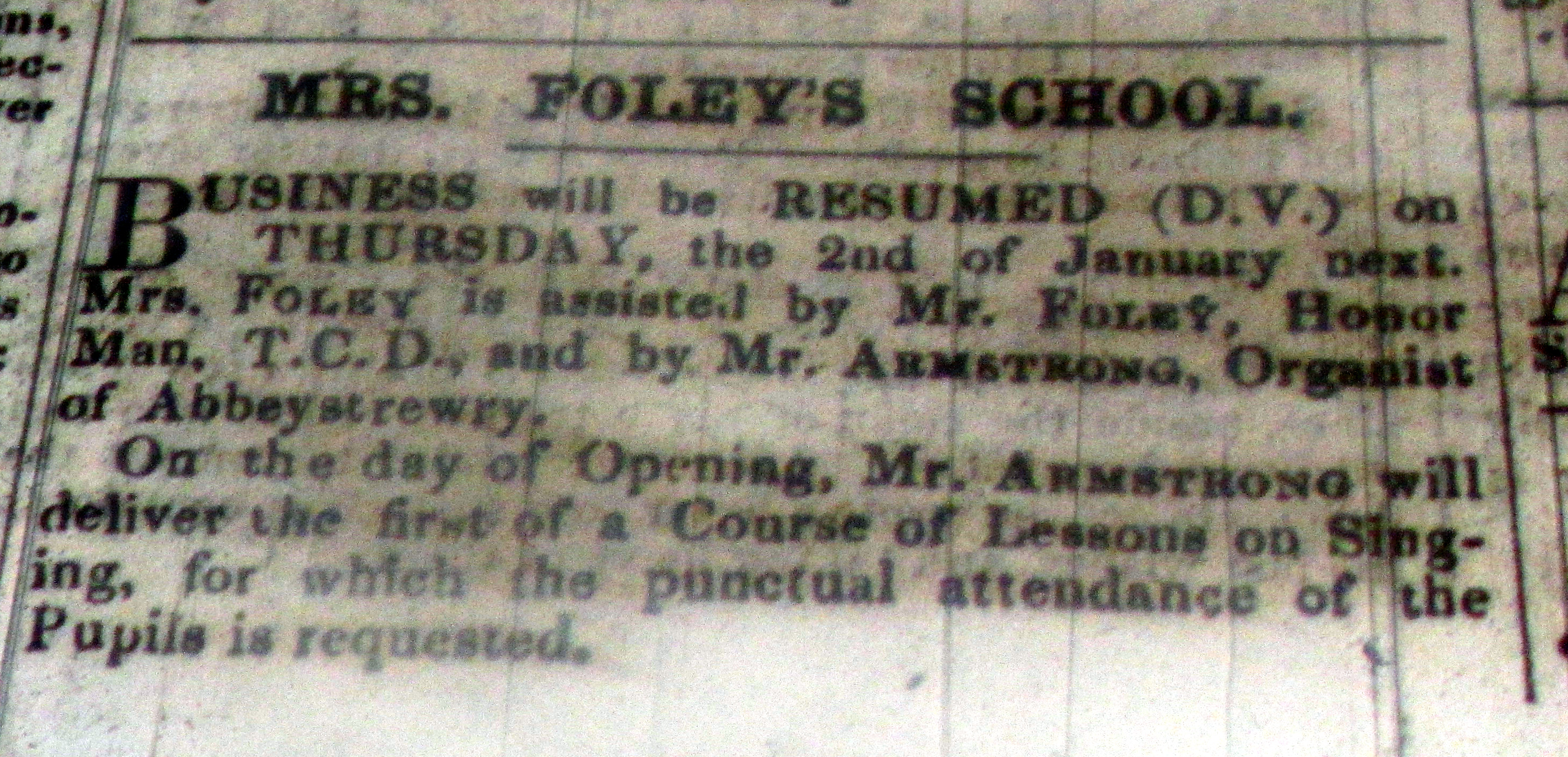
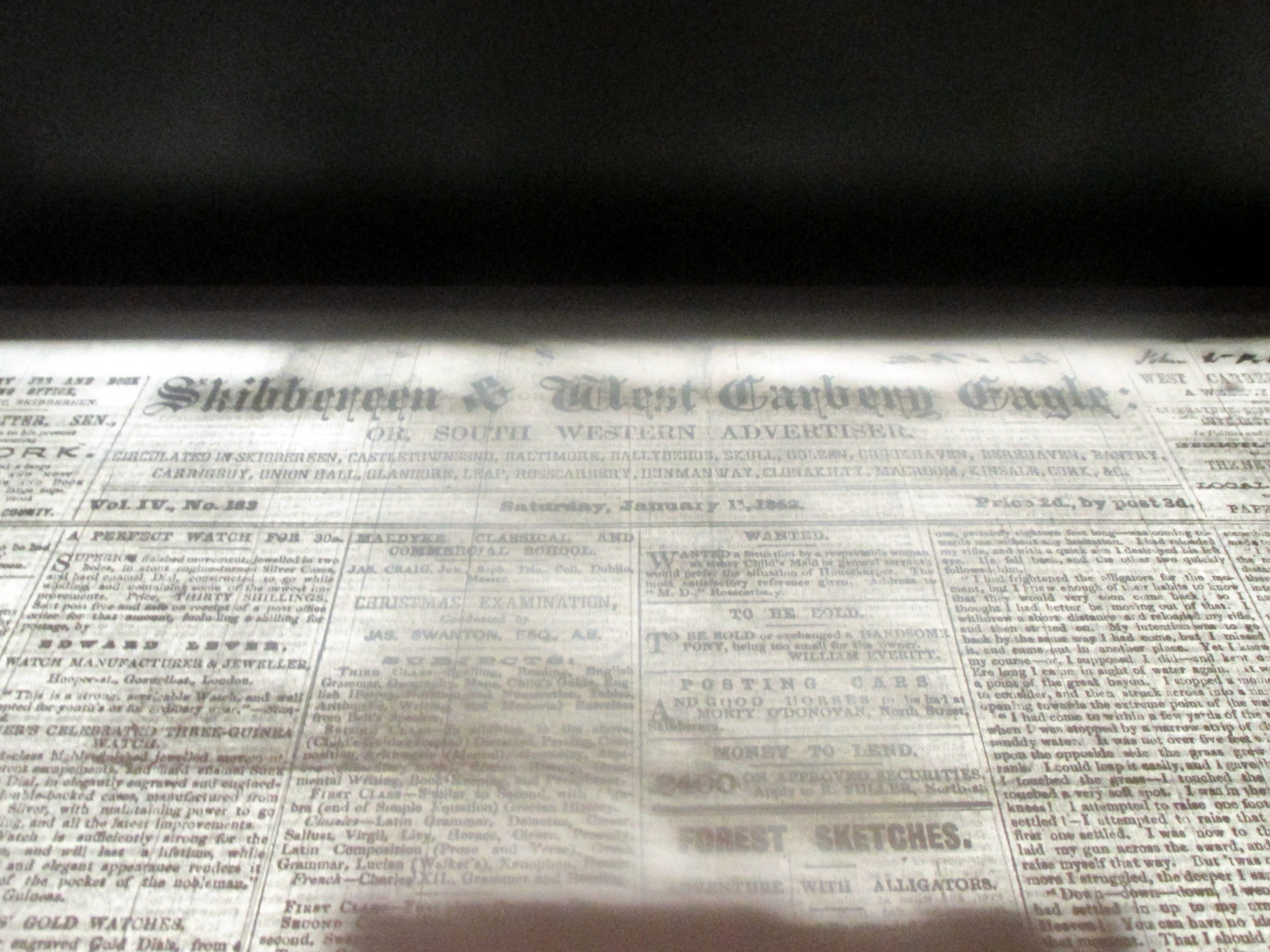
Mrs. Foley’s School and Mardyke Commercial School Skibbereen, 1862, J.P. Harte’s School, Dunmanway, 1940s.
The Dunmanway school had an assistant Mr.O’Keeffe from Limerick in 1940 and later Tom Reilly from Kealkil. His father was from Kilgarvan having spent time in the USA. The school provided education to Matriculation Standard.
Many country towns had small academies which struggled to provide some modicom of 2nd level education.
Before free education in the mid 1960s it was unusual for an Irish child to go to secondary education. The country had one of the worst records in the world in its cohort of countries. At the same time vast sums were expended on the Arterial Drainage of marginal farmland with a huge Engineering workshop in Inchicore Dublin manufacturing customised machinery, somewhat like Stalin’s Russia devoured the State’s Capital Budget.
From that Ireland or at least the Southern State has along with South Korea one of the highest rates of participation at 3rd level in the advanced world.
29 Sunday Mar 2015
Posted in Uncategorized
West Cork Emigration to Rochester, New York, Online Records.
The city and suburban directories for Rochester are online for free at:
http://www3.libraryweb.org/lh.aspx?id=1105
The 1818-1897 newspaper index is online for free at:
http://www3.libraryweb.org/lh.aspx?id=963
The directories give dates of death though about 1960.
Many cemetery records are searchable through links at:
http://www.mcnygenealogy.com/cem/index.htm
29 Sunday Mar 2015
Posted in Uncategorized
A glimpse of the 18th and early 19th century Linen/Flax Industry in Durrus and Schull, West Cork, from the Lost Census of 1766, 1821, 1841, 1851, with names Cole, Croston, Webb, Whitley, Johnson. 1836 Evidence of Father John Kelleher (Early Statistician) and Reverend Edward John Alcock both Durrus to Poor Laws (Ireland) relating to Spinning in Area.
Because of the topography of the Muintervara and Mizen Peninsulas have escaped large scale commercial farming. Even though reclamation has taken place a surprising amount of old features remain. Contactors are often conscious of the local heritage and exercise care and caution. One little known feature is that of flax ponds or retting holes. In the general Durrus District they are to be found in Crottees, Coomkeen, and Brahalish, Coolculaghta and probably more and the same is likely in the Mizen District. Also some field names retain the association with flax growing in the 19th century and earlier.
At one stage in the early 19th century Durrus was described as having a colony of weavers. These wee likely in Crottees, Carrigboy, Culcullaghta, Dromreagh, Ahagouna, Rossmore and Brahalish, The tithe applotments and surviving Catholic birth records from 1820s indicate a huge population in these townlands adn the farm size adn clustering would indicate weaving colonies.
The lost census records and fragments of the area quoted in the Cole family history support this.
The Cole family moved to Coolculaghta in Durrus from Creagh 1767. Their holding as tenant farmers was one of the largest in the area. Interestingly on the Becher estate from where they probably came the Marmions came down from Dundalk to manage the Estate c 1740s adn may have been instrumental in the process that saw many weavers from a Co Armagh background arriving. Names like Williamson, shannon, Johnson, Young, come to mind.
Included is
Francis Cole Creagh born 1701, weaver, moved to Durrus 1767.
1821 Census Richard Cole, Coolculaghta, farmer and weaver.
1841 Census, Gregory Cole, Brahalish, Linen Weaver, has Journeyman, James Croston and William Croston Apprentice. The church records have the Coles intermarrying and being sponsors. In the 1901 census the Crostons appear as weavers. Associated may be the Webbs from Rossmore late 18th century and the Whitleys.
1841, Ardmanagh, Schull. Richard Cole, Weaver.
Another family associated with weaving are the Johnsons, Isaac of that family appear in the 1901 census as a weaver, the family in the Lower Lane in Durrus still have a loom on the premises.
In Dunmanway, Cox introduced many families from North Leitrim and Fermanagh to assist in the flax/linen. Names would include Maguire, McMullan, McGivern/McGovern, Richardson.
In Durrus in the Coolculaghta/Dromreagh area the Brookes family came from East Donegal c 1805 or 1840s. Some of the names associated with the Dunmanway name occur in the area, Hunt, Maguire, Lannins, Millers may have such associations. Often their farms are small as in the tithe Applotments and the Local Loan Reproduction Fund records 1830-50.
Trade directories for the late 18th and early 19th century list quite a number of Linen Merchants in Bantry and Skibbereen
1836 Evidence to Poor Laws (Ireland), weaving highlighted.
Written answers for Durrus/Kilcrohane population 9,606 was given by the Rev. Edward Jones Alcock and the Rev. John Kelcher (Kelleher), R.C.C. Evidence for neighbouring areas was given by Richard Notter, JP, Kilmoe (Goleen), Lionel J. Fleming (Kilmoe/Ballydehob), Rev. Robert Traill, Skull, Tullagh Rev. W. Power, P.P., Caheragh, R. David Dore P.P., Creagh including Skibbereen Rev. W. B. McCartney,
Rev. Edward Jones Alcock
The population is very extensive and very poor. Many would be glad to obtain employment especially where there are more than one male in the family. There are not many as to be classed as labourers as not holding in their own lands. Tilling a few acres of ground and therefore coming under the class of cottier tenants. There may be 500 men desirous of employment there are not I believe more than 150 to 200 constantly employed.
People for the most part live by potatoes grown by themselves aided by a little of the earning while employed. Ordinarily people live on potatoes occasionally with a little milk or fish, the clothing in general is very bad, made of frieze or cheap corduroy.
People are unemployed in the summer months of July and August, after the spring and before the harvest work, and December, January and February when scarcely any work can be done out of doors.
Women are scarcely ever employed on the farm. Some women the odd time get employment in spinning wool or flax in the farmer’s houses but now much seldom than a few years back when the linen trade was encouraged. Task work is scarcely ever known or practised.
Deducting sabbath days, saints’ days, wet days, and funerals, I think very few are employed more than 220 days or from that to 240, these at 6d a day would bring from £5 10 shillings to £6.
In few case is there employment for women or children. If the linen trade wee revived the wife might earn from £2 to £3 a year which would afford considerable relief and assistance.
Labourer’s allowance of four weights of potatoes a week, at 3d per weigh, about £2.12 shillings, milk a little fish, £1 about £3 12 shillings. Wages for labour sometimes in money potatoes for the food of the families. No herdsmen employed in this parish.
Durrus Glebe Built by Alcock, see Father Kelleher’s Comments re Building
Rev. John Kelcher (Kelleher), R.C.C.
In this Union there are about 650 whom we generally term labourer. These generally are such as the farmers give a cabin and a small portion of lad to and require of them to labour in return. Besides there are in this Union more than 1,000 small farmers who employ no labourers, but by their own labour and that of members of their own families cultivate the land surely these are no better the labourers. I do not conceive any of them to be constantly employed.
They endeavour to have a sufficiency of potatoes for the year out to the spot whither hold. And subsist on these whether employed or not. When they do not have enough potatoes they endeavour by selling the pig or the sheep should they have one or by pawning their clothes should they have any fir to be pawned to raise some money to buy potatoes. In other case the usurer profits by their distresses and in other cases the wife and children go to beg.
The ordinary diet consists of potatoes with occasionally a little fish, fresh or salted. They are in most case wretchedly circumstanced. Among those enumerated by me I do not think there was one family whose members have all warm clothing. In all their cabins the children may be seen half naked, the women without cloaks, and almost all without gowns, the en alos in rags. Many of them have not for years even been at mass being ashamed to be seen from far from their cabins in such ragged garments as misery makes the wear. In reference to diet I should have added that the labourer sortime gets gratuitously some milk from his employer, not new milk as may be supposed but buttermilk, or sour milk. A labourer may seldom, if ever, can afford to buy any, nor it it every employer that can give him any.
I understand that the Landed Proprietor of Gentleman when he gives any wages or makes an allowance in the rent gives the labourer 6d a day but without diet generally speaking. The farmer would be ashamed not to give the labourer diet and with it he gives 6d in the summer and 4d in the winter. To his own labourers the former allows in the rent but 4d or at most 5d throughout the year. I understand one employer was to give as much as 8d a day to his labour but without diet. That sum too is not to be paid exactly but some such is allowed in the rent. But the general rate of wages does not exceed 6d per diem this fact will show, the labourers not long since employed at the building of a Glebe House for the Protestant Clergyman were allowed no more more for the work of a day in summer then 6d in the claim then made of them by the clergyman for the tithe, and that without diet, such is the poverty, and so little employment is there for labourers in these parishes that on the occasions referred to some 40 or 50 might be seen coming a considerable distance in search of employment on such terms and moreover understand they were obliged to to be at work before six perhaps at five each morning continue at it until eight, or even later, in the evening, with no diet but those cold and comfortless potatoes boiled in a distant cabin, and eaten by the ditch side or under the scaffolding of the new building.
Not much employment in December, January, February they are not much employed in July or August in like manner.
Women are not employed at all with the exception of a few young women who may earn each year during what is called the season about 12 shillings or perhaps £1by making fish nets, some young women as servants receive at most £1 a year, the young women assist the men in bringing the seaweed on their backs in baskets from the sea shore and the turf from the mountain but this is for their own families. Generally speaking the women and children are not employees at all they know little or nothing of inside work at all. There are in these parishes about 50 and at least that number of individuals who endeavour to make out a livelihood by buying eggs here and taking them to Cork where they are bought for the English market. These individuals are generally young women of blameless morals and great industry the distance they have to travel barefooted with such a load as 300 eggs in a basket on their backs is to many no less than 50 miles. Some will take so many as 350 of these eggs others not more than 200 they generally bring as heavy a load back from the city. And make ten or a dozen such journeys each year. The time devoted to such a journey is generally a week, their profits are inconsiderable perhaps about £3 in the year.
Were a labourer to be employed constantly at 6d per day the highest rate of wages, it is manifest
https://wordpress.com/post/durrushistory.com/23633
Full Details:
The Buachallán Bawn, Spinning Duet, probably pre 1800 sung by girls spinning flax or wool
29 Sunday Mar 2015
Posted in Uncategorized
Grand Jury Presentments 1807 Sitting at King’s Old Castle, Cork, Presided over County Treasurer, Robert De la Court, Sanctioning works to Roads, Bridges, Piers, Some Places mentioned, Skibbereen, Ross, Dunmanway, Bantry, Ballydehob, Crookhaven, Macroom some Contractors, Timothy McCarthy, Michael Driscoll, Horace Townsend, Richard Townsend, Denis Nehane, John Arundel, William and John Swanton, Alexander O’Driscoll,, James Creach, John and William Warner, Lord Carbery and John Crowley,
The De La Cours or Delacours were of Huguenot ancestry and were prominent Cork, merchants. lawyers and land owners.
In the 1841 Ordnance Survey orthography of Durrus, the Mallow Delacours are agents for the Hyde Estate , who have property there.
The Grand Jurys were abolished in the 1890s when the County Council took over. It is clear that the necleus of local administration was functioning in 1807 with a Treasury Department County Surveyor and son on.
Delacours:
http://landedestates.nuigalway.ie:8080/LandedEstates/jsp/family-show.jsp?id=2819
28 Saturday Mar 2015
Posted in Uncategorized

This gallery contains 12 photos.
Originally posted on Roaringwater Journal:
Stained Glass Wall in All Saints Church, Drimoleague It was the early 1960s and I was…
27 Friday Mar 2015
Posted in Uncategorized
https://www.google.ie/maps/@51.5933396,-9.5220372,12z
Excerpts from the Barony of West Carbery, Lost Census of 1766 Inane, Ringarogy, Bridgetown, 1821 Coolculaghta, Crookhaven, Gureen, Lisacaha, Bantry, 1841, Coolculaghta, Durrus and Kilcrohane, Gubeen, Crookhaven, Ardnamagh Schull, 1851 Coolculaghta, Lost Bantry and Schull Church Records
27 Friday Mar 2015
Posted in Uncategorized
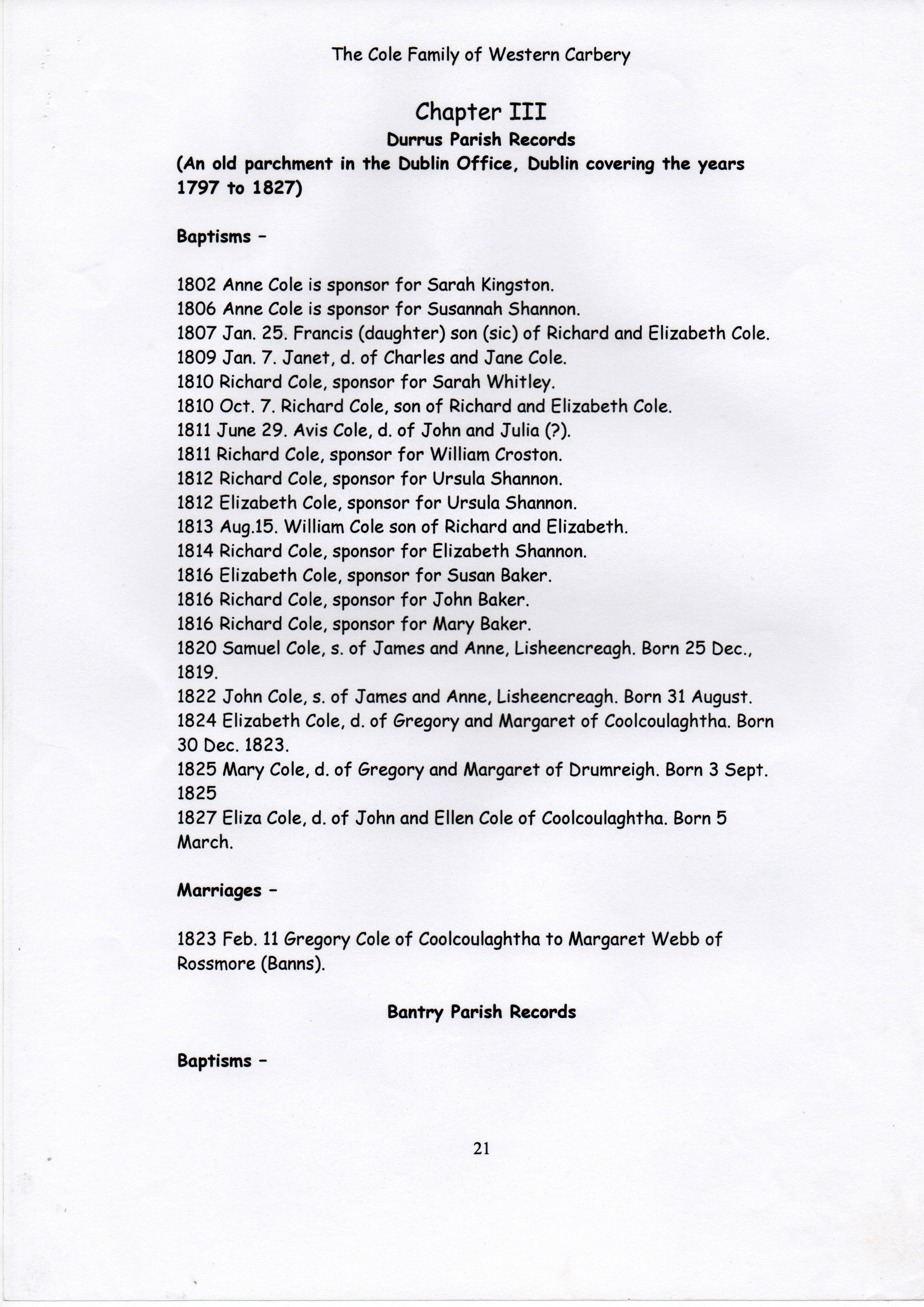
Extract from the Records of St. James, Durrus, West Cork, 1797 to 1827, from an Old Parchment in the Dublin Office, copied before their Destruction at the Public Records Office, Dublin, 1922, names mentioned Kingston, Shannon, Whitley, Croston, Baker, Webb, from Cole Family History.
Some of the names are associated with the weaving industry.
The Cole holding around 70 acres about 1 mile on the Durrus Dunbeacon Road the house occupied by the late Dr. Gallagher.
https://www.google.ie/maps/@51.619353,-9.5235822,18z
Family members included the author of a revised history of the Dioceses of Cork and Ross, who may also have written extensively about the history of Innishannon. Another became the head of the Methodist Church in Ireland in Belfast.


27 Friday Mar 2015
Posted in Uncategorized
Light Station on Fort in Townland of Rooska West, within Two Chains of the Seashore, Overlooking Bantry Bay, from 1841 Orthography by Ordnance Survey. Reference B 628 MFP 1/047
https://durrushistory.com/2015/02/28/pishogs-christian-taboos-old-cures-holy-wells-from-sherkin/
27 Friday Mar 2015
Posted in Uncategorized
The Resident Magistrate, a Unique Irish legal Office in the Common Law World, Robert Peel’s 1830s Enabling Legislation used in 1922 to Appoint District Justices by Irish Free State.

 West Cork History