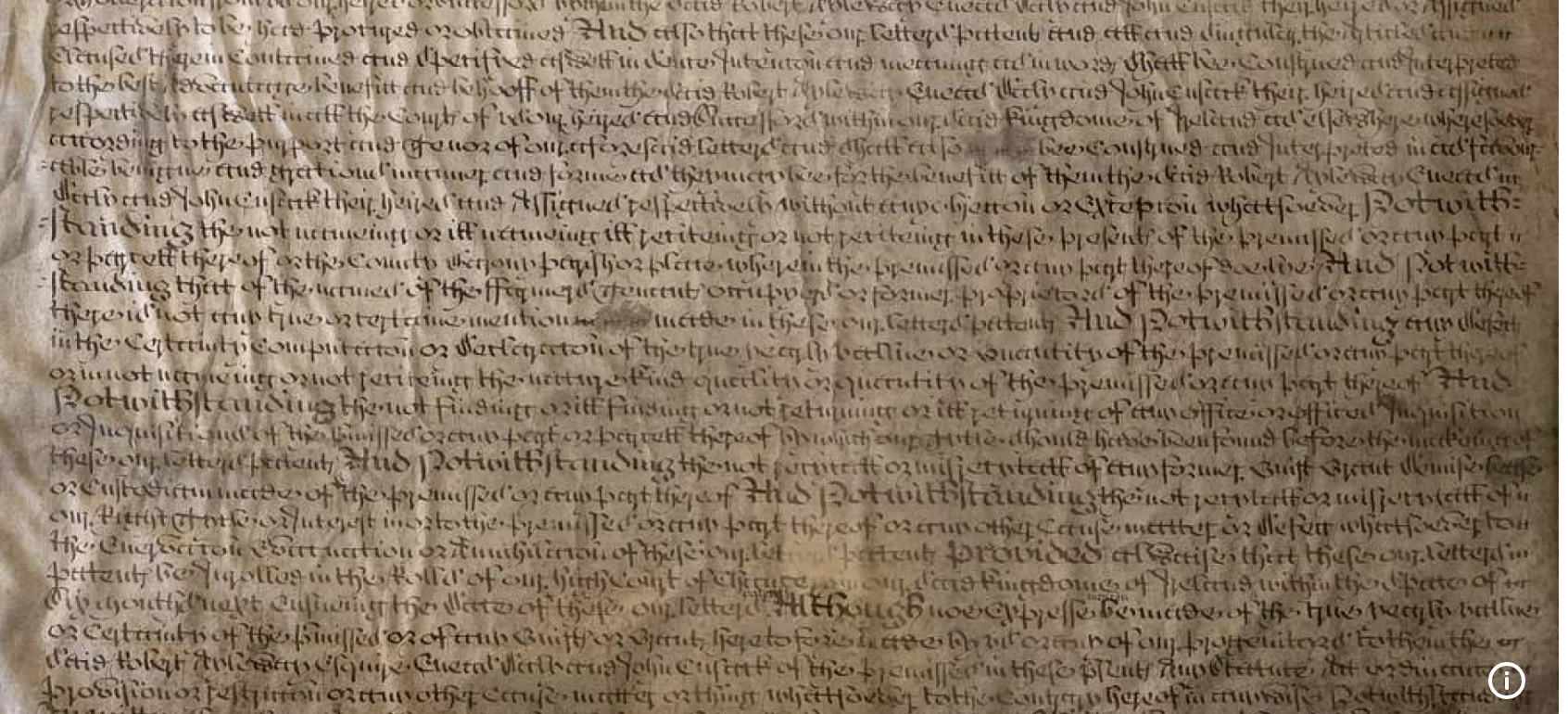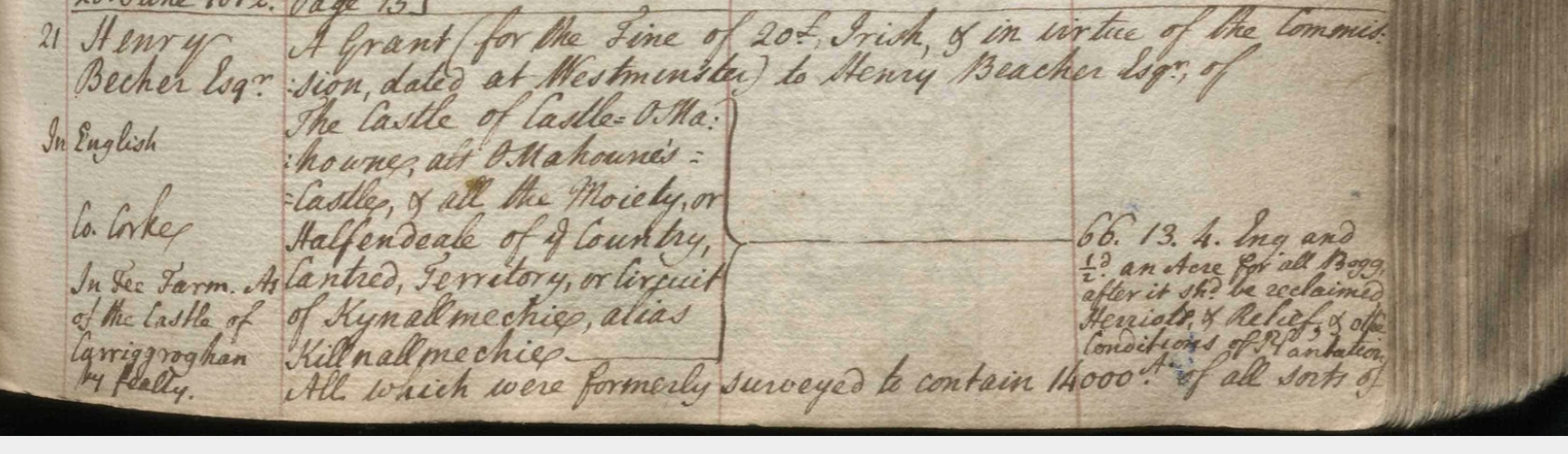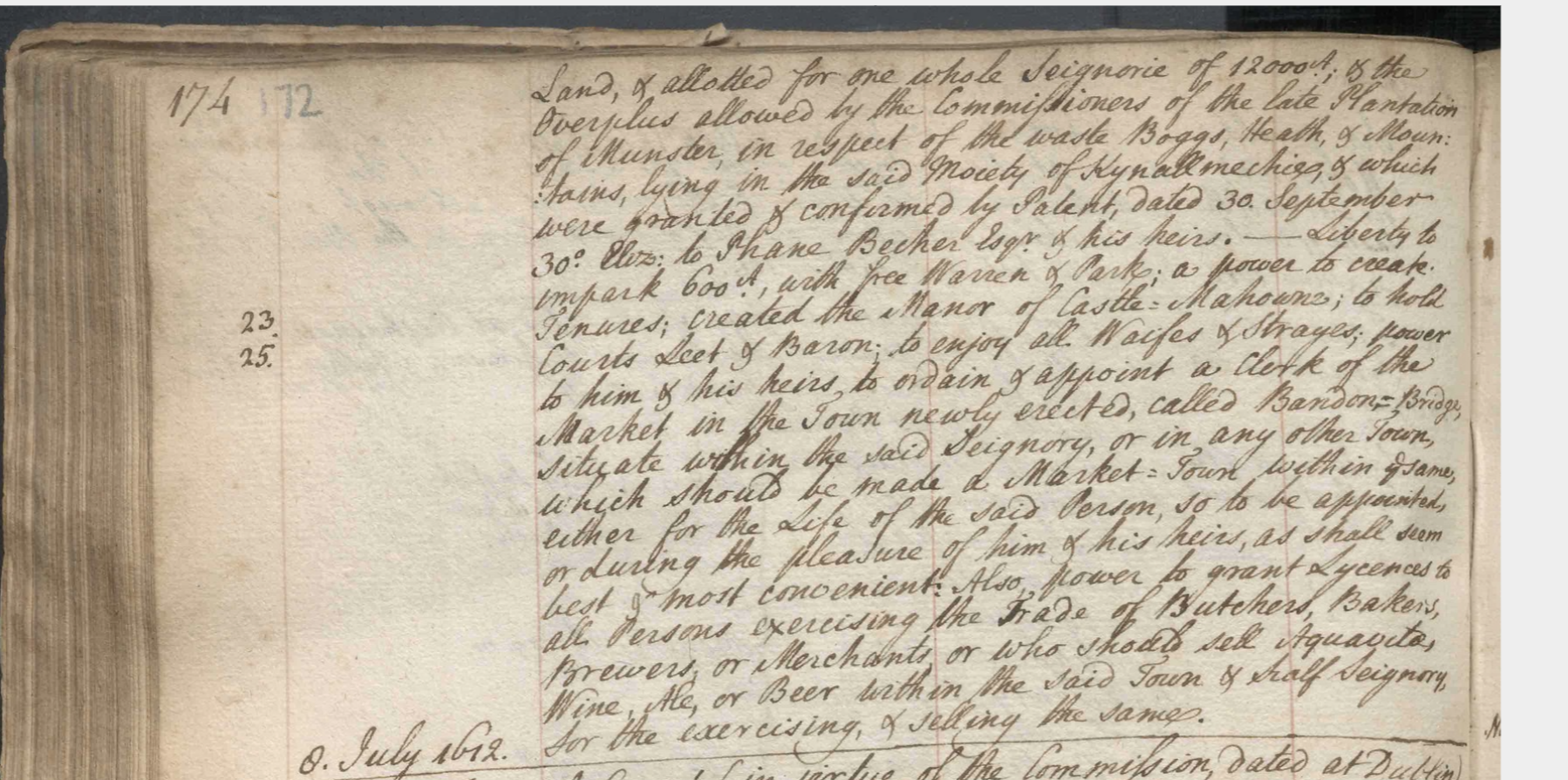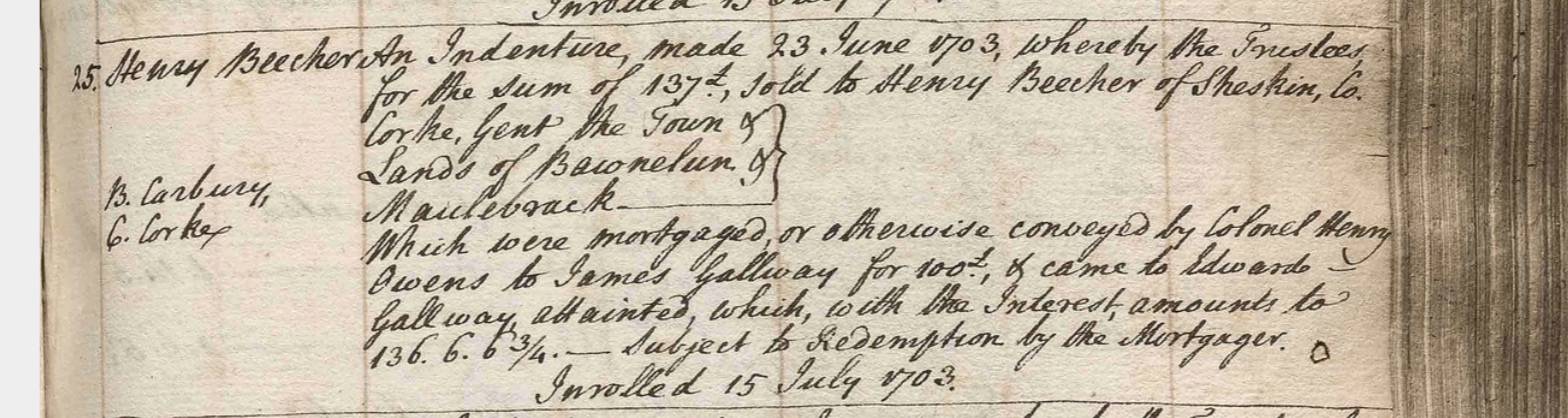
Henry Becher (1664-1738), TCD in 1683 aged 19, son of Thomas Sherkin Island, 1705, witness to 1717 deed with Emanuel Moore. Henry Becher was Thomas Becher’s eldest son. He married Henrietta Owen in 1698. His heir was John Becher. Henry died in 1738.
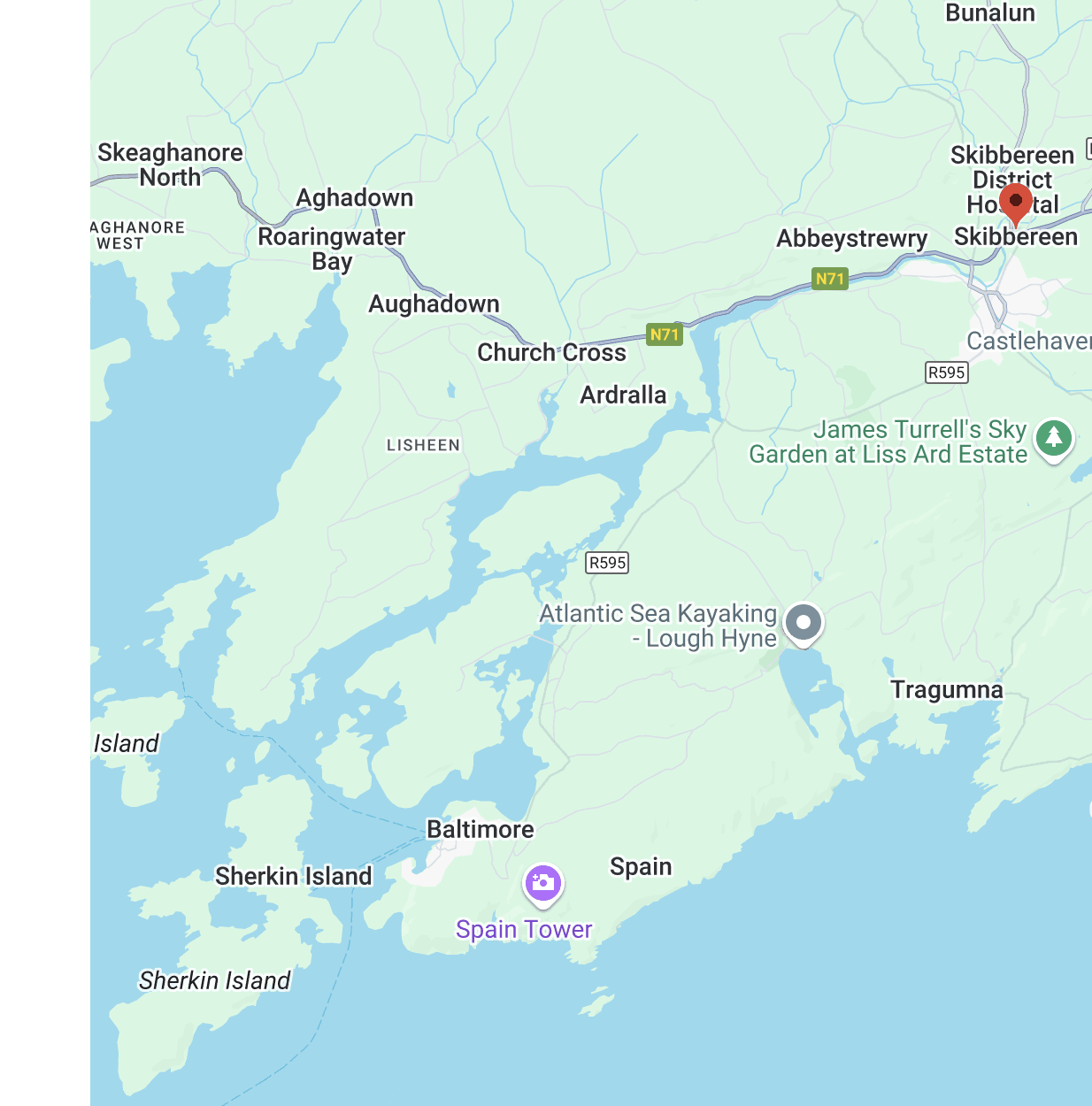
Henry Beecher, (1759-1780), 1779, Creagh/Creaford, Skibbereen. 1765 11 July Cork City Newspapers. “To be Let, part of the estate of Henry Becher(aged 5) during his minority. Lands of Gortadrohid, Ardnagreena on harbour of Baltimore etc. contact Michael Becher guardian. 1779 Hibernian Magazine Dec 1779 “Henry Becher of Creaghtford to be a J.P. of the Peace for the Co of Cork”. 1780 Hibernian Chronicle 25 Dec 1780 “Died Thursday last, Henry Becher at Creagh near Baltimore.” The guardian Michael Henry Becher [1735-1778 was his uncle & my 4 x Great Grandfather. He was married to Catherine French. Poor Henry is the one who died after a shooting accident on his 21st birthday.
John R. Beecher, Hollybrook, Skibbereen, listed 1856, sitting Skibbereen 1861. 1856 Ballydehob Presentment sessions. May have married Catherine Jermyn only child of Henry and Mary of Aughadown, 1805 he assigned property to Richard Hungerford and Becher Fleming to provide £225 pa should she survive him.
l.
John Townsend Beecher, 1760, Anne Grove, 1755 Faulkner’s Dublin Journal 22 Feb 1755 “17 Feb Married last Thursday John Townsend Becher Esq To Miss Donovan, d Rev. Morgan O’Donovan, Magistrate, Ballinacalla, with £5000. Died 1761, at her lodgings near South Gate, Mrs Beecher, relict of John Townsend Beecher of Ann Grove”. Possibly, 1771 Limerick Chronicle 10 Oct 1771, “Thursday last at Cork Colonel John Becher of Hollybrook to Miss Bab. Townsend of Skibbereen.”Michael Beecher, 1777, Creagh, Skibbereen, member Atlantic Society literary society. Subscriber of 1766 ‘The History of the Irish Rebellion’, Cork, 1766. 1778 Dublin Hibernian Journal Aug 24 1778, “Died-Near Bandon Michael Beecher of Creagh Esq.” 1789 Cork Evening Post 12 Jan 1789, ‘Last Sat George Pigott Rogers Esq. to Mary Twogood Becher, dau of the Late Michael Becher of Creagh, Esq’. Michael Alleyne Richard Beecher (1839-, 1875, Ballyduvane, Clonakilty, Resident, £130, 1870, 2,101 acres, listed 1916. Landed proprietor, widower 1901. 1884, signed a protest against the dismissal of Lord Rossmore, Head of Orange Order, Monaghan. Sampson T.
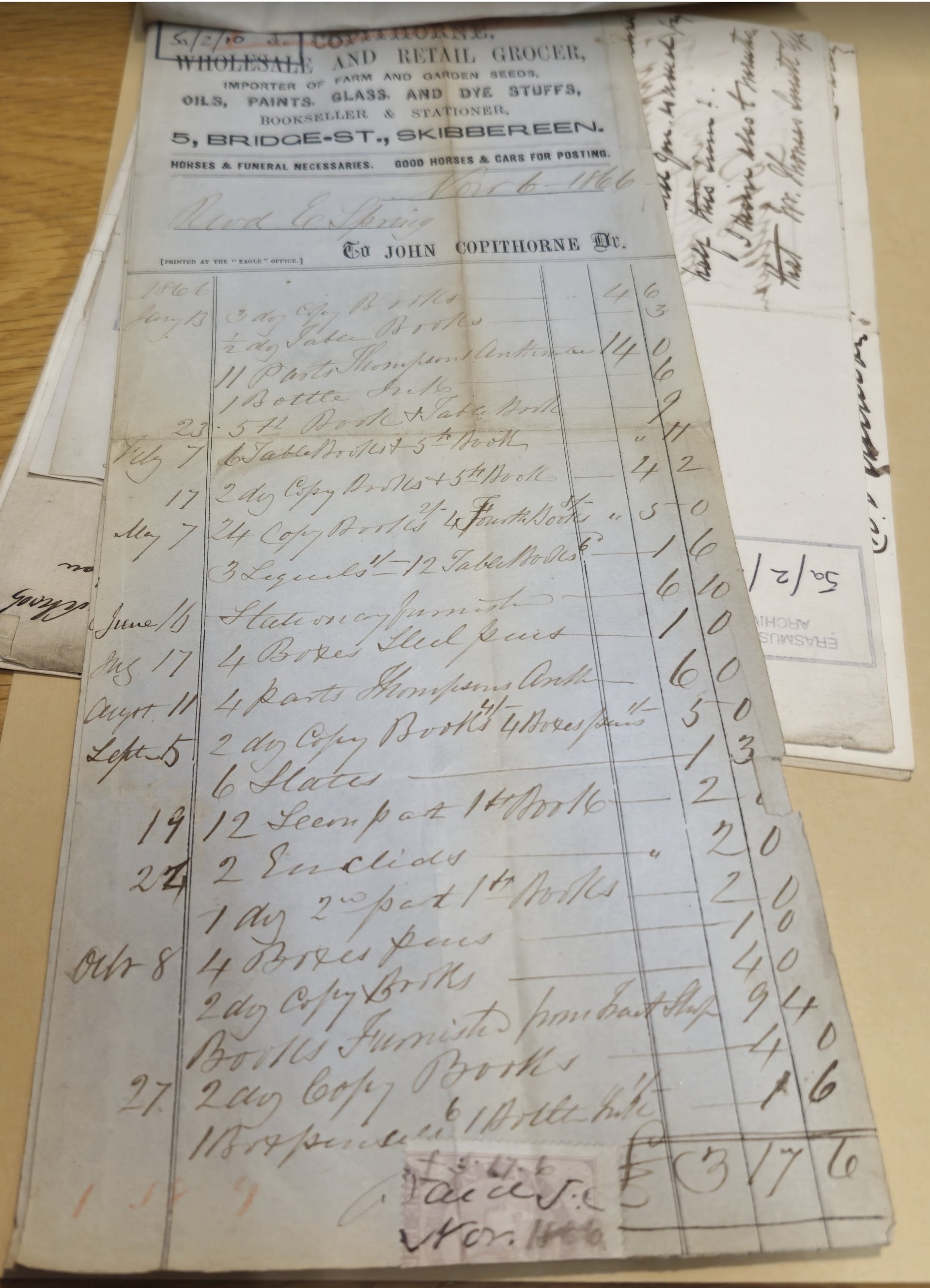
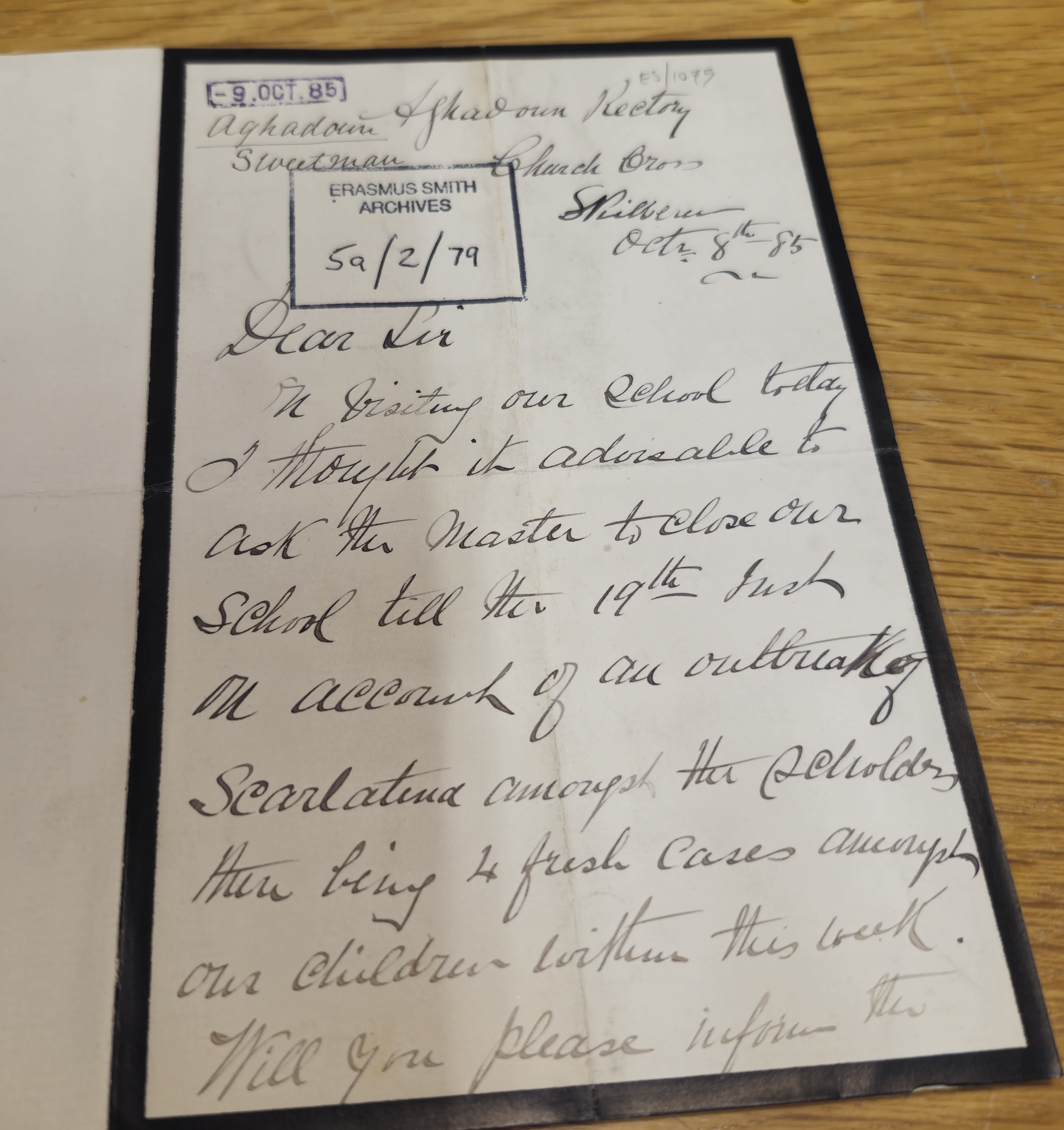
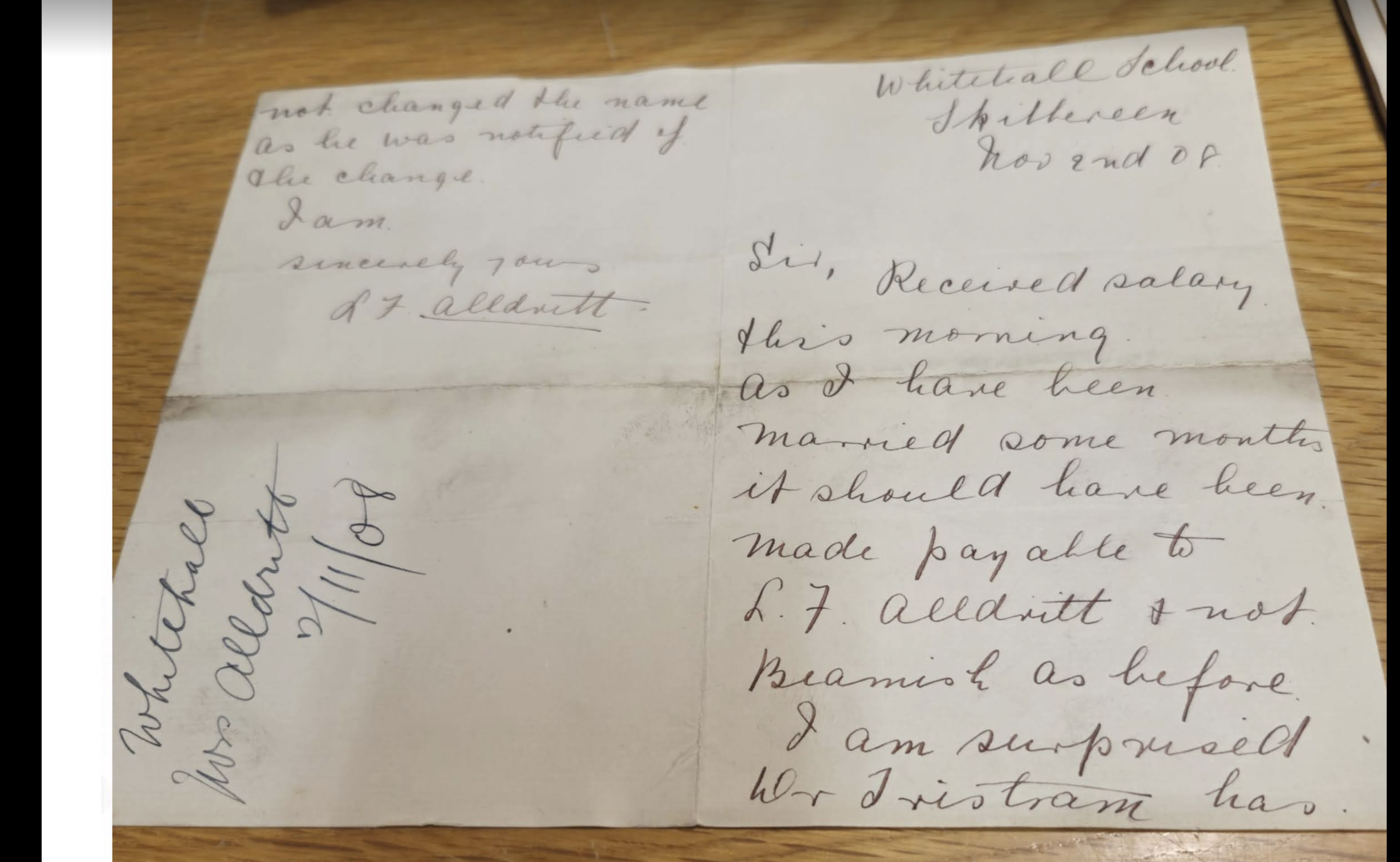
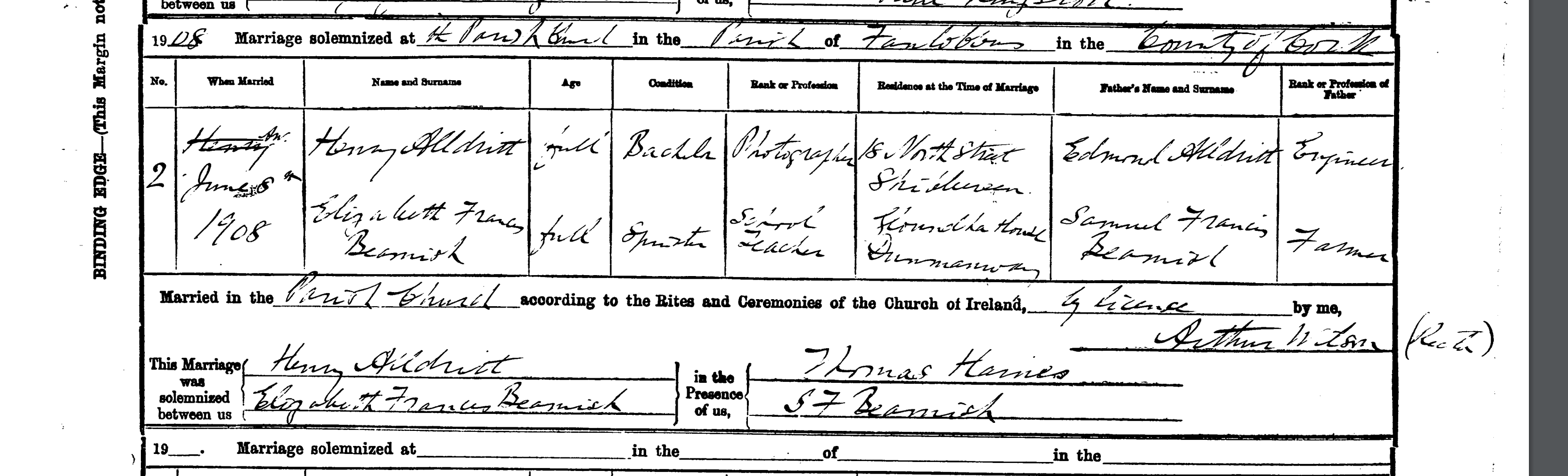
Aughadown (Erasmus Smith) School. 1866 Invoice From John Copithorme, Skibbereen for School Supplies. School Closure 1885 for Outbreak of Scarlatina. 1909 Letter from Mrs. Alldritt teacher (Nee Elizabeth Frances Beamish, Dunmanway) seeking payment of her Salary to her Husband.
.
..
English School Summary School Name Aghadown, Whitehall County Cork
Property Documents Correspondence 1866-1887, 1888-1919 Architectural Plans 1812 Date of Sanction 1828
Notes Patron Rev. H. H. Beecher Grant £ Salary Discontinued 1919 Other Place Names
School Name Baltimore County Cork
Property Documents Correspondence 1882-1918 Architectural Plans Date of Sanction 1883
Notes Patron Rev. J. Jones Grant £ Salary Discontinued 1916 Other Place Names
School Name Bandon County Cork
Property Documents Correspondence 1867-1882 Architectural Plans Date of Sanction 1821
Notes Patron Grant £ Salary Discontinued 1882 Other Place Names
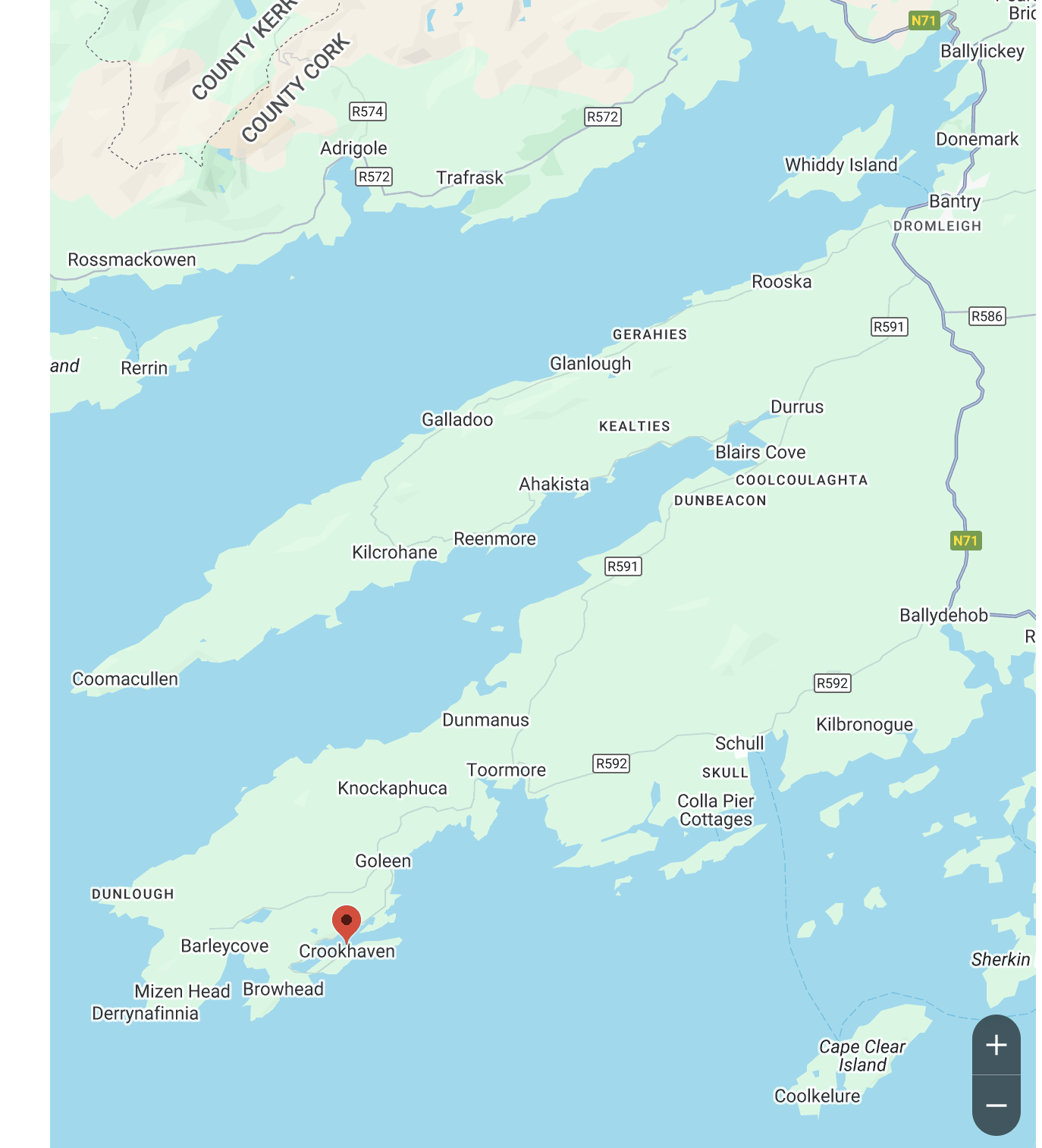
Warrant, by the Duke of Ormond, for the payment, to the Earl of Barrymore, of the sum of twelve pounds sterling, for the building of boats for the Garrison of Crookhaven, &c, Dublin Castle: 9 December 1662
Creator
Edward Edwards (1812-1886)
Level Of Description
Item
Extent And Medium
Copy
Archival History
The Carte Collection (MSS. Carte 1-279) of historical papers was received chiefly by the Bodleian Library, Oxford in 1753-1778. This Calendar (MSS. Carte Calendar 1-75) gives an abstract of every paper in the Carte Collection in chronological order. It was formed by Edward Edwards, a librarian and writer, in 1877-1883 at the expense of the Bodleian Library. In September 2004, the Bodleian Library keyed in 32 of the original 75 volumes of Carte Calendars (Vols. 30-61). This data was shared with, and platformed by, the VRTI in 2024.
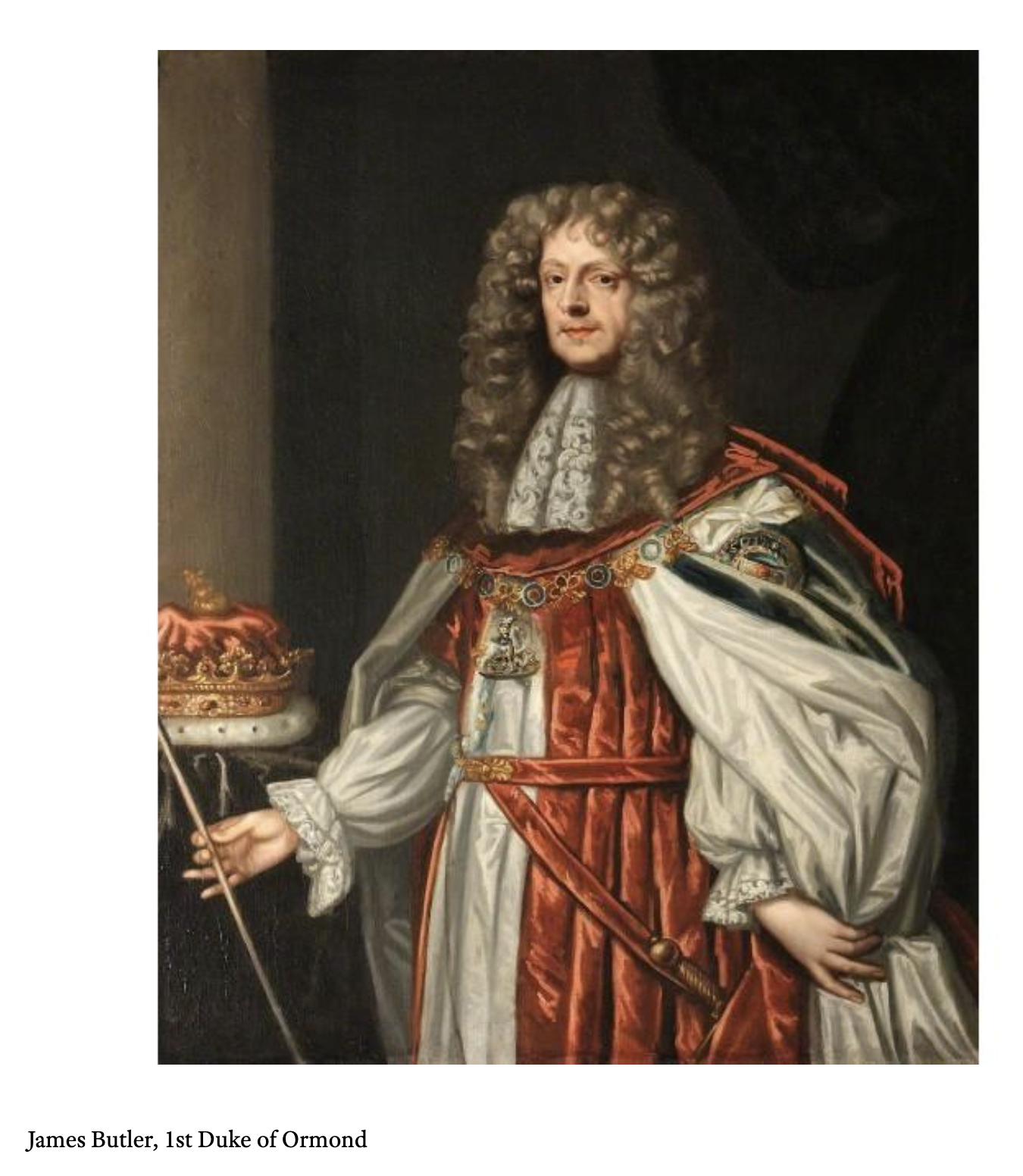
Butler, James (1610–88), 12th earl and 1st duke of Ormond, was born 19 October 1610 at Clerkenwell, Middlesex, England, eldest son of Thomas Butler, Viscount Thurles , and his wife Elizabeth, daughter of Sir John Poyntz, of Iron Acton, Gloucestershire. Thurles was son and heir to Walter Butler (qv), 11th earl, who succeeded to the title in 1614 on the death of his uncle, Thomas (qv), 10th earl, whose one surviving child was a daughter, Elizabeth (qv). The viscount took his family to Ireland, but when returning from a visit to England was shipwrecked and drowned on 15 December 1619, leaving the 9-year-old James as the direct heir to the title. His widow Elizabeth married (a.15 June 1626) George Mathew of Thurles, Co. Tipperary, by whom she had a second family. Youth and marriage The details of James Butler’s youth are mainly derived from Sir Robert Southwell (qv), who presented a brief and laudatory life of the duke to his grandson and successor two months after the first duke’s death. According to Southwell, on his father’s death, Butler’s mother placed him in a school in Finchley to be raised in the Roman catholic faith, to which both parents were committed. However, through the manipulation of the law, James I claimed the young heir as a royal ward and in 1622 put him in the care of George Abbot, archbishop of Canterbury, under whose tutelage he received a protestant upbringing. The religious part of his education made a deep impression on the boy, but in other respects Abbot made little effort to educate his charge, and it was only the intervention of the grandfather that ensured some facility in writing, French, and Irish. His Latin was almost entirely neglected.
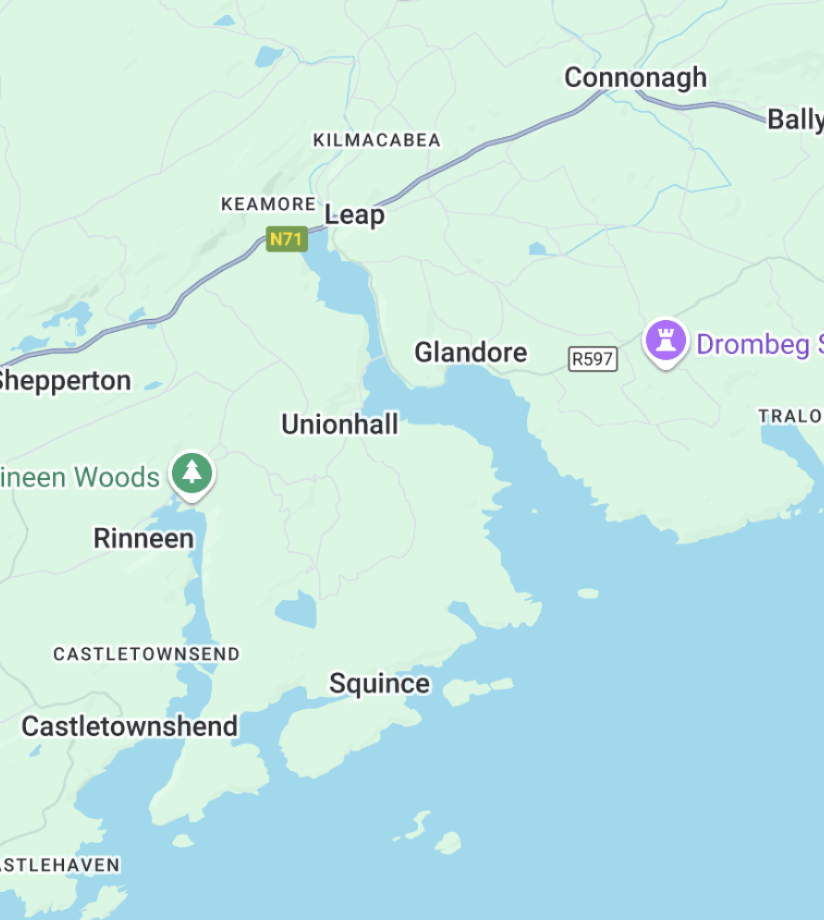
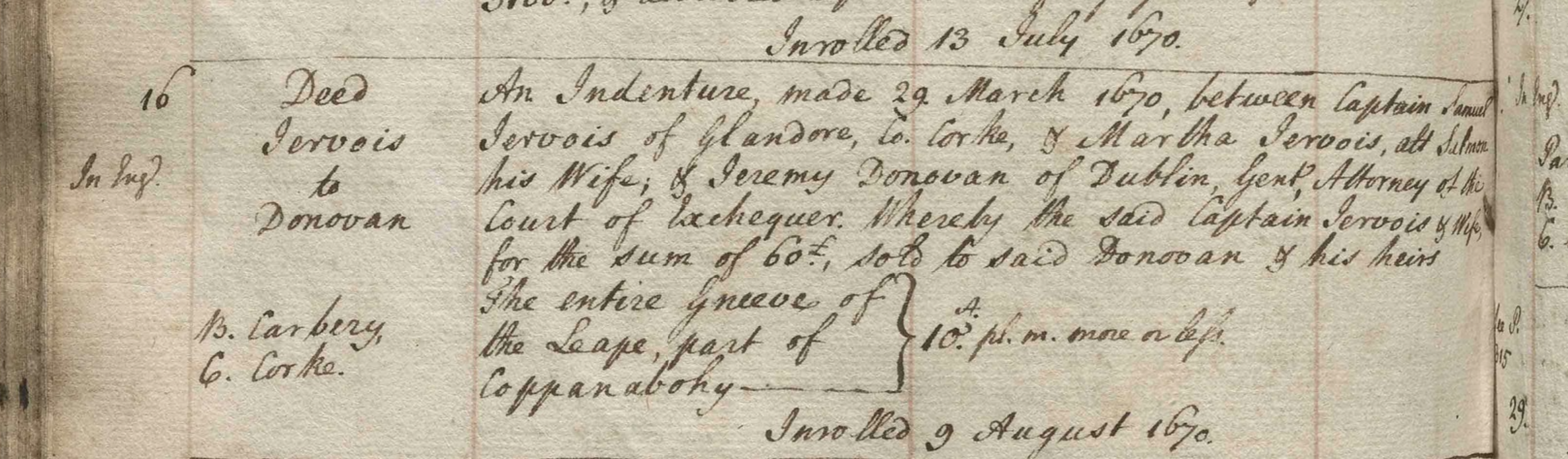
1670 Indenture Captain Samuel Jervois and His Wife sell for £60 the entire Gneeve (Old land measurement a twelfth part of a townland which can vary in size.: https://www.dippam.ac.uk/eppi/documents/11941/page/282490 ) of Leap parrt of Cappanabohy
670 Indenture Captain Samuel Jervois and His Wife sell for £60 the entire Gneeve (Old land measurement a twelfth part of a townland which can vary in size.: https://www.dippam.ac.uk/eppi/documents/11941/page/282490 ) of Leap parrt of Cappanabohy
.
1670 Indenture Captain Samuel Jervois and His Wife sell for £60 the entire Gneeve (Old land measurement a twelfth part of a townland which can vary in size.: https://www.dippam.ac.uk/eppi/documents/11941/page/282490 ) of Leap parrt of Cappanabohy
Samuel Jervois, 1654. Close family connection with Barnstaple Devon. Received land debentures for being a Cromwelian Officer bought other lands. Built Brade House, Leap. Appointed a Commissioner for Transportation 1655 reappointed 1656 to identify those locally suitable for transportation. There are papers extant for the period whereby the church clerk of Castlehaven was to identify local Catholics in particular sons and heirs suitable for transportation. Married Martha Salmon, daughter of Captain Joseph Salmon, Glandore castle. Freeman and Burgess of Clonakilty, Sovereign 1679. Fled to Chester 1688 he reported his income then at £120 per annum. He returned to Brade, 1693, died 1693.
Obtaining letters patent from Charles II, his extensive landholdings were erected into the manor of O’Donovan’s Leap, or the Manor of the Leap, in 1684.
He was also appointed Registrar of the Admiralty in Ireland by James II.
O’Donovan was the son of Daniel Mac Murtogh O’Donovan, Lord of Clan Loughlin. A Protestant, he married in 1686 Elizabeth Tallant, daughter of Oliver Tallant, and they had three children; Jeremiah, John, and Anne.
O’Donovan Lands:
1616. Surrender and Regrant. Patent of James 1 of England.
Court of Pie Powder Reserved to Donnell O’Donovan for Fairs, Ascension Thursday and Townlands Listed from Castledonovan to Castlehaven, Caheragh, Glandore, Squince, Brahalish in Durrus. Manor of Castledonovan Power to Hold Court of Leet and Baron, Friday Market at Rahine, Tuesday market at Drimoleague.
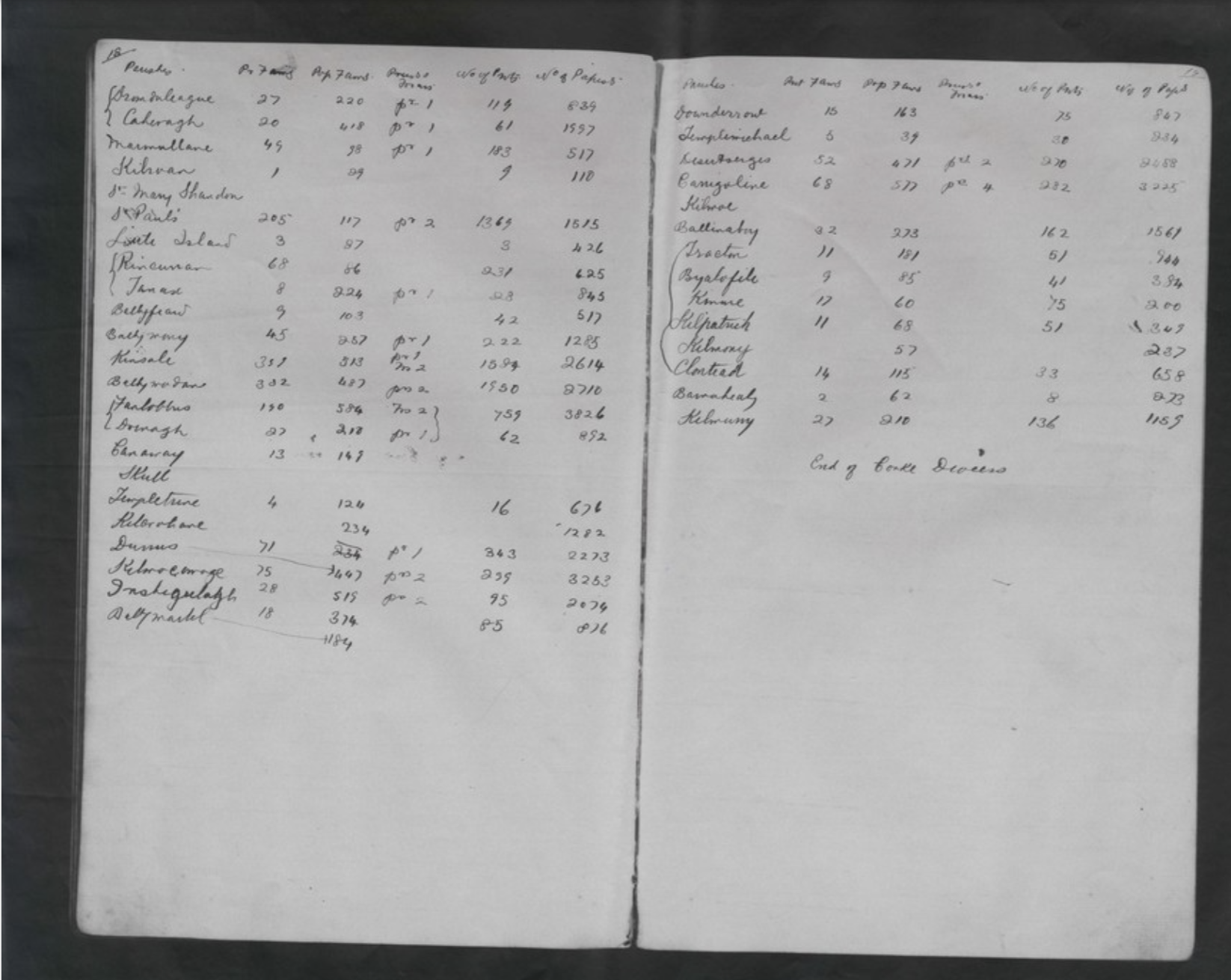
The 1766 religious census return for the Union of Kilmocomoge
The original return provided a list of householders’ names, as was required by the resolution of the House of Lords (see comment below about list of householders in Bantry), but only household and population numbers have survived.* The parishes in the union were Kilcrohane, Durrus and Kilmocomoge.
The numbers reported by Barry were:
Kilcrohane and Durrus, 71 Protestant households, and 343 Protestant individuals; 681 Catholic households, and 3,555 Catholic individuals.
Kilcrohane, 234 Catholic households, and 1,282 Catholic individuals. Protestant numbers only available with Durrus.
Durrus, 447 Catholic households, and 2,273 Catholic individuals. One resident priest. Protestant numbers only available with Kilcrohane.
Kilmocomoge, 75 Protestant and 519 Catholic households, containing 299 Protestants and 3,253 Catholics. Two priests.
William Carrigan provides the following additional information, which, importantly, confirms that the census provided the names of householders (in bold italics, our emphasis):**
Kilmocomoge: ‘Standish Barry, priest; Denis Doly, coadjutor: and in the list of the householders in “Bantry town & suburbs” we find the name of “Standish Barry, Popish priest for this parish”’.
Durrus: ‘Timothy Crowly, living in Upper Coomkeen is “Popish priest for the parish of Durrus”’.
Kilcrohane: ‘No priest given’.
Census abstracts for the dioceses of Cork and Ross can be found in NAI PRIV/M/4921, pp 16-22. For clerical succession lists for Cork and Ross see W. Maziere Brady, Clerical and parochial records of Cork, Cloyne and Ross (3 vols, Dublin, 1863-4).
* Parliamentary Records Index, vol. ix, p. 1,952 (National Archives of Ireland RC 14/9); Brady, Cork, Cloyne and Ross, i, p. 95.
1764-1840Fr. Coombes a noted Cork historian wrote the following in respect of Robert Swanton.
The Swanton Memorial
An Historical Memorial in Skibbereen
by James Coombes
From the Swanton Family History Worldwide by Louise May Swanton
Two forgotten Ballydehob patriots are linked in a memorial in the old Protestant cemetery in Skibbereen. On the obelisk which surmounts the memorial there is a draped urn with the single word ROBERT inscribed on it. One of the four panels had the following inscription:
Sacred to the Memory of
ROBERT SWANTON
Counsellor at Law
One of the Judges of the Marine
Court of the City of New York
Who departed this life
in Ballidahab
On the 15th of February 1840
aged 76
He was a humble Christian and faithful
Friend and Benefactor
Be ye kind to one another, tenderhearted,
Forgiving one another even as God
for Christ’s sake hath forgiven you.
Epb. iv.3
Do ghradhaigh se na Gaedhil agus an Ghaeilge
Another panel commemorates three children of Thomas Swanton, Maria (d. 21 July 1852, aged 11 years 5 months); Ellen (d. 1 April 1856, aged 17 years 9 months); Annie (. 21 Nov. 1857, aged 17 years 9 months). It also contains the inscriptions: “Omnibus inservientes sed servi unius Domini” and “Blessed are the dead who die in the Lord.”
A third panel commemorates Sarah wife of Nathaniel Evanson, IV July 1830 aged 33. Sarah was almost certainly a sister of Thomas Swanton, who was a nephew of Robert Swanton.
Robert Swanton was born about the year 1764. Richard Deasy of Clonakilty wrote of him in 1845 that he had been a ‘most active agent of the United Irishmen’ and that he had ‘organised the country into a military preparation with sergeants and officers’.
Shortly before the rising of 1798 Lord Edward Fitzgerald, the Sheares brothers and other leaders were arrested. Swanton fled to America. According to one account, he had also been arrested and had escaped from jail. The late Thomas Roycroft of Skibbereen kept alive the tradition that he had been hidden in a butter barrel, smuggled out to sea in a rowing boat, and that he had boarded a ship six miles from the coast.
He soon made his mark in his adopted country, and in the 1820’s, was a leading figure in the ‘Friends of Ireland in New York’. He was the author of ‘A Manifesto to the People of Ireland’ issued by the ‘Friends’. Among his colleagues in this society were Dr. William Power and his brother Father John Power, vicar general of New York, and one of the most eminent priests in America. They were sons of Andrew and Elizabeth Power (1), who lived in the house now (1981) occupied by Mr. Joe Connolly of Deelish Skibbereen. They were nephews of Father John Power, the saintly pastor of Kilmacabea. Further research would probably unearth more details of Robert Swanton’s American career. For the moment, we must be satisfied with the obituary published by the New York Evening Post on 4 April 1840.
“It is with heartfelt regret that we announce the death of Robert Swanton, for many years judge of the Marine Court of this city. He died on the 15th of February last in the County of Cork, Ireland, which place he revisited about four years ago after an absence of more than 36 years. The loss of this inestimable man cannot fail to be severely felt by the poor and oppressed to whom he was an undeviating protector and friend.
Possessed of considerable wealth but disdaining the vanities and luxuries for which wealth is so eagerly sought, he freely contributed to the relief of the indigenous and to promoting the interest of numerous relatives and friends. He was no less alive to the political and moral welfare of his fellow creatures. He was an unswerving and ardent advocate of the rights of man.
In the great effort undertaken at the end of the last century by a magnanimous and self-devoted band of patriots to rescue their native land from the grasp of the oppressor, he nearly sacrificed his life, was driven from his home, to become a friendless and destitute exile. But in the cherished land of his adoption, his sound sense, his intelligence, his integrity and his devotion to popular rights were soon appreciated and earned the esteem and love of a numerous circle of friends.
Neither prosperity nor advancing age dampened the ardor of his philanthropy. We have no doubt that after he had passed the alloted span of man’s existence here, he was willing to sacrifice all for the social regeneration of man as when, 44 years ago, he placed his name on the roll of the “United Irishmen”.
The Truth Teller (2) said of him “To the above just tribute to the memory of a good man – ‘the noblest work of God’ – we add that the following extract of a letter from him, for examination of which we are indebted to one of his distinguished friends, dated Cork 30th November last, showing that in his 80th year he was still the same unchanged, unchangeable and uncompromising Democrat which marked his previous course.
The octogenarian asked an old friend in New York “What are the prospects of my esteemed fellow citizen, Martin Van Buren? Electioneering rumor is busy even here. Well have you tacked British to the self-styled Whigs of the present day”. In allusion to the name the opposition have taken he continues, “You and I have often been amused with names, but never gulled by them. I know that American Democracy will — the people will — be true to themselves and Martin Van Buren will be our next President. I hope to be with you in time to give my feeble support to the good old cause”. The prophetic voice of Robert Swanton is now a voice from the grave: “appreciate, believe, act.”
To the admiral of Ire. or his deputy, and to all and singular masters and mariners of ships and barges, and also to the keepers of ports and passages and other marine places, and to all and singular mayors, seneschals, sheriffs, sovereigns, provosts, bailiffs, serjeants, sub-serjeants throughout the K.’s land of Ire.
The K. has considered how the K.’s city of Cork is situated on the frontier of the K.’s Irish enemies and is surrounded on all sides by those enemies, and how the K.’s faithful lieges of the parts neighbouring the city are destroyed and devasted by hostile attacks and daily invasions of those enemies, so that the citizens and commons and the K.’s said lieges cannot reside there upon the defence of that city these days without a great supply of produce [absque magna frugum copia] for their sustenance. The K. has also considered the good place that the K.’s city holds in aid and comfort of his faithful lieges and in resistance of the malice of his Irish enemies.
By advice of the Jcr and council in Ire. and of the K.’s special grace, the K. has granted and given licence to the citizens and commons to buy and load all kinds of grain by themselves or their servants and deputies in ships, barges and boats in any ports in the land of Ire. for their sustenance, as is necessary and fit from time to time; and to transport the grain thus loaded to the same city for that reason, both by land and by sea, and to carry it freely and without any impediment whatsoever, notwithstanding any statutes, proclamations or inhibitions to the contrary made before this time. ORDER not to trouble or oppress them in any way contrary to this the K.’s grant.
Attested:
[John Stanley] Jcr
T:
CPI, p. 87.
C:
RCH.
The following abbreviations are used within in the text of CIRCLE
abp = archbishop [of]
BMV = beate Marie Virginis [of the Blessed Virgin Mary]
C. = chancellor [plural: chancellors]
co. = county (i.e. medieval shire: lower case ‘c’) [plural. cos.]
dcd = deceased
e. = earl of
Edw. = Edward (used when giving dates by regnal year)
Eng. = England
esq. = esquire [plural: esquires]
Ex. = exchequer
g.s. = great seal
Hen. = Henry
Ire. = Ireland
Jcr = justiciar [plural: justiciars]
JP = justice of the peace
K. = king
kt = knight
Lt = lieutenant
O.Carm. = Order of Carmelites
O.F.M. = Order of Friars Minor (Franciscans)
O.P. = Order of Preachers (Dominicans)
Ric. = Richard (used when giving dates by regnal year)
s. = son
sen. = seneschal of
T. = treasurer [plural: treasurers]
w. = wife
This glossary is by no means comprehensive. Readers may also wish to consult standard references books such as Joseph Byrne, Byrne’s dictionary of local Irish History from the earliest times to c.1900 (Cork, 2004); P. G. Osborn, Osborn’s concise law dictionary, ed. Sheila Bone (London, 2001).
Abbreviations
AN = Anglo-Norman
Ir. = Irish
Lat. = Latin
ME = Middle English
OED = Oxford English Dictionary
Term
Explanation
advowson
The right of patronage or presentation to a church benefice.
allocate, writ of
A writ authorizing allowance to be made by the officers of the Ex. of a specified amount: often this amount is to be off-set against the debts owed to the K. by the beneficiary.
alterage
A form of affinity proscribed in late medieval Ireland between the Irish and the English, whereby a man stood sponsor for a child at baptism; (also) gossipred.
assize
Technical term for legal proceedings or various kinds. See mort d’ancestor, novel disseisin.
avener [Lat. avarius]
provider of oats, esp. for the household of the K. or his chief governor
avoirdupois
Miscellaneous merchandise sold by weight.
bonnaght [Ir. buannacht]
The billeting of mercenaries or servants.
cask
See tun.
certiorari, writ of
Letters close issued by the K. to his officers commanding them to supply information to him concerning a specified matter, normally by searching the records.
chattels
Property, goods, money: as opposed to real property (land).
dicker [Lat. dacra]
A measure of 10 hides.
dower
Portion (one third) of a deceased husband’s estate which the law allows to his widow for her life.
escheat
The reversion of land to the lord of the fee to the crown on failure of heirs of the owner or on his outlawry.
extent
A survey and valuation of property, esp. one made by royal inquisition.
falding [Ir. fallaing]
A kind of coarse woollen cloth produced in Ireland; the mantle or cloak made from the same.
fee-farm
A fixed annual rent payable to the K. by chartered boroughs.
fotmel [Lat. fotmellum]
A measure of lead.
engrossment
Technical term: the action of writing out, for instance patent letters and charters; (also) the documents thus written out.
enrolment
Technical term: the action of recording in the records of the K., esp. the registering of a deed, memorandum, recognizance; (also) the specific item or record thus enrolled.
hanaper
A repository for the keeping of money. The ‘clerk of the hanaper in chancery’ was the chancery official responsible for the receipt of fines for the issue, engrossment and ensealing of writs, patents and charters issued by the chancery.
herberger [Lat. herbergerius, hospitator]
One sent on before to purvey lodgings for an army, a royal train (OED).
galangal [AN galyngale]
The aromatic rhizome of certain Asian plants of the genera Alpinia and Kaempferia, of the ginger family, used in cookery and herbal medicine; (also) any of these plants (OED).
generosus [Lat.]
Term designating social status: translated as ‘gentleman’.
king’s widow [Lat. vidua regis]
The widow of a tenant in chief: so called because whe was not allowed to marry a second time without royal licence.
knights’ fees
Units of assessment of estates in land. Originally a single knight’s fee was the amount of land for which the military service of one knight (=knight service) was required by the crown. ‘Fee’ derives from the Latin feudum, which in other contexts translated as ‘fief’. In practice the descent of landed estates meant that many knights’ fees came to be subdivided and, in the later Middle Ages, personal service was frequently commuted to money payments (=scutage).
liberate, writ of
A chancery writ issued to the treasurer and chamberlains of the Ex. authorizing them to make payment of a specified amount, often the annual fees, wages and rewards of the K.’s officers.
linch [Lat. lincia]
A measure of tin.
livery
The delivery of seisin, or possession, of an estate hitherto held in the K.’s hand, for instance when a minor reaches the age of majority.
mainprize
Legal term: the action of undertaking to stand surety (=‘mainpernor’) for another person; the action of making oneself legally responsible for the fulfilment of a contract or undertaking by another person (OED).
mass [Lat. messa]
A standard measure of metal.
messuage
A portion of land occupied, or intended to be occupied, as the site for a dwelling house; (also) a dwelling house together with outbuildings and the adjacent land assigned to its use (OED).
mort d’ancestor, assize of [Lat. assisa mortis antecessoris]
A legal process to recover land of which the plaintiff’s ancestor (father, mother, uncle, aunt, brother sister, nephew or niece) died seised (=in possession), possession of which was since taken by another person.
nolumus, clause of [Lat. cum clausula nolumus]
A standard clause inserted especially in letters of protection by which pleas and suits are delayed for a specified period of time.
novel disseisin, assize of [Lat.assisa nove disseisine]
A legal process to recover land from which the plaintiff claims to have been dispossessed (=disseised).
pensa
See wey.
piece [L. pecia]
A standard quantity of merchandise.
pendent seal
Seal hanging from engrossed letters patent attached to a tongue or tag of parchment.
perpresture
An illegal encroachment upon royal property.
plica
A fold along the foot of engrossed letters patent and charters to create a double thickness of parchment, used for attaching the ‘great seal pendent’ to the letters. An incision was made in the plica and through which a tag of parchment was attached. A wax impression of a seal was then affixed to the tag.
protection
An act of grace by the K., granted by chancery letters, by which the recipient is to be free from suits at law for a specified term; granted especially to persons crossing overseas or otherwise out of reach of the courts in the K.’s service.
quare impedit, writ of
An action brought to recover the advowson of a benefice, brought by the patron against the bishop or other person hindering the presentation.
scutage
The commutation of personal military service to the crown for a money payment. Normally called ‘royal service’ in Ireland.
seisin
Formal legal possession of land.
sendal [Lat. cendallum; ME cendal]
A thin rich silken material (OED).
stallage [Lat. stallagium, estallagium]
Payment for a market stall.
tun [Lat. dolium]
A large cask or barrel, esp. of wine.
valettus
A term designating social status: translated ‘yeoman’.
Vidua Regis [Lat.]
See King’s widow.
volumus, clause of [Lat. cum clausula volumus]
A standard clause inserted esp. in letters of protection by which pleas and suits are delayed for a specified period of time. In full the clause runs: volumus quod interim sit quietus de omnibus placitis et querelis (=we wish that meanwhile he be quit of all pleas and plaints).
waif
A piece of property which is found ownerless and which, if unclaimed within a fixed period after due notice given, falls to the lord.
waivery [AN weiverie]
The technical term for proceedings of outlawry in the case of women.
wey [Lat. pensa, peisa, pisa]
A standard of dry-goods weight.
worsted [ME wyrstede]
A woollen fabric or stuff made from well-twisted yarn spun of long-staple wool combed to lay the fibres parallel (OED).
writ [Lat. brevis]
Letters close containing commands by the K. to certain specified persons, esp. royal officers. Returnable writs, which were not normally enrolled in the chancery rolls, were to be returned by the officer to chancery with details of the actions taken by the officer in response to the contents. See also allocate, certiorari, liberate.
The Irish Reproductive Loan Fund was a micro credit scheme set up in 1824 to provide small loans to the ‘industrious poor’. Local associations and committees administered the scheme, most often from a small town in a rural area, and county committees oversaw their work. The records of the local associations and county committees are in the UK National Archives and cover the years 1824 to 1846 for county Cork. As well as the notes of security for the loans, there are loan ledgers, repayment books and defaulters’ books. The minimum information supplied is address and occupation, but much additional detail is often given in the local association records, including notes on health, family circumstances and emigration.
Verified by Constable Heffernan, Carrigbui, 1853. The handwriting is somewhat difficult to make out, there are comments like gone to England, America, in poor circumstances or middling circumstances.