Maps of Building Plots, Tenants Names, Leases, Rents Dunmanway, West Cork, 1858.


https://www.google.ie/maps/place/Dunmanway,+Co.+Cork/@51.7222571,-9.1118088,13z/data=!4m2!3m1!1s0x484501afd195aefd:0xa00c7a99731ffb0

Maps of Building plots, tenants names, leases, rents Dunmanway, West Cork, 1858.  The town was founded by Sir Richard Cox, who rose from  a relatively humble backgound to eminence inLaw.  He developed the linen industry introducing families from North Leitrim and Fermanagh. This is reflected in some of the names McGivern, Maguire, McMullan,  etc.  These are from the sale of the Estate by his descendants.

Gentleman’s Magazine 1749 on Sir Richard Cox and the development of the Linen Industry in Dunmanway, Co.Cork

The ‘Caoin’ lamentation akin to Hebrew Cina in Cork and Kerry from Crofton Croker including for Sir Richard Cox in 1733 mentioning his relations O’Donovans of Bawnlahan, Townsends of White Court Skibbreen, Dunmanway and O’Donoghue, Aughadown, West Cork.

Dunmanway, West Cork, Shuldham Pedrigree from Genealogical Office, Dublin, commencing with marriage of 1713 between Edmund Shuldham, Crown Solicitor to Mary McCarthy Spannigh.

https://plus.google.com/photos/100968344231272482288/albums/6123821142749797121

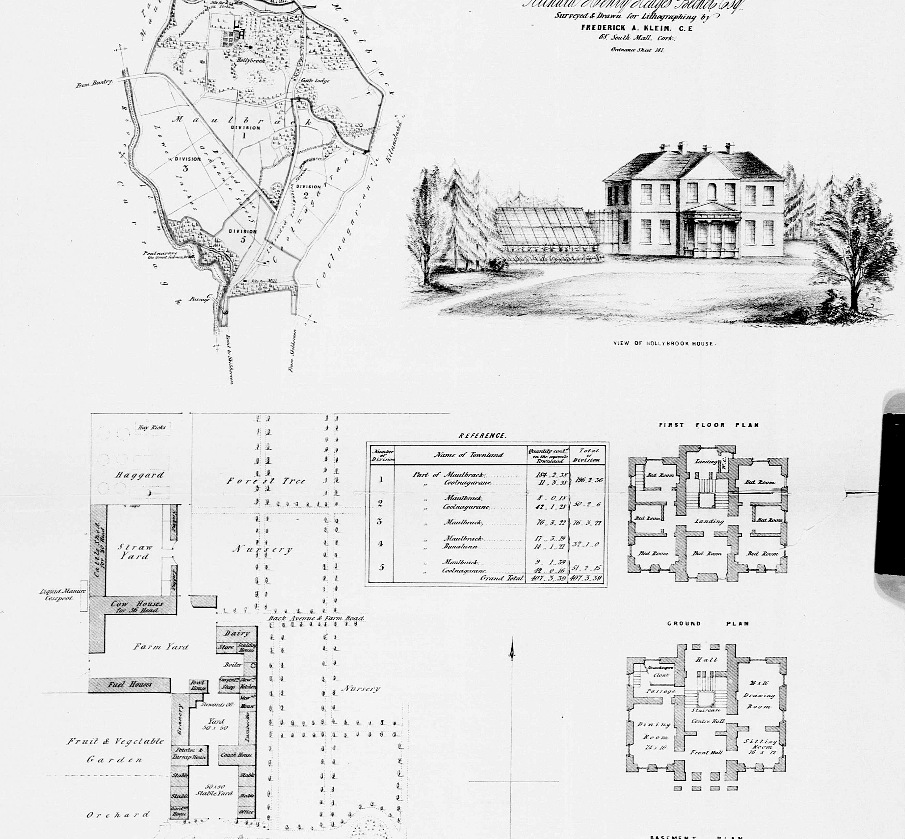
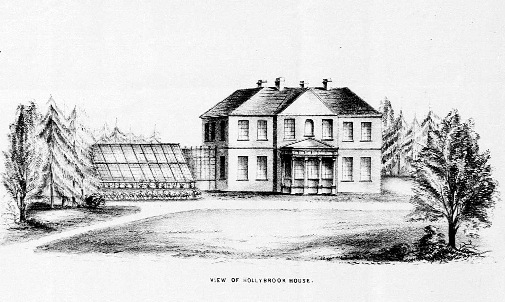
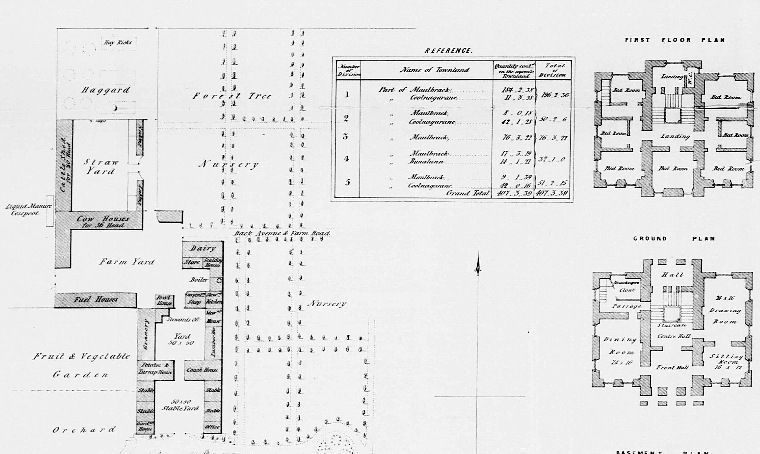
Hollybrook House, Skibbereen, Co. Cork, Greenhouse and Vinery 1852 Residence of Richard Henry Hedges Becher, Esq., with Plans.


https://www.google.com/maps/place/Hollybrook+Lodge,+Skibbereen,+Co.+Cork,+Ireland/@51.5745633,-9.2639296,21z/data=!4m2!3m1!1s0x4845a60b9206d56d:0x3fd52224cb100b7a

Hollybrook House, Skibbereen, Co. Cork, Greenhouse and Vinery 1852 Residence of Richard Henry Hedges Becher, Esq., with Plans.


Magistrate:

Richard Henry Hedges Beecher Esq., Pre 1838, listed 1838,  Hollybrook, Skibbereen,  sitting Skibbereen, 1835, Came into possession pre 1833 very neglected set about improving.  In re organising compensated tenants according to Ulster Custom.  Engaged in road building.  Abolished rundale system.  Subscriber Lewis Topographical Dictionary of Ireland 1837. Attending Protestant Conservative Society meeting 1832. Bandon Brunswick Constitutional Club 1828.  Anti-Repeal Meeting, Dunmanway 1845.  Skibbereen 1847 distress meeting. Presentment sessions Ballydehob 1845. Signed ‘No Popery Petition 1851’. 1866 Freemason Skibbereen 15th Lodge.  Long litigation with Lord Bandon added to financial woes over townland of Rathooragh near Mount Gabriel.  Imprisoned but later freed by his creditors 1848.  The Hollybrook estate was sold in the Encumbered Estates Court in 1851, 17,000 acres, 42 townlands, 8 parishes, debts in 52 charges amounting to £52,275. The sale realised £52,080.  It was estimated that the rent of £4,500 per annum represent only 25% of the value of market rents but two thirds  were given long leases on low rents  with a capital sum in the 1794 to families such as the Ballydehob Swantons.

http://landedestates.nuigalway.ie:8080/LandedEstates/jsp/estate-show.jsp?id=2436

2-hedge 4 3-hedge 5 1-hedge 3-001 1-hedge 3

Deodand due to Richard Boyle, 1st Earl of Cork February, 1619 and its appearance in 18ht century leases.


Deodand due to Richard Boyle, 1st Earl of Cork February, 1619 and its appearance in 18ht century leases.

In leases such as those on the Becher estate 18th century it was common for Landlords to reserve to themselves deodands,  suggesting that for example death of serious injury from horses was common.

Courtesy Melosina Lenox-Conyngham’s ‘Diaries of Ireland’ 1590-1987.


http://en.wikipedia.org/wiki/Deodand

1-Scan 1504

1-Scan 1509

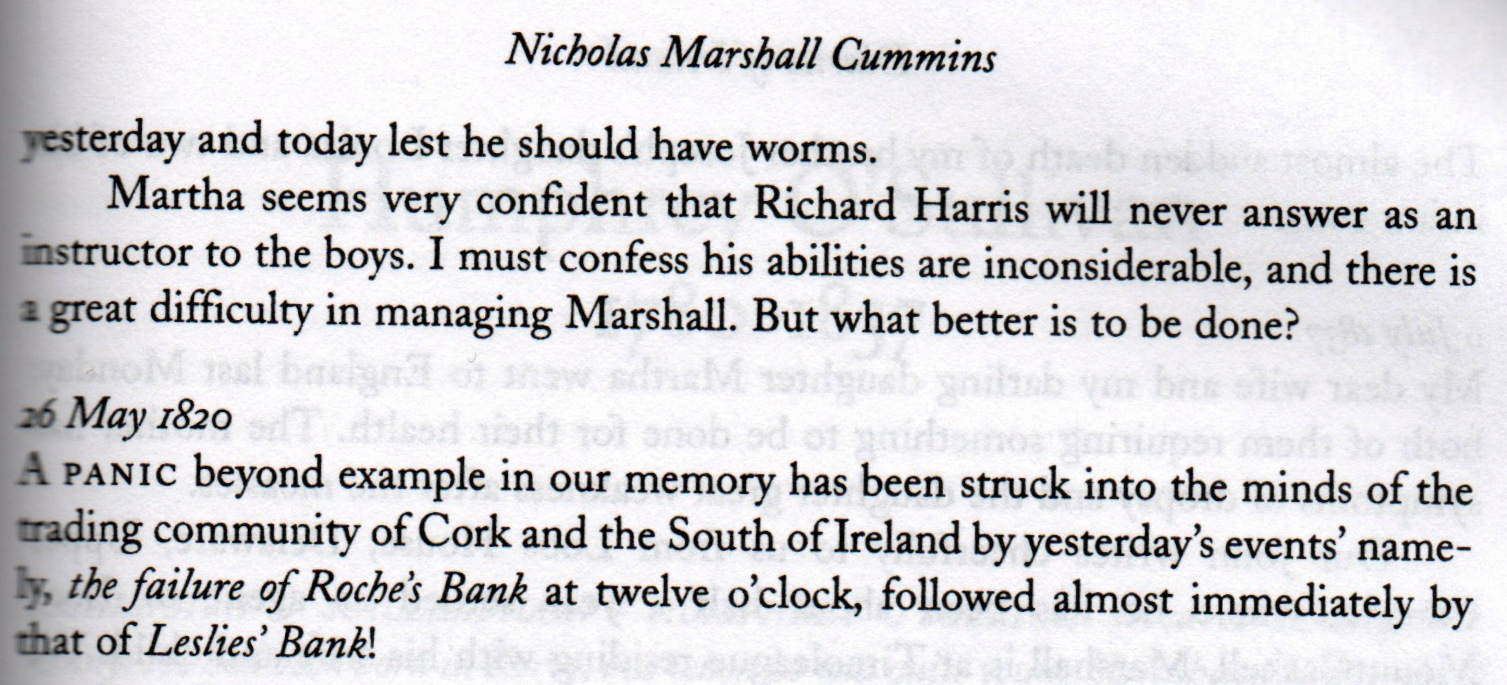
Banking Collapse in Cork, Lawton, Carleton and Feray in 1760, 13th May 1793, Sir Thomas Robert’s Bank stopped payment, 25th May 1820 ‘A Panic beyond example in our memory has been struck into the minds of the trading community of Cork and the South of Ireland by the failure of Roche’s bank at twelve o’clock, followed almost immediately by that of Leslies’ Bank.


Hugh Lawton, 1767, Castlelane, Alderman Cork, Mayor 1777.  Merchant, Partner 1750 in Lawton, Carleton and Feray, Bankers, Bank collapsed 1760.  Lawton’s Quay called after him.

Banking Collapse in Cork, 13th May 1793, Sir Thomas Robert’s Bank stopped payment, 25th May 1820 ‘A Panic beyond example in our memory has been struck into the minds of the trading community of Cork and the South of Ireland by the failure of Roche’s bank at twelve o’clock, followed almost immediately by that of Leslies’ Bank.

Courtesy Melosina Lenox-Conyngham’s ‘Diaries of Ireland’ 1590-1987.

Address by Merchants, and their listing, of Cork, 20th March 1754, to the Duke of Dorset Lord Lieutenant, thanking him for his support of the Public Credit during the Recent Crisis.

Banking Collapse in Cork in the 1820s Roches and Leslies Bank and House of Commons, London, Select Committee Query re Collapse, only functioning Bank left Pikes. First run 1820 Deputation including Messrs Crawford and Gerard Callaghan deputed to see Lord Lieutenant in Dublin to solicit loan o £100,000. 2nd failure of Leslies 1825.

Cork Southern Reporter 1st June 1820 on Calamity in Cork, Failure of Roches Bank and Stoppage of Leslies Bank.

C. M. (McCarthy) Tenison formerly Collins JP, BL, MRIA, Barrister, Bank Manager, Hobart, Tasmania, Author of ‘History, Law and practice of Baking’ and article 1893 on Early Cork Banks, Hoare’s Bank, Hoare’s Lane (1675-1729), Pikes Hoare’s Lane (1729-1825), Falkiner and Co., near the Custom House (1760, Leslie and Co. Failed 1820, Hewitts and Co., South Mall (1776-1789), Newenhams, Patrick St., (1800-1821), (1824-1825), South Mall, Rogers Travers and Shears (c1750-c1798), Nile St., Cotter and Kellett (1775 Bankrupt 1807), Galweys Bank Mallow (not in article), The Pike Family the Debt Cork owes them as Bankers, Merchants,  Shipbuilders, Reclaimers of Marshes and Mrs Pike a Quaker standing by her son in Celebrated Defamation action (Pike V Beamish ), 1894, for Alleged Cheating at Cards.

1-Scan 1504 2-Scan 1508 3-Scan 1510

Report of Engineer, Joseph Conroy, Esq., C.E. 1851, on sale of Becher Estate on Islands and West Carbery, ‘The Tenantry on the Islands are industrious, and very well conducted and like those on the Mainland are generally more intelligent then might be supposed by those unacquainted with of many parts o the country not so remote. Rents are punctually paid.


https://www.google.ie/maps/place/Durrus,+Co.+Cork/@51.4977765,-9.4381498,15z/data=!4m2!3m1!1s0x48459fe7ccd270df:0x231e3744ac95441a

Report of Engineer, Joseph Conroy, Esq.,  C.E. 1851, on sale of Becher Estate on Islands and West Carbery, ‘The  Tenantry on the Islands are industrious, and very well conducted and  like those on the Mainland are generally more intelligent then might be supposed by those unacquainted with of many parts o the country not so remote.  Rents are punctually paid.

1-becher 3

Proposed Railway from Bantry to Crookhaven to be a Port of Call, 1866 Sale with Tenant listings of of Two Ploughlands and Two Gneeves at Dunmanus, Mizen, West Cork, in occupation by Alexander O’Driscoll, Esq. prior to 1814 conveyed to William Swanton and Richard Long, by Lord Riversdale and others (subject to the right of all persons to use the water in the Well Holy? at Tobernasool), with lands Sparagrady, Gurteenalla, Derrenaclogh, formerly enjoyed by Thomas Attridge and his under tenants at Ballydehob, 1812 ,by Lease of 12th September 1768, to William Swanton, Ballydehob from Richard Tonson for three Lives renewed in 1840 for lives of William Swanton, William Swanton (last alive in 1866 aged 34) and William Justice and lands at Drimoleague, Meenies, and Conveyance of 1812 Lord Riversdale to William Swanton Lands .


Dunmanus:

https://www.google.ie/maps/place/Durrus,+Co.+Cork/@51.5392281,-9.6615576,16z/data=!4m2!3m1!1s0x48459fe7ccd270df:0x231e3744ac95441a

Meenies

https://www.google.ie/maps/place/Meenies,+Co.+Cork/@51.6656295,-9.29625,15z/data=!3m1!4b1!4m2!3m1!1s0x48450810f3711675:0x14a80cb2467543b5

Proposed Railway from Bantry to Crookhaven to be a Port of Call,  1866 Sale with Tenant listings of of  Two Ploughlands and Two Gneeves at  Dunmanus, Mizen, West Cork, in occupation by Alexander O’Driscoll, Esq. prior to 1814 conveyed to William Swanton and Richard Long, by Lord Riversdale and others (subject to the right of all persons to use the water in the Well Holy? at Tobernasool), with lands Sparagrady, Gurteenalla, Derrenaclogh, formerly enjoyed by Thomas Attridge and his under tenants at Ballydehob, 1812 by Lease of 12th September 1768, to William Swanton, Ballydehob from Richard Tonson (part of extended Hull family of Leamcon, Schull) for three Lives renewed in 1840 for lives of William Swanton, William Swanton (last alive in 1866 aged 34) and William Justice and lands at Drimoleague, Meenies, and Conveyance of 1812 Lord Riversdale to William Swanton Lands (Levis?).

In relation to those mentioned possible relationships.

From the late 18th century most of the Swantons in the area were Methodist.  One of the family became a Mining Captain and was working in Gortavallig Mines in Kilcrohane in the 1850s he married a Catholic and that branch of Catholic Swantons descend from him.

William Swanton descended from John Swanton and  of Letterinlish, Skibbereen d 1717. Family may have originated in Scotland.  There is a death of a William Swanton of Gortnagrough in 1798.

William Swanton’s sister Elizabeth b 1740 married John Wren from outside Ballineen.

John Wren, the Petitioner for the sale was of the Murragh, outside Bandon a descendant of Elizabeth Swanton b 1740 and John Wren, Murragh.  William Wren was 56 in

Patience Swanton married Edward Elsmore Noble 1825, she is 68, he was chief coast guard officer from Wexford.

The Attridge referred to may have been of a minor land owning family in the Ballydehob area with a branch in Glasheen in Cork.

Possible connection:

Richard Skuse, Derrygarren, Barony of West Carbery, Co. Cork, Farmer, 29th April 1802, Sworn 1st May 1802. To Michael Albridge (wrong should be Attridge), of Skibbereen, Co. Cork, Woollen Draper, and Jno (John?), Glasheen …Aulin?, Cork City, …..Allen said County farmer, all his interest in lands at Derrygarren and Ininshbeg (Inishbeg) both in Co. Cork, … held under Head Lease from Cornelius O’Driscoll, Esq. and the latter under Thomas Somerville and Burris Erwin, Esqs., in trust to pay Testator’s wife Mary Skuse, an annuity of £10 residue of profits from said lands to raise a payment of £40 each to the Testator’s seven daughters, Dorothy, Abigail, Elizabeth, Margaret, Mary, Ann, Frances, and then to pay the profits to Testator’s son Francis Skuse for life, in default of his issue to said seven daughters. Dwelling house at Derrygarren, furniture to the said wife for life, then the furniture divided between the three youngest daughters Mary, Ann and Frances Executors: Thomas Somerville, Michael Attridge, Jno Attridge. Witnesses: Richard Sinnick, Gent. Denis Donoghue servant to said John Denis. John Denis Gent. Witnesses to Memorial Richard Sinnick, John Denis Gent.

Alexander O’Driscoll Esq., probably a middle man, a number of O’Driscolls around Skibbereen and Caheragh early 19th century.

Mary Ann Fairclough, 63, was possible Swanton, perhaps the Reverend Edward Fairclough holding land in 1866 was a son  he may have been a Methodist Minister.

There is a marriage between Richard Long and Catherine Swanton in 1786 and between a Richard Long and Alice Driscoll in 1776.

The Riverdales/Tonsons are descendants of Sir William Hull in Leamcon, Schull in 1600.

https://plus.google.com/photos/100968344231272482288/albums/6123185075123463569


There are two Alexander O’Driscolls at the time Magistrates in the area and one in Cork so it is hard to know who is who.
View of Tempol na mBocht, (The Church of the Poor, Crookhaven), Mizen Peninsula, West Cork, with Parsonage and Sandboat in Foreground on Pamphlet from Rev. William Fisher 1851, setting out History of St. Brendan’s Church, Built 1714, by Bishop Brown, original Protestants gone over as Romanists their descendant ‘Bitter Romanists’ until lately few Protestants left on ‘Protestant Hill’, Plea for Funds, list of Subscribers.


https://www.google.ie/maps/place/Crookhaven,+Co.+Cork/@51.4684001,-9.7260407,15z/data=!3m1!4b1!4m2!3m1!1s0x48458598cbd7f471:0xa00c7a99731a1a0

View of Tempol na mBocht, (The Church of the Poor, Crookhaven), Mizen Peninsula, West Cork,  with Parsonage and Sandboat in Foreground on Pamphlet from Rev. William Fisher 1851, setting out History of St. Brendan’s Church, Built 1714, by Bishop Brown, original Protestants gone over as Romanists their descendant ‘Bitter Romanists’ until lately few Protestants left on ‘Protestant Hill’, Plea for Funds, list of Subscribers.

https://plus.google.com/photos/100968344231272482288/albums/6123162131940641249

Grave of Rev.Fisher and his brother Denis O’Callaghan Fisher, attorney and Genealogist, Mount Jerome, Dublin. On his Vol 1 of Irish Marriages 1740-1820 handwritten medical notes on Goleen, Kilcrohane. May be connection to James O’Callaghan, J.P., Rock Cottage, Schull.

“Deansgrange No.3826

1853, Sale of Estate of Arthur Hutchinson, died Intestate of Townlands, Durrus/Bantry, West Cork, of Derrivahallow, Killovinogue, Clonee, Aghoheen, Parkanagh, part Moulavard, Gurtyclona, Letterlickey East, Middle and West, Lead Mines at Killovinlgue and Gurtyclona operational, Three Leases (one 1806 to William Swanton, Ballydehob), held for lives of persons now advanced in Life and a very Considerable Rise is expected on their Falling in, Possible connection to Partial Norman Conquest.


https://www.google.ie/maps/place/Durrus,+Co.+Cork/@51.6408876,-9.4628328,15z/data=!4m2!3m1!1s0x48459fe7ccd270df:0x231e3744ac95441a

1853, Sale of Estate of Arthur Hutchinson, died Intestate of Townlands, Durrus/Bantry, West Cork, of Derrivahallow, Killovinogue, Clonee, Aghoheen, Parkanagh, part Moulavard, Gurtyclona, Letterlickey East, Middle and West, Lead Mines at Killovinlgue and Gurtyclona operational, Three Leases (one 1806 to William Swanton, Ballydehob), held for lives of persons now advanced in Life and a very Considerable Rise is expected on their Falling in, Possible connection to Partial Norman Conquest.

The Hutchinsons were connected by marriage with the Ballydehob Swantons and alos probably to Richard  Roycroft in Clonee in the 1790s.  His will was copied by Welpy prior to 1922.

An earlier affray on the Estate:

August 1847, Affray at Letterlickey, Durrus, West Cork arising from Seizure of Cattle, by Landlord Hutchinson.

https://durrushistory.com/2015/02/23/copy-of-will-of-richard-roycroft-destroyed-in-the-destruction-of-the-public-record-office-dublin-1922-but-copied-by-william-henry-welply-of-clouney-clonee-bog-road-parish-of-durrus-agd-9th-m/

The Normans had a toe hold in the area around Bantry (Donemark), and up the Durrus River to Letterlickey/Aughaville/Colomane an up the Illen River to Caheragh.  Some of the local names Burke, Goggin,Barrett are Norman.

In the records of the Cathedral of St. Finbarrs in Cork there are ledgers going back to the 1780s acknowledging tithes which belonged to the Cathedral.  Included apart from areas around Bantry, KIlcrohane, Ballydehob and Schull is Letterlickey.   This may have come to the Cathedral via the Waterford Abbeys founded by the Normans.  Also on the boundary is the ancient church of Moulivard once the main population cluster prior to 1600.

St. Finbarr’s Cathedral Cork, 1790 List of Properties, Tenants, Cork City and County, List of Cork Bishops 600 ad-1790 a.d. List of Clergy’s Livings

In a Carbery Estate Map of the 1788 of Ballycomane, Durrus  these townlands are shown as owned by Hutchinson:

Survey of Ballycomane, (Irish: Baile an Chumáin, meaning ‘town of the little valley’), Durrus, Bantry, Co. Cork, 1788.

Tithe Aplottments 1820s:

http://www.corkgen.org/publicgenealogy/cork/titheapplot/durrus/tithe.html

Griffiths 1850s:

http://www.askaboutireland.ie/griffith-valuation/index.xml?action=doNameSearch&PlaceID=295410&county=Cork&barony=Carbery,%20west%20(west%20division)&parish=Durrus&townland=Cloonee

https://plus.google.com/photos/100968344231272482288/albums/6122747795942384369

Lease of 1795 from Bantry Estate to Maurice Spillane of 87 acres at £15 per annum with a covenant ‘To buy all his malt and beer at brewery to be approved by lessor under penalty of 10s per barrel of malt and 5s per barrel of beer’


https://www.google.ie/maps/place/Derryginagh+West,+Co.+Cork/@51.6767116,-9.4097091,15z/data=!3m1!4b1!4m2!3m1!1s0x48450a2efb8e2151:0x2600c7a7bb4c3112

Lease of 1795 from Bantry Estate to Maurice Spillane of 87 acres at £15 per annum with a covenant ‘To buy all his malt and beer at brewery to be approved by lessor under penalty of 10s per barrel of malt and 5s per barrel of beer’

Bantry Estate Rent Books from 1780s Bantry Beara areas, Co. Cork

1-Bantry 11

Lease of 1836, Reenvanagh, Whiddy Island, ‘Covenant to lay out by Lessee (Tobin) Ten Boat Loads (each containing thirty horse loads) of Best Coral Sea Sand Annually of Premises under a penalty of £10.


20160731_154627


1-Bantry 25https://www.google.ie/maps/place/Whiddy+Island,+Co.+Cork/@51.69274,-9.5071249,11z/data=!4m2!3m1!1s0x48450b33c942ea51:0xe2d24a96b0aad7f3

Lease of 1836, Reenvanagh, Whiddy Island, ‘Covenant to lay out by Lessee (Tobin) Ten Boat Loads  (each containing thirty horse loads) of Best Coral Sea Sand Annually of Premises under a penalty of £10.

Tobins:

https://docs.google.com/document/d/13bW08jLMERwfI5cGHHxXfd4IIHkBbpMYfJBmXA9ROX0/edit

The land on Whiddy is very fertile.  A significant part of the Island was used in 1967 by Gulf Oil to build a major oil tank farm still operational which holds Ireland’s strategic oil reserve.

The reference to one of the lives of a son of a local Catholic Landlord Timothy O’Donovan might suggest their involvement in the coral sand business.  This operated in Bantry until the 1950s.  Until guano from Chile and late chemical fertilisers came in the late 19th century Bantry Bay coral was prized as  a fertiliser.

https://durrushistory.com/2014/09/29/the-use-of-mussel-seed-as-a-lime-substitute-in-kilcrohane-west-cork-to-the-1920s/https://durrushistory.com/2012/08/28/history-of-whiddy-island-bantry-bay-co-cork-from1261-from-paddy-okeeffe-papers/

History of Whiddy Island, Bantry Bay, Co. Cork from 1261, from Paddy O’Keeffe papers