• About
  • Customs Report 1821-2 (and Miscellaneous Petitions to Government 1820-5) and some Earlier Customs Data, including staffing, salaries, duties including, Cork, Kinsale, Youghal, Baltimore, with mention of Bantry, Crookhaven, Glandore, Berehaven, Castletownsend, Enniskeane, Passage, Crosshaven, Cove, Clonakilty, Cortmacsherry.
  • Eoghan O’Keeffe 1656-1723, Glenville, Co. Cork later Parish Priest, Doneralie 1723 Lament in old Irish
  • Historic maps from Cork City and County from 1600
  • Horsehair, animal blood an early 18th century Stone House in West Cork and Castles.
  • Interesting Links
  • Jack Dukelow, 1866-1953 Wit and Historian, Rossmore, Durrus, West Cork. Charlie Dennis, Batt The Fiddler.
  • Kilcoe Church, West Cork, built by Father Jimmy O’Sullivan, 1905 with glass by Sarah Purser, A. E. Childs (An Túr Gloine) and Harry Clarke Stained Glass Limited
  • Late 18th/Early 19th century house, Ahagouna (Áth Gamhna: Crossing Place of the Calves/Spriplings) Clashadoo, Durrus, West Cork, Ireland
  • Letter from Lord Carbery, 1826 re Destitution and Emigration in West Cork and Eddy Letters, Tradesmen going to the USA and Labourers to New Brunswick
  • Marriage early 1700s of Cormac McCarthy son of Florence McCarthy Mór, to Dela Welply (family originally from Wales) where he took the name Welply from whom many West Cork Welplys descend.
  • Online Archive New Brunswick, Canada, many Cork connections
  • Origin Dukelow family, including Coughlan, Baker, Kingston and Williamson ancestors
  • Return of Yeomanry, Co. Cork, 1817
  • Richard Townsend, Durrus, 1829-1912, Ireland’s oldest Magistrate and Timothy O’Donovan, Catholic Magistrate from 1818 as were his two brothers Dr. Daniel and Richard, Rev Arminger Sealy, Bandon, Magistrate died Bandon aged 95, 1855
  • School Folklore Project 1937-8, Durrus, Co. Cork, Schools Church of Ireland, Catholic.
  • Sean Nós Tradition re emerges in Lidl and Aldi
  • Some Cork and Kerry families such as Galwey, Roches, Atkins, O’Connells, McCarthys, St. Ledgers, Orpen, Skiddy, in John Burkes 1833 Commoners of Great Britain and Ireland:
  • Statement of Ted (Ríoch) O’Sullivan (1899-1971), Barytes Miner at Derriganocht, Lough Bofinne with Ned Cotter, later Fianna Fáil T.D. Later Fianna Fáil TD and Senator, Gortycloona, Bantry, Co. Cork, to Bureau of Military History, Alleged Torture by Hammer and Rifle at Castletownbere by Free State Forces, Denied by William T Cosgrave who Alleged ‘He Tried to Escape’.
  • The Rabbit trade in the 1950s before Myxomatosis in the 1950s snaring, ferrets.

West Cork History

~ History of Durrus/Muintervara

West Cork History

Author Archives: durrushistory

1826 Subscription List New Catholic Chapel Ballydehob. Some Catholic Swantons.

05 Monday Sep 2022

Posted by durrushistory in Uncategorized

≈ 1 Comment


Courtesy Peadar Ó h-Anracháin, Southern Star, Cois Life (Dublin Letter).

Peadar O’Hourihane, Raiceadoir/Auctioneer, Skibbereen

https://wordpress.com/post/durrushistory.com/40440

Gaelic League (Conradh na Gaeilge) Meeting addressed by Peadar Ó h-Anracháin, in Durrus, West Cork, 1905.

Gaelic League (Conradh na Gaeilge) Meeting addressed by Peadar Ó h-Anracháin, in Durrus, West Cork, 1905.
1924 Peadar O h Anrachain on the Poets of Carbery Including Sean O Coilean The Silver Tongue of Carbery, In Irish using Old Gaelic Script.

\

https://wordpress.com/post/durrushistory.com/40367

1826 Subscription List New Catholic Chapel Ballydehob. Some Catholic Swantons.

..

The Catholic `swantons of Kilcrohane adn Casper Wyoming descedn from a Ballydehob Mining Captain working on the Kilcrohane mines. He married a local woman. According to family tradition he continuet to worship at St.James in Durrus but the children were brought up as Catholics.

Subscription Lists, New Catholic Churches at East Schull 1825, Rosnacaheragh (Akakista) 1826, Durrus 1899.

https://docs.google.com/document/d/1dM5rsbc3AyTde6dJK7aWogFA2A85emvdb1g0M-4IRCs/edit

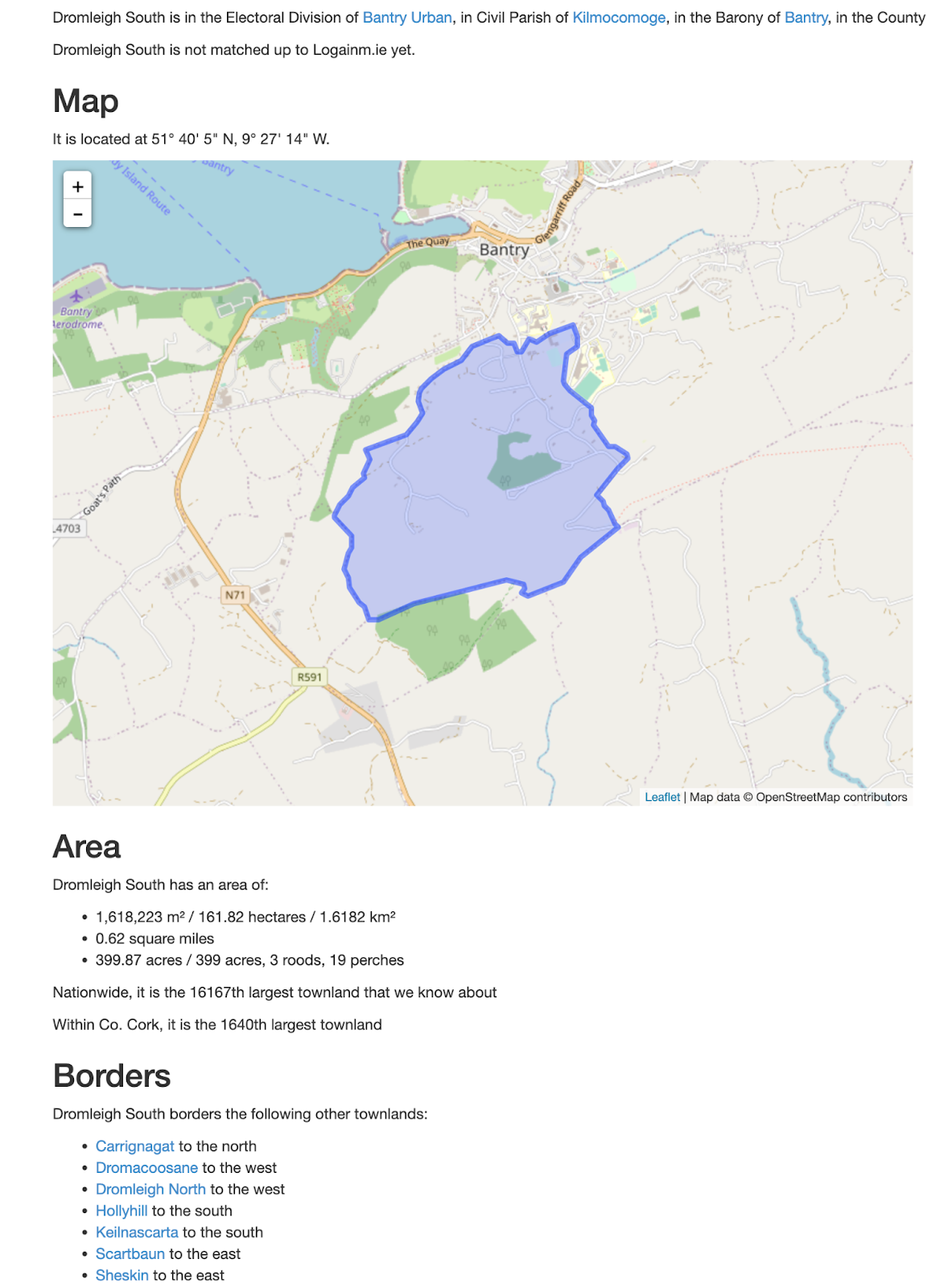
Ó h-Eidrisceoil, (O’Driscoll) Properties, Three Ploughlands in the 1630s from a Schedule of 1850 of The O’Donovan

03 Saturday Sep 2022

Posted by durrushistory in Uncategorized

≈ Leave a comment


O’Driscoll Properties, Three Ploughlands in the 1630s from a Schedule of 1850 of The O’Donovan

The enclosed in a number of articles by Peadar O hAnracháin, in the Souther Star from thr mid 1940s his ‘Dublin Letter’

https://docs.google.com/document/d/1mEc84UgnEmDBGiNgUUSEc_jnMaZO9mUoTE28DWIr9_8/edit

O’Driscoll pages 84-86

Futher information p. 86-95

Ceárdachas Gaelach: Fíodóireacht (Weaving) in Ireland, Brehon Laws 438 A.D.

02 Friday Sep 2022

Posted by durrushistory in Uncategorized

≈ Leave a comment


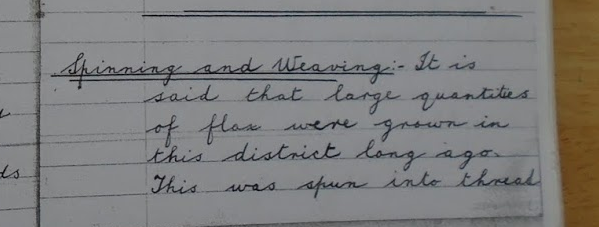
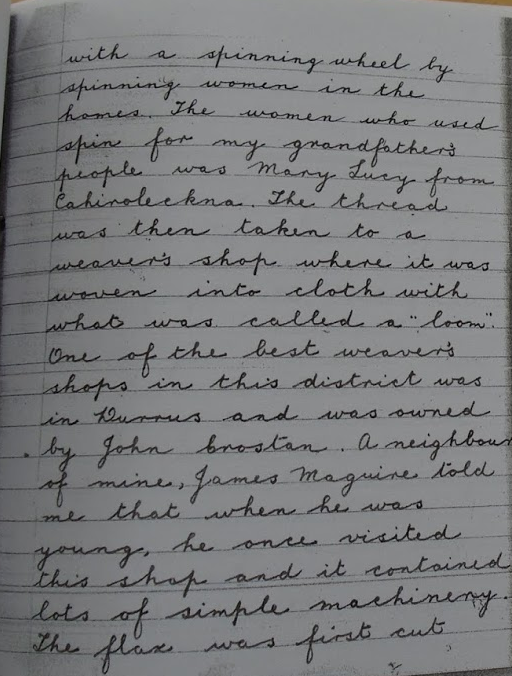
Ceárdachas Gaelach: Fíodóireacht (Weaving) in Ireland, Brehon Laws 438 A.D.

This information piece in the Southern Star was sponsored by the Hospital Trust. In later years it enjoyed a bad press but in its heyday in Ireland it brought huge amounts of foreign exchange to the county the lottery being illegal in most countries except in Ireland

Joe McGrath one of the founders later became involved in establishing Waterford Glass:

http://centretruths.co.uk/pctih/085_Joe_McGrath.htm

Updated Clothiers, Flax, Linen, Textiles, Weaving, West Cork

https://docs.google.com/document/d/1u0vIz1nxG34pJua7qC7jtTCKWLjwVY81jSl0usPdojk/edit

William O’Sullivan, Carriganass Castle, Kealkil, Bantry, (1775-1857). His Life and Times. A Landlord, Middleman, Moneylender, Political Activist.

27 Saturday Aug 2022

Posted by durrushistory in Uncategorized

≈ 3 Comments


William O’Sullivan, Carriganass Castle, Kealkil, Bantry, (1775-1859). His Life and Times. A Landlord, Middleman, Moneylender, Political Activist.

https://docs.google.com/document/d/12y7RsWJg2F8ZlJ-q2yLDh7rZhZz-sByfqI90VfH03zI/edit

William O’Sullivan is a figure not well known but he is representative of a tenacity that characterised elements of the old Gaelic order despite the Penal Laws.  The bulk of the land held in West Cork by Catholics was forfeit for ‘Rebellion’; or lost through the legal chicanery of people like Richard Boyle the Great Earl of Cork or Sir Walter Coppinger.  The only families that come to mind who managed to retain their lands were the descendants of Sir Teague O’Regan who retained ownership to about 1905 when the estate outside Rosscarbery was acquired by the Land Commission.  Also Lord Kenmare estate took in part of the general Bantry aea as well as Kerry.

Landlord families could be adaptable, The Bernards of Bandon later the Earls of Bandon had extensive estate in West Cork and Kerry.  Annually there was a dinner for major tenants those in West Cork tend to be pious Protestant the dinner was a  muted affair.  However the Kerry dinner was for mainly Catholics and resembles a mediaeval feast by an Irish Chieftain, uilleann pipers, fiddlers and drink overflowing.

Recent work on land ownership and the Penal Laws would suggest that perhaps up to 30% of the land was in de facto Cathoolic ownership.  Underneath ownership there were various estates in land and the class of which William O’Sullivan was a member in West Cork had effective control subject to a head rent right through the 18th and into the 19th century.

Even for the group of whom William O’Sullivan was a member the pettifoggery of the Penal Laws rankled.

Father Barry, Parish Priest of Bantry  in evidence to the Select Committee of the House of Commons on Distress in Ireland under the Insurrection Act sitting in Bantry.   He said that 

Protestant  Half Pay Officers  on £40 a year  preferred as Quarter Session Jurors in Bantry to Opulent Catholics the likes of Deasy, Clonakilty on £2,000 a year. He was also presumably referring to John O’Conell of Bantry, a wealthy merchant and political activist.

In assessing the Penal Laws it is worth bearing in mind that in France broadly similar laws were passed but with the exception that they were applied to their own people the Huguenots.  In Ireland’s case they were imposed by an alien invading power.  By 1750 the worst was probably over but legal disabilities on holding land or having professional qualifications remained until the 1770s onwards.  Perversely the Penal Laws contributed to the development of a very wealthy Catholic Mercantile Class……,.,

Recollections Of An Old School in Gallows Hill, Bandon

26 Friday Aug 2022

Posted by durrushistory in Uncategorized

≈ Leave a comment


Recollections Of An Old School in Gallows Hill, Bandon

https://docs.google.com/document/d/10vyehS62fTcayeReTnIZrbWqyKUKR-RJVzhtE2o8-9g/edit

23 Tuesday Aug 2022

Posted by durrushistory in Uncategorized

≈ Leave a comment


1944 Installation of Micro Hydro Electricity Scheme at Castletown Kinneigh by Colonel Patrick (P.J.) Coughlan.

1944 Installation of Micro Hydro Electricity Scheme at Castletown Kinneigh by Colonel Patrick (P.J.) Coughlan.

The Colonel is better known for his Blueshirt (Quasi Fascist ) Organisation in the 1930s associated with the Cumann na nGaedheal/Fine Gael political party and other fringe movements including support for Duffys Brigade to help Franco in Spain. He also was the organiserof the annual Michale Collins commoratin at Beal na Blath

Here however he is involved in setting up a small community based hydro scheme as in the newspaper report. There are futher details of a tenancy dispute with Colonel Conner of the Manch Estate. It must have resulted in the Colonel recovering posession as Colonel Coughlan afterward is operating from Fort Robert nearby.

Apparently the late Tommy Camier who set up Camiers Garage in Ballydehob developed aa small hydro dam on his family farm At Gortnagrough when he was only about 12 yers of age.

Colonel Patrick J. Coughlan, Manch Cottage, Ballineen

https://docs.google.com/document/d/19TCeYd9nU6b1JH9bXaJHDA17N7C3TgF-DI8ywA28Yv0/edit

1944 Secret Weapon Invented By 2 Durrus Men at Experimental Stage

21 Sunday Aug 2022

Posted by durrushistory in Uncategorized

≈ 2 Comments


1944 Secret Weapon Invented By 2 Durrus Men at Experimental Stage

Working on the Bog

There was significant distress and little local employment except for seasonal work on the extensive bogs at Barnagaoithe, Clonee, Glanlough, Liseenacreagh.  The largest bog (15 to 20 acres) was at Glanlough and it was owned by Sonny Clarke, Sullivans (Ballinvillan), Ward and Love families.  For the duration of the war it was operated under the control of the County Council who employed a staff of around 50 from March to October to save the turf. Many of the men were employed with their horses or ponies who also worked in the bog. Glenlough bog was worked by men from the general Durrus area, many of whom travelled many miles on foot to get to work.  The Lisheenacreagh bog (owned by the Trender and Daly families) was somewhat smaller and operated by men from the Ballydehob area.  The turf when saved into sods 9”x 1’ was transported either directly to Cork by lorry or to Bantry railway station and thence to the Cork Hospitals.  One of the trucks was driven by the late Mrs. O’Callaghan (who later owned the Bantry Bay Hotel), then of O’Donovan’s Cove, Ahakista, another by her brother Jackie Cronin.  

The day started at 8 am and apart from a dinner break of an hour went on to 5.45.  The pay was 35/= a week.  There was dissatisfaction with working conditions and a short lived strike of one day towards the start.  Some of the workers such as Eugene Crowley Ahagouna and others  rented adjoining bogs at Barnagaoithe and worked late in the evening.  Turf from these was sold privately to people in the village or out west Goleen and Toormore.  In nearby Lognagapall Bog in Caheragh the Council operated a bog with difficult working conditions.  A strike commenced led by Michael Pat Murphy.  It succeeded in improving conditions and was to launch his career as a Labour TD and Parliamentary Secretary.

Timber was cut from woods such as that of the Rectory which at that time extended to the pier.  The area around the community field on the Dunbeacon Road was forested and these trees were felled with two man saws.  The larger logs were sent to Fullers of Skibbereen and the smaller were cut up as firewood.  This was taken to Cork by Jacky Cronin for sale.

There was a big trade in rabbits which were caught in snares, with ferrets or dazzled.  The price of rabbits went from a half crown (2s 6d) to 3s 6d and were bought by Jackie Cronin, Tom Dukelow, Sea View, the Creamery and O’Sullivan, a dealer from Dunmanway.  There were newspaper ads letting lands for trapping as that of the Cronins at O’Donovan’s Cove and other ads preserving lands and complaining of the damage caused by ferrets, dazzling and general trespass.  The Durrus River had a good run of salmon and it was not unknown for a salmon to be speared under the creamery bridge with a hay fork.  There were no artificial manures; sea sand and coral were used and were landed at the ‘Sand Quay’, opposite the former Good Times Café.  Just after the War there was agitation for a new pier and it was stated that there were 3 sand boats operating and 16 scallop boats. Fertilizer was scarce for a number of years after the war and the late John Crowley (late creamery manager) recalls in 1947 marine wool from the Bay laid out on the road from the Sandquay (the former Good Times café) to the former  Cronin’s forge.  This was a good nutrient.  Post war sand came by lorry from Barley Cove, the Burchill family were active in this trade,  together with ground limestone and chemical fertilizers re-appeared.   In former times townland had a traditional right to a part of the shore.   For example just off the strand is a rock called Carrigeen Cúl na h-Orna.   This sub townland is north of Clashadoo about 3 km away but the farmers in that area had the exclusive right to take seaweed from there.  It seems like the other townlands had similar rights.

Oats, barley and wheat were grown for the farmer’s own use and were threshed on the farm. In earlier years threshing was carried out by horses turning the machine in a circular fashion, Harnedys of Dunbeacon had such a machine. Among the threshing machines in the Bantry area was one operated by Peter O’Neill (Peter Neal), he was also a cattle dealer of Ballycomane. It was jointly owned by Jacky Cronin a local businessman but Peter worked it with his crew who included Eugene Crowley, Ahagouna, Jack Connolly, Gearhameenn, Bernie Kelly, Ballycomane, later Sonny Hosford, Kealties. Like the Whellys of Mealagh the machine went to West Waterford when the local threshing was done. The machine ended up rusting in Pete’s yard after the combine harvester came in. The later threshing machines were owned by Crowleys of Colomane, John McSweeney of Drumsullivan and the Whelly Brothers from east of Bantry.  They would normally spend around 6 weeks threshing in the district from September and then go on to West Waterford where the activities continued until February.  Jack Attridge of Gearhameen built his own threshing machine which operated successfully for many years. Tractors began to appear and the first in the district was around 1940 and was owned by Jack Shanahan, Dunbeacon

Some improvement works were carried out. In 1939 sanction was given for a loan of £560 to develop the Durrus sewage system.  In the same year compulsory purchase orders were issued dto authority the acquisition of land to build labourers cottages at Gearhameen (Flynns), Ballycomane (Flynns) adn Rusheeninaska (Coughlan) as well as multiple other sites around WEst Cork

In 1945 John O’Mahony was associated with the Farmer’s Association Later Party (John Dillon and P O’Neill were also involved) and claimed that due to lack of fertilizer he only achieved a yield of 7 stone per acre despite putting out 16 stone of seed.  There were lectures on improved techniques of potato growing and in 1945 drainage works in Parkanna employed 10 men.

Life went on as there are references to dances in Bantry, Ahakista and Ballydehob and races in Kealkil and Mallow and Ballydehob, many associated with the LDF. In 1941 Durrus races were held and attracted local entries and also from Baltimore, Kinsale and Drinagh with at least 6 horses in each race.

Dancing in these years could be in Bantry in the Town Hall where Spillane’s shop is near the Catholic Church and in the Boy’s Club after 1950. The Town Hall was also the venue of plays put on by strolling players such as Anew McMaster and Frank O’Donovan, in particular during Lent, when there was a 6-week embargo on dances. A Fourpenny Hop in the Green Shed near the Ouvane Falls Inn Ballylickey was popular from 1933 until the late 1940s, as was Vaughan’s Hall in Kealkil.  Many of the dances were associated with the LDF as were sports of ‘Aeriochts’ in the district.  The Durrus LDF Shooting team won the District Shield in 1943.

There were often large crowds at venues such as Dunbeacon Cross near the school on Sunday afternoons for patterns and returning from scores of bowls crowds of up to 150 were not unknown. Another pattern was sometimes held at Gearhameen at the coast crossroads.

1944 Quality is Remembered Long After Price is Forgotten, Atkins of Dunmanway, Atkins/Wolfe History.

19 Friday Aug 2022

Posted by durrushistory in Uncategorized

≈ Leave a comment


Funeral 1941, John Henry Atkins, Merchant, Dunmanway,

1941, John Henry Atkins, Merchant, Dunmanway

Since 1878, Atkins has had a long tradition of supplying farm machinery, home and garden tools and equipment, and much more. We now operate across Ireland with 3 convenient locations in Co. Cork and one in Birr, Co. Offaly. We also offer our full range to purchase through our online shop. Take advantage of our free courier delivery on all orders over €60 throughout the Republic of Ireland

THE ATKINS STORY

https://www.atkins.ie/news/history


Since 1878 John Atkins & Co have been supporting, working with and delivering to Irish Farmers. Through the generations the same top-quality standards have been maintained.
1878When John (Atkins) met Joseph (Wolfe) to form an agricultural merchants at 49 South Mall, Cork.

18852nd outlet opened at 5 Patrick’s Quay. Company now north & south of the river!


1898 McKenzies, a competitor on nearby Camden Quay, acquired. Atkins and McKenzies kept as separate entities offering different products and serving different customers.

1899Legal entity, John Atkins & Co. Ltd., founded. Registration no. 2827, now one of Ireland’s oldest surviving companies.Company 50% owned by both John and Joseph.
1900Rapid growth required another outlet. 54 South Mall, Cork opened

1910WWI, War of Independence, Civil war. Period of retrenchment. John & Joseph, being of the Protestant faith, must have thought about getting out but didn’t and passed the business on to the second generation.


1920Expansion again. Southern Seed Company acquired, outlet opened in Dingle (Co. Kerry).

1936-45″Economic War”, WWII: a grim period in Irish life and farming. Any company does well to come through it.

1950And we’re off again. Into the 3rd generation now. Outlet opened in Clonakilty. New fertiliser subsidiary, CFD, complete with drying plant, built at Monahan Rd., Cork. Staff partake in funding the new company.

1961South Mall outlets closed, Winthrop Street “home and garden store” with its cutting edge “self selection” format opened.

1964Relocation of the farm machinery business from Patricks Quay in Cork City to Carrigrohane Road on the outskirts of the city. Commencement of importation of several lines of machinery from Europe, including Bredal & Bogballe, still successful today.

1970-1980 Ireland joins EEC, farming flourishes, machinery in demand. Addition of branches at Bandon, Fermoy, Midleton to consolidate the territory of Cork for the farm machinery division. McKenzies (garden machinery) and Gardenworld also thrive on urbanisation or Ireland.


1996 Peter Wolfe (4th generation) buys out Atkins family shareholders

2008 Gardenworld rebuilt after a flood the previous year

1943. Too Many Pockets. Lixnaw Tailor James Lynch Fined for Too Many Pockets in A Suit He Made. Same Happened to Hugh O’Sullivan, Tailor, Bantry

17 Wednesday Aug 2022

Posted by durrushistory in Uncategorized

≈ 2 Comments


1943. Too Many Pockets. Lixnaw Tailor James Lynch Fined for Too Many Pockets in A Suit He Made

A reader  saw the article regarding the extra pockets in Lixnaw. That happened to the tailor Hugh O’Sullivan of Market Street as well. See halfway down the page of the attached pdf ‘Hugh OSullivan 1945’. Also his obituary from 1954. 

They are related to me through the Ward Family of Glanlough which as you know then continues back to the Trenwiths, so related to us all!! I believe my grandfather made the coffin for Hugh.

Hugh’s brother was Liam who was a teacher in Gortalassa. Their nephew Owen O’Sullivan died in Bantry a few years back, 2017? 

I don’t know if you’ve seen this…A first cousin of Hugh O’Sullivan was John Sullivan who along with Reginald Dunne killed Sir Henry Wilson in Kensington, you will see Owen in the comments at the bottom of the page:

http://www.nickelinthemachine.com/2008/10/knightsbridge-michael-collins-and-the-murder-of-field-marshall-sir-henry-wilson/

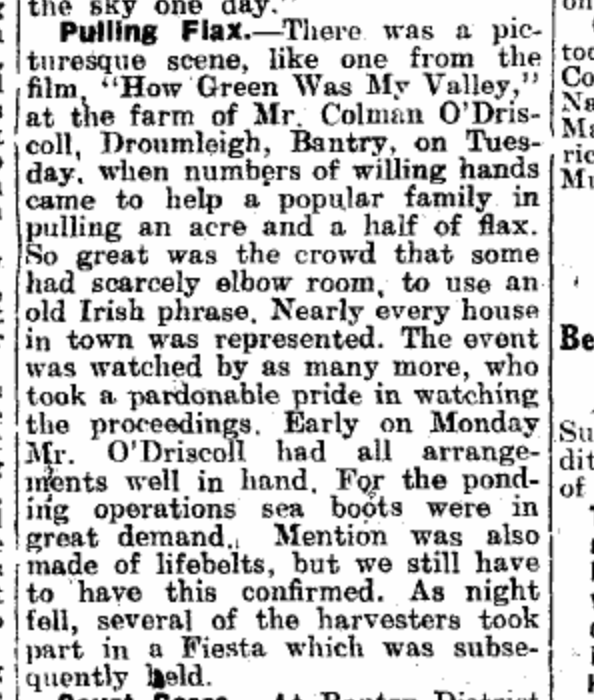
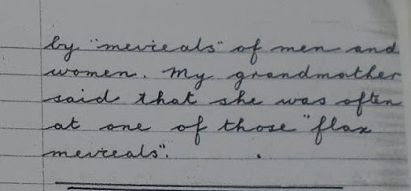
1942.  In the Middle of the War /Emergency, Clonakilty Show.  Flax Exhibitors.  Irish Country Women’s Association.  1942 Carbery Show, Skibbereen.

16 Tuesday Aug 2022

Posted by durrushistory in Uncategorized

≈ Leave a comment


1942.  In the Middle of the War /Emergency, Clonakilty Show.  Flax Exhibitors.  Irish Country Women’s Association.  1942 Carbery Show, Skibbereen.

https://docs.google.com/document/d/1_706-EQjQBC6wBWxyDrUWWx7auC9e6f11YtKFkz9Rt0/edit

1843-1970 West Cork Agricultural Societies and Shows, 4th August 2022

https://docs.google.com/document/d/1yoNjmDNQKT_pk3nvlCsT72YWYoDENcs–uaJxh2ber8/edit

Flax/Linen

Updated Clothiers, Flax, Linen, Textiles, Weaving, West Cork,

https://docs.google.com/document/d/1u0vIz1nxG34pJua7qC7jtTCKWLjwVY81jSl0usPdojk/edit

← Older posts
Newer posts →

Blog Stats

  • 885,049 hits

16th Regiment of Foot assisted female emigration australia ballyclough bantry bay caithness legion cavan regiment of militia cheshire fencibles coppinger's court inbhear na mbearc Irish words in use 1930s lord lansdowne's regiment mallow melbourne ned kelly new brunswick O'Dalys Bardic Family. o'regan Personal Memoirs rosscarbery schull sir redmond barry sir walter coppinger st. johns sydney Townlands treaty of limerick Uncategorized university of Melbourne victoria

16th Regiment of Foot assisted female emigration australia ballyclough bantry bay caithness legion cavan regiment of militia cheshire fencibles coppinger's court inbhear na mbearc Irish words in use 1930s lord lansdowne's regiment mallow melbourne ned kelly new brunswick O'Dalys Bardic Family. o'regan Personal Memoirs rosscarbery schull sir redmond barry sir walter coppinger st. johns sydney Townlands treaty of limerick Uncategorized university of Melbourne victoria
Follow West Cork History on WordPress.com

Enter your email address to follow this blog and receive notifications of new posts by email.

Join 515 other subscribers

Feedjit

  • durrushistory's avatar durrushistory

Archives

  • May 2026
  • April 2026
  • March 2026
  • February 2026
  • January 2026
  • December 2025
  • November 2025
  • October 2025
  • September 2025
  • August 2025
  • July 2025
  • June 2025
  • May 2025
  • April 2025
  • March 2025
  • February 2025
  • January 2025
  • December 2024
  • November 2024
  • October 2024
  • September 2024
  • August 2024
  • July 2024
  • June 2024
  • May 2024
  • April 2024
  • March 2024
  • February 2024
  • January 2024
  • December 2023
  • November 2023
  • October 2023
  • September 2023
  • August 2023
  • July 2023
  • June 2023
  • May 2023
  • April 2023
  • March 2023
  • February 2023
  • January 2023
  • December 2022
  • November 2022
  • October 2022
  • September 2022
  • August 2022
  • July 2022
  • June 2022
  • May 2022
  • April 2022
  • March 2022
  • February 2022
  • January 2022
  • December 2021
  • November 2021
  • October 2021
  • September 2021
  • August 2021
  • July 2021
  • June 2021
  • May 2021
  • April 2021
  • March 2021
  • February 2021
  • January 2021
  • December 2020
  • November 2020
  • October 2020
  • September 2020
  • August 2020
  • July 2020
  • June 2020
  • May 2020
  • April 2020
  • March 2020
  • February 2020
  • January 2020
  • December 2019
  • November 2019
  • October 2019
  • September 2019
  • August 2019
  • July 2019
  • June 2019
  • May 2019
  • April 2019
  • March 2019
  • February 2019
  • January 2019
  • December 2018
  • November 2018
  • October 2018
  • September 2018
  • August 2018
  • July 2018
  • June 2018
  • May 2018
  • April 2018
  • March 2018
  • February 2018
  • January 2018
  • December 2017
  • November 2017
  • October 2017
  • September 2017
  • August 2017
  • July 2017
  • June 2017
  • May 2017
  • April 2017
  • March 2017
  • February 2017
  • January 2017
  • December 2016
  • November 2016
  • October 2016
  • September 2016
  • August 2016
  • July 2016
  • June 2016
  • May 2016
  • April 2016
  • March 2016
  • February 2016
  • January 2016
  • December 2015
  • November 2015
  • October 2015
  • September 2015
  • August 2015
  • July 2015
  • June 2015
  • May 2015
  • April 2015
  • March 2015
  • February 2015
  • January 2015
  • December 2014
  • November 2014
  • October 2014
  • September 2014
  • August 2014
  • July 2014
  • June 2014
  • May 2014
  • April 2014
  • March 2014
  • February 2014
  • January 2014
  • December 2013
  • November 2013
  • October 2013
  • September 2013
  • August 2013
  • July 2013
  • June 2013
  • May 2013
  • April 2013
  • March 2013
  • February 2013
  • January 2013
  • November 2012
  • October 2012
  • September 2012
  • August 2012
  • July 2012
  • June 2012
  • May 2012
  • April 2012
  • March 2012
  • February 2012
  • January 2012
  • December 2011
  • November 2011
  • October 2011

Blog at WordPress.com.

  • Subscribe Subscribed
    • West Cork History
    • Join 515 other subscribers
    • Already have a WordPress.com account? Log in now.
    • West Cork History
    • Subscribe Subscribed
    • Sign up
    • Log in
    • Report this content
    • View site in Reader
    • Manage subscriptions
    • Collapse this bar

Loading Comments...