Land War Prosecution Under The Crime Act 1882 West Cork
Extracts from Skibbereen Eagle 1882-1883, p.5-78
Land War Durrus district, p. 79
Resident Magistrates, p. 82
Local Lawyers, p. 83
…
The backdrop here is the Land War:
Courtesy Lurgan Ancestry
The traditional view of the Land War in Ireland has been of the displacement of a Protestant Ascendancy class and the often absentee landlords. The former ascendancy had been on the decline since the Great Hunger of the late 1840s, and for them the problem was that previously agreed rents could not be paid after the slump in prices from 1874; some allowed generous rent rebates while others stuck to the agreements and enforced their property rights. Some were already owed rent and many had mortgaged their property and needed the rents to pay the mortgage costs. Many new landlords since the famine were Irish Catholics, but were still associated with the Ascendancy because of their wealth. A survey of the 4,000 largest Irish landlords in 1872 revealed that 71% lived on their estates or elsewhere in Ireland. By then, 43% of all proprietors were Roman Catholics, though the richest owners were mostly Anglicans.
Rent strikes often led to evictions. Land League members resisted the evictions en masse during the Land War, resulting in enforcement of evictions by court judgements for possession that were carried out by the quasi-military Royal Irish Constabulary. Murders of some landlords, their agents and policemen, as well as attacks on supportive witnesses and on their property and animals, all occurred as reprisals for evictions. In response, the British army were often deployed to back up the police, restore law and order and enforce evictions, after the Coercion Acts were passed. For protesting tenants, these Acts were a form of martial law; their opponents saw it as the only way to guarantee their legal rights.
Boycotting
The most effective method of the Land League was the boycott, which took its name from when an unpopular landlord’s agent, Charles Boycott, was ostracised by the local community. Boycotting was also applied to tenants who wanted to pay their rent, and to the police, as well as shops and other businesses who traded with boycotted people. The boycotts were often extremely effective, since they were unquestionably lawful under the common law, non-violent, and effectively punitive: since nobody is forced to join a boycott, it was a voluntary act, through private agreeme…..,.,,,
1727, Deed whereby Owen Lander of Kilpatrick, Schull to tend the house of William Hull, of Leamcon, Schull with Musick and to instruct William Hull to play on the Fiddle to the best of his endeavours.
…
Type of deed
Date of current deed
20 May 1727
Vol
Page
Memorial
Lease
Date of earlier deed
19 Oct 1727
60
99
40069
No
Role(s) in earlier deed(s)
Role in current deed(s)
Family name
Forename
Place
Occ or title
A
A
P1
P1
HULL
William
of
Limcon, COR
Esq
B
P2
P2
LANDER
Owen
of
Killpatrick, COR
Farmer
A
C
WD
DONOVAN
Elizabeth
of
Downmanuss, COR
Spinster
D
WD
HULL
Richard
of
Limcon, COR
Son of A
E
WD WM
DONOVAN
Daniel
of
Downmanuss, COR
Gent
F
WD
DONOVAN
Mary
of
Downmanuss, COR
Spinster
G
WM
WINSPEARE
Robert
of
Fourmilewater, COR
Gent
H
REG
MURRAY
George
of
Bantry, COR
Commissioner
I
W REG
WHITE
Richard
of
Co Cork
JP
J
W REG
DAVIES
Richard
of
Co Cork
JP
Abstract
Comment for person [A] :lease amended to reduce the rent for “good services” Person [B] :lands at Kilpatrick for 31 years Person [C] : Person [D] : Person [E] : Person [F] : Person [G] : Person [H] : Person [I] : Person [J] :
MS
Date registered
8 Mar 1728
Date abstract added
20201114
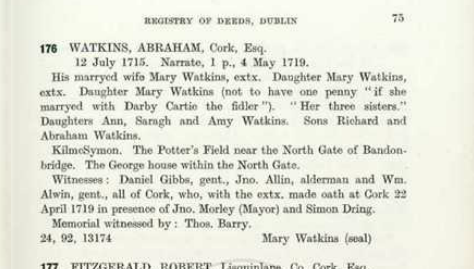
Abraham Watkins Esq, Cork Extensive Property Owner in Bandon, Will dated 12th July 17 My Daughter Mary Watkins ‘Not to have one penny if she marries Darby Cartie the Fiddler’
The Irish Manuscript Commission have digitalised some of their old publications. This is from a series on Memorials in the Registry of Deeds. These survived the destruction of 1922.
This would have been a time of great war induced prosperity.
These grants were shortly after purchased by the first Earl of Cork, who may be justly styled the founder of the town. Through him, the Earls of Cork and Shannon, and the Duke of Devonshire, possess property in the town and neighbourhood. The Earl of Bandon is also a proprietor, but the principal part of his property is in Kerry and in the western part of the county. The Bernard family have always been esteemed good landlords and kind to their tenantry. The following extract from an original letter written by his agent to the Lord Bandon, of April 23rd, 1793, preserved among the papers of Wm. T. Crosbie, Esq., of Ardfert Abbey, county Kerry, will afford a good idea of what an ” Irish tenant gala ” was at the close of the last century :
” None who were not tenants did I invite, except those named by you, viz., Father Morgan Flaherty, Tim M’Carthy, Charles Casey, Doctor Leyne, and Father Nelan, son to Old John. These I asked as Catholics particularly attached to you. Had I gone further I must either Lave excited jealousy, or summoned half the country. We had a company of 22 in the parlour, of whom I will send you a list next post. In the breakfast-parlour there was another company of second rate, and the third rate dined in the tent pitched in the avenue near the abbey. In the parlour your claret was made free with, as Stephen tells me he opened 34 bottles. In the breakfast-parlour port wine and rum-punch were supplied in abundance, and abroad large libations of whiskey-punch. We had two quarter casks (above 80 gallons) of that beverage, made the day before, which was drawn off unsparingly for those abroad, and plenty of beer besides. Two patteraroes, borrowed from Jack Collis, and placed on the top of the abbey tower, announced our dinner, toasts, and our exultation. Pipers and fiddlers enlivened the intervals between the peals of the ordnance. The May-men and maids, with their hobby horse, danced most cheerfully, and were all entertained at dinner, and with drink in abundance. An ox was roasted whole at one end of the turf house, on a large ash beam, by way of a spit, and turned with a wheel well contrived by Tom O’Brien. It was cut up from thence, and divided as wanting. The name of its being roasted entire was more than if two oxen had been served piecemeal. Six sheep were also sacrificed on the occasion, and, in short, plenty and hospitality graced both your board and your sod ; and a fine serene evening favoured happily the glee and hilarity of the meeting. All was happiness, mirth, and good humour. God save great George our king was cheered within and abroad, accompanied with fiddles, pipes, &c., &c.”
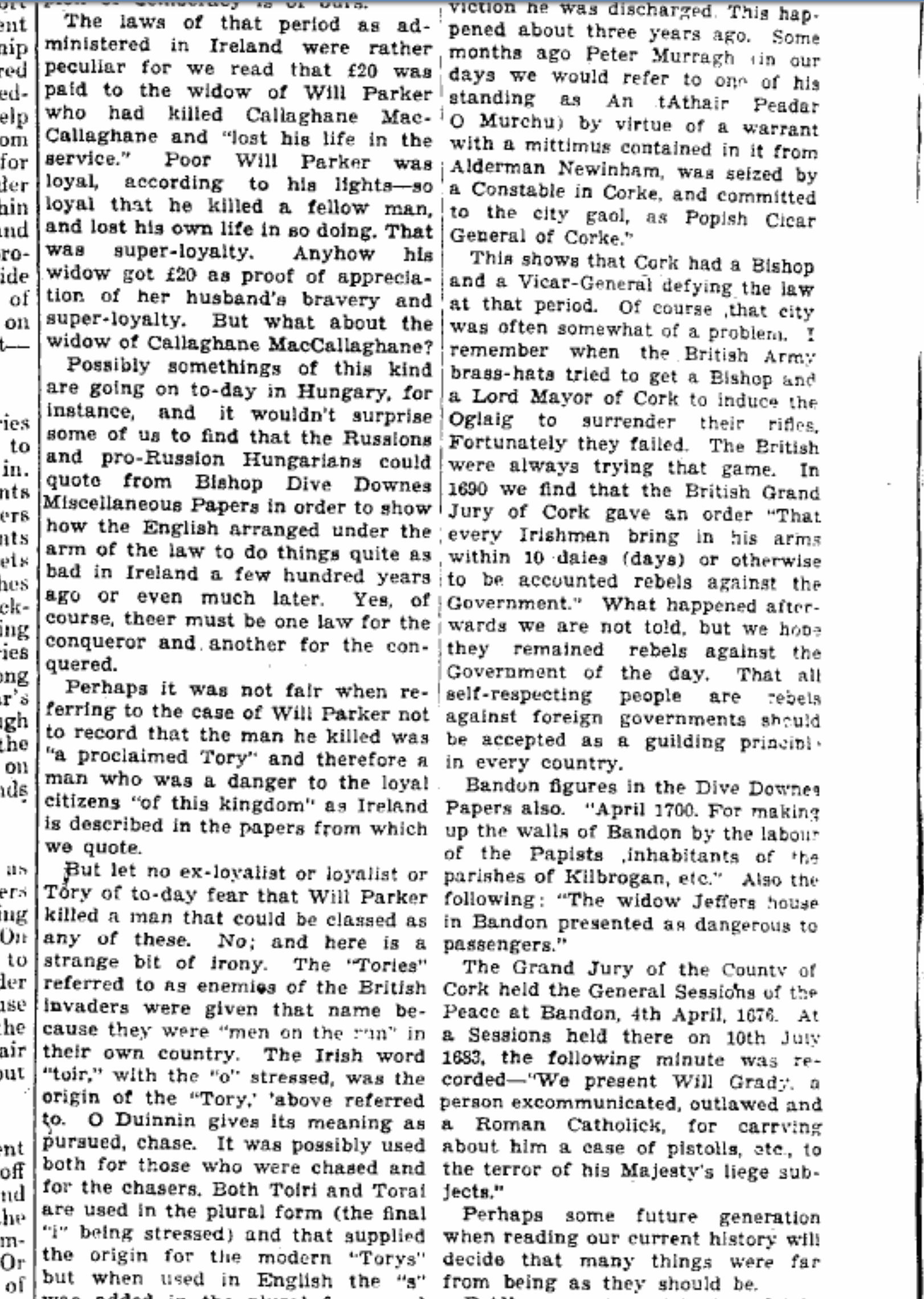
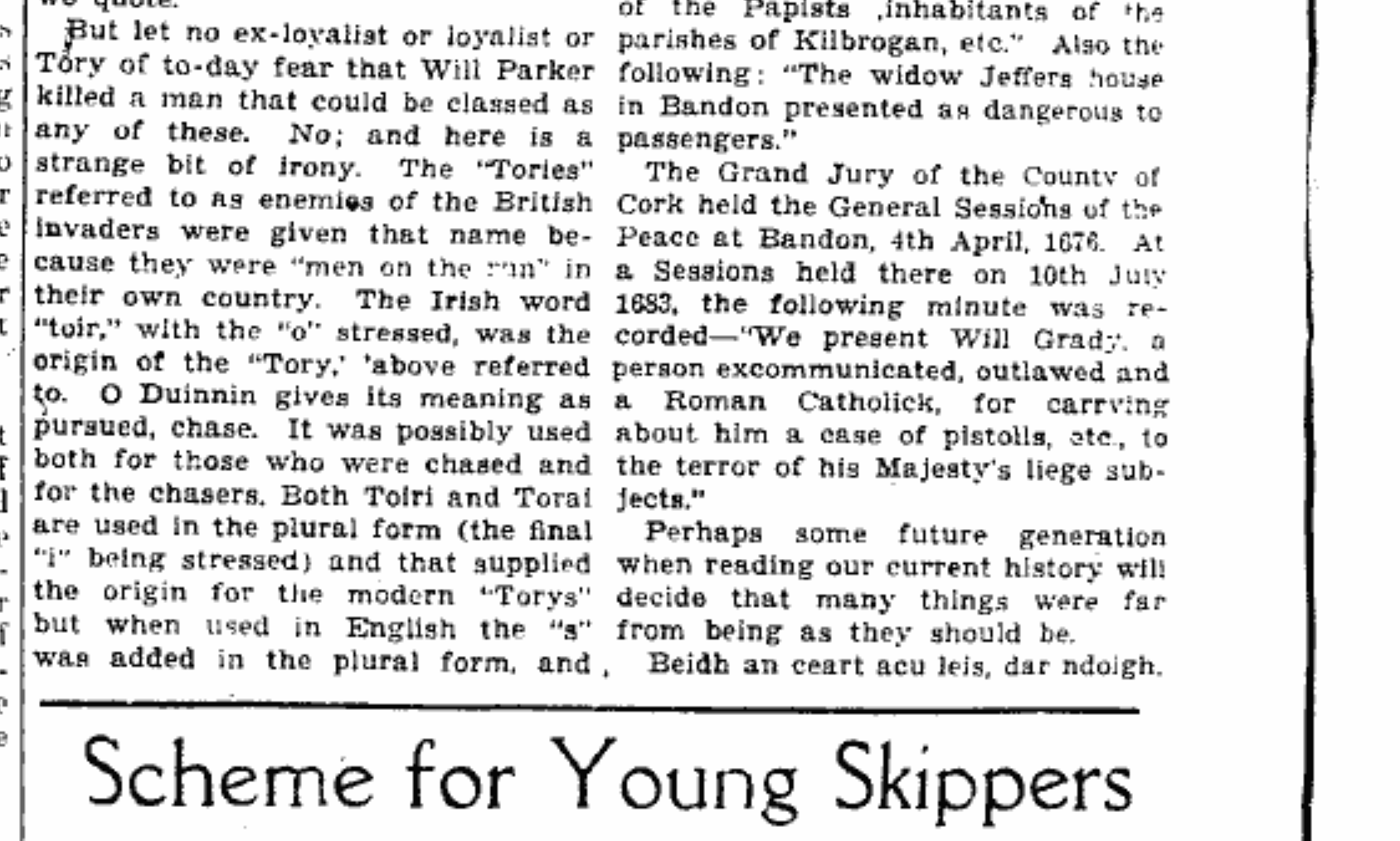
The Bandonians would admit of no piping or fiddling like this. ” In this town,” says Dr. Smith, writing of Bandon, in 1749, ” there is not a Popish inhabitant, nor will the townsmen suffer one to dwell in it, nor a BANDON, CASTLE-BERNARD. 497 piper to play in the place, that being the music used formerly by the Irish in their wars.” The town, at this time, could raise 1,000 men fit for arms. The woollen manufacture, an Irish trade which William III. was petitioned to suppress, and which he faithfully promised to discourage, once flourished here. The trade has now altogether left our shores, while the manufacture of linen has departed to the north, and with it the growth of flax. There are two parish churches in this town Kilbrogan and Ballymodan. The latter contains a fine old monument, erected to Francis Bernard, Justice of the Court of Common Pleas, with this inscription : FRANCIS BERNARD, ESQUIRE, OBIIT JUNE 29ra, 1731, JE 68.
From ‘A Kinsale Scrapbook. Phil O’Neill, Southern Star, 6th April 1935
Fiddler: Abraham Watkins Esq, Cork Extensive Property Owner in Bandon, Will dated 12th July 1715, My Daughter Mary Watkins ‘Not to have one penny if she marries Darby Cartie the Fiddler’, Deed of 1718 between William Bailey, Ballinacolle, Myross, West Cork wherein Charles Stanton is to teach his daughter and four children dancing, jigs, hornpipes, minuets and country dances.
Aibidial Gaoidheilge Agus Caiticiosma, First Book Published in 1571, in Irish, in Ireland Acquired by Trinity College Dublin, 1995, TCD Hurling Team Photo, 1880. One Time Member Sir Edward Carson (Lord Carson).
Record of the North Cork Regiment of Militia with Sketches extracted from History of the times in which its services were required, from 1763 to 1880. Taunts at Hurling Final.
This article is an accumulation of information on all elements of the practice of law by local
magistrates in Ireland (and indeed Ireland in general). It outlines the legal basis on which
magistrates were appointed, and their social and economic backgrounds. It also includes
accounts of their practices, good and bad, and commentaries from various writers on the same.
There are also accounts of political and violent actions taken against magistrates at various
times. The major part of the article is an annotated list of magistrates based on information
from a range of sources. Nobody knows how many magistrates there were. James Chatterton in the 1820s was Clerk of the Crown and Peace (State Solicitor equivalent) in the 1820s and confessed in a return to the UK Parliament that he had no idea how many magistrates there were in the county. He said formerly the Lord Chancellors office had notified him of the appointment but this had been discontinued. Additionally certain offices entitled the holder for the year he held the office eto be a magistrate. This includes the Lord Mayor of Cork, the Provosts of Bandon, Charleville Clonakilty and the Mayor of Youghal. There were numerous appointments from the 1890s onwards and a third of others were nominees of the Irish Parliamentary party. You continuously come across references to people at political meetings attending funerals described as JPs or magistrates. It is likely all the Lord Chancellors’ records were lost in the destruction of the Public Records Office in 1922. There are approximately 3,400 magistrates listed.
Role of Magistrate (Justice of the Peace), p. 2.
Social and Economic background, p. 8.
Penal Enactments on Papists, 1712-1772, p. 10, 475.
Hearth Tax Collection, 1662-1793, p. 12.
Reform from 1814, p. 13.
Military magistrates, 1789-1836, p. 14.
Appointment of British Army Officers, 1821, p. 15.
1821 Census. P. 15.
1821, Dismissal of Catholic and Liberal Protestant Magistrates, p. 16.
1827, Justice for Sale, p. 16.
1827, Petty Session Courts, p. 17.
Tithe Agitation, p. 18.
1831 Return of Magistrates. P. 19.
RIC Recruitment, p. 20.
Daniel O’Connell criticism, p. 20.
Enforcement of Sabbath, p. 21.
Friendly Societies, p. 22.
1884, Protest Against Removal of Lord Rossmore, Grand Master Monaghan Orange Order, p. 23.
RIC Inspectors sitting on Magistrates Bench, p. 24.
1893, Davitt Magistrates, p. 25.
Irish Speaking Magistrates, p. 26.
References in James Joyce Ulysses, p. 27.
War of Independence, Killings, Kidnappings, Big House Burnings, p. 27
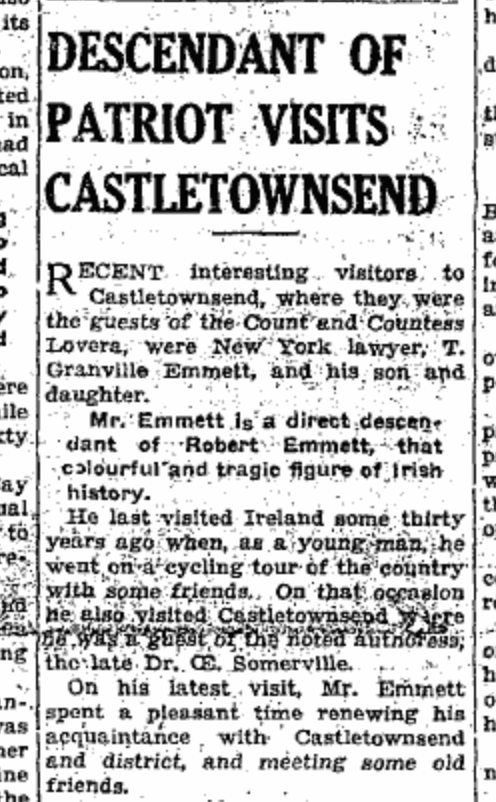
Robert Emmett as far as is know had no descendants struck down even before his prime,
T. Granville Emmett might be a descendant of
1764-1828 Thomas Addis Emmet TCD Studied Medicine. York Attorney United Irishman Doctor Born junction Grattan St/Shears St. Father State Physician 1770 and moved to Dublin. Degree TCD and Edinburgh Medicine, Secretary United Irishmen imprisoned release to Holland then NY. In New York associated with other Cork Attorneys (Robert Swanton, Ballydehob, United Irishman, Admiralty Judge), Clerke Skibbereen. 1817, New York. Judge Robert Swanton (United Irishman, Ballydehob) one of Judges of the New York, Marine Court, Charge to Jury. 1817 One of Committee in New York with Thomas Addis Emmet, (Brother of Robert Emmett) to Promote the Welfare of the Irish. 1828 Pallbearer at Funeral of Thomas Addis Emmet with the Governor of the State of New York, Martin Van Buren later President, United States, Senator Nathan Sandford Thomas Addis Emmet” One of the first lawyers in Dublin and one of the most virtuous and most patriotic of men. He was a member of the Irish Directory with Lord Edward Fitzgerald and was arrested in 1798. He was sent to Fort George. Liberated and expatriates in 1803 like the other prisoners of Fort George. He was chosen by the Irish in Paris in 1803 to be the agent from the provisional Government of Ireland to the First Consul and French Government, which he held till 1805. On finding there was no prospect of an expedition to Ireland} he got his passports and went to America, where the Congress passed a decree, by which, contrary to the usual term of ten years, he received his naturalisation twenty-four hours after landing there. He rose to great eminence as a lawyer in his newly adopted country and died in New York.
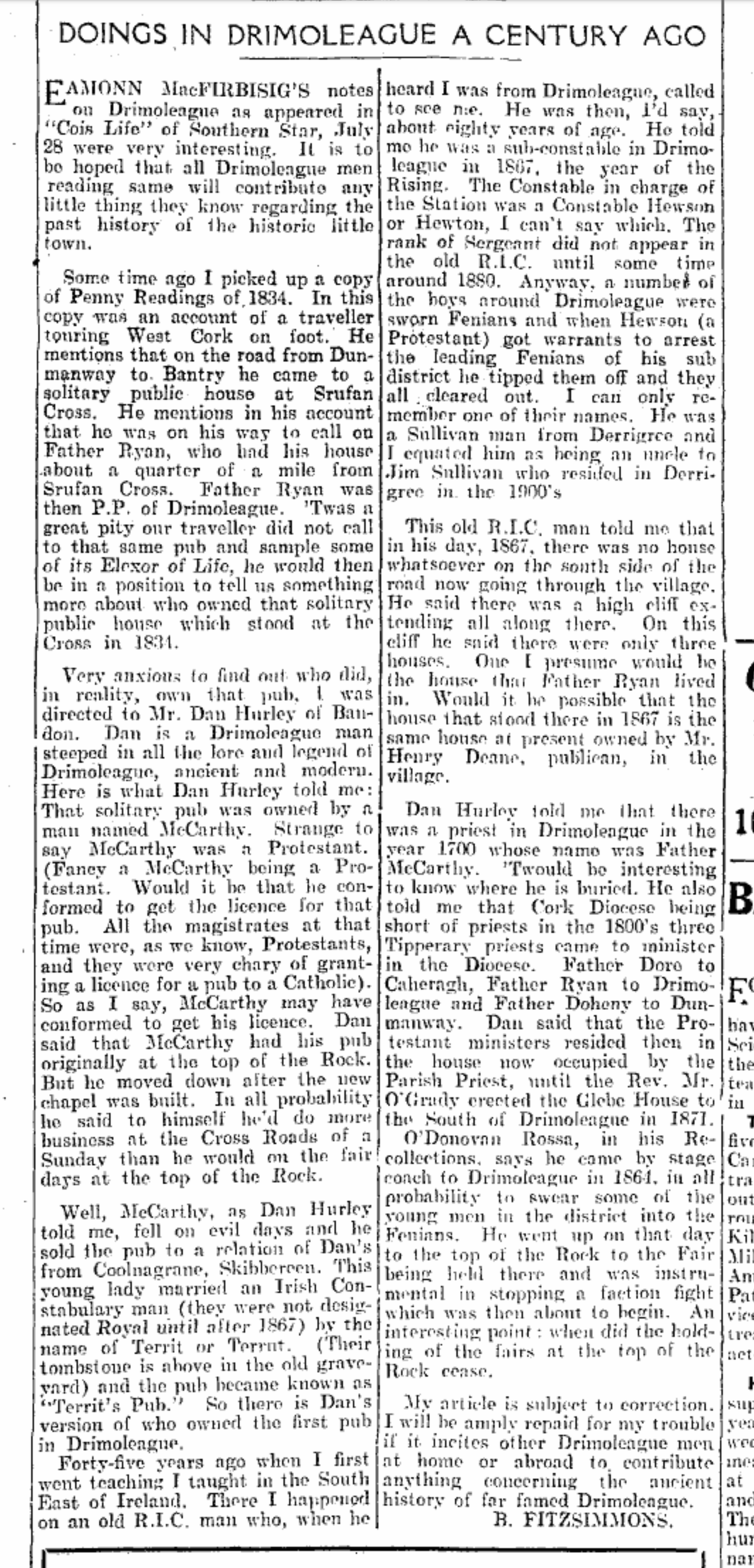
David Ross is living in the house that McCarthy had the pub in at the Top of the Tock. His wife was Genevieve Kingston . They all went to Rochester, New York after
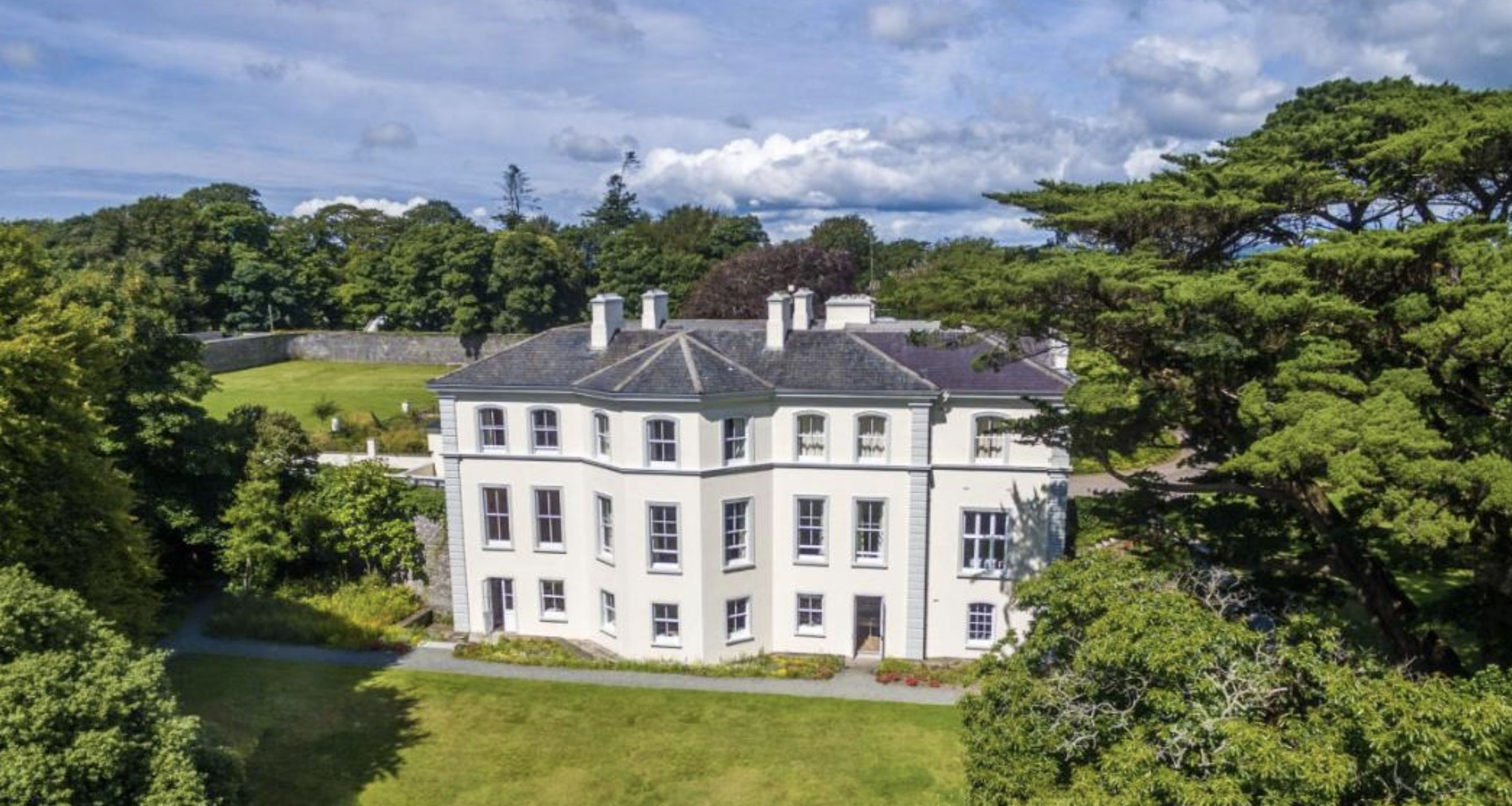
After the death of Lieutenant General Donovan of Bawnlahan, Leap the Chieftainship passed to the Montpelier (Douglas) Cork branch. They too were Protestant very wealthy by way of prudent marriages in the 18th and 19th century into the Cork Mercantiler Community.
When the General died his estate passed to his wife’s nephew Colonel Powell who was from Wales. By all accounts a reasonable landlord but no feeling for him locally as he was not of ancient stock.
The subsequent O’Donovan were in fact very popular and very engaged locally and even after~`independence when they decamped to England were active in promoting agricultural development locally.
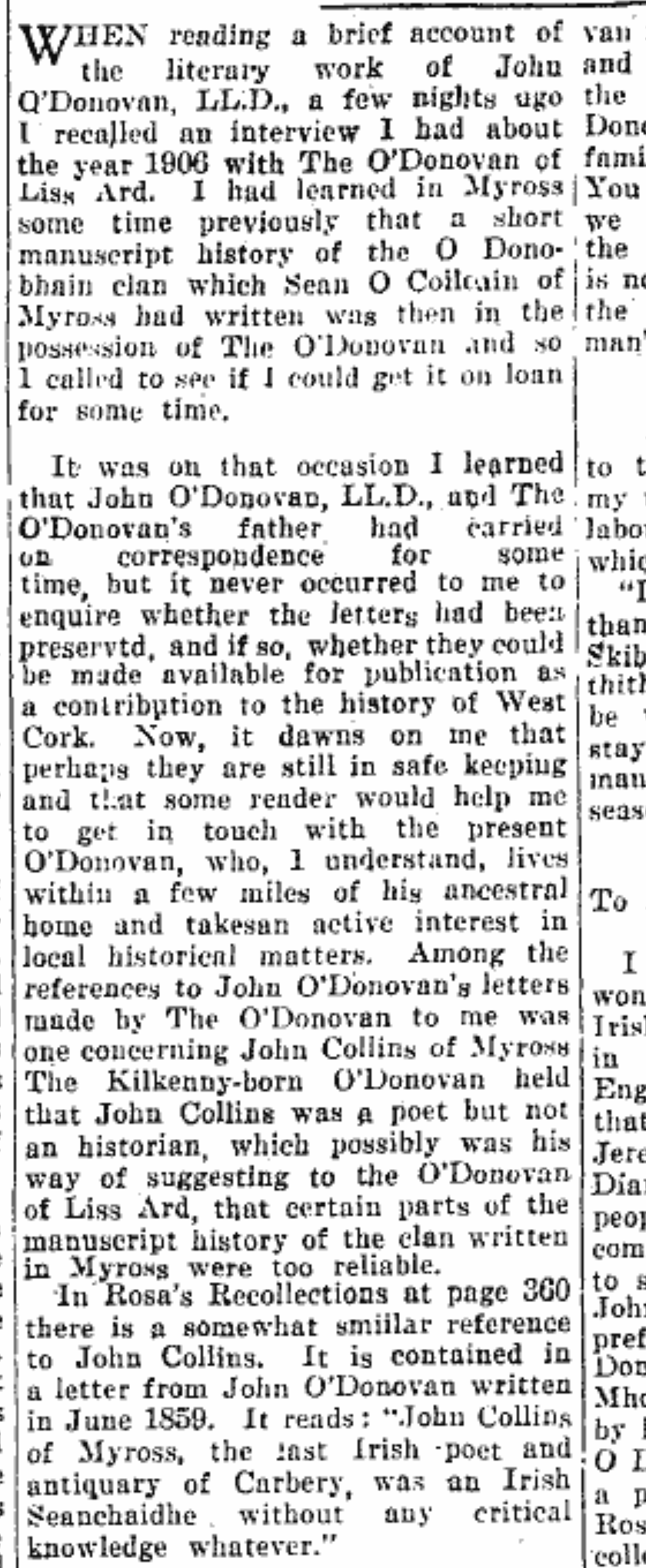
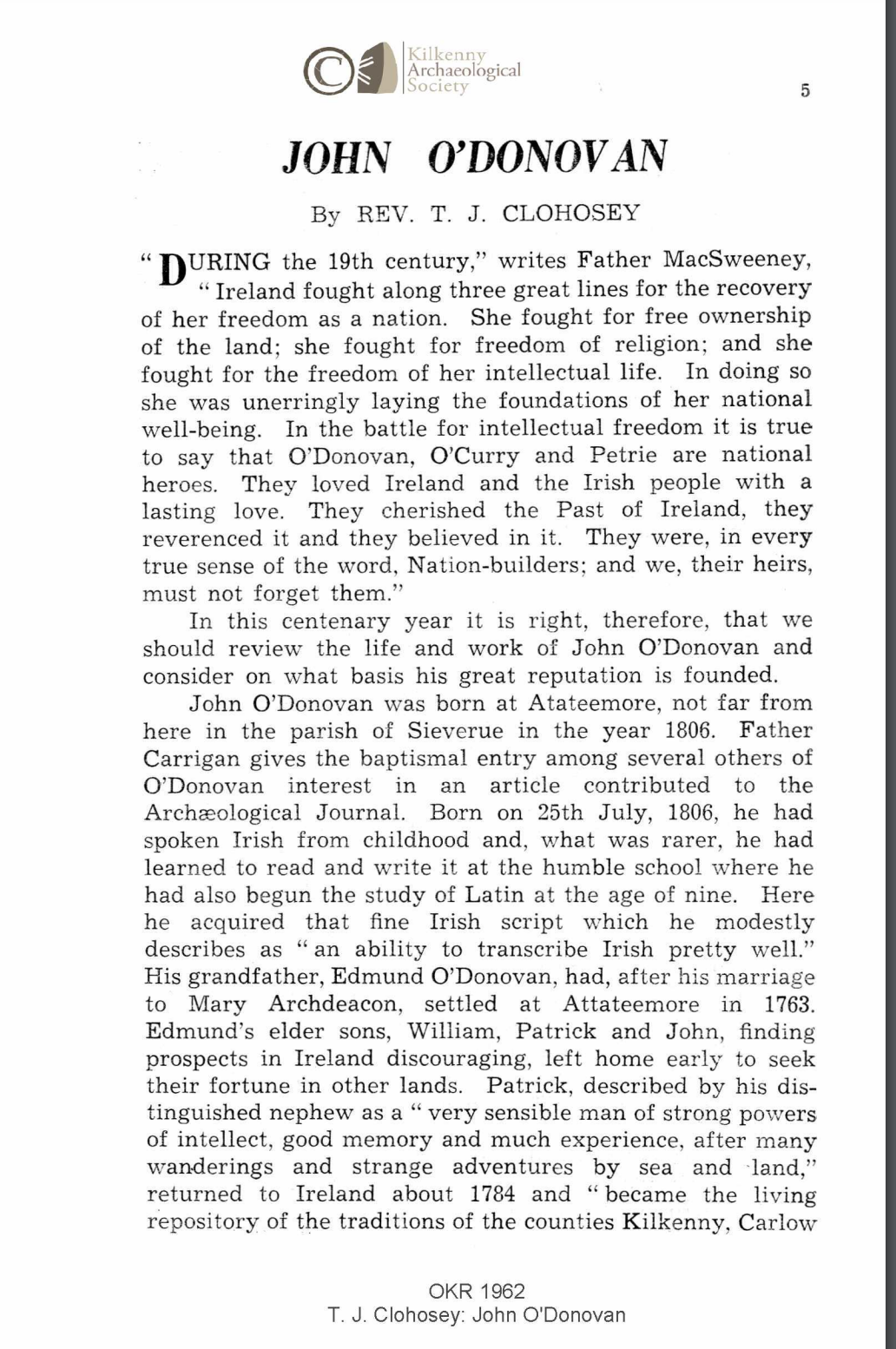
In the John O’Donovan papers and also in O’Donona Rossa’s recollections there were superior genealogical claims to be Chieftain of the O’Donovan including the gateman in Skibbereen Workhouse who wanted no mention of this lest he lose his job. Others mentioned were a ploughman in Myross and a cobbler in Waterford.
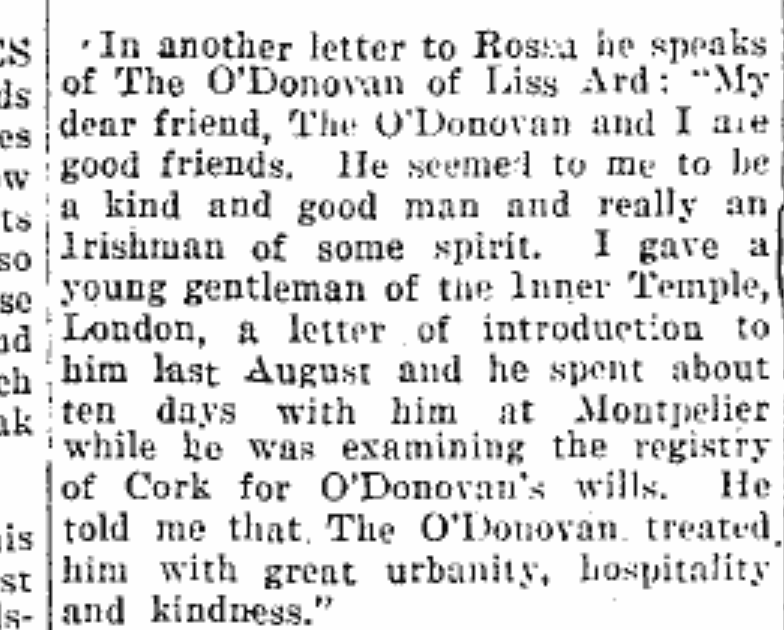
In John O’Donovn reference to a young gentleman on the Inner Temple London he may be from the Wexford O’Donovans on his mother’s side, later a senior figure in Dublin Castle . John O’Donovan said the Wexford O’Donovan originated in Carbery but wer ‘Rabid Orangemen”
Re John Collins, The Silver Tongue of Carbery a wonderful poet but many doubted the facts in his genealogical tracts.
Colonel Morgan William ‘The O’Donovan’ Oxon (1861-1940), CB, D.L., MA, 1888, ‘The O’Donovan’, Clann Cathal, Lis Árd, Skibbereen, son of Henry Wintrop ‘The O’Donovan’ MA, DL. and Amelia d ‘The O’Grady’, Courcy O’Grady, Kilballyowen, Co. Limerick. Ed. Haileybury and Oxford, Lieutenant-Colonel Munster Fusiliers, Colonel South Cork Militia Boer War, Succeeded Colonel Aylmer C. Somerville 1899 as President Carbery Agricultural Society. Presented organ to Creagh Church to commemorate the Jubilee of Queen Victoria. 1892 High Sheriff, Co.Cork ill, spent the summer on the Continent recovering. 1893 Member Cork Historical and Archaeological Society. Member Royal Society of Antiquaries 1889. Sent a carriage to the funeral of Lieutenant-Colonel Thomas Somerville D.L. (1824-1898), Clontaff, Drishane. Signed Requisition 1905. Cork Junction Railway Bill. Requisition to the Right Honourable The Earl of Bandon K.P., to Call a meeting for the purpose of Approving the Cork Junctions Railway Bill. Addressing a recruitment meeting in Drimoleague In July 1915 he referred to this ancient stronghold (Castle Donovan) of his family. After they displaced the O’Driscolls they became the Chief People of the Carberies. Listed family members as giving a present to 1907 Spaight wedding Union Hall. Considered the preservation of ancient documents a matter of importance. M Mary Eleanor, (Madame) odo Rev. J Yarker Barton, Chaplain to British Forces, she chaired the Women’s Emergency Recruiting Committee WW1, Skibbereen, listed 1921. Attending 10 Grand Jury presentments. 1933 writing to Carbery Agricultural Society suggesting horticultural potential in West Cork.
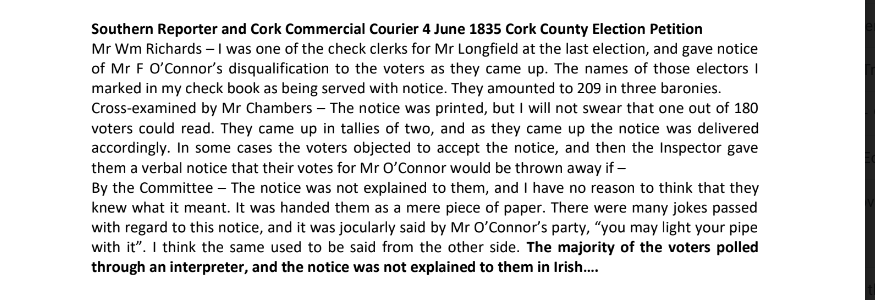
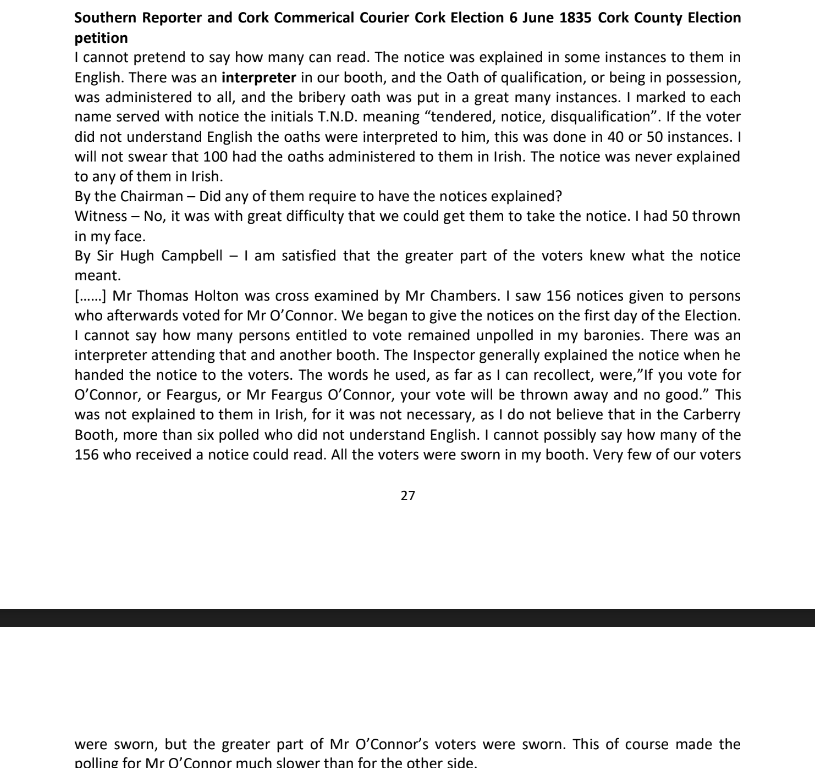
1835-1920. Irish Speakers in West Cork Litigation, 1835 Election Petition Cork County Election. Notice Never Explained in Irish. Irish in Election. Interpeters in Some Booths
Irish Speakers, Interpreters and the Courts 1751 – 1921. Mary Phelan 286PP Four Courts Press Dublin in Association with the Irish Legal History Society. Price €55
The Administration of Justice (Language) Act (Ireland) 1737, (herein after referred to as the 1737 Act), stipulated that all legal proceedings in Ireland should take place in English, thus placing Irish speakers at a huge disadvantage, obliging them to communicate through others, and treating them as foreigners in their own country. Gradually, over time, legislation was passed to allow the grand juries, forerunners of county councils, to employ salaried interpreters. Drawing on extensive research on grand jury records held at national and local level, supplemented by records of correspondence with the Chief Secretary’s Office in Dublin Castle, this book provides definitive answers on where, when, and until when, Irish language court interpreters were employed. Contemporaneous newspaper court reports are used to illustrate how exactly the system worked in practice and to explore official, primarily negative, attitudes towards Irish speakers






 .


 .