1859-1913, died 1915 Dr. Jerry Cotter MD MCH, QUI, FRCSI 8 Sydney Place, Governor UCC, Board North Infirmary Dr Jerry of Sidney pl, Cork city is one of mine, a New Zealand relation, b 1859, Derryginah Bantry, died 1915 in Clonakilty (his McCarthy wife was from there). Him & a brother in London were the first doctors of the family & inspired others including here in NZ to follow suit, although one of his sons chose law instead. At the 1901 funeral Mrs Cotter is his mother Mary Gallagher 1826 of Summerhill, whose sister Mary 1840 married Patrick Burke. I don’t know about the Scullys, but Jeremiah of Breenymore’s brother was William 1858, rate collector. He married Julia Creedon, g’daughter of James Cotter of Derryginah (uncle of Dr Jerry 1859). When Julia died, he married Mary Cassey. From Bantry mother Scully I see he was b. 18 Jan 1859, mother was Mary Scully. There was a tribe of the Scully family descended from Catherine Anne Gallwey who m. James Scully JP but no issue m. to any Cotter that I can find despite several by the name of Mary. 1891 subscriber North Infirmary. 1901 funeral of Mrs. Cotter, Bantry sons Dr. P. J. Cotter, London, Dr. J. Cotter, Cork, nephew Dr. Patrick Burke, London 1886 Committee member of proposed Graduate Reform Association of Queens College Son 1909, 1911 Francis McCarthy Cotter B.A. Barrister “8, Sydney Place, Cork. 1911 Member Cork Historical and Archaeological Society 1912 attending funeral of Rev. Charles Walsh, Rector, Farranferris. Paddy O’Keeffe papers. 1913 car owner. Probate 1915 to widow, Mary, Clonakilty, £10,253
(SR 13/2/1817) – BREWERY – TO BE LET, AND IMMEDIATE POSSESSION GIVEN – THAT Remarkably well Circumstanced BREWERY; Situate at BANTRY, together with the UTENSILS, MALT-HOUSES and CONCERNS thereto Belonging – which have the Advantage of an Uninterrupted supply of Fresh Water, and being in a thickly Inhabited Corn Country, contiguous to the Sea, are worthy of Prompt Attention. – Proposals to be made to Simon White, Esq., Glengarriff, Bantry, or Richard Foott, Attorney, Cork, at whose Office a Plan of the whole may be seen. – Mr. James Cotter of Bantry, will shew the Concerns.
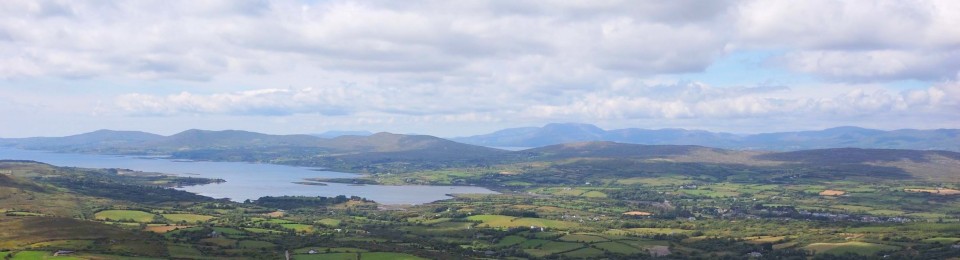
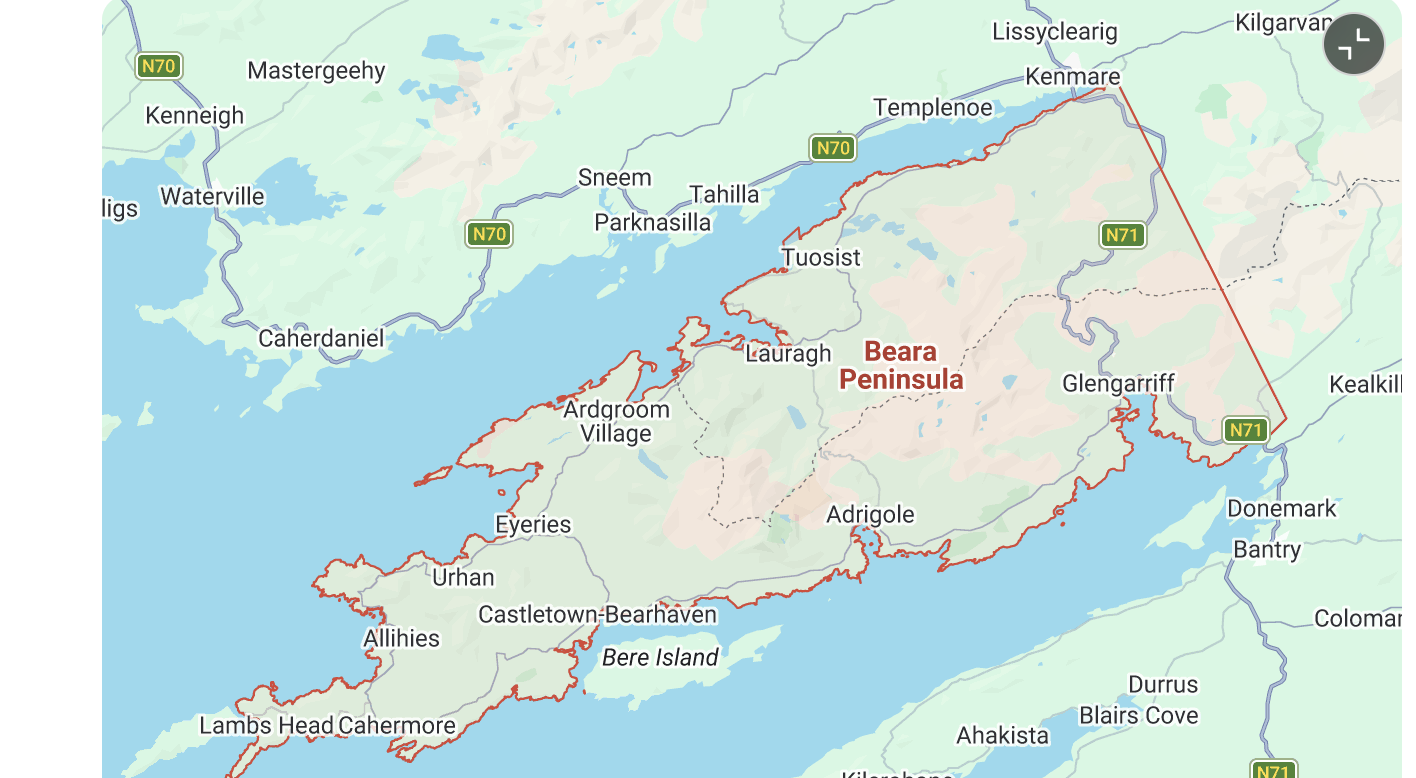
Most but not all of the Beara Peninsula is in Co. Cork with a section in Co. Kerry. The Barony referred to was notorious as it was in effect ruled by the Whites of Bantry (later Lord Bantry) and various Septs of the O’Sullivans mostly but not all Catholic. In theory they lost everything but in fact retained effective control allied closely to the Whites of Bantry and also Lord Kenmare. Most of their tenants who they rackrented would have been far better off under Protestant Landlords
There is a significant amount of correspondence in the Cork Archive in the Paddy O’Keeffe (Bantry businessman and historian ) papers with Lyne. Ranging on genealogy and history.
Courtesy Irish Times
Gerard Lyne was keeper of manuscripts at the National Library of Ireland (NLI) and a noted scholar of 19th-century agrarian Ireland. Born in 1944, he was brought up on the Kerry side of the Cork/Kerry border on the Beara peninsula where, near Ardgroom, in the 17th century, his first known direct ancestor, Dr Dermot Lyne, took a lease of lands. In 1698, Dr Lyne extended his holdings to Kerry, a small portion of which remains in Lyne’s family.
From this link derived his interest in Irish social history which lead to contributions to learned journals, notably, the Kerry Archaeological and Historical Society. He was co-founder, with Canon Thomas Looney, of Éigse Sheáin Úi Shúilleabháin (UCD folklorist) and regularly wrote for his parish’s award-winning Tuosist Newsletter . In 2005 he received the annual Kerry Heritage award.
A kinsman also to Daniel O’Connell, his history studies at UCD led him to a master’s on O’Connell and the Catholic Association and an assignment as assistant editor of the Correspondence of Daniel O’Connell.
Much of this work was carried out in the National Library of Ireland, where he became a permanent staff member in 1973 following a period teaching in Dublin, a stay in London and a time as a sub-editor in The Irish Times. He remained in the NLI until his retirement in 2009.
While, occasionally, wistfully saying that he would like to have been a journalist, he developed and retained a deep love for the NLI where he held various positions in Periodicals, the Genealogical Office, becoming surveyor of manuscripts and later keeper of manuscripts.
It was in this role as keeper of manuscripts that he came into his own. Operating, initially, in a period of tight financial restraint where, frequently, bidding on the open market for important items had to be foregone; happily, his tenure of office saw the pendulum swing allowing for many important acquisitions. Inter alia, whether through donation or purchase, papers of James Joyce, Seamus Heaney, Edna O’Brien and IQA (Ireland’s LGBT Society) were acquired.
Attending auctions, he was always cautious with the public purse. His convivial disposition ensured that he was on good terms with booksellers and literary figures; thus, he frequently got “the nod” when items were coming on stream which might, otherwise, have been missed. And his natural rapport with writers and accessibility are attested to in his many acknowledgements in contemporary publications.
During this period of financial largesse he oversaw the cataloguing of neglected estate papers which became the domain of specially employed archival students, thus ensuring a rich vein of native material for future scholars. He had an unerring eye for recruitment and loved seeing staff develop under his tutelage. Scholarly and knowledgeable, his helpfulness befitted his sense of the library’s serving learning and scholarship.
Becoming secretary of the almost defunct NLI Society, he revived its fortunes through his enthusiasm and a programme of stimulating lectures.
His ability with English was first endorsed when, in 1963, while a student at Cistercian College, Roscrea he won first prize in an all-Ireland schools’ essay competition. But despite being advised that it was cramping his imagination, he chose history rather than English for further studies.
His unique insight into the mindset of the dispossessed Gaelic aristocracy and the Catholic middleman within the new social hierarchy of a planted Munster underpin his books: The Lansdowne Estate in Kerry under WS Trench 1849-72 (2001) and Murtaí Óg (2017). The. (2017). The former was awarded the biennial NUI Irish historical research prize inspiring the RTÉ documentary Land is Gold.
The writer Eugene McCabe noted the “other-worldly aura of his personality” and his valuing “of a folk ballad full of awkward rhymes and unscanned lines as much as great lyrics by Yeats.” McCabe wrote of his ability “to spot the nugget of gold where others see only dross and fix it in that phenomenal memory of his.”
Being himself able to hold a note and deliver expressive renditions of folk song and ballad, Lyne’s liked nothing more, whether in Kerry or Dublin, than to visit a hostelry where a sing-song might ensue before evening’s end.
He passed away on June 5th, 2019 and is survived by his brother, Vincent , sister, Annette, sister-in-law, Elizabeth; nephews, Joseph and John; nieces, Anne Marie, Deirdre and Fionnuala. Suaimhneas síoraí dó.
In Durrus Tom Dukelow originally from Clashadoo spent some time in Tyrone. He had sold his Clashadoo farm and on his return in the 1930s bought Sea lodge a house and a few acres across the disused pier built by Lord Bandon at Gearhameen, Durrus on Dunmanus Bay. I was told he was one of the last persons to hold a licence to grow tobacco. He also operated as a merchant. In the long hot summer of 1940 tuna and pilchards returned to Dunmanus Bay. He bought the pilchards from local fishermen and pressed them for their oil. He ran a scoraiochting/rambling house where in the winter all the neighbours gathered. Neither the Parish Priest nor the Minister were happy as they did not like the religions mixing but nonetheless it was always a lively venue.
Mr. Wyndham- In 1900, 1901 and 1902 experiments under the supervision of the Department were undertaken at a number of selected centres in Ireland, the result of which have satisfied the Department that the tobacco plant can be successfully cultivated in that country. In order, however, to determine the possible commercial value to the country of tobacco cultivation, arrangements were made for the growing of the crop on about 20 acres in the vicinity of Navan during the present year…
The Times, 29 June 1905 ~ Tobacco. House of Commons. Irish Tobacco.
The Departments advisory committee on tobacco recommended that the experiment in 1904 should be confined to one centre – namely Navan – and that at least 20 acres should be grown there. Others in the district having declined to offer land for the purpose Colonel Everard undertook to plant the entire 20 acres, and consequently he was the only approved grower entitled to the rebate.
The Times, 9 Oct 1905 ~
At a special meeting of the Irish Industrial Development Association Mr. R.E. Goodbody made an interesting statement about the Irish tobacco crop for 1905. In company with an American expert, he had just visited Randlestown, Navan, where Colonel Everard had ten acres under process of saving. He had never seen so good a yield in any country, and the expert was of the same opinion. The yield of the ten acres was three times as great as that from a twenty plot last year. The tobacco was a little slow in saving but smoked very well. More than 3,000 hands were employed in Irish tobacco factories.
The Times, 9 July 1906 ~
The experiments in tobacco growing in Ireland, which have now been carried out for several years by Colonel Nugent T. Everard, of Randlestown, Navan, County Meath, appear to have been brought to a successful termination and to have emerged from the experimental stage into an actual industry. The following particulars have been forwarded to us: – In 1904 Colonel Everard, grew 20 acres of tobacco, which yielded 9,000 lbs. of cured leaf. It was favourably reported on by experts and sold freely at ½ per lb. above the same class of American tobacco. In 1905 13 ½ acres were grown by Colonel Everard which yielded 15,500 lb… This year Colonel Everard is experimenting upon 25 varieties, including high class cigar wrappers, and judging from the characteristics developed in the tobacco previously grown the experiment is likely to prove a “With our present experience” writes Captain R. W. Everard “the cost of labour on one acre of tobacco is about £20 per acre, about half of which can be earned by women and boys during the winter, when in this country, there is no other employment for them”.
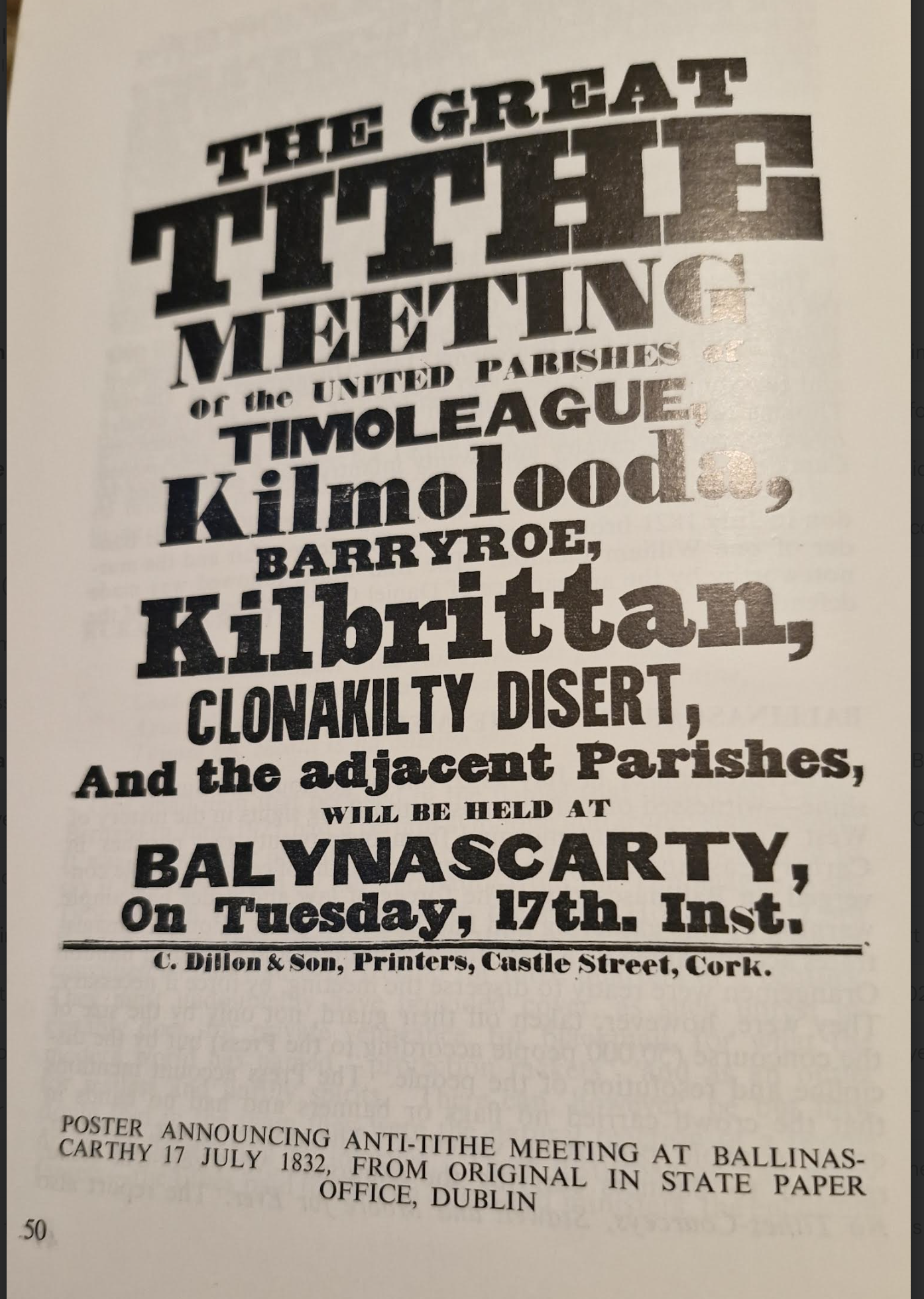
1832 GREAT TITHE MEETING OF THE UNITED PARISHES OF TIMOLEAGUE, KILMALODA, BARRYROE, KILBRITTAN, CLONAKILTY, DISIRT AND THE ADJACENT PARISHES IN BALLYNASCARTY
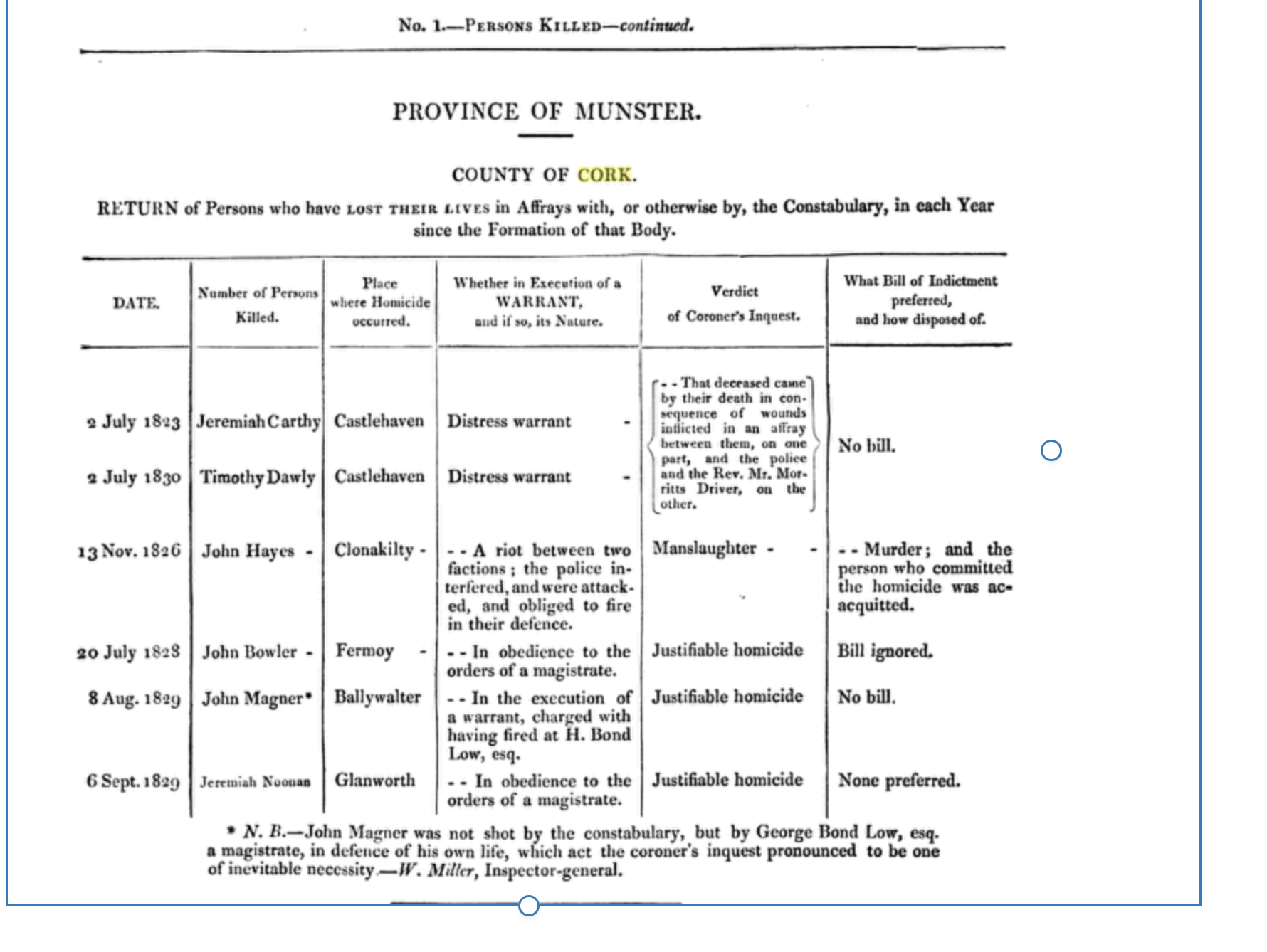
The Tithes in the 1820s: ‘The year’s tithe due to Mr. Alcock, the Rector Durrus, was nearly collected in one day. The summary collection was effected by the police who act as drivers. In the case referred to the determination to to obtain ‘Tithe Distress’ was so great that I have been informed that the house where the parish priest the Revered Quin was saying Mass was forcibly entered and a bed the only item of value would have been taken but for the suggestion of some Protestant who objected to that mode of insult to a Clergyman. The men from Muintervara (Durrus/Kilcrohane) who have the distinguished honour of being the first Western district to have given the death blow to the Tithe system, proceeded under the conduct of Richard O’Donovan Esq of Tullagh and Timmy O’Donovan Esq at Monster Meeting Mount Gabriel 1832
Rev. Edward Herbert Kenny, Rector of Kilmeen, Widely Praised for Work on Road and Bridges enabling Sea Sand to be used as Fertilizer in Interior of West Cork. 1832 calls in Gunboat to Clonakilty, 69th Regiment and Police in Attempt to Collect his tithes at Kilmeen and Ballygurteen. Magistrate: Rev. Edward Herbert Kenny, 1799, died 1842. Freeman of Kinsale 1797. Subscriber, at Moviddy, James Mullalla, Review of Irish Affairs 1688-1795. Major figure in road building praised by Horatio Townsend for road work enabling sea sand to go through Kilmeen to interior. Present at enquiry Skibbereen 1823 into enquiry into fatal affray at Castlehaven caused by Rev. Morritt’s tithe extraction. 1822 received £50 for distress in Kilmeen from Lord Lieutenant. 1830 subscriber Robert O’Callaghan Newenham ‘Views of the Antiquities of Ireland’. 1833 tithes. 1831, Ballineen 1835, 1835 Son of Rev. Dr. John Kenny, rector of Kilbrogan which he spent £3. 104 on, his father had married sister of Emmett Archbishop of Tuam. Family based in Bandon area. Subscriber at Kilmeen Glebe where he was rector for 43 years. Lewis Topographical Dictionary of Ireland 1837. Rector of Durrus for 6 years. Edward Herbert Kenney 1793-1799, a Justice of the Peace 28th May 1799. He was later Rector Rosscarbery and his work in organising relief work (in the famine of 1822) and paying the workers in money or meal was praised by the Parish Priest for his ‘meritorious conduct’. Family buried at Ballymartle. County Freeman Kilmeen of Cork City voting in Cork City Election 1837.
Rev. Edward Herbert Kenny, Rector of Kilmeen, Widely Praised for Work on Road and Bridges enabling Sea Sand to be used as Fertilizer in Interior of West Cork. 1832 calls in Gunboat to Clonakilty, 69th Regiment and Police in Attempt to Collect his tithes at Kilmeen and Ballygurteen.
It is difficult to reconcile his altruism and industry wiht his tithe collecting attempts. Reading the Chief Secretary Papers the military and Dublin Castle Authorities wee thoroughly sick of him and his high handed antics.
Kilmeen Herbert Gillman, Edward O’Brien. Rev. Edward Herbert Kenny £750 entirely to Rev. Edward Herbert Kenny. Special Vestry chaired by Robert Sealy, William Buttomere (Buttimer), John Bateman, John Collins approved no variation for 21 years rector assented. 1833 For 7 years ending 1821 barrel of wheat £1 18 shillings 8 and a half pence grown in said country
CSO/RP/1832/5791. Letters from EH Kenny, Rector of Kilmeen and magistrate, Clonakilty, [County Cork], to Edward Smith Stanley, [Chief Secretary], stating that his bailiff was assaulted while attempting to distrain livestock in lieu of tithe arrears in his parish and that a party of police was stoned while attempting to restore order; seeking the stationing of a military force in the parish and suggesting that the military commanders be appointed to the commission of the peace.
Also letter from Daniel Conner and NS Shuldham, magistrates, to Stanley, reporting on the incident. CSO/RP/1832/6119. Letter from the [Maj Gen Edward Blakeney, Commander in Chief], Major General Commanding, Royal Hospital, [Dublin], to Sir William Gosset, [Under Secretary], forwarding a report [not extant] from Col Wilson, commanding the 65th Reserve concerning the enforcement of tithes at Kilmeen, [possibly County Cork]. CSO/RP/1832/5562.
File containing police reports of a serious attack on the police and military while attempting to assist Rev Edward H Kenny with the enforcement of his tithes at [Ballingurteen, County Cork] CSO/RP/1832/6335.
Letter from [Arthur Chichester, 1st Baron] Templemore, Military Secretary, Royal Hospital, Dublin, to Sir William Gosset, [Under Secretary], referring to military reports from Maj Gen James Douglas and Capt Patience, 65th Reserve at Clonakilty, [County Cork], concerning an unnecessary request made to Capt Patience by Rev EW Kenny, magistrate. Also copy of letter from Gosset, Dublin Castle, to Kenny, Kilmeen, Clonakilty, informing him that the troops should not have been required to march 18 miles on unnecessary business.
1822, The Troubles of a Struggling Farmer, Mud Cabin, Heavy Taxes, Tithes, Cess, and Rack Rents, Wintry Wind, by Poet Mícheál Óg Ó Longáin (1766-1837), Caheragh, (lived later Glanmire), Co. Cork.
Life
1766–1837),poet and scribe; born to the Ó Longáin learned family in Carrignavar, Co. Cork. 1766-1837; b. Carrignavar, Co. Cork; son of Mícheál mac Peadair; orphaned young, his parents dying in 1770 and 1774; employed as cowherd; returned to education, 1784; assisted United Irishmen, 1797-98; wrote for Whiteboys, 1785; ‘Buachaillí Loch Garman [Boys of Wexford]’, 1798; m. 1800; worked as scribe, labourer, and teacher in Co. Cork; settled in north Kerry and East Limerick, 1802-07; wrote on poverty and oppression; employed as a teacher and scribe by Rev. John Murphy, Bishop of Cork, 1814; copied manuscripts, 1817-1820; sons Peadar and Pól, and Seosamh, also became scribes; died. on his son Pól’s 11-acre holding in eleven acres in Knockboy in Carrignavar.
Criticism Breandán Ó Conchúir, Scríobhaithe Chorcaí 1700-1850 (1982)
It is likely that poet JJ Callanan sent quite a while in Caheragh through Bantry Doctor Dr. Thomas Burke in the 1810s who had associations in the area.
From the 18th century to the late 19th century the surname ‘Ó Longáin’ was synonymous with ‘scribes.’ Working as a scribe meant copying stories, poetry, histories and religious texts from manuscripts and printed works for patrons. Working as a scribe also involved translating texts from Irish to English. Frequently their patrons were from Cork merchant families, were Cork scholars themselves such as John Windele or from Cork clergy such as Bishop John Murphy. Working as a scribe had previously been a position of privilege but as the Gaelic order disintegrated following the Flight of the Earls in 1607, scribes found their living situation growing perilous and frequently lived in poverty. Micheál mac Peattair, his son Micheál Óg and his grandson Peadar were based in Carrignavar, Cork. Grandsons Pól and Seosamh were primarily based in Dublin. Seosamh transcribed manuscript facsimiles for publication on behalf of the Royal Irish Academy. The Ó Longáin preserved a tradition and ensured access to countless texts through their scribing endeavours.
The hardness of this bed and the lack of a mantle day or night,
Heavy taxes, tithes, and rack-rent demands,
Have made me troubled, in want, and lamenting.
1828. Petition of Parishioners of the Parish of Caheragh, County Cork, requesting aid be provided to build a parish church. Reverend John Webb, only visits the parish once a year ‘for the purpose of Collecting his tithes’ Numbers of their community have ‘turned to mass and several have been buried without received Protestant burial’ rites.
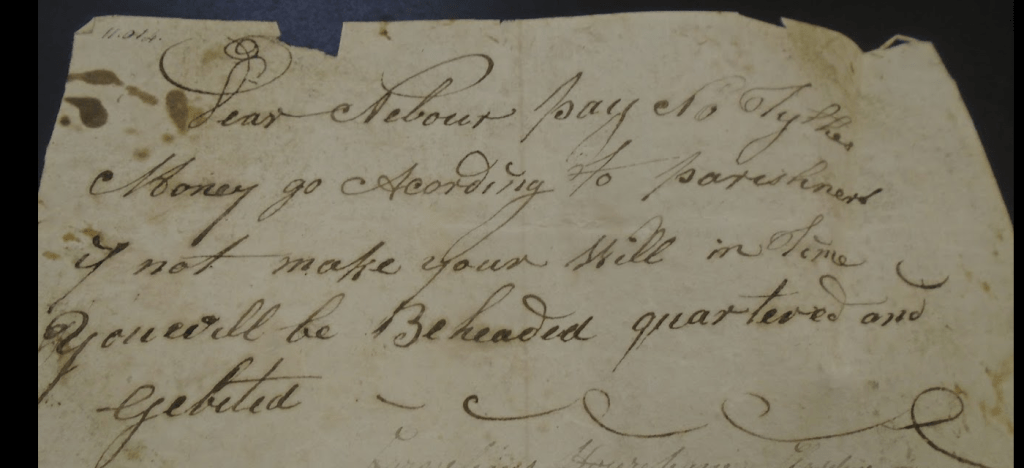
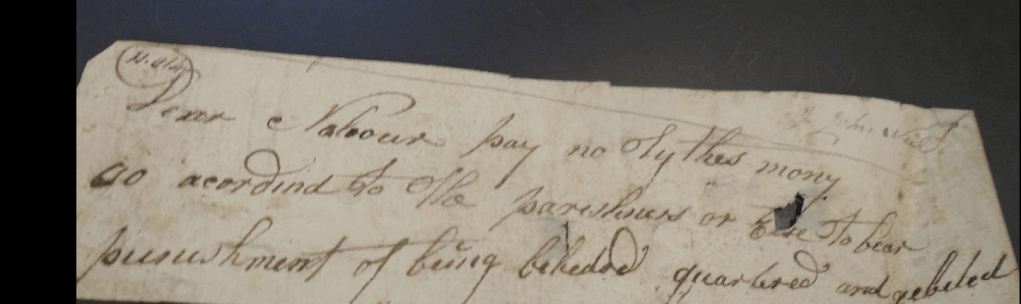
CSO/RP/1832/4660. Letter from A O’Driscoll, Shepperton, [County Cork], to Maj William Miller, [Inspector General], forwarding threatening and anti tithe notices [extant] posted in Drimoleague [Dromdaleague] and reporting on outrages in his area and recommending the strengthening of the military in the area
1832, Drimoleague, Anti Tithe Notice Posted ‘Dear Nebour Pay No Tythe Money Go According to Pereshners if Not Make Your Will or You be Beheaded Quartered and Gelded’
Captain Alexander O’Driscoll, 1827, Clover Hill, Superseded 1810-30, Restored 1843. Norton Cottage, Skibbereen (two of the same name at time), Ancestor Alexander married daughter of McFineen Dubh O’Sullivan, son of Tim ‘The Gauger’, sister Mrs Freke of Baltimore Castle. 1820 signed Memorial for new road Glengariff to Castletownbere. Married to the daughter of Thomas Attridge, Ballydehob. Correspondence with Chief Secretary appealing dismissal of 1820. Bridge at Bawnlahan 1820. 1822 subscriber as Clover Hill, Church Building Fund Durrus, he held tithes in Kilcrohane with Rector and Rev. Alleyn Evanson. Present at enquiry Skibbereen 1823 into enquiry into fatal affray at Castlehaven caused by Rev. Morritt’s tithe extraction. Grand Jury Presentments attending 12 from 1838-1840 at Norton Cottage. Probably engaged with his crew in marine salvage of Clio out of Crookhaven 1825. 1826 City election voted O’Callaghan conservative. Voted 1835 election as out of town Freeman address Shepperton. Public support for him on dismissal 1835 by fellow Magistrates Lord Bantry, Simon White, John Puxley, Samuel Townsend Senior, Samuel Townsend Junior, Hugh Lawton, Thomas Somerville, Rev. Alleyn Evanson, Richard Townsend Senior. Enquiry attended in Bandon 1841 into suspension arising from conduct with Stipendiary Magistrate J. Gore Jones and Sub-Inspector Andrew Creagh attended Earl of Bandon, Lord Viscount Bernard, on. H. White Hedges, Macroom Castle, Henry Bernard, Castle Barnard, Abraham Morris Dunkettle, Captain Henry Wallis, Drishane Castle, Lieutenant Colonel St. John Clerke, Overton House, William Cooke Wallis Junior, Castlecook, Mathias Hendley, Mountrivers, Henry Leader, Mount Leader, George Browne, Coolcower, St. Ledger Aldworth, Newmarket, Charles Evanson, Carlemont, Cork, Sir Thomas Deane, Thomas Hungerford, The Island, Nicholas Dunscomb, Mount Desert, Richard Henry Hedges Becher, Hollybrook, Skibbereen, John Isaac Heard, Kinsale, John Wheeler, Junior, James Gillman, Retreat, MD, Clonakilty, Thomas Herrick, Coolkerry, Captain R.A. Rogers, Petersfield, Michael Gallway, Gurtnagreena, John Nason, G. Nagle, Ballinamona Castle, Samuel Wallis Goold Adams, Jamesbrook, Jeremiah E. McCarthy, Rathduane, William F. Austen, Greenshela, Thomas R. Sarsfield, Ducloyne, Arthur Pery Aylmer, Castlefreke, Thomas Cuthbert Kearney, Garretstown, Joseph Haynes, Maryland House, Charles Connell, Cloverhill, John Barter, Cooldaniel, Francis G. Woodley, Leeds, Lawrence Corban, Maryville, E. Millett, MD, Cove. 1841 supported Conservative Longfield Longueville, Mallow even though Catholic hosted meeting attending John Ross, Rossford, Thomas Morris, Mahonagh, Thomas Wood, Dereeny, Listed 1838, dead….. with address Mount Music/Bunaulin, Caheragh when daughter Kate married Herbert Baldwin Esq., 1845. 1835 Subscriber at Gortnascrena, Skibbereen, Lewis Topographical Dictionary of Ireland 1837. Suspended for a period as J.P. reinstated after altered by a sitting of over 70 Magistrates in Bandon from both political sides. 1828 Bandon Quarter Sessions. His lands managed by Bird. Member Provisional Committee projected Bandon to Bantry Railway 1845, address Norton Cottage. Believed to have been committed to a debtors prison in Cork by his wine merchant where he died. Norton Cottage was lived in once by Dr. O’Donovan, J.P., and bought 1925 by Jasper Woulfe, Solicitor, Crown Prosecutor and TD,
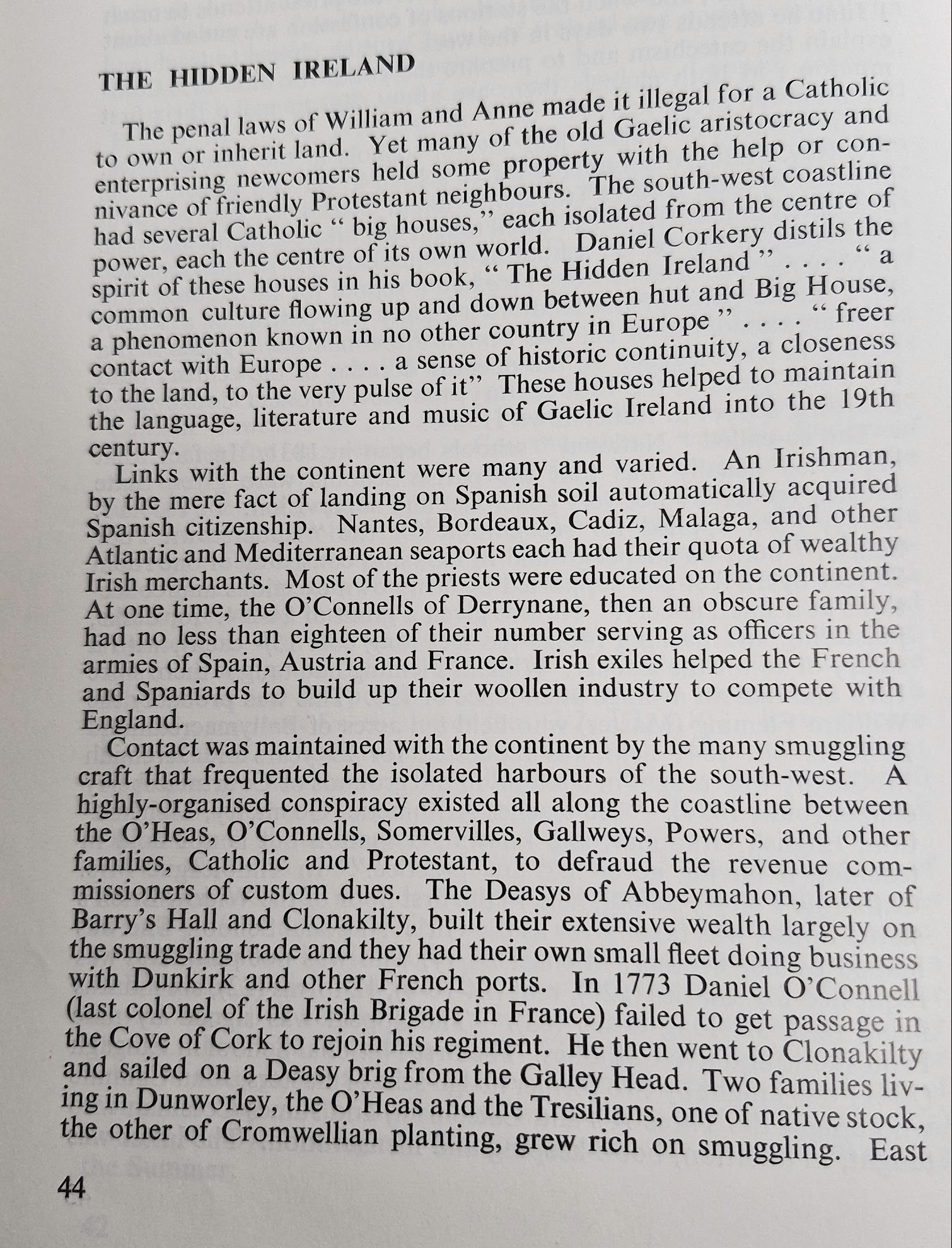
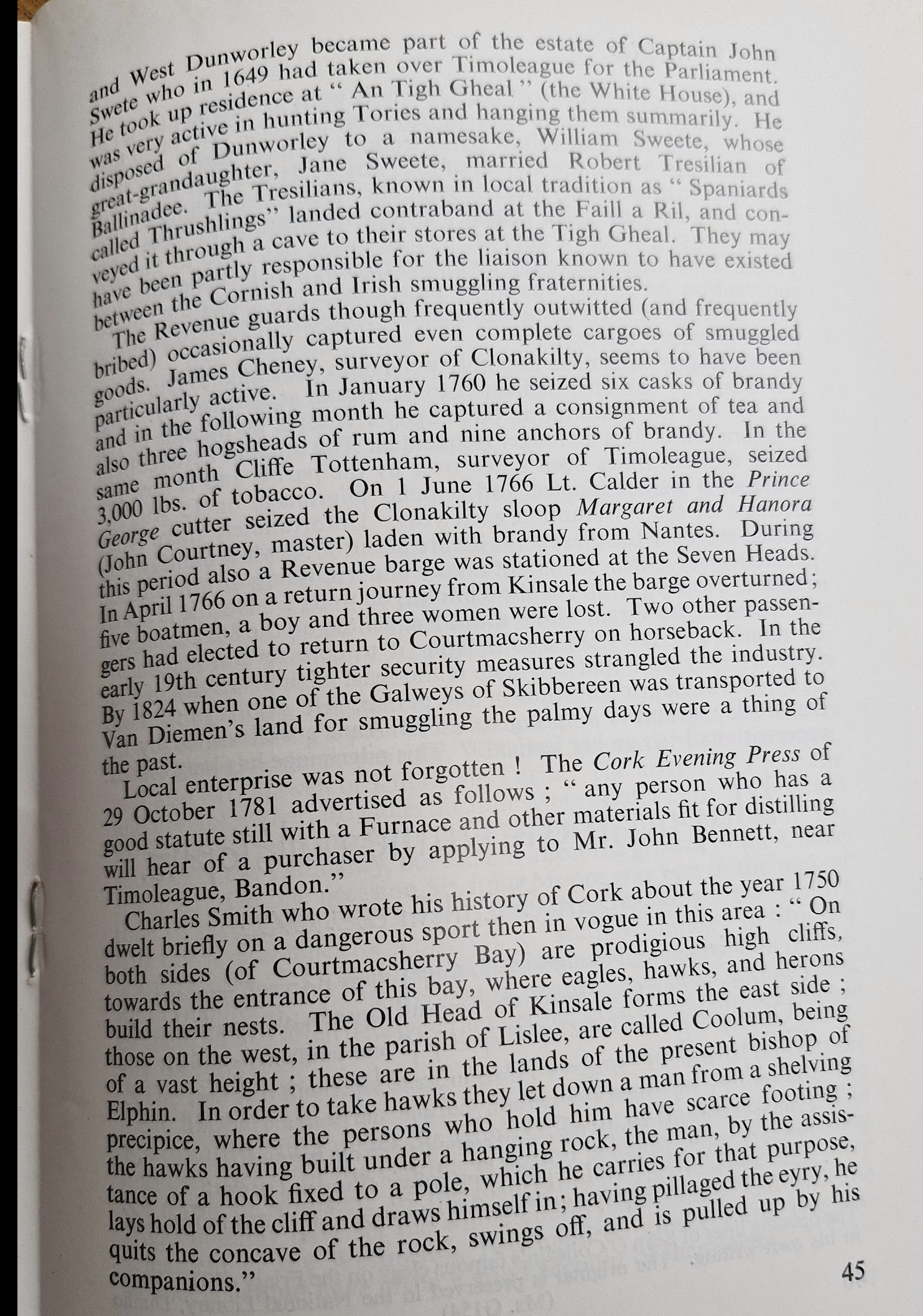
Re smuggling in the 17th century it is worth recalling the context.
After the end of the English Civil War when Parliament prevailed there was a strong view that the English army should be abolished as they might present a threat to the new dispensation. The compromise was a largely reduced army with a standing garrison of 15,000 to be based in new barracks in Ireland. This was to be a charge on the Irish Exchequer. The building of these barracks gave arise to the Irish Barack towns, many of which only closed in the last 30 or so years.
So whenever an old lad in the 1740s had a smathán or smoked his pipe not only was he contributing to the British occupation of Ireland but paying for their garrison.
Clearly when the ‘legal’ price of excitable items excess the market price by a wide margin the opportunities for smuggling are immense.
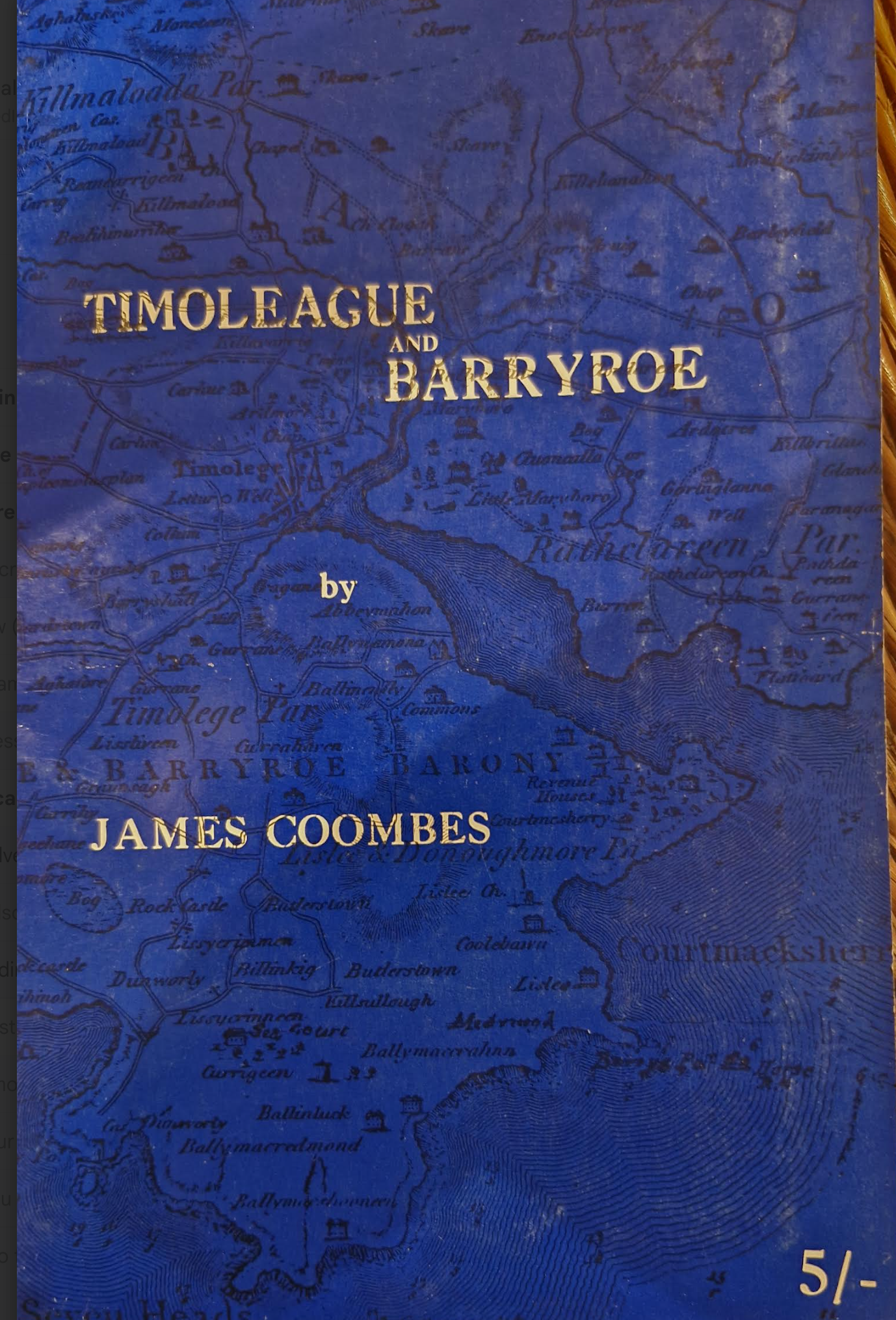
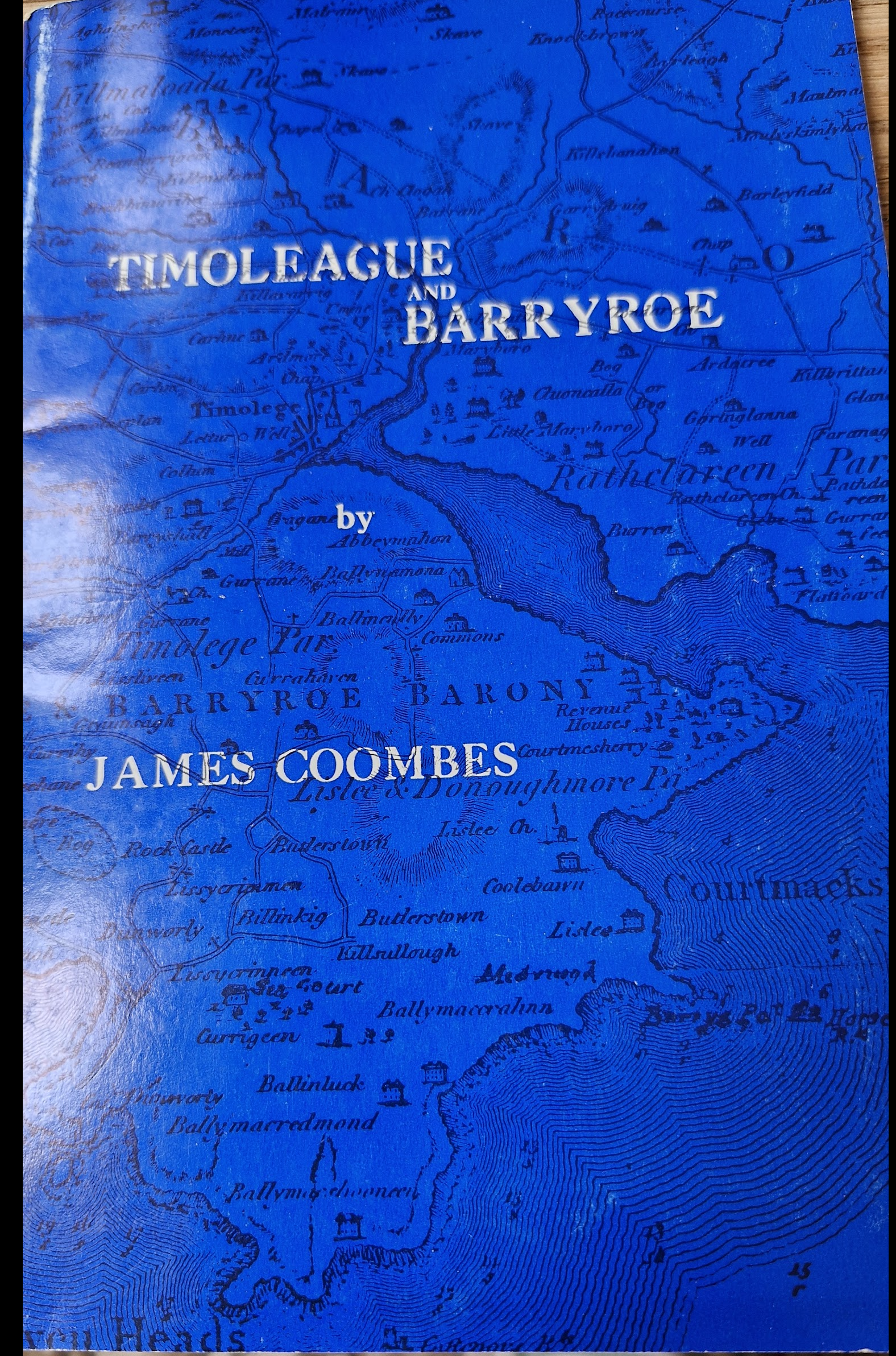
From Father James Coombes History 1969.
Thanks Pat,
That is interesting reading. It’s all true. Edward was the guy transported leaving his wife and six kids. So we’re others near Skibbereen. The Kilkeran ones brought boats into the local “lake” and stored stuff in the basement, allegedly with an underground tunnel. Family fortunes were hard hit. Family were installed in Bordeaux, Nantes, Oporto etc to look after that end of it. There are de Gallweys in France.
Arthur Hutchins, Landlord and Magistrate, Ardnagashel, Bantry married 1802, Matilda O’Donnell, (Smugglers), Erris, Co.Mayo, descendant of Niall of the Nine Hostages, West Cork Crowleys, Descendants of Niall of the Nine Hostages
1740. a Memorial of Several Gentlemen Residing at or near Berehaven in West Cork, setting forth the necessity of having a Barrack built for one company and half of foot to prevent running of Goods and the Shipping Off of Men to Foreign Service
refers to the inaccessibility of the region around Crookhaven harbour and the persistence of smuggling which is difficult to check due to ‘the numerous creeks and inlets on the coast’; includes letter from Griffith, Skull, to Gregory, acknowledging invitation of the Lord Lieutenant to meet for interview in Dublin but to request the date is deferred to enable his attendance at the assizes of counties Kerry and Cork. izes of counties Kerry and Cork.
In the North it became the practice to put studs into horse shoes.
Studs are small metal projections that screw into the horse’s shoes. They’re used to give him better grip on various types of footing, from firm and slippery to soft and boggy. They’re great if the horse loses his focus in less-than-ideal footing or to give him extra traction when doing road work.
For some reason studs were illegal in the Free State.
The Canon wished to bring some down from one of his northern trips. He took the saddle off his bike and filled the hollow of the frame with studs and replaced the saddle. The bike passed over the border no problem and the Canon and his bike with studs arrived safely in Durrus.
When my mother was about to be confined she went to Bandon to be under the care of an old friend and relative who lived an a small house in Castle St. close to the river. Here on the morning of the lst May 1829 at 6 O’C am I was ushered into this world to undergo a training for eternity. The term of that training time has been a little more than the psalmist’s reckoning and on the whole I ought not to complain. My most painful time was during my childhood, the very times which should be the easiest if not the happiest portion of the training time. My grandfather was very old with an old mans ideas when I came under his care. I was naturaly dull and nervous and if I could lot learn as others I must be made to if possible no matter at what cost of pain or misery to the poor dullard. When about five years of age the old people came to live in the town of Bantry. Then I was sent to the usual infant school where I presume I learnt something as when about eight a more advanced school was chosen. Unfortunately there was no great choice, the national school then newly established or a private one conducted by a man named Healy. The Irish protestants from the very first were prejudiced against the national system of schools describing them “poor schools”. The result being they were almost from the commencement under the wing of the R.C. priests. Healy the teacher of the small private school was a self taught man attaining as many self-taught men do a fair knowledge of mathematics but seemingly holding in contempt all other branches of learning. He was a little man essentially a tyrant cruel to a degree whose great delight was to make the unfortunate little come trembling and sobbing into his presence. In certain aspects of his character he exceeded any thing depicted by the pen of Dickens. The treatment I received thus early in my life at this man’s hands must have had an ill effect on me throughout life. He was a Roman Catholic but my grandfather insisted that I should learn so many verses of the bible every day. In the repeating of these and other lessons the rod was continually shaking over us and that rod was usually a well seasoned holly one with the sharp points adhering. I had to endure it all silently having no one to complain to. As an instance of his treatment I may relate the following. The school room was a rough one with an open roof, over one of the rafters one day he threw a small rope tied under my arms and then hoisted me up swinging me too and fro at the same time letting me feel the holly rod greatly to the amusement of the other boys. His wife happened to see him at this, to his pleasant, occupation when she rushed in and released me at the same time giving him some of her mind. He was eventually had up before the Magistrates and fined for cruelly treating some other scholars whose friends became aware of the fact. On our parents death there was some understanding that Robt Edwards of Bandon and our father’s brother James should be our guardians. The one who really took an active interest, at least in life history was Mrs Edwards as good a hearted woman as could be met with but most unwise in all her dealings with young people especially boys. She seemingly could not resist any appeal from her own sons, their father taking little interest in them, so that the sons without exception were a burden instead of a help to their parents. A young couple with whom she was acquainted decided to establish a private school in Bandon and it was thought well that I should be put under their care. When I was ten years of age I together with my cousin George son of adult Bess- came to reside as borders with Mr and Mrs Thomas Robinson.
1886 Address from Some of Bantry Inhabitant to the Earl of Bantry, on His return from Abroad. 1885, House of Commons, London, A Lash of Tim Healy’s , MP, Tongue, The Earl of Bantry Off Chasing Kangaroos in Australia instead of Sitting on Cork Lunacy Board
1909 Bantry Feis. Patrons include Canon (Church of Ireland) O’Grady, James Gilhooley, M.P., Tim Healy King’s Counsel,M.P., Maurice Healy, M.P., The Earl of Kenmare, Magistrates, Dr. O’Mahony, Benjamin O’Connor, M. O’Driscoll, William Martin Murphy, Alexander Martin Sullivan, King’s Counsel, Dr. M. J. McCarthy, Patrick (Rocky Mountain) O’Brien, Dromore. Prizewinners, Industrial Section.
Emigration from Gearhies, Muintervara, to Joliet, Illinois, America. Visit of Bantry Born MP, Tim Healy 1881, Hotbed of Fenians, Hibernian Activity, Pro Boer Meeting Attended by Many Irish.
Bantry Gang: Healy Brothers, Thomas, Solicitor, M.P., Timothy, M.P. , Queen’s Counsel, Governor General Irish Free State, Tim, Sullivan Brothers, Alexander Martin, Owner ‘The Nation’, Founder Irish Parliamentary Party, M.P. Queen’s Counsel, Timothy Daniel, M.P. Composer ‘God Save Ireland”, Donal, Secretary Irish Parliamentary Party, M.P, Lord Mayor of Dublin, Harrington Brothers, Tim, Teacher, Journalist, Author of The Plan of Campaign, M.P., Barrister, Lord Mayor of Dublin, Ned, Organiser, M.P., William Martin Murphy, International Businessman, Railway Contractor, owner Irish Independent, Dublin United Tramways, M.P., James Gilhooley, Fenian, M.P.
Genealogy of O’Healy/Healy Family of Donoughmore, Co. Cork ancestors of Tim Healy, Bantry, Governor General and John Hely-Hutchinson/Earls of Donoughmore and 1850 census of St. Anne’s Parish, Shandon, Cork.
Transferred to Richard Burke, Rathara, Schull, 11/10/1934
Barnett Denis
Brahalish
82
Beamish, R.A.
Ardogeena
89
Burke, Denis
Drishane
94
Baker, John
Rooska
105
Brooks, Edward
Dromreagh
113
Burke, John
Coomkeen
149
Burke, Daniel
Coomkeen
151
Brooke, Herbert
Dromreagh
157
Burke, William
Clashadoo
137
Son in law of Jehr Cronin
Burke, Michael
Brahalish
160
Brooks, Walter
Brahalish
167
Barry?, John
Mureigh
169
Coughlan, Bridget
Coolculaghta
5
Cotter, Rev. Fr Michael
Durrus P.P. 1933
13
Marked zero share later
Cronin ?, John
Rusnacahara
14
Crowley, Robert
Ballycomane
19
Crowley, Patrick
Clashadoo (Ahagouna)
34
Clarke, Goodhand
Glanlough
35
Later Rockmount, Drimoleague
Crowley, Con
Droumreagh
49
Cahalane?, Mrs
Ballycomane
51
Later Durrus village
Coughlan, Burd
Mount Gabriel
57
Later cancelled never subscribed
Cleary, Cornelius
Dunbeacon
66
Connolly, Michael
Colomane
74
Creedon, Daniel
Gurtnalasa, Bantry
110
Cancelled after 1936
Connolly, Thomas
Glenlough
114
Transferred to A.W. Derman, Drimoleague 14/12/1938
Cronin, John
Parkan
126
Coughlan, Daniel
Coolculaghta
135
Cronin, Jehr
Clashadoo
137
Father in law of Wm. Burke
Cleary, James
Ballycomane
132
Later transferred to Rhea, Kilcrohane (son)
Coughlan, John
Dromreagh
140
Crowley, Mrs Irene
Durrus Court
159
Admitted 1958- wife of John staff member
Dukelow, Robert
Dromantanaheen
18
Bantry Road
Dillon, Timothy
Clashadoo
26
Dukelow, Charles
Clashadoo
29
Dukelow, Thomas
Droumatanaheen
32
Transferred to Micjhael Hegarty, Clashadoo 11/10/1933
Dukelow, Peter
Droumreagh
36
Dukelow, John
Crottees
42
Dukelow, John
Rossmore
44
Dukelow, Richard M
Brahalish
46
Deane, Barnabas
Ballycomane
50
Dukelow, Thomas
Clashadoo
81
Donovan, Thomas
Glenlough W
87
Dukelow, Robert
Coomkeen
90
Dukelow, Bert
Blair’s Cove
93
Dungan, Herbert
Ballydehob
108
Later Ballymodan Bandon
Driscoll, James
Dunbeacon
54
Transferred form Patrick J. Barry
Dukelow, Richard
Crottees
118
Transferred to daughter Mable? Salter, Castlehaven, 1975
Donovan, Daniel
Ballycomane
120
Dukelow, John
Coolculaghta
128
Draper, John
Scart
33
Dukelow, John
Droumateenaheen
81
Deane, Thomas
Ballycomane
14
Dinan? A W
Post Office, Drimoleague
114
Of Drimoleague PO should read Donnan
Donovan, Timothy
Kealties
131
Originally Timothy Sullivan, Clonee
Dukelow, Ernest H
Droumatinaheen
165
O’Donovan, Jeremiah
Kealties
172
Transferred from Kilrohane 16/6/1977
Evans, Mrs Kathleen
Moreagh
45
Transferred from pat Hurley, Ballycomane
Flynn, John
Parkana
64
Transferred to Colomane 28/5/1957
Fitzgerald, James
Letterlicky
103
Transferred from John Hegarty 1956
Gay, Richard
Dromreagh
55
Hayes, Daniel
Dunbeacon
1
Hegarty, George M
Rossmore
43
Hurley, Patrick
Ballycomane
45
Harnedy, Tim
Droumreagh
52
Hayes, Daniel
Dunbeacon
62
Hayes, Thomas
Dunbeacon
62
Harrington, John
Brahalish
86
Hegarty, Michael
Clashadoo
32
Hurst, Edwin
Beach, Bantry
111
Transferred to Bantry 1937
Hurley, Mrs Dora
Ballycomane
115
Hurley, Joseph
Ballycomane
123
Holland, Timothy
Dunbeacon
136
Transferred to Timothy Donovan, Kealties (nephew)
Hosford, William John
Brahalish
6
Harrington, Daniel
Kealties
150
Later Blackrock Road, Bantry.
Hegarty, James
Letterlickey
103
See 103 above
Hurley, Daniel
Ballycomane
152Back Row, left to right. Teacher/Trainee? Teacher Mrs Annie Sweetnam, Dunbeacon, not qualified not sure if it was because she had no Irish. Good teacher for writing, hymns, sent her two daughters to Ballydehob. School closed mid 1940s. Some pupils went to St. James Durrus Some to Dunbeacon Catholic. Lack of Irish meant that pupils used to go to St. James probably to Líam Blennerhassett from Kerry he had excellent Irish. No. 2 Richard (Sonny) Pyburn, b 1919, all Pyburns Dunbeacon, farmer. May have spent some months in St. James, Durrus. Front: No. 2 Victor Sweetnam, Lahern, brother to Nan Sweetnam, farmer, never married. No 3. Nan Levis, Cashelane, lived with her single brother neither married, farmers. No. 4. Georgina Pyburn, Dunbeacon, married George Bower (He is buried St. James, Durrus), Co. Louth, he was a horticulturalist with Guinness at Birr. 2 boys, Raymond, Bert, 1 girl. No. 5. Susan Pyburn, married Charlie Gilliard, mechanic, London, 1 boy 1 girl. No. 7 Vera Pyburn, m Ernie Splaine, Riverstick, KInsale,, Son Robert (Show jumping champion) Freida, Jean 3 small boys don’t know names possibly one a Phillips from Dunbeacon or William Levis no family married into farm.
Transferred to Patrick Moynihan, 152 and 155
Hill, Michael A
Blair’s Cove
162
Admitted 11/10/1962
Hickey, Francis
Durrus Village
170
Admitted 19/2/1973
Johnson, Frank M
Fahane, Gortalasa, Bantry
101
Transferred to Thomas Johnson, Clashadoo 12/8/1958
Keohane, Daniel
Clonee
17
Transferred to Daniel Sullivan 18/10/1955
Kelly, Timothy
Ballycomane
127
Kingston, Samuel J
Kealties
166
Admitted 19/11/1968
Lynch, Con
Clashadoo
28
Transferred to John O’Sullivan, (son-in-law) 23/2/1971
Levis, George M
Shountellig
61
Now Gurteenakille
Levis, Samuel
Kealties
161
Transferred from Kilcrohane 19/5/1960
Minihane, John
Parkana
22
Transferred from Mrs Mary Neill 1943
Moynihan, Patrick
Coomkeen
155
Transferred to John Draper, Scart, 11/3/1936
Mahony, Daniel
Ahagowna
33
Mahony, John
Coolculaghta
20
Murnane, Patrick Joseph
Coolculaghta
23
Later Ballydehob
Murphy, Gerry
Airhill, Schull (Drouogh)
53
Murnane, Daniel M
Letterlickey East
63
Transferred to Colomane 1941
Moynihan, John
Shauntullig
67
Marked zero shares after 1933
Murnane, Patrick P
Letteralickey
76
Transferred to Colomane 1940
Murnane, Michael
Letterlickey
98
Transferred to Colomane 1940
Mehigan, Mark
Drishane
116
Transferred to Lowertown
Mahony, John
Brahalish
121
transferred to Julia Teresa Connolly (niece-in-law) 1965
Mahony Daniel
Letterlickey
78
Transferred to Colomane 1941
Moynihan, Patrick
Ballycomane
152
See 155 above
McManaway, Rev T.J.
Durrus
11
Transferred to Dunmanway (17)
McCarthy, Florence
Letterlickey Middle
15
McCarthy, Charles
Coolculaghta
21
McCarthy, Denis
Droumreagh
40
McCarthy, Jeremiah
Droumreagh
41
McCarthy, John
Scart Bawn
75
Transferred to Colomane
McCarthy, Mrs
Parkana
79
McCarthy, Denis
Ardhra
88
Transferred to Colomane
McCarthy, John
Blair’s Cove
99
Later Ardogeena
McSweeney, Ellen
Murreagh
104
Transferred to son Mortimer, Friendly Cove 1971
McCarthy, Timothy
Ardra
124
Transferred to Colomane
McCarthy, Jerome M
Brahalish
133
McCarthy, Michael
Coolculaghta
154
McCarthy, Charles
Glanlough
156
McCarthy, Timothy
Ballycomane
163
Admitted 1963
McCarthy, Patrick
Tullig, Durrus
173
Transferred from Kilcrohane 1977
Neill, Mary
Ballycomane
22
Transferred to John Minihane, Parkana, 1943
Neill, James
Ballycomane
47
Nugent, Jeremiah
Derryfunchion, Dunbeacon
100
Neill, John
Friendly Cove
139
Transferred to Annie Regan, Friendly Cove, 1946
Newman, Jeremiah
Scart
65
Transferred from Denis Sweeney 1936
O’Driscoll, Jehr
Shantullig
100
Transferred to Jehr Nugent, Dunbeacon, 16/8/1935
O’Driscoll, James
Dunbeacon
117
O’Brien, Daniel
Durrus
146
Transferred from Bantry
O’Regan, Mrs Annie
Blair’s Cove
139
Transferred from John Neill, Friendly Cove, 1946
O’Sullivan, Timothy
Ballybrack
77
Transferred from John Miller, Coolculaghta, 1950
O’Sullivan, Stephen T.
Gloun, Schull
89
Transferred from RA Beamish, Ardogeena, 1952
O’Sullivan, Denis J
Durrus
87
O’Sullivan, Daniel
Clonee
17
Transferred from Daniel Keohane 18/10/1955
Pyburn, John M
Dunbeacon
48
Pyburn James
Dunbeacon/Coomkeen
109
Pyburn, William
Dunbeacon
119
Transferred to Lowertown
Roycroft, James
Mount Gabriel
59
Marked zero shares after 1934
Sullivan, William M
Ballycomane
148
Transferred to Mary and Donal Hayes 1994
Shannon, David
Ardogeena
153
Later Dromreagh
Sullivan, Denis
Durrus
24
1948
Shannon, Miss Usher M
Brahalish
84
Transferred from David Shannon 1951
Slater, Owen
Ardoguna
158
Admitted 1955
O’Sullivan, John
Clashadoo
28
Transferred from Con Lynch (father-in-law)
O’Sullivan, Cornelius
Ballycomane
171
Admitted 1974
Shanahan, John
Dunbeacon
2
Marked zero shares 1933
Shannon, Robert M
Brahalish
3
Sullivan, William
Morreagh
4
Sullivan, John
Ardogoena
6
Transferred to William Hosford Brahalish 1943
Shannon, William M
Brahalish
7
Shannon, James
Rossmore
8
Shannon, Robert
Brahalish
9
Sullivan, Patrick
Coomkeen
12
Swanton, James
Ahagoheen
16
Shannon, John
Glanlough
24
Shannon, Robert
Dunbeacon
25
Sweetnam, William
Dunbeacon
31
Shannon, William
Rossmore
27
Sullivan, Denis
Geerahameen
38
Marked zero shares 1947
Shannon, john
Cashelane
56
Transferred to Lowertown 1956
Spillane, Tom
Moulward
58
Sweetnam, John
Lahern
60
Sweeney, Denis
Moulivard
65
Transferred to Bantry 1943
Sweetnam, William
Mount Gabriel
68
Sweetnam. Sam
Raheen
69
Sweetnam, John
Dunbeacon
73
Shannon, Thomas
Clashadoo
83
Shannon, David
Brahalish
84
Shannon, Thomas
Brahalish
85
Swanton, Sam
Clonee
91
Swanton, George
Aughagoheen
92
Spillane, Timothy
Ballycomane
95
Shannon, Mrs Maria
Maulnamill
97
Shannon, John J
Brahalish
102
Marked ‘in England’ 1968
Swanton, James
Mullagh
106
Transferred to Bantry 1939
Sullivan, James
Upper Tedagh
107
Transferred to Bantry 1940
Sullivan, Daniel
Droumacousane
112
Transferred to Bantry 1943
Sweeney, Mrs Kate
Moulavard
130
Swanton, Benjamin
Clonee
134
Sullivan, Jer
Clonee
131
Transferred to Timothy Donovan Kealties 1955
Sullivan, Eugene
Crottees
141
Shannon, Tomas
(Clashadoo), Brahalish
144
Shannon, William
Clashadoo
145
Lissamarig, Skibbereen, transferred to Skibbereen 14/5/76
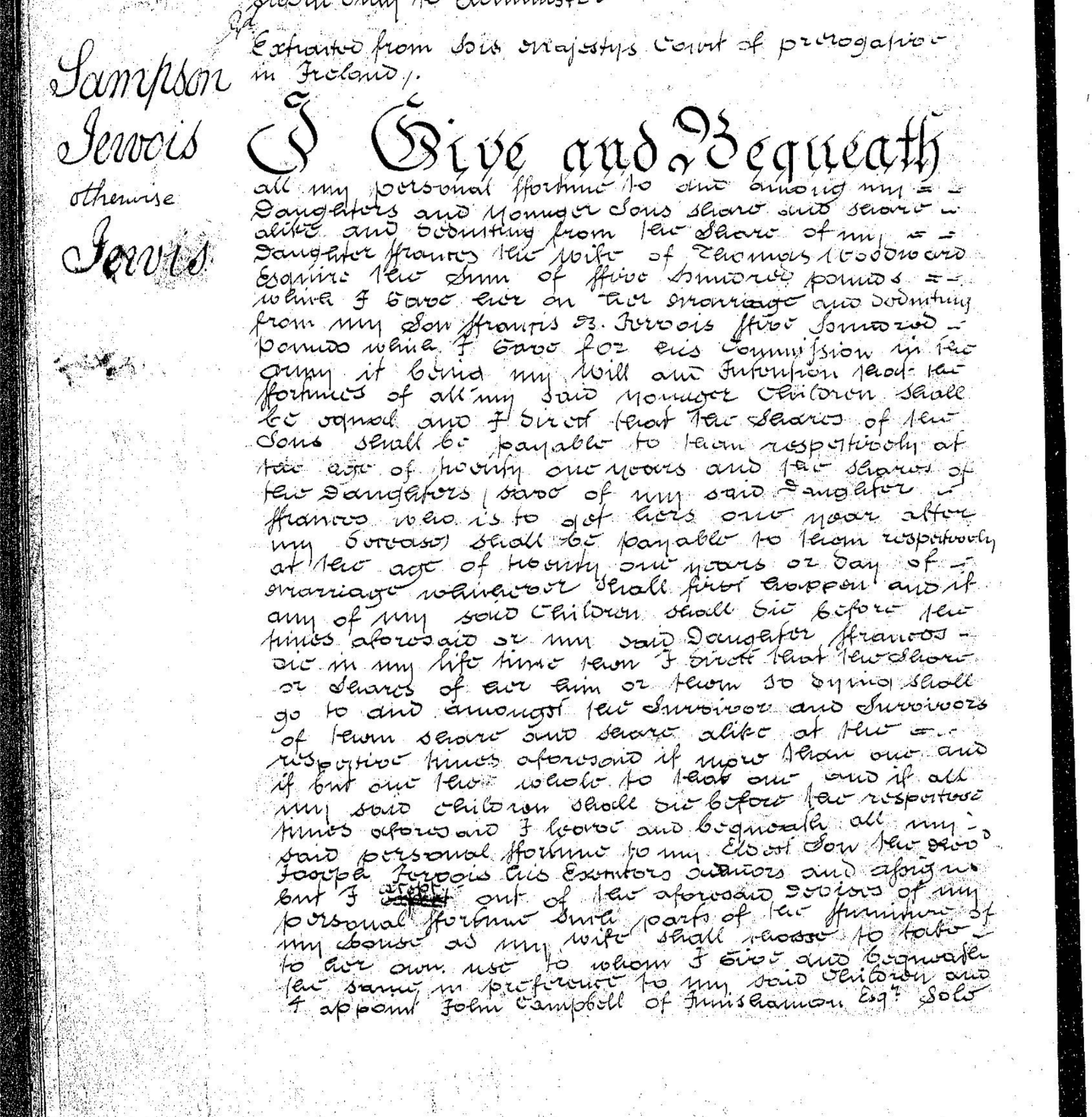
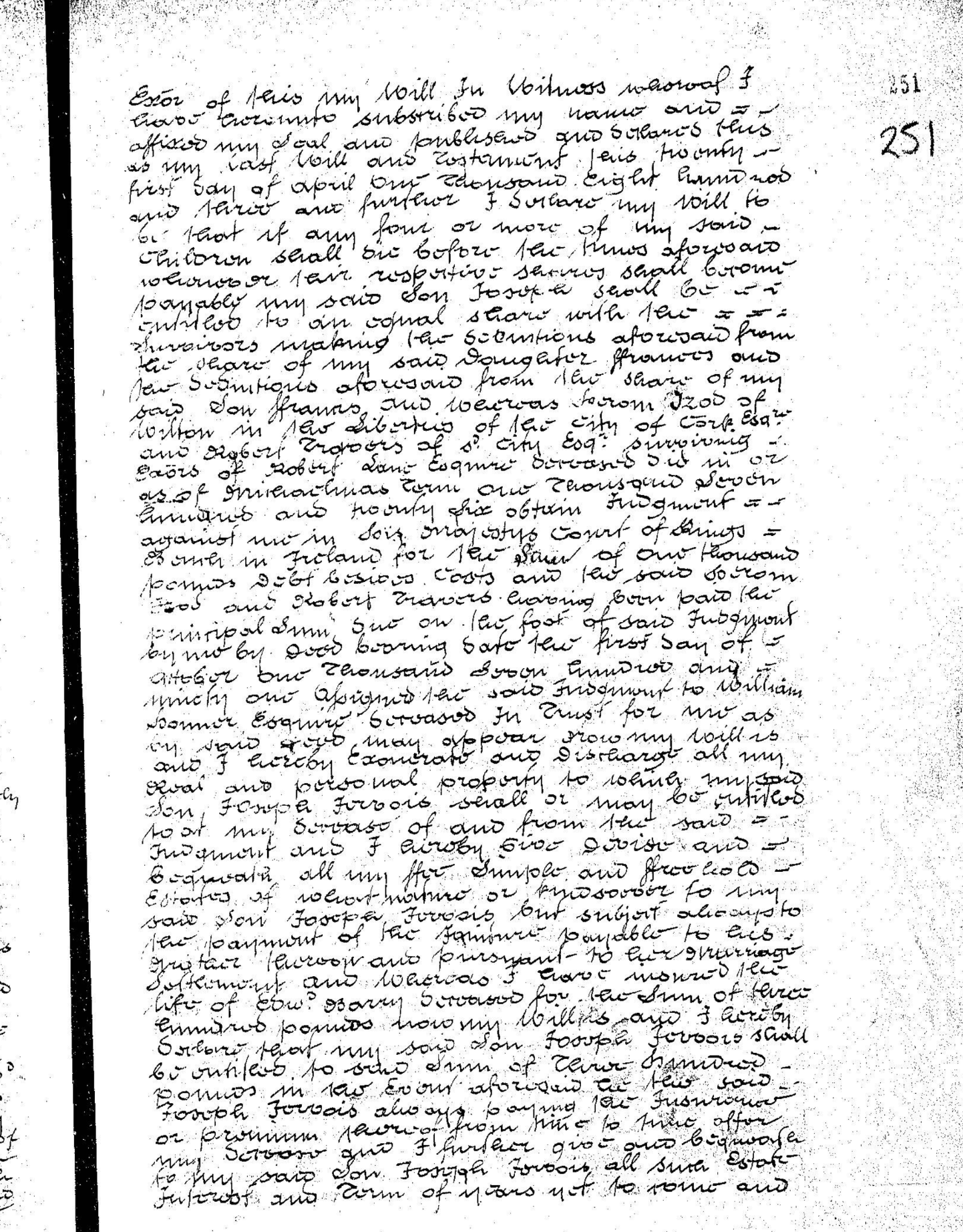
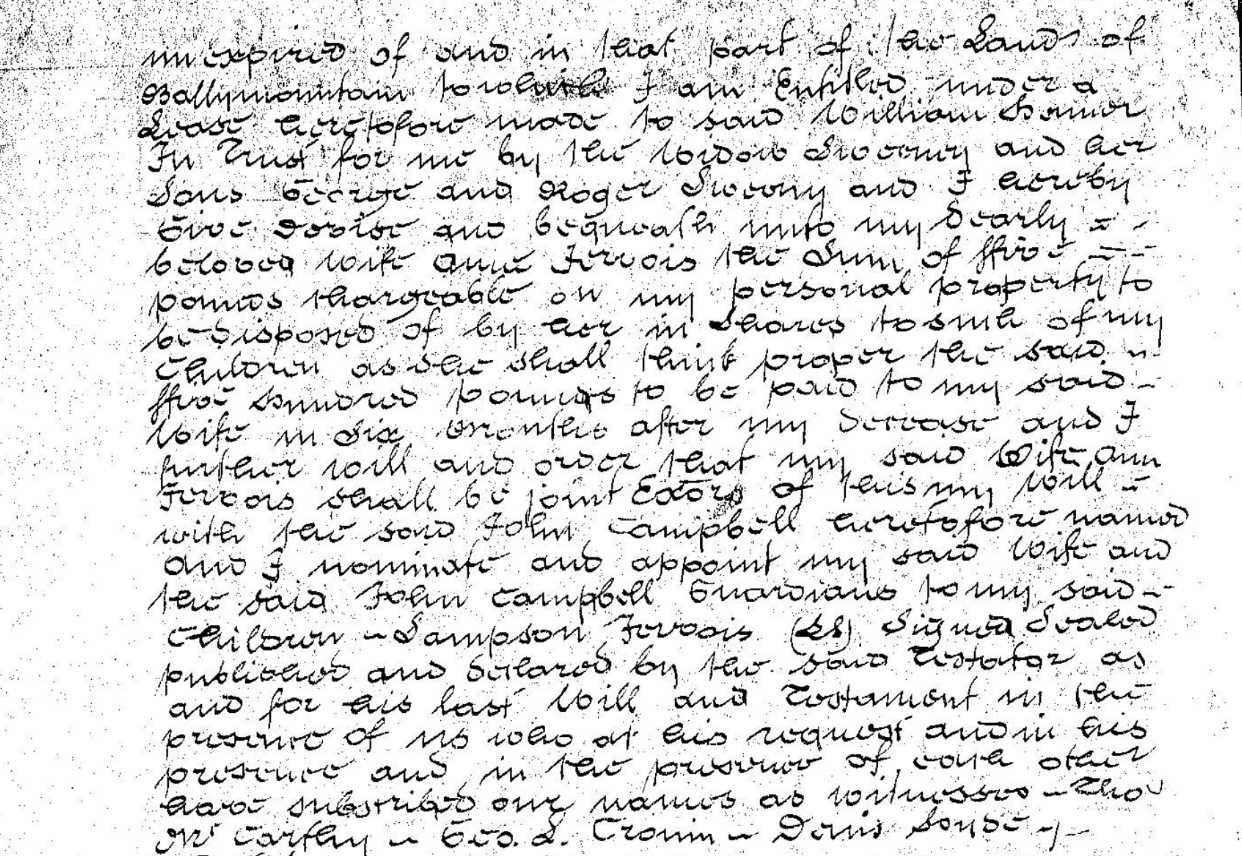
Samuel Jervois, Brade, Skibbereen. Samuel Jervois , 1769, Brade, Skibbereen, in 1777 chasing Banditti in Murdering Glen outside Bantry with Richard and John Townsend and Daniel Callaghan. Member at Bandon Hanover Association meeting Cork 1791 re Whiteboys. 1792 as Provost of Bandon convened a meeting on foot of a requisition of 200 where it was resolved to support the Protestant Ascendancy. 1799 Supporter of the Act of Union Between Ireland and Great Britain. Maybe the father of Samuel who married Lucinda Allen. Purchased 1770 Shandon Castle Cork (now Irish Ballet Company). Elizabeth Murphy, widow of John Murphy of Newtown, is the sister of Samuel Jervois of Brade. In this deed Samuel Jervois is creating an indenture of 14 hundred pounds on the mortgage of Castledonovan to provide a dowry for his niece Martha (Elizabeth’s daughter), on her marriage to Dr Henry Baldwin Evanson in 1828. Among a number of Magistrate who at a meeting in 1812 in Skibbereen offered substantial monies towards the apprehension of those responsible for the murders of Ellen and Simon Loardan whose bodies were discovered in a lake at Bawnlahan and Glandore Harbour.
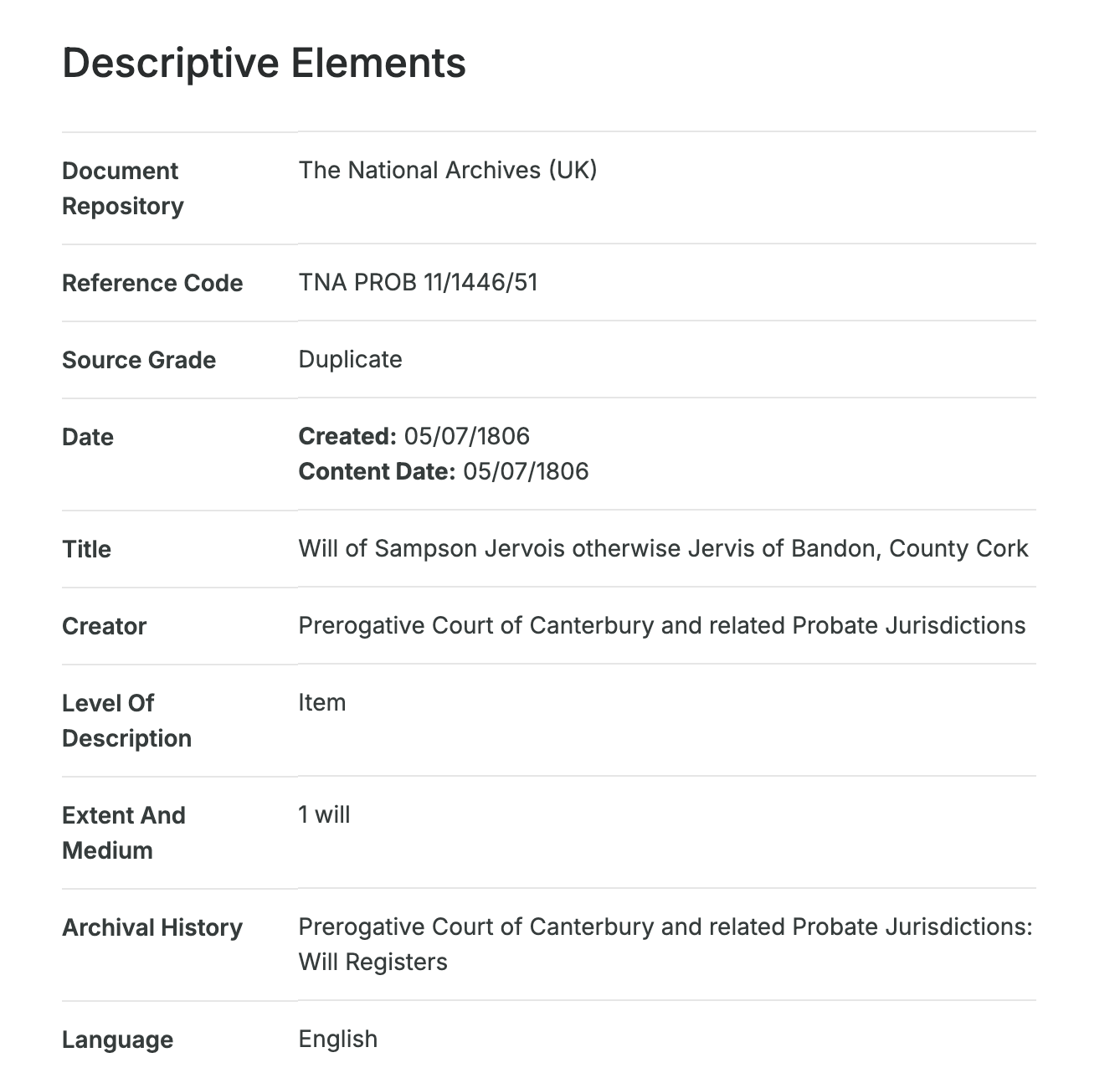
The only thing I’m not sure about is whether the lands at Castledonovan came into Samuel Jervois’s hands through his marriage to Lucinda Alleyn, or if they were Jervois lands all along, or perhaps even both families had interests in them. They are mentioned as “family lands” in his post-marriage settlement to Lucinda in 1818, but it’s not clear which family is meant, so Samuel may have already swapped whatever lands Lucinda originally brought into her marriage for the lands at Castledonovan. There is an earlier mortgage linking the Jervoises to Castledonovan (don’t know the date off-hand), but they may have been one of many families who acquired some portion from Daniel O’Donovan or when Lieut. Nathaniel Evanson mortgaged Castledonovan and moved to Four Mile Water. I suspect these lands were passed back & forth many times, probably each time someone married! Members of the Jervois family held over 450 acres in county Cork in the 1870s. In October 1855 and January 1856 over 100 acres of their property in the parish of Nohaval, barony of Kinalea, were offered for sale in the Encumbered Estates Court. The original lease, dating from 1710, was between the Busteed and Hodder families. In 1853 Samuel Jervois was among the principal lessors in the parish of Dromdaleague, barony of West Carbery. Townsend notes the discovery of copper on the estate of Samuel Jervois, at Leap, before 1810. Family history sources suggest that an earlier Samuel Jervois had come to Ireland with the Cromwellian forces in the mid seventeenth century. He had been granted land around Glandore. Will dated 1803 described as of Bandon extracted 1806.
Meeting of Select Vestry, Skibbereen, West Cork, 10th May 1832, to appoint Officers of Health under Statute of the 59th year of His Late Majesty, King George 3, p. 31
Early Church Wardens, 1699, Bishop Mann Visitation of Church of Ireland Dioceses of Cork. Ref D121.1. 1827 Parliamentary Return of Vestries, 1851, 1861 Visitations, p. 31
1824. Cover letter and memorial from the church wardens of the parish of Fanlobbus, Dunmanway, County Cork, concerning prosecution of Sabbath profaners, p. 32
West Cork Select Vestries. 1885-1890, p. 32
March 1798. Rosscarbery, Drimoleague, Castletownbere, Select Vestries meeting to Levy a Rate to provide Four Men to Serve in Militia and to Levy Seven and a Half Pence Per Gneeve. Further meeting August 1803 to levy £1-6-o per ploughland to raise 5 men for Militia and £5-13-9 on town of Rosscarbery. Cost of Levy for Cork City and County, p. 32
Late 18th early 19th Century Interplay of the Select Vestries of the Church of Ireland (State Church) in Local Administration, Barony of Carbery, Castlehaven, Drimoleague, Durrus, Cess Payer Representatives Named, p. 32
1851 Visitation Book West Cork, Church of Ireland parishes, Population 1834 and 1851, Schools, Parish Clerks, Church Wardens.p. 32
1830 keeping the Sabbath in Clonakilty, p. 32
Townlands and Placenames, 1794 Principal Inhabitants Thanks to Government, 1870 Registered Vestrymen, Kilmeen Parish History, 1975 Dan O’Leary, Funded by Jerry Beechinorp. 32
1793-1803. Cork Grand Jury Returns including provision for Militia from 1795., p. 32
The Military Levy was raised through parishes by the Churchwardens, the parishes were subject to a levy or a bounty to be paid in lieu. The surviving records of Drimoleague and Castlehaven Select Vestries confirm this., p. 33
1757 Castlehaven, (Skibbereen), Select Vestry Records, shows interaction of parishes in road building: Cullane, Daniel, app. Director of the High Way in CTend 37. VM 4 OCT 1757., p. 33
March 1798. Rosscarbery Select Vestry meeting to Levy a Rate to provide Four Men to Serve in Militia and to Levy Seven and a Half Pence Per Gneeve. Further meeting August 1803 to levy £1-6-o per ploughland to raise 5 men for Militia and £5-13-9 on town of Rosscarbery, p. 33
Cork Grand Jury (Civil Jurisdiction) To 1899, p.33

 West Cork History