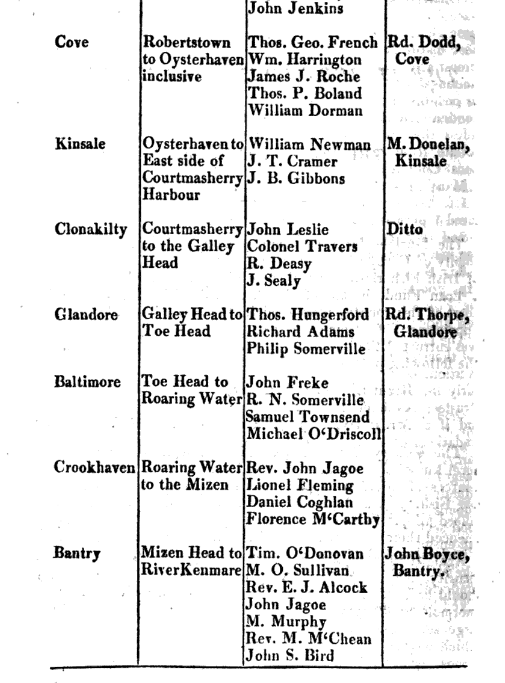
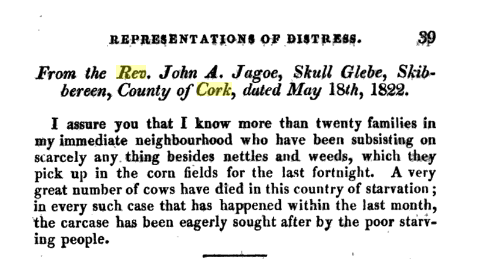
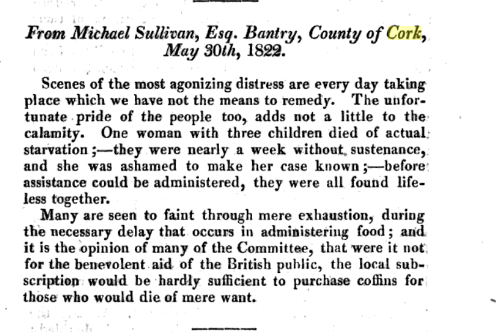
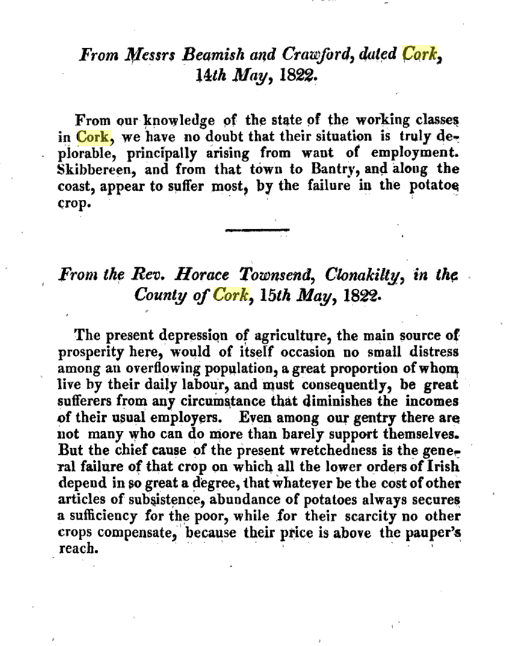
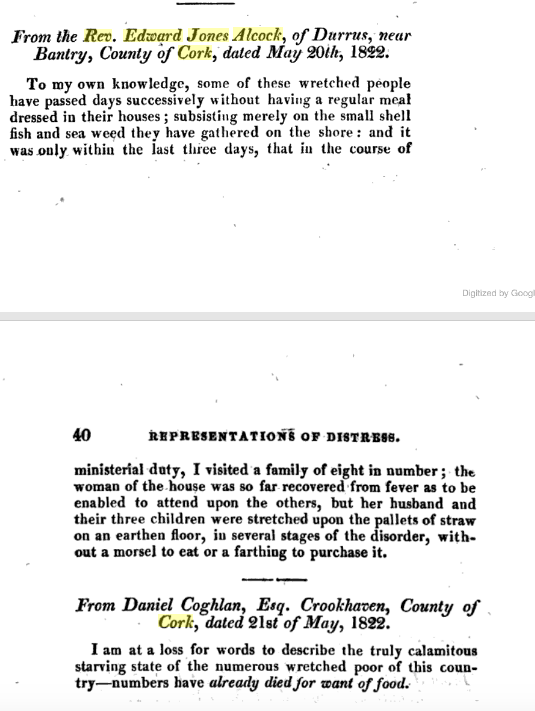
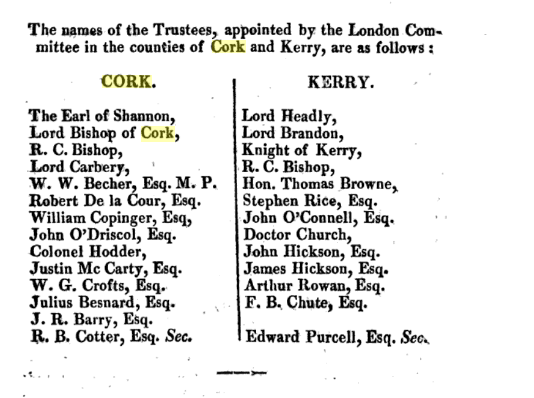
1822 Distress, Clonakilty, Skibbereen, Schull, Crookhaven, Durrus,Bantry, subsisting on Nettle and Weeds which are picked up in Cornfields, Cows have Starved. Carcasses Eagerly Sought After by Poor Starving People, Fever Victims Stretched on Pallets of Straw, Cork Branch of London Relief Society.


durrushistory's avatarWest Cork History

1822 Distress,  Clonakilty, Skibbereen, Schull, Crookhaven, Durrus, Bantry, subsisting on Nettle and Weeds which are picked up in Cornfields, Cows have Starved Carcasses Eagerly Sought After by Poor Starving People, Fever Victims Stretched on Pallets of Straw, Cork Branch of London Relief Society.

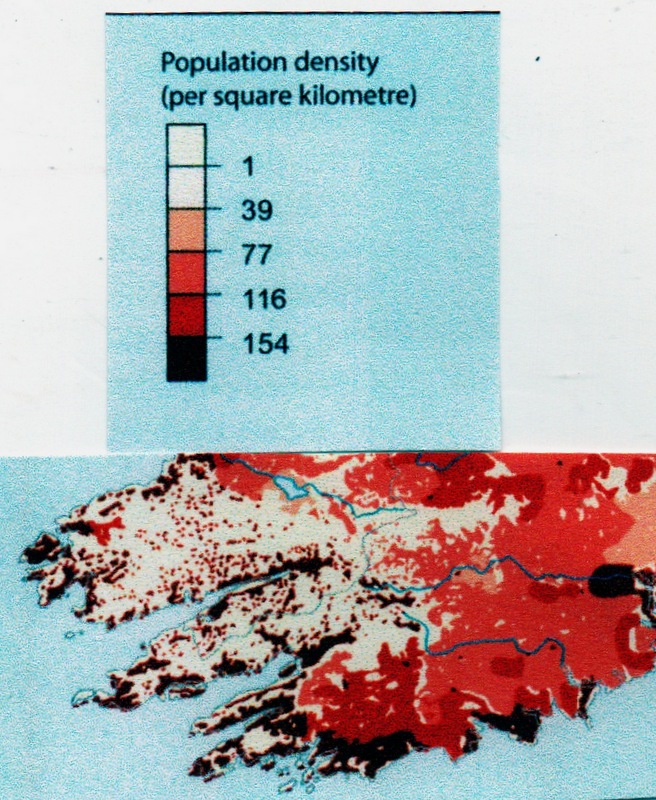
At the time the coast of West Cork was one of the most densely populated rural areas in the world.

Screen Shot 2016-08-19 at 18.03.20Screen Shot 2016-08-19 at 18.05.01Screen Shot 2016-08-19 at 18.07.32Screen Shot 2016-08-19 at 18.04.33

Screen Shot 2016-08-19 at 18.06.42

https://books.google.ie/books?id=8XISAAAAIAAJ&pg=PA39&lpg=PA39&dq=rev+edward+jones+alcock+cork&source=bl&ots=N31NFDoRWZ&sig=ZG8DwEPlBHEeaHJ87JNQDu0xm9g&hl=en&sa=X&ved=0ahUKEwjP5-qS-c3OAhViIcAKHdyODoIQ6AEIOjAF#v=onepage&q=rev%20edward%20jones%20alcock%20cork&f=false

View original post

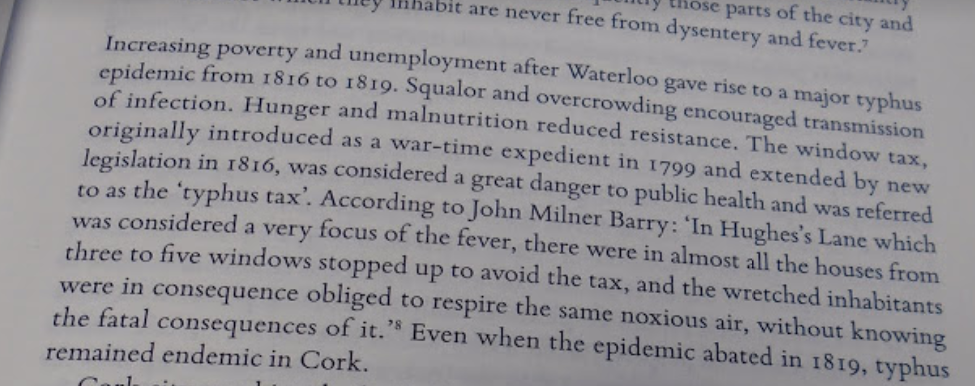
Typhus Epidemic Cork 1816-1819 facilitated by Window Tax (1799 extended 1816).


Typhus Epidemic Cork 1816-1819 facilitated by Window Tax (1799 extended 1816).

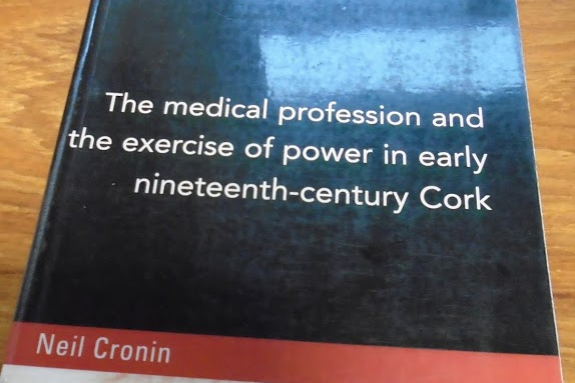
Courtesy Neil Cronin, Cork Medical History.

..

..

1788 Kinsale Heart Tax Returns with Exemptions. Loss of Window Tax Returns and Irish Tax Revenue 1818-8. Applications to Reopen Closed Hearths on Advice of Physicians for Those with Fever.

1832. Return of Fever Hospitals, including Cork, Bandon, Kinsale, Admissions, Deaths, Expenditure, Medical Personnel

1840. Provision by Cork Grand Jury of Medical Services including 53 Dispensaries and 11 Fever Hospitals.

1822 Distress, Clonakilty, Skibbereen, Schull, Crookhaven, Durrus, Bantry, subsisting on Nettles and Weeds which are picked up in Cornfields, Subsisting on Small Shellfish and Seaweed, Cows have Starved. Carcasses Eagerly Sought After by Poor Starving People, Fever Victims Stretched on Pallets of Straw, Cork Branch of London Relief Society.

…\https://wordpress.com/block-editor/post/durrushistory.com/37047

https://wordpress.com/block-editor/post/durrushistory.com/10527

https://wordpress.com/block-editor/post/durrushistory.com/37103

https://wordpress.com/block-editor/post/durrushistory.com/126

https://wordpress.com/block-editor/post/durrushistory.com/34576

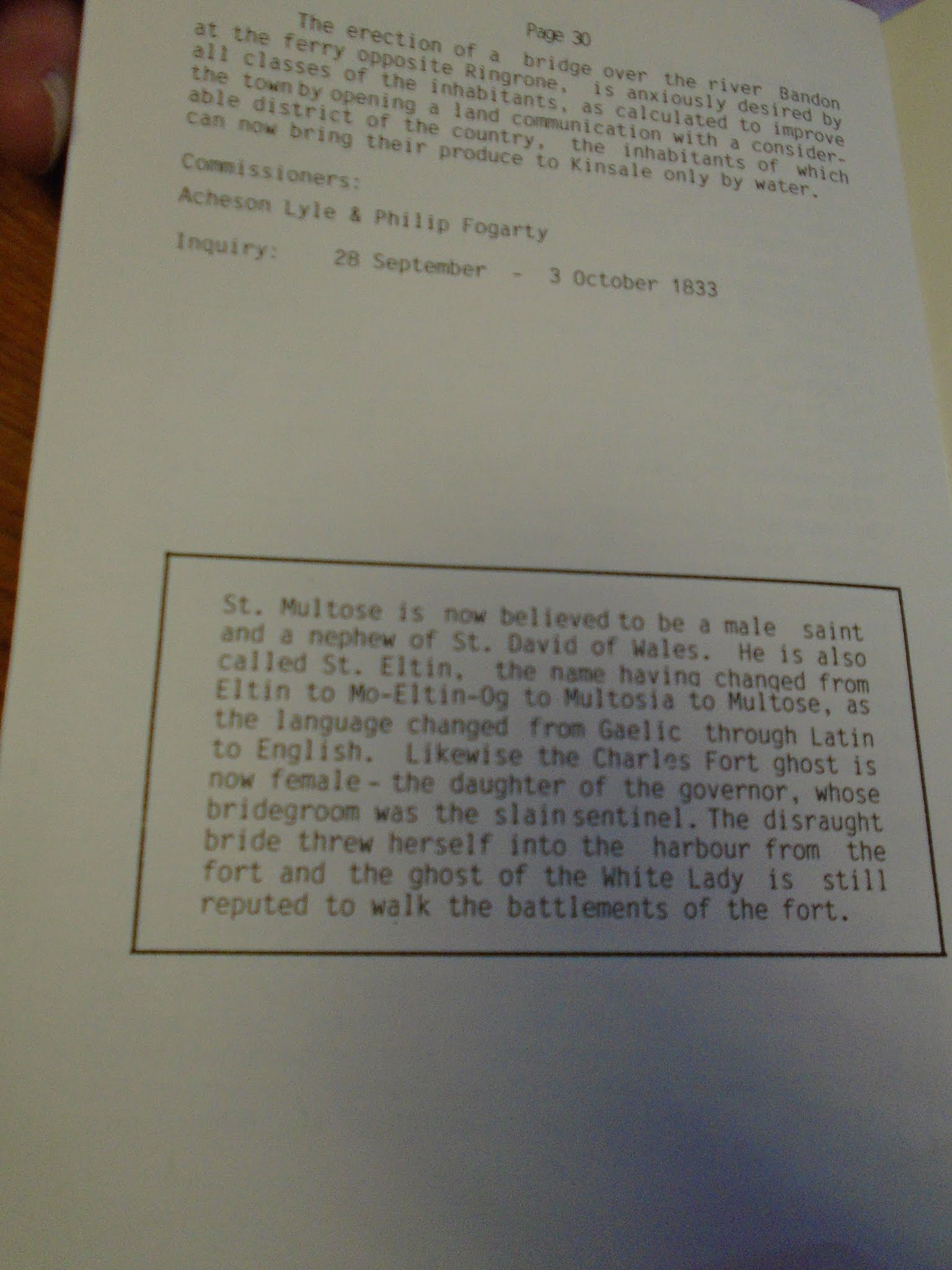
1686, Education Accounts of Jeany Hodder, Kinsale, Enquiry 1833, Commissioners, Lyle Acheson and Philip Fogarty to erect Bridge over River Bandon at Ferry opposite Ringrone.


1686, Education Accounts of Jeany Hodder, Kinsale, 1833 Commissioners Lyle Acheson and Philip Fogarty to erect Bridge over River Bandon at Ferry opposite Ringrone.

Courtesy Ms. Nora Hickey’s, History 1980s.  Hodder education relying on Connor/Conner/O’Connor, Manch papers listed McLysaght 1944.

..

..

DSC01575


..


..


Death 1983 in Cobh, Co. Cork of Miss Mary Swanton of an old Ballydehob Family, WW1 service, founder with her brothers of bus company serving CorkFermoy/Bandon/Macroom/Blarney/ Little Island, a Model of Effeciency before being taken over by CIE, her father Richard Swanton a member of the ‘Bantry Band’ with Tim Healy, Sullivans, Cullinanes later resigned in protest against British policies as a Justice of the Peace, her mother Helene Genis of Paris related to Nano Nagle and Edmund Burke and her family a line of Swanton Political Activists


durrushistory's avatarWest Cork History

Death 1983 in Cobh, Co. Cork of Miss Mary Swanton of an old Ballydehob Family, WW1 service, founder with her brothers of bus company serving Cork/Fermoy/Bandon/Macroom/Blarney/ Little Island, a Model of Efficiency before being taken over by CIE, her father Richard Swanton a member of the ‘Bantry Band’ with Tim Healy, Sullivans, Cullinanes  later resigned in protest against British policies as a Justice of the Peace, her mother Helene Genis of Paris related  to Nano Nagle and Edmund Burke and her family a line of Swanton Political Activists

Obituary by R.C. Thompson in Southern Star, Skibbereen,  5th November 1983 courtesy Ginnie Swanton, Seattle, USA.

The article touches on a tradition of politics with some of the Swantons.  Most of the family were Protestant either Methodist or Church of Ireland.  A Kilcrohane branch descends from a Ballydehob Mining Captain who married locally and the descendants are Catholic as are a number of…

View original post 445 more words

Under the Radar: Roads are discovered to yield a more profitable crop than farming, 1809 Cork Grand Jury Presentments: John Arundel, William and John Swanton, Ballydehob, Alexander O’Driscoll, Skibbereen, John and William Warner, Bantry, Samuel Townsend, Henry Ryan, Skibbereen, Later, Birds and Tobins of Kilcrohane, Moss and Nicholas Families, Durrus, Shanahans of Dunbeacon, Vickeries of Ballycomane, Fitzgeralds of Baltimore.


durrushistory's avatarWest Cork History

Roads are discovered to yield a more profitable crop than farming, 1809 Presentments John Arundel, William and John Swanton, Ballydehob, Alexander O’Driscoll, Skibbereen, John and William Warner, Bantry, Samuel Townsend Henry Ryan, Skibbereen, Later, Birds and Tobins of Kilcrohane, Moss and Nicholas Families Durrus, Shanahans Dunbeacon, Vickeries Ballycomane, Fitzgeralds Baltimore.

The latter families many intermarried and with McCarthys, O’Sullivans, Murnanes of  Letterlickey, Catholic Shannons of Brahalish.

The Fitzgerald are probably the ancestors of JFK’s mother.

Later c 1830s records show the Tobins securing contracts with the Birds of Bantry (Birds and Tobins local agents Lord Bantry) for areas quite distant from home place almost like Irish ‘subbies’ in England.

In 1739 (13 Geo. II, 20 c. 10) Grand Juries were given the power of acquiring any land, other than built-up areas or private gardens, avenues and orchards, that was needed for new roads, and though damages were payable it was…

View original post 132 more words

1808.  Letting of 200 acres Plantation Measure at Inishbeggeleary, Lands of Bishoprick of Ross, Part of Manor of Aughadown, Skibbereen.


1808.  Letting of 200 acres Plantation Measure at Inishbeggeleary, Lands of Bishoprick of Ross, Part of Manor of Aughadown, Skibbereen.


May be Inis Beg almost an island off Skibbereen/Baltimore Road near Creagh Church.  The Landlord, Erwin,  is not a local.

Have not come across land of bishop of Ross before.  The Library of St. Finbarr’s Cathedral has rentals from the 18th century of extensive lands interests at Letterlickey, Durrus, Ballydehob, Schull, Donemark, Bantry, an other ares now in the RCB Library, Dublin.


Type of deed Date of current deed 10 May 1806 Vol Page Memorial
Rent Charge Date of earlier deed 573 535 392897
No Role(s) in earlier deed(s) Role in current deed(s) Family name Forename Place Occ or title A
A P1 ERWIN Burros of Highfield, Barony of W Carbery, Co Cork Gent
B P2 SWANTON William of Ballydehob, Co Cork A
C WD WM SWANTON John of Ballydehob, Co Cork Clerk A
D WD WM MAHONY James of Bridgetown, Co Cork Gent A
Abstract A granted B a rent charge out of the 2 plowlands of Inishbeggaleary, Manor of Aughadown.
MS Date registered 13 May 1806 Date abstract added 20180213

Abstract made by: RonPrice

Go to film


record-image_3Q9M-CSJW-R9RB-T

Church Wardens of Drimoleague : 1782 – 1870


gjrkingston's avatarKyngeston

A list of the church wardens that served in the Church of Ireland parish of Drimoleague (‘Dromaleague’ or ‘Dromdaleague’); 1782 to 1870. Between 1727 and 1818, the parish was united with that of Caheragh and earlier entries contain one church warden from each.

A transcript of the Vestry Book can be found on the Fanlobbus Union genealogy page (thank you, Eunice Jeffers!).

PageYearNameAddress
 
21782John TaylorKeelskohonagh, Dromdaleague
Thomas RossCooragannif, Caharah
 
71783Thomas EvansMaulneskehah, Dromdaleague
Thomas BaldwinMount Musick, Caharah
 
111784William Evans Senr.Lissangle, Caharagh
Luke TaylorKillskohonagh, Drimoleague
 
231785Nathaniel SkuseButler’s Gift, Dromaleague, farmer
John RossCooraganniff, Caharah, farmer
 
271786Paul KingstonGurteenehir, Dromaleague
Richard GogginDerreeny, Caharah
 
311787Jordan LambertTowneeagh, Dromaleague, farmer
Timothy McCarthyMeanvugh, Caharah
 
371788Edward NagleTonson’s town, Drimoleague, farmer
Thomas WoodDerreeny…

View original post 783 more words

1594-1926, Legal Tenure of Durrus and Surrounding District Townlands, West Cork, Ireland.


1594-1926, Legal Tenure of Durrus and Surrounding District Townlands, West Cork, Ireland.


Screen Shot 2018-02-27 at 08.12.14


Durrus  Townlands


Screen Shot 2018-02-27 at 08.05.57


Historical definition of Townland as the area that could be ploughed by a Seisreach (A Six-Horse team) in Forty Eight Days.  This is from Pádraig Ó Loingsigh history of the parish of Caherdaniel.

Legal Tenure Durrus District Townlands from 1594 to 1926


Including sub denominations there are over 70,000 townlands in Ireland. During the Gaelic and Norman tenure and after the forfeitures and confiscations they continued to be the unit of the Landed Estates.  Wealth was held in the form of land.

During the Penal Laws in theory Catholics were locked out of the land market but de facto they probably held 30%.  Their attention concentrated on trade.   Daniel O’Connell just before he became an M.P. in 1827 stated to a Parliamentary enquiry that in 1827 Catholics held the majority of cash on deposit and shares in the Bank of Ireland, the de facto State Bank.

In this listing various interests are recorded, of interest from a genealogical, social, economic, religious and political viewpoint.   From around 1910 most of the tenanted land was vested in the tenants, subject to the payment on an annuity.  The British Government financed the purchase from the Landlords who were paid handsomely.

The details are  abstracted from old deeds, memorials and other sources, it is often difficult to make out names and places.  The exercise could be conducted for any part of Ireland.


Some Townlands:


Ahagouna (Irish: Ath Gamhna, meaning ‘Ford of the calves’). In Clashadoo townland. The ford with stepping stones still extant used before the bridges at Clashadoo built c 1700.

Ardogeena (152 acres) (Irish: Ard na Gaoine, meaning ‘Height of the flint stones’). On the east side is Lisdromaloghera (Irish: Lios Drom Luachra, meaning ‘Fort of the rushy ridge’). Bounded by Boolalaghta.

Ballycomane (1,349 acres) (Irish: Baile an Chumain, meaning ‘town of the little valley’). Part of it is Ballinwillin (Townland of the mill) with a boulder burial, with the remains of a millrace which may have been used by monks at the nearby church of Mouliward, ringfort and standing stone pair.  Mass rock in Vincent Hurley’s farm.  The oldest family are probably the Hurleys (Vincents), they possibly moved from Ballnacarriga outside Dunmanway and Darby Hurley who held Ballycomane Middle was allegedly evicted by Lord Carbery when a rent payment was missed, the farm was then given to the Vickerys c 1770.  The O’Neills are also significant farmers with an old impressive farmyard. On the western end an area known as  Cummer.  Since the 1950s large parts forested, in the western end of the higher farmed land remains of old native woodland.  Two flax ponds at least on O’Neill holding western end, Sam Attridges’ farm abbuting Durrus River. Cromlech at north end. Fort Lís Ballycomane.

Ballydivane (Friendly Cove), name occurs in deeds and Evanson family records.

Boolteenagh (148 acres) (Irish: Buailtinach, meaning ‘summer pasture’). The high land at the south is called Knockboolteenagh (cnoc buailtineach) hill of the little boolies. Site of a possible souterrain, at the north side is a ringfort.

Brahalish (784 acres) (Irish: Breach Lios, meaning ‘spotted fort’) or Braichlis (place of malt or fermented grain). Appears in Patent Rolls 1603.  Four forts on the west side is Brahalish Fort and the east Cummer Fort. In 1659 census written Bracklisse. Probably church at Killbrahalish.  Burial ground for children, horizontal mill stone with a rindbar near the farmhouse of David Shannon on the eastern side, ringforts. Location discovered by Owen Sullivan 1843, of Brahalish  gold fibula (clasp) currently in the British Museum.  There are a series of walkways dating from at least the 19th century from the shore to the upper lands where people used to take baskets of seaweed to fertilize their small holdings.

Carrigboy (116 acres) (Irish: Carraig Buidhe, meaning ‘yellow rock’). Location of Durrus village. The high road from here is built over land known as Carrig Cannon.   Village demolished and rebuilt by Bandon Estate c 1850.  Near the former farmyard of Denis John L O’Sullivan now housing the remains of a souterrain partly demolished during house building between the upper and lower road to Bantry.

Curraghavaddra (195 acres) (Irish: Currach an Mhadra, meaning ‘the bog of the dog’). On the west side is a ringfort.

Clonee (409 acres) (Irish: Cluain Fhia, meaning ‘meadow of the deer’ or ‘Aodh’s meadow’). In the center is Clonee ringfort.   Off the road near Jimmy (Bens) Swantons is a disused quarry used in providing stone for tarring the Durrus/Bantry Road last worked in the hot summer of 1940.  Flax pond at the Inches on Jimmy Swanton’s farm abutting Durrus River.

Clashadoo (749 acres) (Irish: Claise Dubha, meaning ‘dark hollows’). Burial ground last burial 1930s layout of stones suggest an adult as well as children.. To the north on high boggy ground is Coolnaheorna or Coornaheorna (this appears in the 1740 deed to Francis Bernard as a half ploughland) covering the former farms of Kellys and Sullivans leading to the ‘Cumar’, and beyond to Loch na Fola (lake of the blood).  This may have been far more extensive in former times as the stream feeding it may have been diverted; the stream (Moire or in Irish Maighre) on the western end has a deep hole formerly known as Poul Nora Poll Nora (Nora’s hole).  Between Rossmore and Mannion’s Island at half tide a rock ‘Carrig Coolnaheorna’ is visible; this marked the spot where people from Upper Clashadoo were entitled to take seaweed to fertilize their smallholdings.  On the road to Coomkeen, at the eastern end is a graveyard used for unbaptised infants probably the site of Dun Clashadoo marked on the Ordnance Survey map.  The ordnance survey map of 1842 shows ‘Cappanamanna’ on high ground to the west of the old rectory, it appears as ‘ a half ploughland at Cappamonagh’ in the 1740 deed to Francis Bernard and perhaps it may have some old connection with monks.  Football field in the 1930s opposite old rectory near bridge.  Fort Lís Clashadoo.  . The name  Brookfield or Durrus Court is derived, I suppose, from the little brook which flows in front of Evanson’s house, and which was  formerly called Moire (Maighre) by the old people.

Coolcoulaghta (1148 acres) (Irish: Cul Cabhlachta, meaning ‘remote place of the ruins’ or ‘cul cuallachta’ Nook of the tribe or assemblage.  Old name in some deeds Carpolite.  In the upper part is an area formerly called Cumha na acrai and the hill on top is Peakeen or Mount Corrin.  Location of boulder burial, burial ground at cillín for unbaptised infants. Coolcoulaghta Church contains 1847 famine victims, cairn, coastal promontory fort, fulachta fiadh, ringfort, standing stone, a standing stone pair. Sub-townland ’Galans’ off main road near Blair’s Cove on southern side.  Overlooked by Peakín na cCloch (The point of the stones), placename Coo-na-Croi.

Coomkeen (915 acres) (Irish: Cum Caoin, meaning ‘gentle valley’).  Mass rock on the lands of Timmy Whelehan deceased known as Tober an tSagairt, on the south side is Screathan na Muice (stoney slope of the pig) this is given as the address of one of the Dukelows in the 19th century, c 1850, marriage register of St.James’s church., to the north is Crock a wadra.  On the flat bog before the turn for Clashadoo are clay pits on the right used for road making.  The Coomkeen farmers had rights to sea wool between what is now the pier and the sand quay used to fertilize their holdings.

Crottees (490 acres) (Irish: Cruiteanna, meaning ‘humpy ridges’), location of large stone associated with Dukelow family.  On the bounds with Clonee an area known as ‘Chapel Brake’ according to Dan Burke, Coomkeen, RIP, used as a church pre 1794 before new road built.

Dromreagh (842 acres) (Irish: Drom Riabhach, meaning ‘striped/grey ridge’). On the north side is Coill Breach (wolf wood). Possible souterrain, standing stone. Dromatiniheen (97 acres) (Irish: Drom a’tSionnaichin, meaning ‘ridge of the little fox’). Ringfort on the south side. Fulach Fia discovered 2016 in works fro new GAA pitch.  1624 Inquisition Car 1.

Dromreague (92 acres) (Irish: Drom Reidh, meaning ‘even ridge’)

Dunbeacon, sub townland Barrakilla

Dunmanus (Irish: Dun Manus, meaning ‘fort of Manus’)

Durrus (Irish: Dubh Ros, meaning ‘dark wooded promontory’)

Gearhameen (646 acres) (Irish: Gaortha min, meaning ‘small wooded glen’). On the east side is Coolnalong Castle seat of the McCarthy Muclaghs later the property of Lord Bandon.  On the Clashadoo side is Fahies (na Faithi) containing a disused quarry operated by the Spillane family used to provide stone for the Catholic church.  There was a Fullach Fia in a large field opposite Durrus Court removed during agricultural improvements in the 1950s.  Former graveyard and flax pond in Sam Attridge’s  lands no remains.

Gurteen (127 acres) (Irish: Goirtin, meaning ‘small field’)

Kealties (614 acres) (Irish: Caolta, meaning ‘narrow strip of land/or marshes marshy streams’). On the south side is Ros na Bruighne (headland of strife), written Glinkelty (Gleann Caolta) on 17th century map of Petty. Standing stone and possible ringforts.  The high ground was known as Caolagh. Old church pre 1800 remains still visible.

Kiloveenoge (Irish: Cill Ui Mhionoig, meaning ‘Minogue’s church’, or Cill Oighe Mhineog meaning ‘church of the virgin Mineog’). Child burial ground, on the east side is a former Protestant Church built 1860, the west side is the site of an old church and burial grounds.  Some distance from where Mike Hegarty’s shop was located is a grave of sailors who were shipwrecked, marked with thorn bushes, possibly from c 1850.   1603 Patent Roll Jae 1.

Lissareemig (78 acres) (Irish: Lios a’Riamaigh, meaning ‘fort of victory’). Ringfort in centre.

Mannions Island, (c 44 acres) used 19th century by Marmions, Skibbereen for horses, Carbery Island 1900 by the Philips family for horses. Salt marshes when horses used it acres of narcissi

Moulivarde (Irish: Meall an Bhaird, meaning ‘the bard’s knoll’), site of old Durrus Church and graveyard.

Mullagh (173 acres) (Irish: Mullagh, meaning ‘summit’). Possible souterrain on the west side is Lissavully Fort (lios a’Mhullaigh) fort of the summit.

Murreagh (199 acres) (Irish: Muirioch, meaning ‘seaside marsh’). Location of disused grain store also used as a refuge for children in 1847. Disused slate quarry south end also standing stone.

Parkana (Irish: Pairceanna, meaning ‘fields’)

Rooska West (298 acres) East (295 acres) (Irish: Riasca, meaning ‘marshes’). Disused lead mines on western side ringforts in West and East. On Ordnance Survey Name Books reference to a burial place for small pox victims then (1840s) disused.

Rossavanna, appears in 18th century deeds.  Probably between Rossmore and Gearhameen.

Rossmore (310 acres) (Irish: Ros Mor, meaning ‘large copse or large promontory’). Location of Rossmore Castle in ruins former McCarthy sometimes ascribed to O’Mahony  tower house and location of former slate quarry.   In the field west of Attridges off the road there is believed to be a famine graveyard as told to Nancy Dukelow by her father Tom.  This may be in fact the  graveyard marked ‘cillín’ on the ordnance survey map to the east of Attridges in Jimmy Hegarty’s yard which David Shannon of Rossmore says may also have been the site of an old church or a pre workhouse refuge for destitute people.  The townland name occurs on Prince Edward Island, Canada to which some Rossmore families emigrated from the 1820s.

Rusheenasiska (84 acres) (Irish: Ruisin an Uisce, meaning ‘little copse of the water’)

Teadagh ( 107 acres) (Irish: Taodach, meaning ‘rugged land’ or Teideach, meaning ‘flat topped hill’) . Associated with O’Sullivan Hurrug family now largely forested.

Tullig (Irish: Tullach, meaning ‘mound’), location of O’Donovan houses at the Cove and Fort Lodge.


Lease of 1784 from James Bernard, Castlebernard, Bandon to John O’Connor, Skibbereen of lands at (Schull, Ballydehob, Caheragh, Western Bandon Estate). Cahirlekenny, Mauldeny, Rathcool. Bawnicane, Balleenoutragh, Keelbronoge, Dunkelly, Dereenlomane, Lisanaroe, Ballyourane, Letterscanlon.  Release 1806 to Francis Earl of Bandon from Cornelius O’Connor, Esq., Newtown, Bantry, Daniel O’Connor, Gent. Skibbereen,  George O’Connor, Bantry, Gent.  Spellings may not be correct. 


Western Bandon Estate including part Caheragh 1784-1808

Lease of 1784 from James Bernard, Castlebernard, Bandon to John O’Connor, Skibbereen of lands at (Schull, Ballydehob, Caheragh, Western Bandon Estate). Cahirlekenny, Mauldeny, Rathcool. Bawnicane, Balleenoutragh, Keelbronoge, Dunkelly, Dereenlomane, Lisanaroe, Ballyourane, Letterscanlon.  Release 1806 to Francis Earl of Bandon from Cornelius O’Connor, Esq., Newtown, Bantry, Daniel O’Connor, Gent. Skibbereen,  George O’Connor, Bantry, Gent.  Spellings may not be correct.

Litigation over 20 years between Bandon and  Becher estate over Ballydehob townlands mineral rights i 1830s
Many of the rental records are in the Cork Archives.

Of the O’Connor family it is likely Margaret O’Connor married John Jagoe, liberal Protestant, fishing Inspector, Bantry (his mother Young of fish merchant family, he owned mill site of Maritime Hotel), Surgeon Bryan O’Connor exiled to Australia for United Irishmen offences later returned to practice in Clonakilty.  Small Jagoe/O’Connor Estate near Durrus Cross was sold Landed estates Court 1850s.
record-image_3Q9M-CSJ4-3F36