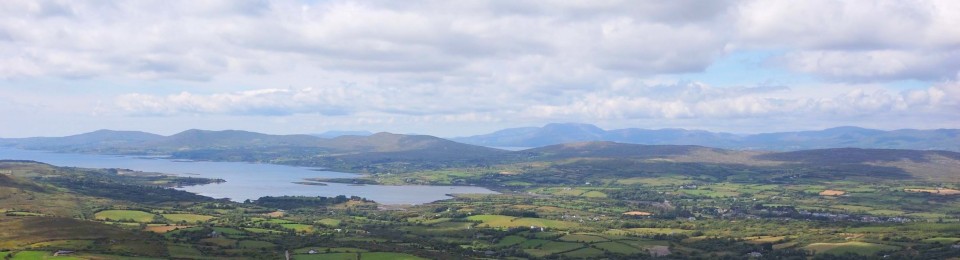
1862 Whale Landed on Dunmanus Bay near Residence of James O’Callaghan, J.P. Rock Cottage, Schull. His son Sir FRANCIS LANGFORD O’Callaghan (1839–1909), civil engineer, born on 22 July 1839, was the second son of James O’Callaghan, J. P., of Drisheen, Co. Cork, by his wife Agnes, daughter of the Rev. Francis Langford, one time Rector of Kilmoe (Goleen), Chief Engineer to the Government of India. Chief Railway Engineer, Government of India. Later managing member of the Ugandan Railway Commission


1862 Whale Landed on Dunmanus Bay near Residence of James O’Callaghan, J.P. Rock Cottage. His son Sir FRANCIS LANGFORD O’Callaghan (1839–1909), civil engineer, born on 22 July 1839, was the second son of James O’Callaghan, J. P., of Drisheen, Co. Cork, by his wife Agnes, daughter of the Rev. Francis Langford, one time Rector of Kilmoe (Goleen), Chief Engineer to the Government of India. Chief Railway Engineer, Government of India. Later managing member of the Ugandan Railway Commission.

Engineer. Francis O’Callaghan was born on 22 July 1839, the second son of James O’Callaghan, JP, of Drisheen, Co. Cork, and his wife Agnes, née Langford. He attended Queen’s College, Cork, and received his practical training under HENRY CONYBEARE . In 1862, he competed for and won a place on the staff of the Indian Public Works Department. He spent thirty two years in the Indian service, rising to the rank of chief engineer, (first class), and retiring in 1894. On his return to England he was appointed managing member of the Ugandan railway commission, a post which he half for three years and in connection with which was awarded a knighthood in 1902. He died at his home in Guildford on 14 November 1909. He had married in 1875 Anna Maria Mary, daughter of Lieutenant Colonel Powell, of Banlahan, Co. Cork.

Lieutenant-Colonel Henry Claringbould Powell, (1801-1902), 1874, Bawnlahan (O’Donovan Estate), Leap, Resident, £67, 2nd. son Major Edward Powell and Eleanor d James B. Buchanan, m Mary Ann d Lieutenant-General Hutchesson, daughter 1837, oldest son Rev. Francis Perry Hutchesson b 1843, Newcastle.   Estate to Powells from Lieutenant-General O’Donovan (The O’Donovan) on the death of his widow to her brother Major Powell. Probate last address 2, Alfred Place, Dover, in Ireland £1,886. Land record, 1870, 2,475 acres. O’Donovan estate passed to Powells from Wales on marriage of The O’Donovan, Miss Powell she died and the estate passed to her brother. 
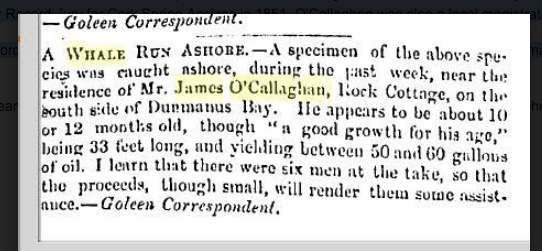
Cork Examiner 4 September 1862.

James McCarthy, Ballydevlin, Goleen.   Cess payer representative.  May be joint Commissioner to assess tithes in Parish of Kilmoe with Florence McCarthy, £500 undivided and payable to Rev. Francis Langford, Rector

Possibly related Denis O’Callaghan Fisher. Solicitor, Mount St., Dublin Genealogist. Brother of Rev. Fisher, Kilmoe may be connected to area. On his Vol 1 of Irish Marriages 1740-1820 handwritten medical notes on Goleen, Kilcrohane. May be connection to James O’Callaghan, J.P. Rock Cottage, Schull. Buried “Deansgrange No.3826 DENIS O’CALLAGHAN FISHER | Genealogist | born 18th Nov. 1809, died 22nd Decr. 1869 | Also | CHRISTABELLA DELANY | Aunt of the above | who died the 8th of May 1869 | aged 86 years | Also his brother | Rev. WILLIAM ALLEN FISHER | for 40 years Rector of | the Parish of Kilmoe, Diocese of Cork | born 4th Nov. 1808, died 5th Aug. 1880 | “”And I heard a great voice from heaven say | unto them come up hither”” | Rev. VI. 12.” Left £1,500 Possibly related

1841 Cork election, Contested Box, Names Addresses of electors, Property Qualifications, Bantry, Beara, Bandon, Clonakilty.


durrushistory's avatarWest Cork History

1841 Cork election, West Carbery, Contested Box, Names Addresses of electors

1841 Election West Carbery Contested Box

Pages 204 on. Voters had to have a property valuation which is indicated ranging from £10 to £50 freeholder and often their addresses does not coincide. To qualify for a vote there had to be an earlier application to the Quarter Session barrister with a qualifying property. Tht often enable to link people to particular localities.

The petition was instigated by the unsuccessful candidates Protestant Conservatives Longfield and Leader. The Liberal/Catholic candidates O’Connell and Roche won.

The elections were highly contested every vote scrutinised adn any legal defect disallowed the vote. It was also the era of open voting.

Unusually those such as the O’Sullivan of Beara and Cotters of Kealkil who you would have expected to vote for O’Connell did not do so reflecting their close connection with Lord Bantry.

April…

View original post 223 more words

Schull East 1828-1867 Church of Ireland Births, some Marriages


Schull East 1828-1867 Church of Ireland Births, some Marriages.

https://docs.google.com/spreadsheets/d/1O7S7YgZS2OGbpCtmam1e5Ks_LVNC7U-Bz4vEiZDNQKI/edit#gid=0

From Box 25 Microfilm C of I Co. Cork Records National Archives. There are some marriages listed which may be the parents. These are from Dr. Albert Casey’s of Alabama Irish Records Database cited in Ancestry.com

Quite a number of Protestants appear in the Catholic records in marriages or as sponsors or witnesses for Catholic friends or neighbours:

https://wordpress.com/block-editor/post/durrushistory.com/34208

Schull East Catholic records:  https://churchrecords.irishgenealogy.ie/churchrecords/search.jsp?name2fm=&name2l=&namefm=&namel=brooks&location=schull+east&yyfrom=&yyto=&submit=Search&sort=&pageSize=100&diocese=CORK+%26+ROSS+%28RC%29&parish=&century=&decade=&ddBfrom=&ddMfrom=&ddDfrom=&mmBfrom=&mmMfrom=&mmDfrom=&yyBfrom=&yyMfrom=&yyDfrom=&ddBto=&ddMto=&ddDto=&mmBto=&mmMto=&mmDto=&yyBto=&yyMto=&yyDto=&locationB=&locationM=&locationD=&member0=&member1=&member2=&member3=&member4=&member5=&member6=&member7=&member8=&member9=&namef0=&namef1=&namef2=&namef3=&namef4=&namef5=&namef6=&namef7=&namef8=&namef9=&namel0=&namel1=&namel2=&namel3=&namel4=&namel5=&namel6=&namel7=&namel8=&namel9=&keyword=&event=

https://wordpress.com/block-editor/post/durrushistory.com/30545

https://wordpress.com/block-editor/post/durrushistory.com/35483

https://wordpress.com/block-editor/post/durrushistory.com/32237

https://wordpress.com/block-editor/post/durrushistory.com/24995

https://wordpress.com/block-editor/post/durrushistory.com/35721

Anti Catholic Petition Southern Reporter and Cork Commercial Courier May 27th 1828.


https://docs.google.com/spreadsheets/d/19yirqKEnxNZtC2rQqMu5ophag5N75B4JaDxrX-r7IGQ/edit#gid=0

The background is heightened political and religious tensions arising from the imminence of Catholic Emancipation.

Judging from the evidence of Daniel O’Connell, a few months before he was elected MP to a British Parliamentary Enquiry, the balance of economic advantage at least in bank deposits and shareholding in the Bank of Ireland had shifted to the Catholics. Also in Cork the Catholic butter and provisions merchants amassed huge fortunes while many of the landlord families were on the edge of insolvency.

1736-1922. Cork Magistrates (Justices of the Peace) Finance/Probate


https://docs.google.com/document/d/1QhYxwzDo2HKR3uhhxrBHsxuqXDl4FMycqnG8YxtWaC4/edit

Cork Magistrates 1199-1922: https://docs.google.com/document/d/1ZvT84JCKTIhMqqZjJsF_AUJLH8S820ksObykwOty3wg/edit

Many landlords who constituted large numbers of the Magistrates where is straitened financial circumstances from the 1790s if the example of the smaller Landlords in Durrus, Blairs, Evansons,Hutchinsons is anything to go by. Various deeds give evidence of rent charges, mortgages they give to members of the local class of rising merchants, large farmers such as the Swantons, various O’Sullivans, McCarthys, O’Connells, Levis, Kingston, Shannon families.

https://docs.google.com/document/d/1AAa_hTrtStGp4LT3SrBIiUmgpvOqlvRo6Vg1V5Tw4Ts/edit

The larger estates were often encumbered by jointures (Charges in favour of unmarried daughters), marriage settlements, trusts as well as mortgages.

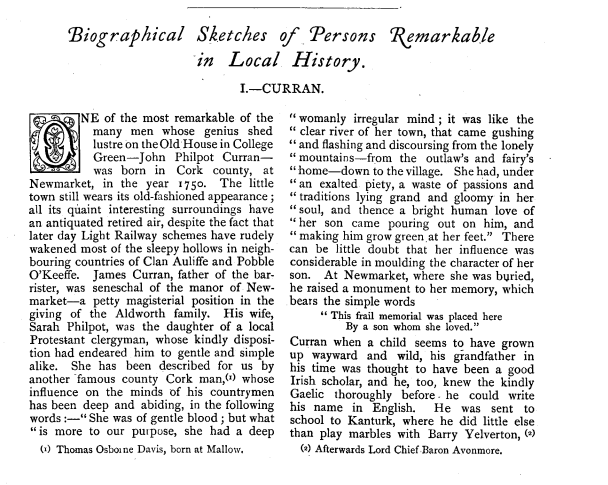
Portrait of John Philpot Curran (1750-1817), Born Co. Cork, Irish Speaker, Author of Patriotic Verse, Master of The Rolls father of Sarah Curran His Youngest daughter Engaged to Robert Emmet.


1616, Sir Walter Coppinger and Coppinger’s Court, Rosscarbery, Co. Cork and some Coppinger Lawyers, Cork.


durrushistory's avatarWest Cork History

1616, Sir Walter Coppinger and Coppinger’s Court, Rosscarbery, Co. Cork.

This article is by Mark Samuel, bases on work he did at the University of London and many thanks to him and courtesy JCHAS 1984. Digital http://www.corkhist.ie/wp-content/uploads/jfiles/1984/b1984-005.pdf

The Coppingers, Cotters and perhaps the Gallweys are of Hiberno-Danish descent. Some of those with this ancestry still have blonde hair.

The Coppingers assembled vast estates in West Cork primarily by the local land owning families raising mortgages and defaulting. One example is the townland of Ballycomane in Durrus. This had been McCarthy of Scart property, mortgaged to Coppinger and when the Coppingers backed the wrong side in the 17th century their land was forfeit.

Much of the estates ended up with the Evans-Freke family (later Lord Carbery), that family around 1778 presumable for raising money commissioned a survey of their estates. The original book of maps in in the National Library Mapping…

View original post 54 more words

Corktown, Detroit, Michigan being Revitalised by Henry Ford The Third.


Corktown, Detroit, Michigan

https://detroithistorical.org/learn/encyclopedia-of-detroit/corktown-historic-district

https://wordpress.com/block-editor/post/durrushistory.com/26983

https://wordpress.com/block-editor/post/durrushistory.com/699

CORKTOWN HISTORIC DISTRICT

Corktown is the oldest existing neighborhood in Detroit, Michigan, though it is only half as old as the city itself. In the 1820s and 30s, with the opening of the Erie Canal and the decreased cost of steamboat travel on the Great Lakes, immigrants began arriving in Detroit in significant numbers and settling downtown. As the number of Irish immigrants fleeing the Great Irish Potato Famine of the 1840s increased, they began to move west of downtown Detroit into the area now known as Corktown, named after County Cork, Ireland. By the early 1850s, half of the residents of the 8th Ward (which contained Corktown) were of Irish descent. Historically, the neighborhood was roughly bounded by Third Street to the east, Grand River Avenue to the north, 12th Street to the west and Jefferson Avenue to the south.

Initially, detached homes and rowhouses in the Federal style were built, a reflection of the architectural fashion of the time. As the area’s population grew, modest one and two-story Victorian townhouses with Italianate, Gothic and Queen Anne features joined the earlier buildings. Though by the 1890s an increasingly affluent Irish population was scattering throughout the city, and Corktown became home to other ethnic communities. Around 1900, three men from the island of Malta settled there and a number of their countrymen followed. After World War I, plentiful auto industry jobs brought immigrants in with great numbers – many of them settling in Corktown. In the 1920s, Latino populations arriving from the Southwest and Mexico came to Corktown seeking work in Detroit’s auto factories.

Following World War II, city planners proposed demolishing large swaths of the neighborhood for factories. 75 acres of Corktown homes and businesses were demolished and hundreds of residents were displaced in preparation for industrial expansion. The planned industrial development never came to fruition, however, and there were no plans to build new homes in the area. Corktown suffered further in the 1960s, when “urban renewal,” construction of the Lodge Freeway, and business district encroachment swallowed up or flattened dozens of residential blocks. The remaining residential section was listed on the National Register of Historic Places in July of 1978 and is designated as a Historic District of the City of Detroit.

Corktown has seen revitalization since the early 2000s, with many new businesses moving into old spaces. Tiger Stadium, longtime Corktown landmark, was demolished in 2009 and replaced by the Detroit Police Athletic League’s Corner Ballpark. Detroit’s iconic Michigan Central Station, which towers over the neighborhood, was purchased by Ford Motor Company in 2018.

Early Judicial Review, Re Cork Gaol, 28th September 1303.


durrushistory's avatarWest Cork History

From Trinity College/Circle, retrieved Calendar Rolls, originals destroyed 4 Courts, Public Records Office, 1922.

Close Roll 32 Edward I

28 Sep. 1304
Turvy
To the sheriff of Cork.

At the suit of Michael s. of Maurice Eylward, detained in the gaol of Cork because of an appeal made by Joan, widow of Adam Prudfot,de consilio mortisof her husband, the sheriff was ordered to bring the appeal before the K.’s justices at Dublin on the morrow of All Souls, because it ought not to be determined in a court lesser than before the K. or his justices, on which day Michael cannot come unless he is released from gaol. ORDER, that if he receives the said writ to remove the appeal and if Michael gives sufficient mainprize to be before the justices on the…

View original post 1,413 more words

1845-1847. Members Ballineen, West Cork,  Agricultural Society from Minute Book.


durrushistory's avatarWest Cork History

The article in now available online: 1845-7

These records were transcribed in 1946 by T. Shea and published in the 1946 issue of the Cork Historical and Archaeological Society.  

Click to access b1946-006.pdf

It was based on the record lent to him by William Daunt of Deriga House, Ballineen.  His uncle Mr. Daunt was secretary of the Society and presumable maintained the records including the townland of the member.

Landlords have enjoyed a bad press in Ireland,. However n West Cork, some and their agent were anxious to promote modern agriculture, new crops, selective breeding, instructors. The various Agricultural Societies normally have a large Landlord representation.

Manch

Conner, possibly not a member but gave speeches. The Conners/Connor/O’Connors were agents for the Devonshire Estate but dismissed for alleged malpractice in granting favourable leases to relations. The family may be a scion of the ancient irish O’Conor family or London merchants…

View original post 958 more words