Flour Bags, Updated With Contributions From Irish America.


Flour Bags

The latest fashion recycling brings back memories of how resourceful our ancestors were.  

Everything was used 

Flour bags  were made from white cotton, a durable material which generally had the millers  logo front and back.

They were universally  used for bedding and clothing for women.

The procedure to try and eliminate the logs was repeated washing and bleaching outdoors

The bags were dyed using materials such as old tree leaves of beetroot juice.  In particular this made colourful dresses for girls.

People became somewhat better off and the practice was abandoned and replaced with bed clothes  bought from shops.

The story was told probably in the late 1920s an elderly lady west Of Kilcrohane was attended by Dr. Michael McCarthy was  a bit of a character with a ready wit.

She was in bed wearing a shift made with flour bags but the emblem was not washed out. In this case it Read Chastity Mills’  He was asked how she was doing, ‘Well’ he said ‘she had chastity on her back and belly…’

Dr. McCarthy:

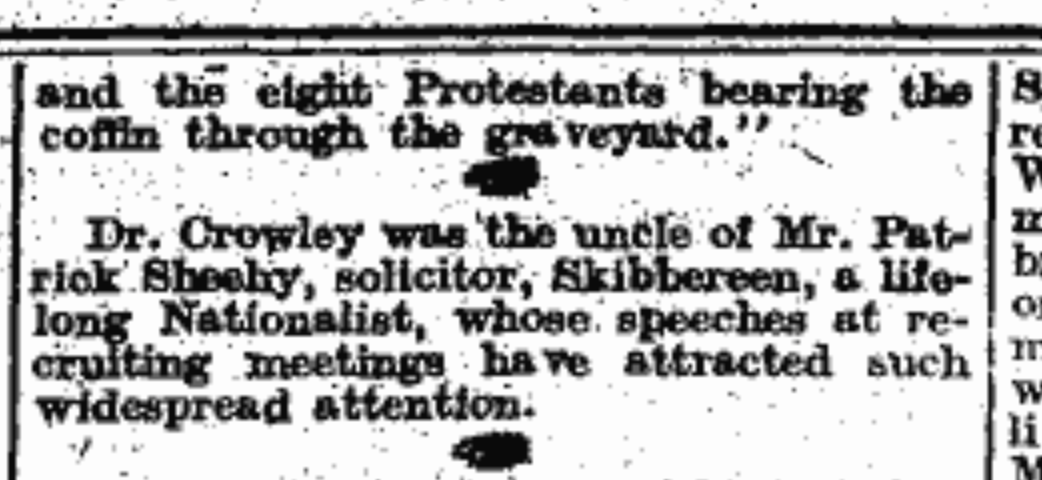
1876-1937 Dr. Michael John McCarthy, LRCP,  Edinburgh, 1903 Doctor Durrus Dispensary, previously 1906 Co.Offaly “Dr. Michael McCarthy was appointed in 1918 and died in 1937 after 20 years service.    He was from Bredagh, Drimoleague, his father a builder mother Anne Crowley, assistant teacher, Drimoleague, 1901 he and  his family have Irish. Married Cork 1906 his wife Margaret Dineen from Cllonakilty.   The salary for his replacement was advertised at £250-350, with £40 for additional health duties. The position of midwife was advertised for Durrus/Kilcrohane in 1938 at a salary of 340-2-£60 per annum. He was active in Fianna Fail and chairman of the old IRA branch.

1935 funeral of Dr. Edward Shipsey, Schull. He also speaks of Dr. McCarthy the Dispensary Doctor of Durrus. He had been a doctor with the British Army but was then the medical advisor to the local IRA and an intelligence officer. It is believed that in the IRA raid of Durrus RIC barracks he managed the explosives. Dr McCarthy of Durrus was prominently involved with Fianna Fail over these elections in 1932 the election speeches referred to the annuities and the general depression.The Durrus Fianna Fail cumann in 1935 comprised Dr.McCarthy Chairman J. A. Moynihan, Vice Chairman, T. Ross, Treasurer, J. McCarthy, Secretary. The Cumann were in 1935 calling for the commencement of the Ballycommane Forestry Scheme.

.

The late Joe O’Boyle was  a ship broker based in Dingle and was often in Vigo in Spain. Some years ago he was with Juan Ferra the founder of a major international machinery company.  In his young days (he is now in his 90s) he was a deckhand and later skipper of one of the trawlers which used to call to Bantry.  The fishermen bartered ling for flour which given the poverty of Spain at the time was prized.  Of more interest were the flour bags which were used as bedding and dyed and made into trousers.  See also Michael Carroll’s book ‘the Second Armada’

From Irish America:


I remember sheets being made of flour bags, but not clothes. ..

I had dresses made from flour sacks.

I am the little dark haired little girl in my dress my grandma made for me.

.

..

During the great depression in America the flour bags were printed with cheerful patterns great for kid clothes and colourful quilts.

I had no idea of any of this! How very interesting! So, is this also what was used for quilting blankets?..Quilts made of flours bags. Love to find sheets.. Quilts made of flours bags. Love to find sheets.

..

From West Cork:

My Granny used also use the flour bags as tea towels , I never remember any other sort of tea towel being used other than those, also she used the flour bags to strain the warm fresh milk from the bucket to the churn.

Sheets were made in our house , and they used to be cut in squares for straining milk straight from the cow.

Subscription Lists, New Catholic Churches at East Schull 1825, Rosnacaheragh (Akakista) 1826, Durrus 1899.


https://docs.google.com/document/d/1dM5rsbc3AyTde6dJK7aWogFA2A85emvdb1g0M-4IRCs/edit

Early Draft

East Schull 1825,  p. 6

Rosnacaheragh (Akakista) 1826, p. 30

Durrus 1899, p. 50

Chapels, Churches and Meeting House 

Catholic 

Durrus is mentioned in a Papal Decretal of Pope Innocent 111 in 1199.  The monastery of Gill Abbey in Cork had a claim for Durrus in the 13th and 14th centuries but it was attached to St. Catherine’s of Waterford.  In mediaeval times the parish of Durrus was part of the deanery of Foneragh (Fionn Iarthach, the western lands) and also included the parishes of Kilmoe, Schull, Kilcrohane, Kilmocomge and Caheragh. 

Report on Popery, 1731 setting out Masshouses and Popish Schools in Co. Cork, Drinagh, Inchigeela 7 sheds, Killaconenagh (Castletownbere) swarms of Priests are constantly going to and from France, 600 families in Parish of whom 12 are of Reformed Church, Kilmoe (Ballydehob), Friars frequently landing from France and dispersing throughout the country, copied from documents in Bermingham Tower, Dublin Castle probably destroyed in 1922.

Further Report Conveyed to His Grace Lord Primate of the Church of Ireland in Dublin 17th December 1731 on the State of Popery including, Aughadown, Ballinadee, Caheragh, a small shed and cabin, Drimoleague, an altar moved from place to place, Fanlobbus (Dunmanway), three small huts open at one end, Drinagh one small hut open at one end, Kilbrittain, Kinsale, Desertserges, Innishannon, Ross, in a field under a hedge, Rathclarin, Schull and Kilmoe three Mass houses three thatched cabins Priests mostly Friars daily moving to and from France and other Popish Countries from Crookhaven, in the Parish of Kilmoe

It is believed that there was a thatched church on the site of the Old Mill, now the housing development Cois Abhann, built around 1750. After the 1798 Rebellion and the arrival of the French Armada in Bantry the church was forced to close.  There were also Mass Rocks, one in Coomkeen in the lands of the late Timmy Wholihan and one at Kealties.  There are the ruins of a church at Kealties; this was a thatched church erected c.1780. There was a belief among the older people that there was a church or house of refuge at Rossmore (on the northern side of the road in George Hegarty’s farmyard) on the site indicated as a burial ground on the Ordnance Survey map. There may have been another church at the boundary between Clonee and Crottees, there is an area there known as ‘The Chapel Brake

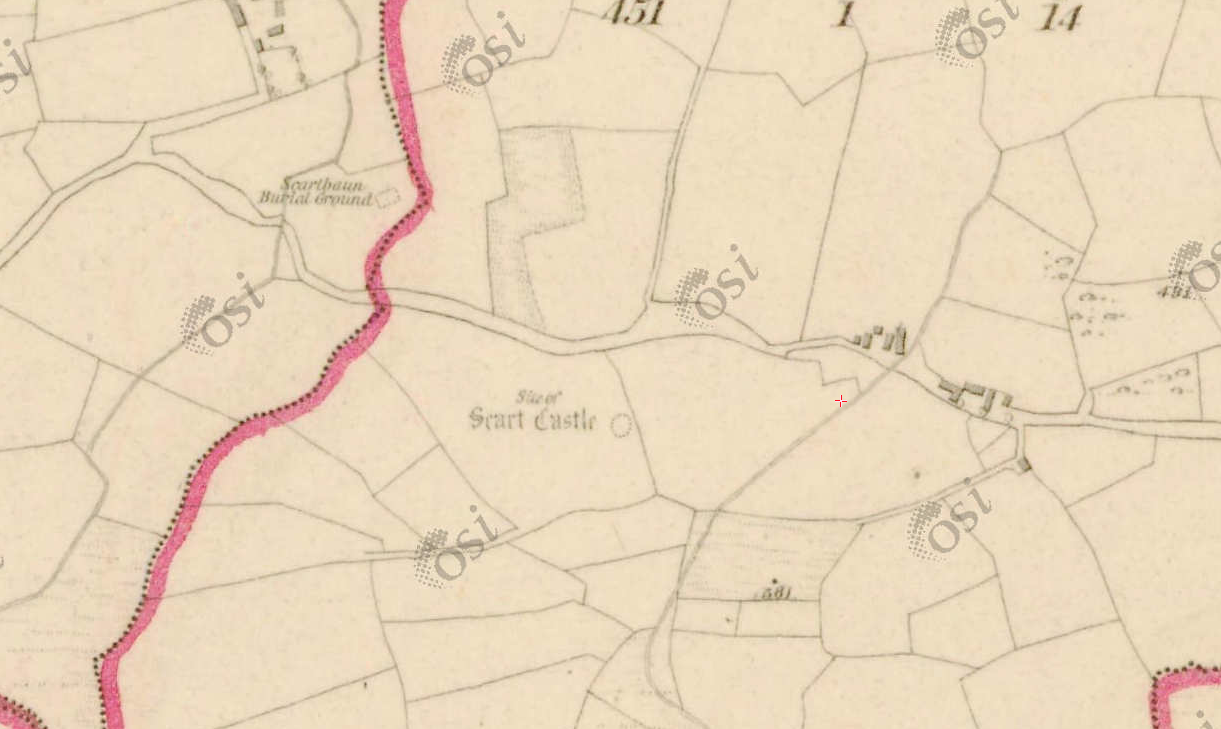
The old Church at Durrus East, Moulivard was probably built around the 14th or early 15th century, contemporaneous with the ruined church in Kilcrohane graveyard. Inside the church is an incised cross dating from the early Christian period.  This was found by Jeremiah Hurley, d. 1933, grandfather of Vincent Hurley while ploughing their farm near the creamery and then placed in the Church grounds.  Another cross of this type is in Cape Clear and may denote an old monastic settlement.  There had been a monastic settlement at Scartbawn under the patronage of the MacCarthy (Teig Rua sept) who had a castle in the area.  This moved to Moulivard to take advantage of the water power of Four Mile Water and the mill race is still visible in Ballinvillen (townland of the mill).  Moulivard Church was in good repair in 1639 and in use mid-17th century but according to Brady was in ruins by 1699.  It is said that the white friars are associated with the site but there is no corroboration of this. There is a local tradition that the church was used in Penal times, when Mass was celebrated from time to time by itinerant friars.  On St John’s Eve an open air mass is celebrated each year.  The stone table used otherwise for coffins is used and in the course of the mass parishioners call out the names of family members buried in the graveyard for prayers In the 1730s the Franciscans had a limited presence in West Cork site of their former monasteries. There is also a local tradition that a priest was hung from a tree on the back road near Durrus Court, there were episodes of ‘priest-catchers’ in 1707, 1712 and 1717.  On the coast near Kilcrohane is an area Coosataggart (Cuas an tSagairt) where priests reputedly used to hide in a cave in Penal times. According to tradition there was a church at Coolculachta. 

An early church stood on the site of the old Mill erected c 1750.  It may have been built by Father Timothy O’Crowley and was probably thatched.
The former church at Chapel Rock (on the site of the present National School) was built by Fr. Quin in 1820 and was a slated structure.  Fr. Richard Quin was from Onoyne, in Co. Tipperary and came to the parish in 1818.  He was one of four from Co. Tipperary who came to West Cork, Father Doheny in Dunmanway, Father Dore in Caheragh and Father Ryan in Drimoleague. All were active in church and school building and politically active in O’Connelite politics  and anti tithe agitation.  In 1820 he started the parish register of births, marriages and deaths.  In 1835 his house was described as ‘a whitewashed cottage embosomed in its snug and thriving orchard, standing further inland among verdant meadows’.  The Ordnance Survey letters describe it and that of the Rector of the only two slated houses in Clashadoo.  A Parliamentary enquiry in 1835……,

1895.  Church of Ireland Diocesan Board of Education Examination Results, West Cork.


1895.  Church of Ireland Diocesan Board of Education Examination Results, West Cork.

https://docs.google.com/document/d/1evuylzr3_1f0GFHgDXCvEZvskuSE20XSYp3Ie1uoiwk/edit

1913, Skibbereen Eagle published the Diocesan Board of Education (Church of Ireland ) exam results.

https://docs.google.com/document/d/1YW71BDz3_E7h_amBKnMrj4rmKtTxn2Bfy9nAwOcqEKw/edit

1914, Diocesan Board of Education, Church of Ireland, Annual Examination Results, West Cork

https://docs.google.com/document/d/11kQksgrVhoXQOCABSmbeKM2CtJhr5jpxXb2QUvBgb28/edit

Fill in the Census Form as Gaeilge


The 10 Oldest Languages Still Spoken in the World Today. Irish has the oldest vernacular literature of any language in Western Europe. While the rest of Europe was speaking their own languages and writing in Latin, the Irish decided that they wanted to write in their own language instead.

\

https://wordpress.com/post/durrushistory.com/37870

1814, Clonakilty, 1804, Lower Class of Protestant Speak English and Irish. 1830, Cotters, Inchileegahg and Irish, Very Ashamed of this Old-fashioned Practice.’

https://wordpress.com/post/durrushistory.com/36360

Canon Shinkwin was talking to the older people in Borlin (Bantry, West Cork), in Irish around 1903 and asking them to speak Irish to the small children at night with a view towards arresting the decline of the language. There were 4 million Irish speakers pre famine in 1840 and in 1900 probably at least 10 million worldwide whose parents had been Irish speakers, Borlin Bull Irish Civil War.

https://wordpress.com/post/durrushistory.com/25795

Decline of the Irish language Muintervara 19th century.

https://wordpress.com/post/durrushistory.com/51

1884, West Muskery Presentment Sessions, Approval to new Road at Gurteenakilla to Serve 15 Townlands to connect to the Macroom/Bantry Road. Up to That Point people could not use a Cart and had to carry their produce on the backs of Horses or their Own Backs.


1884, West Musketry Presentment Sessions, Approval to new Road at Gurteenakilla to Serve 15 Townlands to connect to Macroom/Bantry Road. Up to That Point people could not use a cart and had auto carry there produce on the backs of horses or their own backs.

These session were held to forward proposed works to the Grand Jury for approval. The Justices referred ago are Magistrates associated cesspayers were generally prosperous local farmers. when Cork County Council came in existence in 1899 these session were no more.

The Magistrates were abolished in 1922 by the Irish Free State and replaced by District Justices full time paid judges.,

Of there ~agistrates mention John Edward Barrett married the daughter of William O’Sullivan, Esq., Carriganass Castle and managed his wife’s property as well as other local estates , he too lived in Carriganass Castle after his father in laws death. His brother Dr. Barrett appears as a landlord in Kilcrohane and other areas possibly through the William O’Sullivan connection. He was married to the daughter of Charles Roycroft who came from Boulteen, Bantry/Durrus prominent in nationalist politics. His son in law H. B. Minhear is another magistrate. Norwood is Dunmanway and Warren Kilmurray.

..

Sir Robert Richard Torrens , 1814-1884.  Cork born Inventor of Torrens System of Land Registration with Assistance From German born  Ulrich Hübbe LL.D. Influenced by the Hanseatic League. First introduced to South Australia  1858.  Adopted in Australia, Canada, Fiji, Dominican Republic, Land Registry Ireland 1881, Israel, Malaysia, New Zealand, Philippines, Russia, Saudi Arabia, Singapore, Sri Lanka, Thailand, USA.


The Torrens system is simple. The State guarantees land title on a document known as the Folio instead of a donkey and car load of deeds and documents arising from the first system of land registration in Ireland the Registry of Deeds.

That system was not born out of altruism but another instrument of the Penal Laws to turn the screws on the native Irish under the Penal Laws. Think of the Ukraine and Russia.

One of the unintended consequences of the Registry of Deeds is that there are about 4.5 million memorials (summary of property transactions) beautifully restored about 40 years ago under the Fund of Suitors and are a trove of genealogical and other information. A project in the early stages by the Property Registration Authority aims to digitalise the entire collection and make it fully available free online.

In the meantime a worldwide volunteer project is transcribing the deeds.

https://irishdeedsindex.net/index.php

Sir Robert Richard Torrens 

Australian Dictionary of Biography

https://adb.anu.edu.au/biography/torrens-sir-robert-richard-4739

In Ireland the introduction of the Torrens system coincided with the establishment of the Land Commission. Perhaps the largest voluntary land transfer in world history. About 70% of the land area of the Island of Ireland was transferred from the landlords to the tenant who became full legal owner subject to an annuity to the Land Commission.

At least on the independence of this part of Ireland the land question was settled unlike Hungary where in the 1930s a tiny proportion of the population owned over 90% of the land.

For a history of Land Tenure in Ireland:

From Dispossession to Digitisation: the Transformation of Property Registration Services in Ireland

https://www.elra.eu/from-dispossession-to-digitisation-the-transformation-of-property-registration-services-in-ireland/

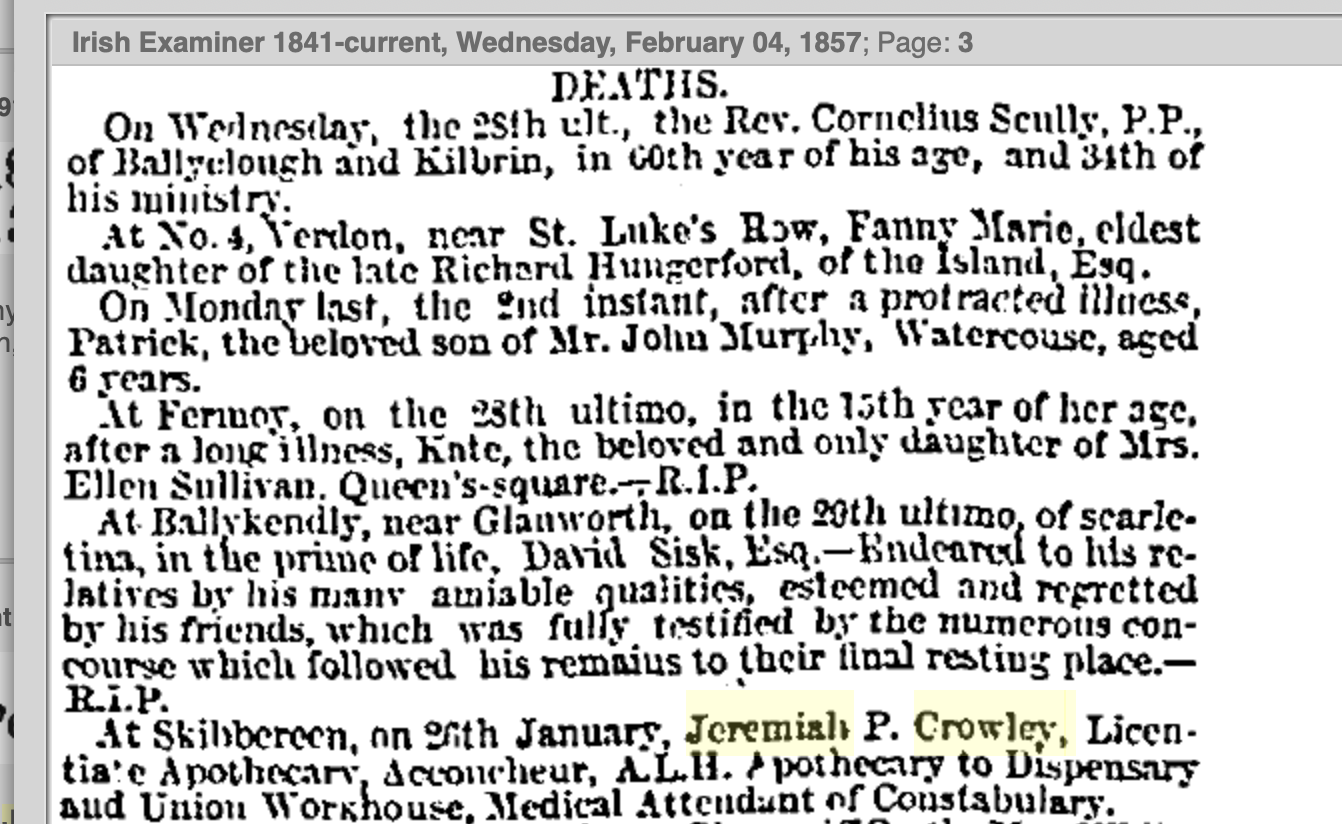
1832 Charles Armstrong, Formerly 1832 Bantry Cholera Hospital, Medical Officer Crookhaven Dispensary, Physician Cork General Dispensary, Surgeon Constabulary and Coast Guard Goleen and Rock Island. Author of Petition Preying on Medical Grievances (Non payment or minimal payment for quasi legal services) presented to both Houses of Parliament in UK


1832 Charles Armstrong, Formerly 1832 Bantry Cholera Hospital, Medical Officer Crookhaven Dispensary, Physician Cork General Dispensary, Surgeon Constabulary and Coast Guard Goleen and Rock Island. Author of Petition Preying on Medical Grievances (Non payment or minimal payment for quasi legal services) presented to both Houses of Parliament in UK

MD Glasgow 1838, MRCS England 1833, FRCI 1844. Doctor, formerly Medical Officer Crookhaven Dispensary, Physician Cork General Dispensary, Surgeon Constabulary and Coast Guard Goleen and Rock island. 1857 Medical Referee various Assurance Companies During cholera epidemic 1832. 1857 Cork 34, King St. Author of Petition on Medical Grievances presented to both Houses of Parliament in UK

.

Early Doctors and Apothecaries (Chemists), Cork City and County

https://docs.google.com/spreadsheets/d/17Xdk_bdkpBSVHaTP45WxSY0r4v6-kluvlPz7ZynQxfU/edit#gid=0

In November 1901 a Splendid Public Demonstration was held on the Outskirts of the Quiet little Village of Durrus to Establish a Branch of the United Irish League in the Parish.


The period before and after in the district was marked by a split on the Nationalist side between 2 factions one of which was the United Irish League.

J. Dukelow is probably Jack Dukelow of Brahalish:

Jack Dukelow, 1866-1953, Brahalish and Others Charlie Dennis Poet, Batt the Fiddler, Canon McManaway smuggling horseshoes stubs into the Free State and others stories:

https://docs.google.com/document/d/1Gnw2LsIbV0Wxk2bGjzCPq9sH9rCCQOrYTh5c0bG7vf0/edit

In November 1901 a Splendid Public Demonstration was held on the Outskirts of the Quiet little Village of Durrus to Establish a Branch of the United Irish League in the Parish.

J. Dukelow is probably Jack Dukelow of Rossmore

.

James Gilhooley MP (1847-1916) was a publican and draper in Bantry, and was jailed under the Coercion legislation during the Land War 1880s.  He was elected to Parliament and kept his seat in each succeeding election until his death. Evidence was given by the Clerk of the Carrigbui Petty Sessions in a case in Bantry that Gilhooley had the licence of a public house in Durrus which was held on his behalf by his sister Agnes.  On the Parnellite split he opposed Parnell and later joined the faction led by O’Brien and known as the All for Ireland Party (AFIP). There was a public meeting in Durrus which founded the United Irish League in November 1901 which he and fellow MPs Crean and Flynn addressed.   Among the attendance were J D Sullivan DC, Jeremiah Hurley DC, J Dukelow, T Dillon, S Kingston, J Moss and numerous others. The parish priest who chaired the meeting recalled the bad days of 1881-1886 for the people of Muintervara and had no doubt that by Christmas of that year the vast bulk of the parish would be members of the United Irish League.

Gilhooley addressed an enthusiastic meeting in Durrus on January 1910 presided over by Mr. John D. Sullivan.  Bonfires were lit in the street, it was market day in the village and large numbers of country people were present.  Mr Gilhooley contested the two elections in 1910 as an Independent, supporting O’Brien; his opponent was Mr. O’Leary, Ahakista Cottage, the U.I.L. (United Ireland League/Redmondite) candidate. Gilhooley had support in Durrus in this election and his opponent was strong in Kilcrohane. His election agent was Jasper Woulfe, Solicitor, later Crown Prosecutor and TD, Skibbereen.  He would later be an Independent TD for West Cork.   Gilhooley up to this time had been elected unopposed for 18 years.  In the later election of 1910 there were disturbances in Bantry, when rival factions fought, some coming from Cork; over a two-day court hearing, 45 were prosecuted for riotous behaviour. In September 1910 a case of assault was brought at the Petty Sessions by Patrick Burke, Coomkeen.  He alleged that while leaving Kilcrohane with his niece driving a trap he was set upon by three locals Arundel, Donovan and Donovan shouting ‘Up the Mollies’ they were convicted and bound over to the peace.

In the election in December Gilhooley had the use of two motor cars to bring constituents to the polling station.  On examining the type of questions raised by Mr. Gilhooley at Westminster, one is struck at the similarity with those raised by a typical country T.D., at Dail Eireann. Gilhooley attended a monster meeting in Bantry in 1888, attended by 5-6,000 people, to set up a branch of the United Traders Association and Industrial League, to promote the purchase of Irish goods and the boycott of English goods.  There is a memory of fish sellers from Gearahies coming to Durrus to sell fish and roaring ‘up the Mollies’ in connection with political controversy at that time this was probably the second election of 1910, when emotions were inflamed.  In the February 1910 election there were 326 votes cast out of 407. 

There were disturbances in Durrus in January 1911 between ‘Redmondites’ and ‘All for Irelanders’ and a force of between 8 and 10 policemen were unable to quell the disturbances which lasted for over an hour, the main street was regarded as unsafe to traverse.  Tension continued into September 1911 at a court hearing in Bantry into those entitled to be on the electoral register.  Mr O’Leary in his dual capacity as a Barrister and potential political representative opposed the inclusion of various people in Durrus as they allegedly did not meet the governing criteria.