Appointment of Rate Collectors 1852 by Bantry Union, Co. Cork, Florence O’Leary, Poundage 6d in the £, Thomas Dillon, Durrus and Kilcrohane 4d.


Appointment of Rate Collectors 1852 by Bantry Union, Co. Cork, Florence O’Leary, Poundage 6d in the £, Thomas Dillon, Durrus and Kilcrohane 4d.

The Dillons lived at Clashadoo, Durrus and were intermarried with Roycrofts of Boultenagh, Rooska and Bantry and Cantys. The family has a large tomb in Moulivard Graveyard (Durrus East). Thomas Dillon also appears as a member of the Bantry Board of Guardians, looking after the workhouse among other things

Thomas is probably an ancestor to Miss Dillon who had a pub in Bantry near the old railway station and extensive property. She left this to her late nephew Shawn Dillon of Clashadoo who in the late 1940s was heavily involved in Clann na Poblachta.

The Dillons may be of the same family as that of the lady who married one of the Bantry Whites in the 1770s. The marriage was set aside as having been performed by a ‘Popish priest’.

Lord Bandon Inspected the Barytes Mines, Dereenlomane, Ballydehob, on his Property on August 1868. He had been staying at Durrus Court, Carrigbue where the High Sheriff and his sister Lady Mary Aldworth were residing.


Lord Bandon Inspected the Barytes Mines, Dereenlomane, Ballydehob, on his Property on August 1868. He had been staying at Durrus Court, Carrigbue where the High Sheriff and his sister Lady Mary Aldworth were residing.


Dereenlomane Barytes Mine

Installation of Steam Engine on Lord Bandon’s Barytes Mines (Dereenlomane),1867, and local Road Damage. At the time roads were maintained on contract for a period usual three years approved by the Grand Jury at presentments. At one of these the Rev. Pratt, the local Church of Ireland Minister, pointed out the the road between Durrus and the Mines was in a dreadful state due to the operation of the mines. He felt it unfair that the local population should bear the cost of rehabilitation.

This was originally worked as a copper mine by the Rev. Traill of Schull, assisted by Captain William Thomas in 1840 and they sold 19 tons of copper.  They discovered barytes or barium sulphate, a heavy white mineral, used for paint, papermaking for which in the 1850s there was a limited market.  An early use was by Josiah Wedgwood in the making of pottery.  In 1863 Captain Thomas was chartering boats c 160 tons and shipping the barytes to Messrs Martyn Dennis Liverpool and around 150 people were employed.  That year there was a serious flood which resulted in the mine being non operational for a period.  In 1867 the mine at what was described as Cahirolickaney Mountain was inaccessible and Captain Thomas built a road from the mine to the Dunbeacon Road nearly a mile long in three weeks.  It was marked by a celebration with ‘creature comforts’ in abundance, followed by a dance.  Before the road was built the farmers had to carry sea sand and manure along the line of the rocky bed of a river and scramble up the mountain as best they could with back load on horses, men and women.  The road was called Wilson’s after one of the promoters by Father O’Regan.  There were quite a number of fatalities in the operation of the mine which were mentioned in the local press.

In 1851, 2,500 tons were raised compared to only 800 tons in three other centres in the former United Kingdom.  The material was washed, dried, crushed and milled.  It was then produced as barytes flour; this was packed into bags and sent to an island jetty in Dunmanus Bay by an aerial ropeway 1.23 miles long.  From 1909, the boats carried coal to Dunbeacon and left with barytes.  During the War men dived there looking for remnants of coal.  Prior to that the ore went by horse and cart to Schull pier. The mine also produced a small tonnage of copper (bornite) and approx 22,000 tons of fine barytes. It was worked by a Liverpool Company controlled by the Roe Brothers; one of the assistant Managers was Mr. Barton.  The mine used to be all lit up at night and it looked like a city.  At its height up to 500 were employed, supervised by Welsh miners. The numbers employed in 1915 were 150 described as highly paid. Among those who worked there were the father and uncles of Danno Mahony of nearby Derreenlomane the World Wrestling Champion. Bells rang to call the labourers to work in the morning.  A report in 1923 described the treatment of the ore as ‘washing, drying, in a revolving furnace, crushing, rolling between steel rollers and milling’.  In 1917 a major fire caused extensive damage, including the underground workings.  Although repairs were carried out, the mine never recovered its former level of activity. In 1922 the then Department of Agriculture and Technical Instruction reviewed the recent history of the mine and commented on it being burnt down in July 1920.   Mr Lynburn of the Department expressed a hope that in time with a more relaxed regime re explosives it might re open.

A line of timber pylons ran from the mine site down the steep hillside all the way to Dunmanus Bay. The pylons, anchored to triangular concrete-and-stone foundations, supported a continuous aerial rope and a number of cable cars. The system was powered by a gas engine. The foundations are all still in situ and can be followed to the sea.  The ships which carried away the ore landed coal and during the War people dived in the area seeking lumps of coal.

Five hundred men had worked at the mine between 1917-18.  Mine water was pumped by a ‘balanced bob’ with the engine house being sited over the main shaft. The gas engine house was located adjacent to the pump house. The mining company entrusted the job of making ore-bearing cable-cars to a local carpenter cum pit-sawyer named Willie Coakley.  He seems to have played a considerable role in erecting the aerial ropeway system and in weaving wicker cable-cars to transport ore from mine to sea.

On the first trial of the aerial ropeway, a number of baskets were laden with barytes and sent down the steep hill to their destination, a pier at Dunmanus Bay.  From there it was exported to Liverpool, London or Glasgow.   However, on releasing the baskets it was discovered that the braking mechanism on the aerial ropeway had failed. On reaching journey’s end, the run-away cable-cars demolished a portion of the aerial rope and caused extensive damage to the system, presumably several pylons were torn from their foundations.

A local wit composed a poem to commemorate the event – the poem was titled ‘Willie Coakley’s Apparatus’ One line of the poem describes the wicker basket in euphemism as ‘a donkey who would never have a foal’

Boats landed at a pier of which a buoy still survives. The Atridge, Shannon and Hegarty families from Rossmore across the Bay jointly owned  a fishing boat. They would regularly cross to trade potatoes, vegetables and meat for tobacco and brandy. The Captain was Captain was generally Captain Bousy and afterwards the Attridges were known as the Bousys. It was the custom for the miners to play football at a field near the mine every Saturday afternoon.

In the records of Carrigbui (Durrus) schools there are frequent reference to the parents of the children being miners and often coming in from outside areas often abandoning earlier occupations.

When the mines closed many of the men went to South Wales to work in the coal mine sother to mines in the USA.

At the Dunbeacon side there was an area of houses now derelict which in the early 20th century was a hive of activity and centre of music and dancing known as the ‘Station Heights’. Many of the families were associated with the mines.

When the mines closed many of the miners went to the coal mines of South Wales or to the USA. One of them was Denis John L O’Sullivan, his father originally from Kilcrohane ran a pub in Durrus, who went to the USA and returned. He had a pub in Durrus Village which is still run by his son Danny.

Kevin Daly

December 6, 2011 at 8:57 pm

My paternal grandfather, Cornelius Leo Daly worked at this mine up until it was ultimately consumed by fire. The Daly family lived in the Station Heights, a series of attached houses just to the west of the foot of the Mine road where it intersects Dunbeacon Road at Dunmannus Bay. There was little work to be had after the fire and my grandfather eventually immigrated to Boston, Massachusetts to find work and support his wife and four children back home in Ireland. My late father, Cornelius Patrick Daly was just shy of five years old when his father left in 1925 and he often told the story of watching his father leaving in a cart being pulled by a black horse headed off to Cobh and America. Sadly his father died around 1930 as the result of injuries he sustained in an automobile accident. He’s buried in West Roxbury, Massachusetts. These were very hard times for the family back home but they managed with hard work and the generosity of others. Until the day he passed my father considered himself a proud American but always an Irishman first. His and his siblings optimism though the hardest of times inspires me each day. God bless the people of Ireland. There are none finer.

Tom Coughlan

January 25, 2016 at 1:26 am

I grew up in Station Heights and recall; your uncle Corney & Aunt Marie (A) either living or (B) visiting when I was a wee lad!
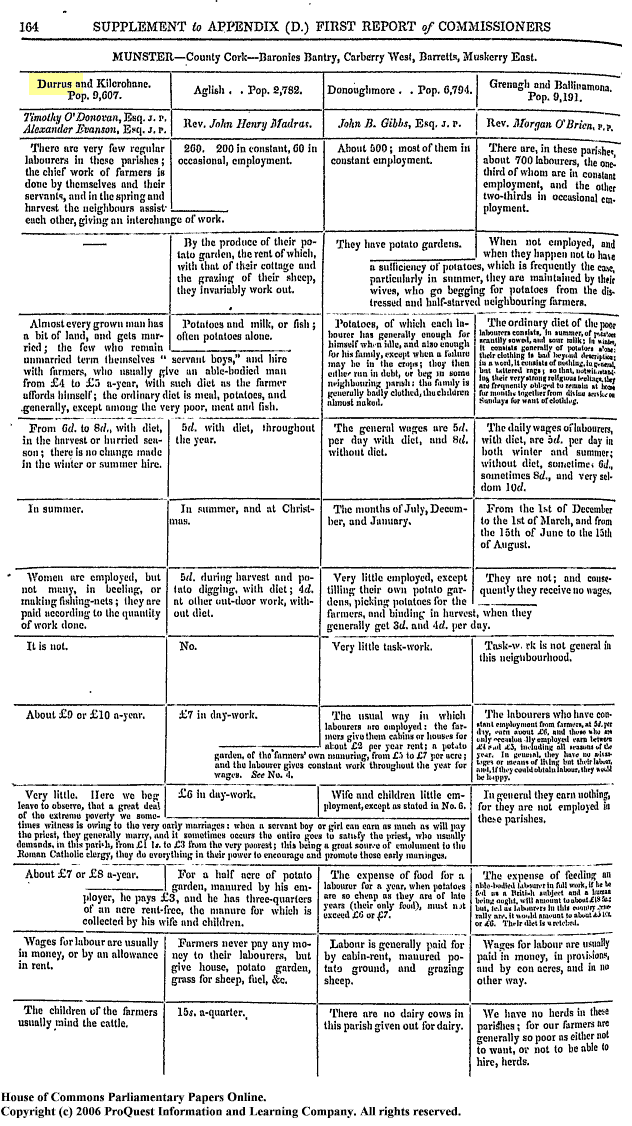
Subscribers Co. Cork, Durrus/Kilcrohane, 1846 to the ‘O’Connell Tribute’: Rev Richard Quinn, Parish Priest £2, Rev Simon Murphy, Curate, Denis McCarthy, £5, Eugene Sullivan £5, Patrick Sheedy £2, Richard ‘King’Tobin Senior 5s, Richard Tobin Junior 5s, Patrick Tobin Junior 5s, Patrick Tobin Senior 5s, James McCarthy 2s, Tom Donovan 2s 6d, Timothy Daly 2s, other smaller amounts


https://www.google.ie/maps/place/Durrus,+Co.+Cork/@51.6497011,-9.4265841,12z/data=!4m2!3m1!1s0x48459fe7ccd270df:0x231e3744ac95441a

Subscribers Co. Cork, Durrus/Kilcrohane, 1846 to the ‘O’Connell Tribute’: Rev Richard Quinn, Parish Priest £2, Rev Simon Murphy, Curate, Denis McCarthy, (Possibly Letterlickey may be related to Richard Tobin’s wife Nora) £5, Eugene Sullivan (Possibly Merchant/Miller Durrus) £5, Patrick Sheedy £2, Richard ‘King’ Tobin Senior (Major Local figure agent Lord Bantry, businessman) Senior 5s, Richard Tobin (probably son of ‘King’ who came to Durrus extensive farmer hotelier and businessman owned present Rosses Hotel large Celtic Cross in Durrus Churchyard wit inscription in Irish) Junior 5s, Patrick Tobin Junior 5s, Patrick Tobin Senior 5s, James McCarthy 2s, Tom Donovan 2s 6d, Timothy Daly 2s, other smaller amounts

The Tobins of Kilcrohane, West Cork, from Catholic Church Records, Muintervara from 1819, the Seven Sisters of Gloun early 19th Century and John F Kennedy Connection, 1740s Lease of Donemark Mills, 1820s Lease of Part of Whiddy Island, Richard ‘King’ Tobin and Lord Bantry, Road Contractors, Richard Tobin, Letter, Member Bantry Board of Guardians.

The O’Connell Tribute Genreally:

http://www.clarelibrary.ie/eolas/coclare/people/daniel.htm

Evidence of Daniel O’Connell, Esq., 1st March 1825 to Select Committee of House of Commons, London, on state of Legal Administration, Function of Assistant Barrister in Court, Grand Juries selected from Improper Persons, Low persons Vendors of Spirits and Beer, The Bar in Cork, Mr. Wagget, Recorder of Cork, of Private Means with a small salary which he refuses to to be increased, outside Cork the sessions conducted by Attorneys of low repute the relaxation of Popery Laws has given a better class of Attorney then what existed before., The Mode of Administering the Criminal Law by the Magistrates in Ireland has been very bad, particularly in relation to Tithes, for the last two-an-twenty years Roman Catholic have been eligible to the situation of Directors of the Bank of Ireland but not one elected although an immense deal of Bank Stock belongs to the Catholics, up to 10 Catholics in Bank of Ireland Clerkships.

Daniel O’Connell addresses Monster Meeting of 500,000? on Repeal in Skibbereen, June 1843, and Bandon, Skibbereen and Bantry connections with O’Connell with O’Donovan Rossa’ Recollections of ‘Wandmen’ at the Meeting.

Election of Daniel O’Connell, 8th July, 1828 from diary of Amhlaoimh Ó Súilleabháin (Humphrey O’Sullivan)

Daniel O’Connell in Folklore

Updated, Art O’Leary, French Educated, Captain of The Hungarian Hussars, refused offer for his winning horse of £5 under Penal Laws by Abraham Morris, proclaimed an outlay, killing at age of 26, his wife an aunt of Daniel O’Connell ‘Caoineadh Art Uí Laoighre.

Bantry Area family of Derrynane, Co. Kerry, O’Connell’s, signature of ‘The Liberator’ Daniel O’Connell, his sister Hanoria married Daniel O’Sullivan, Reendonegan, Bantry, their son Daniel, Magistrate, Dominica West Indies, his sister married Naval Officer in Tsar’s Navy. areas mentioned Coolagh, Borlin some names include Donovan, Lucy, Galway, O’Hea-Cussen, Cronin, compiled by Basil Morgan O’Connell, of Lakeview Branch, 1946 he Head of CID, Malaysia.

1826, United Parishes of Durrus and Muintervara, The Rev,. Richard Quin/Quinn P.P. begs leave to offer his most Respectful Thanks to to the Right Reverend Dr. Murphy, Lord Carbery, and the undermentioned Ladies and Gentlemen by which he has been enable to nearly complete two churches in the United Parishes. Right Rev. Dr. Murphy £10, (Bishop of Cork) Lord Carbery £3.3, (Landlord, Ballycomane), Mrs. Baldwin £10, Mrs. O’Donovan, O’Donovan’s Cove £40, (Landlord) Rev Alcock, £2, (Vicar) R. Evanson Esq., Four Mile Water, £1, (Landlord) D Macguillcuddy Esq., £3, Dr O’Donovan, O’Donovan Cove, £5, (Doctor Daniel Donovan, William Wise Esq., £2, (Possibly Cork Distilling Family) Charles Evanson, Esq (Former Lord Mayor of Cork), £2.2, William Beamish, Esq., £5.5, Jeremiah Murphy, Esq., £10, James Murphy Esq., £3.3 Daniel Murphy Esq., £1, Nicholas Murphy Esq., £1.10, John Murphy Esq., £1 Alexander O’Driscoll. Esq., Clover Hill, £2.2, (Probably Middleman on Mizen), T(imothy) O’Donovan, Glanlough Cottage, £5, (Landlord) T(imothy) O’Donovan, Esq., £5, Rossquinough (Rosnacaheragh), (Landlord) Richard O’Donovan Esq., O’Donovan’s Cove, £3, (Landlord), Captain O’Donovan, Killbrinogue £1.1 (Probably Half Pay officer died 1826), Richard Levins (Levis) Esq., £1.11 (Possibly substantial farmer Mizen), Timothy Sullivan, Esq., Bantry £2


1826, United Parishes of Durrus and Muintervara, The Rev,. Richard Quinn P.P. begs leave to offer his most Respectful Thanks to to the Right Reverend Dr. Murphy, Lord Carbery, and the undermentioned Ladies and Gentlemen by which he has been enable to nearly complete two churches in the United Parishes.

Right Rev. Dr. Murphy £10, (Bishop of Cork)
Lord Carbery £3.3, (Landlord, Ballycomane),
Mrs. Baldwin £10,
Mrs. O’Donovan, O’Donovan’s Cove £40, (Landlord)
Rev Alcock, £2, (Vicar)
R. Evanson Esq., Four Mile Water, £1, (Landlord)
D Macguillcuddy Esq., £3,
Dr O’Donovan, O’Donovan Cove, £5, (Doctor Daniel)
William Wise Esq., £2, ( Cork Distilling Family)
Charles Evanson, Esq  ( Former Lord Mayor of Cork, born Durrus, Douglas), £2.2,
William Beamish, Esq., £5.5,
Jeremiah Murphy, Esq., £10, also donor Schull Church 1825.
James Murphy Esq., £3.3, also donor Schull Church 1825.
Daniel Murphy Esq., £1, also donor Schull Church 1825.
Nicholas Murphy Esq., £1.10, also donor Schull Church 1825.
John Murphy Esq., £1, also donor Schull Church 1825.
Alexander O’Driscoll. Esq., Clover Hill, £2.2,  Middleman on Mizen, Magistrate
T O’Donovan, Glanlough Cottage, £5, (Landlord)
T O’Donovan, Esq., £5, Rossquinough (Rosnacaheragh), (Landlord)
Richard O’Donovan Esq., O’Donovan’s Cove, £3, (Landlord)
Captain O’Donovan, Killbrinogue £1.1 (Last of The Irish Brigade Half Pay officer died 1826)

Richard Levins (Levis) Esq., £1.11 (Possibly substantial farmer Mizen)
Timothy Sullivan, Esq., Bantry £2, also donor Schull Church 1825.

29th October 1864, Coursing Meeting of Friendly Cove Coursing Club, Carrigboy, (Durrus) met at Dromreagh by invitation of Richard Evanson Esq., Owner. The ground was long known for hares being strictly preserved. At 5 o’clock in the evening the members adjourned with some other gentlemen to dinner at Philips Hotel given by Mr. Evanson served in Mr. Philip’s usual style


https://www.google.ie/maps/place/Dromreagh,+Co.+Cork/@51.6143084,-9.5034165,15z/data=!3m1!4b1!4m2!3m1!1s0x48459fbf5aa6407b:0x2600c7a7bb4c0162

29th October 1864, Coursing Meeting at Friendly Cove Coursing Club, Carrigboy, (Durrus) met at Dromreagh by invitation of Richard Evanson Esq., Owner. The ground was long known for hares being strictly preserved. At 5 o’clock in the evening the members adjourned with some other gentlemen to dinner at Philips Hotel given by Mr. Evanson served in Mr. Philip’s usual style

Skibbereen Eagle.

Dublin Penny Journal, Journey to Durrrus 1836, from Butler’s Gift (Drimoleague), West Cork, John Windle Cork Antiquarian and Father John Ryan, Drimoleague to the Rev. Alleyn Evanson.


durrushistory's avatarWest Cork History

https://www.google.ie/maps/place/Durrus,+Co.+Cork/@51.6212816,-9.5479125,16z/data=!4m2!3m1!1s0x48459fe7ccd270df:0x231e3744ac95441a

This journey was undertaken by John Windle, Antiquarian and Fr John Ryan Parish Priest of Drimoleague to Durrus (Four Mile Water) to the house of Alleyn Evanson now known as Durrus Court.  Father Ryan lived in Butler’s Gift (Drimoleague).  The McCarthys referred to are the McCarthy Mucklaghs former occupants of the nearby castle still extant.  They had an earlier castle at Scart just off the Bantry/Cork road about 2 miles from Durrus Cross.

View original post

Letter of Rev Crosthwaithe, Rector, Durrus re Relief Works to The Times November 1846


durrushistory's avatarWest Cork History

Earlier the Rev Crosthwaite was involved with the Island and Coast Society a prosylesying organization. They had an involvement wiht at least three schools at the Western end of the Peninsula. They were involved with the Kerry born Rev. Spring who was active on Cape Clear and the Islands and who was friendly with the Rev. Crosthwaite.. The stones from his Cape Clear church were used in the building of the former AIB Bank in Schull.

The Rev. Crosthwaithe was also on the speech circuit in England raising money for these activities.

View original post

Manor Courts Ballydehob 1621, Bantry 1679, Co. Cork, and coments by John Jagoe, Bantry re same to Commission 1836.


durrushistory's avatarWest Cork History

Manor Courts Ballydehob 1621, Bantry 1679, Co. Cork, and coments by John Jagoe, Bantry re same to Commission 1836.

The jurisdiction of the Manor Courts was transferred to the Petty Sessions in 1859.  Before then they operated throughout Ireland with different dates of commencement.

The court at Ballydehob was set up on the 16th July 1621 over the lands known as ‘Glaght Teige’ or ‘Mahama’ comprising thirteen ploughlands.  A parliamentary report of 1837 stated that in 1833 the court sat on 13 occasions with 131 cases entered and 72 tried.  Its jurisdiction was  below 10 shillings for debt and not exceeding £5 for trespass, detinue, trover and trespass.  The court was presided over by a ‘seneschal’ Mr Sweetnam who was not legally qualified and a jury.

There are papers in relation to the operation of the court in 1761 in the National Library.

The Manor Court in Bantry dated from the…

View original post 281 more words