Old Method of Storing Apples.


Old Method of Storing Apples.

Some of the older people in West Cork used to preserve apples as follows.

The apples would be placed in a pyramid and covered in a mixture of grass and earth from under the apple trees.  The mound was then covered with hessian cloth from sacks which had been soaked in pickle,  This kept the snails at bay.

The method was broadly similar to potato pits.

Present by Daniel Sullivan, Berehaven, West Cork, to Richard Boyle, The Great Earl of Cork, c 1636 of Harvey Apples, Bon Chretien and Bergamotte pears, Arbutus for his new garden at Stalbridge Park, Dorset and Irelands first horticultural export The Strawberry Tree’ (Arbutus unedo) from 1580s.

Inventory of plants grown by Gaelic Irish 1620 prepared by Philip O’Sullivan Bere, and early 19th century cultivation of grapes and pineapples by Timothy O’Donovan Magistrate of O’Donovan’s Cove, Durrus, West Cork.


https://wordpress.com/post/durrushistory.com/30991

1793. Pipers and Fiddlers for Tenant Gala on Kerry Estates of the Earl of Bandon 1793.


1793.  Pipers and Fiddlers for Tenant Gala on Kerry Estates of the Earl of Bandon 1793.

From Gibson’s History of Cork p 496:


This would have been a time of great war induced prosperity.


These grants were shortly after purchased by the first Earl of Cork, who may be justly styled the founder of the town. Through him, the Earls of Cork and Shannon, and the Duke of Devonshire, possess property in the town and neighbourhood. The Earl of Bandon is also a proprietor, but the principal part of his property is in Kerry and in the western part of the county. The Bernard family have always been esteemed good landlords and kind to their tenantry. The following extract from an original letter written by his agent to the Lord Bandon, of April 23rd, 1793, preserved among the papers of Wm. T. Crosbie, Esq., of Ardfert Abbey, county Kerry, will afford a good idea of what an ” Irish tenant gala ” was at the close of the last century :

” None who were not tenants did I invite, except those named by you, viz., Father Morgan Flaherty, Tim M’Carthy, Charles Casey, Doctor Leyne, and Father Nelan, son to Old John. These I asked as Catholics particularly attached to you. Had I gone further I must either Lave excited jealousy, or summoned half the country. We had a company of 22 in the parlour, of whom I will send you a list next post. In the breakfast-parlour there was another company of second rate, and the third rate dined in the tent pitched in the avenue near the abbey. In the parlour your claret was made free with, as Stephen tells me he opened 34 bottles. In the breakfast-parlour port wine and rum-punch were supplied in abundance, and abroad large libations of whiskey-punch. We had two quarter casks (above 80 gallons) of that beverage, made the day before, which was drawn off unsparingly for those abroad, and plenty of beer besides. Two patteraroes, borrowed from Jack Collis, and placed on the top of the abbey tower, announced our dinner, toasts, and our exultation. Pipers and fiddlers enlivened the intervals between the peals of the ordnance. The May-men and maids, with their hobby horse, danced most cheerfully, and were all entertained at dinner, and with drink in abundance. An ox was roasted whole at one end of the turf house, on a large ash beam, by way of a spit, and turned with a wheel well contrived by Tom O’Brien. It was cut up from thence, and divided as wanting. The name of its being roasted entire was more than if two oxen had been served piecemeal. Six sheep were also sacrificed on the occasion, and, in short, plenty and hospitality graced both your board and your sod ; and a fine serene evening favoured happily the glee and hilarity of the meeting. All was happiness, mirth, and good humour. God save great George our king was cheered within and abroad, accompanied with fiddles, pipes, &c., &c.”

The Bandonians would admit of no piping or fiddling like this. ” In this town,” says Dr. Smith, writing of Bandon, in 1749, ” there is not a Popish inhabitant, nor will the townsmen suffer one to dwell in it, nor a BANDON, CASTLE-BERNARD. 497 piper to play in the place, that being the music used formerly by the Irish in their wars.” The town, at this time, could raise 1,000 men fit for arms. The woollen manufacture, an Irish trade which William III. was petitioned to suppress, and which he faithfully promised to discourage, once flourished here. The trade has now altogether left our shores, while the manufacture of linen has departed to the north, and with it the growth of flax. There are two parish churches in this town Kilbrogan and Ballymodan. The latter contains a fine old monument, erected to Francis Bernard, Justice of the Court of Common Pleas, with this inscription : FRANCIS BERNARD, ESQUIRE, OBIIT JUNE 29ra, 1731, JE 68.
Place Names of Prince Edward County, Canada, Rossmore, Shannonville, Relict of 1820s Emigration from Durrus District, West Cork


Placenames of Prince Edward County, Canada, Rossmore, Shannonville, Relict of 1820s Emigration from Durrus District, West Cork

Following the Battle of Waterloo an economic downturn coincided with the collapse of the local textile industry in Co. Cork This was exacerbated by the Cork Banking collapses of Leslies, Roches adn other Banks.  This prompted widespread emigration of small to middling Church of Ireland adn Methodist farming families with a smattering of Catholics.  Also included were labourers adn artisans.

There was much emigration to Canada in the USA an entry tax applied at that time.


Shannonville, the Shannons are a prominent family in Rossmore/Brahalish, Ireland:


https://www.google.ie/maps/place/Shannonville,+ON,+Canada/@44.1949151,-77.2361867,15z/data=!4m5!3m4!1s0x89d62c8f95110531:0xc9696b88f6f23750!8m2!3d44.1948822!4d-77.2273636


Rossmore, Canada:


https://www.google.ie/maps/place/Rossmore,+ON,+Canada/@44.1382761,-77.3950498,15z/data=!3m1!4b1!4m5!3m4!1s0x89d63aa5c7104c05:0x4e09c4829f5046be!8m2!3d44.138277!4d-77.386295


Rossmore, Durrus:


https://www.google.ie/maps/@51.6144125,-9.5566069,17z


Nexus: Picton, Ontario and Muinterbhaire and Mizen Peninsulas, Williamson, Baker, Attridge, Dukelow, King, O’Sullivan and Hurley families


Cork Obituaries in New Brunswick Newspapers, 19th century


Mathanne Williamson is researching her family who probably originate in Rossmore Brahalish (Williamson/Baker) with some Mizen input

‘I noticed last years that some of the road signs were possible throwbacks to Durrus- Rossmore is a community, I was on Shannon Road etc’.

1861, MAC CARTHY, D. (Glas/Green in Irish), Hants, Mac Carthy, D.,Glencurrah (Skibbereen) MacCarthy Glas/Duna. As patrilineal descendants of the 4th Prince, but not the 5th Prince, the MacCarthys of Dunmanway, belonging to the MacCarthy Glas. Subscribers to Rev. Gibson History of Cork


1861, MAC CARTHY, D. (Glas/Green in Irish), Hants, Mac Carthy,     D.,Glencurrah (Skibbereen)   MacCarthy Glas/Duna.  As patrilineal descendants of the 4th Prince, but not the 5th Prince, the MacCarthys of Dunmanway, belonging to the MacCarthy Glas.  Subscribers to Rev. Gibson History of Cork


MAC CARTHY, D. (Glas), Hants, Mac Carthy, D., Glencurrah (Skibbereen)

From a Copy at the University of Southern California digitized by Google.

Click to access The%20history%20of%20the%20county%20and%20city%20of%20Cork%20Vol2%20(1861).pdf


MacCarthy Glas/Duna[edit]

As patrilineal descendants of the 4th Prince, but not the 5th Prince, the MacCarthys of Dunmanway, belonging to the MacCarthy Glas[9][10][11] and MacCarthy Duna[12][13] septs, are not technically MacCarthys Reagh. However, most historians and genealogists refer to all descendants of Donal Gott as MacCarthys Reagh, and it is the case that, should the “senior line”, descendants of the 5th Prince, fail, then the MacCarthys of Dunmanway would become the “new” Princes of Carbery.

https://en.wikipedia.org/wiki/MacCarthy_Reagh


screen-shot-2016-10-12-at-20-13-04

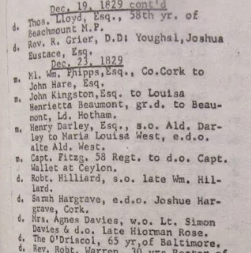
1829. Death of ‘The O’Driscoll’, Baltimore, West Cork.


1829.  Death of ‘The O’Driscoll’, Baltimore, West Cork.

The O’Driscolls along with the Coughlans, and the varied forms of Wholehan/Houlihan are probably descended from the original settlers to West Cork.

Kerry Evening Post, Basil O’Connell Newspaper Extracts, Dr. Casey.


Died, 24th November 1820, Baltimore, Carolina, USA, Dr. Mathew O’Driscoll. of Creagh and Baltimore USA, 64, son of the late ‘The’ O’Driscoll, Creagh brother of Michael O’Driscoll Esq., and Died on the 7th May 1823, at Baltimore House, West Cork, of a Decline induced by too Severe Studies of Medicine which he had completed with great Distinction at Edinburgh Denis O’Driscoll Esq. aged 21, only son of ‘The’ O’Driscoll., Esq., of Baltimore and death of youngest daughter of ‘The O’Driscoll’ July 1826 from The Southern Reporter.


Denis O’Driscoll, Dunbeacon, Harpist and WILLIAM HENRY O’DRISCOLL, Esq., of Stoke, near Plymouth. He was born on the 16th of June, 1803, and, though a fine specimen of the old Irish chieftain race, he is still unmarried. The senior line of the O’Driscolls is, therefore, likely to become extinct in the British Islands, and the genealogist of the next century will probably have to look for it in the United States of America: though, according to a wild tradition in the country, there are fishermen on Cape Clear and on other islands off the Coast of Carbery, who are lineally descended from the youngest son of Sir Finghin, or Florence, of 1602. The Rev. James O’Driscoll, P.P. of Kilmichael in the County of Cork, is said to be the great-grandson of Denis O’Driscoll of Dunbeacon Castle, who is remembered by tradition for his skill in performing on the Irish harp, who was the son of Florence O’Driscoll, called the Captain Cam, who was killed at the siege of Dunboy in 1602. Sed cum de his nihil certi scio, nihil etiam assertive determino.WILLIAM HENRY O’DRISCOLL, Esq., of Stoke, near Plymouth. He was born on the 16th of June, 1803, and, though a fine specimen of the old Irish chieftain race, he is still unmarried. The senior line of the O’Driscolls is, therefore, likely to become extinct in the British Islands, and the genealogist of the next century will probably have to look for it in the United States of America: though, according to a wild tradition in the country, there are fishermen on Cape Clear and on other islands off the Coast of Carbery, who are lineally descended from the youngest son of Sir Finghin, or Florence, of 1602. The Rev. James O’Driscoll, P.P. of Kilmichael in the County of Cork, is said to be the great-grandson of Denis O’Driscoll of Dunbeacon Castle, who is remembered by tradition for his skill in performing on the Irish harp, who was the son of Florence O’Driscoll, called the Captain Cam, who was killed at the siege of Dunboy in 1602. Sed cum de his nihil certi scio, nihil etiam assertive determino.

https://durrushistory.com/2014/09/09/correspondence-with-william-henry-odriscoll-england-1850-2-styling-himself-the-odriscoll-as-was-his-father-who-served-in-the-british-navy-and-devonshire-20-guns-and-grandfather-from-creagh/…

screen-shot-2016-10-09-at-07-12-57


….

Denis O’Driscoll, Dunbeacon, Harpist and WILLIAM HENRY O’DRISCOLL, Esq., of Stoke, near Plymouth. He was born on the 16th of June, 1803, and, though a fine specimen of the old Irish chieftain race, he is still unmarried. The senior line of the O’Driscolls is, therefore, likely to become extinct in the British Islands, and the genealogist of the next century will probably have to look for it in the United States of America: though, according to a wild tradition in the country, there are fishermen on Cape Clear and on other islands off the Coast of Carbery, who are lineally descended from the youngest son of Sir Finghin, (Finin) or Florence, of 1602. The Rev. James O’Driscoll, P.P. of Kilmichael in the County of Cork, is said to be the great-grandson of Denis O’Driscoll of Dunbeacon Castle, who is remembered by tradition for his skill in performing on the Irish harp, who was the son of Florence O’Driscoll, called the Captain Cam, who was killed at the siege of Dunboy in 1602. Sed cum de his nihil certi scio, nihil etiam assertive determino.


durrushistory's avatarWest Cork History

WILLIAM HENRY O’DRISCOLL, Esq., of Stoke, near Plymouth. He was born on the 16th of June, 1803, and, though a fine specimen of the old Irish chieftain race, he is still unmarried. The senior line of the O’Driscolls is, therefore, likely to become extinct in the British Islands, and the genealogist of the next century will probably have to look for it in the United States of America: though, according to a wild tradition in the country, there are fishermen on Cape Clear and on other islands off the Coast of Carbery, who are lineally descended from the youngest son of Sir Finghin, or Florence, of 1602. The Rev. James O’Driscoll, P.P. of Kilmichael in the County of Cork, is said to be the great-grandson of Denis O’Driscoll of Dunbeacon Castle, who is remembered by tradition for his skill in performing on the Irish harp, who was the son of…

View original post 32 more words

Effect of Penal Laws. Sons Of Irish Catholic Aristocratic Families Requirement to Produce Genealogical Proof for Crown Service on the Continent 17th 18th and 19th centuries.


Effect of Penal Laws.  Sons Of Irish Catholic Aristocratic Families Requirement to Produce Genealogical Proof for Crown Service on the Continent 17th 18th and 19th centuries.


From Dr. Albert Casey, O’Kiev Cishe Mong


Discovery of Lost Vellum Manuscript, documenting the Genealogy of the Very Ancient and Illustrious House of the O’Reillys, formerly Princes and Dynasts of Breifne O’Reilly, now called the County of Cavan in the Kingdom of Ireland, over 1,000 years in Munich 2008, Irish presence in Cuba, 18th century and Irish named street escape Castro embargo on Spanish Street Names Havana.

screen-shot-2016-10-08-at-15-55-00

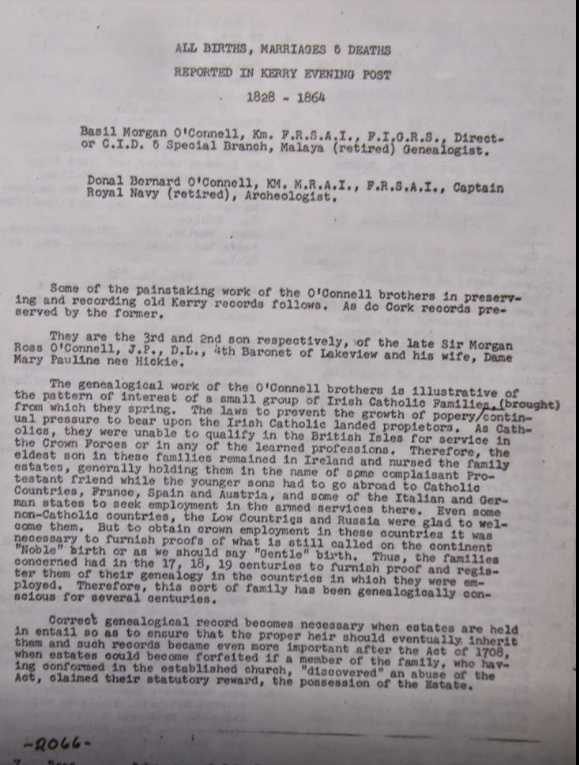
Biographical data from Kerry Evening Post 1824-1864 and other papers including Cork details gleaned by O’Connell Brothers (Basil and Donal) in the 1950s


durrushistory's avatarWest Cork History

Biographical data from Kerry Evening Post 1824-1864 and other papers including Cork details gleaned by O’Connell Brothers (Basil and Donal) in the 1950s. They were descendants ofDaniel “Connell and Basil wrote the O’Connell Tracts.

Dr. Casey has this in Vol 6 and 7 of the O’Kiev Cishe Mang

https://plus.google.com/photos/100968344231272482288/albums/6013023240609479873

View original post

1802. Dr. Bryan O’Connor Born c 1766, Bantry, West Cork, Transported to Australia for United Irishmen Offences. Papers from Australian Archives 1802.


1802.  Dr. Bryan O’Connor Born c 1766, Bantry, West Cork, Transported to Australia for United Irishmen Offences .  Papers from Australian Archives 1802.

The Limrick family. My great great grandmother (Mark O’Connor, Australia) was Ann Limrick Starkey (Starkie) born in Rosscarbery to Wm Starkie and Anna Maria Alcock, (her father was the nephew of Henry Alcock of wilton in Co. Wexford. Her father was Wm Henry Loftus Alcock, transported with his brother in law Dr Bryan O’Connor of Bantry to Australia for being United Irishman and Wm for visiting Dr Bryan O’Connor in Goal.

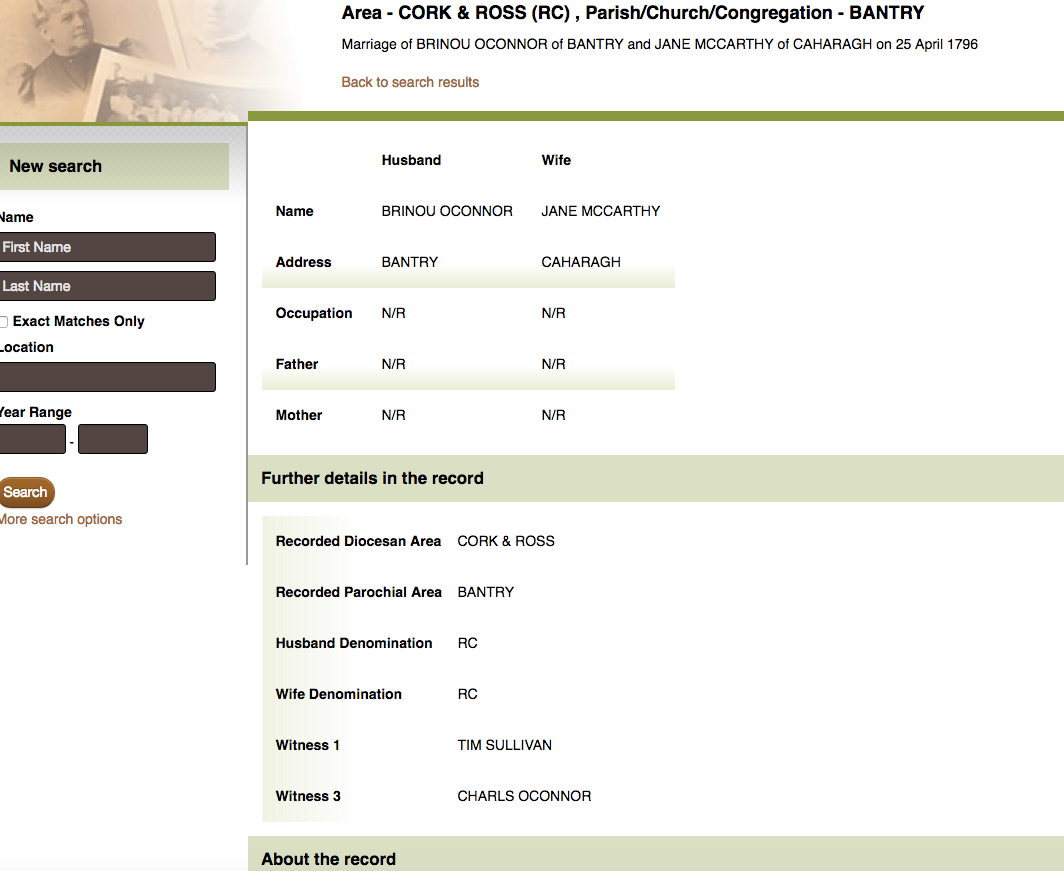
Dr Bryan O’Connor’s wife was Jane McCarthy. A Florence McCarthy and another McCarthy were transported to Australia with Bryan. Florence must have died as he was not heard from again.

The marriage  of Dr. Bryan O’Connor would explain his association with Barrister Alexander McCarthy.  Caheagh is Jane McCarthy’s her home place about 7 miles from Bantry possibly of one of the McCarthy family the major landowner pre 1650 of the area later probably middle men

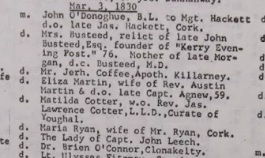
Dr Bryan O’Connor did in fact return to Ireland after receiving a full pardon in 1809, his brother in law, Wm Henry Loftus Alcock, never did return to Ireland from Australia. Dr O’Connor had a medical practice in Clonakilty, where he lived with his wife Jane until he passed away in Clonakilty in 1830 from Basil O’Connell Newspaper Extracts, Dr Casey:

screen-shot-2016-10-09-at-22-42-04

…..

Mark O’Connor found Bryan O’Connor courts martial but was unable to locate either Wm Alcock’s courts martial papers or information on his uncle General Prescott.
 Both the Alcock and Loftus families were mad at him because he married a Catholic woman, Mary Lavina O’Connor, and visited his rebel brother in law in goal.  His uncle Henry Alcock who had inherited the Wilton estate, had told the British his tenants were loyal to the crown and there was no need to search them for pikes. Of course, when the rebellion started, Wilton tenants had pikes and joined the fight. They may have wanted William punished to show loyalty to the crown
screen-shot-2016-10-06-at-12-02-37

””

…..

Transportation to Botany Bay, Australia of Doctor Bryan O’Connor (b c.1766) and Alexander McCarthy, Barrister, Both Bantry, West Cork, after Abortive United Irishmen Rising, Ireland, 1798. Plea for Clemency Arthur Hutchins, Magistrate, Ardnagashel, Bantry.

Sale 1857 O’Connor/Jagoe Estate Bantry Landed Estates Court:

https://wordpress.com/post/durrushistory.com/28490

Jagoe/O’Connor family early draft paper:

https://docs.google.com/document/d/1rUdGCfdeEbJn6ShqXrwqtxFd3GNOhAaSJneNt9NtSKY/edit

Courtesy Elizabeth Thorn, Australia:

To His Excellency Governor King &c &c &c The Memorial of William Henry Alcock

Your memorialist on the presumption that his name is among those Your Excellency has now the goodness to transmit to Government humbly approaches your Excellency with a Very few Lines.

That your memorialist previous to his being sent here, had served in His Majestys Troops, both of the line and Militia, abroad & at Home; the space of eleven Years –and during the Whole of the late Rebellion, actually fought; and to the utmost of his abilities, acted against those very Men as one of whom he has been sent here! That, visiting Dr O’Connor, his Brother in Law in prison; was construed into a correspondence with the Rebels – Doubly criminal in him as a British Officer: at least, rendered so by the complexion of the Times; and immediately laid hold of by a party more of family than political; who succeeded, notwithstanding the unblemished character given him even by his prosecutor; in working his ruin. Inshort could he lay before your Excellency the proceedings of the Court Martial; they alone he trusts, would exculpate him from even the shadow of suspicion. They were so unsatisfactory to his Excellency the Marquis Cornwallis, that he ordered them to be revised. But his Family prevailed; and, your memorialist fill a Sacrifice.

That your memorialists situation here is more irksome & unpleasant, than can be easily imagined [Page 67]

cut off from that Part of society to which he feels he belongs and his former habits of life, also, rendering him unable to help himself manually as others, he is actually in want of all the comforts; & many of the necessaries of Life .

That as your memorialist came out here stigmatised with the appellation of Rebel; and that every member of his Family is firmly attached to the sacred person of His Sovereign; Your memorialist wishes not to return to Europe until he has by his conduct, evinced to them & to the World his similarity of sentiments, & thereby insured to himself their countenance. But if your Excellency would grant him a conditional pardon he would with your Excellency’s permission & approbation go to India, where he has near relations high in the Service of the Government – His Uncle General Prescott & Family by whose influence, he might again be received in the military line; and hereafter return to Europe with credit.

In granting this you Excellency would be the means of restoring your memorialist to that character he has, in the World’s Eye, lost, and to all the comforts of a Rank, not the lowest in Society – His gratitude would then be equal to that respect & veneration with which he now is –

Your Excellency’s
Most Obedient humble ServantWm. H. Alcock

Philip Gidley King – letters received and other papers, 1794 – 1807 MLMSS 710
Mitchell Library, State Library of NSW

Letter from Bryan O’Connor to P.G. King, 1 May 1802 Sir

Your Excellency will humanely forgive this Mode of addressing you as the only means I have of most humbly assuring you nothing was even more foreign to my mind than an Idea of giving you, Sir, any offence, by any remark I might, from the impulse of the moment have been led to make in you presence.

Unconscious of having committed any offence, my feelings were wounded, but I trust to your Clemency to pardon any impropriety they might have hurried me into, and I remain, Sir,

Your Excellency’s most obedient And faithful humble Servant

Bryan O’Connor Sydney Goal May 1st. 1802

[Page 69]

Letter from Bryan O’Connor to P.G. King, undated

His Excellency Philip Gidley King Esqe.
Governor of New South Wales

The Dutiful and Humble petition of Bryan O’Connor Most Respectfully sheweth

That your Excellency’s forlorn Petitioner feels & has felt the sincerest Contrition for having unfortunately Offended your Excellency.

That the most sacred Consciousness of Innocence, as to any Seditious or turbulent principles in the mind of your Excellency’s petitioner, your humble petitioner confidently makes his appeal to that God, who knows the secrets of all hearts, and trusts that the time will come when your Excellency will be convinced that there is not in the Colony a man, whose mind is more disposed to obedience, or whose Heart is less tainted with vicious or evil propensities, and if your Excellency will graciously deign to permit him to remain in this Territory, your petitioner will find Ample Security to any amount for his future quiet, consistent, loyal and dutiful Conduct. And in Gratitude bound will ever pray for you Excellency and the prosperity of the Country.

Bryan O‘Connor

You may be aware that Bryan O’Connor went out to Norfolk Island as assistant to the surgeon William Redfern. I am not sure of the circumstances but O’Connor ended up in gaol in 1802. Here are letters from him and his brother in law, William Alcock to Governor King.

..

1817, William Hutchinson, Clonee, Gent., assigns to William Symms, Enaghotra, Goleen, a rent charge to cover debt, witnesses, William Dealy, farmer, Durrus, Bryan O’Connor, Doctor of Physic, Clonakilty.  Dr. O’Connor was exiled to Australia for United Irishmen offences but left home later.  His sister married John Jagoe (his father Kilronan, Dunmanway), Bantry his mother Young of fishing family related to Gosnells.  John Jagoe had a son John Jagoe a Barrister died in London c 1852 his descendants in Australia. 1814, marriage William Hutchinson, Mary Dealy.

..

Transportation to Botany Bay, Australia of Doctor Bryan O’Connor and Alexander McCarthy, Barrister, Both Bantry, West Cork, after Abortive United Irishmen Rising, Ireland, 1789. Plea for Clemency Arthur Hutchins, Ardnagashel, Bantry.


durrushistory's avatarWest Cork History

Transportation to Botany Bay, Australia of Doctor O’Connor and Alexander McCarthy, Barrister, Both Bantry, West Cork, after Abortive United Irishmen Rising, Ireland, 1789. Plea for Clemency Arthur Hutchins, Ardnagashel, Bantry.

This is an incidental to Paddy O’Keeffe (Bantry Businessman and Antiquarian ) researches into Blair family of Durrus.  McCarthy may be an attorney does not appear in Kings Inns records for Bantry.

Dr. O’Connor had three brothers at the time officers in the British Army.

Extended Jagoe/O’Connor family early draft document:

https://docs.google.com/document/d/1rUdGCfdeEbJn6ShqXrwqtxFd3GNOhAaSJneNt9NtSKY/edit

Emanuel Hutchins, Cregane Castle, Co. Limerick (of Bantry family) Plea for Clemency for Bantry United Irishmen Men, letter 11th August 1799, to The Lord Lieutenant for Bantrymen, Doctor Bryan O’Connor and Attorney, Florence McCarthy. This was against Transportation to Botany Bay.

Robert Swanton Ballydehob, Later Judge New York:

Robert Swanton, (1764-1840) Ballydehob, West Cork, member United Irishmen Directory arrest, imprisonment escape to New York where he was active in…

View original post 48 more words