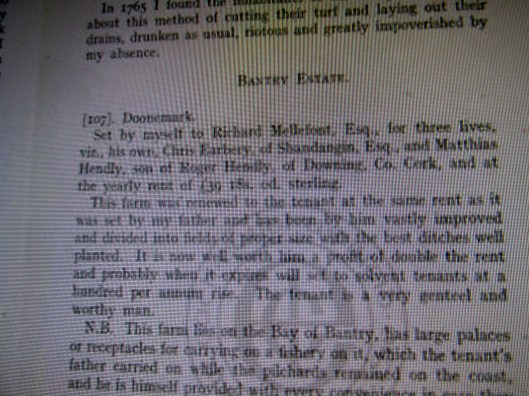
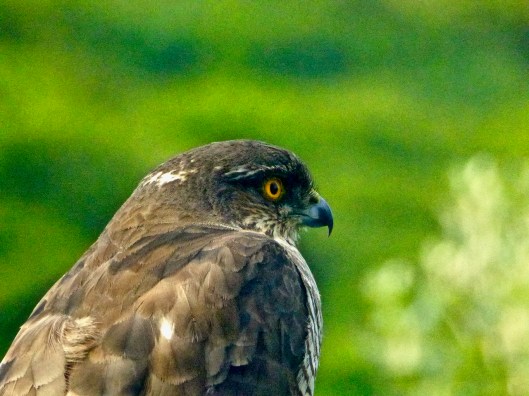
1760s, Lease renewal to Richard Mellefont, Esq., by Kenmare Estate of Donemark, Bantry, West Cork for Three Lives Mellefonts Father had Vastly Improved and Enclosed Fields of a Proper Size with Well Planted Ditches and Had Fish Palaces Redundant Due to Flight of Pilchards.


https://www.google.ie/maps/place/Donemark,+Co.+Cork/@51.6967933,-9.4426287,17z/data=!3m1!4b1!4m5!3m4!1s0x48450bbaf6a63bed:0x5730c094c9aaf311!8m2!3d51.6967676!4d-9.4404316

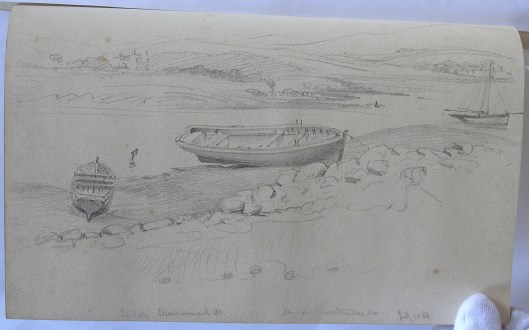
Dummanack House. Gorteenroe House. July 1854; The old salt house Gurteen Roe near Bantry and Gurtnaroe House | George Victor Du Noyer


OLYMPUS DIGITAL CAMERA

.


Donemark is part of the drumlin belt around Bantry good land.

1760s, Lease renewal to Richard Mellefont, Esq., by Kenmare Estate of Donemark, Bantry, West Cork for Three Lives Mellefonts Father had Vastly Improved and Enclosed Fields of a Proper Size with Well Planted Ditches and  Had Fish Palaces Redundant Due to Flight of Pilchards.

Donemark is by legend the place where people first came to Ireland.

This lease and similar ones on the Bantry estate mark a period of the development of the modern landscape and field lay out with planted ditches.


1-img_1678


Magistrates:


David Mellifont, 1794.  Donemark house of Carrignarontha, Bantry.  May have freedom of Cork 1761 as Esq. Appears in frequent deeds as witness 1761-1775 including soe in Bandon area. 1779 Lieutenant Bantry Volunteers, Superseded 1810-30, Middleman on Lord Kenmare estate. Game Cert 1802.  1820 signed Memorial for new road Glengarriff to Castletownbere.  1822 his house and those of Pattison, Doyle, McCormack, Kingston attacked by over 400 Whiteboys searching for arms. William O’Sullivan, Esq., Carriganass Castle, native Ahill purchased Carriganass from David Mellifont, Donemark in 1817 for £250 and £50 rent.  O’Sullivan prominent in anti tithe, repeal. Married 1804, Sophia Grey, Wexford, address given Mardyke, Co. Cork probably Skibbereen. Sophia Mellifont Nee Gray wife of David Mellifont had a brother called Nicholas Gray,he was secretary to the Wexford Insurgents 1798. Gray went to America and was involved in the 1812 War,he was Inspector General of the American Army. The Grays were from Whitfort House Wexford and Jamestown Co Wexford. Mellifont died Donemark 1835, significant debts, estate in Chancery and litigation.

Richard Mellefont, 1766, Downemart (Donemark), Bantry.  Probably son of Gilbert.  Kenmare Estate renewed lease of Donemark for three lives, his own, Christopher Earbery, Shandaragh and Mathias Hendley son of Roger of Downing, Co. Cork.  Lord Kenmare comments ‘The tenant is a very genteel and worthy man’.  Mellifont family of Norman origin, Kinsale converted.  1758 Lease of 31 years from Kenmare Estate to Richard Mellifont as trustee for Patrick Galwey in occupation his ‘near relation’

1741.  Major Tenants on Kenmare Estate Bantry District, Tim Casey, Newtown £18, David Gallwey, Glaunreagh,  Dromsullivan £47, James Gallwey, Donemark £38, Patrick Gallway Gurteenroe £22,  Richard Goodwin, Beversham Harman, Laheran £15, Thomas Hutchins, Ballylickey, £19, Gilbert Mellefont, Donemark ,£38, Rev. Thomas Miller, Reendonegan, £43, Michael Murphy, Donemark, £18,  Rev. Richard Schofield, Ards and Coomleigh, £28, William Sullivan, Ards, £53, Richard Tobin, Donemark Mills, £3, John Young, Direenkollig, £5,


Proceedings at the High Court of Justice at Dublin and Cork 1652–1654 for Trying Irish Catholics Arising from Rising of 1641. Mentioned Belgooly, Bandon, Garretstown, Included : ‘Triall.Jo. Long. Philip Barry oge Ja: Roch. Rich. Roch. not here.David oge Reagh. Catherine Dolbier at Belgooly . Pierse Gogan. saved by him. Co. Corke Gerot Nugent. Laghlyn o Line. Philip Roch. Ric. Barry. Jo. Roch. W Mollifont for murdering Pascha Trudgeon’ 54. Jo. Long. – Guilty.55. Philip oge Barry. – Not Guilty.56. James Roch. – Not Guilty.57. David oge Reagh – Not Guilty.58. Philip Roch – Not Guilty.59. Rich. Roch. – Not Guilty.60. Laughlin Ô Line. – Not Guilty.61. W. Mellifont. – Not Guilty.62. Pierse Gogin – Not Guilty63. Rich. Barry – Not Guilty.64. Gerot Nugent – Not Guilty.65. Jo. Roch. – Not Guilty. Trial of Charles MacCarthy Reagh, Dermot McNecrimineh and John Burrows; Trial of Lieutenant Colonel Bourke; Trial of Dr Hely; Trial of John Barry


Some Rent receipts, Kenmare Estate 1741-46, Bantry Beara Area, William Sullivan, Florence Sullivan, Rev. Thomas Miller, Mort Sullivan, Gilbert Mellifont Donemark, Michael Murphy Newtown and Mills, Beversham Harman Laheran, Patrick Galwey Gurteenroe, Daniel Cronin Gortdarrug Cooloum, Thomas Hutchins Ballylickey, John Riordan Ballylickey, Patrick Minihane Donemark, Richard Tobin Mills Donemark, Ards Coomleigh, Denis Leary, John Harman.


Rev. Paul Limrick legal Action c 1725 re Glebe of Crookhaven, In the court case concerning the glebe in Crookhaven, Paul wrote “Crookhaven is eight miles of barbarous road from Skull, and in winter, though I take horse before day, I can scarce reach Crookhaven by 12 o’clock. I am obliged immediately, without refreshing myself, to take horse and ride in the night to get home, for there is not in the whole parish a bed a man can lie on, or a morsel to be eaten…” People mentioned: Rev. Demetrius O’Coghlan, ordained in Cork 1618, fled to England in Rising 1641 and died there, Thadeus Coghlan son to Rev. Demetrius O’Coghlan husband to Sarah, Richard Coghlan, Mrs. Sarah Coghlan, 80, married to Thadeus son to Rev. Demetrius, Mary Coghlan granddaughter by her mother to Mary Coghlan alias Spain whose grandfather was the proprietor of 8 Gneeves at Crookhaven, Donagh McWilliam Coghlan, Proctor to Rev. Demetrius O’Coghlan. Jeremy/Jeremiah Coghlan, great grandson to Rev. Demetrius O’Coghlan, probably Attorney, Seneschal of Dungarvan Manager with Andrew Crotty of Devonshire Estate Waterford, married Miss Evanson Durrus. Brigid Limrick daughter of Rev. Paul married Benjamin Sullivan, self styled Ó Sullivan Mór, Attorney Cork and Clerk of Crown Cork and Waterford mother of Sir Benjamin Sullivan, Judge of Supreme Court, Madras, India, Colonel Henry Becher grandfather of Henry Becher built a fish palace c 1650 east of Crookhaven Church in opposition to Richard Hull. Darby Mahony 62, son of Teige Mahony, agent, driver to Sir Richard Hull, Gibson moved to a farm on favourable terms by Hull suggestion he was illegitimate son (that it was a pig of his own sow), John Cullane, Mason c 1650.


https://www.google.ie/maps/dir/Crookhaven//@51.485886,-9.7089671,13z/data=!4m8!4m7!1m5!1m1!1s0x48458598cbd7f471:0xa00c7a99731a1a0!2m2!1d-9.7260407!2d51.4684006!1m0

Rev.Paul Limrick legal Action c 1725 re Glebe of Crookhaven,

In the court case concerning the glebe in Crookhaven, Paul wrote “Crookhaven is eight miles of barbarous road from Skull, and in winter, though I take horse before day, I can scarce reach Crookhaven by 12 o’clock. I am obliged immediately, without refreshing myself, to take horse and ride in the night to get home, for there is not in the whole parish a bed a man can lie on, or a morsel to be eaten…”

Later road built:

1824 Sir Richard Griffith, Road Engineer, Progress Report, Skibbereen to Crookhaven, Wheeled Carts now Appear, where heretofore Loads were carried on the Backs of Horses, New Entrance to Town Of Bandon, Road From Courtmacsherry to Timoleague, Road from Clonakilty to New Fishery Pier At Ring, New Road Skibbereen to Bantry, Macroom to Killarney, with a Note on The System of Labour Organisation Used.

People mentioned: Rev. Demetrius O’Coghlan, ordained in Cork 1618, fled to England in Rising 1641 and died there, Thadeus Coghlan son to Rev. Demetrius O’Coghlan husband to Sarah, Richard Coghlan, Mrs. Sarah Coghlan, 80, married to Thadeus son to Rev. Demetrius, Mary Coghlan granddaughter by her mother to Mary Coghlan alias Spain whose grandfather was the proprietor of 8 Gneeves at Crookhaven, Donagh McWilliam Coghlan, Proctor to Rev. Demetrius O’Coghlan. Jeremy/Jeremiah Coghlan, great grandson to Rev. Demetrius O’Coghlan, probably Attorney, Seneschal of Dungarvan Manager with Andrew Crotty of Devonshire Estate Waterford, married Miss Evanson Durrus. Brigid Limrick daughter of Rev. Paul married Benjamin Sullivan, self styled Ó Sullivan Mór, Attorney Cork and Clerk of Crown Cork and Waterford mother of Sir Benjamin Sullivan, Judge of Supreme Court, Madras, India, Colonel Henry Becher grandfather of Henry Becher built a  fish palace c 1650 east of Crookhaven Church in opposition to Richard Hull.  Darby Mahony 62, son of Teige Mahony, agent, driver to Sir Richard Hull, Gibson moved to a farm on favourable terms by Hull suggestion he was illegitimate son (that it was a pig of his own sow), John Cullane, Mason c 1650,

The Coghlans are probably of pre Celtic stock.  They had been vassals to the O’Mahonys later were aligned to Richard  Boyle, Great Earl of Cork and had at least one estate in Carrigaline in their own right. Later many were clergy in the Church Of Ireland and intermarried with local gentry.

Thanks to Brain Limrick:

the-glebe-of-crookhaven

burials-schull-district

People mentioned: Rev. Demetrius O’Coghlan, ordained in Cork 1618, fled to England in Rising 1641 and died there, Thadeus Coghlan son to Rev. Demetrius O’Coghlan husband to Sarah, Richard Coghlan, Mrs. Sarah Coghlan, 80, married to Thadeus son to Rev. Demetrius, Mary Coghlan granddaughter by her mother to Mary Coghlan alias Spain whose grandfather was the proprietor of 8 Gneeves at Crookhaven, Donagh McWilliam Coghlan, Proctor to Rev. Demetrius O’Coghlan.

Case in Cork Assizes 1844 arising from Lands at Carrigmanus of Charles Coughlan Great Grand Father of Ann Jagoe and Alice Dowe, His Son Richard Married Miss Driscoll 1768 and made a Settlement. Litigation over Validity and Provenance of Wills. Names mentioned O’Sullivan, Notter, Simms, Young

Jeremy/Jeremiah Coghlan, great grandson to Rev. Demetrius O’Coghlan, probably Attorney, Seneschal of Dungarvan Manager with Andrew Crotty of Devonshire Estate Waterford, married Miss Evanson Durrus.

Brigid Limrick daughter of Rev. Paul married Benjamin Sullivan, self styled Ó Sullivan Mór, Attorney Cork and Clerk of Crown Cork and Waterford mother of Sir Benjamin Sullivan, Judge of Supreme Court, Madras, India, Colonel Henry Becher grandfather of Henry Becher built a  fish palace c 1650 east of Crookhaven Church in opposition to Richard Hull.  Darby Mahony 62, son of Teige Mahony, agent, driver to Sir Richard Hull, Gibson moved to a farm on favourable terms by Hull suggestion he was illegitimate son (that it was a pig of his own sow), John Cullane, Mason c 1650,

1700, Dives Downes on Kilmoe (Ballydehob/Schull/Crookhaven), West Cork, Lands Recently Forfeit by Coppinger and O’Mahony now Hull, Bishop of Cork, Colonel Beecher, Earl of Cork, in Crookhaven, Arthur Hyde, Thadeus Coghlan/Coughlan, Rectories College of Youghal control Wrested from Earl of Cork by Lord Strafford, Old Chapel at Kilkanget near Dunmanus Castle, In O’Sullivan Country Universally Observed as Festival St Roan’s Day, Tithes on Fishing, later Rev. Fisher, Teampall na mBocht.

Sale in 1729 of lands by Lord Burlington, Jeremh/Jeremiah Coughlan (From Carrigmanus Agent) to Richard Tonson for £3,882, including, One Ploughland Town and Lands of Shannyvoghwora Ballydehob, 422 English acres, 3 Ploughlands Carrigerinat Coghanicue Coghlianullean East Carbery 1, 697 English acres, Coolmountain 1,139 English acres, 4 Gneeves Shanaciane, the Unpropriate Tithes of 14 Ploughlands of Durrus , Kilcrohane and Kikmocomoge (Bantry), Callesita alias Callesta 374 English acres, Carrigneal 1 and a half Ploughland 894 English acres and 1830s Tithe Aplottments of Tithes for Evansons of Durrus

Case in Cork Assizes 1844 arising from Lands at Carrigmanus of Charles Coughlan Great Grand Father of Ann Jagoe and Alice Dowe, His Son Richard Married Miss Driscoll 1768 and made a Settlement. Litigation over Validity and Provenance of Wills. Names mentioned O’Sullivan, Notter, Simms, Young


durrushistory's avatarWest Cork History

Case in Cork Assizes 1844 arising from Lands at Carrigmanus of Charles Coughlan Great Grand Father of Ann Jagoe and Alice Dowe, His Son Richard Married Miss Driscoll 1768 and made a Settlement.  Litigation over Validity and Provenance of Wills.  Names mentioned O’Sullivan, Notter, Simms, Young

Charles is probably of the same line as Jeremy/Jeremiah Coughlan, Attorney, Seneschal, agent 1700 with Andrew Crotty of the Devonshire estate in East Cork and Waterford.  He was related by marriage to the Durrus Evansons.  Another branch of the same family were granted estates by the Boyles in Carrigaline.

The Coughlans probably pre date the coming of the Celts to Ireland.

Some mid 18th century marriages in the Mizen area:

https://docs.google.com/spreadsheets/d/1i1w4CiMviphSsz3jOEMvF_3uw-F04ksPFgmdjum2y0Y/edit#gid=0

The 18th century records are either no existent or destroyed.  The case ran for a number of days and the report casts light on the family relationships friendships.  Incidental detail includes that the…

View original post 166 more words

Religious Wrangles in early 19th Century Mizen.


…..


Religious Wrangles in early 19th Century Mizen.


Courtesy J.A. Murphy, Church of Ireland in Kerry.

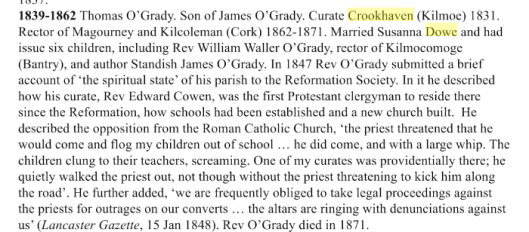
https://books.google.ie/books?id=pCMZBQAAQBAJ&pg=PA208&lpg=PA208&dq=dowe+crookhaven&source=bl&ots=L6UtgGY_PU&sig=G6WhxLZOdrfb85Li0jlC96IuAeY&hl=en&sa=X&sqi=2&ved=0ahUKEwiEqfOp9tDRAhUOnRQKHcmODjoQ6AEIJzAH#v=onepage&q=dowe%20crookhaven&f=false


screen-shot-2017-01-20-at-19-19-44


….

Early 18th Century Introduction of Northern Weavers to Barony of West Carbery, Schull and Durrus, West Cork


https://www.google.ie/maps/@51.6200816,-9.4701861,12z


Early 18th Century Introduction of Northern Weavers to Barony of West Carbery, Schull and Durrus, West Cork

Looking at some of the burial records for the Schull district many of the names which occur as weavers in Durrus recur.


Some Burial Records Church of Ireland and Methodist Schull District, West Cork.

In the 1830s the Reverend Caesar Otway travelling from Schull to Bantry remarked on the poor Protestants of Mizen relicts of a forgotten plantation policy.  Looking at the names quite a number probably originated from Co. Antrim, Armagh, Down, looking at the surname distribution in the 1901 census.

On the Mizen Peninsula one of the largest landowners were the Becher/Beecher family. Sometime after 1730 the Marmion family come down from Dundalk as Estate managers.  It is possible they introduced northerners as weavers and specialist in flax growing.

In Durrus the distribution of weaving families is confined to those  townlands which formed part of two separate Evanson Estates.  Crottees, Carrigboy, Clashadoo/Ahagona, Rossmore and Brahalish all likely to have had weaver colonies were once part of the McCarthy lands forfeit for Rebellion.  Around 1690 the Evansons acquired the lands due to financial distress c 1720 they sold to Bernards of Bandon who leased the lands back until c 1850.  ON the Mizen Peninsula the townlands of Ardgouna Dromreagh and Coolculaghta were acquired in fee simple from the Burlington Estate (Boyle) in the 1740s by the Evansons again the location of weaving activity.

The extant location of flax ponds, field names associated with flax adn leaching green suggest that flax/linen production adn weaving was far more widespread than believed up to now.  In the memoir of James Stanley Vickery of growing up in Molloch, Durrus in the early 1830 with his grandparents he refers to spinning wheels one large one small one for wool one for linen.

Recollections of James Stanley Vickery as a grandchild in Molloch, Durrus, Bantry (1829-1911).Parents Died of Cholera in Skibbereen.

The trade was a big factor in supplementing the enormous population pre 1830. The collapse of the business triggered mass emigration to Canada and Rochester, New York pre famine.

The Evansons had a close association with Bandon and seem to hav often kept residences there and in Durrus.  The Bandon ‘Clothiers’ families such as the Treselian, Wheelers, Sullivans, Biggs seem  to be brought a business system from the West of England woolen trade.  They sourced wool from the 17th century from as far north as Roscommon, it arrived by pack horse in Bandon and was the sent out to as far as Dunmanway and possibly further.  There it was processed in the houses of weavers.  Post 1800 the Act of Union, industrialisation  in English and the later Cork banking collapses (Leslies/Roches) brought a dramatic end to the industry.  This is reflected in the surviving records of the Local Loan Funds for Schull and Durrus.

1840, Reports on Local Loan funds Ballydehob, Dunmanway, West Cork and summaries of Expenditure Baltimore, Bandon, Ballineen, Berehaven, Castlehaven, Crookhaven with Honorary Corresponding Officer, Detailed Returns fro Baltimore, Glandore, Myross.

….


….

Weaving Background

Many of the same names common in Co. Armagh and Down. Some are probably of Scottish stock who moved to Ulster in the 17th century.  They in turn are significant descendant of the Northern Irish who migrated to Scotland pre 1,000 AD.  Often very small holdings as in Durrus. Some of the names appear as discharged soldiers late 18th early 19th century.

Allen, Antrim, Down, Bishop Downes has Thomas Allen in Kilmoe (Toormore/Goleen) in 1700.

Cole, also Creagh, Inane,  moved to Coolculaghta in Durrus as master weavers.

Croston, possibly from Croston, Lankashire also in Durrus.

Johnson, Antrim, Down

King, Antrim, Down.

Love, Antrim, Down.

Melvin, Antrim, Down.

Shannon, Antrim, Down.

Whitley, Antrim

Williamson, Antrim, Armagh,

Willis, Antrim, Armagh, Down.


Some Burial Records Church of Ireland and Methodist Schull District, West Cork.


https://www.google.ie/maps/@51.5453663,-9.5755995,12.56z

The proportion of Irish Protestant on the island has fluctuated between 20-25%, the actual figure taking a broad definition is higher as many Catholics have a Protestant background and visa versa. There are a number of home grown protestant churches, The Plymouth Brethren in Dublin, the Coonyites and Blairites in Cavan/Fermanagh and numerous others. From surviving genealogies of say the Arnopp, Limrick family of Mizen, Eddy outside Clonakilty and the descendants of Father/Reverend Daniel McCarthy and Sarah Blair it is clear that there was probably always significant intermarriage.  Apart from religious difference Irish people share a broad common culture. DNA testing is now suggesting that it was far more extensive than previously thought, a reasonable presumption given the lack or destruction of documentary records.

Pre famine, West Cork from Bandon to the Baronies of Carbery and Bantry had one of the most densely populated rural areas in the world, comparable to China, Indian and Haiti. This was enabled by the land tenure system, potatoes, the availability of sea sand, sea weed and the proximity of the expanding Cork markets.  The area is unusual in an Irish context in having a significant Protestant population many of whom are small farmers and formerly labourers and artisans, a trait share by the Ulster counties.  Apart from the present local population there is an enormous diaspora reflected in the fact that the vast majority of readers of this blog emanate from the USA, Canada, Australia, New Zealand and  the UK.

Some Burial Records Church of Ireland and Methodist Schull District.  These records have been compiled from the gravestones of Altar (Teampal na mBocht), old Schull, family histories, military records and the online registration records of Schull registration district, free:

https://civilrecords.irishgenealogy.ie/churchrecords/civil-search.jsp

Census Records:

chrome-extension://klbibkeccnjlkjkiokjodocebajanakg/suspended.html#uri=http://www.census.nationalarchives.ie/pages/1901/Cork/Dunbeacon/Cashelfean/1159133/

There are close familial links between those named here and communities in Durrus and Skibbereen.

There has been significant emigration to Rochester, New York, New Brunswick, Nova Scotia and the Ottawa Valley in Canada since the late 1810s and local researches have identified many from the Schull area who died there.  In time it is hoped to include these records.

When the details of those born in the 1820s onwards are cross checked in the 1901 and 1910 census a significant number speak Irish.  The area would have been bilingual in their youth.  This is confirmed in the census records for Canada where many report themselves as Irish speaking.

Background to some of the surnames

Pre Celtic

Coughlan

Gaelic

Daly, probably related to the Kilcohane Dalys in area since 13th century when they arrived as ‘Rhymers’ to the McCarthys and O’Mahonys

Donovan/O’Donovan, they with the O’Sullivans, O’Mahonys were displaced by the Norman from Tipperary and Limerick.  Local people probably assumed their surname accounting for the multiple septs.  Due to cultural subjugation the ‘O’ and  ‘Mac’ was abandoned in the 18th century and in the 21st century almost universally restored.  Interestingly from the early 18th century various Protestant branches of the O’Donovan family claimed the Chieftainship which entitled the holder to be known as ‘The’ O’Donovan and they invariably retained the ‘O’ prefix.

Hegarty/Haggerty.  DNA evidence places the family in Donegal/Derry probably one of a cluster of West Cork names O’Neill, O’Donnell, Ward, Gallagher coming down as soldiers 1601 for the Battle of Kinsale remaining and marrying locally.

Kelly

McCarthy

Norman

Barry

German

Notter

Weaving Background

Many of the same names common in Co. Armagh and Down. Often very small holdings as in Durrus.  In famine related records they are often in the category as struggling or in poor circumstances. Some of the names appear as discharged soldiers late 18th early 19th century.

Allen, Antrim, Down

Cole, also Creagh, Inane,  moved to Coolculaghta in Durrus as master weavers.

Croston, possibly from Croston, Lankashire also in Durrus.

Johnson, Antrim, Down

King, Antrim, Down.

Love, Antrim, Down.

Melvin, Antrim, Down.

Shannon, Antrim, Down.

Whitley, Antrim

Williamson, Antrim, Armagh,

Willis, Antrim, Armagh, Down.

Huguenot

Camier

Connell (Quesnel)

Dukelow

Levis

Peer/Pier

Scots

Swanton, a local Minister early 18th century apparently stated the Swantons hailed from Scotland.  The general view was the family originated in Norfolk. What may support his contention is a small Scots Plantation in Castlehaven c 1690 which may account for the names Anderson, Hamilton in the area but Hamilton may be a Gaelic variation.

Landlord/Magistrates

Becher, once had enormous estate taking in most of peninsula and island.  Much sub let to middle men such as Swantons, O’Driscoll late 18th century.  Estimated at the time 1850s of the forced sale before Landed Estates court rental only one quarter of going rate, the rest going to middle men.

Coughlan, formerly vassals to the O’Mahonys.  The senior Carrigmanus line converted to the Church of Ireland c 1600 closely aligned to Hulls and Boyles.  Family were clergymen in the Church of Ireland.  Small estate at Carrigaline outside Cork.  Jeremiah (Jeremy) of the family an attorney 1690s and Seneschal of Dungarvan,  joint manager of West Waterford Devonshire Estate with Andrew Crotty a Catholic. Intermarried with Durrus Evansons.

Hungerford, main line at The Island, Rosscarbery

Sweetnam, agents on Becher estate, middlemen.

Cole family has destroyed Census:

Cole family of Durrus, West Carbery, Extracts from destroyed 18th and 19th Centuries History, published Belfast 1943.

Arnopp Genealogy:

Geneaolgy of Arnopp family in Dunmanway, Crookhaven and Kinsale, Co. Cork from 1666, related to Hulls of Leamcon, Evansons of Durrus, Coughlans of Crookhaven

Limrick Genealogy:

Chronology of Limrick name, including historical events in West Cork, by Reverend H.L.L Denny, including East India Company, Relation, O’Sullivan Mór.

Sweetnam Genealogy:

Genealogy of Sweetnam family of Clehane/Cloghane, Caheragh, West Cork, arising from Marriage 1812 of Mathew Sweetnam (Murrahin) to Elizabeth Connell with descendants, USA, Canada, Australia, England, Northern Ireland compiled 1952 revised 1988.

PDF

burials-schull-district

Version being updated:

https://docs.google.com/spreadsheets/d/1oaIpcG9x-C8FBr62aJXcDlQ-jd3_sVtRU-HlkW5OmGM/edit#gid=0
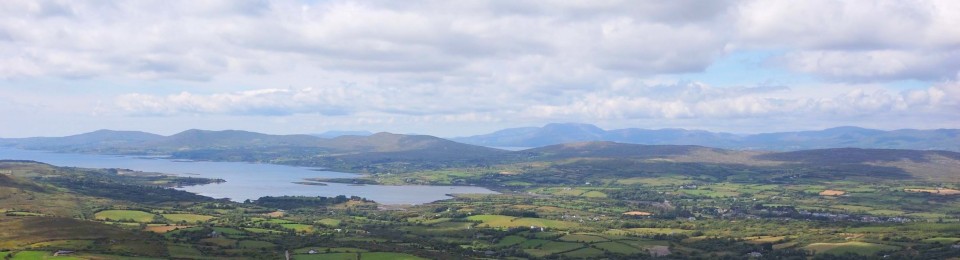
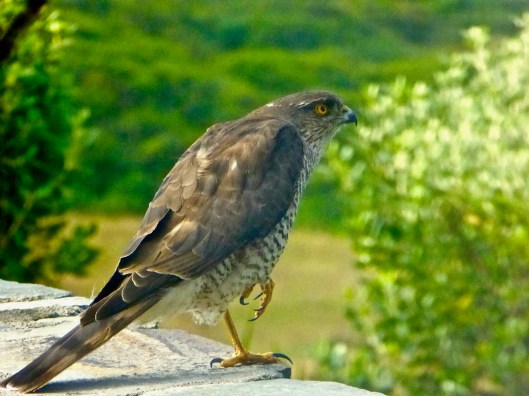
Spioróg, the Sparrowhawk


Finola's avatarRoaringwater Journal

Spiro watchfulWe’ve been calling it Spiro from the Irish work for sparrowhawk – Spioróg (spuh-rogue). Ours is just one of the many sparrowhawks in West Cork – this is not a bird that is endangered in any way at the moment. They’ve been classed as secure. There was a decline back in the old DDT days, but the population has fully recovered since then.

Spiro head

Look at that raptor face – the hooked beak and the piercing yellow eyes

This is one ferocious hunter; but efficient, not so much. In fact, it catches about one bird for every ten it chases. Exhausting! We have watched it plummet from the sky to land on or beside our bird feeder. We’ve watched it chase birds into the bushes only to emerge battered but empty handed. We’ve never seen it actually catch something, although no doubt that will happen in time. When we suddenly see…

View original post 663 more words

Survey St. Finbarr’s Graveyard, in Catholic Church, Bantry, West Cork, Commissioned by Paddy O’Keeffe 1955.


durrushistory's avatarWest Cork History

Survey St. Finbarr’s Graveyard, (in the grounds of the Catholic Church), Bantry, West Cork,  Commissioned by Paddy O’Keeffe (local businessman and antiquarian) 1957, a lot of the leg work on this and the survey of The Abbey was done by Donal Lucey .


Courtesy Hazel Vickery


https://docs.google.com/document/d/1asuHI0SOz3XPd1W2xTjsDBXrO70loa3dxaxFSdLtDTQ/edit

http://www.kilmocomogue.cork.anglican.org/Kilmocomogue/St._Brendans_Church,_Bantry.html

View original post

Burials at Durrus East (Moulivard) Graveyard, West Cork.


https://www.google.ie/maps/place/Durrus,+Co.+Cork/@51.6439037,-9.4782915,17.69z/data=!4m5!3m4!1s0x48459fe7ccd270df:0x231e3744ac95441a!8m2!3d51.6217112!4d-9.521993

Burials at Durrus East (Moulivard) Graveyard, West Cork.

This graveyard is probably one of the most ancient in West Cork and still used on the odd occasion.  The ruined church may date from the 15th century and the walls are still in good condition with the exception of one which was buttressed by a Fás scheme i the 1980s.

In Durrus nowadays Catholics are buried in the graveyard attaching to the Church build in 1900s and members of the Church of Ireland and Methodists in St.James which dates from 1793.  That churchyard became so congested in the 1850s that lord bandon gave additional land for an extension.  The ground being rocks had to be lowered by quarrymen and soil obtained from the buffs near the pier about 500 metres away.   There are a number of Church of Ireland families buried in Moulivard, The Shannon family from Moulamill (Glanlough, lower house) with David Shannon in 1804, the Dukelows from Tralibawn from 1880 likely it originated in Crottees, Williamson from Brahalish, Fergusons, Sullivans/O’Sullivans.

Most of the burials originate in neighbouring townlands of Ballycomane, Moulivard, Letterlickery and part of Caheragh.  Some of those from other areas may have had an ancestor from nearby townlands.

About50 years ago a herd of sheep broke in and cleaned out the graveyard. In so doing they exposed the graves including that of Father Bernane.  The grave was covered by an array of coloured bottles. The was according to tradition fond of the sup an tis may have been a factor in him being sensed.  Grateful people who availed of his miraculous powers left the bottles in thanks.  His grave was exhumed adn his skull is supposed to be on the ledge inside the church polished by hundreds of years o kissing.

The question is where were those from Durrus to Ahakista buried pre 1900?.  There are at least two old burial grounds which we=were tough t be cillíns (Children burial areas) at West Brahalish an Ahagound/Clashadoo.  In fact the distribution of both small and large stone suggest that adults were buried there and the site at Chashadoo has a series of regular lines.

The majority of the burials are unrecorded,

If anyone has an ancestor there I would be happy to include in the record if details are forwarded.

Burial record:

https://docs.google.com/spreadsheets/d/1_ZJPGOWONtCouo_0bFweremkr333Pi8QIMFRe_6MhdE/edit#gid=0

Rounds, Holy Wells, at Rooska, Moulivard and Father Bernane from 1938 School Folklore Collection, Carrigboy National School, Durrus, West Cork.

Moulivard (Ward, the Bard’s Hillock) Church, Durrus, West Cork.

Sale of Durrus/Bantry, West Cork Estate of Arthur Hutchinson Deceased by landed Estate Court, 1854 including to Townlands of Derrivahallow, Killovenogue, Clonee, Ahagoheen, Parkanna, part of Moulivard, Gutheyclona, Middle and West Letterlickey with valuable Lead Deposits with Legal Tenure, Maps, Tenant’s details:

Monastery pre 1650 at Moulivard Church (Durrus East), Co. Cork

Christy Moore sings John Spillane’s Gortatagort (Gort an tSagairt), Chief Francis O’Neill, Pilgrimage to Moulivard Church and Irish Sinologist.

1892. Immense Funeral of Mrs Thomas Dillon, nee Roycroft, Husband Thomas Poor Law Guardian (PLG) Bantry, Obituary a Who’s Who of West Cork.

1601. Reputed Ambush and Massacre of O’Sullivan Bere Troops at Bishopsland Bridge, Caheragh, West Cork, by O’Mahonys, returning from The Battle of Kinsale.

Trinkets, Coins, and Momentoes at The Statue of Our Lady of Tralibawn, Bantry, West Cork, Probably Pre Christian in Origin Also in Brittany.

1875. Parish of Slanes, Upper Ards, Co. Down, ‘At the time of my visit, a workman wa engaged in deepening the fading letters on an old limestone inscription, to preserve a little longer, from total oblivion, the memory of some obscure name. From Alexander Knox, ‘History of Co. Down’


1875.  Parish of Slanes, Upper Ards, Co. Down, ‘At the time of my visit, a workman wa engaged in deepening the fading letters on an old limestone inscription, to preserve a little longer, from total oblivion, the memory of some obscure name. From Alexander Knox, ‘History of Co. Down’

https://books.google.ie/books/about/A_History_of_the_County_of_Down_from_the.html?id=pZIiAQAAIAAJ&redir_esc=y


Earliest Irish script in Latin Antiphony of Bangor, 680 AD, Irish Scribes First to use initials for articulating texts, Late Printing in Irish with Kearney’s Catechism 1571, examples of Gaelic Script, Elizabethan 1571 AD, Vatican, 1675 AD, Jacques Guerin 1732 AD, Petrie 1841 SD.


Antiphonary of Bangor, Co. Down c.690 ad, Mount Stewart and Nugents of Portaferry.


….