1890 Distress in Munitervara. A death by Destitution. A Dying Woman Eating Boiled Mangolds.
08 Thursday Dec 2022
Posted in Uncategorized
08 Thursday Dec 2022
Posted in Uncategorized
04 Sunday Dec 2022
Posted in Uncategorized
https://docs.google.com/document/d/1bqPK0fDRk6sN09vPy4bXDcJGKW75HWvqCV92obQRPCI/edit
Land War Prosecution Under The Crime Act 1882 West Cork
Extracts from Skibbereen Eagle 1882-1883, p.5-78
Land War Durrus district, p. 79
Resident Magistrates, p. 82
Local Lawyers, p. 83
…
The backdrop here is the Land War:
Courtesy Lurgan Ancestry
The traditional view of the Land War in Ireland has been of the displacement of a Protestant Ascendancy class and the often absentee landlords. The former ascendancy had been on the decline since the Great Hunger of the late 1840s, and for them the problem was that previously agreed rents could not be paid after the slump in prices from 1874; some allowed generous rent rebates while others stuck to the agreements and enforced their property rights. Some were already owed rent and many had mortgaged their property and needed the rents to pay the mortgage costs. Many new landlords since the famine were Irish Catholics, but were still associated with the Ascendancy because of their wealth. A survey of the 4,000 largest Irish landlords in 1872 revealed that 71% lived on their estates or elsewhere in Ireland. By then, 43% of all proprietors were Roman Catholics, though the richest owners were mostly Anglicans.
Rent strikes often led to evictions. Land League members resisted the evictions en masse during the Land War, resulting in enforcement of evictions by court judgements for possession that were carried out by the quasi-military Royal Irish Constabulary. Murders of some landlords, their agents and policemen, as well as attacks on supportive witnesses and on their property and animals, all occurred as reprisals for evictions. In response, the British army were often deployed to back up the police, restore law and order and enforce evictions, after the Coercion Acts were passed. For protesting tenants, these Acts were a form of martial law; their opponents saw it as the only way to guarantee their legal rights.
Boycotting
The most effective method of the Land League was the boycott, which took its name from when an unpopular landlord’s agent, Charles Boycott, was ostracised by the local community. Boycotting was also applied to tenants who wanted to pay their rent, and to the police, as well as shops and other businesses who traded with boycotted people. The boycotts were often extremely effective, since they were unquestionably lawful under the common law, non-violent, and effectively punitive: since nobody is forced to join a boycott, it was a voluntary act, through private agreeme…..,.,,,
03 Saturday Dec 2022
Posted in Uncategorized
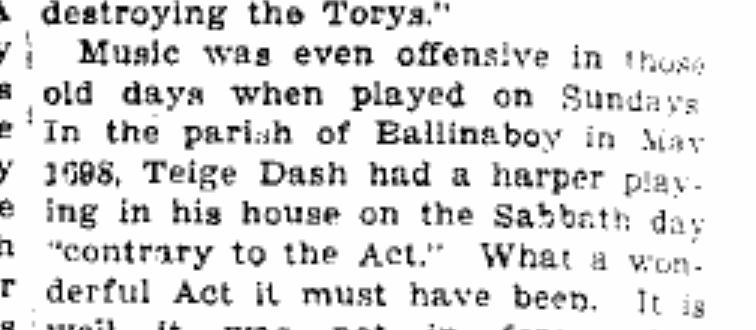
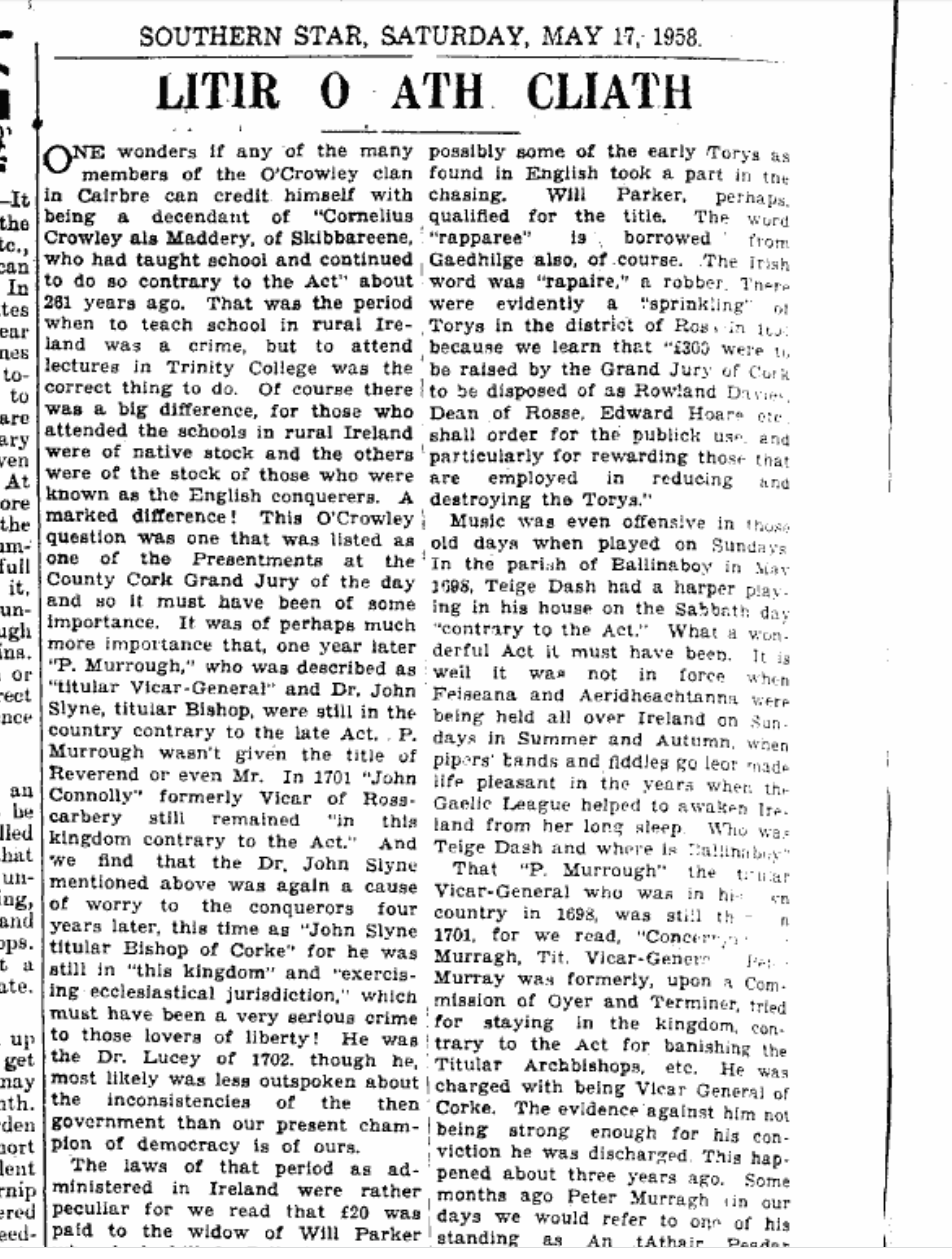
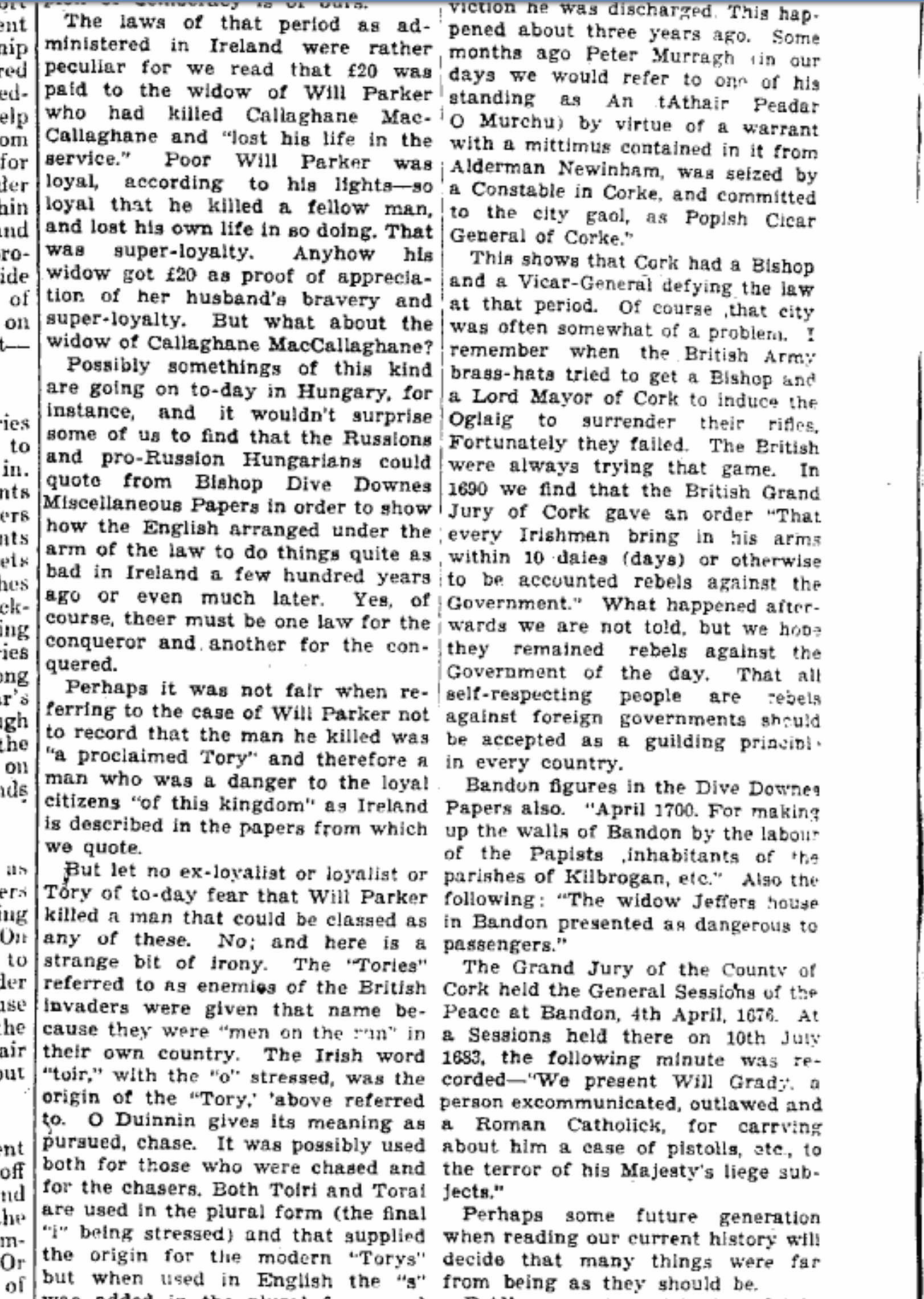
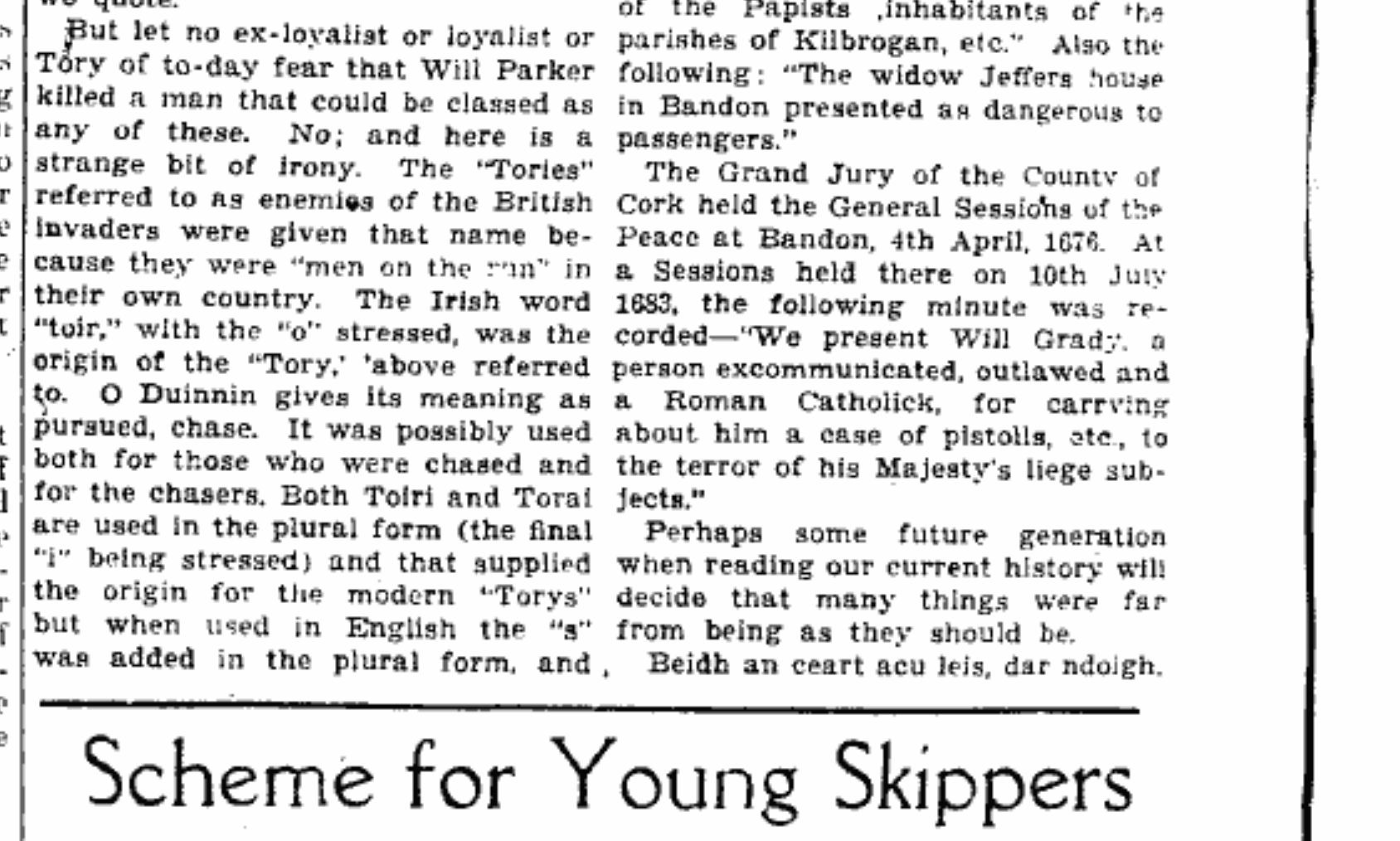
1727, Deed whereby Owen Lander of Kilpatrick, Schull to tend the house of William Hull, of Leamcon, Schull with Musick and to instruct William Hull to play on the Fiddle to the best of his endeavours.
…
| Type of deed | Date of current deed | 20 May 1727 | Vol | Page | Memorial | ||||
| Lease | Date of earlier deed | 19 Oct 1727 | 60 | 99 | 40069 | ||||
| No | Role(s) in earlier deed(s) | Role in current deed(s) | Family name | Forename | Place | Occ or title | A | ||
| A | P1 | P1 | HULL | William | of | Limcon, COR | Esq | ||
| B | P2 | P2 | LANDER | Owen | of | Killpatrick, COR | Farmer | A | |
| C | WD | DONOVAN | Elizabeth | of | Downmanuss, COR | Spinster | |||
| D | WD | HULL | Richard | of | Limcon, COR | Son of A | |||
| E | WD WM | DONOVAN | Daniel | of | Downmanuss, COR | Gent | |||
| F | WD | DONOVAN | Mary | of | Downmanuss, COR | Spinster | |||
| G | WM | WINSPEARE | Robert | of | Fourmilewater, COR | Gent | |||
| H | REG | MURRAY | George | of | Bantry, COR | Commissioner | |||
| I | W REG | WHITE | Richard | of | Co Cork | JP | |||
| J | W REG | DAVIES | Richard | of | Co Cork | JP | |||
| Abstract | Comment for person [A] :lease amended to reduce the rent for “good services” Person [B] :lands at Kilpatrick for 31 years Person [C] : Person [D] : Person [E] : Person [F] : Person [G] : Person [H] : Person [I] : Person [J] : | ||||||||
| MS | Date registered | 8 Mar 1728 | Date abstract added | 20201114 |
Abraham Watkins Esq, Cork Extensive Property Owner in Bandon, Will dated 12th July 17 My Daughter Mary Watkins ‘Not to have one penny if she marries Darby Cartie the Fiddler’
https://wordpress.com/post/durrushistory.com/5125
Will 176:
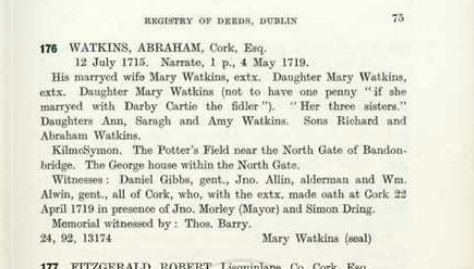
The name Abraham Watkins appears in Coolfadda as early as 1626.
http://www.bandon-genealogy.com/bandon_rent_roll_1720.htm
The Irish Manuscript Commission have digitalised some of their old publications. This is from a series on Memorials in the Registry of Deeds. These survived the destruction of 1922.
http://www.irishmanuscripts.ie/servlet/Controller?action=digitisation_backlist
1793. Pipers and Fiddlers for Tenant Gala on Kerry Estates of the Earl of Bandon 1793.
From Gibson’s History of Cork p 496:
This would have been a time of great war induced prosperity.
These grants were shortly after purchased by the first Earl of Cork, who may be justly styled the founder of the town. Through him, the Earls of Cork and Shannon, and the Duke of Devonshire, possess property in the town and neighbourhood. The Earl of Bandon is also a proprietor, but the principal part of his property is in Kerry and in the western part of the county. The Bernard family have always been esteemed good landlords and kind to their tenantry. The following extract from an original letter written by his agent to the Lord Bandon, of April 23rd, 1793, preserved among the papers of Wm. T. Crosbie, Esq., of Ardfert Abbey, county Kerry, will afford a good idea of what an ” Irish tenant gala ” was at the close of the last century :
” None who were not tenants did I invite, except those named by you, viz., Father Morgan Flaherty, Tim M’Carthy, Charles Casey, Doctor Leyne, and Father Nelan, son to Old John. These I asked as Catholics particularly attached to you. Had I gone further I must either Lave excited jealousy, or summoned half the country. We had a company of 22 in the parlour, of whom I will send you a list next post. In the breakfast-parlour there was another company of second rate, and the third rate dined in the tent pitched in the avenue near the abbey. In the parlour your claret was made free with, as Stephen tells me he opened 34 bottles. In the breakfast-parlour port wine and rum-punch were supplied in abundance, and abroad large libations of whiskey-punch. We had two quarter casks (above 80 gallons) of that beverage, made the day before, which was drawn off unsparingly for those abroad, and plenty of beer besides. Two patteraroes, borrowed from Jack Collis, and placed on the top of the abbey tower, announced our dinner, toasts, and our exultation. Pipers and fiddlers enlivened the intervals between the peals of the ordnance. The May-men and maids, with their hobby horse, danced most cheerfully, and were all entertained at dinner, and with drink in abundance. An ox was roasted whole at one end of the turf house, on a large ash beam, by way of a spit, and turned with a wheel well contrived by Tom O’Brien. It was cut up from thence, and divided as wanting. The name of its being roasted entire was more than if two oxen had been served piecemeal. Six sheep were also sacrificed on the occasion, and, in short, plenty and hospitality graced both your board and your sod ; and a fine serene evening favoured happily the glee and hilarity of the meeting. All was happiness, mirth, and good humour. God save great George our king was cheered within and abroad, accompanied with fiddles, pipes, &c., &c.”
The Bandonians would admit of no piping or fiddling like this. ” In this town,” says Dr. Smith, writing of Bandon, in 1749, ” there is not a Popish inhabitant, nor will the townsmen suffer one to dwell in it, nor a BANDON, CASTLE-BERNARD. 497 piper to play in the place, that being the music used formerly by the Irish in their wars.” The town, at this time, could raise 1,000 men fit for arms. The woollen manufacture, an Irish trade which William III. was petitioned to suppress, and which he faithfully promised to discourage, once flourished here. The trade has now altogether left our shores, while the manufacture of linen has departed to the north, and with it the growth of flax. There are two parish churches in this town Kilbrogan and Ballymodan. The latter contains a fine old monument, erected to Francis Bernard, Justice of the Court of Common Pleas, with this inscription : FRANCIS BERNARD, ESQUIRE, OBIIT JUNE 29ra, 1731, JE 68.
From ‘A Kinsale Scrapbook. Phil O’Neill, Southern Star, 6th April 1935
https://docs.google.com/document/d/1EOxt8dq8L11PmSSGTpCHPKhnCRdwqJrvO9GprR6gMvM/edit
Fiddler: Abraham Watkins Esq, Cork Extensive Property Owner in Bandon, Will dated 12th July 1715, My Daughter Mary Watkins ‘Not to have one penny if she marries Darby Cartie the Fiddler’, Deed of 1718 between William Bailey, Ballinacolle, Myross, West Cork wherein Charles Stanton is to teach his daughter and four children dancing, jigs, hornpipes, minuets and country dances.
https://wordpress.com/post/durrushistory.com/32590
Pipers and Fiddlers for Tenant Gala on Kerry Estates of the Earl of Bandon 1793.
https://wordpress.com/post/durrushistory.com/28683
Aibidial Gaoidheilge Agus Caiticiosma, First Book Published in 1571, in Irish, in Ireland Acquired by Trinity College Dublin, 1995, TCD Hurling Team Photo, 1880. One Time Member Sir Edward Carson (Lord Carson).
https://wordpress.com/post/durrushistory.com/23345
1631. Cork City Council object to the playing of Hurling on the streets and direct the Lord President to abolish it.
https://wordpress.com/post/durrushistory.com/8844
Cowhair Hurling Balls
https://wordpress.com/post/durrushistory.com/8751
Record of the North Cork Regiment of Militia with Sketches extracted from History of the times in which its services were required, from 1763 to 1880. Taunts at Hurling Final.
02 Friday Dec 2022
Posted in Uncategorized
01 Thursday Dec 2022
Posted in Uncategorized
https://docs.google.com/document/d/1iEOKEJwc_qDwTGnI_CgQcU77JzwWrJFeL-_7PN2G1zU/edit
Magistrates See here.
This article is an accumulation of information on all elements of the practice of law by local
magistrates in Ireland (and indeed Ireland in general). It outlines the legal basis on which
magistrates were appointed, and their social and economic backgrounds. It also includes
accounts of their practices, good and bad, and commentaries from various writers on the same.
There are also accounts of political and violent actions taken against magistrates at various
times. The major part of the article is an annotated list of magistrates based on information
from a range of sources. Nobody knows how many magistrates there were. James Chatterton in the 1820s was Clerk of the Crown and Peace (State Solicitor equivalent) in the 1820s and confessed in a return to the UK Parliament that he had no idea how many magistrates there were in the county. He said formerly the Lord Chancellors office had notified him of the appointment but this had been discontinued. Additionally certain offices entitled the holder for the year he held the office eto be a magistrate. This includes the Lord Mayor of Cork, the Provosts of Bandon, Charleville Clonakilty and the Mayor of Youghal. There were numerous appointments from the 1890s onwards and a third of others were nominees of the Irish Parliamentary party. You continuously come across references to people at political meetings attending funerals described as JPs or magistrates. It is likely all the Lord Chancellors’ records were lost in the destruction of the Public Records Office in 1922. There are approximately 3,400 magistrates listed.
Role of Magistrate (Justice of the Peace), p. 2.
Social and Economic background, p. 8.
Penal Enactments on Papists, 1712-1772, p. 10, 475.
Hearth Tax Collection, 1662-1793, p. 12.
Reform from 1814, p. 13.
Military magistrates, 1789-1836, p. 14.
Appointment of British Army Officers, 1821, p. 15.
1821 Census. P. 15.
1821, Dismissal of Catholic and Liberal Protestant Magistrates, p. 16.
1827, Justice for Sale, p. 16.
1827, Petty Session Courts, p. 17.
Tithe Agitation, p. 18.
1831 Return of Magistrates. P. 19.
RIC Recruitment, p. 20.
Daniel O’Connell criticism, p. 20.
Enforcement of Sabbath, p. 21.
Friendly Societies, p. 22.
1884, Protest Against Removal of Lord Rossmore, Grand Master Monaghan Orange Order, p. 23.
RIC Inspectors sitting on Magistrates Bench, p. 24.
1893, Davitt Magistrates, p. 25.
Irish Speaking Magistrates, p. 26.
References in James Joyce Ulysses, p. 27.
War of Independence, Killings, Kidnappings, Big House Burnings, p. 27
Women Magistrates, p. 33.
Post 1922, p. 33.
Listing of Magistrates by surname, p. 33.
Sources, p. 460.
Finances/Probate, p. 463.
Books used 1730s, p. 474.
28 Monday Nov 2022
Posted in Uncategorized
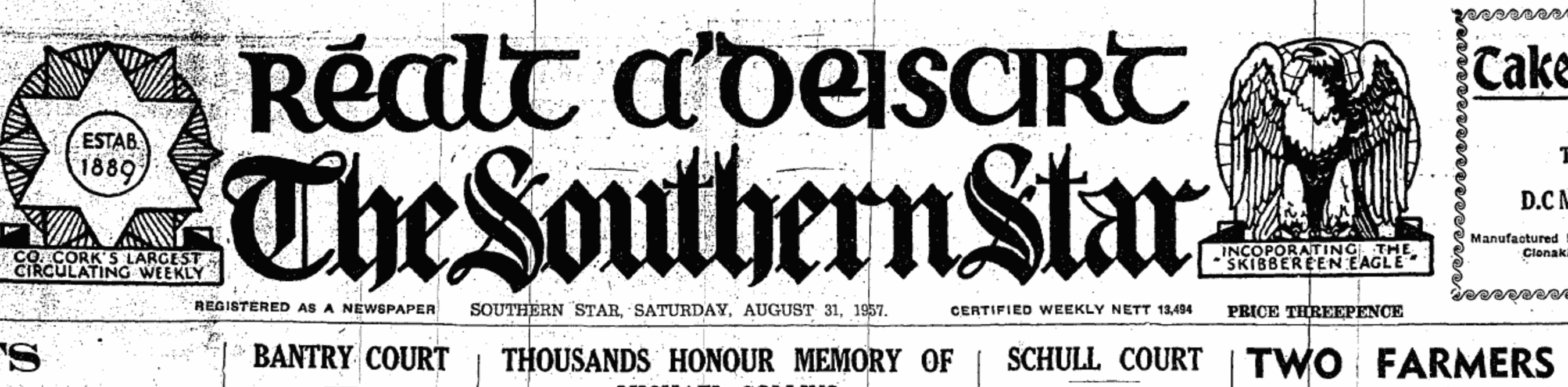
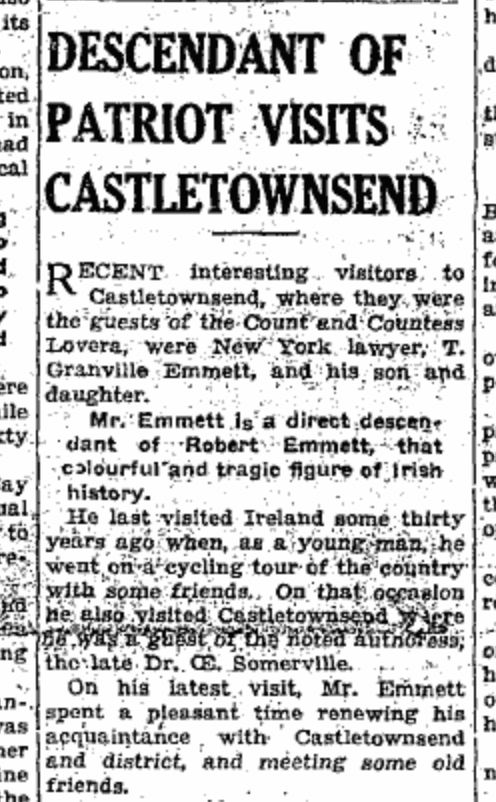
Robert Emmett as far as is know had no descendants struck down even before his prime,
T. Granville Emmett might be a descendant of
1764-1828 Thomas Addis Emmet TCD Studied Medicine. York Attorney United Irishman Doctor Born junction Grattan St/Shears St. Father State Physician 1770 and moved to Dublin. Degree TCD and Edinburgh Medicine, Secretary United Irishmen imprisoned release to Holland then NY. In New York associated with other Cork Attorneys (Robert Swanton, Ballydehob, United Irishman, Admiralty Judge), Clerke Skibbereen. 1817, New York. Judge Robert Swanton (United Irishman, Ballydehob) one of Judges of the New York, Marine Court, Charge to Jury. 1817 One of Committee in New York with Thomas Addis Emmet, (Brother of Robert Emmett) to Promote the Welfare of the Irish. 1828 Pallbearer at Funeral of Thomas Addis Emmet with the Governor of the State of New York, Martin Van Buren later President, United States, Senator Nathan Sandford Thomas Addis Emmet” One of the first lawyers in Dublin and one of the most virtuous and most patriotic of men. He was a member of the Irish Directory with Lord Edward Fitzgerald and was arrested in 1798. He was sent to Fort George. Liberated and expatriates in 1803 like the other prisoners of Fort George. He was chosen by the Irish in Paris in 1803 to be the agent from the provisional Government of Ireland to the First Consul and French Government, which he held till 1805. On finding there was no prospect of an expedition to Ireland} he got his passports and went to America, where the Congress passed a decree, by which, contrary to the usual term of ten years, he received his naturalisation twenty-four hours after landing there. He rose to great eminence as a lawyer in his newly adopted country and died in New York.
25 Friday Nov 2022
Posted in Uncategorized

24 Thursday Nov 2022
Posted in Uncategorized

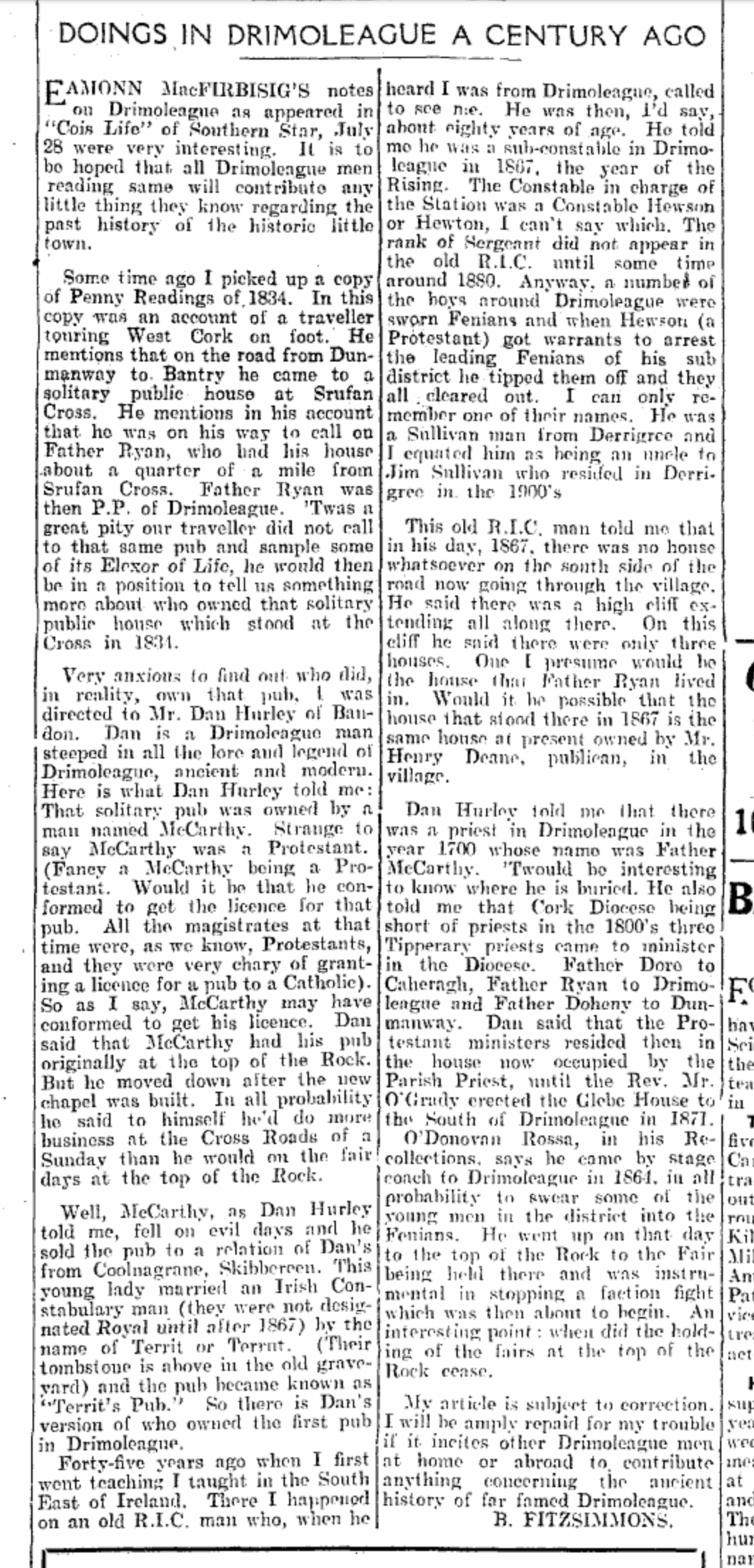
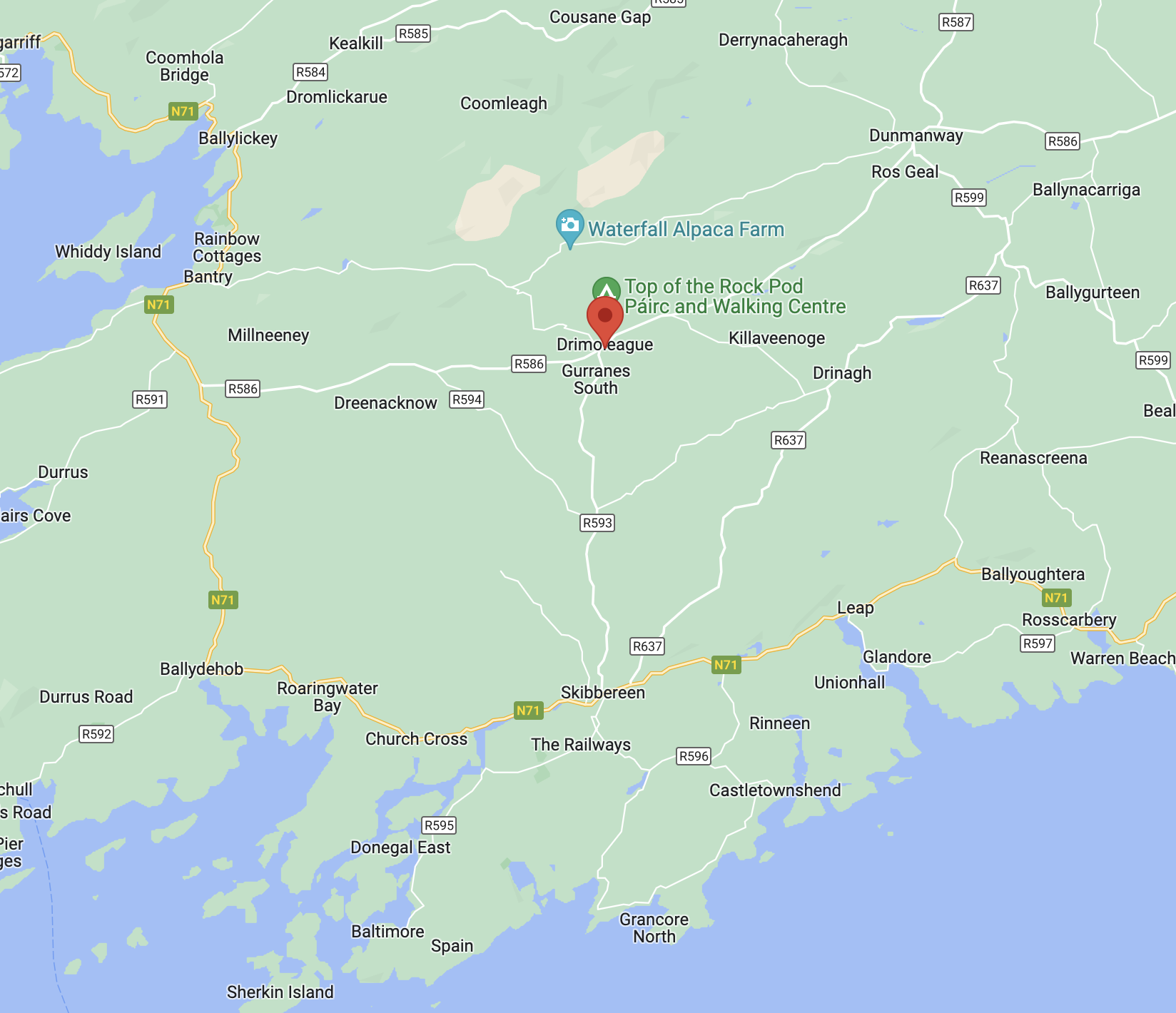
David Ross is living in the house that McCarthy had the pub in at the Top of the Tock. His wife was Genevieve Kingston . They all went to Rochester, New York after
23 Wednesday Nov 2022
Posted in Uncategorized
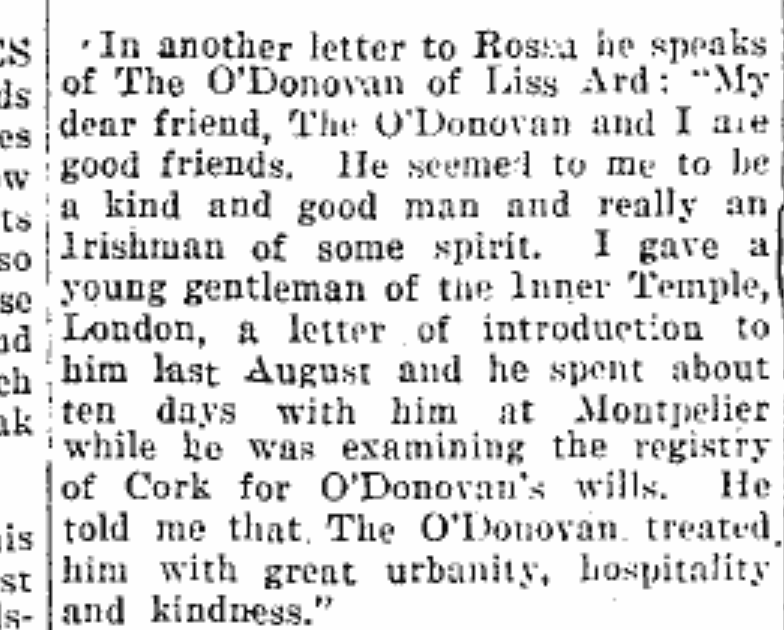

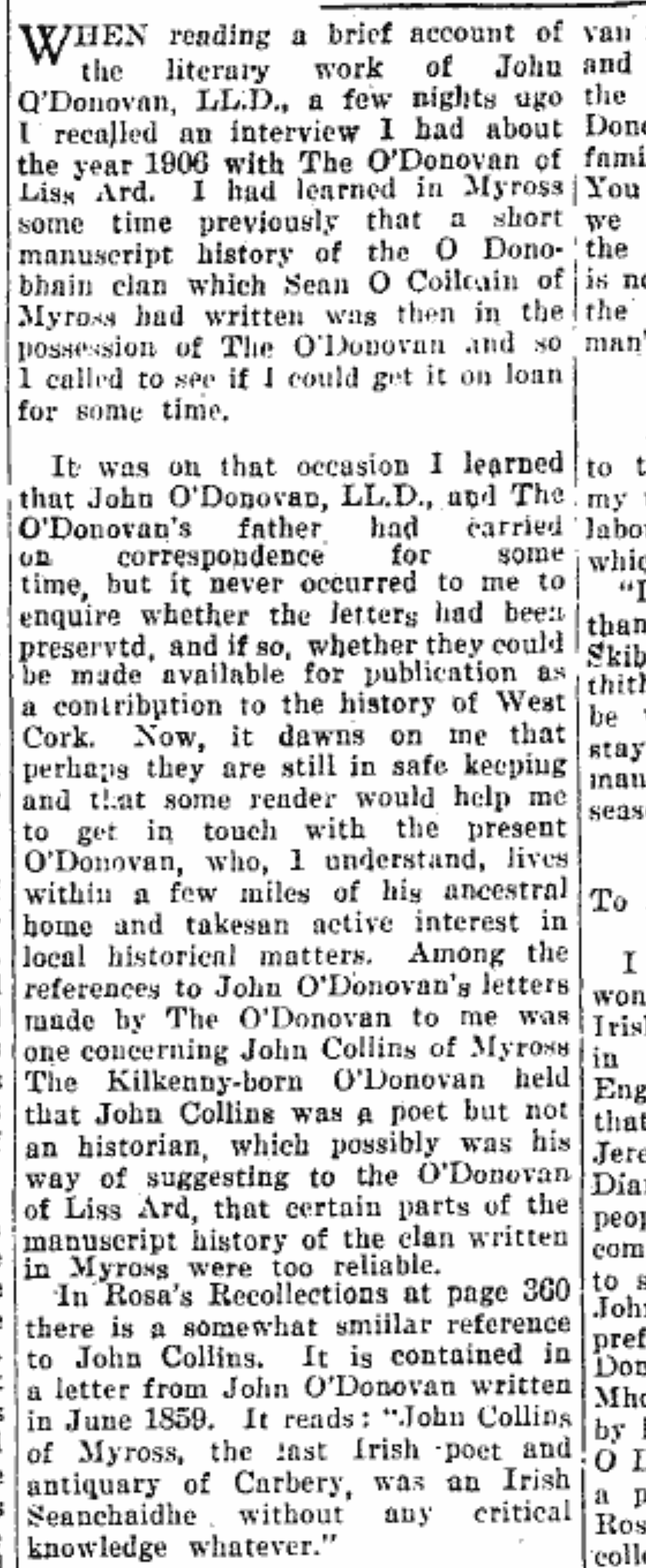
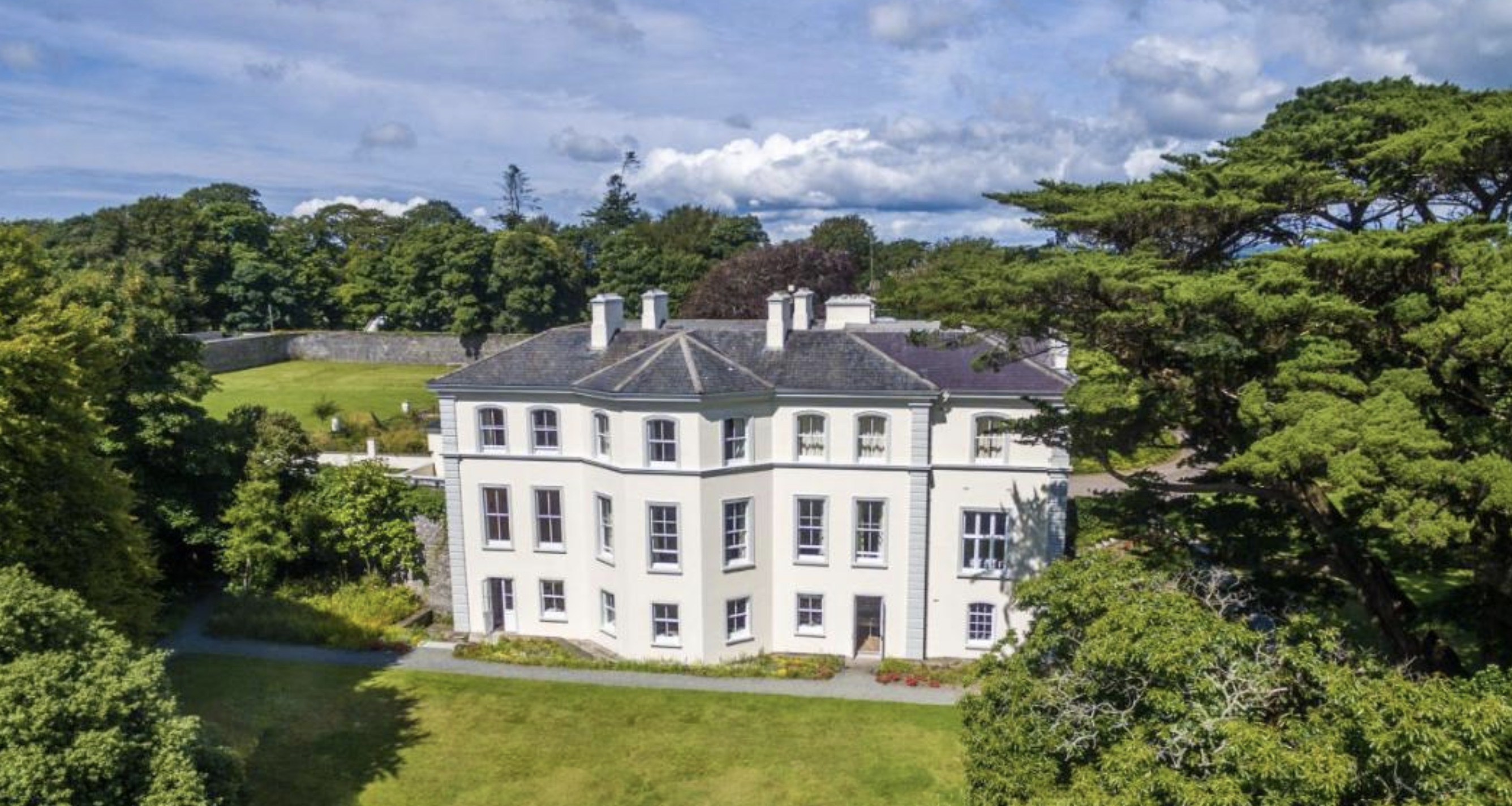
After the death of Lieutenant General Donovan of Bawnlahan, Leap the Chieftainship passed to the Montpelier (Douglas) Cork branch. They too were Protestant very wealthy by way of prudent marriages in the 18th and 19th century into the Cork Mercantiler Community.
When the General died his estate passed to his wife’s nephew Colonel Powell who was from Wales. By all accounts a reasonable landlord but no feeling for him locally as he was not of ancient stock.
The subsequent O’Donovan were in fact very popular and very engaged locally and even after~`independence when they decamped to England were active in promoting agricultural development locally.
In the John O’Donovan papers and also in O’Donona Rossa’s recollections there were superior genealogical claims to be Chieftain of the O’Donovan including the gateman in Skibbereen Workhouse who wanted no mention of this lest he lose his job. Others mentioned were a ploughman in Myross and a cobbler in Waterford.
In John O’Donovn reference to a young gentleman on the Inner Temple London he may be from the Wexford O’Donovans on his mother’s side, later a senior figure in Dublin Castle . John O’Donovan said the Wexford O’Donovan originated in Carbery but wer ‘Rabid Orangemen”
Re John Collins, The Silver Tongue of Carbery a wonderful poet but many doubted the facts in his genealogical tracts.
O’Donovan from Cois Life
https://docs.google.com/document/d/1i81sLnwDt9WZjFM4-3eRYbKjmlOTarVyedlSHM6P2bM/edit
The O’Donovan’s son:
Colonel Morgan William ‘The O’Donovan’ Oxon (1861-1940), CB, D.L., MA, 1888, ‘The O’Donovan’, Clann Cathal, Lis Árd, Skibbereen, son of Henry Wintrop ‘The O’Donovan’ MA, DL. and Amelia d ‘The O’Grady’, Courcy O’Grady, Kilballyowen, Co. Limerick. Ed. Haileybury and Oxford, Lieutenant-Colonel Munster Fusiliers, Colonel South Cork Militia Boer War, Succeeded Colonel Aylmer C. Somerville 1899 as President Carbery Agricultural Society. Presented organ to Creagh Church to commemorate the Jubilee of Queen Victoria. 1892 High Sheriff, Co.Cork ill, spent the summer on the Continent recovering. 1893 Member Cork Historical and Archaeological Society. Member Royal Society of Antiquaries 1889. Sent a carriage to the funeral of Lieutenant-Colonel Thomas Somerville D.L. (1824-1898), Clontaff, Drishane. Signed Requisition 1905. Cork Junction Railway Bill. Requisition to the Right Honourable The Earl of Bandon K.P., to Call a meeting for the purpose of Approving the Cork Junctions Railway Bill. Addressing a recruitment meeting in Drimoleague In July 1915 he referred to this ancient stronghold (Castle Donovan) of his family. After they displaced the O’Driscolls they became the Chief People of the Carberies. Listed family members as giving a present to 1907 Spaight wedding Union Hall. Considered the preservation of ancient documents a matter of importance. M Mary Eleanor, (Madame) odo Rev. J Yarker Barton, Chaplain to British Forces, she chaired the Women’s Emergency Recruiting Committee WW1, Skibbereen, listed 1921. Attending 10 Grand Jury presentments. 1933 writing to Carbery Agricultural Society suggesting horticultural potential in West Cork.
Overview of John O’Donovan from Kilkenny:
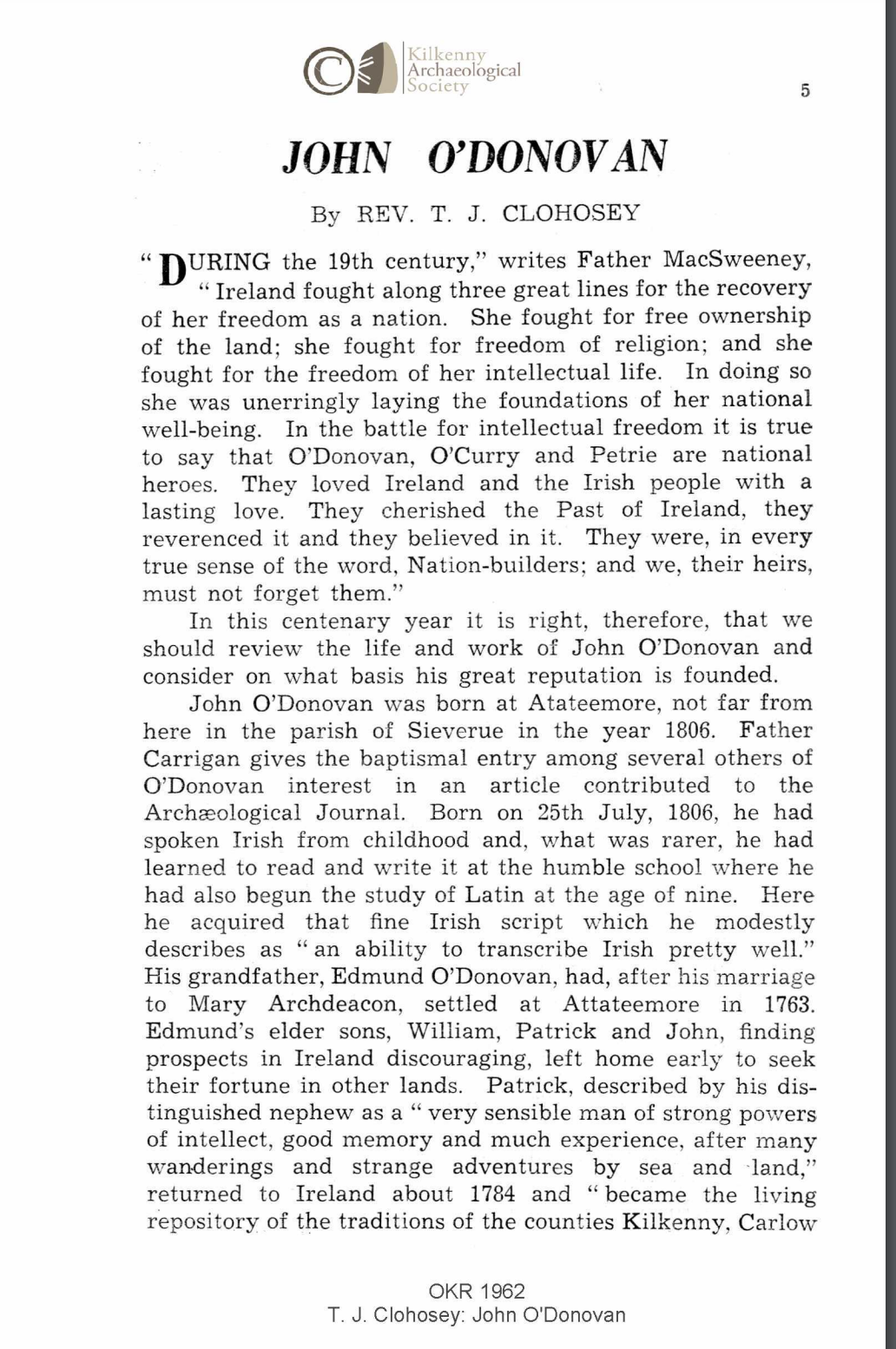
1841-. Dr. John O’Donovan correspondence with Timothy O’Donovan, Landlord and Magistrate, Durrus, James O’Donovan, Gravesend, Kent
Tracing members of the extended O’Donovan family:
Originals in the Royal Irish Academy, Dawson St., Dublinm Graves Collection.
https://docs.google.com/document/d/16VJptRac8CKsG_ylR0Zm78DLE-rPwWHJ_q2n4HKpW5s/edit
18 Friday Nov 2022
Posted in Uncategorized
Patrick James Leahy (1850-1925), Businessman and, Minister for Mines, Member of Legislature
Daniel Vincent Leahy, Barrister
John Leahy (1854-1909 Originator of Land Classification System in Queensland. In Parliament he spoke with a Strong Brogue.
Patrick James Leahy (1850-1925), Businessman and, Minister for Mines, Member of Legislature
Daniel Vincent Leahy, Barrister
https://adb.anu.edu.au/biography/leahy-john-7133