Mizen, West Cork and the Evanson, Dukelow and Jeremy (Jeremiah) Coghlan family of Carrigmanus Mizen
11 Saturday Jan 2014
Posted in Uncategorized
11 Saturday Jan 2014
Posted in Uncategorized
09 Thursday Jan 2014
Posted in Uncategorized
His grave is on the Skibbereen Heritage site:
http://www.graveyards.skibbheritage.com/Gravestone.aspx?GravestoneID=655
He died in Ballydehob, in early years he was lucky to escape to America where he rose to be a Judge of the Marine Court of New York. He died immensely wealthy. He was a Pallbearer at the funeral of Addis Emmett another Cork born New York lawyer and brother of Robert Emmett
On the tomb is buried his sister married to Nathaniel Evanson of Friendly Cove, Durrus, (House still overlooking Dunmnnus Bay), she died in childbirth.
His grave is one of the very few prior to c 1895 with an inscription in Irish:
‘Do ghradhaigh sé na Gaedhil agus an Ghaeilge’ (He loved the Gael and the Irish Language)
Swantons, Ballydehob:

William Swanton & Mary Radcliffe
barrybradfield added this on 22 Nov 2013
This marriage goes back a generation and took place in 1717.Source: Dublin Castle Report. http://www.ginnisw.com/SWANTON%20FAMILY%20HISTORY%20WORLDWIDE/Dublin%20Castle’s%20Report/Thumb/DCR%20A2.htm This William is almost certainly a son of John Swanton of Lettertinlish (near Skibbereen) who died in 1717. You often notice marriages taking place shortly after a death and the resulting inheritance. This William appears to have lived in nearby Aghills and he died in 1750. He is the strongest contender for the ancestor of the next generation which includes amongst others Samuel who had a child baptised in Kinsale in the 1740’s and Ellen who was married to James Hawes by 1750 when John Wesley visited Bandon. Ellen/Ellinor would have been born say 1730 and died in 1806. She was the aunt of Judge Robert.
09 Thursday Jan 2014
Posted in Uncategorized
I was chatting to a fiend recently and she bewailed the loss of the buailteach/seamhú, the little dot over several letters in Irish to denote a ‘h’. With the introduction of the Roman script this is replaced by ‘h’ She says it has the effect of deadening a page while reading giving a stress not intended in the oral language.
Apparently there are now excellent software packages for about €50 giving a variety of fonts in the old Gaelic script easily usable on I Pads, smartphones, etc.
You forget the pure beauty of the old script. I enclose the notebook of William Smith O’Brien transcribed by him about 1860 and the calligraphy is superb. It could easily be replicated hi-tech and would be distinctive and visually beautiful.
http://en.wikipedia.org/wiki/Irish_orthography
Gaelic Type:
http://en.wikipedia.org/wiki/Gaelic_type
Mortgage Deed in Irish 1608, William Smith O’Brien, West Cork list of phrases:
https://plus.google.com/photos/100968344231272482288/albums/5960693160376226161
09 Thursday Jan 2014
Posted in Uncategorized
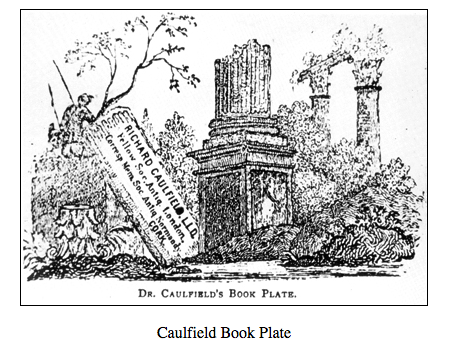
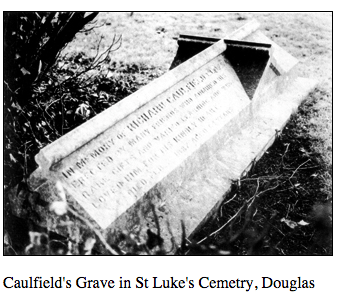
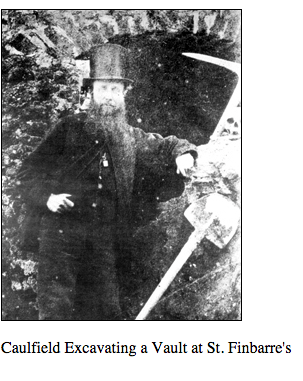
People worldwide with Cork connections owe an eternal debt of gratitude to Richard Caulfield. His career is dealt with here:
http://en.wikipedia.org/wiki/Richard_Caulfield
Many of the Church of Ireland records from the Cork Churches were transcribed by him and the originals went up in a few seconds with the detonation of explosives placed by the Anti-Treaty IRA in the Public Records Office of the 4 Courts Complex in 1922. At the time the Public Records Office was regarded as among the best in the world.
The RCB Library in Orwell Road, Dublin have some of his original transcripts, the industry involved is apparent from his comments.
‘Reverend L.O.Madden lent me the Registers on the 30th June 1877, Saturday 1.30 commenced 8.30 (coden sie)’
In the middle of the transcription between different sections from Births to say Deaths he has inserted in his own hand.
” The entry of burials between the 19th April 1748 and the 11th February 1764 have been cut out of this Register. I am sorry to have to record here the Register of Christ Church Cork are a lasting disgrace to the clergy of the last century who had custody of them.
They are wantonly mutilated in several places the leaves loose, having been torn out, and the entries made (at least to 1784) by some of the most disorganized incompetent person, as would appear by by the spelling of the most common names.
Richard Caulfield LDOFSA, Cork August 1877.
His comments were echoed in the 1820s by probably the greatest Irish scholar of all time Dr. John O’Donovan in his travels around the Northern Counties in connection with the writing of the Ordnance Survey Letters. An absolute treasure trove of each townland, customs, personalities, traditions, and historical associations. He found the state of record preservation deplorable. Unfortunately his work in that area was stopped.
Maziere Brady in the 1850 compiling th History of the Dioceses of Cork Cloyne and Ross says the same.
Christ Church records transcribed 1940s:
https://plus.google.com/photos/100968344231272482288/albums/5936179282398243713
Memorial St. Finbarrs Cathedral:
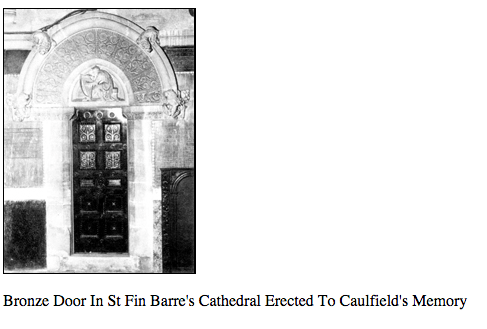
The memorial took the form of a bronze door inlaid with silver erected at the south side of the ambulatory at a spot which would have made it the entrance to the organ had this not been moved to the north. It is now the doorway to the tower stairs. Over it is a tympanum with a carving of David playing the harp and for this reason it is known as the David Door. In marble on the wall beside it is an inscription recording its dedication to the memory of Caulfield. An inscription on the door bears the date 1889. Rev. Canon A.C. Robinson in his Handbook of the Cathedral published in 1898 points to the existence of a colourful tableau representative of Caulfield’s friends and work captured by the positioning of the tombstone of the Rev. Rowland Davies in the floor on the first storey of the central tower reached through Caulfield’s door, while past the door and set in the ambulatory wall is a tablet of white marble commemorating Bishop Isaac Mann. Caulfield was instrumental in having the remains of Bishops Peter Browne and Isaac Mann brought from the chapel of Bishopstown House to the Cathedral in 1865. (39) Beyond the tablet lies the south transept with marble-lined walls dedicated to the memory of Dean S.O. Madden.
03 Friday Jan 2014
Posted in Uncategorized
Jim Herlihy was a neighbor of mine in Cork, he recently retired from the Garda Siochána. He is well known as the historian of the RIC and has done extraordinary work in this regard. This is a lecture he gave in September 2013, it is over an hour but fascination. He has have listed all of the RIC men who volunteered for service in WW1 for publication later this year to coincide with the WWI Commemorations.
Among the nuggets:
Over 85,000 men passed through the force
You had to be 5’9” and 19 to join, but if your father was in the force this was reduced by an inch and a year.
You were not allowed marry until you had 7 years service you could give notice after 5 years. In the early years many were dismissed for breaching this rule. There was a tradition of marriage within the force i.e. constables marrying the daughters of other men.
The overwhelming majority of the men were catholic with some in the Officer Corps
It was regarded as the best police force in the world and was the model for Colonial Police Forces. Many from these forces trained in the Depot in the Phoenix Park and attended the 4 Courts in their exotic colonial uniforms.
One of the Forces modeled on them is the Newfoundland Police. Their buttons are in Irish and the Police band is known as ‘Siochána’.
On disbandment in 1922 a man with 12 years service was given an extra 10 years of added service to retire.
The Dublin Metropolitan Police was unarmed and subsumed into the Garda in 1925.
of the 85,000 personnel files only 4 have survived. The files dating from 1815 would contain a birth cert (official registration generally only started in 1865), a sketch of the recruit, his background, letters of recommendation, medical history, his wife’s details and his postings. Post Treaty in 1922 the flies were removed to Ealing outside London and were shredded in 1938.
https://plus.google.com/u/0/102762529302366057895/posts/TBKmh8R1REc?cfem=1
Included below also are some details of West Corkmen who served in various Police Forces, this is a work in progress and any amendments and additions are welcome at pat25a@gmail.com
02 Thursday Jan 2014
Posted in Uncategorized
Courtesy Peter Mayberry’s site
Bandon:
http://members.pcug.org.au/~ppmay/cgi-bin/irish/irish.cgi
Bantry:
http://members.pcug.org.au/~ppmay/cgi-bin/irish/irish.cgi
Kinsale:
http://members.pcug.org.au/~ppmay/cgi-bin/irish/irish.cgi
Skibbereen:
http://members.pcug.org.au/~ppmay/cgi-bin/irish/irish.cgi
Cork Generally can be trial venue, birth or reference:
31 Tuesday Dec 2013
Posted in Uncategorized
The WordPress.com stats helper monkeys prepared a 2013 annual report for this blog.

Here’s an excerpt:
The concert hall at the Sydney Opera House holds 2,700 people. This blog was viewed about 39,000 times in 2013. If it were a concert at Sydney Opera House, it would take about 14 sold-out performances for that many people to see it.
30 Monday Dec 2013
Posted in Uncategorized
Banking Collapse in Cork in the 1820s Roches and Leslies Bank and House of Commons, London, Select Committee Query re Collapse, only functioning Bank left Pikes. Newenhams had been engaged but withdrew.
A long boom, unprecedented started in Britain and Ireland in 1785 and ended suddenly on the day the Battle of Waterloo ended in 1815.
War prosperity had disguised the weaknesses of the Irish economy and suddenly producers were exposed to competition from the most advanced economy in the world and agricultural products faced competition from North America.
This caused widespread distress. See:
https://durrushistory.wordpress.com/letter-from-lord-carbery-1826-re-destitution-and-emigration-in-west-cork-and-eddy-letters/
It also commenced large scale emigration from West Cork to New Brunswick and other parts of North America.
The local banks were undercapitalized and when there was a run on them the authorities sought to help but then as now these phenomena were not fully understood.
The recently digitized papers from the Chief secretaries Office suggest that official action was stymied by among other things at the lack of appropriate legislation, The Attorney General and de facto head of the Irish Administration William Saurin advised that there was no legal power to intervene:
http://en.wikipedia.org/wiki/William_Saurin
http://www.csorp.nationalarchives.ie/context/progress.html
http://www.csorp.nationalarchives.ie/context/1820.html
The effects of the banking collapse were felt in all area and made a bad situation immeasurably worse. For example in Dunmanway the Church of Ireland Vestry return for 1827 state that the previous years collection was deposited with Leslie’s Bank in Cork and lost when the Bank collapsed even though that happened in 1820.
See Ballincollig site re Leslie family, the Bank and their Gun powder Mills, their house as Wilton House later a religious seminary and adjoining Wilton Shopping Centre:
http://ballincollig.wordpress.com/gunpowder-mills/ballincollig-gunpowder-mills-may-2010/

House of Commons Select Committee:
http://books.google.ie/books?id=jCNDAAAAcAAJ&pg=RA1-PA84&lpg=RA1-PA84&dq=leslie%27s+bank+cork&source=bl&ots=_WhXMNykmU&sig=ldEA2wzTxBxOUYsoJ3Q_MttLfrA&hl=en&sa=X&ei=yoN3VIOhEoPfsAS0qYD4AQ&ved=0CEEQ6AEwAzgK#v=onepage&q=leslie’s%20bank%20cork&f=false
| NAI REFERENCE: | CSO/RP/1821/743 |
|---|---|
| TITLE: | File of papers relating to collapse of banking house of Messrs Leslie, Cork |
| SCOPE & CONTENT: | File of papers relating to the collapse of the banking house of Messrs Leslie in Cork city in 1820, and their request for financial aid from the government and from the commissioners for assistance of trade and manufactures, to re-establish their bank, and thereby facilitate trade in Cork city. Includes letters from Richard Hely-Hutchinson, 1st earl of Donoughmore, on behalf of Messrs Leslie; legal opinions of William Saurin, Attorney General of Ireland, and of John Sealy Townsend, KC and legal advisor to Chief Secretary’s Office, Dublin Castle, on the case; and letters from John Galloway, secretary to the commissioners for assistance of trade and manufactures, on the subject. Also includes letter from Robert Banks Jenkinson, 2nd earl of Liverpool, Prime Minister of Great Britain and Ireland, to William Gregory, Under Secretary, Dublin Castle, enclosing letter from Donoughmore, to Liverpool, on behalf of Messrs Leslie, expressing concern at the ‘the most unpromising state of Credit in the City and County of Cork’. Also expressing his belief that ‘the commissioners have done every thing in their power to interrupt the liberal policy of the Government, and to prevent the re-establishment of the Banking House of the Messrs Leslies again in Cork’, 6 September 1821. Also encloses detailed statement of the circumstances surrounding the bank’s collapse, and subsequent requests for government aid, [September 1821]. Also includes copy of letter from Liverpool, Fife House, Whitehall, London, to Donoughmore, explaining the details of the legal position of both the government and the commissioners, concerning a possible advance of money to Messrs Leslie, 17 September 1821. |
| EXTENT: | 18 items; 70pp |
| DATE(S): | 21 May 1821-27 Dec 1821 |
| DATE EARLY: | 1821 |
| DATE LATE: | 1821 |
| ORIGINAL REFERENCE: | CSORP1821/768 |
29 Sunday Dec 2013
Posted in Uncategorized
Following my post on JJ O’Leary https://durrushistory.wordpress.com/2011/10/28/j-j-oleary-businessman-dublin/ I was contacted by John King, a Transport Historian about his connection with the foundation of Aer LIngus.
Ireland was a late starter in aviation, the troubles not help and links to Britain were in the hands of British based shipping and railway companies. Seán Lemass, the Minister of Industry and Commerce was anxious to develop aviation but only if at least 50% of any structure was under Irish control. Dublin was also handicapped by having no airport apart from the Military Aerodrome at Baldonnel. From such modest beginnings Aer Lingus developed and recent spin offs include European low cost travel through Tony Ryan/GPA/Ryanair and Dublin/Shannon as centers of worldwide aircraft leasing.
John has sent a note of conversations with JJ O’Leary re the origins of Aer Lingus and the part he and Seán Ó h-Uadhaigh (formerly John Kirwan Woods) 1886-1959: http://www.ainm.ie/Bio.aspx?ID=205 to and Colonel Charles Russell played:
I first had contact with JJO in the early 1970s when I first started researching the formation of Aer Lingus in the 1930s. My notes do not indicate who suggested that I contact him but it is clear from my notes that I first spoke him by telephone on 15th March 1973. He asked me to write to him which I did the following day.
He replied on 27th March, offering any help he could. He noted that he was one of three who drew up proposals in 1934 for an Irish airline, the others being Sean O’hUaghaigh, a Solicitor, (he would be the first chairman of Aer Lingus in 1936) and Col Charles Russell who before leaving the Military had been in charge of the Irish Air Corps from 1922 to 1926.
I first met JJO on 15th May 1973 in the Irish AA Club in Dublin. He described Russell as being the driving force for an Irish airline (in fact, I knew that Russell had been pushing for civil aviation since at least 1928.) O’Leary helped Russell with details of costs etc while Col Delamere helped with technical aspects – the latter was still a serving officer with the Air Corps.
The completed document of Russell, O’Leary and O’hUaghaigh was submitted to the Minister for Industry & Commerce. (I think that I have a copy of the document which I obtained from Aer Lingus – unsigned, it is dated April 1934).
The document asserted that in Ireland it was not considered sound business practice to invest money in any enterprise that would not show a reasonable return in a short period. In the absence therefore of Government assistance by way of certain guarantees as to principal and interest, it was thought not to be possible to obtain the whole of the necessary capital. The following paragraph was headed Capital Arrangement. It stated that the capital necessary for carrying through the first objective – a Dublin-London Air service- was estimated at £60,000. It suggested that a Public Limited Liability Company be formed with an authorised capital of £100,000 divided into 80,000 4½% £1 preference shares. THE NECESSARY CAPITAL COULD THEN BE OBTAINED BY A PUBLIC ISSUE OF 48,000 PREFERENCE SHARES AND 12,000 ORDINARY SHARES.”
Another scheme for an Irish airline had been prepared by a Cork group which was headed by R F O’Connor, the Cork County Surveyor. At the request of Lemass, JJO incorporated the Cork scheme into Russell’s.
I wrote to JJO on 1st April 1975 with a number of questions which he answered but in a rather negative “no knowledge” way.
I first met JJO in Dublin on 29 May 1975. He was friendly and not unhelpful but I appeared to make few notes other than his assertion that private capital would have been forthcoming in Ireland for an Irish airline as he and the other two were in contact with businessmen in Ireland
I wrote to him again on 16th June with more questions. Again he answered the questions but not in the way I had hoped for, I mentioned a meeting at the Shelborne Hotel on 8th June 1934 which he presided over for the amalgamation of the two schemes; and that in October John Leydon, Secretary of the Department of Industry and Commerce and longtime confidant of Lemass, said that Lemass was not happy about the new scheme. He queried this and said his impression at the time was that Lemass did not think the time opportune to seek cabinet approval. (I am not sure that I agree with his interpretation)
My final meeting with JJO was at the Military & Navy Club, Piccadilly on 29th November 1976. We discussed the availability of capital again and he was of the opinion that this would have come partly from the Industrial Credit Company which Lemass had set up to foster the start up of Irish industry. JJO was a director of the company.
.
The other interesting note I made was that JJO went with Col Russell and Bonass (a Senior Civil Servant in the Dept of Industry & Commerce ?staff section) to Greystones for the weekend. After mass (on the Sunday), Russell opened an envelope with the details of the Cork scheme. He blasphemed violently when he read the document as he reckoned that it was copied from their scheme. What had happened was that the Cork people had gone to the home of Eddie Smyth, the Assistant Secretary of the Marine & Transport Section of the Dept of Industry & Commerce, to talk about their scheme. Smith told them to get it onto paper. There was a typist present and Smith dictated details of aircraft and airports etc from Russell’s paper. The typist muddled the details. (Who was Miss Hamilton? – she was present)
Unfortunately I never asked JJO if he had kept his diaries and other records. He did not suggest that he might have.
In my file of this scheme, I have many press cuttings relating to Russell and a very small number of notes from railway archives in Britain.
John King, London SE12
27 Friday Dec 2013
Posted in Uncategorized
William Smith O’Brien’s history is given in Wikipedia.
http://en.wikipedia.org/wiki/William_Smith_O’Brien
He is a descendant of Brian Ború d 1014, and it is probably through his line that Queen Elizabeth of England traces her Irish Ancestry. He is credited with the inspiration of the Irish Tricolour, ‘The new Irish flag would be Orange and Green, and would be known as the Irish tricolour’. He was a Protestant and received an education at Harrow.
The National Library of Ireland has his workbook containing transcriptions of Irish poetry, sean focals and much more. It is probable that it was done by him. It is item number M803 and was acquired in 1956 from Alister Matthews.
Gaelic_Manuscripts_List-9 in NLI Dec 2013
https://plus.google.com/photos/100968344231272482288/albums/5960693160376226161
 West Cork History