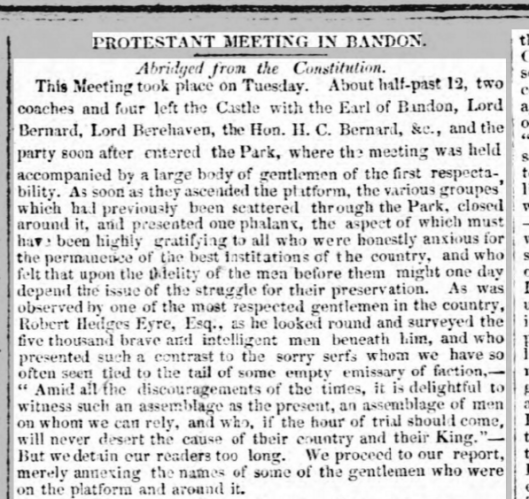
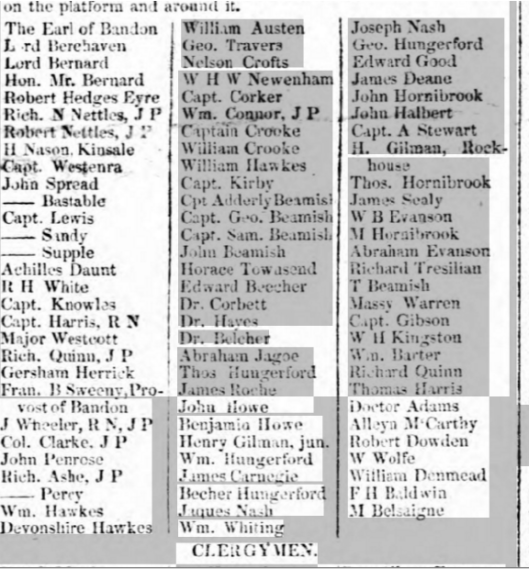
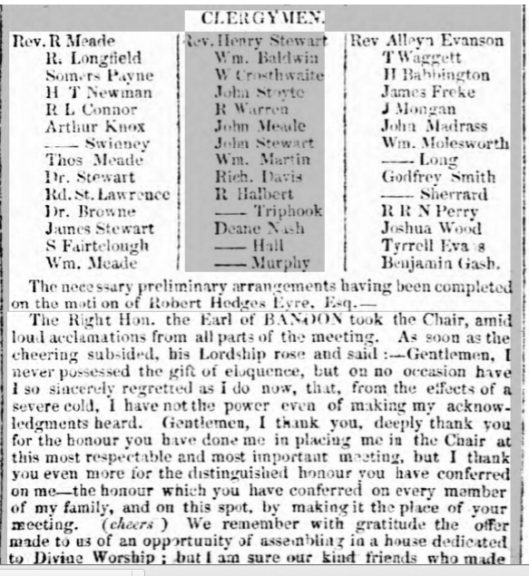
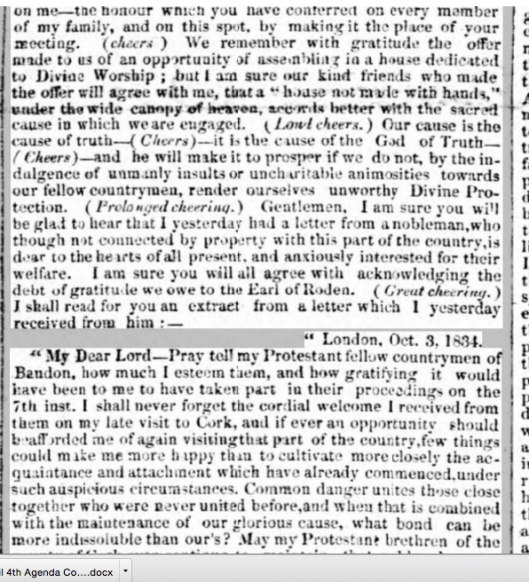
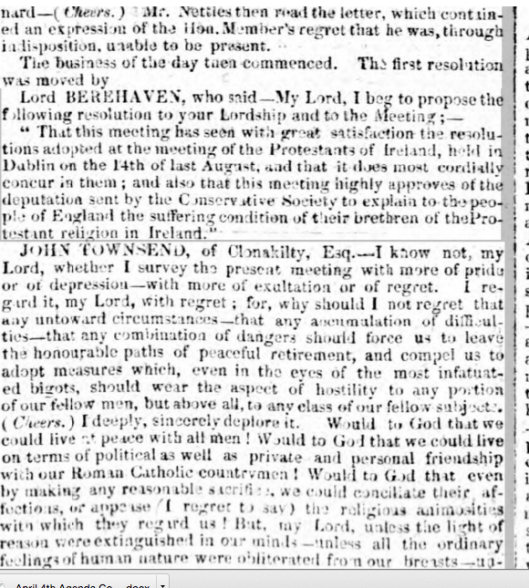
1834. 5,000 at Protestant Meeting, Bandon, Co. Cork.

29 Tuesday Mar 2016
Posted in Uncategorized
1834. 5,000 at Protestant Meeting, Bandon, Co. Cork.
28 Monday Mar 2016
Posted in Uncategorized
Hybrid Military/Religious Monument to Michael McLean, Lowertown, Schull. West Cork, (I ndíl-chuimhne ar Mhiceál MacLeáin, Oifigeach in arm na poblachta, a maráiodh le Gaill ar an 8ú Nolliag 1920 ar Dheis Dé go raibh a anam
Michael McLean, Officer in the Army of the Republic, Killed by Foreigners, on the 8th December 1920. May his soul be at the right hand of God.
This is most unusual monument combing a military monument with a Marian Statue
1841 Election West Carbery:
| John McClean | Towrmore (Toormore, Schull) | Skibbereen | 1837 | £20 | 1 | 1 | One of the McLeans from Lowertown, Schull killed in an engagement wit Crown forces War of Independence 1920 |
28 Monday Mar 2016
Posted in Uncategorized
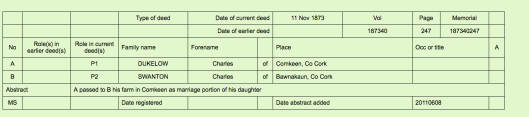
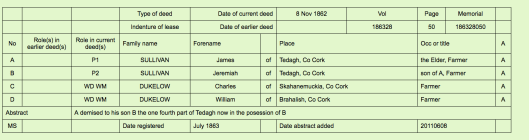
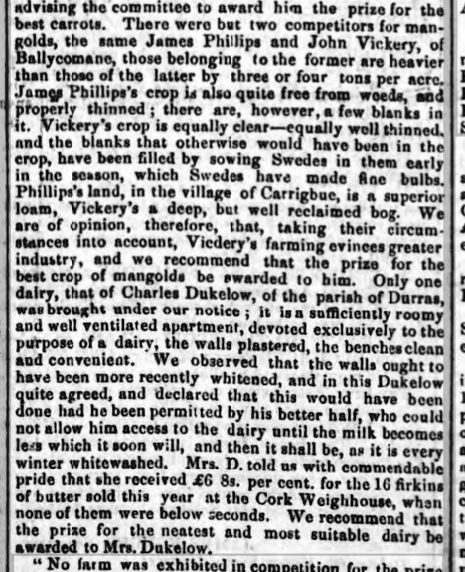
1860 Prize Best Dairy for Mrs. Charles Dukelow, (Coomkeen/Skahenemuckia), Durrus, Sent 14 Firkins of Butter to Cork Weighhouse.
Possibly Charles Dukelow, Coomkeen, he features as a Poor Law Guardian in Bantry.
 :
:
Bandon Estate Records:
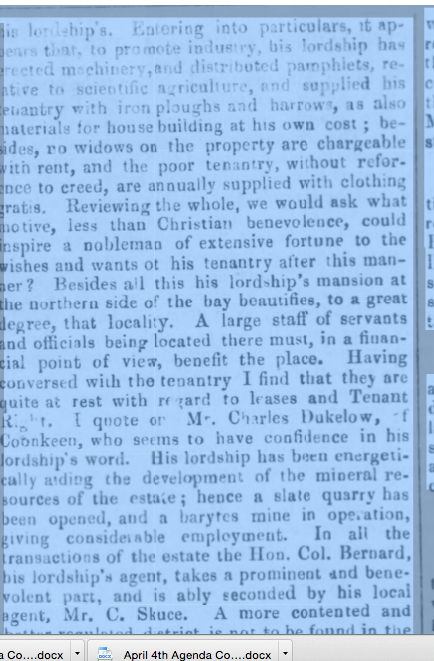
1869, Lord Bandon Has Transformed Carrigbui (Durrus) From a Neglected Filthy Dingy Spot of Forges and Cesspools to Its Pleasant Pleasing and promising Aspect.

28 Monday Mar 2016
Posted in Uncategorized
Early 19th century Bantry Political figures:
https://docs.google.com/document/d/1D8UyxgQoDac2ZKy9p64vQFKnAJDcnXTbKZyddFfY1sQ/edit
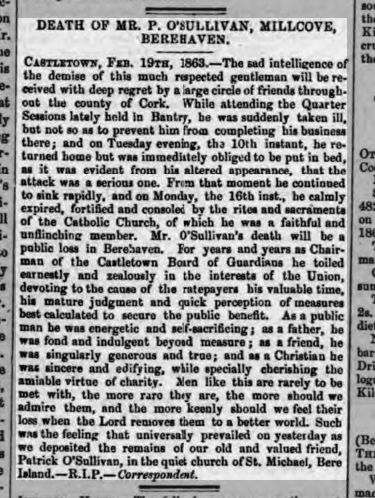
1863. Obituary of Patrick O’Sullivan, Millcove, Beara, West Cork, Seneschal of Manor of Althram, Agent of Lord Bantry his Receivers, Bankers of Beara Estates. Father in Law of Beara Born, American Millionaire Coffee Broker Eugene O’Sullivan.
In his evidence to a Parliamentary Enquiry into the Cork election and its widespread violence of 1841 he comes across as a Chieftain of his area. Usually he brought tenants and middlemen to Cork via Bantry in his sloop. Except for Roger O’Sullivan and Symms both Protestants who was married to a Sullivan they were Catholic and normally would have voted for the Liberal/O’Connell interest. However they all voted Conservative Longfield/Leader, the suggestion in the questioning that he had used undue influence to please Lord Bantry which he rejected.
He fought a vigorous campaign against what he regarded as anti Catholic Libels of Puxley of Dunboy Castle.
‘Big’ Patrick O’Sullivan, Millcove: Castletownbere. Died 1863. Lord Bantry Estate appointed as Seneschal Not legally qualified. Parliamentary Report 1837, Eppi. Baronial collector since 1825 deputy Denis Murphy (Irish speaking) as collector. Appointed fit and proper person to conduct 1831 Census with Mr. W. Murphy. Seneschal of Altham, Mill Cove, Berehaven, Bantry and Donemark from 1843. 1841 organising voters from Beara in Conservative interest. Sitting as Grand Juror, Cork 1842, 1844, Cork County Agricultural Society Dinner 1842. Millcove. leased by Patrick O’Sullivan from the Earl of Bantry’s estate in 1852 when it was valued at £14. O’Sullivan worked as an agent for the White estate. A deeply unpopular Landlord local tradition has it that he used to blow his bugle outside the Church after Sunday Mass to summon his tenants to draw hay or turf or whatever other task he designated. 1856 Chairman Berehaven Board of Guardians.
The house has been demolished though traces of the stone work can still be seen in the gardens which are now part of an art gallery and sculpture display. He was agent for the Beara part of the Bantry estate working with receivers and banks to Lord Bantry while Augustus Payne from the Upton family operated the rest of the estate. His daughter Christina, who emigrated to the United States and became the matriarch of a very rich New York family, before ending her days sadly in a mental home. Ellen O’Sullivan, Convent of Faithful Companions of Jesus, Limerick Chronicle died 6/06/1857, dau of Patrick O’Sullivan of Mill Cove, Berehaven, Laurel Hill. Died Peshawar India 1881 Edward O’Sullivan, Queen’s Regiment, youngest son of Patrick O’Sullivan, Esq., Millove, Castletownbere, agent to Lord Bantry and Seneschal.
Patrick O’Sullivan was nephew to Captain Paddy O’Sullivan of Faha also Agent to Lord Bantry whose sister was the mother of Peter McSweeney. 1857 Peter McSwiney, the last lineal descendant of the Mac Finin Dubh O’Sullivans (a 400 year old title), after his eviction from Dereen in Kenmare by the Lansdowne Estate, spent his last days in Ahakista Cottage. Patrick O’Sullivan, Lord Bantry’s Agent in Beara, Millcove Castletownbere, Agent to Lord Bantry brought the following to Cork 1841, to vote for Longfield/Leader in a Schooner, ‘Sophia’ via Adrigole and Bantry. Longfield paid expenses. Jeremiah O’Sullivan, Murtagh O’Sullivan, Daniel Florence O’Sullivan, Daniel Jeremiah O’Sullivan, Timothy O’Sullivan, Roger O’Sullivan, Timothy O’Sullivan, Simms (Protestant), Denis O’Sullivan, From Adrigole, Daniel Murphy (his deputy Irish speaking), Richard O’Sullivan (Protestant), Daniel Michael O’Sullivan, James Neill, William Murphy, Murtagh Kelly.
| 1836, d 1863 | Patrick O’Sullivan | Seneschal of Altham, Mill Cove, Berehaven, Bantry and Donemark from 1843. | Millcove, Castletownbere. Lord Bantry estate appointed. Not legally qualified. Parliamentary Report 1837, Eppi. Baronial collector since 1825 deputy Denis Murphy (Irish speaking) as collector. | Ran Berehaven Esatte for Lord Bantry and his English Bankers, Somers Payne ran the rest. In 1841 election rounded up tenants and middlemen from Castletown and Adrigole to vote in the Conservative interest in Cork. | Sitting as Grand Juror, Cork 1842, 1844, Cork County Agriculture Society Dinner 1842. |
Eugene OSullivan
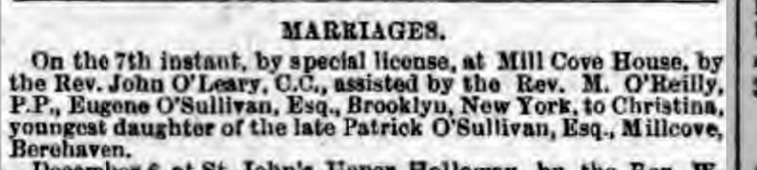
(c.1835-1892), an American millionaire coffee broker who was born at Bere Haven in Ireland. His parents, Eugene O’Sullivan Sr and his wife Frances (née Downey) took their young son Eugene with them when they emigrated to the United States in about 1847-9. In 1865, Eugene Jr married in New York Christina O’Sullivan, described in the newspaper report as a daughter of he late Patrick O’Sullivan of Mill Cove House, Bere Haven.
Obituary 1863

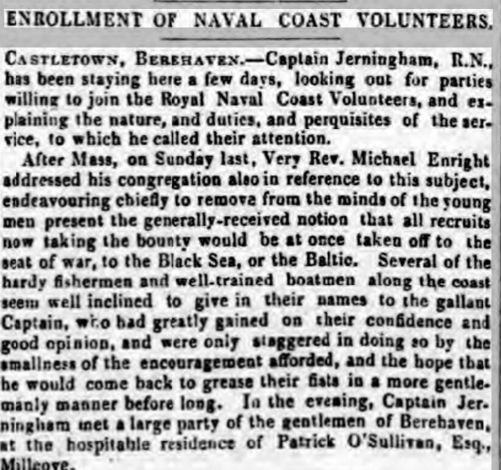

1841 Cork County election, Shenanigans, Patrick O’Sullivan, Millcove, Senescahal, leading Conservative party from Castletown Berehaven on Schooner ‘Sophia’ to Bantry via Adrigole, Leaving Bantry 4am, Breakfast in Dunmanway , Bandon 2pm. Attacked by Mobs in Bantry, Bandon and Upton, Parish Priest of Bantry Father Barry and his Curate Father Ragley pass through Bandon in a Coach Greatly crowded, Festooned with Handkerchiefs, Branches Of Trees Waving, A Great Deal of Noise.
27 Sunday Mar 2016
Posted in Uncategorized
Many of his works are available on digital format:
Thanks to Kieran McCarthy for bringing it to attention.
Colm Creedon b. 1934, died comparatively young in 2001. He lived on the Magazine Road, was educated at Presentation College in Cork. His father worked with the railways on Albert Road. He worked with Thompson’s bakery, McCurtain Street in an administrative capacity. He drove a Morris Minor and spent much time researching in the old Cork City Reference Library on the Grand Parade. His real passion was the railways of West Cork. In his history of the system he recounts when the diesel railcars came in in 1954 to the closure of the system in 1961 ‘the following seven years were the happiest years of my life, with endless journeys by train with my parents and friends throughout West Cork. By now, it had developed far beyond a mere interest…
View original post 284 more words
27 Sunday Mar 2016
Posted in Uncategorized

This gallery contains 8 photos.
Originally posted on Roaringwater Journal:
Our travels took us to the Hill of Slane. On its summit overlooking the River Boyne…
26 Saturday Mar 2016
Posted in Uncategorized
1841 Cork County election, Shenanigans, Patrick O’Sullivan, Millcove, Senescahal, leading Conservative party from Castletown Berehaven on Schooner ‘Sophia’ to Bantry via Adrigole, Leaving Bantry 4am, Breakfast in Dunmanway , Bandon 2pm. Attacked by Mobs in Bantry, Bandon and Upton, Parish Priest of Bantry Father Barry and his Curate Father Ragley pass through Bandon in a Coach Greatly crowded, Festooned with Handkerchiefs, Branches Of Trees Waving, A Great Deal of Noise.
The losing parties in the election Messrs Leader and Longfield (to Daniel O’Connell and Roche) petitioned Parliament to investigate the election.
This is from the evidence of Patrick O’Sullivan, Agent for the Bereaven Estates of Lord Bantry and his English Bankers. He was bringing a party of mostly Catholic Tenants and middle men to Cork to vote. The questioning of him suggest an element of undue influence on his part as most of the Catholic electors voted for o’Connell and Roche. Longfield paid the expenses of the voters.
The appendices give the voters.
Although the O’Sullivan lands were forfeit for rebellion, most of their area remained under their de facto control in either the Bantry/White or Kenmare Estates with the families being agents or middle men well into the mid 19th century.
| 1836 | Patrick O’Sullivan | Seneschal of Altham, Mill Cove, Berehaven, Bantry and Donemark from 1843. | Millcove, Castletownbere. Either Lord Bantry or the Kenmare estate appointed. Not legally qualified. Parliamentary Report 1837, Eppi. Baronial collector since 1825 deputy Denis Murphy (Irish speaking) as collector. | Ran Berehaven Esatte for Lord Bantry and his Englis Bankers, Somers Payne ran the rest. In 1841 election rounded up tenants and middlemen from Castletown and Adrigole to vote in the Conservative interest in Cork. |
http://www.youtube.com/?gl=US&persist_gl=1&hl=en&persist_hl=1
25 Friday Mar 2016
Posted in Uncategorized
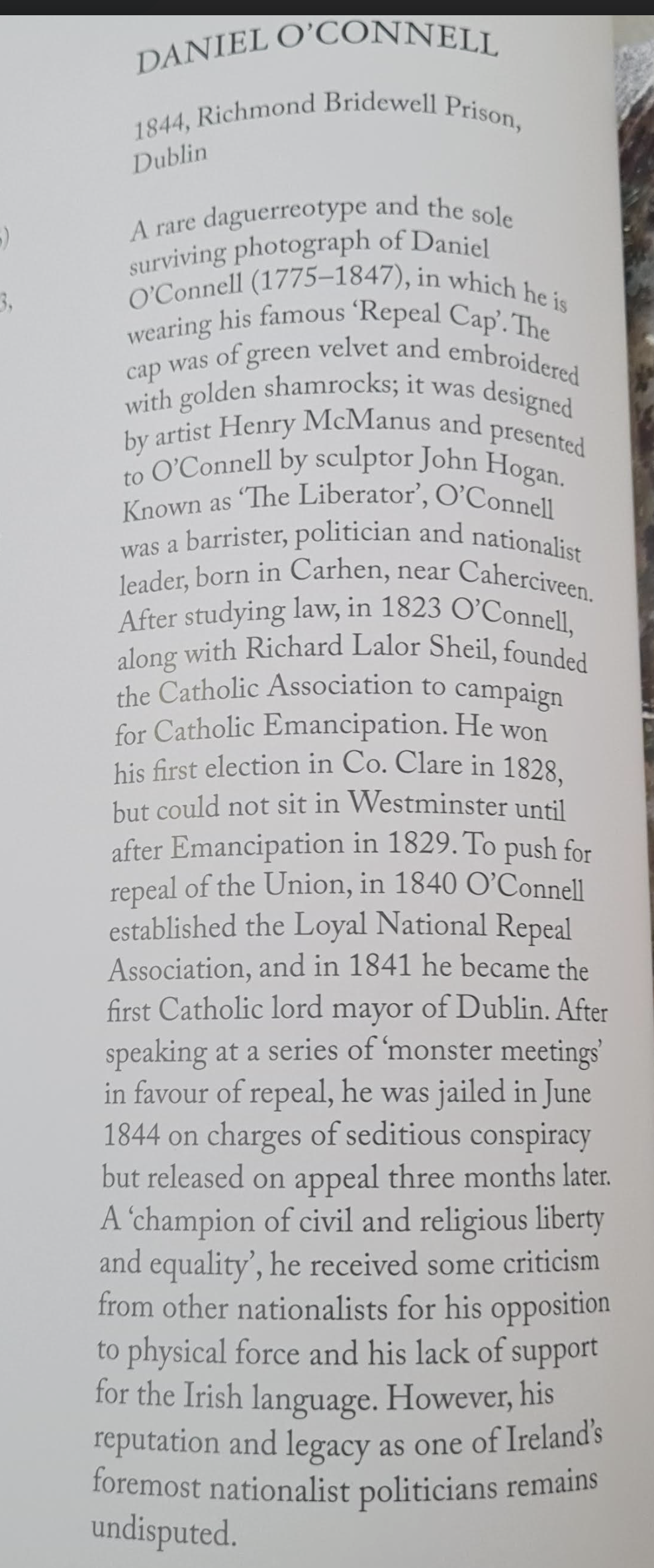
1841. County Cork Election, Daniel O’Connell and Roche elected, Leader and Longfield Defeated, contested Votes in Baronies of West Carbery and Bere, Enhanced British Parliamentary Papers On Ireland.
https://docs.google.com/spreadsheets/d/1l-ttMKKPJT6RP-EwvivLvpw3aeOsNjpv9q8-_kDLFJ4/edit#gid=0
http://www.dippam.ac.uk/eppi/documents/11594/page/270498

25 Friday Mar 2016
Posted in Uncategorized
1828, No Local Appointments Commission, Proposed by Sir Augustus Warren and Seconded by Arthur Beamish Bernard, Unanimously Elected, Franklin Baldwin, Attorney, Bandon, Co. Cork as Coroner.
He may have been a replacement for Hungerford who was inactive adn the Grand Jury went to the High Court to remove him.
| 1822 | Franklin Kirby Baldwin | Attorney, Bandon 1824 74, North Main St. Coroner 1829. | Married 1822, at Templetrine (near Kinsale) Barbara Morris 6th daughter of Nathaniel Evanson of Brookfield (unclear if this is Bandon or Durrus) Cork | 1832 registered to vote for Bantry probably Rusheeninaska, Durrus by Sampson Beamish probably through Evansons renting from Lord Bandon. | 1843 executor of Edward Becher with Rev. Edward Baldwin. Died 1849? |
Arthur Beamish Bernard Esq., Palace Anne, Bandon, Pre 1831, 1828 with Sir Augustus Warren proposed Franklin Baldwin attorney Bandon as Coroner. listed 1854, Subscriber Lewis Topographical Dictionary of Ireland 1837. Member Commission on Magistrates 1838
Sir Augustus Warren, 1781, Warren Court, Macroom, 1831 Sir Augustus, Bart, listed 1838. Involved in attempts to amicably resolve tithes 1838. Subscriber 1821 Dr Thomas Wood’s ‘Primitive Inhabitants of Ireland. 1835 Subscriber Lewis Topographical Dictionary of Ireland 1837. (HC 29/5/1800) –Committed to the County Gaol by Augustus Warren, Esq., DENIS LEARY, charged with the murder of Robert Hutchinson, Esq.


25 Friday Mar 2016
Posted in Uncategorized


