Legal Tenure of Some Townlands in Durrus District, West Cork, from c 1600.
Some of the surnames associated with the general area such as O’Mahony, O’Sullivan, O’Donovan and McCarthy are comparative Johnny Come Latelys arriving from around 1250. The names of the older population probably include the O’Driscolls, Coughlans, Whoolehan/Hoolihan/Wholly. Moynihan, Cronin.
In the upheaval of the 17th century the old Gaelic overlords were displaced and the spreadsheet shows some of the effect locally. This process culminated with the Land Acts so by 1910 most of the tenants had become owners of their holdings subject to the payment of annuities to the Land Commission. The Landlords were handsomely compensated.
Contrary to popular perception most of the Landed Families (Whites/Evansons/Hutchinsons/Beechers) by the early 19th century were hovering on the threshold of bankruptcy through a combination of over borrowing, a collapse in agricultural prices and the onset of emigration. Many estates were sold in a NAMA type process in the 1850s through the Landed estates Court. Many of the purchases were local merchants and lawyers, the odd one from England such as Lord Clinton (Beara, Goleen, Hutchinson estate) and they tended to reap the benefit of the Land Acts.
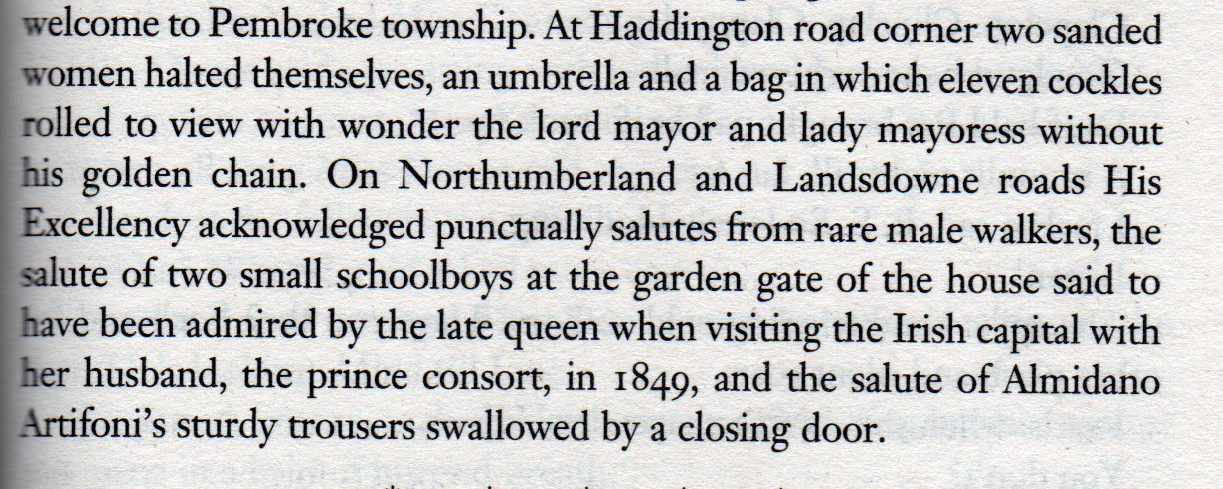
Bloomsday 16th June 1904, in James Joyce’s Ulysses, the Lord Lieutenant Passes Carricksbrook House, Ballsbridge, the home of the Family of James Hutchinson Swanton.
The Swantons had a milling business at Rineen and umerous other businesses in West Cork. Along with local lawyers such as McCarthy Downing they invested heavily in landed estates when they were sold by the Landed Estates Court in the 1850s and 1860s and became extremely wealthy.
Their house Carricksbrook house was demolished and replaced by the present hideous eyesore in 1967. Maybe with the grace of God in time it too will be demolished and replaced by something more pleasing to the eye.
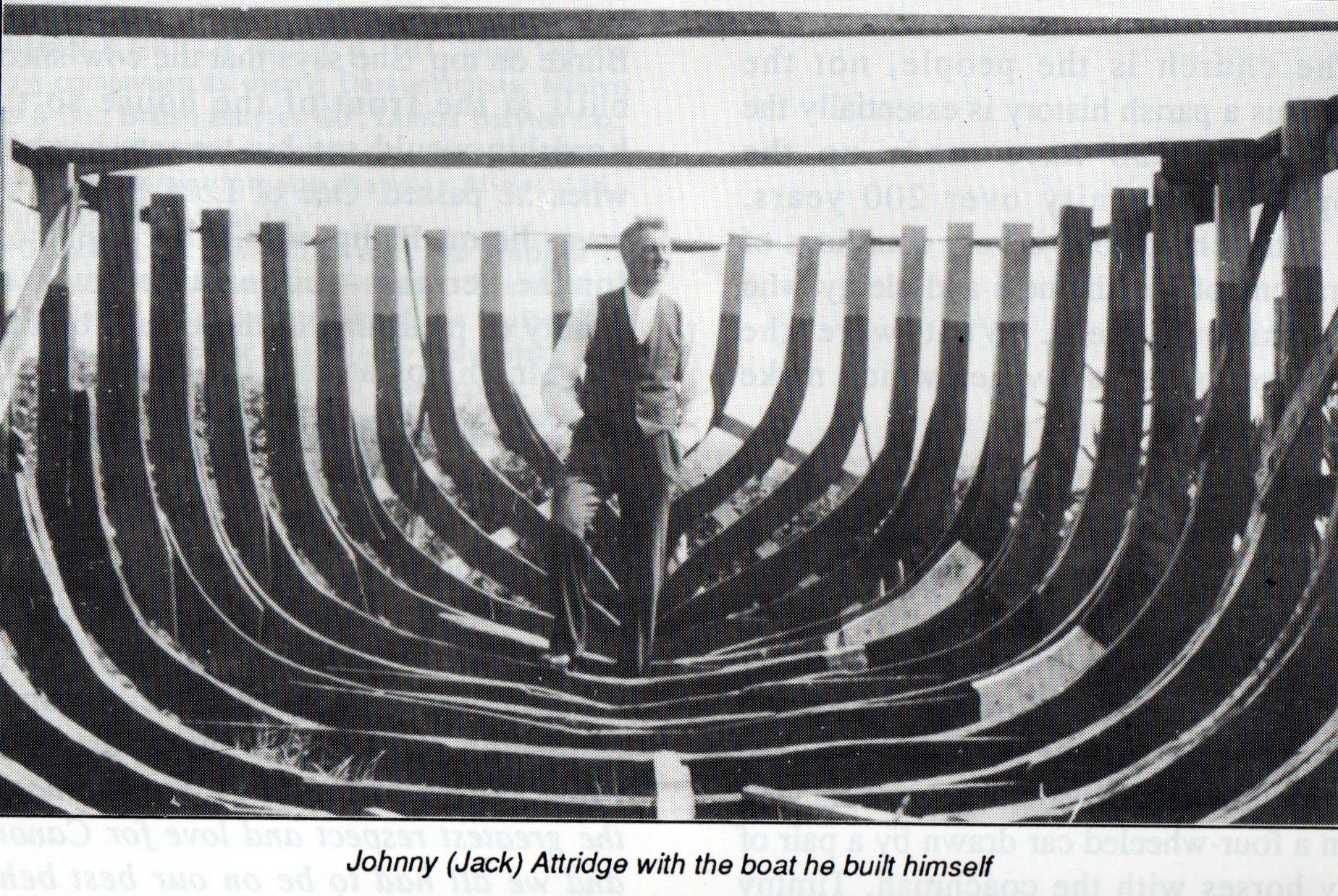
Jack Attridge, Gearhameen, Durrus, West Cork, c 1920-50 with Skeleton of his Boat on Dunmanus Bay and Homemade Threshing Machine.
Courtesy St. James History.
The boat was built with timbers felled from around the Grain Store at Friendly Cove across the bay. They were then floated across the bay to the Priest’s Gate, Gearhameen. The boat was probably a sand boat. The winch was installed but not the engine so it never went into service but would be representative of that type of craft.
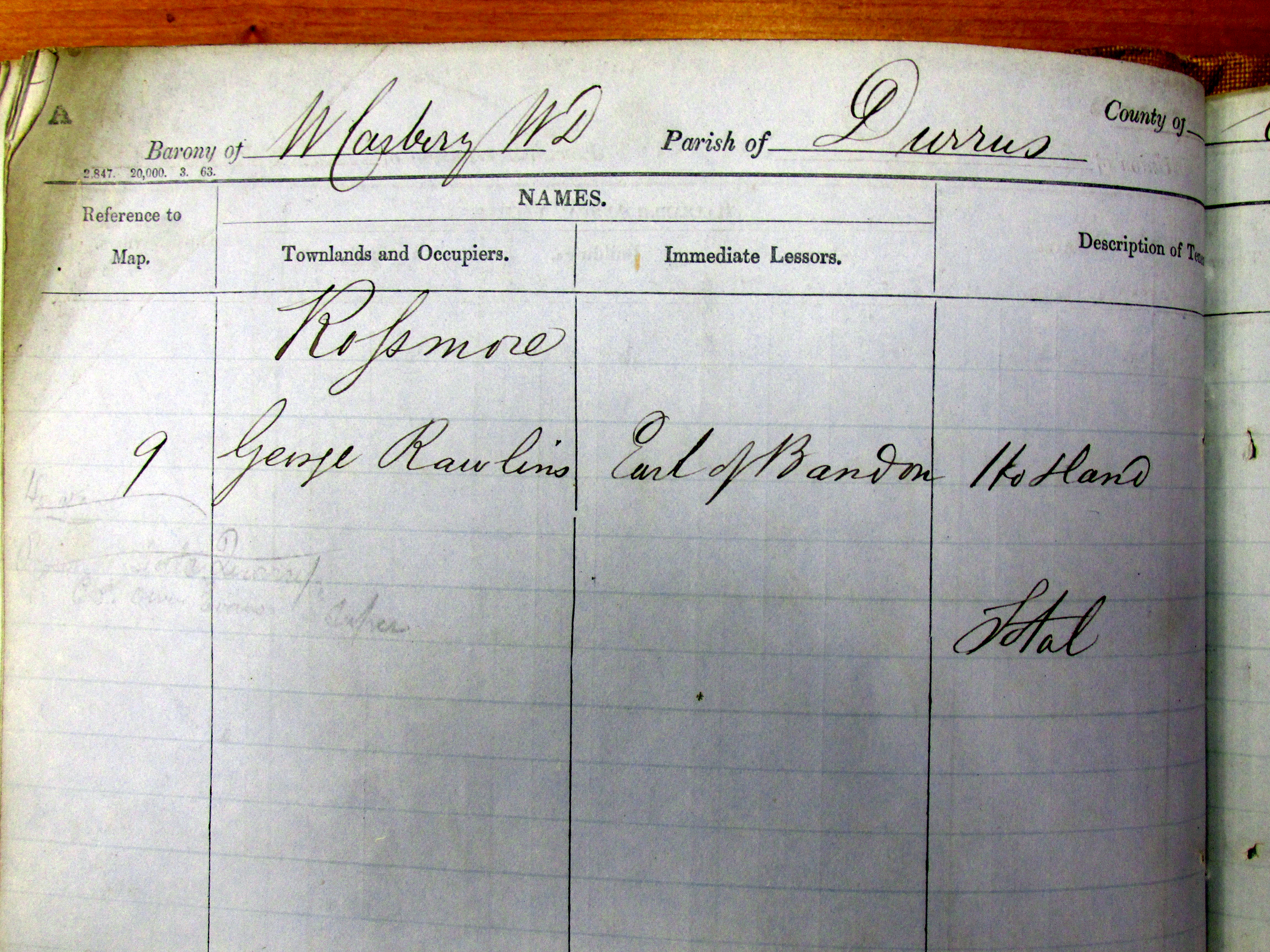
Post Griffith’s Valuation records, 1853-1935, of Occupiers of Durrus East, West Cork, Townlands of Ballycomane, Clonee, Ardogeena, Coolculaghta, Dromreagh, Murreagh and Islands, Dunmanus Bay.
Used with Church records it is a useful aid to compensate for the lack of census pre 1901
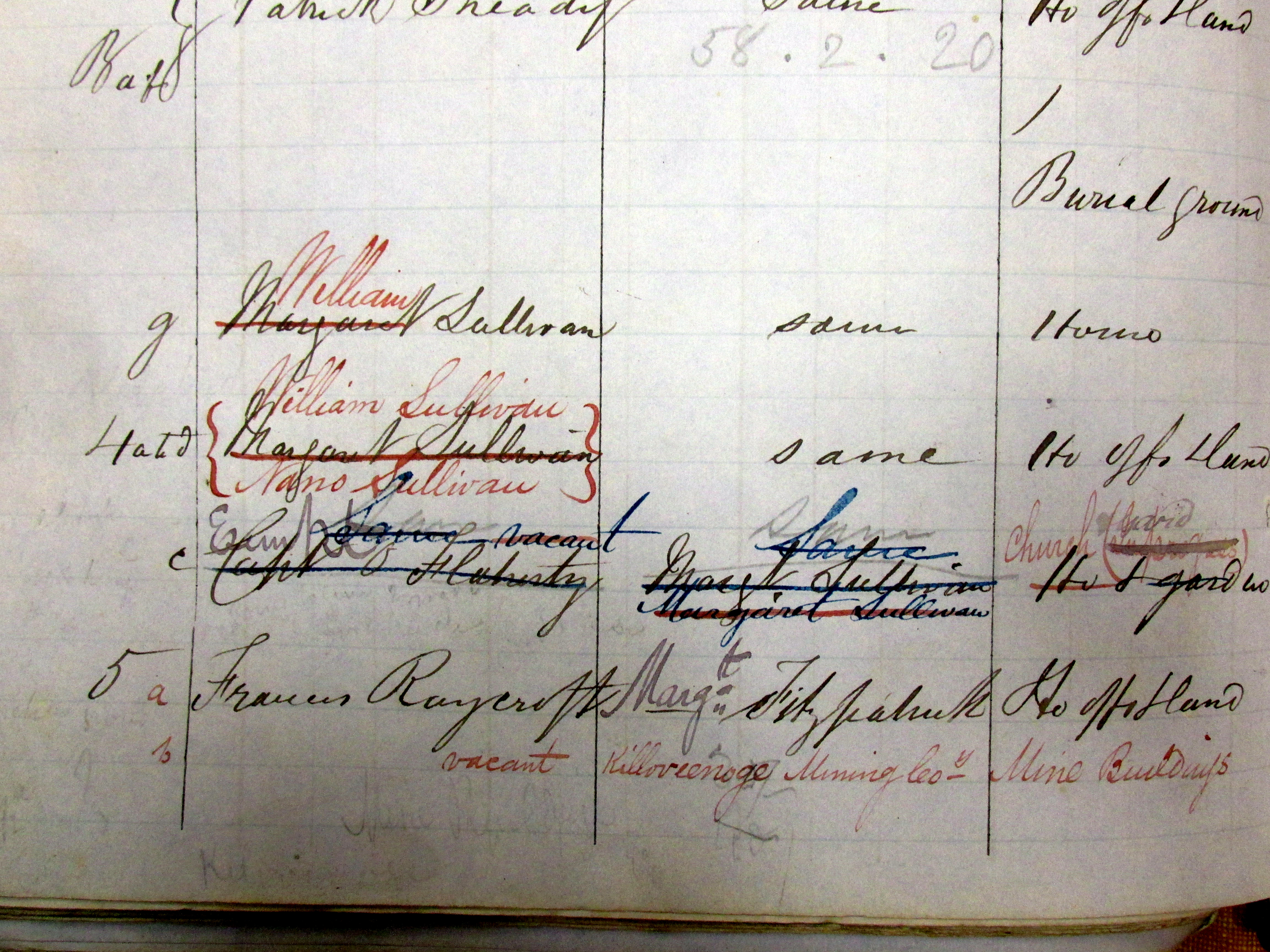
The records comprise a set of books which were updated periodically. Generall this was done in a different colour and it should be possible to establish the approximate date by reference to the colour. Some of the books at the start give a key to colours and dates. The system was in place until the 1970s when it was struck down by the High Court.
The Progression of the Parish Priests of Durrus, West Cork. from having the Tithe Proctors of the Rev. Alcock attempt to seize the bed of Father Quinn in the 1820 to Father Michael Daly 1875 Living in former Landlord Evanson House at Friendly Cove, and Father Bowen living at former Evanson Landlord House Ardgoena and Various Clergy living in another Evanson House, Durrus Court in the early 20th Century and some 19th and early 20th century Priests, including Father Bernane, Kearney..
Apart from reflecting the increased status of the clergy it shown the collapse of the old order. Large houses pre famine had become obsolete thereafter. The Valuation Office records show a succession of retired military officers in occupation. In general the original landlord families had largely become penniless by the 1850s as reflected in enforced estate sales in the Landed Estates Court.
Rev Denis Barnane P.P. 1790-1818, from Dunmanway, died 28 Jun 1834, buried Moulivard, devotion to him to this day. Two other priests who were in College with him, Father John Power d.1831 of the Dioceses of Ross reputedly had supernatural powers having a ‘solus’ light and Father Holland. Extracts from the Statutes of the Diocese of Cork show that he was absent from the Diocesan Synod – 09/07/1817, during the episcopacy of Bishop John Murphy, 1815 – 1847.
Fr. Barnane was credited with curative powers and also had the gift of healing animals. When he was reprimanded by Bishop John Murphy for publicly exercising these powers his reply was; “I’m dying, I’m in bad health, and when I’m dead, I’ll cure the same as I do now.”
Every year on the 28th June, St. John’s Night – anniversary of his death, the graveyard (Maulivard) would be full of people bringing their complaints, all in search of a cure. People even came from as far away as Cork City. The church is still visited on St John’s Night by people from all faiths. It is believed that he had a fondness for the drink and was silenced by the Church. There was another Father Patrick Power from Bantry (1844- ) who had Durrus connections, trained in Louvain and died in Hole Cross. Malden, Mass and there are suggestions of miracles associated with him. A relation was John Sullivan who got a VC in the Crimean War and a former Parish Priest of Durrus had his tabernacle.
Rev Richard Quinn P.P. 1818-1849, Incardated from Dioceses of Cashel, commenced registration of births and marriages, built church at Ahakista 1828 and Kilcrohane 1820. Involved in famine relief in 1822 with the Earl of Bantry and the Rev Alcock. In the Ordnance Survey house books his house in Clashadoo was one of the few slated. In the 1820 the Rev Alcock’s Tithe Proctors attempted to seize his bed for no payment of tithes only the intervention of local Protestant neighbours prevented this.
Rev John Horgan P.P. 10 June, 1849-1860, signed a petition to Lord Landsdowne with the PP of Caheragh and the Rectors of Sneem and Kilgarvan in aid of the five unmarried daughters of Peter McSweeney (who had been evicted from Dereen House and died in Ahakista Cottage).
Rev Patrick O’Flynn P.P. 21 Jan. 1860-1871
Rev John Dulea/Daly (?), P.P. 1875, lived at Ardogeena (former Evanson or Cole house).
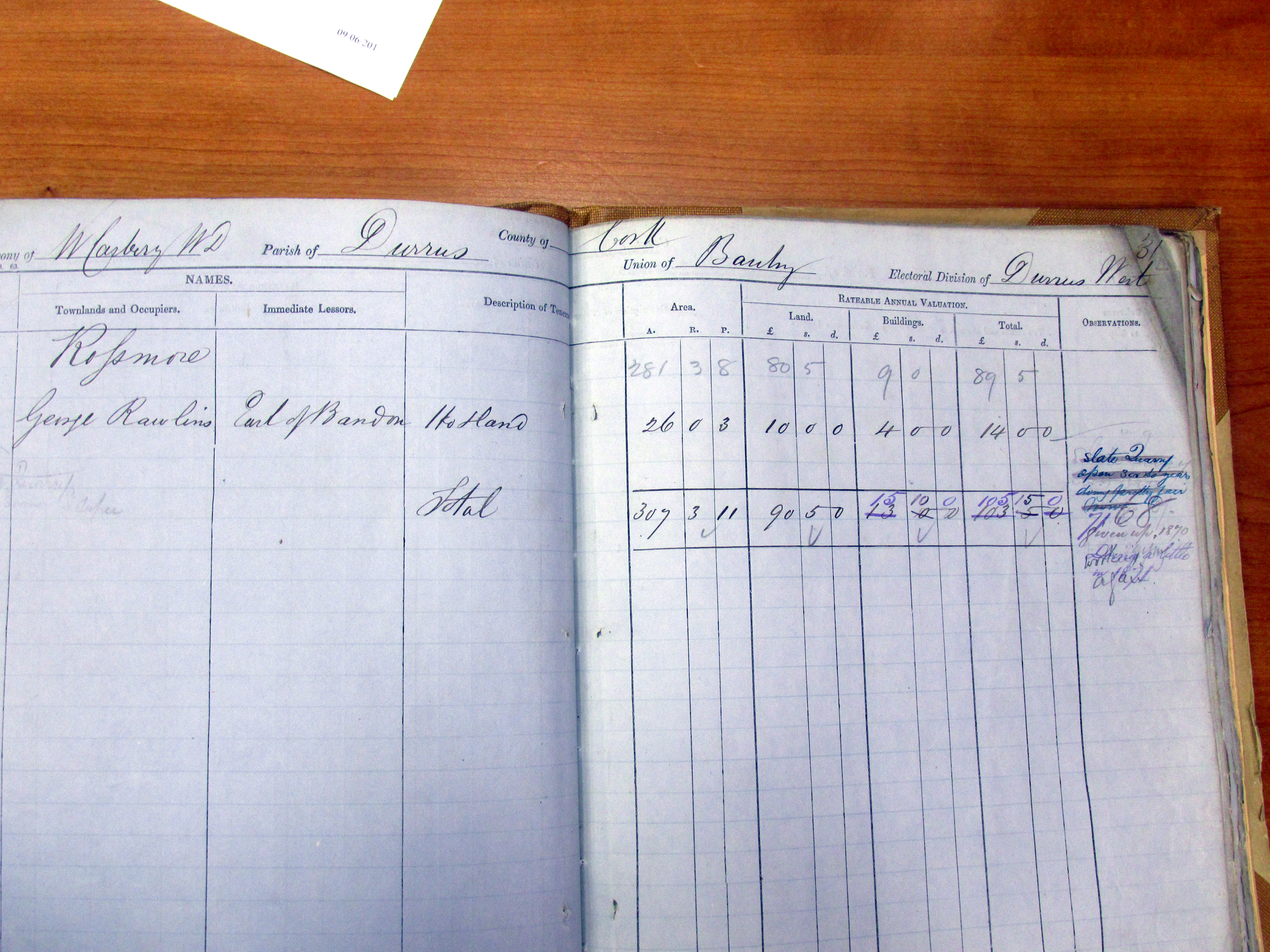
Rev James Bowen P.P. 5 July 1877-1885, there is a tablet in his memory in the church. In 1880 lived at Ardogeena, Coolculaghta now occupied by Peter Gallagher. Also lived at Rawling’s house (Slated) Rossmore, Rawlings went bankrupt and later had a pub in Bantry and was a carman.
Rev Michael Kearney P.P. 1835-1897, attended Diocesan College Cork and Maynooth from a substantial farming family in Manch, Dunmanway, Durrus 9 Feb.1886-1897 built new church Kilcrohane 1895. The Skibbereen Eagle reported in September 1865 on his move as a curate from Kilcrohane to Inchigeela that his move was universally regretted by all denominations. He preached in Irish. He rented Durrus Court (former Evanson house) from Lord Bandon. He features in some of the Ballydehob Presentments for road building at Rossmore with Thomas Shannon in May 1896 and appeared before the Bantry Poor Law Guardians appealing for relief for a blind evicted tenant in Kilcrohane. He is reputed to have been a major purchaser of land on his own account and there are a number of properties in Rossmore and Brahalish listed in the 1901 Census as being owned by William Kearney, Manch, his brother. One of these are lands (25 acres held yearly from the Bandon Estate) at Rossmore which he acquired by mortgage from Mary Evans of £88 5s in 1887. She acquired the interest from her late husband William and paid off another mortgage in favour of George Rawlings, shopkeeper, Bantry and it is possible that Fr. Kearney advanced the money for this.
William Kearney also owned Cummer farm which was put up for auction in 1898 and consisted of 250 acres with 80 good acres and yielding 31/2 tons of hay to the acre. He acquired Durrus Court and various lands from the Earl of Bandon in 1894 by way of lease for 99 years from 29th Sept 1894 at a rent of £25 he died on the 2nd July 1897 and let his interest to his successor Parish Priest of Durrus Daniel Foley he in turn assigned his interest to his successor Timothy O’Leary. On his death the Bantry Poor Law Guardians adjourned for a week
In a court case in Bantry June 1908 arising from the burning of hay ricks belonging to his brother William, who gave evidence that he had acquired two farms (one at Gearameen one at Rossmore, the lands on which the hay ricks were had been acquired from Mr Moss and were near the village) from his brother Michael in his will. One at Gerahameen his brother had acquired from the Evans family and he had made provision for Evan’s daughter in his will, however when William Kearney tried to sell that farm the child’s grandfather O’Connell turned up and said he had no right to sell and there were no bids, the implication was the grandfather considered that Father Kearney’s acquisition may have been improper.
He appears in the folklore of Coomhola as collecting money for church building. He died in the Mercy Hospital in Cork and the funeral leaving Bantry was described as one of the largest seen in years with a cortège over a mile and a half to Kilcrohane and 159 vehicles. The contents of his house in Durrus Court were auctioned off the following month.
Fr Foley 1897-8, he retired due to ill health and an auction of the contents of his property at Durrus Court was held on the 19th march 1898.
Rev Timothy O’Leary P.P. (1854-1928), 1898-1911. He is in the 1901 Census aged 47, speaks Irish and English has two servants, John O’Keeffe coachman and gardener and Anne Collins, housekeeper and cook and the residence Durrus Court has 14 rooms. He was heavily involved in politics and President of the United Irish League in Durrus 1901 and was described as a patriotic priest. His obituary in the Irish Times 1928 said that he was born in the Bantry area and was active with the Congested Districts Board and instrumental in settling many Land Disputes. He trained in the old Cork Seminary at the Mansion House (near the Mercy Hospital, Cork) and in Maynooth
Rev George McDonnell P.P. 23 Sept. 1911-1912
Rev W Desmond (?) P.P. 20 April 1913, organising concerts for the young men’s society hall
Rev Michael Cotter P.P. ordained Maynooth 1896, 1922-1935, died 1946.
Rev Matthew McSwiney P.P. 1935-1943, he had a boat and was responsible for having the first pier at Hetty’s Rock erected. His helper was Mick Bohane. He was attending a meeting of the Irish Forestry Society in Cork in 1938. He did his rounds on horseback Chaired the Parish Council set up 1940 as a war time measure.
Rev Michael Roche P.P. 1943-1957, it was believed he had no great sympathy with Durrus saying he would prefer a back lane in Cork and not in favour of any type of ecunesism. Tried to stop ‘scoraoichting’ in Tom Dukelow’s house at Sea Lodge as he did not want Protestants and Catholics mixing.
Post Griffith’s Valuation records, 1853-1905, of Occupiers of Durrus West, West Cork, Townlands of 1853-1905, Crottees, Droumaniaheen, Rusheeninaska, Carrigboy (Durrus Village), Clashadoo including Ahagouna and Coolnahorna, Coomkeen, Gearhameen, Brahalish, Rosssmore, Kealties.
Used with Church records it is a useful aid to compensate for the lack of census pre 1901
The records comprise a set of books which were updated periodically. Generall this was done in a different colour and it should be possible to establish the approximate date by reference to the colour. Some of the books at the start give a key to colours and dates. The system was in place until the 1970s when it was struck down by the High Court.
An extract from the Valuation Office listing showing the plot vacant. There are references to estate Sales in the 1850s the Hutchinson and Bantry Estate. There were a number of mines in the area and in the hills there are traces of the old workings.
Recruiting Areas, Insignia and Depots of The Irish Infantry Regiments in the British Army, Royal Irish Rifles, Clonmel, Royal Inniskilling Fusiliers Omagh, Royal Irish Rifles Belfast, Royal Irish Fusiliers Armagh, Connaught Rangers Galway, Leinster Rifles Birr, Munster Fusiliers Tralee, Royal Dublin Fusiliers Dublin. The bottom of the map is missing, the Cork area was part of the Munster Fusiliers barracks Ballymullen, Tralee.





 West Cork History