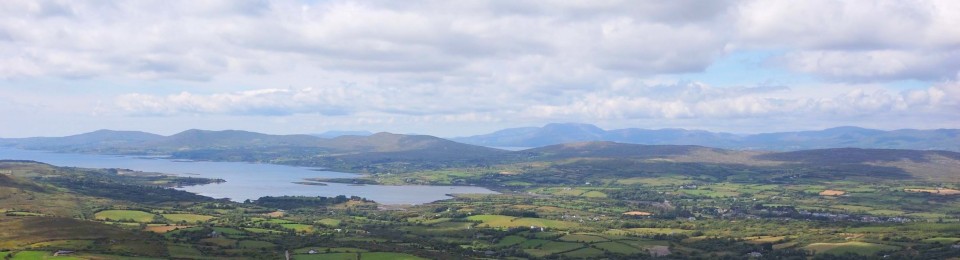
Lisheenacreagh;
Rochester:
East Flanboro:
The progress of the Attridge family from Lisheenacreaagh (Lisín-na-Creiche: little-fort-of-the-cattle-spoil), Ballydehob, West Cork to Rochester, New York, United States and Waterdown, East Flanboro. Ontario, Canada, with associated families, Gosnells, Skerkin Island, and Lees and Sheehans, photographs of Sally and William Atteridge, Rochester, born West Cork 18th century, and Protestant Hedge School Masters.
Courtesy John Attridge, London, Ontario family history, the latter part concentrates on the later generations of the family.
There were other Attridges families in the area and a number of lines in Durrus.
The area mentioned in the book, Lisennacreagh and associated townlands would be in the category of ‘Disadvantaged areas’ but in the 18th and 19th century its proximity to the coast with ample supplies of sea sand and seaweed enabled cultivation to the mountain tops.
Much of this marginal area is now forested. Sherkin and the nearly Islands of Skeagh, Horse and Cape Clear are quite fertile and had enormous populations prior to the Famine in 1847.
The Greenmount, Attridges, Ballydehob were Middlemen and seem to be associated with Jagos in Bantry, O’Driscolls, O’Connors, and Swantons. A branch of them settled in Skibbereen as drapers and in Glasheen in Cork City from the late 18th century.
When the Rev. Dives Downes, Bishop of Cork, visited the Schull area c 1699 he estimated that there were only a handful of Protestant families West of Skibbereen. By 1820 the Protestant population was perhaps 20% of the Peninsula in some townlands more.
In 1822, after being in Schull the Reverend Caesar Otway was commenting on a forgotten Plantation and the Protestant being abandoned.
Caesar Otway, Publisher Dublin Penny Journal, Skull to Bantry, 1822.
The Rev Fisher in 1840s writing said that most of the original Protestant in Crookhaven had gone and become ‘Bigoted Romanists’.
It is possible that the Attridges like the Swantons came in from around the 1710s. On the Becher Estate there were Swanton leases quoted from the late 1740s in the Landed Estates Sale of the 1850s.
In Mr Attridge’s book he mentions a Sheehan a schoolmaster in Sherkin Island c 1810. In the lists of teachers in the 1820s a surprising number in Protestant schools were of Catholic origin. These informal schools were at a stretch in the category of hedge schools. These teachers may have converted out of conviction, convenience but most likely on marriage to a Protestant partner as was the case in reverse.https://durrushistory.com/2013/04/30/teachers-of-baronies-of-east-and-west-carbery-bantry-and-bere-west-cork-1826/
https://plus.google.com/photos/100968344231272482288/albums/6124910036836837745
https://durrushistory.com/2014/01/22/preaching-by-methodist-lay-preacher-william-feckman-lisheenacreagh-ballydehob-west-cork-1834/
https://plus.google.com/photos/100968344231272482288/albums/6124910036836837745


Hello again! I’ve read the first 2 chapters of Attridge book. I know a Roger Attridge here in Canada. His ancestor, Michael Attridge (born 1821 Ireland, d1876) married my ancestor’s sister, Catherine Dukelow. Do you know if the author is still alive? Also, I just want you to know I look at everything you post. I am still looking for confirmation that my Dukelow came from Ardrovinna! Thank you for sharing all this information, and the time it must take! April in Canada
LikeLike
I am from schull Attridges in Ireland,, I know who that Michael Attridge fits into my tree. I have a cousin in new zealand who has done much research into Duklows,, I love research,, I know John very well also he has visited us many times in Ireland,, but I do like to do a broad tree. and am connecting it all
so contact me on sarahattridge999@gmail.com
LikeLike
Pingback: 1905 Valuer’s Report on Estate of Lord (Charles Pelham) Clinton, Crookhaven, West Cork 1905, Crookhaven formerly flourishing, Pilot Station, Fishing even the Isle of Man Fleet now gone, all now passed, Evidence of Want Of Circulation of Money, Coppe
Pingback: Frank Croston 1852-1921, Probably born Durrus, West Cork, Major Real estate Developer of High Quality Commercial and Residential Property, Rochester, New York, Republican Party Activist. Varian Brush Making Family Possible Origin, Rooska, Bantry. | West C
Pingback: Frank Croston 1852-1921, Probably born Reenaccapall. Parish of Kilcrohane, , West Cork, Major Real estate Developer of High Quality Commercial and Residential Property, Rochester, New York, Republican Party Activist. Varian Brush Making Family Possible Or
Reblogged this on West Cork History.
LikeLike
yes john attridge is still alive
and i am sarah attridge in schull still alive look me up in the village ask at the local post office, i love history
LikeLike