• About
  • Customs Report 1821-2 (and Miscellaneous Petitions to Government 1820-5) and some Earlier Customs Data, including staffing, salaries, duties including, Cork, Kinsale, Youghal, Baltimore, with mention of Bantry, Crookhaven, Glandore, Berehaven, Castletownsend, Enniskeane, Passage, Crosshaven, Cove, Clonakilty, Cortmacsherry.
  • Eoghan O’Keeffe 1656-1723, Glenville, Co. Cork later Parish Priest, Doneralie 1723 Lament in old Irish
  • Historic maps from Cork City and County from 1600
  • Horsehair, animal blood an early 18th century Stone House in West Cork and Castles.
  • Interesting Links
  • Jack Dukelow, 1866-1953 Wit and Historian, Rossmore, Durrus, West Cork. Charlie Dennis, Batt The Fiddler.
  • Kilcoe Church, West Cork, built by Father Jimmy O’Sullivan, 1905 with glass by Sarah Purser, A. E. Childs (An Túr Gloine) and Harry Clarke Stained Glass Limited
  • Late 18th/Early 19th century house, Ahagouna (Áth Gamhna: Crossing Place of the Calves/Spriplings) Clashadoo, Durrus, West Cork, Ireland
  • Letter from Lord Carbery, 1826 re Destitution and Emigration in West Cork and Eddy Letters, Tradesmen going to the USA and Labourers to New Brunswick
  • Marriage early 1700s of Cormac McCarthy son of Florence McCarthy Mór, to Dela Welply (family originally from Wales) where he took the name Welply from whom many West Cork Welplys descend.
  • Online Archive New Brunswick, Canada, many Cork connections
  • Origin Dukelow family, including Coughlan, Baker, Kingston and Williamson ancestors
  • Return of Yeomanry, Co. Cork, 1817
  • Richard Townsend, Durrus, 1829-1912, Ireland’s oldest Magistrate and Timothy O’Donovan, Catholic Magistrate from 1818 as were his two brothers Dr. Daniel and Richard, Rev Arminger Sealy, Bandon, Magistrate died Bandon aged 95, 1855
  • School Folklore Project 1937-8, Durrus, Co. Cork, Schools Church of Ireland, Catholic.
  • Sean Nós Tradition re emerges in Lidl and Aldi
  • Some Cork and Kerry families such as Galwey, Roches, Atkins, O’Connells, McCarthys, St. Ledgers, Orpen, Skiddy, in John Burkes 1833 Commoners of Great Britain and Ireland:
  • Statement of Ted (Ríoch) O’Sullivan (1899-1971), Barytes Miner at Derriganocht, Lough Bofinne with Ned Cotter, later Fianna Fáil T.D. Later Fianna Fáil TD and Senator, Gortycloona, Bantry, Co. Cork, to Bureau of Military History, Alleged Torture by Hammer and Rifle at Castletownbere by Free State Forces, Denied by William T Cosgrave who Alleged ‘He Tried to Escape’.
  • The Rabbit trade in the 1950s before Myxomatosis in the 1950s snaring, ferrets.

West Cork History

~ History of Durrus/Muintervara

West Cork History

Tag Archives: ireland

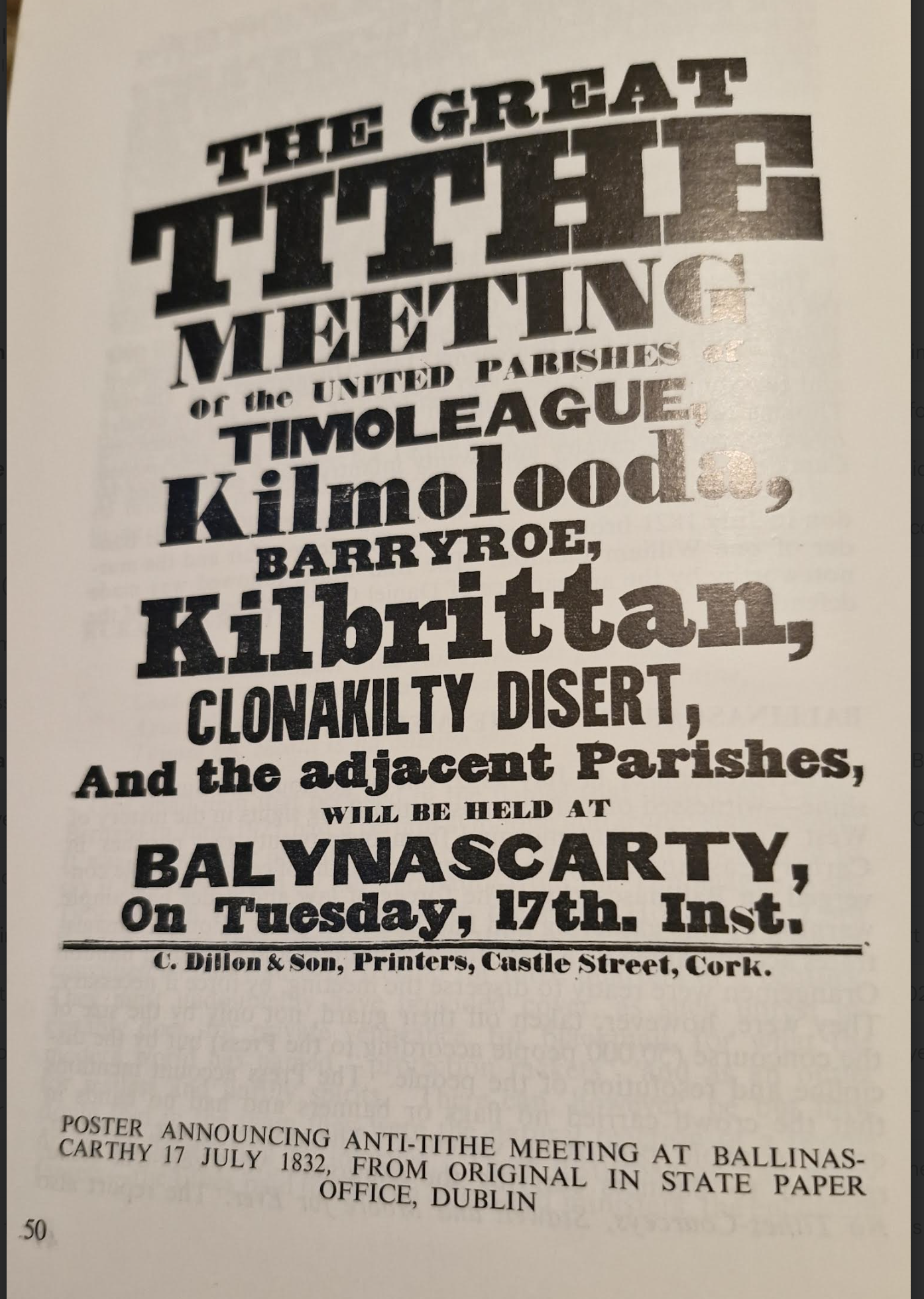
1832 GREAT TITHE MEETING OF THE UNITED PARISHES OF TIMOLEAGUE, KILMALODA, BARRYROE, KILBRITTAN, CLONAKILTY, DISIRT AND THE ADJACENT PARISHES IN BALLYNASCARTY.

23 Thursday Oct 2025

Posted by durrushistory in Uncategorized

≈ Leave a comment

Tags

family-history, Genealogy, history, ireland


.

I969 History

1832 GREAT TITHE MEETING OF THE UNITED PARISHES OF TIMOLEAGUE, KILMALODA, BARRYROE, KILBRITTAN, CLONAKILTY, DISIRT AND THE ADJACENT PARISHES IN BALLYNASCARTY

Tithes, West Cork

https://docs.google.com/document/d/1-NCOWVhITnsanxfjQepzCtRswcV77QZATGCxxPTKkCk/edit?tab=t.0

Historical p. 3

Warning Notice posted in Drimoleague 1832, p. 50

Tithe Composition Act p. 52

1842 Skibbereen Sessions, p. 92

CUTTLE        Francis        Tythe Farmer        Dunmanway, Co Cork , p. 97

Early Mass Disobedience Tithes by West Cork Parish 1824-1834

https://docs.google.com/spreadsheets/d/1xeEzDVPPpkzz67QxfbrBpUSlVKXJoAwZ0PRy4Y_EVL0/edit?gid=0#gid=0

The Tithes in the 1820s: ‘The year’s tithe due to Mr. Alcock, the Rector Durrus, was nearly collected in one day. The summary collection was effected by the police who act as drivers. In the case referred to the determination to to obtain ‘Tithe Distress’ was so great that I have been informed that the house where the parish priest the Revered Quin was saying Mass was forcibly entered and a bed the only item of value would have been taken but for the suggestion of some Protestant who objected to that mode of insult to a Clergyman. The men from Muintervara (Durrus/Kilcrohane) who have the distinguished honour of being the first Western district to have given the death blow to the Tithe system, proceeded under the conduct of Richard O’Donovan Esq of Tullagh and Timmy O’Donovan Esq at Monster Meeting Mount Gabriel 1832

Tithe Applotments, Kilcrohane Parish

https://docs.google.com/spreadsheets/d/1qM-kVPkWSKtX3XKEQAoz3rwXUAVQS4PbqDA6p2oFl1w/edit?gid=0#gid=0

Rev. Edward Herbert Kenny, Rector of Kilmeen, Widely Praised for Work on Road and Bridges enabling Sea Sand to be used as Fertilizer in Interior of West Cork. 1832 calls in Gunboat to Clonakilty, 69th Regiment and Police in Attempt to Collect his tithes at Kilmeen and Ballygurteen. Magistrate: Rev. Edward Herbert Kenny, 1799, died 1842.  Freeman of Kinsale 1797. Subscriber, at Moviddy, James Mullalla, Review of Irish Affairs 1688-1795. Major figure in road building praised by Horatio Townsend for road work enabling sea sand to go through Kilmeen to interior. Present at enquiry Skibbereen 1823 into enquiry into fatal affray at Castlehaven caused by Rev. Morritt’s tithe extraction. 1822 received £50 for distress in Kilmeen from Lord Lieutenant.  1830 subscriber Robert O’Callaghan Newenham ‘Views of the Antiquities of Ireland’. 1833 tithes.  1831, Ballineen 1835, 1835 Son of Rev. Dr. John Kenny, rector of Kilbrogan which he spent £3. 104 on,  his father had married sister of Emmett Archbishop of Tuam. Family based in Bandon area. Subscriber at Kilmeen Glebe where he was rector for 43 years. Lewis Topographical Dictionary of Ireland  1837. Rector of Durrus for 6 years. Edward Herbert Kenney 1793-1799, a Justice of the Peace 28th May 1799.  He was later Rector Rosscarbery and his work in organising relief work (in the famine of 1822) and paying the workers in money or meal was praised by the Parish Priest for his ‘meritorious conduct’.  Family buried at Ballymartle.   County Freeman Kilmeen of Cork City voting in Cork City Election 1837.

Rev. Edward Herbert Kenny, Rector of Kilmeen, Widely Praised for Work on Road and Bridges enabling Sea Sand to be used as Fertilizer in Interior of West Cork. 1832 calls in Gunboat to Clonakilty, 69th Regiment and Police in Attempt to Collect his tithes at Kilmeen and Ballygurteen.

It is difficult to reconcile his altruism and industry wiht his tithe collecting attempts. Reading the Chief Secretary Papers the military and Dublin Castle Authorities wee thoroughly sick of him and his high handed antics.

Kilmeen Herbert Gillman, Edward O’Brien.  Rev. Edward Herbert Kenny £750 entirely to Rev. Edward Herbert Kenny.  Special Vestry chaired by Robert Sealy, William Buttomere (Buttimer), John Bateman, John Collins approved no variation for 21 years rector assented. 1833 For 7 years ending 1821 barrel of wheat £1 18 shillings 8 and a half pence grown in said country

Chief Secretary Papers:

http://www.csorp.nationalarchives.ie/search/index.php?simpleSearchSbm=true&category=27&searchDescTxt=kilmeen&simpleSearchSbm=Search#searchfocus

Chief Secretary Papers:

http://www.csorp.nationalarchives.ie/search/index.php?simpleSearchSbm=true&category=27&searchDescTxt=kilmeen&simpleSearchSbm=Search#searchfocus

CSO/RP/1832/5791. Letters from EH Kenny, Rector of Kilmeen and magistrate, Clonakilty, [County Cork], to Edward Smith Stanley, [Chief Secretary], stating that his bailiff was assaulted while attempting to distrain livestock in lieu of tithe arrears in his parish and that a party of police was stoned while attempting to restore order; seeking the stationing of a military force in the parish and suggesting that the military commanders be appointed to the commission of the peace.

Also letter from Daniel Conner and NS Shuldham, magistrates, to Stanley, reporting on the incident. CSO/RP/1832/6119. Letter from the [Maj Gen Edward Blakeney, Commander in Chief], Major General Commanding, Royal Hospital, [Dublin], to Sir William Gosset, [Under Secretary], forwarding a report [not extant] from Col Wilson, commanding the 65th Reserve concerning the enforcement of tithes at Kilmeen, [possibly County Cork]. CSO/RP/1832/5562.

File containing police reports of a serious attack on the police and military while attempting to assist Rev Edward H Kenny with the enforcement of his tithes at [Ballingurteen, County Cork] CSO/RP/1832/6335.

Letter from [Arthur Chichester, 1st Baron] Templemore, Military Secretary, Royal Hospital, Dublin, to Sir William Gosset, [Under Secretary], referring to military reports from Maj Gen James Douglas and Capt Patience, 65th Reserve at Clonakilty, [County Cork], concerning an unnecessary request made to Capt Patience by Rev EW Kenny, magistrate. Also copy of letter from Gosset, Dublin Castle, to Kenny, Kilmeen, Clonakilty, informing him that the troops should not have been required to march 18 miles on unnecessary business.

1822, The Troubles of a Struggling Farmer, Mud Cabin, Heavy Taxes, Tithes, Cess, and Rack Rents, Wintry Wind, by Poet Mícheál Óg Ó Longáin (1766-1837), Caheragh,  (lived later Glanmire), Co. Cork.

Life

1766–1837),poet and scribe; born to the Ó Longáin learned family in Carrignavar, Co. Cork.
1766-1837; b. Carrignavar, Co. Cork; son of Mícheál mac Peadair; orphaned young, his parents dying in 1770 and 1774; employed as cowherd; returned to education, 1784; assisted United Irishmen, 1797-98; wrote for Whiteboys, 1785; ‘Buachaillí Loch Garman [Boys of Wexford]’, 1798; m. 1800; worked as scribe, labourer, and teacher in Co. Cork; settled in north Kerry and East Limerick, 1802-07; wrote on poverty and oppression; employed as a teacher and scribe by Rev. John Murphy, Bishop of Cork, 1814; copied manuscripts, 1817-1820; sons Peadar and Pól, and Seosamh, also became scribes; died. on his son Pól’s 11-acre holding in eleven acres in Knockboy in Carrignavar.

[ top ]

Criticism
Breandán Ó Conchúir, Scríobhaithe Chorcaí 1700-1850 (1982)

It is likely that poet JJ Callanan sent quite a while in Caheragh through Bantry Doctor Dr. Thomas Burke in the 1810s who had associations in the area.

The Ó Longáin Family

… http://blogs.ucc.ie/wordpress/theriverside/2015/09/09/o-longain-family/

From the 18th century to the late 19th century the surname ‘Ó Longáin’ was synonymous with ‘scribes.’  Working as a scribe meant copying stories, poetry, histories and religious texts from manuscripts and printed works for patrons. Working as a scribe also involved translating texts from Irish to English.  Frequently their patrons were from Cork merchant families, were Cork scholars themselves such as John Windele or from Cork clergy such as Bishop John Murphy. Working as a scribe had previously been a position of privilege but as the Gaelic order disintegrated following the Flight of the Earls in 1607, scribes found their living situation growing perilous and frequently lived in poverty. Micheál mac Peattair, his son Micheál Óg and his grandson Peadar were based in Carrignavar, Cork. Grandsons Pól and Seosamh were primarily based in Dublin. Seosamh transcribed manuscript facsimiles for publication on behalf of the Royal Irish Academy. The Ó Longáin preserved a tradition and ensured access to countless texts through their scribing endeavours.

https://langangeorge.wordpress.com/

Caheragh Poets:

https://wordpress.com/post/durrushistory.com/19786

Courtesy Father Patrick Hickey, Famine in west Cork.

Fuacht na scailpe-se, deathach is gaoth gheimhridh,

Cruas na leapsa-sa’s easpa braith lae’s oíche,

Muarcuid teascnna, deachmaithe’s glaoch cíosa,

Tug buartha cáthach mé, easpaitheach éagaoinaointeach.

The cold of the mud cabin, smoke adn wintry wind,

The hardness of this bed and the lack of a mantle day or night,

Heavy taxes, tithes, and rack-rent demands,

Have made me troubled, in want, and lamenting.

1828.  Petition of Parishioners of the Parish of Caheragh, County Cork, requesting aid be provided to build a parish church.  Reverend John Webb, only visits the parish once a year ‘for the purpose of Collecting his tithes’  Numbers of their community have ‘turned to mass and several have been buried without received Protestant burial’ rites.

Burials in Caheragh Parish:

https://docs.google.com/spreadsheets/d/1uiqhY6JSrv5FvdNN_x1Qs2EzisApZ4pcvkOwNOCyAT8/edit#gid=0

1826. Death in Faction Fight, Clonakilty and Deaths Arising From Rev Morritt’s Extraction of  tithes at Castlehaven, West Cork.
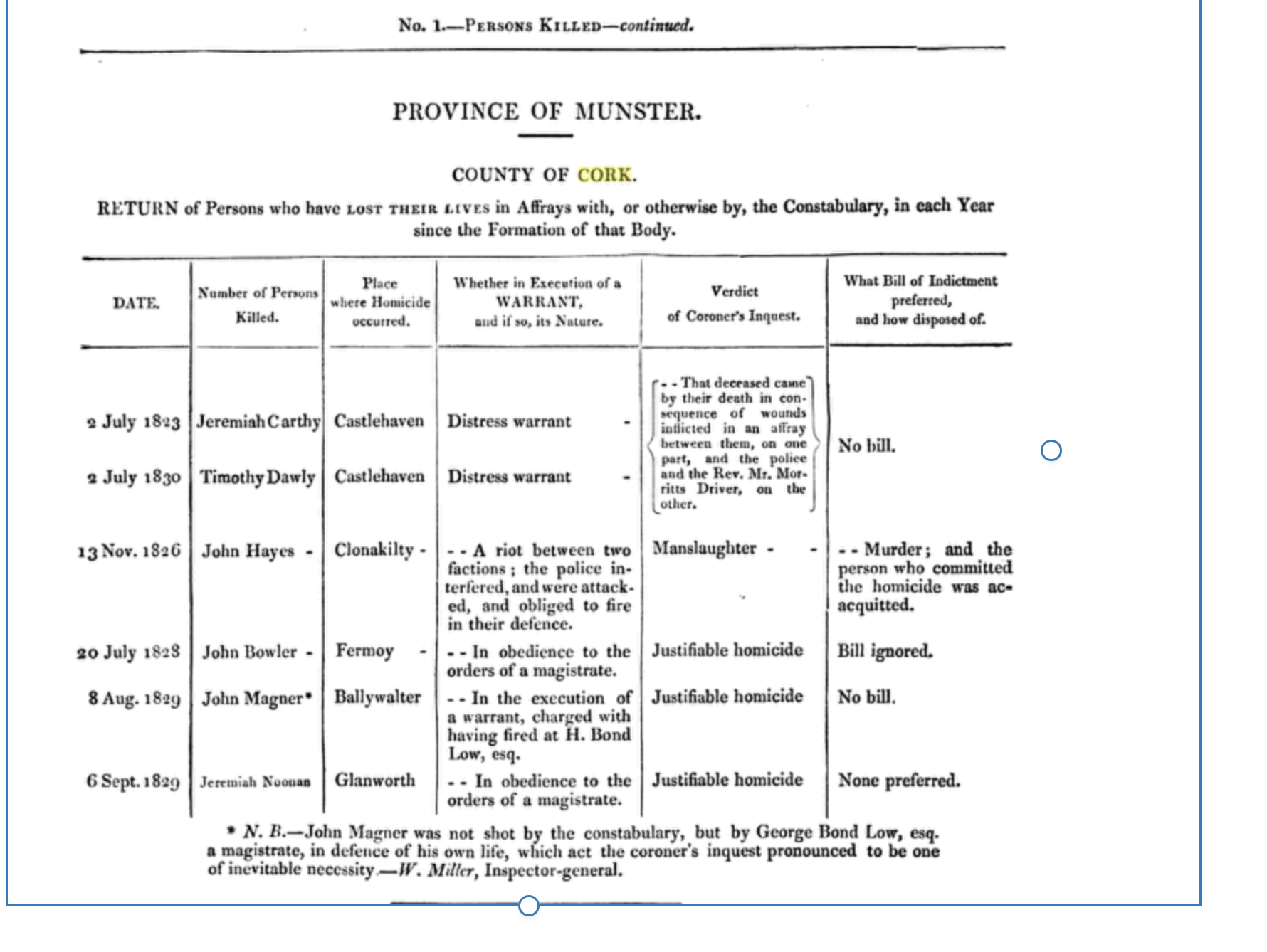
1823. Inquest into Affray Occasioned by the Rev. Robert Morritt, Rector of Creagh and Castlehaven, Notorious Extraction of Tithes, Caused at Castlehaven, West Cork, at which Fatalities Occurred, Stones Placed into Mouths of Killed Policemen, Press Excluded from Publishing Preliminary Investigation on Morritt’s Motion.

https://durrushistory.com/2016/05/06/1823-rev-robert-morritt-rector-of-creagh-and-castlehaven-west-cork-notorious-extr

1826. Death in Faction Fight, Clonakilty and Deaths Arising From Rev Morritt’s Extraction of  tithes at Castlehaven, West Cork.

1823. Inquest into Affray Occasioned by the Rev. Robert Morritt, Rector of Creagh and Castlehaven, Notorious Extraction of Tithes, Caused at Castlehaven, West Cork, at which Fatalities Occurred, Stones Placed into Mouths of Killed Policemen, Press Excluded from Publishing Preliminary Investigation on Morritt’s Motion.
1823. Rev. Robert Morritt, Rector of Creagh and Castlehaven, West Cork Notorious Extractor of Tithes, Searching for Arms in Ballydehob, Caused Affray at Castlehaven at which Fatalities Occurred, Stones Placed into Mouths of Killed Policemen, later Paris Defamation action Against Three English Clergymen.

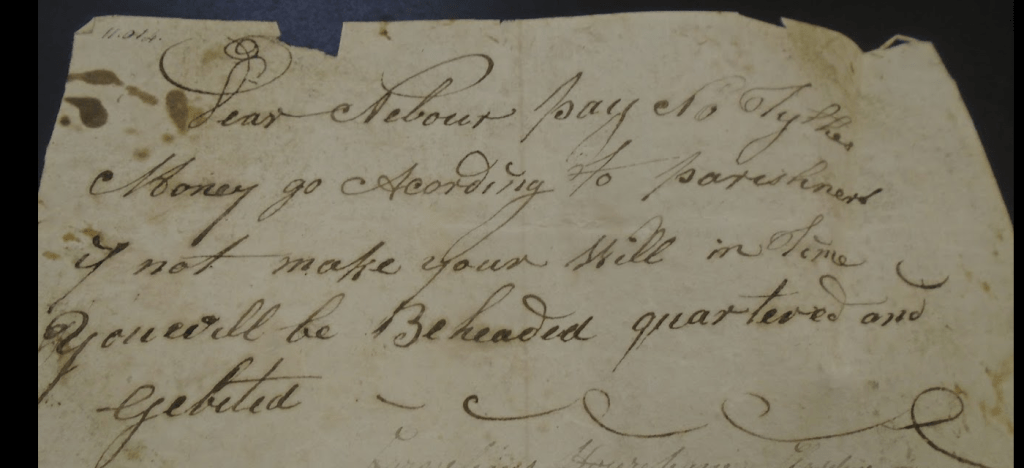
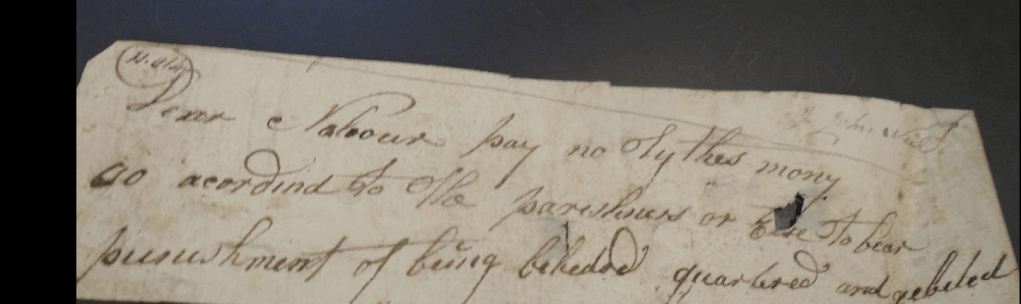
CSO/RP/1832/4660. Letter from A O’Driscoll, Shepperton, [County Cork], to Maj William Miller, [Inspector General], forwarding threatening and anti tithe notices [extant] posted in Drimoleague [Dromdaleague] and reporting on outrages in his area and recommending the strengthening of the military in the area

1832, Drimoleague, Anti Tithe Notice Posted ‘Dear Nebour Pay No Tythe Money Go According to Pereshners if Not Make Your Will or You be Beheaded Quartered and Gelded’
Captain Alexander O’Driscoll, 1827, Clover Hill, Superseded 1810-30, Restored 1843. Norton Cottage, Skibbereen (two of the same name at time), Ancestor Alexander married daughter of McFineen Dubh O’Sullivan, son of Tim ‘The Gauger’, sister Mrs Freke of Baltimore Castle.  1820 signed Memorial for new road Glengariff to Castletownbere.  Married to the daughter of Thomas Attridge, Ballydehob. Correspondence with Chief Secretary appealing dismissal of 1820.  Bridge at Bawnlahan 1820. 1822 subscriber as Clover Hill, Church Building Fund Durrus, he held tithes in Kilcrohane with Rector and Rev. Alleyn Evanson. Present at enquiry Skibbereen 1823 into enquiry into fatal affray at Castlehaven caused by Rev. Morritt’s tithe extraction. Grand Jury Presentments attending 12 from 1838-1840 at Norton Cottage.  Probably engaged with his crew in marine salvage of Clio out of Crookhaven 1825. 1826 City election voted O’Callaghan conservative. Voted 1835 election as out of town Freeman address Shepperton. Public support for him on dismissal 1835 by fellow Magistrates Lord Bantry, Simon White, John Puxley, Samuel Townsend Senior, Samuel Townsend Junior, Hugh Lawton, Thomas Somerville, Rev. Alleyn Evanson, Richard Townsend Senior.   Enquiry attended in Bandon 1841 into suspension arising from conduct with Stipendiary Magistrate J. Gore Jones and Sub-Inspector Andrew Creagh  attended Earl of Bandon, Lord Viscount Bernard, on. H. White Hedges, Macroom Castle, Henry Bernard, Castle Barnard, Abraham Morris Dunkettle, Captain Henry Wallis, Drishane Castle, Lieutenant Colonel St. John Clerke, Overton House, William Cooke Wallis Junior, Castlecook, Mathias Hendley, Mountrivers, Henry Leader, Mount Leader, George Browne, Coolcower, St. Ledger Aldworth, Newmarket, Charles Evanson, Carlemont, Cork, Sir Thomas Deane, Thomas Hungerford, The Island, Nicholas Dunscomb, Mount Desert, Richard Henry Hedges Becher, Hollybrook, Skibbereen, John Isaac Heard, Kinsale, John Wheeler, Junior, James Gillman, Retreat, MD, Clonakilty, Thomas Herrick, Coolkerry, Captain R.A. Rogers, Petersfield, Michael Gallway, Gurtnagreena, John Nason, G. Nagle, Ballinamona Castle, Samuel Wallis Goold Adams, Jamesbrook, Jeremiah E. McCarthy, Rathduane, William F. Austen, Greenshela, Thomas R. Sarsfield, Ducloyne, Arthur Pery Aylmer, Castlefreke, Thomas Cuthbert Kearney, Garretstown, Joseph Haynes, Maryland House, Charles Connell, Cloverhill, John Barter, Cooldaniel, Francis G. Woodley, Leeds, Lawrence Corban, Maryville, E. Millett, MD, Cove.  1841 supported Conservative Longfield Longueville, Mallow even though Catholic hosted meeting attending John Ross, Rossford, Thomas Morris, Mahonagh, Thomas Wood, Dereeny, Listed 1838, dead….. with address Mount Music/Bunaulin, Caheragh when daughter Kate married Herbert Baldwin Esq., 1845. 1835 Subscriber at Gortnascrena, Skibbereen, Lewis Topographical Dictionary of Ireland 1837. Suspended for a period as J.P. reinstated after altered by a sitting of over 70 Magistrates in Bandon from both political sides. 1828 Bandon Quarter Sessions. His lands managed by Bird. Member Provisional Committee projected Bandon to Bantry Railway 1845, address Norton Cottage.   Believed to have been committed to a debtors prison in Cork by his wine merchant where he died. Norton Cottage was lived in once by Dr. O’Donovan, J.P., and bought 1925 by Jasper Woulfe, Solicitor, Crown Prosecutor and TD, 
Smuggling in West Cork

18 Saturday Oct 2025

Posted by durrushistory in Uncategorized

≈ 2 Comments

Tags

family-history, Genealogy, history, ireland, politics


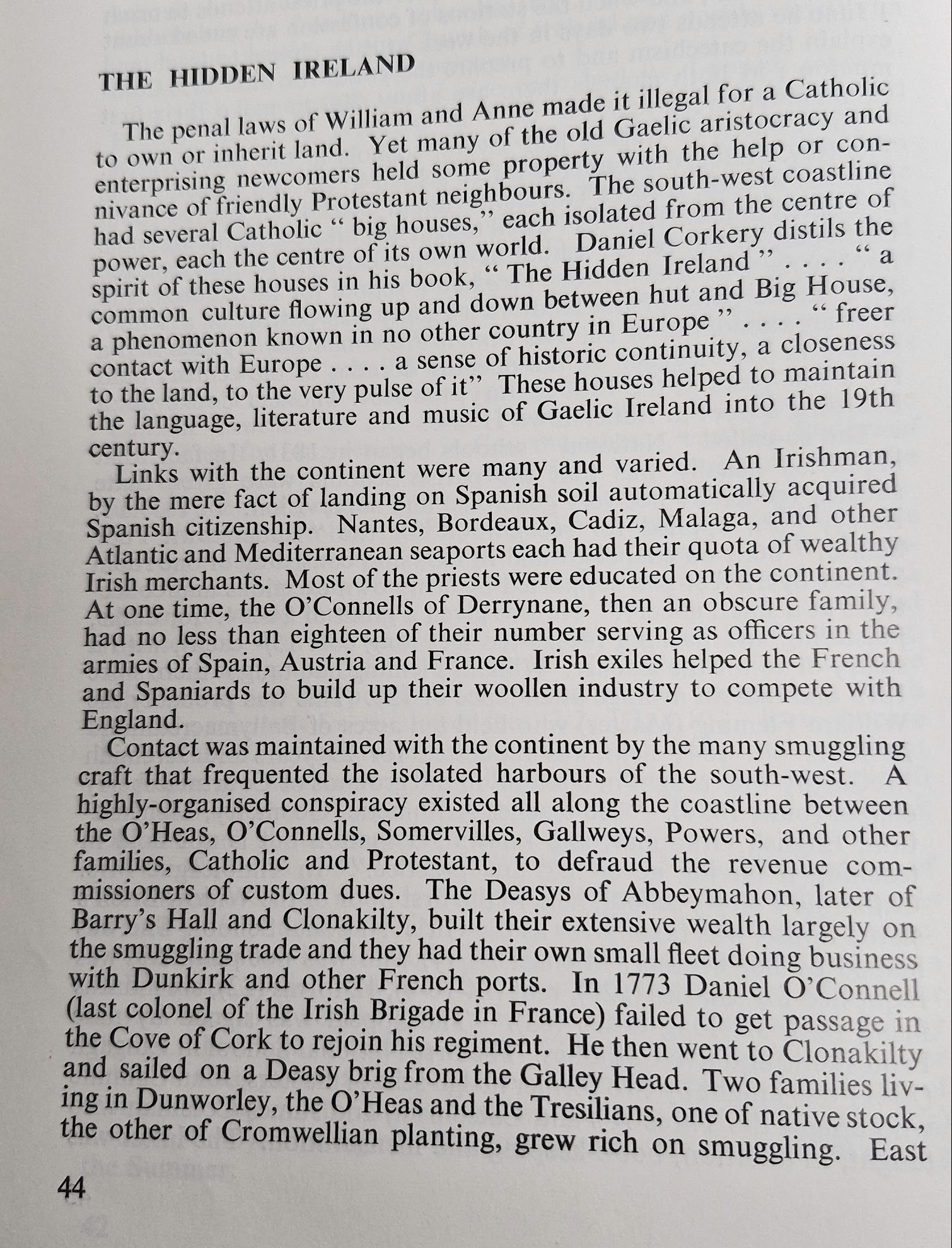
Re smuggling in the 17th century it is worth  recalling the context.

After the end of the English Civil War when Parliament prevailed there was a strong view that the English army should be abolished as they might present a threat to the new dispensation.  The compromise was a largely reduced army with a standing garrison of 15,000 to be based in new barracks in Ireland.  This was to be a charge on the Irish Exchequer.  The building of these barracks gave arise to the Irish Barack towns, many of which only closed in the last 30 or so years.  

So whenever an old lad in the 1740s had a smathán or smoked his pipe not only was he contributing to the British occupation of Ireland but paying for their garrison.

Clearly when the ‘legal’ price of excitable items excess the market price by a wide margin the opportunities for smuggling are immense.

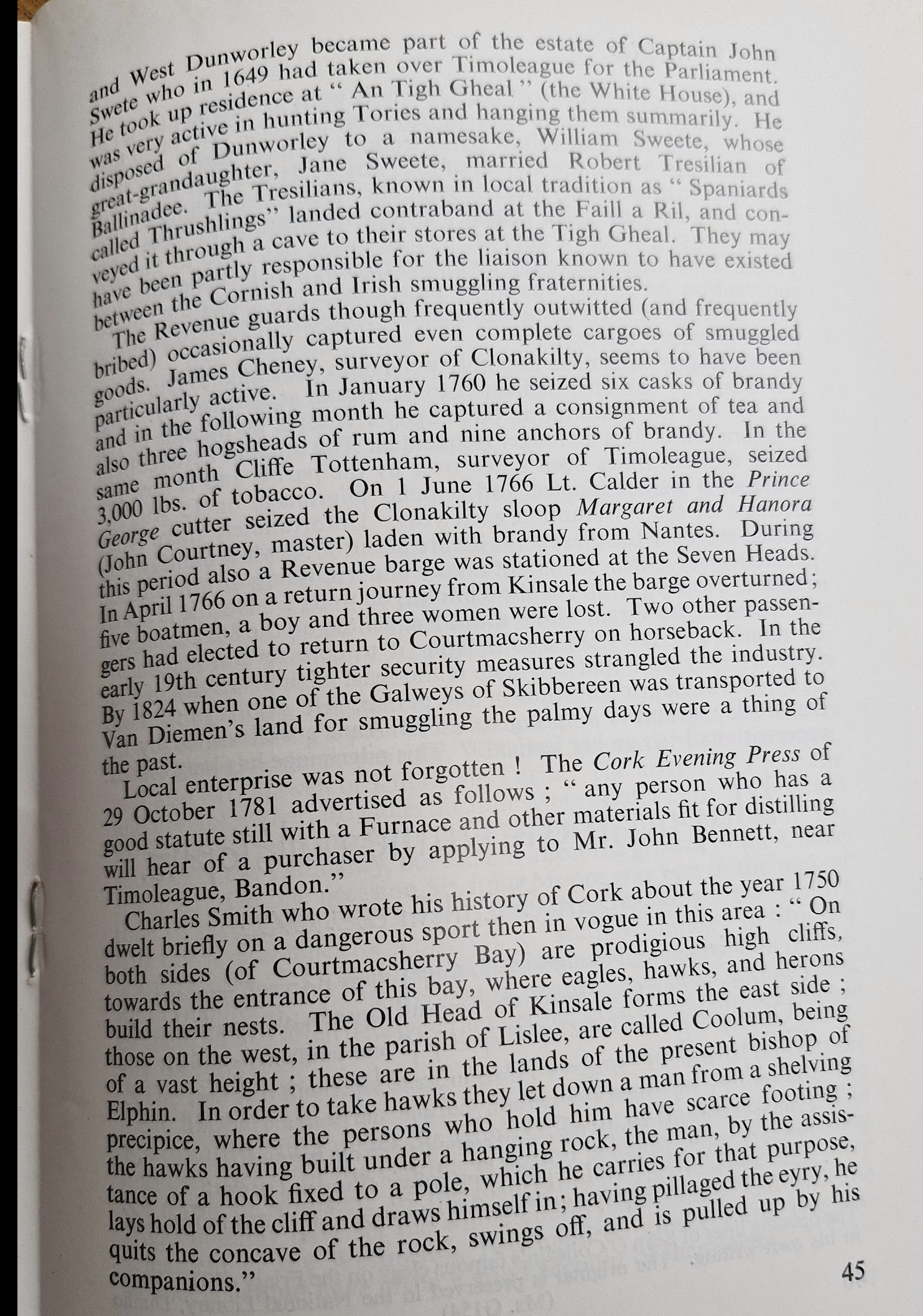
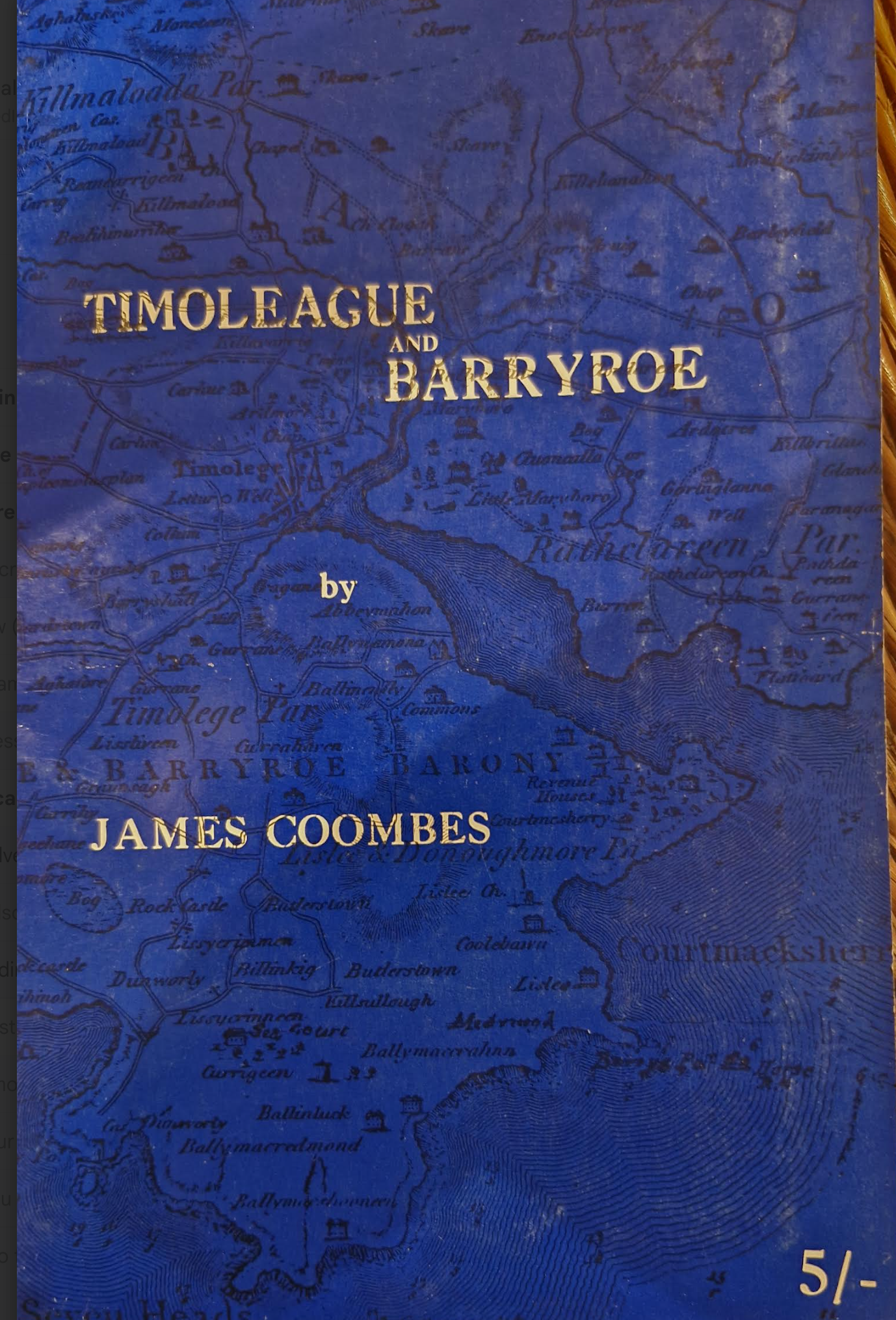
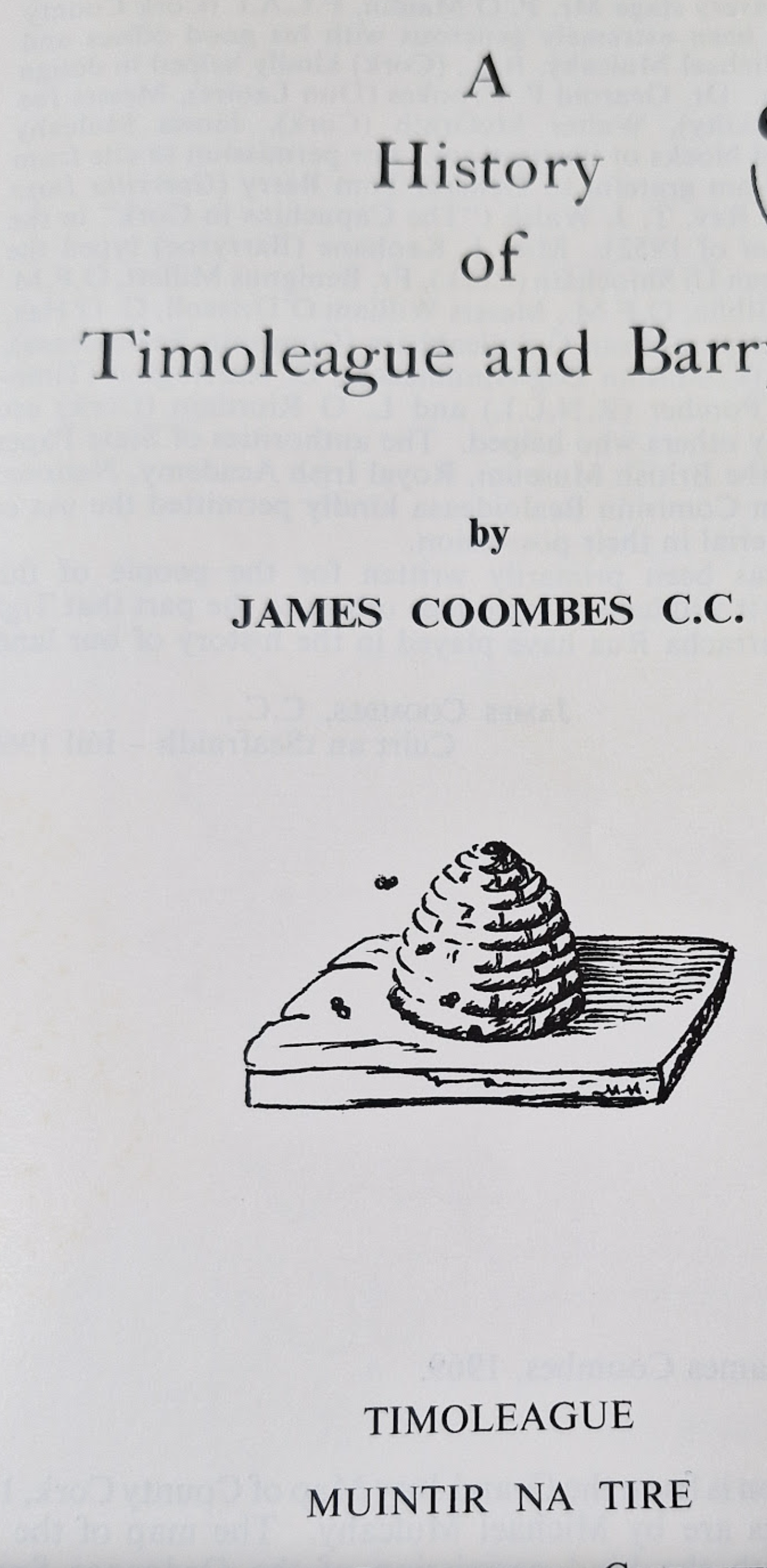
From Father James Coombes History 1969.

Thanks Pat,

That is interesting reading. It’s all true. Edward was the guy transported leaving his wife and six kids. So we’re others near Skibbereen. The Kilkeran ones brought boats into the local “lake” and stored stuff in the basement, allegedly with an underground tunnel. Family fortunes were hard hit. Family were installed in Bordeaux, Nantes, Oporto etc to look after that end of it. There are de Gallweys in France. 

.

1822. Lord Bantry not renewing lease of any of his Tenantry involved in Smuggling.https://durrushistory.wordpress.com/wp-admin/post.php?post=25396&action=edit

Canon Johnny McManaway MA, Rector, 1930s Durrus, smuggling horseshoe stubs into the Free State

https://durrushistory.wordpress.com/wp-admin/post.php?post=39332&action=edit

Arthur Hutchins, Landlord and Magistrate, Ardnagashel, Bantry married 1802, Matilda O’Donnell, (Smugglers), Erris, Co.Mayo, descendant of Niall of the Nine Hostages, West Cork Crowleys, Descendants of Niall of the Nine Hostages

https://durrushistory.wordpress.com/wp-admin/post.php?post=36886&action=edit

1740. a Memorial of Several Gentlemen Residing at or near Berehaven in West Cork, setting forth the necessity of having a Barrack built for one company and half of foot to prevent running of Goods and the Shipping Off of Men to Foreign Service

https://durrushistory.wordpress.com/wp-admin/post.php?post=30175&action=edit

Richard Griffith letter to Dublin Castle on progress of road from Skull to Crookhaven, Co. Cork where ‘upwards of 3,000 are employed’, 1822.

https://durrushistory.wordpress.com/wp-admin/post.php?post=901&action=edit

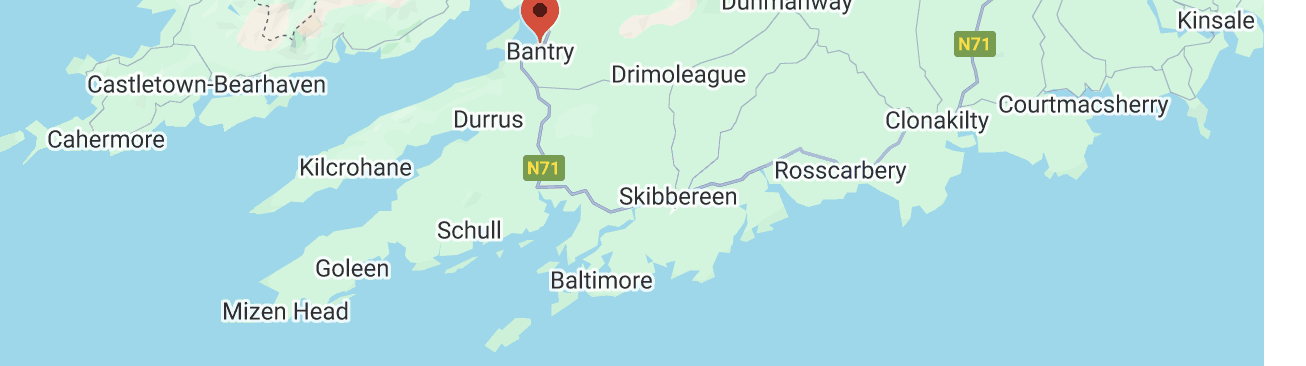
refers to the inaccessibility of the region around Crookhaven harbour and the persistence of smuggling which is difficult to check due to ‘the numerous creeks and inlets on the coast’; includes letter from Griffith, Skull, to Gregory, acknowledging invitation of the Lord Lieutenant to meet for interview in Dublin but to request the date is deferred to enable his attendance at the assizes of counties Kerry and Cork.
izes of counties Kerry and Cork.

In the North it became the practice to put studs into horse shoes.

Studs are small metal projections that screw into the horse’s shoes. They’re used to give him better grip on various types of footing, from firm and slippery to soft and boggy. They’re great if the  horse loses his focus in less-than-ideal footing or to give him extra traction when doing road work. 

For some reason studs were illegal in the Free State.

The  Canon wished to bring some down from one of his northern trips.  He took the saddle off his bike and  filled the hollow of the frame with studs and replaced the  saddle.  The bike passed over the border no problem and the Canon and his bike with studs arrived safely in Durrus.

Memoirs of James Stanley Vickery c. 1889 Australia. The Bantry Schoolmaster Healy Possibly Tim Healys Grandfather

16 Thursday Oct 2025

Posted by durrushistory in Uncategorized

≈ Leave a comment

Tags

books, history, ireland, writing


https://docs.google.com/document/d/1PwugXHb1Be5sqPuvHX2eqWWHrAeKouaQqI8Pp19V3pM/edit?tab=t.0

When my mother was about to be confined she went to Bandon to be under the care of an old friend and relative who lived an a small house in Castle St. close to the river. Here on the morning of the lst May 1829 at 6 O’C am I was ushered into this world to undergo a training for eternity.  The term of that training time has been a little more than the psalmist’s reckoning and on the whole I ought not to complain. My most painful time was during my childhood, the very times which should be the easiest if not the happiest portion of the training time.  My grandfather was very old with an old mans ideas when I came under his care. I was naturaly dull and nervous and if I could lot learn as others I must be made to if possible no matter at what cost of pain or misery to the poor dullard. When about five years of age the old people came to live in the town of Bantry. Then I was sent to the usual infant school where I presume I learnt something as when about eight a more advanced school was chosen. Unfortunately there was no great choice, the national school then newly established or a private one conducted by a man named Healy. The Irish protestants from the very first were prejudiced against the national system of schools describing them “poor schools”. The result being they were almost from the commencement under the wing of the R.C. priests. Healy the teacher of the small private school was a self taught man attaining as many self-taught men do a fair knowledge of mathematics but seemingly holding in contempt all other branches of learning. He was a little man essentially a tyrant cruel to a degree whose great delight was to make the unfortunate little come trembling and sobbing into his presence. In certain aspects of his character he exceeded any thing depicted by the pen of Dickens. The treatment I received thus early in my life at this man’s hands must have had an ill effect on me throughout life. He was a Roman Catholic but my grandfather insisted that I should learn so many verses of the bible every day. In the repeating of these and other lessons the rod was continually shaking over us and that rod was usually a well seasoned holly one with the sharp points adhering. I had to endure it all silently having no one to complain to. As an instance of his treatment I may relate the following. The school room was a rough one with an open roof, over one of the rafters one day he threw a small rope tied under my arms and then hoisted me up swinging me too and fro at the same time letting me feel the holly rod greatly to the amusement of the other boys. His wife happened to see him at this, to his pleasant, occupation when she rushed in and released me at the same time giving him some of her mind. He was eventually had up before the Magistrates and fined for cruelly treating some other scholars whose friends became aware of the fact. On our parents death there was some understanding that Robt Edwards of Bandon and our father’s brother James should be our guardians. The one who really took an active interest, at least in life history was Mrs Edwards as good a hearted woman as could be met with but most unwise in all her dealings with young people especially boys. She seemingly could not resist any appeal from her own sons, their father taking little interest in them, so that the sons without exception were a burden instead of a help to their parents. A young couple with whom she was acquainted decided to establish a private school in Bandon and it was thought well that I should be put under their care. When I was ten years of age I together with my cousin George son of adult Bess- came to reside as borders with Mr and Mrs Thomas Robinson.

1886 Address from Some of Bantry Inhabitant to the Earl of Bantry, on His return from Abroad.  1885, House of Commons, London, A Lash of Tim Healy’s , MP,  Tongue, The Earl of Bantry Off Chasing Kangaroos in Australia instead of Sitting on Cork Lunacy Board

https://durrushistory.wordpress.com/wp-admin/post.php?post=40862&action=edit

1887. Sketch of The Brilliant Irish Member of Parliament.  Tim Healy of Bantry.  By John A. Hennessy a Waterford Man in New York.

https://durrushistory.wordpress.com/wp-admin/post.php?post=40387&action=edit


https://docs.google.com/document/d/1qTE1YKCh3wdnXHBjQZ-jXWUi-_LZuDWU5MyuTmywg04/edit

1909 Bantry Feis. Patrons include Canon (Church of Ireland) O’Grady, James Gilhooley, M.P., Tim Healy King’s Counsel,M.P., Maurice Healy, M.P., The Earl of Kenmare, Magistrates, Dr. O’Mahony, Benjamin O’Connor, M. O’Driscoll, William Martin Murphy, Alexander Martin Sullivan, King’s Counsel, Dr. M. J. McCarthy, Patrick (Rocky Mountain) O’Brien, Dromore. Prizewinners, Industrial Section.

https://wordpress.com/post/durrushistory.com/40015?s=Tim+Healy

Emigration from Gearhies, Muintervara, to Joliet, Illinois, America. Visit of Bantry Born MP, Tim Healy 1881, Hotbed of Fenians, Hibernian Activity, Pro Boer Meeting Attended by Many Irish.

https://wordpress.com/post/durrushistory.com/39957

Bantry Gang: Healy Brothers, Thomas, Solicitor, M.P., Timothy, M.P. , Queen’s Counsel, Governor General Irish Free State, Tim, Sullivan Brothers, Alexander Martin, Owner ‘The Nation’, Founder Irish Parliamentary Party, M.P. Queen’s Counsel, Timothy Daniel, M.P. Composer ‘God Save Ireland”, Donal, Secretary Irish Parliamentary Party, M.P, Lord Mayor of Dublin, Harrington Brothers, Tim, Teacher, Journalist, Author of The Plan of Campaign, M.P., Barrister, Lord Mayor of Dublin, Ned, Organiser, M.P., William Martin Murphy, International Businessman, Railway Contractor, owner Irish Independent, Dublin United Tramways, M.P., James Gilhooley, Fenian, M.P.

Genealogy of O’Healy/Healy Family of Donoughmore, Co. Cork ancestors of Tim Healy, Bantry, Governor General and John Hely-Hutchinson/Earls of Donoughmore and 1850 census of St. Anne’s Parish, Shandon, Cork.

https://durrushistory.wordpress.com/wp-admin/post.php?post=23410&action=edit

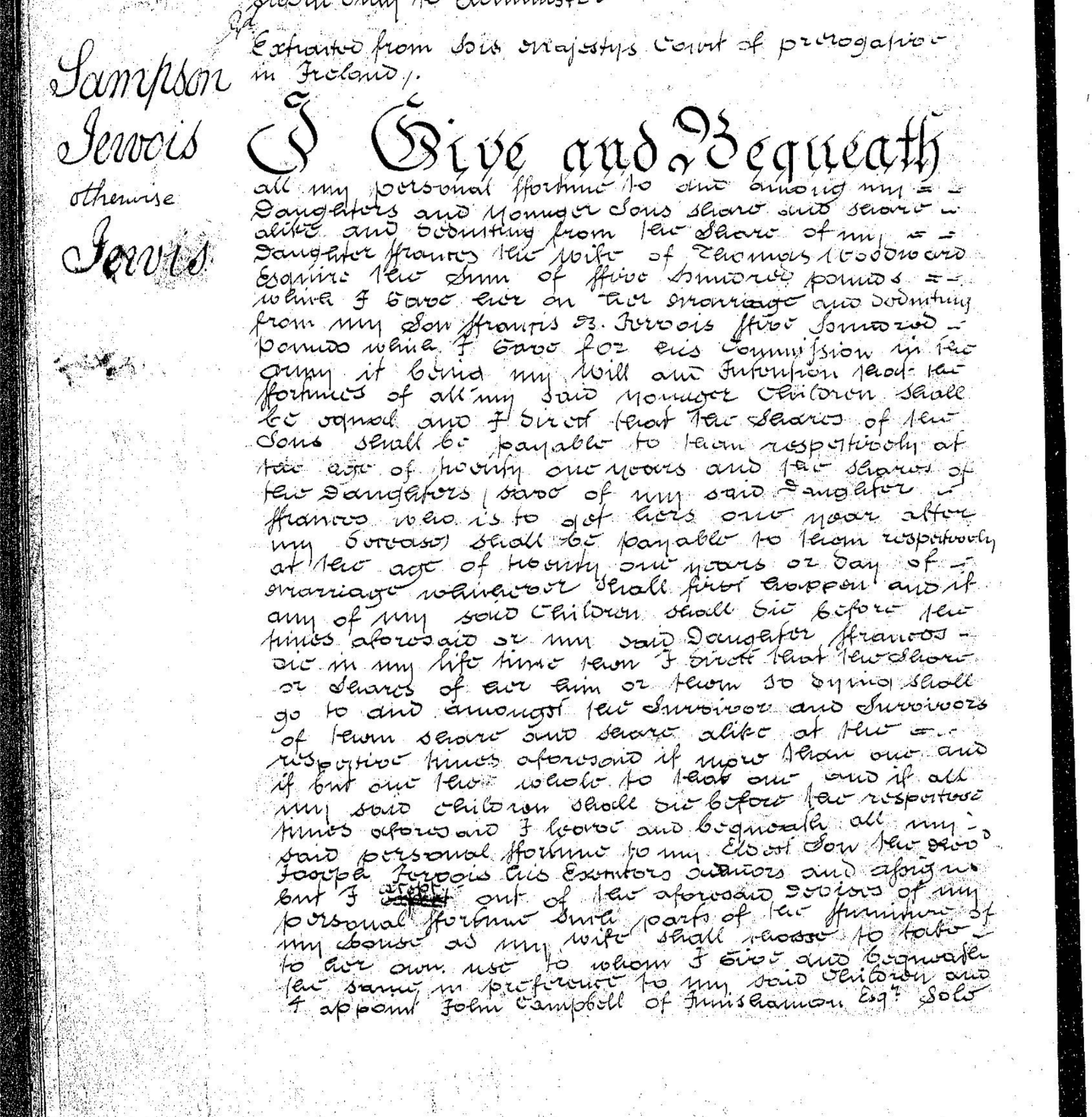
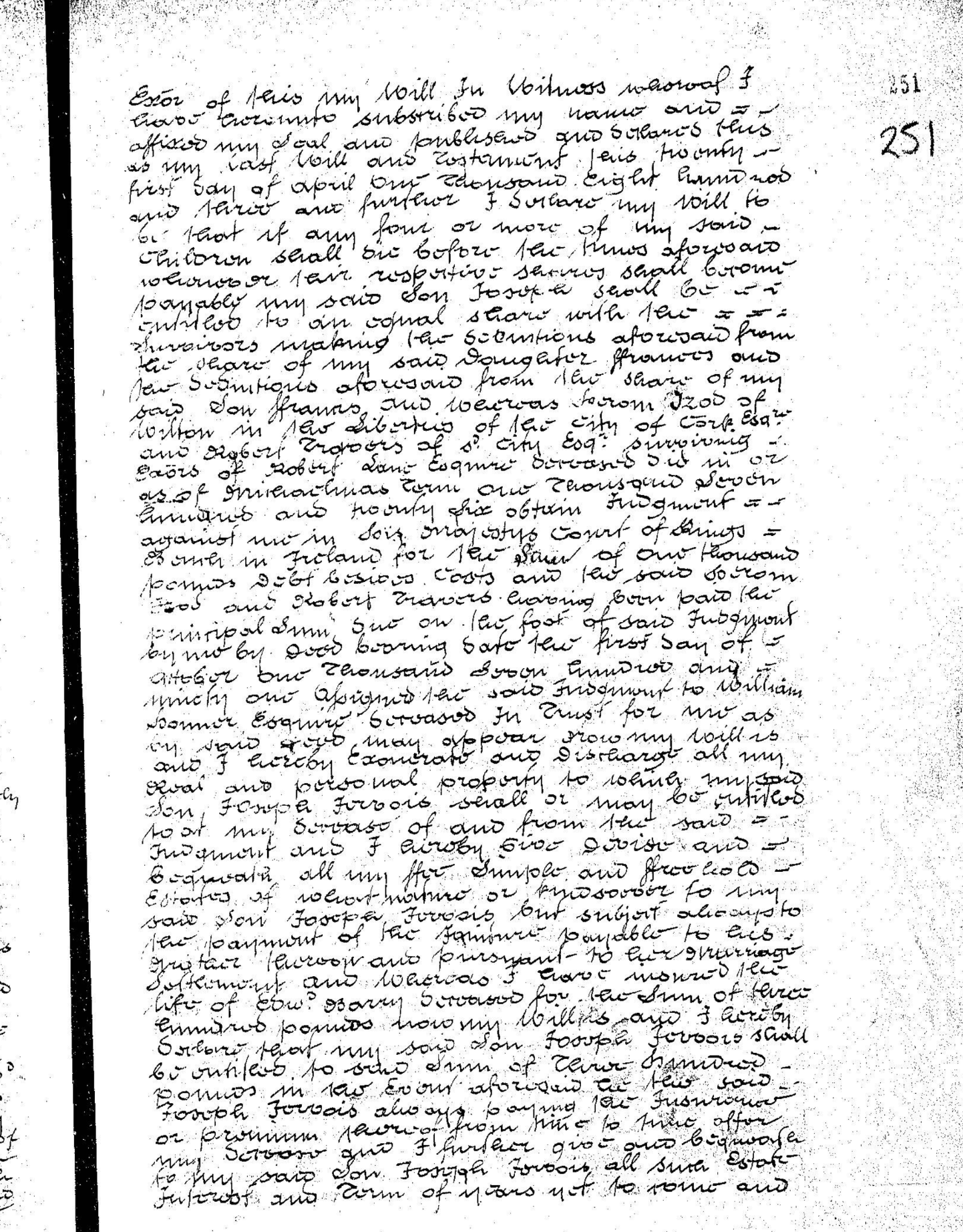
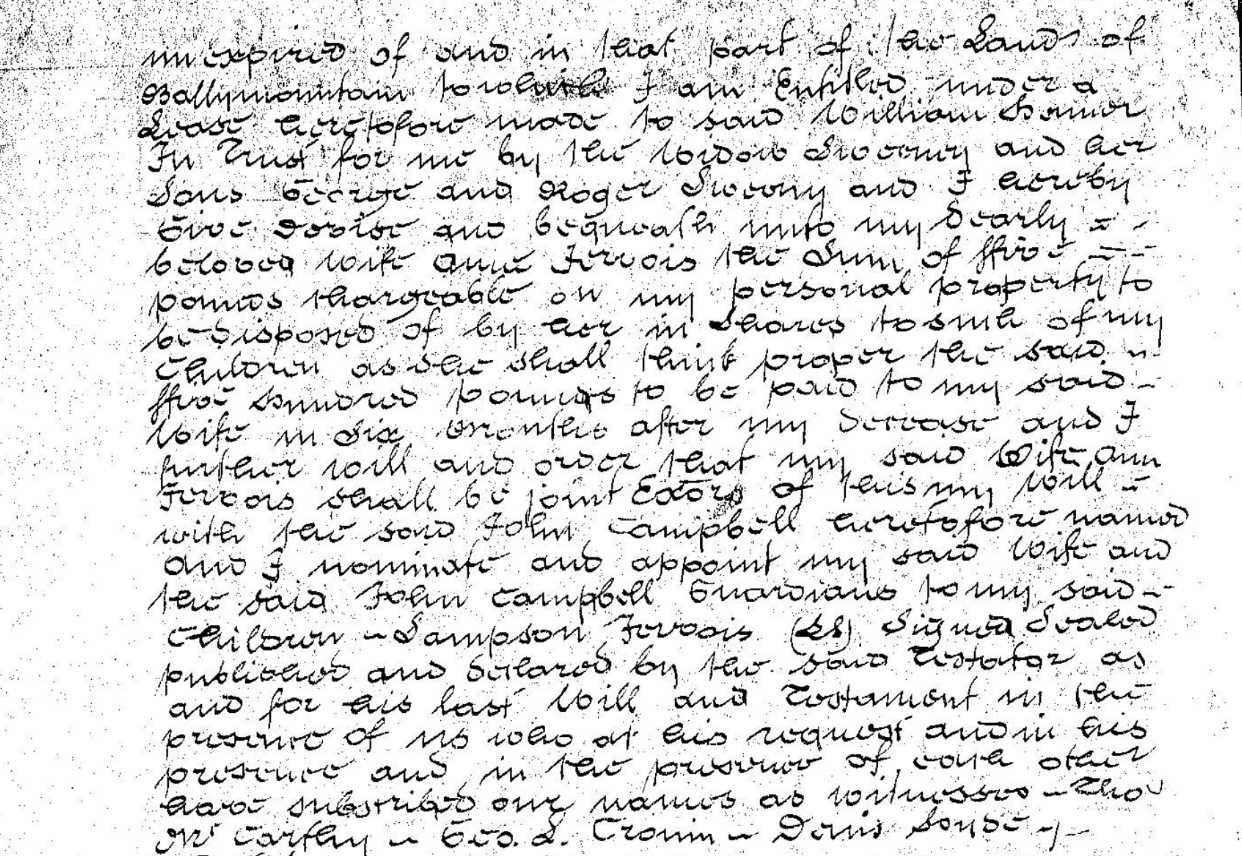
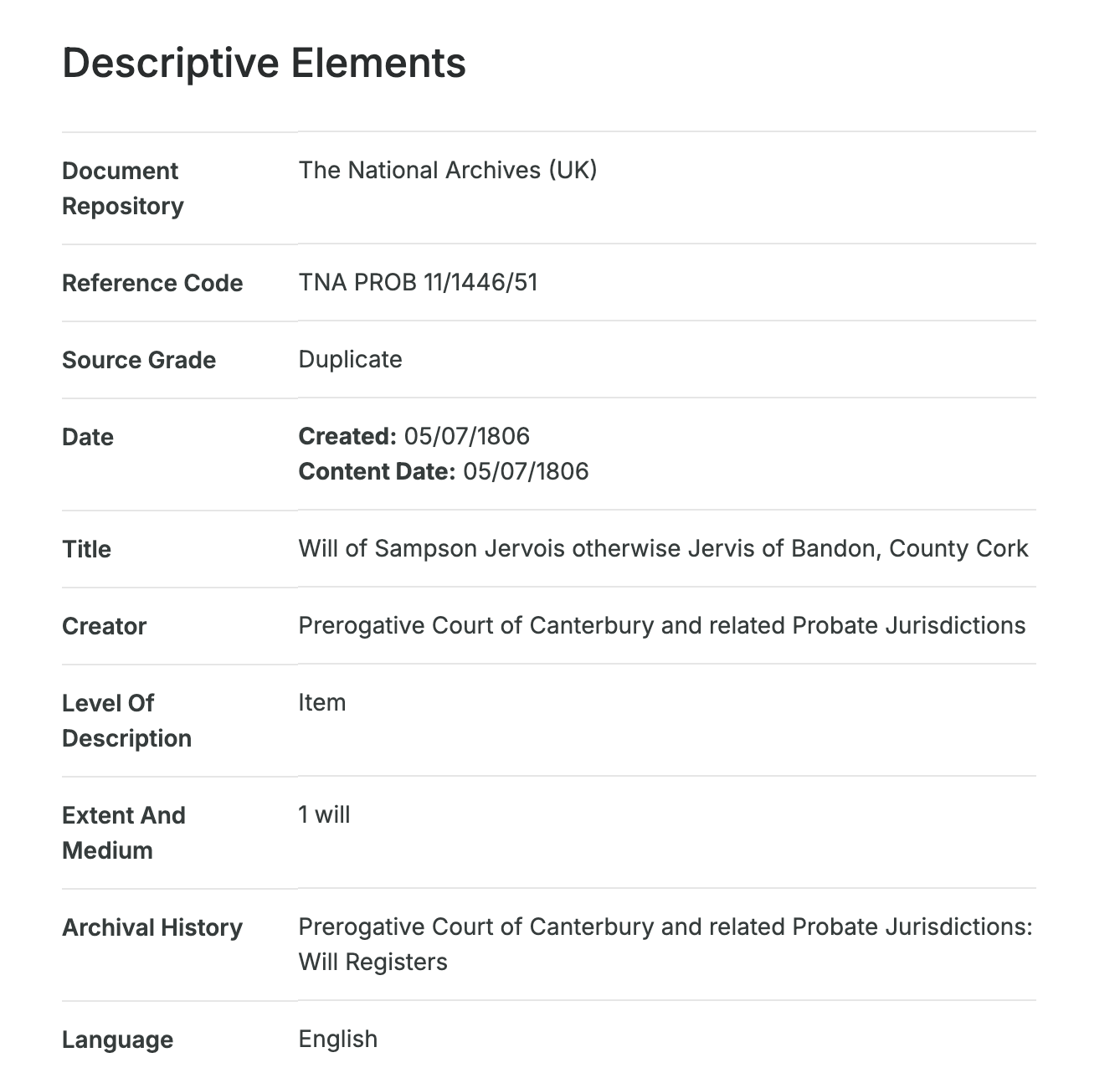
Will 1803. Sampson Jervois, Bandon.

10 Wednesday Sep 2025

Posted by durrushistory in Uncategorized

≈ Leave a comment

Tags

ancestry, family-history, Genealogy, history, ireland


Samuel Jervois, Brade, Skibbereen.  Samuel Jervois , 1769, Brade, Skibbereen, in 1777 chasing Banditti in Murdering Glen outside Bantry with Richard and John Townsend and Daniel Callaghan.  Member at Bandon Hanover Association meeting Cork 1791 re Whiteboys. 1792 as Provost of Bandon convened a meeting on foot of a requisition of 200 where it was resolved to support the Protestant Ascendancy.   1799 Supporter of the Act of Union Between Ireland and Great Britain.  Maybe the father of Samuel who married Lucinda Allen.  Purchased 1770 Shandon Castle Cork (now Irish Ballet Company).  Elizabeth Murphy, widow of John Murphy of Newtown, is the sister of Samuel Jervois of Brade.  In this deed Samuel Jervois is creating an indenture of 14 hundred pounds on the mortgage of Castledonovan to provide a dowry for his niece Martha (Elizabeth’s daughter), on her marriage to Dr Henry Baldwin Evanson in 1828.  Among a number of Magistrate who at a meeting in 1812 in Skibbereen offered substantial monies towards the apprehension of those responsible for the murders of Ellen and Simon Loardan whose bodies were discovered in a lake at Bawnlahan and Glandore Harbour.

The only thing I’m not sure about is whether the lands at Castledonovan came into Samuel Jervois’s hands through his marriage to Lucinda Alleyn, or if they were Jervois lands all along, or perhaps even both families had interests in them. They are mentioned as “family lands” in his post-marriage settlement to Lucinda in 1818, but it’s not clear which family is meant, so Samuel may have already swapped whatever lands Lucinda originally brought into her marriage for the lands at Castledonovan. There is an earlier mortgage linking the Jervoises to Castledonovan (don’t know the date off-hand), but they may have been one of many families who acquired some portion from Daniel O’Donovan or when Lieut. Nathaniel Evanson mortgaged Castledonovan and moved to Four Mile Water. I suspect these lands were passed back & forth many times, probably each time someone married! Members of the Jervois family held over 450 acres in county Cork in the 1870s. In October 1855 and January 1856 over 100 acres of their property in the parish of Nohaval, barony of Kinalea, were offered for sale in the Encumbered Estates Court. The original lease, dating from 1710, was between the Busteed and Hodder families. In 1853 Samuel Jervois was among the principal lessors in the parish of Dromdaleague, barony of West Carbery. Townsend notes the discovery of copper on the estate of Samuel Jervois, at Leap, before 1810. Family history sources suggest that an earlier Samuel Jervois had come to Ireland with the Cromwellian forces in the mid seventeenth century. He had been granted land around Glandore.  Will dated 1803 described as of Bandon extracted 1806.

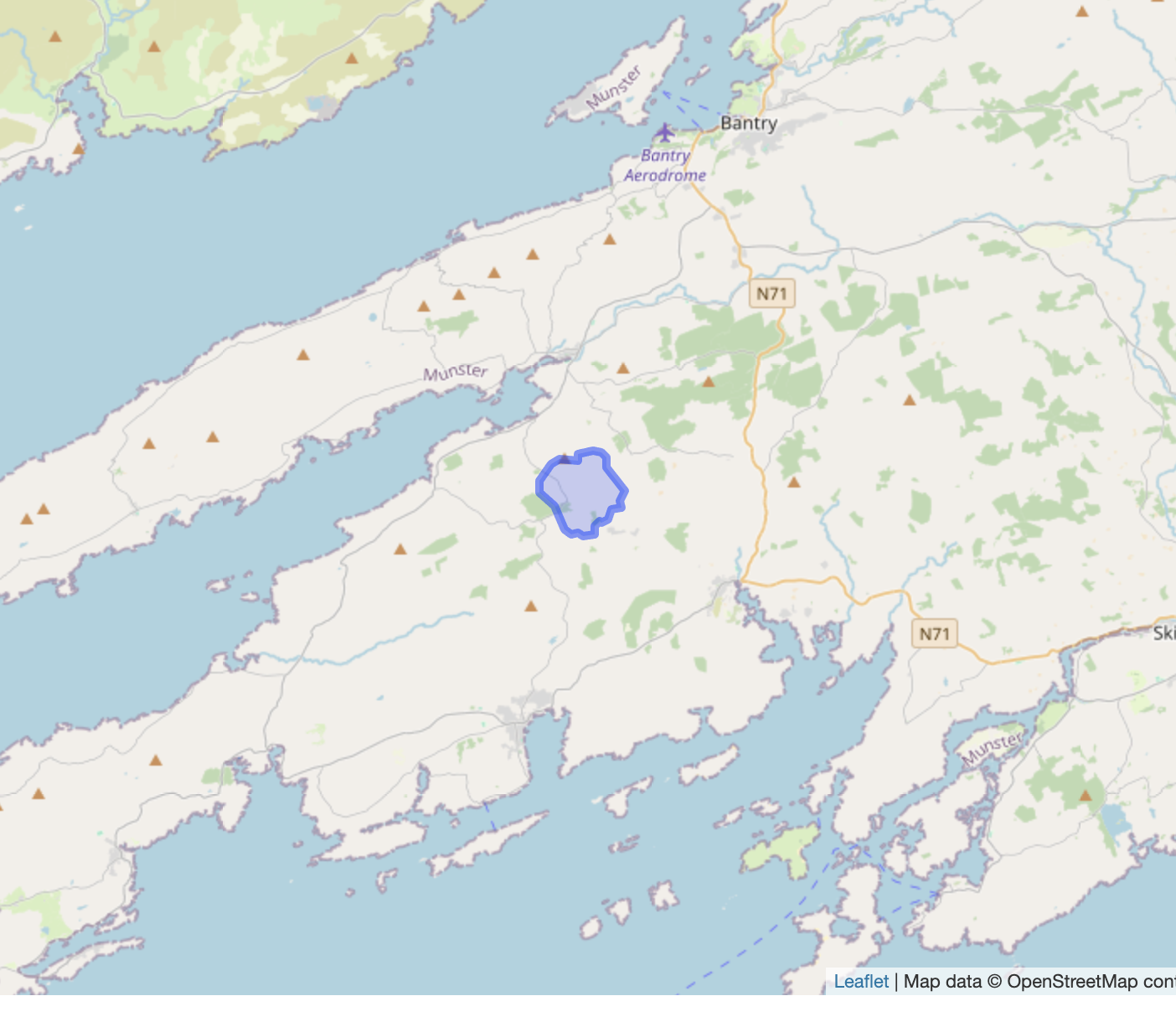
Rents and royalties owed Lord Bandon by the Dereenalomane, Ballydehob, Barytes Mines Company (later Dunmanus Bay Barytes Company)

02 Tuesday Sep 2025

Posted by durrushistory in Uncategorized

≈ Leave a comment

Tags

family-history, Genealogy, history, ireland, politics


Barytes Mines Company (later Dunmanus Bay Barytes Company),

Rents and royalties owed Lord Bandon by the Dereenalomane

Barytes Mines Company (later Dunmanus Bay Barytes Company),

U137 Bandon Estate Office, Rentals and Other Volumes
©Cork City and County Archives 2013
Ref.
U137/RL/A/047
Date: 1901 – 1917
Level : item
Title: Rental
Extent: 134 folios, and enclosures
Scope and Content:
Rental, with title page stating ‘Estate, Earl of Bandon, Ledger, Western, Church Lands’. This is
followed by an index of townlands: Ardentenant, Ballygourane, Balteen, Barnatonicane,
Ballyvonane, Balteen Mine, Cahirolickane, Dereenalomane, Dunkelly East, Dunkelly West, Gortduff,
Lackavaun, Kilbronoge, Lassanaroe, Rathcool, Woodlands, and Knockeens. The top of each folio
contains the following fields: OS Sheet number and number of Holding; Denominations (townland);
tenant’s name; area; rent; valuation, land; valuation, buildings; gale days; commencement of ‘stat.
tenure’; record number; and ‘Remarks’. In this last is generally noted the amount and date of fixed
rent, the Rural District, and the Electoral District. The lower part of the folio records rents and
arrears due and received. Over most of the folios notes are added in blue crayon stating the
purchase money and annuity agreed in a purchase agreement. The volume contains a number of
enclosures, stored separately:
List, ‘Bandon Estate – Purchase under LP Act 1903’ [Land Purchase Act], noting name of townland,
name of tenant, and area and rent details. [4pp and one rough list (1p)];
File of correspondence regarding rents and royalties owed Lord Bandon by the Dereenalomane
Barytes Mines Company (later Dunmanus Bay Barytes Company), 1913-20, including extract from
lease 30 November 1896 Earl of Bandon to Threlfall and Norman Leigh, draft copy advice [1915],
Letters to and from RW Doherty and George Webb, Bandon Estate Office; schedule of output at
Dereenalomane 30 April 1915, and letter regarding surrender of the lease as the mine is worked out,
8 July 1920. [24 items]

Scart and Barytes Mines Derreenlomane, (Doirín na Lomán: Little Oakwood), Ballydehob, West Cork, Barytes Mines,

https://docs.google.com/document/d/1-qw3py3ewmBM6LEUpxJUOYQm4y_Gs5ZG-p_1Wk9EGRU/edit?tab=t.0

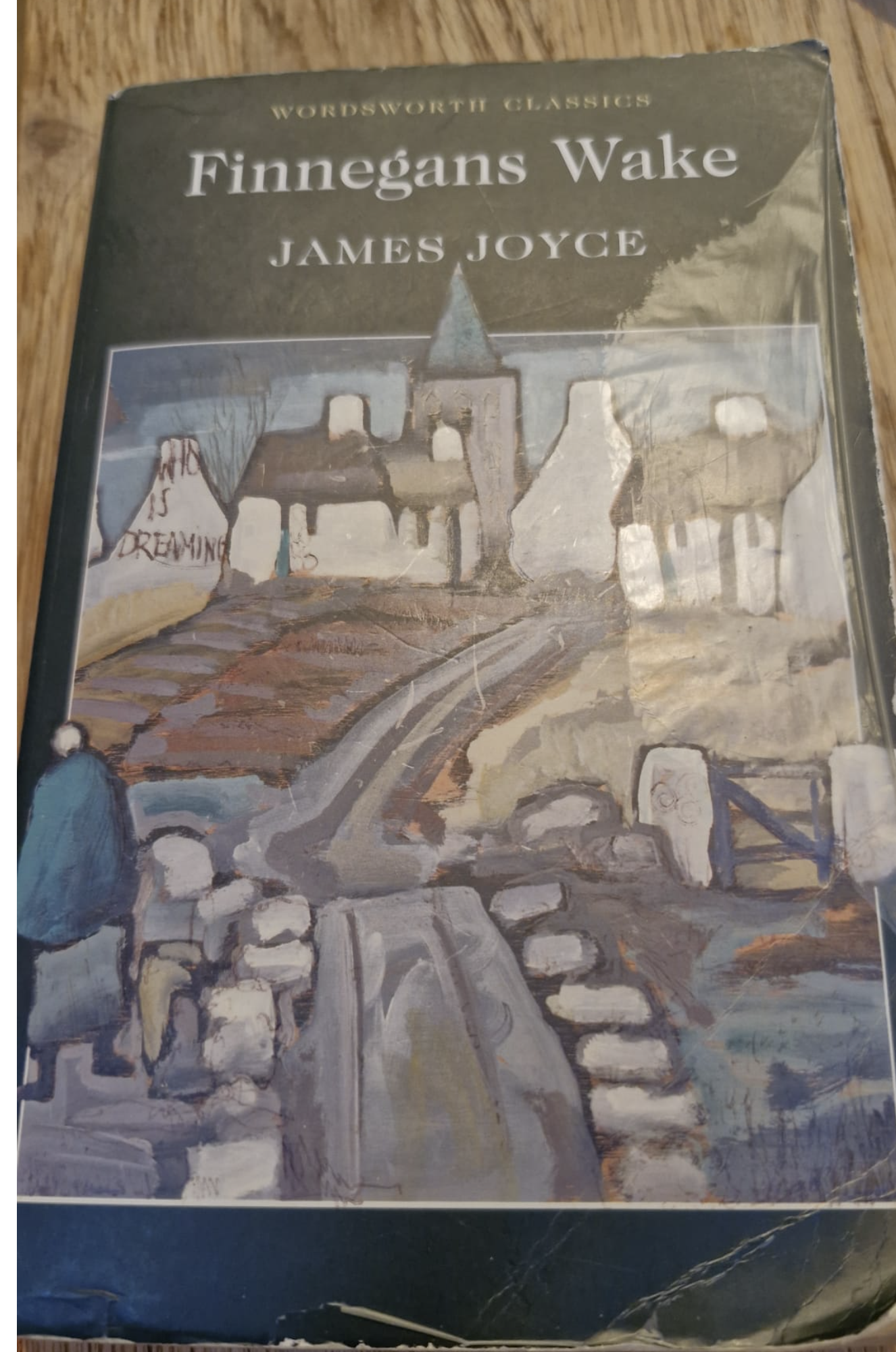
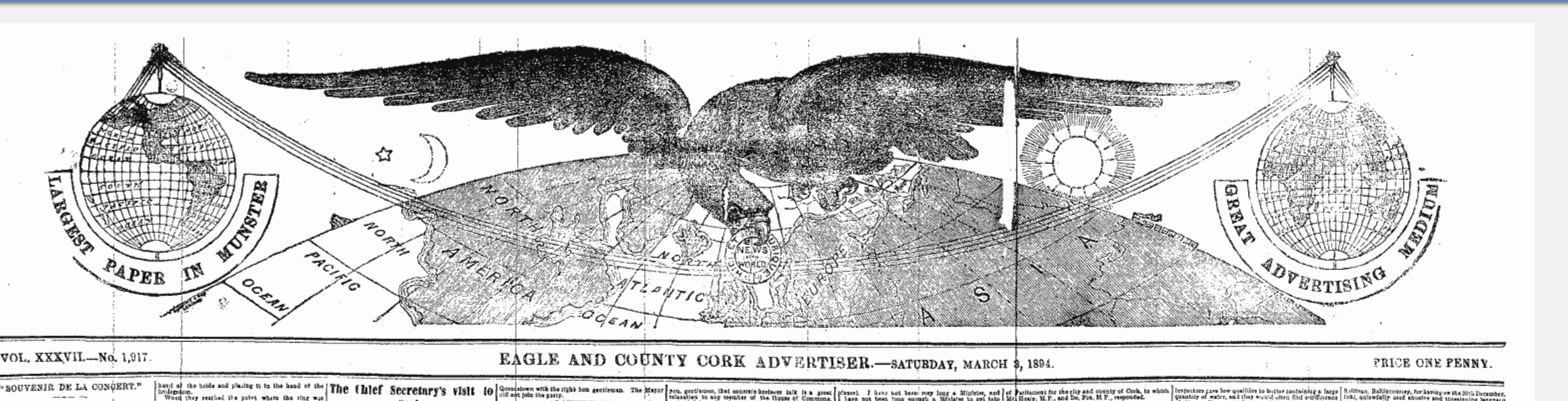
Finnegans Wake, James Joyce, Skibbereen Eagle, The Czar. Dick Adams

16 Monday Jun 2025

Posted by durrushistory in Uncategorized

≈ Leave a comment

Tags

books, history, ireland, writing


593.5:  “Have sea east to Osseania:” HCE to Oceania!  On the one hand, Oceania, the eastern sea, being about as distant as possible from Ireland, supports the claim to world-wide coverage.  On the other hand, Ireland (the land of Ossian) represents the opposite.  Contraries converging, or maybe just plain overweening provincialism: The Skibbereen Eagle once warned the Czar of Russia that it had its eyes on him.  Compare Stephen’s sardonic “(European and Asiatic papers please copy” (P 251).

https://johngordonfinnegan.weebly.com/book-iv

Brendan Kilty Joycean scholar and the man who restored the house on Ushers Island, Dublin,  the setting for the dea

From the ~Skibbereen Eagle

https://www.southernstar.ie/news/is-it-time-to-resend-the-skibbereen-eagles-memo-to-the-russian-tsar-4256173

.

EXACTLY 125 years ago this year, in September 1898, The Skibbereen Eagle instilled fear into the Russian Tsar, a butterfly effect not replicated until the West Cork fishermen saw off the Russian navy last year.

AD

The eye of The Skibbereen Eagle focused on the Tsar’s success in securing an ice-free warm-water base for the Russian Navy on China’s Yellow Sea.

The Southern Star

Share

00:30

00:00

But only two weeks earlier, in something akin to modern day political sports-washing, Tsar Nicolas II sent an unexpected invitation to every government accredited to his Imperial Court. 

The Tsar’s rescript invited these governments to a conference ‘to occupy themselves with the grave problem of excessive armaments.’

In truth it disclosed his military vulnerability dressed up as his pursuit of world peace. 

The Tsar told the world that he was keen to ensure to all people ‘the benefits of a real and durable peace, and above all of putting an end to the progressive development of the present armaments.’ 

With his Chinese warm water naval port now secured, Tsar Nicholas II set out to achieve this worthy ambition ‘by means of international discussion’ at his peace conference.

And it met with great success, for within only a few months the Tsar’s peace conference created the Permanent Court of Arbitration where the arbitration and peaceable resolution of (some) disputes between nations continues down to this day.

The peace conference also developed ‘Rules of War’ for the treatment of prisoners of war. It even banned, for the next five years at least, the discharge of projectiles and deleterious gases from balloons. 

Under Bismarck, the plethora of small German states had coalesced as the increasingly powerful German Empire, with the dynamo of its Prussian siege engine massed on its border with Russia. 

AD

Acutely conscious that his guns could never match those of his neighbour, Tsar Nicholas II set out to prioritise peace over his inevitable defeat. 

Andrew Carnegie, the philanthropist who built 80 libraries across Ireland also funded the construction of the Tsar’s dream home for the Permanent Court of Arbitration at the Peace Palace in The Hague, Netherlands. 

The list of signatories to this Peace Convention today reads as an eerie who’s who of hubris and history – powerful people whose memory is neither remembered nor honoured.

It included the Prince of Montenegro and the Prince of Bulgaria and the long-forgotten Kings of Bohemia, Hungary, the Hellenes, Italy, Portugal, Serbia and Siam. 

Imperial majesties, such as the Shah of Persia and Her Majesty the Queen of the United Kingdom of Great Britain and Ireland, Empress of India also signed, as did the Emperors of Of course, the ‘Emperor of all the Russias’ also signed up. 

In the same month as the Tsar’s call to action in 1898, the son of a Corkman – claiming a connection to Daniel O’Connell – enrolled at Cardinal Newman’s University on St Stephen’s Green in Dublin from where he graduated in 1902.  While it seems to scholars that young James Joyce was possessed of a stunning awareness and broad knowledge, much of his texts are derived from or informed by the newspapers of his time.

For the impecunious Joyce, local, national and international newspapers were readily and freely available to read in public libraries. 

Today, these same public libraries act as ‘warm banks’ – places to visit to stay warm in the face of impossible domestic energy bills caused by Russia’s invasion of Ukraine.

But Joyce was not the only one reading English language newspapers.

They were being read in Moscow and St Petersburg as well.

We know this from the Tsar’s father, Nicholas I, who boasted during the Crimean War (1853-1856) that he had no need of spies.

He was learning everything he needed to know by reading Dubliner William Howard Russell’s account of the Crimean War published by the Times of London and read by embassies everywhere. 

Joyce was nothing if not up-to-date when he weaved the Tsar’s Rescript and notions of world peace and international arbitration into Stephen Dedalus’ conversations with his fellow students at Newman House on St Stephen’s Green where they gathered around the Tsar’s portrait collecting signatures.

They were preparing to send the Tsar a testimonial of gratitude for his pursuit of world peace and the arbitration of disputes among nations. They had every reason to believe that a Tsar name-checked by The Skibbereen Eagle would read the praise of their Testimonial.  

Joyce was clearly impacted by the Tsar’s Rescript and The Skibbereen Eagle as he threads the debate about world peace and international arbitration from Stephen Hero, begun in 1903 just after his graduation, to Portrait of the Artist as a Young Man published before World War I and again, after the horrors of that war, to Ulysses, published in 1922.

Clearly, the watchful eye of The Skibbereen Eagle had spawned an imitator in Joyce and a reader in the Tsar. 

Perhaps, it is time now for The Skibbereen Eagle to re-send its impactful historic note to the current Tsar.

National and international papers, please copy!

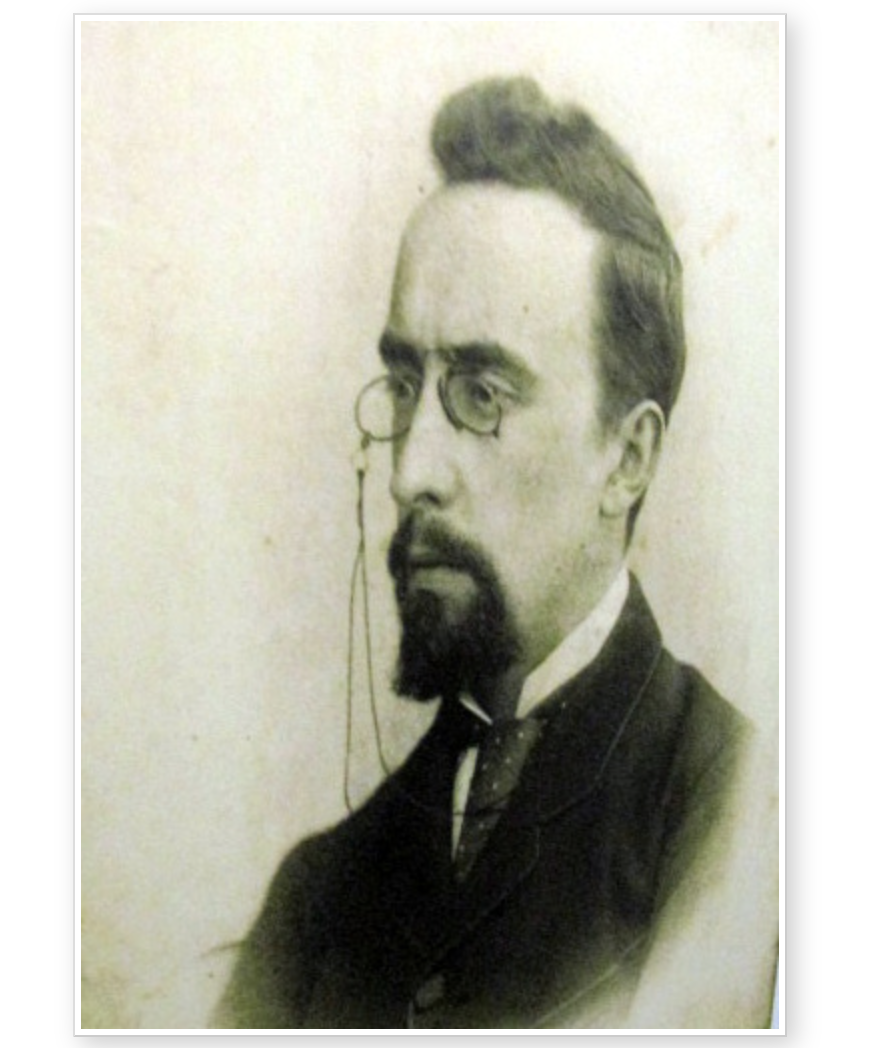
Joycean Brendan Kilty, above, has examined the links between Joyce’s Ulysses and the Skibbereen Eagle’s references to Tsar Nicholas II.
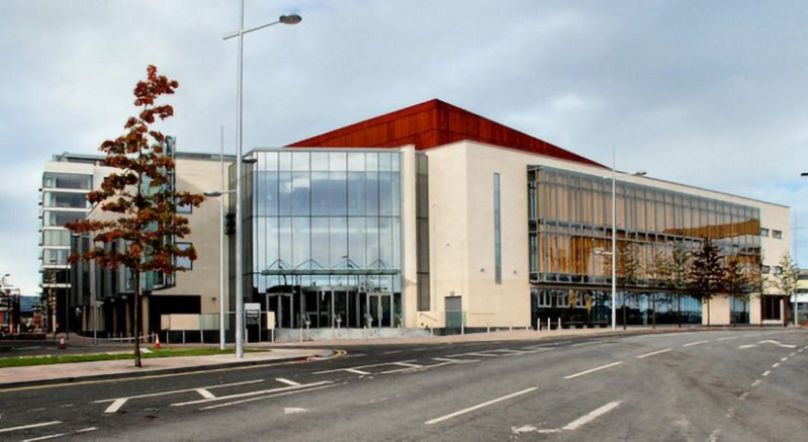
• Brendan Kilty SC is a senior counsel, arbitrator and Joycean. 

His human rights book ‘101 Reasons Not to Execute Someone’ is due to be released in 2023. 

Dick Adams:

B 1843-1908        Richard (Dick) Adams        Journalist, Barrister Inns 1873, Judge County Court Limerick 1892, Down        Born Castletownbere, eldest son Brian Port Surveyor, Customs and Excise mother Frances (Fanny) O’Donovan sister of Doctor O’Donovan, Skibbereen.   First cousin of Skibbereen O’Donovan family, Doctor Daniel adn his 2 Doctor sons, they are of ‘Isladn’ branch and once owned town of Ross.  1880 Munster Bar, 20 Mountjoy Square, Dublin.  Born Castletownbere, eldest son Brian Port Surveyor, Customs and Excise mother Frances (Fanny) O’Donovan sister of Doctor O’Donovan, Skibbereen.   First cousin of Skibbereen O’Donovan family, Doctor Daniel Famine Doctor  his 2 Doctor sons, they are of ‘Island’ branch and once owned the town of Ross.  1880 Munster Bar, 20 Mountjoy Square, Dublin.        “Journalist Cork and Freemans Journal, Defended  James Fitzharris in Phoenix Park Murders, noted wit.   From James Joyce ‘Ulysses’, ‘Dick Adams (Castletownbere born), the besthearted bloody Corkman the Lord ever put the breath of life in’ Journalist, Barrister, Defender of Parnell, Later County Court Judge Limerick

Ulysses: 7.679-80″        Buried St. Marys, Kensal Rise, London        “Courtesy Ruth Cannon: from the Cork Examiner, 6 April 1908, this loving tribute to one of the Irish Bar’s most famous humorists, Limerick County Court Judge Richard Adams (b-l). Adams got much mileage out of his resemblance to King Edward VII (b-r), who he alleged once messaged him in the spa resort of Homburg requesting they dress differently to avoid confusion.

“Those who knew the late Judge Adams well will find it hardest to believe that he is dead. For with his personality, they associate all that was brightest and most vivifying in life. 

That said, the future judge does not appear to have greatly distinguished himself in his early days. His first professional calling was that of a bank clerk in the National Bank in Cork. He was entrusted with the duty of opening letters containing bank notes in separate halves, a favourite way of sending money in those days, and then gumming the two halves together. But his lack of acumen for bank business was such that he frequently gummed the wrong halves together – a terrible misadventure in any well-organized bank. 

Having regard to this, and a general unsuitability for bank life, Richard Adams decided that he had mistaken his vocation. Accordingly, he subsequently got called to the Bar in Hilary term of 1873. In actions for breach of promise of marriage his services were particularly sought, and it was one of the treats of the Four Courts to hear a speech on that congenial topic from one who was a master of humorous exposition. His admission to the Inner Bar was soon followed by his elevation to the Bench as County Court Judge of Limerick.

While not a profound lawyer, he did not himself at all mind jesting on the subject of his legal knowledge, and would tell how once he came into one of the Dublin Courts after the luncheon interval and heard a well-known solicitor proclaiming from the solicitors’ table to a cluster of minor lights ‘Adams! Oh, he has a fine nisi prius prescendi, but he knows absolutely no law,’ whereupon Adams himself put his genial countenance over the side barrier and said, ‘Look here, that’s slander of me in my business trade and profession, and it is actionable without proof of special damage, so look out for a writ.’ This was of course said with glorious good humour.

Judge Adams loved to go to health resorts on the continent. These sojourns were rendered doubly enjoyable by reason of his resemblance to the present King. ‘When in Homburg,’ he said, ‘the King’s Equerry came up to me and said ‘Mr. Adams, the King commands me to ask you as a personal favour not to be going about in a tall hat and frock coat. It is very embarrassing for his Majesty to be so often whacked on the back, and to be shouted at by gentlemen in Dublin accents, ‘Hello Dick, old man, how are all the boys in Dublin…’’

More stories about Judge Adams here: 

https://lnkd.in/eM9aQ549″

Huguenot West Cork. Revised.

24 Monday Mar 2025

Posted by durrushistory in Uncategorized

≈ 3 Comments

Tags

family-history, france, Genealogy, history, ireland


1835 Gun Licences, Dukelows Durrus, p. 54

Families in France, p. 152

Contemporary Families in France:, p. 155

Ranclaud, p. 149, 158

Belsaigne Mathew, p. 158

Chevaisse, p. 163

Dr. Lefebure , p. 168

Rev. John Quarry, Clonakilty, 1855, p. 170

James Huleatt, A. M. Kinsale, p. 173

1681 Chartres, Bandon

1660 Deluane, possibly Bantry, p. 175

Despard possibly born 1660 Glengariff

Jean Humphreys and a Doctor John Bousseau, p. 176

Ranclaud

Paul DUELOS, A.M., vicar of Ballymodan.  He died in 1717 or 1719.      

French Prisoners, Freemasons, Bandon 1746-1747, p. 177  

David la Touche Colthurst (1828 – 19 January 1907)[1] was an Irish Home Rule League politician. He was elected Home Rule Member of Parliament (MP) for County Cork at the 1879, p. 178   

..

From the mid 17th to early 18th century something around 5,000 Huguenots moved to Ireland from religious persecution in France.   The bulk arrived after the Revocation of the Edict of Nantes in 1685. Dr. Alicia St. Ledger the historian of the Cork Huguenot community puts the number in Cork mid 18th century at around 300. In Cork City where many settled they had a French speaking church and minister. This group tended to be well educated, affluent, and involved as merchants, apothecaries, surgeons and as property developers reclaiming the Cork City marshes.  Over time they became English speaking and drifted into the mainstream Church of Ireland and gradually into the wider Catholic community.

No one knows for definite when the various Huguenot families arrived in the Mizen/Durrus areas.  In the main they were unlike their co religionists in Cork as they were artisans, small to medium farmers or labourers and coopers.  Oral tradition has it that they arrived by boat to Dunmanus Bay.  They arrived perhaps c 1750s co incident with various attempts throughout West Cork by Landlords to develop weaving, linen and flax. The old village of Carrigbui (Durrus) was sometimes described as a weaver’s colony.

About 1750 around 60 Huguenots arrived in Cork on board the galley ‘Redhead’ destined for Innishannon with their pastor Rev. Peter Cortes.

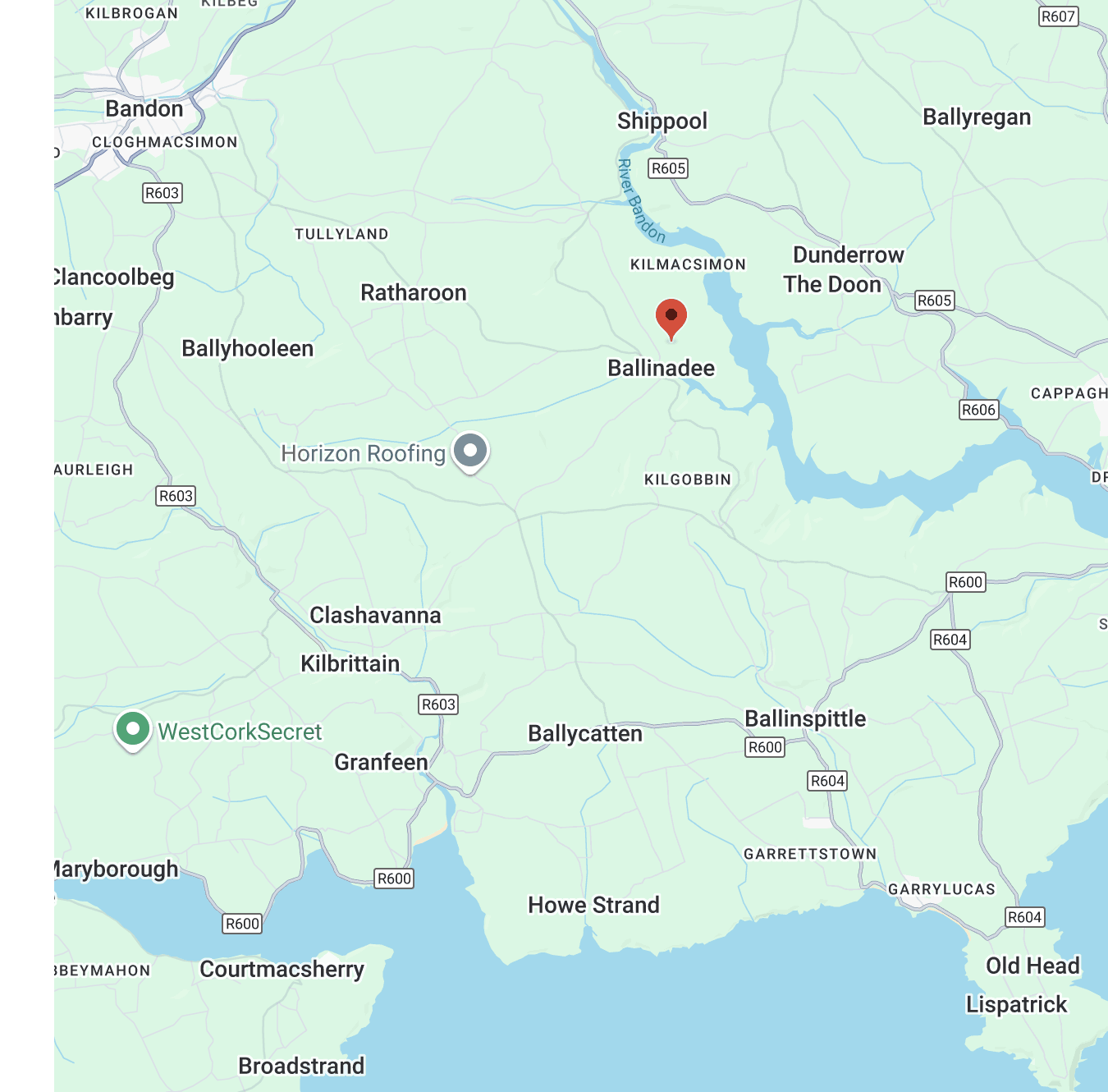
They may have been  being involved in Thomas Addisons failed silk enterprises in Innishannon and left Kilmacsimon Quay for Dunmanus Bay.

Click:

https://docs.google.com/document/d/1qeKIlUN4YVRMp2z5ZqXBCOMlyDGWgQavWIhAyqCMt3k/edit?tab=t.0

Rev. Charles Donovan, (1812-1893, Rector of Ballinadee, West Cork.

04 Tuesday Mar 2025

Posted by durrushistory in Uncategorized

≈ Leave a comment

Tags

family-history, Genealogy, history, ireland


Rev. Charles Donovan, (1812-1893, Rector of Ballinadee, West Cork.

Click here:

https://docs.google.com/document/d/141lyAyNZ7swIVTVnX6o_X57nG0WGnsJIRENVIVwXf_4/edit?tab=t.0

The obituary of the Rev. Charles ~Donovan in the Skibbereen Eagle in 1893 is most unusual insofar as it included a very detailed genealogy.  Maybe the Rev. Charles or one of the family wrote it; it looks like  it relies on family papers.  His career is ironic as a rabid Proselytiser preying on the starving Catholics of the Mizen Peninsula; you would not imagine his genealogy. His ancestor Daniel O’Donovan, head of Clan Cahill fought with his O’Donovan Regiment for King James in the battle of the Boyne in which four of his sons dyed.  HIs grandfather Richard O’Donovan on his marriage to an English woman had to change his name to Donovan, he may have been a Catholic as he had to post a bond for £1,00 to the Church of Ireland Bishop of Cork.  HIs son Charesl was a senior civil servant in Bengal and a Magistrate.  His Indian born grandson Dr.Charles Donovan was a world renowned medical scientist.   In a sense it shown family survival consequential on the Penal laws and adaptation.

Rev.  Charles Donovan (1812-1893), p.1

Funeral and genealogy, p. 3

Among the funeral attendance, p. 14

Proselytiser, 16

1847 Plea for the preservation of the poor in Schull.p. 14 

1849 Protection Meeting Ballydehob, p. 16

1849 Opening of Rev. Spring Protestant Church, Cape Clear, p. 18

1856 attending funeral of James 2nd Earl of Bandon, p. 19

1889 funeral of Archdeacon of Ross, Rev. Dr. Woodroffe, p. 20

Charles Donovan, JP., Bengal, died 1915 aged 74.  His son known in Ballinadee as Judge Donovan, p. 21

1905 Judge Donovan, Courtmacsherry Regatta, p. 23

Grandson Colonel Doctor Charles Donovan, (1863-1951), p. 24

His ancestor Daniel O’Donovan, head of Clan Cahill fought with his O’Donovan Regiment for King James in the battle of the Boyne in which four of his sons died., p. 28

His grandfather Dr. Richard O’Donovan surgeon of Nohoval, p. 30

The O’Heas of West Cork

01 Saturday Feb 2025

Posted by durrushistory in Uncategorized

≈ Leave a comment

Tags

elections, Genealogy, history, ireland, writing


Item 27

Search Results

Courtesy:

Title: The O Heas of south­west Cork
Author: Collins, John T.
Journal of the Cork Historical and Archaeological Society, 1946, Vol. 51, No. 174,
page(s) 97­107
Published by the Cork Historical and Archaeological Society
Digital file created: July 16, 2015

Chancery Rolls, 1624, Bantry Pilchards, c 1600 Landing Spanish Soldiers in Kinsale, Unbought Wine Left Behind, c 1600 Donnogh O’Leary, Kilbarry, Dunmanway or Muskerry, 1628 O’Driscoll, Baltimore/McCarthy, Kilbrittain, James Gallway, Ibane (Clonakilty), O’Sullivan/Coppinger/O’Driscoll, Baltimore, c 1600 Whitcomb, Merchant, Kinsale, Daniel and Dominic Roche v William and Dorothy Gage, lands at Crookhaven, Kinsale, 1625 Morrogh O’Hea

https://durrushistory.wordpress.com/wp-admin/post.php?post=36463&action=edit

1656. Petition of The Following, ‘That Daniell O’Donovand als O’Donovane of Curraghnylickey (Drinagh), Most Knew Him before 1641 Rebellion, as a Civil Honest, and Quite Gentleman’, Samuell Browne, Edward Renys, Edward Clerke, Francis Barnett (Mark) Mathew Perrott, Amos Bennets, Robert Osborne, Dermod O’Mahowby, Samuel Skinner, William Holcombe, Thomas Attridge, Barnabe Witcherly, Der. Coughlan, Will Corlless, Thomas Recraft (Roycroft), Mathew Sweethman (Sweetnam), Geyles Smith (Mark), Timothy Coughlane, Ja? Base, Abel Marshall, John Vallyes (mark), Ralph Fuller, Teig Has (O’Hea?), Phillip Otrrydge (Attridge), John Baily, John Abbott, Philip Madoxe, Rowland Neild, William Ottrydge (Attridge), Thomas Hungerford, Samuel Poole, James Dyer, Richard Nobbs, John Chamberlen (Mark), Bart Philpot, Richard Skines  (Skuse?) (Mark), Henry Abbott (Mark), Richard Chambers (Mark), Thomas Duggen.

https://durrushistory.wordpress.com/wp-admin/post.php?post=32440&action=edit

1718.  Will of James O’Hea, Killkeirane, Clonakilty, Co. Cork, be be Buried in Ancestral Tomb, Timoleague, O’Heas in Convert Rolls.

On the forfeiture of O’Hea lands due to rebellion some held in  trust by Townsend family on their behalf. later substantial lot of townlands let on favourable terms

 Copied by Welply Prior to 1922 Destruction.

In Dr. Casey Collection.

https://durrushistory.wordpress.com/wp-admin/post.php?post=30844&action=edit

O’Hea Magistrates

James O’Hea, 1795, Greenfield.  Son of James O’Hea, Kilkerran will dated 1720. Brother James, a Barrister, other brother John, officer North Cork Militia served in Wexford 1798. 1791 Meeting as ‘James Hea’, at the Kings Arms Tavern Cork of Members of Hanover Association (Landowners/Magistrates) re Whiteboys.

John O’Hea Esq, -1847), listed 1838, Shannon Square, Clonakilty.  1828 seeking reform of the House of Commons.  Honoria Deasy who was a Daughter of Rickard Deasy married John O’Hea (Magistrate from 1838-1843) in 1826  and they had 10 children, the youngest Alfred who was born in 1847 just a few months before the death of his father. Attending an 1843 meeting in Clonakilty of Cork, Kinsale, Skibbereen Turnpike Trust.  Resigned 1843 over dismissal of Magistrates for attending Repeal Meetings. Following a report to the Lord Chancellor regarding the activity of Magistrates sympathetic or attending a dinner in honour of Daniel O’Connell and Roche a number were superseded or resigned.  Testimonial of John O’Hea, Esq., 1847 distribution for Clonakilty of New England Relief Committee Famine Relief. Died Clonakilty, Co. Cork, 1847.  Included Thomas Allen, J.P., Allin and Co Shannonvale, James Redmond Barry Fishery Commissioner, J.P. Glandore, W. J. F. Barry son of Redmond Glandore, Rev. J. Beamish, Kilmalooda, Francis Bennett, Clonakilty, William Bennett Clonakilty, John Callaghan Clonakilty, Daniel Clanchy, J.P., Charleville,  John Coghlan Clonakilty,  James Comyn Cobh, C. Connell and Co Ballinascarthy, J. Nelson Crofts, Clonakilty, Eyre Croke Croker, Ballyra, Thomas Deasy, Clonakilty, Patrick Desmond Clonakilty,  Richard Dennehy, John Donovan, Clonakilty, Jeremiah Donovan brother of Rickard, Midleton, Rickard Donovan, Clerk of Crown (State Solicitor) Cork, Joseph Dugan, Clonakilty, William Ffolliott, M.D. Clonakilty, Henry Franks Clonakilty (Probably of extended Kearney Garretstown House family), Alexander Grant Clonakilty, P. B. Grifin, G. F.Hardy Cork, Miss Anne Gallwey, Kilkerran, Charles Gallwey Kilcoleman, Michael Gallwey J.P. KIlkieran House, Henry Gallwey, Greenfield, William Gallwey, Kilcoleman, Major Hill Late 54th Regiment Clonakilty, Daniel Kelly Clonakilty, M. Irwin Clonakilty, J.E Lucas, Ring, Clonakilty, Dr. Lucas, Richsfordstown, O.H. Marmion, Skibbereen, Nicholas Daniel  Murphy, Cork, Major J.H.O. Moore, 35th Regiment Jersey,   Daniel McCarthy Skibbereen,  John McCarthy Clonakilty, T. McCarthy Downing Solicitor, Skibbereen,  Richard Boyle Norcott, Skibbereen, F.J. Power, Bank Manager, Clonakilty, Rev. J. Quarry, Clonakilty, Patrick Scott, Dublin, William Scott, Mamore House, Rev. Henry Stewart, Rathbarry, James Sweeny, Clonakilty, Daniel Sullivan, Clonakilty, James Toohig, Clonakilty, Winispeare Toye, Clonakilty, Thomas Richard Wright, Solicitor Clonakilty.
Michael O’Hea, (1866-, 1895, Rock Cottage, Timoleague, listed 1913.  Farmer, has Irish. 1896 donor Rosscarbery Church organ fund. 1901 Subscriber Clonakilty Agricultural Society.  1901 Officer Clonakilty Agricultural Show.  Attending 1898, enormous funeral of Dan O’Leary, JP, aged 71, Clonakilty, probably draper. Contributor the indemnity fund 1899 for the election petition of John Walsh.  Butlerstown, Vice Chairman, 1904 Timoleague Athletic Sports.  1910 member Courtmacsherry Regatta Committee.   March 1916 Courtmacsherry recruitment drive.  In the early years of World War 1 there was strong support from all classes regardless of religion or politics in Ireland towards recruitment to assist the British. There was hardly a townland in the country that did not have recruits.  Additionally the farmers prospered due to high food prices.  However at least in nationalist Ireland from mid 1916 and into 1917 when conscription was suggested the mood changed.   Perhaps around 50,000 Irish born men perished for nothing, an epic disaster for young Irish men. Ireland was a colony, in contrast to another small Northern European State,  Denmark was independent and neutral.  It is thought that about 800 Danes died in the conflict.

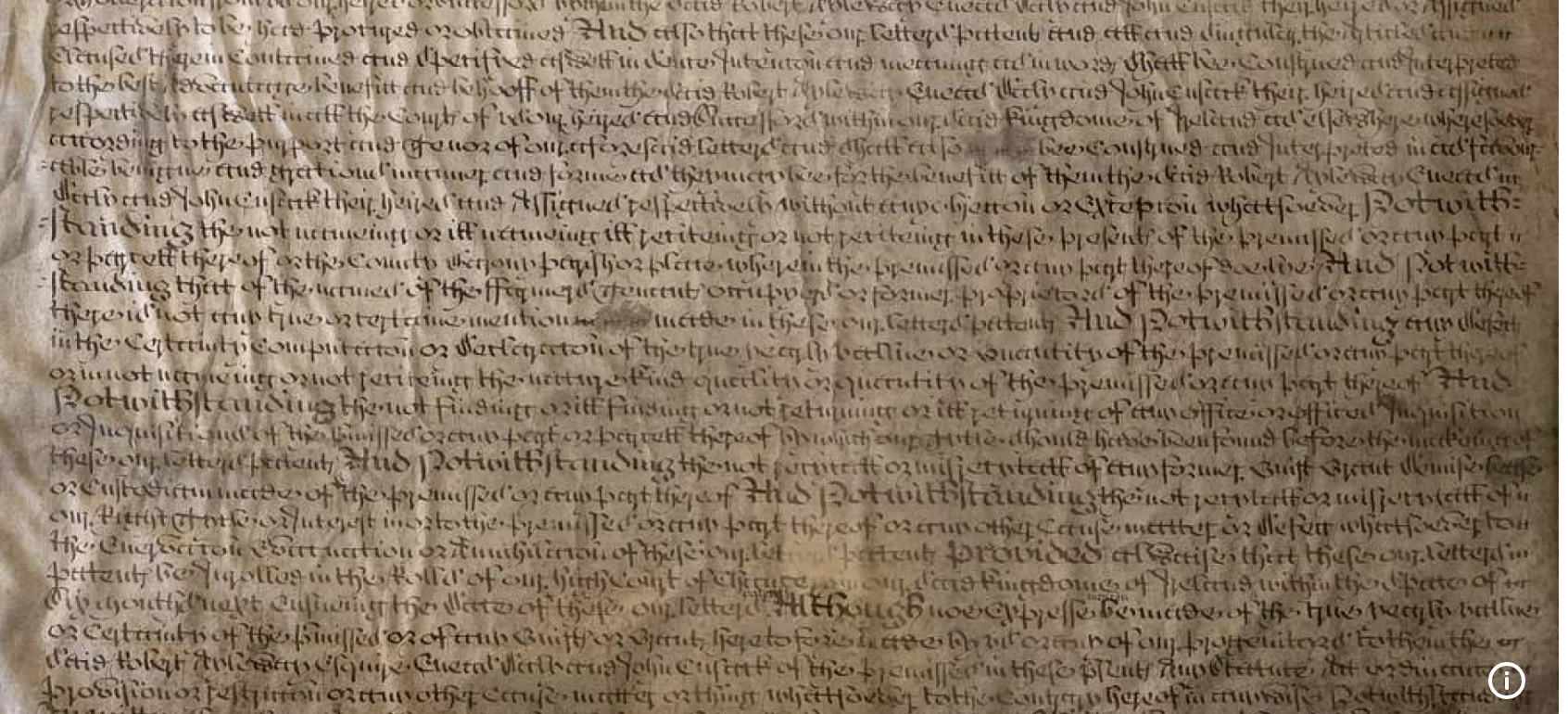
Experts have started the painstaking restoration of a 650-year-old Ecclesiastical Register, one of Ireland’s most important medieval texts, as part of a project to preserve and digitise Ireland’s historical archives. Virtual Treasury of Ireland.

02 Thursday Jan 2025

Posted by durrushistory in Uncategorized

≈ Leave a comment

Tags

europe, Genealogy, history, ireland, travel


Extract from a Medieval Manuscript

A meticulous conservation project has begun to safeguard one of Ireland’s oldest surviving paper documents, The Guardian writes, dating back to the medieval period.

The document in question is an ecclesiastical register, approximately 650 years old, that once belonged to Milo Sweteman, the archbishop of Armagh from 1361 to 1380. Experts at the Public Records Office of Northern Ireland (PRONI) are now working to repair its fragile pages as part of a broader initiative to preserve vital historical records from the medieval period. The register, which contains drafts and copies of legal papers, letters, receipts, and wills, offers a fascinating glimpse into the ecclesiastical workings of the time.

Sarah Graham, the head of conservation at PRONI, explained the rarity of such documents, noting that paper of this age is incredibly scarce in Ireland. “Paper that pre-dates 1450 is particularly rare,” she said, adding that the material used in the Sweteman register likely came from Italy and Spain, regions that the archbishops frequently visited. This discovery came from research into the document’s watermarks, shedding light on the trade of paper in medieval Europe.

The Public Records Office of Northern Ireland, Belfast.
The Public Records Office of Northern Ireland, Belfast.Albert Bridge / CC licence

The Sweteman register is not the first to undergo this meticulous conservation process. The register of Archbishop John Swayne, dating from 1418 to 1438, has already been completed, with a digitised copy and translated summary now available online. This project is part of the Virtual Record Treasury of Ireland, an effort to reconstruct the nation’s historical archive, which was largely destroyed in a fire during the Irish Civil War in 1922.

Virtual Treasury of Ireland:

https://virtualtreasury.ie/search-results?totalElementsInt=10&kwOperList=ANY&kwList=skull&kwSearchFieldList=all&resultSorting=relevance&pageNumberInt=0
← Older posts

Blog Stats

  • 840,565 hits

16th Regiment of Foot assisted female emigration australia ballyclough bantry bay caithness legion cavan regiment of militia cheshire fencibles coppinger's court inbhear na mbearc Irish words in use 1930s lord lansdowne's regiment mallow melbourne ned kelly new brunswick O'Dalys Bardic Family. o'regan Personal Memoirs rosscarbery schull sir redmond barry sir walter coppinger st. johns sydney Townlands treaty of limerick Uncategorized university of Melbourne victoria

16th Regiment of Foot assisted female emigration australia ballyclough bantry bay caithness legion cavan regiment of militia cheshire fencibles coppinger's court inbhear na mbearc Irish words in use 1930s lord lansdowne's regiment mallow melbourne ned kelly new brunswick O'Dalys Bardic Family. o'regan Personal Memoirs rosscarbery schull sir redmond barry sir walter coppinger st. johns sydney Townlands treaty of limerick Uncategorized university of Melbourne victoria
Follow West Cork History on WordPress.com

Enter your email address to follow this blog and receive notifications of new posts by email.

Join 518 other subscribers

Feedjit

  • durrushistory's avatar durrushistory

Archives

  • December 2025
  • November 2025
  • October 2025
  • September 2025
  • August 2025
  • July 2025
  • June 2025
  • May 2025
  • April 2025
  • March 2025
  • February 2025
  • January 2025
  • December 2024
  • November 2024
  • October 2024
  • September 2024
  • August 2024
  • July 2024
  • June 2024
  • May 2024
  • April 2024
  • March 2024
  • February 2024
  • January 2024
  • December 2023
  • November 2023
  • October 2023
  • September 2023
  • August 2023
  • July 2023
  • June 2023
  • May 2023
  • April 2023
  • March 2023
  • February 2023
  • January 2023
  • December 2022
  • November 2022
  • October 2022
  • September 2022
  • August 2022
  • July 2022
  • June 2022
  • May 2022
  • April 2022
  • March 2022
  • February 2022
  • January 2022
  • December 2021
  • November 2021
  • October 2021
  • September 2021
  • August 2021
  • July 2021
  • June 2021
  • May 2021
  • April 2021
  • March 2021
  • February 2021
  • January 2021
  • December 2020
  • November 2020
  • October 2020
  • September 2020
  • August 2020
  • July 2020
  • June 2020
  • May 2020
  • April 2020
  • March 2020
  • February 2020
  • January 2020
  • December 2019
  • November 2019
  • October 2019
  • September 2019
  • August 2019
  • July 2019
  • June 2019
  • May 2019
  • April 2019
  • March 2019
  • February 2019
  • January 2019
  • December 2018
  • November 2018
  • October 2018
  • September 2018
  • August 2018
  • July 2018
  • June 2018
  • May 2018
  • April 2018
  • March 2018
  • February 2018
  • January 2018
  • December 2017
  • November 2017
  • October 2017
  • September 2017
  • August 2017
  • July 2017
  • June 2017
  • May 2017
  • April 2017
  • March 2017
  • February 2017
  • January 2017
  • December 2016
  • November 2016
  • October 2016
  • September 2016
  • August 2016
  • July 2016
  • June 2016
  • May 2016
  • April 2016
  • March 2016
  • February 2016
  • January 2016
  • December 2015
  • November 2015
  • October 2015
  • September 2015
  • August 2015
  • July 2015
  • June 2015
  • May 2015
  • April 2015
  • March 2015
  • February 2015
  • January 2015
  • December 2014
  • November 2014
  • October 2014
  • September 2014
  • August 2014
  • July 2014
  • June 2014
  • May 2014
  • April 2014
  • March 2014
  • February 2014
  • January 2014
  • December 2013
  • November 2013
  • October 2013
  • September 2013
  • August 2013
  • July 2013
  • June 2013
  • May 2013
  • April 2013
  • March 2013
  • February 2013
  • January 2013
  • November 2012
  • October 2012
  • September 2012
  • August 2012
  • July 2012
  • June 2012
  • May 2012
  • April 2012
  • March 2012
  • February 2012
  • January 2012
  • December 2011
  • November 2011
  • October 2011

Blog at WordPress.com.

  • Subscribe Subscribed
    • West Cork History
    • Join 518 other subscribers
    • Already have a WordPress.com account? Log in now.
    • West Cork History
    • Subscribe Subscribed
    • Sign up
    • Log in
    • Report this content
    • View site in Reader
    • Manage subscriptions
    • Collapse this bar
 

Loading Comments...