The obituary of the Rev. Charles ~Donovan in the Skibbereen Eagle in 1893 is most unusual insofar as it included a very detailed genealogy. Maybe the Rev. Charles or one of the family wrote it; it looks like it relies on family papers. His career is ironic as a rabid Proselytiser preying on the starving Catholics of the Mizen Peninsula; you would not imagine his genealogy. His ancestor Daniel O’Donovan, head of Clan Cahill fought with his O’Donovan Regiment for King James in the battle of the Boyne in which four of his sons dyed. HIs grandfather Richard O’Donovan on his marriage to an English woman had to change his name to Donovan, he may have been a Catholic as he had to post a bond for £1,00 to the Church of Ireland Bishop of Cork. HIs son Charesl was a senior civil servant in Bengal and a Magistrate. His Indian born grandson Dr.Charles Donovan was a world renowned medical scientist. In a sense it shown family survival consequential on the Penal laws and adaptation.
Rev. Charles Donovan (1812-1893), p.1
Funeral and genealogy, p. 3
Among the funeral attendance, p. 14
Proselytiser, 16
1847 Plea for the preservation of the poor in Schull.p. 14
1849 Protection Meeting Ballydehob, p. 16
1849 Opening of Rev. Spring Protestant Church, Cape Clear, p. 18
1856 attending funeral of James 2nd Earl of Bandon, p. 19
1889 funeral of Archdeacon of Ross, Rev. Dr. Woodroffe, p. 20
Charles Donovan, JP., Bengal, died 1915 aged 74. His son known in Ballinadee as Judge Donovan, p. 21
1905 Judge Donovan, Courtmacsherry Regatta, p. 23
Grandson Colonel Doctor Charles Donovan, (1863-1951), p. 24
His ancestor Daniel O’Donovan, head of Clan Cahill fought with his O’Donovan Regiment for King James in the battle of the Boyne in which four of his sons died., p. 28
His grandfather Dr. Richard O’Donovan surgeon of Nohoval, p. 30
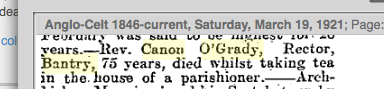
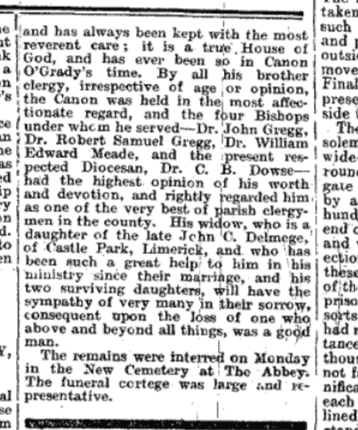
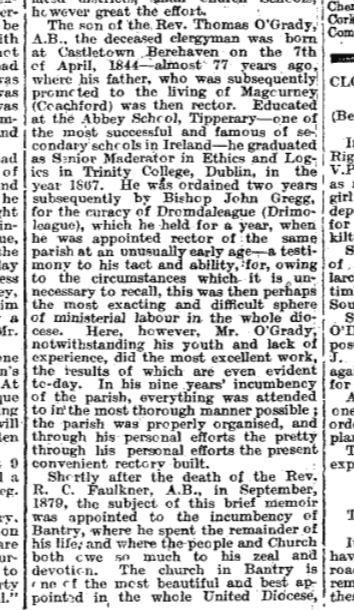
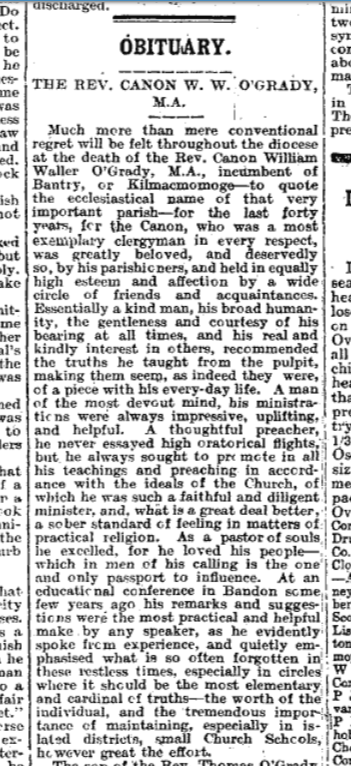
Canon William Waller O’Grady, 42 years, Rector of Bantry, died 1921 aged 76. POK page 7 grave 123
…
His brother: Carew O’Grady (1840-1919), 1875, Carrigmanus House, Goleen, farmer, Resident, £59, son of Rev. Thomas and Susan Dowe born Berehaven, m 1884, Florence, 5th d James Hingston, Aglish, Macroom?, 4 surviving children. Magistrate from 1875, 1881. 1890 Skibbereen Quarter Sessions sitting with Circuit Court Judge Ferguson on Schull licensing appeal cases. Magistrates, John K?. Barrett, William Murphy, M.P., George Robinson, Somers. H. Payne, W.S.Payne, Henry R.Marmion, Samuel Jagoe, O’Donovan, John R. H. Becher, William Norwood, Carew O’Grady. Skibbereen Eagle 14th August 1892. 1893 Unionist meeting Skibbereen. 1883 letting Carrigmanus House with a farm of 143 acres. Re a contested burial. 1894 Patron Schull Regatta. 1901 patron Crookhaven Regatta with Marconi. Co. Grand Juror, listed 1913. Brother of celebrated author and Celtic scholar Standish O’Grady and Canon O’Grady, Bantry. Probably a bee keeper. Probate to daughter Susan Maria spinster.
Probably
Somers (Henry) Payne (1854-1920), BL, 1885, Carrigmahon, Monkstown, major business figure Cork. 1892 attending funeral of Jane Dillon nee Roycroft (1843-1892). Executor James W. Payne. Barrister, Businessman, Land Agent. Somers Payne B.L. (1853-, 1885, Carrigmahon, Monkstown, son John Warren Payne, BL. Land Agent, Beech House, Bantry, he ran against James Gilhooley in election and was defeated, Bantry, ed. Rossall, Irish Bar 1875-1883, Director Munster and Leinster Bank, Bandon Railway, m 1879 Edith d John Leslie, Lee Carrow, Passage, Paynes originate Upton, Bandon, Land Agents to Bantry and other Estates, listed 1913. Somers Henry Payne, James Gilhooly MP alleged he was sitting in Durrus Petty Sessions 1887 outside his district. 1890 Skibbereen Quarter Sessions sitting with Circuit Court Judge Ferguson on Schull licensing appeal cases. Magistrates, John K?. Barrett, William Murphy, M.P., George Robinson, Somers. H. Payne, W.S.Payne, Henry R.Marmion, Samuel Jagoe, O’Donovan, John R. H. Becher, William Norwood, Carew O’Grady. Attending Cork Grand Jury 16 times 1887-1889. Irish Bar 1875, Munster bar, 115 Upper Leeson St.
Title: The O Heas of southwest Cork Author: Collins, John T. Journal of the Cork Historical and Archaeological Society, 1946, Vol. 51, No. 174, page(s) 97107 Published by the Cork Historical and Archaeological Society Digital file created: July 16, 2015
Chancery Rolls, 1624, Bantry Pilchards, c 1600 Landing Spanish Soldiers in Kinsale, Unbought Wine Left Behind, c 1600 Donnogh O’Leary, Kilbarry, Dunmanway or Muskerry, 1628 O’Driscoll, Baltimore/McCarthy, Kilbrittain, James Gallway, Ibane (Clonakilty), O’Sullivan/Coppinger/O’Driscoll, Baltimore, c 1600 Whitcomb, Merchant, Kinsale, Daniel and Dominic Roche v William and Dorothy Gage, lands at Crookhaven, Kinsale, 1625 Morrogh O’Hea
1656. Petition of The Following, ‘That Daniell O’Donovand als O’Donovane of Curraghnylickey (Drinagh), Most Knew Him before 1641 Rebellion, as a Civil Honest, and Quite Gentleman’, Samuell Browne, Edward Renys, Edward Clerke, Francis Barnett (Mark) Mathew Perrott, Amos Bennets, Robert Osborne, Dermod O’Mahowby, Samuel Skinner, William Holcombe, Thomas Attridge, Barnabe Witcherly, Der. Coughlan, Will Corlless, Thomas Recraft (Roycroft), Mathew Sweethman (Sweetnam), Geyles Smith (Mark), Timothy Coughlane, Ja? Base, Abel Marshall, John Vallyes (mark), Ralph Fuller, Teig Has (O’Hea?), Phillip Otrrydge (Attridge), John Baily, John Abbott, Philip Madoxe, Rowland Neild, William Ottrydge (Attridge), Thomas Hungerford, Samuel Poole, James Dyer, Richard Nobbs, John Chamberlen (Mark), Bart Philpot, Richard Skines (Skuse?) (Mark), Henry Abbott (Mark), Richard Chambers (Mark), Thomas Duggen.
1718. Will of James O’Hea, Killkeirane, Clonakilty, Co. Cork, be be Buried in Ancestral Tomb, Timoleague, O’Heas in Convert Rolls.
On the forfeiture of O’Hea lands due to rebellion some held in trust by Townsend family on their behalf. later substantial lot of townlands let on favourable terms
James O’Hea, 1795, Greenfield. Son of James O’Hea, Kilkerran will dated 1720. Brother James, a Barrister, other brother John, officer North Cork Militia served in Wexford 1798. 1791 Meeting as ‘James Hea’, at the Kings Arms Tavern Cork of Members of Hanover Association (Landowners/Magistrates) re Whiteboys.
John O’Hea Esq, -1847), listed 1838, Shannon Square, Clonakilty. 1828 seeking reform of the House of Commons. Honoria Deasy who was a Daughter of Rickard Deasy married John O’Hea (Magistrate from 1838-1843) in 1826 and they had 10 children, the youngest Alfred who was born in 1847 just a few months before the death of his father. Attending an 1843 meeting in Clonakilty of Cork, Kinsale, Skibbereen Turnpike Trust. Resigned 1843 over dismissal of Magistrates for attending Repeal Meetings. Following a report to the Lord Chancellor regarding the activity of Magistrates sympathetic or attending a dinner in honour of Daniel O’Connell and Roche a number were superseded or resigned. Testimonial of John O’Hea, Esq., 1847 distribution for Clonakilty of New England Relief Committee Famine Relief. Died Clonakilty, Co. Cork, 1847. Included Thomas Allen, J.P., Allin and Co Shannonvale, James Redmond Barry Fishery Commissioner, J.P. Glandore, W. J. F. Barry son of Redmond Glandore, Rev. J. Beamish, Kilmalooda, Francis Bennett, Clonakilty, William Bennett Clonakilty, John Callaghan Clonakilty, Daniel Clanchy, J.P., Charleville, John Coghlan Clonakilty, James Comyn Cobh, C. Connell and Co Ballinascarthy, J. Nelson Crofts, Clonakilty, Eyre Croke Croker, Ballyra, Thomas Deasy, Clonakilty, Patrick Desmond Clonakilty, Richard Dennehy, John Donovan, Clonakilty, Jeremiah Donovan brother of Rickard, Midleton, Rickard Donovan, Clerk of Crown (State Solicitor) Cork, Joseph Dugan, Clonakilty, William Ffolliott, M.D. Clonakilty, Henry Franks Clonakilty (Probably of extended Kearney Garretstown House family), Alexander Grant Clonakilty, P. B. Grifin, G. F.Hardy Cork, Miss Anne Gallwey, Kilkerran, Charles Gallwey Kilcoleman, Michael Gallwey J.P. KIlkieran House, Henry Gallwey, Greenfield, William Gallwey, Kilcoleman, Major Hill Late 54th Regiment Clonakilty, Daniel Kelly Clonakilty, M. Irwin Clonakilty, J.E Lucas, Ring, Clonakilty, Dr. Lucas, Richsfordstown, O.H. Marmion, Skibbereen, Nicholas Daniel Murphy, Cork, Major J.H.O. Moore, 35th Regiment Jersey, Daniel McCarthy Skibbereen, John McCarthy Clonakilty, T. McCarthy Downing Solicitor, Skibbereen, Richard Boyle Norcott, Skibbereen, F.J. Power, Bank Manager, Clonakilty, Rev. J. Quarry, Clonakilty, Patrick Scott, Dublin, William Scott, Mamore House, Rev. Henry Stewart, Rathbarry, James Sweeny, Clonakilty, Daniel Sullivan, Clonakilty, James Toohig, Clonakilty, Winispeare Toye, Clonakilty, Thomas Richard Wright, Solicitor Clonakilty. Michael O’Hea, (1866-, 1895, Rock Cottage, Timoleague, listed 1913. Farmer, has Irish. 1896 donor Rosscarbery Church organ fund. 1901 Subscriber Clonakilty Agricultural Society. 1901 Officer Clonakilty Agricultural Show. Attending 1898, enormous funeral of Dan O’Leary, JP, aged 71, Clonakilty, probably draper. Contributor the indemnity fund 1899 for the election petition of John Walsh. Butlerstown, Vice Chairman, 1904 Timoleague Athletic Sports. 1910 member Courtmacsherry Regatta Committee. March 1916 Courtmacsherry recruitment drive. In the early years of World War 1 there was strong support from all classes regardless of religion or politics in Ireland towards recruitment to assist the British. There was hardly a townland in the country that did not have recruits. Additionally the farmers prospered due to high food prices. However at least in nationalist Ireland from mid 1916 and into 1917 when conscription was suggested the mood changed. Perhaps around 50,000 Irish born men perished for nothing, an epic disaster for young Irish men. Ireland was a colony, in contrast to another small Northern European State, Denmark was independent and neutral. It is thought that about 800 Danes died in the conflict.
Probates in Ireland are an absolute disaster zone, mostly all that survived post 1922 destruction of the Public Records Office in Dublin is a 1 line name sometime and address or occupation. This is an attempt to add to some of these listed from other sources or give information on the family.
Prerogative Wills
Prerogative and diocesan copies of some wills and indexes to others, 1596 – 1858
Before a will can take effect, a grant of probate must be made by a court. If someone dies without having made a will, the court can grant letters of administration for the disposal of the estate. Since 1858, grants of probate and administration have been made in the Principal and District Registries of the Probate Court (before 1877) or the High Court (after 1877). They are indexed in the calendars of wills and administrations (available on this website for 1858 – 1922).
Before 1858, grants of probate and administration were made by the courts of the Church of Ireland (the Prerogative Court and the Diocesan or Consistorial Courts). Almost all of the original records were destroyed in the Public Record Office in 1922. Most of what appears on this site are indexes to the original wills.
For the pre-1858 ecclesiastical courts, will books containing copies of the originals survive for the Prerogative Court (1664-1684, 1706-1708, 1726-1728, 1728-1729, 1777, 1813 and 1834) and some Diocesan Courts – Connor (1818-1820 and 1853-1858) and Down (1850-1858). The will books for Armagh, Belfast and Londonderry are in the Public Record Office of Northern Ireland.
The records can be searched by name, date, residence and district or diocese.
A meticulous conservation project has begun to safeguard one of Ireland’s oldest surviving paper documents, The Guardian writes, dating back to the medieval period.
The document in question is an ecclesiastical register, approximately 650 years old, that once belonged to Milo Sweteman, the archbishop of Armagh from 1361 to 1380. Experts at the Public Records Office of Northern Ireland (PRONI) are now working to repair its fragile pages as part of a broader initiative to preserve vital historical records from the medieval period. The register, which contains drafts and copies of legal papers, letters, receipts, and wills, offers a fascinating glimpse into the ecclesiastical workings of the time.
Sarah Graham, the head of conservation at PRONI, explained the rarity of such documents, noting that paper of this age is incredibly scarce in Ireland. “Paper that pre-dates 1450 is particularly rare,” she said, adding that the material used in the Sweteman register likely came from Italy and Spain, regions that the archbishops frequently visited. This discovery came from research into the document’s watermarks, shedding light on the trade of paper in medieval Europe.
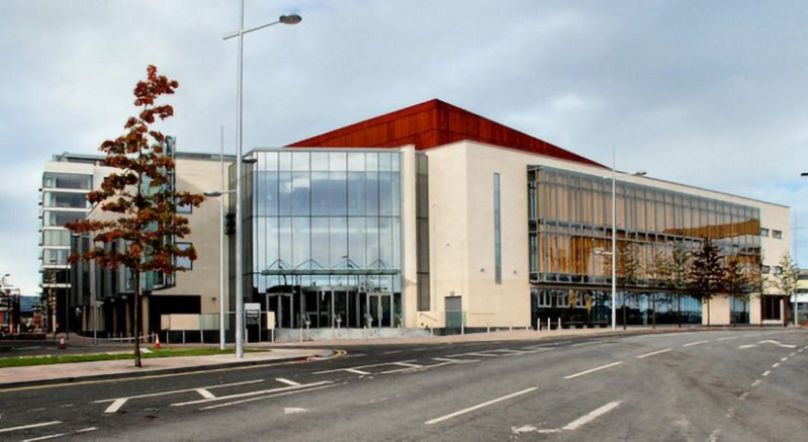
The Public Records Office of Northern Ireland, Belfast.Albert Bridge / CC licence
The Sweteman register is not the first to undergo this meticulous conservation process. The register of Archbishop John Swayne, dating from 1418 to 1438, has already been completed, with a digitised copy and translated summary now available online. This project is part of the Virtual Record Treasury of Ireland, an effort to reconstruct the nation’s historical archive, which was largely destroyed in a fire during the Irish Civil War in 1922.
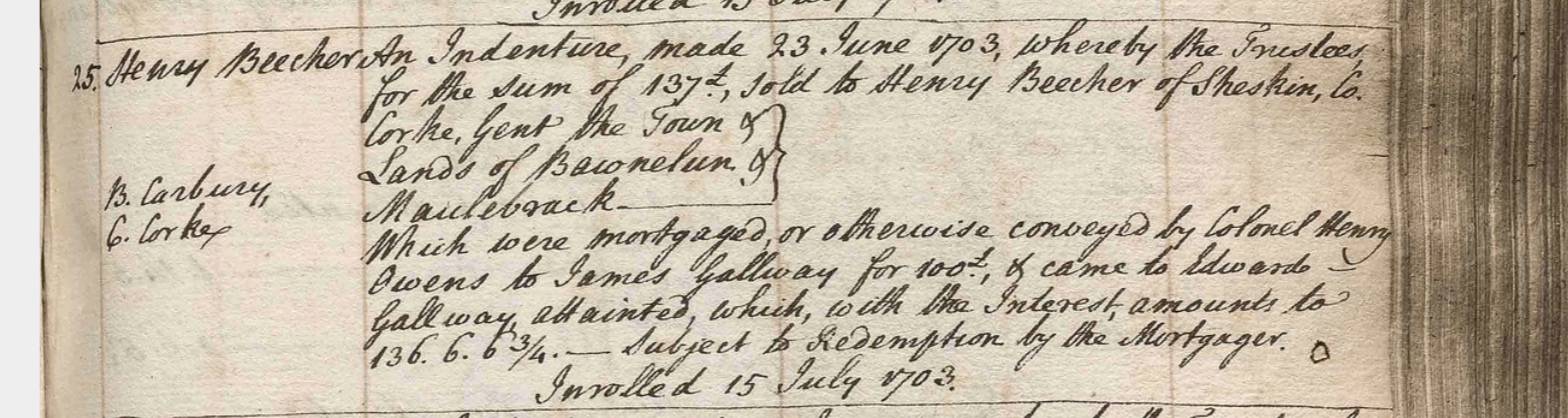
Henry Becher (1664-1738), TCD in 1683 aged 19, son of Thomas Sherkin Island, 1705, witness to 1717 deed with Emanuel Moore. Henry Becher was Thomas Becher’s eldest son. He married Henrietta Owen in 1698. His heir was John Becher. Henry died in 1738.
Henry Beecher, (1759-1780), 1779, Creagh/Creaford, Skibbereen. 1765 11 July Cork City Newspapers. “To be Let, part of the estate of Henry Becher(aged 5) during his minority. Lands of Gortadrohid, Ardnagreena on harbour of Baltimore etc. contact Michael Becher guardian. 1779 Hibernian Magazine Dec 1779 “Henry Becher of Creaghtford to be a J.P. of the Peace for the Co of Cork”. 1780 Hibernian Chronicle 25 Dec 1780 “Died Thursday last, Henry Becher at Creagh near Baltimore.” The guardian Michael Henry Becher [1735-1778 was his uncle & my 4 x Great Grandfather. He was married to Catherine French. Poor Henry is the one who died after a shooting accident on his 21st birthday.
John R. Beecher, Hollybrook, Skibbereen, listed 1856, sitting Skibbereen 1861. 1856 Ballydehob Presentment sessions. May have married Catherine Jermyn only child of Henry and Mary of Aughadown, 1805 he assigned property to Richard Hungerford and Becher Fleming to provide £225 pa should she survive him.
l.
John Townsend Beecher, 1760, Anne Grove, 1755 Faulkner’s Dublin Journal 22 Feb 1755 “17 Feb Married last Thursday John Townsend Becher Esq To Miss Donovan, d Rev. Morgan O’Donovan, Magistrate, Ballinacalla, with £5000. Died 1761, at her lodgings near South Gate, Mrs Beecher, relict of John Townsend Beecher of Ann Grove”. Possibly, 1771 Limerick Chronicle 10 Oct 1771, “Thursday last at Cork Colonel John Becher of Hollybrook to Miss Bab. Townsend of Skibbereen.”Michael Beecher, 1777, Creagh, Skibbereen, member Atlantic Society literary society. Subscriber of 1766 ‘The History of the Irish Rebellion’, Cork, 1766. 1778 Dublin Hibernian Journal Aug 24 1778, “Died-Near Bandon Michael Beecher of Creagh Esq.” 1789 Cork Evening Post 12 Jan 1789, ‘Last Sat George Pigott Rogers Esq. to Mary Twogood Becher, dau of the Late Michael Becher of Creagh, Esq’. Michael Alleyne Richard Beecher (1839-, 1875, Ballyduvane, Clonakilty, Resident, £130, 1870, 2,101 acres, listed 1916. Landed proprietor, widower 1901. 1884, signed a protest against the dismissal of Lord Rossmore, Head of Orange Order, Monaghan. Sampson T.
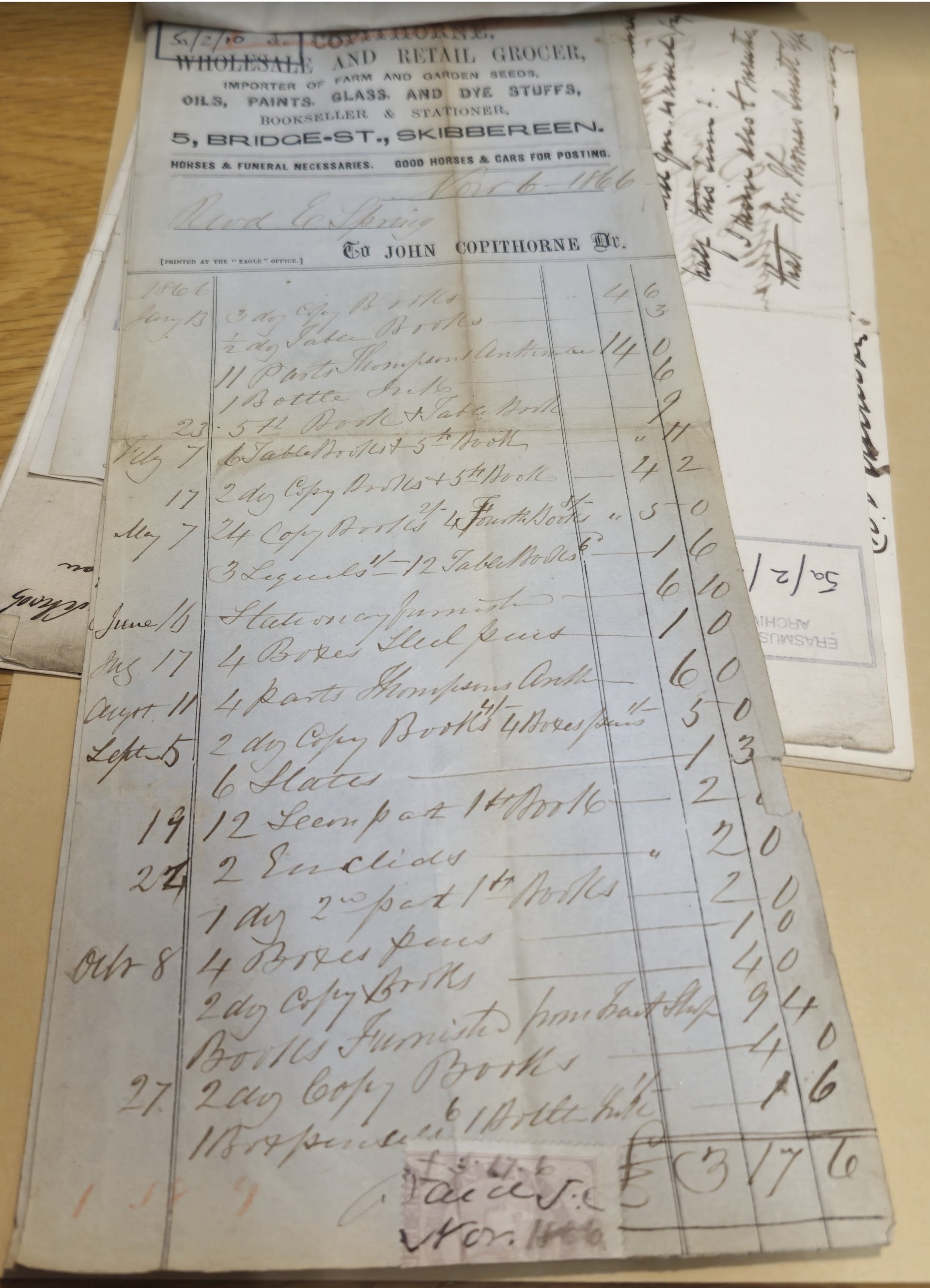
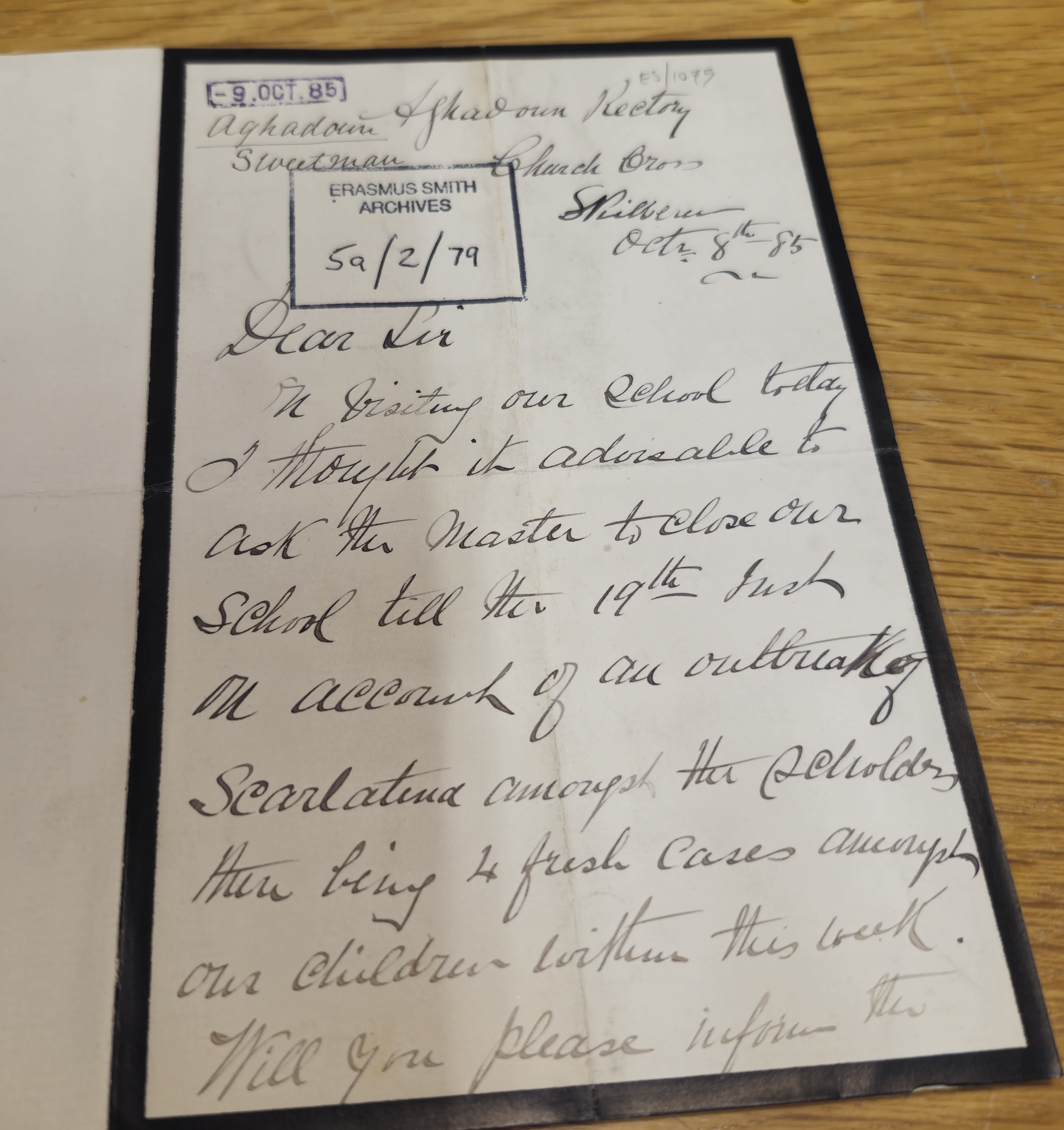
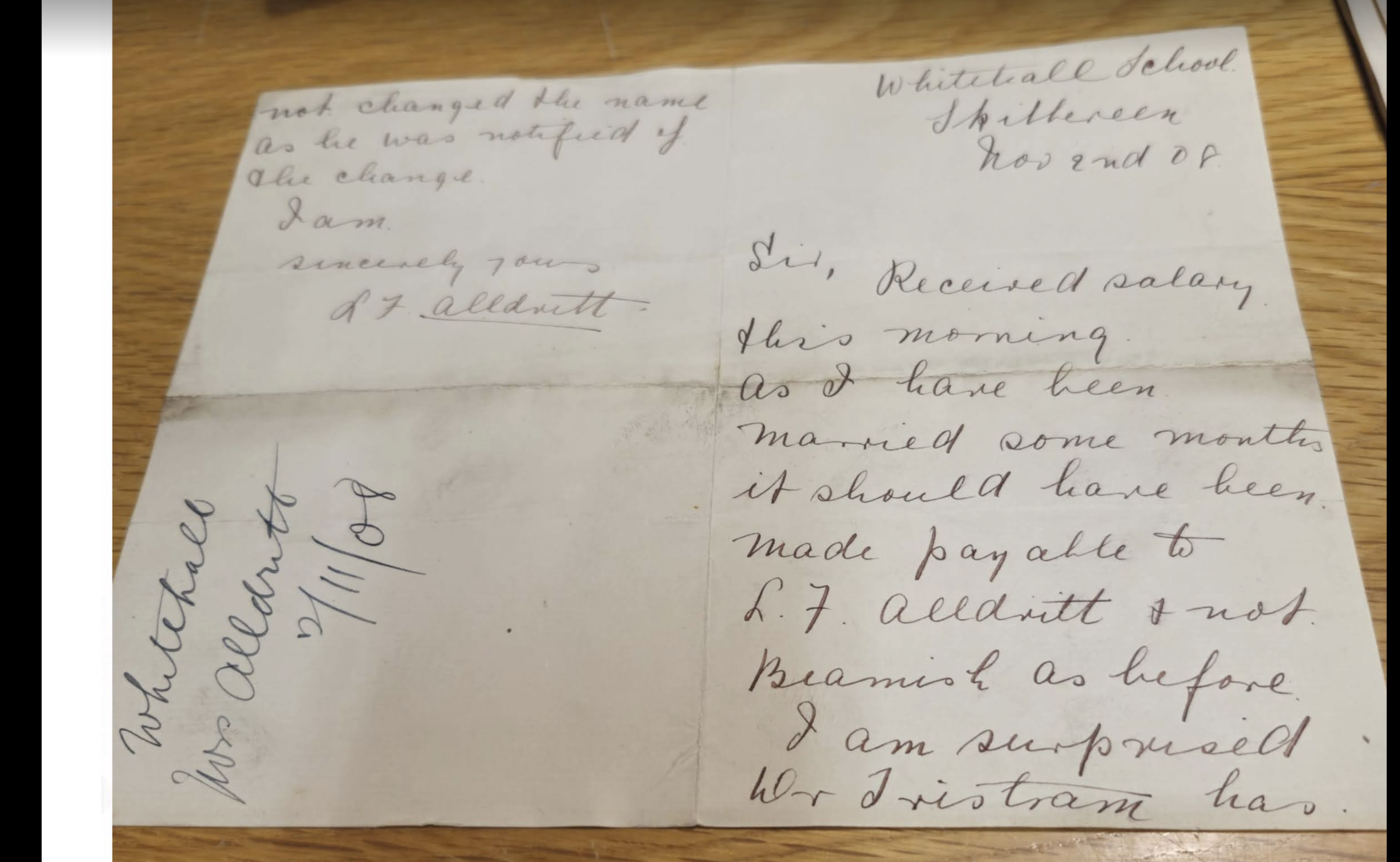
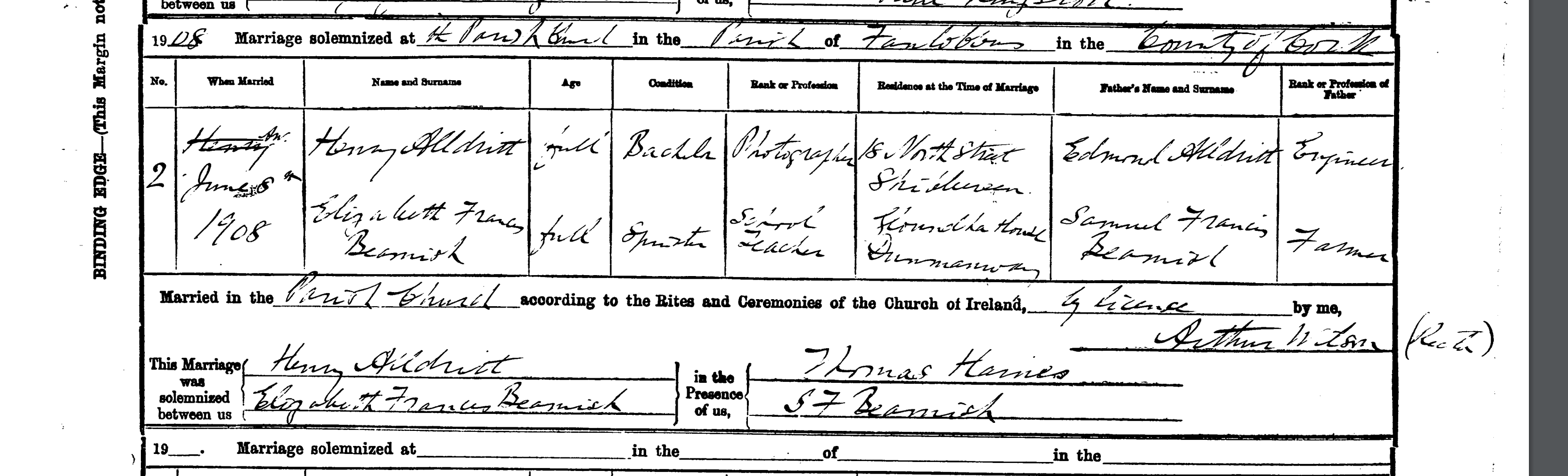
Aughadown (Erasmus Smith) School. 1866 Invoice From John Copithorme, Skibbereen for School Supplies. School Closure 1885 for Outbreak of Scarlatina. 1909 Letter from Mrs. Alldritt teacher (Nee Elizabeth Frances Beamish, Dunmanway) seeking payment of her Salary to her Husband.
.
..
English School Summary School Name Aghadown, Whitehall County Cork
Property Documents Correspondence 1866-1887, 1888-1919 Architectural Plans 1812 Date of Sanction 1828
Notes Patron Rev. H. H. Beecher Grant £ Salary Discontinued 1919 Other Place Names
School Name Baltimore County Cork
Property Documents Correspondence 1882-1918 Architectural Plans Date of Sanction 1883
Notes Patron Rev. J. Jones Grant £ Salary Discontinued 1916 Other Place Names
School Name Bandon County Cork
Property Documents Correspondence 1867-1882 Architectural Plans Date of Sanction 1821
Notes Patron Grant £ Salary Discontinued 1882 Other Place Names
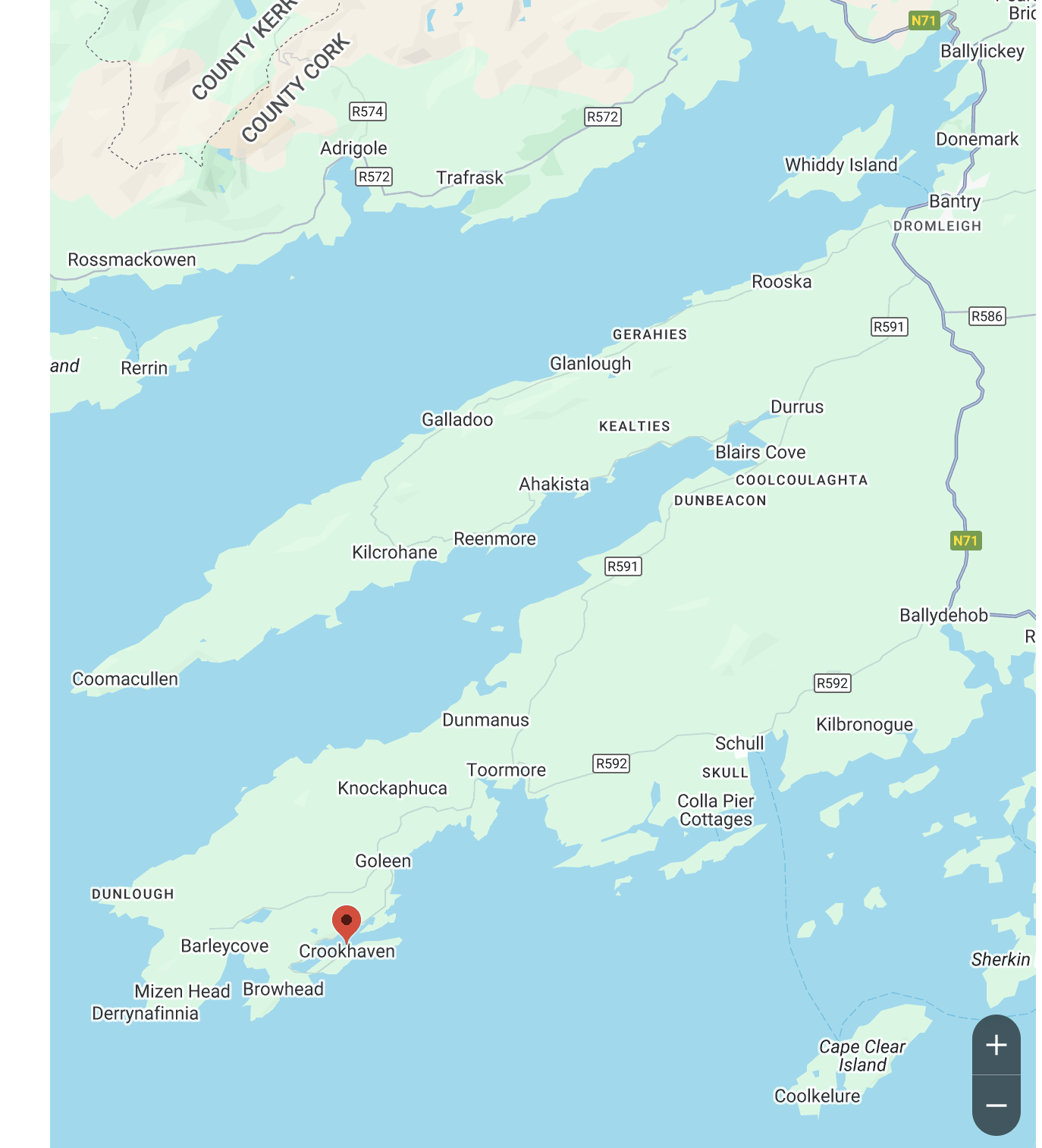
Warrant, by the Duke of Ormond, for the payment, to the Earl of Barrymore, of the sum of twelve pounds sterling, for the building of boats for the Garrison of Crookhaven, &c, Dublin Castle: 9 December 1662
Creator
Edward Edwards (1812-1886)
Level Of Description
Item
Extent And Medium
Copy
Archival History
The Carte Collection (MSS. Carte 1-279) of historical papers was received chiefly by the Bodleian Library, Oxford in 1753-1778. This Calendar (MSS. Carte Calendar 1-75) gives an abstract of every paper in the Carte Collection in chronological order. It was formed by Edward Edwards, a librarian and writer, in 1877-1883 at the expense of the Bodleian Library. In September 2004, the Bodleian Library keyed in 32 of the original 75 volumes of Carte Calendars (Vols. 30-61). This data was shared with, and platformed by, the VRTI in 2024.
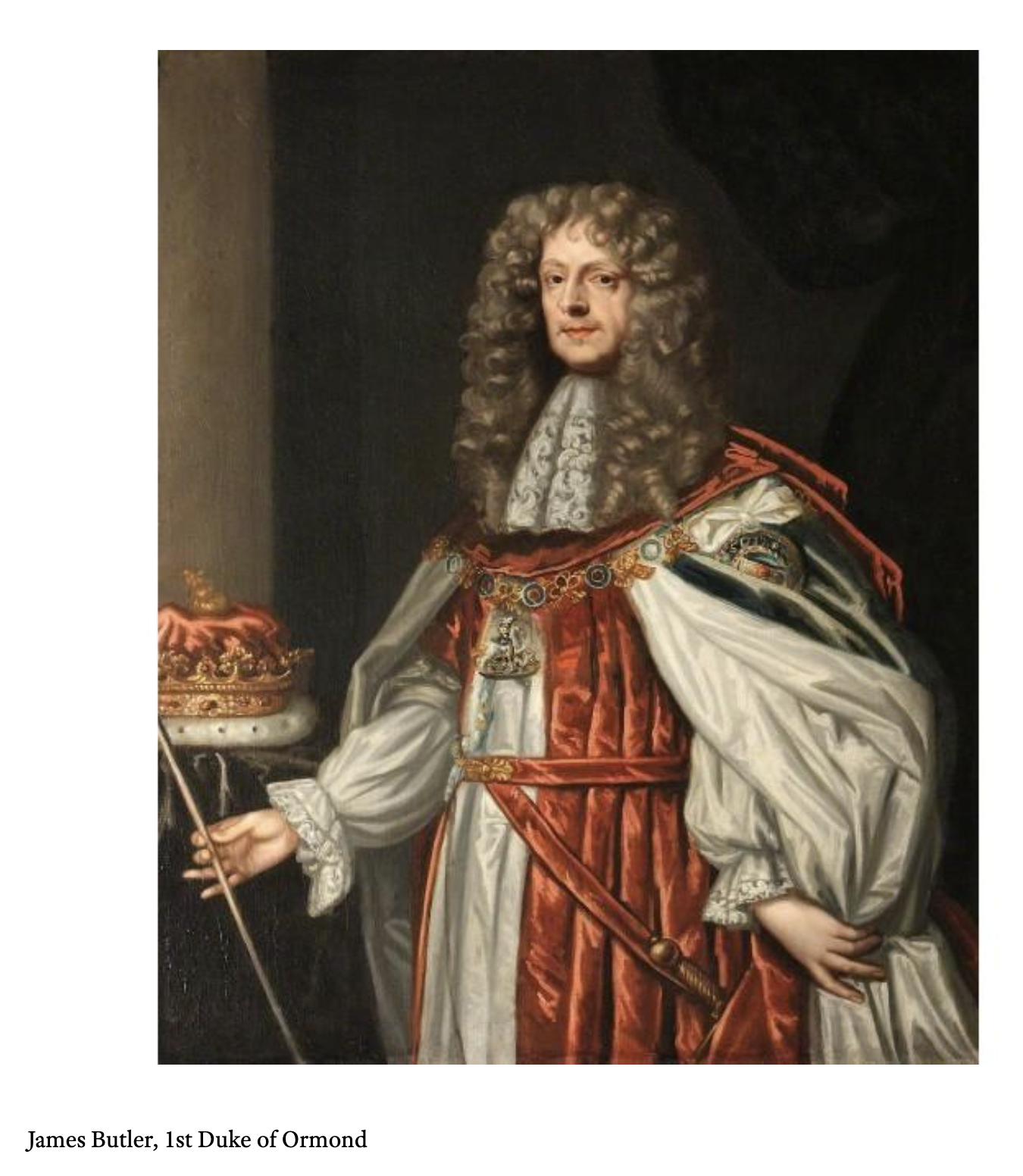
Butler, James (1610–88), 12th earl and 1st duke of Ormond, was born 19 October 1610 at Clerkenwell, Middlesex, England, eldest son of Thomas Butler, Viscount Thurles , and his wife Elizabeth, daughter of Sir John Poyntz, of Iron Acton, Gloucestershire. Thurles was son and heir to Walter Butler (qv), 11th earl, who succeeded to the title in 1614 on the death of his uncle, Thomas (qv), 10th earl, whose one surviving child was a daughter, Elizabeth (qv). The viscount took his family to Ireland, but when returning from a visit to England was shipwrecked and drowned on 15 December 1619, leaving the 9-year-old James as the direct heir to the title. His widow Elizabeth married (a.15 June 1626) George Mathew of Thurles, Co. Tipperary, by whom she had a second family. Youth and marriage The details of James Butler’s youth are mainly derived from Sir Robert Southwell (qv), who presented a brief and laudatory life of the duke to his grandson and successor two months after the first duke’s death. According to Southwell, on his father’s death, Butler’s mother placed him in a school in Finchley to be raised in the Roman catholic faith, to which both parents were committed. However, through the manipulation of the law, James I claimed the young heir as a royal ward and in 1622 put him in the care of George Abbot, archbishop of Canterbury, under whose tutelage he received a protestant upbringing. The religious part of his education made a deep impression on the boy, but in other respects Abbot made little effort to educate his charge, and it was only the intervention of the grandfather that ensured some facility in writing, French, and Irish. His Latin was almost entirely neglected.
1670 Indenture Captain Samuel Jervois and His Wife sell for £60 the entire Gneeve (Old land measurement a twelfth part of a townland which can vary in size.: https://www.dippam.ac.uk/eppi/documents/11941/page/282490 ) of Leap parrt of Cappanabohy
670 Indenture Captain Samuel Jervois and His Wife sell for £60 the entire Gneeve (Old land measurement a twelfth part of a townland which can vary in size.: https://www.dippam.ac.uk/eppi/documents/11941/page/282490 ) of Leap parrt of Cappanabohy
.
1670 Indenture Captain Samuel Jervois and His Wife sell for £60 the entire Gneeve (Old land measurement a twelfth part of a townland which can vary in size.: https://www.dippam.ac.uk/eppi/documents/11941/page/282490 ) of Leap parrt of Cappanabohy
Samuel Jervois, 1654. Close family connection with Barnstaple Devon. Received land debentures for being a Cromwelian Officer bought other lands. Built Brade House, Leap. Appointed a Commissioner for Transportation 1655 reappointed 1656 to identify those locally suitable for transportation. There are papers extant for the period whereby the church clerk of Castlehaven was to identify local Catholics in particular sons and heirs suitable for transportation. Married Martha Salmon, daughter of Captain Joseph Salmon, Glandore castle. Freeman and Burgess of Clonakilty, Sovereign 1679. Fled to Chester 1688 he reported his income then at £120 per annum. He returned to Brade, 1693, died 1693.
Obtaining letters patent from Charles II, his extensive landholdings were erected into the manor of O’Donovan’s Leap, or the Manor of the Leap, in 1684.
He was also appointed Registrar of the Admiralty in Ireland by James II.
O’Donovan was the son of Daniel Mac Murtogh O’Donovan, Lord of Clan Loughlin. A Protestant, he married in 1686 Elizabeth Tallant, daughter of Oliver Tallant, and they had three children; Jeremiah, John, and Anne.
O’Donovan Lands:
1616. Surrender and Regrant. Patent of James 1 of England.
Court of Pie Powder Reserved to Donnell O’Donovan for Fairs, Ascension Thursday and Townlands Listed from Castledonovan to Castlehaven, Caheragh, Glandore, Squince, Brahalish in Durrus. Manor of Castledonovan Power to Hold Court of Leet and Baron, Friday Market at Rahine, Tuesday market at Drimoleague.