1859-1913, died 1915 Dr. Jerry Cotter MD MCH, QUI, FRCSI 8 Sydney Place, Governor UCC, Board North Infirmary Dr Jerry of Sidney pl, Cork city is one of mine, a New Zealand relation, b 1859, Derryginah Bantry, died 1915 in Clonakilty (his McCarthy wife was from there). Him & a brother in London were the first doctors of the family & inspired others including here in NZ to follow suit, although one of his sons chose law instead. At the 1901 funeral Mrs Cotter is his mother Mary Gallagher 1826 of Summerhill, whose sister Mary 1840 married Patrick Burke. I don’t know about the Scullys, but Jeremiah of Breenymore’s brother was William 1858, rate collector. He married Julia Creedon, g’daughter of James Cotter of Derryginah (uncle of Dr Jerry 1859). When Julia died, he married Mary Cassey. From Bantry mother Scully I see he was b. 18 Jan 1859, mother was Mary Scully. There was a tribe of the Scully family descended from Catherine Anne Gallwey who m. James Scully JP but no issue m. to any Cotter that I can find despite several by the name of Mary. 1891 subscriber North Infirmary. 1901 funeral of Mrs. Cotter, Bantry sons Dr. P. J. Cotter, London, Dr. J. Cotter, Cork, nephew Dr. Patrick Burke, London 1886 Committee member of proposed Graduate Reform Association of Queens College Son 1909, 1911 Francis McCarthy Cotter B.A. Barrister “8, Sydney Place, Cork. 1911 Member Cork Historical and Archaeological Society 1912 attending funeral of Rev. Charles Walsh, Rector, Farranferris. Paddy O’Keeffe papers. 1913 car owner. Probate 1915 to widow, Mary, Clonakilty, £10,253
(SR 13/2/1817) – BREWERY – TO BE LET, AND IMMEDIATE POSSESSION GIVEN – THAT Remarkably well Circumstanced BREWERY; Situate at BANTRY, together with the UTENSILS, MALT-HOUSES and CONCERNS thereto Belonging – which have the Advantage of an Uninterrupted supply of Fresh Water, and being in a thickly Inhabited Corn Country, contiguous to the Sea, are worthy of Prompt Attention. – Proposals to be made to Simon White, Esq., Glengarriff, Bantry, or Richard Foott, Attorney, Cork, at whose Office a Plan of the whole may be seen. – Mr. James Cotter of Bantry, will shew the Concerns.
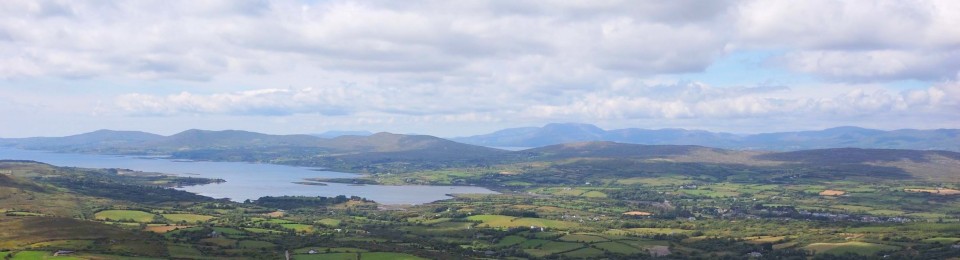
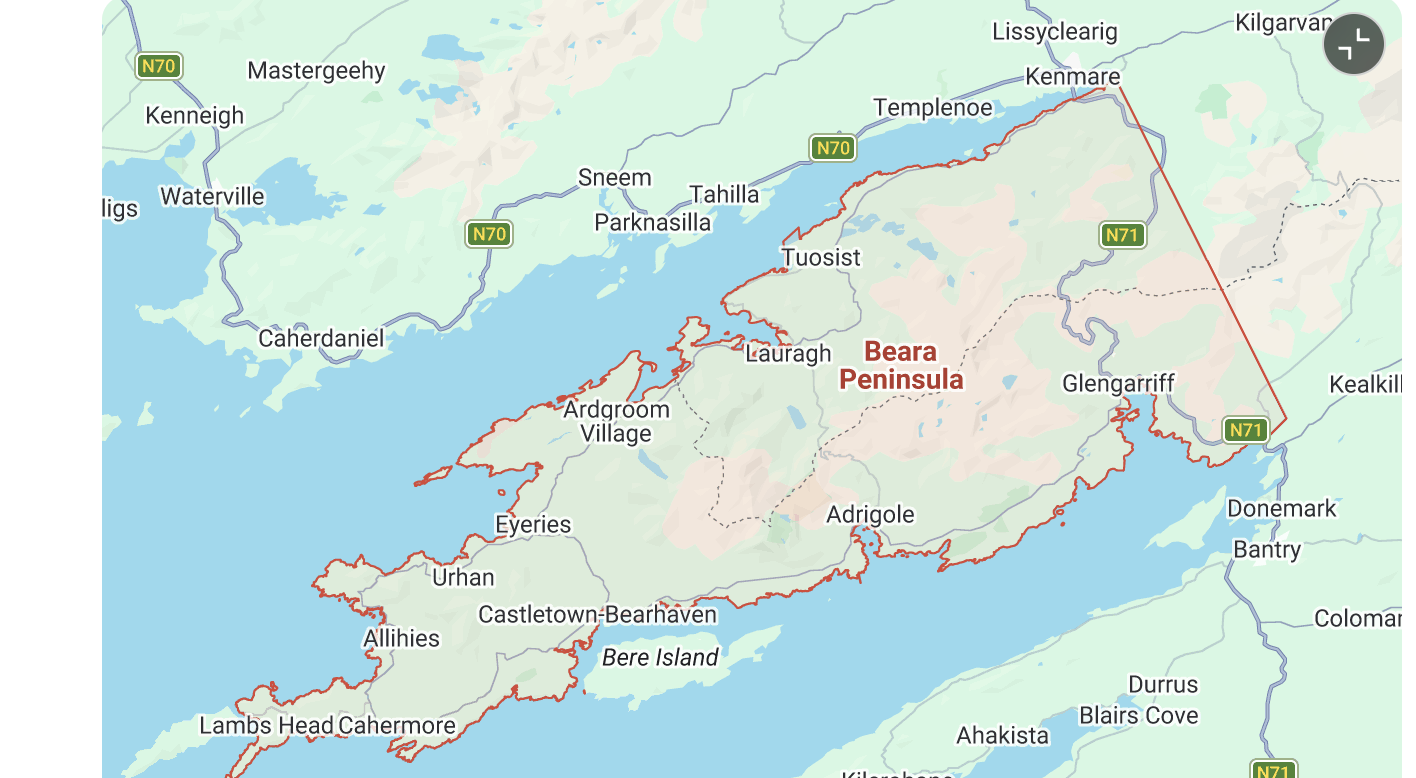
Most but not all of the Beara Peninsula is in Co. Cork with a section in Co. Kerry. The Barony referred to was notorious as it was in effect ruled by the Whites of Bantry (later Lord Bantry) and various Septs of the O’Sullivans mostly but not all Catholic. In theory they lost everything but in fact retained effective control allied closely to the Whites of Bantry and also Lord Kenmare. Most of their tenants who they rackrented would have been far better off under Protestant Landlords
There is a significant amount of correspondence in the Cork Archive in the Paddy O’Keeffe (Bantry businessman and historian ) papers with Lyne. Ranging on genealogy and history.
Courtesy Irish Times
Gerard Lyne was keeper of manuscripts at the National Library of Ireland (NLI) and a noted scholar of 19th-century agrarian Ireland. Born in 1944, he was brought up on the Kerry side of the Cork/Kerry border on the Beara peninsula where, near Ardgroom, in the 17th century, his first known direct ancestor, Dr Dermot Lyne, took a lease of lands. In 1698, Dr Lyne extended his holdings to Kerry, a small portion of which remains in Lyne’s family.
From this link derived his interest in Irish social history which lead to contributions to learned journals, notably, the Kerry Archaeological and Historical Society. He was co-founder, with Canon Thomas Looney, of Éigse Sheáin Úi Shúilleabháin (UCD folklorist) and regularly wrote for his parish’s award-winning Tuosist Newsletter . In 2005 he received the annual Kerry Heritage award.
A kinsman also to Daniel O’Connell, his history studies at UCD led him to a master’s on O’Connell and the Catholic Association and an assignment as assistant editor of the Correspondence of Daniel O’Connell.
Much of this work was carried out in the National Library of Ireland, where he became a permanent staff member in 1973 following a period teaching in Dublin, a stay in London and a time as a sub-editor in The Irish Times. He remained in the NLI until his retirement in 2009.
While, occasionally, wistfully saying that he would like to have been a journalist, he developed and retained a deep love for the NLI where he held various positions in Periodicals, the Genealogical Office, becoming surveyor of manuscripts and later keeper of manuscripts.
It was in this role as keeper of manuscripts that he came into his own. Operating, initially, in a period of tight financial restraint where, frequently, bidding on the open market for important items had to be foregone; happily, his tenure of office saw the pendulum swing allowing for many important acquisitions. Inter alia, whether through donation or purchase, papers of James Joyce, Seamus Heaney, Edna O’Brien and IQA (Ireland’s LGBT Society) were acquired.
Attending auctions, he was always cautious with the public purse. His convivial disposition ensured that he was on good terms with booksellers and literary figures; thus, he frequently got “the nod” when items were coming on stream which might, otherwise, have been missed. And his natural rapport with writers and accessibility are attested to in his many acknowledgements in contemporary publications.
During this period of financial largesse he oversaw the cataloguing of neglected estate papers which became the domain of specially employed archival students, thus ensuring a rich vein of native material for future scholars. He had an unerring eye for recruitment and loved seeing staff develop under his tutelage. Scholarly and knowledgeable, his helpfulness befitted his sense of the library’s serving learning and scholarship.
Becoming secretary of the almost defunct NLI Society, he revived its fortunes through his enthusiasm and a programme of stimulating lectures.
His ability with English was first endorsed when, in 1963, while a student at Cistercian College, Roscrea he won first prize in an all-Ireland schools’ essay competition. But despite being advised that it was cramping his imagination, he chose history rather than English for further studies.
His unique insight into the mindset of the dispossessed Gaelic aristocracy and the Catholic middleman within the new social hierarchy of a planted Munster underpin his books: The Lansdowne Estate in Kerry under WS Trench 1849-72 (2001) and Murtaí Óg (2017). The. (2017). The former was awarded the biennial NUI Irish historical research prize inspiring the RTÉ documentary Land is Gold.
The writer Eugene McCabe noted the “other-worldly aura of his personality” and his valuing “of a folk ballad full of awkward rhymes and unscanned lines as much as great lyrics by Yeats.” McCabe wrote of his ability “to spot the nugget of gold where others see only dross and fix it in that phenomenal memory of his.”
Being himself able to hold a note and deliver expressive renditions of folk song and ballad, Lyne’s liked nothing more, whether in Kerry or Dublin, than to visit a hostelry where a sing-song might ensue before evening’s end.
He passed away on June 5th, 2019 and is survived by his brother, Vincent , sister, Annette, sister-in-law, Elizabeth; nephews, Joseph and John; nieces, Anne Marie, Deirdre and Fionnuala. Suaimhneas síoraí dó.
When my mother was about to be confined she went to Bandon to be under the care of an old friend and relative who lived an a small house in Castle St. close to the river. Here on the morning of the lst May 1829 at 6 O’C am I was ushered into this world to undergo a training for eternity. The term of that training time has been a little more than the psalmist’s reckoning and on the whole I ought not to complain. My most painful time was during my childhood, the very times which should be the easiest if not the happiest portion of the training time. My grandfather was very old with an old mans ideas when I came under his care. I was naturaly dull and nervous and if I could lot learn as others I must be made to if possible no matter at what cost of pain or misery to the poor dullard. When about five years of age the old people came to live in the town of Bantry. Then I was sent to the usual infant school where I presume I learnt something as when about eight a more advanced school was chosen. Unfortunately there was no great choice, the national school then newly established or a private one conducted by a man named Healy. The Irish protestants from the very first were prejudiced against the national system of schools describing them “poor schools”. The result being they were almost from the commencement under the wing of the R.C. priests. Healy the teacher of the small private school was a self taught man attaining as many self-taught men do a fair knowledge of mathematics but seemingly holding in contempt all other branches of learning. He was a little man essentially a tyrant cruel to a degree whose great delight was to make the unfortunate little come trembling and sobbing into his presence. In certain aspects of his character he exceeded any thing depicted by the pen of Dickens. The treatment I received thus early in my life at this man’s hands must have had an ill effect on me throughout life. He was a Roman Catholic but my grandfather insisted that I should learn so many verses of the bible every day. In the repeating of these and other lessons the rod was continually shaking over us and that rod was usually a well seasoned holly one with the sharp points adhering. I had to endure it all silently having no one to complain to. As an instance of his treatment I may relate the following. The school room was a rough one with an open roof, over one of the rafters one day he threw a small rope tied under my arms and then hoisted me up swinging me too and fro at the same time letting me feel the holly rod greatly to the amusement of the other boys. His wife happened to see him at this, to his pleasant, occupation when she rushed in and released me at the same time giving him some of her mind. He was eventually had up before the Magistrates and fined for cruelly treating some other scholars whose friends became aware of the fact. On our parents death there was some understanding that Robt Edwards of Bandon and our father’s brother James should be our guardians. The one who really took an active interest, at least in life history was Mrs Edwards as good a hearted woman as could be met with but most unwise in all her dealings with young people especially boys. She seemingly could not resist any appeal from her own sons, their father taking little interest in them, so that the sons without exception were a burden instead of a help to their parents. A young couple with whom she was acquainted decided to establish a private school in Bandon and it was thought well that I should be put under their care. When I was ten years of age I together with my cousin George son of adult Bess- came to reside as borders with Mr and Mrs Thomas Robinson.
1886 Address from Some of Bantry Inhabitant to the Earl of Bantry, on His return from Abroad. 1885, House of Commons, London, A Lash of Tim Healy’s , MP, Tongue, The Earl of Bantry Off Chasing Kangaroos in Australia instead of Sitting on Cork Lunacy Board
1909 Bantry Feis. Patrons include Canon (Church of Ireland) O’Grady, James Gilhooley, M.P., Tim Healy King’s Counsel,M.P., Maurice Healy, M.P., The Earl of Kenmare, Magistrates, Dr. O’Mahony, Benjamin O’Connor, M. O’Driscoll, William Martin Murphy, Alexander Martin Sullivan, King’s Counsel, Dr. M. J. McCarthy, Patrick (Rocky Mountain) O’Brien, Dromore. Prizewinners, Industrial Section.
Emigration from Gearhies, Muintervara, to Joliet, Illinois, America. Visit of Bantry Born MP, Tim Healy 1881, Hotbed of Fenians, Hibernian Activity, Pro Boer Meeting Attended by Many Irish.
Bantry Gang: Healy Brothers, Thomas, Solicitor, M.P., Timothy, M.P. , Queen’s Counsel, Governor General Irish Free State, Tim, Sullivan Brothers, Alexander Martin, Owner ‘The Nation’, Founder Irish Parliamentary Party, M.P. Queen’s Counsel, Timothy Daniel, M.P. Composer ‘God Save Ireland”, Donal, Secretary Irish Parliamentary Party, M.P, Lord Mayor of Dublin, Harrington Brothers, Tim, Teacher, Journalist, Author of The Plan of Campaign, M.P., Barrister, Lord Mayor of Dublin, Ned, Organiser, M.P., William Martin Murphy, International Businessman, Railway Contractor, owner Irish Independent, Dublin United Tramways, M.P., James Gilhooley, Fenian, M.P.
Genealogy of O’Healy/Healy Family of Donoughmore, Co. Cork ancestors of Tim Healy, Bantry, Governor General and John Hely-Hutchinson/Earls of Donoughmore and 1850 census of St. Anne’s Parish, Shandon, Cork.
Meeting of Select Vestry, Skibbereen, West Cork, 10th May 1832, to appoint Officers of Health under Statute of the 59th year of His Late Majesty, King George 3, p. 31
Early Church Wardens, 1699, Bishop Mann Visitation of Church of Ireland Dioceses of Cork. Ref D121.1. 1827 Parliamentary Return of Vestries, 1851, 1861 Visitations, p. 31
1824. Cover letter and memorial from the church wardens of the parish of Fanlobbus, Dunmanway, County Cork, concerning prosecution of Sabbath profaners, p. 32
West Cork Select Vestries. 1885-1890, p. 32
March 1798. Rosscarbery, Drimoleague, Castletownbere, Select Vestries meeting to Levy a Rate to provide Four Men to Serve in Militia and to Levy Seven and a Half Pence Per Gneeve. Further meeting August 1803 to levy £1-6-o per ploughland to raise 5 men for Militia and £5-13-9 on town of Rosscarbery. Cost of Levy for Cork City and County, p. 32
Late 18th early 19th Century Interplay of the Select Vestries of the Church of Ireland (State Church) in Local Administration, Barony of Carbery, Castlehaven, Drimoleague, Durrus, Cess Payer Representatives Named, p. 32
1851 Visitation Book West Cork, Church of Ireland parishes, Population 1834 and 1851, Schools, Parish Clerks, Church Wardens.p. 32
1830 keeping the Sabbath in Clonakilty, p. 32
Townlands and Placenames, 1794 Principal Inhabitants Thanks to Government, 1870 Registered Vestrymen, Kilmeen Parish History, 1975 Dan O’Leary, Funded by Jerry Beechinorp. 32
1793-1803. Cork Grand Jury Returns including provision for Militia from 1795., p. 32
The Military Levy was raised through parishes by the Churchwardens, the parishes were subject to a levy or a bounty to be paid in lieu. The surviving records of Drimoleague and Castlehaven Select Vestries confirm this., p. 33
1757 Castlehaven, (Skibbereen), Select Vestry Records, shows interaction of parishes in road building: Cullane, Daniel, app. Director of the High Way in CTend 37. VM 4 OCT 1757., p. 33
March 1798. Rosscarbery Select Vestry meeting to Levy a Rate to provide Four Men to Serve in Militia and to Levy Seven and a Half Pence Per Gneeve. Further meeting August 1803 to levy £1-6-o per ploughland to raise 5 men for Militia and £5-13-9 on town of Rosscarbery, p. 33
Cork Grand Jury (Civil Jurisdiction) To 1899, p.33
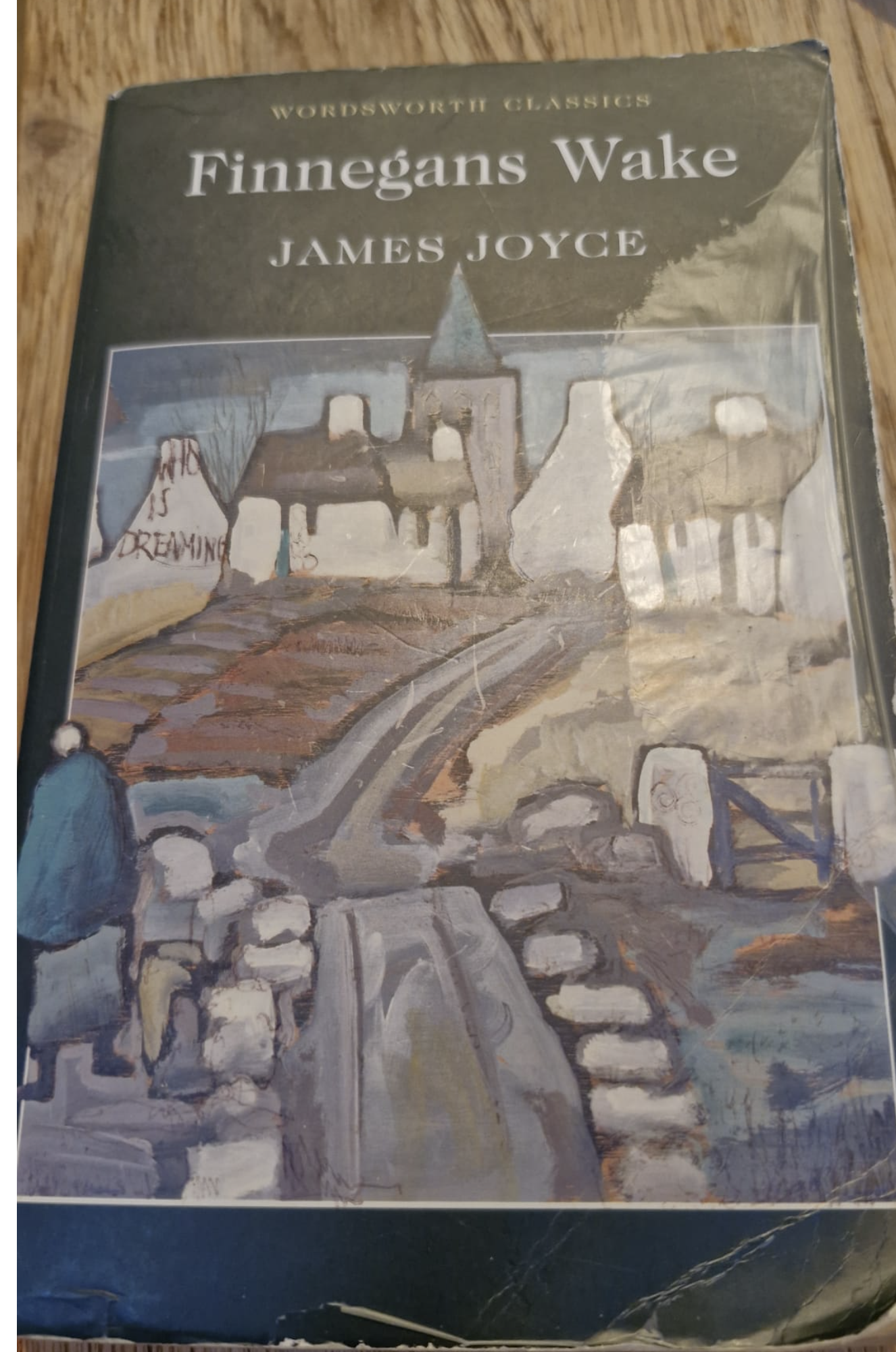
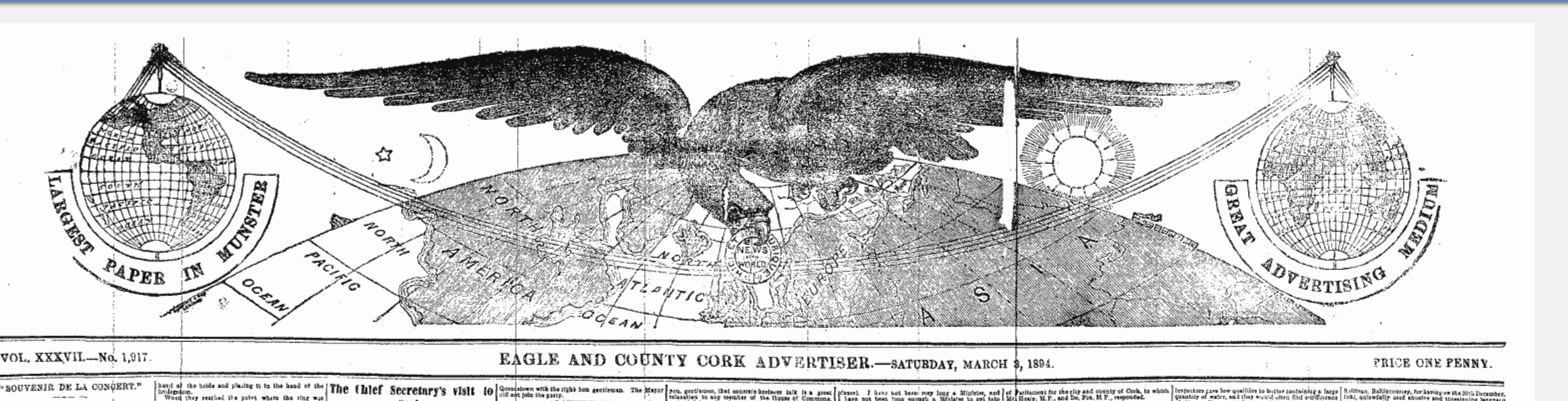
593.5: “Have sea east to Osseania:” HCE to Oceania! On the one hand, Oceania, the eastern sea, being about as distant as possible from Ireland, supports the claim to world-wide coverage. On the other hand, Ireland (the land of Ossian) represents the opposite. Contraries converging, or maybe just plain overweening provincialism: The Skibbereen Eagle once warned the Czar of Russia that it had its eyes on him. Compare Stephen’s sardonic “(European and Asiatic papers please copy” (P 251).
EXACTLY 125 years ago this year, in September 1898, The Skibbereen Eagle instilled fear into the Russian Tsar, a butterfly effect not replicated until the West Cork fishermen saw off the Russian navy last year.
AD
The eye of The Skibbereen Eagle focused on the Tsar’s success in securing an ice-free warm-water base for the Russian Navy on China’s Yellow Sea.
The Southern Star
Share
00:30
00:00
But only two weeks earlier, in something akin to modern day political sports-washing, Tsar Nicolas II sent an unexpected invitation to every government accredited to his Imperial Court.
The Tsar’s rescript invited these governments to a conference ‘to occupy themselves with the grave problem of excessive armaments.’
In truth it disclosed his military vulnerability dressed up as his pursuit of world peace.
The Tsar told the world that he was keen to ensure to all people ‘the benefits of a real and durable peace, and above all of putting an end to the progressive development of the present armaments.’
With his Chinese warm water naval port now secured, Tsar Nicholas II set out to achieve this worthy ambition ‘by means of international discussion’ at his peace conference.
And it met with great success, for within only a few months the Tsar’s peace conference created the Permanent Court of Arbitration where the arbitration and peaceable resolution of (some) disputes between nations continues down to this day.
The peace conference also developed ‘Rules of War’ for the treatment of prisoners of war. It even banned, for the next five years at least, the discharge of projectiles and deleterious gases from balloons.
Under Bismarck, the plethora of small German states had coalesced as the increasingly powerful German Empire, with the dynamo of its Prussian siege engine massed on its border with Russia.
AD
Acutely conscious that his guns could never match those of his neighbour, Tsar Nicholas II set out to prioritise peace over his inevitable defeat.
Andrew Carnegie, the philanthropist who built 80 libraries across Ireland also funded the construction of the Tsar’s dream home for the Permanent Court of Arbitration at the Peace Palace in The Hague, Netherlands.
The list of signatories to this Peace Convention today reads as an eerie who’s who of hubris and history – powerful people whose memory is neither remembered nor honoured.
It included the Prince of Montenegro and the Prince of Bulgaria and the long-forgotten Kings of Bohemia, Hungary, the Hellenes, Italy, Portugal, Serbia and Siam.
Imperial majesties, such as the Shah of Persia and Her Majesty the Queen of the United Kingdom of Great Britain and Ireland, Empress of India also signed, as did the Emperors of Of course, the ‘Emperor of all the Russias’ also signed up.
In the same month as the Tsar’s call to action in 1898, the son of a Corkman – claiming a connection to Daniel O’Connell – enrolled at Cardinal Newman’s University on St Stephen’s Green in Dublin from where he graduated in 1902. While it seems to scholars that young James Joyce was possessed of a stunning awareness and broad knowledge, much of his texts are derived from or informed by the newspapers of his time.
For the impecunious Joyce, local, national and international newspapers were readily and freely available to read in public libraries.
Today, these same public libraries act as ‘warm banks’ – places to visit to stay warm in the face of impossible domestic energy bills caused by Russia’s invasion of Ukraine.
But Joyce was not the only one reading English language newspapers.
They were being read in Moscow and St Petersburg as well.
We know this from the Tsar’s father, Nicholas I, who boasted during the Crimean War (1853-1856) that he had no need of spies.
He was learning everything he needed to know by reading Dubliner William Howard Russell’s account of the Crimean War published by the Times of London and read by embassies everywhere.
Joyce was nothing if not up-to-date when he weaved the Tsar’s Rescript and notions of world peace and international arbitration into Stephen Dedalus’ conversations with his fellow students at Newman House on St Stephen’s Green where they gathered around the Tsar’s portrait collecting signatures.
They were preparing to send the Tsar a testimonial of gratitude for his pursuit of world peace and the arbitration of disputes among nations. They had every reason to believe that a Tsar name-checked by The Skibbereen Eagle would read the praise of their Testimonial.
Joyce was clearly impacted by the Tsar’s Rescript and The Skibbereen Eagle as he threads the debate about world peace and international arbitration from Stephen Hero, begun in 1903 just after his graduation, to Portrait of the Artist as a Young Man published before World War I and again, after the horrors of that war, to Ulysses, published in 1922.
Clearly, the watchful eye of The Skibbereen Eagle had spawned an imitator in Joyce and a reader in the Tsar.
Perhaps, it is time now for The Skibbereen Eagle to re-send its impactful historic note to the current Tsar.
National and international papers, please copy!
Joycean Brendan Kilty, above, has examined the links between Joyce’s Ulysses and the Skibbereen Eagle’s references to Tsar Nicholas II.
• Brendan Kilty SC is a senior counsel, arbitrator and Joycean.
His human rights book ‘101 Reasons Not to Execute Someone’ is due to be released in 2023.
Dick Adams:
B 1843-1908 Richard (Dick) Adams Journalist, Barrister Inns 1873, Judge County Court Limerick 1892, Down Born Castletownbere, eldest son Brian Port Surveyor, Customs and Excise mother Frances (Fanny) O’Donovan sister of Doctor O’Donovan, Skibbereen. First cousin of Skibbereen O’Donovan family, Doctor Daniel adn his 2 Doctor sons, they are of ‘Isladn’ branch and once owned town of Ross. 1880 Munster Bar, 20 Mountjoy Square, Dublin. Born Castletownbere, eldest son Brian Port Surveyor, Customs and Excise mother Frances (Fanny) O’Donovan sister of Doctor O’Donovan, Skibbereen. First cousin of Skibbereen O’Donovan family, Doctor Daniel Famine Doctor his 2 Doctor sons, they are of ‘Island’ branch and once owned the town of Ross. 1880 Munster Bar, 20 Mountjoy Square, Dublin. “Journalist Cork and Freemans Journal, Defended James Fitzharris in Phoenix Park Murders, noted wit. From James Joyce ‘Ulysses’, ‘Dick Adams (Castletownbere born), the besthearted bloody Corkman the Lord ever put the breath of life in’ Journalist, Barrister, Defender of Parnell, Later County Court Judge Limerick
Ulysses: 7.679-80″ Buried St. Marys, Kensal Rise, London “Courtesy Ruth Cannon: from the Cork Examiner, 6 April 1908, this loving tribute to one of the Irish Bar’s most famous humorists, Limerick County Court Judge Richard Adams (b-l). Adams got much mileage out of his resemblance to King Edward VII (b-r), who he alleged once messaged him in the spa resort of Homburg requesting they dress differently to avoid confusion.
“Those who knew the late Judge Adams well will find it hardest to believe that he is dead. For with his personality, they associate all that was brightest and most vivifying in life.
That said, the future judge does not appear to have greatly distinguished himself in his early days. His first professional calling was that of a bank clerk in the National Bank in Cork. He was entrusted with the duty of opening letters containing bank notes in separate halves, a favourite way of sending money in those days, and then gumming the two halves together. But his lack of acumen for bank business was such that he frequently gummed the wrong halves together – a terrible misadventure in any well-organized bank.
Having regard to this, and a general unsuitability for bank life, Richard Adams decided that he had mistaken his vocation. Accordingly, he subsequently got called to the Bar in Hilary term of 1873. In actions for breach of promise of marriage his services were particularly sought, and it was one of the treats of the Four Courts to hear a speech on that congenial topic from one who was a master of humorous exposition. His admission to the Inner Bar was soon followed by his elevation to the Bench as County Court Judge of Limerick.
While not a profound lawyer, he did not himself at all mind jesting on the subject of his legal knowledge, and would tell how once he came into one of the Dublin Courts after the luncheon interval and heard a well-known solicitor proclaiming from the solicitors’ table to a cluster of minor lights ‘Adams! Oh, he has a fine nisi prius prescendi, but he knows absolutely no law,’ whereupon Adams himself put his genial countenance over the side barrier and said, ‘Look here, that’s slander of me in my business trade and profession, and it is actionable without proof of special damage, so look out for a writ.’ This was of course said with glorious good humour.
Judge Adams loved to go to health resorts on the continent. These sojourns were rendered doubly enjoyable by reason of his resemblance to the present King. ‘When in Homburg,’ he said, ‘the King’s Equerry came up to me and said ‘Mr. Adams, the King commands me to ask you as a personal favour not to be going about in a tall hat and frock coat. It is very embarrassing for his Majesty to be so often whacked on the back, and to be shouted at by gentlemen in Dublin accents, ‘Hello Dick, old man, how are all the boys in Dublin…’’
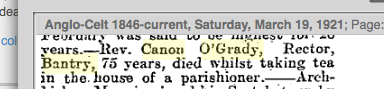
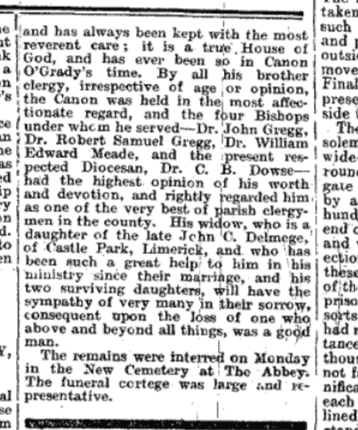
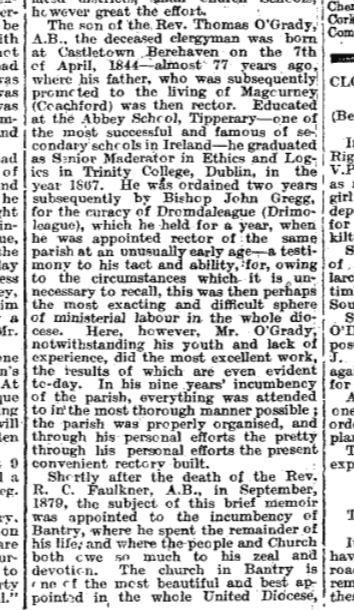
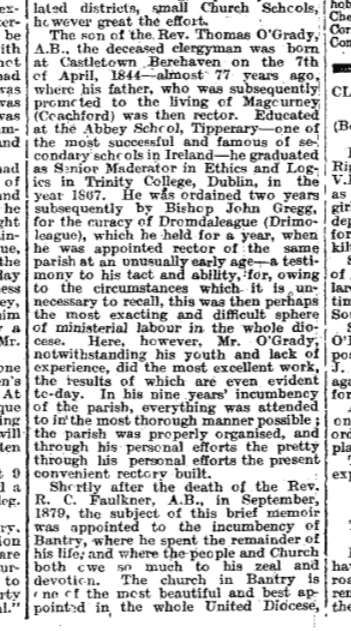
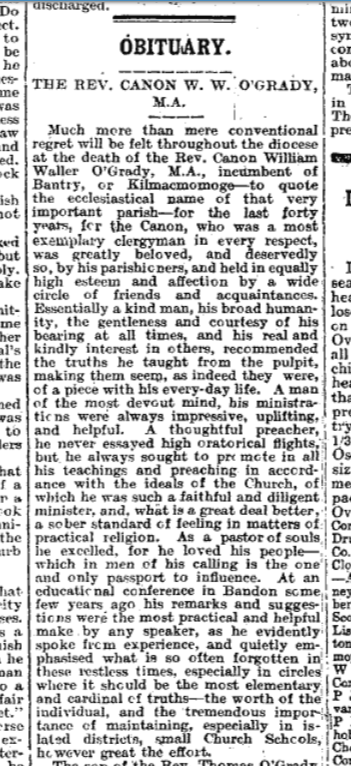
Canon William Waller O’Grady, 42 years, Rector of Bantry, died 1921 aged 76. POK page 7 grave 123
…
His brother: Carew O’Grady (1840-1919), 1875, Carrigmanus House, Goleen, farmer, Resident, £59, son of Rev. Thomas and Susan Dowe born Berehaven, m 1884, Florence, 5th d James Hingston, Aglish, Macroom?, 4 surviving children. Magistrate from 1875, 1881. 1890 Skibbereen Quarter Sessions sitting with Circuit Court Judge Ferguson on Schull licensing appeal cases. Magistrates, John K?. Barrett, William Murphy, M.P., George Robinson, Somers. H. Payne, W.S.Payne, Henry R.Marmion, Samuel Jagoe, O’Donovan, John R. H. Becher, William Norwood, Carew O’Grady. Skibbereen Eagle 14th August 1892. 1893 Unionist meeting Skibbereen. 1883 letting Carrigmanus House with a farm of 143 acres. Re a contested burial. 1894 Patron Schull Regatta. 1901 patron Crookhaven Regatta with Marconi. Co. Grand Juror, listed 1913. Brother of celebrated author and Celtic scholar Standish O’Grady and Canon O’Grady, Bantry. Probably a bee keeper. Probate to daughter Susan Maria spinster.
Probably
Somers (Henry) Payne (1854-1920), BL, 1885, Carrigmahon, Monkstown, major business figure Cork. 1892 attending funeral of Jane Dillon nee Roycroft (1843-1892). Executor James W. Payne. Barrister, Businessman, Land Agent. Somers Payne B.L. (1853-, 1885, Carrigmahon, Monkstown, son John Warren Payne, BL. Land Agent, Beech House, Bantry, he ran against James Gilhooley in election and was defeated, Bantry, ed. Rossall, Irish Bar 1875-1883, Director Munster and Leinster Bank, Bandon Railway, m 1879 Edith d John Leslie, Lee Carrow, Passage, Paynes originate Upton, Bandon, Land Agents to Bantry and other Estates, listed 1913. Somers Henry Payne, James Gilhooly MP alleged he was sitting in Durrus Petty Sessions 1887 outside his district. 1890 Skibbereen Quarter Sessions sitting with Circuit Court Judge Ferguson on Schull licensing appeal cases. Magistrates, John K?. Barrett, William Murphy, M.P., George Robinson, Somers. H. Payne, W.S.Payne, Henry R.Marmion, Samuel Jagoe, O’Donovan, John R. H. Becher, William Norwood, Carew O’Grady. Attending Cork Grand Jury 16 times 1887-1889. Irish Bar 1875, Munster bar, 115 Upper Leeson St.
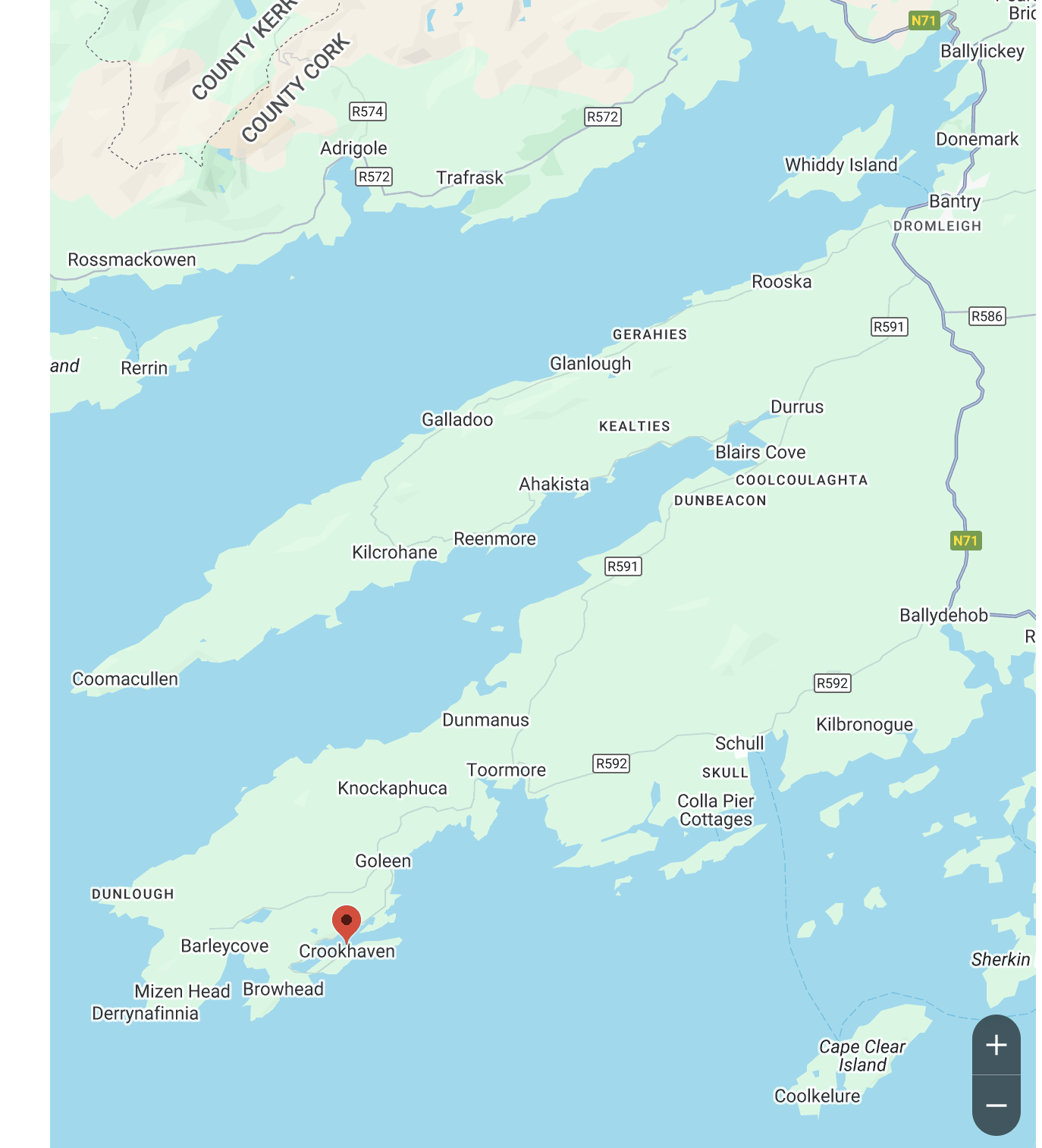
Warrant, by the Duke of Ormond, for the payment, to the Earl of Barrymore, of the sum of twelve pounds sterling, for the building of boats for the Garrison of Crookhaven, &c, Dublin Castle: 9 December 1662
Creator
Edward Edwards (1812-1886)
Level Of Description
Item
Extent And Medium
Copy
Archival History
The Carte Collection (MSS. Carte 1-279) of historical papers was received chiefly by the Bodleian Library, Oxford in 1753-1778. This Calendar (MSS. Carte Calendar 1-75) gives an abstract of every paper in the Carte Collection in chronological order. It was formed by Edward Edwards, a librarian and writer, in 1877-1883 at the expense of the Bodleian Library. In September 2004, the Bodleian Library keyed in 32 of the original 75 volumes of Carte Calendars (Vols. 30-61). This data was shared with, and platformed by, the VRTI in 2024.
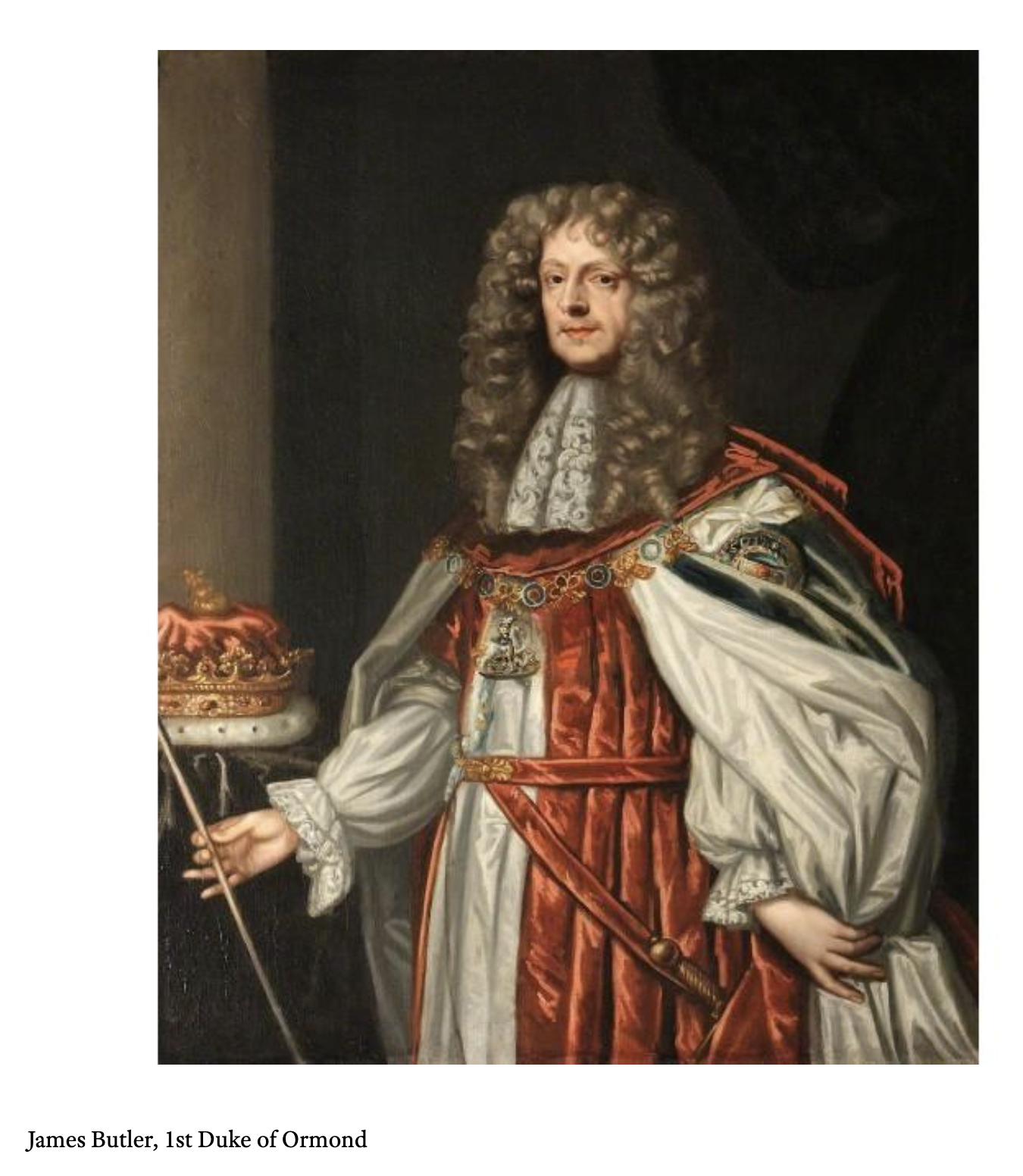
Butler, James (1610–88), 12th earl and 1st duke of Ormond, was born 19 October 1610 at Clerkenwell, Middlesex, England, eldest son of Thomas Butler, Viscount Thurles , and his wife Elizabeth, daughter of Sir John Poyntz, of Iron Acton, Gloucestershire. Thurles was son and heir to Walter Butler (qv), 11th earl, who succeeded to the title in 1614 on the death of his uncle, Thomas (qv), 10th earl, whose one surviving child was a daughter, Elizabeth (qv). The viscount took his family to Ireland, but when returning from a visit to England was shipwrecked and drowned on 15 December 1619, leaving the 9-year-old James as the direct heir to the title. His widow Elizabeth married (a.15 June 1626) George Mathew of Thurles, Co. Tipperary, by whom she had a second family. Youth and marriage The details of James Butler’s youth are mainly derived from Sir Robert Southwell (qv), who presented a brief and laudatory life of the duke to his grandson and successor two months after the first duke’s death. According to Southwell, on his father’s death, Butler’s mother placed him in a school in Finchley to be raised in the Roman catholic faith, to which both parents were committed. However, through the manipulation of the law, James I claimed the young heir as a royal ward and in 1622 put him in the care of George Abbot, archbishop of Canterbury, under whose tutelage he received a protestant upbringing. The religious part of his education made a deep impression on the boy, but in other respects Abbot made little effort to educate his charge, and it was only the intervention of the grandfather that ensured some facility in writing, French, and Irish. His Latin was almost entirely neglected.
 .
.
 Joycean Brendan Kilty, above, has examined the links between Joyce’s Ulysses and the Skibbereen Eagle’s references to Tsar Nicholas II.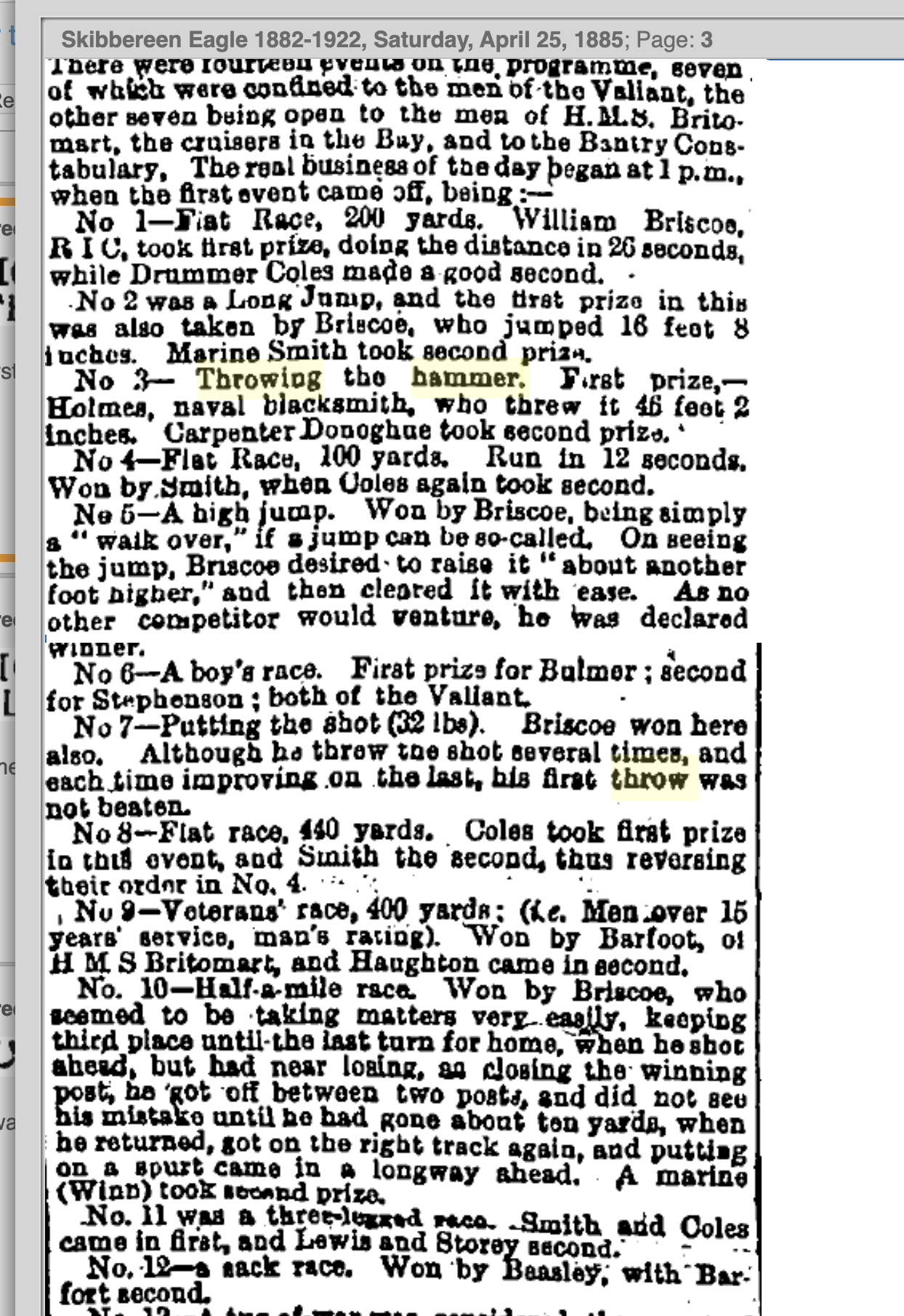
 West Cork History