1694-?1761 [Dunlevy; Donleavy; var. 1765; DD; LLD]; b. prob. Sligo; ed. nr. Ballymote, and Irish College, Paris, 1710; studied law; Prefect of the Irish College, where he drew up a new code of rules, making it subject to the University and the the diocese of Paris; Titular Dean of Raphoe, later Dean Raphoe; publ. An Teagasg Críosduidhe do reir ceasada agus freagartha or The Cathecism, or Christian Doctrine (Paris 1742), in Irish and English, being an “abridgement of Christian doctrine ” by Giolla Brighde Ó hEódhasa (or Bonaventura), and with an appendix on “The elements of the Irish Language”, was still in use in Maynooth up to 1848. ODNB DIW DUB OCIL FDA Douglas Hyde (1974) writes of Andrew Donleavy’s Catechism (Paris 1742; Dublin eds., 1822, 1848): the edition includes questions and answers in English and Irish, together with ‘an abridgement of the Christian doctrine in rhymed Irish, composed upwards of an Age ago by the zealous and learned F. Bonaventure Ó hEoghusa of the Order of S. Francis; and also with the elements of the Irish language, in Favour of such as would fain learn to read it; and thereby be useful to their Neighbour.’ The author bewails the fact that Irish is now ‘on the Brink of Utter Decay, to the great dishonour and shame of the Natives, who shall always pass every where for Irish-men, Although Irish-men without Irish is an Incongruity, and a great Bull. Besides, the Irish-Language is undeniably a very Ancient Mother-Language, and one of the smoothest in Europe, no way abounding in Monosyllables, nor clogged with rugged Consonants … And there is still extant a great Number of old valuable Irish Manuscripts, both in publick and private Hands, which would, if translated and published, give great Light into Antiquities of the Country, and furnish some able Pen with Materials enough, to write a compleat history of the Kingdom; What a Discredit then must it be to the whole Nation, to let such a Language go to Wrack …’. (Daly, p.40-41.)
Honourable Simon White (1769-1838), 1789, Glengarriff Castle, Bantry, 1823, 1831. Listed supporter of Act of Union, 1799. 1820 signed Memorial for new road Glengariff to Castletownbere. Goodwin YoungHatter, Cork probably from Banty. Obtained judgement 1807 against Simon White Esq., Glengariff Castle assigned 1825 to William O’Sullivan, Esq., Carriganass Castle, 1822 Customs and Excise Inspector responsible for Excise trials. 1821 wife seeking payment for him Mrs. J D White at Wickcourt St., Cheltenham. Notified as Magistrate of Catholic meeting in Bantry re loyalty to King 1825. Attending Protestant Conservative Society meeting 1832. Grand Jury Presentment Session 1834 Renmeen with John Lavellan Puxley. 1834, New Annual Grand Jury Contract: Patrick O’Sullivan, Earl of Bantry, Simon White, John O’Connell to keep in repair for three years, road from Bantry to Castletown between post office at Castletown and Droumgoulane bridge, £90 annually. Signed public declaration to Alexander O’Driscoll on his removal as Magistrate 1835 with Lord Bantry, Simon White, John Puxley, Arthur Hutchins, Samuel Townsend Junior and Senior, Hugh Lawton, Thomas Somerville, Richard Townsend Senior, Rev.. Alleyn Evanson, Timothy O’Donovan, Richard Townsend, Lyttleton Lyster. 1835 Subscriber Lewis Topographical Dictionary of Ireland 1837. County Freeman of Cork City voting in Cork City Election 1837. Freeman of Cork 1794.
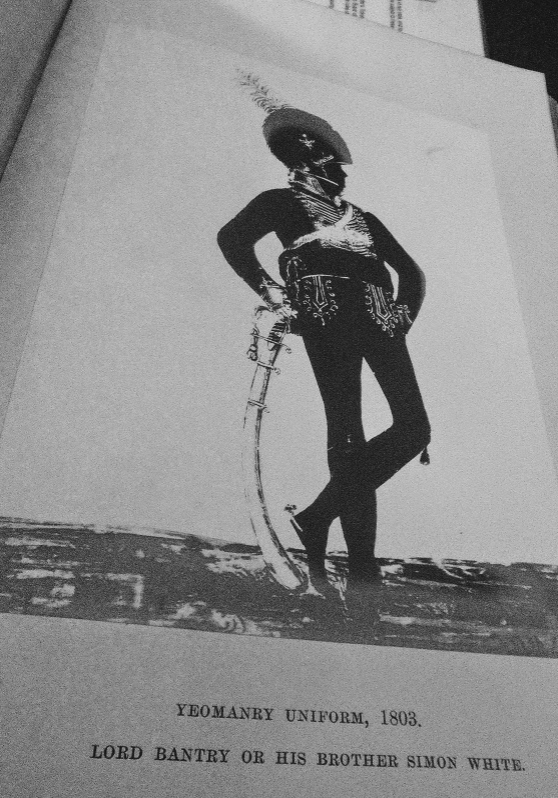
Richard (White) -1851), 1st Earl of Bantry, Bantry House (bought 1730 from Hutchinsons as Blackrock House) Pre 1831, 1822, Created Baron White for his part in alerting British of French landing at Bantry Bay 1797, 1801 advance to Viscount Berehaven 1816 created 1st Earl of Bantry. 1799 married Margaret Hare, daughter of William Hare, Earls of Listowel (they had been Cork provision merchants). Subscriber 1821 Dr Thomas Wood’s ‘Primitive Inhabitants of Ireland. C 1810 Lord Shannon complained of a bill for £2,000 presented to British Government for entertaining French officers captured at attempted invasion. 1822 seeking support from Lord Lieutenant for Bridewell and market House in Bantry. Notified as Magistrate of Catholic Meeting on Loyalty to King 1825. 1834, New Annual Grand Jury Contract: Patrick O’Sullivan, Earl of Bantry, Simon White, John O’Connell to keep in repair for three years, road from Bantry to Castletown between post office at Castletown and Droumgoulane bridge, £90 annually. Correspondence with Chief Secretary promoting road Bantry to Skibbereen, sitting Bantry, 1835, listed 1838, Quarter Sessions, Bantry 1842. Receiver appointed to Estate rents 1837 on a charge of £46,150. Member provisional Committee projected Bandon to Bantry Railway 1845. The Irish House of Lords Journal recorded the introduction of White as Lord Bantry in Cork ‘Richard White, Esq. being by letters patent dated 24th day of March 1799 created Baron Bantry of Bantry on the County of Cork, was this day, the 22nd Jan 1799, in his robes, introduced between Lord Tyrawley, and the Lord Mock also in their robes; the Yeoman Usher of the Black Rod and Ulster King of Arms, in his coat of arms, carrying the said letters patent preceding: his lordship presented the same to the Lord Chancellor.
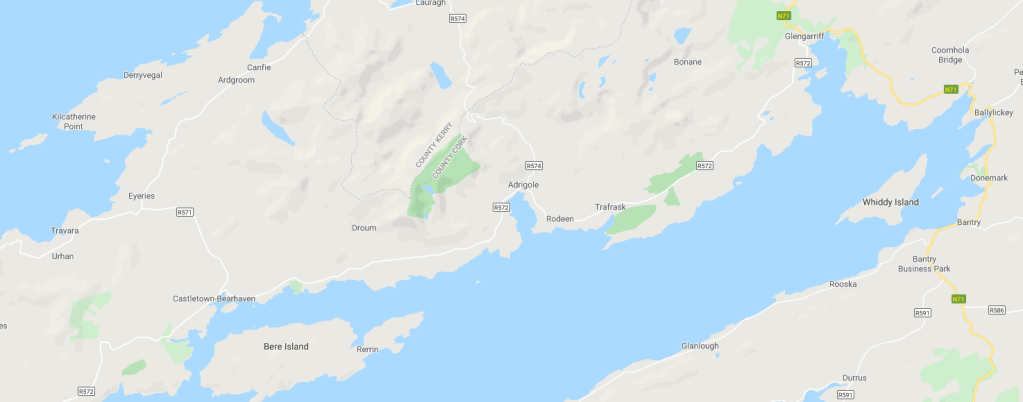
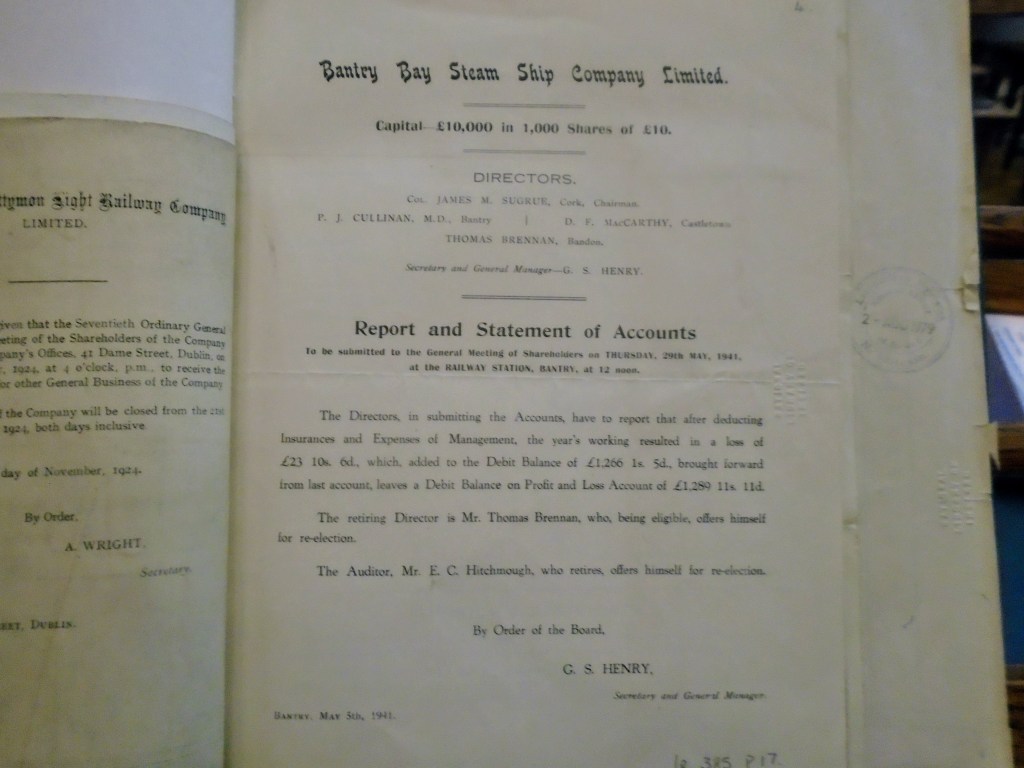
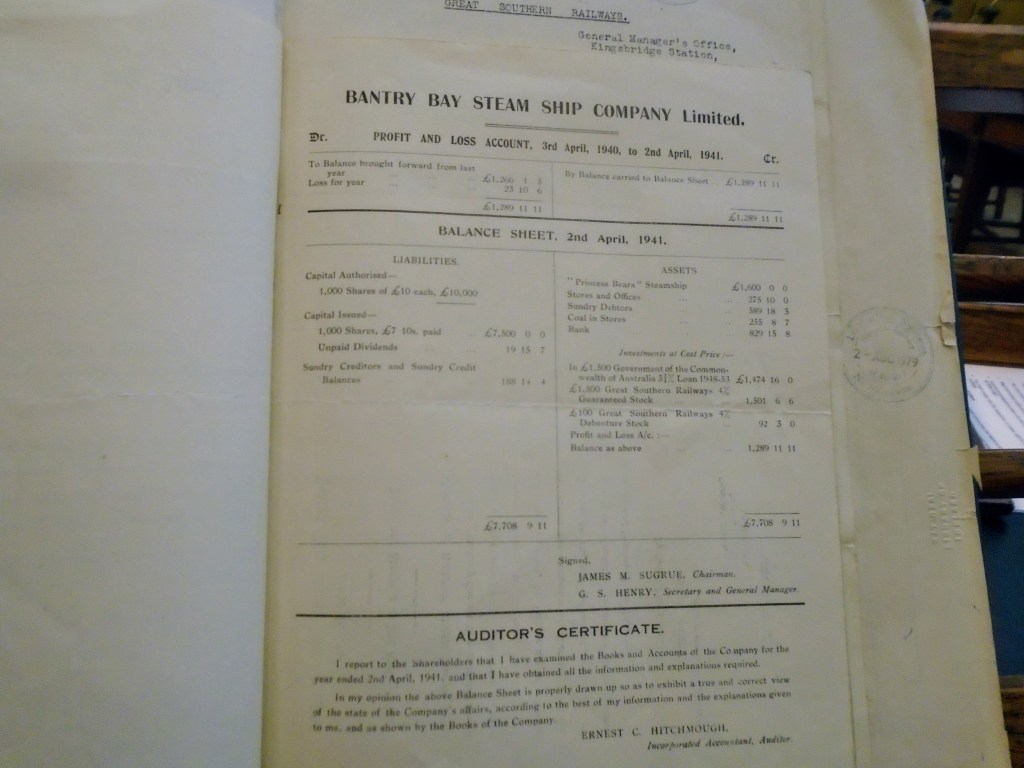
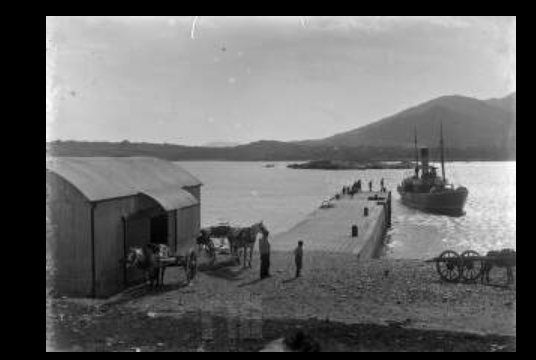
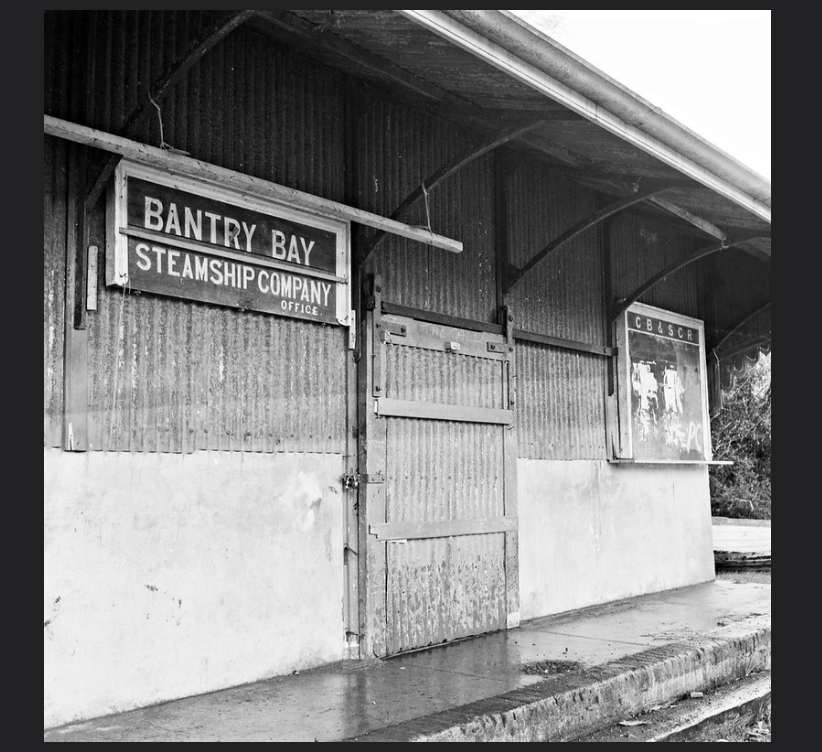
In the 19th century and up to the 1940s a common method of travelling from the Bear Peninsula to Bantry was by steamers operated by the Bantry Bay Steamship Company. Their schedules ties in wiht the Cork to Bandon railway. When the ports were returned to Ireland by the British in 1937 the naval base on Bere Island closed. This represented a high revenue loss to the company. Over time the road from Bantry to Castletownbere once dubbed the ‘Burma Trail’ was improved. However even with huge improvements around 15 km remains in a pretty poor state.
IN the 19th century the Somers Payne family wee associated with the Company.
Directors:
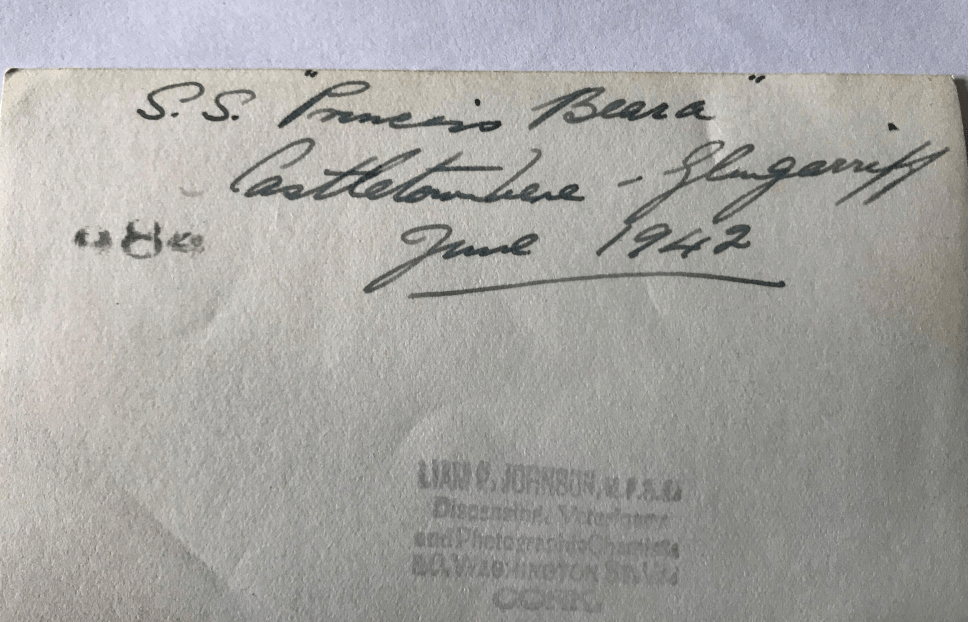
1910, 1920 Dr. Patrick Joseph Cullinane, M.B, BC.H., B.A. NUI 1910 Doctor 1910 interim Registrar of Births Post mortem of deaths War of Independence Diarmuid Kingston, RIC in West Cork during War of Independence, 2013. Bantry Bay Steamship Company Annual Report 1941, Among directors Dr. P. J. Cullinane. Steamship Princess Beara . Magistrate: Dr. Patrick J. Cullinane M.D,. 1914, The Square, house Sunville (large early 19th century house) Bantry, listed 1916. The dynasty starts with Kate O’Sullivan marrying a Robert Swanton, their daughter was Anne Swanton who marries a Jeremiah Cullinane who was born in 1795. It was he who moved to Skibbereen and really founded Fields and managed it from 1829. They had the family that developed the drapery in Bantry. Bantry Bay Steamship Company Annual Report 1941, Among directors Dr. P. J. Cullinane. Steamship Princess Beara After his death an auction of his effects in the 1960s included the set of Shakespearean B & W prints at his auction early in the 1960s They were purchased by the Vickery family and hung in their hotel front lounge until its closure in 2006.
Thomas Brennan is probably of the prominent Bandon business family of who was the first Secretary of the Department of Finance. Joseph Brennan (18 November 1887 – 19 March 1976) was an Irish economist and senior Irish civil servant who served as the Governor of the Central Bank of Ireland from 1943 to 1953. ” “Brennan was born in Bandon, County Cork. In 1909, he entered Christ Church, Cambridge, where he studied Mathematics and then switched to classics. In successive years he obtained a first in Latin and Greek. In 1911, he entered the Civil Service and was assigned to the Board of Customs and Excise and a year later transferred to the finance division of the Chief Secretary’s office in Dublin Castle. During the July 1921 Truce he was introduced to Michael Collins and later became a financial advisor to the team negotiating the Anglo-Irish Treaty.” “In April 1922, he became the Irish Free State’s first Comptroller and Auditor General and in April of the following year he was appointed Secretary of the Department of Finance, a post he held until his retirement from the Civil Service in 1927.[1] Later that year he was appointed Chairman of the Currency Commission. In 1925, his lengthy note on the Free State’s financial position was helpful in concluding the Irish Boundary Commission negotiations.[2]” “When the Currency Commission was dissolved in 1943, he became the first Governor of the Central Bank of Ireland. From 1928 until his retirement in 1953 his signature appeared on all Irish Banknotes.[3] In 1938, Joseph Brennan was conferred with an Honorary LLD by the National University of Ireland. He died in 1976.”
Pier at Adrigole, Princess of Beara
Glengariff:
CB&SCR is Cork Bandon and South Coast Railway.
Tadhg Ó Murchadha T.D., I am availing of your permission, Sir, to raise, briefly, the subject of the following question that I addressed to the Minister for Industry and Commerce on Wednesday last:— “To ask the Minister for Industry and Commerce whether he is aware that the Bantry Bay steamship service, from Bantry to Berehaven, is about to be suspended, following the initiation of a road transport service by Córas Iompair Éireann; that this change will have the effect of cutting off Bere Island from securing supplies directly from Bantry and other trading centres, with consequent hardship to the residents of the island; and whether he will arrange for the retention of the steamship service to Berehaven, calling at Bere Island.” The Minister’s reply is in the following terms:— “I am aware that the Bantry Bay Steamship Company have suspended their weekly sailings and that Córas Iompair Eireann, in response to a demand for direct road transport, are providing a daily lorry service between Bantry and Castletownbere. “The traffic formerly consigned to Bere Island by the steamer service amounted to about 25 tons per month, and I understand that there are small boats available which are capable of dealing with this traffic. In the circumstances, I see no reason to intervene in the matter.” The Minister has had a fairly hard day and I will be as brief as I possibly can. I propose, therefore, to confine the presentation of this case to three main aspects. May I give the House some information about the history of the Bantry Bay Steamship Company that is concerned? The company was originally founded in November, 1883, and since then they have provided a service to this isolated part of the constituency of West Cork, consisting of transport of passengers, goods, live stock, etc. They provided a steamer for that service weekly. I want to give the House some particulars of the traffic carried. Bere Island has figured in this matter because I hope to convince the Minister that the peculiar position that Bere Island will now find itself in is a serious matter for the inhabitants and one that should have his attention as Minister supervising the question of transport changes and similar matters. In the year 1936 there were 500 tons of traffic carried to Bere Island, in 1937, 488 tons; in 1938 485 tons; in 1946, 365 tons. As commodities were rationed and consequently smaller parcels of the various commodities only could be sent, the reduction in the traffic is quite understandable. In the same periods the traffic to Castletownbere was represented by the following figures: In 1936, 3,274 tons; in 1937, 3,200 tons; in 1938, 3,436 tons; in 1946, 3,035 tons. I am also in possession of certain figures with regard to transport of passengers which I do not consider entirely vital to the presentation of this case and I shall not therefore trouble the House by giving the figures. Bere Island is in an extremely unfortunate position as a result of this change. May I quote from a letter which I received from one of the traders there:— “I wish to let you know that after 43 years of hard work to build up a business I find that there will be no alternative for me in a short time but to close it down. This is due to the initiation of a road transport service by Córas Iompair Éireann”. He goes on to say:— “The manager of Córas Iompair Éireann wrote to me to have arrangements made with a trader in Castletownbere to store my goods which would be dumped there by their lorries. I could not do that easily. There are no means now of getting goods into this island and I would also have to pay the trader for storing the goods in Castletownbere”. The suggestion of the Minister that various small boats owned by local people would be capable of handling this traffic seems quite unsatisfactory to the people of the island and to represent a position that cannot be at all satisfactory to the people concerned. When this boat that plied between Bantry and Castletownbere was laid up each year for the annual overhaul required by Board of Trade regulations, the goods coming to Castletownbere could be conveyed to Bere Island by means of military tender. The military tender, which was the main means of communication between the island and Castletownbere, has now gone, because Bere Island, one of the ports which figured so largely in our discussions in recent years, including our election speeches, has been completely abandoned. The entire military personnel in Bere Island has been removed, and I understand that the only military remaining there is a maintenance party consisting of four men. The military tender, therefore, is not available, and there is no means by which goods can be conveyed to the island, except in whatever way it can be done by small row-boats which may be available to residents and some of the merchants living on the island. This man says that it seems to him that a position is rapidly developing in which the island will be completely isolated, and he does not see much point in being compelled to pay taxes in a quarter of the country in which no services are available to the people. The Minister will appreciate the fact that in regard to certain goods, such as paraffin, sugar and commodities of that kind which are on demand as soon as they are available, and, in fact, some days before they are available, it is necessary that there should be some service by which they could be made available speedily. I suggest that the position of these people in Bere Island —some 300 or 400 people live on the island—will be extremely difficult. For one thing, they will have to face higher costs for the goods they receive, and, for another, the service will be irregular, unsatisfactory, inadequate and, I am afraid, infrequent, because it seems that, at certain parts of the year, it would not be possible for small row-boats to convey goods to the island because the passage is not quite easy. I do not think the arrangement would be at all satisfactory. So much for the position of the people there. Let me come now to the position of the employees of this company —not a great number, but, still, all of them bread-winners and the supports of households—who are concerned with this change. There was a crew of seven or eight on the boat and a number of other people were directly employed by the Bantry Bay Steamship Company. I understand that every single one is now out of employment. Furthermore, I am informed that it is very questionable whether, under any existing legislation, they have any pension rights, or any rights to get alternative employment, and though the number of people is not very large, a great deal of hardship is involved for the people concerned, a number of whom have spent the best years of their lives in the service of this company. May I suggest that that aspect of the case, at least, ought to have the earnest and special consideration of the Minister who does not wish, I am sure, to add to the number of people who are deprived of employment and who may be compelled to exist by some other means in the absence of that employment? I suggest further to the Minister that a transport service by road to Castletownbere is a very uncertain undertaking, from the point of view of giving service to the people. The distance from Bantry to Castletownbere is 33 miles and the road is rather perilous and difficult. That is well known to most road-users and I think it a great pity that some alternative cannot be found to putting this old-established company, which, in a modest way, gave a certain amount of employment and which, in a general way, gave good service to the people concerned, completely out of business. May I suggest that he may be able to devise some means by which a restricted road service could be permitted, together with this service for the period for which it is available to the people, that is, one run per week and that, in addition, he should examine the question of whether the alternative service provided is capable of carrying the same amount of traffic and the same bulk of traffic as was carried by the other service? It seems to be rather difficult to understand that live stock can be carried as easily by a road service as they were carried by the service which now goes out of commission, the steamship service. I have been informed, though I cannot personally vouch for it, that on the occasion of the last fair in Castletown, a number of cattle could not be removed by lorries and had to be driven by easy stages along the road between Castletownbere and Bantry. The Minister will have the advantage of certain arguments in this matter— that the people will be getting a daily service and a more up to date service. I feel that, while that may look all right on the surface, it is not at all clear that the service will be either up to date or satisfactory, having regard to the peculiar geographical position of the area concerned and to the adjacent island of Bere which will be in a position of special difficulty. I urge the Minister, not in any spirit of controversy or any spirit of Party advantage, to examine the matter further to see whether there is any possibility of meeting what I believe to be a fairly strong local view that it it a most unfortunate act which deprives them of this service. Seán F. Lemass Minister for Industry and Commerce (Mr. Lemass) The circumstances of this case are easy enough to understand, but it is not quite so easy to devise a remedy for the particular problems which may arise for individuals, by reason of the change which has taken place. In the past, goods were brought by ship from Bantry to various points along the Castletownbere peninsula. The Bantry Bay Steamship Company provided this weekly service by steamer which called at Glengarriff, Adrigole, Castletownbere and Bere Island. Early in this year, Córas Iompair Éireann provided a lorry service and the popularity of that lorry service resulted in a very substantial fall in the amount of goods available for transportation by steamer. It could be said, therefore, that the immediate cause of the steamship company’s difficulties is the operation of a lorry service by Córas Iompair Éireann, but that would be a very inaccurate description of the problem, because Córas Iompair Éireann provided the lorry service when it became clear to it that the goods were going to be moved by lorry anyhow, that the traders concerned with the movement of the goods would provide their own lorry service, if a service by Córas Iompair Éireann were not provided for them, and, consequently, although the decline of the company’s business can be traced to the beginning of the service by Córas Iompair Éireann, it is obvious that it would have lost the business anyhow, if not to the lorries of Córas Iompair Éireann, to lorries operated by private traders. I think there can be no doubt that the lorry service is immensely popular in the area. It began as a tri-weekly service, but so great was the demand for it that it is now operated three times daily. There is a lorry service three times a day from Bantry to Castletownbere, and the advantage of a daily service at lower cost is obviously greatly appreciated by the residents in the peninsula area. There is a problem in relation to Bere Island. The steamer service was of exceptional advantage to the residents on the island, and the manner by which goods can reach the island or be transported from the island now involves the use of this lorry service from Bantry to Castletownbere, and the movement of the goods over the mile of sea between Castletownbere and the island. In that regard, I understand that some small boats are available. Córas Iompair Eireann accept the obligation to provide an alternative service, but they would like to be assured that such a service is needed and that local opinion would prefer the service to be provided by it rather than by the local business people who might find provision of such a service a remunerative occupation to engage in. There are some boats there now and these boats would be adequate to move the inward traffic. There is a problem, and there is likely to be a problem, concerning the movement of cattle from the island, by reason of the unsuitability of the facilities for discharging cattle at Castletownbere, in relation to which I intend to have some further inquiries made. Personally, I cannot see what I can do. It is not practicable to restore the old position merely by persuading Córas Iompair Eireann to withdraw its service of lorries. I feel certain that the withdrawal of the lorries would be unpopular in the locality. In any event, it would not settle the problem. It seems obvious that it would merely mean that goods would travel on the lorries of private traders rather than on the lorries of the Transport Company. The reason for the withdrawal of the steamer service was the fact that there was no business for it. On July 5, the company wrote to my Department that while the usual traffic offered was close on 100 tons weekly, since the lorry services began in June, the traffic offering was on June 6, 25 tons; June 13, 35 tons; June 20, six tons. At that stage, the company decided to suspend the service. On the facts of the case, it appears to me that there is a better transport service being provided at lower cost. It is not merely a cheaper service, but a better service than the area enjoyed through the steamship company. Inquiries I have made indicate that the service is popular, and that there is no local demand for its withdrawal. On the contrary the demand has resulted in its expansion. The problem of the islands and the provision of boats for the transportation of goods to the islands will be considered by Córas Iompair Éireann, if that is desirable. If the local service is capable of handling the business Córas Iompair Éireann would prefer that. They do not deny that they have obligations to provide a service if it is not provided by other people. As regards the crew, Córas Iompair Eireann informed me that they would consider sympathetically other alternative employment for the men concerned. The captain of the ship has already been employed by the company, but they explained that it is not very easy to find employment suitable for the men in the locality. They cannot, therefore, say definitely that they will be able to provide employment for all the men concerned, but they are prepared to consider their applications as sympathetically as possible, and to make every effort to get them into some suitable employment in the locality. Personally I do not see that there is anything I can do about it. Some years ago there was a number of these coastal services from Sligo to Ballina, and Limerick to Westport, all of which have ended. They could not compete with road transport. While the Bantry Bay Steamer Company lasted longer, it looks as if the time has come when the business it formerly obtained has passed to the roads. In some cases it might be necessary, for reasons of public safety, for the State to take special measures to ensure that coastal shipping services are maintained, and following some disasters on the west coast, a committee was set up to examine the law and the obligations of the Government in regard to shipping services to islands off our coast. That committee has not reported. They dealt primarily with shipping to Tory Island, and to other islands where there is a much more definite problem involved than in the case of Bere Island. It is only one mile from the mainland, and there is no reason to expect exceptional danger in making the passage as in other cases. It seems to me that the problem of the transportation of goods to Bere Island is a matter for organisation in Castletownbere with some sort of store accommodation for goods. I think it would be better, from every point of view, that services between Castletownbere and Bere Island should be provided locally. Córas Iompair Éireann state that if they are not provided they will see what they can do. Personally, I do not see that anything else can be done. The Dáil adjourned at 7.47 p.m. until 3 p.m. on Tuesday, 23rd July, 1946. Industrial Relations
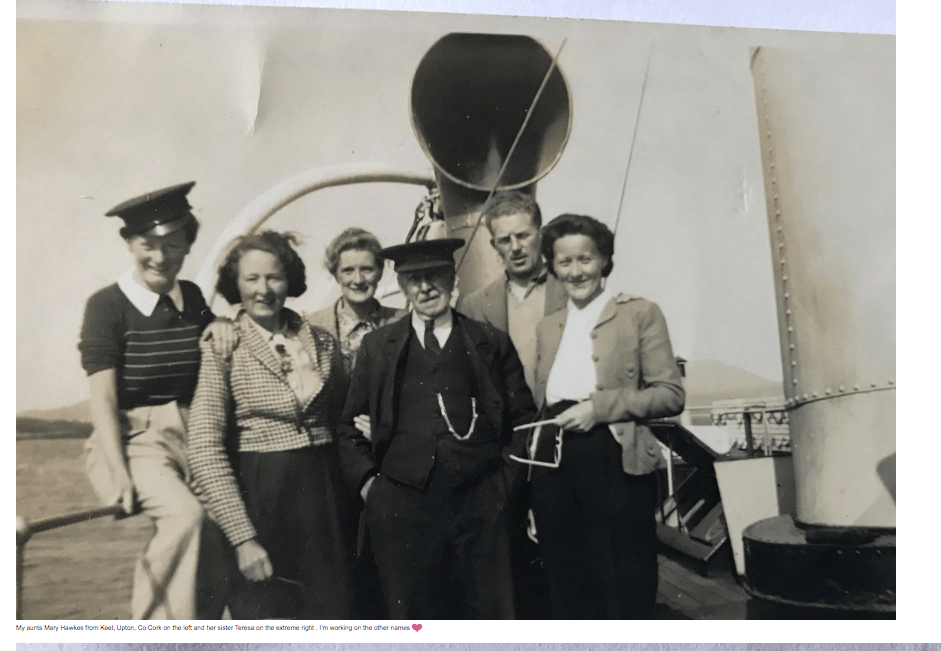
Mary Hawkes from Keel, Upton, Co Cork on the left and her sister Teresa on the extreme right
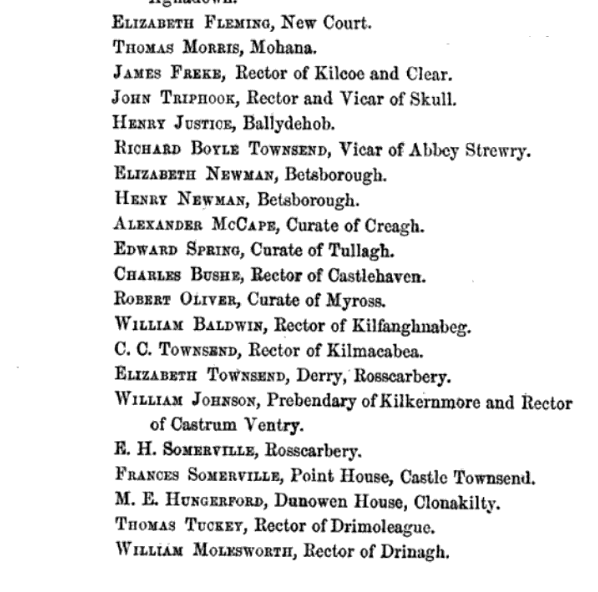
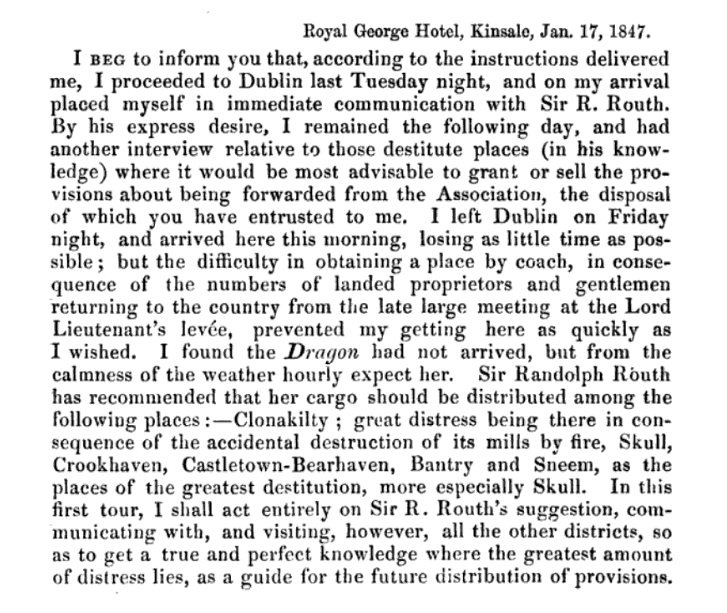
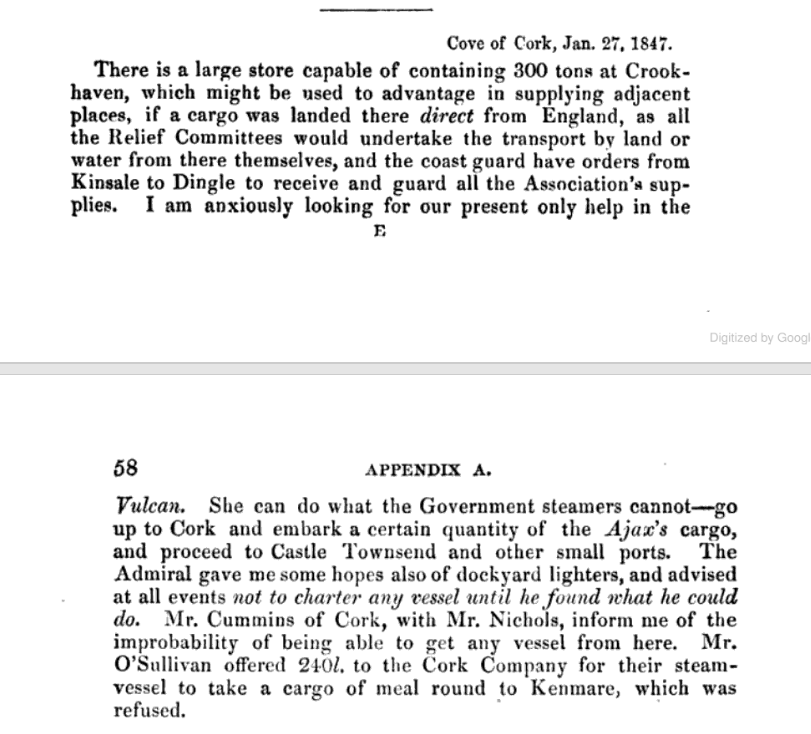
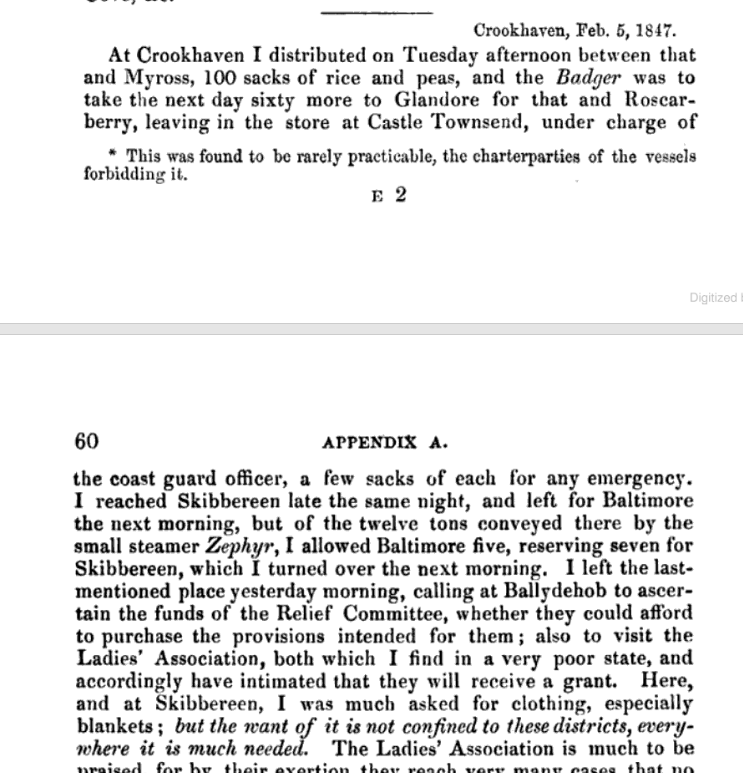
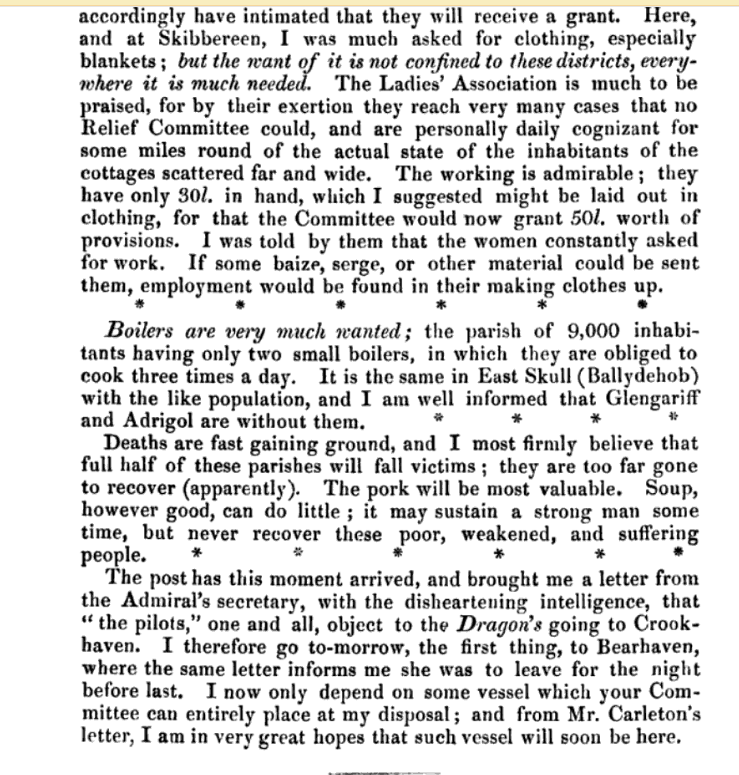
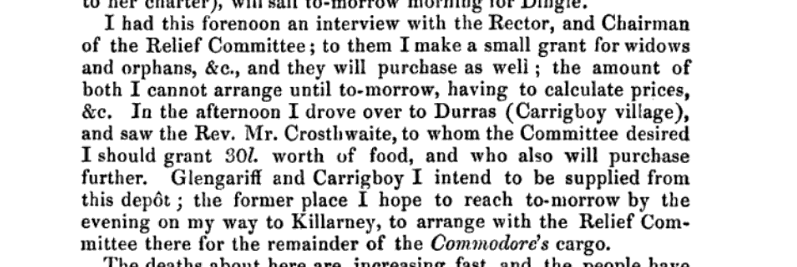
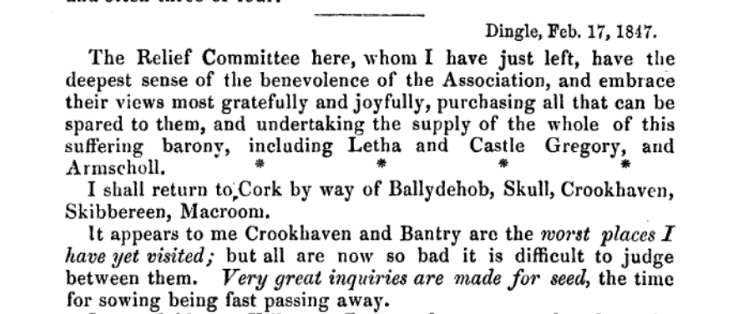
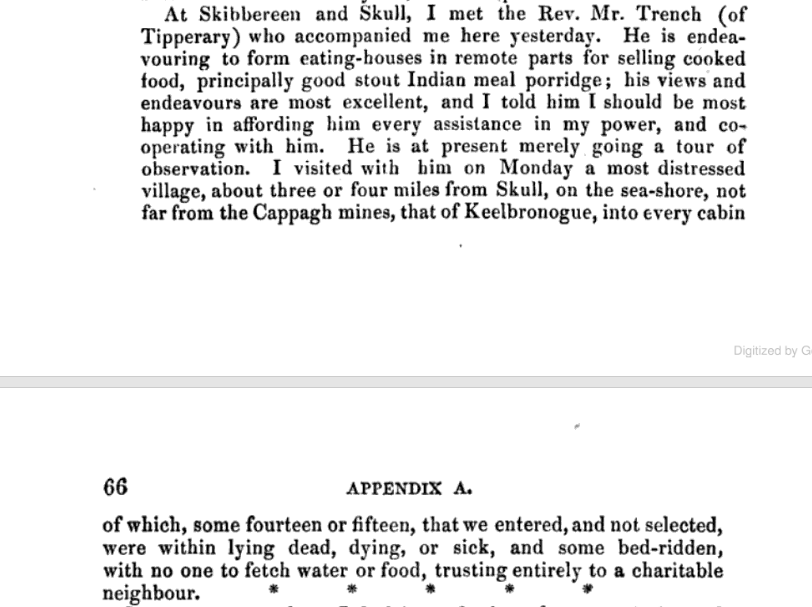
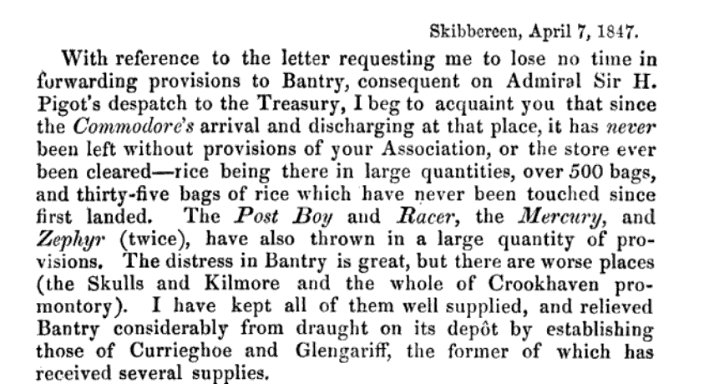
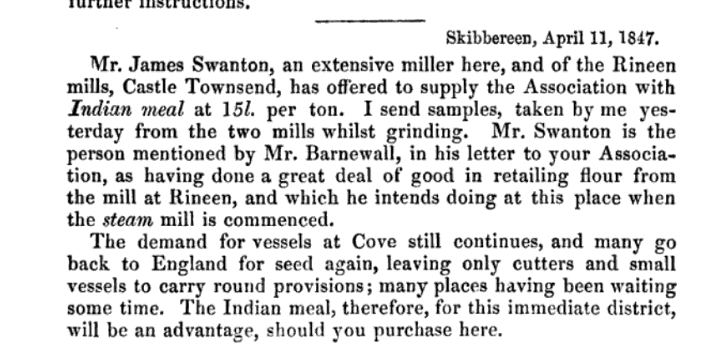
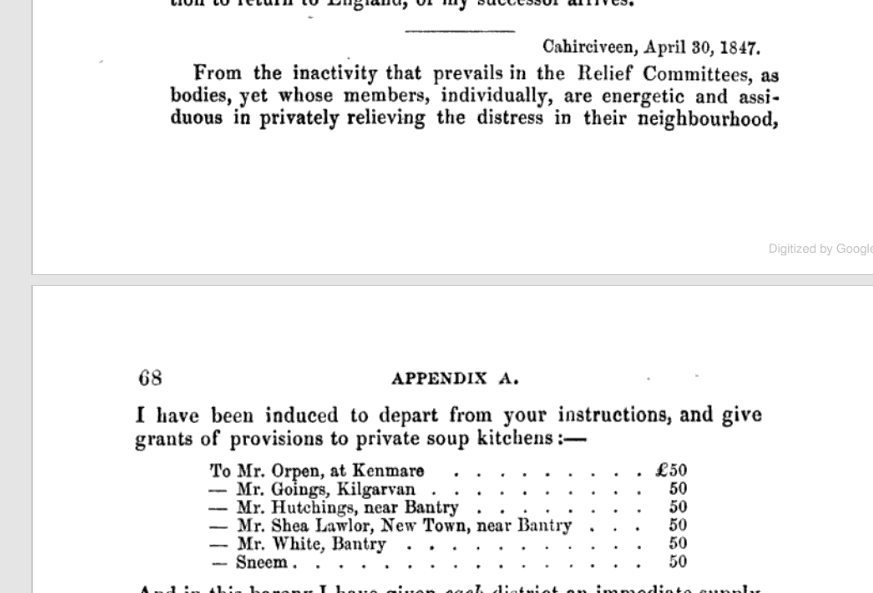
Report …: With Correspondence of the Agents, Tables, &c., and a List of … By British Association for the Relief of the Extreme Distress in Ireland and Scotland
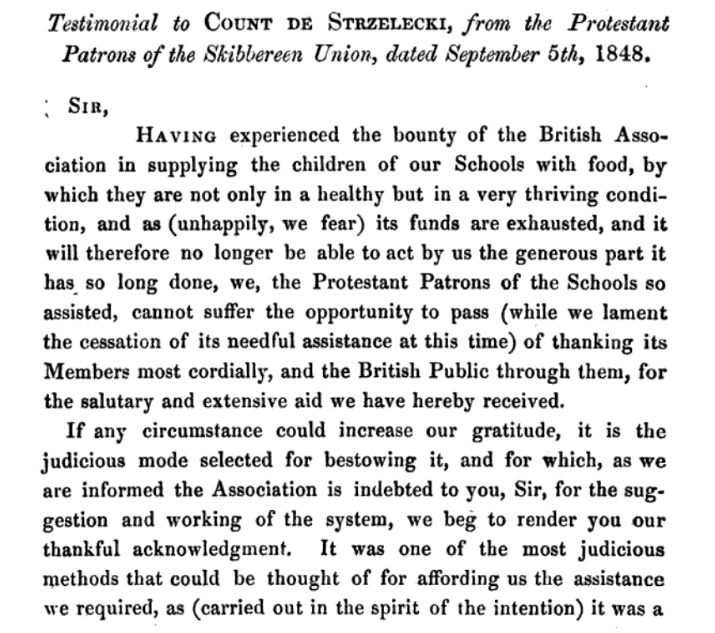
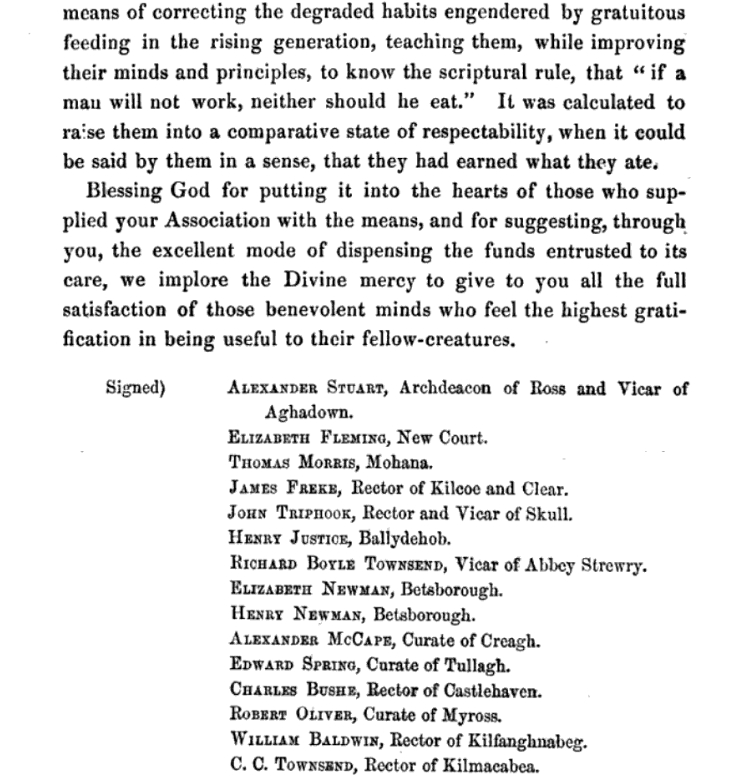
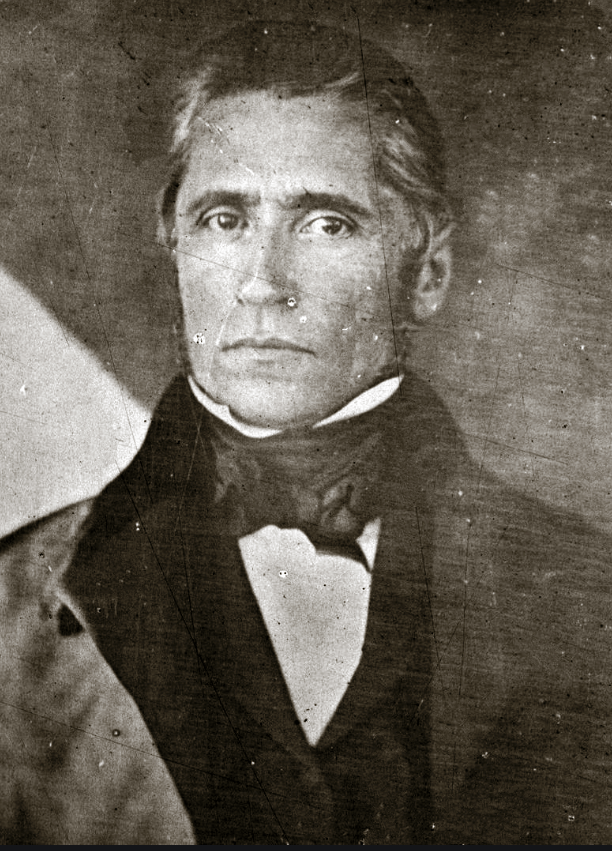
During the autumn and winter of 1846-1847 the disaster of the great famine came to Ireland. In January 1847, a group of English banking leaders combined to raise funds for famine relief via a private charity named the “British Relief Association” and entrusted Strzelecki to dispense them ( £500,000) Strzelecki was appointed the main agent of the Association to superintend the distribution of supplies in County Sligo, County Mayo and County Donegal. In order to alleviate the critical situation of famished Irish families and especially children, Strzelecki developed a visionary and exceptionally effective mode of assistance: feeding starving children directly through the schools. He extended daily food rations to schoolchildren across the most famine-stricken western part of Ireland, while also distributing clothing and promoting basic hygiene. At its peak in 1848, around 200,000 children from all denominations were being fed through the efforts of the B.R.A., many of whom would have otherwise perished from hunger and disease. Despite suffering from the effects of typhoid fever he contracted in Ireland, Strzelecki dedicated himself tirelessly to hunger relief. His commitment was widely recognized and praised by his contemporaries. In recognition of his services, he was made a Companion of the Order of the Bath (CB) in November 1848.
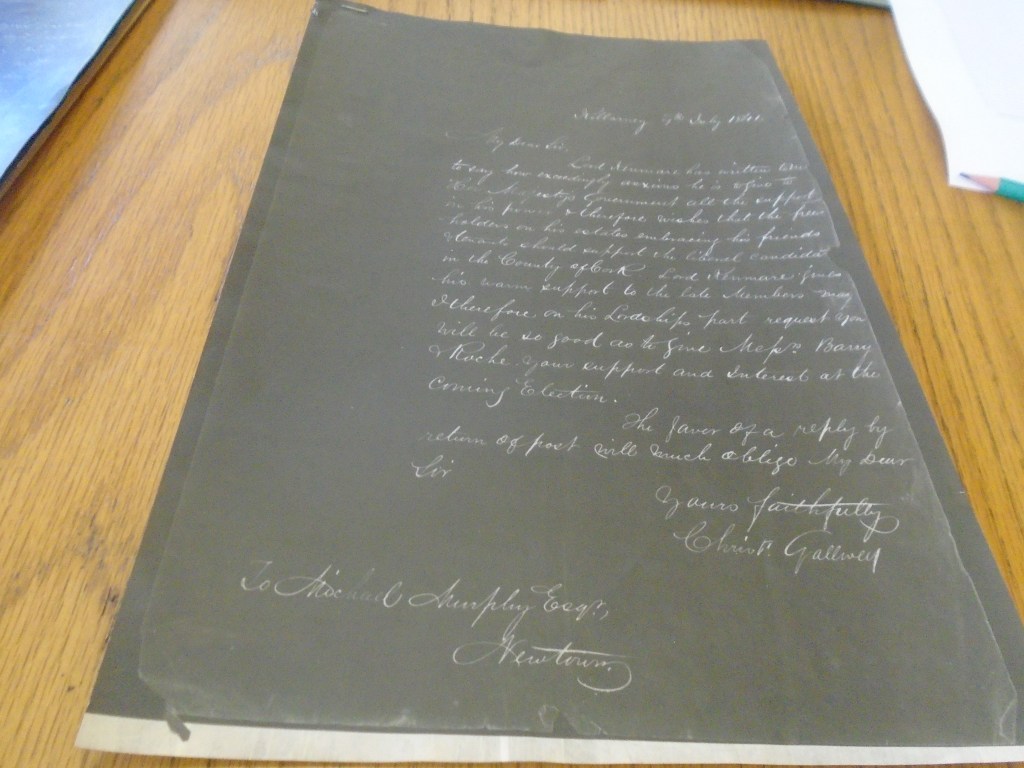
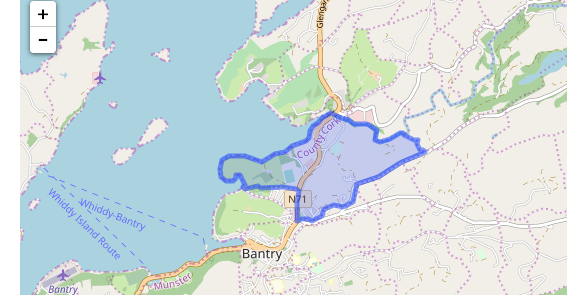
The Kenmare (Brown) estate in Bantry extended from around the present Bantry Tyre property around Bantry Bay over into Kenmare. In the early to mid 19th century it was managed by Christopher Galwey of Kilarney. The Galweys were one extensive and opulent land owners and merchants in Bantry.
Newtown:
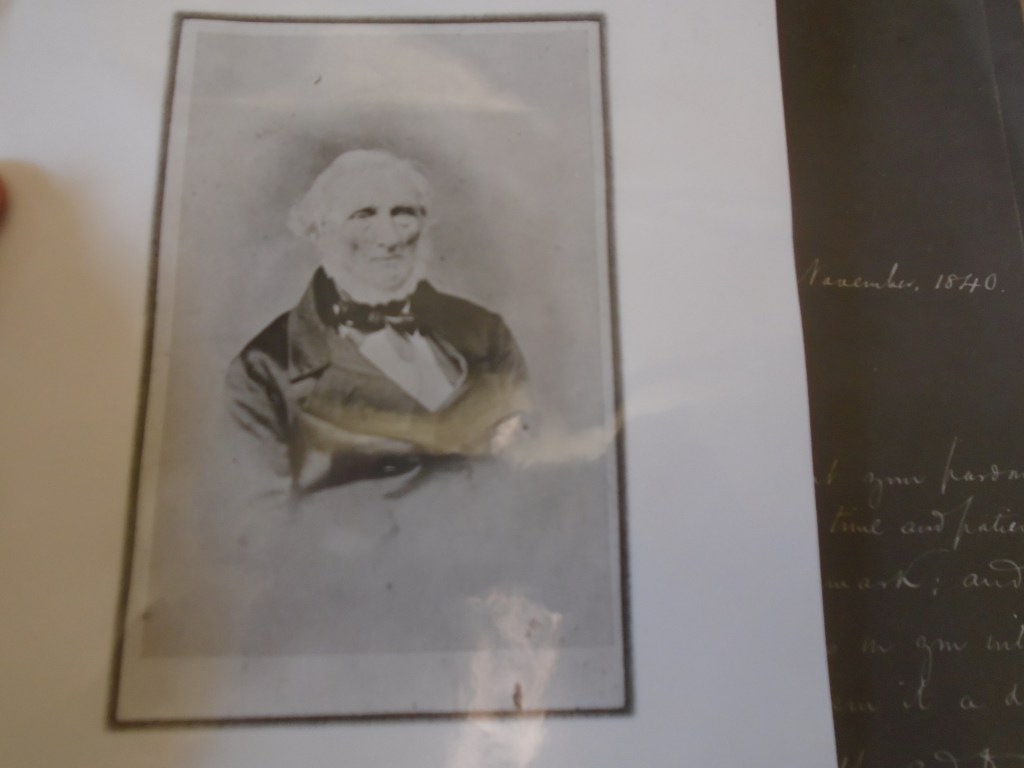
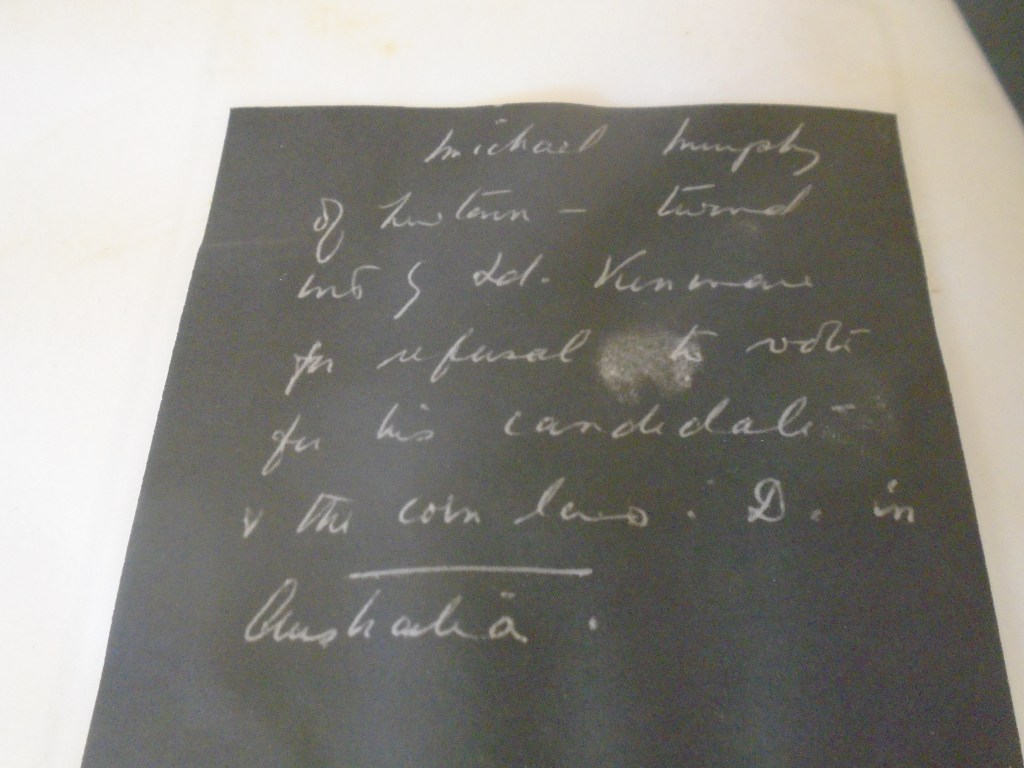
Michael Murphy, died in Australia
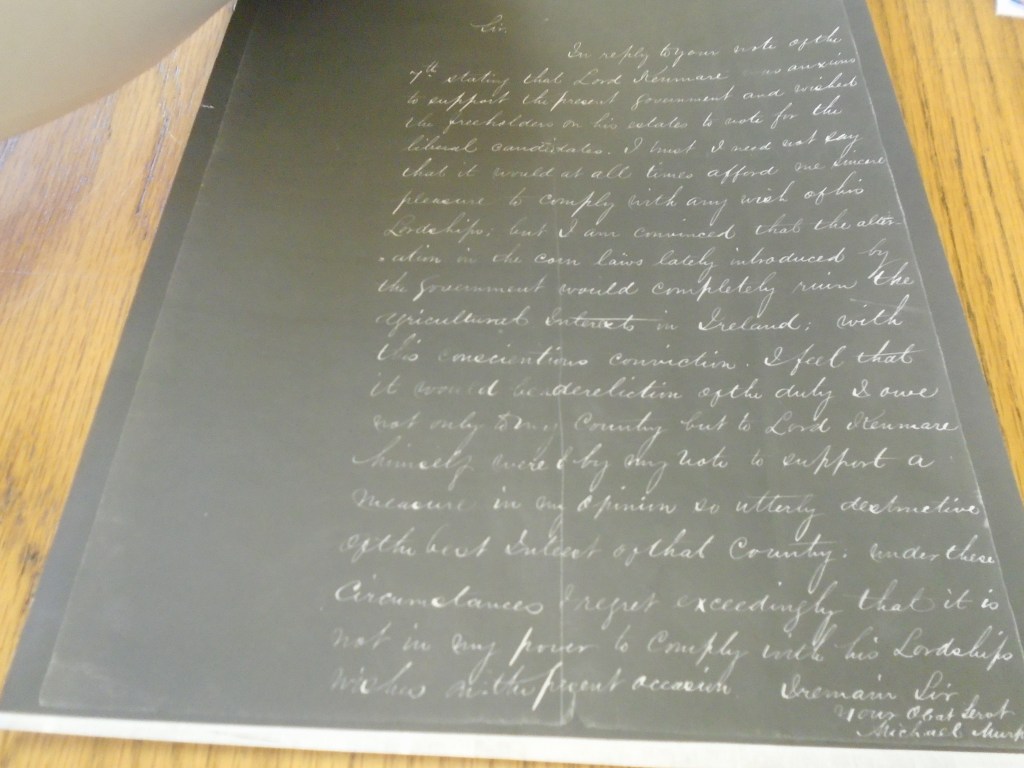
Michael Murphy, Newtown and Donemark. Pigot lists 1824 at Newtown. Gave evidence to 1845 Commission Law and practice in respect to the occupation of land in Ireland (Devon Commission), Protestant. Farmer formerly on Lord Kenmare’s estate family held for 200 years, and hugely improved with tenants having hundreds of pounds worth of trees unregistered due to confidence in earlier Lords Kenmare now possessed without compensation. County Freeman of Cork City voting in Cork City Election 1837. Holds mills and purchases corn. Extensive ruins of mills still there at Donemark Bridge towards sea. His vote sought by Christopher Galwey Lord Kenmare agent for liberal candidates Roche and Barry Cork election 1859, declined due to imposition of Corn Laws. Died in Australia.
1837, Christopher Galwey, Lord Kenmare’s Agent writing to him at Newtown, ‘I am pleased to report by your messenger’s report that the flour from your Donemark Mill is in such good demand that you re kept at full work
1829 Michael Murphy with Lord Bantry funds from Dublin Castle. Murphy may have later difficulties as he may have had a personal liability for this advance. Michael Murphy was a workhouse Guardian up to October 1847 when the Board of Guardians was dissolved by the Poor Law Commissioners. Then he was a Guardian again beginning in November 1849. He married Jane Besnard and they had four daughters. One of them (Charlotte Murphy) married Rev. Pratt of Enniskeane. After the famine she died and Pratt became rector in Durrus. Jane Murphy wrote some letters to Charlotte during the 1840s that have survived.
Michael Murphy’s brother John Murphy was rector of Bantry from about 1842 and during the famine. He was dutiful but his curate Alexander Hallowell was much more active in working for the poor. Michael Murphy was a prominent figure in Bantry. He traveled to England to try to get food for Bantry district and was also on various Cork boards and committees. He had been very active in the Donemark mills but had to move from Donemark House to Newtown house because of the row with Lord Kenmare. The mill was inactive by 1847 according to Griffiths valuation. In 1850 Michael Murphy volunteered its use for housing workhouse boys.
.
He sold the Donemark mill which was operating as a mill and brewery to William Tisdall. He ground flour and corn there and he had an accident there in 1872 and had to have his hand amputated.
1863, Military Discharge Papers of John Patrick Jagoe, Dunmanway, formerly Farmer, Private 39th Regiment of Foot, Enrolled 1845 over 16 years Service including Gibraltar, Crimea, Canada.
JAMES (2nd EARL of BANDON) and MARY SUSAN (Brodrick) had
(1) Francis (heir), born 3rd January, 1810 Grosvenor Street, London, died 17th February 1877 at Castle Bernard aged 67 (heir and 3rd Earl) m 16th August 1832 in Brighton Catherine Mary Whitmore (born 17th June, 1811 and died 13th December 1873), eldest daughter of Thomas Whitmore of Apley Park in Shropshire who was High Sheriff of Shropshire, MP, JP, DL by his wife Catherine Thomason. Catherine, wife of Francis, was born 1812 and died on 15th December 1873 at Castle Bernard, (2) Charles Brodrick, 2nd son, born 4th January 1811 and died 31st January1890, rectory and prebendary of Kilbrogan, Bishop of Tuam m 25th July1843 the Hon Jane Grace Dorothea Evans Freke,sister of 7th Lord Carbery and daughter of Percy Evans-Freke. She died on 56th June 1892. They had the following children, Captain Percy Brodrick of Castle Hackett, Tuam, Co Galway, Royal Munster Fusiliesr, RA, JP, DL who was born on 17th September 1844 and died on 18th July 1912 having married (1) 11th April 1872 Isabel Emma Beatrice Lane, daughter of John Newton Lane, Esq of Bromley Manor, Staffs, JP, DL, son of John Lane and Sarah Amler (nee Lloyd) by John Lane’s wife the Hon Agnes Bagot, daughter of 2nd Baron Bagot and Lady Louisa Legge. She died on 1st May 1876. He married (2) on 6th February 1880 Mary Lissey Kirwan, daughter and heiress of Denis Kirwan, esq of Castle Hacket, High Sheriff of Co Galway, JP, DL by his wife Margaret Macan. She was born 1850 and died on 1st August 1898. Percy and Mary Kirwan had Frances Mary Bernard who married (1) 1900 George Arthur Paley, son of John Paley of Langcliffe Yorkshire and Ampton, Suffolk by his wife Hon Clara Emily Strutt, only daughter of 2nd Lord Raleigh. George Arthur Paley and Frances Bernard’s marriage was dissolved in 1916 2ndly Major Henry Hastings Brooke. Percy Brodrick Bernard married (3) on 2nd June 1900 as her first husband Evangeline Hoare, daughter of Henry Hoare Esq of Iden Park, Staplehurst, Kent, partner in Hoares Bank by his wife Beatrice Anne Paley. She died on 17th February 1950. (3) Henry Boyle, 3rd Son, born 6th Febru
..
Lord Bandon:
JAMES ( 4th EARL of BANDON) and GEORGIANA (Evans Freke) had no issue The title passed to a cousin. James, 4th Earl was an only son so the grandson of his father, Francis’s brother, Rev Charles Brodrick Bernard who married Jane Grace Evans Freke inherited Castle Bernard. (Both his father’s brother, Rev Charles Brodrick and the son of Charles, Percy had died before the death of James, hence his grandson inherited the title). Rev Charles had Percy Brodrick Bernard, born 17th September 1844 and died 18th July 1912. Percy married (1) Isabel Emma Lane on 11th April 1872 (2) Mary Lissey Kirwan on 6th February 1880 and (3) Evangeline Hoare on 2nd June 1900.
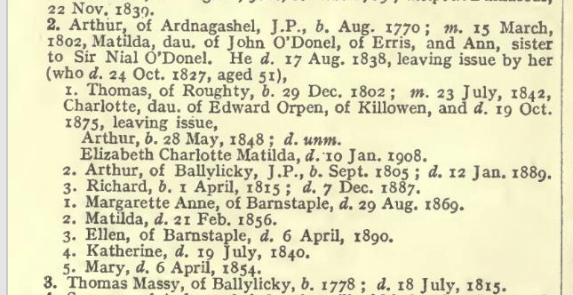
Arthur Hutchins, Landlord and Magistrate, Ardnagashel, Bantry married 1802, Matilda O’Donnell, Erris, Co.Mayo, descendant of Niall of the Nine Hostages, West Cork Crowley, Descendants of Niall of the Nine Hostages
This branch of the O’Donnells moved from Donegal to North Mayo. By mid 18th century they were affluent due to smuggling. At that stage they purchased a landed estate in North West Mayo and converted to the Church of Ireland. A number of the sons were officers in the Mayo Militia and served in the Bantry area after the attempted French Invasion of Bantry Bay 1796.
Arthur Hutchins, Ardnagashel. Visited by reformer Sir Francis Burdett 1817. Listed 1823. Present at enquiry Skibbereen 1823 into enquiry into fatal affray at Castlehaven caused by Rev. Morritt’s tithe extraction. Notified as Magistrate of Catholic meeting in Bantry re loyalty to King 1825. Litigation. Signed public declaration to Alexander O’Driscoll on his removal as Magistrate 1835 with Lord Bantry, Simon White, John Puxley, Thomas Baldwin, Samuel Townsend Junior and Senior, Hugh Lawton, Thomas Somerville, Richard Townsend Senior, Rev. Alleyn Evanson, Timothy O’Donovan, Richard Townsend, Lyttleton Lyster. 1824. Letter from Anthony (probably Arthur) Hutchins, magistrate, Ardnagashel, near Bantry, County Cork, to Henry Goulburn, Chief Secretary of Ireland, Irish Office, Westminster, London, offering observations on causes of instability in Irish society. Concludes the upper classes have failed in their responsibilities to the lower orders, providing neither a fair measure of justice nor general employment; in such circumstances there is ‘still the strongest necessity for continuing the Insurrection Act’. Traces much of social disquiet to factors such as corrupt use of public money in grand jury presentments and to an unfair administration of the law in tithe cases; advocates that legal consideration of tithe cases be conducted by assistant barristers at general sessions rather than by local magistrates. Observes should modification be made to the tithe or to status of church property ‘it will probably tend to the decline of the Protestant Religion in Ireland’. Offers assistance to the government on necessary measures to bring stability to Irish society.
Two letters from Dr George A Borthwick, Forres Street, Edinburgh [Scotland], to Sir Francis Leveson Gower, [Chief Secretary], and William Gregory, [Under Secretary, Dublin Castle], complaining about the inadequacy of Irish law and detailing his suit against Mr Arthur Hutchins, magistrate, Adnagashel, County Cork over land from Borthwick’s grandmother Mrs Alleyn, providing copy letter from his solicitor John Drew Atkin, Dublin, affidavit by James Lomasney, [bailiff], which further mentions Borthwick’s co-plaintiff Anthony Pack, [bailiffs] John McCarthy and John White, [Hutchins’s employee] John Peddle, Mr Ashe and Henry Milward, magistrates, showing that a writ of outlawry to Hutchins was violently prevented from being served. Also includes letter from [William] Kemmis, [crown solicitor], Kildare Street, [Dublin], confirming the details of the case, and an annotation by Richard W Greene, [legal advisor, Dublin], advising on further procedure.
Crowleys:
They are a branch of the Roscommon McDermotts, i the early fiant of the English Queen Elizabeth they are often referred to as McDemot wiht Crua Laoich (tough warrior0 used as nicknmae after a period the McSermot is dropped.
Harvard Professor Gates Is Half-Irish, Related to Cop Who Arrested Him
Two men at the center of the controversy are linked by their Irish heritage.
July 28, 2009— — Henry Louis Gates Jr., the black professor at the center of the racial story involving his arrest outside his Harvard University-owned house, has spoken proudly of his Irish roots.
In a PBS series on African-American ancestry that he hosted in 2008, Gates discovered his Irish roots when he found he was descended from an Irish immigrant and a slave girl.
He went to Trinity College in Dublin to have his DNA analyzed. There he found that he shared 10 of the 11 DNA matches with offspring of Niall of the Nine Hostages, the fourth century warlord who created one of the dominant strains of Irish genealogy because he had so many offspring.
Ironically, James Crowley, whose name in Gaelic means “hardy warrior,” is also descended from the same line as Gates, having very close links to Niall of the Nine Hostages.
So the two men who took part in what is now an infamous confrontation outside the Gates home near Harvard this month are actually related through common Irish lineage — one of the more extraordinary aspects of the incident that has sparked worldwide headlines.
Gates is one of many famous African-Americans with Irish heritage, including President Barack Obama and award-winning author Alice Walker.
On the PBS series, Gates visits Trinity College to find his roots, and says to the genealogist, “Do I look like an Irishman to you? I’m here to find my roots. I’ve been looking all over Africa and I couldn’t find anybody, so I ended up here.
“I’m descended from a white man, he says. “A white man who slept with a black slave. And we know from the analysis of my DNA that … goes back to Ireland. So maybe you can help me.”
When the genealogist tells him he does indeed have Irish links, Gates says, “I find this oddly moving. It is astonishing,” he says, “that I have a kinship with someone (Niall of the Nine Hostages) dating back to the fourth century A.D.”
Irish American Descendants
Millions of Irish Americans, especially those in New York, may be directly descended, like Gates, from Niall of the Nine Hostages, the most prolific warrior in Irish history.
A team of geneticists at Trinity College led by professor Dan Bradley have discovered that as many as 3 million men worldwide may be descendents of the Irish warlord, who was the Irish “High King” at Tara, the ancient center of Ireland from A.D. 379 to A.D. 405.
The story of Niall of the Nine Hostages is already the stuff of legend, which has been passed on to countless Irish schoolchildren over the years.
The supposedly fearless leader battled the English, the Scots, the French and even the Romans, and struck fear into the heart of his enemies. His dynasty lasted for centuries, continuing up until the Elizabethan conquest of Ireland at the end of the 16th century.
Legend has it that it was Niall of the Nine Hostages who, on a raid in Wales, captured a young slave and brought him to Ireland. That slave would later escape, and go to become Ireland’s patron saint, St. Patrick.
But one story not told to most Irish elementary schoolchildren was of Niall’s prolificacy.
When it came to the bedroom, it seems that Niall of the Nine Hostages was even more fearless and energetic than he was on the battlefield.
This warlord was responsible for the very common Irish surname “O’Neill” — which means “descendant son of Niall.” It is also the name of Irish pubs all over the world.
The researchers also found that as many as one in 12 men in Ireland have the same DNA as the Irish king — and in Ireland’s northwest, that figure rises to one in five.
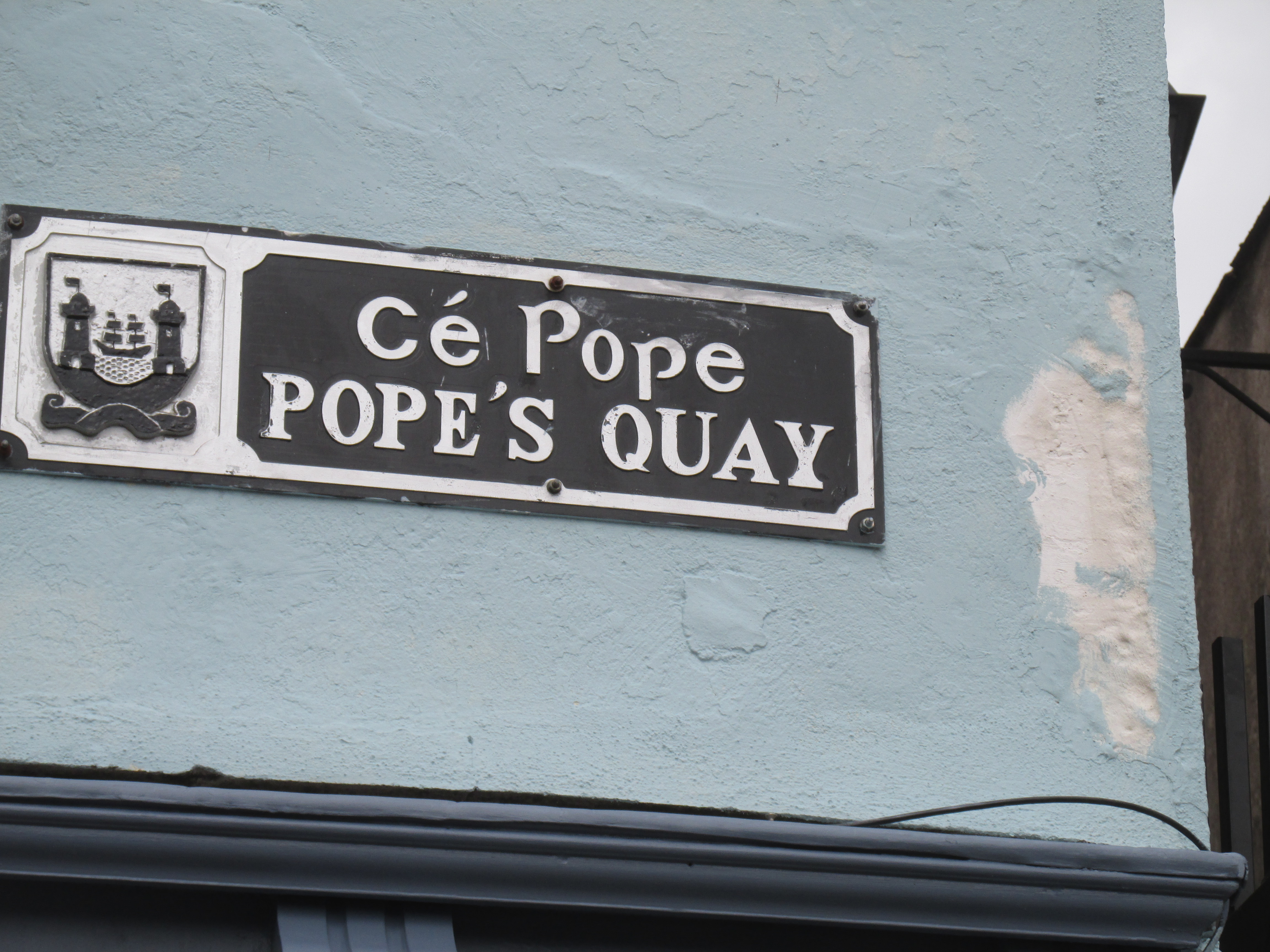
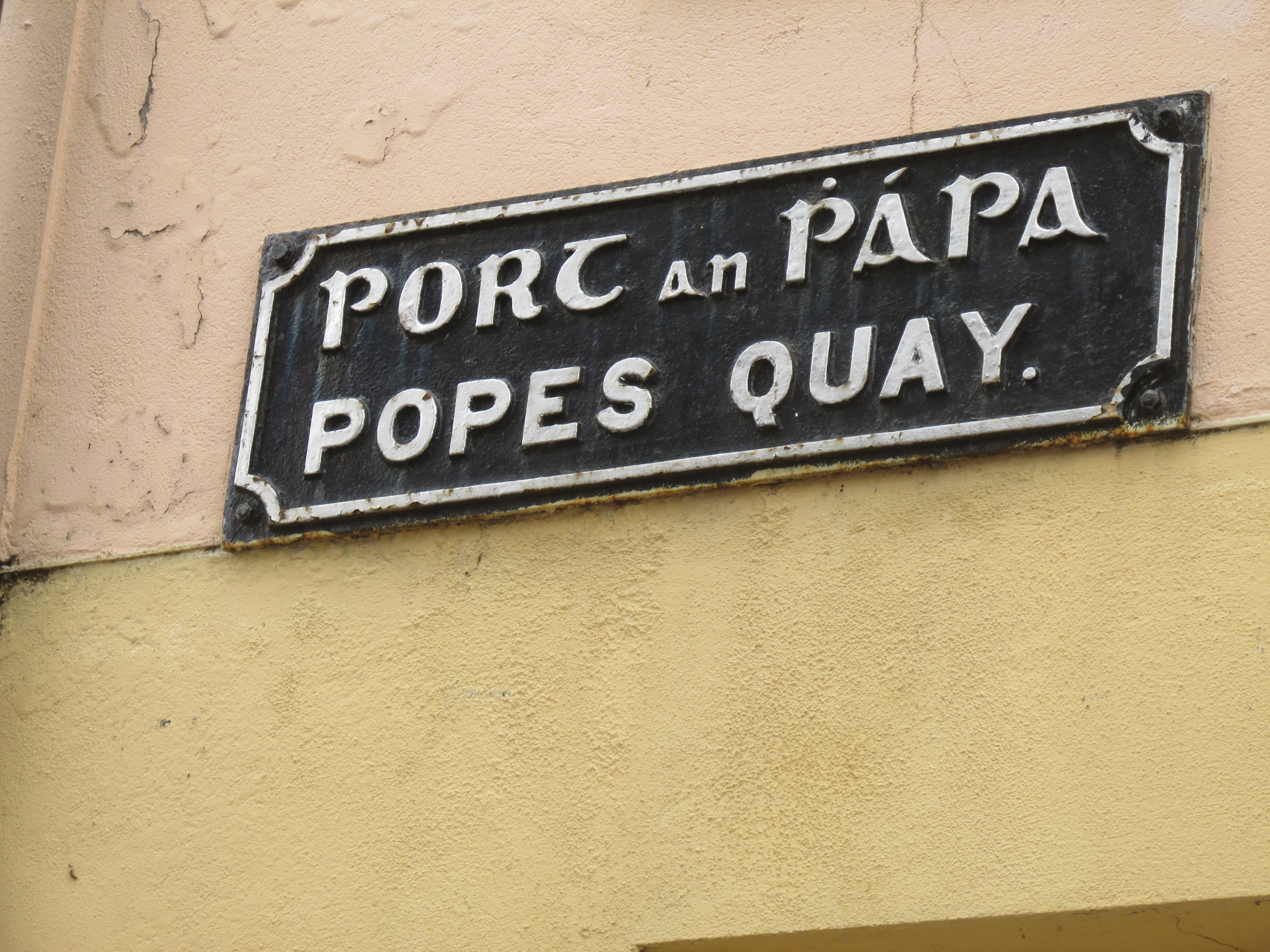
An old sign at one end of the Quay in the Irish Translation suggested that the Quay is called after the Pope in Rome. The other Irish version has the corrects signage insofar as it is called after the Merchant family.
Camden Quay is named after Lord Camden who was Lord Lieutenant of Ireland and visited Cork in 1795. Pope’s Quay is named after the widow of Thomas Pope who lived in Cork in the early eighteenth century. The Council Book of the Corporation of Cork records that ‘In November 1718 permission was granted to the Widow Pope to build a quay between Alderman Brown’s Quay and Mr Farren’s Quay’.
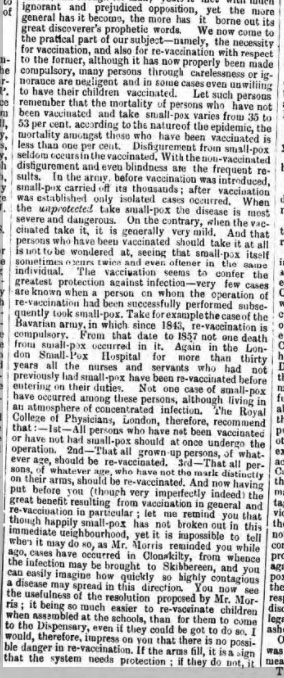
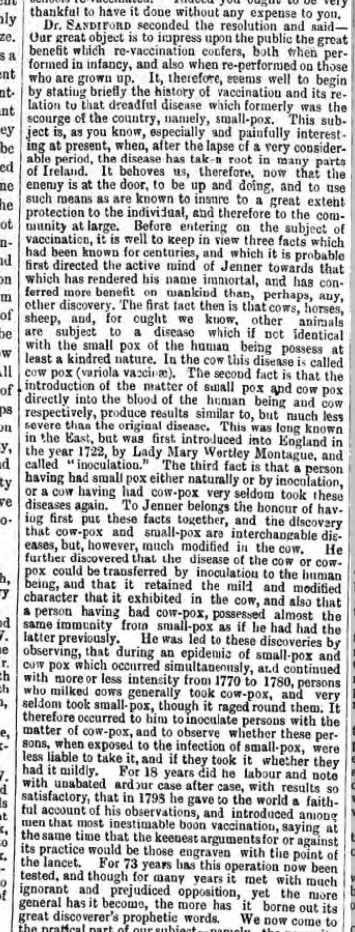
Ireland was on e of the first countries in Europe to largely eradicate smallpox due to the dedication of Dispensary Doctors, a poorly paid and over worked profession.
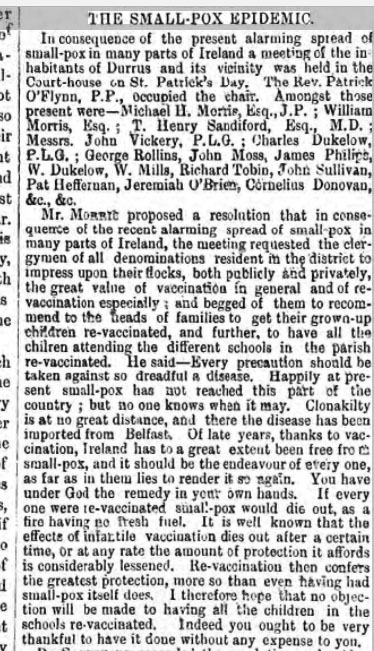
1871, Meeting Courthouse, Durrus, Patrick’s Day re Alarming Spread of Smallpox
Chaired by Father O’Flynn, P.P., Durrus.
Michael Hungerford Morris, Eq., J.P. Friendly Cove
William Morris, Esq.,
Dr. Thomas Henry Sandiford, M.D., Dispensary Doctor
John Vickery, Poor Law, Guardian, Ballycomane
Charles Dukelow, Poor Law Guardian
George Rollins, Rossmore, Slate Quarry Owner
John Moss, Contractor
James Philips, Owner Bandon Arms Hotel, Durrus
W. Dukelow
W. Mills
Richard Tobin, Businessman, probably grandson ‘King’ Tobin, Kilcrohane
John Sullivan, probably shop owner
Pat Heffernan
Jeremiah O’Brien
Cornelius Donovan
etc
….
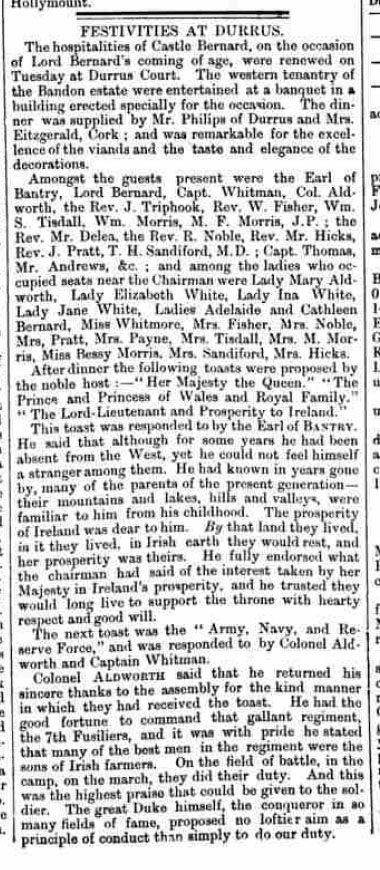
1871 Western Tenantry Entertained by Lord Bandon on coming of age of Lord Bernard, at Durrus Court (Gearhameen). Dinner provided by James Philips of Durrus and Mrs. Fitzgerald, Cork.
Among those present
Earl of Bantry
Captain Whitman
Colonel Aldworth
Rev. John Triphook, Schull
Rev. W. Fisher, Teampall na mBochht, Goleen
William S. Tisdall
William Morris
Michael Hungerford Morris, J.P., Evanson descendant, Friendly Cove.
Rev. W. Dulea, later Parish Priest Durrus.
Rev. R. Noble
Rev Hicks
Rev. Pratt, Durrus
Dr. Thomas Henry Sandiford, M.D., Dispensary Doctor
Captain Thomas, Mine Owner
Mr. Andrews
Lady Mary Aldworth nee Bernard, Bandon
Lady Elizabeth white
Lady Ina White
Lady Jane White
Lady Adelaide and Cathleen Bernard, Bandon
Miss whitmore
Mrs Fisher
Mrs. Noble
Mrs. Pratt, nee Murphy, Newtown, Bantry
Mrs Payne, probably wife of Somers Payne agent Lord Bantry
Mrs Tisdall, may be nee Murphy Newtown, Bantry
Mrs M. Morris
Miss Bessy Morris
Mrs. Sandiford
Mrs. Hicks
Toasts to :’Her Majesty the Queen’, ‘The Prince and Princes of Wales’, and the Royal Family
‘The Lord Lieutenant and Prosperity to Ireland’, ‘Army Navy and Reserve Forces’
Doctor Barry, 1800, on ‘Shinach’ (Small Pox) and practice in Cork of inoculation with Cow Pox 50 years before Dr Jenner’s vaccination and late 18th century inoculations by Mr. Goodwin, Bantry, Wes
Clais na Bolainghe (Clashnabullagee), Small Pox Trench/Pit, containing remains of those who died of Small Pox, identified in 1842 Ordnance Survey Orthography, 1842, Townland of Rooska adjoining Bantry Bay.
Ross Cathedral Records: included are details of the three young Griffith girls who died by small pox in 1717.
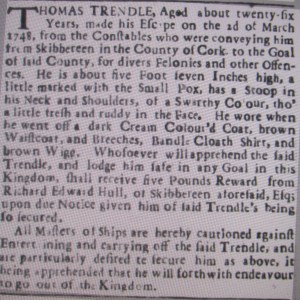
1748, Thomas Trendle (Trender?), Skibbereen escaped Convict en route to Cork Gaol, Marked with Small Pox, Wig, Description of Clothing, Reward £5 from William Hull, Skibbereen, Ship Masters Notified.
1822, Dr William Folliott, Clonakilty, County Cork, to Chief Secretary’s Office, Dublin Castle, making case for increase of vaccination against small pox in District Edward Hunt, Kinsale, 1822, observes that many Magistrates are uneducated men ‘who in many instances are Tythe Proctors and in most instances are as Middlemen the cruelest and most unrelenting oppressors of the unfortunate tenantry under them’
1835, The Cow-Pock Institution, Inoculation in Clonakilty 1822, Rooska, Bantry, Pit with Small Pox Victims, Old Practice of Shinnack, 50 Years before Jenner.
The disease inspired particular dread in Ireland where smallpox and its ugly sisters, cholera, typhoid and dysentery made themselves at home for hundreds of years and exploited extreme poverty and ignorance to devastating effect. The symptoms of the disease were high fever, headache, pain in the back and muscles. Children might also experience vomiting and convulsions.
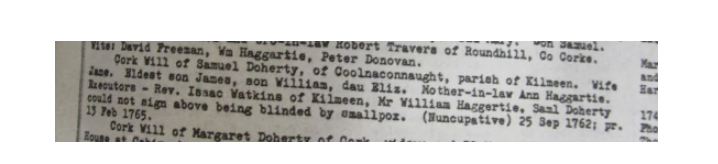
If you didn’t die of smallpox in 18th and 19th century Ireland you probably went blind. The next time you hear the music of the great harpist Turlough O’Carolan from Nobber in County Meath think of smallpox. It blinded him at the age of eighteen in 1688 making him virtually useless for any occupation until he developed a talent as a harpist and a facility for musical composition. Many other itinerant harpists had been similarly afflicted.
The disease, which was highly contagious and infectious, is believed to have caused about one fifth of all deaths in the city of Dublin between 1661 and 1746. About a third of all child deaths were probably caused by smallpox. Although it mainly afflicted the poor it was no respecter of rank. The children of the rich could die of the disease just as quickly as those closer to the breadline.
Hope emerged towards the beginning of the 18th century when the efficacy of inoculation started to become apparent. Inoculating people with small doses of the virus had apparently been practiced in China since the 10th century but didn’t really begin to make inroads in Europe for almost another eight hundred years. In Ireland the technique was first tried on a number of, presumably unwilling, prisoners in Cork Jail in 1721. Four years later the experiment was extended to five children in Dublin.
As the effectiveness became clear the better off began to use inoculation to protect themselves and their children. During periodic epidemics in the mid to late 18th centuries the survival rate among the wealthy families who had engaged in the practice encouraged its more widespread use. The South Infirmary in Cork even initiated a programme to inoculate the poor.
Naturally where there was money to be made there were charlatans. Travelling inoculators with a very basic grasp, if any, of what they were doing, competed for trade. In Donegal in 1781 all but one child of a group of fifty-two died when one unqualified practitioner purported to inoculate them.
Whatever inroads were being made in Ireland against the disease came to virtually nothing with the onset of the Great Famine of the 1840s when smallpox returned with a grim vengeance. Even for sufferers who survived the recovery period of the disease ensured that many were pauperised and died anyway with breadwinners unable to work.
It was only from the 1880s onwards that the disease began to be more rapidly eradicated in Ireland. In the 1870s more than seven and a half thousand people died of smallpox. By the first decade of the 20th century that figure was down to sixty-five. Between 1901 and 1910 almost a million Irish people were vaccinated against the disease.








 West Cork History