Sir John Jocelyn Coghill, 4th Baronet, and typically known as Sir Jocelyn Coghill, came from a long-established and wealthy Yorkshire family. He was born in Co.KIlkenny. His second marriage brought him ties to Ireland. When or how he became interested in photography is not known, but Coghill began taking paper negatives by the early 1850s or even before. His photographs reflect the interests of a wealthy amateur and include family portraits, idyllic country scenes, and architectural studies. Coghill became briefly active in photographic circles in 1857, contributing a view to The Photographic Album for the Year 1857; showing nine landscapes in the “Manchester Art Treasures” exhibition…
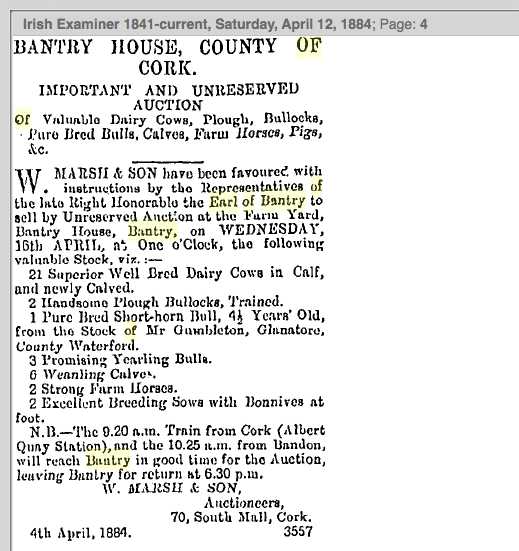
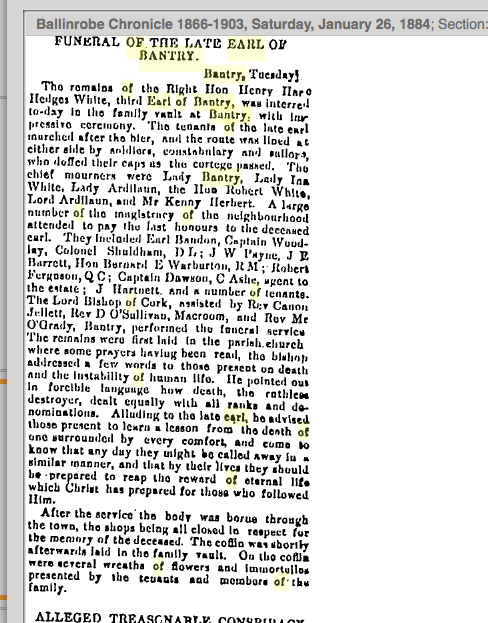
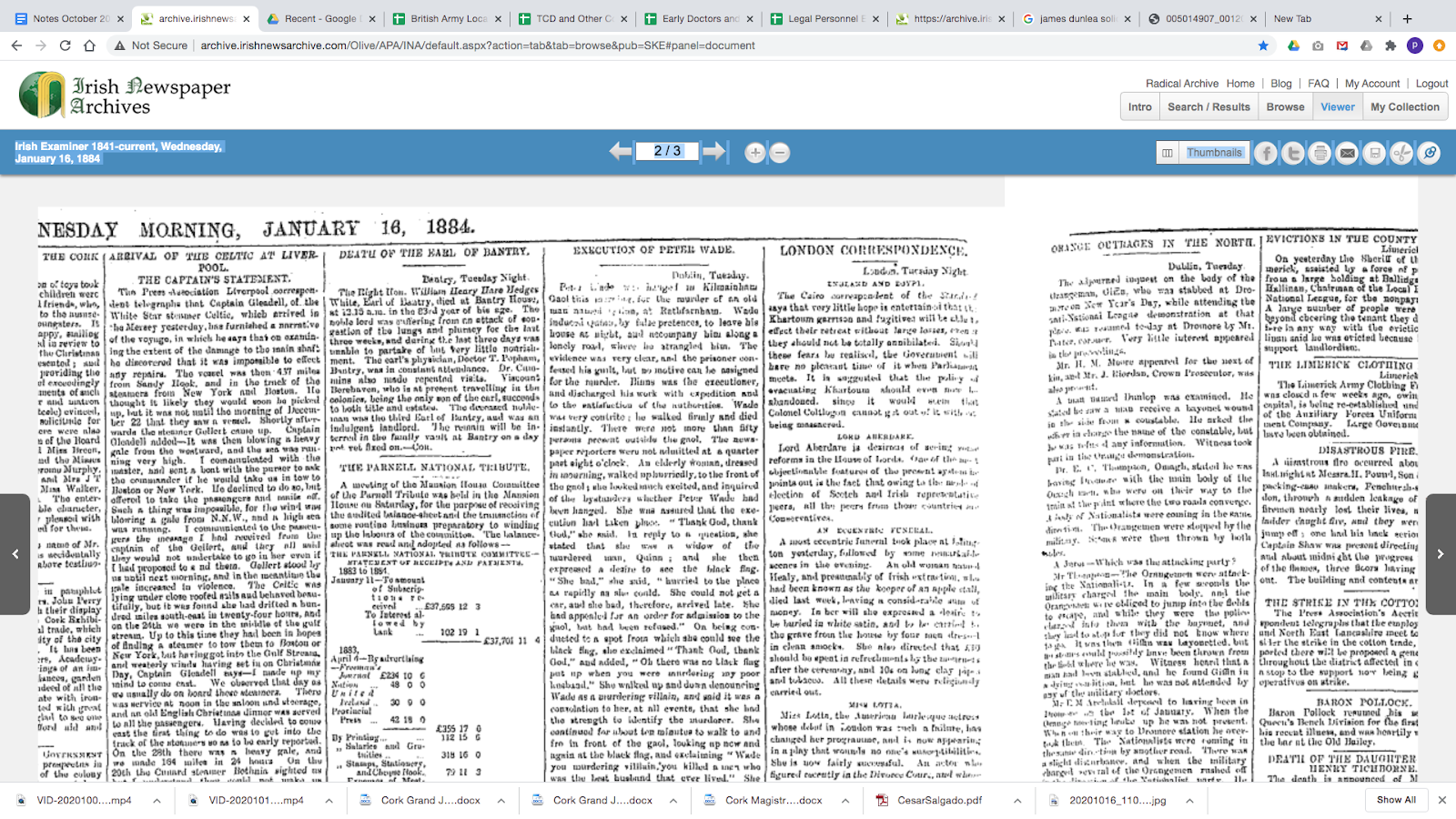
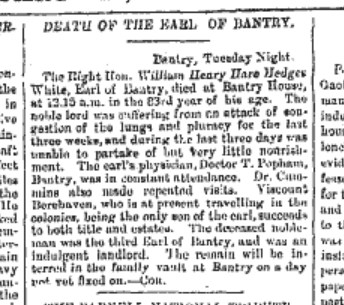
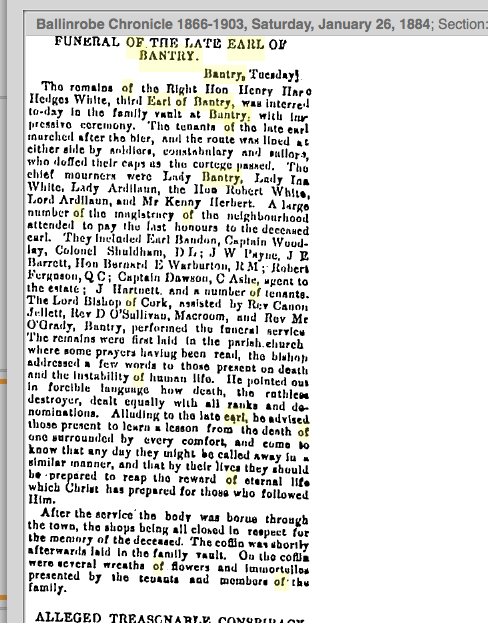
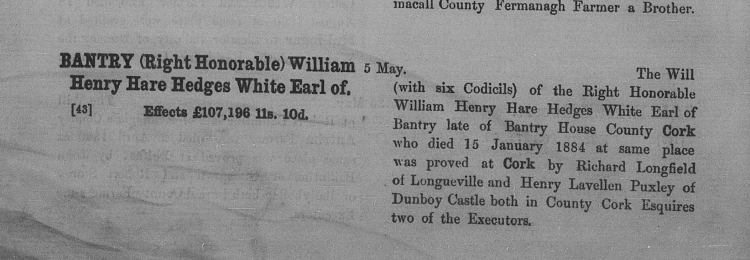
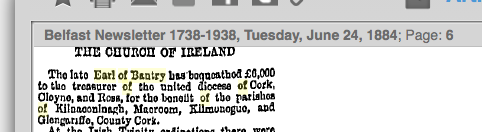
1883 Funeral of the Earl of Bantry, aged 83, Auction of the Late Earl of Bantry, Livestock including Two Handsome Plough Bullocks, Trained. Probate £107,000 (Circa €25 Million in 2020 terms).
To Give an estimate to present day values a Resident Magistrate had a package of around £500 per annum a rough equivalent Irish District Justice is on around €150,000, c £120,000.
His predessor left an estate of c £50,000.
What is surprising is that the Bantry Estate throughout the 19th century hoved on insolvency, Lord Ardilaun commissioner a financial report.
Finances of Bantry Estate, 1888, requested by Lord Ardilaun rents of £11,600 for Bantry and £4,800 for Macroom, deficit of £2,035, with rent reductions for tenants of 25%.
1871 Lord Ardilaun (Guinness heir) married Lady Olivia Hedges-White, daughter of The 3rd Earl of Bantry, whose family home is Bantry House in County Cork. His report showed a rental of £10,000 per annum. The agent to the estate the Somers Paye kept the White family on a tight financial leash. Despite the value of his estate the previous Earl of Bantry, Lord Berehaven kept complaining about a lack of cash.
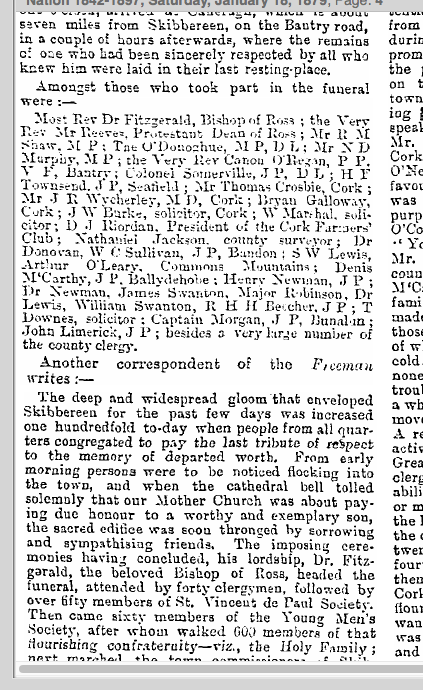
Funeral of the Earl of Banty aged 83,
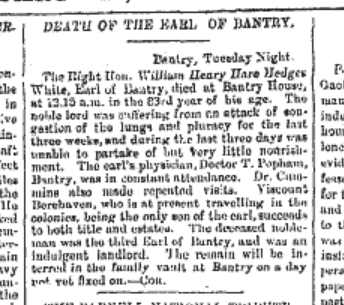
1884, William Henry Hedges Hare Hedges-White, (1801-1884), 3rd Earl of Bantry. Probate £107,000.
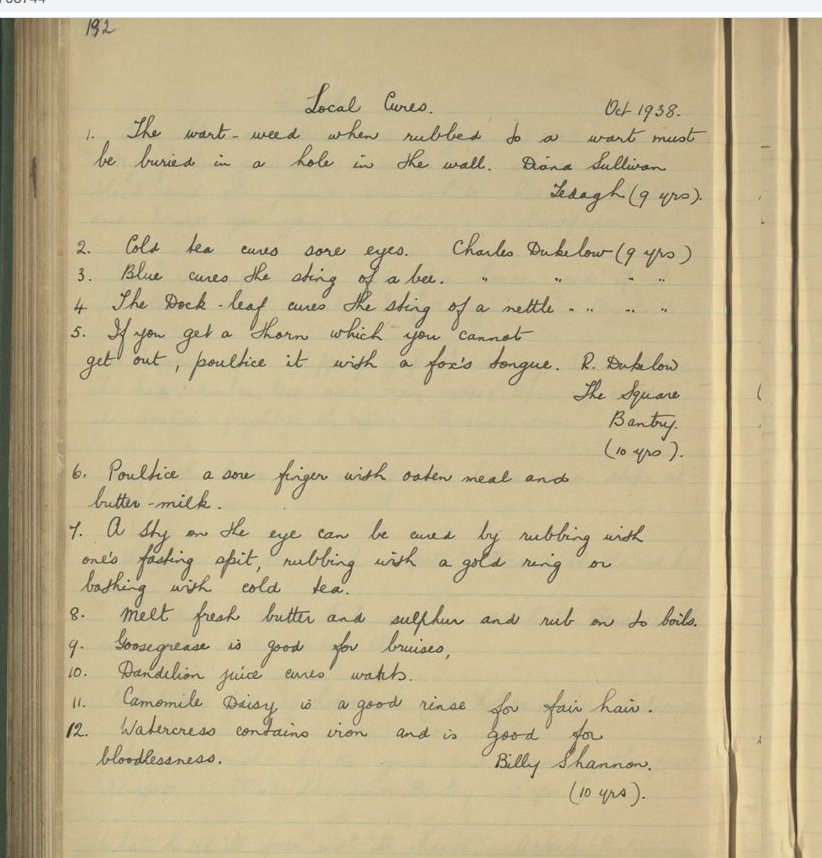
National Folklore Collection (NFC) and its collections
The objectives of the National Folklore Collection (NFC) are to collect, preserve and disseminate the oral tradition of Ireland. The NFC, which is located in UCD, includes the following records:
c.2 million manuscript pages
c.500,000 index cards
c.12,000 hours of sound recordings
c.80,000 photographs
c.1,000 hours of video material
The original holdings of the NFC are divided into collections:
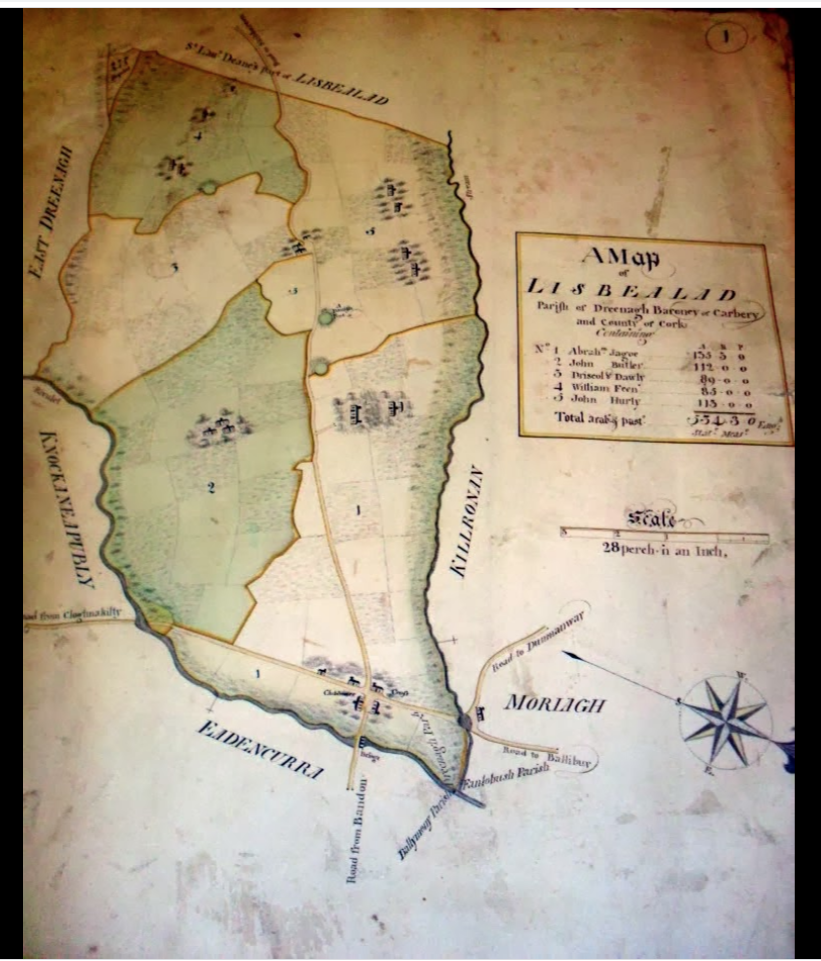
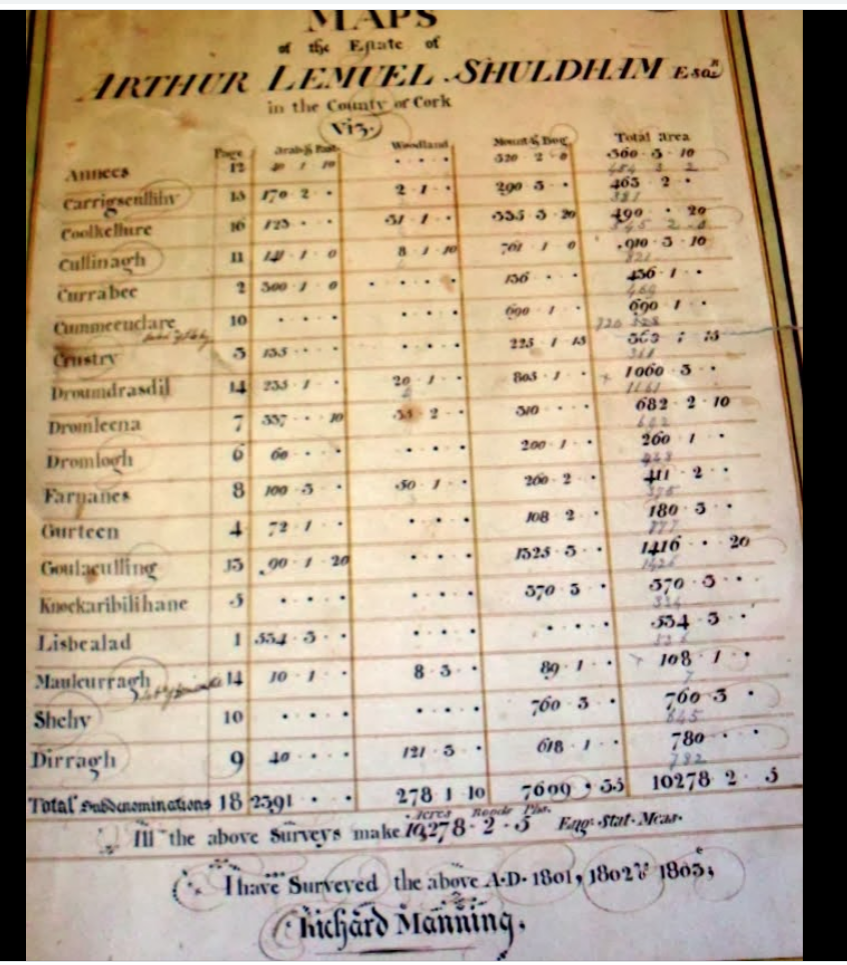
1801-1803, Maps by Richard Manning of the Estate of Arthur Lemuel Shuldham, Esq., Dunmanway.
The Shuldhams on the maternal side are a branch of the McCarthys. Shuldham c 1720 married a McCarthy heiress. She appears shortly after in the convert rolls.
Usher Genealogy: Marriage c 1720 of Edmond Shuldham to Miss MacCarthy, heiress to MacCarthy Mór, Dunmanway, West Cork.
Dunmanway, West Cork, Shuldham Pedrigree from Genealogical Office, Dublin, commencing with marriage of 1713 between Edmund Shuldham, Crown Solicitor to Mary McCarthy Spannigh.
Middle Temple one of the four London Law Schools. These entries capture the British Empire at it height. There are quite a number of Irish and Cork entries.
There are a number of Japanese entries. Presumably this coincides with the modernisation of Japan. Unlike India or Pakistan it was not colonised they had the misfortune to be looted by the tis East India Company and after them the British
1904 Robert Travers, Queens College Galway. Kings Inns, Middle Temple 1878, Barrister, 1901 Judges Registrar, Dublin Timoleague, executor of Robert Augustus Travers, 1878 Clerk in Probate Court, Dublin, died 1904 probate £8,331 1910 living Dublin wife English 2 servant probably returned to home place Timoleague shortly after.
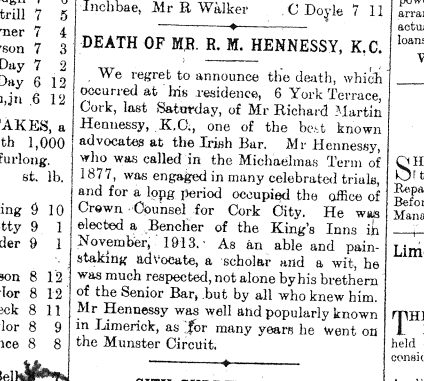
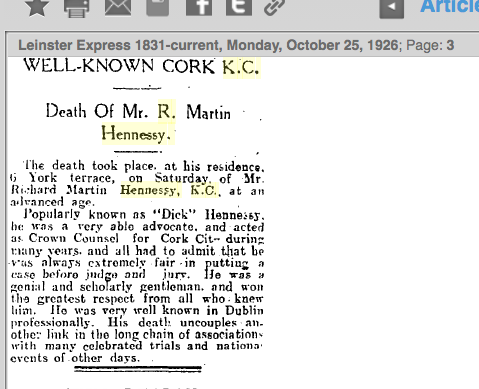
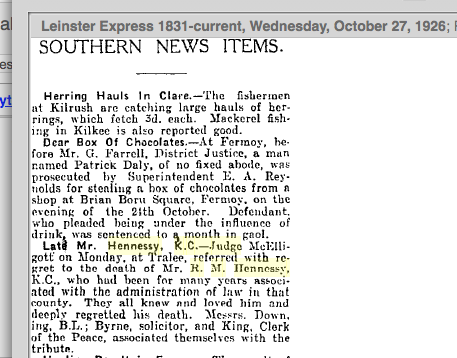
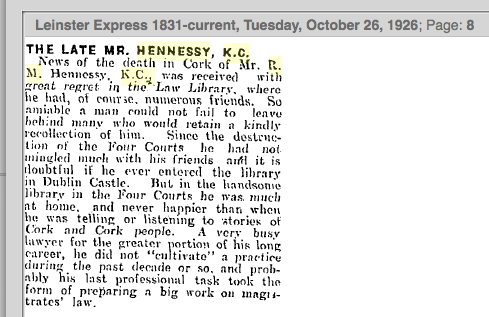
1926, Dick Hennessy, King’s Counsel, Bencher 1913, County Court Judge Waterford 1919.
1876, 1891, 1899 Richard Martin (Dick/RM) Hennessy TCD Middle Temple, 1876, Bencher 1913, County Court Judge Waterford 1913. Ballindeasig House, Kinsale, 2nd son of John Chrysostom Hennessy. 1899 instructed by McCarthy, Bandon in election case for applicants allegation of bribery.At inaugural meeting Solicitors Apprentices Debating Society. Family probably had an estate. 1891 address Lower Baggot St., Dublin executor of fathers estate £14,427. 1926 died at residence 6 York Terrace, Cork Substantial buildings are marked at the site of Ballindeasig House on the first Ordnance Survey map and at the time of Griffith’s Valuation the house valued at £18 was occupied and held by Richard Kenefick in fee. Ballindeasig was conveyed to John C. Hennessy by Richard Kenefick in 1853. It was the home of Michael Hennessy in the late 19th century and was left by Miss Minnie Hennessy to Bishop Cohalan of Cork in 1937. The house was then converted into a holiday home for the Sisters of Mercy Order. Now known as Tabor Lodge it is a centre for the treatment of substance abuse
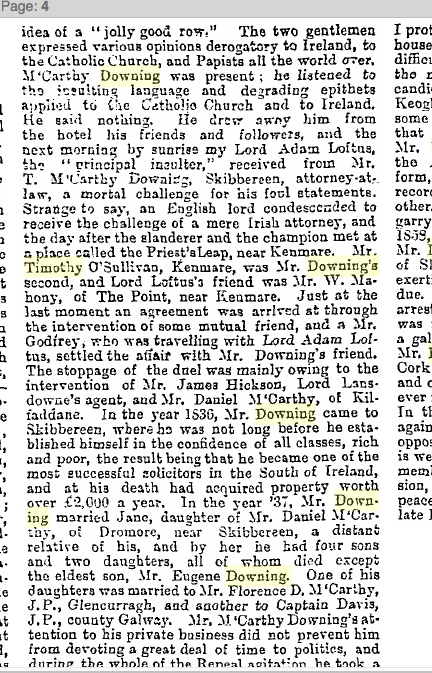
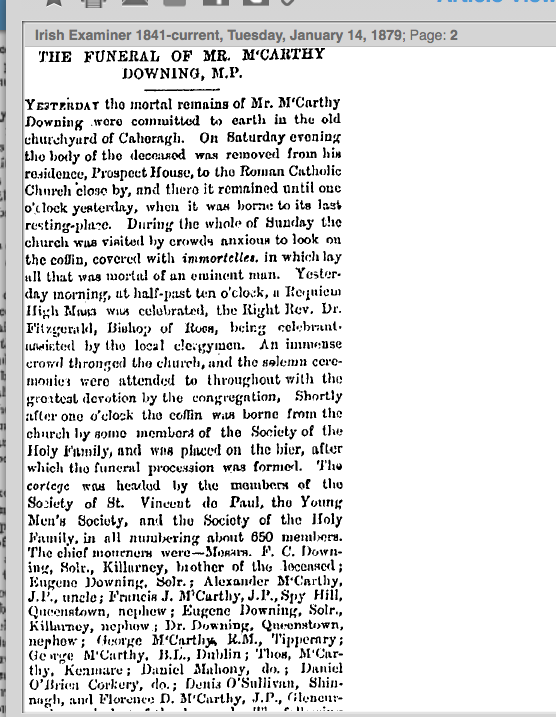
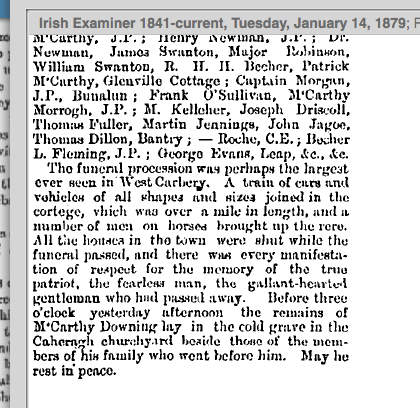
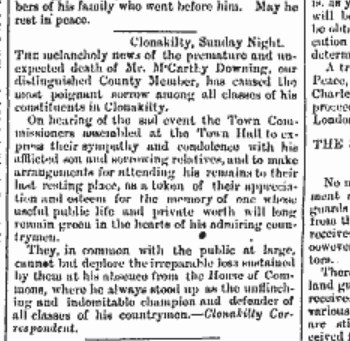
1813-1879,1835, 1847 Timothy McCarthy Downing “Apprenticed to F.H. Downing, Kenmare. Solicitor in Skibbeeen 1836. , MP. His parents were Eugene and Nellie. Eugene was from Kenmare and Nellie hailed from Kilfadamore ? Back in 1876 Timothy proposed to change the name of Skibbereen to Illenmore or Illentown, which was voted down. ” Skibbereen 1847 distress meeting. as Clover Hill. Addressed meeting 1848 in Skibbereen to celebrate Liberation of William Smith O’brien. Seeking equality of endowment in Catholic education Prospect House 1859. REntal income from his estates £2,000. From around Kenmare and brother of Roger Downing, Merchant, Bantry alos active in Repeal Told O’Donovan Ross he was a ’48’ man he had a cherished possession a green cap the 48 men had when they were on the run and he would have been the first to handle a pike if he thought it would be of any use but not with England’s Army and Navy.. “Downing McCarthy, (M.P. for Co. Cork) ; second son of Eugene Downing, Esq, of Kenmare, co. Kerry b. 1814 ; m. 1837. Is a J.P. and D.L. of co. Cork. First elected, 1868. Res.—Prospect House, Skibbereen, co. Cork; Reform Club, S. W.
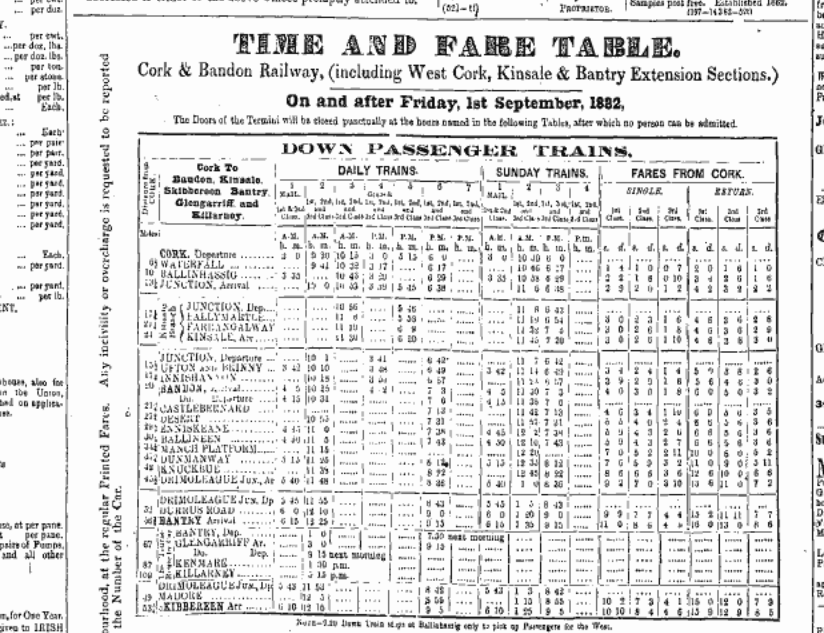
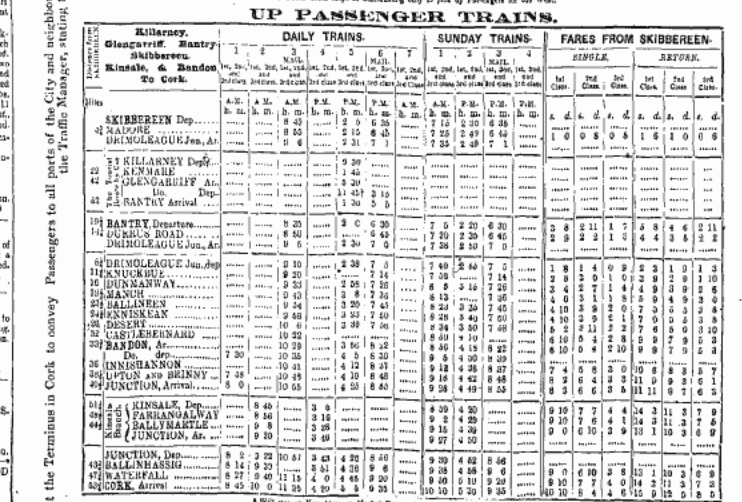
1849. Commencement of Cork Bandon Railway with The Bandon-Ballinhassig stretch operations with two engines, Rith Tinneadh (Speeding Fire) and Sighe Goithe (Whirlwind)
1846. Subscribers to Projected Railway (Probably to Skibbereen), Francis Roycroft, Accountant, €2,500, John Shannon, Accountant, £2,500, Thomas Attridge, £3,250, Dealer all Ballydehob, Daniel Donovan, M.D., Skibbereen, £2,500.
650 Men Working Night and Day to Open Skibbereen Railway. Along the line Large Numbers of Rustics Lined Up to See the First Train.
The Right Honourable Earl of Bandon, Patron and Honorary Director of the Steam Carriage and Wagon Company for The Conveyance of Goods and passengers Throughout Ireland Upon Common Roads.
1830, Subscribers to Robert O’Callaghan Newenham’s, (25 years Superintendent Barracks Department of Ireland), Picturesque Views of the Antiquities of Ireland. 1845 Promoter of Projected Bandon to Bantry Railway
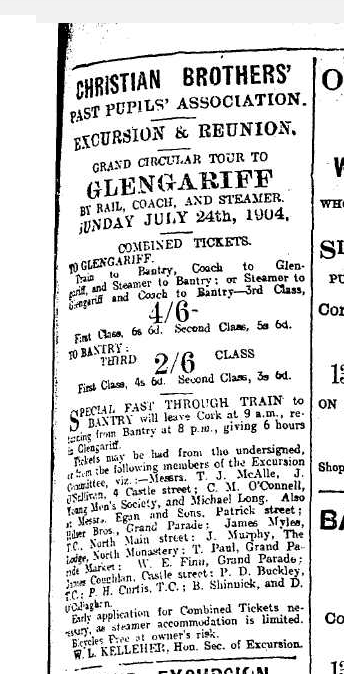
1890, Will of Denis Murphy, Builder, Bantry, Builder of Bantry Pier, Father of William Martin Murphy. 1919, William Martin Murphy, Derrymihan, Beara and Dublin, businessman. Estate £250,000. He left a range of businesses with a substantial asset value, including Dublin’s tramway system, hotels in Dublin and Glengariff, Cleary’s Department store, a range of railway shares and various properties including a builders yard in Bantry (which is still in business). He had also invested heavily in the Dublin newspaper industry.
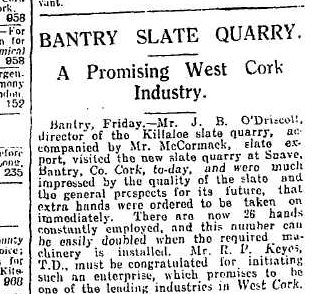
Slate Quarries, Drimoleague, Sea Lodge, Durrus, Kilcrohane, West Cork from Skibbereen and West Carbery Eagle or South Western Advertiser 1865/6, and Lead Mine, 1310 Belamire (Probably Gearhameen), Durrus
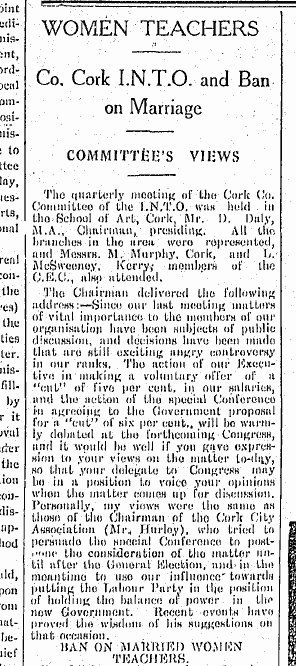
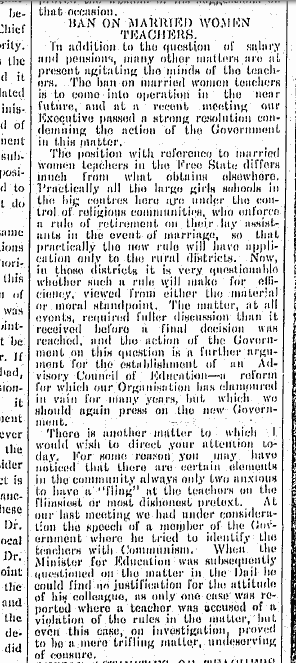
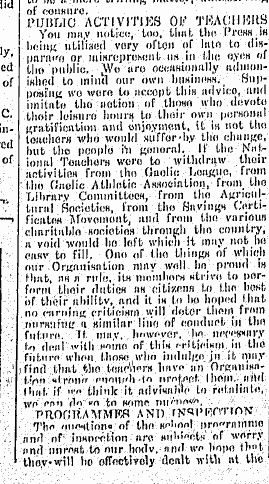
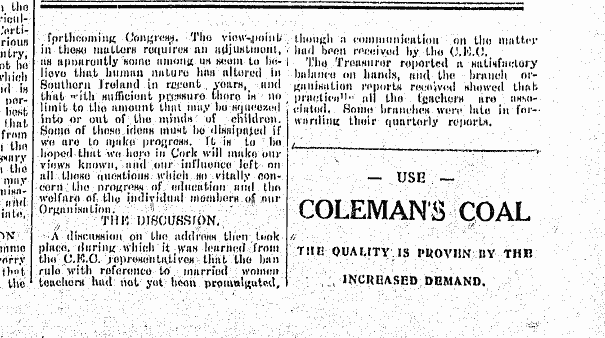
In 1932, the Irish government, facing an economic downturn, introduced a marriage ban which required that female primary school teachers were required to resign on marriage. This followed a series of restrictive legislative measures adopted by Irish governments throughout the 1920s which sought to limit women’s participation in public life and the public sector. Such a requirement emerged in several countries in response to high unemployment and applied principally to women’s white-collar occupations, leading some commentators to argue that it stemmed from a social consensus rather than an economic rationale. Despite opposition to the ban from the Irish National Teachers’ Organisation (INTO) on the basis that it was unconstitutional, would lead to fewer marriages and that married women were in fact more suited to teaching children, it remained in place until 1958. Although the ban is much referred to as part of the gender ideology that informed legislation in the early years of independent Ireland, the particular history of married women teachers has been little researched in the academic context. Over 50 years since the rescinding of the ban, this article examines its impact through an analysis of primary sources, including government cabinet minutes and the public commentary of the INTO and positions this history within the international context.
Collect her children’s allowance
The 1944 legislation that introduced the payment of children’s allowances (now called child benefit) specified that they be paid to the father. The father could, if he chose, mandate his wife to collect the money, but she had no right to it.
How it changed
Responding to the report of the Commission on the Status of Women, the 1974 Social Welfare Act entitled mothers to collect the allowance.
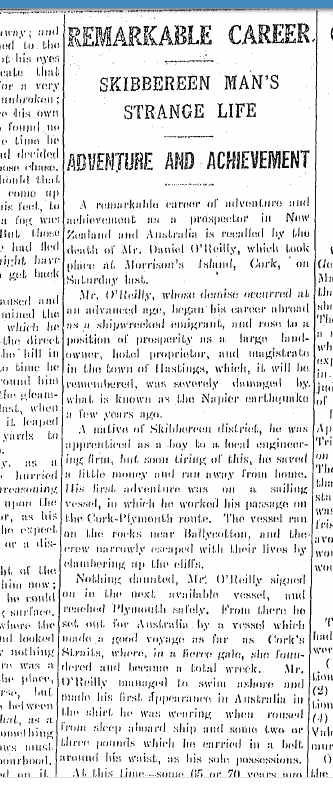
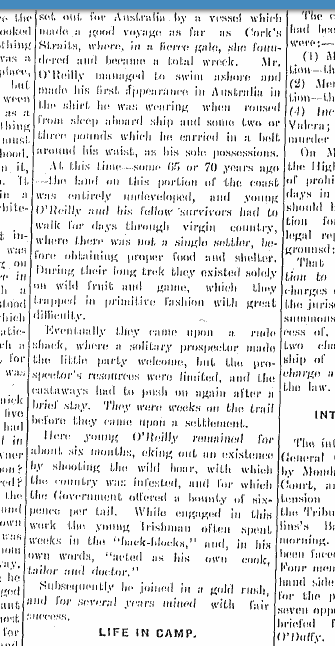
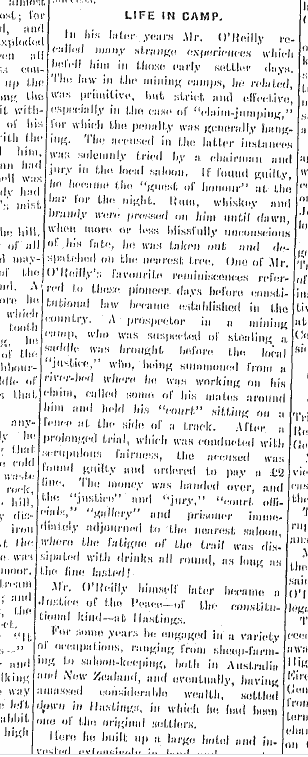
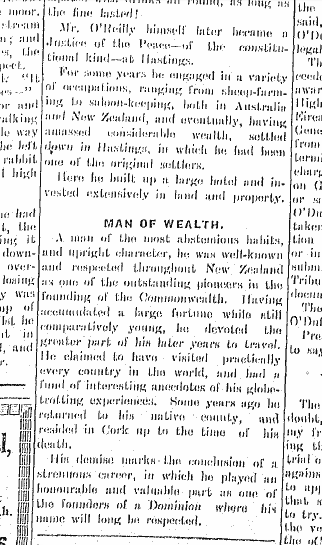
The Remarkable Daniel O’Reilly, Born Skibbereen, Shipwrecked, Mining Prospector Australia, Sheep Farmer, Hotel Owner, Magistrate Hastings New Zealand. Died Cork 1934
==
Daniel O’Reilly, Magistrate, Hastings New Zealand, Born Skibbereen area, mining prospector Australia 1880s, substantial property owner Australian and New Zealand. Retired to Cork died 1934.
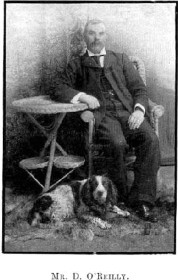
MR. DANIEL O’REILLY, proprietor of the Hastings Hotel, is a native of Cork, Ireland, and came to New Zealand in the year 1878, by the ship “City of Auckland,” which was wrecked on the Otaki beach. Mr. O’Reilly lost all his possessions. and was conveyed with other passengers to Napier by the Government steamer “Hinemoa.” He energetically set to work to make the best of bad fortune, and obtained agricultural employment, at which he continued for six years. He removed to Hastings in 1885, started a boot and shoe shop, and carried on that business successfully for three years, when he sold it to the Egmont Boot Factory Company, of New Plymouth. Mr. O’Reilly then opened a drapery business, which he disposed of three years later to considerable advantage, and in 1892 bought an interest in the Hastings Hotel. He owns a fine little farm of about ten acres, from which the hotel table is supplied with fruit, vegetables, and poultry; and he also owns a large block of land opposite the railway, on which he has erected five large shops. In politics Mr. O’Reilly is a liberal. He has been a member of the Hibernian Society for many years, and of the Napier Park and Hastings Trotting Clubs, Agricultural and Pastoral Society, and Hastings Bowling Club. In 1887 Mr. O’Reilly married Miss Julia O’Neill, and has two children
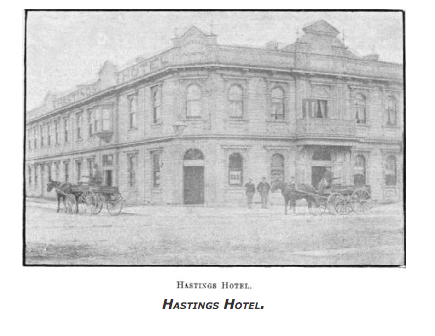
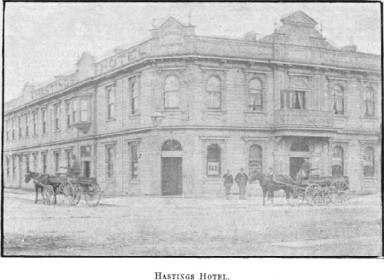
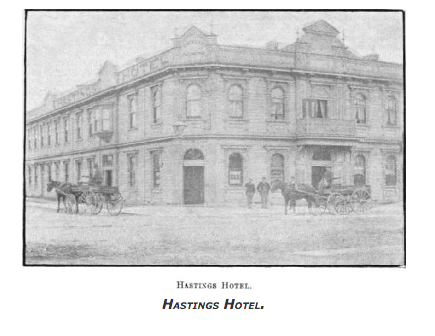
THE HASTINGS HOTEL (Daniel O’Reilly, proprietor), corner of Heretaunga and Railway Streets, Hastings. Telephone, 190. Bankers, Bank of New South Wales. This hotel is a large two-storeyed building, situated in the centre of the town, and near the railway station, post office, and other public buildings. It contains on the upper floor about thirty bedrooms, a ladies’ drawing-room, and a number of private sitting-room, all furnished in first-class style. On the ground floor is the dining-room (capable of accommodating ninety guests), commercial and billiard rooms, and six sitting-rooms. The house is much resorted to by country settlers, tourists and the general travelling public. The whole domestic arrangements are under the immediate supervision of Mrs. O’Reilly.

















 West Cork History