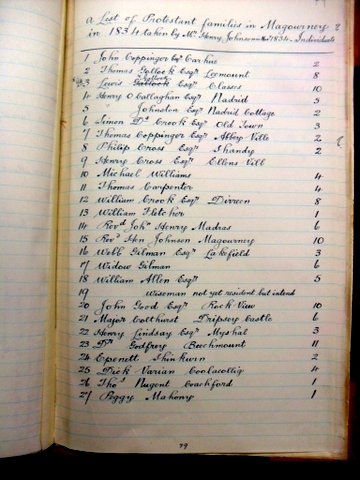
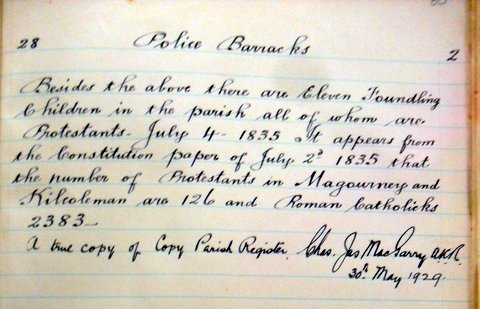
Some records from 1838 of Clonmel Parish, Church of Ireland, Dioceses of Cloyne, Co. Cork


https://www.google.ie/maps/place/Fota+Island,+Co.+Cork/@51.8991665,-8.298333,15z/data=!3m1!4b1!4m2!3m1!1s0x48449cd349444cb1:0xc2c672cd6b7788d2

https://plus.google.com/photos/100968344231272482288/albums/5937114655285244577

Brady:

Click to access brady_vol2_cropped.pdf

Skib Girl:

Townlands, Tithe Aplottments, Griffiths.
http://corkgen.org/publicgenealogy/cork/parishes/clonmel-1044.html

https://familysearch.org/learn/wiki/en/Clonmel_Civil_Parish,_County_Cork

Records Lislee (Courtmacsherry), Church of Ireland, Co. Cork some from 1775


https://www.google.ie/maps/place/Courtmacsherry,+Co.+Cork/@51.6338546,-8.7146887,15z/data=!3m1!4b1!4m2!3m1!1s0x4844594b253080cf:0x0a00c7a99731f960


Screen Shot 2018-01-02 at 11.18.39


..

Courtesy Catherine Fitzsimmon’s Tresilian family history:

Lislee Church

20180102_124030


..

Some of the records were copied by the Vicar for transmission to the Rolls Court at the end of his incumbency. At that time the Church of Ireland was the State Church and ran a parallel legal system dealing with probate matters.

Among the names in the community are those long associated with the area O’Hea, McCarthy, Collins, Coghlan, Hurley, O’Sullivan. The Travers family are associated with the sea as Master Mariners, Ships Husbands. There a number of marriages from Tide Waiters early Customs and Excise and Water Guards early Coastguard some English. During the Napoleonic Wars the signal tower at Seven Heads was occupied and some of the personnel married locally.

The Lislie Landlord family is represented, and their marriages including on to a Charles Andrews a Barrister of Comber, Co. Down in 1839.

A number of pages are missing as they did not copy well.

https://plus.google.com/photos/100968344231272482288/albums/5936210697797523233

From Bandon Genealogy Baptisms 1809-1862

http://www.bandon-genealogy.com/baptisms_lislee.htm

Marriages 1809-1844:

http://www.bandon-genealogy.com/marriages_lislee.htm

Burials:

http://www.bandon-genealogy.com/burials_lislee.htm

Some marriages:

Click to access Lislee%20P%20667%20011.pdf

Skib Girl Page for townlands, Tithe Aplottments, Griffith Valuations.
http://www.corkgen.org/publicgenealogy/cork/parishes/lislee-1210.html

Kilgariff Union
http://cork.anglican.org/places/kilgariffe-union/

Christ Church Cork, Birth, Marriages and Death Records from 1640s


There is a comprehensive set of records in the ‘Register of the Parish Register of Holy Trinity (Christ Church), Cork 1643 – 1669’. Edited by Susan Hood. Published by Representative Church Body 1998

The Holy Trinity (Christ Church), City of Cork 1732 – 1786 burial records and they are on the database of Cork Records

http://www.corkrecords.com

The records below were transcribed by the Public Records Office in 1961 from registers lent.

https://plus.google.com/photos/100968344231272482288/albums/5936179282398243713

Morpeth Roll, 1841, Castle Townsend, Co. Cork

Tags

, , , ,


In 1841 Lord Morpeth was leaving Ireland having served a successful term as Chief Secretary. The Duke of Leinster organised a roll of 160,000 signatures of those thanking him for his tenure. Maynooth University (http://history.nuim.ie/morpethroll) has organised the restoration and digitalization of the roll which can be accessed on ancestry.com.

One one page headed Robert Troy R.C., Vicar of Castletownsend there are around 250 names. Included also for local identification purposes is the name of Thomas Attridge, Merchant, Castle Townsend. Most of the names are local to the area but quite a number may be local Church of Ireland names. Given the loss of various census and church records it is of use to those researching their family pst. Included in the names are

Attridge

Thomas (Merchant), James, Sandy, John, Thomas, James, Arthur, Richard, John, Thomas, Joseph

Burchie (Burchill?)

Samuel, Abram, John, John

Dunston
William, Morgan, Thomas,
Michael Salter, William Glenville, Adam McGuire,

http://interactive.ancestry.com/2514/MTR_000145/24152?backurl=http%3a%2f%2fsearch.ancestry.com%2fcgi-bin%2fsse.dll%3fdb%3dmorpethtestimonialroll%26so%3d2%26pcat%3dROOT_CATEGORY%26rank%3d1%26new%3d1%26MSAV%3d0%26msT%3d1%26gss%3dangs-g%26gsfn%3dedward%26gsln%3dattridge%26uidh%3dmkg&ssrc=&backlabel=ReturnSearchResults

Capel Street Opinion


Just after the 4 Courts in Dublin was built a practice developed whereby Attorneys (precursors of Solicitors) would get their office boys early on the morning to way lay eminent counsel on their way to the courts. The Attorneys were anxious to get the jist of the legal position but did not want to pay for a formal opinion. At that time many members of the Senior Bar lived on the Northside and would amble down Capel Street. There they would be accosted and either in a huddled doorway or on the hoof they would have the situation in summary and be asked for their thoughts. This became known in the parlance as “Capel Street Opinion’

St. Finbarr’s Cathedral Cork, 1790 List of Properties, Tenants, Cork City and County, List of Cork Bishops 600 ad-1790 a.d. List of Clergy’s Livings


https://plus.google.com/photos/100968344231272482288/albums/5932811033460570609

The RCB Library in Dublin has the original tithe ledgers for St. Finbarrs including many of the South Liberties of Cork (Bishopstown, Ballyphehane, Ballintemple Mahon, Blackrock. Ballinure) and others for 1770-80 in perfect hand and legible with listings of landholders many very small holdings with valuations.

Schools in Bantry/Skibbereen/Schull area West Cork 19th century School Boycott, Dromore (Bantry) 1880s. Remarkable as a consequence of the Catholic Church dispute with the British Government that for 30 years (c 1845-75) children were taught by untrained teachers. c 1830 Appointment of Master Madden, Ardfield at a Salary of £28 per annum.

Tags

, , , ,


Schools in Bantry/Skibbereen/Schull area West Cork 19th century School Boycott, Dromore (Bantry) 1880s Remarkable as a consequence of the Catholic Church dispute with the British Government that for 30 years (c1845-75) children were taught by untrained teachers

In the early 19th century there was an extensive network of informal or hedge schools in the area.  A Parliamentary enquiry of 1823 lists these.

An idea of what informal schools might be like is described in the Diary of Humphrey O”Sullivan (Amhlaóibh Ó Suilleabáin) published in 1820. In the 1790, he and his father left the Killarney area to set up a hedge school in South Kilkenny. The locals built a sod house in three days for the school. He later left teaching and became a prosperous merchant.

The Church of Ireland schools had funding from the Church Education Society.  Their records are in the Representative Church Body Library in Rathgar in Dublin.  Some schools were set up by the Erasmus Smith organisation and their records are held in the Archive of the High School in Dublin.

The Islands and Coast Society was a nakedly proselytising society and set up schools and mission stations in remote areas of Ireland.  They had a number of schools in the area and their is a limited amount of information from their annual reports some of which are on Google Books.  Their records are in Trinity College.

The National Education system begins to operate in West Cork from the 1830s sometimes taking on schools which were already in existence.  They met a hostile reception from the Church of Ireland and de facto became Catholic Schools.  From the 1880s schools such as Durrus Church of Ireland applied to join the National system due to funding being cut off from other sources.

One of the teachers recruited possibly a hedge school teacher was Master Madden of Ardfield, Clonakilty at a salary of £28 per annum. The family still have the letter of appointment.

The National Schools have been criticized as advancing Anglicization but a review of their records would suggest that the inspectors were anxious that the children have as good an education as was attainable.

From 1862 the Catholic Church placed an embargo on members attending the Teacher Training Colleges and this continued until the 1880s when the Baggot Street College for women was set up and St. Patrick’s Drumcondra for men. The hostility of the major religious meant that the consumers the innocent children suffered. An outcome of the Catholic embargo was played out in Dromore outside Bantry in the 1890s. Miss Hurley had attended, contrary to Church Policy the Teacher Training College at Marlborough Street and was appointed principal at Dromore School. The manager the parish priest instead appointed someone else.  Miss Hurley’s supporters occupied the school and the stand off continued. The Bishop became involved and suggested a short period for Miss Hurley in the Catholic Teacher Training College at Baggot Street. This case received widespread publicity in England and elsewhere. Mrs. M. Hegarty nee Hurley Catholic Lisheen, Ballydehob to 1892 Her sister Annie Hurley trained at Marlborough St against Church rules. She commenced teaching 1881 and alleged that the PP promised her the position of principal on her sister’s retirement. He appointed someone else claiming no memory of promise He told her she could not in any event be appointed as she had trained against Church rules. A dispute broke out in the parish, school closed for 63 days. She then agreed to attend the Catholic Training College and she was appointed A similar dispute around the same time broke out in Dromore, Bantry

Probably former Girls and  Boys School, Dromore.

]

A similar dispute broke out in Lisheen:  Mrs. M. Hegarty nee Hurley Catholic Lisheen, Ballydehob to 1892 He sister Annie Hurley trained at Marlborough St against Church rules. She commenced teaching 1881 and alleged that the PP promised her the position of principal on her sister’s retirement. He appointed someone else claiming no memory of promise He told her she could not in any event be appointed as she had trained against Church rules. A dispute broke out in the parish, school closed for 63 days. She then agreed to attend the Catholic Training College and she was appointed

It is remarkable as a consequence of the Catholic Church dispute with the British Government that for 30 years (c1845-75)children were taught by untrained teachers and the young teaching aspirant were not clerically allowed to attend the Commissioner ‘s of Education Colleges.

It is reminiscent of the famous Drimoleague down the road school dispute in the 1970s.

The National Archives have many files dealing with on an individual basis the first application to build a National School.  There are ledgers where each school is assigned a Folio and each inspection is documented, with details of numbers on the roll average attendance and a grading of the school.  A large part is taken up with teacher problems.  The are many awards of ‘adequate’ but also many below that .  There are frequent references to teachers being disciplined, fined or even dismissed.  The charges were of poor quantity or inadequacy of teaching, absences, cheating at exams, various manifestations of drunkenness, assault.  The general poverty of the area is reflected in children being kept at home to assist, lack of materials and poor furnishings and repair of the schools.  All that being said a review of the various folios show s a concerted effort to ensure an adequate standard of education.  Again in the early years there was no formalized system of training for teachers so a bit of hit and miss was unavoidable.

A listing of the teachers is given, sometimes their service is short this my be of interest for genealogical purposes.

Some teachers:

https://docs.google.com/spreadsheets/d/1Eg1XT1Z9dnB0wf0B7dGZX_r85d8EwjnpBLxqCv0M9ck/edit#gid=0

The Methodist Church also maintained their own schools for example in Durrus.

https://docs.google.com/spreadsheet/ccc?key=0AqhnQGE3ANjzdHUwSW9scF9BNmwtWlJoYXZSdmt2eVE&usp=drive_web#gid=0

Society for the Promotion of Education among the Poor 1820s West Cork:

https://durrushistory.wordpress.com/2014/08/28/society-for-the-promotion-of-the-education-of-the-poor-1827-some-west-cork-schools-2/

Lisheen dispute 1891:

DSC04766

..

Maps 1801-1803, Shuldham (McCarthy) Estate 10,000 acres Dunmanway, Co. Cork

Tags

, , , , , , , ,


https://plus.google.com/photos/100968344231272482288/albums/5930280599610320513

Shuldham/Shouldham Magistrates:

Captain Edmund Anderson Shuldham, Coolkelure, Dunmanway, listed 1854, A.D.C. to Lord Lieutenant,  subscriber 1861 to Smith’s History of Cork.  Niece Georgina, Countess of Bandon.  Built Coolkelure Church, Dunmanway, 1865.  Dunmanway Shouldhams descend from Shouldham/McCarthy marriage c 1720. Land record,  Major Shuldham, 1870, 13,039  acres.

Leopold Shuldham 1856, Coolkelure, Dunmanway, Resident

W.L. Shuldham Esq., Coolkelure, Dunmanway, sitting Dunmanway 1835, 1835 Subscriber Lewis Topographical Dictionary of Ireland  1837.

Lieutenant-General Shouldham (1810-, Coolkelure, Dunmanway, daughter Catherine m 1852, Percy Freke Evans, 7th Baron.


Convert Rolls from Catholic to Church of Ireland, Penal Laws:


Anstace Shuldham, possibly nee McCarthy 1737 Spinster, Co. Cork The Shouldham Estate in Dunmanway West Cork comprised over 10,000 and arises from the marriage of Shouldham from Kerry/Limerick to a McCarthy heiress in Dunmanway in the early 1700s. This lady may be her or her daughter. In August 1766 800 or 900 acres at Gleanarough wee advertised during the minority of Master Shuldam aged 7 apply Dr Creagh or James Galway Tullyglass, Enniskeane


Magistrate:


Leopold Shuldham 1856, Coolkelure, Dunmanway, Resident

From Landed Estates Database University College Galway

https://www.google.ie/maps/place/Dunmanway,+Co.+Cork/@51.7289301,-9.1854404,15z/data=!4m2!3m1!1s0x484501afd195aefd:0xa00c7a99731ffb0

Shuldham/Shouldham – The Shuldhams were originally from Norfolk. In 1690 Shouldham from Dunmanway, the Solicitor General for Ireland, married one of the Whites of Whiddy Island later this line became the Whites of Bantry House. In the early 18th century Edmond Shuldham of Ardtully, County Kerry married Mary MacCarthy, daughter and heiress of MacCarthy Spaniagh of Dunmanway, county Cork. Their eldest son, Edmond Shuldham, held lands in the counties of Cork, Limerick and in the city of Dublin. He was a subscriber to Smith’s History of Cork in 1749. Many members of the family followed military careers. Arthur Lemuel Shuldham of Dunmanyway, and of Pallas Green, county Limerick, had a son Edmond William who was Quarter Master General at Bombay for a number of years. At the time of Griffith’s Valuation General Shuldham owned an estate in the parishes of Oola and Tuoghcluggin, barony of Coonagh, county Limerick. Thomas Apjohn of Pallas was agent for the Shuldhams circa 1840. In 1851, Maj. Gen. Edmund Anderson Shuldham was among the principal lessors in the parishes of Drinagh, Fanlobbus and Kilmichael, barony of East Carbery, county Cork. His estate in county Cork in the 1870s amounted to over 13,000 acres.

Major General Shuldham was involved in famine relief in Dunmanway and was Chairman of the Workhouse Committee taking an active interest in promoting the inmates welfare. This is dealt with in the Cork Archives Dunmanway Board of Guardian papers referred to below.

From the early 18th century marriage the Dunmanway Shoudhams are a sept of the McCarthys through the female line showing the resilience of this line over the millenia.

From Convert Rolls, Anstace Shuldham, possibly nee McCarthy 1737 Spinster, Co. Cork. The Shouldham Estate in Dunmanway West Cork comprised over 10,000 and arises from the marriage of Shouldham from Kerry/Limerick to a McCarthy heiress in Dunmanway in the early 1700s. This lady may be her or her daughter.

Cork Evening Post had an ad on the 25th August 1766 letting 800 or 900 aces Gleanrough apply to Dr. Creagh or James Galway at Tullyglass near Enniskeane during the minority of Master Shouldam 7 years old.

In the 1880s Colonel Shuldham was involved in evictions from the Estate which is referred to in the Dunmanway Board of Guardians Minutes now in the Cork Archives: http://www.corkarchives.ie/media/BG83web.pdf

Grave of Shuldham family, Coolkelure,Church of Ireland, courtesy Gordon Kingston.  Other family members are buried in Dunmanway graveyard and in Dunmanway church there are stained glass windows to the family one erected late 19th century by O’Donovan D.L. as a memorial to his brother-in-law William Lemuel Shuldham (Cole)

011011

Coolkelure Church and Graveyard

https://plus.google.com/photos/100968344231272482288/albums/5934826455826521697

Dunmanway Church Records from 1640, work in progress:

https://docs.google.com/spreadsheet/ccc?key=0AqhnQGE3ANjzdDJHRWp1RTdIUGlLcmluUVkySl9qNUE&usp=drive_web#gid=0

Genealogy:
http://books.google.ie/books?id=uo9AAAAAcAAJ&pg=PA653&lpg=PA653&dq=shouldham+family+dunmanway&source=bl&ots=3tHQDgMMGp&sig=7D9IXxvDejrbz2C9LNAXoXdUSLg&hl=en&sa=X&ei=CqFtUvL4NsG60QWx9IH4CA&redir_esc=y#v=onepage&q=shouldham%20family%20dunmanway&f=false

Church of Ireland Parishes, West Cork, 1291-1860 from Maziere Brady

Tags

, , , , , , ,


The three volumes of Maziere Brady’s history of the Dioceses of Cork, Cloyne and Ross are now online at Cork Past and Present:http://www.corkpastandpresent.ie/history/bradysclericalandparochialrecords/

These records were updated by Cole which is also online at Cork Past and Present.

For Maziere Brady on Wikipedia

http://en.wikipedia.org/wiki/William_Maziere_Brady

For details of population, schools etc.

https://docs.google.com/spreadsheet/ccc?key=0AqhnQGE3ANjzdFRiNTlKcnU2ajRwazVpeDVMN2x4QkE&usp=drive_web#gid=0