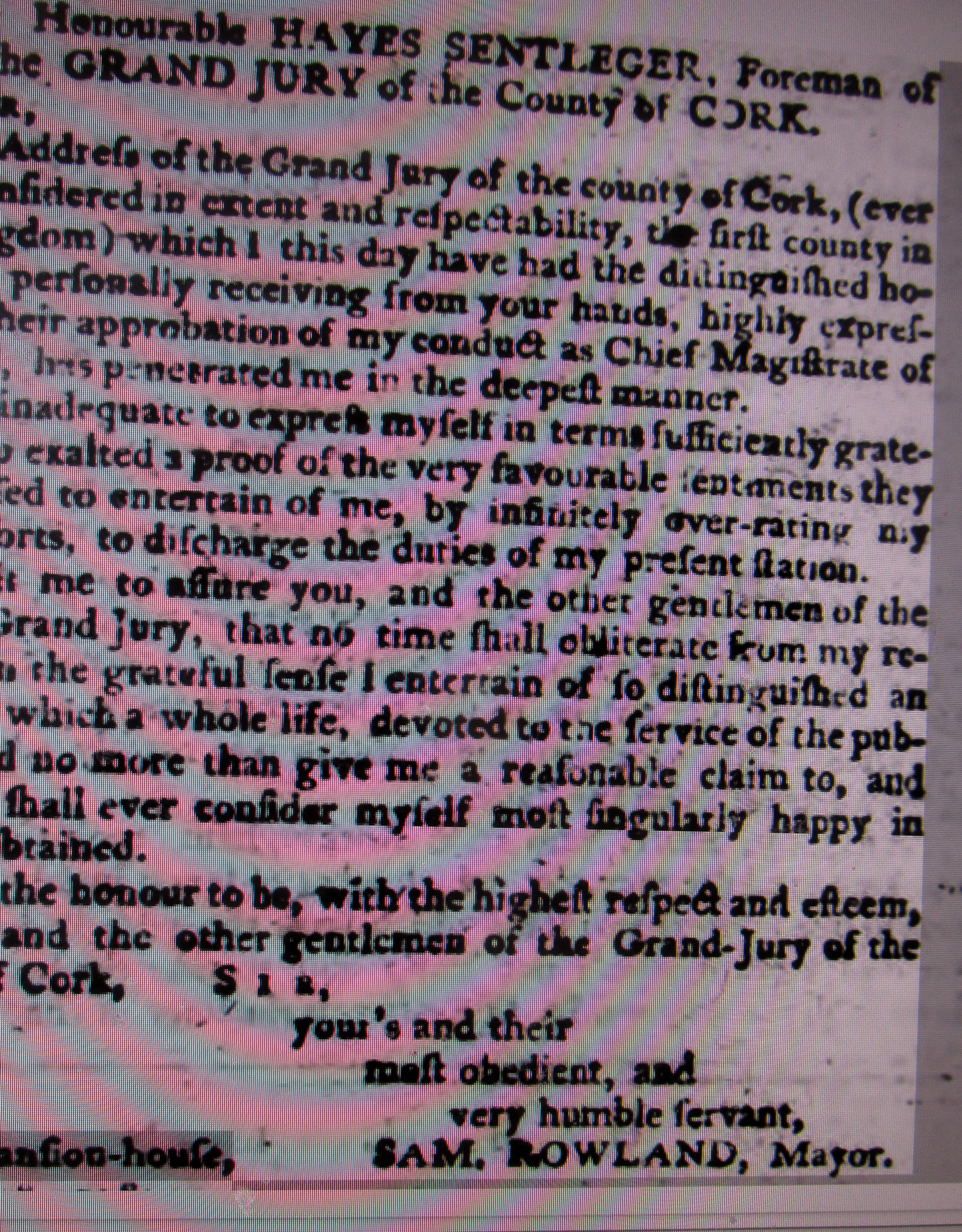
Cost of improvements and description of Glebe House, Inchigeelah and Ballinadee, West Cork, 1755


durrushistory's avatarWest Cork History

Inchigeela:

https://www.google.ie/maps/place/Inchigeelagh,+Co.+Cork/@51.8424459,-9.1264323,15z/data=!3m1!4b1!4m2!3m1!1s0x48451d4de78a27eb:0x0a00c7a997319e20

Ballinadee:

https://www.google.ie/maps/place/Ballinadee,+Co.+Cork/@51.7118405,-8.6268508,17z/data=!3m1!4b1!4m2!3m1!1s0x4844f552187cdeb9:0xa00c7a99731da80

Maziere Brady’s 3 volume history of the Dioceses of Cork, Cloyne and Ross in on the website of Cork Past and Present.

Page 22 contains a description of improvement work carried out by Rev. John Smith:  He obtained a certificate for £201. 10 shillings.

Quarrymen 8d a day, Labourers 6d., a man and a horse 1shilling a day.  Twenty five dozen floor tiles cost £1 0s 10d.  Three tons and one and a half f. balk timber 36. 7s. 6d 3,000 brick, delivered at Ballinadee came to £1. 12s 8d.  Thirty single deals cost £2 12s 6d.  Lime for plastering cost 2s per barrel.  Slate 3s per 1,000.  “Bought a horse for £3 15s and sold him again for £2 5s 6d allowed £1 2s 9d.  Hair for plastering, 8d per barrel.  The total return is £201.10.4d and the house is very fit for the residence…

View original post 103 more words

Church of Ireland Parishes, West Cork, 1291-1860 from Maziere Brady


durrushistory's avatarWest Cork History

The three volumes of Maziere Brady’s history of the Dioceses of Cork, Cloyne and Ross are now online at Cork Past and Present:http://www.corkpastandpresent.ie/history/bradysclericalandparochialrecords/

These records were updated by Cole which is also online at Cork Past and Present.

For Maziere Brady on Wikipedia

http://en.wikipedia.org/wiki/William_Maziere_Brady

For details of population, schools etc.

https://docs.google.com/spreadsheet/ccc?key=0AqhnQGE3ANjzdFRiNTlKcnU2ajRwazVpeDVMN2x4QkE&usp=drive_web#gid=0

View original post

Schools in Bantry/Skibbereen/Schull area West Cork 19th century.


durrushistory's avatarWest Cork History

In the early 19th century there was an extensive network of informal or hedge schools in the area.  A Parliamentary enquiry of 1823 lists these.

An idea of what informal schools might be like is described in the Diary of Humprey O”Sullivn (Amhlaóibh Ó Suilleabáin) published in1 820. In the 1790she and his father left the Killarney area to set up a hedge school in South Kilkenny. The locals built a sod ouse in three days for the school. he later left teaching and became a prosperous merchant.

The Church of Ireland schools had funding from the Church Education Society.  Their records are in the Representative Church Body Library in Rathgar in Dublin.  Some schools were set up by the Erasmus Smith organisation and their records are held in the Archive of the High School in Dublin.

The Islands and Coast Society was a nakedly prosylesytising society and set up…

View original post 512 more words

St. Finbarr’s Cathedral Cork, 1790 List of Properties, Tenants, Cork City and County, List of Cork Bishops 600 ad-1790 a.d. List of Clergy’s Livings


durrushistory's avatarWest Cork History

https://plus.google.com/photos/100968344231272482288/albums/5932811033460570609

The RCB Library in Dublin has the original tithe ledgers for St. Finbarrs including many of the South Liberties of Cork (Bishopstown, Ballyphane, Ballintemple Mahon, Blackrock. Ballinure) and others for 1770-80 in perfect hand and legible with listings of landholders many very small holdings with valuations.

View original post

Recollections of Sir Richard Griffith (1784-1878), including his escape from death by Grenadiers 1798.


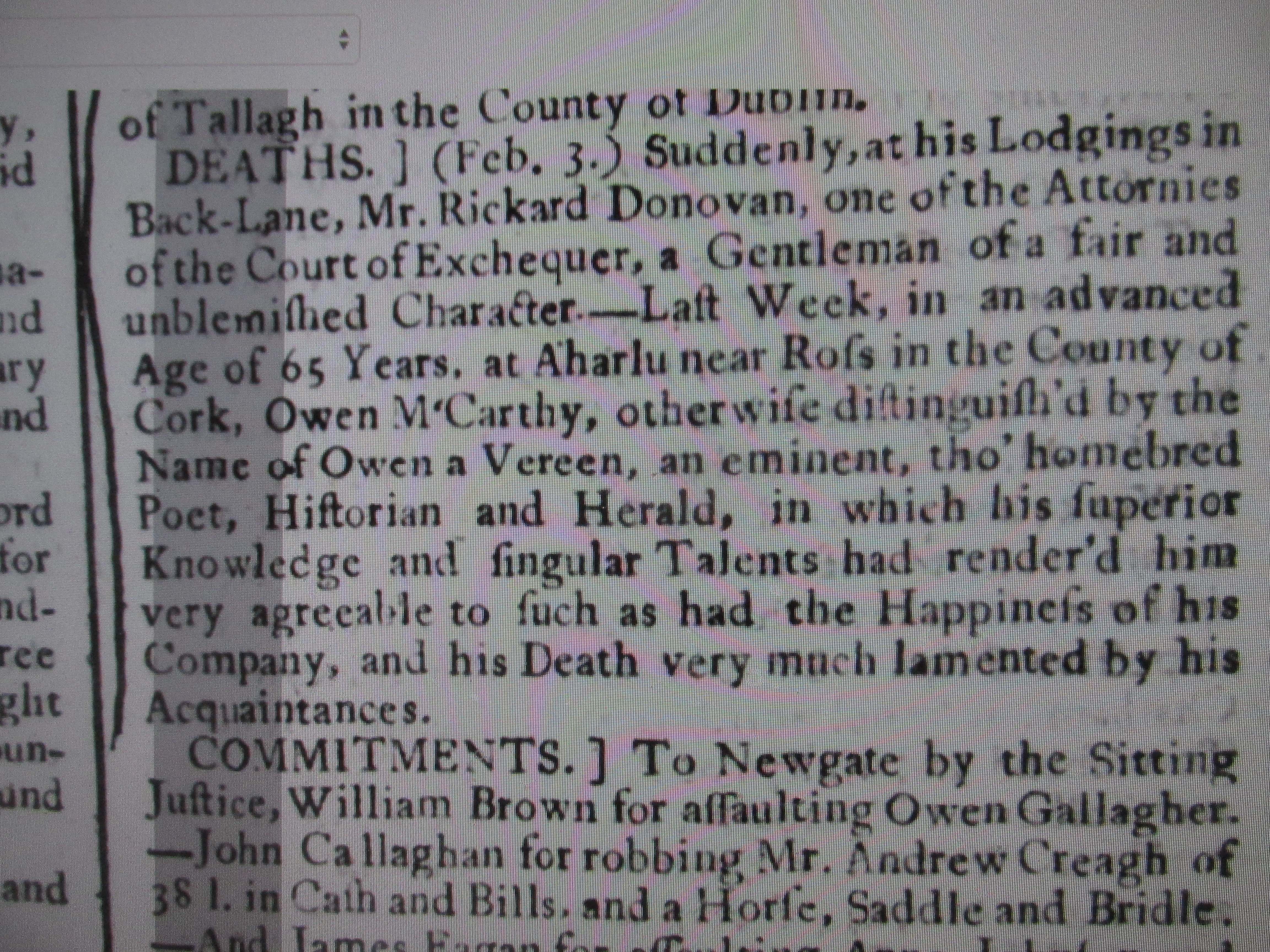
From Pue’s Occurrences, Death January 1756, of Owen McCarthy Otherwise Distinguished by name of Owen a Verely, An Eminent, Tho Homebred Poet, Historian and Herald, in Which Superior Knowledge and Singular Talent rendered him a Very Agreeable to such as had the Happiness of his Company and His Death is very much regretted and lamented by His Acquaintances and Death of Rickard Donovan, Attorney.


From Pue’s Occurrences, Death January 1756, of Owen McCarthy Otherwise Distinguished by name of Owen a Verely, An Eminent, Tho Homebred Poet, Historian and Herald, in Which Superior Knowledge and Singular Talent rendered him a Very Agreeable to such as had the Happiness of his Company and His Death is very much regretted and lamented by His Acquaintances and Death of Rickard Donovan, Attorney.

While the Donovan death took place in Dublin lodgings given his Christian name common in West Cork Donovans it is likely hie is connected with the general family.

1-IMG_6215

2-IMG_6216

3-IMG_6217

4-IMG_6218

‘Three Hours Work a Day is Quite Enough’, James Maynard Keynes and Kerry Economics


‘Three Hours Work a Day is Quite Enough’, James Maynard Keynes and Kerry Economics

https://next.ft.com/1f9894a6-3546-11e5-bdbb-35e55cbae175
https://durrushistory.com/2014/01/13/sir-william-petty-1623-1687-true-genius-founder-of-modern-economics-adn-government-accounts-and-prohobition-of-non-protestants-working-in-his-berehaven-mines/

Kerry Economics:

https://en.wikipedia.org/wiki/Richard_Cantillon

Courtesy Financial Times:

Working long hours pays off in monetary terms, but it means there is less time for pursuits. If John Maynard Keynes is looking down upon me now — he might make a good guardian angel for economists — then he is wondering why I am writing this column instead of lounging by the pool.

“Three hours a day is quite enough,” he pronounced in his 1930 essay Economic Possibilities for our Grandchildren. The essay offers two famous speculations: that people in 2030 will be eight times better off than people in 1930; and that as a result we will all be working 15-hour weeks and wondering how to fill our time.

Keynes was half right. Barring some catastrophe in the next 15 years, his rosy-seeming forecasts of global growth will be an underestimate. The three-hour workday, however, remains elusive. (Keynes was childless, but NPR’s Planet Money show recently tracked down his sister’s grandchildren and asked them if they were working just 15 hours a week. They were not.)

So where did Keynes go wrong? Two answers immediately spring to mind — one noble, and one less so. The noble answer is that we rather like some kinds of work. We enjoy spending time with our colleagues, intellectual stimulation or the feeling of a job well done. The ignoble answer is that we work hard because there is no end to our desire to outspend each other.

Keynes considered both of these possibilities, but perhaps he did not take them seriously enough. He would not have been able to anticipate more recent research suggesting that the experience of being unemployed is miserable out of all proportion to its direct effect on income.

Perhaps Keynes also failed to appreciate that there is more to keeping up with the Joneses than conspicuous consumption. We want to live in pleasant areas with good schools and easy access to dynamic employers. As a result, we find ourselves in ferocious competition for a limited supply of desirable houses.

There are subtler explanations for Keynes’s error. As the late Gary Becker observed in an essay with Luis Rayo, Keynes may have been led astray by contemplating the leisured elite of the 1920s. The income flowing to the “1 per cent” was not much different back then, but they owned much more of the wealth. A gentleman in 1920s Bloomsbury drawing income from capital was just as wealthy as a partner at a 21st-century New York law firm billing at a vast hourly rate. Yet it is no mystery that the gentleman spent his time at the club while the lawyer is working her socks off.

Perhaps Keynes also failed to appreciate that there is more to keeping up with the Joneses than conspicuous consumption.


A few years ago, the economists Mark Aguiar and Erik Hurst published a survey of how American work and leisure had evolved between 1965 and 2005. Both men and women had more leisure time — although nothing like as much as Keynes had expected. But some people defied this trend. The best educated and the highest earners, both men and women, had less free time than ever. Starting in the mid 1980s, this elite began to drop everything and work ­furiously.

Perhaps the real story, then, is that we are trying to keep up not with the Joneses but with our work colleagues. By pulling the longest hours and taking the least leave, we climb the corporate ladder. It may be no coincidence that the collapse in leisure time began in the 1980s, at a time when inequality at the top of that ladder was surging. The rewards for working hardest are large.

We are still 15 years away from the world that Keynes imagined. If we are to live up to his laid-back expectations, much will have to change. We’ll need plentiful access to nice schools and neighbourhoods, and less of a rat-race culture in the office.

That sounds welcome. But perhaps the fundamental truth is that many of us enjoy working hard on something that feels worthwhile, or aspire to such work. John Maynard Keynes was a wealthy man, but that did not stop him working himself to death.
Freemasons (Provincial Grand Lodge of Munster), Warrants including, Bandon from 1738,20, 84, 130, 155, 156, (Including Catholic Lodge 413), Bantry 67, 995, Castletownsend from 1747, Clonakilty 3885, Kinsale from 1747, 156, 179, 212, 220,234, 528, Rosscarbery from 1775, Skibbereen from 1751, 15, 223, 504, South Cork Militia, and Military Connections


Freemasons (Provincial Grand Lodge of Munster), Warrants including, Bandon from 1738,20, 84, 130, 155, 156, (Including Catholic Lodge 413), Bantry 67, 995, Castletownsend from 1747, Clonakilty 3885, Kinsale from 1747, 156, 179, 212, 220,234, 528, Rosscarbery from 1775, Skibbereen from 1751, 15, 223, 504, South Cork Militia, and Military Connections

Many of the lodges were associated with British Army Officers in Regiments based in West Cork. The South Cork Militia’s warrant originated in Mohill,, Co. Leitrim and the leitrim served n Cork in the late 18th century. Some of the Cork Warrants ended up in various location in Northern Ireland.

https://docs.google.com/spreadsheets/d/1HQrKsTDoupxktWQ41Wx5P4GFliNUT4Z2uyTdwyi0xjU/edit#gid=0

Warrant’s

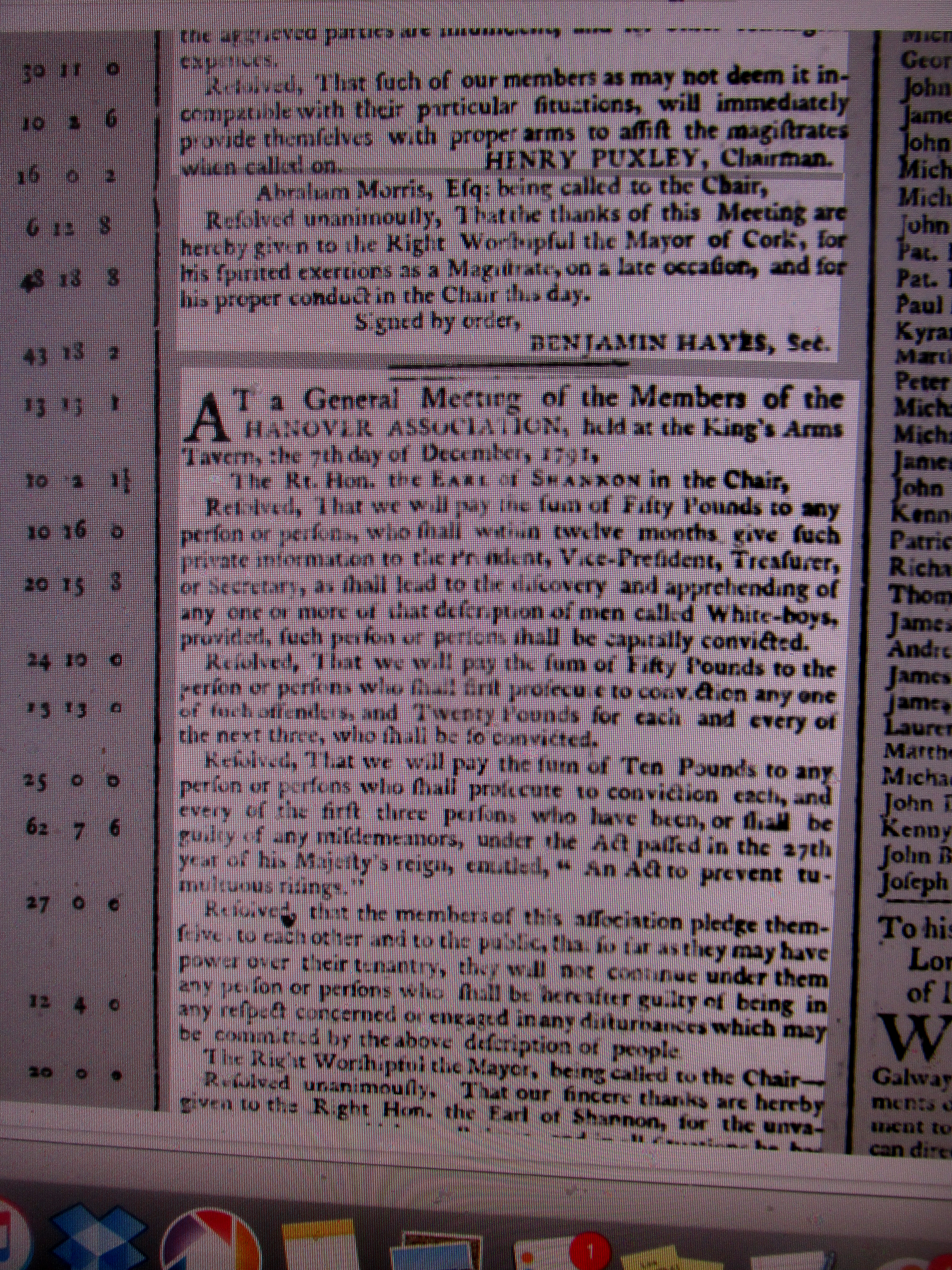
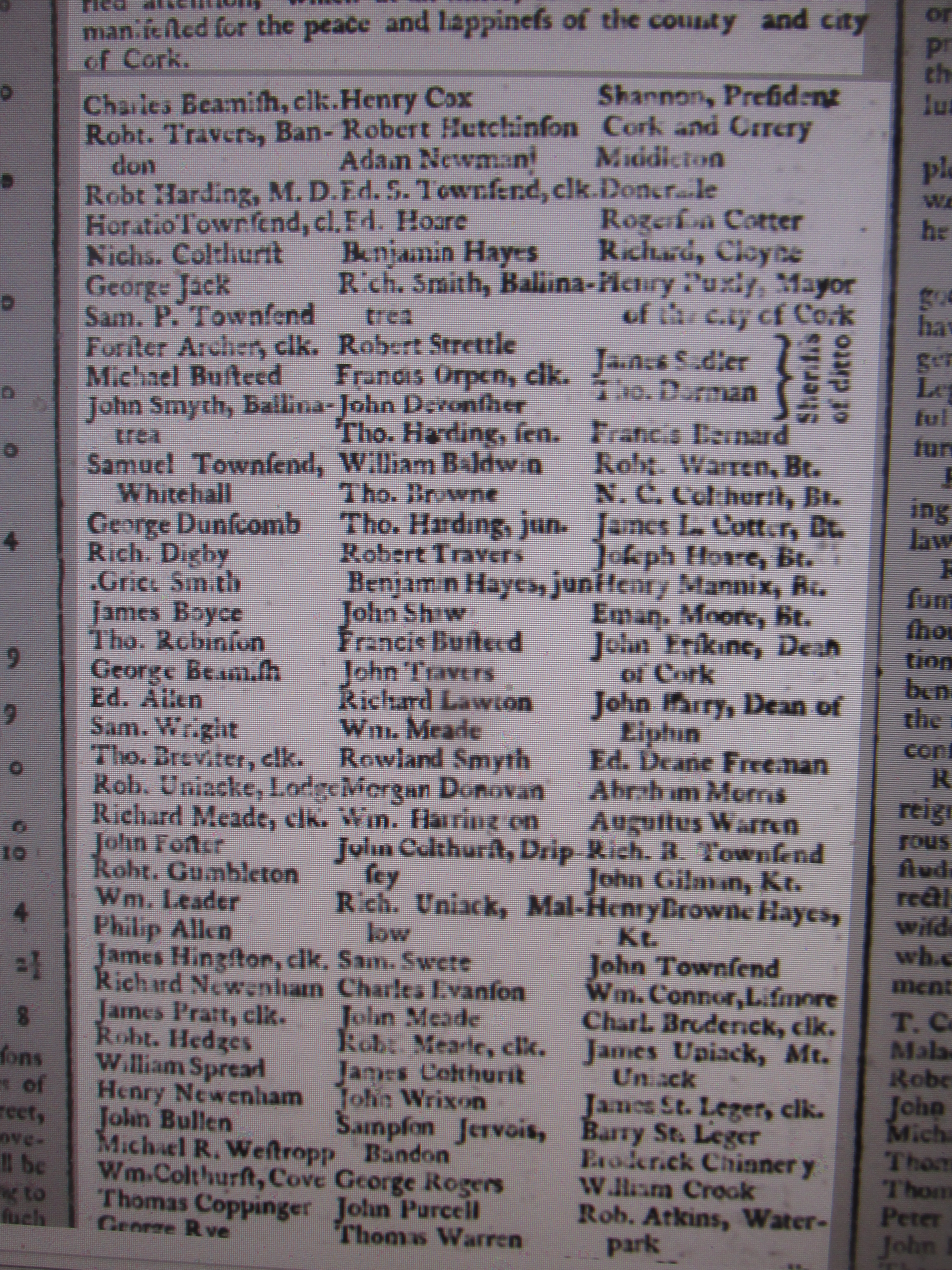
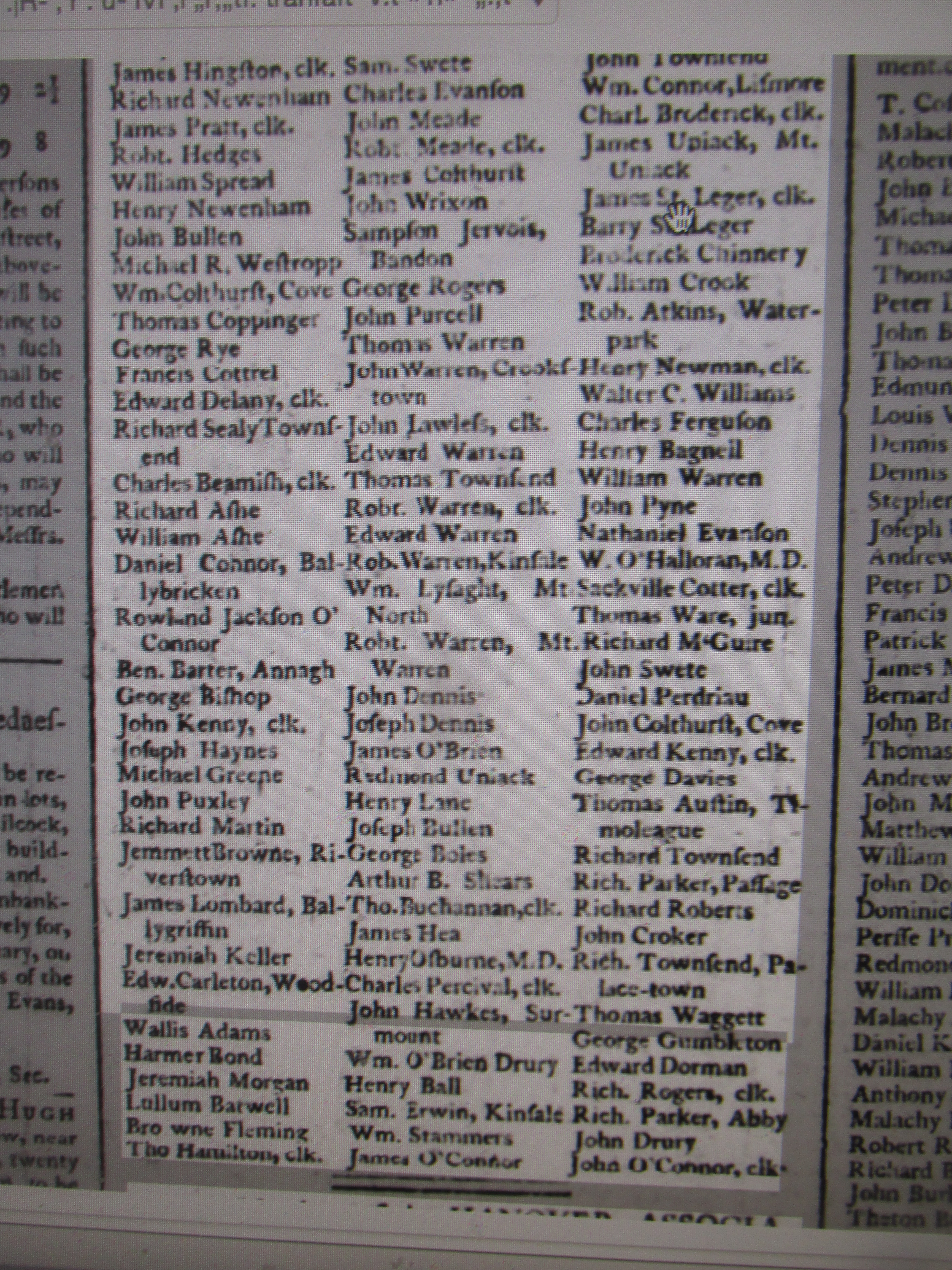
Meeting at the Kings Arms Tavern, Cork, on 15th November 1791 of Named (Listed) Gentlemen of the City and County of Cork with Lord Mayor and Sheriffs forming as Hanover Association to Combat Whiteboys


Meeting at the Kings Arms Tavern, Cork, on 15th November 1791 of Named (Listed) Gentlemen of the City and County of Cork with Lord Mayor and Sheriffs forming as Hanover Association to Combat Whiteboys

Petition against Captain Rock (Whiteboys), Bandon Co. Cork, 1820s Subscribers

John Wesley’s Cork Visitations, 1750, 1752, 1762, including Bandon, Kinsale, meeting Whiteboys and their Oath to Queen Sive and overview of Methodism in West Cork.

The Reverend Alcock, Church of Ireland Minister, Journey in a Gig from Durrus to Gougán Barra, West Cork, 1827, aftermath of Whiteboys 1823 at Keimineagh, attempts to use Irish Testament complaint about futility of Holy Wells unsuccessful attempt to set up Irish school in the area.

The Tobins of Kilcrohane, West Cork, from Catholic Church Records, Muintervara from 1819, the Seven Sisters of Gloun early 19th Century and John F Kennedy Connection, 1740s Lease of Donemark Mills, 1820s Lease of Part of Whiddy Island, Richard ‘King’ Tobin and Lord Bantry, Road Contractors, Richard Tobin, Letter, Member Bantry Board of Guardians.


1-IMG_6210

2-IMG_6211

3-IMG_6212

4-IMG_6213

5-IMG_6214

Grand July Spring 1787, Co. Cork, H Santledger (St Ledger), Foreman, Nicholas Conw Colthurst, Thomas Roberts, John St. Ledger Gillman, Richard B Townsend, Edward Deane Freeeman, Edward Deane freeman, Robert warren Joseph Hoare, Thomas B Herrick, William Evans, Daniel Connor, William Atkin, Henry Manning, Robert Hutchinson, John ..ellen, Edward Dorman, Henry Puxley, Simon F Davies, Robert Hoare, John Newenhan Devonshire, Thomas Newenham.


Grand July Spring 1787, Co. Cork, H Santledger (St Ledger), Foreman, Nicholas Conw Colthurst, Thomas Roberts, John St. Ledger Gillman, Richard B Townsend, Edward Deane Freeeman, Edward Deane freeman, Robert warren Joseph Hoare, Thomas B Herrick, William Evans, Daniel Connor, William Atkin, Henry Manning, Robert Hutchinson, John ..ellen, Edward Dorman, Henry Puxley, Simon F Davies, Robert Hoare, John Newenhan Devonshire, Thomas Newenham.

1-IMG_6207

2-IMG_6208

3-IMG_6209