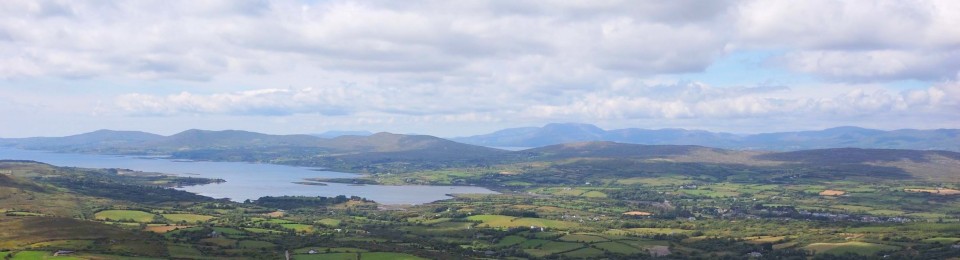
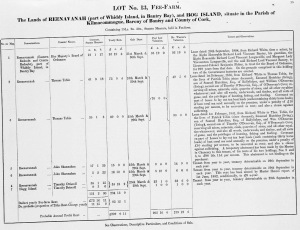
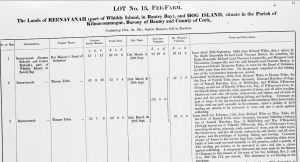
Lease of 1836, Reenvanagh, Whiddy Island, ‘Covenant to lay out by Lessee (Tobin)Ten Boat Loads (each containing thirty horse loads) of Best Coral Sea Sand Annually of Premises under a penalty of £10.


durrushistory's avatarWest Cork History

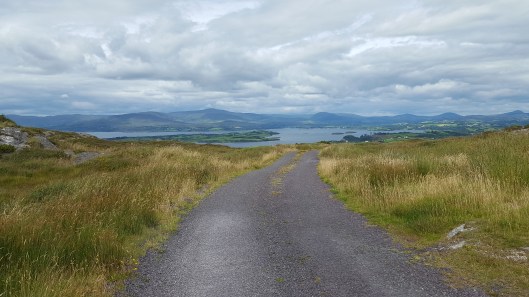
20160731_154627

1-Bantry 25https://www.google.ie/maps/place/Whiddy+Island,+Co.+Cork/@51.69274,-9.5071249,11z/data=!4m2!3m1!1s0x48450b33c942ea51:0xe2d24a96b0aad7f3

Lease of 1836, Reenvanagh, Whiddy Island, ‘Covenant to lay out by Lessee (Tobin) Ten Boat Loads  (each containing thirty horse loads) of Best Coral Sea Sand Annually of Premises under a penalty of £10.

Tobins:

https://docs.google.com/document/d/13bW08jLMERwfI5cGHHxXfd4IIHkBbpMYfJBmXA9ROX0/edit

The land on Whiddy is very fertile.  A significant part of the Island was used in 1967 by Gulf Oil to build a major oil tank farm still operational which holds Ireland’s strategic oil reserve.

The reference to one of the lives of a son of a local Catholic Landlord Timothy O’Donovan might suggest their involvement in the coral sand business.  This operated in Bantry until the 1950s.  Until guano from Chile and late chemical fertilisers came in the late 19th century Bantry Bay coral was prized as  a fertiliser.

https://durrushistory.com/2014/09/29/the-use-of-mussel-seed-as-a-lime-substitute-in-kilcrohane-west-cork-to-the-1920s/https://durrushistory.com/2012/08/28/history-of-whiddy-island-bantry-bay-co-cork-from1261-from-paddy-okeeffe-papers/

History of Whiddy Island, Bantry Bay, Co. Cork from 1261, from Paddy O’Keeffe papers
View original post

History of Whiddy Island, Bantry Bay, Co. Cork from 1261, from Paddy O’Keeffe papers

durrushistory's avatarWest Cork History

20160731_154627

Paddy O’Keeffe was a businessman based in Bantry who had an interest in the history of the locality. He was associated with other local historians John T. Collins and Bernard O’Regan. His papers are now in the Cork Archive collection and this account of Whiddy Island is taken History of whiddy Island, Bantry Bay, from Paddy O’Keeffe papers there

Down Survey 1665-85

http://downsurvey.tcd.ie/down-survey-maps.php#bm=Beara+%26+Bantry&c=Cork&indexOfObjectValue=-1&indexOfObjectValueSubstring=-1&p=Killmackamoge

Proposed Sale of part Bantry Estate

Screen Shot 2015-11-07 at 08.37.42

View original post

Traditional cures for Horse Ailments, Dandelion Roots and Rotten Seaweed from Durrus District, West Cork.


Traditional cures for Horse Ailments, Dandelion Roots and Rotten Seaweed from Durrus District, West Cork.

Courtesy David Shannon.

Up to the 1960 the horse did most of the farm work and was also the method of transport. His health was vital to the family welfare.  Before Vets and medicines the old people had various remedies.  For skin complaints a deep roots of dandelions were dug up and boiled, the liquid strained and after cooling added to the horse feed.   For some skin complaints such as ulceration rotten seaweed was applied presumably the iodine element would be of use.

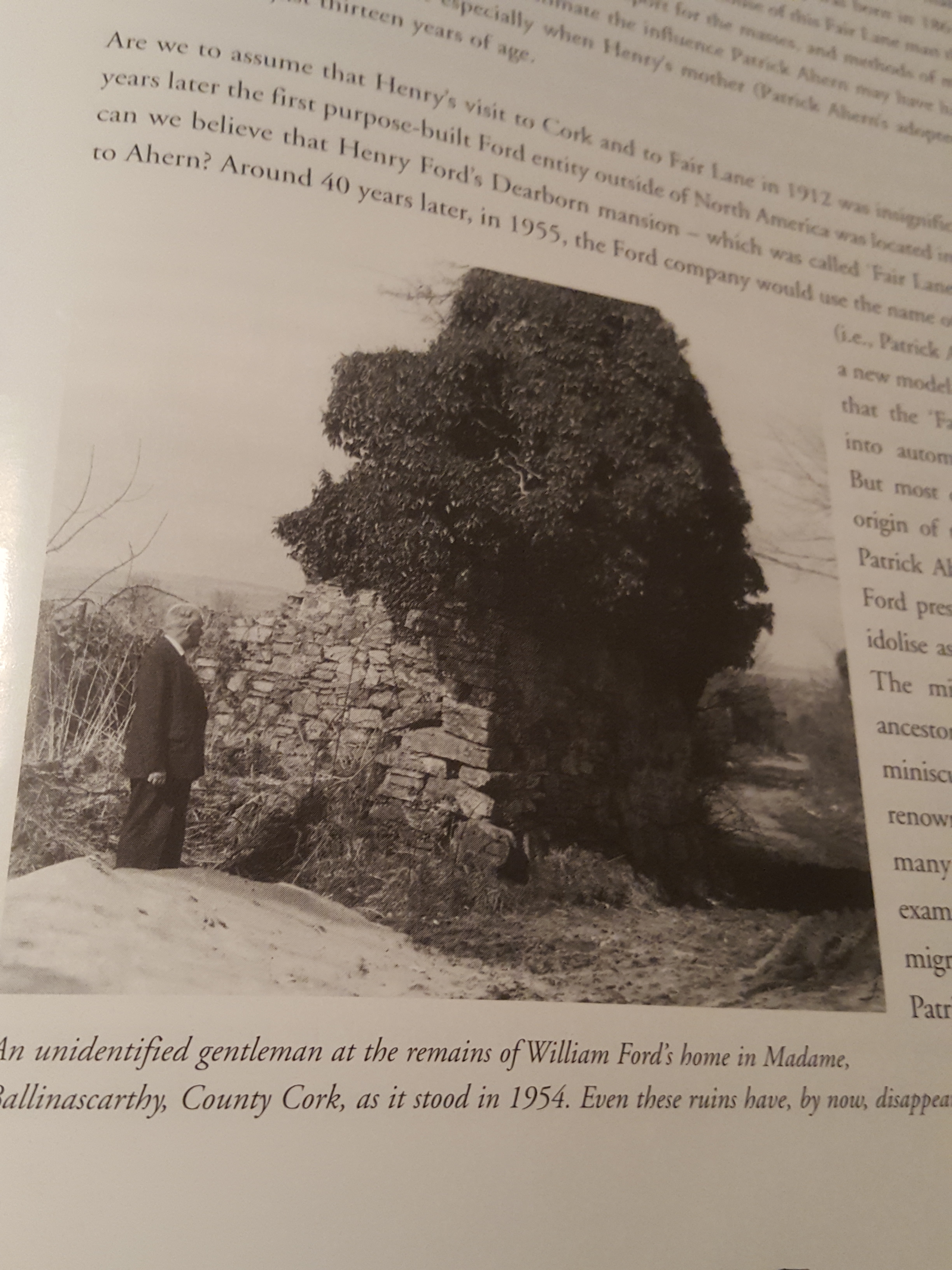
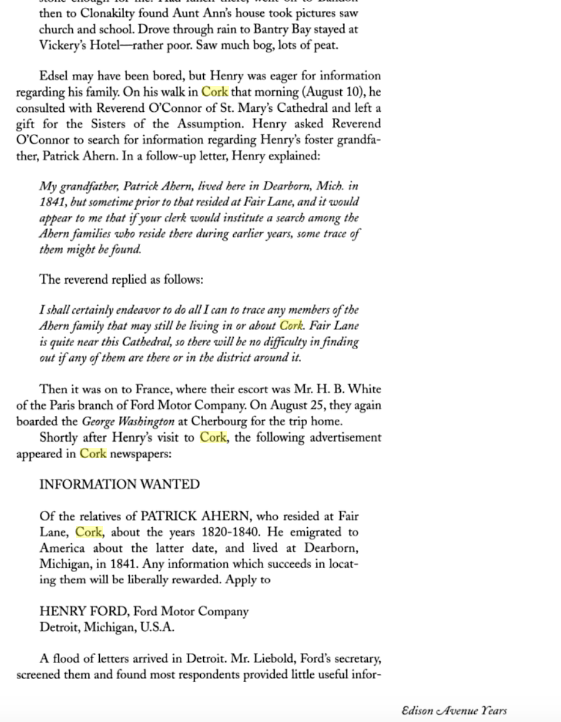
1912 Henry Ford, Chasing his Cork Roots, Madame, Ballinascarthy, Clonakilty and Fair Lane, Cork and sending his Father’s Uilleann Pipes to Cork for Repair.


1912 Henry Ford, Chasing his Cork Roots, Clonakilty and Fair Lane, Cork and sending his Father’s Uilleann Pipes to Cork for Repair.

Uilleann Pipes:

Henry Ford, Madame, Ballinascarthy, West Cork and the Uilleann Pipes

Henry Ford established the Ford Ford Motor Company plant outside the USA in Cork in 1917 and it operated until the 1980s giving valuable well paid work.  When part of the operation relocated to Dagenham in London in 1926 the Cork workforce migrated there and became known as ‘Dagenham Yanks’.

20190111_225625

The Fords may be related to the Buttimers/Buttimores of Ballinascarty.

Screen Shot 2016-08-02 at 16.53.30
Screen Shot 2016-08-02 at 16.52.37
Screen Shot 2016-08-02 at 16.51.39
Screen Shot 2016-08-02 at 16.51.53

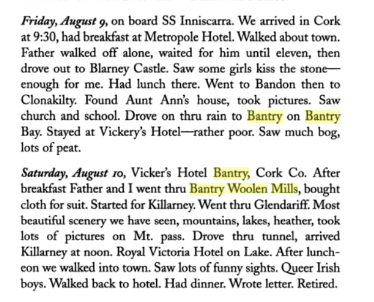
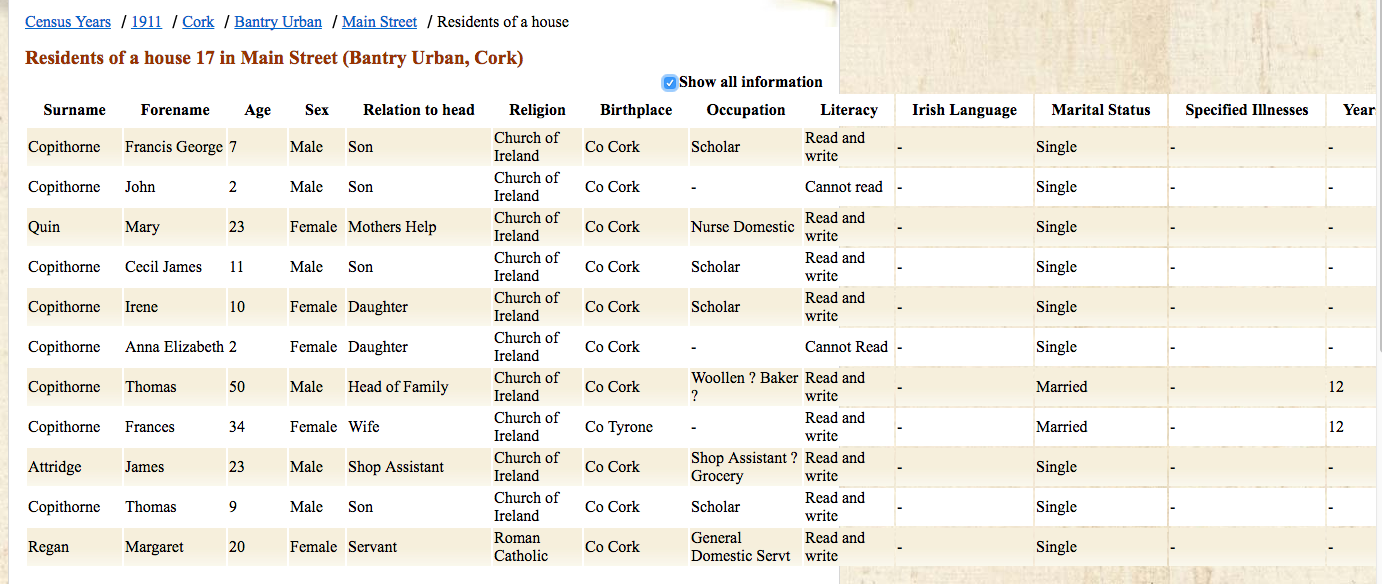
Frys (Frieze) Trousers from Copithorns Woolen Mills, Bantry, West Cork. Mrs Clara Ford, wife of Henry in 1912 stayed in Vickerys Hotel bought cloth for suit at Copithorns, visited her aunt Annie near Clonakilty


Frys (Frieze) Trousers from Copithorns Woolen Mills, Bantry, West Cork. Mrs Clara Ford, wife of Henry in 1912 stayed in Vickerys Hotel bought cloth for suit at Copithorns, visited her aunt Annie near Clonakilty

Up to about 70 years age as pronounced Frys (freize)  trousers were in common use by farmers when working or shearing sheep. Made from a rough stiff woolen cloth they tended after time to rot from the bottom up in an era before wellington boots.   The normal itching from wool was mitigated as many wore ‘long johns’.  Copithornes also made blankets and finer products and at one time were major employers in the town.

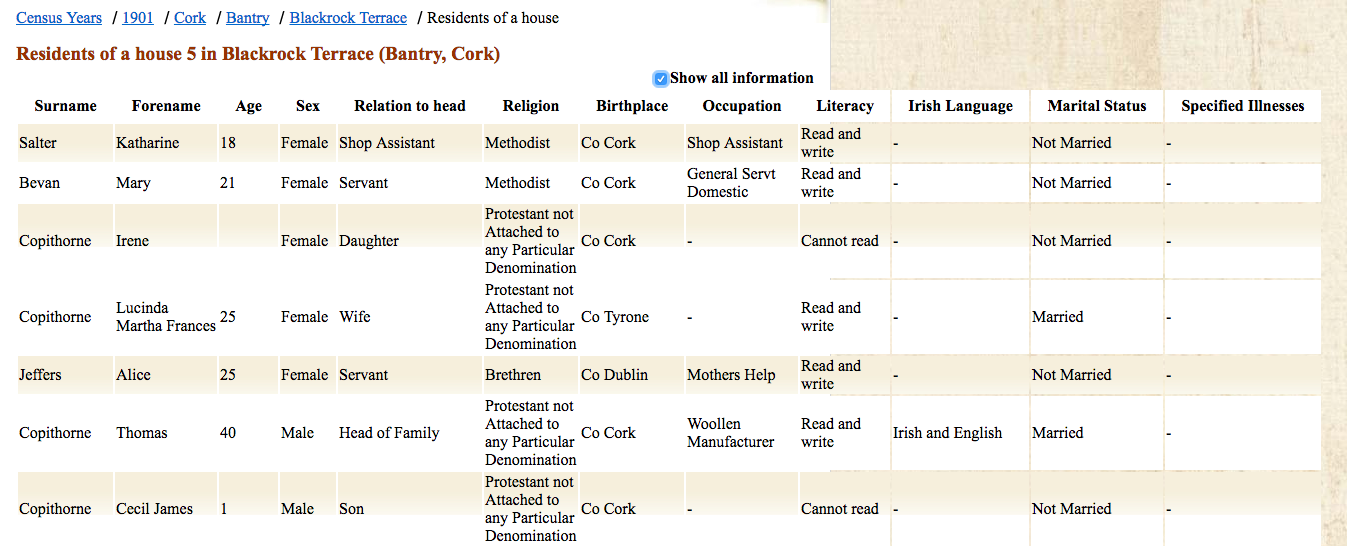
In 1901 the owner Tomas Copithorne was a Protestant of no particular denomination spoke Irish and English.

Mrs Clara Forde (Nee Bryant) wife of Henry visited 1912 and bought cloth.  It is assumed that is it her aunt rather than Henrys.  He was in Ireland but it is not clear if he was with her on this trip.

Screen Shot 2016-08-02 at 16.38.28
Screen Shot 2016-08-02 at 16.44.17
Screen Shot 2016-08-02 at 16.48.43

Hermitages on the Mizen, Muinter Bháire, Beara Peninsulas and the Island and the Deserts of Sinai, the Middle Eastern influences of the Book of Kells


durrushistory's avatarWest Cork History

Hermitages on the Mizen, Muinter Bháire, Beara Peninsulas and the Island and the Deserts of Sinai, the Middle Eastern influences of the Book of Kells.

A little while ago I met  an Iraqi, in Ireland for over 40 years.  . I don’t know whether was Christian or Muslim  but he had a great knowledge of early Irish History. He said that the refuges of the early monks in the isolated peninsulas and island have a common tradition with the hermitages of the Middle Eastern Deserts such as Sinai. Some of the old church sites and graveyards are the locations of these hermitages and indeed they may pre date the coming of Christianity to Ireland.

He then drew attention to the calligraphy of the Book of Kells and other such books and said that the decoration was Middle Eastern in origin. He felt that there were connections between Ireland and the…

View original post 5 more words

Teaching of Book Keeping in Irish Hedge Schools in the 18th and 19th centuries.


durrushistory's avatarWest Cork History

In Estudios Irlandes Vol 5, there is a fascinating article by Peter Clarke, of UCD, on the history of bookkeeping in Hedge Schools in the 18th and 19th centuries.

In the Report of The Commissioners of Irish Education 1826 it transpired that over 500,000 children over 70% of Irish children were being educated in hedge schools.  Their curriculum was flexible and many included basic business education.

In the 18th century Irish Emigrants to the US including Cornelius Lynch 1740, and Terence O’Neill 1789 taught bookkeeping in New York.  In Australia John Kenny taught double entry book keeping in Sydney in 1793.

Peter Clarke’s article suggests that the hedge schools had an important influence through Irish teachers on the curriculum of the American mid west and frontier.

Click to access Peter_Clarke.pdf

View original post

Post 1798 Arms Seizures Caheragh, West Cork.


durrushistory's avatarWest Cork History

In the online history of the Townsend family of Co. Cork, compiled by Colonel John Townsend in Australia,

http://www.astro.wisc.edu/~townsend/tree/record.php?ref=405

https://www.google.ie/maps/place/Caheragh,+Co.+Cork/@51.6325479,-9.3065158,15z/data=!3m1!4b1!4m2!3m1!1s0x4845a797cbacb2a1:0xa00c7a99731ea90

In the article relating to Samuel Townsend 1768-1836 of Whitehall, Aughadown there is a piece on the post 1798 situation.

The British Government employed Sir John Moore to disarm Co. Cork.  He used a scorched earth policy designed to intimidate people to hand in their arms.  In Caheragh 800 pikes were located as well as 3,400 stands of arms.  The soldiers were billeted on the local population and literally ate them out of house and home.  One exception to this was in Aughadown where the joint efforts of the Catholic Parish Priest Father Timothy O’Sullivan and the Church of Ireland Vicar Joseph Wright ensured that the local commanding officer Samuel Townsend did not billet the soldiers on the local population.

View original post