15 Wednesday May 2024
Posted in Uncategorized
15 Wednesday May 2024
Posted in Uncategorized
11 Saturday May 2024
Posted in Uncategorized
..

I am indebted to Jenny Stiles in Australia for additional information, she is a Beecher descendant.
Click:
https://docs.google.com/document/d/14T_K7IFK3T_ujCLxEH6ifrj0bhyVDjuF/edit
John William Becher, 1855, Castle Hyde, Fermoy, Usually Resident, £432. Subscriber Hollybrook as D.L. 1861 Rev. Gibson’s History of Cork. I have John William Becher as born 20 Jan 1849 and baptized 16 Feb 1849 at Abbeystrewry, Co Cork, the son of Richard “O’Donovan” Becher & Bessie Hungerford. In 1881 he married at the Catholic chapel at Skibbereen to Ellen Young. He was a farmer/farm servant. Still living in 1911.
Edward Beecher, 1767, Ballicallen. This is most likely Edward Becher, son of Lionel Becher & Catherine Dunscombe. He was of Bally Cotton & died at Crookhaven in July 1797. He married Jane Bousfield in 1756 & Ruth Herrick in 1761.
SIR JOHN WRIXON-BECHER, 3rd Baronet (1828-1914), JP DL, High Sheriff of County Cork, 1867, who espoused, in 1857, the Lady Emily Catherine Hare, daughter of William, 2nd Earl of Listowel. His son Sir Eustace William Wyndham Wrixon Becher (1860-1934) Bart, DL, 1915, Creagh, Skibbereen, Ballygiblin, Mallow, listed 1922. Executor of his father Sir John Wrixon Becher, M.A., D.L., (1828-1914), £11,299.
Sir Eustace William Wyndham Wrixon Becher (1860-1934) Bart, DL, 1915, Creagh, Skibbereen, Ballygiblin, Mallow, listed 1922. Executor of his father Sir John Wrixon Becher, M.A., D.L., (1828-1914), £11,299. 1911 living Roxboro, Co. Limerick living off land income, wife born London, 8 servants. His father was the third holder of the baronetcy created in 1831 for Sir William Wrixon-Becher and to his death passed to his son Sir John. He married, in 1907, Constance, daughter of Augustus, 6th Baron Calthorpe, and had issue, WILLIAM FANE, his successor.
Henry Becher (1664-, TCD in 1683 aged 19, son of Thomas Sherkin Island, 1705, witness to 1717 deed with Emanuel Moore. Henry Becher was Thomas Becher’s eldest son. He married Henrietta Owen in 1698. His heir was John Becher. Henry died in 1738. etc see document
Phane Beecher

From:

Burke’s ”Irish Family Records” and Smith both indicate that the Beechers were originally a Kent family. Fane Becher was granted over 12,000 acres in county Cork during the reign of Elizabeth I. Henry Beecher was granted land in West Carbery in 1669 and is recorded as the purchaser of land from Lord Kingston and Sir William Petty. In 1778 Mary daughter of John Townshend Becher of Creagh and Annisgrove, county Cork, married William Wrixon of Cecilstown, county Cork. She succeeded to the estates of her brother Henry Becher of Creagh. Their eldest son William Wrixon of Ballygiblin assumed the name of Becher and was made a baronet in 1831. He married an actress, Miss O’Neill, and had a number of children. Griffith’s Valuation records Sir William Wrixon Beecher holding an estate in the parishes of Castlemagner, Clonfert, Kilmeen, Knocktemple and Subulter, barony of Duhallow, county Cork. Sir Henry Becher, who succeeded his father in 1850, was among the principal lessors in the parishes of Castlehaven, Aghadown, Creagh and Tullagh in the barony of West Carbery, county Cork. Sir William Becher also held land in the parish of Kilvellane, barony of Owney and Arra, county Tipperary. The estate of Sir Henry Wrixon Becher of Ballygiblin amounted to 18,933 acres in county Cork and 358 acres in county Tipperary in the 1870s. Michael A Becher held townlands in the parish of Kilmeen, barony of East Carbery and in the 1870s Michael R. A. Becher of Ballyduvane, Clonakilty owned over 2,000 acres in county Cork. In 1854 lands and mining interests, the property of Edward Baldwin Becher, were offered for sale in the Encumbered Estates Court, and includes a report on the mines of Coolaghmore and Coolaghbeg. The Freeman’s Journal provides details of the purchasers of lots sold at auction, though it indicates that some lots were sold by private contract. In the 1870s the Becher estate in Cork (a combination of the Wrixon and Becher estates) amounted to over 18,000 acres while he also held lands in Tipperary. The estate of the representatives of the late John Beecher amounted to over 1600 acres in the 1870s. At the time of Griffith’s Valuation, Edward and George Beecher were among the principal lessors in the parish of Kilcoe while Richard Beecher was the lessor of townlands in the parish of Skull. Eliza Beecher held several townlands in the parish of Kilgarriff, barony of Ibane & Barryroe, at the same time. In October 1851, 17,000 acres, the estate of Richard H. Hedges Beecher, was offered for sale in the Encumbered Estates Court. Lot 1 included the owner’s house at Hollybrook. A sale of the remaining lots took place in February 1852 and included the house at Lakelands, leased to Richard O’Donovan Beecher. In April 1858, the house and demesne at Hollybrook were again offered for sale. The Freeman’s Journal reports their purchase, in trust, by Robert Johnson. An extensive family history of both the Becher/Beecher and Wrixon families is given by Grove White and published in the ”Journal of the Cork Historical and Archaeological Society” (1907) under Ballygiblin. The spelling Becher and Beecher are used almost interchangably thoughout the eighteenth and nineteenth centuries.
02 Thursday May 2024
Posted in Uncategorized
.
https://docs.google.com/document/d/1S4n3ap8RBzg-2OAJwNSxp8qP8dQbiMOW3tyNTjv7DdE/edit?pli=1
‘’

Rabies in West Cork 1885-1894
The one good news story here is that a young McCarthy girl from the Skibbereen District was bitten by a rabid dog. She went to Paris to be treated by Dr. Pasteur at public expense and made a full recovery.
Rabies is an infection associated with a wide range of wild and domestic animals. After dogs, cattle were the most commonly affected animals in Ireland in the late 1890s, mostly having been bitten by rabid dogs. The rabies virus is shed in the saliva of infected animals and may be transmitted by animal bite or by a lick to an open wound. It may also be acquired from an infected human as a result of injury related to their behaviour in the ‘furious’ stage of the disease. The virus enters the peripheral nerves via muscle cells and travels to the central nervous system, where it causes inflammation of the brain (encephalitis) and spinal cord (myelitis). The incubation period may last from two weeks to six months. Very often the primary wound is healed and forgotten by the time of clinical presentation.
When the virus reaches the central nervous system the victim presents with headache, fever, irritability, restlessness and anxiety. This may progress to muscle pains, salivation and vomiting. After a few days to a week the patient may experience a stage of excitement and be wracked with painful muscle spasms, triggered sometimes by swallowing saliva or water. Hence they drool and learn to fear water (hydrophobia). The patients are also excessively sensitive to air blown on the face. The stage of excitement lasts only a few days before the patient lapses into coma and dies.
In 1897 provisions were put in place under the Disease of Animals Act to prevent the further spread of rabies throughout Ireland. Under this general order all dogs in public places were required to be muzzled, and more stringent measures came into force as to the seizure, destruction and disposal of stray and unmuzzled dogs. Isolation was compulsory for any animal suspected of exposure to rabies. These measures had an almost instant impact on the infection of animals in the country. In 1895, 771 animals (567 dogs) were reported to be infected; in 1896, 687 (491 dogs). In the first six months of 1897, before the provisions came into force on 1 July, there were 335 animals reported as infected, but only 162 reported cases in the second six months. The project was deemed a success, as in 1898 the number of reported infections had been reduced to 132, and in 1899 to only 92. During 1898 the police seized 5,495 stray and unmuzzled dogs, and 4,364 of these were destroyed.
Over the last few years that rabies was prevalent in Ireland there were a number of human fatalities: in 1895 three males and two females (one from Leinster, three from Munster and one from Ulster); in 1896 two males and two females (one from Munster, two from Connacht and one from Ulster); and in 1897 four males (two from Munster, one from Ulster and one from Connacht). In 1898 four died, the last recorded human fatalities in Ireland due to rabies.
These statistics don’t get across the tragedy of individual cases. In December of 1894 Denis Moloney, a man in his seventies who lived alone in Cloughakeating between Ballinacurra and Patrickswell, was standing in the boreen leading to his house when he spotted a local stray terrier. He attempted to divert the dog away from his house but to no avail. The dog jumped at him and bit him on the left hand, causing a flesh wound between his fore and index fingers. After a number of weeks his appetite gradually failed and he took to his bed, but he still did not wish to avail of medical assistance and instead called on the services of a local ‘charmer’. Finally Dr O’Brien, medical officer of Patrickswell dispensary, was called in; after treating the patient and learning of the incident with the terrier he pronounced that the man had hydrophobia (rabies), to which he succumbed a few days later on 25 March 1895.
Cork City: 1760s rabies in city sporadically
Relevant Legislation from 1851 and Miscellaneous orders:
29 Monday Apr 2024
Posted in Uncategorized
,

27 Saturday Apr 2024
Posted in Uncategorized
26 Friday Apr 2024
Posted in Uncategorized
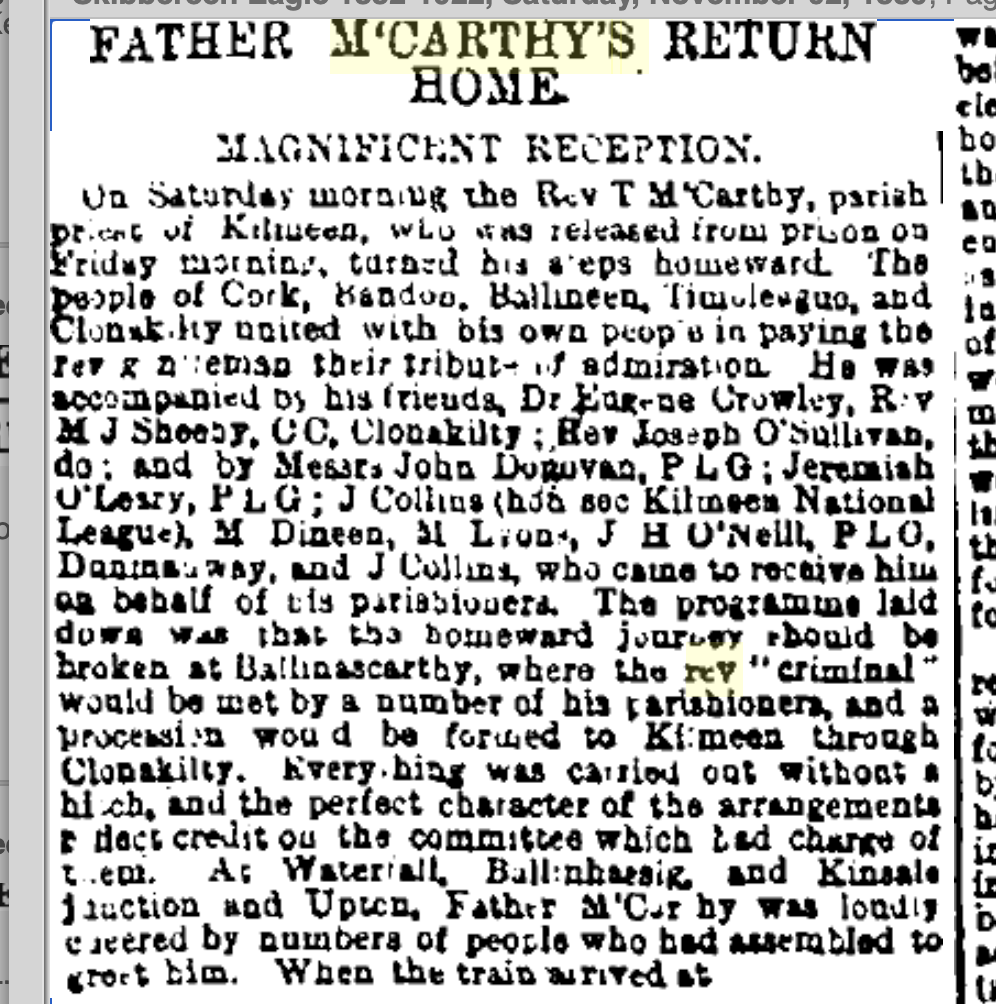
1889 Rev. Timothy (Criminal) McCarthy. Parish Priest Kilmeen. Triumphal Return to West Cork from Cork Prison. Jailed for Remarks at the Eviction of Paul Kingston. Posse of Armed RIC with Rifles and Government Note Taker on the Train from Cork. Testimonial in His Favour…..
Click
https://docs.google.com/document/d/1qjLB_ciUBarJ0OatTgZc_MAyqs6RIFOVWvUmrs_01q0/edit
23 Tuesday Apr 2024
Posted in Uncategorized
.
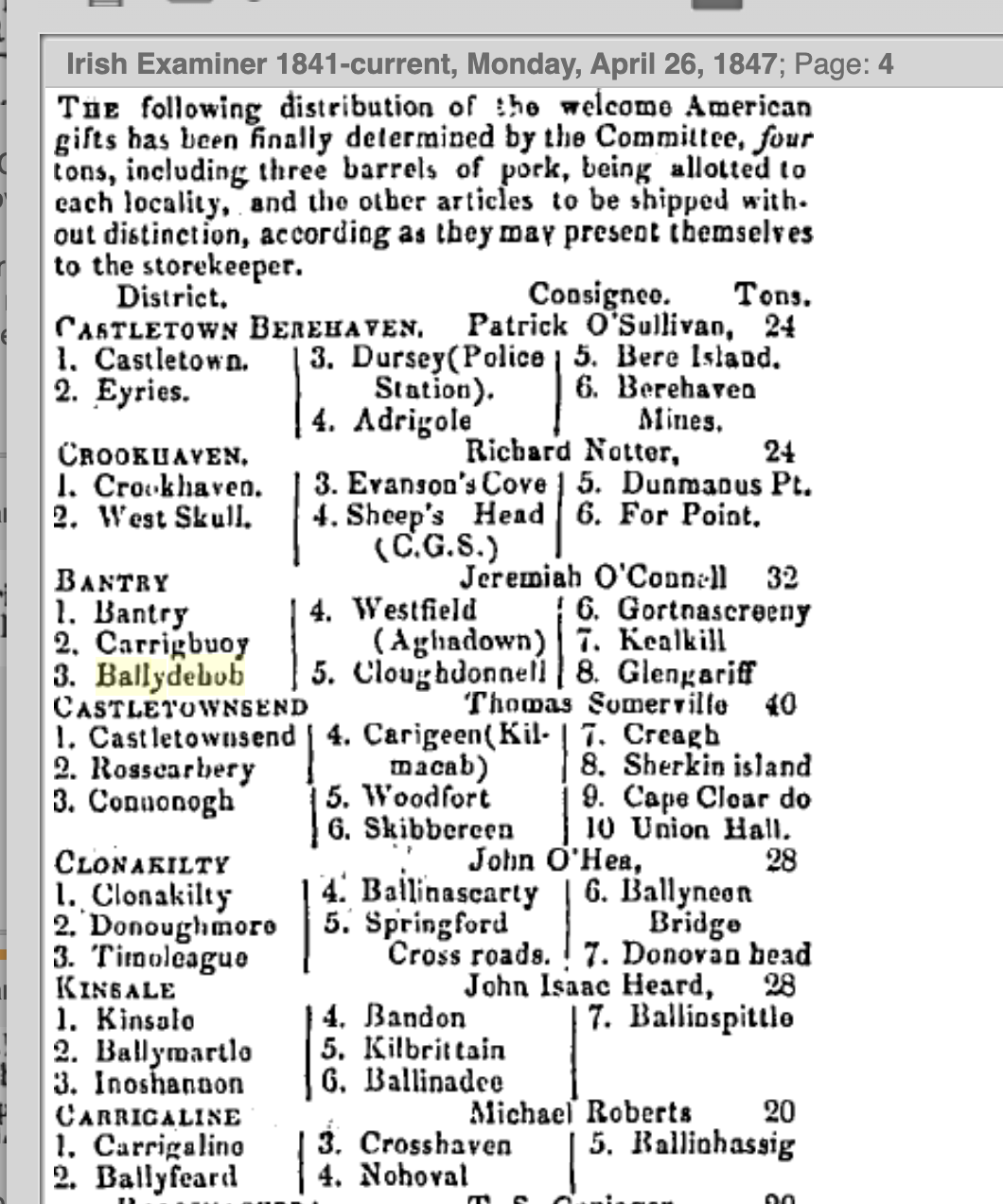
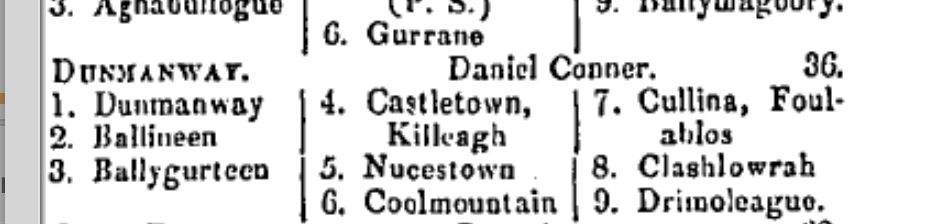
18 Thursday Apr 2024
Posted in Uncategorized
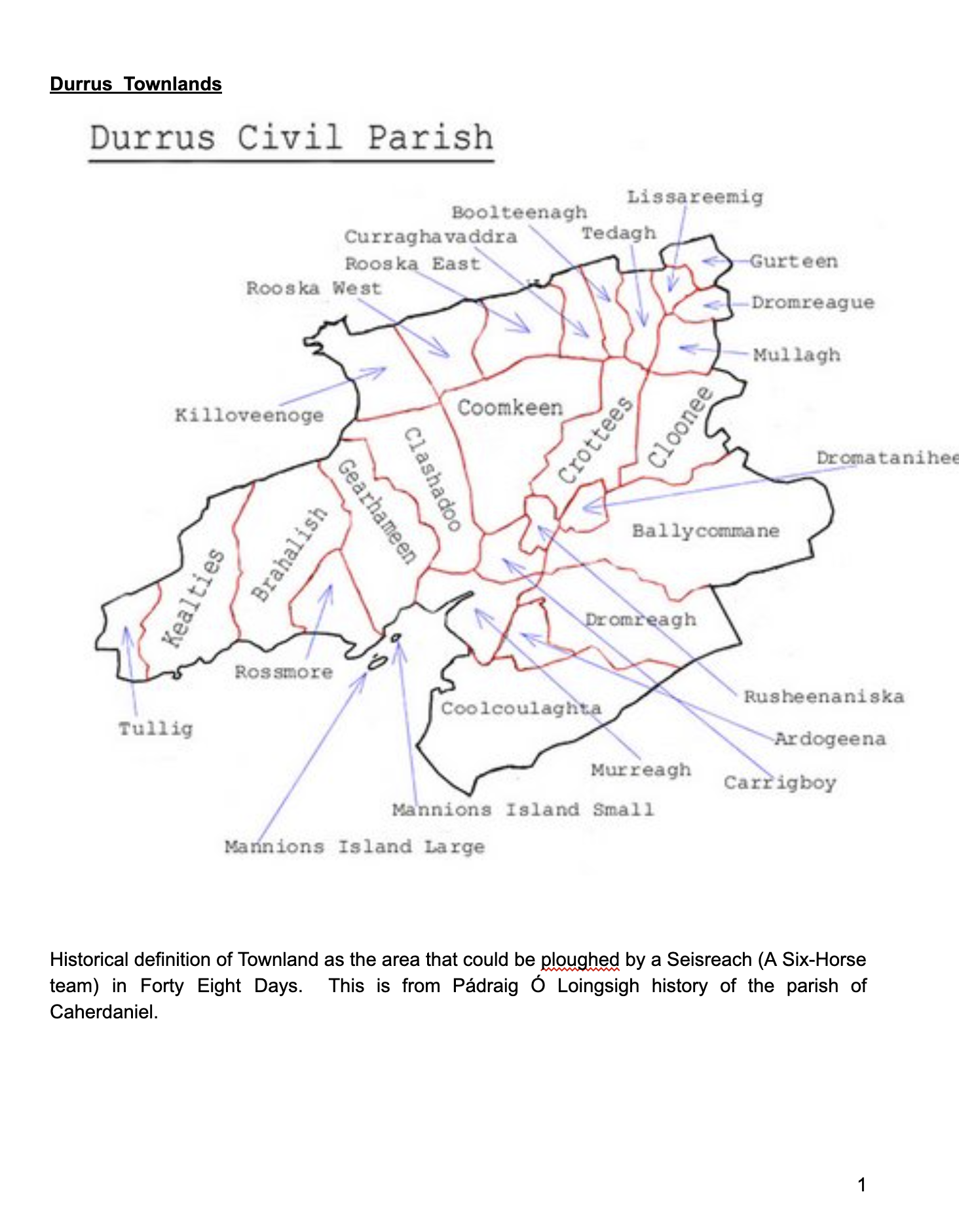


1888 Chancery Court Sale of Morris Ploughlands of Dromreagh, Murreagh and Ardaginna together With Impropriate Tithes of the Parishes of Durrus, Kilcrohane and Bantry, House and Demesne of Friendly Cove Part of Bog Known as The Cael
Durrus Evanson Landlord family:
https://docs.google.com/document/d/1c550F3fK7ZT0qUzH4DjP4I87TPHU5-yK-l4D-_cH-E4/edit
17 Wednesday Apr 2024
Posted in Uncategorized
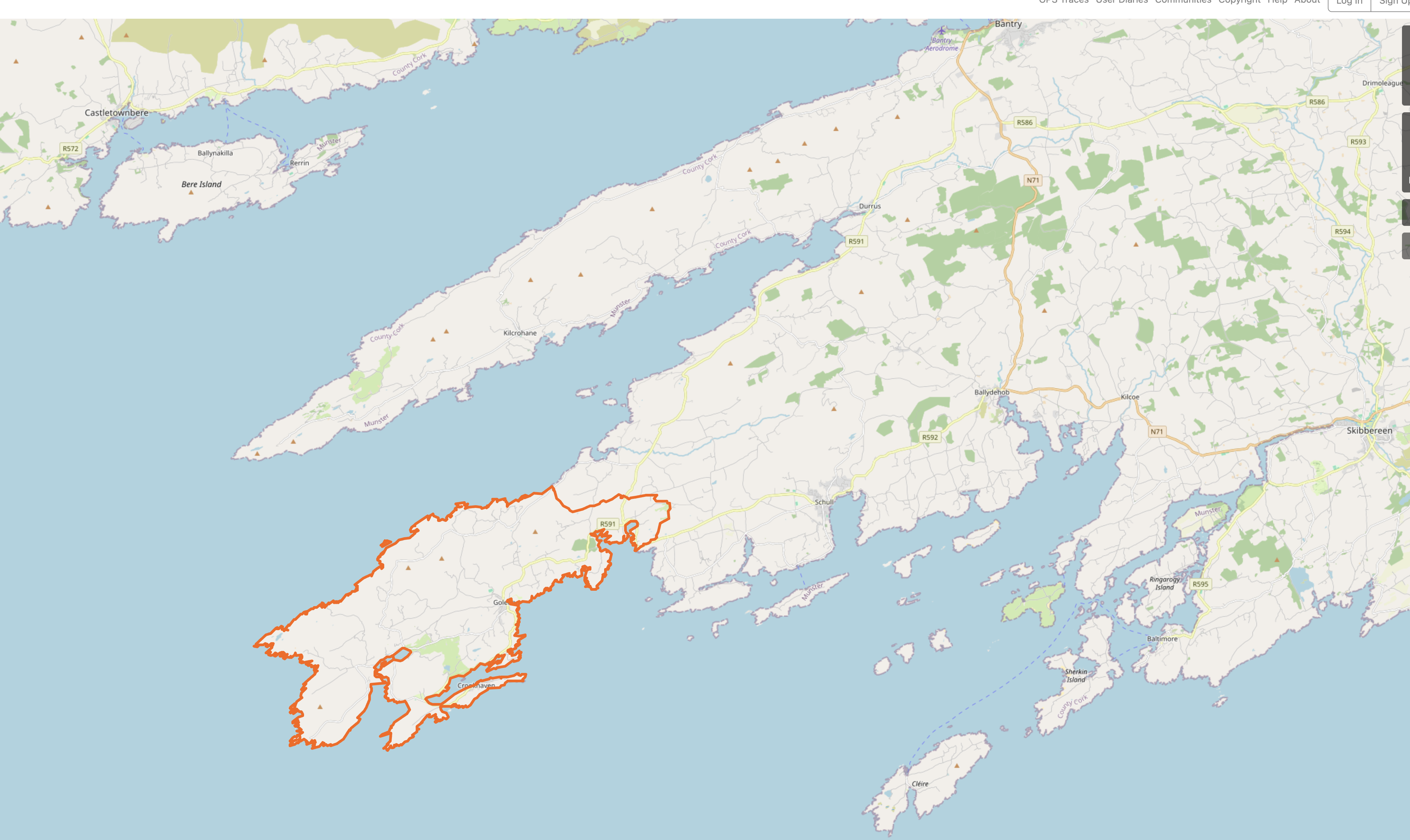
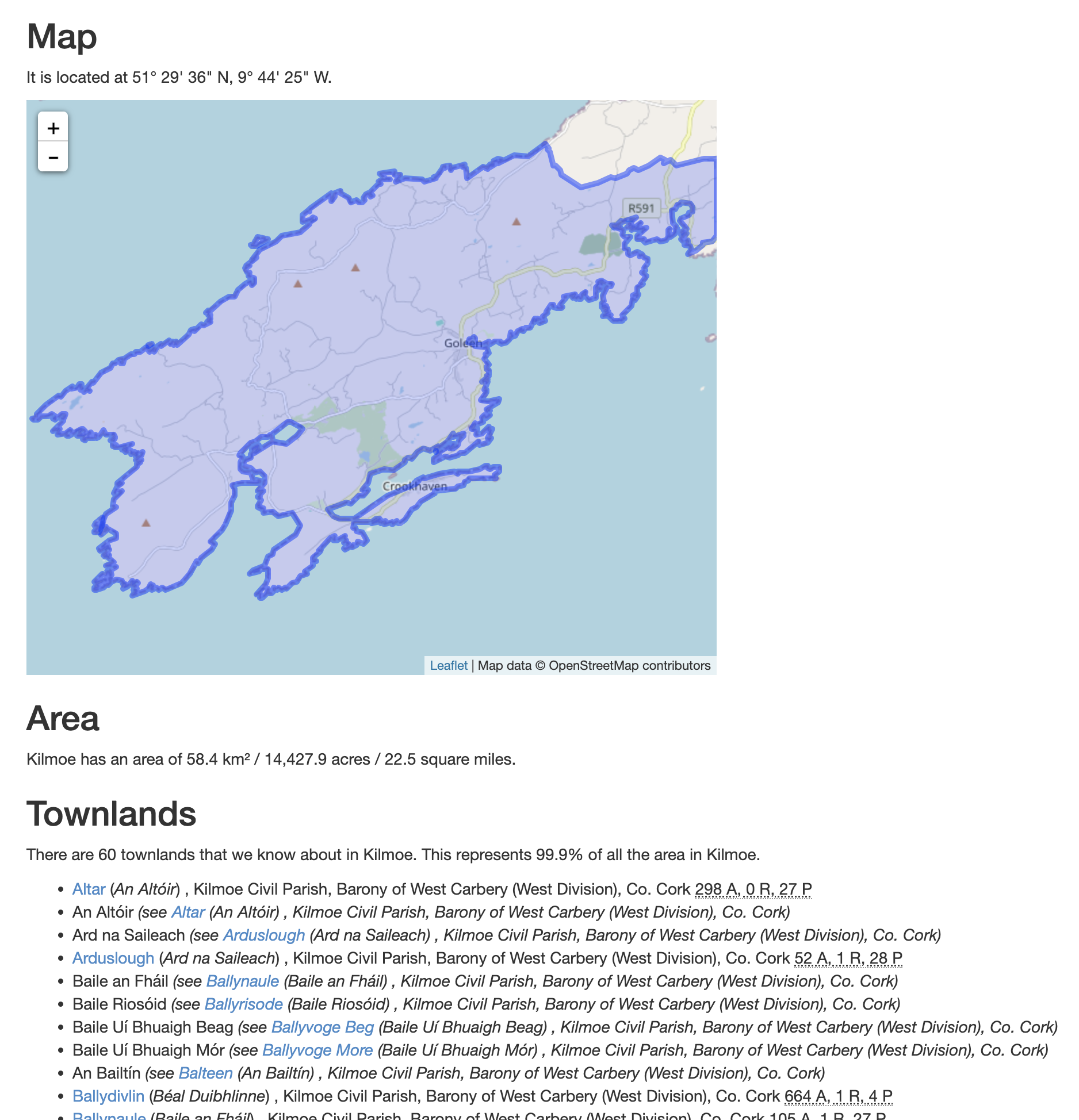
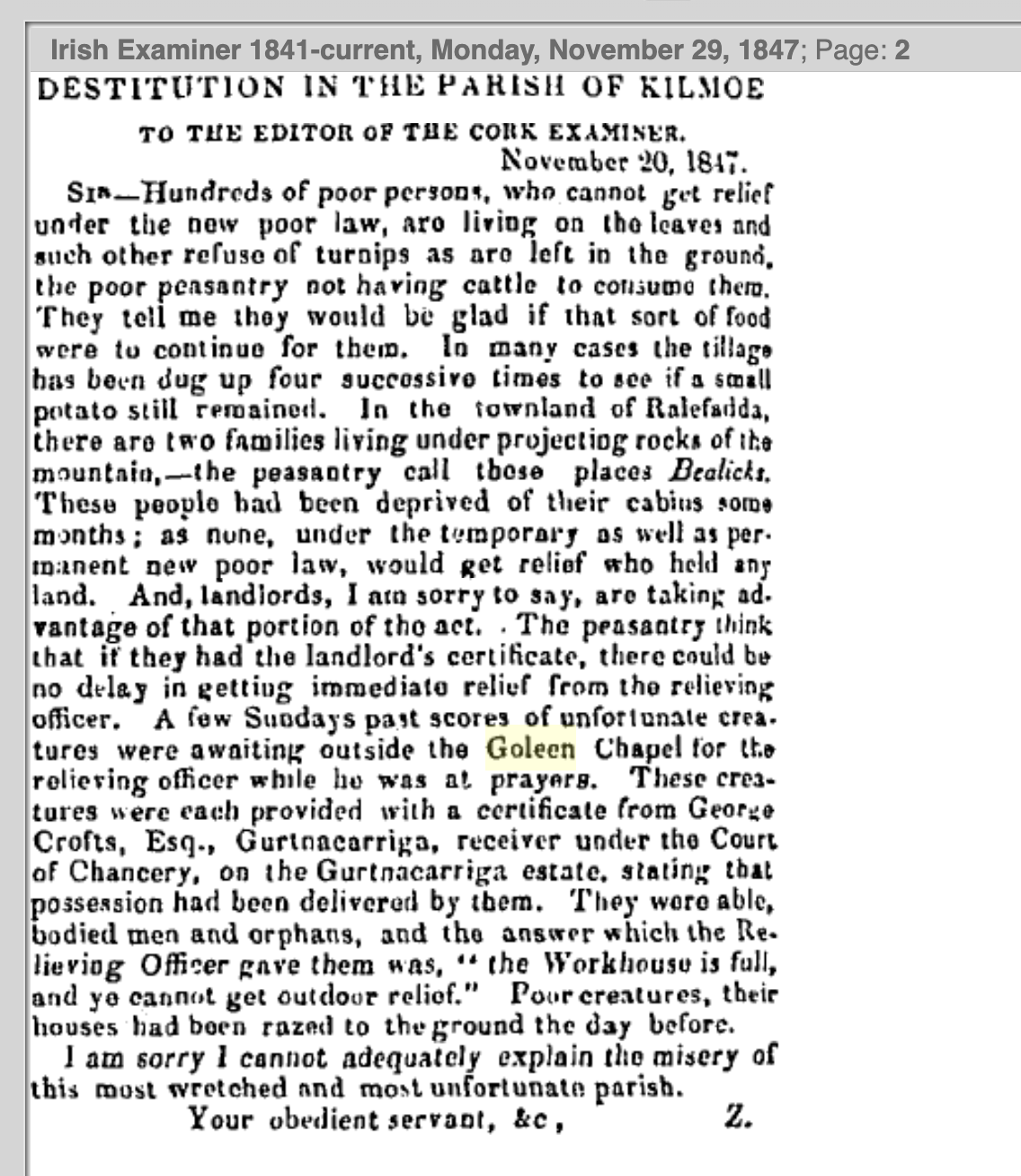
09 Tuesday Apr 2024
Posted in Uncategorized
.,,
1845 Skibbereen Petty Sessions., 2 Starving Little Brothers. Half Fed Half Clad. Sentenced to 10 Days Imprisonment in Cork County Gaol for Having a Few Bundles of Withered Furze and a Few Rotten Sticks At the Prosecution of the Rev. Thomas Fitzgerald Stephens Townsend Brother and Heir at Law Of The late Colonel John Townsend, Castletownshend
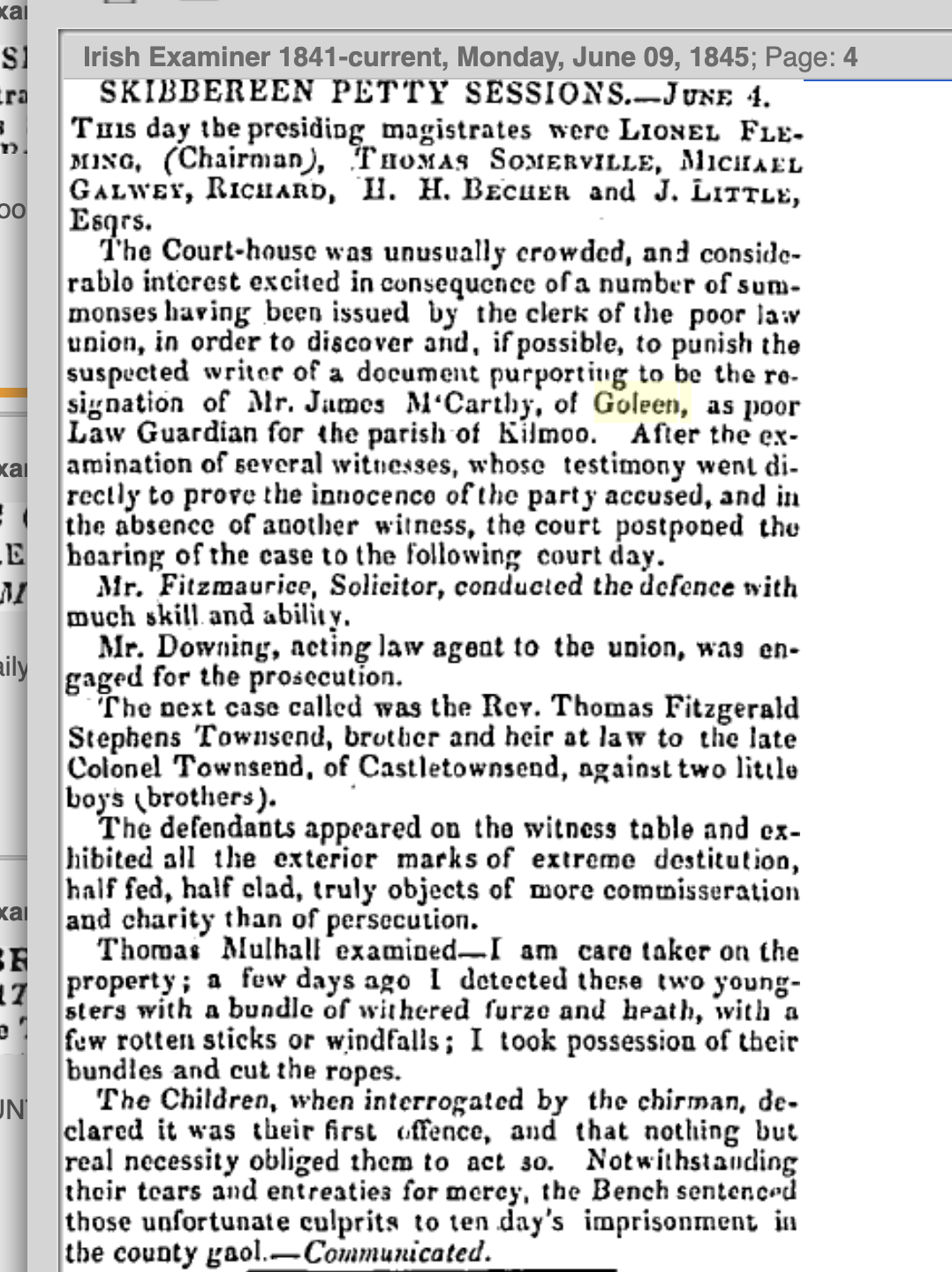
This behaviour seems at odds with the family history of him being a benevolent landlord. Prosecution possibkly by his local agent Marmion.
| Date of Birth: | 7 May 1791 |
|---|---|
| Date of Death: | 21 Mar 1872 |
| Generation: | 6th |
| Residence: | Thornbury and Castletownshend |
| Father: | Richard Boyle Townsend [219] |
| Mother: | Newenham, Henrietta |
| Spouse: | Shute, Alice Elizabeth |
| Issue: | Henry John [251] Geraldine Henrietta [252] Alice Gertrude [253] |
| See Also: | Table II ; Scrapbook ; Lineage ; Ancestors’ Tree ; Descendents’ Tree |
Notes for Reverend Maurice FitzGerald Stephens Townshend DL JP. See also.
Married 16 May 1826. Alice Shute (1) was the only daughter of Henry Richmond Shute (d. 25 Nov 1855) of Iron Acton, Gloucestershire. Three years before her marriage Alice had inherited her uncle Henry Stephens’ estate at Chavenage, Tetbury, Gloucestershire, when he died in 1823 without issue (2). Maurice assumed by Royal License the additional name of Stephens on 27 January 1827 as reported in the London Gazette and ‘The Gentleman’s Magazine’ Volume 97 Part 1.
Maurice was educated at Westminster and Christ Church Oxford, where he read classics, at the same time as his brother Abraham Boyle Townsend [233]. In a letter (3) dated June 29th 1810 to ‘Mrs Townsend, 8 Montague Square, London’, Maurice’s tutor, Mr Frederic Ricketts, wrote “I am just come from Maurice’s examinations and although I have but little time at my disposal I cannot resist giving you some account of him…..If there is a point to be spoken of with less commendation than the others, it is the grammatical part of his knowledge. But as I said before he did on the whole very fairly. He is in my room at the moment as merry and contented as possible. Both he and Boyle are in high health.”
In the summer of 1810, whilst still at Oxford, Maurice and his brother, Abraham Boyle Townsend [233], went out to Portugal to see their brother John Townsend [230] – known to them as Jack, then a Lieutenant in the 14th Light Dragoons serving under the Duke of Wellington during the Peninsula Campaign. Letters (4) home from Maurice describe the good life of Lisbon – “Lisbon is so delightful a place I should like to stay here the rest of the winter”; “The ladies in Lisbon are delightfully pleasant and rather pretty but the men are the most uncultivated stupid, dirty, lazy, ugly bears I ever met.” In a letter to his mother from Lisbon dated September 29th 1810 Maurice said that he and ‘Boyle’ should return to Oxford for the Michaelmas term. However, the good life of Lisbon was clearly too tempting for Maurice later wrote to seek leave of absence for the term which was granted. Other letters to his mother tell of Jack being “in high health and spirits” but very frustrated that he did not yet have his own troop (5). In his last letter from Lisbon dated Saturday December 15th 1810 he wrote “I heard of Jack yesterday from Charles Syng, he is very well and has done one of the most gallant things that has as yet been done in Portugal – namely he with eight of his men surprised and brought home as prisoners fifty French troopers, it has been the talk of the town these last four or five days”..
Maurice went to Paris to meet his brother John after his release from captivity in Pau, and wrote home on 1st July 1814 from the Hotel Versailles saying that they were in high spirits and that “Jack would write but has sprained his thumb in an attempt to thrash me….We dined all of us with Walsh’s sister and had a most delightful grub”.
Having graduated (6) Maurice spent much of his time in his early years in London. He was a member of Almack’s and is reputed to have danced there in the first quadrille ever performed in England.
It is not known when he was ordained but The Clergy of the Church of England Database records that Maurice was appointed on 12th September 1823 as Vicar, St Mary’s Parish Church, Thornbury, Gloucestershire. A letter dated 10 January 1824 in the archives of Christ Church Oxford shows that Maurice was settling into his new vicarage and was involved in “all the horrors of painting and furnishing.” He was beginning to collect the Great Tithes owed from the year before when his predecessor died. Maurice commented that he was getting to know his parishioners and that many of them were Dissenters of all kinds but not Roman Catholics. He lived at 11, Castle Street, Thornbury and remained at St Mary’s until his death in 1872.
According to An Officer of the Long Parliament Maurice was an accomplished classical scholar with a great wit and, like his father, had a most retentive memory. In 1844 Joseph Leech wrote ‘Rural Rides of the Bristol Churchgoer’ which described a trip to Thornbury at Christmas to attend the service at St Mary’s. He gave a brief description of Maurice and his sermon at that time. “I hardly remember ever hearing a better reader…..he delivered in a distinct and sonorous voice, and with a clearness and correctness of enunciation …..He had other advantages too ..a good head and shoulders and he stood something like six feet, honest measure in his shoes. His sermon, whether a holiday one or not, was a good one; and on the whole in pulpit and reading-desk, the Rev Townsend Stephens may take a very respectable stand amongst country parsons.”
On the death of his brother Colonel John Townsend [230] in 1845 Maurice inherited Castletownshend by which time the disastrous alterations undertaken by his mother had been put right. Sadly the house was burned to the ground in 1852. The blaze was so fierce that the large quantity of silver, which had been stored at the top of the house, ran down in molten streams and Maurice sent a Bristol silversmith to search the ruins to value the silver by the pound. The silversmith did so and promptly disappeared to America! Maurice was a most benevolent landlord for on acquiring the estate from his brother he dismissed £10,000 of arrears hoping thus to give his tenants a fresh start. An article dated Wednesday 23 December 1868 in ‘The Irish Examiner’ carries a report of a meeting in the Courthouse, Skibbereen called to determine the “best mode of complimenting the Rev F.S. Townsend, of Thornbury, England, in appreciation of his conduct as a landlord and liberal proprietor.” At the meeting it was resolved to hold a banquet in honour of Maurice and present to him “a piece of plate with a suitable inscription.” It was also resolved to present Maurice’s daughter, Geraldine Townsend [252], with a suitable ornament in acknowledgement of all her good works in Skibbereen.
Both Maurice and his brother Colonel John were absentee landlords who left running the estate to their agent; it is known that Thomas H Marmion from Skibbereen was agent in 1849 and his son was to follow him.
At some time between his accession to the Castletownshend estate in 1845 and his death in 1872 Maurice raised a substantial mortgage from Mr Robert Stayner Holford of Westonbirt in Gloucestershire using the Chavenage estate as security. It is not known why this was necessary, though it could well have been to repair the house after the fire of 1852. When this encumbrance on the estate was called-in in 1891, Maurice’s daughter, Geraldine Townsend [252], who by then had in equal share with her sister a ‘life interest successively’ in the Castletownshend estate’ was forced to put the estate up for auction.
Maurice altered the spelling of his name to Townshend in 1870 at the suggestion of Marquis Townshend of Raynham, Norfolk, and requested that the whole family conform – some did not do so hence the anomaly in the family of the ‘h’ in the spelling of the name.
Maurice’s will is dated 11 April 1870 and, as his son Henry Townsend [251] pre-deceased him, he left a ‘life interest successively’ in the Castletownshend property and the whole of his Dingle and Kerry estates to be divided equally between his two daughters Geraldine Townsend [252] and Alice Townsend [253]. The sad fate of the Castletownshend estate in 1897 can be found at the entry for Geraldine Townsend [252] or Charles Loftus Townsend [5C01].
Along with his brothers, John and Abraham, Maurice was made a Freeman of Limerick on 6th August 1817. He was also a Freeman of the City of Cork. Between 1710 and 1841, when the power of admitting Freemen only by birth or right ceased, a total of thirty three members of the Townsend family were admitted as Freemen.
Page 299 of the Appendix to the First report of the Commissioners Part 1 – Municipal Corporations (Ireland). Published by William Clowes, Stamford Street, London in 1835 concerns the Borough of Dingle. In the section headed ‘Burgesses’ it records that “Several of the burgesses are nearly connected with the patron of the borough. The following are the present burgesses:
– John Townshend Esquire, Lieutenant Colonel 14th Light dragoons, patron of the Borough and principal proprietor of the town. (Colonel John Townsend [230])
– Rev Thomas Townshend, his brother. (Wrong. Should read Maurice.)
– Rev Boyle Townshend, ditto. (Abraham Boyle Townsend [233])
– Richard Townshend Esq., second cousin. (Richard Townsend [236])
– Samuel Townshend Esq., Whitehall Co Cork. ( Samuel Townsend [412] or [405])”
None of them lived within the limits of the borough and it would appear that they rarely, if ever, attended borough meetings.
‘Griffith’s Valuation of Ireland 1848-1864‘ records “Townsend Rev MFS” and “Townsend Rev. MFS. Main Street, Castletownsend” owning land and property in Myross, Castle Townsend, Castlehaven and Creagh. The entry for Brade House in the National University of Ireland (NUI) Galway Connacht and Munster Landed Estates Database records that Maurice owned the property “John Swanton was leasing this property from Rev. Maurice Townsend at the time of Griffith’s Valuation, when it was valued at £15 10s. Lewis had noted it as the seat of Rev. E.P. Thompson in 1837. It was the residence of Samuel Jervois in 1814. Taylor and Skinner’s 1783 map also indicate it as a Jervois residence. In 1906 it was owned by Katherine Townsend and valued at £44 5s. There is still an extant house at the site.” Katherine Townsend almost certainly refers to the wife of John Hancock Townshend [523] who would have moved to Brade when her son Richard Harvey Townshend [534] inherited the Myross estate in 1889. There are several connections with the Jervois family – see Richard Townsend [501].
‘Slater’s Commercial Directory 1856‘ records “Townsend, Rev. Maurice, T.S. (Castle Townsend House)”. The ‘Register of Landowners in County Cork 1876‘ records “Townsend, Rev. MTS, reps of 8,665 acres £4,794 5s” (2005 equivalent – £346,606). This figure is reflected in ‘Landowners of Ireland 1878’ compiled by U.H. Hussey de Burgh.
Maurice was buried at Thornbury and Alice is buried at Castletownshend.
Page 639 of the Calendar of Wills and Administration 1858-1922 in the National Archives of Ireland records that “The Reverend Maurice Fitzgerald Stephens Townsend late of Thornbury Gloucester Clerk Vicar of Thornbury”. Died 21 March 1872. Probate granted at Gloucester on 30 November 1872. Re-sealed at the Principal registry Dublin on 5 December 1873. Effects in Ireland £5,129 13s 9p..
(1) Alice was born in 1803 and died of a fever on 1 November 1831.
(2) Details about how Alice came to inherit the estate can be seen at ‘A History of the County of Gloucester: Volume 11’ second and third paragraphs or for a more detailed account at ‘Transactions of the Bristol and Gloucestershire Archaeological Society l899’ – Notes On Chavenage and The Stephens Family by the Rev. W. H. Silvester Davies, MA, pages 128 – 135. When Alice died in 1831 the estate was left in trust for her eldest son Henry John Townsend [251] for when he came of age in 1848. Full details of what subsequently happened to the estate are given in the records for Henry and his sister Geraldine.
(3) RBT Papers 231/3.
(4) This and subsequent letters from ‘An Officer of the Long Parliament’ can be seen on pages 165 – 179; they are fascinating reading.
(5) John finally got his own troop after the Battle of Fuentes d‘Onor were he was ADC to Sir Stapleton Cotton. It was during this battle that Captain Knife of the 14th Light Dragoons was mortally wounded and John was promoted Captain on 6 June 1811, without purchase, and put in command of Captain Knife’s troop.
(6) A letter from Maurice’s brother John records “I hear that Maurice has taken his degree with great eclat”.
‘An Officer of the Long Parliament‘ Ch VII p. 184-187 refers.
 West Cork History