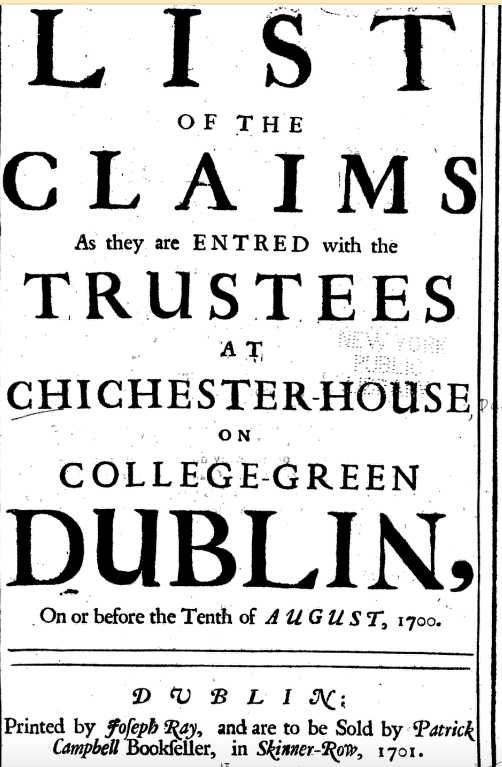
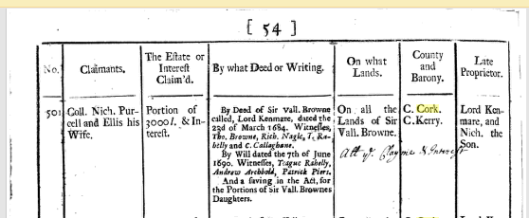
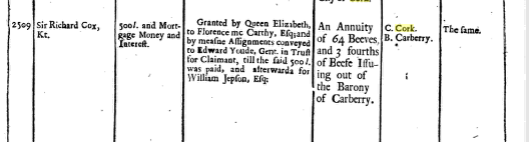
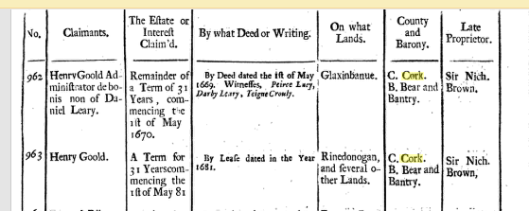
1710, List of the CLAIMS as they are ENTERED with the TRUSTEES at CHICHESTER HOUSE on COLLEGE GREEN DUBLIN, for Baronies of West Carbery Bantry and Bere including Baltimore, Sherkin, Clonee, Durrus, Reendonegan, Bantry.


1710, List of the CLAIMS as they are ENTERED with the TRUSTEES at CHICHESTER HOUSE on COLLEGE GREEN DUBLIN, for Baronies of West Carbery Bantry and Bere including Baltimore, Sherkin, Clonee, Durrus, Reendonegan, Bantry.

This was part of the appeal process for those whe lands were forfeit for rebellion from 1641 and after.  Some of the appeals were successful as the Browns (earls of Kenmare one of the few catholic families to retain their lands during the Penal Laws.

Chichester House was build on the site of a suppressed nunnery and was later demolished to make way for the Irish Parliament.  In turn this was abolished in 1800 and the building now houses the bank of Ireland.

It is estimated that a very large portion of legal business in Dublin 1700-1730 was taken up with such claims at Chichester House adn in the 4 Courts then located in the area.Christchurch Cathedral.Because of the Penal Laws Catholics could only practice if they became members of the Church of Ireland.  Most did but they were regarded with suspicion as ‘crypto-Catholics.  A common complaint was that their affluent wives has chapels in the houses dn priests calling.  One of them famously said ‘I would rather leave my soul to God than my land to the Laws of Ireland’

https://books.google.ie/books?id=pWJZAAAAYAAJ&pg=PA198&lpg=PA198&dq=thomas+gan+attorney+cork&source=bl&ots=YErHW7Y-yj&sig=HWvXFJ761JKVhxdh_yhjfVg9sYU&hl=ga&sa=X&ved=0ahUKEwjL37rFk5nLAhUBbRQKHSopAtQQ6AEISDAJ#v=snippet&q=cork&f=false


screen-shot-2017-02-27-at-09-05-19


screen-shot-2017-02-27-at-09-04-36

screen-shot-2017-02-27-at-09-03-28

screen-shot-2017-02-27-at-09-03-06

screen-shot-2017-02-27-at-09-01-23screen-shot-2017-02-27-at-08-59-49screen-shot-2017-02-27-at-08-59-08

screen-shot-2017-02-27-at-08-57-52

Lost Landmark


Finola's avatarRoaringwater Journal

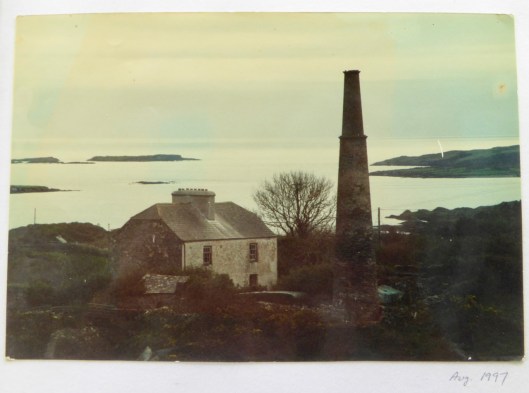
Photo 97It’s a sad thing to lose an iconic landmark. You know the kind I mean – the one that’s in every photo of the place, the one that helps to define it, the instantly recognisable image. In the case of West Cork, that would include the Mizen Bridge, the Galley Head Lighthouse, Ballydehob’s Twelve Arch Bridge, the castles at Three Castle Head, Bantry House, the Baltimore Beacon and of course the Fastnet Rock.

The morning after the lightening strike

The Cappaghglass Mine Chimney the morning after the lightning strike

But we used to have another one, until it was hit by lightning and came down in 2002, 15 years ago this month. The mine chimney at Cappaghglass stood tall on the crest of the hill, visible for miles around from Mount Gabriel to Cape Clear, from Long Island to Baltimore.

View from magazine

I don’t know the origin of this drawing. It’s a view of both mine captain houses…

View original post 631 more words

Some Burials from 1612, Bantry West Cork, Old Catholic, Church of Ireland, Methodist.


Some Burials from 1612, Bantry West Cork, Old Catholic, Church of Ireland, Methodist.

This is a mere snapshot in the absence or destruction of records.  For deaths post 1865 this can be viewed online at irishgenealogy.ie for free by Bantry Registration District.  I cannot say if the more detailed records are online but the original registers give the cause of death occupation address and the name of informant who is often a relative.

bantry-early-wills-and-church-of-ireland-methodist-old-catholic-families-deaths-25th-february-2017

1863, Military Discharge Papers of John Patrick Jagoe, Dunmanway, formerly Farmer, Private 39th Regiment of Foot, Enrolled 1845 over 16 years Service including Gibraltar, Crimea, Canada.


1863, Military Discharge Papers of John Patrick Jagoe, Dunmanway, formerly Farmer, Private 39th Regiment of Foot, Enrolled 1845 over 16 years Service including Gibraltar, Crimea, Canada.

From the mid 18th century an enormous number of Irish men served in the British Army, Navy and the Army of the East India Company.

Courtesy Elizabeth Thorne, Australia.

Some West Cork  Military personnel:

https://docs.google.com/spreadsheets/d/11urZxIDy4fdnr2ih_r8mtr4i1zI5dqmLgz6ipOIRhCM/edit

https://docs.google.com/spreadsheets/d/1HQrKsTDoupxktWQ41Wx5P4GFliNUT4Z2uyTdwyi0xjU/edit

img_2043

Some Genealogical Data from Townlands of Ahagouna, Clashadoo, Coomkeen from 1783, Durrus District, West Cork


https://www.google.ie/maps/place/Ahagouna,+Co.+Cork/@51.6213833,-9.5371587,17z/data=!3m1!4b1!4m5!3m4!1s0x48459fce5a16b103:0x95e1055fb310a27b!8m2!3d51.6213805!4d-9.5349687

Some genealogical Data from Townland of Ahagouna, Clashadoo, Coomkeen from 1783, Durrus District, West Cork

These townlands has an enormous population pre Famine.  Ahagouna was possibly a weaving colony and before Ahagouna Bridge was built possibly 1775-1825 it was the main crossing point at the ford for western traffic on the peninsula.

The famine wiped out the cottier class it is possible to identify most from the Catholic church records (online Muintervara irishgenealogy.ie)  many of these families moved around probably subsisting on sod huts which might only last a year.

Very few of the original families are left but worldwide there are an enormous number of descendants

coomkeenahagounaclashadoogenealogicalfeb2017