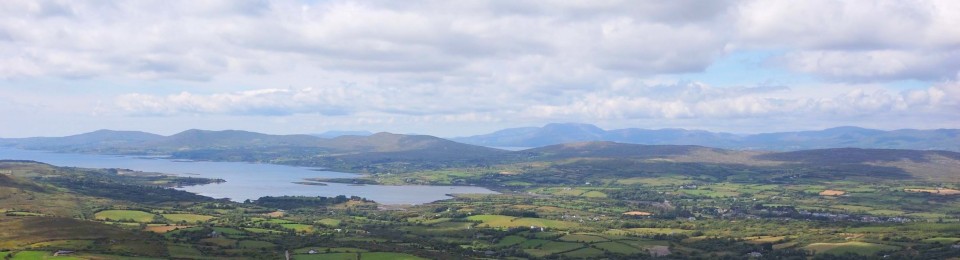
Dereenlomane
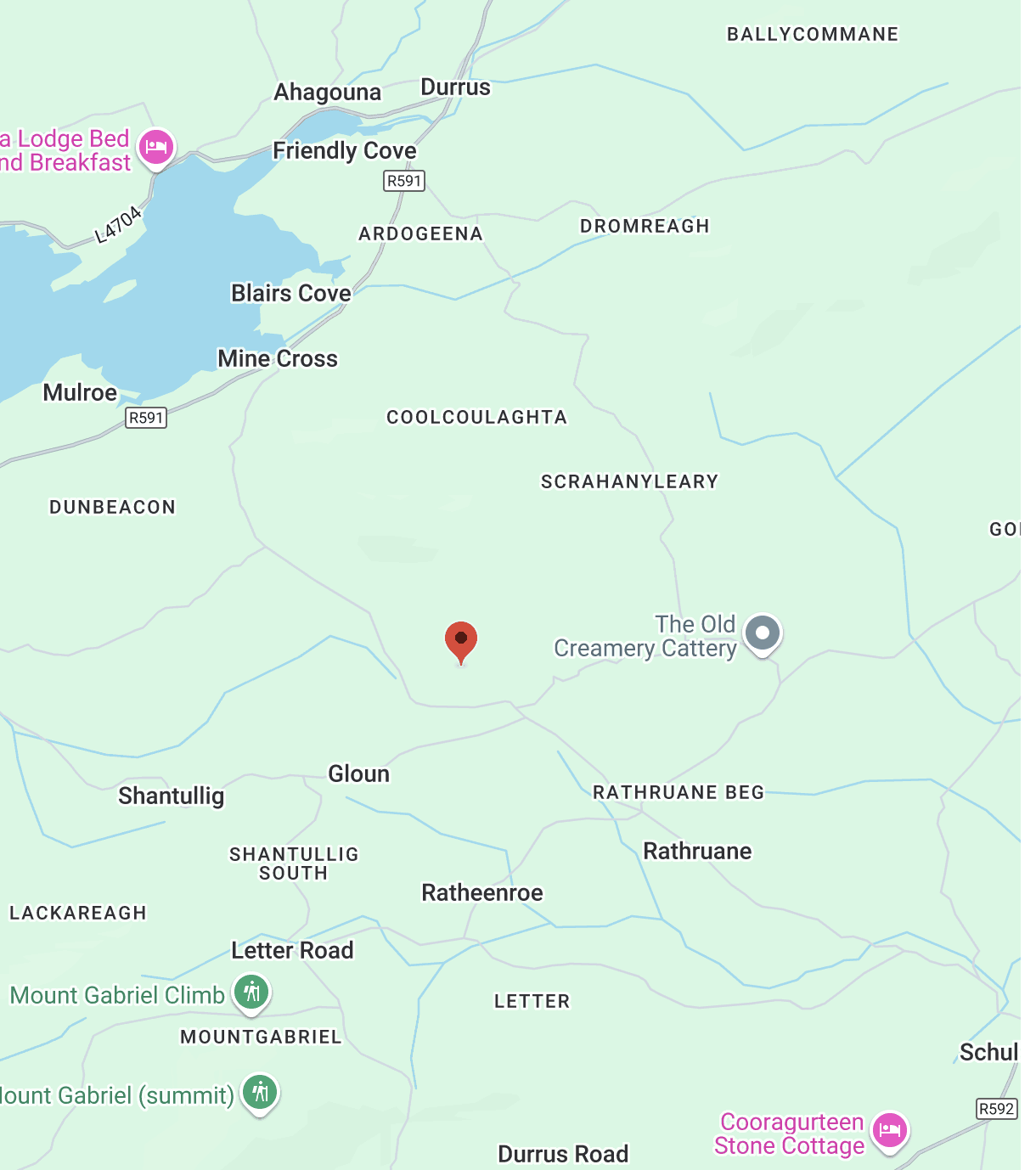
Rossmore
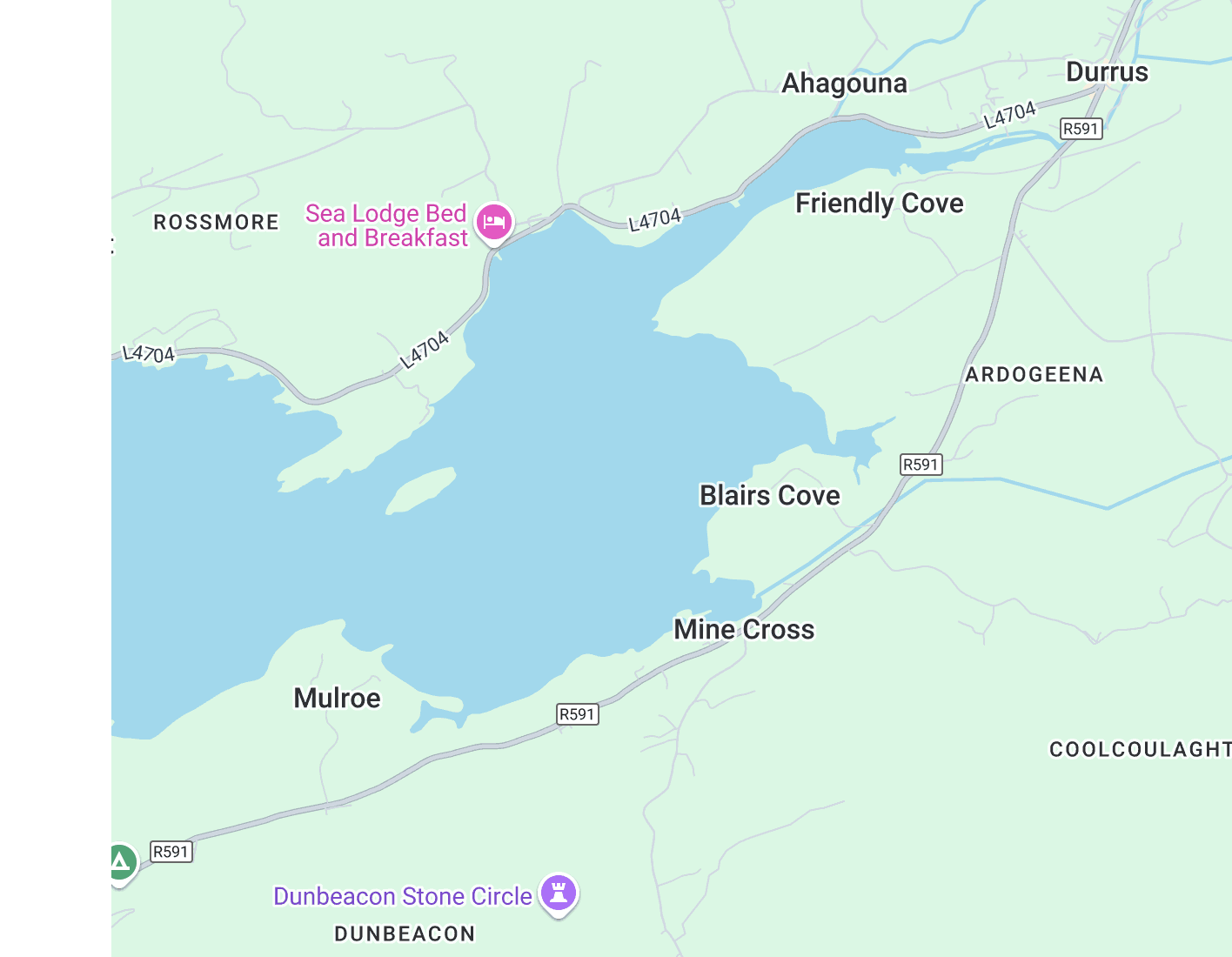
Rossmore
Pat, I am one of the folks who you send drafts of your lists, historical documents and odds & ends about Durrus+ West Cork history. Your work is enormously helpful to those involved in family history. Thank you. Thank you.
Based partially on your research, and the oral and written work of my Dereenlomane and Rossmore-Durrus relations, I have been able to produce a short family history, an introduction to the genealogy of Susan Baker/Daniel McCarthy and Mary Baker/James Shannon – “Two West Cork Sisters.” Attached is a copy for you. If you would like to download it to your website (or pass it along to others), please feel free. I believe strongly that information should be shared!!
A second volume is being brainstormed at the moment.
Thank you again. I will be in touch more often.
Peace,
Tommy Driscoll
Two West Cork Sisters
Our Ancestors
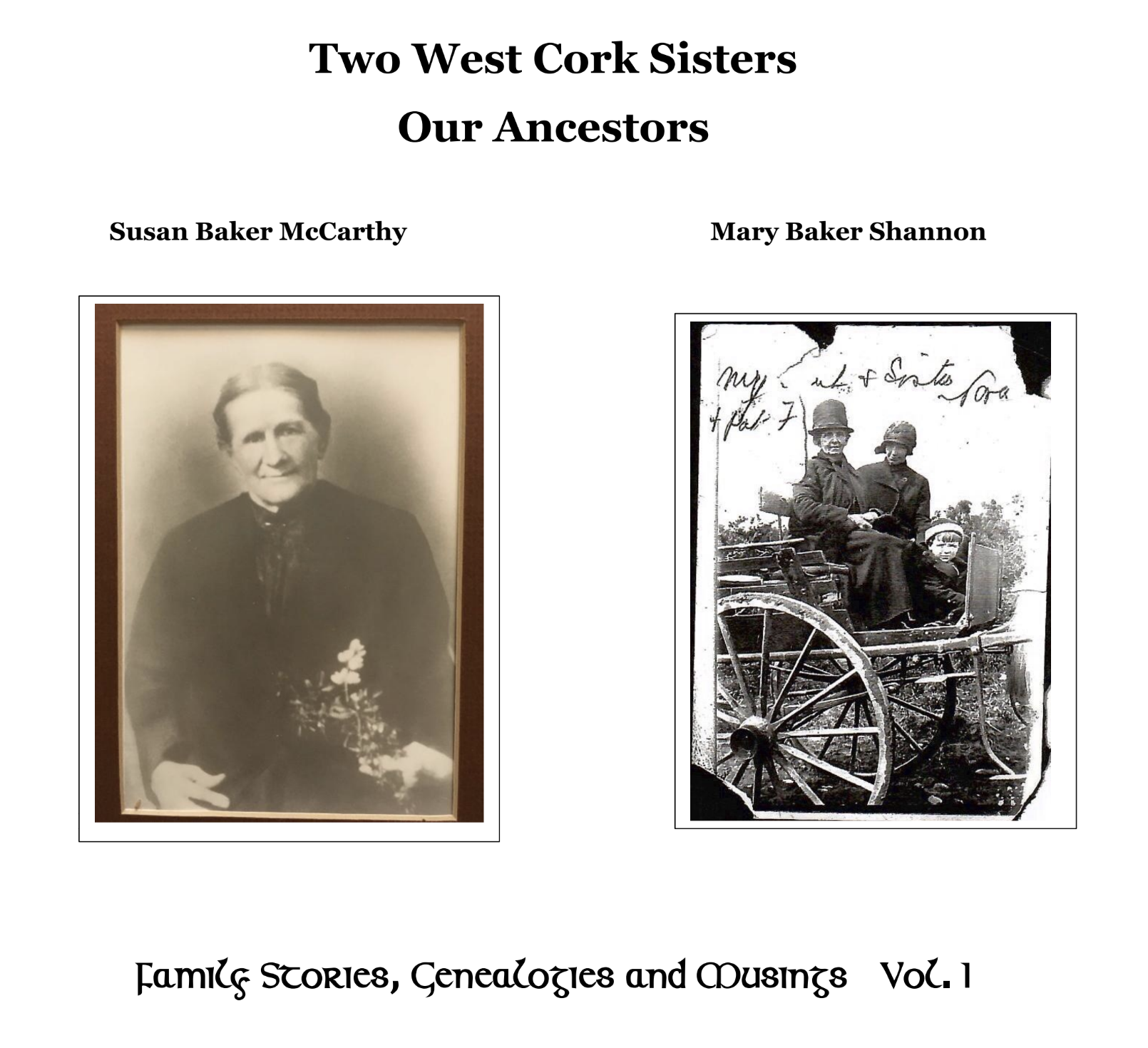
Susan Baker McCarthy Mary Baker Shannon
Family Stories. Genealogies
Family Stories, Genealogies and Musings Vol. I
Tommy & Michele Driscoll
105 School Street
Victor New York 14564, USA
585-727-5656
thomasdriscoll@hotmail.com
June 2025
Revised
2
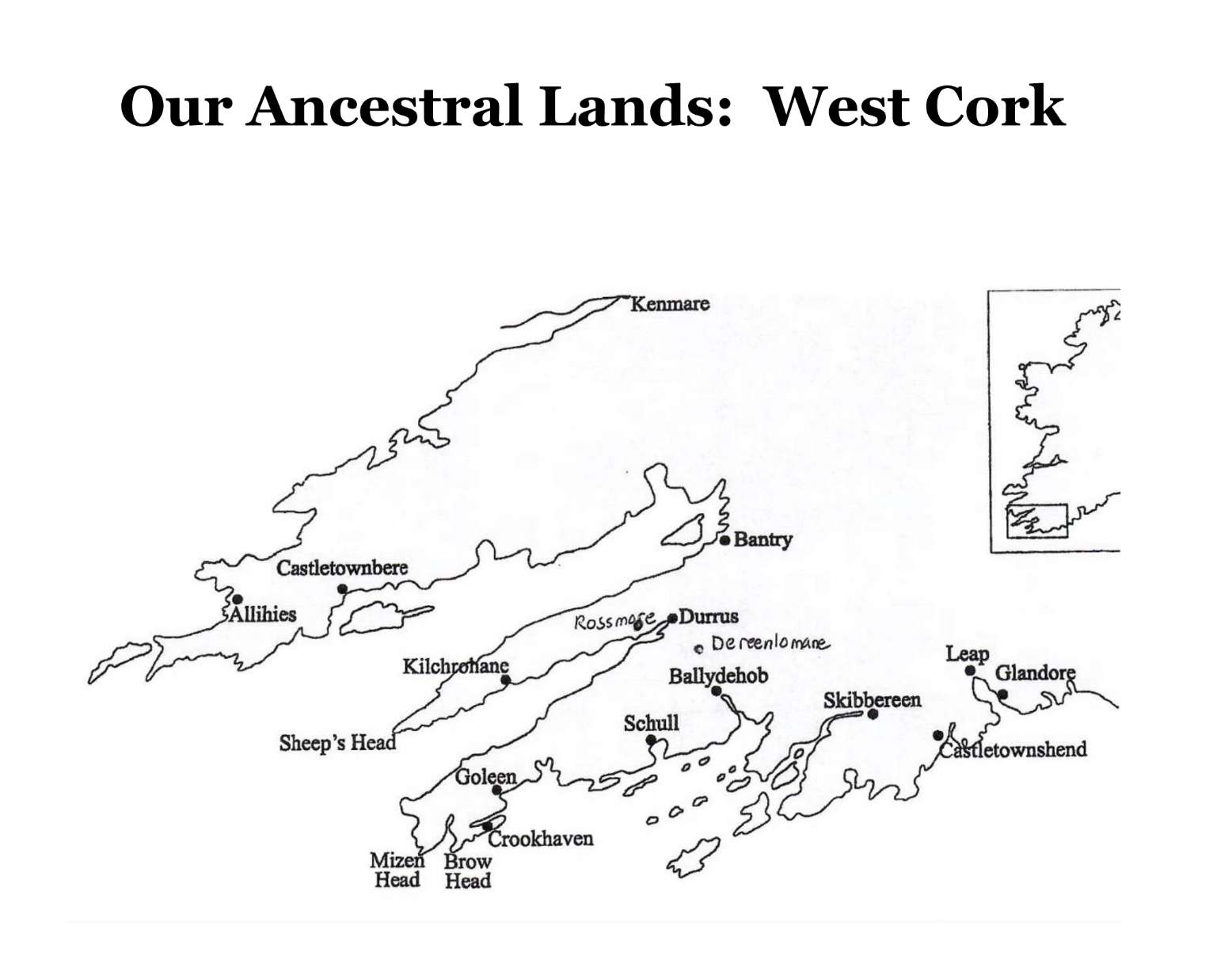
Our Ancestral Lands: West Cork
County Cork (Irish: Contae Chorcai) the southernmost county of Ireland. Often
called “Rebel Cork”, Cork is the largest county in Ireland by land area, and the
largest of Munster’s six counties by population and area. Cork is the second-most
populous county in the Republic, and the third-most populous county on the island
of Ireland.
In the 1841 census, before the outbreak of the “Great Famine”, County Cork had
a recorded population of 854,118. By the 2022 census, Cork City and county had a
combined population of 584,156 people. Cork has not recovered its pre-famine
population.
West Cork is a treasure trove of natural wonders, vibrant towns, and rich
cultural heritage. Its coastline stretches over picturesque inlets, dramatic cliffs, and
inviting sandy beaches, while its inland promises a perfect blend of history, culture,
and idyllic landscapes.
3
Our McCarthy/Baker Ancestors
Susan Baker (1854-1929) was born in the townland of Rossmore. The Baker
homestead sits on Dunmanus Bay with a wonderful view of the Mannion Islands and
Mt. Corin. On the property are the remains of a McCarthy (originally O’Mahony)
castle. The Bakers were on the land at least from the early 1800’s. They farmed the
land, raised cows and pigs. Susan married Daniel McCarthy on 14 Feb 1876 in the
Oratory Chapel at Blair’s Cove, directly across Dunmanus Bay from Rossmore. Daniel
and Susan moved into the McCarthy home at Dereenlomane with his parents. It was
said that Susan was baptized in the Church of Ireland in Durrus. The records of the
Roman Church in Durrus reveal that Susan Baker was baptized Roman Catholic on 12
Feb 1876, three days before she married Daniel McCarthy. She raised the children as
devote Catholics. She read to them from the Bible and prayed the rosary with them.
There were two bedrooms upstairs: one for Daniel and Susan and the newest child, the
other room for all the other children. Susan died at her daughter, Nora’s home at
Crottees near Durrus on 18 Nov 1929, age 75, and is buried in the McCarthy tomb in
Schull Cemetery.
Daniel McCarthy 1847-1910 is believed to be the sixth generation of McCarthys to
live and farm the land at Dereenlomane near the village of Ballydehob. Daniel was
born in 1847 as the “Irish Famine” was near its height. Dereenlomane is located with
a view of Mt. Gabriel. Near the McCarthy homestead was a barytes mine in which many
of the McCarthy’s worked. The original buildings are in ruin with no evidence of the
house. The property is now the home of the Cadogan family, relations of Dannie
McCarthy (1921-1999) of Glaun, son of Thomas (Sonny) and grandson of Daniel
McCarthy. Daniel died at Dereenlomane on 7 Sept 1910 and is buried in the McCarthy
tomb at Schull.
Baker – McCarthy Civil Marriage Record
4
The Children of Susan Baker and Daniel McCarthy
Married 35 years; birthed 16 children between 1877 and 1900 (23 years)
Remained in Ireland Sources: Fr. Charles L. McCarthy, John Joseph Driscoll, Fr. Daniel V. Hogan – fr0m Rochester NY, Kitty (Dan F) Keane from Bredagh Cross, Susan Elizabeth McCarthy from
Boston, MA, Mary Catherine McCarthy from Canandaigua, NY
Thomas* (Sonny) 1877-1921. 44 years. Married Julia Cullinane in Schull. As first born
inherited the farm; died of cancer. Buried in McCarthy tomb. Child: Dannie
Florence (Flur) 1878 – 1963 85 years old, worked in barytes mine. Married Annie Nagle
from Dereenlomane in 1911. Emigrated to Boston. Street car mechanic and driver for MTA.
Died 22 Nov 1963. Buried St. Joseph Cemetery, West Roxbury MA, Children: Catherine (Sr.
Aquinas), Tom, Susan, Daniel, Margaret.
Ellen (Nellie) 1879-1970. 91 years old. Married John Driscoll in 1915. Described as “proud
and stately.” Emigrated to Rochester NY. Worked as a domestic and a cook. Took in
immigrants at her home, 12 Holmes St. Developed severe emotional illnesses – hospitalized
for many years. Died 23 May 1970, buried in Holy Sepulchre, Rochester NY. Child: John
Joseph Driscoll
Margaret (Maggie) 1881-1964 83 years old. Worked as a cook and domestic in a fraternity
house at the University of Rochester. Married Richard Fennell in 1921. Lived at 20 Kron St..
described as a “quick talker” Died 8 Nov 1964. Buried at Holy Sepulchre. Children: “Son” 1922,
and Richard C. 1923-1947
Susan Matilda 1882-1954. 72 years old. Described as “hard working”, married to Jeremiah
“Jerry” Healey in 1922. Known for her homemade cookies. Lived at 66 Pomeroy St. Rochester
NY. Died 27 August 1954; buried Holy Sepulchre Cemetery, Rochester NY. No children.
Catherine* (Sister Magdalen) 1884-1937, 53 years old. attended a boarding school in
Crookhaven and a finishing school in Dunmanway; gifted intellectually; studied in Paris;
Member of the Sisters of Charity of St. Vincent de Paul for 27 years. Became the Mother
Superior. Described as a “very proud person.” Helped establish an orphanage in Dublin; died
of cancer on 24 June 1937; buried at Glasnevin Cemetery, Dublin. No children.
Mary Elizabeth. 1886-1964. 78 years old. Worked as a domestic and a cook. Everyone loved
Mary. Her father did not want her to emigrate to America; described as “big-hearted soul”
married Thomas Joseph (Joe) Hogan in 1920. Lived at 25 Chatfield Street. Rochester NY; died
from heart disease 9 Dec 1964; buried at Holy Sepulchre Cemetery, Rochester NY. Children:
Daniel, Eleanor (Sis), Thomas, Bernard.
Elizabeth * (Lill) 1887 – 1964. 77 years old. Emigrated to Rochester NY, lived with her sister
Susan. Son: Thomas born at Our Lady of Victory, Lackawanna, NY.in 1917. Thomas died in
WWII at age 28. Lill returned to Ireland, married Tim McSweeney in 1925 in Ballydehob. Son:
Patrick. Lived at Knockroe, Ballydehob. Lill died 25 Dec 1964. Buried at Bannaknockane
Cemetery, Ballydehob.
Daniel Frank* 1889-1963. 74 years old. Sergeant in the Royal Irish Constabulary, served in
Nenagh, County Tipperary. Family legend says that Dan F. was “knee-capped: by the IRA.
Returned to Dereenlomane after the War of Independence. Eventually moved to Lisheen.
Married Catherine (Nurse) Keehan; good neighbor- stopped evictions; generous with money
5
especially with his siblings. Children: Dannie, Kathleen (Kitty). Died 9 June 1963. Buried
Schull Cemetery (not the McCarthy tomb).
Hanorah (Nora)* 1890-1952 62 years old. Stayed home and took care of the homestead.
Described as “very generous” known for cooking great breakfasts of salmon, eggs and sausage.
Married Paddy O’Sullivan in Bantry. Lived on Wolfe Tone Square in Bantry. Children: Pat
Francis, Madeline, Mary Jo. Died 21 Sept 1952. Buried Abbey Cemetery, Bantry.
Charles John 1893-1977. 84 years old. Emigrated to Rochester NY. Worked at Reed Glass
Company on Maple St. Postal worker for many years. Married a cousin: Mary Brigid McCarthy
from Glaun. Took care of his sisters: Nellie, Maggie, Susan, Lill, Annie, Aggie. Considered
himself as head of the McCarthy Clan in Rochester. Known for his vacation property,
“Dereenlomane” at Old Forge NY Lived at 59 Monica Street. Rochester. Children: Charles Leo,
Mary Margaret, Eileen Ann, Catherine Magdalen, Susanne Monica. Died: 30 May 1977 at Old
Forge NY. Buried Holy Sepulchre Cemetery, Rochester.
Denis Florence* 1894-1952. 58 years old. Twin of John James. Jailed for republican
activities in Ireland, West Cork Brigade of the old IRA; 32 years selling hardware, seeds and
general merchandise; gentle, married Bea Scanlon in 1930; lived in Ballyduff, Co. Waterford.
Children: Donal, Rita, Sean, Denis, Madeline. Died: 23 Oct 1952. Buried in St. Michael’s
Church Cemetery, Ballyduff.
John James (Jack) 1894-1982. 88 years old. Twin of Denis. Involved in Republican
activities in Ireland. Married Catherine Foley (1907-1938) in 1929 in Rochester. No children.
Fun-loving, kind, called “honest John” Long time fire fighter for the City of Rochester; rose to
the rank of lieutenant, “They just don’t make people like that anymore.” Married Mary Ellen
Hegarty (1904-2006) in 1941. Children: Mary Catherine, Sean, Daniel. Died 14 March 1982.
Buried White Haven Memorial Park, East Rochester NY.
Anna Mariah 1896-1992. 96 years old. Emigrated to Rochester NY. Wonderful faith in God;
lived a life of honesty, known for her chocolate chip cookies, loved to be with other people.
Married John (Jack) Holland in 1930, Children: Mary Kay, Jack, Daniel, Ann. Lived at 103
Ellicott St. Died: 11 April 1992. Buried at Holy Sepulchre Cemetery, Rochester
Sarah Jane* 1899-1901. 2 years old. Described as “sickly” Died of Scarlet Fever. Buried in
McCarthy tomb at Schull.
Agnes Teresa 1900-1987 87 years old. Emigrated to Rochester NY. Worked as a
domestic/housekeeper for Rose Kennedy in Florida. Also, worked as a waitress at Oak Hill
Country Club and the Wishing Well restaurant in Rochester. Lived at 20 Kron St. Generous,
warm, very giving with a great laugh. Always ready to go out. Preferred to play cards with the
men at holiday card games. Died 27 May 1987. Buried at Holy Sepulchre, Rochester
Out-buildings on McCarthy
lands – looking south east.
Building on right is the
piggery
6
Children of Daniel McCarthy and Susan Baker
by the Numbers
Shortest Life Spans Longest Life Spans
Sarah Jane 2 years Annie 96 years
Thomas 44 years Ellen 91 years
Catherine 53 years John 88 years
Denis 58 years Agnes 87 years
Nora 62 years Florence 85 years
Susan 72 years Charles 84 years
Dan F. 74 years Margaret 83 years
Lill 77 years Mary 78 years
Marriages { ^ = married in Ireland }
^Dan. F. m Kathleen Keehan 1910
^Florence m Annie Nagle 1911
Ellen m John Driscoll 1915
Mary m Thomas J. Hogan 1920
^Thomas m Julia Cullinane 1920
Charles m Mamie McCarthy 1920
Margaret m Richard Fennell 1921
Susan m Jeremiah Healey 1922
^Lill m Tim McSweeney 1925
^Nora m Paddy O’Sullivan 1925
John m Katie Foley 1929
^Denis m Bea Scanlon 1930
Annie m John Holland 1933
John m Mary Ellen Hegarty 1941
Never Married: Catherine – nun; Sarah Jane – died young; Agnes – single
7
Children of Mary Baker (1851-1931) &
James Shannon (1845-1916)
Married 40 years; birthed 14 children between 1871 and 1897 (26 years)
1.John James 1871-1955 m Minta Corey of Rochester NY. Child: Herbert
- Frances (Fannie) 1872-1958 m George Hegarty of Rossmore
Children: Dan, Jim, Eva, Bill, Mary Violet, George, Rose, Dick - Thomas 1874 – 1950 m Sarah Swanton of Rochester
Children: Frances, Anne (Teentz), James - James 1876 – ? 1. Married: Mary Shannon child: Violet
2.Married: Mae Swanton from Rossmore
Children: James, Baby, Tom, Mary, William, Matilda, David
- Maria (Mim) 1878-1956 m William Shannon
Children: Bill, Mary Jane (Chassie), Jim, Little Lill, Dick, Georgie (Little George) - Elizabeth (Lill) 1875-1945. Children: none
- Anne Christine 1881-1963 m George Sweetnam of Rochester NY
Children: Florence, Bernice, Louise - Sarah Jane (Sadie) 1884-1973 m Bill Kingston of Rochester NY
Children: Mary Violet, Bill - Susan Matilda (Tillie) 1886-1977 m Bill Marsh of Rochester NY
Children: Lorella, Lester (Bus) - Ursula (Tine) 1888-1969 m Albert Dorothy of Rochester NY
Children: David, Franklin - Richard (Dick) 1892-1970 m Ruth Swanton of Rochester NY
Children: Lee, Bill, Bob, Mary, Tom - William 1893-1976 m Teenie Creighton of Crookstown, Co. Tyrone
Children: Jimmie, Bernard, Eina, Sylvia, David - Rebecca (Becky) Rosina 1896 – 1991 m Bob Kingston of Rochester NY
Children: Peggie, Bob, Jim, Paul - David Christopher 1897-1953 m Jessie Seater of Orkney Scotland by way of
Rochester NY
8
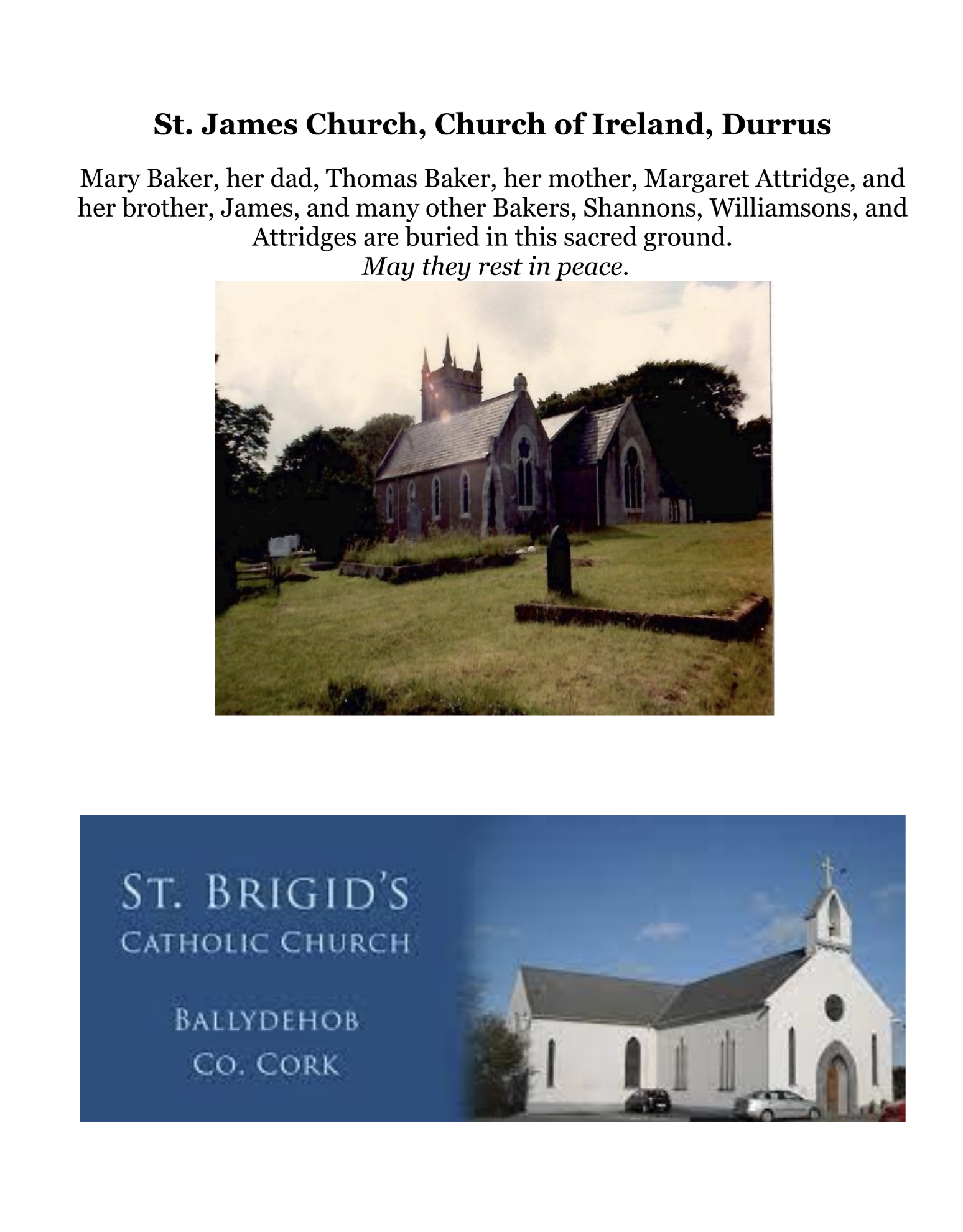
St. James Church, Church of Ireland, Durrus
Mary Baker, her dad, Thomas Baker, her mother, Margaret Attridge, and
her brother, James, and many other Bakers, Shannons, Williamsons, and
Attridges are buried in this sacred ground.
May they rest in peace.
9
Who are the siblings of Thomas Baker,
Susan Baker and Daniel McCarthy?
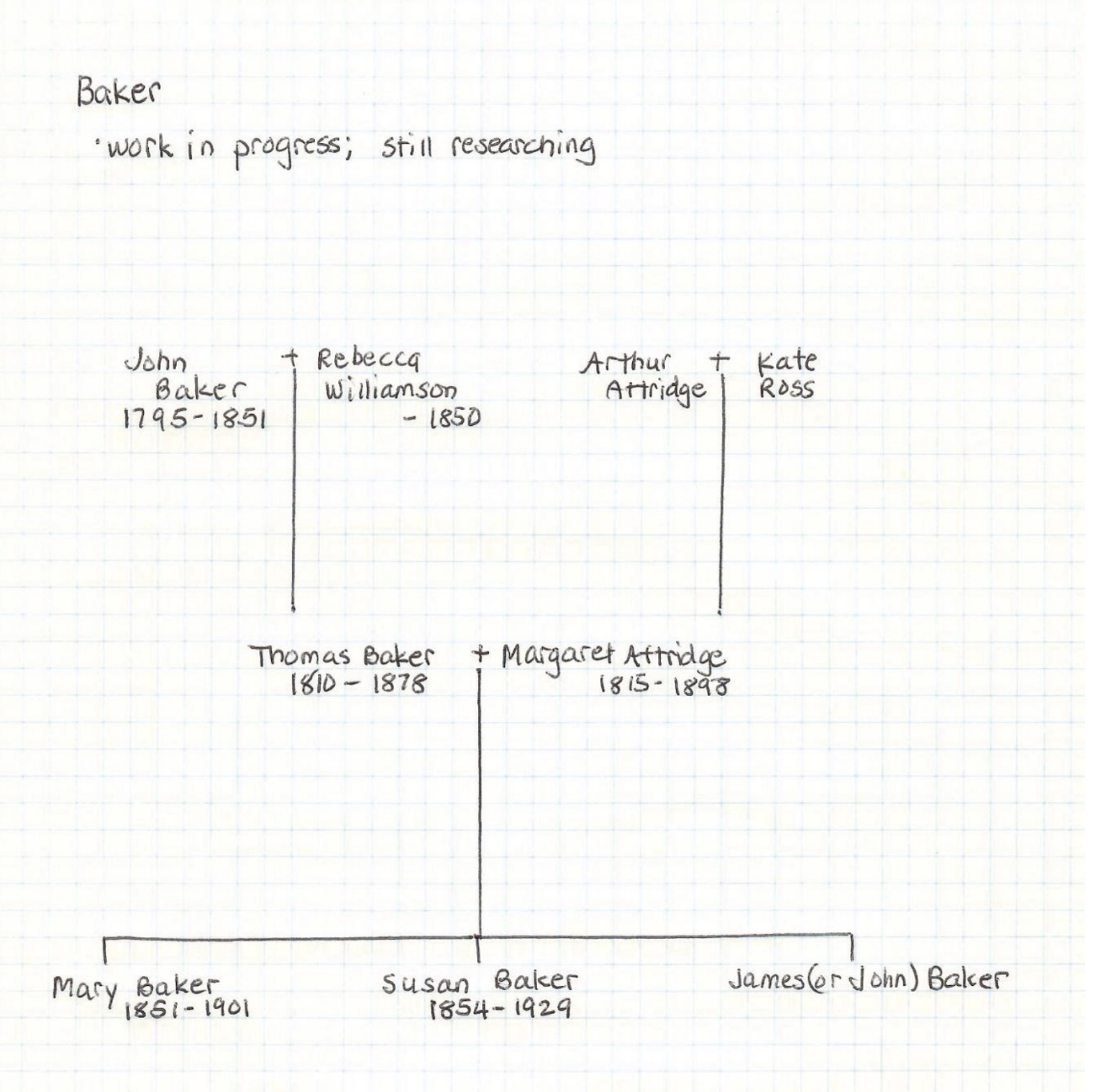
Thomas Baker 1810-1878
Richard Baker 1803 – ??
Samuel Baker 1808- 1879 lived at Rooska
Sarah Baker 1820 – 1907
Susan Baker 1854 – 1929
James (or John) Baker 1847 -1864 believed to have died at age 17
Mary Baker 1851 – 1931 m. James Shannon
Daniel McCarthy 1846 – 1910
Thomas McCarthy 1841 – ? single
Elizabeth McCarthy 1843 – died young
Kate McCarthy 1852- 1891 m. Ned Roycroft
Ellen McCarthy 1852 – 1891 m. Maurice O’Keefe
Charles McCarthy 1854 – ? Catherine Sullivan
Mary McCarthy 1858- 1948 m. Mike Sullivan
McCarthy – Baker Trivia
Susan Baker had 16 children; her sister, Mary, had 14 Total = 30
How many grandchildren did they have together? 84
How many of Susan’s children stayed in Ireland ? 7
How many of Mary’s children stayed in Ireland ? 5
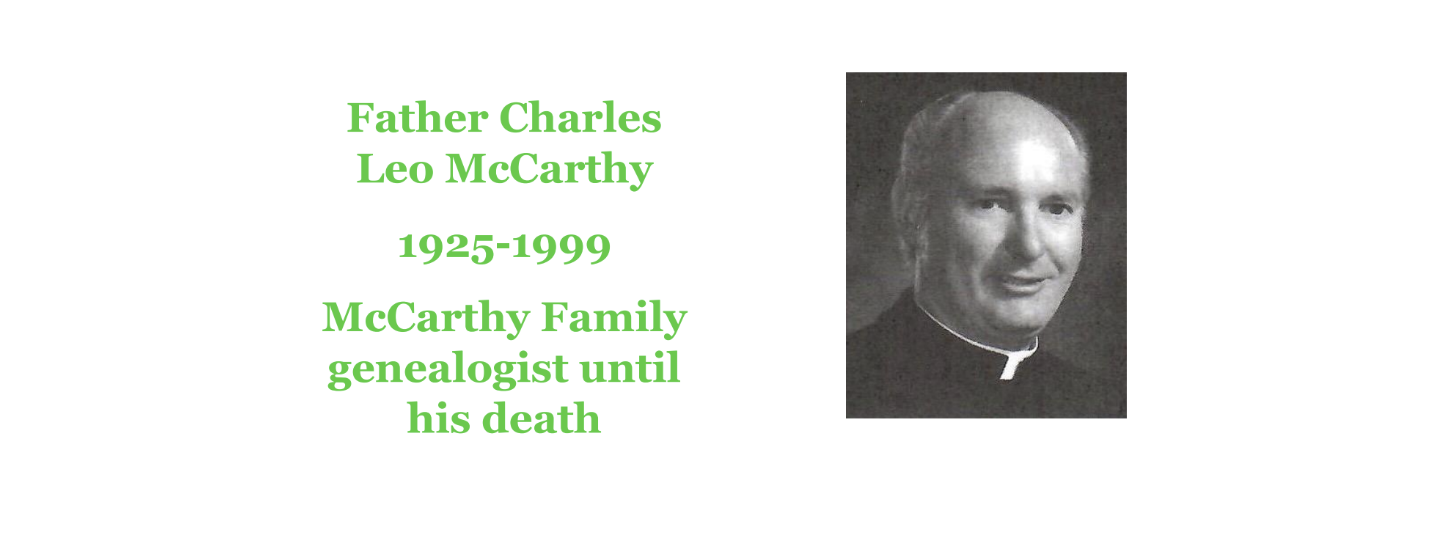
Father Charles
Leo McCarthy
1925-1999
McCarthy Family
genealogist until
his death
10
The Marriage of Mary Baker
and James Shannon
Notice:
- They were married in 1869, just after civil registration was
created - The witnesses, Thomas Baker and John Shannon were the
bride and groom’s fathers – common practice in those
days - The Shannons were from the townland of Brahalish, just
across the road from Rossmore. Normal in those days to
not go far to find a spouse. - James was 26, Mary was 18 – not particularly young for
the times! While the legal minimum age for marriage was
14 for boys and 12 for girls, the average age at first
marriage was significantly higher, according to the Law
Reform Commission of the United Kingdom.
11
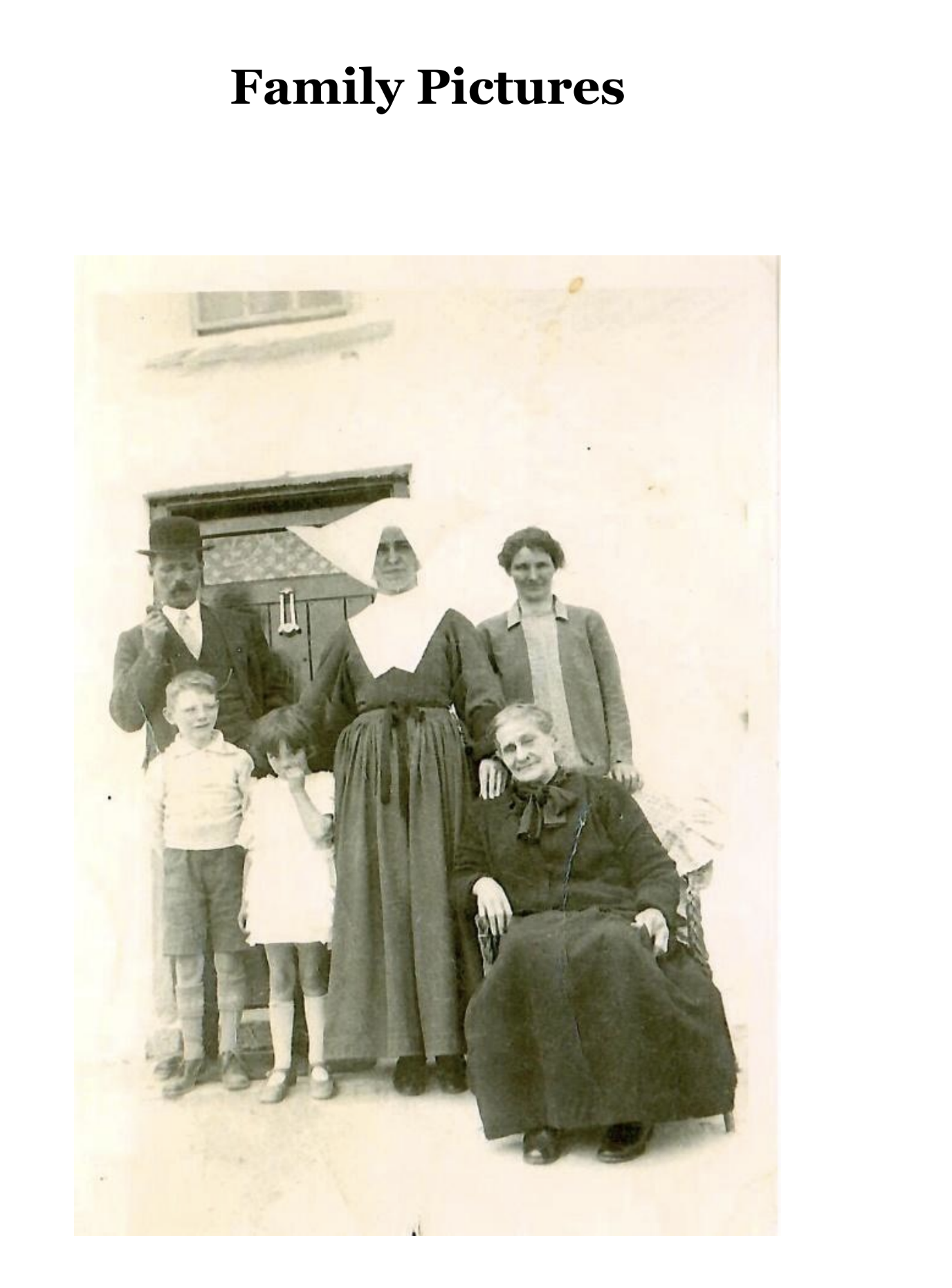
Family Pictures
Children: Dannie 1917-1977 and Kathleen (Kitty Dan F.) 1922-1992
Adults: Dan F. McCarthy, Catherine (Sister Magdalene DC) McCarthy,
Kathleen (Nurse) Keehan McCarthy, Susan Baker McCarthy.
Dereenlomane c. 1928 or 1929
12
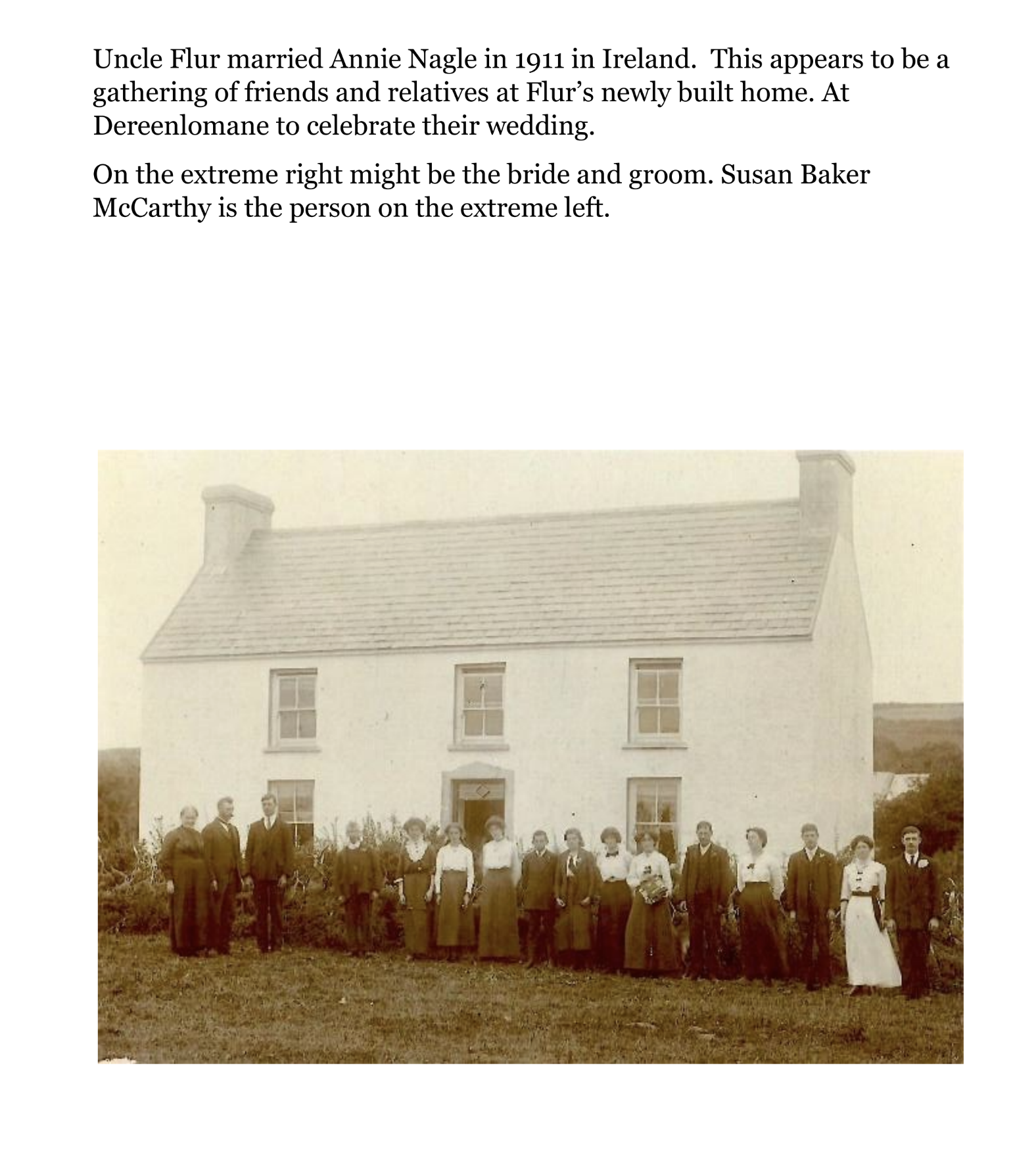
Uncle Flur married Annie Nagle in 1911 in Ireland. This appears to be a
gathering of friends and relatives at Flur’s newly built home. At
Dereenlomane to celebrate their wedding.
On the extreme right might be the bride and groom. Susan Baker
McCarthy is the person on the extreme left.
13
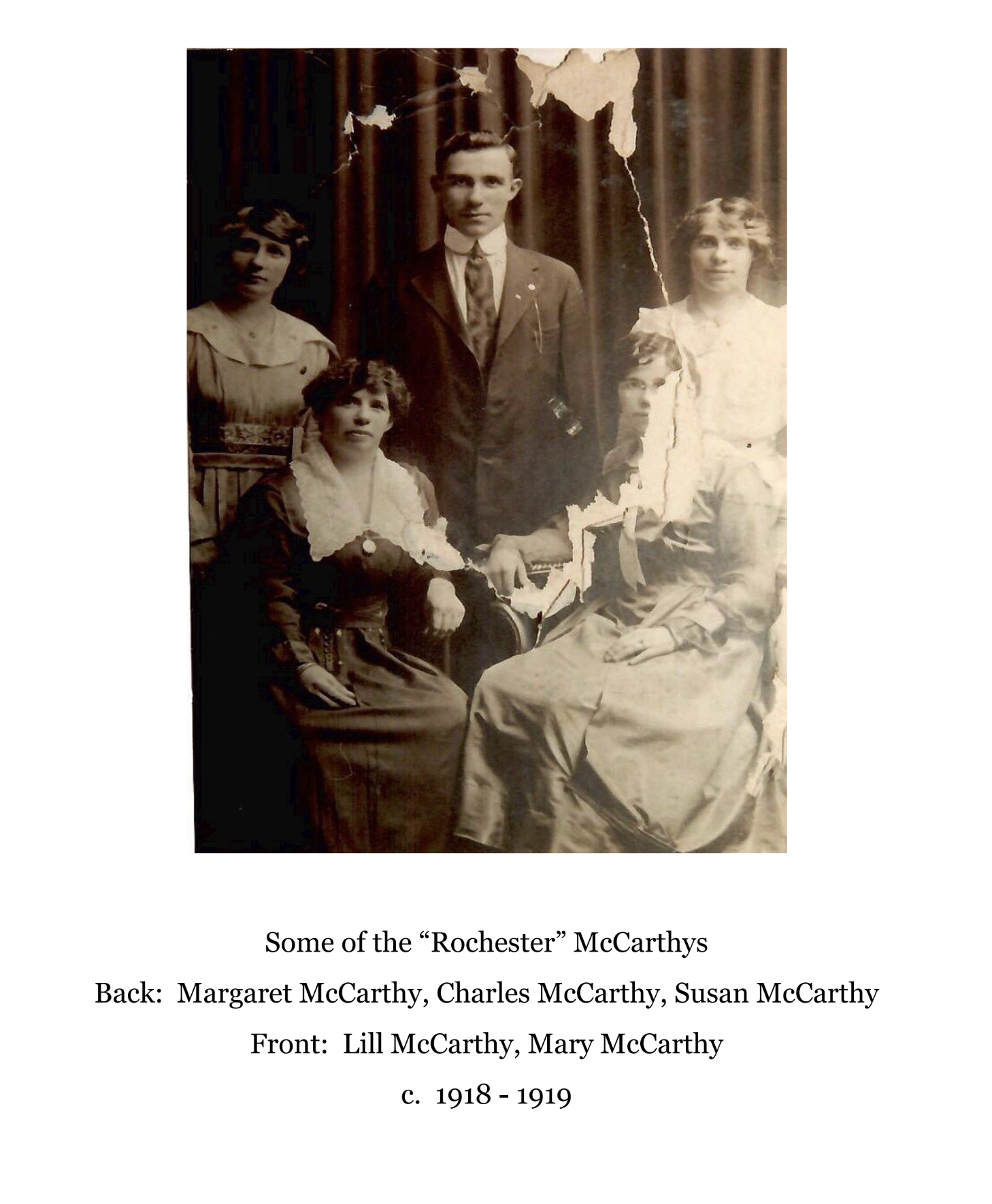
Some of the “Rochester” McCarthys
Back: Margaret McCarthy, Charles McCarthy, Susan McCarthy
Front: Lill McCarthy, Mary McCarthy
c. 1918 – 1919
14
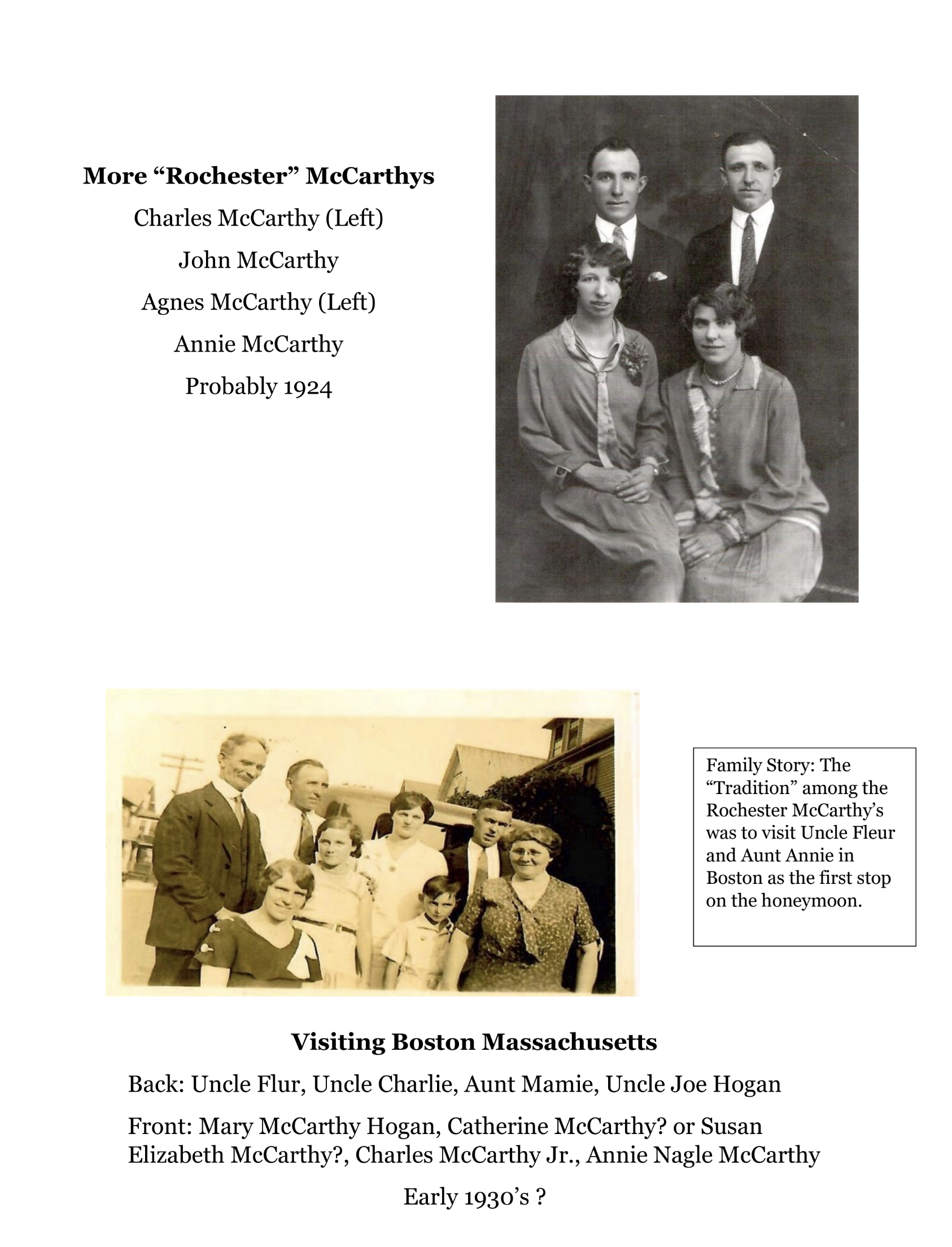
More “Rochester” McCarthys
Charles McCarthy (Left)
John McCarthy
Agnes McCarthy (Left)
Annie McCarthy
Probably 1924
Visiting Boston Massachusetts
Back: Uncle Flur, Uncle Charlie, Aunt Mamie, Uncle Joe Hogan
Front: Mary McCarthy Hogan, Catherine McCarthy? or Susan
Elizabeth McCarthy?, Charles McCarthy Jr., Annie Nagle McCarthy
Early 1930’s ?
Family Story: The
“Tradition” among the
Rochester McCarthy’s
was to visit Uncle Fleur
and Aunt Annie in
Boston as the first stop
on the honeymoon.
15
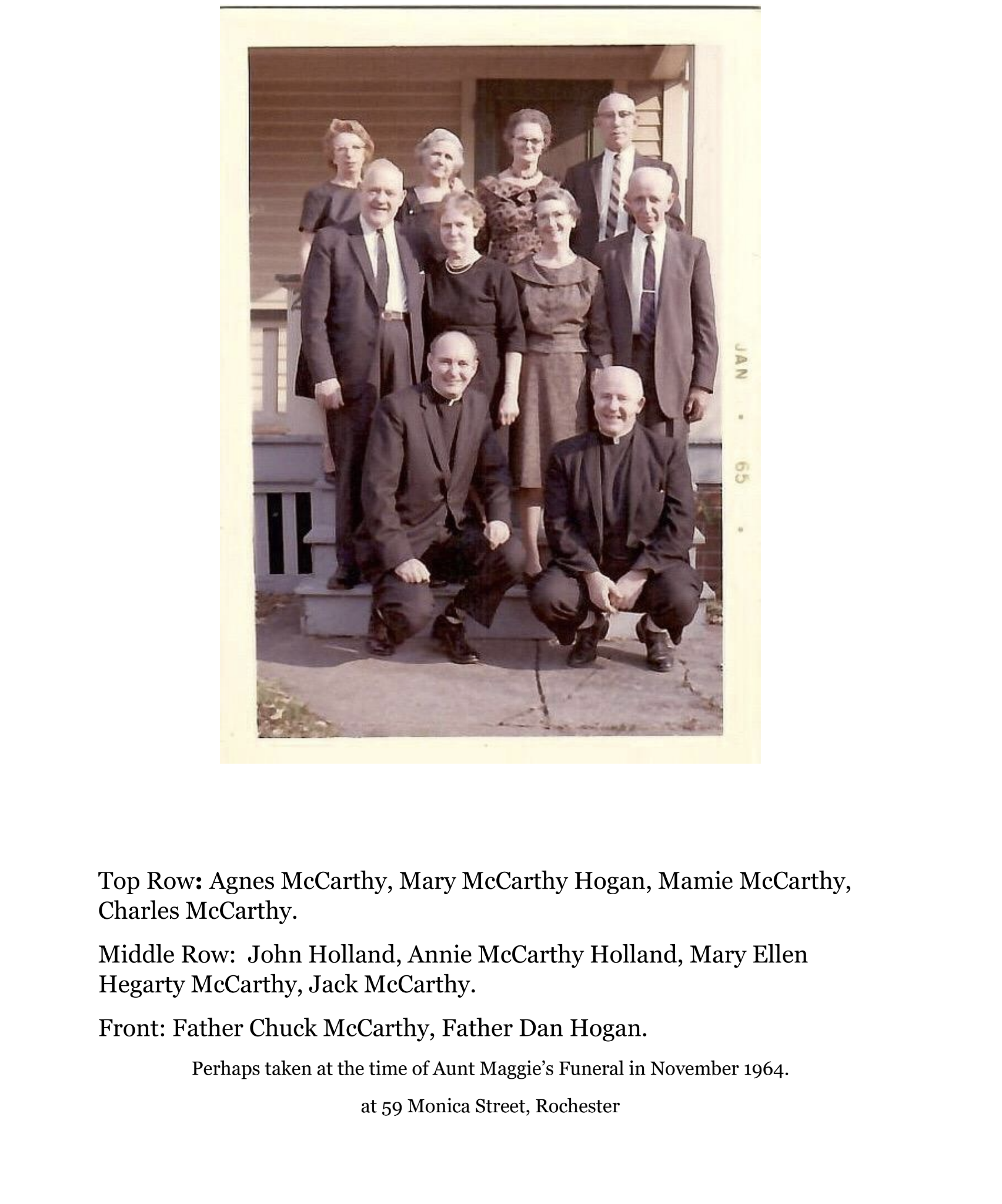
Top Row: Agnes McCarthy, Mary McCarthy Hogan, Mamie McCarthy,
Charles McCarthy.
Middle Row: John Holland, Annie McCarthy Holland, Mary Ellen
Hegarty McCarthy, Jack McCarthy.
Front: Father Chuck McCarthy, Father Dan Hogan.
Perhaps taken at the time of Aunt Maggie’s Funeral in November 1964.
at 59 Monica Street, Rochester
16
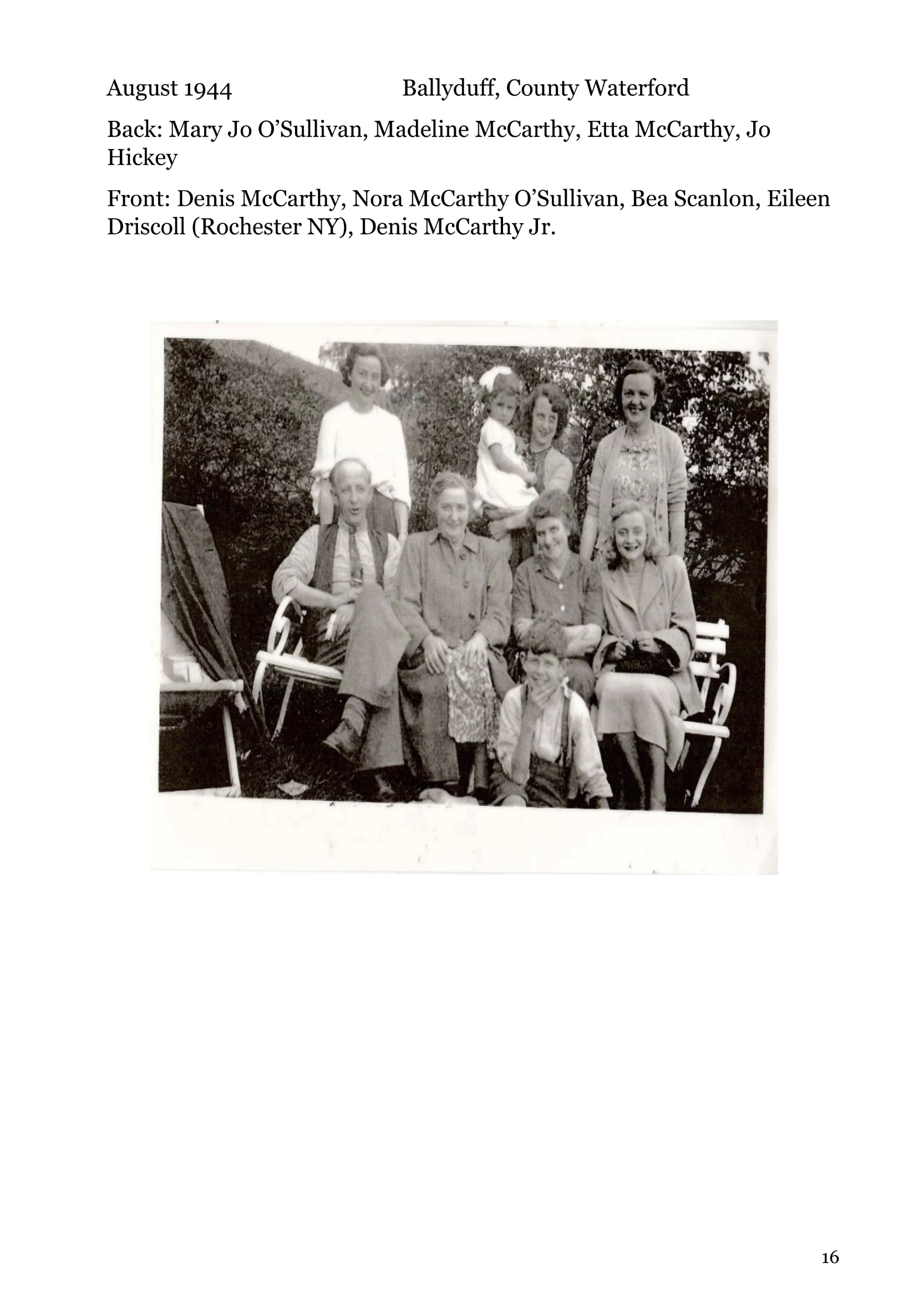
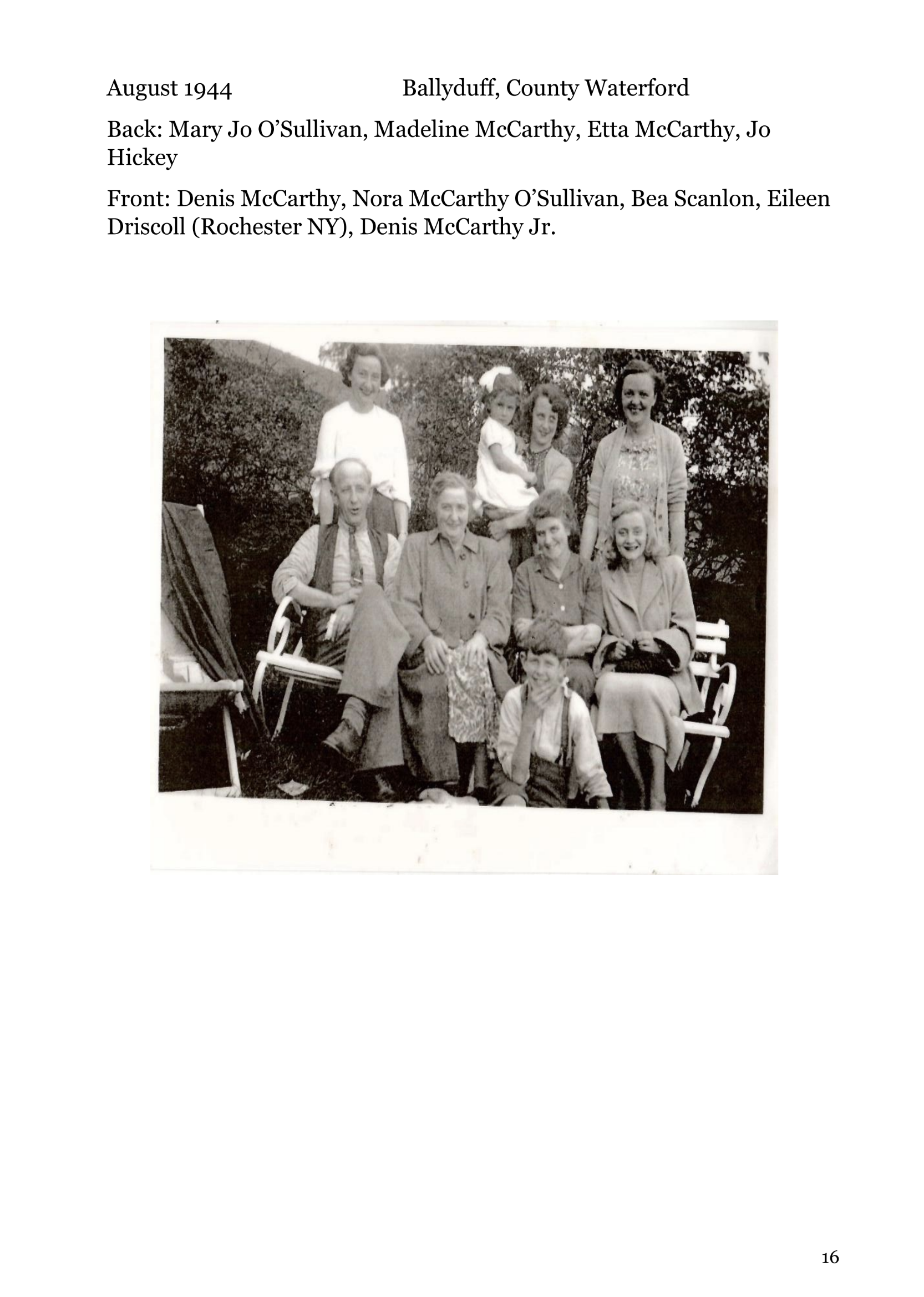
August 1944 Ballyduff, County Waterford
Back: Mary Jo O’Sullivan, Madeline McCarthy, Etta McCarthy, Jo
Hickey
Front: Denis McCarthy, Nora McCarthy O’Sullivan, Bea Scanlon, Eileen
Driscoll (Rochester NY), Denis McCarthy Jr.
17
June 1915
Wedding of Nellie McCarthy
(right) and John Driscoll
(seated)
Witnesses:
Margaret McCarthy
Eugene Driscoll
Blessed Sacrament Church,
Rochester NY
18
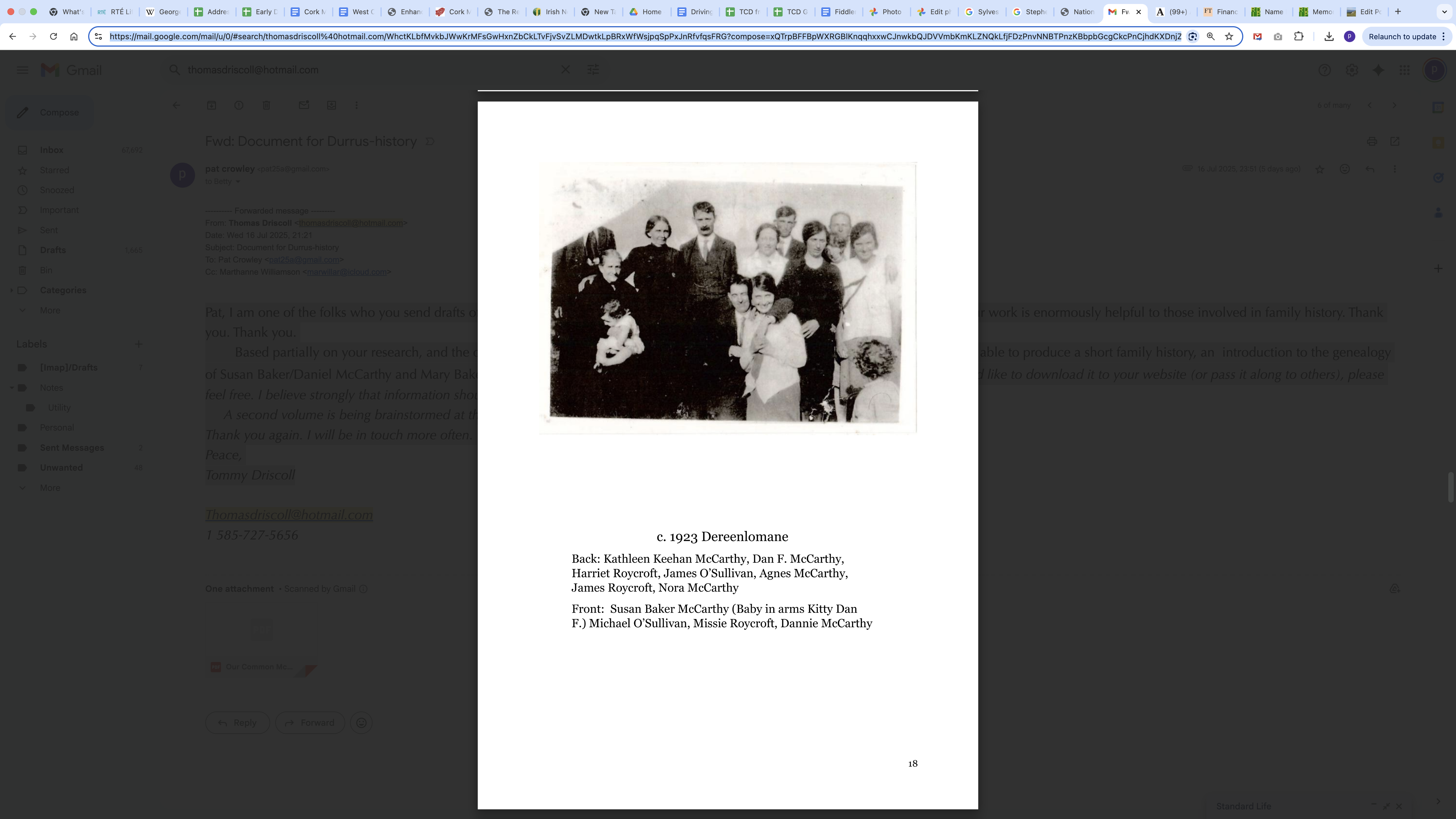
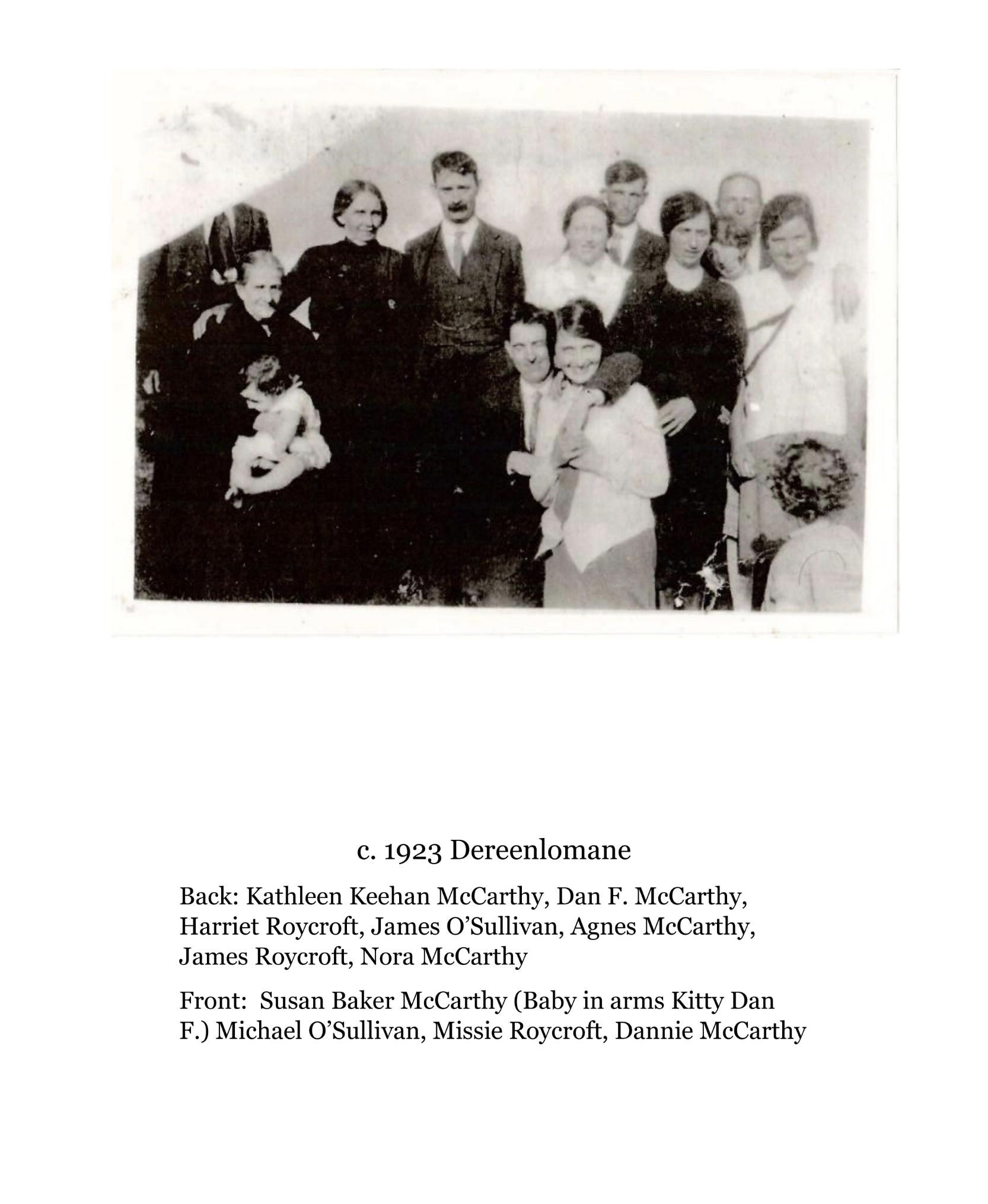
c. 1923 Dereenlomane
Back: Kathleen Keehan McCarthy, Dan F. McCarthy,
Harriet Roycroft, James O’Sullivan, Agnes McCarthy,
James Roycroft, Nora McCarthy
Front: Susan Baker McCarthy (Baby in arms Kitty Dan
F.) Michael O’Sullivan, Missie Roycroft, Dannie McCarthy
19
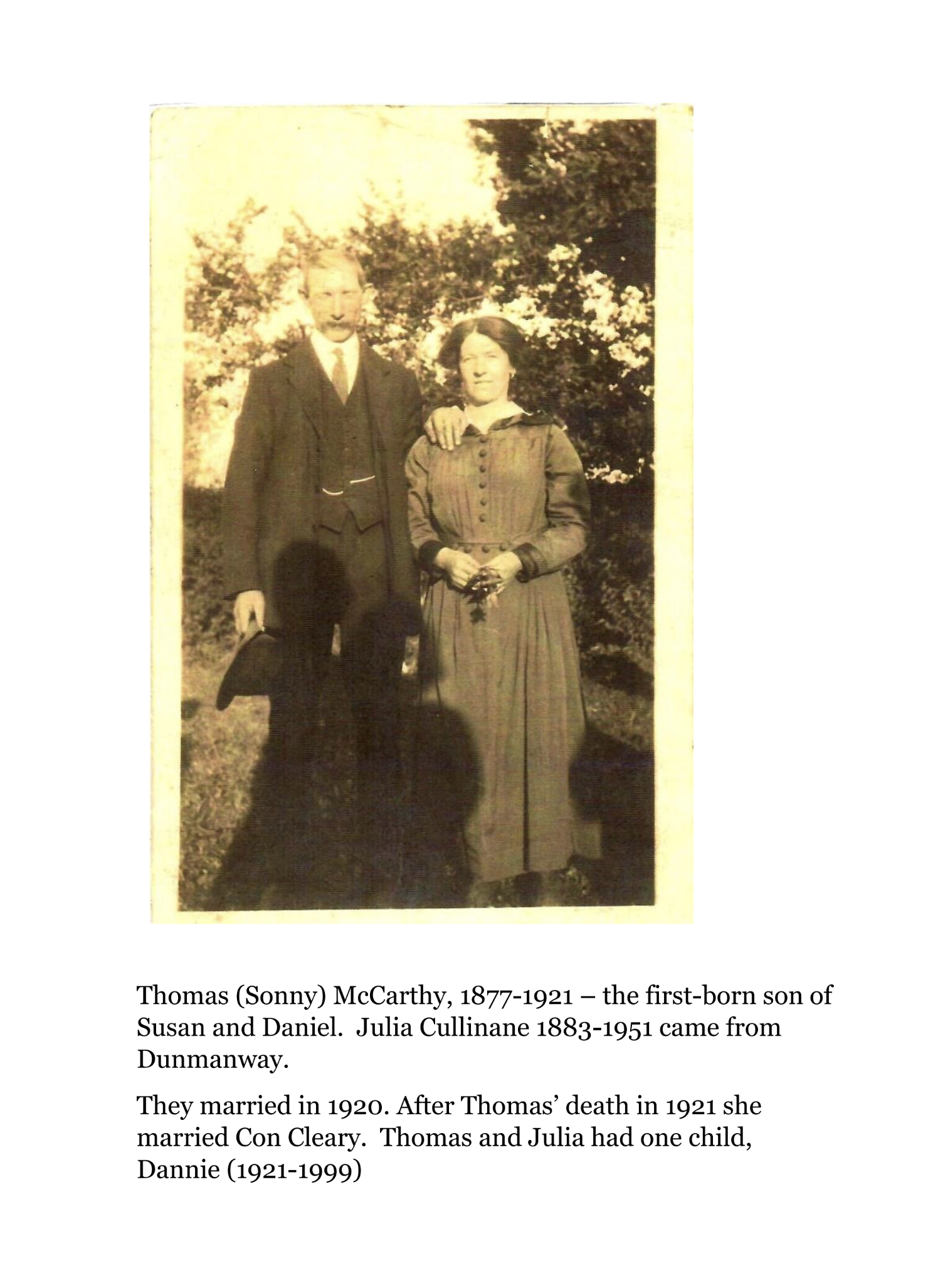
Thomas (Sonny) McCarthy, 1877-1921 – the first-born son of
Susan and Daniel. Julia Cullinane 1883-1951 came from
Dunmanway.
They married in 1920. After Thomas’ death in 1921 she
married Con Cleary. Thomas and Julia had one child,
Dannie (1921-1999)
20
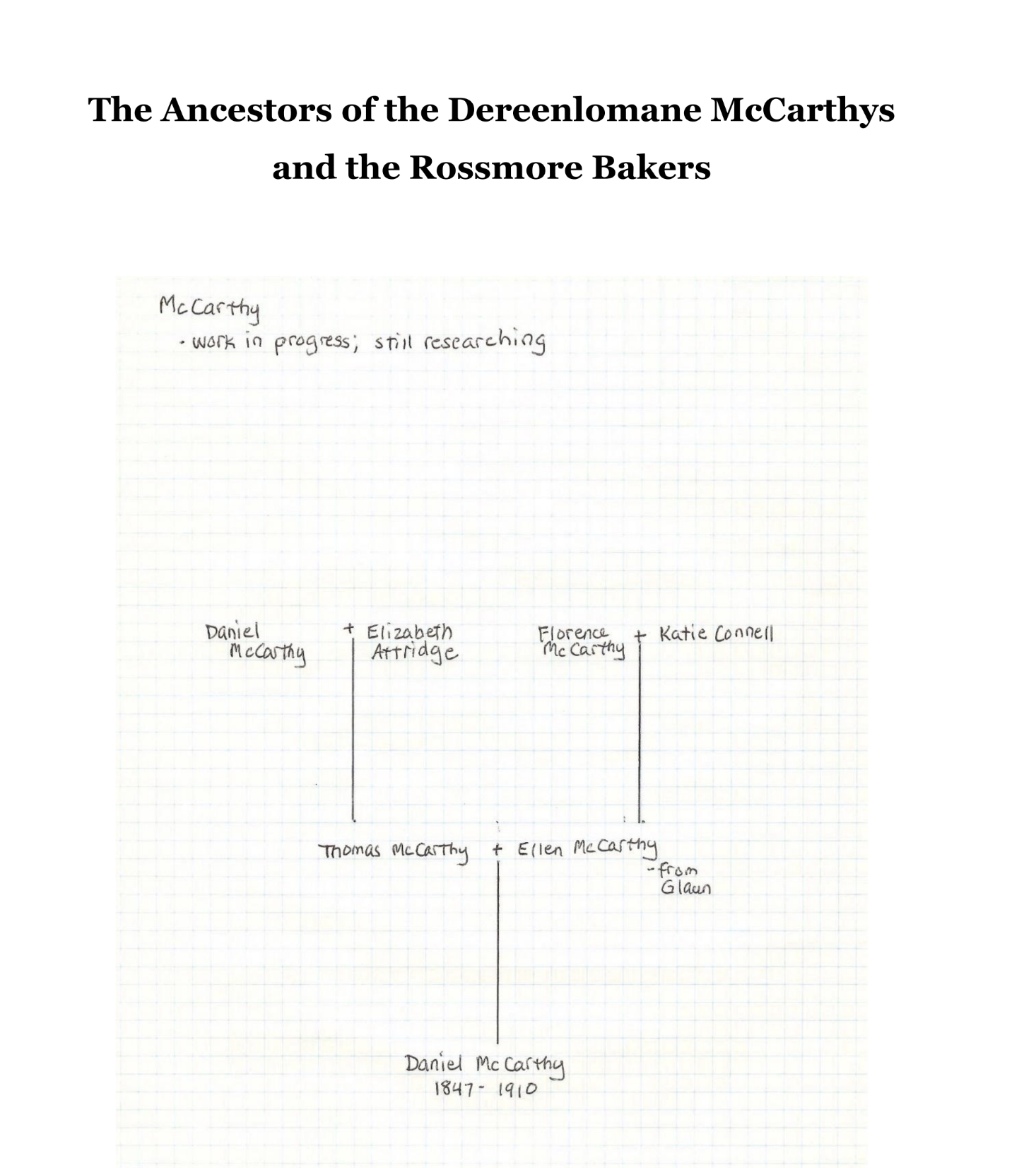
The Ancestors of the Dereenlomane McCarthys
and the Rossmore Bakers
21
22
A Vital Village for us: Ballydehob
Irish: Beal an Da Chab, “mouth of the two river fords”, is a coastal village in the
southwest of County Cork. During the Bronze Age (2200-600 BCE) copper was
mined on Mount Gabriel, just west of the village. About the same time, stone circles,
wedge and boulder tombs were constructed in the area. The Celts arrived some time
later in the early historic period. Various clanns fought for dominance, until the
eventual emergence of the McCarthys and the O’Mahonys as the rulers of the region.
A string of castles was built along the coastline. Kilcoe Castle was the most westerly
stronghold and their only coastal foothold. It has been renovated and rebuilt by
owner, actor Jeremy Irons. Irish Actress, Saoirse Ronan, has a family homestead in
Foilnamuck very near Ballydehob on Roaring Water Bay From: Wikipedia
23
Mt. Gabriel: A West Cork Legend
Long ago the devil was flying over Mount Gabriel and he was flying so low that he hit his
wing against a rock. He got so cross that he took a bite out of the rock. When he had gone
eight or nine miles from Mount Gabriel, he left the rock fall into the sea. The rock was so
large that a part of it remained over the water and it is on that rock the lighthouse is built on
now and it is known as the Fastnet Rock. There is a large lake where he took the bite and the
water in that lake is of a black colour. From The Roaringwater Journal, Jan. 2021.
Genocidal Famine
In the first house I entered there as a
lying in fever and wife and a child
sitting up. There was a can of water
near the bed: four of the family had
died. The sick people said they had eaten
nothing and expected nothing that day.
F.F. Trench, “Famine in Schull” in
Realities of Irish Life. Wm Stewart,
1868
Genocidal Famine
In the first house I entered there as
lying in fever and a wife and a child
sitting up.
There was a can of water near the
bed: four of the family had died. The
sick said they had died. The sick
people said they had eaten nothing
and expected nothing that day.
F.F. Trench, “Famine in Schull” in
Realities of Irish Life. Wm. Stewart
1868
24
On the Farmlands: The Rundale System
According to the evidence, the civil parishes of Kilmoe and Schull practiced a
modified form of the ancient Gaelic system of “rundale.” Under this system, the land
was held communally by the cineadh, the extended family which roughly consisted of
all those with a common great grandfather. The rundale system of agriculture
consisted of nucleated villages known as clachans.
All the sheep or cattle of the village were grazed together to alleviate pressure on
growing crops, providing fresh pasture for livestock. The land was a complex mixture
of arable, rough and bogland. The extended family lived in the clachan, a cluster of
huts which included an “infield” of tillage plots and an “outfield” of pasturage. The
infield was re-distributed after a death or an emigration.
How did this system affect agricultural productivity? The rundale system was
designed to ensure equitable distribution of land and resources. It allowed for a
sustainable approach to farming by matching the land allocated to the productive
capacity of the livestock a family owned.
What is the historical significance of the Rundale system? Rundale is significant as
it represents a communal approach to land management and agriculture, contrasting
with the individualistic methods introduced during the English colonization.
Source: Wikipedia “Rundale”
Our ancestors in Rossmore and Dereenlomane surely shared in the
rundale
25
OUR ANCESTORAL TOWNLANDS
Dereenlomane
944 acres. Doirin na Loman “Little oakwood of the bare patches or the
bare tree-trunks.” At the northside of Mt. Corin – Meall Cairn, a heap of
stones probably used as a landmark. At the east-side is a disused cillin
burial ground, a burial ground in which at one time there was a church
or Mass-house. From Parish Histories Place Names of West Cork by
Bruno O’Donoghue, 1985
26
Barytes Mine
This was originally worked as a copper mine by the Rev. Traill of Schull
assisted by Captain William Thomas in 1840; they sold 19 tones of
copper. They discovered barytes or barium sulphate, a heavy white
mineral used for paint and paper-making for which in the 1850’s there
was a limited market. An early use was by Josiah Wedgewood in the
making of pottery. The material was washed, dried, crushed and milled.
It was then produced as barytes flour, packed into bags and sent to an
island jetty in Dunmanus Bay by an aerial ropeway 1.23 miles long.
Source: http://www.durrus-history.com
27
Rossmore
310 acres. Ros Mor – Large promontory. On the sea-coast are remains of Rossmore
Castle of the O’Mahonys. It later belonged to the Clan Muclagh McCarthys. A slate
quarry was worked near the coast. Off the coast are Mannion’s Islands Large (4
acres) and Small (1 acre) – Oileain Ui Mhainchin. From Parish Histories Place
Names of West Cork by Bruno O’Donoghue, 1985
The ”later” Shannon/Baker house at Rossmore
Photos taken in 1985
The oldest building on the Baker – Shannon property at Rossmore,
28
“MCCARTHY CASTLE ROSSMORE,
(IRISH: ROS MOR, MEANING ‘LARGE
COPSE OR LARGE PROMONTORY’),
DURRUS, WEST CORK, WITH DEEP
WATER ANCHORAGE OPPOSITE.
Susan Baker came from the townland of Rossmore very near the village
of Durrus, at the end of Dunmanus Bay. The Baker homestead originally
was a fisherman’s cottage. Our ancestors walked over or around Corin on
the way to Rossmore to spend Sundays with the Shannon/Baker
relatives.
The farm yard nearby was in the Baker family and in the 19th century
became Shannon by marriage. The Bakers are probably in the area since
the 1600s possibly in connection with fishing. The farmyard ‘on the
water’ was originally a thatched fisherman’s cottage later raised and
lengthened. The adjoining farm is Hegartys, originally Attridges, related
to Hegartys by marriage.
Location of Rossmore Castle in ruins, former McCarthy (sometimes
ascribed to O’Mahony) tower house and location of a former slate
quarry. In the field west of Attridges off the road there is believed to be
a famine graveyard as told to Nancy Dukelow by her father Tom. This
may be in fact the graveyard marked ‘cillín’ on the ordnance survey map
to the east of Attridges in Jimmy Hegarty’s yard which David Shannon of
Rossmore says may also have been the site of an old church or a pre-
workhouse refuge for destitute people.
During World War II the German U-Boats would land at Mannion
Island. The sailors would play football on the island in the moonlight and
return to the war before daylight. More recently fish farms have been
developed in Dunmanus Bay raising salmon, oysters, mussels as well as
sea urchins and seaweed.
Sources: Kitty Dan. F. Keane, and Pat Crowley in Durrus History.
29
Dunmanus Bay – with a view of Mt. Corin
(in the distance on the left)
The remains of an O’Mahony Tower House are well hidden down a little boreen
and are to be found right at the seashore gazing down into the expanse of Dunmanus
Bay. Not a huge lot remains – a three storeyed wall, some windows, a chimney
breast, the remains of a garderobe, a stairwell and a cluster of little outbuildings plus
farm house. Probably built in the 14C, the castle seems to have been owned by the
McCarthy family who later built themselves a fine modern building at Cúl na Long.
This is a wonderful, well- hidden spot at the end of a little boreen. The old tower
house has been customised with farm buildings being built on its walls, and tiny
windows placed in its original huge ones. The whole area is peppered with little
buildings – a farm house right at the water’s edge and a cluster of outbuildings. A
resident donkey regarded me with gentle interest. (from durrus-history.com)
30
Back: James O’Sullivan, Kitty Dan F. McCarthy, Frances Roycroft, Ella
Moynihan, Father Daniel V. Hogan
Front: Harriet O’Sullivan, Mary McCarthy Hogan, Margaret McCarthy
Fennell, Agnes Teresa McCarthy
July 1951
31
Our research into the McCarthy-Baker history has been inspired, encouraged
and commissioned by Father Charles Leo McCarthy (1925-1999), a lover of
family, collector of connections, conversations, singing and the relations, a
gentle soul with a radiant smile. Just weeks before he died, he handed us an
envelope of old McCarthy charts, saying “See what you can do with this.” We
consider that a divine mission.
Ballydehob, from the Skibbereen Road/Bantry Road Intersection c. 1905
Mary Baker Shannon
1851 – 1931
James Shannon
1845 – 1916
Married in 1869
St. James Church,
Church of Ireland, Durrus
32
,
.
.
The Connell refrerrd to her may of Huguenot ancestry
 .
.
 Joycean Brendan Kilty, above, has examined the links between Joyce’s Ulysses and the Skibbereen Eagle’s references to Tsar Nicholas II.







 West Cork History