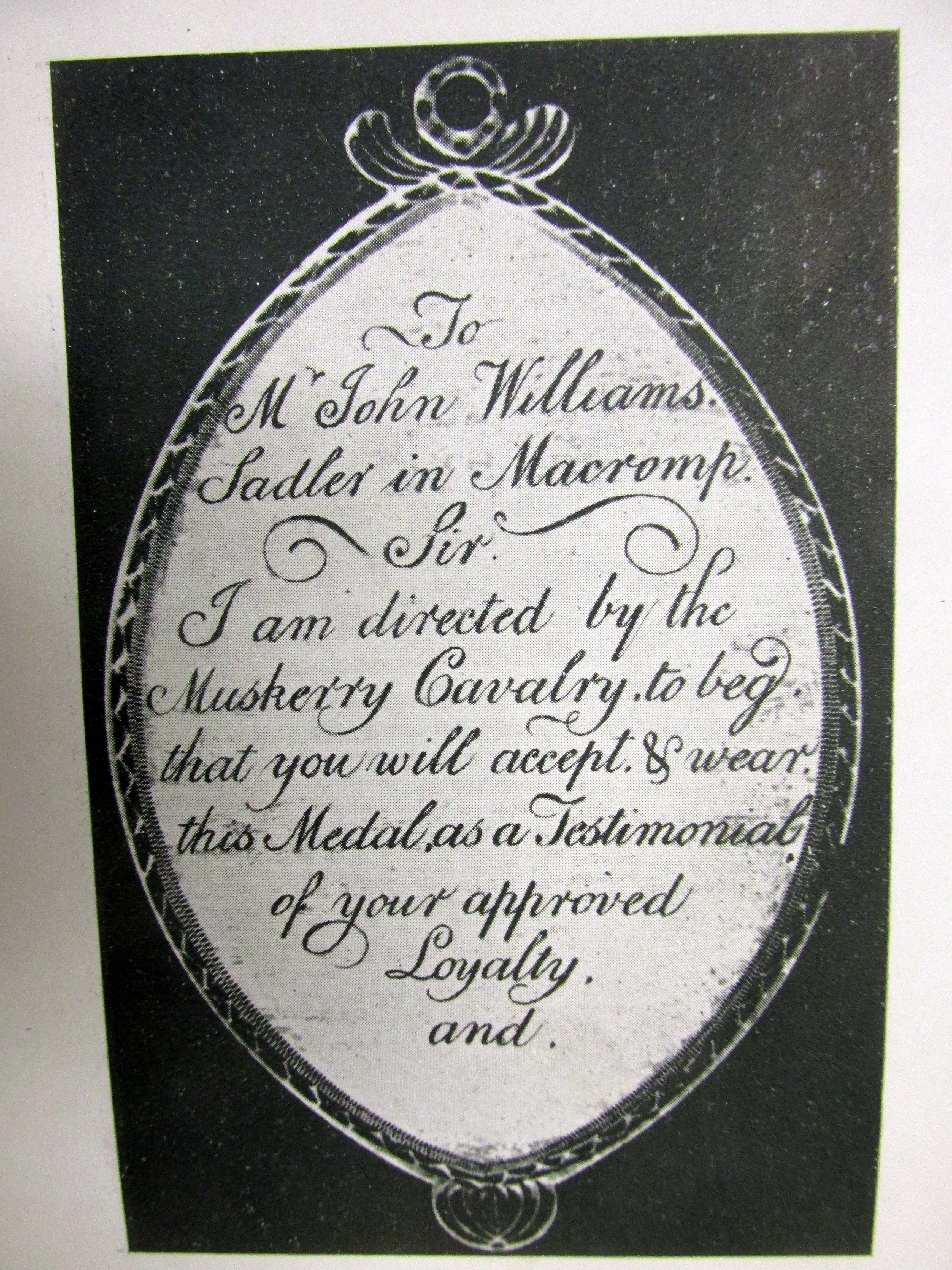
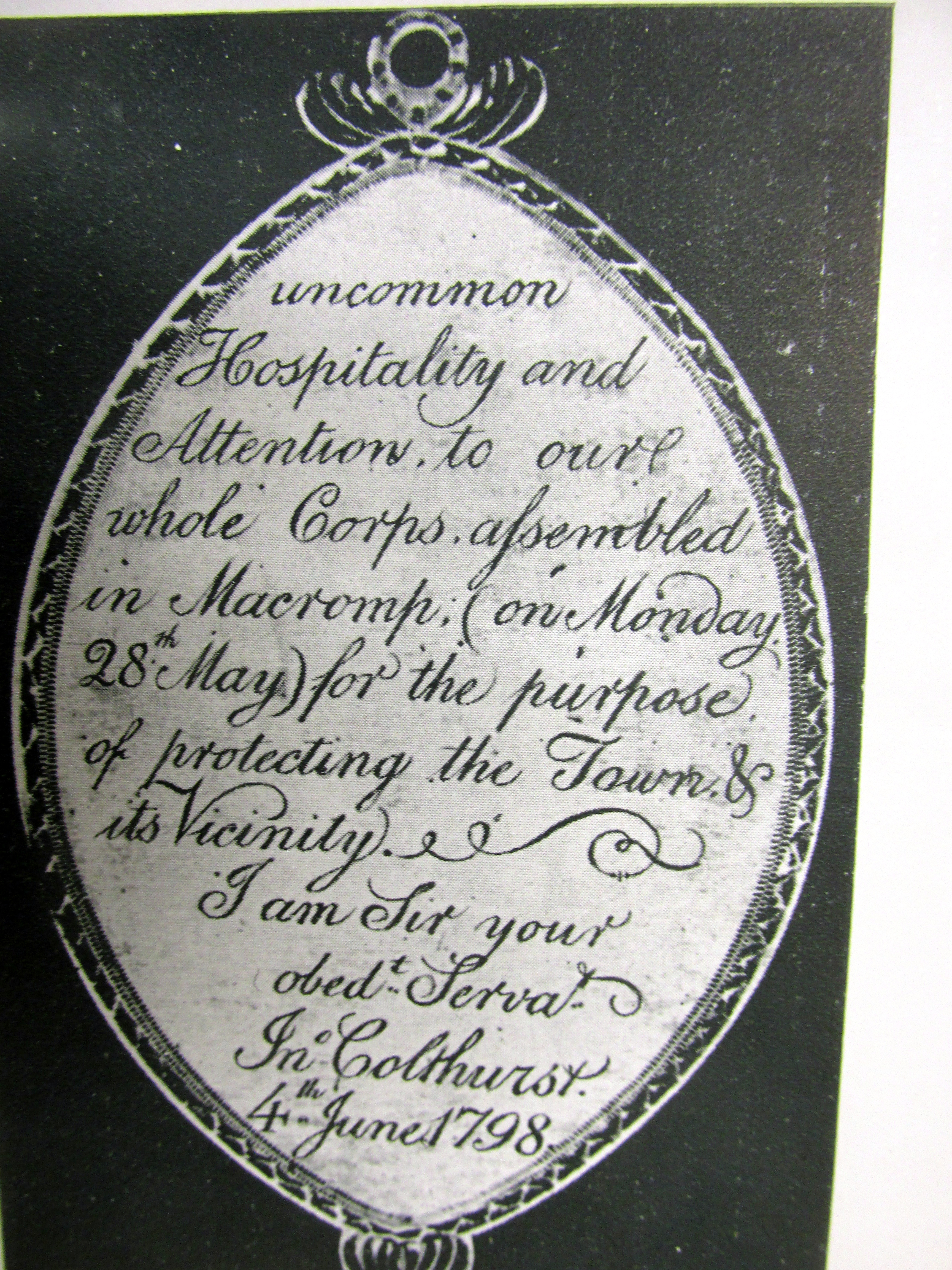
Medal for John Williams, Sadler, Macromp (Macroom), Co. Cork,for Loyalty and protection of Macromp Town and Vicinity signed by John Colthurst, 4th June 1798.
16 Tuesday Dec 2014
Posted in Uncategorized
Medal for John Williams, Sadler, Macromp (Macroom), Co. Cork,for Loyalty and protection of Macromp Town and Vicinity signed by John Colthurst, 4th June 1798.
16 Tuesday Dec 2014
Posted in Uncategorized
Tags
Bank of Ireland, Bank of Ireland Clerkships, Daniel O'Connell, London, Select Committee of House of Commons
Evidence of Daniel O’Connell, Esq., 1st March 1825 to Select Committee of House of Commons, London, on state of Legal Administration, Function of Assistant Barrister in Court, Grand Juries selected from Improper Persons, Low persons Vendors of Spirits and Beer, The Bar in Cork, Mr. Wagget, Recorder of Cork, of Private Means with a small salary which he refuses to to be increased, outside Cork the sessions conducted by Attorneys of low repute the relaxation of Popery Laws has given a better class of Attorney then what existed before., The Mode of Administering the Criminal Law by the Magistrates in Ireland has been very bad, particularly in relation to Tithes, for the last two-an-twenty years Roman Catholic have been eligible to the situation of Directors of the Bank of Ireland but not one elected although an immense deal of Bank Stock belongs to the Catholics, up to 10 Catholics in Bank of Ireland Clerkships.
From Google Books from page 58 others matters are also dealt with.
16 Tuesday Dec 2014
Posted in Uncategorized
Updated :
Meziere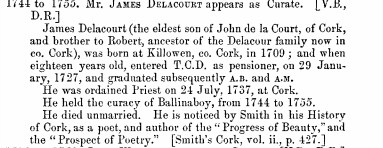 Brady:
The Wit, Epigrams and Poetry of the Reverend De La Cour ‘The Mad Parson’, Blarney, Co. Cork.
http://www.ricorso.net/rx/az-data/authors/d/Delacour_J/life.htm
http://landedestates.nuigalway.ie:8080/LandedEstates/jsp/estate-show.jsp?id=2893
From Crofton Croker:
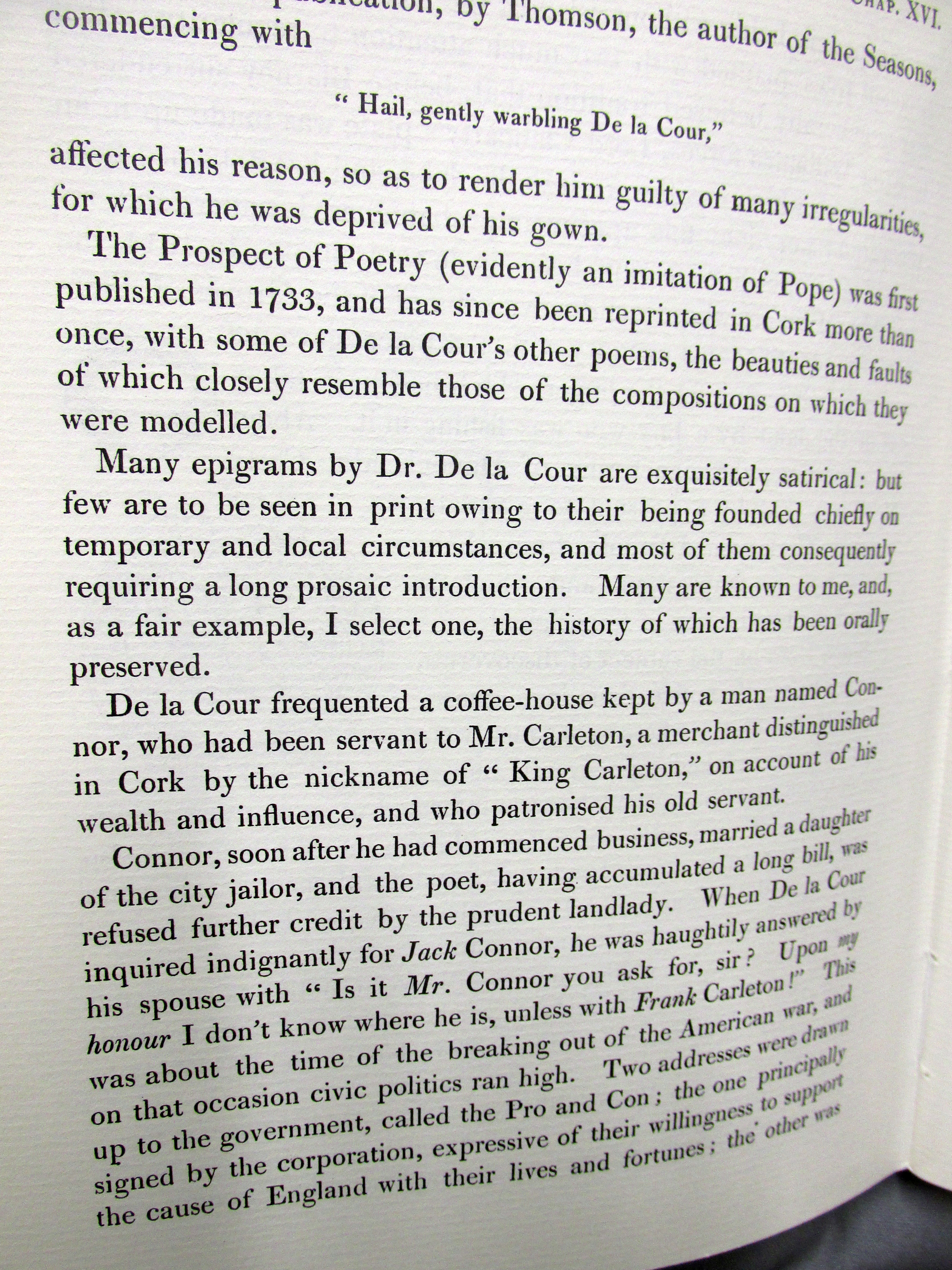
At Killowen, near Blarney, the Rev. James De la Cour was born, whose ‘ Prospect of Poetry,’ unfortunately for him, was much admired. It is reported that some complimentary lines addressed
p.308
to him on this publication, by Thomson, the author of the Seasons, commencing with Hail, gently warbling De la Cour,’’
James Thomson, The Seasons London: Henry Woodfall for A. Millar (1744)
affected his reason, so as to render him guilty of many irregularities, for which he was deprived of his gown.
The Prospect of Poetry (evidently an imitation of Pope) was first published in 1?33, and has since been reprinted in Cork more than once, with some of De la Cour’s other poems, the beauties and faults of which closely resemble those of the compositions on which they were modelled.
Many epigrams by Dr. De la Cour are exquisitely satirical: but few are to be seen in print owing to their being founded chiefly on temporary and local circumstances, and most of them consequently requiring a long prosaic introduction. Many are known to me, and, as a fair example, I select one, the history of which has been orally preserved.
De la Cour frequented a coffee-house kept by a man named Connor, who had been servant to Mr. Carleton, a merchant distinguished in Cork by the nickname of ‘King Carleton,’ on account of his wealth and influence, and who patronised his old servant.
Connor, soon after he had commenced business, married a daughter of the city jailor, and the poet, having accumulated a long bill, was refused further credit by the prudent landlady. When De la Cour inquired indignantly for Jack Connor, he was haughtily answered by his spouse with ‘Is it Mr. Connor you ask for, sir? Upon my honour I don’t know where he is, unless with Frank Carleton!’ This was about the time of the breaking out of the American war, and on that occasion civic politics ran high. Two addresses were drawn up to the government, called the Pro and Con; the one principally signed by the corporation, expressive of their willingness to support the cause of England with their lives and fortunes; the other was
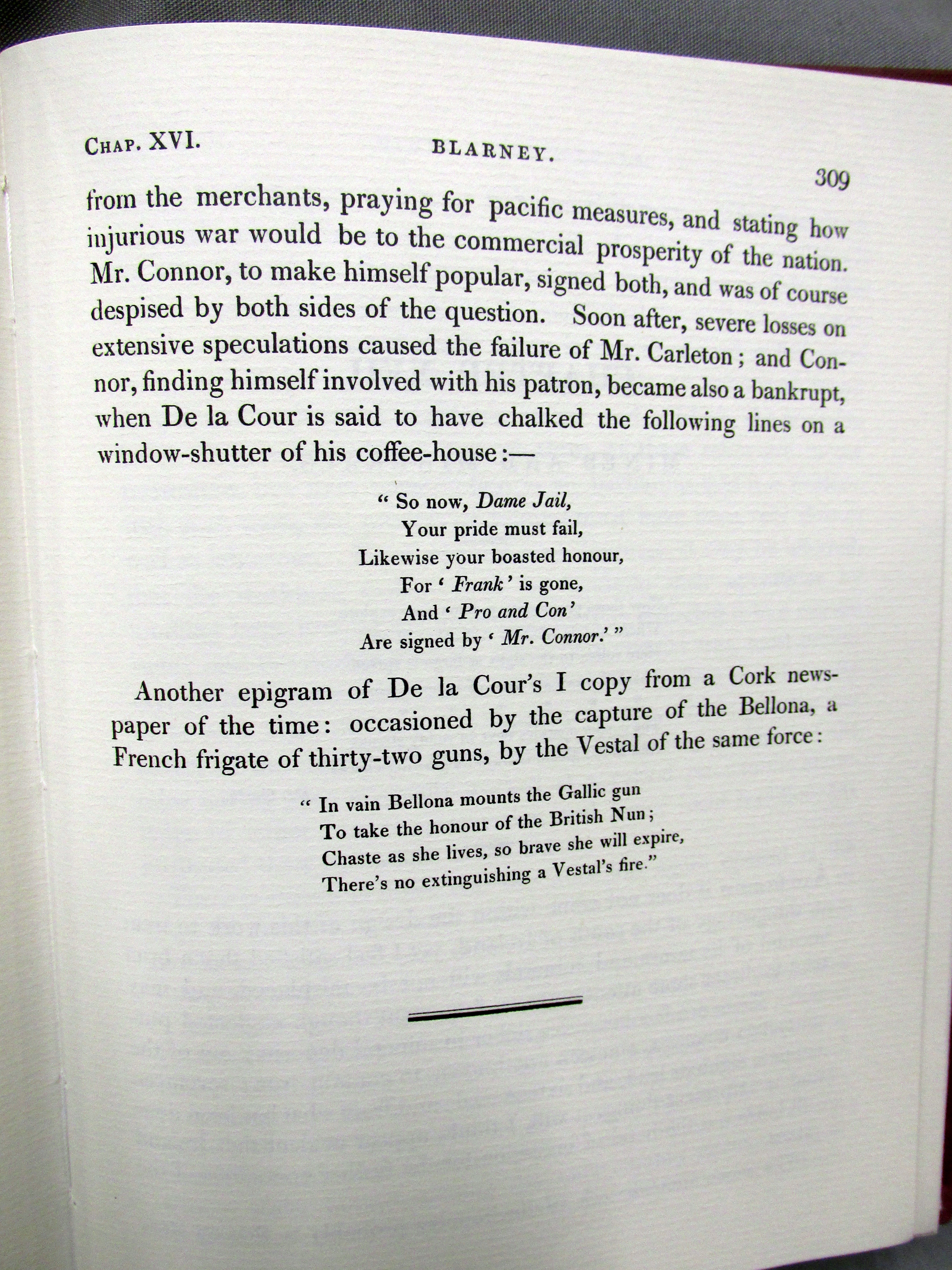
p.309
from the merchants, praying for pacific measures, and stating how injurious war would be to the commercial prosperity of the nation. Mr. Connor, to make himself popular, signed both, and was of course despised by both sides of the question. Soon after, severe losses on extensive speculations caused the failure of Mr. Carleton; and Connor, finding himself involved with his patron, became also a bankrupt, when De la Cour is said to have chalked the following lines on a window-shutter of his coffee-house:
So now, Dame Jail,
Your pride must fail,
Likewise your boasted honour,
For ‘Frank’ is gone,
And ‘Pro and Con’
Are signed by ‘Mr. Connor.’
Another epigram of De la Cour’s I copy from a Cork newspaper of the time: occasioned by the capture of the Bellona, a French frigate of thirty-two guns, by the Vestal of the same force:
In vain Bellona mounts the Gallic gun
To take the honour of the British Nun;
Chaste as she lives, so brave she will expire,
There’s no extinguishing a Vestal’s fire.
16 Tuesday Dec 2014
Posted in Uncategorized
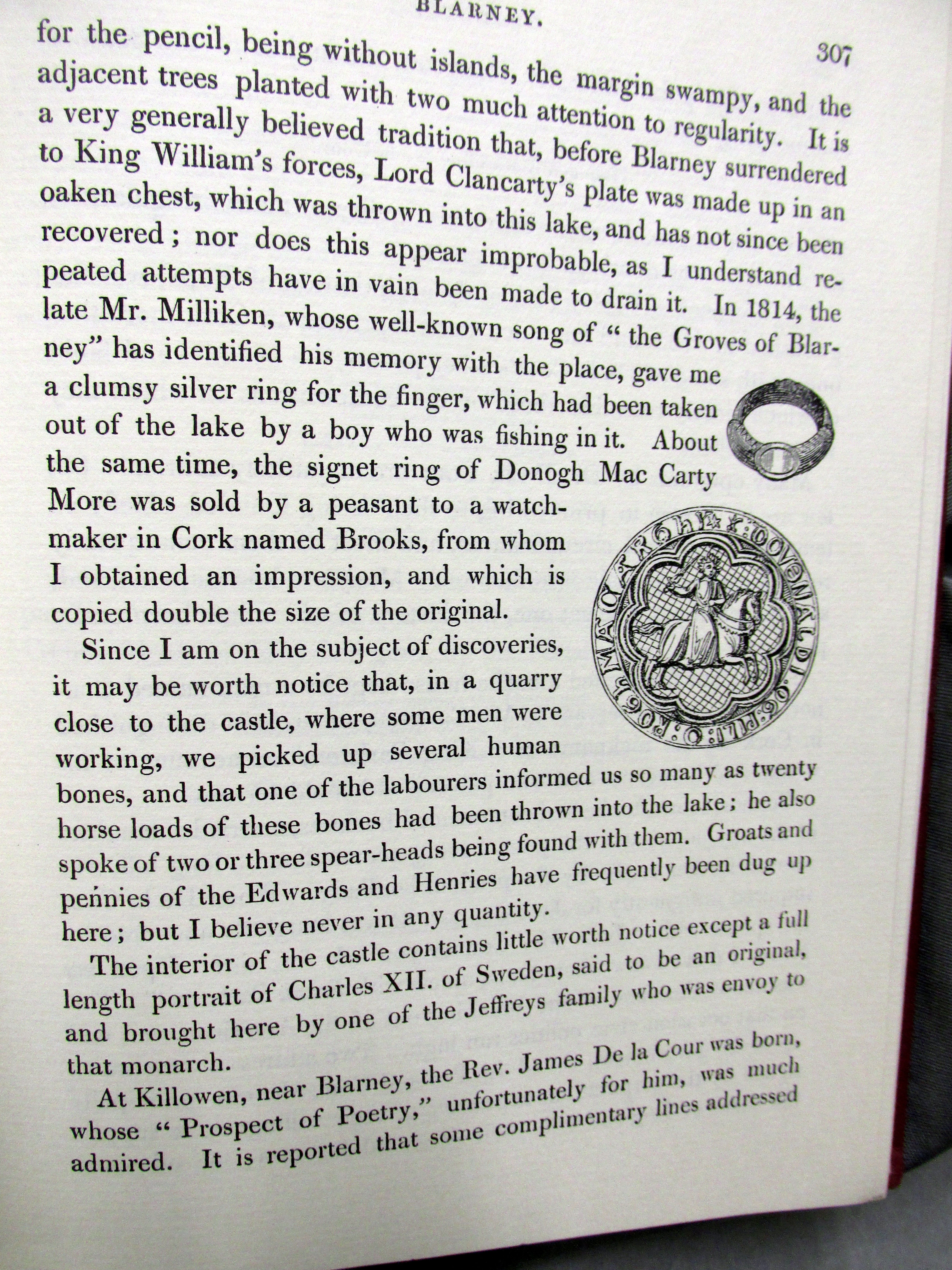
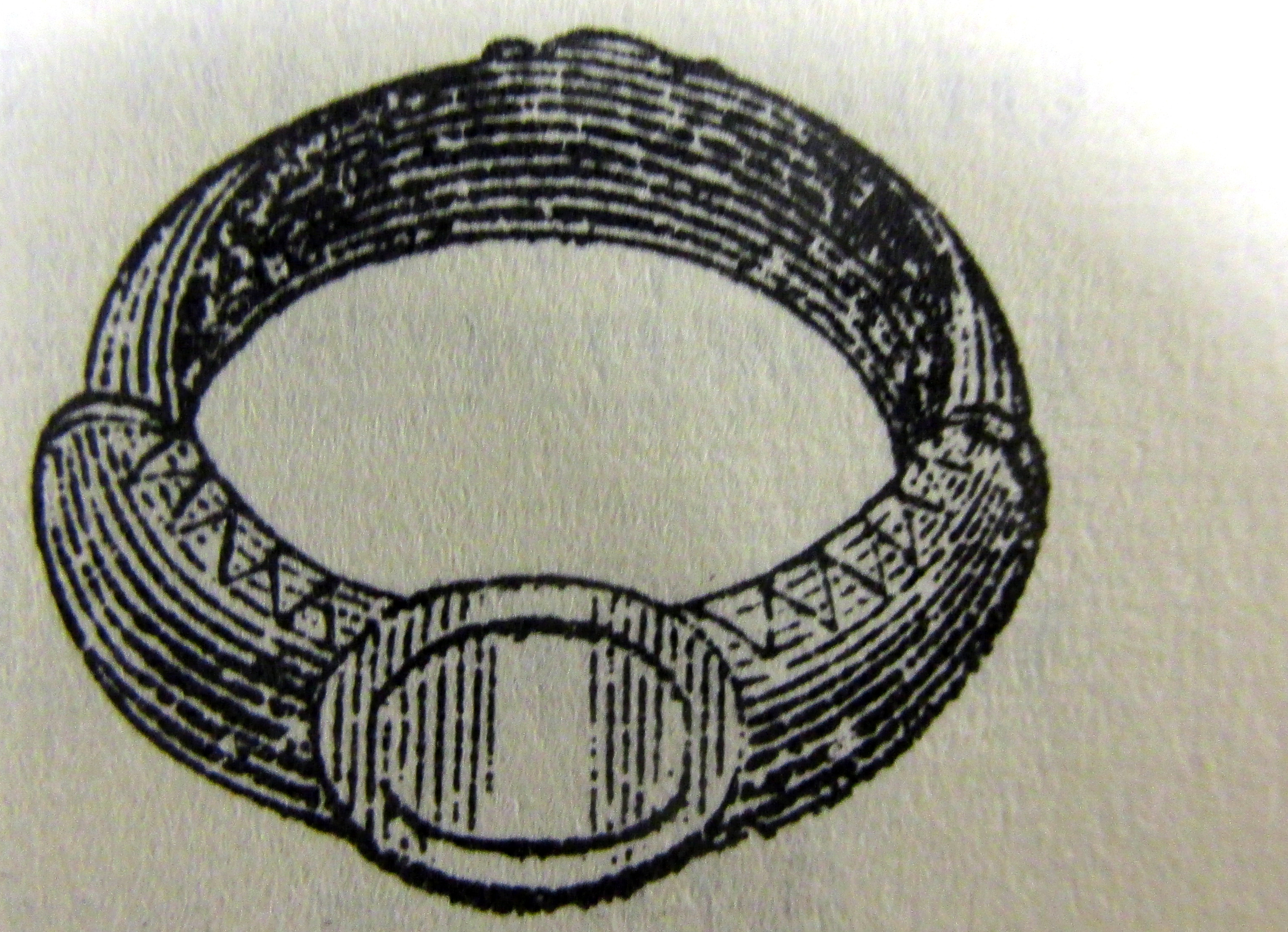
Signet Ring of Donogh MaCarthy More with Family Crest. Found 1814, Blarney.
Crofton Croker.


16 Tuesday Dec 2014
Posted in Uncategorized
View original post 559 more words
16 Tuesday Dec 2014
Posted in Uncategorized
All over Ireland, January 6 marks the end of the Christmas season – it is the day on which the fairy lights, the Christmas tree, the decorations and the Christmas cards are taken down and put away for another year. It is considered bad luck if decorations remain displayed after this date! January 6 has many titles – Epiphany, Little Christmas, 12th Night , Women’s Christmas, Women’s Little Christmas,and Nollaig na mBan. Such an important day to have 6 different names!
 Epiphany: The 3 Kings arrive with gifts
In Ireland, ‘Little Christmas’ (‘Nollaig Bheag’ in Irish) is one of the traditional names for January 6, the feast of the Epiphany. Epiphany is a Christian celebration of the day on which the Magi arrived with gifts of gold, frankincense and myrrh to honour the new-born baby Jesus, the day on which Jesus is revealed to the gentiles. Epiphany is one of the oldest Christian holy days that originated in the Eastern church and was…
View original post 356 more words
16 Tuesday Dec 2014
Posted in Uncategorized
Souvenir of Funeral of O’Donovan Rossa (1831-1915), pieces by Arthur Griffith, Curtis O’Leary, James Connolly, McDonagh among others.
Courtesy John Tobin saved from destruction.
16 Tuesday Dec 2014
Posted in Uncategorized
15 Monday Dec 2014
Posted in Uncategorized
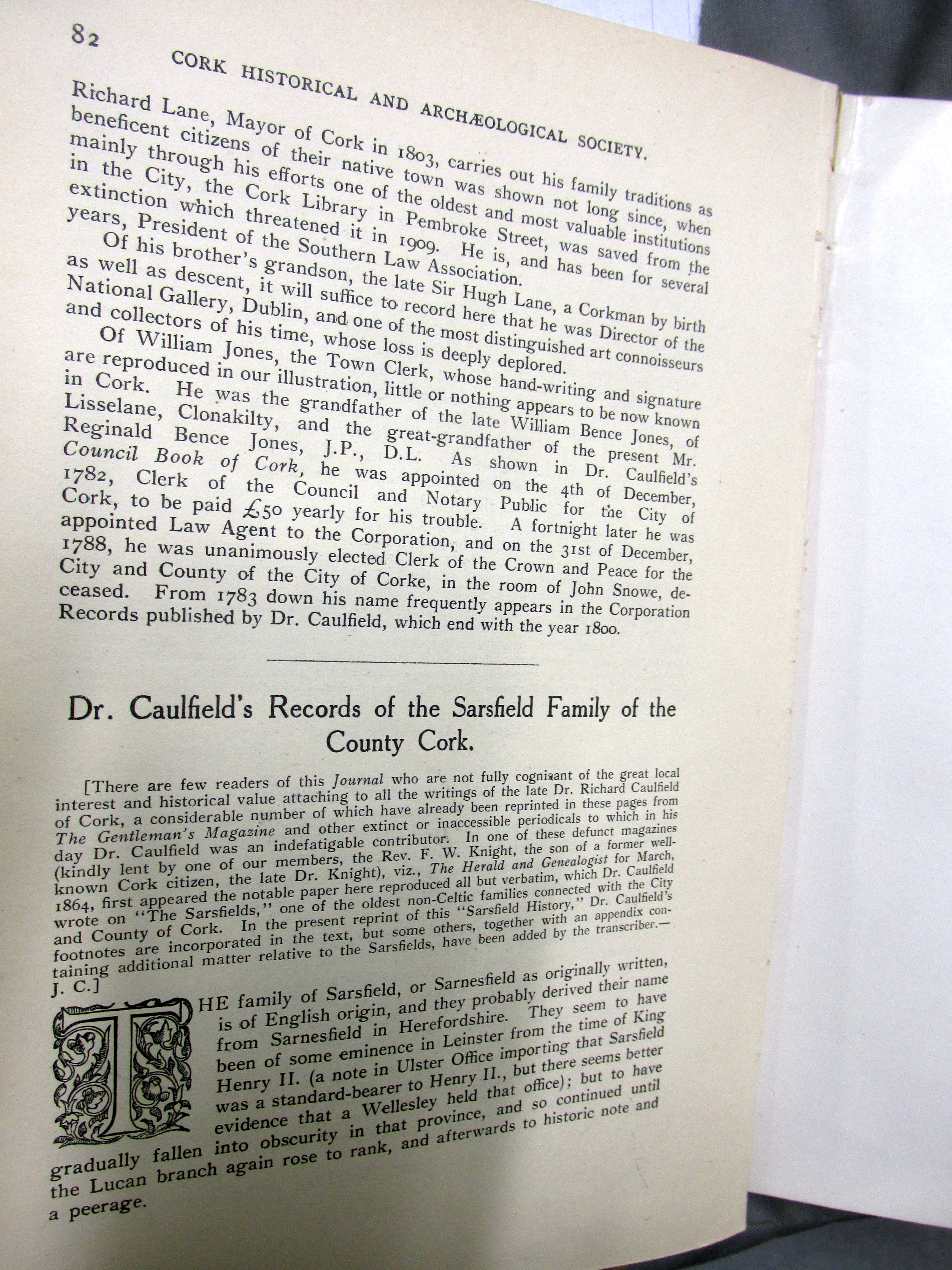
Invitation to the Cork Council Reception at the Mansion House, 1802 signed by William Jones, Town Clerk (he was also Clerk of the Crown for the City and County of Cork and Notary Public from 1782)
Some Cork Lawyers:
https://docs.google.com/spreadsheet/ccc?key=0AqhnQGE3ANjzdEkxdVM0YVNzbzFHbV8tRGxNM2pmMWc#gid=0


15 Monday Dec 2014
Posted in Uncategorized
Tags
The Rev. Alcock lived at Sea Lodge, Gearhameen, he later built the old Rectory in Clashadoo.
The Tithes in 1833: ‘The year’s tithe due to Mr. Alcock, the Rector Durrus, was nearly collected in one day. The summary collection was effected by the police who act as drivers. In the case referred to the determination to to obtain ‘Tithe Distress’ was so great that I have been informed that the house where the parish priest the Reverend Quin was saying Mass was forcibly entered and a bed the only item of value would have been taken but for the suggestion of some Protestant who objected to that mode of insult to a Clergyman.
The Tithes were a tax on cultivated land pasturage was exempt. In was in the popular imagination seen as being for the maintenance of the Church of Ireland clergy it then being the State Church. In fact in at least some areas it was partly used to carry out welfare function such as the care of foundlings and the burial of the poor dead. Clearly many of the Clergy lives a life out of all proportion to the ability of their own local flock to sustain them.
Tithes were a form of property and were often owned by Landed families and freely traded mortgaged and the basis for family settlements. Often the tithes were sold and the owners sub contracted their collection to Proctors who were universally loathed.
In ways the agitation mirrored the contemporary Whiteboy troubles referred to in Mr.Alcock’s article on Gougán Barra.
The agitation and the organisation of it was to form the basis of political organisation in Ireland and the current political parties North and South owe their system of organisation to these days.
Father Quin who is referred to was from Co. Tipperary. A man of great ability he built churches, schools and instituted the Parish Registers which are still extant his handwriting was however terrible.
https://mail.google.com/mail/u/0/?tab=wm#inbox/14a4d0b42d5d5af4?projector=1
Edward Jones Alcock 1805-1842, son and curate of Rev. Mason Alcock. May have lived at Sea Lodge, built old rectory (Glebe House) in 1831. 1822 Lord Lieutenant sends £30 for local distress. 1822 involved in famine relief with Father Quinn. 1822. Local Fishery Committees, Kinsale, Clonakilty, Glandore, Baltimore, Crookhaven For Bantry Timothy O’Donovan JP, O’Donovan’s Cove, Durrus, Michael O’Sullivan, Rev. Edward Jones Alcock, Rector Durrus, John Jagoe later Fishery Commissioner, Michael Murphy, Newtown, Bantry, Rev. M McChean, Bantry, John Sandys Bird.
He sat on a committee in Bantry in 1824 to petition against the withdrawal of the bounty on linen production as had been agreed in the Act of Union. Magistrate. Involved in proselytising. Father Quinn’s application for National School 16th November 1830 ED1/13/74/2, signed by for Roman Catholics Richard O’Donovan, Timothy O’Donovan, Richard Tobin, Edmond Tobin, Daniel Daly, Richard O’Donovan, John Murphy, John Carthy, Thomas Cormack?, Elias Roycroft, Andrew Caverly, Richard Caverly, Protestants E. Evanson, Richard L. Blair, Thomas Ferguson, Thomas Duklow, Charles Ducklow, John Ducklow. Rev Alcock of the Church of Ireland was asked to consent but declined but his parishioners signed. His proctors, 1833, attempted to seize Father Quin’s bed while mass was being said in is house to secure tithe payment only the intervention of Protestant neighbours stopped it. Durrus Parish Tithes payable to him of which the sum of £320 Sterling is due and payable by the year to the said Reverend Edward Jones Alcock, the composition from the tithes claimable by him as figure of such part of said Parish as is commonly known by the name of Durrus or Parish of KIlcrohane is payable to the Reverend Alcock Vicar of the said Parish the sum of £170. Most of the tithes were the property of Nathaniel Evanson and Alexander O’Driscoll having leases of tithes. So it may be he who sent the proctors otherwise all outstanding tithes collected in one day. Cess payer representative Barony West Carbery 1834.
The labourers not long since employed at the building of a Glebe House for the Protestant Clergyman (Rev. Alcock) were allowed no more more for the work of a day in summer then 6d in the claim then made of them by the clergyman for the tithe, and that without diet, such is the poverty, and so little employment is there for labourers in these parishes that on the occasions referred to some 40 or 50 might be seen coming a considerable distance in search of employment on such terms and moreover understand they were obliged to to be at work before six perhaps at five each morning continue at it until eight, or even later, in the evening, with no diet but those cold and comfortless potatoes boiled in a distant cabin, and eaten by the ditch side or under the scaffolding of the new building.
1839 Gaming Certificate. Father in law Henry Jones 1799-1805, late Rector of Lislee his daughter Frances Jane July 1833 married Rev. Edward James Alcock, 1831 at Kilmacabea.
Olr Rectory Durrus: