• About
  • Customs Report 1821-2 (and Miscellaneous Petitions to Government 1820-5) and some Earlier Customs Data, including staffing, salaries, duties including, Cork, Kinsale, Youghal, Baltimore, with mention of Bantry, Crookhaven, Glandore, Berehaven, Castletownsend, Enniskeane, Passage, Crosshaven, Cove, Clonakilty, Cortmacsherry.
  • Eoghan O’Keeffe 1656-1723, Glenville, Co. Cork later Parish Priest, Doneralie 1723 Lament in old Irish
  • Historic maps from Cork City and County from 1600
  • Horsehair, animal blood an early 18th century Stone House in West Cork and Castles.
  • Interesting Links
  • Jack Dukelow, 1866-1953 Wit and Historian, Rossmore, Durrus, West Cork. Charlie Dennis, Batt The Fiddler.
  • Kilcoe Church, West Cork, built by Father Jimmy O’Sullivan, 1905 with glass by Sarah Purser, A. E. Childs (An Túr Gloine) and Harry Clarke Stained Glass Limited
  • Late 18th/Early 19th century house, Ahagouna (Áth Gamhna: Crossing Place of the Calves/Spriplings) Clashadoo, Durrus, West Cork, Ireland
  • Letter from Lord Carbery, 1826 re Destitution and Emigration in West Cork and Eddy Letters, Tradesmen going to the USA and Labourers to New Brunswick
  • Marriage early 1700s of Cormac McCarthy son of Florence McCarthy Mór, to Dela Welply (family originally from Wales) where he took the name Welply from whom many West Cork Welplys descend.
  • Online Archive New Brunswick, Canada, many Cork connections
  • Origin Dukelow family, including Coughlan, Baker, Kingston and Williamson ancestors
  • Return of Yeomanry, Co. Cork, 1817
  • Richard Townsend, Durrus, 1829-1912, Ireland’s oldest Magistrate and Timothy O’Donovan, Catholic Magistrate from 1818 as were his two brothers Dr. Daniel and Richard, Rev Arminger Sealy, Bandon, Magistrate died Bandon aged 95, 1855
  • School Folklore Project 1937-8, Durrus, Co. Cork, Schools Church of Ireland, Catholic.
  • Sean Nós Tradition re emerges in Lidl and Aldi
  • Some Cork and Kerry families such as Galwey, Roches, Atkins, O’Connells, McCarthys, St. Ledgers, Orpen, Skiddy, in John Burkes 1833 Commoners of Great Britain and Ireland:
  • Statement of Ted (Ríoch) O’Sullivan (1899-1971), Barytes Miner at Derriganocht, Lough Bofinne with Ned Cotter, later Fianna Fáil T.D. Later Fianna Fáil TD and Senator, Gortycloona, Bantry, Co. Cork, to Bureau of Military History, Alleged Torture by Hammer and Rifle at Castletownbere by Free State Forces, Denied by William T Cosgrave who Alleged ‘He Tried to Escape’.
  • The Rabbit trade in the 1950s before Myxomatosis in the 1950s snaring, ferrets.

West Cork History

~ History of Durrus/Muintervara

West Cork History

Category Archives: Uncategorized

1740. a Memorial of Several Gentlemen Residing at or near Berehaven in West Cork, setting forth the necessity of having a Barrack built for one company and half of foot to prevent running of Goods and the Shipping Off of Men to Foreign Service

27 Tuesday Dec 2016

Posted by durrushistory in Uncategorized

≈ 1 Comment


https://www.google.ie/maps/place/Castletown-Bearhaven,+Co.+Cork/@51.6514987,-9.9485186,12.88z/am=t/data=!4m5!3m4!1s0x48457e4fcf1360df:0x15e0b4d55c1c38fd!8m2!3d51.6514954!4d-9.9103302


1740.  a Memorial of Several Gentlemen Residing at or near Berehaven in West Cork, setting forth the necessity of having a Barrack built for one company and half of foot to prevent running of Goods and the Shipping Off of Men to Foreign Service


Sir George Carew writes to Lord Deputy Mountjoy, 13th May 1602 from Camp at Bantry Abbey prior to Siege of Dunboy They lie in such incredible strengths of huge mountains and ugly glynns of bog and wood, as I think no place of the world yields the like, and the ways of such advantage unto them as an 100 men may forbid an army of 5,000 to march from Bantry to Donboye, which is but 24 miles; and if there were no enemy to resist us, nor any baggage in our army, the ways in themselves are so difficult as in less time than eight days I cannot come thither, for three miles a day is the most we can march; and for horse or garrons to carry victuals and munitions no possibility of passage. Wherefore I have resolved by boats and shipping to cross the Bay of Bantry, and to land within seven miles of the castle, which is a reasonable way (though mountainous), yet indifferent as well for us as the enemy. I would not have believed any man’s report if my own eyes had not seen the mountains and glynns which here I find…’


Dirge of Murty Óg O’Sullivan Bere, composed in Irish by his nurse translated by Jeremiah Joseph Callnan, Murty killed John Puxley in turn he was betrayed by his servant Scully, killed, his body dragged by boat from Berehaven to Cork beheaded and his head lay for years on Cork Jail.


1822. Lord Bantry not renewing lease of any of his Tenantry involved in Smuggling.


Davy Crockett, Rev. James Fontaine, Battle of the Alamo and the Huguenots of Bantry Bay, Co. Cork.


Thomas Hutchins, Bantry, West Cork, being paid for Impressing Beara Seamen for British Royal Navy 1746.


Click to access caulfield_complete.pdf


screen-shot-2016-12-25-at-09-36-19

…


…

1692. Colonel Thomas Becher Appointed Governor of Island of Inshirken (Sherkin) near the harbour of Baltimore, West Cork, Salary of 10 Shillings a Day.

26 Monday Dec 2016

Posted by durrushistory in Uncategorized

≈ Leave a comment


https://www.google.ie/maps/place/Sherkin+Island/@51.4716647,-9.4336905,14z/data=!3m1!4b1!4m5!3m4!1s0x4845bd4c81aa8267:0x682caa4657ed7f41!8m2!3d51.4660543!4d-9.4175617


Early Map of Baltimore, West Cork (Between 1605-1640), showing English Settlement, Dunasead Castle, Sherkin Island, Loo Rocks, Storehouse for Preserved Fish, 12 Fishing Boats, Seine Pilchards, 5 Possible Royal Navy Boats.


1760, Pue’s Occurrences. Explanation of Place Names ‘Quarantine Hill’ North East Sherkin Island and Quarantine Baltimore, West Cork


Pishógs (Pre-Christian Taboos), Old Cures, Holy Wells from Sherkin Island, West Cork.


James M Burke, M.A., B.L., History Sherkin Island, West Cork, Antiquities, Townlands.


Progress of Island and Coast Society Proselytising Education activities in West Cork, 1853, Bere Island, Capaneel, (Muintervarra; Doonore, Roskeera, Rooska, Geahies), Dunmanus Bay then Irish speaking, Here Island, Sherkin Island, Cape Clear, Kilcoe.


1692.  Colonel Thomas Becher Appointed Governor of Island of Inshirken (Sherkin) near the harbour of Baltimore, West Cork, Salary of 10 Shillings a Day.


….


screen-shot-2016-12-25-at-09-26-07


Patent of Charles 2, 1668 of England to Lands in West Cork to Henry and John Beecher and John Bayley

1700, Dives Downes on Kilmoe (Ballydehob/Schull/Crookhaven), West Cork, Lands Recently Forfeit by Coppinger and O’Mahony now Hull, Bishop of Cork, Colonel Beecher, Earl of Cork, in Crookhaven, Arthur Hyde, Thadeus Coghlan/Coughlan, Rectories College of Youghal control Wrested from Earl of Cork by Lord Strafford, Old Chapel at Kilkanget near Dunmanus Castle, In O’Sullivan Country Universally Observed as Festival St Roan’s Day, Tithes on Fishing, later Rev. Fisher, Teampall na mBocht.


Will of Thomas Becher, Property Magnate, Sherkin Island, West Cork, Esq., 21 August 1705. Proved 11th March 1708. 11 March 1708. Brothers in Law Henry Turner Richard Turner and John Roberts Trustees and Executors. Wife Elizabeth Becher. Sons Edward and Michael Becher both married. His Henry John and Lionell Becher daughter Susan Becher. Kinsman Francis Becher Tallough (Tallow) Co Waterford Clerk. Legacy to Parish of Ballymodan (Bandon) Ardtentane, Cahiroleckeny, Ratooragh, Gortloen, Banratonacane, Kiltomane, Mauladinny and Coomfarna in parish of Schull. Ballyrisode, Dunkilly, Callirisoughtra, Baltenoughtra, Kilbean, Lynane, Cahir, Quorisk, Co Cork. Baneaknockakane and Quolaigh, Parish of Schull, Co. Cork. Old Court, Kilfenan, Glaunaroura. Leasehold lands of Aghadowne, Kilkilleene, Callitrumore, Callitrumbegg, Drumnacahara, Lysheenoughra, Kilmoonagh, Cluddagh, Smorane, Quoecurine, Rinedolane, Gortnaclough, Skibbereene alias New-Stapletown, Coronra, All in Co Cork Witness: Dive Downes (Son-in-Law) Lord Bishop of Cork and Ross. Robert Conrad, Kinsale, Co. Cork, Esq. Benjamin Weekes, Cork, Notary Public, James Russell servant to Bishop of Cork.


Lt Col Richard O’Donovan of Bawnlahan, Skibbereen, West Cork, son of Daniel O’Donovan, The O’Donovan of Clancahill’ and Jane Beecher, 1768; Major in 6th Dragoons 19 December 1799; Lieutenant-Colonel 2 May 1800; brevet Colonel 25 July 1810; subsequently Major-General 4 June 1813; Lieutenant-General 27 May 1825; Recognised at ‘The O’Donovan’, died Ireland November 1829.

Beecher Estate Improvement from 1841, Voluntary Surrender of 200 holdings , reallocations, new roads.


..


http://www.corkpastandpresent.ie/history/caulfield_complete.pdf


…

screen-shot-2016-12-25-at-09-18-18


…

Shared from WordPress

24 Saturday Dec 2016

Posted by durrushistory in Uncategorized

≈ Leave a comment


Trí Cois-Céim an Coillaigh, 3 steps of the Cock, sign of the Day’s starting to Lengthen – http://wp.me/p1UlSr-VR

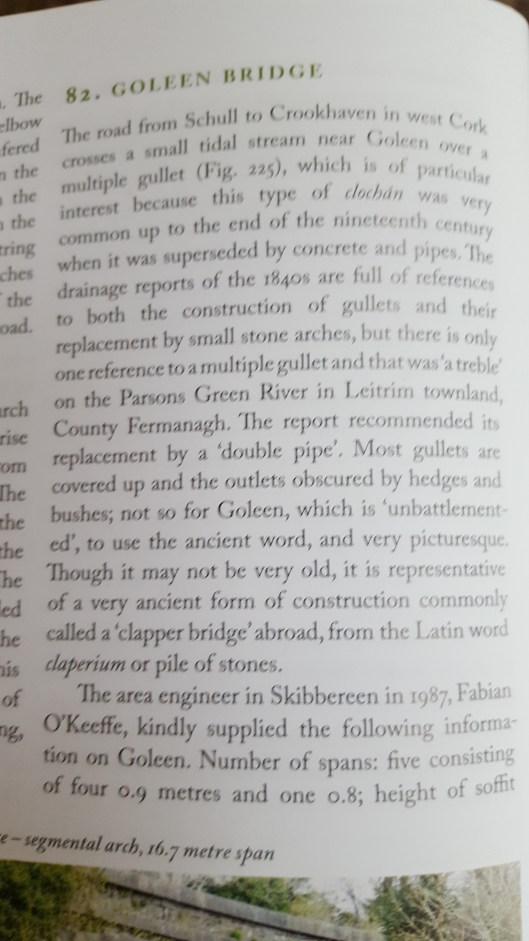
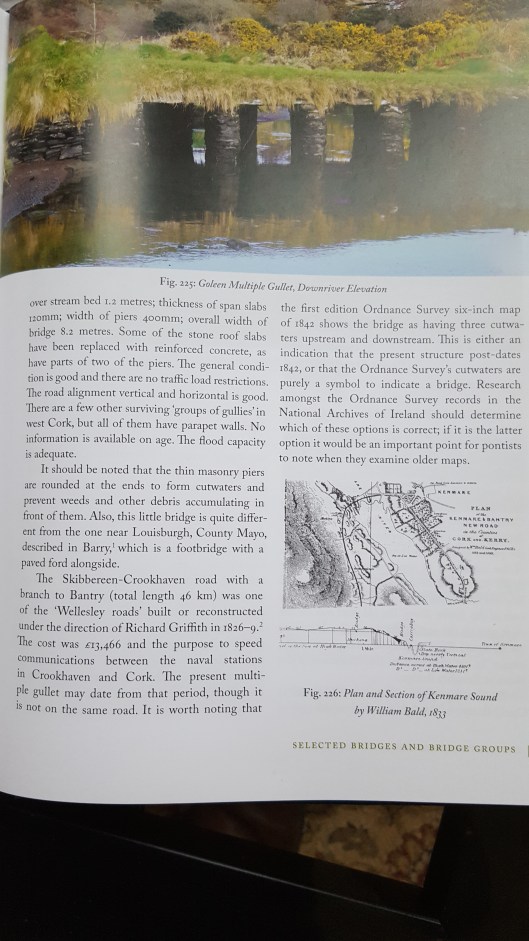
Goleen Bridge (Multiple Gullett/Clochán), West Cork

23 Friday Dec 2016

Posted by durrushistory in Uncategorized

≈ Leave a comment


Goleen Bridge (Multiple Gullett/Clochán), West Cork


20161223_131715

20161223_131736

20161223_131748

20161223_131801


Griffith’s ‘Wellesley Roads’ included Skibbereen to Crookhaven with Branch via Letterlickey to Bantry, 46 km. built between 1826 and 1829 and costing £13,466.

23 Friday Dec 2016

Posted by durrushistory in Uncategorized

≈ 1 Comment


Skibbereen to Crookhaven:

https://www.google.ie/maps/place/Crookhaven,+Co.+Cork/@51.4684039,-9.8661164,11z/data=!4m5!3m4!1s0x48458598cbd7f471:0xa00c7a99731a1a0!8m2!3d51.4683386!4d-9.7259903

Griffith’s ‘Wellesley Roads’ included Skibbereen to Crookhaven, 46 km. built between 1826 and 1829 and costing £13,466,

Griffiths  Cork projects known as the ‘Wellesley Roads’ included Skibbereen to Crookhaven, 46 km. built between 1826 and 1829 and costing £13,466, Bantry to Skibbereen, Crookhaven to Bantry and the road to north Cork to Banteer.   HIs works are characterised by a high degree of engineering excellence. It was said that in building bridges he insisted on going to bed rock for foundations, the Grand Jury contractors would be happy with building on gravel resulting in so many were washed away in floods.  His schemes highlights the deficiencies of the Grand Jury system and might be looked at like the recently completed motorway schemes in Ireland. The effects were dramatic, on the Mizen Peninsula they first wheeled carts made their appearance.  Alexander Nimmo (1783-1832), the Scots Engineer who was also involved said the North Cork Road opened up the entire area to commerce with a beneficial result.

1824, Evidence of Sir Richard Griffith Esq., Road Engineer, to House of Commons Select Committee, on Harmony in West Cork between Protestant and Catholics, Distress of 1822, Only Part of Ireladn he Employed Poor Protestants on Road Building, Evidence of Alexander Nimmo, Scots Road Engineer on Building of 19 miles on the Northern Side of Bantry Bay under Joint Supervision of Captain O’Sullivan Most of His Workers are His Tenants Not Paid in Cash but in Rent Abatement. Elsewhere Nimmo’s evidence of Enormous Economic Benefits of Road Building

Griffith’s Roads: Report of Patrick Leahy, Civil Engineer, 1834 to Co. Cork Grand July of Progress of Road from Dunmanus Bay to Skibbereen, Nearly Completed, Extension to Ballydehob Approved, and Report of Edmund Leahy, County Surveyor to Grand July 1840 on Ballylickey to Crookstown, 27 miles Active, Bantry to Glengariff 10 miles Near Completion, Crookhaven to Barleycove, Ballydehob to Bantry To Be Finished Current Season.

Griffith’s Roads: Report of Patrick Leahy, Civil Engineer, 1834 to Co. Cork Grand July of Progress of Road from Dunmanus Bay to Skibbereen, Nearly Completed, Extension to Ballydehob Approved, and Report of Edmund Leahy, County Surveyor to Grand July 1840 on Ballylickey to Crookstown, 27 miles Active, Bantry to Glengariff 10 miles Near Completion, Crookhaven to Barleycove, Ballydehob to Bantry To Be Finished Current Season.

23 Friday Dec 2016

Posted by durrushistory in Uncategorized

≈ Leave a comment


durrushistory's avatarWest Cork History

Griffith’s Roads: Report of Patrick Leahy, Civil Engineer, 1834 to Co. Cork Grand July of Progress of Road from Dunmanus Bay to Skibbereen, Nearly Completed, Extension to Ballydehob Approved, and Report of Edmund Leahy, County Surveyor to Grand July 1840 on Ballylickey to Crookstown, 27 miles Active, Bantry to Glengariff 10 miles Near Completion, Crookhaven to Barleycove, Ballydehob to Bantry To Be Finished Current Season.

1824 Sir Richard Griffith, Road Engineer, Progress Report, Skibbereen to Crookhaven, Wheeled Carts now Appear, where heretofore Loads were carried on the Backs of Horses, New Entrance to Town Of Bandon, Road From Courtmacsherry to Timoleague, Road from Clonakilty to New Fishery Pier At Ring, New Road Skibbereen to Bantry, Macroom to Killarney, with a Note on The System of Labour Organisation Used.

Richard Griffith letter to Dublin Castle on progress of road from Skull to Crookhaven, Co. Cork where ‘upwards of 3,000 are employed’, 1822.

View original post 11 more words

1770, Cork Subscribers to the Poetry, 1734, of The Rev. Robert De La Coer (The Mad Parson), (1709-1781)

22 Thursday Dec 2016

Posted by durrushistory in Uncategorized

≈ Leave a comment


…


1734, Cork Subscribers to the Poetry of The Rev. Robert De La Coer (The Mad Parson), (1709-1781)


Subscribers from p 59, mostly from Cork or with Cork connections.

https://books.google.ie/books?id=yKJYAAAAcAAJ&pg=PA59&lpg=PA59&dq=rev.+robert+de+la+cour+poet&source=bl&ots=LY8NYnW91R&sig=YFdApBXzmGQU1asfIbvVi-XbIfc&hl=en&sa=X&ved=0ahUKEwi_0qi-lojRAhUhCsAKHfnDAI04ChDoAQgpMAE#v=onepage&q=rev.%20robert%20de%20la%20cour%20poet&f=false


JAMES DE LA COUR or DELACOURT, an Irish poetical writer, was the second son of Robert De la Cour, esq. of the County of Cork, in Ireland, and born at Killowen, near Blarney, in that county, in 1709. He was educated at the university of Dublin, where to his classical studies he added an uncommon predilection for poetry, and before he had reached his twenty-first year, produced a poem entitled Abelard to Eloisa, in imitation of Pope, which was thought to possess a considerable portion of the spirit and harmony of that master. From this time he proceeded to publish shorter poems and sonnets, which were all favourably received; and in 1733 appeared his principal work, The Prospect of Poetry. So creditable a publication, and at such an age, gained him much and deserved applause; and in this list of admirers he had to count on some of the best judges in both countries.

Soon after this he took holy orders, but had little zeal for the profession, and produced his sermons as matters of ordinary duty: his muse was the mistress which engaged his principal attention; and, as the muses generally love “the gay and busy haunts of men,” this pursuit was of no service to his promotion or clerical character. He unfortunately, too, loved his bottle as well as his muse; and by such indulgences sunk in the esteem of his fellow citizens, who said poetry affected his head; and in a little time they gave him the title of “the mad parson,” under which general character, the graver kind of people grew cautious of his acquaintance, whilst the young ones solicited his company to enjoy his eccentricities. In time he fell so much into this last seduction, that be was the volunteer of any party who would engage him for the night. This constant dissipation at last enfeebled his understanding; and the charge which malice and ignorance at first fastened on him, was now realized; his intellects were at times evidently deranged; and he fancied himself, after the example of Socrates, to be nightly visited by a demon, who enabled him to prophesy all manner of future events.

In the career of this unhappy impression, the following circumstance deserves some notice: A gentleman one day meeting the doctor in a bookseller’s shop, during the siege of the Havannah, asked him whether he could tell him when the garrison would surrender? “O yes,” says De La Cour, very confidently, “I’ll tell you the precise day; it will be on the 14th of August next” “Do you pledge yourself for that day?” “So much so,” replied the doctor, “that I will stake my character as a prophet on it, and therefore I beg you will take a memorandum of it.” The gentleman immediately noted it in his pocket-book; and it so happened, that on that very day we had in account of its surrender to the British arms. A public event thus predicted six weeks before it happened, and falling in so accurately according to the prediction, of course made a great noise in a little place. The common people wondered at, and even philosophers could not resist pausing on the coincidence of circumstances: but the doctor was elated beyond measure. He now claimed the diploma of a prophet, and expected to be consulted on the issue of all important circumstances.

He continued thus many years, prophesying and poetizing; and though in the first he made many mistakes, in the latter he in a great measure preserved the vis poetica; particularly in his satires on individuals, which sometimes exposed and restrained those too cunning for the law, and too callous for the pulpit. He had originally a little estate of about £80 per year left him by his father, which, with the hospitality of his friends, enabled him to live independent. Towards the latter end of his life, he sold this to his brother-in-law, for a certain sum yearly, and his board and lodging; but at the same time restrained himself from staying out after twelve o’clock at night, under the penalty of one shilling. In consequence of this, the doctor’s balance at the end of the year was very inconsiderable.

He died about 1781, at the advanced age of seventy two, leaving behind him many monuments of poetical talents, and adding another testimony to the truth of Dr. Johnson’s observation, “that nothing will supply the want of prudence; and that negligence and irregularity long continued, will make knowledge useless, wit ridiculous, and genius contemptible.”

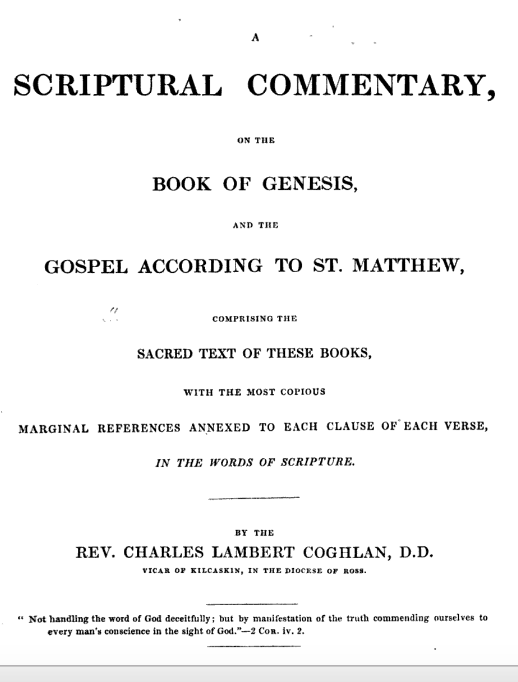
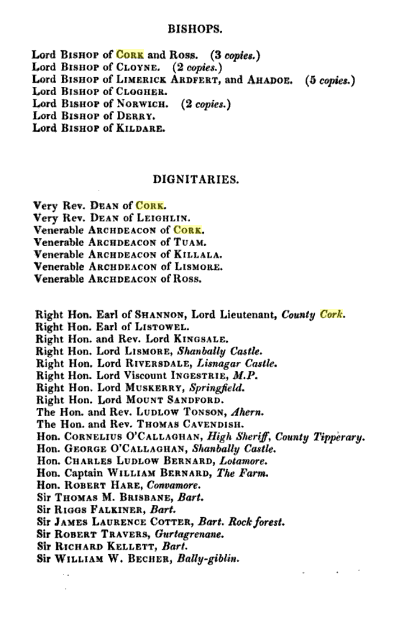
1832. A Roll Call of Cork Protestants. Subscribers to A scriptural commentary on the Book of Genesis and the Gospel, Volume 1. edited by Charles Lambert Coghlan

21 Wednesday Dec 2016

Posted by durrushistory in Uncategorized

≈ Leave a comment


1832.   A Roll Call of Cork Protestants. Subscribers to A scriptural commentary on the Book of Genesis and the Gospel, Volume 1. edited by Charles Lambert Coghlan.

Probably descended from the Coughlans of Carrigmanus Goleen.


….

screen-shot-2016-12-21-at-09-41-36

screen-shot-2016-12-21-at-09-41-47

screen-shot-2016-12-21-at-09-41-57

screen-shot-2016-12-21-at-09-42-12

…

screen-shot-2016-12-21-at-09-42-25

screen-shot-2016-12-21-at-09-43-24

screen-shot-2016-12-21-at-09-43-33

screen-shot-2016-12-21-at-09-43-48


…

……


screen-shot-2016-12-21-at-09-42-39
screen-shot-2016-12-21-at-09-42-48
screen-shot-2016-12-21-at-09-43-01


……

screen-shot-2016-12-21-at-09-43-13
screen-shot-2016-12-21-at-09-43-24
screen-shot-2016-12-21-at-09-43-33
screen-shot-2016-12-21-at-09-43-48


……

screen-shot-2016-12-21-at-09-41-36
screen-shot-2016-12-21-at-09-41-47
screen-shot-2016-12-21-at-09-41-57
screen-shot-2016-12-21-at-09-42-12
screen-shot-2016-12-21-at-09-42-25

Early. 19th Century Political Figures in Bantry and Carbery District, Tithes, Cess Payments, Baronial Constables, Drivers, Village Pounds

20 Tuesday Dec 2016

Posted by durrushistory in Uncategorized

≈ Leave a comment


durrushistory's avatarWest Cork History

Early. 19th Century Political Figures in Bantry and Carbery District, Tithes, Cess Payments, Baronial Constables, Drivers, Village Pounds

Tithes

Tithes were a medieval tax of one tenth of crops.  The benefits went to the clergy who were expected to provide civil services out of it.  In Cork Richard Boyle (ancestor the the Dukes of devonshire and numerous other lines) managed by underhand methods in the early 17th century to acquire most of the Diocesan tithes.  A large part was ‘impropriate’ and in time were traded as any form of property.  Much of the later trouble with tithes came from the vigorous enforcement to entitlement sby tithe proctors who sometime acquired the tithes or received a significant proportion of money collected.

The Tithe Composition Act of 1823 provided that a special Vestry could appoint an arbitrator to determine the amount of tithe.  The exemption of pasture from tithe was abolished in…

View original post 5,423 more words

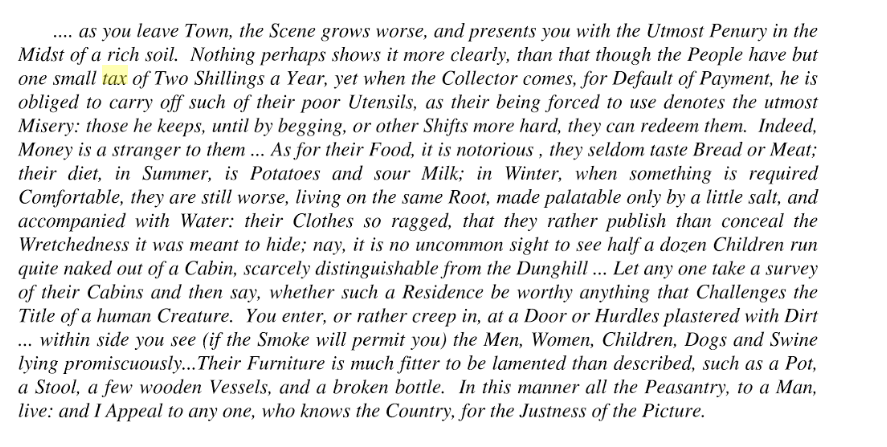
Edmund Burke (1729-1797) on the Misery of an Irish Cabin c 1750

20 Tuesday Dec 2016

Posted by durrushistory in Uncategorized

≈ Leave a comment


Edmund Burke (1729-1797) on the Misery of an Irish Cabin c 1750


https://en.wikipedia.org/wiki/Edmund_Burke

screen-shot-2016-12-19-at-12-07-22

← Older posts
Newer posts →

Blog Stats

  • 865,985 hits

16th Regiment of Foot assisted female emigration australia ballyclough bantry bay caithness legion cavan regiment of militia cheshire fencibles coppinger's court inbhear na mbearc Irish words in use 1930s lord lansdowne's regiment mallow melbourne ned kelly new brunswick O'Dalys Bardic Family. o'regan Personal Memoirs rosscarbery schull sir redmond barry sir walter coppinger st. johns sydney Townlands treaty of limerick Uncategorized university of Melbourne victoria

16th Regiment of Foot assisted female emigration australia ballyclough bantry bay caithness legion cavan regiment of militia cheshire fencibles coppinger's court inbhear na mbearc Irish words in use 1930s lord lansdowne's regiment mallow melbourne ned kelly new brunswick O'Dalys Bardic Family. o'regan Personal Memoirs rosscarbery schull sir redmond barry sir walter coppinger st. johns sydney Townlands treaty of limerick Uncategorized university of Melbourne victoria
Follow West Cork History on WordPress.com

Enter your email address to follow this blog and receive notifications of new posts by email.

Join 507 other subscribers

Feedjit

  • durrushistory's avatar durrushistory

Archives

  • April 2026
  • March 2026
  • February 2026
  • January 2026
  • December 2025
  • November 2025
  • October 2025
  • September 2025
  • August 2025
  • July 2025
  • June 2025
  • May 2025
  • April 2025
  • March 2025
  • February 2025
  • January 2025
  • December 2024
  • November 2024
  • October 2024
  • September 2024
  • August 2024
  • July 2024
  • June 2024
  • May 2024
  • April 2024
  • March 2024
  • February 2024
  • January 2024
  • December 2023
  • November 2023
  • October 2023
  • September 2023
  • August 2023
  • July 2023
  • June 2023
  • May 2023
  • April 2023
  • March 2023
  • February 2023
  • January 2023
  • December 2022
  • November 2022
  • October 2022
  • September 2022
  • August 2022
  • July 2022
  • June 2022
  • May 2022
  • April 2022
  • March 2022
  • February 2022
  • January 2022
  • December 2021
  • November 2021
  • October 2021
  • September 2021
  • August 2021
  • July 2021
  • June 2021
  • May 2021
  • April 2021
  • March 2021
  • February 2021
  • January 2021
  • December 2020
  • November 2020
  • October 2020
  • September 2020
  • August 2020
  • July 2020
  • June 2020
  • May 2020
  • April 2020
  • March 2020
  • February 2020
  • January 2020
  • December 2019
  • November 2019
  • October 2019
  • September 2019
  • August 2019
  • July 2019
  • June 2019
  • May 2019
  • April 2019
  • March 2019
  • February 2019
  • January 2019
  • December 2018
  • November 2018
  • October 2018
  • September 2018
  • August 2018
  • July 2018
  • June 2018
  • May 2018
  • April 2018
  • March 2018
  • February 2018
  • January 2018
  • December 2017
  • November 2017
  • October 2017
  • September 2017
  • August 2017
  • July 2017
  • June 2017
  • May 2017
  • April 2017
  • March 2017
  • February 2017
  • January 2017
  • December 2016
  • November 2016
  • October 2016
  • September 2016
  • August 2016
  • July 2016
  • June 2016
  • May 2016
  • April 2016
  • March 2016
  • February 2016
  • January 2016
  • December 2015
  • November 2015
  • October 2015
  • September 2015
  • August 2015
  • July 2015
  • June 2015
  • May 2015
  • April 2015
  • March 2015
  • February 2015
  • January 2015
  • December 2014
  • November 2014
  • October 2014
  • September 2014
  • August 2014
  • July 2014
  • June 2014
  • May 2014
  • April 2014
  • March 2014
  • February 2014
  • January 2014
  • December 2013
  • November 2013
  • October 2013
  • September 2013
  • August 2013
  • July 2013
  • June 2013
  • May 2013
  • April 2013
  • March 2013
  • February 2013
  • January 2013
  • November 2012
  • October 2012
  • September 2012
  • August 2012
  • July 2012
  • June 2012
  • May 2012
  • April 2012
  • March 2012
  • February 2012
  • January 2012
  • December 2011
  • November 2011
  • October 2011

Blog at WordPress.com.

  • Subscribe Subscribed
    • West Cork History
    • Join 507 other subscribers
    • Already have a WordPress.com account? Log in now.
    • West Cork History
    • Subscribe Subscribed
    • Sign up
    • Log in
    • Report this content
    • View site in Reader
    • Manage subscriptions
    • Collapse this bar
 

Loading Comments...