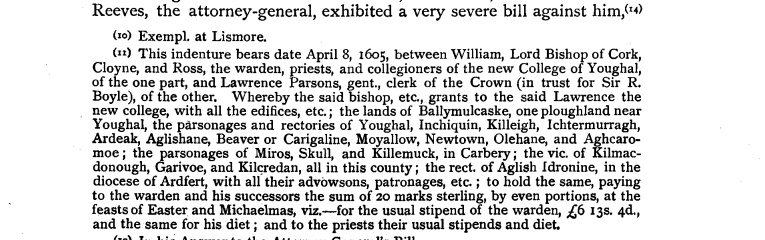
1605 Acquisition of Interest in Certain Church Properties at Schull, Myross, Killemuck Barony of Carbery and Garryvoe by Sir (Great Earl of Cork) Richard Boyle.
These properties and those at Bantry, Durrus, Kilcrohane were held by the College of Youghal and St. Catherine’s of Waterford. Presumably a legacy of small Norman incursions. Some of these properties appear at late as 1780 in the account books of the Cathedral of St. Finbarrs Cork and are available for inspection at the RCB Library in Dublin
This is from a commentary by Dr. Richard Caulfield of Dr. Smith’s History of Cork
This is an attempt to see how the descendant of the old Gaelic families fared after the ancestral lands were forfeit or confiscated for ‘rebellion’ against the English Crown and administration. It is impossible to be definitive but is likely that many of those represented here are of the old lines. In the long run they have done well and even thrived.
In contrast those families granted estate, Beechers, Townsends or those like the Whites of Biantry or Bernards of Bandon who bought land cheaply early 18th century from the Hollow Blade Company did not fare as well. Few of the West Cork Landed families invested locally in productive assets. Even of the large estates the rentals were modest compared to the larger Irish estates. An exception would be Cox in the development of the Dunmanway linen industry or Addelry in Innishannon. The building of large houses, ostentatious lifestyles residences in Dublin and London ensued large debts and ultimately little disposable income. Papers such as the Chief Secretary are replete with Petitions from the West Cork Gentry for Government aid for road, harbour building various types of distress. However their individual personal contribution can characterised by the following during the cholera epidemic in 1833:
1833, John Roberts, Bantry, Magistrate, reported 15th April 1833, death of one of his policeman Ferguson of cholera. Has been prevalent since the 11th March, 20 cases 5 dead many more now being treated. This is a miserable neglected town without any resident gentry and the few who do, don’t exert themselves whether by contribution or otherwise to check the advance of the disease. The Board of Health do not have the money to open a hospital which is the cause of this disease.
There is an untold story of economic development by the likes of the Bandon Clothiers and textile entrepreneurs, the millers, shippers, brewers such as the Deasys of Clonakilty of McCarthys of Skibbereen, the Bantry Vickeries who were the founders of West Cork tourism. Of Thomas Vickery who founded the hotel and pioneers the ’Prince of Wales Route, Bantry to Killarney, ‘he did more for the people of Bantry and surrounding area all the belted Earls.
The section of deeds in the Bantry/Durrus shows the emergence of a class up to now invisible. They comprise Catholic and Protestant farmers of substance, merchants, Grand Jury road contractors who were in a position to advance loans to the local small Landlords such as the Blairs of Blairs Cove, Evansons of Durrus, Hutchinson of Clonee, Durrus. These are either by way of mortgage or rent charge. Ironically the advances commenced in the late 1780s a time of unparalleled prosperity when a well managed estate should have being doing well. It is estimated the land rent went up by a factor of 3 between 1780 and 1815 the dated of the Battle of Waterloo.
Introduction, p.1
Subject area, p.2
General Charles Vallancey (1731-1812) Survey Report 1778, p.5
Crowley Wills ,p. 8
Professionals
Apothecaries, Doctors p. 16
Lawyers, p.18
1825 Balance of economic advantage grievance of Catholics excluded from Juries, p.19
Convert Rolls/Converts, p.23
Game Certs (Gun Licences), p. 25
Grand Jury Records, Cess payer representatives, p.26
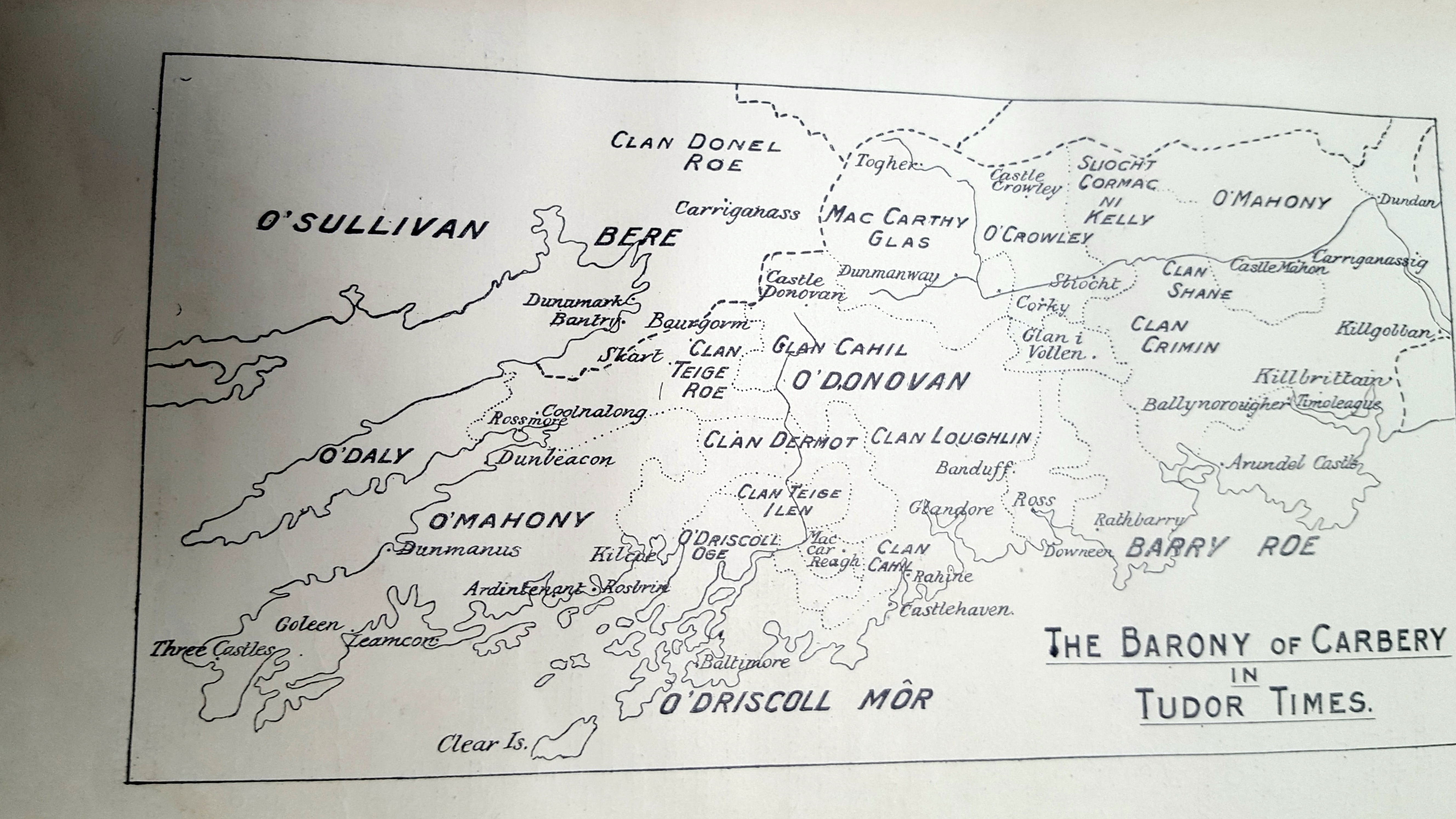
Courtesy Cork Historical and Archaeological Society 1904.
…
The families shown are strongly still represented. The influx of those who have arrived since have been absorbed. DNA evidence suggests a significant amount of intermarriage in the late 17th and 18th century so the headline surname is no guide to the multiple origins of the particular family regardless of religion. From the mid 18th to mid 19th century this was one of the most densely populated rural areas in the world, excluding lake, bog and mountain.
Tim O’Riordan: An Piobáire Bán (Blind Peter Hegarty aged 44) Come and Hear me every Sunday Morning at the Cross of Colomane known from Bantry, Dunmanus Bay to Baltimore, in every Boreen, Shebeen, Frances O’Neill
From Tim O’Riordan’s album
The saem townland has another Spillane recorded by Christy Moore, Gortataggart.
Descendants of James McGiverin, (McGovern) and Pattison Dunmanway, Return to Dunmanway 1871, names include Hungerford Roche, Glandore Castle. New Brunswick, New zealand Return to Dunmanway 1871. Meeting Judge Robert Swanton and Mrs, Sullivan, New York, Hibernia Freemason Lodge, New Brunswick, Rev. William Meade Dunmanway.
McGiverns a Protestant variation of McGovern common in West Cavan, Leitrim, Fermanagh
McGiverns and pattersons pat of an influx of norther artiscasn introduce to Dumnawy by Sirl Richard Cox to promote lined/flax in Dunmanway with considerble sussess
The famiies adn other appear in numeous deed sfo bleach yards, mills adn lnds in Dunmanwy post 1770:
Richard Becher Hungerford (1801-1894). Probate £52 to Winspeare Hungerford, Cork, Estates at Ballyrizard, Goleen, Island in Dunmanus Bay, Cremona violin, picture of John O’Donovan, brother of General O’Donovan and their mother, to be given to their relative ‘The O’Donovan’, Lissard, other pictures and books to his daughter Frances Sweetnam, Lemcon, Schull. Hungerford Magistrates. Winispeares, Shipwrights, Bantry and Durrus, 17th century.
The Winispeares appear in the Bantry area as mariners adn shipwrights from the mid 17th century. One time around 1730 living in Rossmore, Durrus possibly involved in pilchard industry. A Winspear Toye, merchant and contractor to the Grand Jury in Clonakilty 1820s. May be related to extended Attridge family.
Henry Jones Hungerford, TCD, 1856, Cahermore House, Rosscarbery, Resident, £454, 1870 return 3,532 acres. Henry Jones Hungerford, the last effective owner and resident landlord of the Cahirmore Estate. He qualified as a Barrister and had little interest in the Estate. His income from rental was foolishly spent and on his death the Land Commission took it over. Mary Boone Cowper Hungerford. Wife of Henry Jones Hungerford. (1870)..They had nine children most of whom emigrated. At the time of its destruction in 1921 Cahermore was owned by a merchant named Regan, who had purchased the property from representatives of the Hungerford family “some years” after the death of Henry J. Hungerford, J.P. Probably father 1863. We Hope We May Never See Carbery Without A Pack of Hounds. Dinner to Henry Jones Hungerford Esq., Cahermore, Rosscarbery, West Cork. 1861 executor, £13,000. Thomas Hungerford Esq, TCD, Island House, Clonakilty
Launcelot Hungerford, 1865-1939 Resident Magistrate, Busselton, Western Australia. Born Cahermore, Rosscarbery. Doctor went to Australia. For two years he was district medical officer at Dongara, and was then transferred to Busselton, where, in addition to being a resident medical officer, he was also the resident magistrate. Cahermore, Rosscarbery, parents Henry Jones Hungerford, Mary Boon Cooper. Died 2 February 1939; buried at the Karrakatta Cemetery in Perth, Western Australia, Anglican
Richard Beecher Hungerford (1801-1894), probably son of, 1793 19 July Morning Herald “Married on Monday 8th Inst at St James, Bath, Richard Hungerford of the Island to Miss (Frances Eyre) Becher, dau of Richard Becher, Esq of Hollybrook, Co Cork”, Presentment sessions Ballydehob 1845, listed 1875-6, Ballyrisode House, Goleen. 1870 return 638 acres. Daughter Frances married Matthew Sweetnam, Leamcon House, Schull, Magistrate. listed 1875, Skibbereen, subscriber Dr. Daniel Donovan ‘History of Carbery, 1876. Probate £52 to Winspeare Hungerford, Cork, Estates at Ballyrizard, Goleen, Island in Dunmanus Bay, Cremona violin, picture of John O’Donovan, brother of General O’Donovan and their mother, to be given to their relative ‘The O’Donovan’, Lissard, other pictures and books to his daughter Frances Sweetnam.
Thomas Hungerford Esq., 1767, Union Hall. Ancestor Captain Thomas Hungerford, of Farley, Somerset, settled in Cork where he was married in 1640. A Thomas Hungerford Senior was buried in Rosscarbery in 1710. The Census of 1659 shows him as owner of Croaghna and Gortngrenane (Rathbarry area) with a population of 2 English and 13 Irish. He purchased considerable estates in the Rosscarbery area and on 28th October 1674 purchased Rathbarry Castle from Edward Williams. Died 1680-81, buried in Rosscarbery Cathedral where there is a monument to him. His son Richard left Rathbarry in 1691 and occupied the Island of Inchydoney, Clonakilty. (Tuckey’s Cork Remembrancer) – AD 1772 – Feb. 24 – About three o clock this morning, the house of Thomas Hungerford, esquire, and the King’s stores at Glandore, were attacked by a great number of armed men, in order to rescue a cargo of tobacco; they were however beaten off by Mr. Hungerford, assisted by a party from the Thunderbolt cutter. Several of the persons who made the attack were wounded. Shown 1788 as owner of adjoining lands estate map of Sir John Freke, Bart. 1809 subscriber of revised edition of Meredith Hanmer, Chronicles of Ireland. 1800 in a group including Hungerfords of The Island and Cahermore, William Allen of Ring, James Sadlier of Shannonvale, Rev. William Stewart, Wellfield signing Pre Union Manifesto.
Thomas Hungerford Esq, TCD, Island House, Clonakilty. Thomas Hungerford (1789-1861). He established the present day estate of Cahirmore and married Alicia Jones, the daughter of a landed family from Glandore. 1817 Freemason Skibbereen. Thomas Hungerford, Cahirmore, County Cork, to Henry Goulburn, Chief Secretary, Dublin Castle, 7 August 1823, enclosing petition of Hungerford, Richard Wellesley, 1st Marquis Wellesley, Lord Lieutenant, Dublin Castle, referring to the distress of the peasantry in his district, and emphasising his belief in the benefits of establishing the linen trade on a permanent basis in the area. Requests a government loan of £3,000 to reclaim 300 acres of his own unimproved land for the cultivation of flax, and to establish a linen manufactory for weavers and spinners, 7 August 1823. Cholera 1832. Lewis, 1837, Kilcoe: Two manorial courts are held here monthly by the seneschals of the bishop of Ross and Thos. Hungerford Esq. respectively. In 1851 the Cahirmore estate covered the townlands of Cahirmore, Freehanes, Maulyregan, Maulantanavally and Gounbrack with total acreage of 2780 acres and a valuation of £962. Hungerford let the estate at a yearly rent of £4.0.0 an acre. This was usually increased depending on the quality of the land in some areas. Despite the huge income the estate was practically bankrupt by 1900. (c.1850)1822 local fishery committee. Vice president Bandon Brunswick Constitutional Club 1828. County Freeman of Cork City voting in Cork City Election 1837. Listed 1835, 1838, 1842, 1843, sitting Rosscarbery, 1835. Gave evidence 1835 to enquiry to Poor Law Commission. 1861 Supporting Alexander O’Driscoll, J.P. suspended, Bandon 1841. Subscriber Lewis Topographical Dictionary of Ireland 1837, subscriber 1861 to Smith’s History of Cork. Attended 18, Grand Jury Presentments. 1861 probate to Henry Jones Hungerford, Millfield, £13,000.
Thomas Hungerford, pre 1831, voted 1850 for William Hungerford as High Constable for Ibane and Ballyroe (Clonakilty).
.
Portrait of Alicia Jone Hungerford (c.1814) Present not certain which Thomas at enquiry Skibbereen 1823 into enquiry into fatal affray at Castlehaven caused by Rev. Morritt’s tithe extraction. Cork Summer Assizes 1828. Involved in attempts to amicably resolve tithes 1838. Attending Protestant Conservative Society meeting 1832. Protestant protest meeting Cork 1834. Subscriber as The Island Lewis Topographical Dictionary of Ireland 1837, subscriber 1861 to Smith’s History of Cork. Freedom of Cork 1830 described as radical and a very great one in politics. County Freeman of Cork City voting in Cork City Election 1837. Attended 11, Grand Jury Presentments
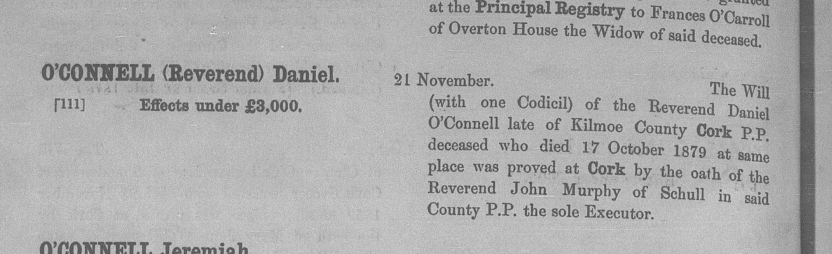
1879, will of Rev. Daniel O’Connell, Parish Priest, Kilmoe (Goleen), £1,037 in Munster Bank, Bantry and Bank of Ireland Cork. 8 Shares Union Bank of Australia, 6 Shares London and Westminster Bank, 5 Egyptian Bonds/Preference Shares, 10 Preference Shares Eastern Telegraph Company, £100 in Notes and Gold, £200 for the Poor of Kilmoe and West Schull.
The general picture of 19th century Ireland is one wracked by poverty. This is true but there was also a significant middle class. This is reflected in the copies of wills which have survived. The estates show a degree of sophisticated financial knowledge which at first sight is surprising. A sample:
Banks/Insurance:
1888, John Acton, merchant, Bantry. Money in books of Munster and Leinster Bank.
1872, Adderley (Arthur George) Bernard, Phale House near Dunmanway, Estate £1,700. Money in Munster Bank, £300 on his life with Standard Life insurance Company.
1890, Elizabeth Connell, (her mark), widow, Knockraha, Aughadown. Estate £336. Money Munster and Leinster Bank.
1887, John Copithorne, Gentleman, Cork to be buried in Aughadown. Estate £1,518. Two insurance policies for £500 with Star Life
1860, John Brien Corkery, Gentleman, Bantry. Estate £200. Policy of assurance on life of Skibbereen Post Master John Rowan assigned to him, insurance on own life with Royal Exchange Insurance Office.
1873, Thomas Fitzgibbon, Castle Salem, Rosscarbery, Licentiate of Kings and Queens College of Physicians. Estate £600. Purchased estates from Encumbered Estates Court, stocks, bonds.
1861, Joseph Helen, pawnbroker, Cork, Bantry connections. Interest in life assurance policy 1840 taken out by John Bird, Bantry in the lives of Robert Young, Samuel Young, John Young for £700 with the North British Insurance Company.
1880, Samuel Jagoe, famer, Drimoleague. Estate £200. Insurance policy £100 Star Assurance.
1870, John Francis O’Connor, Gentleman, Bantry. Estate £600. £500 held in trust for him by Colonel Aldworth (brother-in law of Lord Bandon), at Munster Bank Bantry.
1887, Father Patrick O’Flynn, Parish Priest Durrus Kilcrohane. Shares in Cork gas company.
1859, William O’Sullivan, Esq., Landlord, Carriganass Castle, Bantry. Insurance policy for £2,000, money vested in Government stocks and funds, all debts due to him by mortgage, judgements, bonds, promissory notes, bill of exchange.
1892, Ellen Levis, widow, Clonakilty. Estate £490. Money in Monarch Building Society, Dublin.
1861, Philip Somerville, The Prairie, Schull. Estate £4,000. Annuity of £50 per annum for wife charges on lands at North Liscaha and store at Schull. Commission purchased for son William Cameron Somerville for £600.
Very Rev. Daniel O’Connell, PP
Deceased
Parish Of Birth
Unspecified
Colleges Attended
St. Patrick’s College, Maynooth Co Kildare, Ireland
Details Of Ordination
St. Patrick’s College Chapel, Maynooth, Co. Kildare
17/6/1848
Appointments
Goleen PP : 1873 – 17/10/1879
Enniskeane CC : 1871 – 1873
Murragh and Templemartin CC : 1870 – 1871
Innishannon CC : 12/1857 – 1870
Carrigaline CC : 1853 – 12/1857
Drimoleague CC : 1851 – 1853
Goleen CC : 1849 – 1851
Date Of Death
17/10/1879
Place Of Burial
Church of Our Lady, Star of the Sea, & St. Patrick’s Grounds, Goleen, Co. Cork








 West Cork History