• About
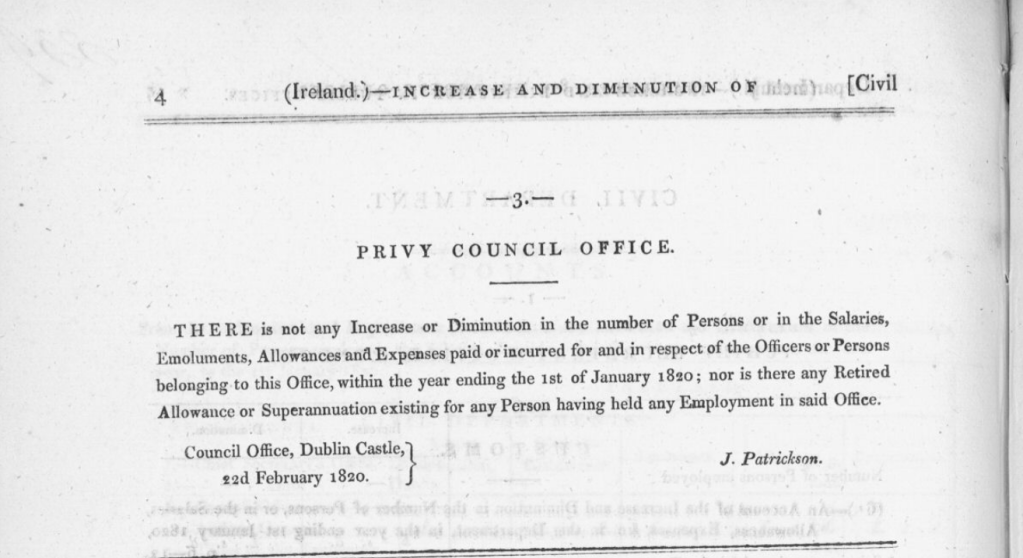
  • Customs Report 1821-2 (and Miscellaneous Petitions to Government 1820-5) and some Earlier Customs Data, including staffing, salaries, duties including, Cork, Kinsale, Youghal, Baltimore, with mention of Bantry, Crookhaven, Glandore, Berehaven, Castletownsend, Enniskeane, Passage, Crosshaven, Cove, Clonakilty, Cortmacsherry.
  • Eoghan O’Keeffe 1656-1723, Glenville, Co. Cork later Parish Priest, Doneralie 1723 Lament in old Irish
  • Historic maps from Cork City and County from 1600
  • Horsehair, animal blood an early 18th century Stone House in West Cork and Castles.
  • Interesting Links
  • Jack Dukelow, 1866-1953 Wit and Historian, Rossmore, Durrus, West Cork. Charlie Dennis, Batt The Fiddler.
  • Kilcoe Church, West Cork, built by Father Jimmy O’Sullivan, 1905 with glass by Sarah Purser, A. E. Childs (An Túr Gloine) and Harry Clarke Stained Glass Limited
  • Late 18th/Early 19th century house, Ahagouna (Áth Gamhna: Crossing Place of the Calves/Spriplings) Clashadoo, Durrus, West Cork, Ireland
  • Letter from Lord Carbery, 1826 re Destitution and Emigration in West Cork and Eddy Letters, Tradesmen going to the USA and Labourers to New Brunswick
  • Marriage early 1700s of Cormac McCarthy son of Florence McCarthy Mór, to Dela Welply (family originally from Wales) where he took the name Welply from whom many West Cork Welplys descend.
  • Online Archive New Brunswick, Canada, many Cork connections
  • Origin Dukelow family, including Coughlan, Baker, Kingston and Williamson ancestors
  • Return of Yeomanry, Co. Cork, 1817
  • Richard Townsend, Durrus, 1829-1912, Ireland’s oldest Magistrate and Timothy O’Donovan, Catholic Magistrate from 1818 as were his two brothers Dr. Daniel and Richard, Rev Arminger Sealy, Bandon, Magistrate died Bandon aged 95, 1855
  • School Folklore Project 1937-8, Durrus, Co. Cork, Schools Church of Ireland, Catholic.
  • Sean Nós Tradition re emerges in Lidl and Aldi
  • Some Cork and Kerry families such as Galwey, Roches, Atkins, O’Connells, McCarthys, St. Ledgers, Orpen, Skiddy, in John Burkes 1833 Commoners of Great Britain and Ireland:
  • Statement of Ted (Ríoch) O’Sullivan (1899-1971), Barytes Miner at Derriganocht, Lough Bofinne with Ned Cotter, later Fianna Fáil T.D. Later Fianna Fáil TD and Senator, Gortycloona, Bantry, Co. Cork, to Bureau of Military History, Alleged Torture by Hammer and Rifle at Castletownbere by Free State Forces, Denied by William T Cosgrave who Alleged ‘He Tried to Escape’.
  • The Rabbit trade in the 1950s before Myxomatosis in the 1950s snaring, ferrets.

West Cork History

~ History of Durrus/Muintervara

West Cork History

Author Archives: durrushistory

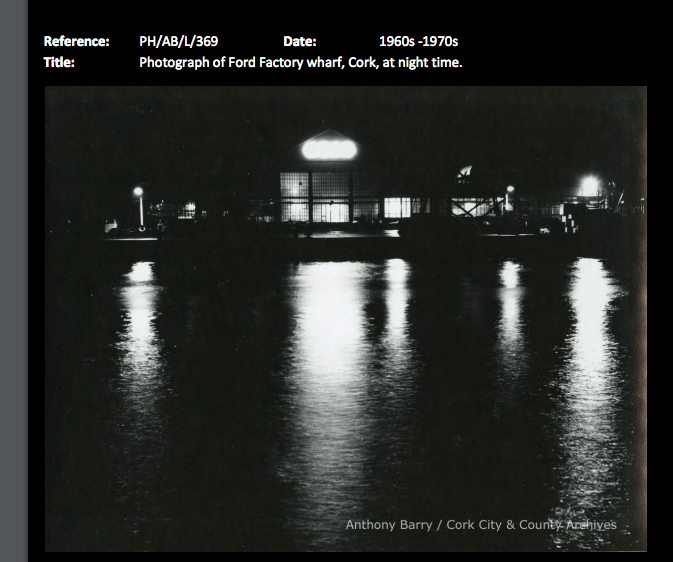
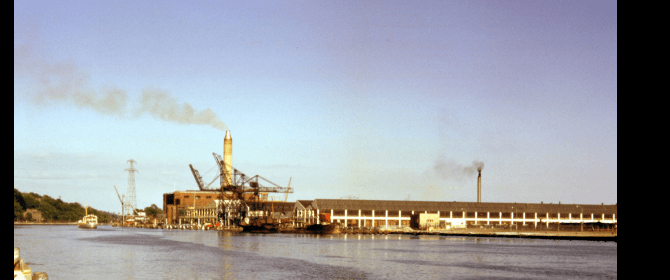
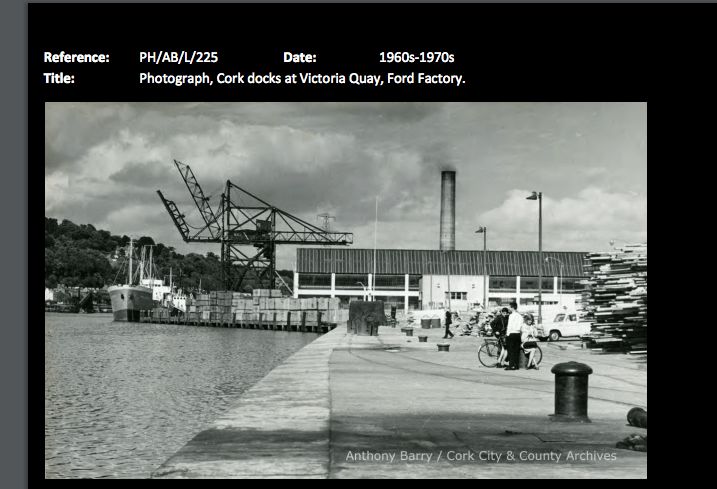
1912, Henry Ford of Detroit in Vickery’s Hotel, Bantry. Famous Visitors to Vickery’s Hotel.

11 Friday Sep 2020

Posted by durrushistory in Uncategorized

≈ Leave a comment


From Hazel Vickery who donated Vickery papers UCC, Boole Library:

https://libguides.ucc.ie/ld.php?content_id=32363594

In 1912, Willie’s cousins, Herbert & Tommie Vickery, sons of George J. Vickery, of Vickery’s Hardware Shop,opened a motor repair garage behind the hotel. As they were Ford dealers, they needed a showroom on the street. This was in the new hotel building between the front door and the archway, with petrol pumps on the footpath. The hotel was used by the Cork Ford Company for regional meetings and Henry Ford, his wife Clara and daughter stayed in the hotel on the night of the 10th August 1912.

Corktown, Detroit, Michigan being Revitalised by Henry Ford The Third.

https://wordpress.com/block-editor/post/durrushistory.com/35978

Henry Ford, Madame, Ballinascarthy, West Cork and the Uilleann Pipes

https://wordpress.com/block-editor/post/durrushistory.com/699

Famous Visitors to the Hotel:


Noel O’Sullivan a porter in 1940 wrote that he remembered opening the door for the then, Taoiseach, Eamon de Valera; General Tom Barry; Dan Breen, Eoin O’Neill, Dr Noel Browne, the singer Delia Murphy and actresses
Kathleen Ryan and Hermione Badderly. In 1961, during the making of the film “I Thank a Fool” on the Mizen Head Peter Finch stayed with his wife Yolande. Susan Hayward and Diane Cliento who were starring in the same film were regular clients for meals at that time. Trevor Howard, Cyril Cusack and Geraldine Plunkett (Glenroe) visited when making a film in Baltimore. Trevor was so pleased with one of the photos of him taken by Ian that he ordered 100 copies to use as a publicity photograph. Maureen O’Hara and her husband Charles Blair stayed when looking for property in the area which they eventually found in Glengarriff. She became a regular client as was Christy Moore when he had a house in Durrus – much to excitement of the staff. Before the private sitting-room/guest lounge became
the dining room I have fond memories of great sing-songs with various friends and guests playing the baby grand piano which had come from Elsie and Ian’s home in Reenmeen, Glengarriff after it was sold. Pianists included Donal Crosbie of the Cork Examiner family, Joe Lynch (Dinny in Glenroe), Maureen Potter and Jimmy O’Dea who stayed when they were staging their revues in the Parochial Hall. Later the old bar became the venue for the Young Musicians’ Platform during the West Cork Chamber Music Festival until they outgrew the room.

1914-1919, Gardens at Garretstown House, Kinsale, Grapes, Peaches, Lemons, Oranges

03 Thursday Sep 2020

Posted by durrushistory in Uncategorized

≈ Leave a comment


1914-1919, Gardens at Garretstown House, Kinsale, Grapes, Peaches, Lemons, Oranges

Courtesy Kinsale Historical Society (2016, Vol 24, P. 19)

Click to access 55da60b99ef932fd0808622f6fafd3cd.pdf

Lost demesne and historic gardens of Ballintubber near Ballinhassig, Co. Cork built by Lt-Colonel William Meade c 1650 and home of Samuel Thomas Heard creator of Rossdohan Gardens.

Gumbelton Estates including areas of Kilcrohane and Durrus West Cork, William Edward Gumbleton (1840-1911) garden at Belgrove, Great Island, Cobh, Co. Cork and donation of Botanic library to Botanic Gardens at Glasnevin.

https://wordpress.com/block-editor/post/durrushistory.com/17499

Samuel Thomas Heard (1835-1921), of Ballintubber, (late 17th century formal gardens), Kinsale, Co. Cork, East Indian Army Surgeon Major, inspired by Madras Horticultural Gardens he created Rossdohan gardens in Kenmare, Co. Kerry in 1873 utilising Furze as sea shelter emulating Lord Carbery at Castle Freke and son’s plant collecting in Abyssinia.

https://wordpress.com/block-editor/post/durrushistory.com/17490

Inventory of plants grown by Gaelic Irish 1620 prepared by Philip O’Sullivan Bere, and early 19th century cultivation of grapes and pineapples by Timothy O’Donovan Magistrate of O’Donovan’s Cove, Durrus, West Cork.

https://wordpress.com/block-editor/post/durrushistory.com/6139

Present by Daniel Sullivan, Berehaven, West Cork, to Richard Boyle, The Great Earl of Cork, c 1636 of Harvey Apples, Bon Chretien and Bergamotte pears, Arbutus for his new garden at Stalbridge Park, Dorset and Ireland’s first horticultural export The Strawberry Tree’ (Arbutus unedo) from 1580s.

https://wordpress.com/block-editor/post/durrushistory.com/6139

1893, Baseline Reports for The Congested District Board, West Cork

28 Friday Aug 2020

Posted by durrushistory in Uncategorized

≈ 2 Comments


https://www.academia.edu/s/9a05a2014a?source=created_email

Courtesy Cormac Levis and Folklore Department, University College Dublin.

Agricultural Improvement, County Premium Boars, Premium Bulls, Extra Premium Bulls, Stallion Asses, Barony of Bantry and Bere, Carbery.

This is part of the Congested District Board and Department of Agriculture and Technical Instruction effort to improve agriculture.   Many of the same families appear from the 1850s winning prizes in agricultural shows and some of their present day descendants are still involved.

https://wordpress.com/block-editor/post/durrushistory.com/25053

From James Morrissey

https://www.irishtimes.com/news/on-the-verge-of-want-1.313466

Apparently in 1890, Arthur Balfour, Chief Secretary for Ireland, visited the west of Ireland to witness for himself the appalling conditions.

In a speech delivered in Liverpool, he declared: “The general impression left upon the casual traveller is that you are dealing with a population not congested in the sense of being crowded, but congested by not being able to draw from their holdings a safe and sufficient livelihood for themselves and their children, whose condition trembles constantly on the verge of want, and when the potato crop fails, goes over that margin and becomes one of extreme and even dangerous destitution.”

Balfour decided that action was needed in the form of a new entity to bring about an improvement in conditions. And so the Congested District Board was established by the Land Act of 1891.

Areas were designated “congested” if the total rateable value, when divided by the number of population, was “less than one pound ten shillings for each individual”. The prime objective was to “help the people to help themselves” but before any assistance was given, Balfour wanted the board to ascertain in detail the circumstances which prevailed in the eight counties (Donegal, Sligo, Leitrim, Roscommon, Mayo, Galway, Kerry and Cork).https://tpc.googlesyndication.com/safeframe/1-0-37/html/container.html

On November 6th, 1891, he told his fellow board members: “I would suggest… that a careful study be made of the whole region from north to south with which we have to deal.”

Balfour recommended the study should include “a minute examination into the existing condition of the inhabitants… their means of livelihood, the quality of the soil, the amount of land (if any) now available for extension of holdings, the fishing accommodation in existence, the possibility of increasing it, the number of migratory labourers and the character and extent of local industries.

“It would also be very desirable among the results of this survey to find a place for some account of the general character of the dwellings in which the people live, and the actual items of their annual receipts and expenditure.”

A team of inspectors was subsequently appointed to conduct the study and in their letters of appointment, W. L. Micks, the first secretary of the board, emphasised the confidentiality of their work.

A search for these board reports took me to the early printed books section of Trinity College. My greatest curiosity was reserved for what the “confidential study” had to say about Kiltimagh. Henry Doran, the inspector who filed his report on May 6th, 1892, declared that “the land is very badly cultivated and rotation of crops is not followed.” Dwellings, he found, were “divided into two apartments, one used as a living room, and at one end of it the cattle are usually kept… the children of both in the other apartment, and the milk and butter are kept there”.

Despite the cramped conditions, Doran was impressed by the inhabitants: “Reflecting on the habits of the people of this and neighbouring districts, who are born and reared in the same room as their cattle; where brothers and sisters occupy the same sleeping apartment, insensible of any violation of human decency; living in such foul surroundings, in such close association as the brutes of the field, I have often marvelled how they are so moral, so well-disposed and so good in many ways as they generally are.”https://tpc.googlesyndication.com/safeframe/1-0-37/html/container.html

Clearly the families were poor. The estimated annual income for a family of six was £25. 7s. with the sale of two pigs yielding the highest return (£6) while the expenditure was just four shillings less at £25. 3s. One quarter of the spending went on the purchase of Indian meal, which was consumed by the family for breakfast and supper and by the pigs and poultry.

The poverty picture was broadly similar all along the western seaboard. In Fanad, Co Donegal, F.G.Townsend Gahan, the inspector, remarked: “To look at the land generally one is inclined to say that, comparatively speaking, these men are fairly well off, but again to look at the houses one feels inclined to say they are very poor”.

In Cahirciveen, J.E.Butler recommended that the number of public houses be halved and that whiskey should not be sold in the same shops with meal, flour and other goods.

“I would prevent a concoction of vitriol etc. being sold as whiskey which maddens the drinkers and helps to fill Killarney asylum with lunatics, now numbering over 400.” It became very clear to all the inspectors that a range of improvements was required to alleviate the plight of the people. Better methods of farming, the introduction of agriculturalists, more modern equipment and boats for fishing, new piers, roads and bridges and radically improved housing were all deemed essential.

“I have no faith in itinerant instructors,” wrote Doran. “The agricultural instructors should be resident in the district and be in daily communications with the people and have some land which should be managed in a manner that would demonstrate the advantage of his skill and knowledge. If he cannot practise what he preaches, who can have faith in him?”

The Congested Districts Board embarked on a range of worthwhile initiatives until its dissolution in 1923. For example, the improvement of housing resulted in 28,267 dwellings either being constructed or improved. New farming methods were introduced and a range of cottage industries developed. The success of such projects depended greatly on the level of support.

A real measure of improved circumstances was seen in the level of deposits in post-office savings accounts in the eight counties. Some years before the board was established, these stood at about £243,000. By 1912, 21 years later, savings had risen to £2.26 million.

Micks witnessed tangible evidence of the improved conditions in and around Kiltimagh: “I have accompanied Father Denis through the numbers of clustered hovels in which people lived on their rundale holdings (farms comprised of numerous isolated plots) before the board’s real land work began; and afterwards I have seen the comfortable detached houses and improved compact holdings”.

On the Verge of Want is compiled and edited by James Morrissey (published by Crann≤g Books, £23.60)
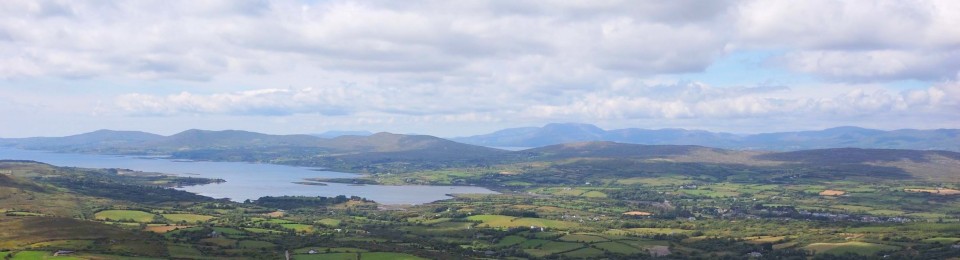
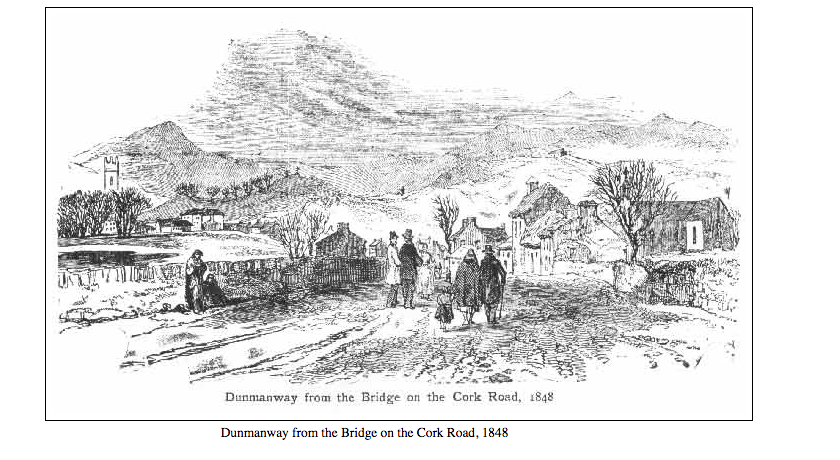
1848, Michael Doheny Young Irelander On the Run, Dunmanway, Gougane Barra, Probably Borlin Valley, Bantry, Supper of Trout, Bedding of Fresh Hay on a Settle, Breakfast Included a Slice of Fried Badger

25 Tuesday Aug 2020

Posted by durrushistory in Uncategorized

≈ Leave a comment


1848, Michael Doheny Young Irelander On the Run, Dunmanway, Gougane Barra, Probably Borlin Valley, Bantry, Supper of Trout, Bedding of Fresh Hay on a Settle, Breakfast Included a Slice of Fried Badger

Doheney

Title: The Felon's Track
       History Of The Attempted Outbreak In Ireland, Embracing The Leading
       Events In The Irish Struggle From The Year 1843 To The Close
       Of 1848
       

Author: Michael Doheny

Release Date: December 26, 2004 

Chapter 9 deals with his wanderings in West Cork

http://www.gutenberg.org/files/14468/14468-h/14468-h.htm#CHAPTER_IX

companion’s flight down the slope with the best speed my stiffened limbs could be forced to. Arriving over a valley which is called, I think, Branlieu, situated in a western direction from Gougane Barra, he pointed to a lone house at the extremity of the valley, as my destination. It was about four o’clock, but the rays of the sun had ceased to irradiate this gloomy valley, over which hung the shades of night. At the western side the mountain was steep as a wall, and down from the summit dashed headlong torrents, swelled by the morning’s rain. The waters gleamed like sheeted ice through the haze, and their roar fell upon the ear with a dull sense of loneliness and pain. On the eastern slope wound a new road, one of those heartless experiments which the inventive genius of the Board of Works in Ireland substituted for the exploded trial of prolonging beggars’ lives by Soyer soup and chained spoons. On these roads the people were to perform the greatest possible amount of work, and live on the least possible quantity of food. But, although these operations cost much waste of blood, the roads opened no new and fruitful sources of industry in these mountain valleys, only frequented by the footsteps of the sportsman, or scanned by the eye of the votaries of pleasure. The house where I called was intended for my guide. However, I found my claim for hospitality at once recognised on pronouncing the password of my host by the sea. The cabin—it was literally such—was in the most filthy state. The dung of the cattle had not been removed for days, and half-naked children squatted in it as joyously as if they rolled on richest carpets. The housewife merely replied to my question in the affirmative. But she immediately proceeded, with the help of two little girls, to remove the filth. I was so fatigued and hungry that I could willingly postpone the process of cleaning for the sake of providing any sort of food. I was doomed to disappointment. No appearance of supper interrupted the busy operation, until the dung was removed, and the floor drained. I retired, and endeavoured to ascend the eastern hill, to a point where I could catch a glimpse of the setting sun.

On my return I found the owner of the house, a man of giant frame and noble features. His dress bespoke a taste or pursuit incompatible with the wild mountain destiny stamped upon the external aspect of his home and family. His wife spoke a few words in Irish, explaining my presence, to which he answered that I was welcome. Supper was at length prepared, when he drew from a basket a few of the finest trout I ever saw. He cleaned and fried them with his own hands, as if the operation were above the capacity of his wife, who performed the other culinary duties with silent assiduity. It might be owing to hunger, it might be owing to the actual superiority of the fish, or it might be owing to the mode of cooking, but it seemed to me as if I never tasted anything of equal flavour to those trout. The entertainment was ended with some boiled new milk, slightly curdled, a delicacy little known in the circle of fashion, but never surpassed either in that or any other. Some fresh hay was procured and strewn on an article of furniture common in the houses of the Kerry peasantry, called a “settle.” It is a sort of a rude sofa, made of common deal timber. On this “settle” my host prepared my bed of new-mown hay, barricaded with old chairs and a table against the assaults of the hungry animals. I had not long lain down when a man entered (the door consisted of a pair of tongs, so placed as to prevent the egress of the cattle), lay at full length on the table, and fell fast asleep. In an hour or so afterwards, there came another, who groped his way over the cattle, and, sweeping the fire from the hearth, lay down to sleep in peace. This man slept uneasily, and groaned heavily, as if some terrible sense of guilt or fear pressed against his heart.

I had a vague feeling of uneasiness, not free from alarm, but the hearty snoring of the one, and the fitful complaints of the other of my bedfellows died away on my ear, and I, too, shared their unconsciousness in deep sleep. The man who brought my baggage arrived early next morning. My host soon provided a good substantial breakfast—excellent new potatoes, which had escaped the blight, butter, new milk, and a slice of the flesh of fried badger. He then proposed to accompany us with his son, aged about thirteen, who by some inexplicable privilege seemed exempt from any portion of the drudgery which was the lot of the family. The other man who brought the baggage was persuaded to leave his horse and car, and accompany us with my bundle, as far as the summit of the hill. To climb the steepest mountain side had become an amusement to me, and we ascended the one then before us, merrily, our host relating many anecdotes of sportsmanship, and detailing the startling incidents and wild rapture of badger-hunting. From the summit we commanded a view of the country for miles around. “Here we are,” said our host, “higher than the proudest of your enemies.” He then traced the route of the man with the bundle, through the open plain, and by the nearest way; and turning to me, he said: “You must not go in the same direction, for every yard of it is set. Follow my son,” he said, and turning to the boy, he named several points in the path whereby he should conduct me. “Lead Mr. Doheny safely,” he concluded, “and remember you are the son of —-.” In utter astonishment I inquired how he knew me, and he answered by waving his hand in the direction of the boy, who had bounded off and was scarcely perceptible above the tall heath. I soon overtook him, and as we went along, I learned that my two companions during the night were also evading the law’s pursuit. One of them he described as having killed a man by accident, and ever after leading, the life of a “poor wild goose.” I made no doubt but this was he whose spirit seemed so heavily laden. We had a couple of terriers of the truest breed, whose sudden discovery of a badger interrupted our conversation and impeded our journey. The young hunter became delirious with joy. His encouraging cries to the dogs were broken outbursts of wildest rapture; and when the game took shelter in his inaccessible den, he would dash himself against the rocks with the same reckless vehemence as his dogs, who, in their rage, attempted to bite away the hard mountain stones.

He left the spot with the utmost reluctance, after venting an oath of vengeance against the head of the poor badger, to which he promised sure destruction on the occasion of their next meeting. We quickly descended in the direction of Gougane Barra, where he parted from me, indignantly refusing a half-crown which I offered him.

Once more I found myself on the slopes of Shehigh, in sight of Lough Lua. My immediate object was to place myself in communication with my lady friend at Dunmanway. I was extremely anxious to see her. I wanted to procure through her some things to complete my costume as a disguised priest, and finally I expected to learn through her some news of my family. With the view of seeing her in the safest retreat, I determined to conceal myself in a wood belonging to a Mr. O’Leary, at a place called Coolmountain. I endeavoured to gain the friendship of a man in the neighbourhood, of whom I had learned the highest character for probity. It was necessary to confide in him fully; for his fidelity to his employer might induce him to betray me, if he suspected that my flight was occasioned by moral guilt. He did not disappoint me. At once he entered into all my plans, and immediately sent his wife with a message to Dunmanway. The distance was about six miles; and the utmost caution was necessary, for the police authorities, baffled in all their calculations, concerning my retreat, and deceived in every word of the information they were able to purchase, had determined on making simultaneous searches in all quarters of the country, so that scarcely a house remained in this vicinity that had not the honour of a domicilary visit.

Re Dunmanway Father Doheny was the parish Priest. He alone with Father Quin, Durrus, Dore,Caheragh, Ryan, Drimoleague were incardated from the Dioceses of Tipperary to Cork. All were highly able building churches schools introducing parish registers. The were involved in anti tithe agitation and highlt politicas

Doheneys observation on the filth of the house is echoed in 1900 by Father Tim O’Mahony visiting relations around Bandon and Dunmanway many quite prosperous

West Cork Clergy and letter from Fr. Tim Mahony, Brasher, New York, October, 1901 after Cork Visit to Inchigeela, Caheragh, Droumdeegy, Coolmountain, Ballyvilone, KIlmurray, Researching his Lantry/Lanktree family, Tánaiste of the O’Mahonys living in wretched hut, outside Ballineen, healthy children thriving in filthy house with pigs and hens in kitchen relatives going to Argentine Republic, New Zealand.

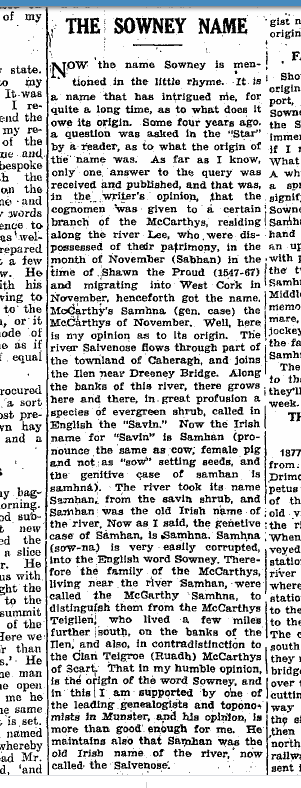
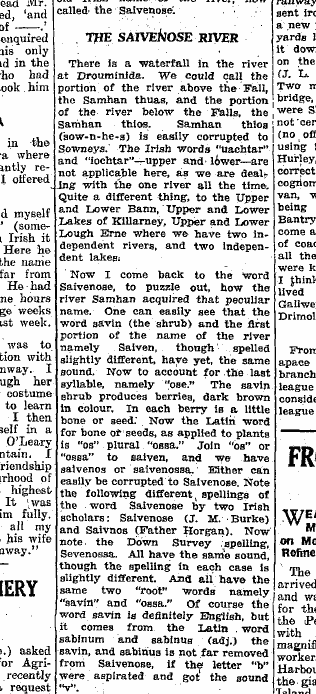
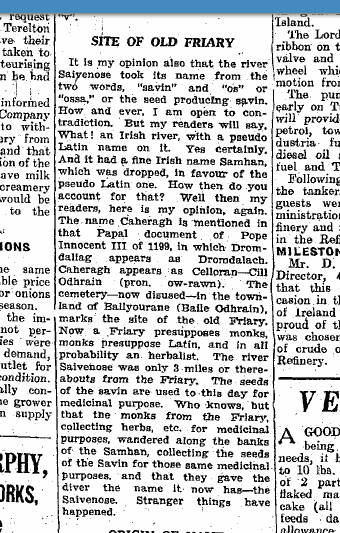
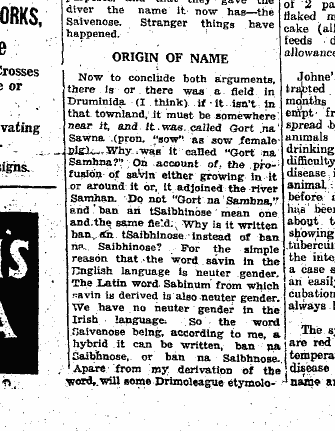
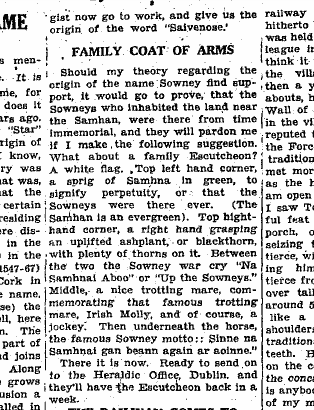
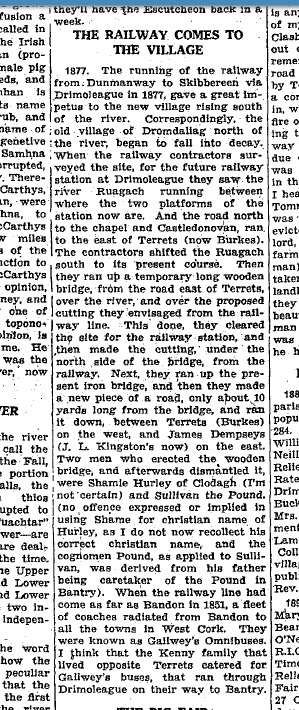
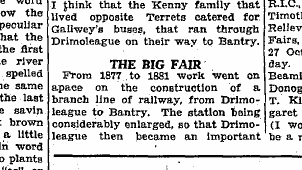
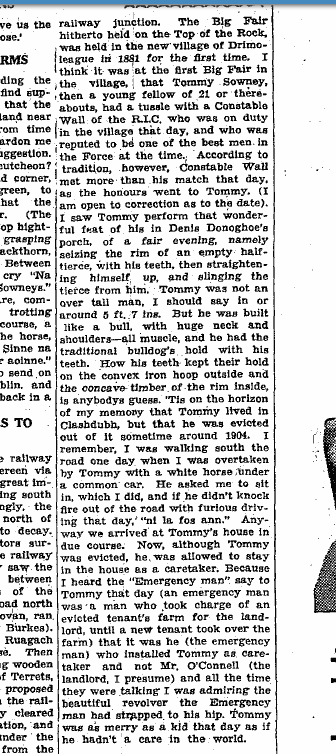
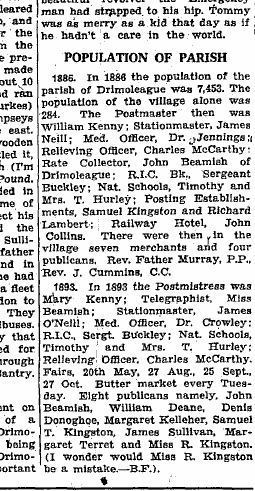
Historical Notes Drimoleague, History of McCarthy Sowneys

24 Monday Aug 2020

Posted by durrushistory in Uncategorized

≈ 1 Comment


Historical Notes Drimoleague, History of McCarthy Sowneys

Courtesy Southern Star

https://wordpress.com/block-editor/post/durrushistory.com/37737

https://wordpress.com/block-editor/post/durrushistory.com/37467

https://wordpress.com/block-editor/post/durrushistory.com/36366

https://wordpress.com/block-editor/post/durrushistory.com/34557

https://wordpress.com/block-editor/post/durrushistory.com/33076

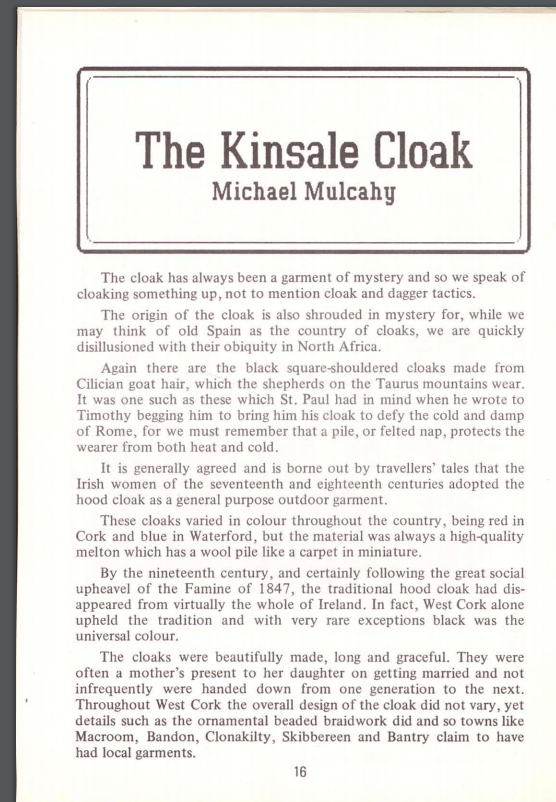
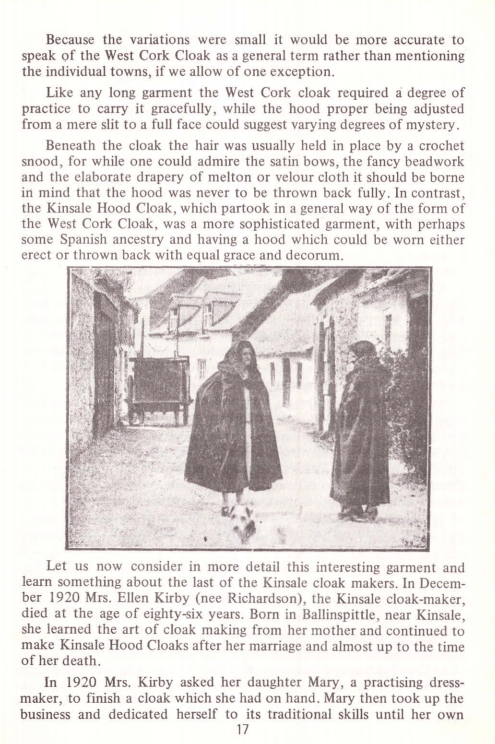
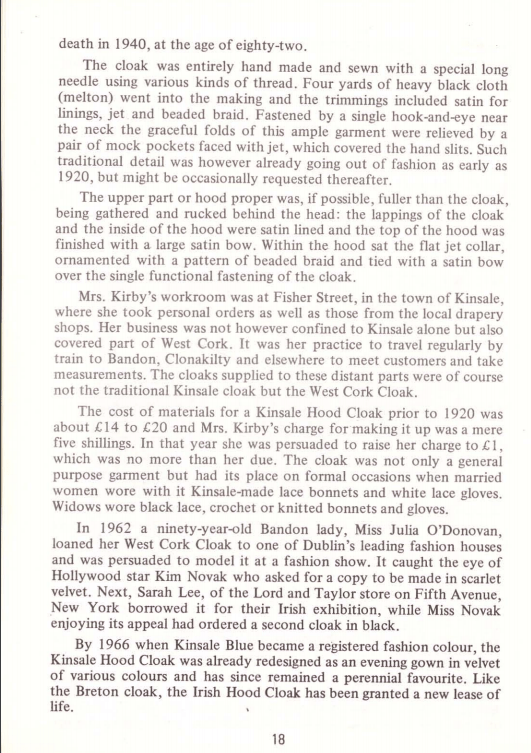
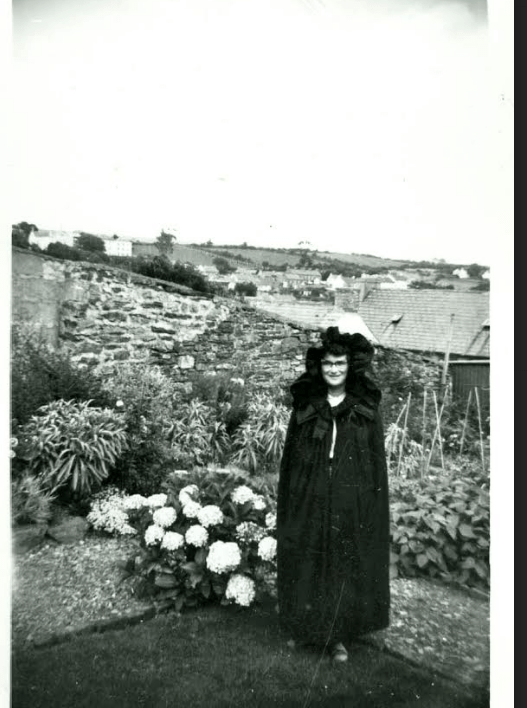
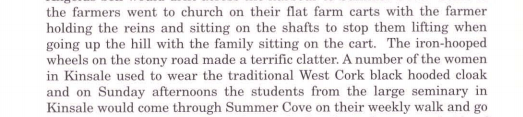
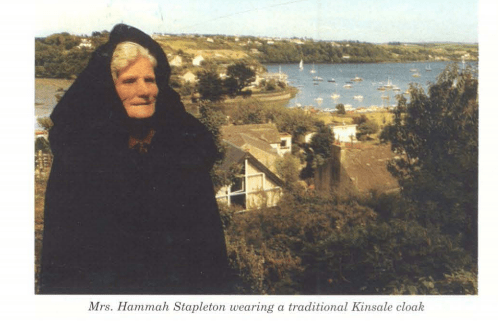
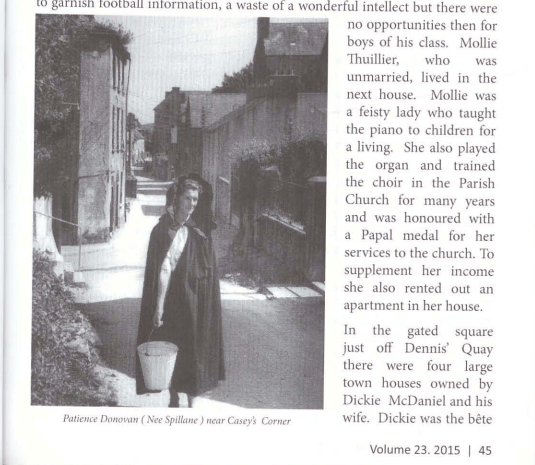
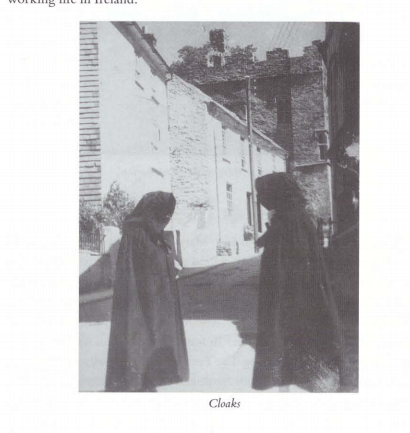
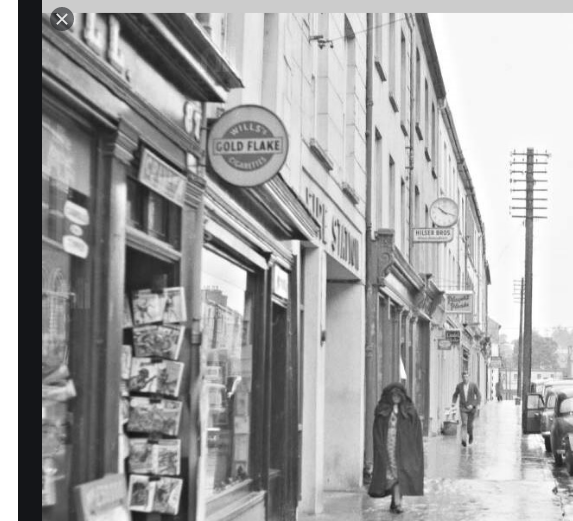
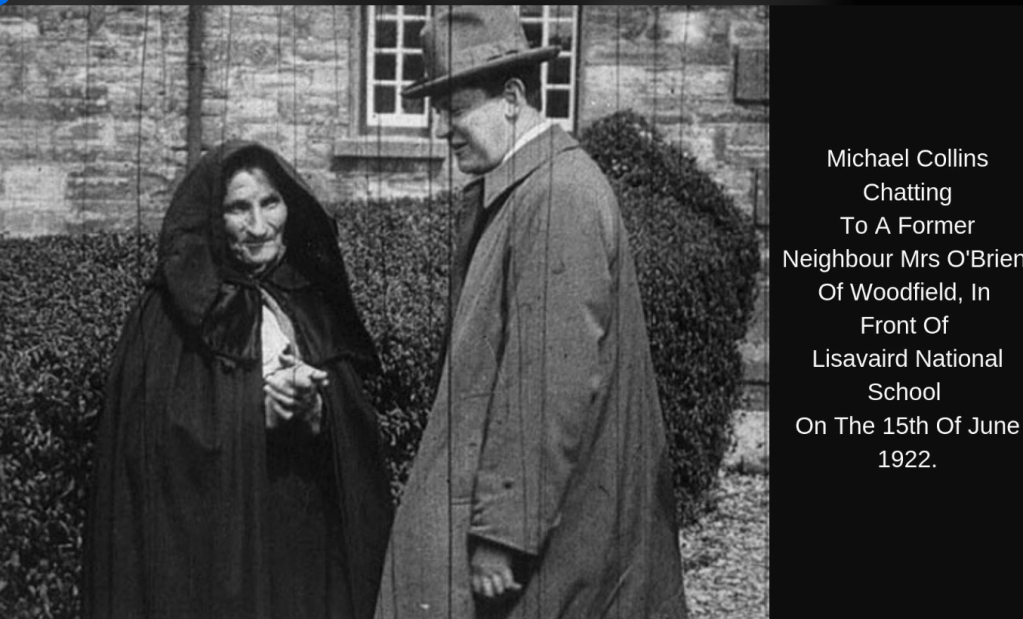
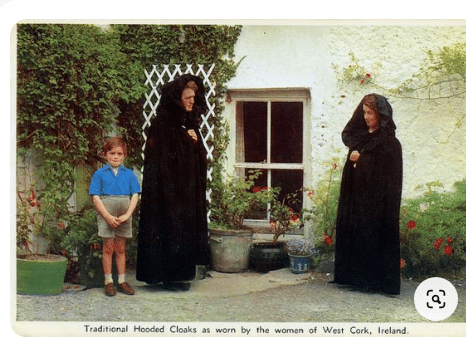
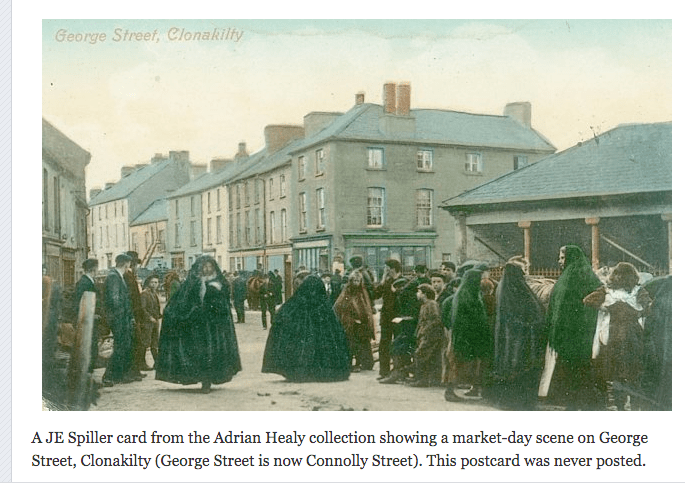
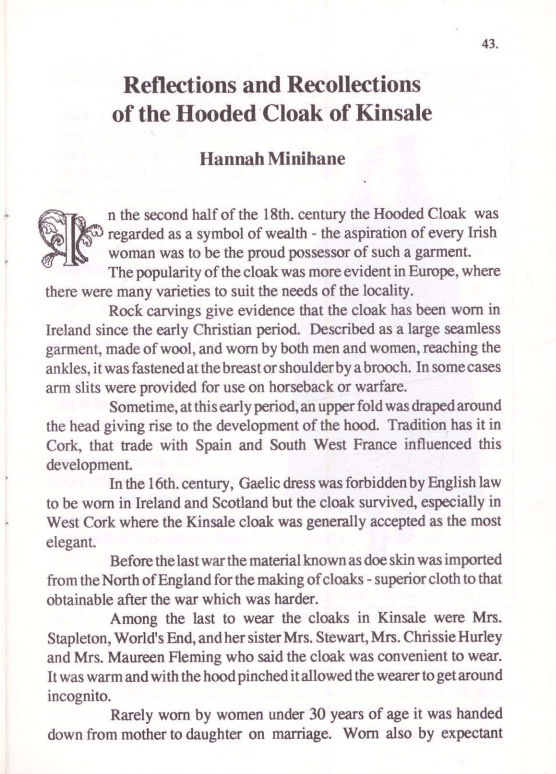
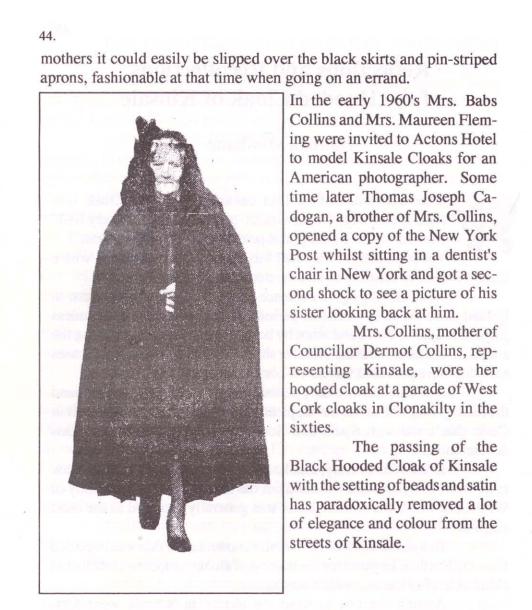
Kinsale and West Cork Cloak, Possibly of North African Origin, Death of Last Black Cloak Makers, Mrs. Ellen Kirby nee Richardson, Kinsale, Born Ballinspittle (1834-1920), her daughter Mary (1858-1940), Copy Made 1960s, for Kim Novak, Hollywood Star.

21 Friday Aug 2020

Posted by durrushistory in Uncategorized

≈ Leave a comment


Cork County Library have an excellent digital online resourse:

https://www.corkcoco.ie/en/library-services/library-online

Click to access f25a5dd044737c7ce09c685b315d0080.pdf

The West Cork Cloak features in Irelands Own stories of Kitty The Hare

The attached photo is of the cloak being worn by Margaret Arnopp, family originate in Goleen. The cloak probably belonged to Hannah Arnopp (nee Newman) who died in 1947. She wore it regularly and was one of the last women to do so.
Bantry

Courtesy Michael Collins Centre, Clonakilty:

Click to access 6496cecc0fd002c62652761de1e8e13f.pdf

Dunmanway

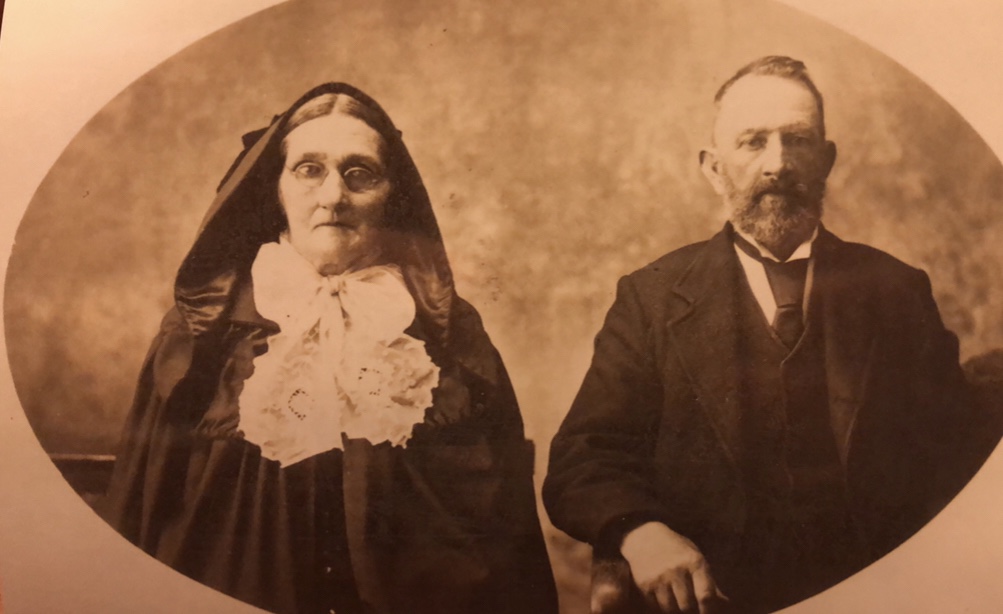
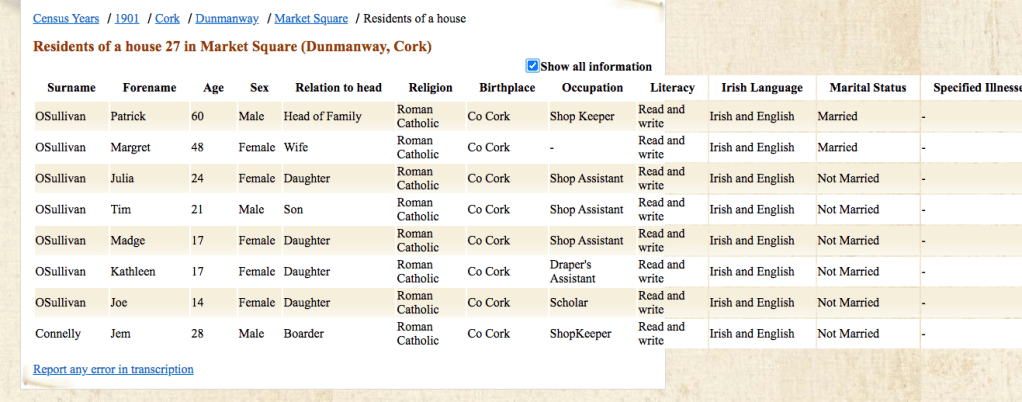
Margaret Mennis of Reenascreena and her husband Patsy Sullivan of Dunmanway. A nice example of the cloak. She obviously liked it and was of value to her to wear it for the photograph. it’s probably dated around 1900 taken in Dunmanway. Patsy was connected to the Board of Guardians at the D’way workhouse. His son Tim Patsy (Timothy) married the daughter of the Master, named Burke. She unfortunately died and he in turn married her younger sister. Tim Patsy bought the old Cox Manor House from Lucas and his the family are still there – Jack Sullivan. The lady in the photo had a tragic accident in about 1904 when she fell from a store window/door at the rear of their house on Main St. It’s the house that is now Duggans bar, next to Connolly’s shoe shop. 

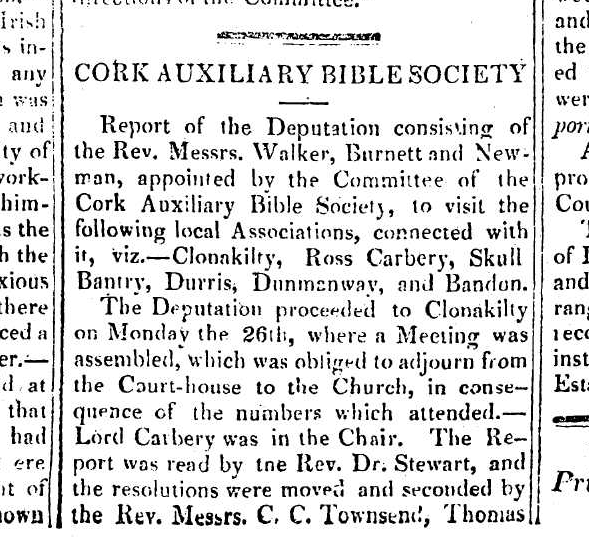
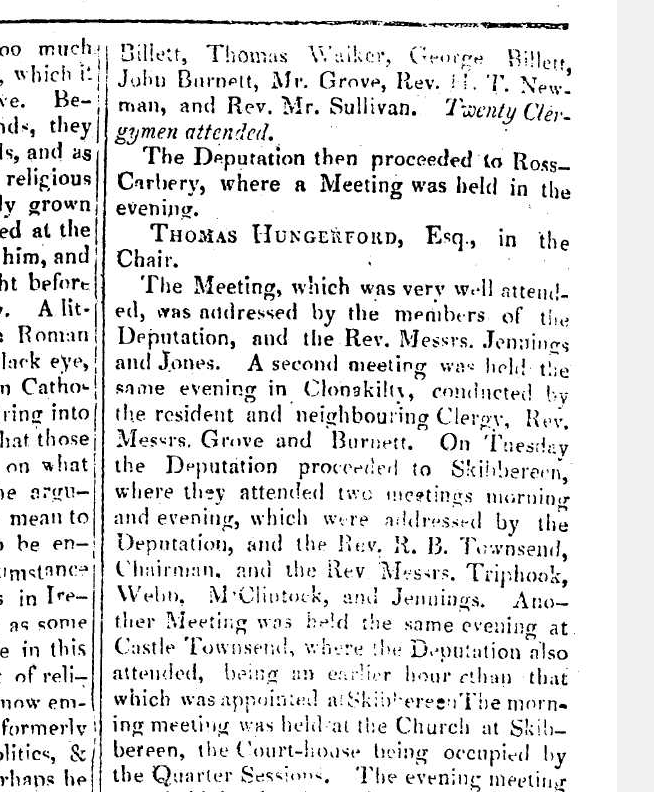
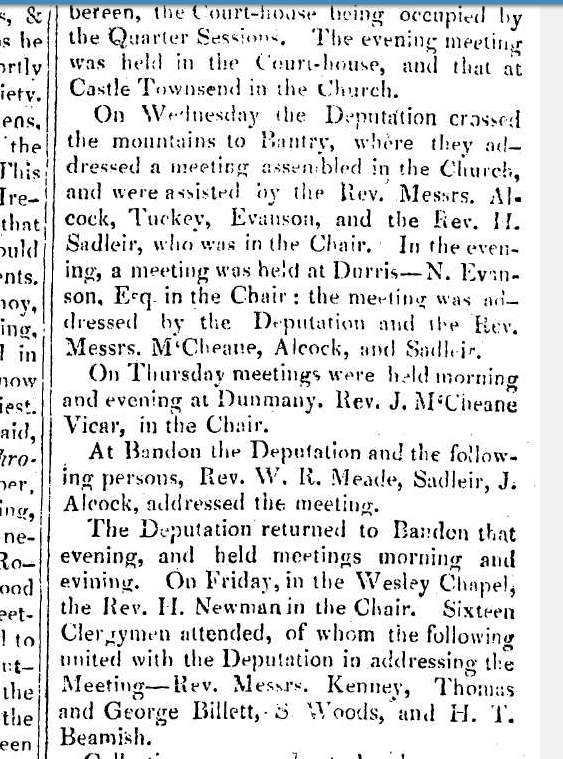
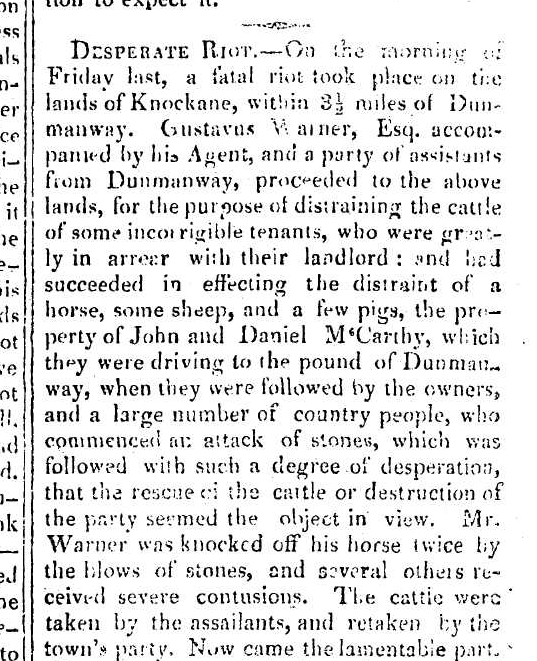
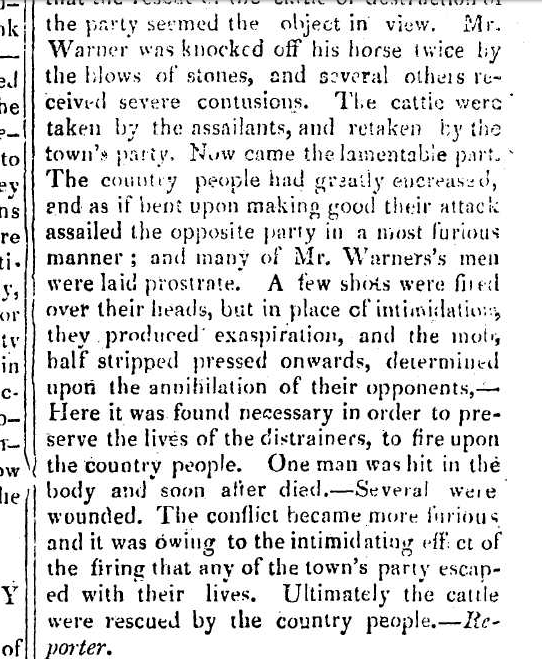
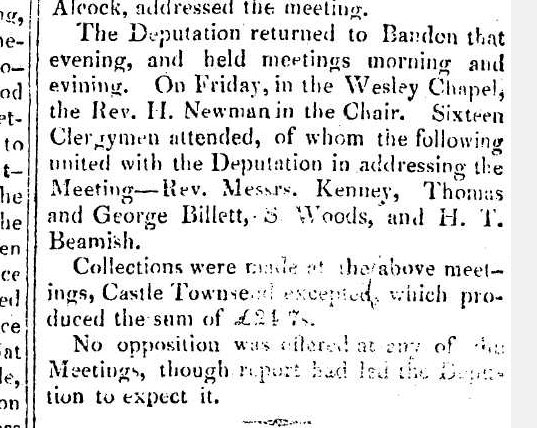
1828. Cork Auxiliary Bible Society Deputation Visit to Clonakilty, Rosscarbery, Schull, Bantry, Durrus, Dunmanway, Bandon, Opposition Expected None Materialised. Dunmanway attempt by Gustavus Warner, Esq and His Drivers to seize livestock at Knockane at attempt to Seize A Horse, Sheep and Pigs property of John and Daniel McCarthy, Locals Fired on. One man Killed.

19 Wednesday Aug 2020

Posted by durrushistory in Uncategorized

≈ Leave a comment


1828. Cork Auxiliary Bible Society Deputation Visit to Clonakilty, Rosscarbery, Schull, Bantry, Durrus, Dunmanway, Bandon, Opposition Expected None Materialised. Dunmanway attempt by Gustavus Warner, Esq and His Drivers to seize livestock at Knockane at attempt to Seize A Horse, Sheep and Pigs property of John and Daniel McCarthy, Locals Fired on. One man Killed.

https://wordpress.com/block-editor/post/durrushistory.com/35157

https://wordpress.com/block-editor/post/durrushistory.com/33824

https://wordpress.com/block-editor/post/durrushistory.com/22910

Dunmanway attempt by Gustavus Warner, Esq and His Drivers to seize livestock. The first Ordnance Survey Maps shows tht most town adn villages in West Cork had pounds. There cattle or other livestock that were seized for nonpayment of rent to tithes were held prior to auction.

Seizures were by drivers or proctors men often around midnight adn were often the cause or serious violence. With the coming of rates from 1850 adn the abolition of tithes pounds disappear from the mid 19th century. Rent arrears were through the courts ultimately in some case resulting in evictions.

https://wordpress.com/block-editor/post/durrushistory.com/36225

https://wordpress.com/block-editor/post/durrushistory.com/32826

https://wordpress.com/block-editor/post/durrushistory.com/30067

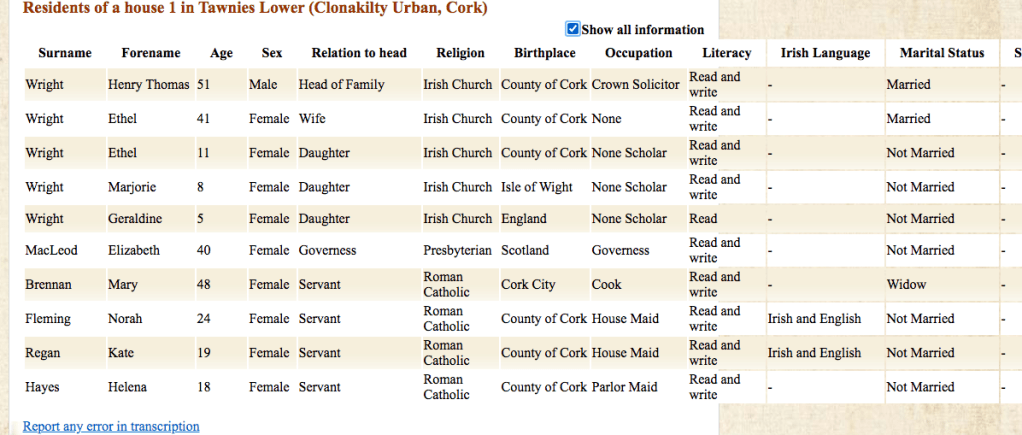
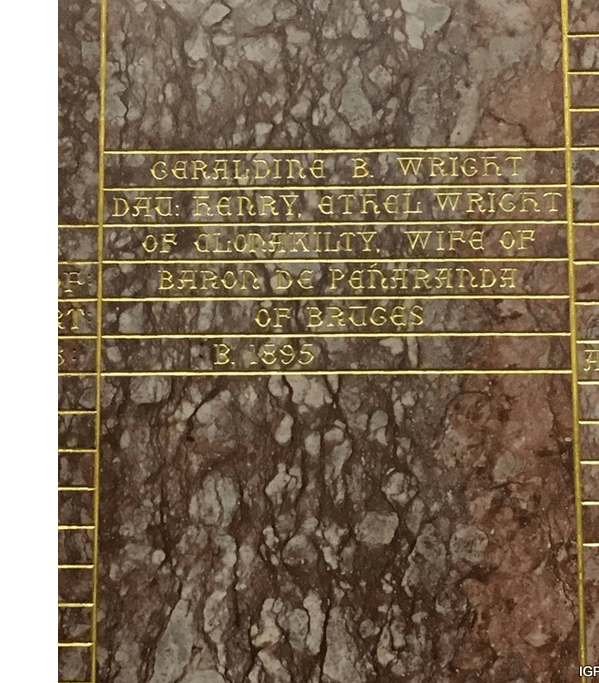
Geraldine Wright, Clonakilty, Daughter of Henry Thomas Wright, Mother Ethel Hungerford, Crown Solicitor, wife of the Baron de Penaranda, Bruges.

13 Thursday Aug 2020

Posted by durrushistory in Uncategorized

≈ Leave a comment


Geraldine Wright, Clonakilty, Daughter of Henry Wright, Crown Solicitor, wife of the Baron de Penaranda, Bruges.

GERALDINE B. WRIGHT | Dau. HENRY, ETHEL WRIGHT | of Clonakilty. Wife of

of Bruges.

St.Finbarrs cathedral Cork.

Headstones: St Fin Barre's Cathedral, Cork, Co. Cork, Ireland

http://www.igp-web.com/IGPArchives/ire/cork/photos/tombstones/1headstones/st-finbarrs.htm
GERALDINE B. WRIGHT | Dau. HENRY, ETHEL WRIGHT | of Clonakilty. Wife of
| Baron de Penaranda | of Bruges | B. 1895

Peñaranda de Franchimont


Skip to navigationJump in search
Arms of the family of Peñaranda de Franchimont (I. Stein d'Altenstein, 
Armorial of the Kingdom of Belgium , 1845)
De Peñaranda and 
de Peñaranda de Franchimont is a family from 
the southern Netherlands of Spanish origin. 
Today she is part of the 
Belgian nobility .


Photo No.45 To the Glory of God | and in loving memory of | Captain HENRY THOMAS | RICHARD SOMERSET WRIGHT | 2nd Manchester Regiment | Killed on active service | at DIBBIS SOUDAN | on Decr. 24th 1916 | Aged 32 years. | "He suffered and was buried" | "Awake thou that sleepest | and arise from the dead | and Christ shall give | thee light." | Also of HENRY THOMAS WRIGHT | Died April 13 1937 Clerk of the | Crown and Peace, Cork 1905 1926 Photo No.46 Sacred to the memory of THOMAS RICHARD WRIGHT | of Fern Hill, Clonakilty | Co. Cork. Died October 6th | 1881 aged 69. And to the | memory of | ETHEL WRIGHT | Nee HUNGERFORD | of Cahermore | Rosscarbery Co. Cork | And widow of H. T. WRIGHT | of Fern Hill, Clonakilty | Co. Cork. | Died Jan 25th 1944 aged 83. | Lt. Col. G. WRIGHT D.S.O. M.C. | Fern Hill Clonakily | 1886 - 1973 | LEILA his wife | 1900 - 1968 | Daughter of Col. MOORE C.B.E. | Binfield

Wright Estate:

http://landedestates.nuigalway.ie/LandedEstates/jsp/estate-show.jsp?id=3069

ESTATE: WRIGHT (CO CORK)

Associated Families

  • Wright (Co Cork)

Description

In 1666 William Wright was granted 839 acres in the barony of East Carbery, county Cork. The estate expanded over time but over 1400 acres was offered for sale in the Landed Estates Court in February 1860. This sale included lands in the baronies of West Muskerry and West Carbery as well as Lurriga Mill. Over 700 acres, the property of Samuel Digby Wright and Henry Wilson Wright (deceased) as well as interest in Lurriga Mill, were offered for sale in the Court in October 1874. In the 1870s Digby Wright of Bandon owned 715 acres, Henry Wright of Cashefane, Durrus, and Thomas R. Wright of Clonakilty owned 1,257 acres in county Cork. The representatives of Rev. Richard Wright held over 800 acres in county Cork in the 1870s.

The Clonakilty Wrights may be related to the Protestant Dunmanway O’Sullivan Landowning family which might explain their association with Cashelane, Durrus.

Thomas Richard Wright Solicitor. Land Agent to Lord Charles Pelham-Clinton, 1863, 13,600 acres. Fern Hill sons Henry Thomas 1850, Thomas William 1859, Solicitor. Signed Testimonial to Resident Magistrate, John Gore Jones, Bantry, 1844. Assistant 1879 Michael David Kennedy. Also agents for Durrus Estates. Subscriber memorial John O’Hea JP, Clonakilty, 1847. Probate 1880 to widow eliza £12,000. Thomas Richard Wright of Fern Hill, died 1880 he mentions his children and Rev. Richard Walton Marmion Standard Life Agent 1844. 1857 dinner for departing manager of National Bank, P.D. Griffin. Gave evidence Parliamentary Commission tht he persuaded Lord Shannon to withdraw his objection to railway coming to Clonakilty 1887 Chancey Court case involving recovery of seaweed at Friendly Cove, Durrus. Beamish v Crowley. Appearing for Beamish was Bewley Q.C., Trench Q.C., … Tuckey, instructed by John White. For Crowey, Piece White Q.C., , The McDermott, Q.C., Richard Wright, instructed by W. T. Wright , Clonakilty. The Crowleys are McDermotts descendant of Niall of the Nine Hostages who migrated from Roscommon post 1200, to about 1600 often known as McDermott (as in Elizabeth Fiants) with a leas ainm (nickname) Crua Laoich (tough warrior) which supplant the McDermott. DNA confirms connection.

https://wordpress.com/block-editor/post/durrushistory.com/37151

https://wordpress.com/block-editor/post/durrushistory.com/35483

https://wordpress.com/block-editor/post/durrushistory.com/28732

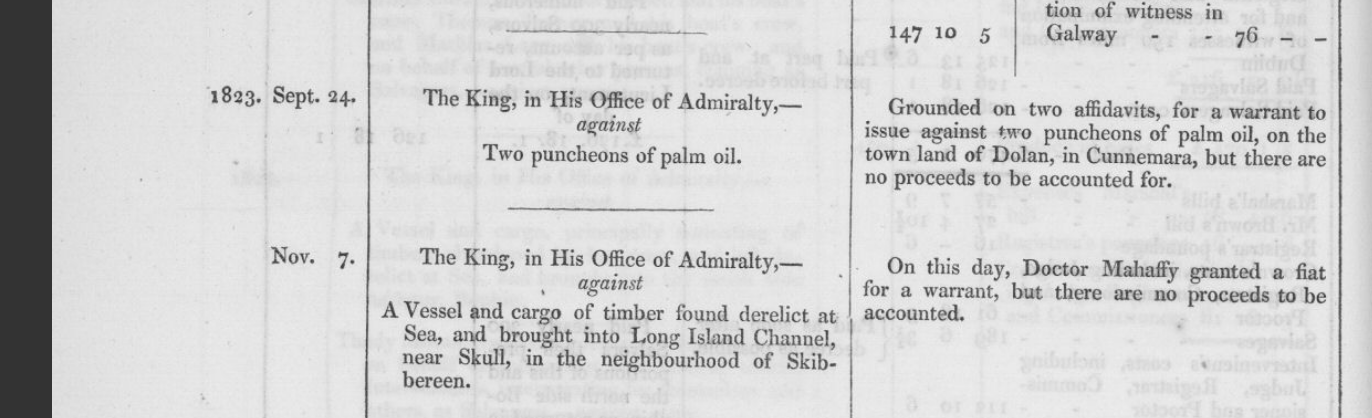
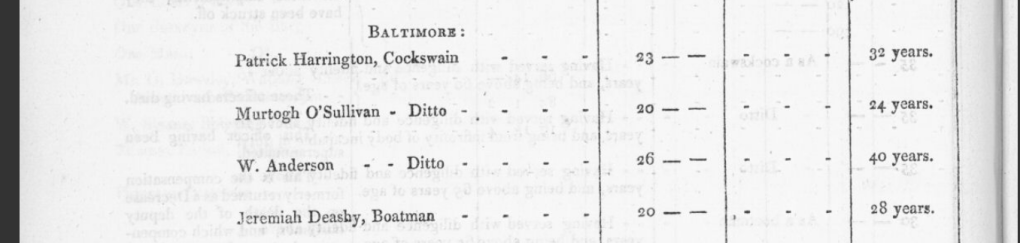
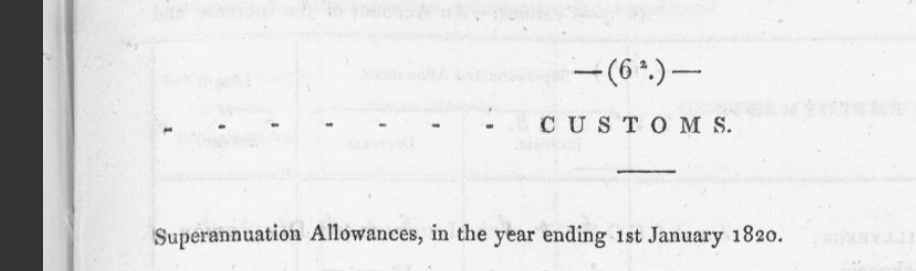
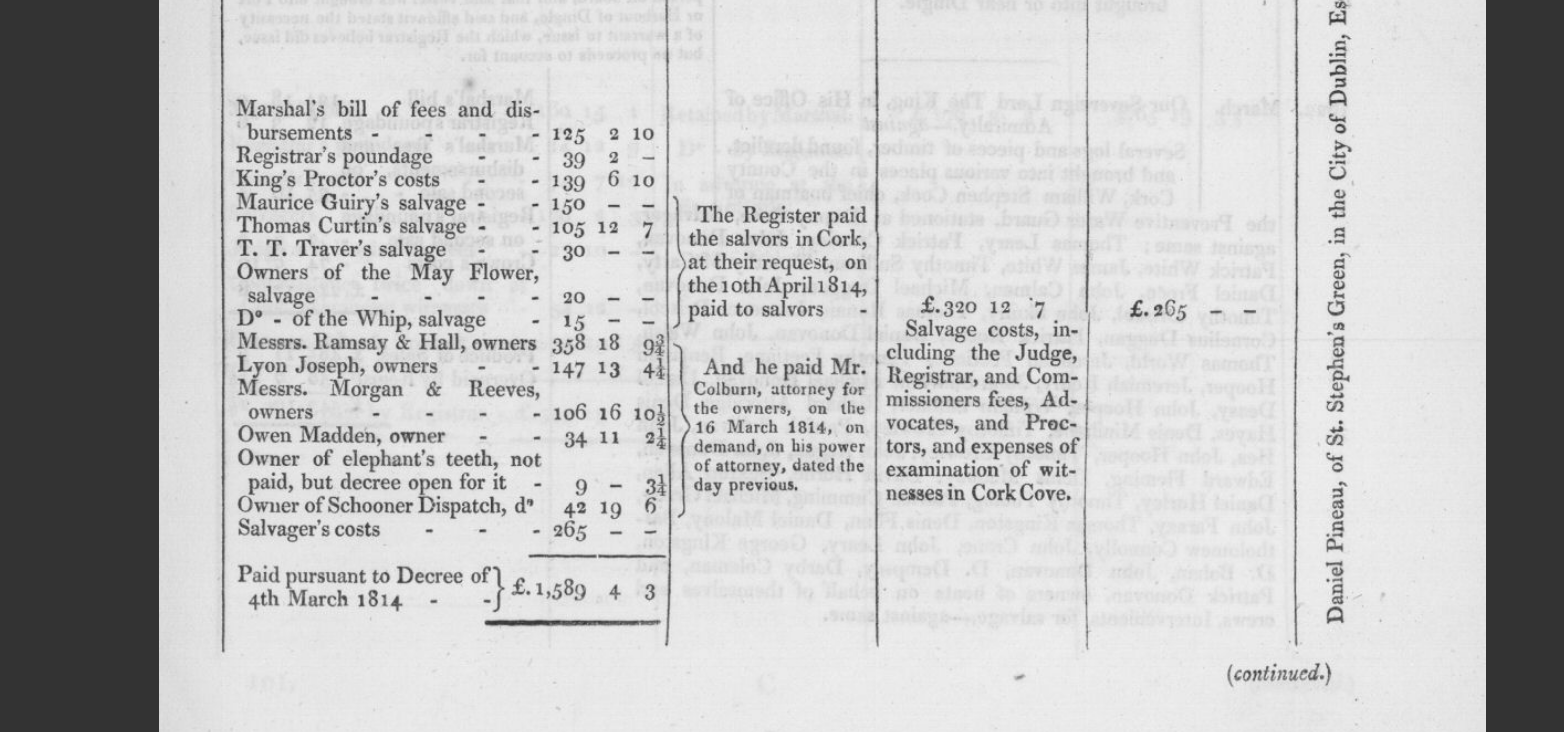
1812-1825, Admiralty Court, West Cork Wrecks, Dunny Cove, Clonakilty. Extensive Listing of Names of Boat Owners and Crews: Allen, Alteridge, Bohan, Coleman, Connolly, Crone, Crowley, Cumming, Deasy, Dempsey, Driscoll, Duggan, Farazy, Feetiane, Fleming, Flinn, Freen, Grady, Hayes, Hea, Honnor, Hooper, Hurley, Kingston, Leary, Mahony, McCarthy, Minihane, Regan, Ronan, Skinner, Sullivan, Twohig, White. 1820 Baltimore Customs

08 Saturday Aug 2020

Posted by durrushistory in Uncategorized

≈ Leave a comment


of Boat Owners and Crews: Allen, Alteridge, Bohan, Coleman, Connolly, Crone, Crowley, Cumming, Deasy, Dempsey, Driscoll, Duggan, Farazy, Feetiane, Fleming, Flinn, Freen, Grady, Hayes, Hea, Honnor, Hooper, Hurley, Kingston, Leary, Mahony, McCarthy, Minihane, Regan, Ronan, Skinner, Sullivan, Twohig, White

Admiralty Court, West Cork, Wrecks


.

.
.

.

Baltimore 1820

.

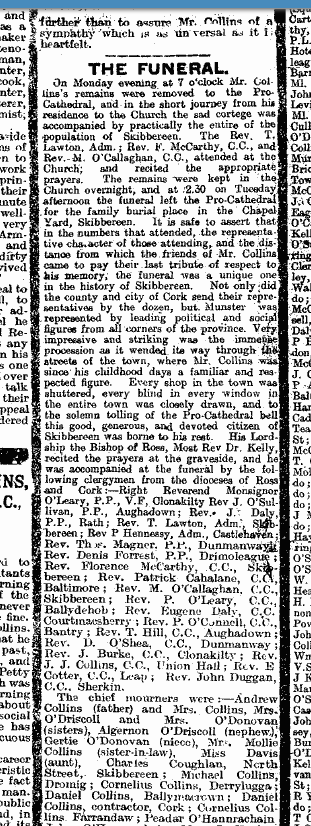
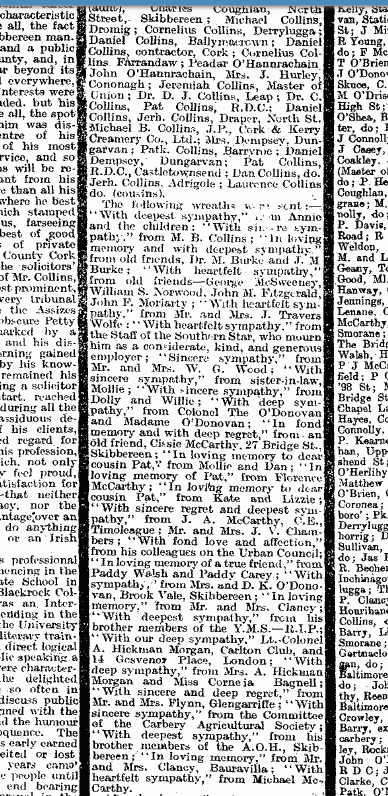
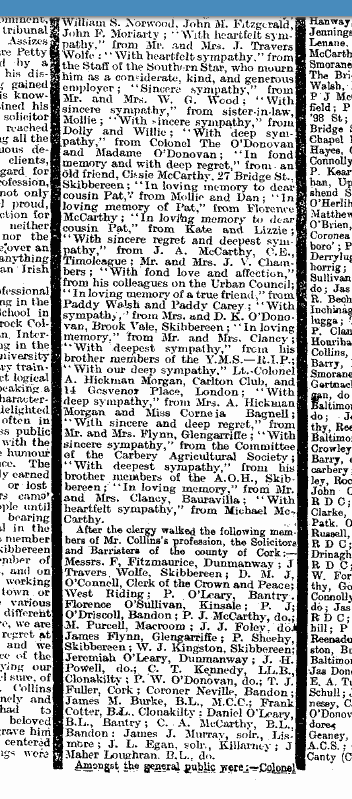
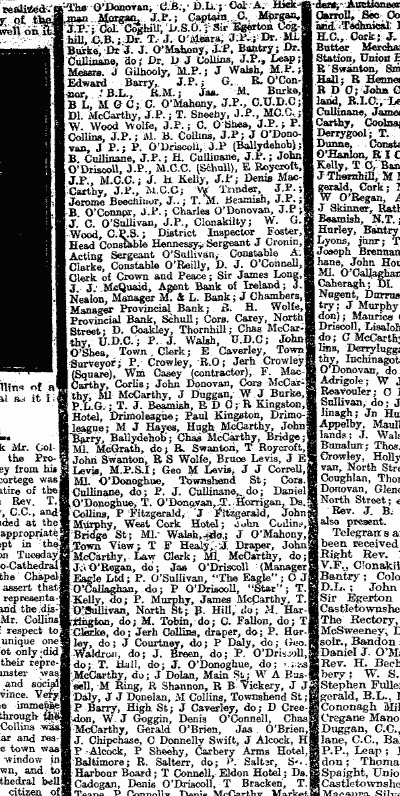
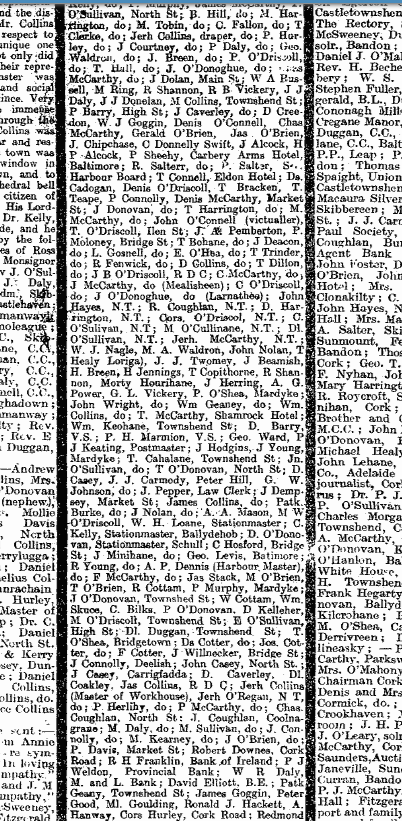
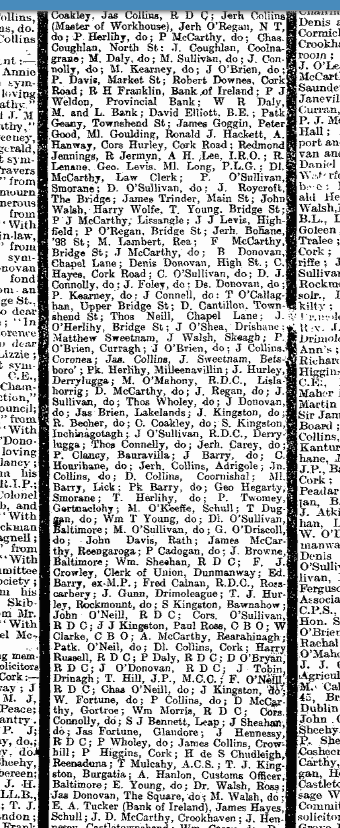
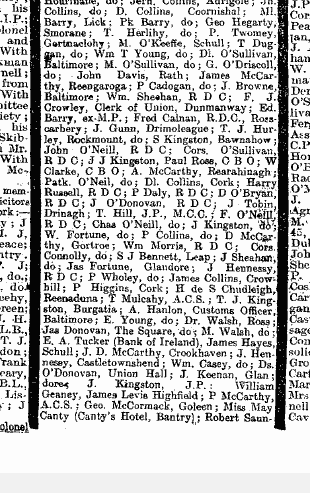
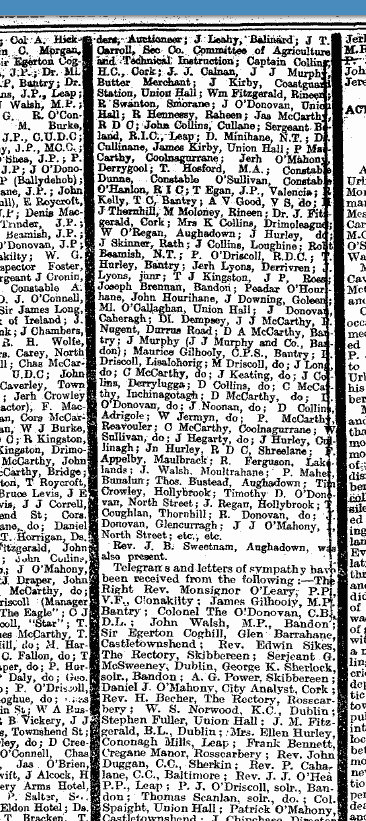
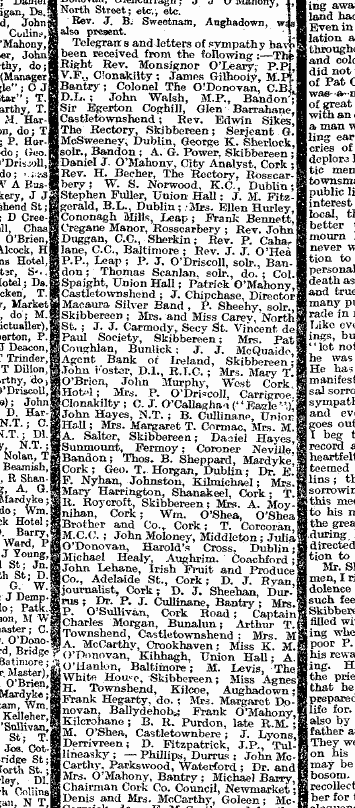
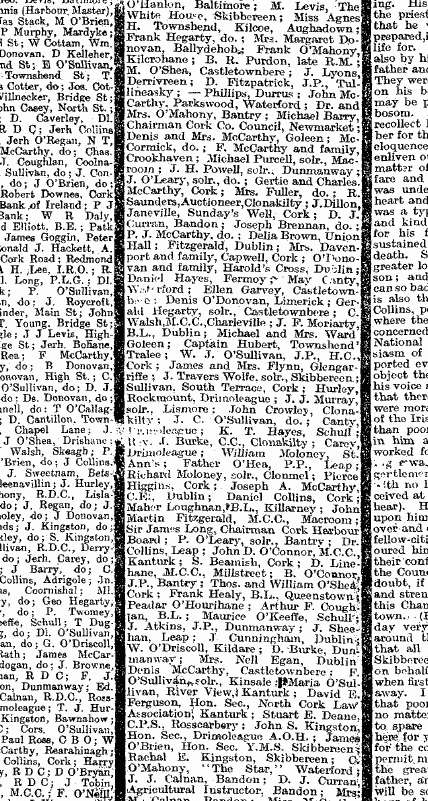
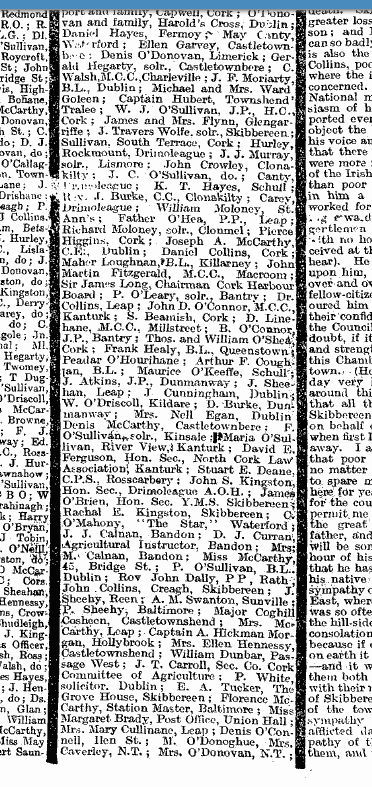
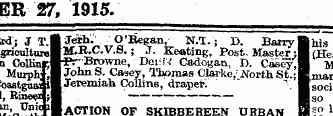
1915, Patrick James Collins, Solicitor, Skibbereen. Member County Council, Skibbereen Urban District Council. Enormous Funeral. Every Shop was Shuttered, Every Blind was Closed in Skibbereen.

06 Thursday Aug 2020

Posted by durrushistory in Uncategorized

≈ Leave a comment


1915, Patrick James Collins, Solicitor, Skibbereen. Member County Council, Skibbereen Urban District Council.

1873-1915 Patrick James Collins Solicitor, admitted 1896, apprenticed to Thomas Downes. Marshbanks, Blackrock College Dublin, TCD, Chairman UDC. 1911 single, 2 servants Committee Carbery Show 1892 . District Council 1914 assentors Timothy Sheehy, J.M. Burke,B.L.,he nominated William Joseph Burke.

Interesting he attended Blackrock College from the mid 19th century a class of prosperous Catholic professionals and merchants emerged the sons of the going to Clongowes College in Kildare as described by James Joyce, Blackrock College or some of the exclusive English Catholic Colleges such as Ampleforth.

Son of Andrew Collins Law Clerk 1876, Petty Session Clerk, Skibbereen and Drimoleague Committee Carbery Show 1892 and joint Secretary. Law Clerk 1876, assistant to Thomas Downes 1901 North St. aged 54, has Irish stable boy and servant in house. Son Patrick solicitor. Executor of Son Patrick 1915

This is one of the most detailed listing of a funeral in the local press. The First World War had started just a year before. Up to 50,000 Irish born men died, Denmark independent and neutral suffered only 700 casualties.

The revolution the following year 1916 changed everything, independence of limited form in 1922. Many of those listed were swept away by 1922.

y those comig out of the shadows,

.

.

.\\

.

.

← Older posts
Newer posts →

Blog Stats

  • 866,472 hits

16th Regiment of Foot assisted female emigration australia ballyclough bantry bay caithness legion cavan regiment of militia cheshire fencibles coppinger's court inbhear na mbearc Irish words in use 1930s lord lansdowne's regiment mallow melbourne ned kelly new brunswick O'Dalys Bardic Family. o'regan Personal Memoirs rosscarbery schull sir redmond barry sir walter coppinger st. johns sydney Townlands treaty of limerick Uncategorized university of Melbourne victoria

16th Regiment of Foot assisted female emigration australia ballyclough bantry bay caithness legion cavan regiment of militia cheshire fencibles coppinger's court inbhear na mbearc Irish words in use 1930s lord lansdowne's regiment mallow melbourne ned kelly new brunswick O'Dalys Bardic Family. o'regan Personal Memoirs rosscarbery schull sir redmond barry sir walter coppinger st. johns sydney Townlands treaty of limerick Uncategorized university of Melbourne victoria
Follow West Cork History on WordPress.com

Enter your email address to follow this blog and receive notifications of new posts by email.

Join 508 other subscribers

Feedjit

  • durrushistory's avatar durrushistory

Archives

  • April 2026
  • March 2026
  • February 2026
  • January 2026
  • December 2025
  • November 2025
  • October 2025
  • September 2025
  • August 2025
  • July 2025
  • June 2025
  • May 2025
  • April 2025
  • March 2025
  • February 2025
  • January 2025
  • December 2024
  • November 2024
  • October 2024
  • September 2024
  • August 2024
  • July 2024
  • June 2024
  • May 2024
  • April 2024
  • March 2024
  • February 2024
  • January 2024
  • December 2023
  • November 2023
  • October 2023
  • September 2023
  • August 2023
  • July 2023
  • June 2023
  • May 2023
  • April 2023
  • March 2023
  • February 2023
  • January 2023
  • December 2022
  • November 2022
  • October 2022
  • September 2022
  • August 2022
  • July 2022
  • June 2022
  • May 2022
  • April 2022
  • March 2022
  • February 2022
  • January 2022
  • December 2021
  • November 2021
  • October 2021
  • September 2021
  • August 2021
  • July 2021
  • June 2021
  • May 2021
  • April 2021
  • March 2021
  • February 2021
  • January 2021
  • December 2020
  • November 2020
  • October 2020
  • September 2020
  • August 2020
  • July 2020
  • June 2020
  • May 2020
  • April 2020
  • March 2020
  • February 2020
  • January 2020
  • December 2019
  • November 2019
  • October 2019
  • September 2019
  • August 2019
  • July 2019
  • June 2019
  • May 2019
  • April 2019
  • March 2019
  • February 2019
  • January 2019
  • December 2018
  • November 2018
  • October 2018
  • September 2018
  • August 2018
  • July 2018
  • June 2018
  • May 2018
  • April 2018
  • March 2018
  • February 2018
  • January 2018
  • December 2017
  • November 2017
  • October 2017
  • September 2017
  • August 2017
  • July 2017
  • June 2017
  • May 2017
  • April 2017
  • March 2017
  • February 2017
  • January 2017
  • December 2016
  • November 2016
  • October 2016
  • September 2016
  • August 2016
  • July 2016
  • June 2016
  • May 2016
  • April 2016
  • March 2016
  • February 2016
  • January 2016
  • December 2015
  • November 2015
  • October 2015
  • September 2015
  • August 2015
  • July 2015
  • June 2015
  • May 2015
  • April 2015
  • March 2015
  • February 2015
  • January 2015
  • December 2014
  • November 2014
  • October 2014
  • September 2014
  • August 2014
  • July 2014
  • June 2014
  • May 2014
  • April 2014
  • March 2014
  • February 2014
  • January 2014
  • December 2013
  • November 2013
  • October 2013
  • September 2013
  • August 2013
  • July 2013
  • June 2013
  • May 2013
  • April 2013
  • March 2013
  • February 2013
  • January 2013
  • November 2012
  • October 2012
  • September 2012
  • August 2012
  • July 2012
  • June 2012
  • May 2012
  • April 2012
  • March 2012
  • February 2012
  • January 2012
  • December 2011
  • November 2011
  • October 2011

Blog at WordPress.com.

  • Subscribe Subscribed
    • West Cork History
    • Join 508 other subscribers
    • Already have a WordPress.com account? Log in now.
    • West Cork History
    • Subscribe Subscribed
    • Sign up
    • Log in
    • Report this content
    • View site in Reader
    • Manage subscriptions
    • Collapse this bar
 

Loading Comments...