• About
  • Customs Report 1821-2 (and Miscellaneous Petitions to Government 1820-5) and some Earlier Customs Data, including staffing, salaries, duties including, Cork, Kinsale, Youghal, Baltimore, with mention of Bantry, Crookhaven, Glandore, Berehaven, Castletownsend, Enniskeane, Passage, Crosshaven, Cove, Clonakilty, Cortmacsherry.
  • Eoghan O’Keeffe 1656-1723, Glenville, Co. Cork later Parish Priest, Doneralie 1723 Lament in old Irish
  • Historic maps from Cork City and County from 1600
  • Horsehair, animal blood an early 18th century Stone House in West Cork and Castles.
  • Interesting Links
  • Jack Dukelow, 1866-1953 Wit and Historian, Rossmore, Durrus, West Cork. Charlie Dennis, Batt The Fiddler.
  • Kilcoe Church, West Cork, built by Father Jimmy O’Sullivan, 1905 with glass by Sarah Purser, A. E. Childs (An Túr Gloine) and Harry Clarke Stained Glass Limited
  • Late 18th/Early 19th century house, Ahagouna (Áth Gamhna: Crossing Place of the Calves/Spriplings) Clashadoo, Durrus, West Cork, Ireland
  • Letter from Lord Carbery, 1826 re Destitution and Emigration in West Cork and Eddy Letters, Tradesmen going to the USA and Labourers to New Brunswick
  • Marriage early 1700s of Cormac McCarthy son of Florence McCarthy Mór, to Dela Welply (family originally from Wales) where he took the name Welply from whom many West Cork Welplys descend.
  • Online Archive New Brunswick, Canada, many Cork connections
  • Origin Dukelow family, including Coughlan, Baker, Kingston and Williamson ancestors
  • Return of Yeomanry, Co. Cork, 1817
  • Richard Townsend, Durrus, 1829-1912, Ireland’s oldest Magistrate and Timothy O’Donovan, Catholic Magistrate from 1818 as were his two brothers Dr. Daniel and Richard, Rev Arminger Sealy, Bandon, Magistrate died Bandon aged 95, 1855
  • School Folklore Project 1937-8, Durrus, Co. Cork, Schools Church of Ireland, Catholic.
  • Sean Nós Tradition re emerges in Lidl and Aldi
  • Some Cork and Kerry families such as Galwey, Roches, Atkins, O’Connells, McCarthys, St. Ledgers, Orpen, Skiddy, in John Burkes 1833 Commoners of Great Britain and Ireland:
  • Statement of Ted (Ríoch) O’Sullivan (1899-1971), Barytes Miner at Derriganocht, Lough Bofinne with Ned Cotter, later Fianna Fáil T.D. Later Fianna Fáil TD and Senator, Gortycloona, Bantry, Co. Cork, to Bureau of Military History, Alleged Torture by Hammer and Rifle at Castletownbere by Free State Forces, Denied by William T Cosgrave who Alleged ‘He Tried to Escape’.
  • The Rabbit trade in the 1950s before Myxomatosis in the 1950s snaring, ferrets.

West Cork History

~ History of Durrus/Muintervara

West Cork History

Author Archives: durrushistory

Public meeting in Skibbereen re failure of Munster Bank in 1885

20 Thursday Oct 2022

Posted by durrushistory in Uncategorized

≈ Leave a comment


https://docs.google.com/document/d/1spML-5s28rs1uUEshmF_IaOU8hdxHWDPg-JcalhKGAI/edit

Skibbereen Meeting re Failure of Munster Bank

From  Should the Munster Bank have been saved?  Cormac Ó Gráda, University College Dublin  WP01/ 15July 2001

https://www.researchgate.net/publication/24140366_Should_the_Munster_Bank_have_been_saved

In the century and a half since Sir Robert Peel s Bank Act of 1845 only two major Irish banks have failed.  The Tipperary Bank, which folded in February 1856, was one of the swindles perpetrated by John Sadleir M.P.   Less drastic in terms of losses to shareholders but more interesting as banking history is the collapse of the much bigger Munster Bank inJuly 1885.  Though the problems which led to its demise were largely self-inflicted, several observers felt at the time that it could, or should, have been rescued.  Some even accusedIreland s then quasi-central bank, the Bank of Ireland, of allowing it to sink.  Was this an example of the Bank of Ireland failing to discharge its unofficial responsibility as the Irish Banking system’s lender of last resort (LLR)?  Or was it a case of the Old Lady of College Green acting so as to minimise the moral hazard inherent in that function

…

.

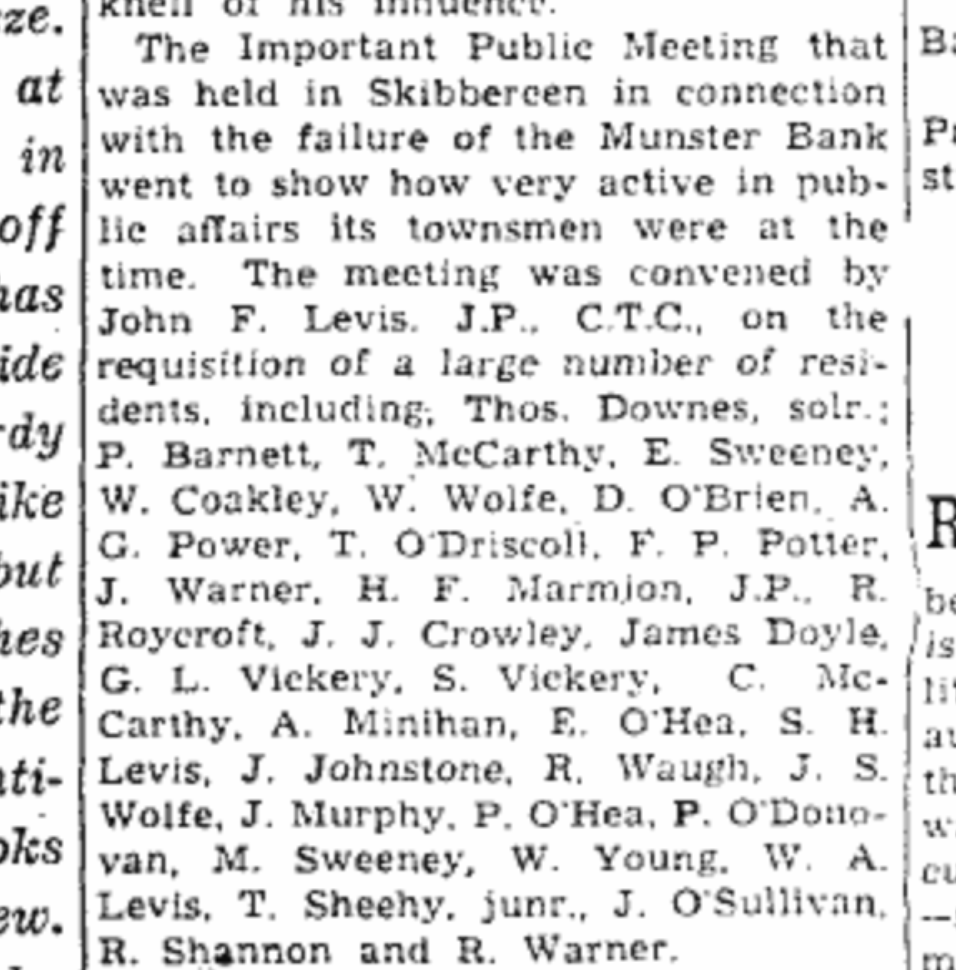
Convened public meeting in Skibbereen re failure of Munster Bank in 1885

Of those mention attending the meeting

.

Richard Carey, (1838-, Skibbereen, 188?,  son of Rev. Richard, Tipperary, ed Fermoy College, Manager Munster and Leinster Bank.  m Katherine d William Hill Cork 8 children.   Present at the opening of Skibbereen Railway, July, 1877.  1909 Funeral Dr. William Jennings, Doctor and  Magistrate, Skibbereen. Listed North Main St., Youghal, 1916

Dr. John Samuel Levis, TCD,  M.D., 1865, (1822-1902), Glenview, Skibbereen, Resident, £182.  Son of Samuel, Baronial Constable and major land holder.  Adjudicating Magistrate Skibbereen and Drimoleague Districts. Ex-Officio member Skibbereen Board of Guardians. Regarded as a tolerant Landlord well respected. Levis family pre 1800 usually described as Lavers of Huguenot origin.  Sitting Drimloleague 1866.1885 chairing presentment session West Division, West Riding.  1893, attending funeral of Michael Sheehy, T. C., P.L.G., Skibbereen. 1901 two servants. Probate 1903 to Bruce Levis, £2,472.

Thomas Downes, Solicitor, North St. “Born son Thomas Mitchelstown, Castleknock College, Gold Medalist, partner with McCarthy Downing MP 1870, land agent to Wrixon-Beecher, Local bodies and railways.  Subscriber (3 copies) Dr. Daniel Donovan ‘History of Carbery, 1876. Probably advanced money in 1888 and secured a mortgage to Whites (Lord Bantry).  Paddy O’Keeffe   1894 assistant John James Carmody.  1876 Andrew Collins. Attending  1893, Rev. Charles Davis, Parish Priest, Baltimore aged 63, Founder of Baltimore Fishery School. ” “1871 funeral Skibbereen, Timothy McCarthy Downing, solicitor, MP, landlord.   Married 1876, Teresa d late Charles O’Connell, RM, Bantry, and first Catholic MP for Kerry whose wife was the 2nd daughter of Daniel O’Connell.   subscriber Zenith Marine Disaster, Baltimore, 1895.  1877.   Opening  Skibbereen Railway

T. Downes  J. E. Marshall  Prominent in Carbery Agricultural Show.  Sent a carriage to the funeral of Lieutenant-Colonel Thomas Somerville D.L. (1824-1898), Clontaff, Drishane. Died 1904, probate to widow Theresa and Daniel O’Connell Esq Agent Bank of Ireland Effects £10,676 5s 6d…..

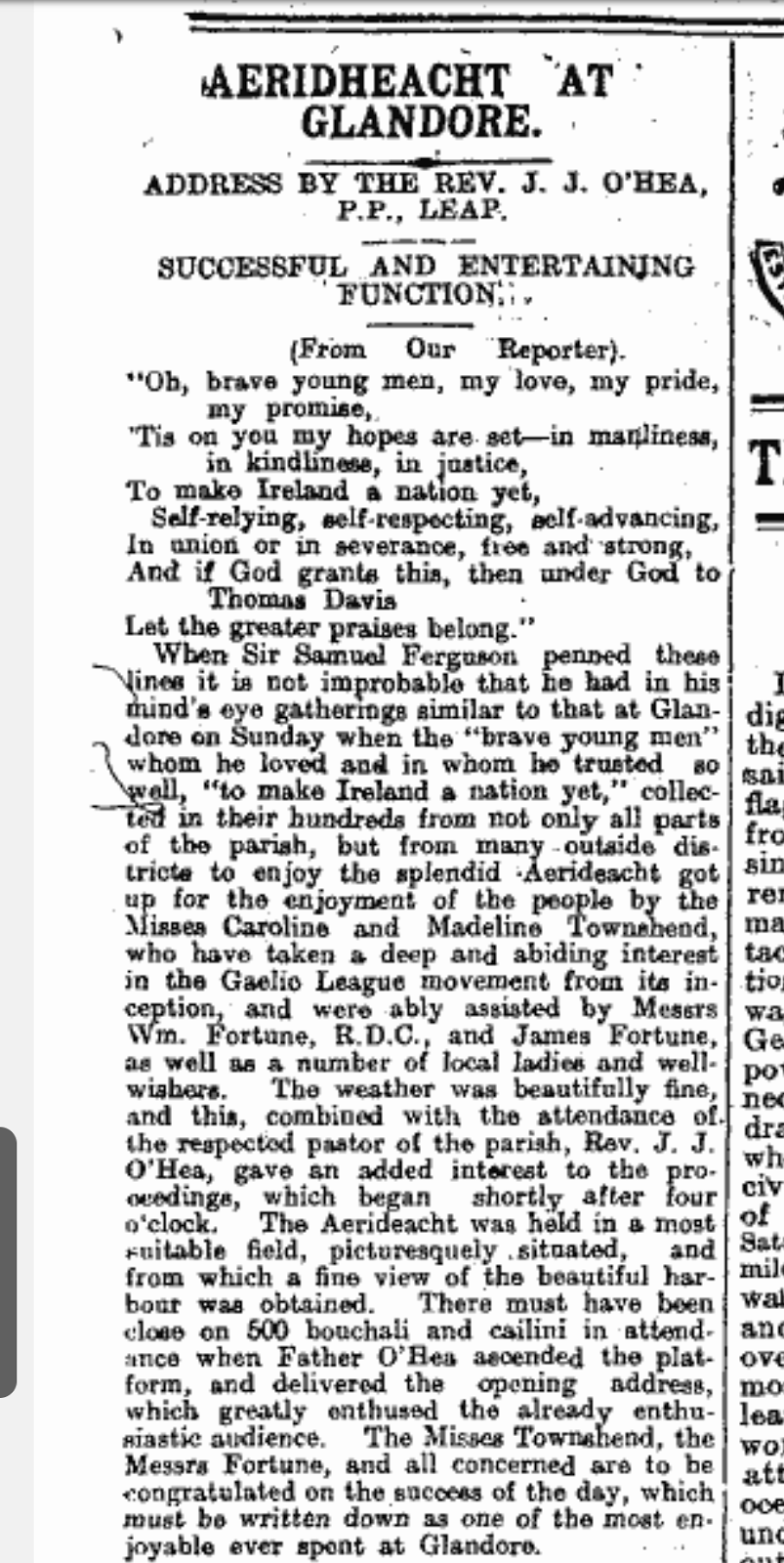
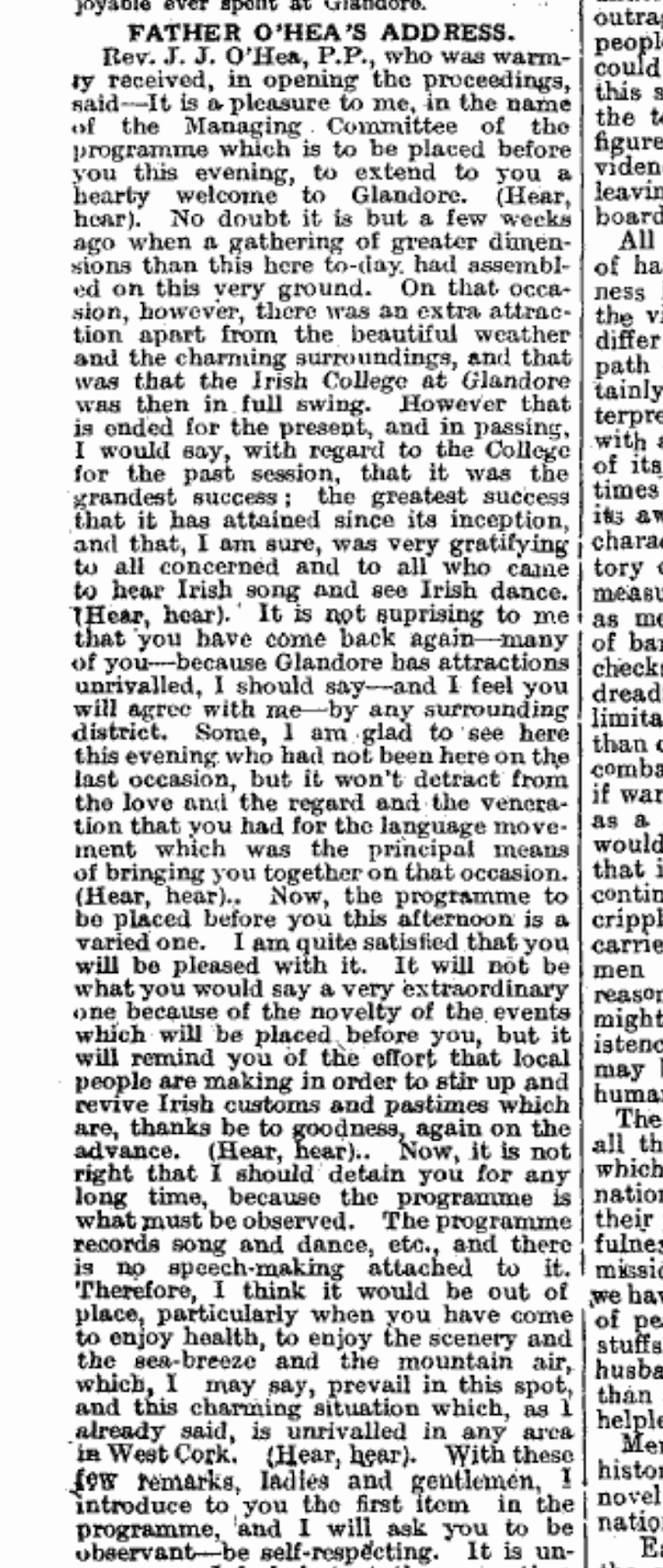
Ms. Carrie (Caroline Mary)  Townshend, (1859 -1951).  West Cork  and Dublin.  Popularity of the Irish Harp.  Teacher of Irish. Giving evidence in America of British Brutality During Troubles in Ireland.  Member Christian Science Church.  1915 Aeridheacht at Glandore with Madeline Townshend.  The name Caroline Townshend is known to only a handful of people in Ireland but if any deserves to be a household name, surely it is hers, for it almost entirely due to her efforts that the ancient Irish harping tradition became firmly re-established.

19 Wednesday Oct 2022

Posted by durrushistory in Uncategorized

≈ 1 Comment


https://docs.google.com/document/d/17vjisOFikNYRJbVWV36jHXwpIXB_XcT1u7oNHdLnoog/edit

Ms. Carrie (Caroline Mary)  Townshend, (1859 -1951).  West Cork  and Dublin.  Popularity of the Irish Harp.  Teacher of Irish. Giving evidence in America of British Brutality During Troubles in Ireland.  Member Christian Science Church.  1915 Aeridheacht at Glandore with Madeline Townshend.  The name Caroline Townshend is known to only a handful of people in Ireland but if any deserves to be a household name, surely it is hers, for it almost entirely due to her efforts that the ancient Irish harping tradition became firmly re-established.

Re Peadar Ó hAnnracháin, (1873-1985). Peadar was a wonderful Conradh na Gaeilge organiser throughout a number of counties including Cork and he wrote several books as Gaeilge. He also wrote on the Southern Star as ‘Cois Life’ in the 1940s and 1950s. In that period he worked in the Pigs and Bacon Commission in Dublin.  The column often wandered over long lost history, family relationships and there was a touch of the ‘Seanachaí’ about them.  The daughter of the Gaelic Scholar, landowner and businessman in Ballydehob Thomas Swanton, Crianlarich, gave him her father’s papers.

…

The extended Townshend/Townsend family of West Cork have a rainbow of political opinion from bright Orange to bright Green.  Carrie is definitely on the Green wing.  One of the rarely matriarch of the family is Helen Gallwey alias Townsend1709 Wife to Philip Townsend and daughter to John Galway, of Cork, Esquire.  She is Ancestor of Skibbereen Townsends The Cork Galweys/Galways may be Hiberno-Danish in origin She appears in the Convert Rolls ac converting to the Church of Ireland due to the Penal Laws.

..

This account is very much in the style Peadar Ó hAnnracháin, (1873-1985).

One of Ireland’s Great Patriots. Sir Richard Griffith (1784–1878). Partial Reminiscences Dictated 1869. Lent by Ashley Powell SC.

14 Friday Oct 2022

Posted by durrushistory in Uncategorized

≈ 1 Comment


Sir Richard Griffith Partial Reminiscences Dictated 1869. Lent by Ashley Powell SC.

Ashley Powell SC

Professor Ashley Powell, B.A., T.C.D., B.L., S.C. Barrister, 1913,  Judge Egypt to 1923 after practising Cairo in British and native courts, British Intelligence in Middle East, WW1, wounded Arabia, Reid professorship of Law TCD 1930,  Senior Counsel 1947, Bencher 1956, Registrar St. Patrick’s Cathedral, Member Church of Ireland Council, Son of Venerable Archdeacon Dace Powell, St. Annes Shandon.  Nephew Dr. Ashley Cummins, Professor of Medicine UCC. Grandson of Dr. William Jackson Cummins, South Mall.  Attending the 1953 funeral of Jasper Travers Wolfe, solicitor, Skibberen.  Went to Cambridge to study Arabic.  Married 1922 Dorothy Uniacke Townsend, Pairc-na-Saileoge, Enniskerry of West Cork family. 1941 funeral of Geoge Daly representing Protestant Barristers.  Jack Lynch, Circuit Court Office later Taoiseach, P.D. Fleming, B.L., Sean McBride, B.L., Mrs. Siobhan McCurtain-McNamara, B.L., F. Neville B.L., S. Fawsitt, B.L., T. Desmond, B.L., F. McCarthy-Cotter, Father of the Cork Circuit,  D .O’Donovan Junior, B.L., D.P. Forde., B.L., Jasper Travers Wolfe representing Incorporated Law Society, Prof C. K. Murphy UCC Law Department, Ashley Powell representing Protestant members of the Bar Funeral of  Maurice Healy (1859-1923), Bantry  Born Solicitor,  Jubilee Dinner given to him by the Bar at Victoria Hotel addressed by John A. Costello, father of Munster Bar, former Taoiseach. Son William Powell, M.D. Cork

https://photos.google.com/share/AF1QipMKvCprk8V8y_V-_uTf1Ti0pbBb6k7tnzmI3ChHI_gpG6BBLvThYYeSWakPaIWkyA?key=cS1lSjVzMWwySUNhWFZQa1RmaDFOWWpzWDYxVFlR

1831, Sir Richard Griffith Report on Bridges he Built on Roads from Skibbereen to Crookhaven and Skibbereen to Bantry, Span, Cost, Location.

https://wordpress.com/post/durrushistory.com/36560

1824 Richard Griffith, Road Engineer, Progress Report, Skibbereen to Crookhaven, Wheeled Carts now Appear, where heretofore Loads were carried on the Backs of Horses, New Entrance to Town Of Bandon, Road From Courtmacsherry to Timoleague, Road from Clonakilty to New Fishery Pier At Ring, New Road Skibbereen to Bantry, Macroom to Killarney, with a Note on The System of Labour Organisation Used.

https://wordpress.com/post/durrushistory.com/30429

Griffith’s Roads: Report of Patrick Leahy, Civil Engineer, 1834 to Co. Cork Grand July of Progress of Road from Dunmanus Bay to Skibbereen, Nearly Completed, Extension to Ballydehob Approved, and Report of Edmund Leahy, County Surveyor to Grand July 1840 on Ballylickey to Crookstown, 27 miles Active, Bantry to Glengariff 10 miles Near Completion, Crookhaven to Barleycove, Ballydehob to Bantry To Be Finished Current Season.

https://wordpress.com/post/durrushistory.com/30113

Report of Richard Griffith Engineer on new road Skibbereen to Bantry 1823

https://www.dib.ie/biography/griffith-sir-richard-john-a364

Griffith, Sir Richard John Contributed by Jackson, Patrick N. Wyse Griffith, Sir Richard John (1784–1878), public servant, surveyor, and geologist, was born 20 September 1784 at 8 Hume St., Dublin (the house is marked by a plaque), son of Richard Griffith (qv), MP for Askeaton, deputy governor of Co. Kildare, and director of the Grand Canal Co. of Ireland, and Charity Yorke (née Bramston; d. 1789) of Oundle, Northamptonshire. His father had made a considerable fortune with the East India Co., but lost a great deal of money during the building of the canals. Griffith spent much of his childhood at his father’s estate at Millicent, Co. Kildare. He was educated at a number of provincial schools, in Portarlington, Queen’s Co. (Laois), and then Rathangan, Co. Kildare, and at the age of 15 joined the Royal Irish Regiment of Artillery in 1800. His army sojourn was short; following the enactment of the act of union in 1801, Griffith resigned his commission (but continued to receive full pay) and went to London, where he studied geology, chemistry, and mineralogy at William Nicholson’s Scientific Establishment for Pupils. At much the same time he also studied chemistry under Robert Perceval (qv) of TCD. In 1806 he was in Edinburgh, where he attended the lectures of Robert Jameson, and moved in the city’s scientific circles, becoming a fellow of the Royal Society of Edinburgh the following year. Between 1809 and 1813 he served as one of a number of engineers appointed to investigate and map bogs for the Irish bog commissioners, and produced a valuable report on the bog of Allen. Recognising his newly acquired geological expertise, the Dublin Society in 1809 commissioned him to survey the Leinster coalfield; his report and map were published in 1814, and he followed this with similar reports for the Connacht coalfield (1819) and that of Co. Tyrone and Co. Antrim (1829). He served as the society’s mining engineer (1812–39), which required him to deliver a public course of lectures, and was engaged in road and bridge building in the south-west of the country (1822–36). During this period he was responsible for laying out 243 miles of roads and erecting eighteen bridges; his finest bridge is that of five arches which spans the River Feale at Listowel, Co. Kerry. Griffith is today mainly remembered for his work as commissioner of the general survey and valuation of rateable property (1830–64). He was responsible for overseeing two important surveys. The first general survey undertaken was the ‘perambulation’ or ‘boundary survey’, which mapped the extent of the 68,000 townlands in Ireland. The second tenement valuation survey, now known as the ‘Griffith valuation’, was established in 1846 and charged with estimating the value of land holdings, data that was then used to determine local taxation levies. From 1836 he was a commissioner of railways (the commission deliberated until 1838 on the most suitable routes for Ireland’s developing rail network), and later was appointed deputy chairman, and subsequently chairman, of the board of works, positions he held between 1846 and 1864. Through his own field observations and through those of a number of members of the valuation staff, most notably Patrick Ganly (qv), Griffith acquired a comprehensive knowledge of the geology of Ireland. He was determined to produce a geological map of the country that would match William Smith’s 1815 geological map of England and Wales, and in 1839 he persuaded the railway commissioners to publish such a map at the scale of a quarter of an inch to the mile; further revised versions appeared up till 1855. Griffith was very proud of his geological cartographic achievement but failed to acknowledge the major contribution of others in its genesis. His fossil collections were described in two monographs (1844, 1846) by Frederick M’Coy (qv), and these remain important sources for modern-day palaeontological research. Griffith was an active and founder member of the Geological Society of Dublin and its successor the Royal Geological Society of Ireland, serving on the council for many years and as its president (1836, 1840). He was elected an honorary member of the Geological Society of London (1808) and an MRIA (1819), and was president of the geological and geographical section at the 1835 Dublin meeting of the British Association for the Advancement of Science. TCD conferred on him an honorary LL.D. (1849) and honorary MAI (1861). In 1854 he was awarded the Wollaston medal by the Geological Society of London. He was elected president of the Institution of Civil Engineers of Ireland (1850–55; 1861–63). Griffith had a remarkable, long, and varied career as a public servant, and he was rewarded for this work with a baronetcy in 1858. He died 22 September 1878 at his home, 2 Fitzwilliam St., Dublin (marked, like his birthplace, with a plaque), and is buried in a prominent position in Mount Jerome cemetery, Dublin. A marble bust by Sir Thomas Farrell (qv) is in the possession of the RDS. He married (September 1812) Maria Jane Waldie (1786–1865) of Kelso, Scotland. They had one son – George Richard (d. 1889), who later took the surname Waldie-Griffith on inheriting his mother’s family Scottish estate in 1865 – and four daughters. His eldest daughter Jane, was thought to have eloped to America at the age of 16, and was apparently never mentioned in the family circle again. Sources G. L. Herries Davies and R. C. Mollan (ed.), Richard Griffith 1784–1878 (1980); G. L. Herries Davies, Sheets of many colours: the mapping of Ireland’s rocks 1750–1890 (1983); G. L. Herries Davies, article in ODNB (2004); R. Griffith, ‘Autobiography’, MS dated 25 Aug. 1869 (copies in NAI and NLI) PUBLISHING INFORMATION

1950, Funeral.  Father William Holland, (An Athair Líam Uí Ualacháin) Parish Priest of Ardfield, Author History of West Cork and the Dioceses of Ross.  His Holland Brothers, Nephews their World War 1 Service.

13 Thursday Oct 2022

Posted by durrushistory in Uncategorized

≈ Leave a comment


https://docs.google.com/document/d/1MzjuNbHTOwR-PdBnv7KRiyc4Xggkaad2CC3MPMzuu9w/edit

Father William Holland, Ardfield, Clonakilty, (1876-1950). 1949 History of West Cork. Included genealogies of Barrys, De Courceys, McCarthys, O’Crowleys, O’Driscolls, O’Heas, O’Hurleys, O’Mahonys, O’Sullivans. 1950 Funeral and Background.

Father William Holland, SMA, 1911-1952 was a relative.

His extended family included the O’Heas and Maddesn of Ardfield. Included was the famous Master Madden, after he finished this National School at Ardfield he ran a cramming school to prepare I think boys only for English Civil Service e Exams. Included among his pupils were future revolutionaries Sam Maguire and his brother and Michael Collins.

At the back of the book is a series of notations by John T.Collins from Kilmeen, Clonakilty. He was part of a loose group including Paddy O’Keeffe, Bantry, Bernard O’Regan, Aughadown, Emmet O’Donovan, Clonakilty. He assisted Basil O’Connell in compiling ‘The O’Connell Tracts’. In the 1950s he was given access to a 18th century collection of Cork Newspaper compiled by the Kearneys of Garrettstown House. By the 1950s Mr. Cussen, Solicitor, Newcastle West had the collection. John T. Collins published widely in the Cork Historical adn Archaeological JOurnal available online great research highly accurate.

History of West Cork:

Pretty much a a stunning achievement before the Internet and Google and the he spent long periods serving in Northern Nigeria.

Funeral and background:

https://photos.google.com/share/AF1QipMIfS_tZBVzk6nxPSY8FobTKXQIT0pG4UgoqVjtlzdLiwteVHZKMEcdEG3NamhszA?key=azNfNy1XamRBdUdBTWthM2p6aHB6VkZ2LWl0MXRB

Funeral and background:

https://docs.google.com/document/d/1mBDukIFQhkhJiRA5xOIfNPtIDgWzoz_-FHNDjPgPSoc/edit

1754. 22 Butchers Listed Operating at the Shambles, Bandon

07 Friday Oct 2022

Posted by durrushistory in Uncategorized

≈ 2 Comments


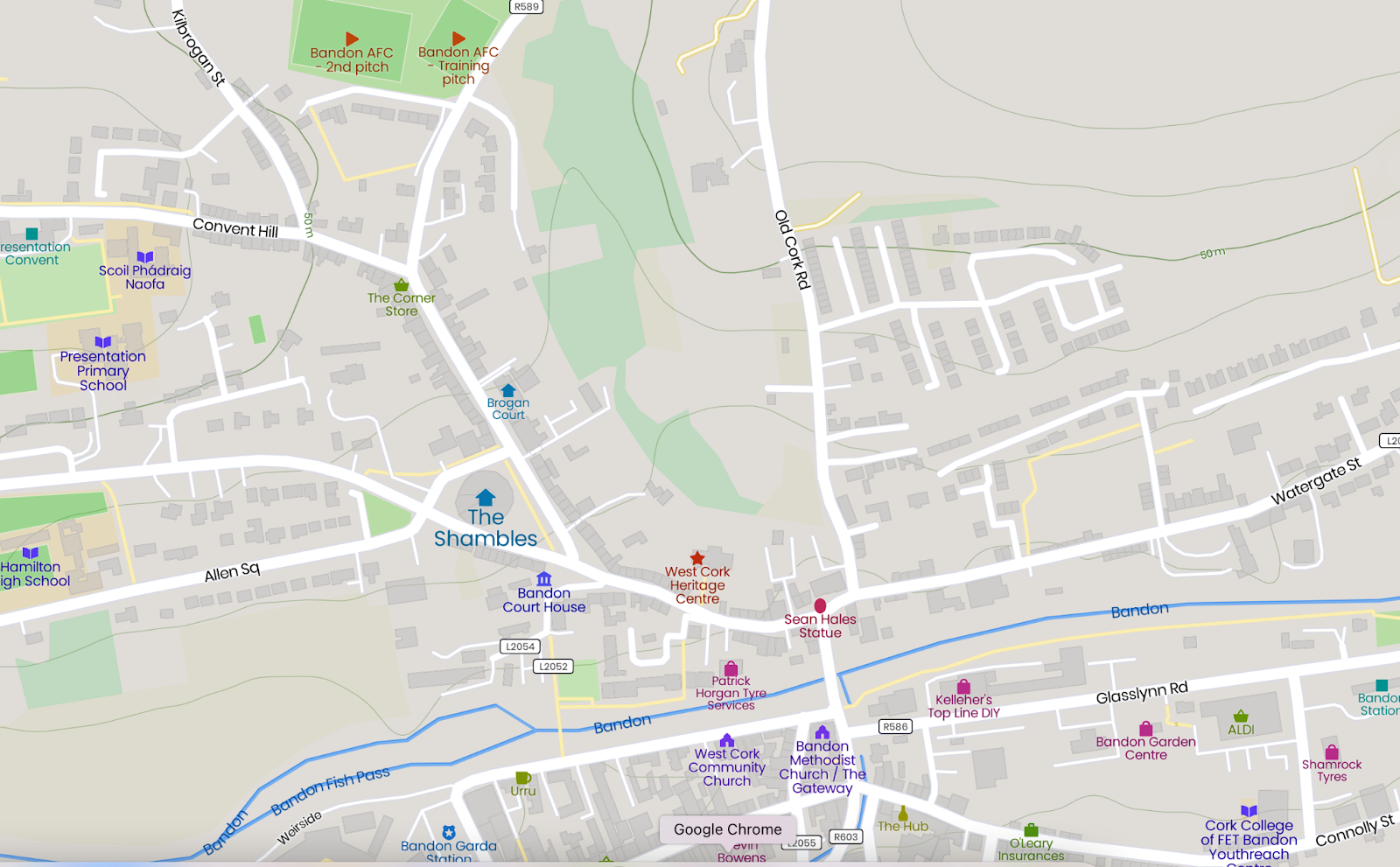
1754. 22 Butchers Listed Operating at the Shambles, Bandon

1943 Meitheal Pulling Flax, Droumleigh, Bantry

04 Tuesday Oct 2022

Posted by durrushistory in Uncategorized

≈ Leave a comment


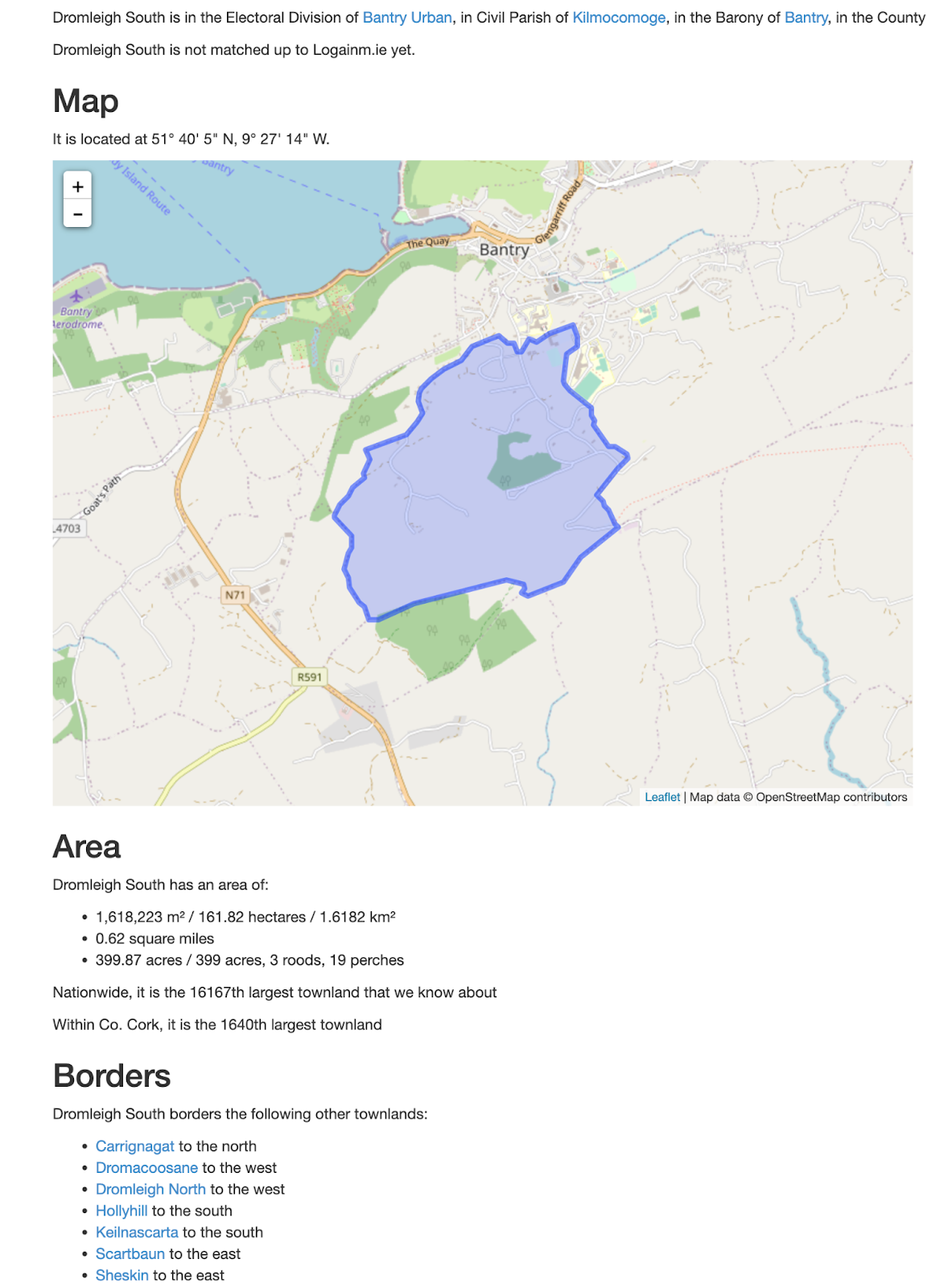
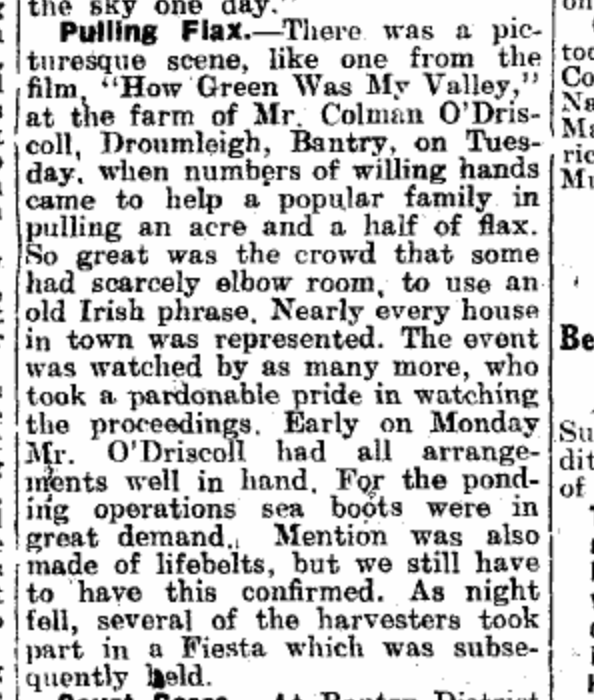
1943 Meitheal Pulling Flax, Droumleigh, Bantry

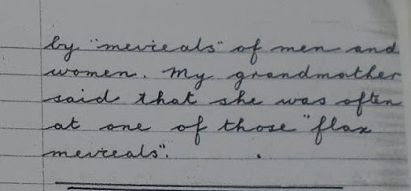
Flax Meitheals..

SchoolFolklore Collection

MEANING OF THE WORD MEITHEAL Meitheal is the Irish word for a work party, a team, or a gang of workers. It inherently refers to a group of people working together, to provide support, and assistance where and when needed. This little word tells of the cooperative labor system that existed in Ireland in years gone by. Here are some examples of how it would be used in day to day language. Meigheal mhóna (phonetic pronunciation meh-hal voe-nah) referred to a band of turf-cutters. Cutting, stacking and drying turf is intensive, back-breaking work and a band of workers would definitely come in handy to store up fuel for the winter. Cuir meitheal ar do chuid móna (phonetic pronunciation kir meh-hal er duh kwid mow-nah) is another wonderful expression. It means ‘get a working party to cut your turf for you.’ There is something powerful in the use of the verb “cuir” which literlly means put. There is no confusion here. You should simply put the power of the meitheal to work for you. It’s as if you can assume if you call, they will answer. Fear cinn meithle (phonetic pronunciation far keen meh-lah) referred to a leader of a working party. It would usually be the farmer who called the meitheal to his aid. If someone had a large family of sons to help them the saying was… Tá meitheal mac aige (phonetic pronunciation thaw meh-hal mock egg-ah) which meant he has a large family of sons to help him. Tá meitheal iníon aige (phonetic pronunciation thaw meh-hal in-een egg-ah) might even be better, since it means he has a large family of daughters to help him. Stack of turf in a field at the base of a mountain with text overlay Saving Turf in Ireland COMMUNITY COOPERATION Neighbors helped neighbors whenever required. All you had to do was send out the word that you were in need, and a meitheal sprang together to come to your aid. In years gone by, before the days of tractors and combine harvesters, farm work was totally dependent on manual labor. Farmers succeeded only through the cooperative help of their neighbors, and their own reciprocated support. You reaped what you sowed, so to speak. If you helped out many of your neighbors, you in turn could count a a vast number of hands when it came time for the heavy lifting and seasonal tasks associated with running your own farm. This little word carries the weight of history in its meager two syllables. It tells of an ancient cultural practice of helping one another out. Our ancestors applied and benefited from the age old practice of mutual cooperation. As a community they addressed their shared social and labor needs. It is a word we continue to need to this very day, and one we should resurrect and apply with all of its powerful attributes. A strong meitheal mentality could ensure that each and everyone of our communites succeeds and flourishes. Thanks for celebrating the Irish language with me today. Woman beside a horse Slán agus beannacht,

1937 School Folklore Project:

..

​​Breda Mac Carthy
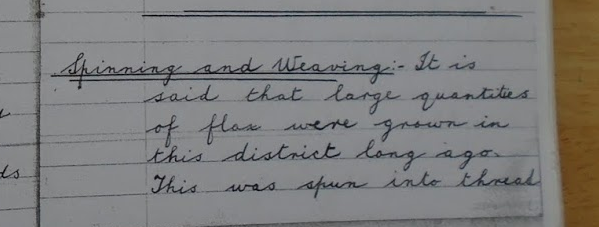
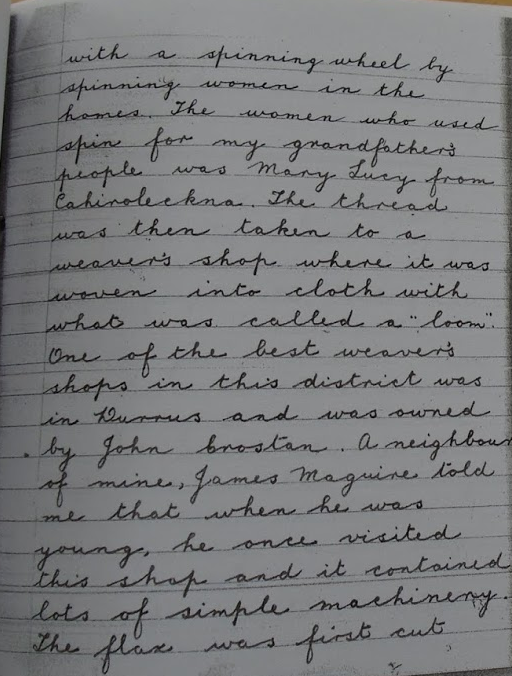
to be woven into frieze. The machine used by this gentleman was called a loom and was also worked by hand which was a very slow and tedious work and would not be tolerated in any modern woollen mill. From the weavers the frieze was conveyed to the tucker where it was tucked to ensure better wear.
John and Isaac Johnson, brothers, of Lower Lane Durrus and John Crostan of the same place were the only weavers in this locality. Those individuals have long since gone to their Eternal reward which leaves the district devoid of Looms and Spinning-Wheels, of weavers and spinners, which is rather a pity.
Looms, and all the accompanying paraphernalia have long since been demolished and a mill has been set up in Bantry whether all the wool is carted. But as sheep-rearing is not such a profitable industry at present as it formerly was the number of sheep reared in the district has diminished considerably.
These facts were related to me by my father Michael Mac Carthy on May 7th 1938.

…

1937 school folklore collection, Dunbeacon Mary Lucy, spinner, Cahirlucky.

.

1884 Skibbereen Eagle. Nurse Wanted. An Experienced Protestant Woman Capable of Bottle Feeding an Infant.  Horse Racing Challenge.

02 Sunday Oct 2022

Posted by durrushistory in Uncategorized

≈ Leave a comment


.

Horse Racing Challenge.

https://docs.google.com/document/d/10_NjScyJSoX01VEub824aq_e61okd8PpOml_D457zrU/edit

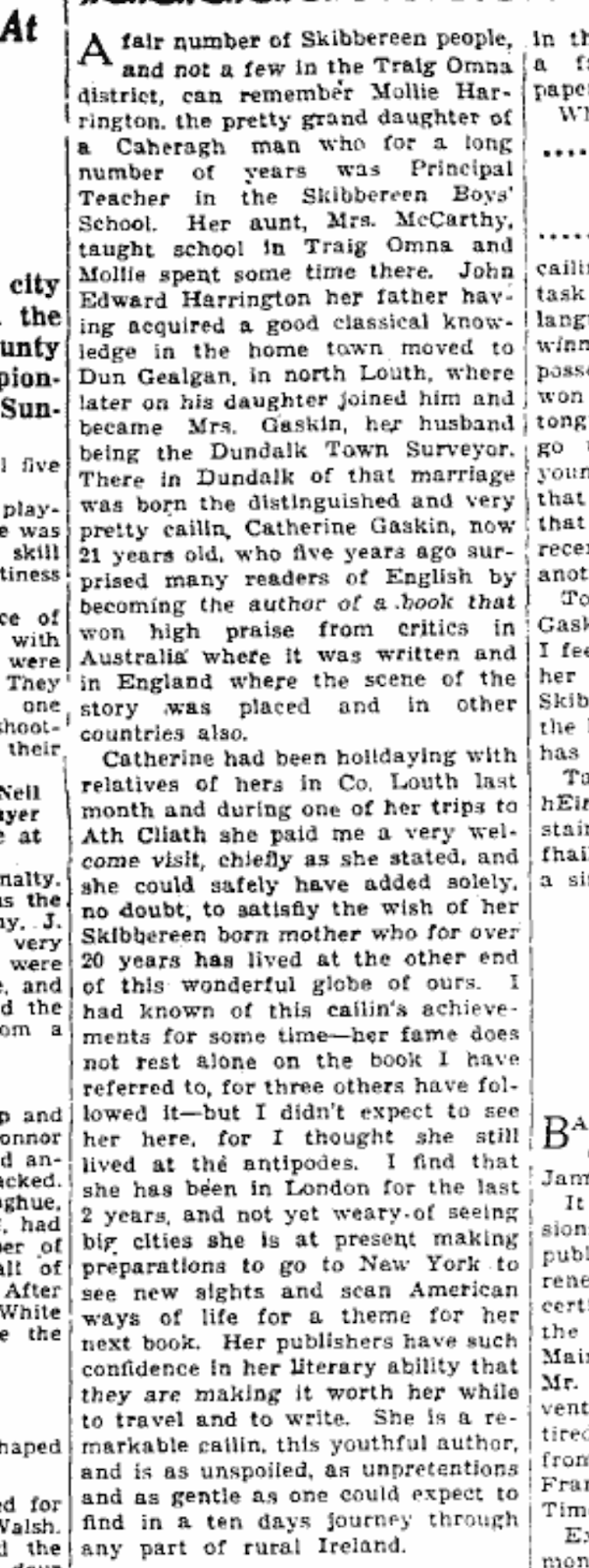
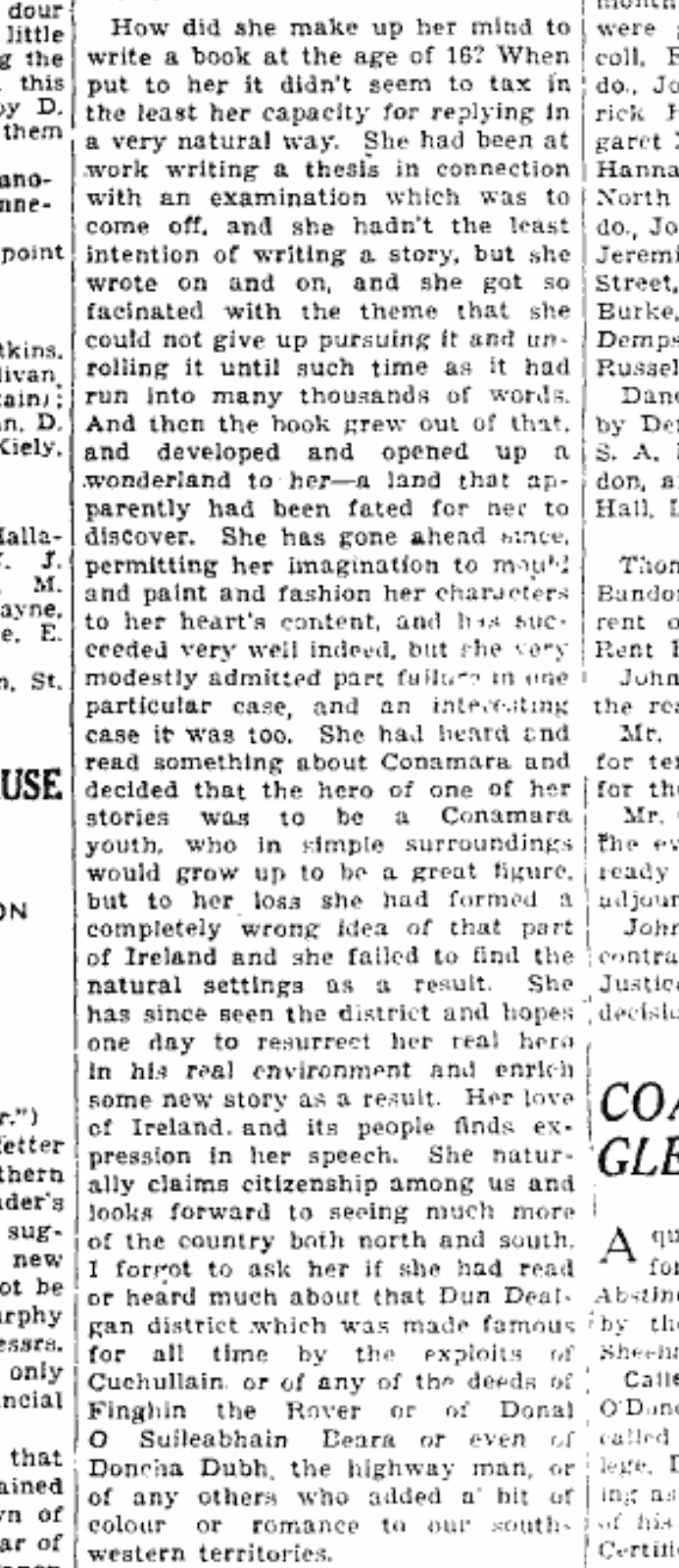
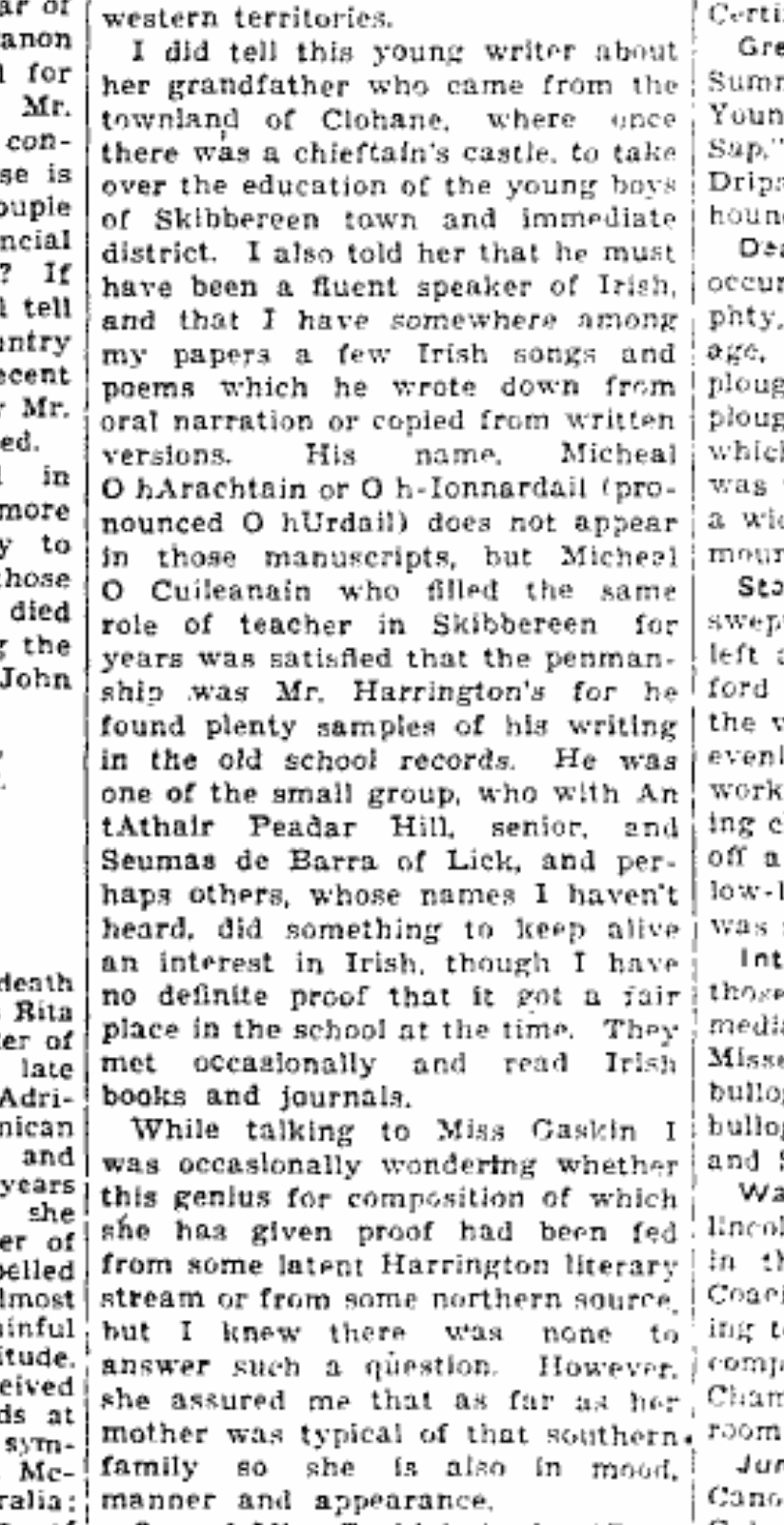
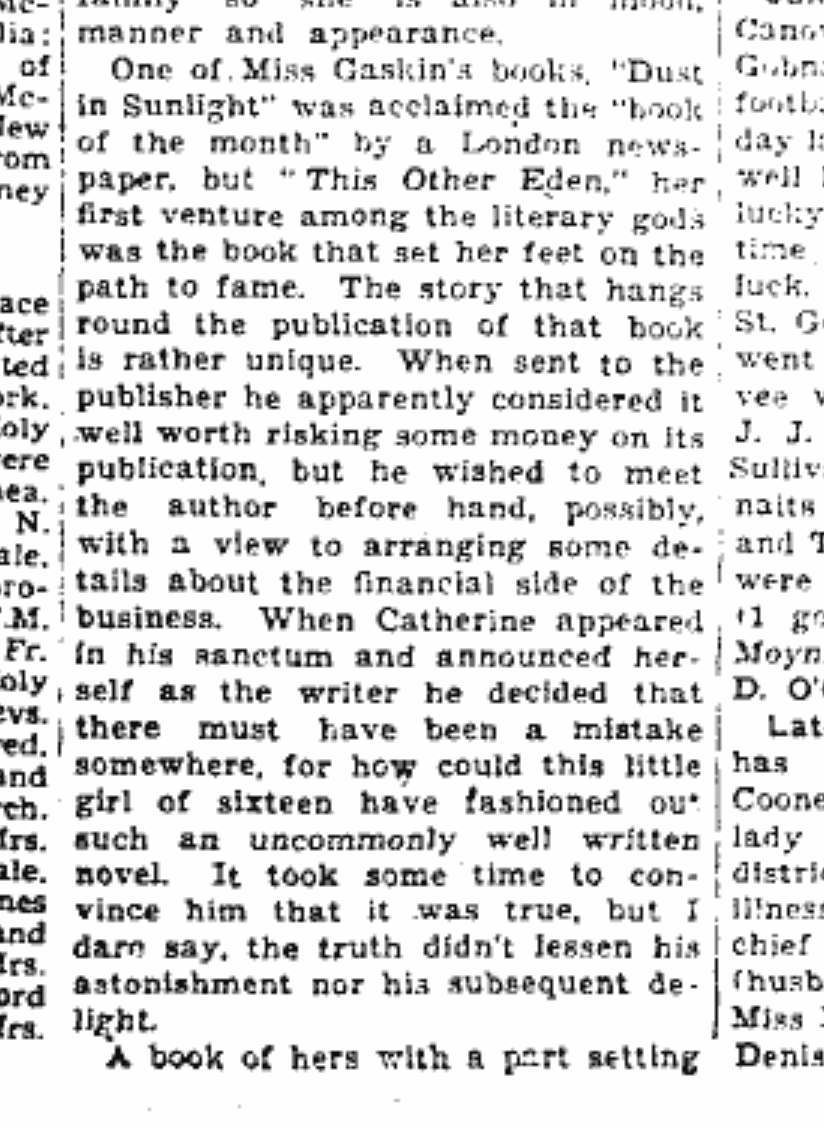
Catherine Gaskin, (1929-2009), Irish Australian Novelist, her Grandfather Michael Ó hArachtáin, Collector of Manuscripts in Irish, from Clohane In Caheragh where was once a Chieftains Castle.

28 Wednesday Sep 2022

Posted by durrushistory in Uncategorized

≈ Leave a comment


Catherine Gaskin, (1929-2009), Irish Australian Novelist, her Grandfather Michael Ó hArachtáin, Collector of Manuscripts in Irish, from Clohane In Caheragh where was once a Chieftains Castle. 

https://docs.google.com/document/d/1qM18Y-PfKftNlTgD2P2qtSo9thtunMC0QnqyuV9JGeM/edit

..

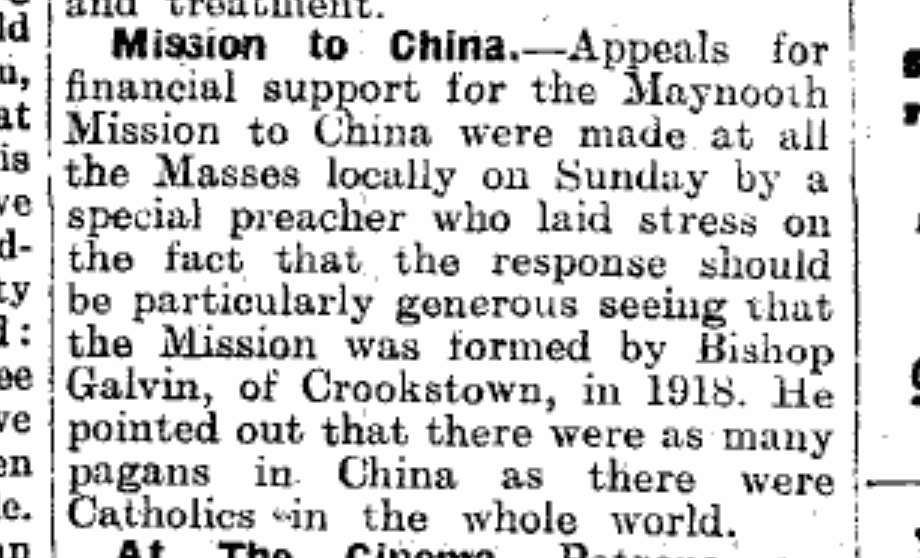
1944 Collection Maynooth Mission to China. ‘As many Pagans in China as Catholics in the Whole World. Bishop Galvin. West Cork Methodists Missionaries in China

27 Tuesday Sep 2022

Posted by durrushistory in Uncategorized

≈ Leave a comment


1944. Collection Maynooth Mission to Chine ” As many Pagans in China as Catholics in the Whole World. West Cork Methodists in China

https://columbans.ie/maynooth-mission-to-china-foundation-decree-translated-by-fr-neil-collins/

DECREE The Society named the MAYNOOTH MISSION TO CHINA was recently set up in Ireland to spread the Faith among pagans, especially the Chinese. The Holy See was consulted beforehand and the Irish Bishops gave their approval. A little later the founders established a new College with an oratory named St Columban’s College at Dalgan, Shrule as the seat of the Society in this diocese. They did so with permission given under certain conditions for a year by our decree of 29/11/1917. Based on many indications, especially the very purpose of the society, the character of the founders, and the truly marvellous zeal of the whole of Ireland for this project, we may hope with the greatest confidence that very rich fruits for the good of the whole Church will spring from this society. Therefore we joyfully assent to the petition of the founders and canonically erect this society as a diocesan society in this our diocese and declare it erected; we approve its constitutions until it is recognized by the Holy See but only under the conditions stated in this decree; and we give permission with no time limit for the aforesaid College of St Columban to continue as the headquarters of the Society in this diocese provided all legalities are observed, under the same conditions as before. If any of these conditions is violated this permission immediately expires.

Bishop Edward Galvin – An Irish Missionary in China

May 22, 2015Special Collections

By Barbara McCormack, Special Collections & Archives

Last year saw the launch of the exhibition Letters from an Irish Missionary in China – a collaborative endeavour between the Columban Fathers Central Archive and the Russell Library, Maynooth University.

Bishop Edward Galvin

The exhibition told the remarkable story of Bishop Edward Galvin, co-founder of the Maynooth Mission to China Society which later became the Missionary Society of St. Columban and included letters, photographs and articles from the archives of the Columban Fathers, supplemented by primary and secondary sources from the Russell Library. A fantastic collection of artefacts, including Galvin’s suitcase and violin, were also on display in the Library as part of the event.

Artefacts on display during the exhibition 'Letters from an Irish Missionary in China'
Violin on display during the exhibition ‘Letters from an Irish Missionary in China’

Galvin was ordained for the diocese of Cork in the year 1909 following the completion of his studies at Maynooth College. He spent the following three years as a priest on loan to the diocese of Brooklyn in New York before embarking on his journey to China. Galvin allegedly read every single book about China he could find in the Brooklyn Public Library before embarking on his travels!

After spending four years in China working as a missionary, he made a decision to return to Ireland in the hope of recruiting new volunteers from Maynooth College. It was here that he met Professor John Blowick, co-founder of the Maynooth Mission to China society. Galvin and Blowick worked tirelessly to achieve formal recognition of the Society.

Chinese fan on display during the exhibition

The Bishops officially sanctioned the Society at a meeting in Maynooth during October 1916. Formal recognition from Rome followed in 1918, with the first batch of volunteers travelling to China in 1920.

Bishop Galvin's suitcase
Bishop Galvin’s suitcase

Galvin’s devotion to the missionary cause saw him remain in China through periods of political unrest, cholera outbreaks, and floods. He was one of the last foreign missionaries to leave China in the year 1952.

https://wordpress.com/post/durrushistory.com/39157

Irish Christian Brothers Mission to Hupei, China, 1921-1926, Memoir of Brother Dougan (1900-1987), Impressions of Shanghai 1921, Assistance to Columban Fathers Prefecture Hubei, Monsignor Galvin, Hanyang Iron Works taken over by Japanese, holidays in Kuling Mountains, Chinese Funerals, Ancestor Worship, Marriage Customs, Snakes, Malaria, Small Pox (Black Death), Warlord Wu-Pey-Fu in Hupoi, Moscow trained Political Commissars take over College home via Saigon elegant Boulevards, shock in Dublin at new Griffith Avenue

Irish Christian Brothers Mission to Hupei, China, 1921-1926, Memoir of Brother Dougan (1900-1987), Impressions of Shanghai 1921, Assistance to Columban Fathers Prefecture Hubei, Monsignor Galvin, Hanyang Iron Works taken over by Japanese, holidays in Kuling Mountains, Chinese Funerals, Ancestor Worship, Marriage Customs, Snakes, Malaria, Small Pox (Black Death), Warlord Wu-Pey-Fu in Hupoi, Moscow trained Political Commissars take over College home via Saigon elegant Boulevards, shock in Dublin at new Griffith Avenue

Seán (John Joseph) Hurley (1883-1961), Durrus, West Cork, China and Dublin, First Irishman to have a Chinese Passport and early founder of Aer Lingus. Obituary 1961.

The Hurley family have a long lineage in Ballycomane, Durrus,  they had a large farm pre 1780 there when the Vickery family moved in.  There was a a marriage between John Vickery and Hanora Hurley around the same time so there may be a connection there.   In the 1870s elements of the family were active in East London with Dukelows and Swantons in Fenian activities and there is a connection with Michael Collins who lodged with one of their associates when he came to work in London.

One of the Hurleys was active in Home Rule Politics in the 1890s and was later involved with the County Council.

Sean Hurley may have been associated in Dublin with JJ O’Leary also from Cork, and be one of the pioneers of Aer Lingus

The Cork Catholics were not the only Christian Religion with designs on China:

https://wordpress.com/post/durrushistory.com/28750

Born 1832. John Richard Wolfe from the townland of Mallavonea, Skibbereen, West Cork. He was the second son of farmer Richard Wolfe and Susan Croston, He became a Scripture Reader for the Irish Church Mission. He then trained as a missionary with the Church Missionary Society (C.M.S) in England from 1857 and after being ordained Deacon in St. Paul’s Cathedral in May 1861 he was assigned to Foochow in South China.

https://wordpress.com/post/durrushistory.com/3913

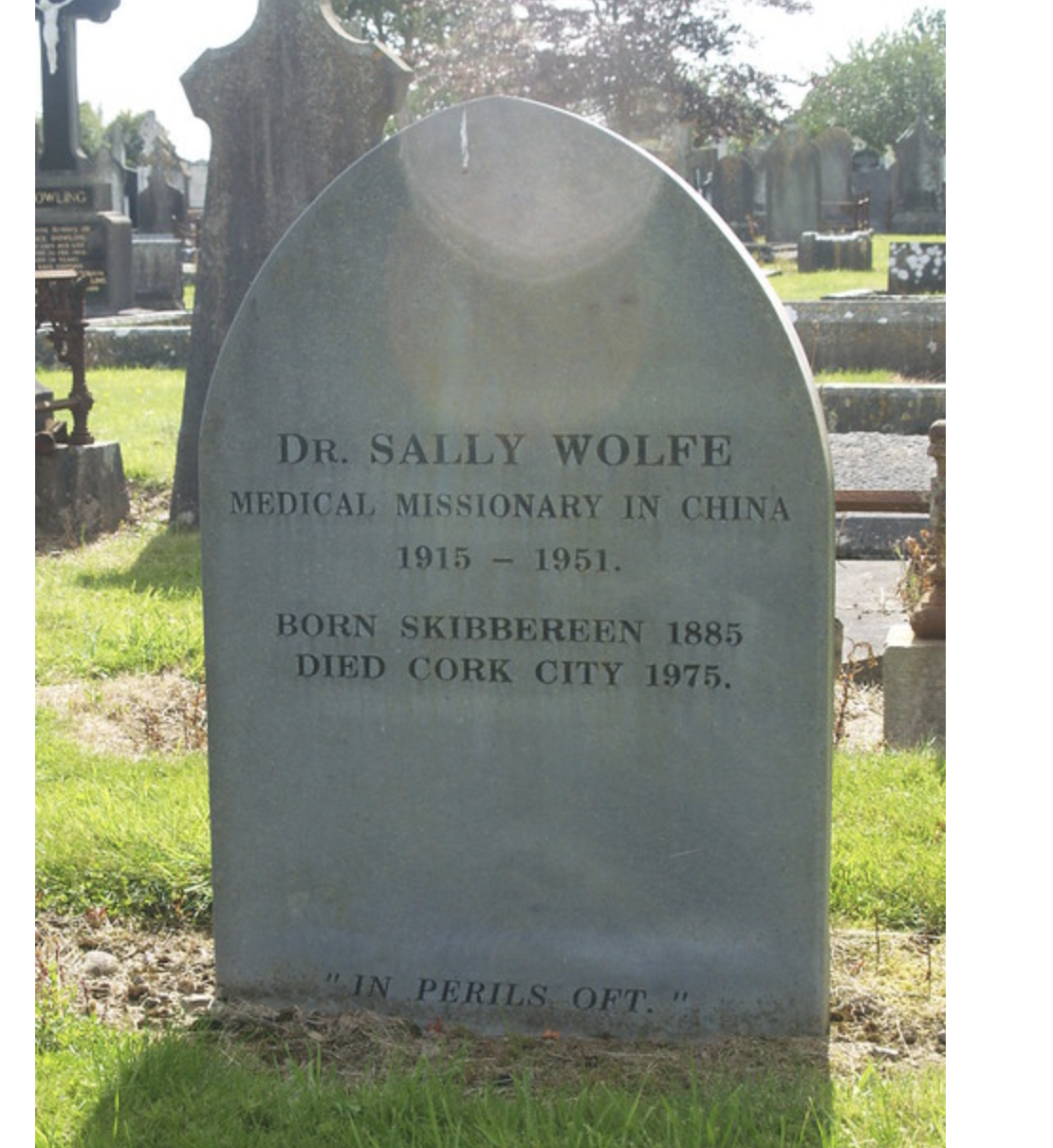
1938, Doctor Sarah Wolfe, Medical Missionary of Skibbereen, West Cork and Chungsiang, Hupeh, China, on recovering from Illness contracted attending to wounded in Hankhow

Known as ‘Dr Sally, she retired to Canada for a few years before returning to Cork where she died in 1975. She’s buried in St Finbarr’s Cemetery in Cork. Jane Wright has written a biography: ‘She Left Her Heart in China: The Story of Dr Sally Wolfe Medical Missionary 1915-1951’.

1610 Map of China, by Chinese Cartographer in Java, finding the sea route to China, the Law of the Sea and the emergence of London as a Global City 1549-1689.

https://wordpress.com/post/durrushistory.com/3662

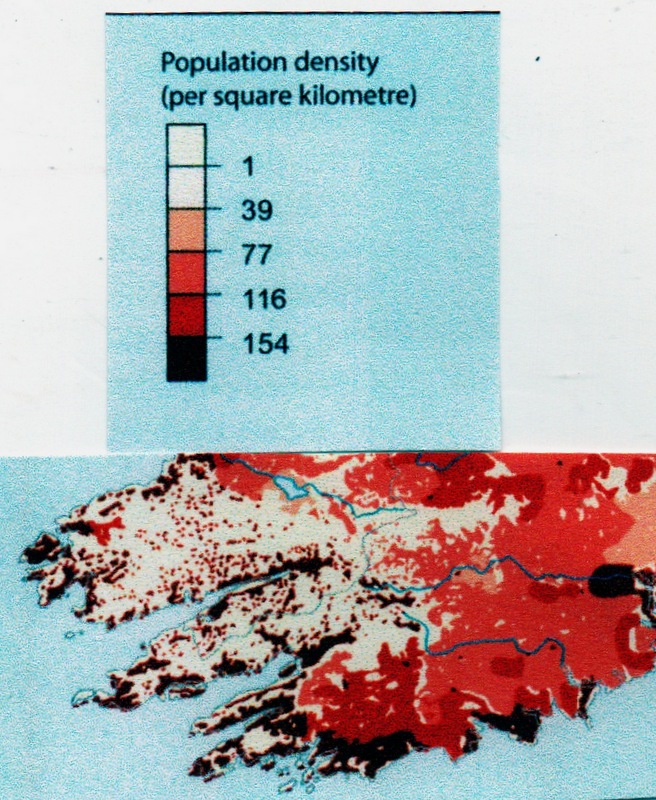
This map is taken from The Atlas of the Irish Famine, John Crowley, William J. Smyth and Mike Murphy, Cork University Press 2012.  The population density of the populated areas is calculated by excluding mountain, lake and bog.  The result is a density comparable to China, India and Haiti.

https://wordpress.com/post/durrushistory.com/1435

Scan 289

Oscar Fingal O’Flahertie Wills Wilde (1854–1900). B.A, TCD. ? Descendant of Niall of the Nine Hostages, the legendary 5th century A.D. High King of Ireland.  His West Cork Remote Cousins

23 Friday Sep 2022

Posted by durrushistory in Uncategorized

≈ Leave a comment


Oscar Fingal O’Flahertie Wills Wilde (1854–1900).  ? Descendant of Niall of the Nine Hostages, the legendary 5th century A.D. High King of Ireland.  His West Cork Remote Cousins

In essence his Flynn/O’Fynne/Flynne/Ó Floinn, paternal grandmother, 

Mount Jerome Graveyard Dublin.

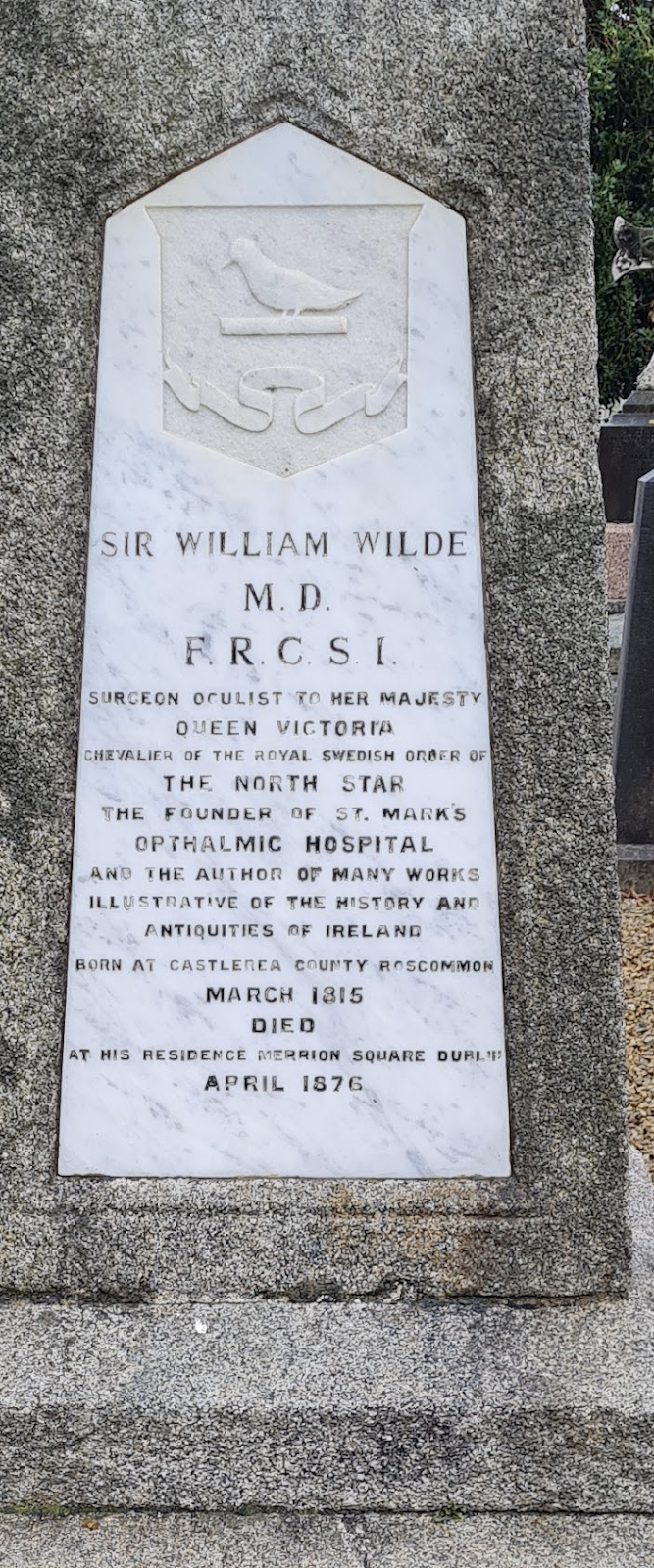
Sir William Wilde, (1815-1876), M.D., F.R.C.S.I., Surgeon Oculist to Her Majesty Queen Victoria, father of Oscar.  HIs birthplace coincides with  his mother name Flynn/O’Flynn/Ó Floinn, 

 His West Cork Remote Cousins with a hot spot of descendants of Niall of The Niall Histges.  Possibly 5th century 

Modern surnames tracing their ancestry back to Niall include (but are not limited to) (O’)Flynn, 

His West Cork Remote Cousins, families

Crowley  (really McDermott of Roscommon)

Gallagher

Hegarty

O’Donnell

O’Neill 

Ward

..

Memorial to his mother (1821-1896), buried in London:

https://docs.google.com/document/d/11n3bnC7rz8bD3BZEihrphxc6Hylzg158FH964aiGUHs/edit#

← Older posts
Newer posts →

Blog Stats

  • 866,185 hits

16th Regiment of Foot assisted female emigration australia ballyclough bantry bay caithness legion cavan regiment of militia cheshire fencibles coppinger's court inbhear na mbearc Irish words in use 1930s lord lansdowne's regiment mallow melbourne ned kelly new brunswick O'Dalys Bardic Family. o'regan Personal Memoirs rosscarbery schull sir redmond barry sir walter coppinger st. johns sydney Townlands treaty of limerick Uncategorized university of Melbourne victoria

16th Regiment of Foot assisted female emigration australia ballyclough bantry bay caithness legion cavan regiment of militia cheshire fencibles coppinger's court inbhear na mbearc Irish words in use 1930s lord lansdowne's regiment mallow melbourne ned kelly new brunswick O'Dalys Bardic Family. o'regan Personal Memoirs rosscarbery schull sir redmond barry sir walter coppinger st. johns sydney Townlands treaty of limerick Uncategorized university of Melbourne victoria
Follow West Cork History on WordPress.com

Enter your email address to follow this blog and receive notifications of new posts by email.

Join 507 other subscribers

Feedjit

  • durrushistory's avatar durrushistory

Archives

  • April 2026
  • March 2026
  • February 2026
  • January 2026
  • December 2025
  • November 2025
  • October 2025
  • September 2025
  • August 2025
  • July 2025
  • June 2025
  • May 2025
  • April 2025
  • March 2025
  • February 2025
  • January 2025
  • December 2024
  • November 2024
  • October 2024
  • September 2024
  • August 2024
  • July 2024
  • June 2024
  • May 2024
  • April 2024
  • March 2024
  • February 2024
  • January 2024
  • December 2023
  • November 2023
  • October 2023
  • September 2023
  • August 2023
  • July 2023
  • June 2023
  • May 2023
  • April 2023
  • March 2023
  • February 2023
  • January 2023
  • December 2022
  • November 2022
  • October 2022
  • September 2022
  • August 2022
  • July 2022
  • June 2022
  • May 2022
  • April 2022
  • March 2022
  • February 2022
  • January 2022
  • December 2021
  • November 2021
  • October 2021
  • September 2021
  • August 2021
  • July 2021
  • June 2021
  • May 2021
  • April 2021
  • March 2021
  • February 2021
  • January 2021
  • December 2020
  • November 2020
  • October 2020
  • September 2020
  • August 2020
  • July 2020
  • June 2020
  • May 2020
  • April 2020
  • March 2020
  • February 2020
  • January 2020
  • December 2019
  • November 2019
  • October 2019
  • September 2019
  • August 2019
  • July 2019
  • June 2019
  • May 2019
  • April 2019
  • March 2019
  • February 2019
  • January 2019
  • December 2018
  • November 2018
  • October 2018
  • September 2018
  • August 2018
  • July 2018
  • June 2018
  • May 2018
  • April 2018
  • March 2018
  • February 2018
  • January 2018
  • December 2017
  • November 2017
  • October 2017
  • September 2017
  • August 2017
  • July 2017
  • June 2017
  • May 2017
  • April 2017
  • March 2017
  • February 2017
  • January 2017
  • December 2016
  • November 2016
  • October 2016
  • September 2016
  • August 2016
  • July 2016
  • June 2016
  • May 2016
  • April 2016
  • March 2016
  • February 2016
  • January 2016
  • December 2015
  • November 2015
  • October 2015
  • September 2015
  • August 2015
  • July 2015
  • June 2015
  • May 2015
  • April 2015
  • March 2015
  • February 2015
  • January 2015
  • December 2014
  • November 2014
  • October 2014
  • September 2014
  • August 2014
  • July 2014
  • June 2014
  • May 2014
  • April 2014
  • March 2014
  • February 2014
  • January 2014
  • December 2013
  • November 2013
  • October 2013
  • September 2013
  • August 2013
  • July 2013
  • June 2013
  • May 2013
  • April 2013
  • March 2013
  • February 2013
  • January 2013
  • November 2012
  • October 2012
  • September 2012
  • August 2012
  • July 2012
  • June 2012
  • May 2012
  • April 2012
  • March 2012
  • February 2012
  • January 2012
  • December 2011
  • November 2011
  • October 2011

Blog at WordPress.com.

  • Subscribe Subscribed
    • West Cork History
    • Join 507 other subscribers
    • Already have a WordPress.com account? Log in now.
    • West Cork History
    • Subscribe Subscribed
    • Sign up
    • Log in
    • Report this content
    • View site in Reader
    • Manage subscriptions
    • Collapse this bar
 

Loading Comments...