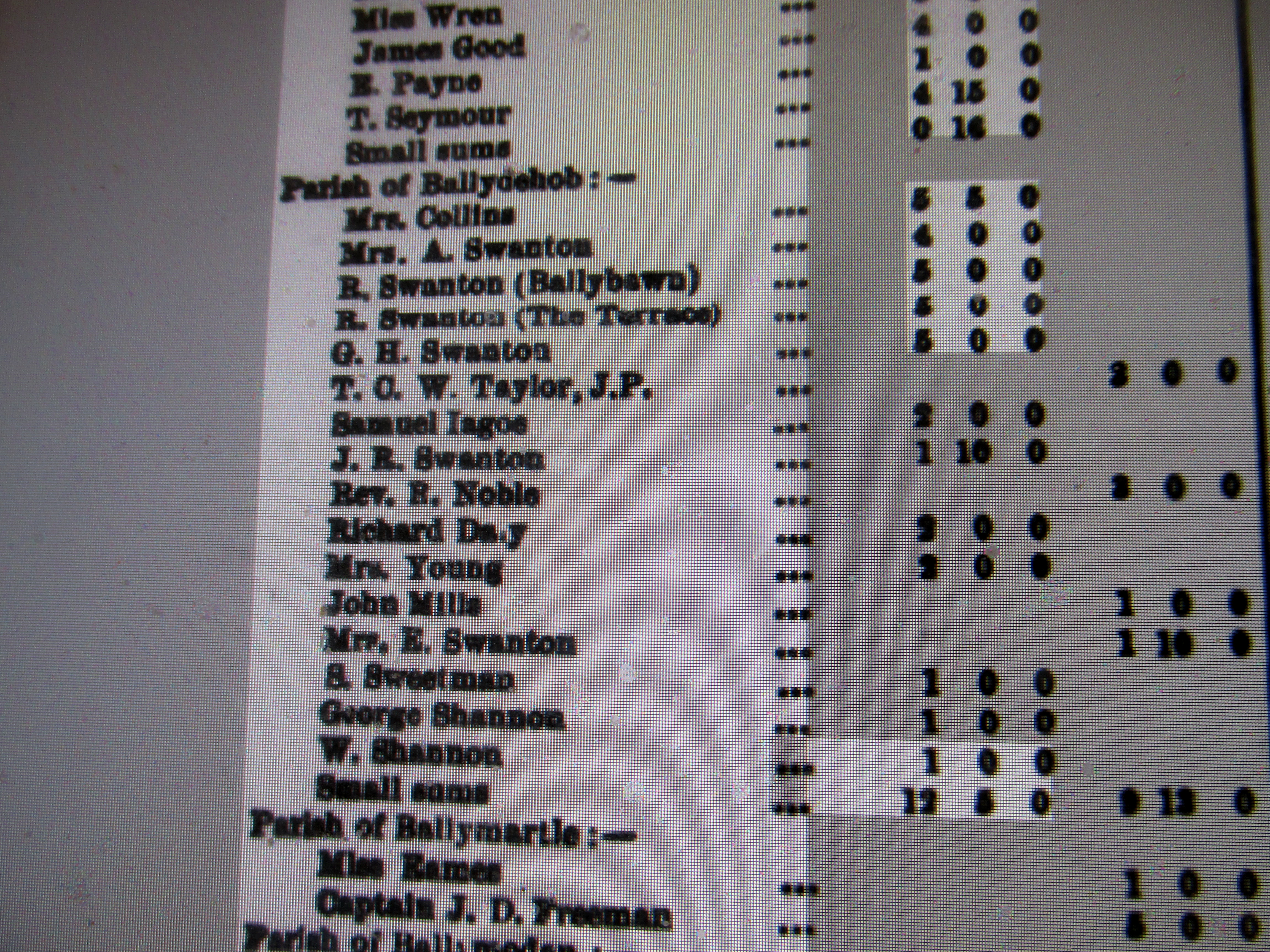
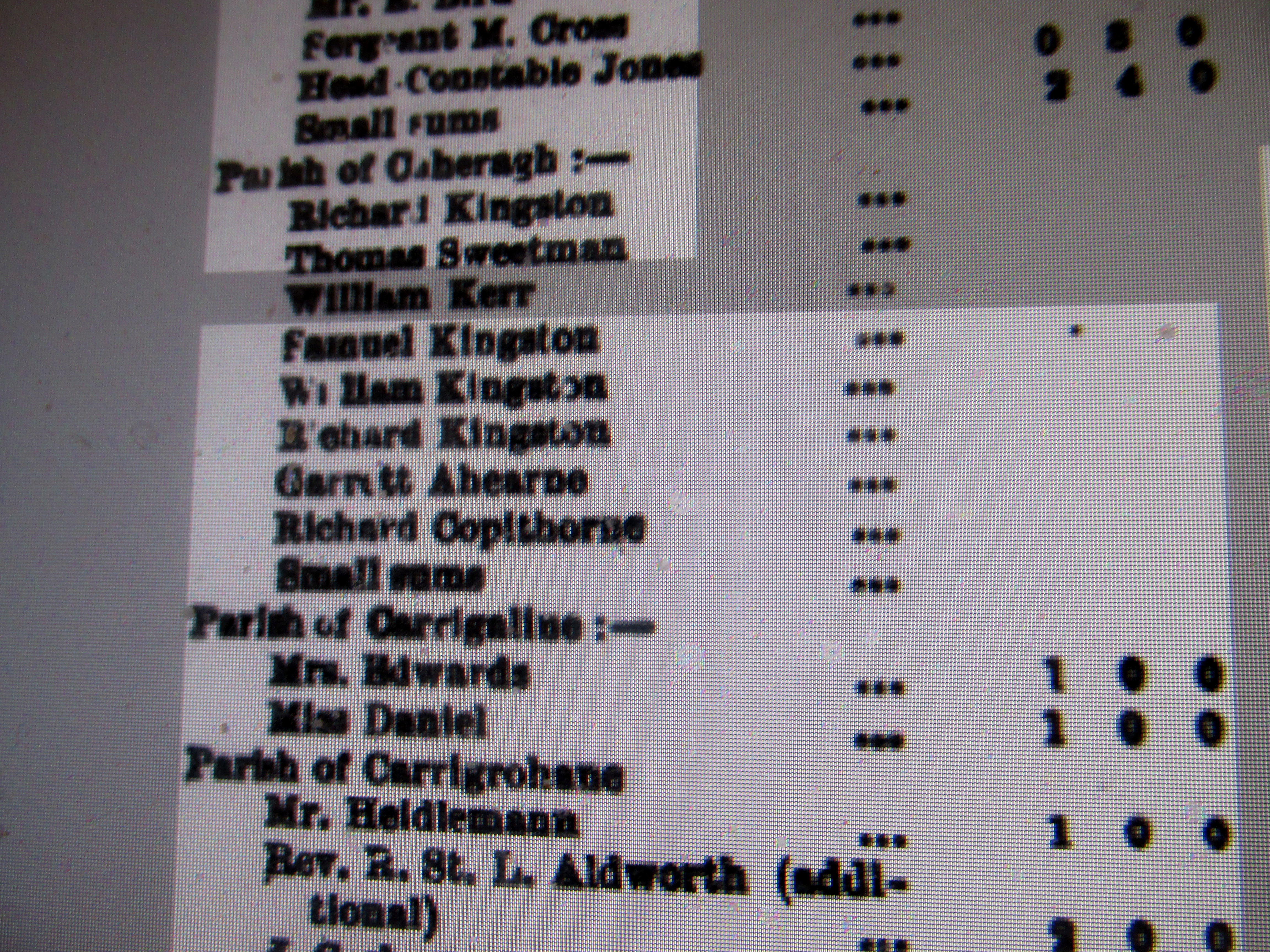
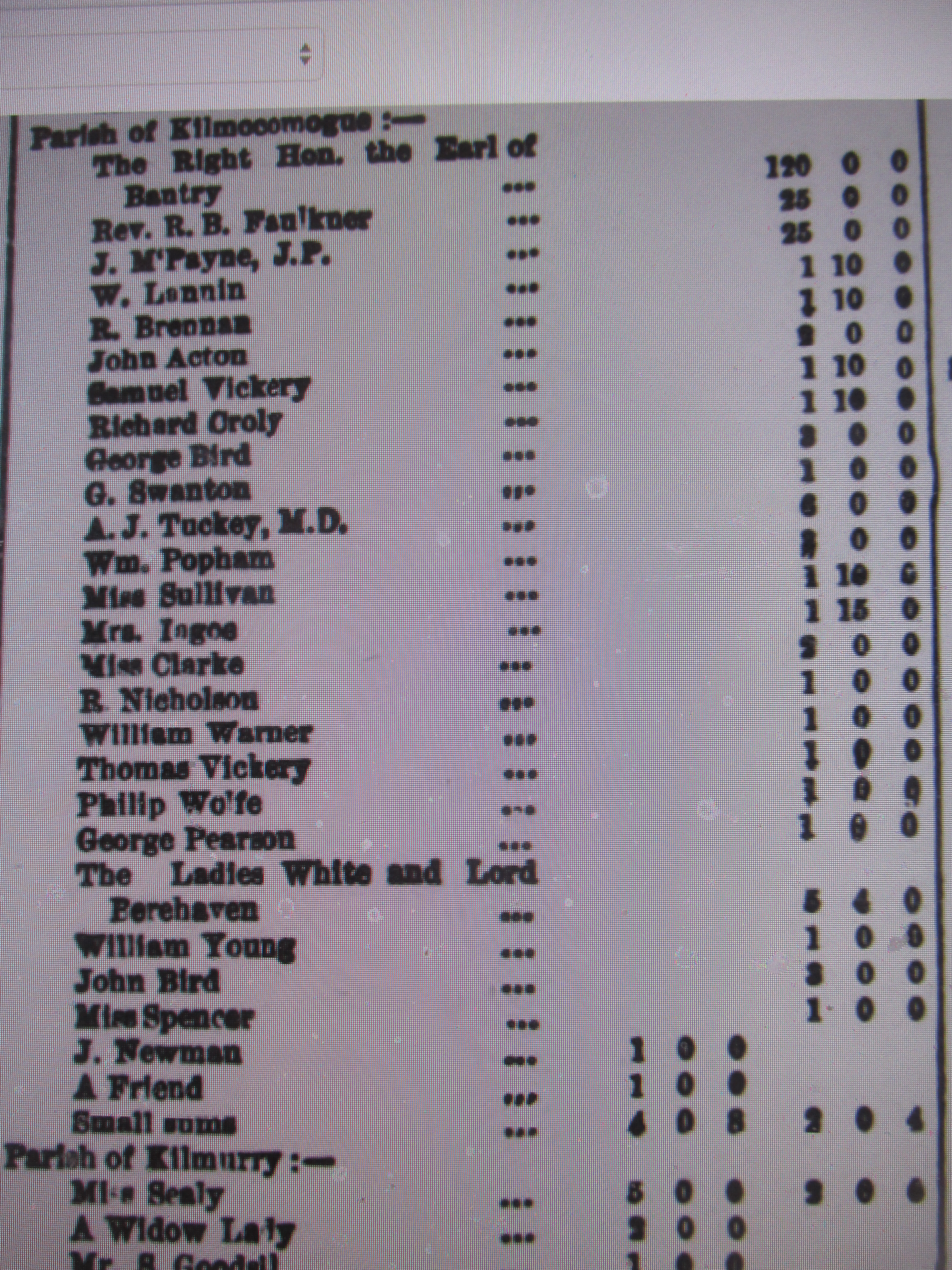
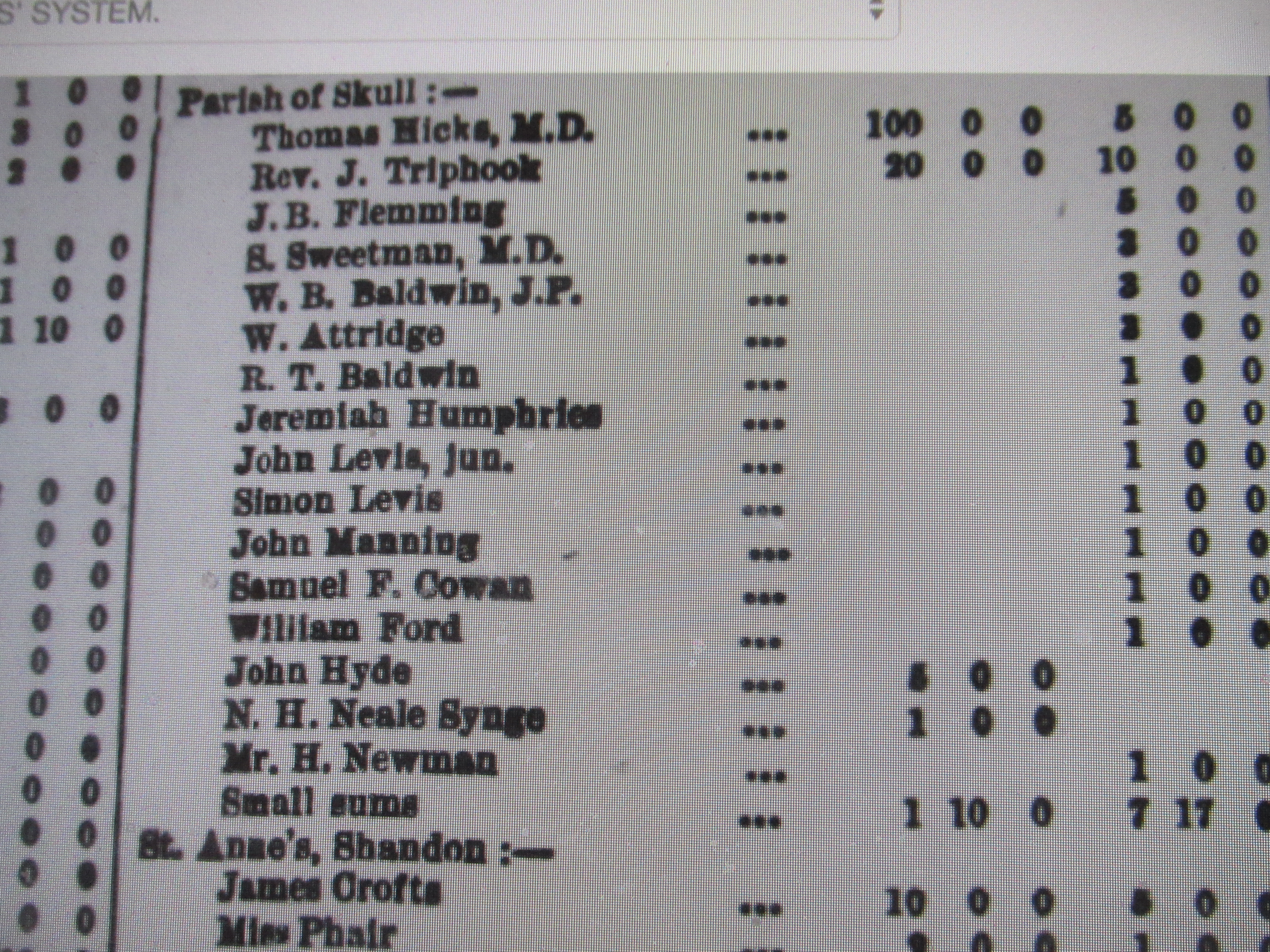
Subscribers to Church of Ireland, Sustenation Funds (Post Disestablishment), 1870, Dunmanway, Caheragh, Ballydehob, Bantry, Durrus, Schull, Co. Cork.
09 Thursday Jul 2015
Posted in Uncategorized
09 Thursday Jul 2015
Posted in Uncategorized
09 Thursday Jul 2015
Posted in Uncategorized
The name of John Jago, Bantry appears on the online index of the Bantry Estate records as acquiring a lease for a store and yard on the Quay in 1830. Some of the Chief Secretary Papers for Dublin Castle held in the National Archives have now been put on line and Mr. Jago also features there.
At one stage he had a shop in Cork in the Barrack Stret/Bandon Road area.
In 1821 he was writing proposing that education be provided free of any particular sect. He was also petitioning for the development of the fishing industry and for his own appointment as a Fishery Inspector in Kerry. Mr Jago was presumably involved in the fishing industry.
His son John qualified as a barrister and entered a lease with the Bantry Estate for the store and yard in 1844. His date of birth is 1804 and his mother is Margaret…
View original post 1,489 more words
09 Thursday Jul 2015
Posted in Uncategorized
The Duke of Devonshire commenced an action in 1854 in the Encumbered Estates Court to confirm that lands to be disposed of by Nathaniel Evanson did not include minerals.
The land was originally sold by the Duke’s predecessor on title, Edward Boyle and his wife Mary by way of lease for 500 years from the 21st May 1626. The property including 3 ploughlands at Drumreagh, Dromelower and Ardgenane in Durrus including Murreagh was acquired by the Earl of Burlington and Cork and Sir William Heathcote who disposed of it to Richard Tonson in 1738 included as part of the Manorial rights to the Lord of the Manor of Ballydehob including the Durrus lands. In 1765 the Durrus lands were demised to Richard Tonson Evanson and renewed by Lord Baron Riversdale to Nathaniel Evanson in 1811,
The Duke succeeded in his claim. The papers are in the National Library, Lismore…
View original post 5 more words
09 Thursday Jul 2015
Posted in Uncategorized
Ohallaha:
John J. McCarthy was born in 1859 in Tullig, Durrus in the vicinity of O’Donovan’s Cove which is the subject of his poem. His father was Charles and was believed to be a active Parnellite.
The local area was a hive of political activity going back to Timothy O’Donovan, local Landlord and JP a supporter of O’Connell, Tithe Reform and Liberal politics.
John went to the USA in 1880 and his career is documented in an obituary at the back of the enclosed document. He died in Nebraska in 1931.
His home place in Ogallaha, Nebraska is in US terms relative near Casper, Wyoming where a lot of people from Muintervara settled.
John J. McCarthy, Tullig, Durrus, Co. Cork and Nebraska, Rancher, Poet and Politician.
09 Thursday Jul 2015
Posted in Uncategorized
On the 24th August 1843 the ‘Cork Examiner’ reported on the discovery on ‘an ancient brewery’ in a lios (ringfort) in Brennymore, Kealkil, four miles from Bantry.
09 Thursday Jul 2015
Posted in Uncategorized
Ernest Blythe, The Minister for Finance in the first Free State Government has had a terrible press for cutting the old age pension and trying to balance the budget. A statement attributed to him in this period was that he could if left run the Free State for £20 million a year. In the light of the recent past maybe its a pity a little more of his Northern Presbyterian financial ethic wasn’t incorporated into spending public and private.
An interesting aside is that during this period and in the 1930s the Northern Ireland Government under the Unionist Party was divided into two factions, one led by the Prime Minister Craig, Andrews, and Dawson-Bates were populists and spenders, the other comprising the head of the cicil service Sir Wilfed Spender and Minister Milner-Barbour were trying to balance the budget. In theory most of the expenditure was supposed to be raised…
View original post 11 more words
09 Thursday Jul 2015
Posted in Uncategorized
In issue 16 of ‘The Archive’, the Journal of the Cork Northside Fiolklore Project, there is an article about the Crowley Music family and shop in McCurtain Street, Cork.
It relates how in the 1926, Henry Ford (1863-1947) the Motor Magnate, sent a set of uileann pipes, belonging to his father William (1826-1905) for repair. The pipes are reputedly in the Ford Museum in Detroit on display.
The Fords occupied a 23 acre farm on the Bence Jones estate at Lisellan near Ballinascarty, before emigrating to the US, the rest is history.
The implication in the article was that William was able to play the pipes a matter that might yield further research.
09 Thursday Jul 2015
Posted in Uncategorized
John Stevens was a Jacobite and landed in Bantry on the 2nd May 1689. The enclosed piece is from a collection of tales in ‘Diaries of Ireland’, An Anthology 1590-1987, by Melosine Lenox-Conyngham, The Lilliput Press, 1998.
Thursday 2 May 1689
We landed in Bantry, which is a miserable poor place, not worthy of the name of a town, having not above seven or eight little houses, the rest very mean cottages… Two nights that we continued here I walked two miles out of town to lie upon a little dirty straw in a cot or cabin, no better than a hog-sty among near twenty others. The houses and cabins in town were so filled that people lay all avor the others. Some gentlemen took up their lodgings in an old rotten boat that lay near the shore, and there wanted not some who quartered in a saw pit. Meat…
View original post 160 more words
09 Thursday Jul 2015
Posted in Uncategorized
On the 8th January 1886 it was reported in the Shields Daily Gazette and Shipping Telegraph that ‘moonlighters’ savagely beat Mr. David Burley, the Petty Session Clerk, in search of arms the previous day and no arrests were made.
At that time the Petty Sesssions were held in Carrigboy (Durrus), the courthouse is still extant next to Ó Suilleabhaín’s pub. Mr Burley (or Burleigh) lived in the large house between the West Lodge Hotel and the cemetry in Bantry.
08 Wednesday Jul 2015
Posted in Uncategorized
From Trinity College/Circle.
APPOINTMENT of William Sygyn and John Galvy1 as admirals in all ports within co. Cork, with power to arrest all ships, boats and vessels, and to arrest all mariners and masters, and other defensible men of that county, to fight with God’s aid the lineage of the Hinderscoles [O’Driscolls], Irish enemies, who constantly remain upon the western ocean; with power to amerce refractory persons and to the spend the amercements on the wars.2
NAI, Lodge MS 21, p. 39; RCH.
Hardiman, Statute of the fortieth year of King Edward III, p. 35 note.
1 RCH reads ‘Galny’.
2 The record as given by Lodge is reproduced in full in Herbert Wood (ed.), ‘The Public Records…
View original post 1,396 more words