This is a good example of the system of local government prior to the County Council taking over the operations of the Grand Jury in 1899.
The presentment were suggested rodworks or such projects. The meeting of the Magistrate approved the presentment adn since about 1830 the largest farmer in the are were nominated as cess payer representative to try and limit perceived abuses. The contractors are often substantial farmer who9 probably ahd labourers working fro them tht they would allocate to the works.
Large scale projects were presented to the Grand Jury twice a year after the Assize were over. From the mid 19ht century the Grand Jury had professional surveyors employed.
1855 Landlord Richard O’Donovan, Esq., Fort Lodge, Durrus reserves to himself the right of making a lease to Mary Foley at Rosnacaheragh until the minor comes of age provided she marries with the lessor’s consent. 1854 Sale Estate of Arthur Hutchinson, deceased, intestate, Durrus, Tenant Listing
Lease 1855, Richard O’Donovan, Esq., to Maurice and Thomas Foley for 61 years from 1855 of 58 acres at Rosnacaheragh at a rent of £7 12 shillings for Maurice Foley and £7 12 shillings to Daniel Burke, Maurice and Thomas Foley. Lessee to supply a horse and guide for 4 days a year or to pay 2 shillings for each day in lieu of a horse is not provided and 1 shilling a day for every day a guide is not provided. The lease contains a covenant not to have more than one dwelling house on the premises under a penalty of £20 and the lessor reserves to himself the right of making a lease to Mary Foley until the minor comes of age provided she marries with the lessor’s consent. The holdings are intermixed and the quantity held by each cannot be stated. Recited in the Landed Estate Sale of O’Donovan lands 1876.
Timothy O’Donovan, Justice of the Peace, Durrus, and his Extended Family Network, The O’Donovans of Squince (Myross), The Clonakilty Deasys, a Survival of Catholic Gentry in the 18th and early 19th century in West Cork
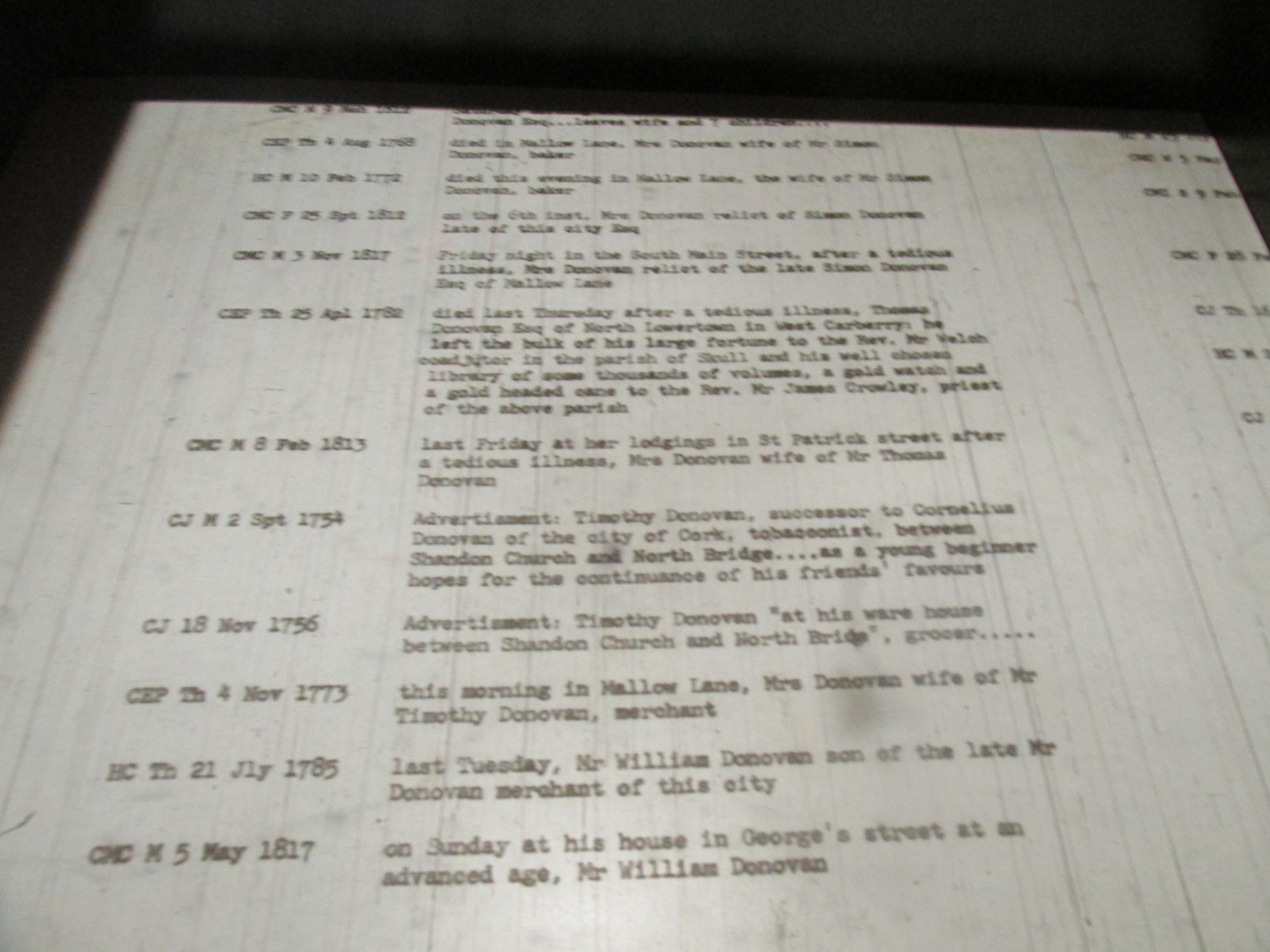
1782, died after a long illness Thomas Donovan, Esq., North Lowerton, West Carbery, left the bulk of his large fortune to the Rev. Mr. Walsh, in the Parish of Schull and his well chosen library of thousands of volumes and a gold watch and a gold beaded cane to the Rev. Mr. James Crowley of the same parish.
In old deeds and wills you come across example of wealth 18th century Catholics in the area such as Alexander Donivan of Squince, Castlehaven.
Decorative walking canes were once very common both in Ireland and in China.
David Cagney in the newspaper letter is thanked for his kindness in providing free lime to his tenants to Whitewash their cottages.
This is probably the Alexander O’Driscoll of Crookhaven referred to Post 1817 Florence McCarthy (The Grinder) Crookhaven 1817 married Mary grand daughter of Morty Óg O’Sullivan. He is believed to have taken own life. His sister married 1816 Alexander O’Driscoll, Crookhaven Another of her sisters Mary married Amos Bennett, Schull Paddy O’Keeffe, Bantry
David Cagney, (1806-1885), Cork. 1840 petition for Catholic Equality, voted 1850 for Denis Galwey as High Constable for Ibane and Ballyroe (Clonakilty), Member Election Committee, Alexander McCarthy 1855. Famine Relief 1847. Seeking equality of endowment in Catholic education 1859, subscriber 1861 to Smith’s History of Cork. 1877 donor Newcestown Church Spire. Probably David Cagney, died widower aged 79, merchant, 1885, Parkgariff, Monkstown. Probate £68,639 to Francis Cagney and Thomas Francis Lyons, merchants.
Michael Cagney -1861), 1857, Tivoli, sworn in by John Besnard J.P.. Police Court, Paradise Place, Cork, 1857. Besnard family of Huguenot descent ran a major sail making factory in Douglas. Wife Mary O’Regan she a descendant of Sit Teague O’Regan whose lands at Leap were restored under the Treaty of Limerick, 7 sons. 1840 calling for Testimonial to late William Crawford Cork benefactor. Seeking equality of endowment in Catholic education 1858. Subscriber 1861 Rev. Gibson’s History of Cork. Probate 1861 to widow Louise?, £9,000. The Clonakilty lands were sold to the tenants under the Land Purchase Act 1903
Alexander O’Driscoll
Not known if he was in jail or at home when he died of cholera.
s
Colourful character, dismissed and reinstated as a Magistrate. May have been charged after whipping a young boy during a hunt at Shepperton.
His father Timothy was an excise man known as ‘Tim the Gauger’ appears in multiple deed wj the Beechers on the Mizen Peninsula.
He was a ‘Lay Impropriator’ of part of the tithes in the Parish of Kilcrohane. 1831 Kilcrohane (Cill Chrócháin) tithes applotments. The Commissioners appointed to value were William Symms, William Pearson, certified 13th February 1831, Parish of Kilcrohane (Cill Chrócháin), 18,353 acres, value, £2,435.2 shillings. Apportioned as to Rev. Alcock,Vicar Durrus, £170, 45?, Alexander O’Driscoll, Esq., Lessee of Lord Donoughmore, £170, 45%, Nathaniel Evanson, Esq., £30, 10%, lessee of Lord Riversdale.
In the 1827 tithe applotments he is a middleman on numerous townlands in the Parish of Schull
Captain Alexander O’Driscoll, 1827, Clover Hill, Superseded 1810-30, Restored 1843. Norton Cottage, Skibbereen (two of the same name at time), Ancestor Alexander married daughter of McFineen Dubh O’Sullivan, son of Tim ‘The Gauger’, sister Mrs Freke of Baltimore Castle. 1820 signed Memorial for new road Glengariff to Castletownbere. Married to the daughter of Thomas Attridge, Ballydehob. Correspondence with Chief Secretary appealing dismissal of 1820. Bridge at Bawnlahan 1820. 1822 supporting new road Skibbereen to Bantry. 1822 subscriber as Clover Hill, Church Building Fund Durrus, he held tithes in Kilcrohane with Rector and Rev. Alleyn Evanson. Present at enquiry Skibbereen 1823 into enquiry into fatal affray at Castlehaven caused by Rev. Morritt’s tithe extraction. Grand Jury Presentments attending 12 from 1838-1840 at Norton Cottage. Probably engaged with his crew in marine salvage of Clio out of Crookhaven 1825. 1826 City election voted O’Callaghan conservative. Voted 1835 election as out of town Freeman address Shepperton. Public support for him on dismissal 1835 by fellow Magistrates Lord Bantry, Simon White, John Puxley, Samuel Townsend Senior, Samuel Townsend Junior, Hugh Lawton, Thomas Somerville, Rev. Alleyn Evanson, Richard Townsend Senior. Enquiry attended in Bandon 1841 into suspension arising from conduct with Stipendiary Magistrate J. Gore Jones and Sub-Inspector Andrew Creagh attended Earl of Bandon, Lord Viscount Bernard, on. H. White Hedges, Macroom Castle, Henry Bernard, Castle Barnard, Abraham Morris Dunkettle, Captain Henry Wallis, Drishane Castle, Lieutenant Colonel St. John Clerke, Overton House, William Cooke Wallis Junior, Castlecook, Mathias Hendley, Mountrivers, Henry Leader, Mount Leader, George Browne, Coolcower, St. Ledger Aldworth, Newmarket, Charles Evanson, Carlemont, Cork, Sir Thomas Deane, Thomas Hungerford, The Island, Nicholas Dunscomb, Mount Desert, Richard Henry Hedges Becher, Hollybrook, Skibbereen, John Isaac Heard, Kinsale, John Wheeler, Junior, James Gillman, Retreat, MD, Clonakilty, Thomas Herrick, Coolkerry, Captain R.A. Rogers, Petersfield, Michael Gallway, Gurtnagreena, John Nason, G. Nagle, Ballinamona Castle, Samuel Wallis Goold Adams, Jamesbrook, Jeremiah E. McCarthy, Rathduane, William F. Austen, Greenshela, Thomas R. Sarsfield, Ducloyne, Arthur Pery Aylmer, Castlefreke, Thomas Cuthbert Kearney, Garretstown, Joseph Haynes, Maryland House, Charles Connell, Cloverhill, John Barter, Cooldaniel, Francis G. Woodley, Leeds, Lawrence Corban, Maryville, E. Millett, MD, Cove. 1841 supported Conservative Longfield Longueville, Mallow even though Catholic hosted meeting attending John Ross, Rossford, Thomas Morris, Mahonagh, Thomas Wood, Dereeny, Listed 1838, dead….. with address Mount Music/Bunaulin, Caheragh when daughter Kate married Herbert Baldwin Esq., 1845. 1835 Subscriber at Gortnascrena, Skibbereen, Lewis Topographical Dictionary of Ireland 1837. Suspended for a period as J.P. reinstated after altered by a sitting of over 70 Magistrates in Bandon from both political sides. 1828 Bandon Quarter Sessions. His lands are managed by Bird. Member Provisional Committee projected Bandon to Bantry Railway 1845, address Norton Cottage. Believed to have been committed to a debtors prison in Cork by his wine merchant where he died. Norton Cottage was lived in once by Dr. O’Donovan, J.P., and bought 1925 by Jasper Woulfe, Solicitor, Crown Prosecutor and TD,
./.
There was another Alexander O’Driscoll around the same time a Magistrate in Caheragh and another in Cork
Tithe Applotments 1831 Townland as written Landlord The Tithe Applotment Books are a vital source for genealogical research for the pre-Famine period, given the loss of the 1821-51 Census records. They were compiled between 1823 and 1837 in order to determine the amount which occupiers of agricultural holdings over one acre should pay in tithes to the Church of Ireland (the main Protestant church and the church established by the State until its dis-establishment in 1871). “Although the Tithe Applotment Books are not a list of householders, in the absence of censuses for this period, they are valuable to the family historian, since they serve as a listing of land occupiers. However, since the commissioners were concerned only with those occupiers liable for the payment of the tithe, they would not generally have included cottiers, laborers holding conacre land, or landless people such as weavers, farm servants and vagrants.
Equally important, the books preserve the name and topography of pre-Ordnance survey territorial divisions, many of which were to disappear from the official record in the following decade. As a result of the countrywide mapping begun in 1833 and the changes in administrative boundaries by the Boundary Act of 1836, the government declared some denominations of land too large and subdivided them into smaller units with new names. Some townlands, for example, were transferred not only from one parish to another but from one county to another! The topographical and geographical problems thus cReagh (An Ré)ted for the genealogist can make territorial location of an ancestor difficult.
This is an example for the Parish of Durrus/Kilcrohane (Cill Chrócháin) retained in the Land Commission records originals probably destroyed in 1922. Each parish select vestry had a function in approving applottments the Cork Consistory Registry kept the originals.”
1831 Kilcrohane (Cill Chrócháin) tithes applotments. The Commissioners appointed to value William Symms, William Pearson, certified 13th February 1831, Parish of Kilcrohane (Cill Chrócháin), 18,353 acres, value, £2,435.2 shillings. Apportioned as to Rev. Alcock,Vicar Durrus, £170, 45?, Alexander O’Driscoll, Esq., Lessee of Lord Donoughmore, £170, 45%, Nathaniel Evanson, Esq., £30, 10%, lessee of Lord Riversdale.
Also included is census information from 1766 to 1841.
Further information on of the weavers in the district.
The Franco-Irish Ambulance Brigade (known in French as the Ambulance Irlandais)[1] was a volunteer medical corps sent from Ireland to assist the French Army in the 1870–71 Franco-Prussian War. At the time Ireland was part of the United Kingdom of Great Britain and Ireland and parliament had passed the Foreign Enlistment Act 1870 which, in most circumstances, prohibited British citizens from enlisting in foreign armies. As a non-combatant force the ambulance brigade was not covered by the act. Around 280 men joined the brigade which arrived in France in early October 1870. They served with the French armies of the North and of the Loire until the signing of the armistice in January 1871. The unit was controversial as only a minority of the men who enlisted were retained for ambulance service, with many choosing instead to fight in the French Foreign Legion. The British government investigated the unit for breaches of the 1870 act but no prosecutions were brought.
This is an exercise taking the tithe applotments for the whole Parish and reclassifying it by property valuation and occupier.
For values between £42 and £10, 32, 6%
£10 to £5, 128, £24
£5 to £3, 132, £25
£3 to 8 shillings, 245, 45%, this probably included cottiers and weavers.
Some occupier have land in different townlands so there are more holding than occupiers.
Pre Famine this Parish had one of the highest population densities in the world like India or China, if bog, hill and lake are removed.
The townland names are being given their modern version and the Irish version.
The collection of tithes was ruthless and army of proctors, drivers, with police and sometime British Army assistance seized livestock kept in the village pound.
A vigorous campaign on the Muintervara Peninsula led by Landlord and Magistrate Timothy O’Donovan of O’Donovan Cove succeeded in beiht the first area of West Cork to be rid of tithes in the 1830s.
The Commissioners appointed to value were William Symms, William Pearson, certified 13th February 1831, Parish of Kilcrohane, 18,353 acres, value, £2,435.2 shillings. Apportioned as to Rev. Alcock, Vicar Durrus, £170, 45?, Alexander O’Driscoll, Esq., Lessee of Lord Donoughmore, £170, 45%, Nathaniel Evanson, Esq., £30, 10%, lessee of Lord Riversdale.
The Tithe Applotment Books are a vital source for genealogical research for the pre-Famine period, given the loss of the 1821-51 Census records. They were compiled between 1823 and 1837 in order to determine the amount which occupiers of agricultural holdings over one acre should pay in tithes to the Church of Ireland (the main Protestant church and the church established by the State until its dis-establishment in 1871). The set online were deposited in the Court Consistory Court Registry adn seems to have arrived in the `Land Commission, as per the last page of the record. For the Parish of Kilcrohane they would have been signed off by the select vestry of Durrus Church of Ireland Parish in exercise of its civil function as the Irish State Church, until 1869.
Although the Tithe Applotment Books are not a list of householders, in the absence of censuses for this period, they are valuable to the family historian, since they serve as a listing of land occupiers. However, since the commissioners were concerned only with those occupiers liable for the payment of the tithe, they would not generally have included cottiers, laborers holding conacre land, or landless people such as weavers, farm servants and vagrants.
In this set of records it is likely that those with a valuation of less than £3, i.e., 245 out of 540 holdings 45% and a few are in fact weavers holding mayabe an acre of land for potatoes.
Tis class of cottiers were wiped out by the Famine
Equally important, the books preserve the name and topography of pre-Ordnance survey territorial divisions, many of which were to disappear from the official record in the following decade. There are a number of sub townlands tht do not feature in the Griffith Valuation. As a result of the countrywide mapping begun in 1833 and the changes in administrative boundaries created by the Boundary Act of 1836, the government declared some denominations of land too large and subdivided them into smaller units with new names. Some townlands, for example, were transferred not only from one parish to another but from one county to another! The topographical and geographical problems thus created for the genealogist can make territorial location of an ancestor difficult.
Also include are some records of local weaver and others in various records.
Edward Jones Alcock, TCD, 1790-1842, son and curate of Rev. Mason Alcock. Crookhaven 1823. May have lived at Sea Lodge, built old rectory (Glebe House) in 1831. 1822 Lord Lieutenant sends £30 for local distress. 1822 involved in famine relief with Father Quinn. 1822. Local Fishery Committees, Kinsale, Clonakilty, Glandore, Baltimore, Crookhaven For Bantry Timothy O’Donovan J.P., O’Donovan’s Cove, Durrus, Michael O’Sullivan, Rev. Edward Jones Alcock, Rector Durrus, John Jagoe later Fishery Commissioner, Michael Murphy, Newtown, Bantry, Rev. M McChean, Bantry, John Sandys Bird. 1820. Memorial to Lord Lieutenant by William Swanton, Gortnagrough, Ballydehob, West Cork. High Constable (Rate and Tax Collector), Barony of West Carbery For Relief on Losses Caused to Him in Banking Collapse when He had transmitted Due Amount to Co. Treasurer, Leslies, Stephen and Roches Bank, Supported by Lord Bantry and Magistrates Timothy O’Donovan (Durrus), William Hull (Schull), Richard Townsend (Skibbereen), Rev. Edward Jones Alcock (Durrus), Nathaniel Evanson (Durrus), Robert Kenny (Bantry). In 1823 he applied for relief of poor of Ballydehob, which he had founded. He sat on a committee in Bantry in 1824 to petition against the withdrawal of the bounty on linen production as had been agreed in the Act of Union. Involved in proselytising. Father Quinn’s application 16th November 1830 ED1/13/74/2, signed by for Roman Catholics Richard O’Donovan, Timothy O’Donovan, Richard Tobin, Edmond Tobin, Daniel Daly, Richard O’Donovan, John Murphy, John Carthy, Thomas Cormack?, Elias Roycroft, Andrew Caverly, Richard Caverly, Protestants E. Evanson, Richard L. Blair, Thomas Ferguson, Thomas Duklow, Charles Ducklow, John Ducklow. Rev Alcock of the Church of Ireland was asked to consent but declined but his parishioners signed. His proctors, 1833, attempted to seize Father Quin’s bed while mass was being said in his house to secure tithe payment only the intervention of Protestant neighbours stopped it. Grand Jury Presentment Sessions Schull, 1834, cess payer. Durrus Parish Tithes payable to him of which the sum of £320 Sterling is due and payable by the year to the said Reverend Edward Jones Alcock, the composition from the tithes claimable by him as a figure of such part of said Parish as is commonly known by the name of Durrus or Parish of KIlcrohane is payable to the Reverend Alcock Vicar of the said Parish the sum of £170. Most of the tithes were the property of Nathaniel Evanson and Alexander O’Driscoll having leases of tithes. So it may be he who sent the proctors otherwise all outstanding tithes collected in one day. Cess payer representative Barony West Carbery 1834.
The labourers not long since employed at the building of a Glebe House for the Protestant Clergyman (Rev. Alcock) were allowed no more more for the work of a day in summer then 6d in the claim then made of them by the clergyman for the tithe, and that without diet, such is the poverty, and so little employment is there for labourers in these parishes that on the occasions referred to some 40 or 50 might be seen coming a considerable distance in search of employment on such terms and moreover understand they were obliged to be at work before six perhaps at five each morning continue at it until eight, or even later, in the evening, with no diet but those cold and comfortless potatoes boiled in a distant cabin, and eaten by the ditch side or under the scaffolding of the new building.
1839 Gaming Certificate. Father in law Henry Jones 1799-1805, late Rector of Lislee his daughter Frances Jane July 1833 married Rev. Edward James Alcock, 1831 at Kilmacabea.
2nd January 1840 Mrs. Jones Clashadoo At the Durrus Glebe home of her son in law of Rev. J. E. Alcock, relict of Rev. Henry Jones, Drombeg, Rosscarbery late incumbent of Lislee and Killsallagh.
Attending Dunmanway Conservative and anti Repeal Meeting 1845.
Maskelyne Alcock, 1767, Rough Grove/Ballygarvy, witness deed at Derrygariff 1743. Subscriber of 1766 ‘The History of the Irish Rebellion’, Cork, 1766. 1814 at Tuc
Nathaniel Evanson, 1799, Four Mile Water, Durrus, Listed supporter of Act of Union, 1799. 1820 signed Memorial for new road Glengariff to Castletownbere. 1831, listed at North Main St., Bandon 1824, son Nathaniel Kings Inns 1818 and 1823 his address is Brookfields, Bandon. He or his father may have built Durrus Court, Gearhameen late 1780s. 1794 Freeman of Cork Nathaniel Evanson, of Four Mile Water, Esq., at the request of Sheriff (Charles) Evanson Senior member 1810, Bandon Militia. Member or father Hanover Association meeting Cork 1791 re Whiteboys. 1820. Memorial to Lord Lieutenant by William Swanton, Gortnagrough, Ballydehob, West Cork. High Constable (Rate and Tax Collector), Barony of West Carbery For Relief on Losses Caused to Him in Banking Collapse when He had transmitted Due Amount to Co. Treasurer, Leslies, Stephen and Roches Bank, Supported by Lord Bantry and Magistrates Timothy O’Donovan (Durrus), William Hull (Schull), Richard Townsend (Skibbereen), Rev. Edward Jones Alcock (Durrus), Nathaniel Evanson (Durrus), Robert Kenny (Bantry). In 1823 he applied for relief of poor of Ballydehob, which he had founded. 1822 petitioning Chief Secretary for road works in Durrus/Kilcrohane in view of want of work and deficiency of food. 1826 election voted for Hutchinson. Member 1832 Cork Friendly Club. Daughter Dora then at Bandon married Abraham Jagoe, Kinrath Cottage, Dunmanway she died at Blackrock, Cork, 1863. In 1835 his rent charge at Dromnea, Gearhameen and Rasavourney, Rossiviree in Durrus was granted to Charles, Abraham and Hungerford Baldwin Evanson entitling them to vote. Non resident Freeman voting Cork City Election 1837. Died at Four Mile Water Court 1833.\
Captain Alexander O’Driscoll, 1827, Clover Hill, Superseded 1810-30, Restored 1843. Norton Cottage, Skibbereen (two of the same name at time), Ancestor Alexander married daughter of McFineen Dubh O’Sullivan, son of Tim ‘The Gauger’, sister Mrs Freke of Baltimore Castle. 1820 signed Memorial for new road Glengariff to Castletownbere. Married to the daughter of Thomas Attridge, Ballydehob. Correspondence with Chief Secretary appealing dismissal of 1820. Bridge at Bawnlahan 1820. 1822 supporting new road Skibbereen to Bantry. 1822 subscriber as Clover Hill, Church Building Fund Durrus, he held tithes in Kilcrohane with Rector and Rev. Alleyn Evanson. Present at enquiry Skibbereen 1823 into enquiry into fatal affray at Castlehaven caused by Rev. Morritt’s tithe extraction. Grand Jury Presentments attending 12 from 1838-1840 at Norton Cottage. Probably engaged with his crew in marine salvage of Clio out of Crookhaven 1825. 1826 City election voted O’Callaghan conservative. Voted 1835 election as out of town Freeman address Shepperton. Public support for him on dismissal 1835 by fellow Magistrates Lord Bantry, Simon White, John Puxley, Samuel Townsend Senior, Samuel Townsend Junior, Hugh Lawton, Thomas Somerville, Rev. Alleyn Evanson, Richard Townsend Senior. Enquiry attended in Bandon 1841 into suspension arising from conduct with Stipendiary Magistrate J. Gore Jones and Sub-Inspector Andrew Creagh attended Earl of Bandon, Lord Viscount Bernard, on. H. White Hedges, Macroom Castle, Henry Bernard, Castle Barnard, Abraham Morris Dunkettle, Captain Henry Wallis, Drishane Castle, Lieutenant Colonel St. John Clerke, Overton House, William Cooke Wallis Junior, Castlecook, Mathias Hendley, Mountrivers, Henry Leader, Mount Leader, George Browne, Coolcower, St. Ledger Aldworth, Newmarket, Charles Evanson, Carlemont, Cork, Sir Thomas Deane, Thomas Hungerford, The Island, Nicholas Dunscomb, Mount Desert, Richard Henry Hedges Becher, Hollybrook, Skibbereen, John Isaac Heard, Kinsale, John Wheeler, Junior, James Gillman, Retreat, MD, Clonakilty, Thomas Herrick, Coolkerry, Captain R.A. Rogers, Petersfield, Michael Gallway, Gurtnagreena, John Nason, G. Nagle, Ballinamona Castle, Samuel Wallis Goold Adams, Jamesbrook, Jeremiah E. McCarthy, Rathduane, William F. Austen, Greenshela, Thomas R. Sarsfield, Ducloyne, Arthur Pery Aylmer, Castlefreke, Thomas Cuthbert Kearney, Garretstown, Joseph Haynes, Maryland House, Charles Connell, Cloverhill, John Barter, Cooldaniel, Francis G. Woodley, Leeds, Lawrence Corban, Maryville, E. Millett, MD, Cove. 1841 supported Conservative Longfield Longueville, Mallow even though Catholic hosted meeting attending John Ross, Rossford, Thomas Morris, Mahonagh, Thomas Wood, Dereeny, Listed 1838, dead….. with address Mount Music/Bunaulin, Caheragh when daughter Kate married Herbert Baldwin Esq., 1845. 1835 Subscriber at Gortnascrena, Skibbereen, Lewis Topographical Dictionary of Ireland 1837. Suspended for a period as J.P. reinstated after altered by a sitting of over 70 Magistrates in Bandon from both political sides. 1828 Bandon Quarter Sessions. His lands are managed by Bird. Member Provisional Committee projected Bandon to Bantry Railway 1845, address Norton Cottage. Believed to have been committed to a debtors prison in Cork by his wine merchant where he died. Norton Cottage was lived in once by Dr. O’Donovan, J.P., and bought 1925 by Jasper Woulfe, Solicitor, Crown Prosecutor and TD,
Alexander O’Driscoll, two of the same name at period locally. 1822 supporting new road Skibbereen to Bantry. 1828 seeking reform of the House of Commons address Shepperton. Bantry Quarter Sessions 1842.
1880 probate Sarah Caroline Donovan, spinster, Rafeen Duff, Co. Wexford, value £4,000 executor James Edward Meldicott. Wexford Donovans, a Protestant sept of the O’Donovans originating in Carbery described by Dr. John O’Donovan as ‘Rabid Orangemen”
Dr. John O’Donovan probably one of Ireland’s greatest scholars. Many of his paper are in the Royal Irish Academy, Dublin a gift by Dr. Graves ad Kilkenny Antiquarian.. He bought them from Dr. O’Donovan widow.
1876 Subscriber to Dr. Daniel O’Donovan’s History of Carbery, John Glasscott, Dublin Castle, (2 copies), mother, Wexford, Donovan, a Protestant sept of the O’Donovans originating in Carbery described by Dr. John O’Donovan as ‘Rabid Orangemen”
1822 Rev. William Glascott Probably Wexford married Protestant O’Donovan in female line who originated in Carbery.
1806- , Some West Cork Members of the Association Incorporated for Discontinuancy Vice and Promoting the Knowledge and Practise of The Christian Religion
Many of the names in the 1725 settlement rental appear in the 1702 Patrickson/Cox deed enclosed. Patrickson acquired from the Hollow Blade Company. They were not active estate managers, this may have been confiscated McCarthy Lands. It is possible that the tenants were McCarthy tenants moving westward from the Bandon Plantation post 1650.
Skibbereen Heritage Centre has a database of the Townlands and Street Names for much of West Cork. You can search this database below. The results will show the Alternative Name (AKA), Civil Parish, Poor Law Union (PLU), District Electoral Division (DED) and Notes associated with each Townland or Street.

 West Cork History