Tags
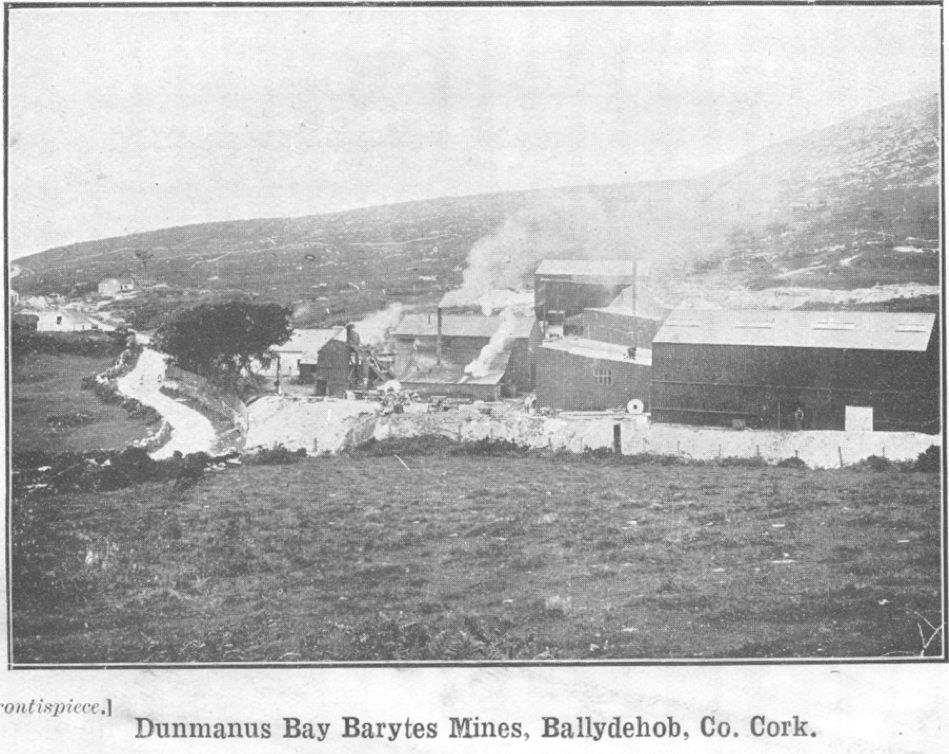
Dereenlomane Barytes Mine
This was originally worked as a copper mine by the Rev. Traill of Schull, assisted by Captain William Thomas in 1840 and they sold 19 tons of copper. They discovered barytes or barium sulphate, a heavy white mineral, used for paint, papermaking for which in the 1850s there was a limited market. An early use was by Josiah Wedgewood in the making of pottery. In 1863 Captain Thomas was chartering boats c 160 tons and shipping the barytes to Messrs Martyn Dennis Liverpool and around 150 people were employed. That year there was a serious flood which resulted in the mine being non operational for a period. In 1867 the mine at what was described as Cahirolickaney Mountain was inaccessible and Captain Thomas built a road from the mine to the Dunbeacon Road nearly a mile long in three weeks. It was marked by a celebration with ‘creature comforts’ in abundance, followed by a dance. Before the road was built the farmers had to carry sea sand and manure along the line of the rocky bed of a river and scramble up the mountain as best they could with back load on horses, men and women. The road was called Wilson’s after one of the promoters by Father O’Regan. There were quite a number of fatalities in the operation of the mine which were mentioned in the local press.
In 1851, 2,500 tons were raised compared to only 800 tons in three other centres in the former United Kingdom. The material was washed, dried, crushed and milled. It was then produced as barytes flour; this was packed into bags and sent to an island jetty in Dunmanus Bay by an aerial ropeway 1.23 miles long. From 1909, the boats carried coal to Dunbeacon and left with barytes. During the War men dived there looking for remnants of coal. Prior to that the ore went by horse and cart to Schull pier. The mine also produced a small tonnage of copper (bornite) and approx 22,000 tons of fine barytes. It was worked by a Liverpool Company controlled by the Roe Brothers; one of the assistant Managers was Mr. Barton. The mine used to be all lit up at night and it looked like a city. At its height up to 500 were employed, supervised by Welsh miners. The nembers employed in 1915 were 150 described as highly paid. Among those who worked there were the father and uncles of Danno Mahony of nearby Derreenlomane the World Wrestling Champion. Bells rang to call the labourers to work in the morning. A report in 1923 described the treatment of the ore as ‘washing, drying, in a revolving furnace, crushing, rolling between steel rollers and milling’. In 1917 a major fire caused extensive damage, including the underground workings. Although repairs were carried out, the mine never recovered its former level of activity. In 1922 the then Department of Agriculture and Technical Instruction reviewed the recent history of the mine and commented on it being burnt down in July 1920. Mr Lynburn of the Department expressed a hope that in time with a more relaxed regime re explosives it might re open.
A line of timber pylons ran from the mine site down the steep hillside all the way to Dunmanus Bay. The pylons, anchored to triangular concrete-and-stone foundations, supported a continuous aerial rope and a number of cable cars. The system was powered by a gas engine. The foundations are all still in situ and can be followed to the sea. The ships which carried away the ore landed coal and during the War people dived in the area seeking lumps of coal.
Five hundred men had worked at the mine between 1917-18. Mine water was pumped by a ‘balanced bob’ with the engine house being sited over the main shaft. The gas engine house was located adjacent to the pump house. The mining company entrusted the job of making ore-bearing cable-cars to a local carpenter cum pit-sawyer named Willie Coakley. He seems to have played a considerable role in erecting the aerial ropeway system and in weaving wicker cable-cars to transport ore from mine to sea.
Boats landed at a pier of which a buoy still survives. The Atridge, Shannon and Hegarty families from Rossmore across the Bay jointly owned a fishing boat. They would regularly cross to trade potatoes, vegetables and meat for tobacco and brandy. The Captain was Captain was generally Captain Bousy and afterwards the Attridges were known as the Bousys. It was the custom for the miners to play football at a field near the mine every Saturday afternoon.
On the first trial of the aerial ropeway, a number of baskets were laden with barytes and sent down the steep hill to their destination, a pier at Dunmanus Bay. From there it was exported to Liverpool, London or Glasgow. However, on releasing the baskets it was discovered that the braking mechanism on the aerial ropeway had failed. On reaching journey’s end, the run-away cable-cars demolished a portion of the aerial rope and caused extensive damage to the system, presumably several pylons were torn from their foundations.
A local wit composed a poem to commemorate the event – the poem was titled Coakley’s Apparatus’ One line of the poem describes the wicker basket in euphemism as ‘a donkey who would never have a foal’.
At the Dunbeacon side there was an area of houses now derelict which in the early 20th century was a hive of activity and centre of music and dancing known as the ‘Station Heights’. Many of the families were associated with the mines.
When the mines closed many of the miners went to the coal mines of South Wales or to the USA. One of them was Denis John L O’Sullivan, his father originally from Kilcrohane ran a pub in Durrus, who went to the USA and returned. He had a pub in Durrus Village which is still run by his son Danny.
 .
.
 Original Book Cornell University, New York
Prom the Genealogical Table given at p. 4, it is clear that
Cuchonnacht na Sgoile O'Daly, who died at Clonard, in 1139,
was the first man of the O'Dalys who was celebrated for his
learning. Prom his period forward poetry became a profession
in the family, and the Corca-Adaim sent forth poetical
professors to various parts of Ireland. About the middle of
the twelfth century Eaghnall O'Daly settled in Desmond, and
became chief professor of poetry to Mac Carthy, king of Des-
mond. Prom him, no doubt, the O'Dalys of Muintir-Bhaire,
in the south-west of the County of Cork, are descended ; but
their pedigree has not been preserved by the O'Clery's or Mac
Pirbises, and it is to be feared that it is irrecoverably lost. Dr.
O'Brien, indeed, asserts in his Irish Dictionary (voce dala),
that the O'Dalys of Munster are descended from the third son
of Aenghus, king of Cashel, who was baptized by St. Patrick ;
'O'Beilly mentions twenty-eight poets of this family, and gives
the first lines of upwards of one hundred poems written by them ;
and we have in our own collection almost as many more which es-
caped his notice ; but they are chiefly religious, being the
compositions
of Donough Mor O'Daly, who died in 1244, and of Aenghus O'Daly
surnamed " na Diadhachta" (the Pious or Divine), who flourished
about the year 1670. See O'Reilly's Irish Writers, p. cxxxix.
But this is one of the very many unaccountable errors with
which that work abounds. The same error has been interjiol-
ated into several modern copies of Keating's History of Ireland.
Of the O'Dalys of Muintir-Bhaire, of whom was Aenghus
the Bard liuadli, some notices occur in the Pacata Hibernia,
Book III., and in the MS. entitled Carbrim Notitia, which
formed No. 591, of the sale catalogue of the late Lord Kings-
borough's library,' which are here given, that tlie reader may
have before him all the information respecting the sept of the
O'Dalys at present accessible : —
" 1603. Fourth [of May], Odalie was convented before
the Lord President and Councell, and in regard it was proved
that hee came from the Eebells, with messages and offers to
Owen Sulevan. to adhere and combine with the Enemy,
which the said Owen did first reveal to Captaine Flower, Ser-
geant Major of the Army, and after publikely justified it to
Odalie' s face ; the said Baly was committed to attend his
tryal at the next sessions.
"This Odalie^ s Ancestor had the country of Moyntirbary
given unto him by the Lord President's Ancestor, many hun-
dred yearcs past, at which time Carew had to his inheritance,
the moity of tjie whole kingdom. This account of Carew is, however, not very accuratee of Corke, which was first
given by King Heni-y the second unto Robert Fitz StepJien ;
the service which Odaly and his progenie were to doe, for so
large a proportion of Lands unto Carew and his successors was
(according to the custom of that time) to bee their Eimers, or
Chroniclers of their actions."
this account is not very accurae; for . the family never had
possession of this territory until the reign
of Queen Elizabeth, and then only for a very short time. In
the reign of Edward III. Thomas de Carew set up a claim, as
heir to Eitz-Stephen, to all his ancient estates in Cork ; but
by an Inquisition taken at Cork, before Sir Anthony Lucey,
Lord Justice of Ireland, on the 31st. of August, in the fifth
year of the reign of Edward III., it was found that " Robert
Fitz-Stepheu died seized of the moiety of the estate granted
by Henry II. to him and Milo de Cogan, and that the said
Eitz-Stephen was a Bastard, and died without issue of his
body J that the claim of Thomas de Carew, asserting that he
and liis ancestors were heirs to Eitz-Stephen, could not be true,
because the said Fitz-Steplien was a Bastard, and died
without issue of his body."
Notwithstanding this Inquisition the claim was again set
up in 1568, by Sir Peter Carew, whose brother Sir George,
was afterwards President of Munster ; but Sir Peter died in 1575,
and his heir Peter junior, was slain by the O'Byrnes at Qlen-
malure in 1580; and the prosecution of the suit ended in
nothing. (Four Masters, A. D. 1580). From this it is very
clear that the O'Dalys of Muintir- Bhaire had little or no
connection with the Carews either in the reigns of Edward III.
or of Elizabeth. The Author of Carbrice Notiiia, evidently seeing
through the fallacy of this statement in the Pacata Hibernia,
thus modifies it in his account of the south-west of the County
of Cork.
" And soe [crossing Dunmanus Bay] you come to Mynter-
vary, which lyes between Dunmanus Bay and Bearhaven, in
which there is nothing worth observation except Coolnalong,
a pretty seat belongingformerly to Mucklagh, a sept of the
Cartys. This country was, according to Irish custome,
given to O'Daly, who was successively Bard to O'Mahony and
Carew ; and to O'Glavin, who was his Termoner or receiver."
Dr. Smith also describes Minterbarry, and calls it " a most
barbarous country, lying between Dunmanus Bay and Bantry
^^"j " (The story of Cork, Book II, c. ^.), but says nothing of
the O'Dalys in connection with it ! !
The head of this family had his residence at Druim-Naoi,
or Drumnea, in the parish of Kilcrohane, where a portion of
his house, commonly called " The Old College House," still
remains, and forms the residence of a farmer, Mr. George
Nicolas. The walls are well built, and cemented with lime
and mortar, and from fragments of ruins still to be seen close
to what remains, it may be inferred that it was once a house
of some importance. According to tradition, two sons of a
king of Spain, who were at school here under the tuition of
O'Daly, died and were buried in Drumnea.
The head of this family, Aenghus, son of Aenghus Caech
O'Daly Cairbreach, died in the year 1507'. The last profes-
sional poet of this house was Conchobhar Cam O'Dalaigh Cair-
'A branch of this family of the O'Dalys, removed to the County of
Kerry, a member of whom was the celebrated Daniel or Dominick
O'Daly, who wrote the History of the Geraldincs. He was born in
(he year 1505, and died at Lisbon in the year 1662.
breacbj wlio wrote an elegy of forty ranns or quatrainSj on the
death of Donnell O'Donovan, chief of Clann-Cathail, who died
in 1660, beginning: —
" CiteAb bo tiU3 A1% tpAitcttAift ?Ou)ii)i)eAC ? "
" What has overtaken the Momonian Youths ?"
He also addressed a poem of thirteen ranns or quatrains,
to his pupil Donough, the son of Donnell O'Donovan, and
brotlier of said Donnell, who died in 1660, beginning : —
" Saoc lcAii)-i-A luibe feof)ijcAi8. "
" Sorrowful to mo is the lying [siolmessj of Donnchadh."
This Donough, who was the foster-son of O'Daly Cairbreach,
is the ancestor of Mr. James O'Donovan of Myross, in the
County of Cork.
Conchobhar Cam O'Daly also addressed a short poem' of nine
quatrains, to Joan, daughter of Sir Owen Mac Carthy Eeaglt,
and wife of O'Donovan (Donnell, son of Donnell, son of Teige),
beginning : —
" O 1 Joan, confirm our treaty.''
The last descendant of O'Daly of Drumnea, who was recog-
nized in the country as the head of the sept, and who claimed
the O'Daly tomb at Kilcrohane, was Mr. James Daly of Bantry.
He removed from Bantry to Cork, where he became a distiller,
and kept a respectable establishment in John-street. He died
some three or four years since, leaving a son, Mr. James O'Daly,
who is still living at Cork.
That Aenghus O'Daly the Bard Ruadh, was of this family,
but not the chief of it, little doubt can be entertained ; and
O'lleilly believes that he was the Angus O'Daly of Balliorrone,
wlio according to an Inquisition taken at the Old Castle in Cork,
on the 1 8th. of September, 16?,4, died on the 1 6th. of Decem-
ber, 1617, leaving a son Angus Oge O'Daly.
The Ballyorrone mentioned in this Inquisition is now called
Ballyrune. It originally comprised the present Ballyrune, as
well as Cora, Laherdoty, and Ballyieragh. Laherdoty was for-
merly called Mid-Ballyrune, and Ballyieragh (BA^le iA|iCA|tAc,
i. e., west town), West-Ballyrune. The site and small portions
' Copies of these poems are preserved in paper MS. about one
hundred and sixty years old, which was in the possession of Mr.
Peter Lavalli, late Peruquier of the Four Courts, Dublin ; and now
living in Paris.
Of the walls of Aenglius O'Daly's, or the Bard Ruadfi's house,
are still pointed out in that subdivision of Ballyrune called
Cora. The walls are built of freestone and cemented with lime
and hair mortar. There is a rock near the Tower at Sheep's
Head, called Bfto Sleugun*, (i e., Angus's Quern), which is
locally believed to have received its name from Aenghus na
n-Aer O'JiiAy. Several of the Dalys, or 0' Dalys of Muintir-
Bhaire, claimed descent from him, namely, Daniel Daly of
Ahakista, deceased, and several others, but the widow Connell
alias Mary Daly, now in the Bantry work-house, is believed to
be the nearest akin to him now living. Her friends have emi-
grated to America. Several verses attributed to the Bard
Ruadh of Ballyrune, and having reference to his coshering pro-
pensities, in his old age, when he was poor, are still locally
recited, which corroborate O'Reilly's opinion, that he was the
Angus O'Daly mentioned in the Inquisition above referred to ;
but never, at any period of his life, was he poet to O'Keeffe, as
O'lleilly thinks.
The family of O'Daly was always considered as forming about
the one-twelfth part of the population of Muintir-Bhaire, now
included in the parish of Kilcrohane.
Prom a census of the population taken by the Eev. John Keleher, P. P.,
in October, 1834, it appears that the total popu-
lation of the parish was then 4448 souls, of which th6 O'Dalys
were 345, including 183 males, and 163 females, i. e., about
one-twelfth of the entire population.
In December, 1849, a census of the parish was also taken
by the Eev. Jeremiah Cummins, R. C. C, from which it appears
that the population had decreased to 2820 souls, of which the
O'Dalys constituted 217, (125 males, and 92 females), i. e., one-
thirteenth of the entire population. Both censuses prove that
the O'Dalys have kept up their old proportion to the population,
although they are as liable to disappear by starvation and emi-
gration as the other families of Muintir-Bhaire.
The O'Dalys (who appear to have forfeited the last remnant
of their property in Muintir-Bhaire, at the Revolution), are now
reduced to the condition of cottiers or struggling farmers, in this
wild district. The principal proprietors at present are, Richard
O'Donovan, Esq., J. P., Fort Lodge, Bantry ; Dr. Daniel
O'Donovan of Skibbereen, J. P. ; Timothy O'Donovan, Esq.,
J. P., O' Donovan's Cove; and Timothy O'Donovan, Esq., of
Ardahill.
The ancestor of the three first-mentioned proprietors, took
this large tract of land for 999 years, from a Mr. Congreve of
Mount Congreve, in the County of Waterford, an undertaker ;
to whose descendant they still pay some small head rent. Ti-
mothy O'Donovan, Esq., of Ardahill (who descends from Kedagh
Mor, the youngest son of O'Donovan, by the daughter of Sir
Owen Mac-Carthy Reagh), was himself the purchaser of Arda-
hill, Oarravilleen, Derry-clovane and Taunmore.
Original Book Cornell University, New York
Prom the Genealogical Table given at p. 4, it is clear that
Cuchonnacht na Sgoile O'Daly, who died at Clonard, in 1139,
was the first man of the O'Dalys who was celebrated for his
learning. Prom his period forward poetry became a profession
in the family, and the Corca-Adaim sent forth poetical
professors to various parts of Ireland. About the middle of
the twelfth century Eaghnall O'Daly settled in Desmond, and
became chief professor of poetry to Mac Carthy, king of Des-
mond. Prom him, no doubt, the O'Dalys of Muintir-Bhaire,
in the south-west of the County of Cork, are descended ; but
their pedigree has not been preserved by the O'Clery's or Mac
Pirbises, and it is to be feared that it is irrecoverably lost. Dr.
O'Brien, indeed, asserts in his Irish Dictionary (voce dala),
that the O'Dalys of Munster are descended from the third son
of Aenghus, king of Cashel, who was baptized by St. Patrick ;
'O'Beilly mentions twenty-eight poets of this family, and gives
the first lines of upwards of one hundred poems written by them ;
and we have in our own collection almost as many more which es-
caped his notice ; but they are chiefly religious, being the
compositions
of Donough Mor O'Daly, who died in 1244, and of Aenghus O'Daly
surnamed " na Diadhachta" (the Pious or Divine), who flourished
about the year 1670. See O'Reilly's Irish Writers, p. cxxxix.
But this is one of the very many unaccountable errors with
which that work abounds. The same error has been interjiol-
ated into several modern copies of Keating's History of Ireland.
Of the O'Dalys of Muintir-Bhaire, of whom was Aenghus
the Bard liuadli, some notices occur in the Pacata Hibernia,
Book III., and in the MS. entitled Carbrim Notitia, which
formed No. 591, of the sale catalogue of the late Lord Kings-
borough's library,' which are here given, that tlie reader may
have before him all the information respecting the sept of the
O'Dalys at present accessible : —
" 1603. Fourth [of May], Odalie was convented before
the Lord President and Councell, and in regard it was proved
that hee came from the Eebells, with messages and offers to
Owen Sulevan. to adhere and combine with the Enemy,
which the said Owen did first reveal to Captaine Flower, Ser-
geant Major of the Army, and after publikely justified it to
Odalie' s face ; the said Baly was committed to attend his
tryal at the next sessions.
"This Odalie^ s Ancestor had the country of Moyntirbary
given unto him by the Lord President's Ancestor, many hun-
dred yearcs past, at which time Carew had to his inheritance,
the moity of tjie whole kingdom. This account of Carew is, however, not very accuratee of Corke, which was first
given by King Heni-y the second unto Robert Fitz StepJien ;
the service which Odaly and his progenie were to doe, for so
large a proportion of Lands unto Carew and his successors was
(according to the custom of that time) to bee their Eimers, or
Chroniclers of their actions."
this account is not very accurae; for . the family never had
possession of this territory until the reign
of Queen Elizabeth, and then only for a very short time. In
the reign of Edward III. Thomas de Carew set up a claim, as
heir to Eitz-Stephen, to all his ancient estates in Cork ; but
by an Inquisition taken at Cork, before Sir Anthony Lucey,
Lord Justice of Ireland, on the 31st. of August, in the fifth
year of the reign of Edward III., it was found that " Robert
Fitz-Stepheu died seized of the moiety of the estate granted
by Henry II. to him and Milo de Cogan, and that the said
Eitz-Stephen was a Bastard, and died without issue of his
body J that the claim of Thomas de Carew, asserting that he
and liis ancestors were heirs to Eitz-Stephen, could not be true,
because the said Fitz-Steplien was a Bastard, and died
without issue of his body."
Notwithstanding this Inquisition the claim was again set
up in 1568, by Sir Peter Carew, whose brother Sir George,
was afterwards President of Munster ; but Sir Peter died in 1575,
and his heir Peter junior, was slain by the O'Byrnes at Qlen-
malure in 1580; and the prosecution of the suit ended in
nothing. (Four Masters, A. D. 1580). From this it is very
clear that the O'Dalys of Muintir- Bhaire had little or no
connection with the Carews either in the reigns of Edward III.
or of Elizabeth. The Author of Carbrice Notiiia, evidently seeing
through the fallacy of this statement in the Pacata Hibernia,
thus modifies it in his account of the south-west of the County
of Cork.
" And soe [crossing Dunmanus Bay] you come to Mynter-
vary, which lyes between Dunmanus Bay and Bearhaven, in
which there is nothing worth observation except Coolnalong,
a pretty seat belongingformerly to Mucklagh, a sept of the
Cartys. This country was, according to Irish custome,
given to O'Daly, who was successively Bard to O'Mahony and
Carew ; and to O'Glavin, who was his Termoner or receiver."
Dr. Smith also describes Minterbarry, and calls it " a most
barbarous country, lying between Dunmanus Bay and Bantry
^^"j " (The story of Cork, Book II, c. ^.), but says nothing of
the O'Dalys in connection with it ! !
The head of this family had his residence at Druim-Naoi,
or Drumnea, in the parish of Kilcrohane, where a portion of
his house, commonly called " The Old College House," still
remains, and forms the residence of a farmer, Mr. George
Nicolas. The walls are well built, and cemented with lime
and mortar, and from fragments of ruins still to be seen close
to what remains, it may be inferred that it was once a house
of some importance. According to tradition, two sons of a
king of Spain, who were at school here under the tuition of
O'Daly, died and were buried in Drumnea.
The head of this family, Aenghus, son of Aenghus Caech
O'Daly Cairbreach, died in the year 1507'. The last profes-
sional poet of this house was Conchobhar Cam O'Dalaigh Cair-
'A branch of this family of the O'Dalys, removed to the County of
Kerry, a member of whom was the celebrated Daniel or Dominick
O'Daly, who wrote the History of the Geraldincs. He was born in
(he year 1505, and died at Lisbon in the year 1662.
breacbj wlio wrote an elegy of forty ranns or quatrainSj on the
death of Donnell O'Donovan, chief of Clann-Cathail, who died
in 1660, beginning: —
" CiteAb bo tiU3 A1% tpAitcttAift ?Ou)ii)i)eAC ? "
" What has overtaken the Momonian Youths ?"
He also addressed a poem of thirteen ranns or quatrains,
to his pupil Donough, the son of Donnell O'Donovan, and
brotlier of said Donnell, who died in 1660, beginning : —
" Saoc lcAii)-i-A luibe feof)ijcAi8. "
" Sorrowful to mo is the lying [siolmessj of Donnchadh."
This Donough, who was the foster-son of O'Daly Cairbreach,
is the ancestor of Mr. James O'Donovan of Myross, in the
County of Cork.
Conchobhar Cam O'Daly also addressed a short poem' of nine
quatrains, to Joan, daughter of Sir Owen Mac Carthy Eeaglt,
and wife of O'Donovan (Donnell, son of Donnell, son of Teige),
beginning : —
" O 1 Joan, confirm our treaty.''
The last descendant of O'Daly of Drumnea, who was recog-
nized in the country as the head of the sept, and who claimed
the O'Daly tomb at Kilcrohane, was Mr. James Daly of Bantry.
He removed from Bantry to Cork, where he became a distiller,
and kept a respectable establishment in John-street. He died
some three or four years since, leaving a son, Mr. James O'Daly,
who is still living at Cork.
That Aenghus O'Daly the Bard Ruadh, was of this family,
but not the chief of it, little doubt can be entertained ; and
O'lleilly believes that he was the Angus O'Daly of Balliorrone,
wlio according to an Inquisition taken at the Old Castle in Cork,
on the 1 8th. of September, 16?,4, died on the 1 6th. of Decem-
ber, 1617, leaving a son Angus Oge O'Daly.
The Ballyorrone mentioned in this Inquisition is now called
Ballyrune. It originally comprised the present Ballyrune, as
well as Cora, Laherdoty, and Ballyieragh. Laherdoty was for-
merly called Mid-Ballyrune, and Ballyieragh (BA^le iA|iCA|tAc,
i. e., west town), West-Ballyrune. The site and small portions
' Copies of these poems are preserved in paper MS. about one
hundred and sixty years old, which was in the possession of Mr.
Peter Lavalli, late Peruquier of the Four Courts, Dublin ; and now
living in Paris.
Of the walls of Aenglius O'Daly's, or the Bard Ruadfi's house,
are still pointed out in that subdivision of Ballyrune called
Cora. The walls are built of freestone and cemented with lime
and hair mortar. There is a rock near the Tower at Sheep's
Head, called Bfto Sleugun*, (i e., Angus's Quern), which is
locally believed to have received its name from Aenghus na
n-Aer O'JiiAy. Several of the Dalys, or 0' Dalys of Muintir-
Bhaire, claimed descent from him, namely, Daniel Daly of
Ahakista, deceased, and several others, but the widow Connell
alias Mary Daly, now in the Bantry work-house, is believed to
be the nearest akin to him now living. Her friends have emi-
grated to America. Several verses attributed to the Bard
Ruadh of Ballyrune, and having reference to his coshering pro-
pensities, in his old age, when he was poor, are still locally
recited, which corroborate O'Reilly's opinion, that he was the
Angus O'Daly mentioned in the Inquisition above referred to ;
but never, at any period of his life, was he poet to O'Keeffe, as
O'lleilly thinks.
The family of O'Daly was always considered as forming about
the one-twelfth part of the population of Muintir-Bhaire, now
included in the parish of Kilcrohane.
Prom a census of the population taken by the Eev. John Keleher, P. P.,
in October, 1834, it appears that the total popu-
lation of the parish was then 4448 souls, of which th6 O'Dalys
were 345, including 183 males, and 163 females, i. e., about
one-twelfth of the entire population.
In December, 1849, a census of the parish was also taken
by the Eev. Jeremiah Cummins, R. C. C, from which it appears
that the population had decreased to 2820 souls, of which the
O'Dalys constituted 217, (125 males, and 92 females), i. e., one-
thirteenth of the entire population. Both censuses prove that
the O'Dalys have kept up their old proportion to the population,
although they are as liable to disappear by starvation and emi-
gration as the other families of Muintir-Bhaire.
The O'Dalys (who appear to have forfeited the last remnant
of their property in Muintir-Bhaire, at the Revolution), are now
reduced to the condition of cottiers or struggling farmers, in this
wild district. The principal proprietors at present are, Richard
O'Donovan, Esq., J. P., Fort Lodge, Bantry ; Dr. Daniel
O'Donovan of Skibbereen, J. P. ; Timothy O'Donovan, Esq.,
J. P., O' Donovan's Cove; and Timothy O'Donovan, Esq., of
Ardahill.
The ancestor of the three first-mentioned proprietors, took
this large tract of land for 999 years, from a Mr. Congreve of
Mount Congreve, in the County of Waterford, an undertaker ;
to whose descendant they still pay some small head rent. Ti-
mothy O'Donovan, Esq., of Ardahill (who descends from Kedagh
Mor, the youngest son of O'Donovan, by the daughter of Sir
Owen Mac-Carthy Reagh), was himself the purchaser of Arda-
hill, Oarravilleen, Derry-clovane and Taunmore.