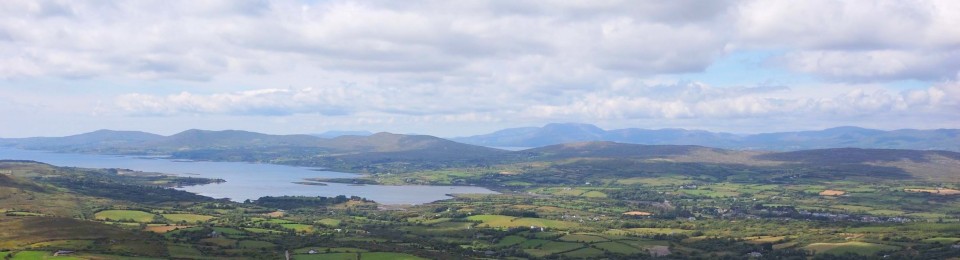
‘Kernan’s Corner’ and Victoria Road, Killiney, Co. Dublin, 1910
28 Wednesday May 2014
Posted in Uncategorized
28 Wednesday May 2014
Posted in Uncategorized
27 Tuesday May 2014
Posted in Uncategorized
Judge Robert Swanton (1767-1840), of New York Marine Court, late of the Parish of Skull, West Cork, Oath to become US Citizen 1800 and ‘To renounce forever All Allegiance and fidelity to any foreign Prince, Potentate, State or Sovreign, whatsoever and particularly to the King of Great Britain and Irelnd whereof, I am now a subject”
27 Tuesday May 2014
Posted in Uncategorized
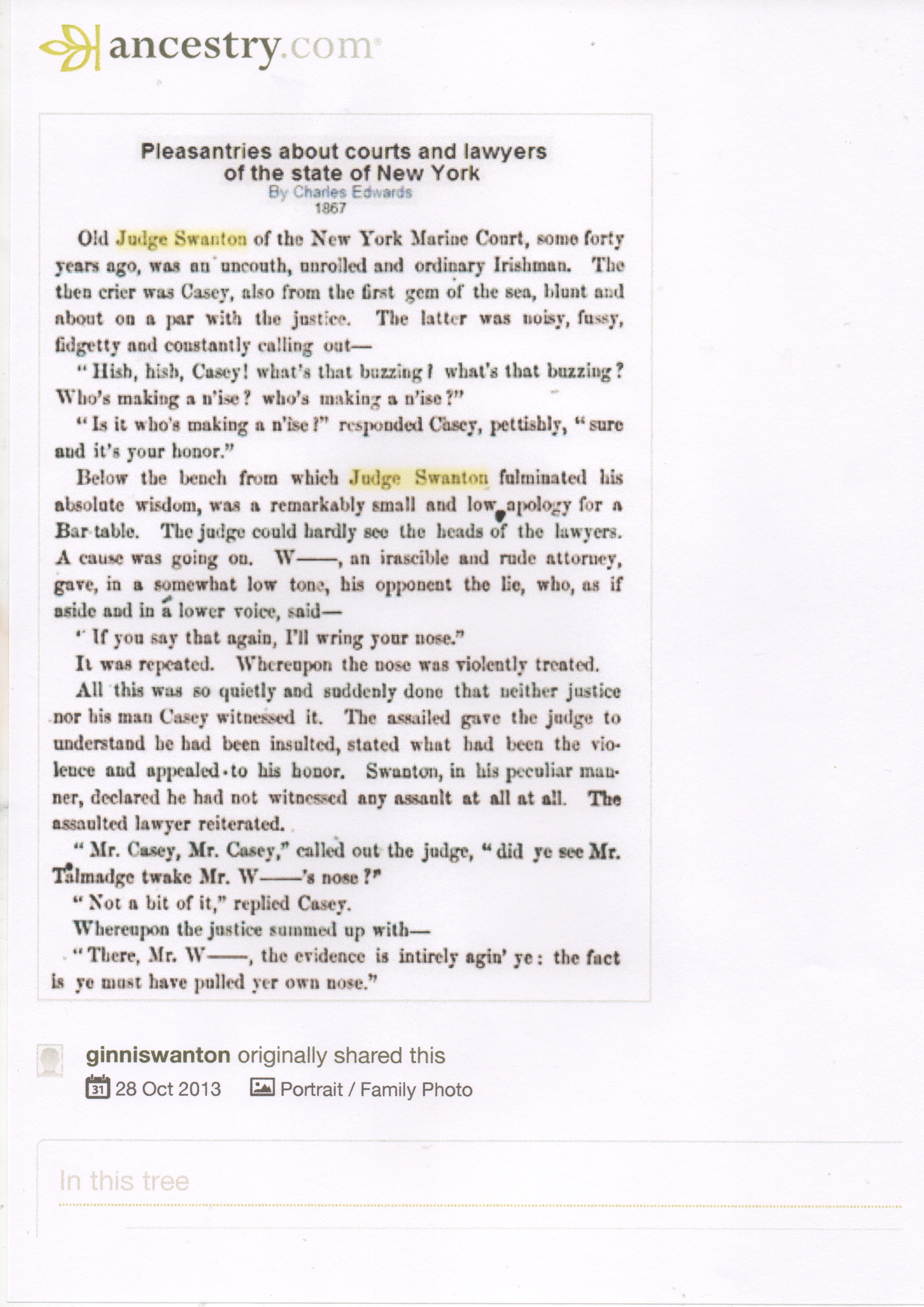
Judge Robert Swanton (1767-1840), Ballydehob, West Cork presiding at New York Marine Court with Tipstaff Casey 1827. Thanks to Ginnie Swanton.

22 Thursday May 2014
Posted in Uncategorized
Some Cork Wills (1528-1859), destroyed in 1922 copied by William Henry Welply of Ballineen, West Cork.
The Welply’s are the McCarthy Mór’s who married Welply’s (a Dutch Man) daughter about 1700 and inherited his large estate in Cork City and Macroom. Welply had no sons and McCarthy assumed the name Welply.
Welply was born in Ballineen 1866 and died in Belfast at the age of 90. He was a School Inspector and after Partition opted to serve out his time in Northern Ireland. The wills were copied pre 1922 most are now destroyed. The RCB Library in Rathgar in Dublin have some of his papers including many visits to Archives and Libraries in Ireland and the UK.
https://www.ireland.anglican.org/about/rcb-library
This is taken from Dr. Albert Casey’s collection.
In 1945 he was a member of the Cork Historical and Archaeological Society with an address in Greenisle, Co. Antrim.
https://plus.google.com/photos/100968344231272482288/albums/6016019881220541265
21 Wednesday May 2014
Posted in Uncategorized
Harry Clarke windows St. Barrahanes Church, Castletownsend, West Cork with floor mosaics designed by Violet Martin.
http://www.abbeystrewryunion.com/#/st-barrahanes-church/4557284996
Some other Harry Clarke work:
16 Friday May 2014
Posted in Uncategorized
Died November 1829 Columbia, Doctor Thomas Foley, Physician to Czar and Surgeon General late Killarney.
From Basil O’Connell newspaper extracts, Dr. Casey Collection, Vol 6 2103. There are many medical entries often abroad some with the British Military medical Service quite a number of Irish doctors abroad.
13 Tuesday May 2014
Posted in Uncategorized
Biographical data from Kerry Evening Post 1824-1864 and other papers including Cork details gleaned by O’Connell Brothers (Basil and Donal) in the 1950s. They were descendants of Daniel O’Connell and Basil wrote the O’Connell Tracts in conjunction with his brother a retired officer in the Royal Navy. They were from the Lakeview branch of the O’Connells outside Killarney.
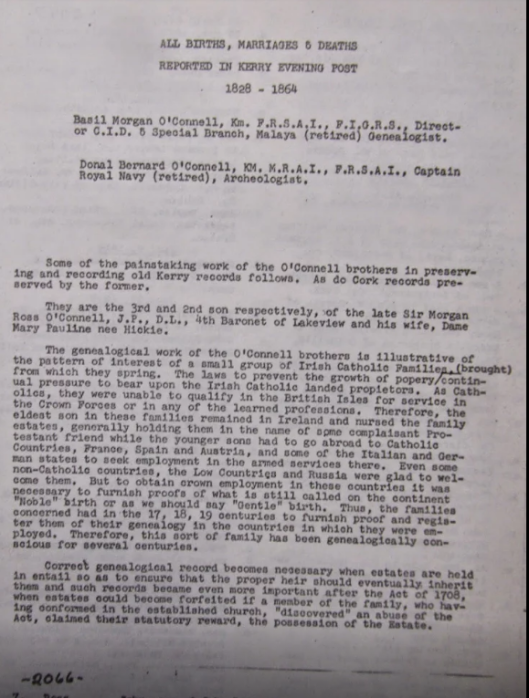
Basil may have trained as a barrister an was the head of CID in Malaya spending a lot of his leave in the 1940s and 50s in Dublin in Lansdowne Road. In an amusing letter in the 1950s to Bantry historian Paddy O’Keeffe he signs off saying ‘I’m off now to fight the Communists’
Dr. Casey has this in Vol 6 and 7 of the O’Kiev Cishe Mang
https://plus.google.com/photos/100968344231272482288/albums/6013023240609479873
13 Tuesday May 2014
Posted in Uncategorized
Cork Newspaper Extracts 1753-1771, 1782-4, collected by John T. Collins.
They are reproduced in Dr. Casey’s collection Vol 6 1753-1771
John T. Collins, was a Cork Genealogist operating in the 1950s. He collected these from private collections including that of Mr. Cussen, Solicitor, Newcastle West, Co. Limerick. These were given to Basis O’Connell who at the time was writing the O’Connell Tracts. Basil in the 1950 was a retired Senior Police Officer who had worked in Malaysia and was a descendant of Daniel O’Connell. The tracts are the Genealogy of the extended family.
11 Sunday May 2014
Posted in Uncategorized
Genealogy of Baldwin family from Salop. England 1580s Co. Cork, to Mossgrove /Garranconnig (Garran a’Chunaig), Mount Pleasant/Curravordy(Corra Mhor Dhuibhe), Lisnagat (Lois na gCat Cat’s Fort), Economic Resources Co Cork 17th century, Prices and Wages.
Online history compiled by Terence Kermode, Suffolk, 2001, with some will extracts and deeds and some interesting comment on behaviour patterns.
Click to access Baldwin-History.pdf
Landed Estates:
http://landedestates.nuigalway.ie/LandedEstates/jsp/estate-show.jsp?id=3005
05 Monday May 2014
Posted in Uncategorized
Tags
Colonel James Grove White (1852-1938), Historical Notes North East Cork precursor to Dr. Casey’s of Birmingham Alabama O’Kiev Coshe Mang.
The notes cover the area around the family estates around Fermoy. They are an interesting mixture of history, archaelogy, ‘Seanachas’ amd genealogy. In compiling them he had access to family papers and the records of the Public Records Office destroyed in 1922. The records spill into other areas of Co. Cork. Dr Casey’s collections (15 volumes) cover the North West Cork/East Kerry areas and have some similarities.
Grove White would have been a contemporary of Colonel Lunham, Robert Day, earlier figures such as Maziere Brady, Dr. John O’Donovan, Crofton Croker, Denny Lane, Dr. Richard Caulfield and later historians John T Collins, Paddy O’Keeffe, Bernard O’Regan, Father TJ Walsh.
http://www.corkpastandpresent.ie/places/northcork/grovewhitenotes/indextoplaces/

